Ivermectin Study’s Negative Conclusion is at Odds With Its Findings of Significant Clinical Benefit
BY WILL JONES | THE DAILY SCEPTIC | JUNE 21, 2022
A new study on cheap, repurposed Covid treatment ivermectin has concluded that its findings “do not support the use of ivermectin to treat mild to severe forms of COVID-19”. However, this conclusion is at odds with its findings.
The study, “Non-effectiveness of Ivermectin on Inpatients and Outpatients With COVID-19; Results of Two Randomised, Double-Blinded, Placebo-Controlled Clinical Trials”, is published in Frontiers in Medicine. It includes among its authors Dr. Andrew Hill, who last year appeared to suggest to Dr. Tess Lawrie that pressure had been applied to him not to find in support of ivermectin in an earlier paper. He told her, “I’m in a very sensitive position here”, and “I don’t really want to get into” revealing who from Gates-funded charity Unitaid, which funded the study, really wrote the conclusion of the paper downplaying the benefits of the treatment.
The new study gives a helpful introduction to the drug.
Ivermectin is a low-cost established drug with clinical benefits and minimal safety concerns, which has been shown to inhibit SARS-CoV-2 in vitro in studies. Ivermectin has rapid oral absorption, with high lipid solubility is widely circulated in the body, metabolised in the liver, and excreted in faeces. The adequate concentration of ivermectin inhibiting SARS-CoV-2 in the in vitro experiment is higher than the approved dose of ivermectin concentration in plasma and the lungs of humans. However, a meta-analysis demonstrated that the administration of a standard FDA-approved dose shows a positive clinical response in COVID-19 patients.
The study is a follow-up to an earlier, smaller study which showed promise. However, the promise has not, the authors say, been borne out.
Despite our previous more favourable results from a multicentre, randomised clinical trial in 69 COVID-19 patients at the beginning of the pandemic which noted the effectiveness of ivermectin in recovery and decreasing duration of hospital stay, the current results of this extensive study on 609 admitted patients with moderate to severe form of COVID-19 and 549 outpatients with a mild form of COVID-19, did not show adequate support for the effectiveness of this drug.
Despite this downbeat assessment, the new study did actually find a significant 32% improvement in ivermectin hospital patients achieving complete recovery, with 37% of ivermectin patients vs 28% of placebo patients achieving the outcome [95% CI, 1.04–1.66].
A number of the other key outcomes, including ICU admission and death, were also better in the ivermectin group, though the study was underpowered (not large enough) for these results to be statistically significant (i.e., we can’t be sure they weren’t coincidence). These were:
- ICU admission: 28 ivermectin vs 32 placebo patients; 9% vs 11%; 16% improvement [95% CI, 0.52–1.36].
- Invasive mechanical ventilation: 3% ivermectin vs 6% placebo; 50% improvement [95% CI, 0.24 –1.07].
- Supplemental oxygen by non-invasive ventilation: 244 ivermectin vs 252 placebo; 78% vs 85%; 7% improvement [95% CI, 0.86–1.00].
- Death: 13 ivermectin vs 18 placebo; 4% vs 6%; 33% improvement [95% CI, 0.35–1.39].
The fact that all these outcomes showed an improvement, and mechanical ventilation and death considerably so, is a signal that the benefit is unlikely to be solely due to chance. Thus the conclusion should really have been that a larger study is needed to see if the promising results can achieve statistical significance.
For outpatients, there were also some significant clinical benefits:
- Fever duration: 2.02 (± 0.11) days ivermectin vs 2.41 (± 0.13) days placebo; 16% improvement.
- On the day seventh of treatment, fever, cough and weakness were significantly higher in the placebo group compared to the ivermectin group.
A few results went the other way, though none of these were statistically significant. For inpatients:
- Length of hospital stay: 7.98 (± 4.4) days ivermectin vs 7.16 (± 3.2) days placebo; 20% worse [95% CI, 0.15–1.45]. The study claims this finding is “significant”, but the wide confidence interval going through 1.0 indicates not. The authors write that “delays in discharging patients to other facilities such as rehabilitation centres… might be the reason for more extended hospital stay other than treatment for COVID-19”.
- Mean oxygen saturation at day seven: 92.01 (Range: 72–99) ivermectin vs 93 (Range: 48–99) placebo; 1% worse [95% CI, –2.89 to 0.91].
- Relative recovery (where some symptoms persist on discharge): 53% ivermectin vs 60% placebo; 13% worse [95% CI, 0.76–1.00].
- Persistent dry cough (until seventh day): 5 ivermectin vs 10 placebo; 3% vs 9%; 36% worse [95% CI, 0.13–1.03].
For outpatients:
- Hospitalisation: 7% ivermectin vs 5% placebo; 36% worse [95% CI, 0.65–2.84].
- PCR negative on day five after treatment: 26% ivermectin vs 32% placebo; 19% worse [95% CI, 0.60–1.09].
The authors write that “no evidence was found to support the prescription of ivermectin on recovery, reduced hospitalisation and increased negative RT-PCR assay for SARS-CoV-2 five days after treatment in outpatients”. However, it’s important to note that this was for ivermectin given more than a week after symptoms began. Proponents of ivermectin often argue that treatment should be given within five days of exposure, i.e., as soon as possible.
The paper does mention this issue, though in a strange sentence with typographical errors perhaps indicative of a late addition: “Ivermectin may be going to be effective if it is given at the earliest possible time that clinical symptoms appear whiles [sic] the mean duration of symptoms before randomisation was 7.36 ± 3.43 days in the ivermectin group and 6.98 ± 3.63 days in the placebo group.” Typographical errors aside, the point is correct; an outpatient study really needs to start the treatment sooner.
There may also be a dosage issue. While the trial gave a dose of 0.4 mg per kg per day over a duration of three days, some have suggested a higher dose is required. The paper nods at this where it says: “Krolewiecki et al. assessed antiviral activity and safety of a five-day regimen of high dose ivermectin, comparing the control group in 45 patients with COVID-19. The findings support the hypothesis that ivermectin has a concentration-dependent antiviral activity against SARS-CoV-2.”
A further potential problem with the study, which was conducted in Iran where ivermectin has been popular as a Covid treatment, is the question of how many of the placebo group were also secretly taking ivermectin anyway. In the limitations the authors note that “after the allocation of ivermectin or placebo, a significant number of patients declined to be participants”, which may be because they realised they wanted to be sure they were taking the drug. Taking an antiviral medication was an exclusion criterion for outpatients – 18 admitted to it, but how many continued with the trial (for which they were presumably paid) but took such drugs anyway? Furthermore, previously taking an antiviral does not appear to have been an exclusion criterion for inpatients, so it is unknown how many placebo-arm inpatients had taken ivermectin or another medication prior to hospitalisation. Once in hospital, I imagine they would not have been able to continue taking any medication secretly, and perhaps that explains why nearly a third of the inpatient participants were lost to follow up, most due to voluntary withdrawal or “incomplete intervention” (31.6%, 282 of 891; 136 ivermectin and 146 placebo).
Overall, I find the conclusion baffling given the findings. There were statistically significant benefits of ivermectin for complete recovery, shorter duration of fever and quicker clearing up of cough and weakness. There were also large but not-statistically-significant benefits for mechanical ventilation and death. The negative findings were mostly small and none were statistically significant. This is for a study which didn’t start the treatment until over a week into symptoms, and may have been confounded by people in the placebo arm also taking the drug.
Perhaps we will never get to the bottom of exactly how effective ivermectin is against COVID-19. But since it’s a safe drug (to quote U.K. Chief Medical Officer Chris Whitty, “Ivermectin has proven to be safe. Doses up to 10 times the approved limit are well tolerated by healthy volunteers”) and this study shows once again that it gives some benefit – other studies show much greater benefit – why not be honest about that, allow medics to include it in their treatment protocol, and stop making such a fuss about stopping them?
Israel Murders Iranians While Biden Kills the Iran Deal
By Connor Freeman | The Libertarian Institute | June 23, 2022
In a clear message to Tehran, an American B-52 flew over the Persian Gulf as soon as Joe Biden entered the White House. Biden promised to return the U.S. to the Iran nuclear deal. But indirect talks to revive the Joint Comprehensive Plan of Action (JCPOA), which began last April, have stalled for three months without a resolution in sight. Counting on the reliable support of Biden and bipartisan Iran hawks in Congress, the nuclear-armed Israeli apartheid regime intends to kill the deal entirely.
Tehran, a decades-long signatory of the Non-Proliferation Treaty, is neither seeking nor has ever sought nuclear weapons. But the Islamic Republic, once Tel Aviv’s “best friend,” serves as Israel’s favorite boogeyman, superficially justifying billions of dollars in American military aid each year. The JCPOA threatens the racket.
Formally known for years as “Israel’s man in Washington,” President Biden is essentially pursuing ultra-Zionist Donald Trump’s foreign policy regarding Iran and supporting, tacitly or otherwise, Tel Aviv’s relentless attacks against Iran and its allies. Biden is continuously imposing yet more sanctions, increasing the “Maximum Pressure” on the economically crippled Iranian people.
The rial has hit all-time lows. With a population of 82 million, almost half of all Iranians live below the poverty line, and inflation is somewhere between 40-50%.
America’s self-styled sanctions artists delight in seeing the results of their economic war on Iran: excess deaths, severe medical shortages, prohibitively high prices for staple goods, plummeting incomes, and social unrest over food costs.
This year, Tel Aviv has been bombing Syria, Tehran’s ally, at the usual weekly rate. A recent strike, coming from the illegally occupied Golan Heights, attacked Damascus International Airport. The airstrike targeted the facility’s only working runway Israel had not yet destroyed, rendering the airport temporarily inoperable.
Shortly afterwards, The Wall Street Journal put out a story confirming that Tel Aviv coordinates with the Pentagon on many of its strikes in Syria.
The Israelis just wrapped up month-long war drills, the largest held in decades, aimed squarely at Tehran. Exercises over the Mediterranean Sea, with over 100 aircraft and navy submarines, spanned 10,000 kilometers and were designed to simulate repeated airstrikes on Iran and their civilian nuclear facilities.
Early reports were that the U.S. Air Force would participate, providing refueling planes, but this reportedly did not come to pass. Although General Michael Kurilla, the new head of U.S. Central Command (CENTCOM), observed some of these Chariots of Fire exercises.
On May 22, 2022, the Israelis carried out a high profile assassination of a senior colonel in the Iranian Revolutionary Guard Corps (IRGC), Col. Hassan Sayyad Khodaei. Shortly afterwards, citing an unnamed intelligence official, The New York Times reported Tel Aviv had informed Washington that it was responsible. Israel’s attacks seem to be primarily focused on the Iranians’ drone program, namely killing people who work on drone technology and attacking related sites.
As Dave DeCamp, Antiwar.com news editor, reported,
Israel was immediately suspected of the assassination since it has a history of carrying out targeted killings and other attacks inside Iran. Israel rarely officially acknowledges such operations, and it’s typical that its responsibility is revealed by leaks to the media, often by Israeli officials.
Israeli officials claimed to the Times that Khodaei was in charge of a secret covert IRGC group known as Unit 840, which Iran denies exists. The Israelis claim Khodaei was involved in plots to kill and kidnap Israeli civilians and officials around the world, but there’s no evidence Tehran was planning to target Israelis abroad.
Two people affiliated with the IRGC told the Times that Khodaei was a logistics officer who played a key role in transporting drone and missile technology to Syria and Hezbollah in Lebanon and advised militias in Syria. Iran has said Khodaei was involved in the fight against ISIS in Iraq and Syria.
Israel is suspected to have subsequently poisoned and murdered two Iranian scientists including Ayoub Entezari, an aerospace engineer, who reportedly worked on missile and drone projects, and Kamran Aghamolaei, a geologist.
Last month, a few dozen miles south of Tehran, quadcopter suicide drones attacked the Parchin military complex. The drones hit a building being used for drone development and killed a young engineer. In February, Israel used six quadcopter drones in a strike targeting another Iranian drone facility in Kermanshah which did significant damage. In Tabriz, there were reports of another Israeli attack on a drone factory, as many as three people may have been killed. This month, two additional IRGC members also working in the aerospace industry died during mysterious accidents in Iran. Both deaths were declared “martyrdoms.”
In the midst of these soaring tensions, Robert Malley, Biden’s Iran envoy, is telling Congress “all options are on the table.”
The U.S. Senate overwhelmingly voted to pass a non-binding resolution which insists they would never support a restoration of the JCPOA if the IRGC were removed from the Foreign Terrorist Organization (FTO) blacklist. The FTO designation is ostensibly one of the final sticking points preventing the deal’s straightforward revival. Congress has been sending messages, loud and clear, to Tehran and Biden that the deal has virtually no support.
Meanwhile, Secretary of State Antony Blinken is peddling baseless stories about Tehran attempting to assassinate his predecessor Mike Pompeo. Pompeo enthusiastically supported Trump’s Maximum Pressure campaign as well as the drone strike murder of top Iranian General Qasem Soleimani, leader of the IRGC Quds Force. Though these claims of Pompeo’s life being endangered remain unproven, U.S. taxpayers pay millions per month for a security detail to put his and Blinken’s mind at ease.
Much like Tel Aviv’s unproven accusations that the IRGC is out to kidnap and murder Israelis, especially in Istanbul for some reason, this obviously plays well with the overall anti-JCPOA campaign.
The IRGC is the only state military organization on the terrorism blacklist. Considering the myriad preexisting sanctions on the unit, it is a superfluous insult. In 2019, Trump implemented this policy at the behest of Israeli-partisan hawks like Mark Dubowitz at the Foundation For Defense of Democracies, a notoriously anti-Iran think tank. This is one of the largest bricks in the so called “sanctions wall” precluding any of Trump’s successors from ever returning to the deal for fear of the built-in political toxicity. It is enough to keep Biden and the cowardly Democrats from backing what is ultimately Barack Obama’s deal in favor of a neoconservative-style Iran policy.
As May began, Israel started making these claims about a global Iranian plot to kill Israelis. At that time, the JCPOA negotiations were seemingly stalled irrevocably because of the IRGC-FTO issue. But then the Vienna talks’ broker, European Union nuclear negotiator Enrique Mora, traveled to Tehran. He took meetings with Iran’s lead negotiator Ali Bagheri Kani as a last ditch effort to break the deadlock. Mora was sent by EU foreign policy chief Josep Borrell. As a result of the American led sanctions blitz on Russia, Europeans are in desperate need of another crude supplier as Borrell has noted. The same week, the emir of Qatar, Sheikh Tamim bin Hamad Al Thani, also made a trip to Tehran and pushed for progress during meetings with President Ebrahim Raisi as well as Ayatollah Ali Khamenei. On May 13th, Borrell announced Mora’s mission went “better than expected,” Vienna talks had been unblocked, and a final deal was within reach.
Days later, coinciding with Israeli Defense Minister Benny Gantz’s visit to Washington, and his meetings with National Security Adviser Jake Sullivan and Pentagon chief Lloyd Austin, Khodaei was murdered in the drive-by shooting. Israel’s assassination campaign had commenced.
Two days after the Khodaei killing, Politico reported that the final decision to keep the IRGC on the FTO list was made. On Twitter, Israeli Prime Minister Naftali Bennett thanked Biden for the “principled decision and for being a true friend of the State of Israel.”
Following Trump, Biden’s administration is also continuing to seize tankers, stealing Iranian oil and pirating it for profit. Ironically, after Russian President Vladimir Putin invaded Ukraine, there was some talk from Biden officials about making a deal with the Islamic Republic to put Iran’s abundant oil back on the market to reduce global energy prices. But this was apparently never taken seriously.
Biden instead prefers to kowtow to the genocidal Saudi regime which along with Abu Dhabi and Washington have starved to death and bombed over 400,000 Yemenis, including more than 263,000 children.
Those deaths mean little to the Abraham Accords caucus. This bipartisan coalition in Congress is working to ensure Washington arms these tyrants further while the Pentagon assists them in joining forces, as well as integrating missile defenses with Tel Aviv eyeing Tehran. As Biden heads to the Middle East, there is even talk of the U.S. offering security guarantees to the United Arab Emirates.
For almost a year, the Israelis have been pushing an anti-Iran, NATO-style, U.S. led alliance in the Middle East. In recent weeks, Gantz has openly promoted this strategy which Bennett is said to have suggested to Biden during a White House meeting last year.
As Iran is encircled militarily and strangled economically, the American Empire is refusing to allow them any breathing room. Each day the U.S. forgoes lifting sanctions and restoring the deal the likelihood of a hot war increases.
Given the size of Iran, its population, its geostrategic location, substantial ballistic missile deterrent, its Axis of Resistance partners, and the wide variety of U.S. military targets in the region, a war with Tehran would likely dwarf the catastrophic damage, scope, and deaths of America’s other Middle East wars.
If the JCPOA fails, the hawks armed to the teeth surrounding Iran may try to goad Tehran into leaving the NPT. Whether this happens ultimately or not, Israel may use the coming breakdown in diplomacy to justify instigating its long desired war. Rightfully, the Iranians will see such an Israeli attack as an American declaration of war.
This week, Tehran has formally dropped their demand for removing the IRGC from the FTO list. Washington has not yet responded. Contrary to the corporate press narrative, the ball is now firmly in Washington’s court.
Iran called Biden’s bluff. It is imperative that the American people now assert our support for terminating the unjustified and brutal Maximum Pressure campaign as well as denounce Israel’s murderous aggressions.
The Iranian people deserve to live and trade in peace.
The Lockdown Advocacy of Devi Sridhar
By Jeffrey A. Tucker | Brownstone Institute | June 20, 2022
The Covid era gave rise not only to popular mania but also to astonishing intellectual pretension. The experts were everywhere. They had all the answers. They knew for certain that a path never tried in anyone’s lifetimes was the certain way to go in order to control a virus. And this fanatical attachment to one goal caused all other considerations to be pushed aside.
The end of the story was baked in from the start. The experts were proven to have massively exaggerated their prowess and understanding of events. On point after point, their models blew up. The epidemic would end the way they always have, through acquired immunity and endemicity. Nowhere did the methods of the vaunted experts achieve the goal; at best they delayed the end point and created tremendous destruction along the way.
Now there is a problem: how to dial it all back without admitting profound error. This is a particular problem for those who wrote books before the story was complete. And by complete I am referring especially to the tremendous waves of infections that came 20 months after lockdowns were first imposed.
A paradigmatic case is Devi Sridhar, professor and chair of global public health at the University of Edinburgh, Scotland. During the pandemic, she became a ubiquitous presence on television for two years both in the UK and the US. Her main message was to advocate and defend lockdowns, masking, mandates, and the entire apparatus of compulsion that characterized the pandemic response in nearly every country in the world. Her message was always geared toward what is called eliminationism or zero Covid.
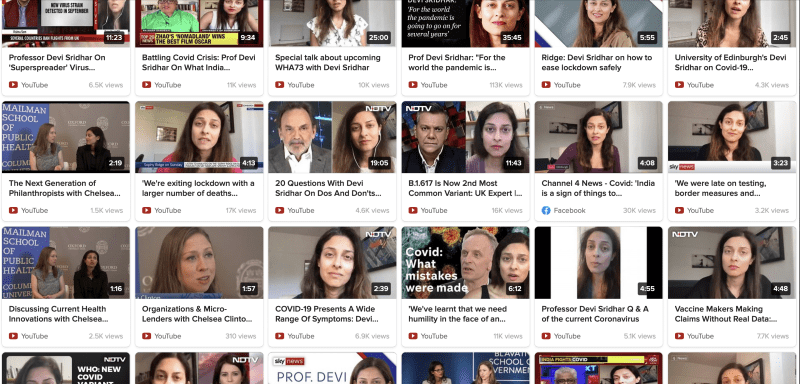
As a Rhodes scholar in a high prestige position, she was well positioned to be this messenger. She has a compelling way and presents well in the medium. Plus, the message she delivered was the one that earned an official stamp of approval from all mainstream media. She was also a pro at delivering an attitude of disdain toward anyone who dared question the zero Covid story.
Now she has a book out that further elaborates on her point of view. It has the right title: Preventable: How a Pandemic Changed the World and How to Prevent the Next One. It’s a pretentious title, presuming that she knows for certain that the pandemic was preventable and therefore she should be trusted to tell us what to do next time.
What’s striking is the contrast between the certitude of the body of the book in which she is an unapologetic defender of China-style lockdowns and the afterword, which must have been written only days before the book went to print. Here we have a very different tone, discussed toward the end of this review.
Sadly for her, the book came out just before a wave of new lockdowns came to China that wrecked the lives and liberties of hundreds of millions of people and made an enormous mess of the entire economic mission of the country. She must not have had time to revise the manuscript.
Of China, her book says:
The way China set about eliminating SARS-CoV-2 could be described as draconian. It undertook house-to-house testing and removed individuals to quarantine facilities if they tested positive (sometimes against their will); it used tracking technology to trace 99–100 per cent of those who had had contact with the infected; it locked down entire buildings so individuals could not leave their flats or have free movement; and it constructed completely new hospitals within days…
The Chinese government understood well that the virus moves when people move. So it stopped people moving internally…
The efforts to contain the spread within Wuhan were effective and focused on reducing the R number…
These measures to contain spread worked…
[China showed that] containment strategies (however draconian) could be effective at stopping this respiratory pathogen…
The evidence in February 2020 showed that containment was successful…
Within the span of three months, China had eliminated the virus fully within its borders…
This is the same message she delivered to millions day after day for two years.
We could just stop this review here, observing that none of the above turns out to be true. Currently, China faces an enormous problem. If we are to believe the data, vast swaths of China’s population still lack acquired immunity to Covid. Millions or billions need the exposure, and, as with all places in the world, the result for nearly everyone moderately healthy and not elderly will be recovery. This will happen with or without lockdowns.
President Xi Jinping, however, became convinced either by virtue of his ego or his circle of sycophants that his lockdowns two and a half years ago were his greatest achievement. He was celebrated by the World Health Organization and nearly every country in the world copied his brutal methods of virus suppression. He regarded it then as evidence that the CCP was destined to rule the future, by virtue of its masterful social, economic, and now medical management of society.
So of course the CCP cannot turn back now. He has stated repeatedly that there will be no compromise of the zero Covid stance that both he and Dr. Sridhar have long advocated. He must now either continue to threaten and enact lockdowns or figure out some clever way to back away from the position without admitting past error. He may in fact figure it out at some point.
After all, nearly every other government in the world has finally figured it out. Even under the best of assumptions that lockdowns offer some contribution to mitigate the ill-effects of a pathogen, the costs far outweigh those benefits. And those costs not only include economic, educational, and nutritional ones but also costs in terms of deaths from overdoses, despair, and self-harm from the inevitable demoralization from being treated like a prisoner or lab rat.
So I did read Dr. Sridhar’s book in search of some insight as to why she could have made such a profound error. All I found was a relentless and single-minded attachment to a zero Covid agenda, or some version of it, a genuine belief that the right deployment of human force could somehow make a virus go away. It truly boggles the mind.
The rest of the narrative is utterly predictable.
Countries that locked down are good, especially New Zealand and Australia. Countries that did not are bad, especially Sweden but also the UK and the US after reopening. Countries that kept lockdowns longer are good. Countries that opened up too soon are corrupt and rejecting “the science.” The Great Barrington Declaration is bad. Ramdesivir is good while Ivermectin is bad. And so on.
Her hard-core bias extends even to a rousing defense of Rebekah Jones, the low-level data employee in Florida who wrongly accused the Governor’s office of manipulating data in a case that was later tossed out.
The book is so partisan that she sometimes lets her politics even race ahead of her epidemiological position. For example, and this probably won’t surprise you, she comes to the defense of the George Floyd protests even in the midst of lockdowns:
In late May 2020, I was asked whether protesters were wrong to take to the streets. I replied that racism is also a pandemic, and one that Black Americans feel can’t be swept under the carpet any longer. While clearly mass gatherings during a pandemic are risky, I could understand that people were willing to take this risk in order to effect change for their children and the children of their children. This is how the civil rights movement has attempted to progress racial equality over decades.
In any case, you get the point here. She has a tribe and she wants to be its messenger. Still, I struggled through the entire text to see if I could find insight. This one jumped out at me:
While WHO was at the forefront of press briefings and leading technical and normative guidance to the pandemic, the World Bank had the financial power to help governments respond with key policies, whether through building up health systems and testing, putting in place economic packages to support lockdown measures, or in acquiring and distributing vaccines.
There we go: the World Bank subsidized lockdowns. Fascinating. That I did not know. This is a serious problem that needs to be fixed. How many millions face malnutrition as a result?
So much for the body of the book.
Probably the most telling part of the book is the afterword, written January 2022. Here our author jumps in with the latest information, namely that China had not in fact eradicated the virus and now keeps locking down, which she says is due to inferior vaccines. Within a few paragraphs, she – for the first time in the book – recognizes that even the best vaccines do not stop infection and do not stop the spread..
Whoops. Is she willing to rewrite the entire book in light of this last-minute realization that lockdown eliminationism and even mass vaccination cannot achieve the goal? No. Is she willing to rethink? Perhaps a bit but not enough.
While some say we should adapt normal social relations and mixing for the foreseeable future, I struggle with this line of thought. Humans are social: we need to hug, talk, dance, sing, kiss and be around others. We’re not bears or rhinos or other solitary creatures. We like seeing each other’s faces. And we know that a sense of community and connection are vital to wellbeing too. A holistic approach to public health is vital, and this includes not just people’s mental health but also their ability to pay rent, feed their family, stay warm through the winter and have a meaningful role in society, be that going to church or being part of a glee club. For a certain period of time, altering these made sense, so that we could avoid preventable illness and deaths; allow vaccines to be created, trialled and distributed in 2020 and into 2021; allow clinicians to better understand how to treat COVID-19; and allow a better understanding of transmission and risk.
Again, very interesting, especially because the change in tone from the rest of the book is so sharp. She doesn’t come close to repudiating her entire book – and she still believes that totalitarian measures somehow make sense for a “period of time” – but she does say that she is tired and exhausted and perhaps ready for some rethinking.
“I’ve taken a step back from media work… I’ve been testing several times a week, and, while I cautiously avoid crowded spaces, and wear masks on public transport and in shops, I continue to go to the gym and to hot yoga and to see friends outside or in small groups. I’ve found a sustainable way to live alongside COVID-19 for now… You’ve heard enough from me.
These are hopeful signs. It’s possible that even Devi Sridhar might eventually come to see the error of her ways. Or perhaps like most of the exalted experts who assisted in driving the world into the greatest calamity of the modern era, she will quietly disappear from the op-ed pages and television screens and go back to her prior life as a public health professor with degrees in anthropology. At some point, too, she will get Covid and discover with millions of others that it is part of the human experience to get sick and get well and become stronger as a result.
We will wait in vain for any sort of extended literary mea culpas. Not even the pensive afterword comes close. After all, when the next great health crisis presents itself, the WHO pushes for lockdowns again, and the major media empires need some great excuse to order people back home to be glued to the screen, the expertise of these compelling pundits – now with real media experience – will need to be called upon again.
Jeffrey A. Tucker is Founder and President of the Brownstone Institute and the author of many thousands of articles in the scholarly and popular press and ten books in 5 languages, most recently Liberty or Lockdown.
The UK Online Safety Bill has laughable free speech and privacy “protections”
By Tom Parker | Reclaim The Net | June 21, 2022
The UK government’s latest push to censor online speech, the 225 page Online Safety Bill, has been roundly criticized by rights groups and proponents who have branded it a “censor’s charter” and “an attack on free speech.”
UK Digital, Culture, Media, and Sport (DCMS) Secretary of State Nadine Dorries, one of the main proponents of the bill, has pushed back against this criticism by pointing to the bill’s “duties to protect free speech.”
However, these duties and the duties for platforms to protect user privacy are so weak that they have no impact when platforms comply with the bill’s obligations to tackle “harmful” content.
The bill pays lip-service to the idea that platforms should “have regard” to the importance of “protecting users’ right to freedom of expression within the law” and that they should be “protecting users from a breach of any statutory provision or rule of law concerning privacy.”
But if platforms comply with these over-reaching obligations to tackle this so-called “harmful but legal” speech as outlined in the bill, they will, by default, be at odds with the idea of protecting speech rights and privacy.
The bill itself is the biggest threat to free speech and privacy in living memory and Big Tech platforms have no history of protecting either.
Provisions for privacy should not mean social media monopolists acting as a guardian of user privacy; they should be in place to protect citizens’ data from the platforms themselves.
Not only does the bill have weak free speech protections but it also disproportionately impacts small, independent media outlets, harms privacy, and creates a dystopian censorship alliance between Big Tech companies and the UK government.
You can get a full overview of all the free speech and privacy threats posed by the Online Safety Bill here.
You can see a full copy of the full Online Safety Bill here.
The bill is currently making its way through Parliament and you can track its progress here.
BRICS Leaders Vow to Enhance & Expand New Development Bank
Samizdat – 23.06.2022
The leaders of Brazil, Russia, India, China, and South Africa held their 14th annual summit on Thursday virtually. This year, the summit was chaired by China.
BRICS members vowed to widen the Shanghai-based New Development Bank (NDB) on Thursday, following the successful admission of Bangladesh, Egypt, the United Arab Emirates (UAE) and Uruguay in September 2021.
“We look forward to further membership expansion in a gradual and balanced manner in terms of geographic representation and comprising of both developed and developing countries, to enhance the NDB’s international influence as well as the representation and voice of Emerging Market and Developing Countries (EMDCs) in global governance,” the 75-point joint declaration released after the summit read.
BRICS has supported the NDB’s goals of attaining the highest possible credit rating and institutional development. The BRICS member nations have also stressed that they have a similar approach to the global economic governance, and their mutual cooperation can make a valuable contribution to the post-Covid economic recovery.
Geopolitical Concerns
Leaders also discussed the ongoing crisis in Eastern Europe, recalling their national positions at different global forums, including the United Nations’ Security Council and General Assembly.
“We support talks between Russia and Ukraine. We have also discussed our concerns over the humanitarian situation in and around Ukraine,” the joint declaration said.
Amid border tensions between India and China, the leaders committed to “respect the sovereignty and territorial integrity of all States,” stressing the peaceful resolution of differences and disputes through dialogue and consultation.
The BRICS countries – which represent 24 percent of the global GDP and 16 percent of worldwide trade – further reiterated the need to resolve the Iranian nuclear issue through peaceful and diplomatic means as per international law. They stressed the importance of preserving the Joint Comprehensive Plan of Action, a deal reached between Iran and the five permanent members of the UN Security Council in 2015. The stand-off between Iran and western nations continues following the US’ withdrawal from the JCPOA in May 2018.
The UK’s shadowy “counter-disinformation unit” has shifted from Covid to war
By Cindy Harper | Reclaim The Net | June 23, 2022
One of the unwanted “gifts” that the pandemic has left the UK is something called “the counter-disinformation unit,” set up by the Department for Digital, Culture, Media, and Sport.
The task of this unit, according to the country’s lawmakers, is to identify “misinformation” and then “work” with social media companies to make sure this content is removed.
The unit has existed for two years, at first focused on monitoring and taking down Covid-related information it disapproved of, but with the outbreak of the war in Ukraine (and the waning interest in Covid), that conflict is now the group’s focus.
However, the unit’s existence and methods have been marred with controversy, from the lack of transparency to the definition of what constitutes misinformation.
It appears all it takes for UK’s authorities to brand something as misinformation and force tech companies to censor, is that they find it to be “inappropriate.”
MP Chris Philp revealed this during a hearing, shedding some light also into what “working” with social media companies looks like.
“In some cases, ministers have engaged directly with social media firms to encourage them to remove content that is clearly inappropriate,” he is heard saying in the hearing about the proposed Online Safety Bill, the UK’s other major threat to free speech.
All that put together means the government is censoring citizens’ speech at its discretion, as had already been suggested by UK government minister Nadine Dorries.
Dorries – who is in charge of the department that had set up the “counter-disinformation unit” – was earlier this year trying to dispel the fears of those who thought that even as the pandemic handily gave way to the war, the unit had been disbanded.
That is not true, she said, adding that their work takes place “daily, and daily we work to remove that content online.” Dorries described the offending content as that which is harmful or is classed as misinformation or disinformation.
None of these terms, including “inappropriate,” win any prizes for being specific, with the work of the unit itself said to be “opaque,” which has led critics to worry it might end up simply producing censorship.
State Department ‘Illegally Obstructing’ Afghanistan Probes, Watchdog Says
By Kyle Anzalone and Will Porter | The Libertarian Institute | June 23, 2022
The US government’s top oversight official for Afghanistan has accused the State Department and the US Agency for International Development (USAID) of stonewalling ongoing investigations, saying they have refused interviews with staff and even failed to provide “basic information” to assist the probes.
In a letter obtained by Politico this week, Special Inspector General for Afghanistan Reconstruction (SIGAR) John Sopko outlined a series of complaints against State and USAID, claiming the agencies are obstructing audits looking into the final months of the war in Afghanistan, the fall of the US-built Afghan government and the transfer of billions in aid.
“The coordinated efforts by State and USAID officials to deny SIGAR access to information and assistance are unprecedented,” Sopko wrote in the letter, which was addressed to Secretary of State Antony Blinken and USAID chief Samantha Power.
He demanded the two officials “cease their illegal obstruction of SIGAR’s oversight work,” insisting that “The billions of US taxpayer dollars that have been spent and continue to be spent in support of the Afghan government and the Afghan people warrant independent oversight, and the law requires it.”
Though Sopko said the two agencies have “historically… supported SIGAR’s mission” and worked with his office willingly, “inexplicably, this long track record of cooperation seems to have abruptly ended. Agency officials now appear to have adopted a premeditated position of obstruction.”
The IG described several examples of obstruction, including the State Department’s refusal to make staffers available for interviews to discuss Afghan refugees and the conditions they endured after fleeing their home country. Most concerning for Sopko, however, was the agencies’ reluctance to provide even “basic information” on American aid programs meant to support Afghans, as SIGAR is conducting an audit to ensure tax dollars aren’t flowing to the Taliban – which now rules Afghanistan – or other militant groups.
The two agencies have pushed back on Sopko’s allegations, arguing that they have cooperated with SIGAR’s probes, though suggested the IG has acted outside the jurisdiction of his office in some cases.
“State and USAID are committed to assisting SIGAR with its important auditing and oversight role,” a department spokesperson said in a separate letter obtained by Politico, adding “We have had concerns about how some of SIGAR’s requests for information relate to their statutory jurisdiction.”
However, while the officials claimed humanitarian aid programs “do not pertain to reconstruction” and therefore fall beyond the scope of SIGAR’s mandate, Sopko said his office has audited such programs for more than a decade without any objections from the government.
“State and USAID legal counsels’ claim that SIGAR’s jurisdiction does not include such matters is not only contrary to the law, but a gross deviation from over 14 years of precedent set by three prior administrations,” the IG wrote.
Twitter censors ads for free speech event

By Christina Maas | Reclaim The Net | June 22, 2022
Yet another casualty of Twitter censorship, The Minds Festival of Ideas, was denied the approval to advertise their upcoming event on the Twitter platform.
The Minds Festival of ideas, a gathering devoted to the unrestricted exchange of viewpoints through a comedic lens, was seeking ad placement for its upcoming event in NYC.
The ad outlined basic details, such as the date, location, sponsor, and headshots of the speakers. The ad also provided a ticket purchasing link and a direct quote regarding the key purpose of the event. Essentially, this quote addressed the mission of Minds in a nutshell: to encourage the free exchange of ideas between individuals. The goal is to foster “productive conversation” and basically to “have a good time together.”
Due to the ad’s basic nature, the public is again calling into question the ethics of Twitter censorship and what it means for the future of free speech for users on the platform.
Bill Ottman, the co-founder of Minds, confirmed that the ad denial occurred “immediately after pressing the submit button on the promotion” when he received what appeared to be a canned rejection email in his inbox. In light of Twitter’s swift response, Ottman expressed doubt that the message was written by a human at all. He further asserted his belief that Twitter provided its response based on “an account restriction or maybe some AI/ML trigger,” further describing the situation as indicative of life in “a dystopia.”
Minds followed up by posting a response to Twitter’s actions on the official Twitter page, proposing that the denial was, perhaps, just a mistake and not a calculated move by the company. These remarks were followed by a brief overview of the Minds Festival of Ideas and how it encourages the respectful exchange of beliefs and opinions among popular speakers, comedians, and influencers in today’s political circuit.
Microsoft Says Russian Media Popular in US, Ukraine Despite Efforts to Reduce Traffic
Samizdat – 23.06.2022
In a move to punish Russia for launching a military operation with a goal to “denazify and demilitarize” Ukraine, Western countries have tried their hardest to target Russian media outlets by reducing their traffic and blocking their social media channels. However, it seems the efforts have proven to be fruitless.
Content produced by sanctioned Russian media outlets Sputnik and RT is still in high demand in the United States and Ukraine despite efforts to curb viewer traffic, Microsoft said.
“Even after all efforts to reduce traffic to Sputniknews and RT.com, consumption of Russian propaganda is still higher than before the war (~60MM per month in the US, on par with the WSJ),” the company said on Wednesday.
Since January 2022, there has been a significant increase in traffic to Russian media websites in the US, according to the report. The peak of Russian media content consumption activity occurred on February 24, when it spiked 82%, Microsoft added.
Sputnik’s International News website boasts more than 40 million hits from January to May 2022. After scoring 5.3 million hits during January, Sputnik’s website exceeded 13 million views in March. Sputnik International’s US-based audience increased from 29% of its entire audience in March to 41.5% in April and 42.9% in May.
The situation in Ukraine has been similar, with the consumption of content Microsoft designated as “Russian propaganda” having grown by 216% since the last week of February, hitting a peak on March 2, the report said. It began to decline afterwards but still remains at a level higher than before the start of Russia’s military operation in Ukraine, Microsoft noted.
On February 24, Russia launched a military operation in Ukraine after the breakaway republics of Donetsk and Lugansk appealed for help in defending themselves against Ukrainian forces. In response to Russia’s operation, Western countries have rolled out a comprehensive sanctions campaign against Moscow, which includes airspace closures and restrictive measures targeting numerous Russian officials and entities, news media and financial institutions.
Mr. Trudeau, tell us how you decide which invasions count
By Yves Engler | June 19, 2022
In a world of vast injustice, one cannot expect a government’s foreign policy to be principled or consistent. But there should at least be some limit to hypocrisy.
On June 16 Justin Trudeau spoke with Rwandan president Paul Kagame about this week’s Commonwealth Summit in Kigali. Half the government’s readout about the discussion was devoted to opposing a foreign invasion. It read, “the two leaders exchanged views on Russia’s invasion of Ukraine and noted that the invasion was contrary to foundational principles of the Commonwealth. Prime Minister Trudeau reiterated that the invasion was an affront to the fundamental principles of sovereignty, territorial integrity, self-determination, and international law, and expressed that it is important for the Commonwealth summit to provide an opportunity for member countries to stand up for democracy and denounce Russia’s invasion of Ukraine.”
Recently, Rwandan-backed rebels instigated fighting that has caused over 170,000 Congolese to flee their homes since November. Reportedly, Rwanda has deployed 500 troops to assist the M23 rebels. According to the UN, M23 is planning an attack on the major eastern city of Goma in the coming days. On Friday Rwandan forces killed a Congolese soldier on the border between the two countries and Congo has closed the border.
Highlighting the hypocrisy of Trudeau discussing foreign invasion with Kagame, former Congolese presidential candidate and long-time UN worker, Angèle Makombo, tweeted, “No kidding Prime Minister Justin Trudeau, you spoke with Paul Kagame about ‘Russia’s illegal invasion of Ukraine’? Did you also care about raising the issue of Rwanda’s aggression of Congo and its dire impacts on the Congolese people and Africa Great Lakes subregion?”
The M23 is a “Rwandan sponsored” force, reported the Globe and Mail previously. A 2012 UN report concluded that officials in Kigali organized, armed and “coordinated” M23’s military activities in the mineral rich eastern Congo. The M23 is the successor to the Rwanda-backed rebel force lead by Laurent Nkunda, who grew to prominence after Rwanda invaded.
In 1996 Rwandan forces marched 1,500 km to topple the regime in Kinshasa. Two years later they re-invaded after the Congolese government it installed expelled Rwandan troops. This led to an eight-country war between 1998 and 2003, which left millions dead. A January 2008 study by the International Rescue Committee blamed the conflict and its destabilizing impact for 5.4 million Congolese deaths over a decade. In October 2010, the UN Office of the High Commissioner for Human Rights released a report on the Congo spanning 1993 to 2003 that charged Rwandan troops with engaging in mass killings “that might be classified as crimes of genocide.”
Aside from the mayhem he’s unleashed in the Congo, Kagame oversees a brutal dictatorship. Opposition media is entirely suppressed and opponents rot in jail. Top officials and other dissidents that flee have repeatedly been assassinated across east and southern Africa. A year and a half ago, the regime kidnapped its most famous opponent Paul Rusesabagina, who is the namesake for the Hollywood film Hotel Rwanda. A Belgian citizen and US Green card holder, Rusesabagina was snatched from Dubai and flown to Rwanda where he languishes in jail.
Trudeau’s dalliance with Kagame isn’t new. In 2018 Toronto-based Rwandan dissident David Himbara wrote, “the romance between the two and among their respective ministers has blossomed beyond belief.” In February 2020 the PM’s press people released a photo of him laughing with the Rwandan president. On at least five occasions since 2018 Trudeau has been photographed with Kagame during one-on-one meetings on the sidelines of different international summits. At one of those meetings the PM “affirmed the importance of strong and growing bilateral relations” between Canada and Rwanda. Ottawa provided $39 million in assistance to Rwanda last year.
While the media, opposition and government have spent much of the past week complaining/apologizing about a low-level Canadian diplomat attending an irrelevant social function put on by the Russian Embassy, the prime minister deepens Canada’s ties to Africa’s most bloodstained ruler.
For Trudeau it appears as if only invasions of European countries matter.
As Kagame renews his brutal war on the Congo, Trudeau wants us to believe his aim is to uphold international law and oppose foreign invasion.
The hypocrisy is staggering.
Israeli forces beat up international activists in Masafer Yatta
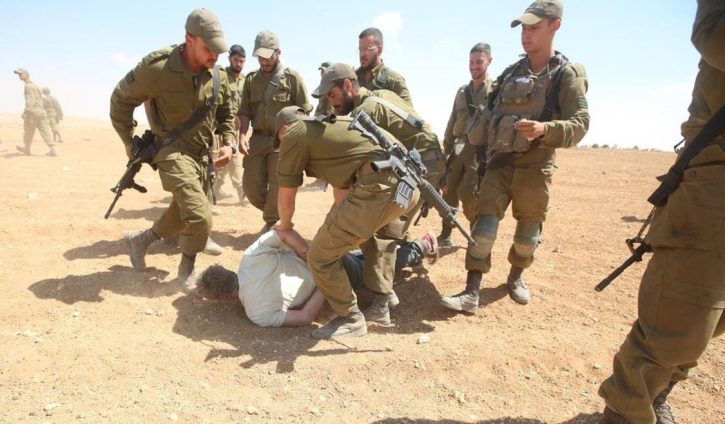
Israeli soldiers beat up a handcuffed international activist in Masafer Yatta
WAFA – June 22, 2022
HEBRON – Israeli forces today beat up a number of international solidarity activists in Masafer Yatta in the southern Hebron hills, according to local sources.
Coordinator of the Protection and Steadfastness Committee in Masafer Yatta, Fuad al-Amour, said the heavily-armed soldiers brutally assaulted a number of international activists while protesting the military drills close to and in al-Markez, and held two others for a long period.
The Israeli army have been conducting drills in al-Markez, one of 12 hamlets making up the Masafer Yatta, which rely heavily on animal husbandry as the main source of livelihood, for the second day in a row.
Al-Amour added that the army has built mock-ups as targets between the makeshift dwellings of the hamlet residents and has been conducting training with heavy weaponry, spreading panic among the residents.
The army has also deployed military checkpoints in the vicinity of the hamlets in the area, in preparation for military training, and perhaps paving the way for an imminent removal of the Palestinian residents.
Recently, Israel’s top court gave the army the green light to forcibly expel some 1,300 Palestinians living in twelve villages or hamlets making up the Masafer Yatta area marking one of the largest expulsions carried out by the State of Israel in recent decades.
Located in Area C of the West Bank, under full Israeli administrative and military control, the area has been subjected to repeated Israeli violations by settlers and soldiers targeting their main source of living – livestock.
It has been designated as a closed Israeli military zone for training since 1980s and accordingly referred to as Firing Zone 918.
Israeli violations against the area include demolition of animal barns, homes and residential structures. Issuance of construction permits by Israel to local Palestinians in the area is non-existent.
Featured Video

Revive Iran’s MOU Deal or Face a Forever War
or go to
Aletho News Archives – Video-Images
From the Archives
China names world’s ‘hacking empire’
RT | March 15, 2022
Calling the US a “hacking empire” of the world, the Chinese Foreign Ministry urged Washington to stop “malicious” cyber activities following reports that American hackers subverted a network in China to launch attacks on Russia and Belarus.
“China is gravely concerned about cyberattacks against other countries that originate from the US and use China as a springboard,” Foreign Ministry spokesperson Zhao Lijian told reporters at a press briefing on Monday.
Zhao was commenting on recent Chinese media reports that hackers, mainly from the US but also from NATO allies Germany and the Netherlands, recently hijacked a Chinese computer network for cyberattacks, 87% of which targeted Russia.
“Against the background of the Ukraine situation, such a move may produce the negative effect of misleading the international community and spreading disinformation,” Zhao said, pointing out that “a former US senior official called publicly for launching cyberattacks on Russia not long ago.”
This appeared to be a reference to Hillary Clinton, former US secretary of state and presidential candidate, who made the calls in an MSNBC interview at the end of February. … continue
Blog Roll
 Aletho News
- Iran-Linked Ships Spotted Hovering over Subsea Cables: Report
- New attack on Iran could devastate ‘Israel’, IOF general warns
- Nuclear deterrence: The US-Israeli military aggression against Iran made the unthinkable legitimate
- U.S. Midterms – a Referendum on Israel and Zionist Power
- Twice as many Canadian Jews serve in Israeli military as Canada’s armed forces: Report
- Thousands of Syrian troops set to join Saudi war on Yemen
- Jared Kushner’s Diplomacy for Hire
- Russia backs Tehran’s conditions in talks with US, Iran’s envoy says
- Irish ‘fake news’ expert exposed as fake
- China expresses strong opposition to Dutch report alleging Chinese cyberattacks
- If Americans Knew
- An error has occurred; the feed is probably down. Try again later.
- No Tricks Zone
- Zonal Asymmetry of Temperature Change in the Antarctic Circumpolar Current
- New Study: The Net Fossil Fuel Contribution To Rising Atmospheric CO2 Has Been Zero For 500 Years
- Germany’s Green Energy Transition Becoming Increasingly Expensive…Another 6 Trillion Euros!
- Sudden Stratospheric Warming, Powerful El Niño Combination May Lead To Extreme Europe Cold, Energy Crisis!
- Two New Studies Find Thwaites Glacier Melt Cannot Be Driven By Human Activity Or A Warming Ocean
- E-Cars Reduce CO2 Emissions By Only 41% Compared To Internal Combustion Engine Vehicles
- Predictions Made By Renowned Climate Professor Over Past Decades Have Been Proven To Be Poor
- New Study Suggests Large Regions Of The Pacific Ocean Have Been Cooling For The Last 80 Years
- Germany’s Green Energy Debacle: High Energy Costs Force Kahla Porzellan to Close After 182 Years!
- New Study: 50 Years Of The Most Aggressive ‘Net Zero’ Policies Can Only Affect The Global Climate By 0.03°C

