The Israeli occupation forces destroy an access road to a Ramallah-area village
WAFA – June 22, 2022
RAMALLAH – The Israeli occupation forces today destroyed an access road to Ras Karkar village, northwest of Ramallah, hampering the movement of people, according to the head of Ras Karkar village council, Marwan Nofal.
He said that the destroyed road had been partially paved for 20 years and that three months ago, following coordination with the Israeli military government, work on the rehabilitation of the road started. However, two days after the start of the work, the military forces raided the area and seized the vehicles used in the work, imposing a fine on their owners.
Nofal said that despite continuous promises to allow the rehabilitation work, the army sent its bulldozers today to destroy the road under the pretext that the road is located on “state land”.
The destruction of the road led to depriving farmers of access to their lands on the western side of the village, he said, and isolating several houses, noting that this is not the first time the Israeli military has targeted the village.
Ras Karkar suffers from the presence of seven iron gates at its entrances that limit the movement of people and access to their homes and lands.
At the same time, the Israeli military government does not allow it to carry out any work to improve the village’s infrastructure, said Nofal.
Tanzania: Maasai people face violence, eviction amid protests over UAE-owned game reserve
MEMO | June 22, 2022
Tanzania’s Maasai people have faced a violent crackdown from police over the past two weeks, amid plans to evict them from their ancestral homeland in parts of the Serengeti National Park to make way for trophy hunting and conservation zones.
Human rights organisations and the Maasai people have accused Tanzanian police of using teargas, live bullets and beating protestors who oppose the planned development in the Ngorongoro district near the village of Ololosokwani.
So far, at least 700 Maasai villagers have fled across the border to neighbouring Kenya as refugees, while dozens have been wounded by police. The response by the Tanzanian authorities has been condemned by the African Commission on Human Rights and Peoples’ Rights who called on the government to halt the ongoing forcible evictions and to open independent investigations into the violence against the Maasai people who should be consulted and allowed to review plans to establish the conservation area.
According to a report by Al Jazeera last week, the protests erupted after police began to demarcate 1,500 square kilometres (540 square miles) of land to make way for the reserve, to be operated by a UAE-owned company.
The government denies accusations that it is trying to evict the Maasai from their ancestral land, and has claimed they will still have access to 2,500 square kilometres of it.
The East African Court of Justice is to rule on a legal challenge to the planned evictions, but is likely to rule in favour of the controversial move, which could displace up to 70,000 people but will be a major contribution to the country’s vital tourism sector.
‘Canada working to return Russian gas turbines’
Samizdat | June 22, 2022
Ottawa is exploring ways to return crucial parts for Russia’s Nord Stream pipeline, which are currently stuck in Canada due to sanctions, Bloomberg reported on Tuesday citing Canadian Minister of Natural Resources Jonathan Wilkinson.
“We want to respect the sanctions because the sanctions were put into place for a reason. That being said, the intent of the sanctions was never to cause significant pain to Germany, which is one of our closest friends and allies. So, we are very seized with this issue,” Wilkinson told the news outlet.
“We are talking to Germany, trying to find a pathway through which we can actually enable the flow of gas. There may be different options that we can look at,” he stated, adding that Ottawa is negotiating with Berlin on ways to return the equipment.
Russia’s energy supplier Gazprom was forced to slash natural gas flows to Germany via the Nord Stream pipeline by 60% last week, because Siemens turbines from Gazprom’s Portovaya pumping station in Vyborg were stuck in Montreal, where they were sent to undergo maintenance. The parts fall under Canada’s sanctions against Russia, and the country says it cannot return them without breaching these restrictions.
According to the German Federal Grid Agency, the reduction in gas flow affected the supply of Russian gas from Germany to other European countries, including France, Austria and the Czech Republic.
The situation prompted these and other EU countries to announce emergency measures this week aimed at reducing the use of natural gas. Some countries have claimed that the reduction of gas flows was a political decision made by Moscow to increase pressure on Europe. Gazprom says the issue is technical.
Pfizer CEO says “beauty” of mRNA will allow for annual doses
TCS WIRE | June 22, 2022
Pfizer CEO Albert Bourla touted the “beauty” of mRNA vaccine technology in a recent MSNBC interview, saying he fully expects the Coronavirus to require an annual dose.
“Do you think we’re going to get updated mRNA vaccines every season that will be directed to each new variation of the Coronavirus, and will we have to take those shots every year?” asked the host.
“I’m almost certain about it, and I say almost certain because, of course, regulators have the final say on all of that, but that’s the beauty of mRNA. You can adapt your vaccine just by changing the sequencing, which is a very minor change,” said Bourla.
“For this reason, I’m very confident we will be able to respond very, very fast to every new variant.”
Prime Minister Justin Trudeau recently lifted travel mandates and vaccine requirements after facing widespread pushback from the public and airlines.
When lifting the mandates, the Liberals maintained they were only temporarily suspending the restrictions citing the threat of future waves.
“The reality is, as much as people would like to pretend that we’re not, we’re still in a pandemic,” said Trudeau early in June.
“There are Canadians who die every single day because of COVID-19 in our hospitals.”
Bourla has stated in the past that anyone who spreads misinformation regarding Coronavirus vaccines or potential side effects were literally criminals responsible for millions of deaths.
“Those people are criminals,” Bourla told Atlantic Council CEO, Frederick Kempe. “They’re not bad people. They’re criminals because they have literally cost millions of lives.”
“The only thing that stands between the new way of life and the current way of life is, frankly, hesitancy to vaccinations,” he added.
Canada’s Chief Public Health Officer Theresa Tam echoed fearmongering about a theoretical future wave earlier this month.
“The pandemic is not over,” Tam said. “We think that it is very likely that we will get some more viral activity in the future, and we can’t predict exactly how big the next wave is, but I think we need to prepare.”
CDC Admits It Never Monitored VAERS for COVID Vaccine Safety Signals
By Josh Guetzkow, Ph.D. | The Defender | June 21, 2022
In a stunning development, the Centers for Disease Control and Prevention (CDC) last week admitted — despite assurances to the contrary — the agency never analyzed the Vaccine Adverse Event Reporting System (VAERS) for safety signals for COVID-19 vaccines.
The admission was revealed in response to a Freedom of Information Act (FOIA) request submitted by Children’s Health Defense (CHD).
In September 2021, I published an article in The Defender in which I used the CDC’s published methodology to analyze VAERS for safety signals from COVID-19 vaccines.
The signals were loud and clear, leading me to wonder “why is nobody listening?”
Instead, I should have asked, “Is anybody even looking for them?”
After that article was published, I urged CHD’s legal team to submit a FOIA request to the CDC about its VAERS monitoring activities.
Since CDC officials stated publicly that “COVID-19 vaccine safety monitoring is the most robust in U.S. history,” I had assumed that at the very least, CDC officials were monitoring VAERS using the methods they described in a briefing document posted on the CDC website in January 2021 (and updated in February 2022, with minor changes).
I was wrong.
The lynchpin of their safety monitoring was to mine VAERS data for safety signals by calculating what are known as proportional reporting ratios (PRR’s).
This is a method of comparing the proportion of different types of adverse events reported for a new vaccine to the proportion of those events reported for an older, established vaccine.
If the new vaccine shows a significantly higher reporting rate of a particular adverse event relative to the old one, it counts as a safety signal that should then trigger a more thorough investigation.
The briefing document states, “CDC will perform PRR data mining on a weekly basis or as needed.”
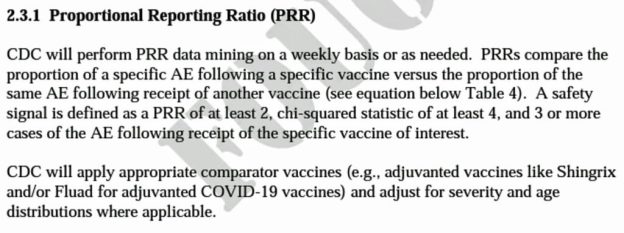
And yet, in the agency’s response to the FOIA request, it wrote that “no PRRs were conducted by CDC. Furthermore, data mining is outside of the agency’s purview.”
The agency suggested contacting the U.S. Food and Drug Administration (FDA), which was supposed to perform a different type of data mining, according to the briefing document.

CDC officials repeatedly claimed they have not seen safety signals in VAERS.

For example, on April 27, 2021, CDC Director Dr. Rochelle Walensky stated the CDC did not see any signals related to heart inflammation.
But a PRR calculation I did using the number of myo/pericarditis reports listed in the first table produced by the CDC obtained via the FOIA request reveals clear and unambiguous safety signals relative to the comparator vaccines mentioned in the briefing document (i.e., flu vaccines, FLUAD and Shingrix).
The table is dated April 2, 2021, almost four weeks before she made those remarks.
In fact, among the 15 adverse events for adults included in that week’s tabulations, PRRs I calculated also show loud-and-clear safety signals for acute myocardial infarction, anaphylaxis, appendicitis, Bell’s palsy, coagulopathy, multisystem inflammatory syndrome in adults (MIS-A), stroke and death.
The actual monitoring the CDC did diverges from the one promised in the briefing document in other ways.
For example, the CDC never created tables of the top 25 adverse events reported in the previous week, tables comparing different vaccine manufacturers, or tables of auto-immune diseases.
And it only began monitoring in early April 2021, even though reports from COVID-19 vaccines had been flooding VAERS since mid-December of the previous year.
To be clear, VAERS is not the only database the CDC uses to monitor COVID-19 vaccine safety.
For example, the CDC sponsored several studies of COVID-19 safety using the Vaccine Safety Datalink (VSD), which is comprised of millions of medical records from HMO’s across several states.
Those studies do not raise many safety concerns. However, they make many questionable methodological choices.
To give one example, a major safety study based on VSD data published in September 2021, in “JAMA,” compares adverse event rates that occur within 1-21 days of vaccination to the rate of occurrence from 22 to 42 days after vaccination.
It makes no comparison between vaccinated and unvaccinated individuals, or before vaccination versus after in the same individuals.
Moreover, the VSD is far from infallible, having failed initially to detect the increase in myocarditis rates.
In contrast, although calculating PRR’s is a blunt pharmacovigilance tool and far from perfect, it nevertheless has the advantage of being straightforward and difficult to manipulate with statistical sleight of hand.
PRRs are one of the oldest, most basic and most well-established tools of pharmacovigilance. The calculations are so straightforward that the CDC automated it several years ago, so it could have been done at the press of a button.
It simply beggars belief that the CDC failed to do this simple calculation. Even now, a paper published by CDC staff in March on the safety of the mRNA COVID-19 vaccines remains purely descriptive with no PRR calculation.
Meanwhile, a study published by a researcher not affiliated with the CDC in February in “Frontiers in Public Health” analyzes VAERS and EudraVigilance data using a method similar to PRRs, revealing clear and concerning safety signals.
And while it is true that VAERS is not the only database the CDC can use to monitor COVID-19 vaccine safety, it is of critical importance because it can reveal signals much faster than any other method — if anybody cares to look for them.
It remains to be seen if the FDA was properly monitoring VAERS. That will be the subject of a future FOIA request.
But even if it was, it doesn’t change the fact that the CDC completely failed in its promise to monitor VAERS for safety signals.
© 2022 Children’s Health Defense, Inc. This work is reproduced and distributed with the permission of Children’s Health Defense, Inc. Want to learn more from Children’s Health Defense? Sign up for free news and updates from Robert F. Kennedy, Jr. and the Children’s Health Defense. Your donation will help to support us in our efforts.
India’s weapon diversification not a “humiliating blow for Putin”
By Paul Antonopoulos | June 22, 2022
India for decades has had a close cooperation with Moscow, which extends into the defence industry. With India attempting to rise to Great Power status in the context of the current multipolar system, it has also engaged in an ambitious effort to achieve a thriving indigenous military industrial complex through joint productions, which includes Russia. However, according to Western media, India’s diversification of its defence systems is a “humiliating blow” for Russian President Vladimir Putin.
Britain’s Express newspaper, with the title “India turns on Russia and strikes major deal with West in humiliating blow for Putin”, wrote on June 20 that India is beginning talks with the US, Israel and European countries for a new arms deal.
The article explains that “India is not a major importer of Russian oil and gas” but omits, according to Bloomberg, that the South Asian country has bought more than 40 million barrels of Russian oil between late-February and early-May, which comes to about 20% more than flows for all of 2021.
India imports 80% of its oil but usually only buys about 2% to 3% from Russia. With oil prices increasing following the Russian military operation in Ukraine, New Delhi has increased its intake from Moscow, taking advantage of the major discounts. In this way, India is rapidly becoming a major market for Russian energy, so-much-so that the country has overtaken Saudi Arabia to become India’s second biggest supplier of oil – only behind Iraq.
The article’s author writes: “Russia’s ability to influence European decisions due to its energy dependence has sparked concerns about relying too heavily on a single supplier.” However, there is no evidence or indication from New Delhi that Europe’s energy dependence on Russia has motivated India’s weapon diversification.
In fact, Javin Aryan in his March 2021 paper titled “The evolving landscape of India’s arms trade”, stated that: “defense transfers from the US to India declined by 46% as well. India’s goal, thus, seems to have been to cut its dependence on other countries for defence systems across the board rather than to pivot from one supplier to the other. This underlines New Delhi’s resolve to promote indigenous defence manufacturing and export.”
He then stresses that “India should find ways of becoming self-reliant that would not adversely affect relations with its partner countries”, naming Russia, France and Israel, as they are countries which New Delhi find “operationally, diplomatically, and politically unviable to sever” from.
In this way, India’s weapons diversification and indigenous programs is not a “humiliating blow to Putin” as the Express leads readers to believe, but rather a years-long stated goal that has been worked on, and even with assistance from Russia. More importantly, it is certainly not a reaction to the war in Ukraine and Europe’s energy dependence on Russia.
Rather, it is a lazy attempt to coverup the fact that the West has been humiliated time and again in their incessant demand that India ends its decades long cooperation with Moscow to impose sanctions and end energy imports.
“Furthermore, Putin’s invasion of Ukraine has deepened relations between Russia and China, a neighboring country that India is continually in a border conflict with,” the Express article added.
Although the strategic relationship between Moscow and Beijing has certainly strengthened over the course of the war in Ukraine, the statement alludes that this has affected Russia-India ties. Moscow, New Delhi and Beijing, unlike most of the West, operate on principles of bilateral relations not being beholden by third parties. In this way, despite tensions that may exist between India and China, it will not spill over into their relations with Russia.
As the Express was alluding to Putin’s “humiliation” from India, Indian banks met with Russian banks, that are not under Western sanctions, on June 15 to facilitate bilateral payments. According to the Economic Times, these Indian banks will likely open accounts at their Russian counterparts and vice versa without violating the economic sanctions on Russia over the Ukraine war.
If these banks from both sides start engaging bilaterally, banking transactions can take place in any currency, including the dollar, euro, rupee or the rouble. A proposal of paying Russians in rupees was also discussed.
The British tabloid alludes that there is a crisis, or at least a looming crisis, in Russian-Indian relations. However, despite these allusions, deceiving Western readers does not change the facts on the ground that Moscow-New Delhi ties and cooperation is only expanding and not contracting just because India is pursuing its years-long stated goal of diversification and indigenisation of its defence systems.
Paul Antonopoulos is an independent geopolitical analyst.
Covid vaccines more likely to put you in hospital than keep you out: BMJ editor’s analysis of Pfizer and Moderna trial data
BY WILL JONES | THE DAILY SCEPTIC | JUNE 22, 2022
A new paper by BMJ Editor Dr. Peter Doshi and colleagues has analysed data from the Pfizer and Moderna Covid vaccine trials and found that the vaccines are more likely to put you in hospital with a serious adverse event than keep you out by protecting you from Covid.
The pre-print (not yet peer-reviewed) focuses on serious adverse events highlighted in a WHO-endorsed “priority list of potential adverse events relevant to COVID-19 vaccines”. The authors evaluated these serious adverse events of special interest as they were observed in “phase III randomised trials of mRNA COVID-19 vaccines”.
A serious adverse event was defined as per the trial protocols as an adverse event that results in any of the following conditions:
- death;
- life-threatening at the time of the event;
- inpatient hospitalisation or prolongation of existing hospitalisation;
- persistent or significant disability/incapacity;
- a congenital anomaly/birth defect;
- medically important event, based on medical judgement.
Dr. Doshi and colleagues found that the Pfizer and Moderna mRNA COVID-19 vaccines were associated with an increased risk of serious adverse events of special interest of 10.1 events per 10,000 vaccinated for Pfizer and 15.1 per 10,000 for Moderna (95% CI -0.4 to 20.6 and -3.6 to 33.8, respectively). When combined, the mRNA vaccines were associated with a risk increase of serious adverse events of special interest of 12.5 per 10,000 vaccinated (95% CI 2.1 to 22.9).
The authors note that this level of increased risk post-vaccine is greater than the risk reduction for COVID-19 hospitalisation in both Pfizer and Moderna trials, which was 2.3 per 10,000 participants for Pfizer and 6.4 per 10,000 for Moderna. This indicates that the Pfizer vaccine results in a net increase in serious adverse events of 7.8 per 10,000 vaccinated and the Moderna vaccine of 8.7 per 10,000 vaccinated.
Addressing the difference between their findings and those of the FDA when it approved the vaccines, the authors note that the FDA’s analysis of serious adverse events “included thousands of additional participants with very little follow-up, of which the large majority had only received one dose”. The FDA also counted people affected rather than individual events, despite there being twice as many individuals in the vaccine group than the placebo group who experienced multiple serious adverse events.
The authors wonder where the U.S. Government’s own studies of adverse events are. They note that in July 2021 the FDA reported detecting four potential adverse events of interest following Pfizer vaccination – pulmonary embolism, acute myocardial infarction, immune thrombocytopenia and disseminated intravascular coagulation – and stated it would further investigate the findings. However, no update has yet appeared.
They also note that “while CDC published a protocol in early 2021 for using proportional reporting ratios for signal detection in the VAERS database, the agency has not yet reported such a study”.
Their results are compatible, they point out, with a recent pre-print analysis of COVID-19 vaccine trials by Benn et al., which found “no evidence of a reduction in overall mortality in the mRNA vaccine trials”, with 31 deaths in the vaccine arms versus 30 deaths in the placebo arms (3% increase; 95% CI 0.63 to 1.71).
Noting that their study is limited by the fact that the raw data from COVID-19 vaccine clinical trials are not publicly available, they stress that “given the global public health implications, there is an urgency to make all COVID-19 trial data public, particularly regarding serious adverse events, without any further delay”.
They conclude that there is a need for formal harm-benefit analyses for Covid vaccines, taking into account the different levels of risk of serious Covid and adverse events that exist between demographic groups. Ideally, this would be based on individual participant data, they add, though such data remain frustratingly unavailable.
Washington supports blockade of Russian exclave by NATO member Lithuania
Samizdat | June 22, 2022
The US says that it “appreciates” anti-Russian sanctions imposed by EU nations and that its military is committed to the defense of Lithuania, after the country banned some Russian goods from passing through its territory to the Russian exclave of Kaliningrad.
Ned Price, the spokesman for the US state department, dismissed Moscow’s displeasure with the Lithuanian blockade of its territory as “saber-rattling” and “bluster.” Speaking at a daily briefing, he said he didn’t want to “give it additional time.”
“We, of course, appreciate the unprecedented economic measures that many countries around the world… including in this case Lithuania, have joined us in taking against Russia for its unprovoked war in Ukraine,” he said.
Price said that the US would protect Lithuania from any military attack, as is due under its NATO obligations.
“Lithuania has been a stalwart partner in this. We stand by NATO. We stand by our NATO Allies, and we stand by Lithuania,” he said.
The row between Russia and its Baltic neighbor erupted last week after Lithuania started blocking the transit of goods between mainland Russia and Kaliningrad region. The partial restrictions came into force last Saturday, with Vilnius claiming it was a natural part of enforcing EU sanctions against Russian trade. Roughly half of the traffic is estimated to be affected. The banned items include coal, metals, and construction materials.
Moscow said the restrictions were crossing every line and warned that there would be serious consequences for what it described as a Lithuanian blockade of its exclave. The decision clearly violated international law, the Russian government noted. Some experts suggested that it could even amount to a casus belli – a cause to start a war over.
Kaliningrad region is sandwiched between Poland and Lithuania and has access to the Baltic Sea, which technically allows Russia to ferry goods to it. The relatively small exclave also hosts a significant number of Russian troops and weapon systems, making it a key component in the country’s national security.
Biden predicts ‘second pandemic’

Samizdat – June 22, 2022
The US needs more money to plan for “the second pandemic,” President Joe Biden said during a press briefing on Tuesday, as he praised his government’s efforts to ensure children under five can get Covid-19 vaccines.
Biden also hailed as “a very historic milestone” that the US has become the first country in the world to offer “safe and effective” Covid-19 vaccines for children as young as six months old.
When asked about how long the administration could keep up the new vaccine campaign, Biden suggested that the current budget would be enough to “get through at least this year” but stressed that “we do need more money.”
He went on to insist that he needed even more money for an unspecified “second pandemic.” “We need more money to plan for the second pandemic. There’s going to be another pandemic,” the president warned, without going into detail about what this new wave might entail.
Biden also took the opportunity to take a swipe at his predecessor, implying that Donald Trump’s lack of preparation increased the impact of the Covid pandemic. “We have to think ahead. That’s not something the last outfit did very well and that’s something we’ve been doing fairly well. That’s why we need the money,” surmised Biden.
Some health experts and agencies such as the World Health Organization have also warned of the likelihood of future pandemics. The WHO had previously announced that it plans to confirm a global pandemic treaty at the 2024 World Health Assembly, which it hopes will help “set out the objectives and fundamental principles in order to structure the necessary collective action to fight pandemics.”
The agreement, which heavily focuses on increased surveillance, vaccinations and “restoring trust in the international health system,” would legally bind its members under international law, superseding regulations of individual countries in an effort to get all nations to act as one in the face of a future outbreak.
Most African countries support Russia
By Lucas Leiroz | June 22, 2022
Apparently, Volodymir Zelensky’s popularity in Ukraine is very low. The Ukrainian leader called for a virtual diplomatic meeting with African heads of state, but the event failed completely. Almost all African leaders declined to participate, hampering Zelensky’s plans to make the meeting a pro-Kiev propaganda stage. Meanwhile, the Russian government’s popularity is growing in Africa, where citizens take the streets in support for the special military operation in Ukraine and ask for Russian help in combating terrorism.
On June 20, the Ukrainian president met with representatives of the African Union in order to discuss matters concerning the current conflict situation in Eastern Europe and the role of Africa on the world arena. Of the fifty-five heads of state invited to the meeting, only four attended. The other countries sent only diplomats or ministers, with the heads of state and government not willing to attend, even with the meeting being virtual.
The heads of state who attended the meeting were Macky Sall of Senegal, Alassane Ouattara of Côte d’Ivoire, Mohammed el-Menfi, President of the Libyan Council, and Denis Sassou Nguesso of Congo. It is important to note that Sall is the current president of the African Union, which is why his presence was essential for the event to take place. Therefore, his attendance does not necessarily mean an expression of his real desire – even more considering his recent conversations with Russian President Vladimir Putin and the effort to increase Russia-Africa cooperation.
The virtual meeting was operated in secret, behind closed doors. According to official sources, Zelensky reiterated the Ukrainian position on the conflict, calling the Russian operation an unjustified “aggression”. He also commented on the current food crisis affecting Africa as a result of the conflict’s impact on the grain market. According to Zelensky, the African continent is Russia’s “hostage” because food shortages would be the result of such “aggression” and would only end when Russia decided to retreat.
Commenting on the event, Macky Sall took the most neutral and impartial stance possible, demonstrating that the Africa Union did not adhere to Zelensky’s appeals, but was concerned only with African states’ interests and the proper functioning of international law.
“Africa remains committed to respecting the rules of international law, the peaceful resolution of conflicts and the freedom of trade”, he said in a publication in his Twitter account.
It is interesting to note how Zelensky’s attempt to convince African leaders to adhere to the Kiev-Western narrative absolutely failed. Not only did most African heads of state refuse to listen to the Ukrainian leader, but there was no adherence to the pro-Kiev speech on the part of those who attended the conference. For the African Union, the meeting was just a diplomatic formality, with no real gains or changes in position – which reveals that Zelensky’s plans did not work as expected.
This failure, however, was predictable for any realistic analyst. For African leaders, it is really hard to believe the fallacious narrative that Ukraine is a simple “victim” of an “unjustified aggression”. African countries are used to centuries of Western interventionism and violence and the peoples of this continent react to this with strong distrust of everything that Western nations support. As Zelensky is the ally of the US and Europe, he will likely be viewed with suspicion by countries that suffer so much from Western colonialist mentality and praxis.
In addition, there are other factors that need to be mentioned. Zelensky’s arguments that the food crisis is caused exclusively by Russia are no longer able to convince public opinion and state authorities. It is evident that, more than the conflict itself, the crisis has been caused by the sanctions against Russia, which motivates emerging countries to be enthusiastic about the end of these sanctions. Also, there are many reports that Kiev is exporting grain to the US and Europe in exchange for weapons, which is unacceptable.
Furthermore, there has recently been a strong wave of popular support for the operation in Ukraine from citizens of several African countries, especially in the regions most affected by terrorism. After the abandonment that Africa has suffered from the West in terms of security policies and defense cooperation, seeking Russian support has become the greatest hope for the members of the African Union, which is why recently there have been popular demonstrations in support of all Moscow’s actions, alongside requests for help to solve Africa’s internal problems.
In fact, in international relations, nothing matters more than cooperation. Zelensky will not be able to garner African support if he does not show interest or conditions to cooperate with Africa. Kiev currently has nothing to offer African countries, as it is economically broken and militarily virtually neutralized. On the other hand, Russia shows itself as a pillar for African food security and as a hope against terrorism in the continent. It is absolutely expected that in this context the African Union will decline its ties with Kiev and seek to approach the side that offers the best opportunities for cooperation.
Lucas Leiroz is a researcher in Social Sciences at the Rural Federal University of Rio de Janeiro; geopolitical consultant.
Featured Video

Revive Iran’s MOU Deal or Face a Forever War
or go to
Aletho News Archives – Video-Images
From the Archives
China names world’s ‘hacking empire’
RT | March 15, 2022
Calling the US a “hacking empire” of the world, the Chinese Foreign Ministry urged Washington to stop “malicious” cyber activities following reports that American hackers subverted a network in China to launch attacks on Russia and Belarus.
“China is gravely concerned about cyberattacks against other countries that originate from the US and use China as a springboard,” Foreign Ministry spokesperson Zhao Lijian told reporters at a press briefing on Monday.
Zhao was commenting on recent Chinese media reports that hackers, mainly from the US but also from NATO allies Germany and the Netherlands, recently hijacked a Chinese computer network for cyberattacks, 87% of which targeted Russia.
“Against the background of the Ukraine situation, such a move may produce the negative effect of misleading the international community and spreading disinformation,” Zhao said, pointing out that “a former US senior official called publicly for launching cyberattacks on Russia not long ago.”
This appeared to be a reference to Hillary Clinton, former US secretary of state and presidential candidate, who made the calls in an MSNBC interview at the end of February. … continue
Blog Roll
 Aletho News
- Iran-Linked Ships Spotted Hovering over Subsea Cables: Report
- New attack on Iran could devastate ‘Israel’, IOF general warns
- Nuclear deterrence: The US-Israeli military aggression against Iran made the unthinkable legitimate
- U.S. Midterms – a Referendum on Israel and Zionist Power
- Twice as many Canadian Jews serve in Israeli military as Canada’s armed forces: Report
- Thousands of Syrian troops set to join Saudi war on Yemen
- Jared Kushner’s Diplomacy for Hire
- Russia backs Tehran’s conditions in talks with US, Iran’s envoy says
- Irish ‘fake news’ expert exposed as fake
- China expresses strong opposition to Dutch report alleging Chinese cyberattacks
- If Americans Knew
- An error has occurred; the feed is probably down. Try again later.
- No Tricks Zone
- Zonal Asymmetry of Temperature Change in the Antarctic Circumpolar Current
- New Study: The Net Fossil Fuel Contribution To Rising Atmospheric CO2 Has Been Zero For 500 Years
- Germany’s Green Energy Transition Becoming Increasingly Expensive…Another 6 Trillion Euros!
- Sudden Stratospheric Warming, Powerful El Niño Combination May Lead To Extreme Europe Cold, Energy Crisis!
- Two New Studies Find Thwaites Glacier Melt Cannot Be Driven By Human Activity Or A Warming Ocean
- E-Cars Reduce CO2 Emissions By Only 41% Compared To Internal Combustion Engine Vehicles
- Predictions Made By Renowned Climate Professor Over Past Decades Have Been Proven To Be Poor
- New Study Suggests Large Regions Of The Pacific Ocean Have Been Cooling For The Last 80 Years
- Germany’s Green Energy Debacle: High Energy Costs Force Kahla Porzellan to Close After 182 Years!
- New Study: 50 Years Of The Most Aggressive ‘Net Zero’ Policies Can Only Affect The Global Climate By 0.03°C

