Germans warned of ‘difficult autumn’ and ‘tough winter’
“Whoever saves energy helps Germany become more independent from Russian imports and also does it for the sake of the climate”
Samizdat | June 11, 2022
Germans should brace for a difficult autumn and winter due to skyrocketing prices, as the country pushes for independence from Russian energy, the Vice Chancellor, and head of the Ministry of Economy, Robert Habeck warned on Friday.
“As for the support of the people who need it, I clearly indicated what is ahead of us and what is already partially a reality… we are facing a very difficult autumn and a very tough winter,” he said, as cited by RIA Novosti.
Habeck made the prediction as he presented a new energy saving initiative of the Federal Ministry for Economic Affairs and Climate Action (BMWK). Berlin is planning to replace Russian coal and oil by the end of the year and stop importing Russian gas by 2024, and is struggling to find alternative energy sources. According to the vice chancellor, energy prices are already extremely high and “many people will get significantly higher bills than usual” in the upcoming heating season.
“For this reason alone, saving energy is urgently needed, and I know that many are already looking at where they can save something, especially when they have to watch every cent anyway,” he said.
The new initiative – ‘80 million together for energy change’ – aims to motivate people to save energy. It provides examples on its website from everyday life and recommendations for saving energy, including: regularly defrosting the freezer, raising the refrigerator temperature to 7C, using LED light bulbs in offices, ways to cut down on water consumption and heating in the bathroom and kitchen, etc.
“Whoever saves energy helps Germany become more independent from Russian imports and also does it for the sake of the climate,” Habeck said.
The tumultuous situation with energy prices around the world has hit Germany hard. The availability of Russian energy carriers on the global market was put into jeopardy following the launch of Moscow’s military operation in Ukraine and the retaliatory sanctions from the West.
Energy prices propelled annual inflation in Europe’s largest economy to 7.9% in May, its highest level in nearly 50 years. Energy prices in the country rose 38.3% year-on-year last month, while food prices posted an 11.1% leap, data from the Federal Statistical Office (Destatis) shows. As a result, nearly half of German citizens have been forced to change their lifestyle and cut back on spending, media reports, citing polls. According to a study conducted for Bild newspaper by INSA this week, every sixth German citizen does not eat regularly due to the rise in prices, and another 13% are considering the possibility of saving on food.
One in Six Germans Forced to Skip Meals Thanks to Food Price Crunch: Survey
Samizdat – 11.06.2022
Europeans face a perfect storm of soaring inflation, self-inflicted energy price shocks caused by sanctions on Russia, and fears of a looming recession. In Germany, the region’s traditional economic and industrial powerhouse, ordinary people have taken a hit to their wallets, while businesses have warned of large-scale losses and layoffs.
Nearly one in six Germans (16 percent) have been forced to go without regular meals to make ends meet, and another 13 percent may face a similar situation if food prices continue to rise, a new survey by the Institute for New Social Answers (INSA) for Germany’s Bild newspaper has found.
According to the survey, people from low-income households whose income after taxes is less than 1,000 euros per month have been the most heavily affected, with 32 percent of respondents forced to skip meals regularly.
42 percent of those polled also indicated that they are forced to cook more sparingly due to inflation, leaving out certain ingredients in meals, or dessert. Another 41 percent said they rely on supermarket special offers and discounts to stretch their euros as far as possible.
INSA’s study was conducted on 7 June, with a representative sample of 1,002 people queried.
Adolf Bauer, president of the German Association for Social Affairs, told Bild he was “greatly worried” by the survey’s results, saying it was a “clear sign that the measures taken by the federal government to date are not sufficient.” Bauer had previously warned Berlin not to introduce an energy embargo on Russia, saying it would add to suffering among ordinary people caused by out of control energy, food and rent prices.
Verena Bentele, president of the Social Association of Germany, a major Berlin-headquartered socio-political advocacy organization, echoed Bauer’s concerns, saying the figures show that people are “suffering greatly from the increased prices.”
“Members tell us they can only afford pasta and toast. We urgently need the VAT on fresh foods to be abolished and financial relief for those who have so far received nothing from the government’s energy price flat-rate,” Bentele urged.
Germans and other Europeans have faced out of control inflationary and price pressures in recent months, with Handelsblatt reporting double-digit growth on some food items in April. Last month, Deutsche Wirtschafts Nachrichten reported that EU sanctions on fertilizer imports from Russia and Belarus would result in losses of up to 3 million tonnes of harvest in the current year. Europe relied on the two countries for some 4.6 million tonnes of its 13 million tonnes-worth of fertilizer consumption last year, while local production efforts have been hampered by the large amount of energy required to produce them.
Russian President Vladimir Putin has lamented at the European Union’s decision to commit “economic suicide” by depriving itself of cheap and reliable Russian energy supplies, and expressed sympathy for ordinary Europeans and Americans suffering as a result of their leaders’ decision-making. “The truth is that the current problems that millions of people in the West face are the result of many actions by the ruling elites of their states, their mistakes, myopia and ambitions. These elites are not thinking about how to improve the lives of their citizens. They are obsessed with their own selfish interests and surplus profits,” he suggested at a briefing in March.
US policies led to ‘new G8’ – Moscow
Samizdat | June 11, 2022
The United States “with its own hands” pushed the countries, which are not participating in “sanctions wars,” to form a “new Big Eight” group with Russia, the Russian State Duma speaker Vyacheslav Volodin said on Saturday.
Following the launch of Russia’s military offensive in Ukraine in late February, the US, EU, UK and many other countries imposed hard-hitting restrictions on Moscow, making Russia the most sanctioned country in the world.
In a Telegram post, Volodin included a table with IMF data on GDP based on purchasing power parity of countries he calls the “new G8” and of countries forming the current G7 (after Russia’s participation in the bloc was suspended over Crimea’s vote to join the country in 2014, the G8 effectively turned into the G7).
“The group of eight countries not participating in the sanctions wars – China, India, Russia, Indonesia, Brazil, Mexico, Iran, Turkey – in terms of GDP at PPP is 24.4% ahead of the old group,” Volodin wrote.
In his opinion, the economies of the G7 members – the United States, Japan, Germany, Britain, France, Italy and Canada – continue “to crack under the weight of sanctions imposed against Russia.”
“The rupture of existing economic relations by Washington and its allies has led to the formation of new points of growth in the world,” Volodin claimed.
While having serious economic difficulties, the US, according to the Duma speaker, continues “doing everything to solve their problems at the expense of others.” Creating tensions will “inevitably” lead the US to lose its world domination, Volodin stressed.
“The United States created the conditions with its own hands for countries wishing to build an equal dialogue and mutually beneficial relations to actually form a ‘new Big Eight’ together with Russia,” he said.
Meanwhile, on Friday, US Deputy Assistant Secretary of State Eric Woodhouse said that Washington and its allies had realized that they would get “spillovers” of anti-Russia sanctions into their own economies. Their determination in imposing sanctions on Moscow, he claimed, has demonstrated a willingness to “accept those costs.”
US Treasury Secretary Janet Yellen admitted on the same day that the anti-Russia sanctions have made a “huge difference to food and energy prices,” amid record-setting inflation. The remarks followed the statement by the Russian President Vladimir Putin who said that “many years of mistakes made by Western nations” in their economic and sanctions policies have caused “a global wave of inflation, disruption of established logistical and manufacturing chains, a surge in poverty and a deficit of food.”
Research Confirms Statins Are a Colossal Waste of Money
This article was previously published December 8, 2021, and has been updated with new information.
By Dr. Joseph Mercola | June 9, 2022
The lecturer in the featured video, Maryanne Demasi, Ph.D., produced the 2014 Australian Catalyst documentary, “Heart of the Matter: Dietary Villains,” which exposed the cholesterol/saturated fat myths behind the statin fad and the financial links which lurk underneath.
The documentary was so thorough that vested interests actually convinced ABC TV to rescind the two-part series.1 The Australian Heart Foundation, the three largest statin makers (Pfizer, AstraZeneca and Merck Sharp & Dohme) and Medicines Australia, Australia’s drug lobby group, complained2 and got the documentary expunged from ABC TV.
Cholesterol and saturated fat have been the villains of heart disease for the past four decades, despite the many studies showing neither has an adverse effect on heart health.
The entire food industry shifted away from saturated fat and cholesterol, ostensibly to improve public health, and the medical industry has massively promoted the use of cholesterol-lowering statin drugs for the same reason. Despite all of that, the rate of heart disease deaths continues to be high.3 That really should tell us something.
Statins Are a Colossal Waste of Money
Since the release of Demasi’s documentary, the evidence against the cholesterol theory and statins has only grown. As noted in an August 4, 2020, op-ed by Dr. Malcolm Kendrick, a general practitioner with the British National Health Service:4
“New research shows that the most widely prescribed type of drug in the history of medicine is a waste of money. One major study found that the more ‘bad’ cholesterol was lowered, the greater the risk of heart attacks and strokes.
In the midst of the COVID-19 pandemic, almost every other medical condition has been shoved onto the sidelines. However, in the UK last year, heart attacks and strokes (CVD) killed well over 100,000 people — which is at least twice as many as have died from COVID-19.
CVD will kill just as many this year, which makes it significantly more important than COVID-19, even if no one is paying much attention to it right now.”
According to a scientific review5 published online August 4, 2020, in BMJ Evidence-Based Medicine, lowering LDL is not going to lower your risk of heart disease and stroke. “Decades of research has failed to show any consistent benefit for this approach,” the authors note.
Since the commercialization of statin drugs in the late ’80s (lovastatin being the first one, gaining approval in 19876), total sales have reached nearly $1 trillion.7,8 Lipitor — which is just one of several brand name statin drugs — was named the most profitable drug in the history of medicine.9,10 Yet these drugs have done nothing to derail the rising trend of heart disease.
Lowering Cholesterol Does Not Show a Beneficial Impact
According to a press release announcing the BMJ Evidence-Based Medicine review, the analysis found that:11
“… over three quarters of all the trials reported no positive impact on the risk of death and nearly half reported no positive impact on risk of future cardiovascular disease.
And the amount of LDL cholesterol reduction achieved didn’t correspond to the size of the resulting benefits, with even very small changes in LDL cholesterol sometimes associated with larger reductions in risk of death or cardiovascular ‘events,’ and vice versa. Thirteen of the clinical trials met the LDL cholesterol reduction target, but only one reported a positive impact on risk of death …”
In their paper,12 the study authors argue that since dozens of randomized controlled trials looking at LDL-cholesterol reduction “have failed to demonstrate a consistent benefit, we should question the validity of this theory.”
They also cite the Minnesota Coronary Experiment,13 a double-blind randomized controlled trial involving 9,423 subjects that sought to determine whether replacing saturated fat with omega-6 rich vegetable oil (corn oil and margarine) would reduce the death rate from heart disease by lowering cholesterol.
It didn’t. Mortality and cardiovascular events increased even though total cholesterol was lowered by 13.8%. For each 30 mg/dL reduction in serum cholesterol, the death risk rose by 22%. In conclusion, the Evidence-Based Medicine study authors note that:14
“In most fields of science the existence of contradictory evidence usually leads to a paradigm shift or modification of the theory in question, but in this case the contradictory evidence has been largely ignored, simply because it doesn’t fit the prevailing paradigm.”
Deception Through Statistics
If lowering cholesterol doesn’t reduce mortality or cardiovascular events, there’s little reason to use them, considering they come with a long list of adverse side effects. Sure, there are studies claiming to show benefit, but many involve misleading plays on statistics.
One common statistic used to promote statins is that they lower your risk of heart attack by about 36%.15 This statistic is derived from a 2008 study16 in the European Heart Journal. One of the authors on this study is Rory Collins, who heads up the CTT Collaboration (Cholesterol Treatment Trialists’ Collaboration), a group of doctors and scientists who analyze study data17 and report their findings to regulators and policymakers.
Table 4 in this study shows the rate of heart attack in the placebo group was 3.1% while the statin group’s rate was 2% — a 36% reduction in relative risk. However, the absolute risk reduction — the actual difference between the two groups, i.e., 3.1% minus 2% — is only 1.1%, which really isn’t very impressive.
In other words, in the real world, if you take a statin, your chance of a heart attack is only 1.1% lower than if you’re not taking it. At the end of the day, what really matters is what your risk of death is the absolute risk. The study, however, only stresses the relative risk (36%), not the absolute risk (1.1%).
As noted in the review18 “How Statistical Deception Created the Appearance That Statins Are Safe and Effective in Primary and Secondary Prevention of Cardiovascular Disease,” it’s very easy to confuse and mislead people with relative risks.
Statins Sabotage Your Health
A stunning review of statin trials published in 2015 found that in primary prevention trials, the median postponement of death in those taking statins was a mere 3.2 days. While potentially extending life span by 3.2 days, those taking statins are also at increased risk for:
- Diabetes (if taken for more than two years, your risk for diabetes triples)
- Dementia, neurodegenerative diseases and psychiatric problems such as depression, anxiety and aggression
- Musculoskeletal disorders
- Osteoporosis
- Cataracts
- Heart disease
- Liver damage
- Immune system suppression
Oftentimes statins do not have any immediate side effects, and they are quite effective, capable of lowering cholesterol levels by 50 points or more. This is often viewed as evidence that your health is improving. Side effects that develop over time are frequently misinterpreted as brand-new, separate health problems.
Crimes Against Humanity
The harm perpetuated by the promotion of the low-fat, low-cholesterol myth is so significant, it could easily be described as a crime against humanity. Ancel Keys’ 1963 “Seven Countries Study” was instrumental in creating the saturated fat myth.19,20
He claimed to have found a correlation between total cholesterol concentration and heart disease, but in reality this was the result of cherry picking data. When data from 16 excluded countries are added back in, the association between saturated fat consumption and mortality vanishes.
In fact, the full data set suggests that those who eat the most saturated animal fat tend to have a lower incidence of heart disease, which is precisely what other, more recent studies have concluded.
Procter & Gamble Co.21 (the maker of Crisco22), the American Heart Association and the Center for Science in the Public Interest (CSPI) all promoted the fallacy for decades, despite mounting evidence that Keys had gotten it all wrong.
The AHA was issuing stern warnings against butter, steak and coconut oil as recently as 2017.23 That same year, Procter & Gamble partnered with University Hospitals Harrington Heart & Vascular Institute to promote heart health by lowering cholesterol.24
CSPI was also instrumental in driving heart disease skyward with its wildly successful pro-trans fat campaign. It was largely the result of CSPI’s campaign that fast-food restaurants replace beef tallow, palm oil and coconut oil with partially hydrogenated vegetable oils, which were high in synthetic trans fats linked to heart disease and other chronic diseases.
As late as 1988, CSPI praised trans fats, saying “there is little good evidence that trans fats cause any more harm than other fats” and that “much of the anxiety over trans fats stems from their reputation as ‘unnatural.'”25
CSPI and AHA Omit Their Role in Heart Disease Epidemic
Today, you’ll have to dig deep to unearth CSPI’s devastating public health campaign. In an act of deception, they erased it from their history to make people believe they’ve been doing the right thing all along. Their historical timeline26 of trans fat starts at 1993 — the year CSPI decided to change course and start supporting the elimination of the same trans fat they’d spent years promoting.

Similarly, the AHA conveniently omits saturated fat and cholesterol from its history of “lifesaving” breakthroughs and achievements.27 It makes sense, though, considering the AHA’s and CSPI’s recommendations to swap saturated fat for vegetable oils and synthetic trans fat never resulted in anything but an epidemic of heart disease.
The idea that the harms of trans fats were unknown until the 1990s is simply a lie. The late Dr. Fred Kummerow started publishing evidence showing trans fat, not saturated fat, was the cause of heart disease in 1957. He also linked trans fat to Type 2 diabetes.
The Truth About Saturated Fat
In addition to the more recent studies mentioned earlier, many others have also debunked the idea that cholesterol and/or saturated fat impacts your risk of heart disease. For example:
•In a 1992 editorial published in the Archives of Internal Medicine,28 Dr. William Castelli, a former director of the Framingham Heart study, stated:
“In Framingham, Mass., the more saturated fat one ate, the more cholesterol one ate, the more calories one ate, the lower the person’s serum cholesterol. The opposite of what … Keys et al [said] …”
•A 2010 meta-analysis,29 which pooled data from 21 studies and included 347,747 adults, found no difference in the risks of heart disease and stroke between people with the lowest and highest intakes of saturated fat.
•Another 2010 study30 published in the American Journal of Clinical Nutrition found that a reduction in saturated fat intake must be evaluated in the context of replacement by other macronutrients, such as carbohydrates.
When you replace saturated fat with a higher carbohydrate intake, particularly refined carbohydrate, you exacerbate insulin resistance and obesity, increase triglycerides and small LDL particles, and reduce beneficial HDL cholesterol. According to the authors, dietary efforts to improve your cardiovascular disease risk should primarily emphasize the limitation of refined carbohydrate intake, and weight reduction.
•A 2014 meta-analysis31 of 76 studies by researchers at Cambridge University found no basis for guidelines that advise low saturated fat consumption to lower your cardiac risk, calling into question all of the standard nutritional guidelines related to heart health. According to the authors:
“Current evidence does not clearly support cardiovascular guidelines that encourage high consumption of polyunsaturated fatty acids and low consumption of total saturated fats.”
Will Saturated Fat Myth Soon Be Upended?
Nina Teicholz, a science journalist, adjunct professor at NYU’s Wagner Graduate School of Public Service and the executive director of The Nutrition Coalition, is the author of “The Big Fat Surprise: Why Butter, Meat and Cheese Belong in a Healthy Diet,” which reviews the many myths surrounding saturated fat and cholesterol.
In an interview I did with Dr. Paul Saladino and Teicholz, they reviewed the history of the demonization of saturated fat and cholesterol, starting with Keys, and how the introduction of the first Dietary Guidelines for Americans in 1980 (which recommended limiting saturated fat and cholesterol) coincided with a rapid rise in obesity and chronic diseases such as heart disease.
Teicholz also reviewed a paper32 in the Journal of the American College of Cardiology, published online June 17, 2020, which actually admits the long-standing nutritional guideline to limit saturated fat has been incorrect. This is a rather stunning admission, and a huge step forward. As noted in the abstract:
“The recommendation to limit dietary saturated fatty acid (SFA) intake has persisted despite mounting evidence to the contrary. Most recent meta-analyses of randomized trials and observational studies found no beneficial effects of reducing SFA intake on cardiovascular disease (CVD) and total mortality, and instead found protective effects against stroke.
Although SFAs increase low-density lipoprotein (LDL)-cholesterol, in most individuals, this is not due to increasing levels of small, dense LDL particles, but rather larger LDL which are much less strongly related to CVD risk.
It is also apparent that the health effects of foods cannot be predicted by their content in any nutrient group, without considering the overall macronutrient distribution.
Whole-fat dairy, unprocessed meat, eggs and dark chocolate are SFA-rich foods with a complex matrix that are not associated with increased risk of CVD. The totality of available evidence does not support further limiting the intake of such foods.”
Sources and References
- 1 Highstreaks May 21, 2014
- 2 YouTube Dr. Maryanne Demasi: My Experience of Exposing the Statin Con
- 3 Cardiovascular Business August 27, 2019
- 4, 7 RT August 4, 2020
- 5, 12, 14 BMJ Evidence-Based Medicine August 4, 2020 DOI: 10.1136/bmjebm-2020-111413
- 6 News-Medical.net History of Statins
- 8 BMJ January 21, 2018
- 9 Youtube.com Maryanne Demasi, Statin Wars: Have We Been Misled by the Evidence?, 1:40 minutes
- 10 Kiplinger December 1, 2017
- 11 Medical Xpress August 3, 2020
- 13 BMJ 2016;353:i1246
- 15 Youtube.com Maryanne Demasi, Statin Wars: Have We Been Misled by the Evidence?, 14:40 minutes
- 16 European Heart Journal February 1, 2008; 29(4): 499-508
- 17 CTT Collaboration, About
- 18 Expert Review of Clinical Pharmacology March 2015:8(2); 201-210
- 19 Carnivore Aurelius June 16, 2019
- 20 Institute for Science in Society April 13, 2015
- 21 The Atlantic April 26, 2012
- 22 Weston A. Price February 23, 2009
- 23 Los Angeles Times July 23, 2017
- 24 UH Hospitals August 17, 2017
- 25 The Free Library, The Truth About Trans Fat, CSPI 1988
- 26 CSPI Timeline for Trans Fat
- 27 Heart.org Our Lifesaving History
- 28 Archives of Internal Medicine 1992 Jul;152(7):1371-2
- 29 American Journal of Clinical Nutrition 2010 Mar;91(3):535-46
- 30 American Journal of Clinical Nutrition March 2010: 91(3); 502-509
- 31 Annals of Internal Medicine March 18, 2014
- 32 Journal of the American College of Cardiology June 17, 2020 [Epub ahead of print]
Obama: We have to “detoxify” the “scourge of disinformation and conspiracy theories and hate online”
By Tom Parker | Reclaim The Net | June 10, 2022
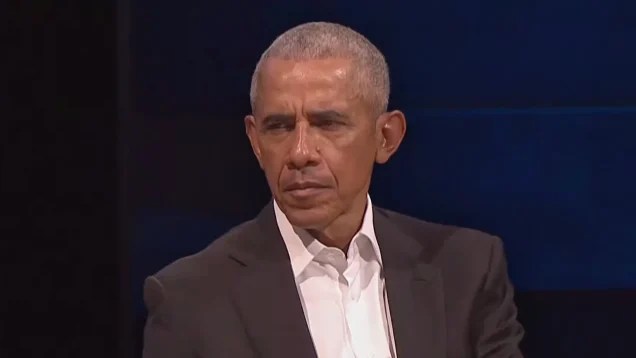
Former US President Barack Obama made a fresh push for online censorship during an appearance at the Copenhagen Democracy Summit by calling for crackdowns on content that he deems to be “disinformation,” “hate,” or a “conspiracy theory.”
Before Obama took the stage, 2022 Obama Foundation Leader Sarah-Josephine Hjorth hinted at what was to come by railing against “fake news and misinformation.”
“While the increase in use of smartphones and social media first came with the whisper of renewed democratic participation, fake news and misinformation dominate the digital landscape and result in an erosion of the fabric of truth and polarization,” Hjorth said.
Shortly after taking the stage, Obama continued this theme by invoking the January 6 Capitol riot and tying it to “misinformation and conspiracy theories.”
“In my own country, the forces that unleashed mob violence on our Capitol are still churning out misinformation and conspiracy theories,” Obama said.
Towards the end of his speech, Obama made a more direct call for censorship of content that’s branded as a conspiracy theory, disinformation, or hate.
“We have to take steps to detoxify our discourse,” the former President said. “Particularly the scourge of disinformation and conspiracy theories and hate online that has polluted our political discourse.”
Obama continued by demanding that technology companies “accept a certain degree of democratic oversight and accountability” and noting that he spoke at length about these issues during his April 21 speech at Stanford University.
In his Stanford speech, Obama called for “solving the disinformation problem,” welcomed social media censorship of “hate speech,” and said that content moderation “doesn’t go far enough.”
After finishing his speech, Obama invited three 2022 Obama Foundation leaders, Tudor Iulian Bradatan, Selvije Mustafi, and Federica Vinci, to the stage. He then complained about the increased amount of misinformation since he left office and the difficulty of “sorting between what’s true and what’s false, what’s journalism and what’s fabrication.”
Obama continued by claiming that the politicization of COVID issues, such as getting vaccinated or wearing masks, was “driven just by misinformation that was out there.”
“I’m wondering how…it’s [misinformation] affected you and whether you’ve seen some solutions to…help young people distinguish between what’s true and false in making decisions about how to participate and what to support?” Obama asked.
Mustafi, a national grassroots organizer at the biggest Roma movement in North Macedonia, said “there are big concerns also in our movement about how…false information and misinformation is spreading on the internet to influence decisions by some political actors or political sides.”
She added that the challenge of this kind of fake news and misinformation is that it makes people have a “different kind of opinion which is not necessarily relevant or truthful.”
Vinci, the Deputy Mayor of Isernia, Italy, described the spread of “false news” and “false noise” as “scary.”
Obama’s Copenhagen Democracy Summit and Stanford University speeches are some of the many pushes he’s made for rules that would chill online speech.
Earlier this year, the former President proposed “modifications” to online anonymity when people are “rude, obnoxious, cruel, or lie” and suggested that social media algorithms should be audited by federal inspectors to deal with misinformation.
And in previous years, Obama has called for social media regulations that curb “crazy lies and conspiracy theories” and pushed internet platforms to reduce the influence of hate groups.
‘Boeing falls victim to anti-Russia sanctions’
Samizdat | June 10, 2022
Boeing’s decision to pause production of its popular 737 MAX plane may be due to sanctions imposed on Moscow, air safety expert Roman Gusarov told the newspaper Izvestia. Russia provides critical parts and components to the American aircraft maker.
Last week, the Wall Street Journal reported that Boeing had to bring production of narrow-body jets to a halt for 10 days in May due to supply-chain snarls.
“Boeing’s dependence on Russian titanium is extremely high, amounting to about 30-40%, meaning that at least every third Boeing aircraft is assembled entirely from Russian titanium,” Gusarov said, adding that apart from titanium, which is vital to aircraft engineering, the company also imports titanium products from Russian producer VSMPO-AVISMA.
The analyst added that the US aircraft manufacturer previously received nearly finished parts that were produced at a jointly-run factory in the Russian town of Verkhnyaya Salda.
In March, Boeing suspended titanium purchases from Russia, saying that it had substantial inventory of the metal and could secure additional supplies from other sources. This decision was made after Russia was hit with severe sanctions by the US and its allies.
According to Gusarov, the temporary halt in production of the 737 MAX jets could be attributable not only to the suspension of Russian titanium deliveries but also to the global disruption of supply chains. The expert added that the annual global production of up to 600 planes typically involves engaging nearly all of the global manufacturing capacity of the relevant components.
“After all, Russia has also imposed indirect retaliatory sanctions that target supplies of nonferrous metals and products of gas-to-chemicals industry, which are widely used by microchip producers across the world,” Gusarov said, adding that the products for Boeing are made by thousands of global companies.
In March, Bloomberg reported that the ban of Russian aircraft from US airspace could also hit Boeing because the company used to contract giant Antonov An-124 cargo planes, operated by Russia’s Volga-Dnepr Group, to move supplies to its plants in the US.
Germany demands Serbia impose anti-Russian sanctions
Samizdat | June 10, 2022
Serbia must follow the EU lead in embargoing Russia and recognize its breakaway province of Kosovo as an independent state if it hopes to join the bloc some day, German Chancellor Olaf Scholz said on Friday. At a press conference in Belgrade after his meeting with Serbian President Aleksandar Vucic, Scholz also said that the anti-Russian sanctions won’t end once the fighting in Ukraine stops.
“It is important that many countries join the sanctions, because in addition to deliveries of weapons that is something that helps Ukraine defend its sovereignty and territorial integrity,” Scholz said. “We expect all candidates for EU membership to join the sanctions as well.”
Brussels has so far adopted six “packages” of anti-Russian sanctions, with the most recent one including a phased ban on oil imports. These EU sanctions are “not something that will end when the hostilities are over,” Scholz said in Belgrade.
Instead, the German chancellor explained, Russia must accept it “cannot dictate the terms of peace” to Ukraine and guarantee Kiev’s sovereignty and territorial integrity, before the EU would consider lifting the embargo.
Russian President Vladimir Putin said on Thursday that the sanctions have backfired on the West, citing examples of inflation and shortages that US and EU governments are now trying to blame on Moscow. US Treasury Secretary Janet Yellen admitted on Friday the sanctions have made a “huge difference to food and energy prices,” amid record-setting inflation.
Vucic praised Serbia’s economic cooperation with Germany but reiterated that sanctioning Russia would be a difficult proposition for Belgrade. Earlier this week, he told Serbian television that the EU oil embargo has already cost $600 million in higher prices.
At the World Economic Forum meeting in Davos last month, Vucic said there was “no possibility” of anti-Russian sanctions at the moment and expressed pride that Serbia had been able to maintain its own, independent policy despite ongoing pressure.
On Friday, however, he said he “understood perfectly” Scholz’s demands, adding that “the chancellor will be notified of all our decisions going forward.”
Sanctioning Russia was not the only demand Scholz made to Belgrade, however. The German chancellor started his Balkans tour in Pristina, the capital of the breakaway Serbian province of Kosovo, which declared independence in 2008 with NATO backing.
“It is unimaginable for two countries that don’t recognize each other to become EU members,” Scholz said in a press conference with Kosovo prime minister Albin Kurti, which was widely interpreted to mean that Serbia must recognize the breakaway province before hoping to join the bloc.
“We first heard of this at the press conference in Pristina,” Vucic said later on Friday, adding that it came as a surprise, since until now the EU demanded “normalization” of relations, not recognition. He told reporters he had told Scholz that Serbia values its own integrity “as much as you value the integrity of Ukraine.”
“But Germany is powerful and we are small. It’s up to us to figure out how to deal with that.”
Zelensky’s delay in opening sea corridor threatens the globe with hunger
By Paul Antonopoulos | June 10, 2022
Hundreds of Ukrainian mines floating in the Black Sea threaten to halt tens of millions of tons of grain from being exported. Ukrainian officials claim it would take six months to clear the mines, something which directly contradicts the long-held claim that Russia’s naval blockade is preventing the export of wheat.
Markiyan Dmytrasevych, an adviser to Ukraine’s Minister of Agrarian Policy and Food, said that regardless of any agreement with Russia, thousands of mines would remain floating around the port of Odessa, making the export of wheat difficult. According to Dmytrasevych, it will take until the end of the year to clear out all the mines, thus making a mockery of the months-long disinformation campaign that Russia was blockading Ukrainian wheat shipments and therefore responsible for any global food shortage.
Russia and Ukraine collectively supply about 40% of the wheat consumed in Africa, and due to the war and consequential anti-Russia sanctions, prices have already risen by about 23% across the continent. The two countries also account for about 33% of the world’s grain supply, and wheat prices have skyrocketed by a third since February 24.
To derail a global food crisis, Ukraine’s Black Sea coastline will have to be demined. However, demining efforts require specialized equipment to scour wide swaths of open water, something Kiev was fully aware of when it began mining the Black Sea.
NATO issued a warning on June 1, stating: “Drifting mines have been detected and deactivated in the Western Black Sea by coastal nation’s authorities. The latest statement of regional authorities, confirming another sighting of a mine, shows the threat of drifting mines in the Southwest part of the Black Sea still exists.”
Along with the obvious problem associated with traversing mine-laden waters, shipping insurance for vessels heading to the region has skyrocketed. “There is clearly a growing nervousness around the region in the insurance market, especially in relation to the Black Sea,” Marcus Baker at insurance broker and risk adviser Marsh told Reuters.
Ukraine President Volodomyr Zelensky told the Financial Times that while, in theory, he supports a maritime corridor, no Russian vessels should be allowed access. “On UN-led talks to restore access to Ukrainian Black Sea ports, Zelensky was willing to back the idea of a maritime corridor to enable grain exports from Ukrainian ports as long as no access was given to Russian ships,” the paper reported. “There was no need for a dialogue with Moscow to resolve the blockade given that the only threat to world food supplies was coming from Russia.”
However, despite Kiev now acknowledging that demining efforts could take up to six months, Zelensky is still attempting to blame Russia’s naval blockade as the reason why 75 million tons of grain could be stuck in Ukraine after the summer season.
Latvian Prime Minister Krišjānis Kariņš is also disingenuous to the situation, questioning to the Atlantic Council on June 8 whether “a US or French warship [should] go through the Bosphorus and dock in the port of Odesa?”. Of course, his suggestion completely omits that US and French warships would not only have to break the Russian blockade, but also traverse mined waters.
None-the-less, Ukraine is in a difficult position. As the country unrelentingly refuses to negotiate an end to the war with Russia on the open orders of Washington and London, Ukraine does not want to weaken its coastal defenses around Odessa. However, at the same time, it has been exposed that Ukraine’s Black Sea mines are responsible for halts in the export of wheat, and not Russia’s naval blockade as Western leaders, officials and media led to us to believe for months.
Despite offering a way out of the emerging food crisis by calling for the demining of the Black Sea and the creation of a maritime safe corridor, Ukraine Foreign Ministry spokesman Oleg Nikolenko tweeted on Wednesday that the words of Russian Foreign Minister Sergey Lavrov “are empty.”
“Ukraine has made its position on the seaports clear,” Nikolenko tweeted. “Military equipment is required to protect the coastline and a navy mission to patrol the export routes in the Black Sea. Russia cannot be allowed to use grain corridors to attack southern Ukraine.”
As Kiev stubbornly continues to carry out the demands of the US and UK, it appears that the establishment of a safe corridor for the export of grain from Ukraine will not emerge anytime soon, thus artificially creating a global food crisis that can be relatively easy to resolve, despite the inevitability of high wheat prices. Most disingenuously though is the continued portrayal that Ukraine is not responsible for the halt of exports, however, even this has been exposed to the point that Western media cannot ignore Kiev’s refusal to demine its coast.
Paul Antonopoulos is an independent geopolitical analyst.
On Ukraine, ‘progressive’ proxy warriors spell disaster
Urging leftists to support the Ukraine proxy war, Bernie Sanders aide Matt Duss whitewashes the US role, attacks The Grayzone, and advocates dangerous militarism.
By Aaron Maté | The Grayzone | June 7, 2022
The unanimous vote by progressive lawmakers for the $40 billion Ukraine funding bill has been followed by a near-unanimous refusal to defend it. To date, no member of the Congressional Progressive Caucus – with the sole exception of Cori Bush – has publicly explained why they chose to hand over billions of dollars to the weapons industry and intensify a proxy war against nuclear-armed Russia.
Amid this resounding silence, Matt Duss, a foreign policy adviser to Sen. Bernie Sanders, has stepped in to fill the void. In a New Republic article titled “Why Ukraine Matters for the Left,” Duss attempts to convince fellow progressives that the “provision of military aid” to Ukraine “can advance a more just and humanitarian global order.” Duss has only praise for a Biden administration that, in his view, “should be applauded for its judicious reaction to the Ukraine crisis.” By contrast, Duss opts to launch an attack on dissident journalists, myself included, who don’t share his enthusiasm.
To make his case, Duss omits an abundance of inconvenient facts, betraying either considerable ignorance of the Ukraine-Russia conflict or a deliberate effort to distort it.
While apologia for US hegemonic projects is normal in DC foreign policy circles, Duss’ contribution is particularly noteworthy given his painstaking attempt to cast himself as an outsider. “Our political class,” Duss states, “advocates military violence with a regularity and ease that is psychopathic.” Duss’ comment is both accurate and wildly ironic, given his choice to advocate our political class’s military violence in Ukraine — with the remarkable ease that he identifies in others as psychopathic.
When it comes to how the Biden administration has handled the Ukraine crisis, Duss cannot identify a single fault. “The Biden team clearly did not seek this war,” Duss claims, and “in fact… made a strenuous, and very public, diplomatic effort to avert it.”
Duss does not explain what the administration’s “strenuous” diplomacy entailed, perhaps because even its top officials now openly admit that none existed.
In an interview with War on the Rocks, State Department counsellor Derek Chollet was asked if NATO expansion into Ukraine was “on the table” in pre-invasion contacts with Russia. “It wasn’t,” Chollet replied. The White House, Chollet explained, “made clear to the Russians that we were willing to talk to them on issues that we thought were genuine concerns they have that were legitimate in some way,” including “arms control.” (emphasis added) But when it comes to “the future of Ukraine” and its potential NATO membership, Chollet said, this was deemed a “non-issue.”
To Duss, the Biden administration’s (openly admitted) refusal to even discuss Russia’s core demands – and to only entertain issues that it deemed to be “legitimate” on Russia’s behalf – is apparently a “strenuous diplomatic effort.” If “diplomacy” amounts to enforcing US hegemony, as many in DC seem to believe, then Duss would have a case. But in the rest of the world, where diplomacy entails constructive dialogue with a semblance of parity, he does not.
Duss also takes aim at the argument, advanced by prominent leftists including former Brazilian President Lula da Silva, that a US-European pledge that Ukraine won’t join NATO “would have solved the problem” with Russia.
To refute Lula, Duss stresses that “in the weeks leading up to the war, U.S. allies, specifically German Chancellor Olaf Scholz and French President Emmanuel Macron, signaled clearly” that Ukraine’s NATO ascension “was not going to happen.” According to Duss, it is Putin who sabotaged their efforts by invading, and who “has now made that discussion moot.”
Duss omits what also happened in the weeks leading up to the war. While Germany and France did indeed float a proposal to keep Ukraine out of NATO, it was Ukraine – with US backing – that rejected it. According to an account in the Wall Street Journal, Scholtz proposed to Volodymyr Zelensky on Feb. 19 – five days before Russia’s invasion — that Ukraine “renounce its NATO aspirations and declare neutrality as part of a wider European security deal,” signed by both Putin and Biden. But Zelensky rejected Schultz’s plan, a response that “left German officials worried that the chances of peace were fading.” In dismissing the Germans’ NATO proposal, Zelensky joined the Biden White House, as State’s Derek Chollet acknowledged and other Biden officials made clear in public.
Ignoring US-Ukrainian rejectionism, Duss then declares that “it seems absurd to suggest that even an ironclad public pledge from President Biden that Ukraine would never be accepted into NATO would have convinced Putin to draw back the 180,000 troops he had placed on Ukraine’s borders.” Perhaps, but that very public pledge happened to be the centerpiece of Germany’s last-minute diplomatic effort – one that Duss himself invoked, and that Zelensky (along with Biden) chose to reject.
Duss’ whitewashing of the Biden administration’s rejection of diplomacy before the Russian invasion carries over to the period since.
Since Russia’s invasion, Duss says, the White House has “acted with restraint and care not to get drawn into a wider war with Russia.” While it is true that Biden has opted not to start World War III – in other words, has opted not to trigger a global suicide pact — he has done anything but act with “restraint.” One day before Duss’ article was published, Biden authorized the delivery of medium-range advanced rocket systems to Ukraine. These rockets have the capacity to strike inside of Russia; the US is acting on Ukraine’s assurance that it won’t.
Duss may support undermining diplomacy in Ukraine and shipping off billions of dollars worth of heavy weaponry instead, but this can only be described as “restraint” if the sole measure is an immediate — rather than merely prospective — nuclear holocaust.
Duss is so impressed with Biden’s handling of the war that he cannot even detect a tangible path that could end it. “As of this writing,” Duss declares, “I have seen no evidence of a settlement in the offing—as in, a deal that Putin would actually entertain, let alone accept—that we’re refusing to ‘push for.'”
If Duss cannot see evidence of a realistic settlement that Russia could accept, then he is being willfully blind. Russia’s explicit proposals, issued before the war and after, including two weeks into the invasion, called on Ukraine to “cease military action, change its constitution to enshrine neutrality, acknowledge Crimea as Russian territory, and recognise the separatist republics of Donetsk and Lugansk as independent states.”
It is worth noting that the latter is Russia’s only new condition: for the eight years before the February invasion, Russia formally accepted the Minsk accords, which, to end the Donbas war, would have kept the Donetsk and Lugansk regions inside Ukraine’s borders, with limited autonomy.
Duss is free to argue that Russia’s terms for ending the war are unacceptable. But to pretend that Russia has not even laid out those terms, is to essentially advocate that the war never end.
By omitting Russia’s stated terms for a settlement, Duss also allows himself to erase one of the invasion’s key causes: the 2014 Maidan coup, and the ensuing eight-year Donbas war that had left more than 14,000 people dead by the time Russian forces crossed the border on February 24th.
In his 2500+ word piece, Duss makes no mention of the Donbas war and how it began: the 2014 ouster of a democratically elected Ukrainian president, with new leadership selected by Washington; the coup government’s assault on Ukraine’s ethnic Russian and anti-coup citizens, who launched a rebellion in the Donbas; the critical role of fascists and neo-Nazis in the Maidan coup and the Donbas war since; the fascist-led sabotage of the 2015 Minsk accords, which could have put an end to the conflict. By omitting this history, Duss can also omit how the US has helped undermine the Minsk agreements by siding with Ukrainian’s far-right and choosing to use the Donbas war to “fight Russia over there” (Adam Schiff) and “make Russia pay a heavier price,” (John McCain), because Ukraine’s “fight is our fight.” (Lindsey Graham).
After ignoring Russia’s stated grounds for a peace settlement, Duss goes on to disingenuously claim that the Ukrainian government has been pushing for one.
“Ukraine presented Russia with a far-reaching set of proposals over a month ago, including a commitment to ‘permanent neutrality,’” Duss claims. “Volodomyr Zelenskiy continues to offer to negotiate directly with Putin to end the war.”
It is true that Ukraine presented Russia with a 10-point plan in late March. But Duss omits what happened immediately after: while Russia “signaled its preliminary support,” (RAND analyst Samuel Charap) Ukraine’s Western backers sabotaged it, and Zelensky acquiesced. In early April, Ukrainian and Russian officials were finalizing details for a Zelensky-Putin summit. But UK Prime Minister Boris Johnson traveled to Kiev and ordered him to halt diplomacy. Citing sources close to Zelensky, Ukrayinska Pravda reports that Johnson informed his Ukrainian counterpart that Putin “should be pressured, not negotiated with.” Johnson also relayed that even if Russia and Ukraine chose to sign security guarantees, the UK and its allies would not take part – rendering any such agreement worthless.
Zelensky clearly received the message, as Duss’s own source makes clear. When Duss claims that Zelensky “continues to offer to negotiate directly with Putin to end the war,” he links to a Reuters article that reveals such an “offer” to be hollow. Zelensky, Reuters reports, said he would only negotiate with Putin if Russia first withdrew entirely from Ukraine – an obvious non-starter. “Get out of this territory that you have occupied since February 24,” Zelensky said. “This is the first clear step to talking about anything.” Zelensky also “ruled out suggestions… that Ukraine should make concessions for the sake of securing a peace agreement that would allow Putin to save face.”
Thus, returning to Duss’ rendering, Zelensky’s “far-reaching proposals” were immediately rescinded under Western orders, and Zelensky’s “offer to negotiate” was premised on a condition that would have made negotiations impossible.
None of this is to suggest that Russia was justified in launching an invasion of Ukraine. To defend the use of force, which has been so catastrophic, Russia has to meet a high burden of evidence that, in my view, it has not. But one does not need to defend Russia’s invasion to see through Duss’ attempt to whitewash the US role in provoking and prolonging it.
Tellingly, Duss is openly hostile to journalists who have reported on the context that he has omitted. Out of nowhere, Duss introduces an attack on The Grayzone, the Max Blumenthal-founded news outlet that I work for. While Duss has nothing but praise for Biden, he has nothing but ad hominems for us (“pernicious authoritarian agitprop,” “atrocity-denying grifters” “click-baiting provocateurs”). After sharing this vitriol, he then immediately declares that engaging with us is “wasting time.”
I feel the same way about his juvenile name-calling, but interested readers can judge for themselves whether his insults are supported by facts. (He links to two “sources,” one a Medium blog post that, true to the neo-McCarthyite norm, peddles innuendo that The Grayzone is funded by Russia, among other smears).
If Duss is genuinely concerned about wasting time, he also might reflect on why he devotes ample space to paying lip service to progressive principles, only to ultimately endorse policies that flagrantly violate them. “Centering opposition to U.S. imperialism and militarism is an entirely appropriate starting point,” Duss states. Yet Duss’ desired end point would see leftists center U.S. imperialism and militarism, with disastrous results: among them, prolonging a proxy war against a nuclear armed power, threatening a worsening global food crisis, and sentencing more Ukrainians to death.
Even putting aside US complicity in the Ukraine proxy war and its dangers for the planet, progressives like Duss might wish to consider the likely political consequences. One obvious guide is the election of 2016, when Donald Trump won over a significant portion of voters by claiming to oppose the military interventionism that Duss is now urging progressives to embrace. Having seemingly learned nothing from 2016, Democrats in 2022 are again ceding anti-war sentiment to Republicans, 68 of whom voted against the $40 billion Ukraine bill in the House and Senate (versus zero Democrats).
As at least some Republicans vote against the proxy war, Biden has defended the domestic pain caused by his Ukraine proxy war by blaming “Putin’s Price Hike” and trying to argue that “defending freedom is going to cost.” Biden’s defense of “freedom” in Ukraine is now costing him a transatlantic flight to grovel at the feet of the Saudi autocracy, in the hopes of staving off a humiliating cost in the November midterms.
Continuing his mealy mouthed approach, Duss both claims to support diplomacy while simultaneously declaring it to be unattainable. The US, he says, “should certainly be actively engaged in finding a diplomatic path to end the war, and avoid committing to maximalist aims that could foreclose one.” But yet, according to Duss, “for the moment that path is unclear.”
If the path toward peace for Ukraine is unclear to Duss, then that can only be because he has chosen to erase the factual background and the diplomatic solutions on offer, thereby reinforcing the “maximalist aims” that he claims to oppose. Duss’s proxy war apologia will certainly win him a warm reception in establishment DC circles. For the US progressive movement, Ukraine, and the rest of the planet, it only spells disaster.
France investigating nuclear ‘cover-ups’
Samizdat | June 10, 2022
The French government is investigating whistleblower allegations that a state-run utility agency attempted to conceal safety issues at a nuclear power plant. Prosecutors confirm they are following up on complaints filed late last year.
Officials in Marseille launched an investigation into the alleged safety problems last month after an anonymous whistleblower said conditions at the Tricastin nuclear plant in southern France were “endangering the lives of others,” French newspaper Le Monde reported on Wednesday.
An engineer at the facility, the whistleblower also accused officials at the plant of “harassment,” as well as “violations of the criminal code, the environmental code, the labor code and the regulations relating to nuclear installations.” Though incidents continued – including a mysterious power surge at one reactor in 2017 and a flood at the same station one year later – no action was taken.
The largely state-run firm which operates the plant, Electricite de France (EDF), confirmed the ongoing investigation to the Wall Street Journal, saying the probe would help to “shed all necessary light on the alleged facts and thereby show the truth.”
Speaking to Reuters on Thursday, a lawyer for the whistleblower, William Bourdon, said the complaint was initially filed in November, but noted that the subsequent investigation does not target EDF directly. Instead, a probe “against X” has been launched, allowing prosecutors to look into the actions of multiple different parties.
The new investigation marks another blow for the French utility, which has recently taken half of the country’s nuclear reactors offline due to scheduled maintenance and refueling, and even outages caused by corrosion and damage. The spate of shutdowns coincided with soaring energy prices across Europe and elsewhere, driven in part by the conflict in Ukraine, as well as Western sanctions on Russian gas and oil exports.
The cost of inspecting and repairing the French nuclear plants could exceed €4.5 billion ($4.8 billion), according to recent EDF estimates, well beyond previous expectations. France derives around 70% of its electricity from nuclear power, and has seen a jump in prices throughout 2022.
Prior to the whistleblower filing, the Tricastin nuclear site had encountered some safety issues, including two separate uranium leaks within a matter of days in July 2008 which contaminated 100 employees at the plant and led to a ban on using local water for drinking, swimming, and agriculture.
Wired retracts statement accusing Substack of “paying extremists”
Substack supports “open debate,” not censorship.
By Christina Maas | Reclaim The Net | June 10, 2022
In one of its recent articles attacking Substack, which has a relatively open free speech policy, Wired falsely claimed that the newsletter platform “actively recruits and pays extremists.”
The tech outlet was forced to retract the statement after Substack’s head of communications Lulu Cheng Meservey, who has done a good job in speaking out in support of free speech, took to Twitter to expose how Wired did not provide evidence and refused to provide evidence of their claims even after Substack pointed that out to the outlet privately.
“We do not and have not, and he can’t name any examples,” Meservey wrote in one of the tweets. “Yet when approached about it, he said: ‘I’d be happy to remove it if you could provide evidence that it’s inaccurate.’”
Meservey rightly pointed out that is not how journalism works.
“It’s not journalism to make an unfounded claim and demand contrary “evidence” to remove it. It borders on extortion: we will defame you unless you give us what we want,” she wrote.
She likened what Wired did to a news outlet accusing you of laundering money “and when you protest, they refuse to issue a correction unless you give them your financial statements,” adding that the “burden of proof is on the journalist, not the subject.”
Meservey went on to note that not only was evidence not provided, the writer did not make an attempt to show any of the allegedly recruited people were extremists.
The false claim was retracted but it is a testament to the recent smear campaign against Substack. The newsletter platform allows journalists, writers, and other content creators to make money, as it is subscription-based, meaning creators can avoid having to rely on invasive advertising practices.
Where’s the Emergency? 18 Congress Members Demand Answers as FDA Set to Approve COVID Shots for Kids Under 5
The Defender | June 8, 2022
Members of Congress today demanded answers from Dr. Robert M. Califf, commissioner of the U.S. Food and Drug Administration (FDA), as the agency reviews Emergency Use Authorization (EUA) for COVID-19 shots in children age 5 and under.
The FDA’s Vaccines and Related Biological Products Advisory Committee (VRBPAC) is meeting on four separate occasions in June to discuss additional EUAs that would provide cradle-to-grave COVID-19 shots — and to consider a “Future Framework” that will permanently lower the bar for safety and efficacy, according to Toby Rogers, Ph.D.
A letter signed by Sen. Ted Cruz (R-Texas), Rep. Bill Posey (R-Fla.) and 16 other members of Congress today asked Commissioner Califf 19 questions about the safety of COVID-19 vaccines for young children.
The questions focused on the youngest children (6 months to 5 years) due to the Congress members’ concerns about what they called the FDA’s “one-size-fits-all” approach to the vaccines.
“The data show that the risks of serious adverse outcomes for COVID for children five and under is very low and as such the standard for evaluating EUA interventions must be very high,” the letter states.
“We believe it is prudent and necessary that the FDA provide answers to a number of questions before approving EUA vaccines for children under age 5, including more than 70% of whom are already seropositive for COVID-19.”
The VRBPAC meetings began Tuesday. The meeting schedule is:
- June 7 — EUA for Novavax’s COVID-19 shot for adults.
- June 14 — Amendment to Moderna’s EUA to include primary series to children and adolescents 6 through 17 years of age.
- June 15 — Amendment to Moderna’s EUA to include primary series for children 6 months to 5 years and amendment to Pfizer’s EUA to include the primary series to children 6 months through 4 years of age.
- June 28 — Proposed “Future Framework” for COVID-19 shots.
The Congress members’ letter presses the FDA to address unanswered questions regarding the risks and benefits of administering COVID-19 vaccines to children.
They ask the FDA to explain, among many other things:
- What the cardiac risk factor is for children who receive EUA COVID-19 vaccines.
- Why the FDA recently lowered the efficacy bar for COVID-19 vaccines for the youngest children.
- When the FDA and the Centers for Disease Control and Prevention (CDC) will provide the public with more details on children’s serious adverse outcomes from COVID-19 infections.
- If it is possible that administering the vaccines in young children could predispose them to increased risk from future novel COVID-19 variants.
- How many children ages 5 and under with and without pre-existing medical conditions have died from COVID-19 or its variants.
Finally, the letter asks Commissioner Califf to “please list the medical emergencies [among] children 0 to 4 years old that enables the FDA to approve the COVID vaccine for children using its EUA.”
Children’s Health Defense calls for action
Mary Holland, Children’s Health Defense (CHD) president and general counsel, called the FDA’s Future Framework proposal “quite possibly the worst idea in the history of public health.”
Children under 18 with no comorbidities have virtually no risk of death from COVID-19, according to a November 2021 study published in Nature.
A July 2021 preprint paper found children have a 99.995% recovery rate, and the vast majority of children have minimal symptoms.
The Nature study described how children between 3 and 11 years of age mount effective, robust and sustained immune responses to COVID-19.
The CDC’s own data show that at least 75.2% of children ages 0 to 11 and 74.2% of adolescents ages 12 to 17 already have superior natural immunity.
There is no clinically significant health benefit from the mRNA vaccines, according to Moderna. Reporting on its Phase 2/3 KidCOVE study, the company said, “the absence of any severe disease, hospitalization or death in the study precludes the assessment of vaccine efficacy against these endpoints.”
Preliminary data showed the shots were only about 44% effective at preventing symptomatic infection in children 6 months to 2 years old, and 37% effective in children ages 2 to 5 — both below the 50% level that regulators generally called the minimum level for EUA approval in 2020.
In New York, officials observed that Pfizer’s efficacy against Omicron plummeted from 68% to 12% after 7 weeks in children ages 5 to 11.
“These shots are dangerous and carry very real risks,” Holland said.
Studies show vaccinated children face a substantial risk of myocarditis. Moderna’s EUA application, originally filed in June 2021, has already been held up because of a clear safety signal for myocarditis, which prompted a number of European countries to prohibit its use in young people.
Additionally, the Vaccine Adverse Events Reporting System or VAERS has more than 48,500 reports of adverse events in children, including 112 deaths (as of May 27), and a growing number of reports of encephalopathies, clotting issues, diabetes and neurological problems in children following COVID-19 shots.
© 2022 Children’s Health Defense, Inc. This work is reproduced and distributed with the permission of Children’s Health Defense, Inc. Want to learn more from Children’s Health Defense? Sign up for free news and updates from Robert F. Kennedy, Jr. and the Children’s Health Defense. Your donation will help to support us in our efforts.
Featured Video
Revive Iran’s MOU Deal or Face a Forever War
or go to
Aletho News Archives – Video-Images
From the Archives
China names world’s ‘hacking empire’
RT | March 15, 2022
Calling the US a “hacking empire” of the world, the Chinese Foreign Ministry urged Washington to stop “malicious” cyber activities following reports that American hackers subverted a network in China to launch attacks on Russia and Belarus.
“China is gravely concerned about cyberattacks against other countries that originate from the US and use China as a springboard,” Foreign Ministry spokesperson Zhao Lijian told reporters at a press briefing on Monday.
Zhao was commenting on recent Chinese media reports that hackers, mainly from the US but also from NATO allies Germany and the Netherlands, recently hijacked a Chinese computer network for cyberattacks, 87% of which targeted Russia.
“Against the background of the Ukraine situation, such a move may produce the negative effect of misleading the international community and spreading disinformation,” Zhao said, pointing out that “a former US senior official called publicly for launching cyberattacks on Russia not long ago.”
This appeared to be a reference to Hillary Clinton, former US secretary of state and presidential candidate, who made the calls in an MSNBC interview at the end of February. … continue
Blog Roll
 Aletho News
- Iran-Linked Ships Spotted Hovering over Subsea Cables: Report
- New attack on Iran could devastate ‘Israel’, IOF general warns
- Nuclear deterrence: The US-Israeli military aggression against Iran made the unthinkable legitimate
- U.S. Midterms – a Referendum on Israel and Zionist Power
- Twice as many Canadian Jews serve in Israeli military as Canada’s armed forces: Report
- Thousands of Syrian troops set to join Saudi war on Yemen
- Jared Kushner’s Diplomacy for Hire
- Russia backs Tehran’s conditions in talks with US, Iran’s envoy says
- Irish ‘fake news’ expert exposed as fake
- China expresses strong opposition to Dutch report alleging Chinese cyberattacks
- If Americans Knew
- An error has occurred; the feed is probably down. Try again later.
- No Tricks Zone
- Zonal Asymmetry of Temperature Change in the Antarctic Circumpolar Current
- New Study: The Net Fossil Fuel Contribution To Rising Atmospheric CO2 Has Been Zero For 500 Years
- Germany’s Green Energy Transition Becoming Increasingly Expensive…Another 6 Trillion Euros!
- Sudden Stratospheric Warming, Powerful El Niño Combination May Lead To Extreme Europe Cold, Energy Crisis!
- Two New Studies Find Thwaites Glacier Melt Cannot Be Driven By Human Activity Or A Warming Ocean
- E-Cars Reduce CO2 Emissions By Only 41% Compared To Internal Combustion Engine Vehicles
- Predictions Made By Renowned Climate Professor Over Past Decades Have Been Proven To Be Poor
- New Study Suggests Large Regions Of The Pacific Ocean Have Been Cooling For The Last 80 Years
- Germany’s Green Energy Debacle: High Energy Costs Force Kahla Porzellan to Close After 182 Years!
- New Study: 50 Years Of The Most Aggressive ‘Net Zero’ Policies Can Only Affect The Global Climate By 0.03°C

