Independent Pharmacovigilance Report Confirms Evidence for Recall of Covid-19 Vaccines
World Council for Health | June 11, 2022
Adverse Reactions for Novel Covid-19 Vaccines More Numerous Than for Similar Products by Factor of Between 10 and 169
BATH, UK — A new report prepared by the World Council for Health (WCH) has confirmed that data on adverse drug reactions from the experimental Covid-19 vaccines exist in an amount sufficient for the recall of similar products in the past.
The report was prepared to determine whether sufficient pharmacovigilance data exist on official and public databases (WHO VigiAccess, CDC VAERS, EudraVigilance, and UK Yellow Card Scheme) to establish a safety signal on the novel Covid-19 injections.
On all databases, it was found that adverse drug reaction (ADR) reports linked to Covid-19 injections are more numerous than other similar products by a factor of between 10 and 169 (see graph below). Many of the ADR reports are serious in nature and there exists sufficient evidence of associated harm on these databases to indicate a product recall.
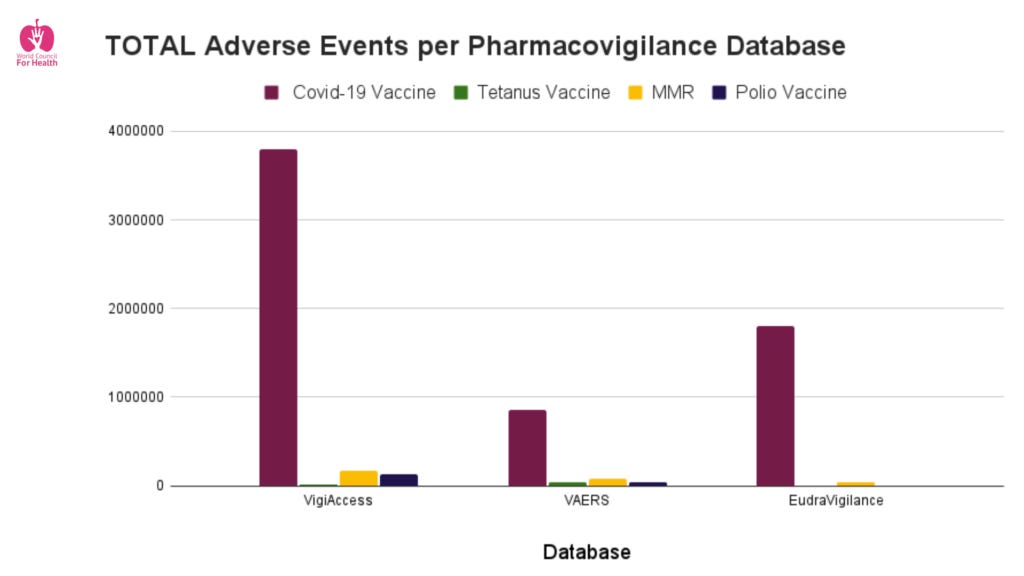
Total Adverse Events per Pharamacovigilance Database
In total, more than 40,000 deaths are linked to the novel Covid-19 vaccines in the official databases analysed.
In addition, the WCH pharmacovigilance report found that several thousand adverse drug reactions on official databases are related to the use of the experimental Covid-19 vaccines among young boys and girls for whom the vaccine had not been approved at the time.
The purpose of pharmacovigilance databases is to provide a signal of safety, and not to prove causality. To ensure that harms are detected in time, suspicion that an event is linked to the administration of the medicine is enough to register an event. “There is no need to prove that the medicine caused the adverse reaction, just the suspicion is good enough,” Dr. June Raine, head of the UK’s Medicines and Healthcare products Regulatory Agency, said in 2006. When sufficient pharmacovigilance data show a signal of harm, administration of the product should be ceased, the product recalled, and the safety signal investigated.
It should also be noted that such systems of passive surveillance result in significantly fewer ADR reports than active surveillance reporting. As a result, the actual number of adverse events that occurred in temporal relation to Covid-19 injections is likely to be much higher than revealed by the available official data.
In December 2021, World Council for Health called on regulators and governments around the world to immediately cease use of all experimental Covid-19 injections.
Dr. Tess Lawrie, co-founder of the World Council for Health, calls for people to come together to raise awareness of vaccine injury so that those harmed can get the help they deserve. “It is concerning that a grassroots organisation has had to do this work and point out that none of these experimental vaccines are safe according to publicly available official data. Why have the regulators not done their job and protected us?“
***
World Council for Health Covid-19 Vaccine Pharmacovigilance Report: https://worldcouncilforhealth.org/resources/covid-19-vaccine-pharmacovigilance-report/
World Council for Health Calls for an Immediate Stop to the Covid-19 Experimental “Vaccines”: https://worldcouncilforhealth.org/campaign/covid-19-vaccine-cease-and-desist/
World Council for Health Statement on Covid-19 Vaccines: https://worldcouncilforhealth.org/news/2021/12/covid-19-vaccines/14001/
World Council for Health Statement on Risk of Myocarditis in Children: https://worldcouncilforhealth.org/news/2022/01/risk-of-myocarditis-in-children/18570/
Contact: Dr. Katarina Lindley at katarina@thewc4h.org
Gaza Running Out of Bread as Authorities Struggle to Find a Solution
Samizdat – 12.06.2022
There are roughly 2.3 million people in the Gaza Strip and they consume 500 tons of flour a day. For years, they have relied on exports from Russia and Ukraine but the outbreak of Moscow’s special military operation has disrupted these supplies sending prices to unprecedented heights. Wheat has long been a staple of Palestinian cuisine.
The outbreak of hostilities between Russia and Ukraine, however, and the subsequent shortage of wheat has led to Gazans tightening their belts.
Adham Al-Basiouny, the official spokesman for the Hamas-run Ministry of Agriculture in Gaza, says the enclave’s small quantities of wheat will barely last weeks.
“What we are seeing now is a serious crisis. We are struggling to obtain wheat and its derivatives. And what we have at present does not exceed 30 percent of our citizens’ needs,” he says.
The Gaza Strip does produce its own wheat – the region has 12,000 dunams (approximately 3,000 acres) of fields producing 4,300 tons annually. But that only answers the needs of three to four percent of the 2.3 million inhabitants. Put another way, if the locals consume 500 tons a day, each year the region produces enough to last only nine days.
Unable to rely on their own production, Gazans have turned to Russia and Ukraine, both of which account for nearly a third of global grain production. The outbreak of hostilities in Ukraine have not only disrupted much-needed wheat supplies – it has also put a rocket under prices, squeezing the already impoverished Gazans, who have been living for years under dire economic conditions, further.
Reports suggest that in recent weeks the Gaza Strip has seen a price spike of 20 percent on wheat and its derivatives. In an area, where nearly 60 percent live below poverty line, that rise has not gone unnoticed.
Al-Basiouny says he doesn’t believe the crisis will reach the levels of unrest and clashes which existed in Egypt back in the Seventies. But he acknowledges the situation is acute and that his government needs to do “everything in its power” to cater for the needs of the population.
One of the measures Hamas – that has been running the enclave since 2007 – has already taken is to approach other wheat-producing countries, such as Canada and Australia, to make good the shortfall. Their prices, however, turned out to be higher than those demanded by Russia and Ukraine so the government, whose annual budget is normally no greater than $1 billion, is still struggling to find grain.
Hamas has also threatened local millers and bakery owners with fines and punishments if they are caught manipulating prices.
However, that move has run into certain obstacles, not least because those local merchants who have been importing wheat from the West at inflated prices are reluctant to operate at a loss. They, therefore, are angry with the government for forcing them to work for what they consider to be peanuts.
Once again, Hamas needs to find a solution, and Al-Basiouny says the organisation has no choice but to lobby support from rich donors.
“Right now, we are communicating with a number of donor countries such as Qatar, who would provide us with financial assistance to buy flour,” he says. “We also get flour from the United Nations Relief and Works Agency for Palestine Refugees in the Near East (UNRWA) that provides bread to Palestinian refugees in the enclave, who account for about 85 percent of all residents.”
So far, reliance on what UNRWA provides has kept things stable. But with more and more donors to the organisation cutting back on spending, a situation where Gazans are starving for bread could just be a matter of time.
Damascus Airport Runways Out of Service After Israeli Strikes: Syrian Transport Ministry
Samizdat – 10.06.2022
 The runways at Damascus airport are out of service as a result of airstrikes conducted by the Israeli air force, the Syrian Ministry of Transport said.
On Thursday, the Syrian Defense Ministry said that Israel had fired missiles at a number of targets south of Damascus. Syria said that Israeli warplanes aimed to hit the airport.
“As a result of the Israeli aggression, which hit the infrastructure of the international airport of Damascus, the runways are significantly damaged in several places along with the navigation lighting,” the ministry said, as quoted by the Shams FM broadcaster.
The attack also damaged the second terminal of the airport.
“At the moment, our specialists are working to eliminate the consequences of the airstrikes and repair what was damaged as a result of the attack. The airport’s operations will be resumed immediately after repair and safety checks,” the ministry added.
Syria’s Cham Wings Airlines said earlier that all of its flights were diverted from Damascus airport to Aleppo in the north of the country.
Russia’s Foreign Ministry Strongly Condemns Israeli Airstrike at Damascus Airport
Also on Friday, Maria Zakharova, the Russian Foreign Ministry’s spokeswoman, said that Moscow strongly condemns the Israeli airstrikes at the airport and calls on the Israeli side to halt such activities.
“In this regard, we are forced to emphasize again that the ongoing Israeli shelling of Syria territory … is absolutely unacceptable. We strongly condemn Israel’s provocative attack on critical Syrian civilian infrastructure,” the spokeswoman said in a statement published by the ministry.
Zakharova also said that such strikes create risks “for international air traffic.”
“We demand from the Israeli side to halt such activities,” Zakharova added.
How the West helped Israel take the IAEA hostage
By Syed Zafar Mehdi | Press TV | June 11, 2022
Israel, the world’s eighth-largest nuclear power, initiated its nuclear program in 1952 with technological support from France and the US, the two countries most vocal about Iran’s peaceful nuclear program.
The first nuclear weapons were developed by Tel Aviv somewhere around 1967-1968, according to military think tanks. After that, the production accelerated rapidly, with zero international outcry.
Today, the regime possesses over 90 nuclear warheads with enough plutonium to produce at least 200 nuclear weapons. Around 5 kg of weapons-grade plutonium is required for one nuclear bomb.
Despite its nuclear program being an open secret – thanks to technician Mordechai Vanunu who blew the lid off Pandora’s Box back in 1986 – the regime has obdurately refused to confirm or deny it.
Vanunu, who worked at the Dimona nuclear facility, was in 1988 convicted of treason and sentenced to 18 years in prison. The same year he was also nominated for the Nobel peace prize.
Vanunu isn’t the only one to blow the whistle. In December 2013, former Israeli Knesset member Avraham Burg in a rare admission said the regime possessed both nuclear and chemical weapons, dubbing the official policy of nuclear ambiguity as “outdated and childish”. He was soon reprimanded.
What has emboldened Tel Aviv to accelerate its nuclear activities while wrapping a cloak of secrecy around them is Western sponsorship made possible by Zionist lobbying groups in the US and Europe.
The two countries most critical of Iran’s nuclear program are Israel’s staunchest allies, who helped the regime become a nuclear power. Israel’s weapons-grade fissile material stocks originated in France in the 1960s and the US in the late 1960s.
The US support, in particular, has allowed Israel to escape accountability for its diabolic activities. In a classic case of double standards, successive regimes in Washington have made a conscious effort not to talk about Israel’s nuclear arsenal despite making hullabaloo for non-proliferation in the region.
It began back in 1968 when then-CIA director Richard Helms informed President Lyndon Johnson that Israel had built nuclear weapons and that its air force had conducted aerial maneuvers to drop them.
Johnson’s response, on expected lines, was muted. A year later, at a meeting between just-elected President Richard Nixon and then Israeli premier Golda Meir, it was agreed that Washington will not force Israel to sign the NPT, which had opened for signature months before, in July 1968.
The US policy of silence continued, which helped the illegitimate regime in Tel Aviv escape the scrutiny of the UN nuclear agency. This silence amounted to both cowardice and complicity.
Importantly, and quite scandalously, Israel is not the signatory to the Nuclear Non-proliferation Treaty (NPT). It has repeatedly rejected calls to join the keystone accord of the international arms control regime and refused to give UN nuclear agency inspectors access to its nuclear sites.
Despite the regime’s dismissive approach, the International Atomic Energy Agency has adopted a remarkably soft approach to the point that many see collusion between the two.
IAEA chief Rafael Grossi’s whirlwind trip to Tel Aviv ahead of the UN nuclear agency’s board of governors meeting in Vienna earlier this week lent credence to the plausible Israel-IAEA collusion theory.
Grossi dashed off to Israel to discuss the anti-Iran resolution drafted by the US and the European troika with Israeli officials, aimed at mounting pressure on Iran to give up its legitimate demands.
Does it make sense that the IAEA chief meets the head of an illegitimate regime, which has secretly built a nuclear arsenal and refused to cooperate with the UN agency, to discuss the nuclear program of a country that has signed the NPT, cooperated fully with the agency and fulfilled all its obligations? It smells of something deeply sinister, extremely despicable.
The resolution against Iran at the IAEA board of governors meeting, which has already seen a “firm and proportionate response” from Tehran, blamed Iran for lack of cooperation with the UN agency.
For those unnerved by Iran’s decision to ramp up its nuclear enrichment capacity, it is essential to understand that the Islamic Republic claims its rights under Article IV of the NPT to pursue a peaceful nuclear program for energy purposes, unlike rogue regimes like Israel.
It’s also imperative to understand that the decision to scale up uranium enrichment from 3.65 percent stipulated in the 2015 nuclear deal came a year after former US President Donald Trump in a unilateral and illegal move pulled his country out of the landmark agreement, followed by reinstatement of sanctions.
The negotiations between Iran and the world powers to salvage the deal have been paused not because of Iran’s excessive demands or non-compliance but due to the West’s obstructionism. Iran did everything to save the deal but the other parties continue to make all-out efforts to kill the same deal.
The latest move to remove cameras operating beyond the NPT safeguards agreement at some Iranian nuclear sites and feed gas into machines including IR-6 is a milder reaction to the hostile move at the IAEA board of governors meeting.
As Iran’s nuclear body chief Mohammad Eslami stated, it’s preposterous that the IAEA has been taken hostage by the illegitimate regime, which raises questions over its credibility and independence.
Unless the agency comes out of the ominous Israeli shadow and makes a concerted effort to focus on its professional and technical mandate, beyond politics, Iran reserves the right to take remedial measures.
And as President Ebrahim Raeisi asserted unambiguously, the Islamic Republic will not back down even an inch. The writing is on the wall.
Syed Zafar Mehdi is a Tehran-based journalist, editor and blogger. He has reported extensively from Kashmir, India, Pakistan, Afghanistan and Iran for leading publications worldwide.
Another nudge to vaccinate children and for whose benefit?
The runaway train that refuses to be knocked off course
Health Advisory & Recovery Team | June 10, 2022
When the JCVI considered covid vaccines for children in July 2021, they stated, “JCVI is of the view that the health benefits of universal vaccination in children and young people below the age of 18 years do not outweigh the potential risks”. Even in September 2021, they still said, “A precautionary approach was agreed given the very low risk of serious disease in those aged 12 to 15 years without an underlying health condition that puts them at increased risk.” As HART bulletin readers will know, the Chief Medical Officers eventually recommended the vaccine for 12-15s, in the vain hope of reducing school closures, which of course could have been achieved by simply stopping routine testing of asymptomatic school children and the sending home of healthy contacts.
Roll on to February 2022, when a ‘non-urgent offer’ was made of Pfizer vaccine for 5-11-year-olds, JCVI stated, “This advice on the offer of vaccination to 5 to 11-year olds who are not in a clinical risk group is considered by JCVI as a one-off pandemic response programme. As the COVID-19 pandemic moves further towards endemicity in the UK, JCVI will review whether, in the longer term, an offer of vaccination to this, and other paediatric age groups, continues to be advised.”
If any of our readers has seen this review, we would be pleased to know, as it might help us clarify the surprising appearance of Covid-19 on the NHS routine immunisation programme. Placing an unlicenced preparation onto the routine schedule is unprecedented. It raises serious questions of the legality, given the conditional authorisation was predicated on there being an emergency. It is also of course a subtle way of making parents think this vaccine is just run-of-the-mill. The current low uptake (53% of 12-15s and a mere 8.5% of 5-11s) suggests that at present, parents are well aware that covid-19 vaccines are not the same as other vaccines, either in terms of the risk of the disease for children or in terms of drug safety. They will also be well aware that lots of their triple vaccinated adult friends and family, have been catching covid regardless.
Not content with slipping this drug into the schedule under cover of the 4-day Jubilee holiday, the Local Government Association has been pushing behavioural psychology techniques to increase vaccine uptake in the young. Their opening gambit is, “Younger generations are more likely to be vaccine hesitant partly because they perceive themselves to be at lower risk of developing a severe form of COVID-19”. Surely, this is not a ‘perception’, it is a ‘fact’, which should surely have been viewed as a blessing, rather than an annoyance.
It gets worse: “Highlight the pro-social benefits of vaccination
Behavioural Insight: Emphasising the pro-social benefits of vaccination is particularly effective among young people. Prosocial benefits include achieving herd immunity and protecting others, especially those that are vulnerable and cannot get vaccinated. Combining both informational and emotional content can be effective.” Another one for the fact checkers – the JCVI say, “the benefits to the wider population are highly uncertain.”
And worse: “Highlight social norms about vaccination
Behavioural Insight: Highlighting that there are growing intentions to get vaccinated, that most people are getting vaccinated and that they approve doing so, can effectively encourage vaccine take up. Since young people tend to be more susceptible to peer influence, it is likely that social norms can be particularly effective when targeting this group.
Potential application: Emphasise Social norms in communications targeted towards young people. Make vaccination visible to other young people by setting up vaccination centres in university campuses or schools. Launch an ‘I will get vaccinated’-pledge on social media.”
And faintly ridiculous: “Second vaccine jab compliance
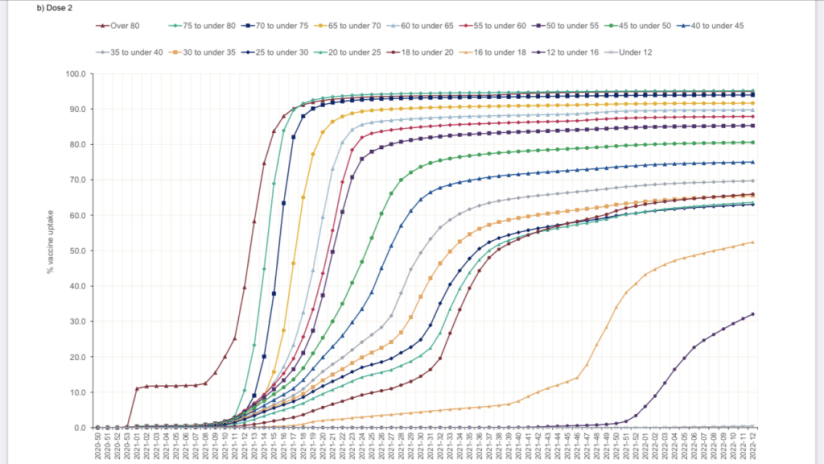
Ensuring residents take their second vaccine dose could be a challenge with which councils can support PHE and the NHS. This could be especially the case if news on vaccine efficacy and new strains undermines the perceived value of the second jab.” Again, the use of the word ‘perceived’ implies that the ‘news’ on vaccine efficacy and new strains is somehow irrelevant to informed consent. No wonder the powers that be don’t want people to see this graph from week 13 of 2022, dropped from the more recent weekly vaccine reports.
Talking to Normies About Vaccination
Thoughts on how to dissuade older friends and relatives from going back to the vaccinators in the Fall

eugyppius | June 7, 2022
The vaccinators are in summer hibernation, but very soon they’ll be with us again, hawking a novel set of wares. The media blitz will start anew and the medical bureaucrats will return to forcing superfluous and potentially harmful medical interventions on millions of people who don’t need them. One day, all of this will be recognised for the absurd hypochondriac panic that it is, but no few people will be hurt, and at least a few will die, before we get there. What follows are some thoughts I have about how to approach especially older acquaintances, who will be at ground zero of the coming propaganda campaign, and who probably don’t need a fifth dose of the magical miraculous mRNA elixir.
First, some notes on normie psychology:
You have to understand that they think the vaccines are the best things ever. They believe Pfizer and Moderna have almost singlehandedly turned the whole pandemic around and given them their lives back. If ever a doubt should creep into their minds about that, they will fall back to believing that being vaccinated is the right pro-social thing to do, and that not being vaccinated is evil, selfish and stupid. It is the unvaccinated who are responsible for variants, who spread Corona and who are prolonging the pandemic. Normies have The Science on their side, and they take great comfort in buying into and espousing the mythology that has been sold to them. This is how sophisticated propaganda and information management works. Contradictory information will make them extremely uncomfortable, and they’ll look for any reason at all not to believe it. If you cause them too much discomfort, they’ll get angry, tune you out, and put you in the antivaxxer bin, where you can be safely ignored.
It’s going to be very hard to win ground here, and your goal shouldn’t be total victory. You just want to get them to think for themselves, consider their own experiences as valid and real information about the world, and break out of the limited vaccinator-cult patterns of thought long enough to ponder how many boosters they really want to put up with.
The most important thing is to present a relaxed, jovial scepticism on key points. The goal is not to argue, but to challenge in an oblique, casual way, while giving as much as you take. Unless we’re talking about somebody who absolutely trusts you and is earnestly seeking your opinion, you shouldn’t be scheduling in-depth conversations or sitting down for a serious talk. You want to raise questions and plant little seeds of doubt, before they ever realise what is happening, and then you want to fade away before they notice that you’re encouraging them to have heretical thoughts.
Weird that the “I-Believe-The-Science(TM)” crowd has completely given up on science
The NY Times announces that henceforth, clinical trials for Covid-19 shots must be abandoned because real world data makes the cartel look bad
By Toby Rogers | June 9, 2022
I. Pharma is losing the game so they are throwing the chess board across the room
The NY Times published a vile piece of fascist Pharma propaganda today. Berenson flagged the online version of the article yesterday. As you know, I have been yelling about the FDA’s Orwellian “Future Framework” for weeks because it’s literally the worst idea in the history of public health.
It turns out that it’s even worse than I thought.
Pharma has already begun a PR offensive to get it across the line and Sharon LaFraniere of the NY Times was eager to do their bidding.
Here’s what’s happening. The mRNA shots are not working against SARS-CoV-2. Everyone knows this. So Moderna and Pfizer are racing to reformulate these shots. The reformulated shots are not working either. Just last week Moderna was touting a bivalent shot that combined Alpha + Beta, but now, apparently, they’ve abandoned that approach. The NY Times article hypes a Moderna shot targeting earlier Omicron variants (it does not say, but perhaps BA.2 and BA.2.12.1?). However evidence from South Africa shows that BA.4 and BA.5 are outcompeting the earlier Omicron variants and the reformulated Moderna shot probably won’t work against the new strains (the virus evolved for a reason — to evade vaccines).
So what are predatory pharmaceutical companies and their feckless government enablers supposed to do!? Abandon clinical trials altogether!
Here’s how the NY Times describes this scheme:
… many experts worry that the virus is evolving so quickly that it is outpacing the ability to modify vaccines, at least as long as the United States relies on human clinical trials for results.
See, it’s not that coronavirus vaccine have failed over and over again (even though they have). It’s that This Wily Virus(TM) is just evolving so quickly that we could not possibly allow human clinical trials of coronavirus vaccines ever again. The only way to beat This Wily Virus(TM) at this point is to abandon science.
Of course it gets worse. The NY Times elaborates:
The problem is that Moderna and Pfizer — the maker of the other main coronavirus vaccine in the United States — do not have enough time now to run more human clinical trials and still manufacture shots before the fall, when the Biden administration is hoping to be able to offer an updated vaccine to counter what public health experts predict will be a winter surge.
See, it’s not that rapacious pharmaceutical companies want to suck all wealth out of the world and put it into their own pockets while setting up a 1,000 year Pharma Reich. No, no, no, silly. It’s just that they “do not have enough time” to do actual science anymore so they are just going to skip all that. Don’t you worry your little head about it.
Furthermore, only a conspiracy theorist would believe that the FDA has abandoned all of its statutory responsibilities to protect public health in order to prostitute themselves to Pharma. The Correct Understanding(TM) is that the FDA is being forced by circumstances outside their control to abandon science. This is not a problem because the cartel is truth, the cartel has always been truth, and since the cartel has decided to abandon science altogether then that’s the new science.
Henceforth, quite literally, the peasants will be forced every six months to inject whatever they are told, with no questions asked, and “they will be [required by law to be] happy about it”.
Instead of human clinical trials the FDA will rely on a few test tube and mouse studies. In the article, Fauci describes this as, “alternative pathways of decision.” That guy just oozes totalitarianism at this point.
So if the “Future Framework” is approved on June 28 the new rules will be: a pharmaceutical company can claim that some new injection creates antibodies in a test tube or mouse (that no one else can see or audit). Done! Ship it and inject it! That’s it. Even though the FDA admits that there are no “correlates of protection.”
In the replies to my earlier articles about the Future Framework some astute readers have pointed out that the FDA has already abandoned human trials when it comes to Covid-19 shots in kids. None of the Moderna or Pfizer clinical trials in kids showed any real world health benefit at all. So they switched to looking at antibodies in the blood and use this tortured mental gymnastics called “immunobridging” to conjure up hypothetical future benefits that never materialize in the real world. Abandoning even the pretense of human trials and moving to test tubes and mice is the obvious next step in this complete abandonment of science.
When people say “I Believe The Science(TM)” what they really mean is “I Support The Genocide.” That’s what’s happening. The FDA has not done science in two years, probably much longer than that.
There is no left and right in politics anymore. Just, the FDA Pharma Fascist Party where members are expected to participate in self-genocide for “the good of society” (read: the profits of the cartel)
vs.
the Rebel Alliance where we practice actual science, critical thinking, logic, and reason, and work every day to protect human health and dignity.
Any politician who wants the 18 million votes of single-issue medical freedom voters in November needs to know that there must be hearings, arrests, and trials of the bureaucrats at FDA, CDC, NIAID, HHS, and NIH who did this to us.
II. What is to be done?
In the meantime, here are the email addresses for all of the public health political appointees, FDA staff, and VRBPAC members who have a say in connection with the “Future Framework”. Please contact them to urge them to reject this nonsense (proposed subject line and email text below — or share your own personal story).
Subject line: The “Future Framework” is the WORST idea in the history of public health. Please vote NO.
1. No Covid-19 shots for kids that failed clinical trials. According to the journal Nature Medicine, children and young people have a 99.995% recovery rate. According to the CDC, the overwhelming majority of children already have natural immunity. The harms from Covid-19 shots in kids are catastrophic.
2. The FDA and CDC must pivot to therapeutics. About twenty off-the-shelf treatments are more effective than vaccines (if used for prophylaxis or early intervention). Get these safe and effective medicines to people who need them and let doctors be doctors again and treat patients based on their own best clinical judgment.
3. Any reformulated Covid-19 shots MUST go through proper HUMAN clinical trials and FDA review. That means:
• large (50,000+ person) double-blind randomized controlled trials with inert saline placebos conducted by an independent third party;
• safety and efficacy studies for two years prior to any application; monitor the treatment and control group for the rest of their lives to record non-specific effects;
• must provide sterilizing immunity with greater than 90% efficacy and less than 0.1% Grade 3 Adverse Events; and
• proper monitoring for carcinogenesis, mutagenesis, and impairment of fertility.
[Contact list:]
sean.mccluskie@hhs.gov, commissioner@fda.hhs.gov, DeanofPublicHealth@brown.edu, Aux7@cdc.gov, Peter.Marks@fda.hhs.gov, Hong.Yang@fda.hhs.gov, Richard.Forshee@fda.hhs.gov, Huilee.Wong@fda.hhs.gov, Leslie.Ball@fda.hhs.gov, Doran.Fink@fda.hhs.gov, CBERVRBPAC@fda.hhs.gov, hanae@bcm.edu, paula.annunziato@merck.com, adam.berger@nih.gov, hbernstein@northwell.edu, acohn@cdc.gov, anc0@cdc.gov, hjanes@fredhutch.org, hgans@stanford.edu, david.kim@hhs.gov, asmonto@umich.edu, offit@chop.edu, spergam@fredhutch.org, Jportnoy@cmh.edu, erubin@hsph.harvard.edu, erubin@nejm.org, ashane@emory.edu, swamy002@mc.duke.edu, fullerao@umich.edu, bgellin@rockfound.org, RandyHawkins@cdrewu.edu, officeofthepresident@mmc.edu, JYLee@uams.edu, ofer.levy@childrens.harvard.edu, wayne_marasco@dfci.harvard.edu, cmeissner@tuftsmedicalcenter.org, mrn8d@virginia.edu, stanley-perlman@uiowa.edu, reingold@berkeley.edu, mhsawyer@ucsd.edu, mew2@cdc.gov
III. The FDA has opened the formal comment portal for the “Future Framework”
If you prefer the official route, you can lodge a formal comment with the FDA by following the instructions (here). Enter docket number FDA-2022-N-0905 at https://www.regulations.gov by June 22 to tell the FDA what you think of their proposed plan to abandon clinical trials for Covid-19 shots in perpetuity.
THE WHO, PANDEMIC PREPAREDNESS, AND THE IMPORTANCE OF FALSE MESSAGING
By Dr David Bell | Pandemics – Data and Analytics | June 9, 2022
The World Health Organization (WHO), and the growing pandemic preparedness industry sponsoring it, has faced considerable challenges in maintaining support for its COVID-19 response. It has addressed this difficult situation with simple and uniform messaging. The compliance thus achieved by the WHO has been vital to achieving a successful concentration of wealth, benefitting not just its major sponsors, but also the army of global health staff who have remained obedient throughout.
Threatening this progress, a skeptical minority within the public sphere have been using evidence and rational argument to undermine the pandemic industry’s potential. As the pandemic preparedness and response narrative is poorly defensible on rational criteria, such criticism and opposition must be dealt with and dismissed by other means. This is being achieved through the creation of a dogma around mass COVID-19 vaccination sufficiently separated from reality as to render the normal processes of debate irrelevant. If the gap between pandemic messaging and reality can be kept sufficiently wide, few passengers can step off, and this lucrative gravy train becomes unstoppable.
Small lies can be argued against, big lies become matters of faith
The development and mass deployment of vaccines has been a key component of the COVID-19 response, underpinning much of the transfer of wealth from lower-income people and countries to large Pharma, their investors and the global health workforce they sponsor. Against a background of rapidly increasing global poverty, this unprecedented increase in wealth has in turn raised the potential for unprecedented funding to global health institutions – the mostly Western-based industry that fills offices and drains aid budgets in Europe and North America. A significant cognitive decoupling has been necessary across this sector to achieve sufficient uniformity of voice and purpose, as the institutions involved were ostensibly intended to improve the health and uphold the rights of those less financially fortunate. To achieve success, staff of the WHO and other international organizations therefore had to be enabled to signal virtuous intent while acting in concert for corporate gain.
Vaccines traditionally protect the vaccinated against a target pathogen and humans tend to develop good immunity after respiratory virus infections. These two realities create an urgent problem for the pandemic preparedness industry, as the increased financing set to expand their reach is dependent on successfully convincing the world that these truths are indeed fallacies. Thus, to sell COVAX, the WHO’s financing facility for mass COVID-19 vaccination and the model for future pandemic responses, it was vital for the WHO to ensure that the obvious nonsensical nature of the programme would be ignored. This required coordination and adherence to a single simple message, repeated incessantly to stifle external opinion; a slogan so ridiculous that it becomes inarguable. In other words, it required propaganda.
It is essential to focus people on simplistic slogans if the aim is to suppress their tendency for independent thought and to make any venture in that direction a cause of stress. If people can see their respected authority figures standing behind a statement that is otherwise obviously false, it becomes easier to accept that the false must be true than to stand alone against authority and the crowd. Once one’s colleagues are on-board, the Asch conformity phenomenon kicks in – if everyone else is saying ‘X’, then it surely must be ‘X’, even if it looks like ‘Y’. If a health programme flies in the face of all existing medical knowledge, it must therefore be supported by a sufficiently strong dogma to negate evidence-based arguments. It is a testament to the power of group-think, loyalty to sponsors and the allure of money that this has, thus far, been brilliantly achieved.

COVAX – Selling the golden goose
“No one is safe, until everyone is safe”, the WHO’s COVAX motto, fulfills all the above criteria.
Most people want to be safe – and to achieve industry aims, the public must be convinced that others, not just themselves, are the key to their personal safety. They must support the blame or coercion being applied to these others. But the brilliance of ‘No one is safe, until everyone is safe’ is not just in its appeal to self-preservation and its divisiveness, but in its simple stupidity.
1) For the slogan to be true, the vaccine must be transmission-blocking only. It must not protect the vaccinated individual. Otherwise, their safety will not be dependent on the vaccination of others. However, the WHO and its partners also claim that “COVID-19 vaccines provide strong protection against serious illness, hospitalization and death”. Therefore, in promoting its ‘No one is safe’ slogan, WHO staff must collectively proclaim a falsehood. This builds loyalty and cohesion, as a lie is more easily maintained within a like-minded group.
2) To be ‘safe’ from a virus, one must either be intrinsically at very low risk (as most people are to most viruses) or gain immunity.
- ‘Intrinsic low risk’ created a huge problem for the mass-vaccination narrative early in the COVID-19 outbreak, as data from China showed the very strong skew of severe COVID-19 towards old age, and association with certain comorbidities. Most people are clearly at minimal risk. This had to be suppressed to enable mass-vaccination – all must consider themselves at risk. Public health agencies and their corporate backers even proclaimed impending catastrophe for the people of sub-Saharan Africa, more than half of whom are under 20 years of age. The use of age-based disease metrics, standard for disease-burden assessments up to 2019, were put aside and ‘COVID-19’ mortality reported as raw mortality numbers only.
- Immunity presents a problem, as it is both the pathway through which vaccines work, and the way we naturally gain protection. Immunity makes us safe, but natural immunity is useless to investors. While a safe vaccine would be preferable to a dangerous virus, once infection has occurred the gain from vaccination is minimal. This poses an immediate threat to profits and share price. The response to this dilemma included one of history’s more ludicrous statements from a global institution, when the WHO modified its herd immunity definition to only recognize immunity resulting from pharmaceutical intervention. This is nonsense to anyone with even a rudimentary understanding of immunology, and of course the WHO’s staff have at least rudimentary knowledge.
Inevitably, SARS-CoV-2 has continued spreading, including from the vaccinated. Based on serology from Africa, India and the USA, and the highly transmissible Omicron variant, we can now be confident that nearly all the world’s population have post-infection immunity. It is no biological surprise that immunity gained from a respiratory tract infection with whole virus reduces disease severity more effectively than injection with spike-protein or its mRNA precursors. Claiming that mass vaccination still has public health relevance in these populations requires both abandonment of logic, and a willingness to dispense with decades of prior scientific learning. It requires acceptance of dogma.
A final component of the COVAX strategy, to lock-in celebrity support and enable those promoting the vaccine to still feel virtuous, is ‘vaccine equity’. People in rich countries are having boosters whilst many of the ‘global poor’ still await their first doses. The lack of benefit to be obtained from these doses, and the requirement of coercion to attain high coverage, are irrelevant – inequity in vaccine distribution simply has to be ‘bad’. Whilst pushing more boosters on high income markets, the same Pharma companies can look good by demanding vaccine equity, advocating for the ‘disadvantaged’. In reality this diverts resources from areas of greater need, thereby killing more children, but such fine print will never make the front pages. Commodity equity expands markets and provides returns, while health equity does not. Fear of being vilified as anti-equity helps keep skeptics quiet.
Bolting down the golden goose
Science, including public health, were previously held to be based on processes of logic, based on an acceptance that aspects of our world are grounded in discoverable truth. This concept is a threat to COVAX and the wider pandemic preparedness narrative. It is a threat to the return on investment of the pandemic industry’s sponsors. Greed is a stronger driver than truth, and it must be allowed to run free if society is to be truly reset in favor of those who wish to concentrate and control its wealth.
Despite its massive internal contradictions, disproportionate cost, coercion, and requirement for its promoters to live obvious lies, COVAX and the entire mass-vaccination paradigm has created a strong model for the success of the wider pandemic preparedness project. If truth in public health can be so readily dispensed with, and those working in the field so willingly corralled, the potential for milking the public’s trust and desire for safety presents unprecedented potential for profit. As this wealth accumulates, it supports the continuing advocacy and manipulation required to keep its adherents loyal. This creates a self-perpetuating cycle – we can expect to see more outbreaks, health emergencies and pandemics declared, more vaccines rolled out, and more wealth concentrated as a result. An unstoppable cycle burying truth under a growing fog of fear and falsehood.
That, at least, is the plan. The eventual outcome will depend on whether truth, human rights, equality and trust were ever fundamental to maintaining societal cohesion and peace. If they were, then let us hope the chaos that follows their abandonment is somehow contained. For now, business is business, and the golden goose, bolted down in a hall of lies, will keep on laying.
The January 6 Capitol riot was not the real insurrection
America is under attack from within, and it’s not by the DC rioters from 17 months back

By Ian Miles Cheong | Samizdat | June 11, 2022
As members of the House of Representatives gather to attend the hearing of the US House Select Committee to Investigate the January 6th Attack on the United States Capitol, one can’t help but wonder about the hypocrisy of the spectacle, especially in light of the Biden administration’s soft touch approach to the George Floyd riots that swept the nation in 2020.
As the pandemic raged during the summer of 2020, thousands of Americans took to the streets to protest, and in some cases riot, over the death of George Floyd, an African-American man who was killed in police custody.
Floyd’s death was a flashpoint in America’s growing racial and cultural divide, exacerbated by social justice activists who maintain that police in America are racist, and that their actions are enabled by systemic racism inherent in America’s culture, history, and its very foundations.
The riots saw over a billion dollars in property damage, according to reporting from Axios, but the true cost of the violence is even higher due to their impact on cities – not to mention the human cost and the destruction of anything that wasn’t properly insured.
Opportunists and looters ran amok in American cities, wreaking havoc on commercial districts – and even residential neighborhoods. Black- and minority-owned businesses in cities like Kenosha and Minneapolis were burned to the ground by rioters chanting ‘Black Lives Matter’ slogans, few of which have recovered.
In Seattle, Antifa and Black Lives Matter activists took over an entire neighborhood. Dubbing it ‘CHAZ’ (Capitol Hill Autonomous Zone) or ‘CHOP’ (Capitol Hill Organized Protest), the protesters sectioned off a portion of the city, turning it into a police no-go zone. It was rife with crime. Several people, including minors, were shot and killed in the so-called ‘autonomous zone’. Several sexual assaults allegedly took place. Only one man was arrested over one of the fatal shootings a year later.
In the US alone, at least 25 people are estimated to have been killed while participating in protests and incidents related to the political violence that occurred throughout that summer. Retired police officer David Dorn was murdered on the streets of St. Louis while trying to protect a pawn shop. His death was a rallying cry for conservatives and supporters of the police who were tired of seeing the men and women in blue vilified for doing their jobs.
The impact of the George Floyd riots cannot be understated. It continues to reverberate throughout America as numerous liberal cities have moved to implement bail reform, defund police forces, and put in place legislation to hinder so-called ‘police brutality’ – effectively neutering law enforcement.
The nation saw a drop in police recruitment and rise in resignations, transfers, and an overall decline in morale. Cities like San Francisco, Chicago, Pittsburgh, Los Angeles, Seattle, Portland, and Minneapolis have seen spikes in property crime, violent crime, and carjackings as prosecutors refuse to try cases, letting felons back out onto the street with little more than a slap on the wrist. The shocking examples of victims falling by the wayside as violent criminals with extensive arrest records get away with racially-motivated assaults on whites, Asians, and Jews. Their crimes go unpunished while Joe Biden and members of his administration continue to rail against the threat of ‘white supremacy’ and wave around Transgender Pride flags, giving empty speeches about society’s apparently most marginalized demographic – trans people.
‘Move out of the cities’ has become a common refrain among conservatives who cite the destruction of America’s most prosperous and populous locales as a reason to embrace rural living outside of suburbia.
Cities, once the pinnacle of American culture, and home to monuments honoring the Founding Fathers, have become a sad parody of themselves. Crime goes unpunished, drug addicts litter the streets with needles, and homeless people set up camp right in front of the world’s largest corporations. In Seattle, Amazon was forced to shutter its downtown office due to violent crime.
At the height of the summer, innumerable statues were torn down, damaged, or removed by the cities due the racially-charged protests. Few were ever held responsible for the destruction of these historical monuments.
Despite the destruction and ruination of American cities, and the attack on America’s founding values, Democrats have chosen instead to not only ignore the riots’ cost to American lives, but champion the protests as a positive, progressive development.
Approximately $90 million was given to Black Lives Matter, and millions more have been spent on reshaping American culture through diversity initiatives in corporate boardrooms, civilian government, and even the military. The mayors of Portland and Minneapolis endured struggle sessions. Democrats took a knee in a symbolic gesture honoring Black Lives Matter.
When Democrats insist that the January 6 attack on Capitol Hill was one of the worst moments in American history, they’re ignoring the ongoing destruction of America and absolving themselves of their participation in it.
“The insurrection on January 6 was one of the darkest chapters in our nation’s history,” said President Biden at an event on Friday. Describing it as “a brutal assault on our democracy, a brutal attack on law enforcement,” the president insists that “it’s important that the American people understand what truly happened and to understand that the same forces that led to January 6 remain at work today.”
Biden is right about one thing – the forces that led to January 6 remain at work today.
To understand what’s going on, we have to look at how the January 6 riot was caused by a general sense of discontent with America’s downward trajectory. It was staged by a collective of Americans who refer to themselves as patriots, who are unhappy with the continued destruction of America and its values. When they raised their voices, they were mocked, silenced, and disenfranchised as traitors and conspiracy theorists – all this even before the events of that fateful day. And after that day, many were arrested – some of whom were forced into solitary confinement and stripped of their rights even to this day. They have had few defenders, and the legacy media remains unwilling to even speak of their plight.
If there’s an insurrection, it’s ongoing, and it’s seeing through the destruction of America’s core values. When all is said and done, the events of January 6, 2021 will be nothing more than a footnote in the history books.
Ian Miles Cheong is a political and cultural commentator. His work has been featured on The Rebel, Penthouse, Human Events, and The Post Millennial.
Leslie Wexner’s Inner Demon
This short excerpt from Whitney Webb’s upcoming book “One Nation Under Blackmail” examines an obscure media profile of Leslie Wexner, Jeffrey Epstein’s mentor, from the 1980s that contains disconcerting revelations about Wexner’s personality and his inner world.
BY WHITNEY WEBB |
UNLIMITED HANGOUT| JUNE 10, 2022
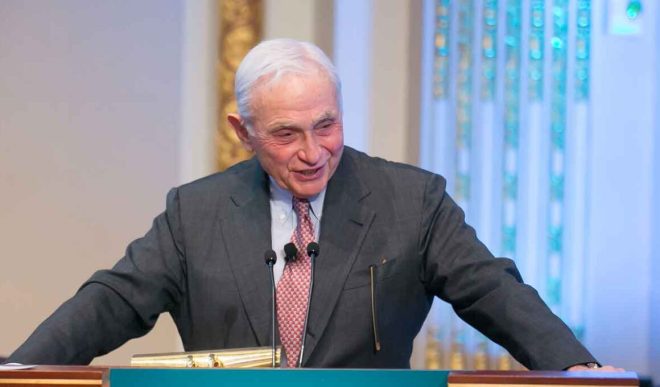
1985 was the year that Leslie Wexner became a billionaire. It was also that year that the chairman of The Limited (now L Brands) began to build up his public persona. This effort to “re-brand” himself began with a series of fawning media profiles. The main outlets that participated in Wexner’s first main, personal PR campaign were written by prominent New York City-based outlets, like New York magazine and the New York Times.
The New York magazine profile, which was the cover story for its August 5, 1985 issue, was entitled “The Bachelor Billionaire: On Pins and Needles with Leslie Wexner.” Though filled with photos of a middle-aged Wexner grinning and embracing friends as well as lavish praise for his business dealings and his “tender” and “gentle” personality, one of the main themes of the article revolves around what is apparently a spiritual affliction or mental illness of Wexner’s, depending on the reader’s own spiritual persuasion.
The New York magazine article opens as follows:
“On the morning Leslie Wexner became a billionaire, he woke up worried, but this was not unusual. He always wakes up worried because of his dybbuk, which pokes and prods and gives him the itchiness of the soul that he calls shpilkes [“pins” in Yiddish]. Sometimes he runs away from it on the roads of Columbus, or drives away from it in one of his Porsches, or flies from it in one of his planes, but then it is back, with his first coffee, his first meeting, nudging at him.”
One may interpret this use of shpilkes, literally “pins” or “spikes” in Yiddish and often used to describe nervous energy, impatience or anxiety, as Wexner merely personifying his anxiety. However, his decision to use the word dybbuk, which he does throughout the article, is quite significant. Also notable is how Wexner goes on to describe this apparent entity throughout the article and his intimate relationship with it.

First page of New York magazine’s 1985 profile of Wexner
As defined by Encyclopedia Britannica, a dybbuk is a Jewish folklore term for “a disembodied human spirit that, because of former sins, wanders restlessly until it finds a haven in the body of a living person.” Unlike spirits that have yet to move on but possess positive qualities, such as the maggid or ibbur, the dybbuk is almost always considered to be malicious, which leads it to be translated in English as “demon”. This was also the case in this New York magazine profile on Wexner.
The author of that article, Julie Baumgold, describes Leslie Wexner’s dybbuk as “the demon that always wakes up in the morning with Wexner and tweaks and pulls at him.” Wexner could have easily chosen to frame the entity as a righteous spirit (maggid) or as his righteous ancestors (ibbur) guiding his life and business decisions, especially for the purpose of an interview that would be read widely throughout the country. Instead, Wexner chose this particular term, which says a lot for a man who has since used his billions to shape both mainstream Jewish identity and leadership in both the US and Israel for decades.
As the article continues, it states that Wexner has been with the dybbuk since he was a boy and that his father had recognized it and referred to it as the “churning”. Per Wexner, the dybbuk causes him to feel “molten” and constantly pricked by “spiritual pins and needles”. It apparently left him at some point as a young man, only to return in 1977 when he was 40, half-frozen during an ill-fated trip up a mountain near his vacation home in Vail, Colorado. This specific trip is when Wexner says he both rejoined with his childhood dybbuk and decided to “change his life.”
He told New York magazine that his dybbuk makes him “wander from house to house”, “wanting more and more” and “swallowing companies larger than his own.” In other words, it compels him to accumulate more money and more power with no end in sight. Wexner later describes the dybbuk as an integral “part of his genius.”
Wexner further describes his dybbuk as keeping “him out of balance, emotionally stunted, a part of him — the precious, treasured boy-son part — lagging behind [the dybbuk].” This is consistent with other definitions of the term in Jewish media, including a feature piece published in the Jewish Chronicle. That article first defines the term as “a demon [that] clings to [a person’s] soul” and then states that: “The Hebrew verb from which the word dybbuk is derived is also used to describe the cleaving of a pious soul to God. The two states are mirror images of each other.” Per Wexner’s word choice and his characterization of what he perceives as an entity dwelling within him, the entity — the dybbuk — is dominant while his actual self and soul “lags behind” and is stunted, causing him to identify more with the entity than with himself.
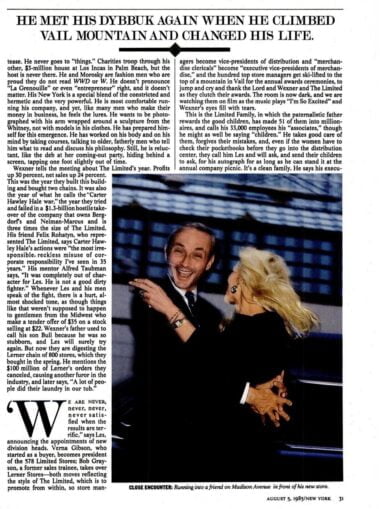 This is also reflected in the concluding paragraph of the New York magazine article:
“Les Wexner picks up his heavy black case and flies off in his Challenger, with his dybbuk sitting next to him, taunting and poking him with impatience, that little demon he really loves. The dybbuk turns his face. What does he look like? ‘Me,’ says Leslie Wexner.”
Outside of the spiritual aspect of this discussion, it can also be surmised from the above that there is a strong possibility that Wexner suffers from some sort of mental disorder that causes him to exhibit two distinct personalities which continuously battle within him. What is astounding is that he describes this apparent affliction to a prominent media outlet with pride and the author of the piece weaves Wexner’s “demon” throughout a piece that seeks to praise his business acumen above all else.
Yet, perhaps the most troubling aspect of Wexner’s experience with his “dybbuk”, whether real or imagined, is the fact that Wexner, in the years before and after this article was published, has had a massive impact on Jewish communities in the US and beyond through his “philanthropy.” Some of those philanthropic efforts, like the Wexner Foundation, saw Wexner mold generations of Jewish leaders through Wexner Foundation programs while others, such as the Mega Group, see the organized crime-linked Leslie Wexner joined by several other like-minded billionaires, many of which also boast considerable organized crime connections, in an effort to shape the relationship of the American Jewish community, as well as the US government, with the state of Israel.
For a man of such influence in the Jewish community, why have there been essentially no questions raised as to Wexner’s role in directing the affairs of that ethno-religious community given that he has openly claimed to be guided by a “dybbuk”? This is particularly odd when one considers that Wexner has come under increased scrutiny in recent years after his protege and closest associate for decades, Jeffrey E. Epstein, was outed as both a pedophile and serial sex trafficker. Did Wexner’s dybbuk draw him to Epstein and prompt him to financially support his horrific crimes against minors?
Note: The above is an adapted excerpt from Whitney Webb’s upcoming book “One Nation Under Blackmail: the sordid union between Intelligence and Organized Crime that gave rise to Jeffrey Epstein”. Those interested may pre-order the book directly from the publisher’s website or from Amazon.
Ex-Bolivian president Jeanine Anez sentenced to 10 years in prison
Press TV – June 11, 2022
Former Bolivian interim president Jeanine Anez has been sentenced to a 10-year prison term more than a year after being arrested on charges of leading a US-backed plot in 2019 to oust re-elected socialist president Evo Morales.
Anez will serve 10 years in a women’s prison in La Paz, the administrative capital’s First Sentencing Court announced on Friday in a ruling that came three months after her trial began.
Convicted of crimes “contrary to the constitution and a dereliction of duties,” the former right-wing television presenter was sentenced to “a punishment of 10 years” over charges stemming from when she was a senator, before becoming president.
Government prosecutors, however, had asked for a 15-year jail term for Anez, who has been held in pre-trial detention since March 2021 while dismissing her trial as “political persecution.”
Also sentenced to 10 years were the former chief of Bolivia’s armed forces, William Kaliman, and the country’s ex-police chief Yuri Calderon — both of whom have reportedly fled the country and remain on the run.
This is while Anez still faces a separate, pending court case for sedition and other charges related to her short presidential tenure.
At the start of her presidency, the US-sponsored rightist politician had called in the police and military to restore order. The post-election unrest left 22 people dead, according to the Inter-American Commission on Human Rights (IACHR).
For that, Anez also further faces genocide charges, which carry prison sentences of between 10 and 20 years.
The IACHR described the 22 deaths that occurred at the beginning of Anez’s presidential stint as “massacres,” and found they indicated “serious violations of human rights.”
Unlike the other accusations against Anez, the case will be dealt with by congress, which will decide whether or not to hold a trial.
The ex-president had already declared she would appeal if convicted, claiming, “We will not stop there. We will go before the international justice system.”
Anez became Bolivia’s interim president in November 2019 after Morales, who had won a fourth consecutive term as president, fled the country in the face of what was widely viewed as a US-sponsored unrest purportedly against alleged electoral fraud.
The US-led and Washington-based Organization of American States (OAS) claimed at the time that it had found “clear evidence” of voting irregularities in favor of Morales, a popular, anti-US president who was re-elected into office for 14 years.
Many potential successors to Morales — all members of his MAS party – were also forced to resign or flee, leaving right-wing opposition member Anez, then vice-president of the Senate, next in line.
Virtually unknown, the lawyer and former TV personality proclaimed herself interim president of the Andean nation on November 12, 2019, two days after Morales’ forced resignation.
The Constitutional Court recognized Anez’s mandate as interim, caretaker president, but MAS members disputed her legitimacy.
Elections were held a year later, and won by Luis Arce – a close ally of Morales.
With the presidency and congress both firmly in MAS control, Morales returned to Bolivia in November 2020.
After handing over the presidential reins to Arce, Anez was detained in March 2021, charged with illegitimate assumption of power.
“I denounce before Bolivia and the world that in an act of abuse and political persecution, the MAS government has ordered my arrest,” she proclaimed in a Twitter post at the time.
Featured Video

Revive Iran’s MOU Deal or Face a Forever War
or go to
Aletho News Archives – Video-Images
From the Archives
China names world’s ‘hacking empire’
RT | March 15, 2022
Calling the US a “hacking empire” of the world, the Chinese Foreign Ministry urged Washington to stop “malicious” cyber activities following reports that American hackers subverted a network in China to launch attacks on Russia and Belarus.
“China is gravely concerned about cyberattacks against other countries that originate from the US and use China as a springboard,” Foreign Ministry spokesperson Zhao Lijian told reporters at a press briefing on Monday.
Zhao was commenting on recent Chinese media reports that hackers, mainly from the US but also from NATO allies Germany and the Netherlands, recently hijacked a Chinese computer network for cyberattacks, 87% of which targeted Russia.
“Against the background of the Ukraine situation, such a move may produce the negative effect of misleading the international community and spreading disinformation,” Zhao said, pointing out that “a former US senior official called publicly for launching cyberattacks on Russia not long ago.”
This appeared to be a reference to Hillary Clinton, former US secretary of state and presidential candidate, who made the calls in an MSNBC interview at the end of February. … continue
Blog Roll
 Aletho News
- Iran-Linked Ships Spotted Hovering over Subsea Cables: Report
- New attack on Iran could devastate ‘Israel’, IOF general warns
- Nuclear deterrence: The US-Israeli military aggression against Iran made the unthinkable legitimate
- U.S. Midterms – a Referendum on Israel and Zionist Power
- Twice as many Canadian Jews serve in Israeli military as Canada’s armed forces: Report
- Thousands of Syrian troops set to join Saudi war on Yemen
- Jared Kushner’s Diplomacy for Hire
- Russia backs Tehran’s conditions in talks with US, Iran’s envoy says
- Irish ‘fake news’ expert exposed as fake
- China expresses strong opposition to Dutch report alleging Chinese cyberattacks
- If Americans Knew
- An error has occurred; the feed is probably down. Try again later.
- No Tricks Zone
- Zonal Asymmetry of Temperature Change in the Antarctic Circumpolar Current
- New Study: The Net Fossil Fuel Contribution To Rising Atmospheric CO2 Has Been Zero For 500 Years
- Germany’s Green Energy Transition Becoming Increasingly Expensive…Another 6 Trillion Euros!
- Sudden Stratospheric Warming, Powerful El Niño Combination May Lead To Extreme Europe Cold, Energy Crisis!
- Two New Studies Find Thwaites Glacier Melt Cannot Be Driven By Human Activity Or A Warming Ocean
- E-Cars Reduce CO2 Emissions By Only 41% Compared To Internal Combustion Engine Vehicles
- Predictions Made By Renowned Climate Professor Over Past Decades Have Been Proven To Be Poor
- New Study Suggests Large Regions Of The Pacific Ocean Have Been Cooling For The Last 80 Years
- Germany’s Green Energy Debacle: High Energy Costs Force Kahla Porzellan to Close After 182 Years!
- New Study: 50 Years Of The Most Aggressive ‘Net Zero’ Policies Can Only Affect The Global Climate By 0.03°C

