Biden regime seeks $33 billion more for Ukraine
Samizdat | April 28, 2022
US President Joe Biden has asked Congress for an additional $33 billion in funding to prop up Ukraine in the ongoing conflict with Russia. A vast part of the massive package is destined for additional military and security aid, while the rest will be used for economic and humanitarian assistance.
“The Administration is requesting $20.4 billion in additional security and military assistance for Ukraine and for U.S. efforts to strengthen European security in cooperation with our NATO allies and other partners in the region,” the white House said in a statement.
Unveiling the package during his speech at the White House, Biden said it was “critical” for the lawmakers to adopt it. “We need this bill to support Ukraine and its fight for freedom,” he said, admitting the price was not “cheap.” “But caving to aggression is going to be more costly if we allow it to happen,” he stressed.
The US administration wants the aid package to get designated as emergency spending, so that it does not have to be offset by spending cuts elsewhere. Apart from the massive aid package for Ukraine, Biden is also seeking new powers to target wealthy Russians the US administration believes to be ‘oligarchs.’
“I’m also sending to Congress a comprehensive package that will enhance our underlined effort to accommodate (sic) the Russian oligarchs and make sure we take their ill-be-gotten gains. We’re going to accommodate them, we’re going to seize their yachts, their luxury homes, their ill-begotten gains,” Biden stated, struggling with the world “kleptocracy” to describe those wealthy Russians to be targeted. “These are bad guys,” he said eventually.
If enabled, the proposed powers would allow US authorities to “streamline the process for seizure of oligarch assets,” to sell these and to funnel the proceeds to Ukraine.
The US alone has funneled more than $3 billion in military aid to Ukraine since the ongoing conflict broke out late in February. Washington’s allies poured in lavish economic and military aid to Kiev as well, with certain Western officials – including British PM Boris Johnson and top EU diplomat Josep Borrell – openly stating they wanted Ukraine to beat Russia on the battlefield.
Moscow has repeatedly warned the West against ramping up aid for Kiev, stating that this would only prolong the ongoing conflict and inflict further damage on Ukraine, as well as suffering on the country’s people.
How Selling the ‘Russia-China’ Threat Serves the US
By Salman Rafi Sheikh – New Eastern Outlook – 27.04.2022
Today, if there is one issue in the United States that draws equal support from both the Republicans and the Democrats, it is the fact that China presents the most serious threat to the US global supremacy. Related to this is the other point of agreement i.e., developing a global coalition against China. The Trump administration’s Secretary of State, Mike Pompeo, was on a mission throughout his tenure to build that coalition. The Biden administration, too, has devoted itself to the same task. Indeed, the level of deterioration we have seen in the US-China relations during the Biden era surpasses the trouble that the Trump administration caused. The same holds true about US geopolitics vis-à-vis Russia. The ongoing Russian military operation in Ukraine has allowed the US to cement its position vis-à-vis Europe.
One very useful way for the US to maintain its hegemony is through the sale of its weapons to its allies. Selling weapon systems is a multi-dimensional activity. On the one hand, the US makes billions of dollars by selling weapons. On the other hand, by selling its weapon systems to its allies, the US enhances these countries’ dependence on the US. All of this is achieved, first and foremost, by selling the China-Russia threat to the world. It is, therefore, not surprising to see that ever since the beginning of tensions between Russia and Ukraine – which began because of the US push to expand NATO to Eastern Europe to encircle Russia – the US military-industrial complex’s finances have jumped massively.
As reports in the US media have indicated, ever since the breakout of the Russia-Ukraine war, market shares of major US military companies have jumped massively, with Lockheed Martin’s registering a growth of 25% while Raytheon’s shares have gained 16.4% in the same period. For these companies, the US-created crisis is, thus, a major business opportunity. This was indeed confirmed in so many words by James Taiclet, the CEO of Lockheed Martin himself.
On January 25, in an ‘earning call’ meeting with investors, the Lockheed CEO told his that,
“If you look at the evolving threat level and the approach that some countries are taking … especially Russia today, these days, and China, there’s renewed great power competition that does include national defense and threats to it … And the contribution we can make at Lockheed Martin is to increase the efficiency and the reliability of our products that we have today for our customer. And secondly, to try to bring this 21st century digital technology to the enterprise in a way that allows us to keep up with the adversaries while we’re developing even newer and more advanced systems.”
They are minting money already in ways that complement the overall political economy of the US. The US has been providing military assistance to Ukraine – weapon systems that are supplied directly by these companies. Military assistance worth millions of dollars being provided to Ukraine is part of the total aid package of $13.6 billion for Ukraine. This aid makes the US, on the one hand, the sole ‘protector’ of Europe, and on the other, paves the way for other countries to rely more and more on the US for their defence needs. As it stands, many countries in Europe – including Germany – have adjusted their defence policies. Germany is even buying F-35 jets, thus creating many more business opportunities for the US military-industrial complex.
The exponential growth the US military-industrial complex is experiencing is not tied to the Russia-Ukraine conflict alone. The US has been effectively selling the China threat to countries that are relevant, e.g., Australia.
As some recent reports indicate, Australia is all set to purchase more weapon systems from the US to shield itself against the ‘China threat.’ On April 5, Australia’s Defense Minister Peter Dutton, referring to the ‘Russia-China threat’, said that they will be spending US$2.6 billion to increase Australia’s deterrence to potential adversaries. To quote him, “There was a working assumption that an act of aggression by China toward Taiwan might take place in the 2040s. I think that timeline now has been dramatically compressed.”
Given the so-called ‘imminent’ nature of the Chinese attack, Australia’s FA-18F Super Hornet fighter jets would be armed with improved U.S.-manufactured air-to-surface missiles by 2024.
In addition to this, Australia has also hired Raytheon Technologies and Lockheed Martin to help build guided weapon systems in the country. As reports indicate, the Australian government is planning on spending US$761 million to build a system of guided missiles.
This partnership with the US military-industrial complex is in addition to AUKUS allies’ April 5 statement that showed cooperation in the field of “hypersonics and counter-hypersonics, and electronic warfare capabilities, as well as to expand information sharing and to deepen cooperation on defense innovation.”
Importantly enough, this renewed cooperation comes against the backdrop of what the statement called “Russia’s unprovoked, unjustified, and unlawful invasion of Ukraine”, showing how the US, alongside its time-tested ally, continues to sell the ‘Russian threat’ across the Pacific to maintain what the US calls a “free and open” Pacific Ocean.
However, as the details of the profits and contracts that the US companies are generating through these very crises shows that, for the US, it is never about doing anything to maintain a ‘free’ system.’ On the contrary, it is always about benefitting the US, both geopolitically and economically.
More contracts for the US military companies means more business, which means more jobs for the Americans in those companies. The more these countries buy weapons from the US, the greater their reliance on the US for their defense and survival. This is how Washington aims to maintain its supremacy.
Salman Rafi Sheikh is a research-analyst of International Relations and Pakistan’s foreign and domestic affairs.
Here’s what I found at the reported ‘mass grave’ near Mariupol
A first-hand look at the location where Kiev claims trenches hold thousands of bodies

© Eva Bartlett
By Eva Bartlett | Samizdat | April 28, 2022
According to recent Western media, Russian forces have buried up to 9,000 Mariupol civilians in “mass graves” in a town just west of the Ukrainian city. These reports use satellite imagery as supposed evidence and repeat the claims of officials loyal to Kiev that “the bodies may have been buried in layers” and “the Russians dug trenches and filled them with corpses every day throughout April.”
I went to the site in question and found no mass graves.
On April 23, I joined RT journalist Roman Kosarev on a visit to the location, in the town of Mangush. What I saw were new, orderly grave plots including some still empty ones – an extension of a cemetery that already exists at the spot. No mass pit. Many of the graves have placards with the names and dates of birth of the deceased when available, and the remaining plots were numbered according to burial.
Since the media is essentially copy-pasting from the same source – the former mayor of Mariupol, Vadym Boichenko (who seems to be far from the city now) – I’ll cite from the Washington Post’s article.
Boichenko, the article notes, “called the site the ‘new Babyn Yar,’ referring to one the largest mass graves in Europe located in the outskirts of Kyiv, where 33,000 Jews where killed by Nazis in 1941 during World War II.”
This is ironic on several levels. A mayor who is whitewashing the neo-Nazis who have run amuck in his city – notably those from the Azov Battalion, who have used civilians as human shields, occupied and militarized civilian infrastructure, point-blank executed civilians – is comparing an alleged (non-existent) mass grave to a Nazi massacre of WWII.
Meanwhile, the Kiev regime has re-written history, making WW2 Nazis and their collaborators heroes of the nation. The most notorious example being the WWII figure Stepan Bandera.
Boichenko’s other alarming claim was that the alleged “mass grave” was “the biggest war crime of the 21st century.” We are only 22 years into it, but we’ve already seen the US-led invasion and destruction of Iraq, the levelling of Syria’s Raqqa, Saudi Arabia’s ongoing war in Yemen – all of which are much stronger contenders than the nowhere-to-be-found “mass graves” of Mangush.
In reality, the site has around 400 individual plots, including nearly 100 empty ones. The 9,000 bodies and “biggest war crime of the 21st century” were unverified claims made by a mayor who fled his city, promoted by media which down the page admitted they could independently verify the claims – but by then, the damage had been done.
Gravediggers disprove mass grave claims
While walking around the site, two men responsible for burials arrived, and when presented with the former mayor’s accusations of mass graves they vehemently rejected the claims.
“This is not a mass grave and no one is throwing bodies into a pit,” one told me.
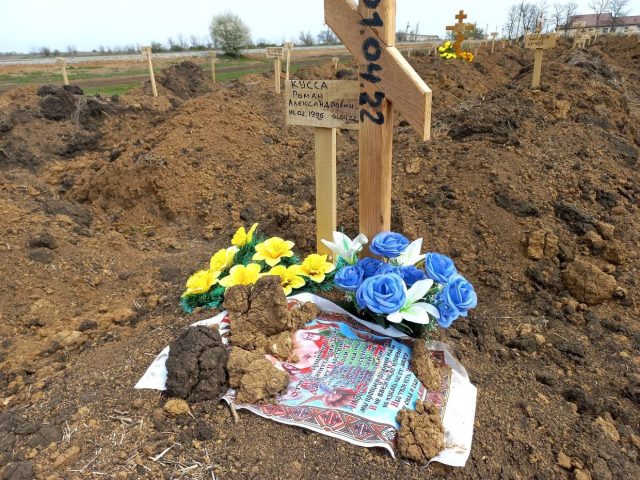
© Eva Bartlett
According to them, they bury each person in a coffin and separate grave, details are logged in the morgue, and when any documents regarding name and age are given, the plot is marked with a placard containing those details. Otherwise a number is used.
Interestingly, they also noted that a section of the new graves included buried Ukrainian soldiers. “They’re human, too” one of the men said.
For those in doubt as to the location, see Roman’s report: his drone footage shows that it’s precisely the same location as shown in the satellite images used by Western media.
Meanwhile, as Roman noted while walking, mass graves is something Ukraine has previously been accused of. He cited DPR leader Denis Pushilin as having stated that at least 300 such sites have been discovered since 2014.
He also spoke of what he witnessed. “In 2014 or 2015, mass graves were discovered as Azov or Aidar fighters retreated from the Donetsk region. I even saw a woman, she was dug up, she had her arms tied behind her back, she was in the late stages of pregnancy and she had a hole in her head, so that means she was executed.”
American journalist George Eliason, who has lived in Lugansk for many years, has written about these alleged atrocities. In a documentary on the issue, he said: “I’m here for five minutes and then I’m told the first five people they found, it was five decapitated heads. They were all civilians. Who does this to people?”
This story of a mass grave in Mangush is another fake from the Western corporate media, which previously pushed incubator babies being thrown on the floor by Iraqi soldiers, pushed lies about WMDs in Iraq, and carried reports of a chemical attack in Douma that never happened, to name but a few of their litany of hoaxes.
Meanwhile, when I was in Mariupol on April 21 and 22, yes there was destruction – thanks to those Neo-Nazi & regular Ukrainian forces occupying upper floors of residential buildings and using them as military positions, thus drawing return fire on the buildings – but I also saw people in the streets, and the beginning of the cleaning up process before rebuilding can occur.
I’ll repeat what I’ve said on Western media reporting on Syria (which in my experience, from on the ground in that country, is largely dishonest): those who promote these hoaxes and war propaganda have blood on their hands.
After the countless lies emanating from Western corporate media, I would hope people would exercise critical thinking whenever a new claim is pushed, particularly when it is repeated in chorus by the usual suspects.
The Guardian inadvertently shakes up Bucha narrative
By Drago Bosnic | April 28, 2022
When the events in Bucha were first reported, Ukrainian and Western mainstream media were unanimous – Russian Armed Forces were the alleged “perpetrators of the Bucha massacre”, while some even called it a “genocide”. The Ukrainian side claims Russian troops killed at least 412 people, while so-called “independent” sources state there were 50 victims. The peculiar claims were completely unsupported by any actual official investigation by any neutral side. The Kiev regime and their Western sponsors flatly refused to allow an international investigation, while any claims contrary to the official narrative were immediately suppressed. If anyone dared to question the narrative, they would be labeled “conspiracy theorists”, “genocide deniers” and “Putin’s propagandists”.
It is more than clear that such a blunt approach to the events in Bucha is designed to silence not just those opposing the official narrative, but even those who are not invested with either side and simply want answers to legitimate questions regarding the veracity of mainstream media reports. This completely removes any sort of public debate, limiting it to one-sided talkshows where so-called “pundits” are called to brainwash the public into thinking that the Russian military is entirely composed of alleged rapists, murderers, alcoholics, drug addicts, etc. By pushing this narrative, the mainstream media are “normalizing” Russophobia and anyone trying to denounce it is promptly silenced.
However, lies are still lies. And they are significantly harder to sustain than the truth. The truth is just truth, it stands by itself. Lies require the liar to circumvent and twist facts. In other words, more lies are necessary to sustain just one. It’s a neverending rabbit hole which inevitably spirals out of control. And precisely this happened on 24 April, when The Guardian published an article about new findings regarding the events in Bucha. According to the UK-based daily, “independent” investigators found evidence of fléchettes used by artillery (supposedly Russian) in Bucha.
“Independent” pathologists and coroners who are carrying out postmortems on bodies found in mass graves in the region north of Kyiv, where “occupying” Russian forces have been accused of alleged atrocities, said they had found small metal darts, called fléchettes, embedded in people’s heads and chests, the report stated.
“We found several really thin, nail-like objects in the bodies of men and women and so did others of my colleagues in the region,” Vladyslav Pirovskyi, a Ukrainian forensic doctor, told The Guardian. “It is very hard to find those in the body, they are too thin. The majority of these bodies come from the Bucha-Irpin region.”
“Independent” weapons experts who reviewed pictures of the metal arrows found in the bodies, seen by The Guardian, confirmed that they were fléchettes, an anti-personnel weapon widely used during the First World War.
These small metal darts are contained in tank or field gun shells. Each shell can contain up to 8,000 fléchettes. Once fired, shells burst when a timed fuse detonates and explodes above the ground. Fléchettes, typically between 3cm and 4cm in length, release from the shell and disperse in a conical arch about 300m wide and 100m long. On impact with a victim’s body, the dart can lose rigidity, bending into a hook, while the arrow’s rear, made of four fins, often breaks away causing a second wound.
“According to a number of witnesses in Bucha, fléchette rounds were fired by Russian artillery a few days before forces withdrew from the area at the end of March,” the report added.
As with all cases of Western-reported alleged crimes, there are always numerous witnesses, independent international experts, anonymous whistleblowers, etc. We just never get to see them. Which means we should simply take the claims of these people, whose very existence we cannot verify, at face value. And any sort of view opposing this narrative is immediately shut down.
According to Neil Gibson, another “Independent” weapons expert at the UK-based Fenix Insight group, who has reviewed the photos of the projectiles seen, they include the 122mm 3Sh1 artillery round, in use by Russian artillery and which are filled with fléchettes. What Mr. Gibson conveniently “forgot” to mention is that these same shells are used in all post-Soviet countries, including Ukraine. More specifically, the shells fit the D-30 howitzers, which are in service with both Russia and Ukraine, as well as dozens of other countries.
A spokesperson for the Ukrainian Ground Forces was quick to state that Ukraine’s military “does not use shells with fléchettes”. However, facts beg to differ, as surgeons in eastern Ukraine have reported the use of fléchettes by Ukrainian artillery in Donbass warzone since at least 2014. It’s obvious the Ukrainian and Western media find it convenient to use Soviet-era weapons as “proof” of alleged Russian war crimes, while ignoring the fact that these same weapons are used by Ukraine. What’s more, Ukraine is more likely to use them, since they have produced little to no new weapons and munitions since the collapse of the USSR.
Russian forces left Bucha on March 30. It took only a few days for the “independent” pathologists and coroners to file the reports from Bucha. At first, the reports claimed Russian forces allegedly shot civilians at point-blank range. Satellite image company Maxar Technologies claimed its photos provided “critical evidence that mass killings of civilians in the Ukrainian city of Bucha must have occurred when Russian forces were occupying the territory in mid to late March”. Combined with the report about fléchettes, this would mean the Russian artillery fired at the city while Russian troops were there, which defies any military logic.
If the reports about the usage of fléchettes are true, the only logical conclusion is that the Ukrainian military shelled Russian positions after the decision to withdraw from the Kiev and Chernigov regions. Russian forces deployed in Bucha certainly didn’t shell their own positions. Since we now know that the Ukrainian forces have and use fléchettes in their artillery shells, what conclusion can we draw except that the civilians were killed by the side which shelled the city while Russian troops were there?
Drago Bosnic is an independent geopolitical and military analyst.
Study: Lockdowns Drove 60,000 Children in UK to Clinical Depression
By Paul Joseph Watson | Summit News | April 28, 2022
A new study published in the Royal Society Open Science journal found that lockdowns in the UK caused around 60,000 children to suffer clinical depression.
Researchers detected a 27.1 per cent prevalence of depression amongst their sample, a number significantly higher than would have occurred without lockdowns.
According to a report by the Telegraph, the percentage equates to about 60,000 extra kids who suffered clinical depression thanks to COVID-19 restrictions.
“After controlling for baseline scores and several school and pupil-level characteristics, depressive symptoms were higher in the COVID-19 group,” the study found.
“These findings demonstrate that the COVID-19 pandemic increased adolescent depressive symptoms beyond what would have likely occurred under non-pandemic circumstances.”
Figures show that 400,000 British children were referred to mental health specialists last year for things like eating disorders and self-harm.
Once again, the study underscores how those who vehemently promoted lockdowns, while demanding voices of dissent be silenced, were on the wrong side of history.
As we previously highlighted, a shocking outbreak of hepatitis cases in children was likely caused by lockdowns and social distancing, which served to weaken immune systems, according to health experts.
Many infants are also suffering from cognitive developmental and speech disorders due to adults wearing face coverings during the pandemic.
According to speech therapists, mask wearing has caused a 364% increase in patient referrals of babies and toddlers.
A major study by Johns Hopkins University concluded that global lockdowns have had a much more detrimental impact on society than they have produced any benefit, with researchers urging that they “are ill-founded and should be rejected as a pandemic policy instrument.”
Doctors Could Be Struck Off For Questioning Government Line on Lockdowns and Vaccines Under New Guidance
By Will Jones | The Daily Sceptic | April 27, 2022
Doctors who criticise vaccines or lockdown policies on social media could face being struck off if regulators rule they are guilty of spreading ‘fake news’, according to new guidance from the GMC. The Telegraph has the story.
The core guidance for medics has been updated for the first time in almost a decade to cover media such as Twitter, Facebook and Instagram. The rules on use of social media include a duty to be “honest” and “not to mislead”, as well as to avoid abuse or bullying.
The draft regulations from the General Medical Council (GMC) – which the watchdog describes as a 21st-century version of the Hippocratic Oath – also say doctors must speak out if they encounter “toxic” workplace cultures that threaten patient safety. And they say medics must take action if they encounter workplace bullying, harassment or discrimination.
The watchdog regulates doctors, who can face a range of sanctions – including being struck off the medical register – if they are found to have failed in their duties.
Charlie Massey, the Chief Executive of the GMC, said… the fundamental principles of the guidance remained the same, but had been updated to reflect the modern world.
“We’ve had feedback that doctors want more clarity on using social media. We are already clear that doctors must be honest and trustworthy in their communications, and are now emphasising that this applies to all forms of communication. The principles remain the same whether the communication is written, spoken or via social media,” he said.
The use of social media by medics has become an increasingly vexed issue during the pandemic, the report adds.
In December a judge ruled that the GMC’s interim orders tribunal had made an “error of law” when it ordered a GP accused of spreading misinformation to stop discussing Covid on social media.
Dr. Samuel White, who was a partner at a practice in Hampshire, raised concerns about vaccines and claimed “masks do nothing” in a video posted last June.
The GMC’s Interim Orders Tribunal imposed restrictions on Dr. White’s registration as a result. But the High Court said this decision was “wrong” under human rights law.
He had claimed “lies” around the NHS and Government approach to the pandemic were “so vast” that he could no longer “stomach or tolerate” them.
In August, the tribunal concluded Dr. White’s way of sharing his views “may have a real impact on patient safety”. It found Dr. White allegedly shared information to a “wide and possibly uninformed audience” and did not give an opportunity for “a holistic consideration of COVID-19, its implications and possible treatments”.
But the GP’s barrister, Francis Hoar, argued the restrictions imposed on his client’s registration were a “severe imposition” on his freedom of expression.
The draft guidance says doctors can be held accountable for promoting misleading information or stepping outside areas of their expertise. They are told to “be honest and trustworthy … make clear the limits of your knowledge… [and to] make reasonable checks to make sure any information you give is not misleading.
“This applies to all forms of written, spoken and digital communication,” the draft guidance states. And doctors are warned that online rows and trolling could jeopardise their professional futures.
It is of course outrageous that medics should be at risk of losing their career for questioning on Twitter the Government line on its draconian public health interventions. If there’s one thing we were lacking during the pandemic it was not an excess of conformity amongst doctors. The right of medics to ‘informed dissent’ should be strengthened, as per the High Court ruling in favour of Dr. White, not weakened.
On the other hand, there are plenty of Government advisers I can think of who could do with being penalised for “stepping outside areas of their expertise”. Somehow I doubt anything similar will ever be applied to them, however.
Worth reading in full.
Stop Press: The GMC guidance is still the subject of a public consultation – and anyone can contribute. Click here to begin the process.
Ukraine Says Austria “Indulging Putin” For Rejecting EU Membership Bid
BY TYLER DURDEN | ZERO HEDGE | APRIL 25, 2022
Austria has just broken from what was looking like an emerging EU consensus on Ukraine’s membership bid, with Foreign Minister Alexander Schallenberg announcing Vienna’s opposition on Sunday at the 14th European media summit.
Underscoring Austria’s commitment to neutrality as a central element to Ukraine’s “self-definition”, he asserted that Ukraine’s application for candidate status should be rejected by the 27-country economic and political union.
“We don’t belong to any military alliance and we don’t want to,” he stressed in the speech, instead urging a “different way” for Ukraine to deepen its ties with Europe, strongly suggesting that EU membership for Ukraine would unnecessarily deepen Europe’s involvement in the conflict amid the Russian invasion.
He called Austria “militarily neutral, but not politically” on the issue of the Russian war in Ukraine. Additionally, Schallenberg went so far as to spell out that Ukraine shouldn’t be granted membership even in the future.
As part of current rules and procedures dictating the process, to even start Ukraine’s candidate status, all EU governments would have to unanimously agree.
Schallenberg suggested an alternative that would look something like the EU relationship with Balkan countries:
Austrian publication Heute reported that Mr Schallenberg called for models other than full membership and for more flexibility.
Mr Schallenberg justified his position by saying there are countries in the Western Balkans, who the EU calls “enlargement countries,” who have come a long way without full membership.
As expected, Ukraine’s foreign ministry was quick to slam the statements, calling FM Schallenberg’s position “short-sighted” and ultimately “not in the interests of the united Europe.”
“Such statements also ignore the fact that the vast majority of the population of the EU founding member states support Ukraine’s membership,” Ukrainian Foreign Affairs Ministry spokesperson Oleg Nikolenko said.
Kiev also suggested that somehow the government under Austrian Chancellor Karl Nehammer – who came under some degree of criticism in EU corners for his April 11th meeting with President Putin for “direct, open and tough” talks – is being ‘influenced’ by Russia. Nikolenko suggested Schallenberg’s stance represents Austria “indulging Putin’s aggressive plans.”
Current polling in reporting, however, points to the Austrian public generally wanting to avoid confrontation with Russia:
But around 40% of Austrians consider the government’s position on Ukraine as “on the whole correct,” while 23% believe the government is “too pro-Ukraine” and 17% “too pro-Russia,” according to Heute.
At the same time, once-neutral EU governments like Germany have flipped – going from expressing a strictly neutral status on Ukraine to shipping heavier and heavier arms to Kiev.
FDA Rubber-Stamps Remdesivir for Infants Without Evidence of Safety, Efficacy
By Madhava Setty, M.D. | The Defender | April 27, 2022
The U.S. Food and Drug Administration (FDA) on Monday approved the use of the antiviral therapy, remdesivir, to treat COVID-19 in infants four weeks and older.
Dr. Patrizia Cavazzoni, director of the FDA’s Center for Drug Evaluation and Research, said in a press release:
“As COVID-19 can cause severe illness in children, some of whom do not currently have a vaccination option, there continues to be a need for safe and effective COVID-19 treatment options for this population.
“Today’s approval of the first COVID-19 therapeutic for this population demonstrates the agency’s commitment to that need.”
According to the press release, the FDA’s decision to approve the therapy, marketed under the name Veklury, is supported by a clinical study conducted on infants 4 weeks and older weighing a minimum of 6.6 pounds.
The study is underway and will not be completed until February 2023. There are no published results.
However, Gilead Sciences, maker of remdesivir and sponsor of the study, provided the following details in a company press release:
- A total of 53 hospitalized pediatric patients were enrolled in the clinical study.
- 72% suffered adverse events.
- 21% suffered serious adverse events determined to be unrelated to the drug.
- Three children died from either underlying conditions or COVID-19.
Nevertheless, Gilead Science assured that “no new safety signals were apparent for patients treated with Veklury.”
The study was of single-arm, open-label design.
A single-arm study has no control group, making it impossible to compare its effectiveness against standard of care.
Open-label means participants and investigators were aware they were receiving the drug, making it impossible to separate placebo from drug effect.
Studies show little or no benefit
Beyond the absence of any publicly available data on the efficacy and safety of this drug in humans of this age, available studies on older subjects indicate remdesivir offers no more than a meager benefit to those who survive its use.
In fact, this is why the World Health Organization (WHO) in November 2020 recommended against the use of remdesivir to treat COVID-19. The WHO only recently (April 22, 2022) updated its recommendation to support the drug’s use in patients who are at high risk for hospitalization.
Nevertheless, the FDA explains its long-standing support of remdesivir use in adults here, citing six studies that had the greatest impact on the agency’s position.
Here is a summary of the findings of each study from the FDA’s webpage:
- ACTT-1 Trial: Time to clinical recovery was shortened from 15 days to 10 through the use of remdesivir. There was no difference in mortality. The drug was no better than placebo when administered to patients who required high-flow oxygen, non-invasive respiratory support, mechanical ventilation or extracorporeal membrane oxygenation at baseline. A benefit was seen only in patients who required low levels of supplemental oxygen.
- Discovery Trial: There was no clinical benefit of remdesivir in hospitalized patients who were symptomatic for >7 days and who required supplemental oxygen. There was no difference in mortality between remdesivir and standard of care. Investigators judged three of 429 participants who received remdesivir died from the drug.
- WHO Solidarity Trial: Remdesivir did not decrease in-hospital mortality or the need for mechanical ventilation compared to standard of care. Four hundred and forty patients in this study were also enrolled in the Discovery trial above.
- Journal of the American Medical Association (moderate disease): After 10 days of treatment with remdesivir, clinical status was not significantly different from standard of care.
- New England Journal of Medicine (severe disease): No difference between five and 10 days of remdesivir treatment. No placebo group, thus “the magnitude of benefit cannot be determined.”
- PINETREE study: Three consecutive days of IV remdesivir resulted in an 87% relative reduction in the risk of hospitalization or death when compared to placebo.
As demonstrated, the first five studies used to justify the FDA’s approval of remdesivir showed little, if any, benefit to hospitalized patients with moderate or severe disease.
This is in contrast to the sufficiently proven benefit of off-label use of the previously licensed medications hydroxychloroquine and ivermectin.
Only the PINETREE study investigated the benefit of remdesivir for outpatient use. In that study, the drug provided a substantial benefit in preventing hospitalization when given in three separate doses over three days.
However, only eight individuals under the age of 18 were enrolled in the study, and none were younger than 12.
The primary endpoint, a composite of COVID-19-related hospitalization or death from any cause, did not occur in the under-18 group.
In other words, the study — funded by Gilead Sciences — showed the drug offered no benefit in this cohort.
Nevertheless, in reporting on the FDA’s approval of remdesivir for infants and young children, CNN found someone to support the FDA’s decision.
CNN wrote:
“The FDA’s approval of remdesivir for young children is ‘great,’ said Dr. Daniel Griffin, an instructor in clinical medicine and associate research scientist in the Department of Biochemistry and Molecular Biophysics at Columbia University.”
Safety ‘not established’ in pediatric patients
Not only is there scant evidence that remdesivir is an effective treatment for COVID-19, the drug’s safety is debatable.
With regard to its use in infants, even the FDA must acknowledge nobody knows how safe it is.
After all, the manufacturer’s label states:
“The safety and effectiveness of VEKLURY (remdesivir) have not been established in pediatric patients younger than 12 years of age or weighing less than 40 kg.”
With regard to pharmacokinetics (where the drug distributes in the body) the label states:
“The pharmacokinetics of VEKLURY in pediatric patients have not been evaluated.”
An indictment of the drug regulatory process
Let’s reflect on what the director of the FDA’s Center for Drug Evaluation and Research said regarding the approval of remdesivir for treating COVID-19 in infants 4 weeks and older:
“As COVID-19 can cause severe illness in children, some of whom do not currently have a vaccination option, there continues to be a need for safe and effective COVID-19 treatment options for this population. Today’s approval of the first COVID-19 therapeutic for this population demonstrates the agency’s commitment to that need.”
To summarize:
- Some children do not have a vaccination option.
- They need a safe and effective treatment.
- The FDA meets that need by approving a drug with no safety and efficacy record in children.
Safety and efficacy apparently can be conveniently established by fiat, not evidence.
In the end, the FDA’s approval of remdesivir is not an assurance of the drug’s safety and efficacy but an indication the agency is no longer interested in protecting the public from potentially harmful and ineffective therapies — or, in other words, in doing its job.
There will undoubtedly be doctors like Griffin who welcome this approval.
However, I don’t believe every pediatrician will accept the FDA’s guidance so readily.
It’s not easy to place an intravenous line to administer remdesivir in the tiny vein of an irritable baby coming from home with a positive rapid test. And then do it again the next day. And the day after that.
At some point, clinicians’ sensibilities will be challenged enough to compel them to actually examine how the FDA arrived at its conclusions.
Guidelines are meaningless if doctors choose not to abide by them.
Madhava Setty, M.D. is senior science editor for The Defender.
© 2022 Children’s Health Defense, Inc. This work is reproduced and distributed with the permission of Children’s Health Defense, Inc. Want to learn more from Children’s Health Defense? Sign up for free news and updates from Robert F. Kennedy, Jr. and the Children’s Health Defense. Your donation will help to support us in our efforts.
Denmark Suspends COVID Vaccine Campaign, EU Set to End Mass Testing
By Michael Nevradakis, Ph.D. | The Defender | April 27, 2022
Denmark on Tuesday became the first country to suspend its national COVID-19 vaccine campaign after health officials said the pandemic is under control there.
Bolette Soborg, director of the Danish Health Authority’s department of infectious diseases, on Tuesday said Denmark is “winding down” the mass vaccination program, and that invitations for vaccinations would no longer be issued after May 15.
“We plan to reopen the vaccination programme in the autumn,” Soborg said, adding: “This will be preceded by a thorough professional assessment of who and when to vaccinate and with which vaccines.”
Public health authorities cited several factors contributing to the decision to end the national vaccination campaign. These include a decline in the number of new reported infections, stabilized hospitalization rates and an overall high level of vaccination.
This decision comes just a few months after Denmark eliminated all COVID-19-related restrictions, becoming the first European Union (EU) member state to do so.
On February 1, the country dropped restrictions ranging from vaccine passports to mask mandates. Public health authorities at the time said COVID-19 was no longer considered a critical threat to public health.
Despite a “surge” in reported infections in Denmark, attributed to the Omicron variant, health authorities said these cases are not placing a heavy burden on the country’s health system.
Denmark’s health authorities are the first to explicitly state that future COVID-19 vaccination drives will be targeted, rather than universal.
EU set to announce ‘post-emergency’ phase of pandemic, Fauci says U.S. out of ‘pandemic phase’
Denmark’s decision comes as several other countries appear to be walking back mass-scale COVID-19 vaccination and related public health initiatives.
In an interview Tuesday on PBS NewsHour, Dr. Anthony Fauci said, “We [the United States] are certainly right now in this country out of the pandemic phase.”
However, when asked whether there will be an end to the COVID-19 pandemic, he said that’s “an unanswerable question.”
In the U.K., the country’s Health Security agency this week announced it is slashing its staff by almost half, and reducing its COVID-19 budget by nearly 90% compared to 2021 levels.
And the European Commission — the executive branch of the EU — is reportedly preparing to announce the EU has entered a new “post-emergency phase” of the COVID-19 pandemic, Reuters reported today, citing a draft document the news agency said it reviewed.
Despite there being no official statements yet from EU officials, according to Reuters, the draft document, prepared by EU Health Commissioner Stella Kyriakides, states:
“This Communication puts forward an approach for the management of the pandemic in the coming months, moving from emergency to a more sustainable model.”
In practical terms, this would mean an end to mass COVID-19 testing, already shut down in several EU countries.
This approach contrasts with China’s “zero-COVID” policies — which have resulted in mass testing and a renewed wave of mass lockdowns.
In a possible reflection of the EU’s new policy direction — and its stark differentiation from China’s COVID policies — Greek health minister Thanos Plevris said recently “we are entering the phase of co-existing with COVID … we don’t believe in the zero-COVID policy, like in China.”
According to Reuters, the EU’s draft document is non-binding on member-states and states that “COVID-19 is here to stay,” with a likely emergence of new variants and “surges,” necessitating that “vigilance and preparedness remain essential.”
The document asks EU governments to be ready to re-enact emergency measures if deemed necessary, though the nature of these “emergency measures” does not appear to be specified.
However, the draft document does address the introduction of more sophisticated means of detecting outbreaks of — and the spread of — COVID-19, highlighting that “[t]argeted diagnostic testing should be put into place.”
Such “targeted” testing would focus on “priority groups,” such as people close to outbreaks, those at risk of developing severe COVID-19 symptoms and medical staff who are in regular contact with vulnerable populations.
The draft document also suggests surveillance and tracking of COVID-19 infections should be adapted and targeted, focusing more on genomic sequencing and less on the mass reporting of “cases.”
This new surveillance system would amount to one that, according to Reuters, is “similar to that used to monitor seasonal flu, in which a limited number of selected healthcare providers collect and share relevant data.”
As reportedly stated by the document, “[t]he objective of surveillance should no longer be based on the identification and reporting of all cases, but rather on obtaining reliable estimates of the intensity of community transmission, of the impact of severe disease and on vaccine effectiveness.”
However, unlike Denmark’s approach, the document states that vaccines remain essential, with a recommendation that EU member states consider enacting strategies to bolster vaccination levels among children age 5 and up prior to the start of the new school year.
Some EU member states, such as Greece, have strongly hinted wide-scale COVID-19 vaccinations and restrictions may resume in September.
Michael Nevradakis, Ph.D., is an independent journalist and researcher based in Athens, Greece.
© 2022 Children’s Health Defense, Inc. This work is reproduced and distributed with the permission of Children’s Health Defense, Inc. Want to learn more from Children’s Health Defense? Sign up for free news and updates from Robert F. Kennedy, Jr. and the Children’s Health Defense. Your donation will help to support us in our efforts.
Moldova turns down Kiev’s suggestions on Transnistria
Samizdat | April 27, 2022
Moldova has turned down the “offer” to capture its breakaway region of Transnistria by force floated by Kiev, stating that it seeks to reintegrate the self-proclaimed republic only through political means.
“The settlement of the Transnistrian issue can be achieved by political means and only on the basis of a peaceful solution, excluding military and other forcible actions, as well as on the basis of the principles of democratization and demilitarization of the region, [and] respect for the sovereignty and territorial integrity of Moldova,” the country’s office for reintegration told RIA Novosti on Wednesday.
The statement came in response to remarks made by Alexey Arestovich, an adviser to Ukrainian President Volodymyr Zelensky. The official suggested the country was capable of “capturing” Transnistria should Chisinau formally request Kiev’s help in conquering the breakaway region.
“Yes, [we] would have managed somehow, but this is the territory of sovereign Moldova, [it could happen] only after the appeal of the Moldovan side,” he said.
Arestovich’s remarks garnered condemnation in Moscow as well, with Kremlin spokesman Dmitry Peskov describing such statements as “quite provocative.”
The international attention towards Transnistria comes as the breakaway nation endured a string of mysterious incidents over the past few days. On Monday, Transnistria’s Ministry of State Security was attacked by three unknown assailants, who fired shoulder-mounted rocket launchers at the building, blowing out its windows and damaging its façade.
The attack was followed back-to-back by explosions at a local broadcasting center on Tuesday morning. While no one was hurt, the facility had its biggest antennas – transmitting Russian radio stations – destroyed.
The president of the self-proclaimed republic of Transnistria, Vadim Krasnoselsky, blamed the incidents he described as “terror attacks” on Ukrainian nationals and urged Kiev to investigate the armed groups that had allegedly infiltrated his region.
Transnistria, officially known as the Pridnestrovian Moldavian Republic (PMR), is a self-proclaimed state located along a narrow strip of land between the Dniester River and the Ukrainian border in the eastern part of Moldova.
The region broke away from Moldova in the early 1990s shortly after the collapse of the Soviet Union. The region maintains close ties with Moscow, with Russian peacekeepers stationed there and a sizable portion of local residents holding Russian citizenship.
Putin warns the US to back off in Ukraine
BY M. K. BHADRAKUMAR | INDIAN PUNCHLINE | APRIL 27, 2022
The Western narrative of the two-month old war in Ukraine imbued with the rhetoric of “democracy versus autocracy,” has dramatically changed with the assertion by the US Secretary of Defence Lloyd Austin at a news conference in Poland Monday following his and Secretary of State Antony Blinken’s trip to Kiev, that Washington wants to “to see Russia weakened.”
David Sanger at the New York Times noted that Austin was “acknowledging a transformation of the conflict, from a battle over control of Ukraine to one that pits Washington more directly against Moscow.” But this is not really a transformation. Sanger’s colleague at the Washington Post, David Ignatius, had written over three months ago that the Biden Administration was working on a road map to get Russia bogged down in Ukraine and attrition it in a way that it becomes a much diminished power on the world stage.
For the Kremlin, most certainly, Austin’s remark would not have come as surprise. As recently as on Monday, President Vladimir Putin repeated at a meeting in the Kremlin that the US and its allies have sought to “split Russian society and destroy Russia from within.” Putin revisited the topic again on Wednesday pointing out that “the forces that have been historically pursuing a policy aimed at containing Russia just don’t need such an independent and large country, even enormously large, in their view. They believe that its very existence poses a threat to them.”
In fact, several perceptive Western observers had estimated that the Kremlin has effectively fallen into a trap laid by the US that is intended to bring down Putin’s regime. Come to think of it, that famous gaffe on 26 March wasn’t a gaffe after all, when President Biden, speaking in Warsaw, had blurted out the impromptu, unscripted remark: “For God’s sake, this man (Putin) cannot remain in power.”
All the same, Austin’s remark signifies that a dramatic change is taking place in the geopolitical situation, which could have positive or negative results. On Monday, Russian Foreign Minister Sergey Lavrov warned the West that staying involved in the Russia-Ukraine war posed “serious” and “real” risks of a World War III and “we must not underestimate it.”
To be sure, the conflict is slowly but steadily turning into a new phase. Foreign fighters and soldiers from NATO regular units are increasingly beefing up the depleted Ukrainian army’s front lines.
That said, the optics also need to be understood. Austin’s war cry comes soon after Mariupol fell to the Russian forces. A couple of thousands Ukrainian nationalists and a few hundred military personnel from NATO countries are trapped in an underground labyrinth at the Azovstal complex in the city, which Russian forces have sealed off. It has been a severe blow to the US’ prestige.
The Russian special operation is on track — “grinding” the Ukrainian forces to the ground, to borrow the graphic expression from UK prime minister Boris Johnson. On Monday, Russian high-precision missiles hit at least six railway substations in Western Ukraine destroying railway facilities in Krasnoe, Zdolbunov, Zhmerinka, Berdichev, Kovel, Korosten, which were meant to be key transshipment points for the supply of Western weaponry to the Ukrainian forces in the Donbas region. Rail communication in several western regions of Ukraine is effectively blocked.
Reports from the east show that Ukrainian forces are suffering heavy losses. Russian forces have taken the city of Kremennaya and are approaching the town of Lyman, which would give them control of a direct road to Slavyansk from the east.
Austin’s hyped up rhetoric notwithstanding, Ukraine is not only not showing any signs of winning but keeps bleeding, and the territory under the actual control of the Ukrainian government is steadily shrinking. US officials admit that the Pentagon lacks the ability to track the weapons that are going in. Yet, the Biden administration has so far spent around $4 billion on Ukraine. Therein hangs a tale. Who are the real beneficiaries of the US supplies? The level of corruption in Ukraine is legion.
The plain truth is that it will be many weeks or months before meaningful volumes of heavy weapons could be delivered to Ukrainian combat units but in the meanwhile, the Battle of Donbass will be fought almost entirely on the basis of the current strength on the ground. In a detailed analysis this week, a former colonel in the US Army and prolific media commentator Daniel Davis concluded: “It will take too long for Western governments to come up with a coherent equipping plan and then prepare, ship, and deliver the kit to its destination in a timeframe that could provide Kyiv’s troops the ability to tip the balance against Russia.”
The bottom line is this: The Biden Administration’s geopolitical agenda is to prolong the military conflict, which apart from weakening Russia militarily and diplomatically, turns Europe into a battlefield and makes the continent heavily dependent on the US leadership for a very long time to come. For Biden, the war provides a useful distraction in US politics in an election year.
Austin hosted a conference of the US’ allies on Monday at the American base in Germany to form a monthly contact group on Ukraine’s self defence to coordinate the “efforts to strengthen Ukraine’s military for the long haul.” It has the ominous look of a “coalition of the willing.” Even Israel was recruited. But the US is underestimating the steely Russian resolve to fully realise the objectives behind the special operation in Ukraine. Moscow will not brook any roadblocks, no matter what it takes.
Putin issued a stern warning today: “If someone from outside moves to interfere in the current developments, they should know that they will indeed create strategic threats to Russia, which are unacceptable to us, and they should know that our response to encounter assaults will be instant, it will be quick.”
He was explicit that Russia has military capabilities that the US cannot match. “We have all the tools to do it, the tools that others can’t boast of at the moment, but as for us, we won’t be boasting. We will use them if the need arises and I would like everyone to be aware of it. We have made all the necessary decisions in this regard,” Putin warned.
Featured Video

Spain train disaster raises questions over Israeli-linked security contractors
or go to
Aletho News Archives – Video-Images
From the Archives
Are There 50,000 ‘Israeli-born’ Individuals Living in the UK?
By Professor David Miller | August 18, 2026
Recent disclosures by the Zionist regime show that some 2,069 British nationals were serving in the IDF as of March 2025, according to Freedom of Information (FoI) requests submitted to the occupation forces (1,686 dual British-Israeli, plus 383 multinational). We cannot tell from the figures how many of these were already settler colonists and intend to stay in the colony, and how many will return or have returned to the UK. Presumably, those returning to the UK will number far fewer than 2,000, since many are known to have become permanently residents of the colony.
Additionally, the IDF figures only provide a snapshot, and do not tell us how many have served in the Jewish supremacist military either before or after March 2025. One way into the question of how many genocidaires are living in Britain is to ask how many current British residents were born in the Zionist colony. There is data on that, as we shall see. … continue
Blog Roll
 Aletho News
- German CDU MPs Seek Climate “Misinformation” List
- The ‘Gaza Treatment’: How Media Headlines Obscure Who is Bombing Yemen
- Ro Khanna urges Democrats to strip Israel ‘integration’ provision from defense bill
- Why Iran designated British MI6, Royal Navy, and RAF as hostile, terrorist organizations
- Armenian opposition politician dies in custody
- US still trying to recycle failed hypersonic missile programs
- France’s ‘Cold War’: Paris blames Tehran for supermarket fridge hacks
- Psywar no more? 77th Brigade’s sudden death
- Ukraine Already Carved Up… Before Talks Begin? /Prof. Richard Sakwa
- The vindication of Marjorie Taylor Greene
- If Americans Knew
- An error has occurred; the feed is probably down. Try again later.
- No Tricks Zone
- German Authorities Start Initiative To Evaluate Public Register For Climate “Disinformation” Spreaders!
- Zonal Asymmetry of Temperature Change in the Antarctic Circumpolar Current
- New Study: The Net Fossil Fuel Contribution To Rising Atmospheric CO2 Has Been Zero For 500 Years
- Germany’s Green Energy Transition Becoming Increasingly Expensive…Another 6 Trillion Euros!
- Sudden Stratospheric Warming, Powerful El Niño Combination May Lead To Extreme Europe Cold, Energy Crisis!
- Two New Studies Find Thwaites Glacier Melt Cannot Be Driven By Human Activity Or A Warming Ocean
- E-Cars Reduce CO2 Emissions By Only 41% Compared To Internal Combustion Engine Vehicles
- Predictions Made By Renowned Climate Professor Over Past Decades Have Been Proven To Be Poor
- New Study Suggests Large Regions Of The Pacific Ocean Have Been Cooling For The Last 80 Years
- Germany’s Green Energy Debacle: High Energy Costs Force Kahla Porzellan to Close After 182 Years!

