Germany seeks to spend billions on weapons for Ukraine – media
Samizdat | April 15, 2022
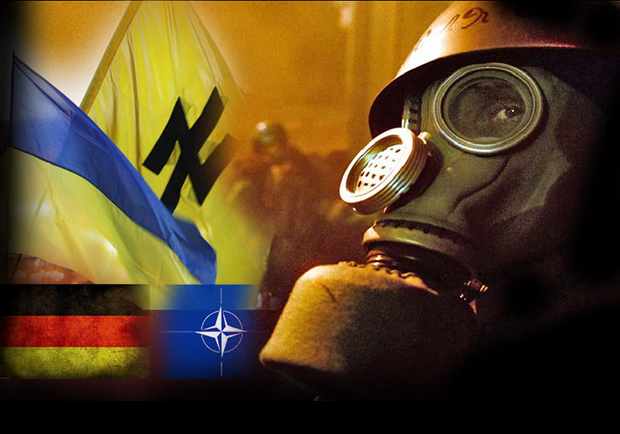
German Chancellor Olaf Scholz has announced plans to spend an additional €2 billion ($2.16 billion) on military needs, most of which is aimed at providing supplies to Ukraine, Reuters reported on Friday.
Citing a government source, the news agency said that approximately €400 million ($432.5 million) of the new money is being allocated to the European Peace Facility, a funding mechanism through which military aid is being procured for Ukraine. The remaining part of the additional funds will be deployed directly on supplies for Kiev, among other needs.
The decision of the German authorities to send weapons to Ukraine, which was announced two days after Moscow’s launch of its military operation, marked a major shift in Berlin’s policy of not providing Kiev with lethal weapons.
Soon thereafter, Scholz announced a plan to beef up the German military, which has been plagued by equipment shortages for years. He pledged €100 billion ($112.7 billion) of the 2022 budget for the armed forces and committed to reaching the target of 2% of GDP spending on defense that is requested by NATO. However, later on the chancellor took a rather cautious approach when it came to the conflict in Ukraine.
Earlier this week, Scholz said that Germany would continue military supplies to Kiev but would send only “correct and reasonable” weapons and only in close coordination with its partners. Berlin also made it clear that it was not planning to send “offensive” weapons, such as tanks and other armored vehicles, despite Ukraine’s numerous requests.
Such a policy, along with the government’s reluctance to support the plans for an EU ban on Russian oil and gas, has prompted criticism from the Green Party, which controls the foreign and economy ministries. On Monday, Foreign Minister Annalena Baerbock urged the West to provide Kiev with heavy weaponry and appeared to criticize Scholz, stressing that “now is not the time for excuses.”
A senior Green MP, Anton Hofreiter, called the chancellor’s approach “damaging” not only to Ukraine but also to Germany’s reputation in Europe and in the world.
Many of his compatriots seem to agree. According to a recent poll conducted by the outlets ARD and Welt, 55% of Germans support supplying heavy weapons to Ukraine, while 37% do not back such an idea.
Initially, Berlin provided Ukraine with 1,000 anti-tank weapons and 500 anti-aircraft Stinger missiles. In mid-March, Germany said that due to security risks it would not disclose further information about supplies of weapons to Ukraine
Boris Johnson Supports Ukraine to the Detriment of the Brits
By Valery Kulikov – New Eastern Outlook – 15.04.2022
A highly sensationalist article by Bloomberg clearly shows that the British government left more than 5 million Britons without support in the current crisis in implementing its pronounced Russophobic policy!
As the publication emphasizes, a significant part of the British population feels the consequences of the cost of living crisis especially strongly, and this is due more to politics than to the economy. An increase in electricity bills and in the cost of food and loan rates has already become a difficult test for all the British without exception. Thus, since April 1, gas and electricity prices alone have increased by 54%! Prices for fruits and vegetables in Britain may soon rise by a third, which is already creating problems and a shortage of products on the shelves of British stores. At the same time, warehouses are already running out of sunflower oil, which jeopardizes the production of traditionally beloved British dishes, writes Daily Mail.
New statistics shows that food inflation in Britain has already increased by 5.3% year-on-year. The Bank of England warned last week that the incomes of many Britons will experience an “historic” shock after inflation jumped to a 30-year high last month, has already reached 6.2%, and, according to forecasts, may rise to 8% this spring, notes Daily Mail.
The independent Food Aid Network, which consists of more than 550 food banks from all over Britain, has sent a letter to Prime Minister Boris Johnson, writes The Independent, with a demand to take urgent measures, since the number of requests for help has increased enormously in recent weeks. This is due to high electricity bills, rising food prices and health insurance. For this very reason, many families are barely surviving, and in some food banks the number of requests has doubled since the end of 2021. Some food banks have already had to reduce the amount of food they provide.
Britain is witnessing the biggest decline in living standards since the 1950s, and many British families in such conditions have to wonder, “how to survive further”?
“Fuel poverty” has affected 88% of the British population, Sky News reports. As the British told the TV channel, against the background of rising energy prices, they are forced to go to bed earlier or take buses and trains all day to keep warm. At the same time, the country predicts that as energy prices continue to rise, it will be even more difficult for families already living on the brink.
However, instead of providing effective assistance to the residents of the kingdom and reducing unnecessary spending, at the expense of the British taxpayers, on “settling in and helping Ukraine,” the British government continues to take not just a wait-and-see stance, but one overtly contradicting the interests of its own people. Against this background, the “decision”, covered by The Sun, of the British company Octopus Energy to distribute blankets with electric heating to financially struggling customers in order to “help them survive a sharp rise in heating prices,” is perceived as a cruel joke on the impoverished Britons. This company did not even stop to think about how the British will pay bills for the use of electric blankets when they do not have enough money to pay for heating their homes! Do not forget that in early April, energy prices in the United Kingdom jumped by 54% due to a strong rise in wholesale gas prices. The rates increase has hit millions of households across the kingdom. Now the energy bill for the country’s residents will increase by an average of 700 pounds per year.
The results of a survey conducted by the National Statistical Service indicate that residents of the United Kingdom have to seriously reduce spending. More than half of respondents stated that they save on “non-essential” goods, 34% – on gas or electricity, and 31% – on food and essential goods.
On March 28, Chancellor of the Exchequer Rishi Sunak, speaking before the British Parliament, said that although rising costs have been hitting people across Europe in recent weeks, no major economy leaves its unemployed population in such a vulnerable position. There are 5.3 million people in Britain today who could work but depend solely on state aid, and more and more Britons are forced to resort to the services of food banks and apply for short-term cash loans at high interest rates. This number of disadvantaged Britons is approximately equal to the number of all residents of Scotland and accounts for a tenth of people of working age in the United Kingdom.
Against the background of the lack of financial assistance from the government to the catastrophically impoverished Britons, the inhabitants of the kingdom were perplexed at learning the results of the recent trip of the British Prime Minister to Kiev, where he arrived with a new package of financial and military assistance to this country. In particular, Boris Johnson said that Britain would supply Ukraine with an additional 120 armored vehicles and anti-ship complexes. In addition, Kiev will receive new loan guarantees from Britain worth USD 500 million through the World Bank, while the British Prime Minister expressed readiness to help in the restoration of Kiev and the Kiev region after the end of the Russian military operation.
This is causing new anti-government protests among Britons who are outraged by the sharp rise in the cost of living over the past couple of months and the failed government policies. Protest demonstrations took place across the country, including in Belfast, where the rally participants demanded that the government allocate an additional thousand pounds to each family in Northern Ireland to help the population reduce the rising costs of fuel and food. Similar actions took place in dozens of other cities across the kingdom. British households are telling the government that they are experiencing more blows to their finances amid an unprecedented crisis caused by the rising cost of living.
“The residents of Britain are facing difficult times due to anti-Russian sanctions, but the country’s authorities, apparently, do not realize the threat,” was the conclusion of retired General Jonathan Shaw made on the pages of The Independent. He is convinced that the Johnson government’s Russophobic policy of banning, in particular, imports of wheat and oil, will hit the standard of living of the population, which will become “much worse.” Shaw believes that many people in Britain, like the government, have “the wrong mentality” about the severity of the consequences of the “new cold war” with Russia.
Recall that in early March, the British government announced its intention to stop importing oil and petroleum products from Russia. After that, the cost of gasoline and diesel fuel at British gas stations went up sharply, breaking several records along the way.
Considering how much attention Boris Johnson pays to the sanctions policy against Russia, it is surprising how this Titanic still manages to stay afloat despite the widespread negative attitude towards it. At the same time, his criticism is growing every day, in proportion to the rate of decline in the standard of living of the population and the resolution of the issue of Scotland’s independence referendum.
In principle, it is already obvious to everyone today that the era of economic liberalism in its former form has come to an end. In fact, the current Western political elites openly follow the path of forming an ultratotalitarian supersystem, supranational hyperfascism, in which the former values of capitalism, free market and political freedoms of citizens have almost entirely lost their value. And the “welfare state” that the collective West was so proud of is already a thing of the past. And by trying to unleash an even more Russophobic sanctions policy, the rulers of Britain and some other parts of the West only accelerate the change of political power in their states.
NATO warships arrive to Baltic Sea
Samizdat | April 15, 2022
A group of NATO warships belonging to the Standing NATO Maritime Group 1 (SNMG1) and Standing NATO Mine Countermeasures Group 1 (SNMCMG1) have started arriving in the Baltic Sea to partake in joint exercises with allied and partnered nations, with some having already docked in a port in Tallinn, Estonia, according to a NATO press release published on Thursday.
The bloc announced the move on Monday, saying “NATO regularly deploys maritime forces in the Blatic Sea in order to maintain a credible and capable defensive capability in accordance with treaty obligations.”
The SNMG1 consists of flagships from the Netherlands, Denmark, Germany and the United Kingdom, while the SNMCMG1 is composed of Norwegian, Belgian, German, Estonian, British and Dutch mine layers and minesweepers.
These are two of a total of four task groups comprising ships from various allied countries that are continuously available to NATO to perform different tasks ranging from participation in exercises to operational missions.
Four ships from the SNMG1 group arrived at the Port of Tallinn on Thursday, where they were joined by the Canadian frigate HMCS Halifax (FFH 330).
“I am very pleased to welcome the SNMG1 teams in Tallinn,” said commodore Jüri Saska, commander of the Estonian Navy. “The call is especially important in the current security situation, in which our neighbor to the east has taken up arms against the freedom and independence of the people of Ukraine.”
Saska added that a strong maritime presence on NATO’s eastern border showcased the speed, flexibility and determination of the alliance to defend member states on land, by air and at sea.
The group is set to conduct routine operations and joint exercises with the Estonian Navy next week, which are intended to “improve interoperability among NATO forces and increase shared knowledge of maritime tactics, while promoting professionalism among sailors, cultural understanding and trust,” according to the NATO press release.
Le Pen promises to pull France out of NATO
By Uriel Araujo | April 15, 2022
NATO now has become one of the most important issue in Europe, with the new developments in Sweden and Finland, and electoral impacts in France. French Presidential candidate Marine Le Pen (who heads for the second round to be held on April 24) has vowed to pull France out of NATO’s military command. It would not be unprecedented, as the country did it in 1966. Le Pen claims the alliance structure “perpetuates the anachronistic and aggressive logic of the Cold War bloc”.
France was one of the Alliance’s founding members in 1949 and even hosted it for 15 years. This was a major event in French history. To help French ordinary citizens to accept the presence of foreign troops on their territory in times of peace, films like À votre service were shown in movie theaters, as part of a NATO PR campaign, so to speak. France’s relationship with the Anglo-Saxon structure (which is hegemonic within NATO), and with the alliance itself has always been complex, and Le Pen’s promise should be understood in this context and not necessarily as mere “extremism”.
In doing so, if elected, Le Pen would be in fact following the steps of general Charles de Gaulle (who ruled the country 1940-46 and 1958-1969). The conservative French leader wanted a truly independent nuclear France who would engage with Washington on more equal terms, becoming perhaps a kind of third force in the then Cold War’s bipolar world and even possibly reaching a détent with the USSR. The British-American “special relationship” was seen by him as detrimental to Europe.
Moreover, the US veto power regarding nuclear weapons also prevented Paris from pursuing its own atomic goals. Unable to place France in the tripartite directorate he proposed in his 1958 memorandum to US President Dwight Eisenhower and UK Prime Minister Harold Macmillan, de Gaulle refused to sign the 1963 agreement against nuclear testing – and, by 1969, France was already a fully fledged nuclear power. He also vetoed British entry into the European Union in the same year and, in 1964, told West Germany it should cease to follow a policy subordinated to Washington and adopt one for European independence (albeit not hostility). Of course, no NATO country followed his lead.
Isolated, France went on to withdraw from the Alliance’s so-called integrated military structure in 1966 (although not completely leaving the Treaty) and expelled all of its headquarters and units on French territory. It was President Nicolas Sarkozy who finally ended Paris “estrangement” from the organization in 2009 – so it took 43 years for Paris to change its course.
Even though Paris still hosted some NATO meetings and civilian structures, the spirit of Gaullism still shaped to some degree French strategic thinking during the Cold War, and the NATO-France relationship alternated between phases of rapprochement and tension. It was President Miterrand who started to bring France back into the Alliance’s integrated military command. And even so, it has been a kind of “flexible membership” (as it is often described).
Charles de Gaulle was one of the most important political leaders of the 20th century and even so, France remained relatively isolated in the European continent pertaining to its stance on NATO during the time of his leadership. He also faced several challenges, as the European countries acted in concert to try to neutralize many of his efforts. One cannot really tell whether Le Pen would be up to such a task, and estranging from NATO in any case is obviously not so simple, but the current situation on the other hand is also full of contradictions from a French and European perspective.
Meanwhile, on April 13 both Finland and Sweden took a major step towards joining NATO. In their joint press conference, the Prime Ministers Sanna Marin (Finland) and Magdalena Andersson (Sweden) both claimed that the security landscape in the continent has changed. Marin stated that Finland which shares a border with Russia will decide within weeks whether to join the Alliance. While a tight majority in Sweden now are in favor of joining the Atlantic Alliance, according to a recent poll, about 70% of Finnish people back it and this figure has more than doubled since the current Russian-Ukrainian war started.
Currently, both Nordic countries are NATO partners, since they abandoned their previous neutral stance by joining the European Union in 1995 and thus take part in military exercises and intelligence exchange, but they are not full-fledged members. Both countries were publicly assured by NATO secretary general Jens Stoltenberg that their applications would indeed be welcome, and they also received public support from Germany, France, and the UK. Joining or leaving the Alliance is not so simple – an application to join it must be accepted by all 30 member states, and this should take a minimum of four months and probably at least a whole year to be processed. In any case, it will be seen by Moscow as yet another provocation, amid a situation of escalating tensions.
Experts such as University of Chicago political scientist John Mearsheimer have been warning since 2014 that the ongoing Ukrainian war was mainly the West’s fault and Mearsheimer maintains it remains the West’s fault to this day. NATO’s constant expansion breaking the 1990 promises that were made during the fall of the Soviet Union as well as Washington’s policy of “encircling” and “containing” Moscow have cornered it to its limits. As Russian President Vladimir Putin said in December 2021: “What would Americans do if we went to the border between Canada and the U.S. or to the border with Mexico and deploy our missiles there?” Mearsheimer also warns that should tensions escalate, there is a real risk of a nuclear war.
Today the world faces the risks of a global food crisis and hunger, as well as on-going international energy crises, and a migration crisis in Europe. It is up for responsible Western leaders to open communication and dialogue channels with the Kremlin. Further provoking Moscow at this point is simply irresponsible and not in Europe’s best interests. France could thus play a key role in the continent. The EU in fact now faces the hard choice between being a self-dependent Europe or an Atlantic Europe.
Uriel Araujo is a researcher with a focus on international and ethnic conflicts.
Should We Commit to Fight Russia — for Finland?
BY PAT BUCHANAN • UNZ REVIEW • APRIL 15, 2022
The prime ministers of Sweden and Finland, Magdalena Andersson and Sanna Marin, both signaled Wednesday that they will likely be applying for membership in NATO.
The “prospect” is most “welcome,” says The Washington Post: “Finland and Sweden Should Join NATO.”
The editorial was titled “A Way to Punish Putin.”
Before joining the rejoicing in NATO capitals, we might inspect what NATO membership for these two Nordic nations would mean for the United States.
Finland is a nation the size of Germany, but with a population only 4% of that of Russia and a border with Russia that is 830 miles long.
Should Finland join NATO, the United States, under Article 5 of the NATO treaty, would be obligated to go to war with the world’s largest nuclear power to retrieve Finnish lands that an enraged Russia might grab.
Moscow has already indicated that, should Sweden and Finland join NATO, Russia will introduce new nuclear weapons into the Baltic region.
Why is it wise for us to formally agree, in perpetuity, as NATO is a permanent alliance, to go to war with Russia, for Finland?
Given the war in Ukraine and concomitant crisis in Eastern Europe, it is understandable why Stockholm and Helsinki would seek greater security beneath the U.S. nuclear umbrella.
But why would we voluntarily agree to give Sweden and Finland these war guarantees? Why would we commit to go to war with Putin’s Russia, a war that could, and likely would, escalate to the use of tactical nuclear weapons, especially if Russia were losing?
Finland was neutral during the Cold War. Sweden has been neutral since the Napoleonic wars of the early 19th century.
How did we suffer from their neutrality?
In Helsinki and Stockholm, the benefit of a U.S.-NATO commitment to go to war for Finland or Sweden is understandable.
But how does it benefit our country, the USA, to be obligated to go to war with a nation that commands the world’s largest stockpile of nuclear weapons — over some quarrel in the Baltic Sea or Gulf of Finland that does not affect us?
Asked for his view on Sweden and Finland’s campaign to join NATO, Putin spokesman Dmitry Peskov had a note of warning:
“We have repeatedly said that the (NATO) alliance remains a tool geared towards confrontation and its further expansion will not bring stability to the European continent.”
Should Putin’s Russia clash with Finland or Sweden today, the U.S. is free to respond, or not to respond, as it sees fit, depending on our own assessment of risks and rewards.
Why not keep it that way? Why surrender our freedom of action in some future collision involving our main adversary?
History holds lessons for us here.
In March 1939, six months after Munich, when Czechoslovakia disintegrated into its ethnic components, Britain issued an unsolicited war guarantee to Poland, then negotiating with Germany over the port city of Danzig taken from Germany by the victorious Allies after World War I.
When Germany, on Sept. 1, 1939, invaded Poland, Britain was obligated to declare war on Germany over a matter that was not a vital interest of Great Britain or its worldwide empire.
Lest we forget, it was the Bucharest Declaration of 2008, opening the door to membership in NATO for Ukraine and Georgia, that led to the recent crises in Eastern Europe and the current war.
The Russia-Georgia War of August 2008, the U.S.-backed coup in Ukraine in 2014, and Putin’s annexation of Crimea, Luhansk and Donetsk in eastern Ukraine all proceeded from NATO’s decision in 2008 to open the door to membership for Georgia and Ukraine.
Russia’s invasion of Ukraine today is partly due to the U.S. and Ukraine’s refusal to rule out NATO membership for Kyiv.
No NATO nation today has a border with Russia nearly as long as that of Finland. If Finland joins NATO, will we put U.S. boots on the ground along that 830-mile border with Russia? Will U.S. warplanes fly in and out of Finnish airfields and air bases up to the border of Russia?
Collective security is said to be a good idea.
But the core of NATO security is provided by U.S. war guarantees, while most of the collecting is done by our 29 NATO allies, which could become 31 by summer’s end.
Otto von Bismarck predicted that the Great War, when it came, would be ignited by “some damn fool thing in the Balkans.”
And World War I was indeed triggered by the assassination of the Austrian archduke in Sarajevo in June 1914. The Germans came in in part because the kaiser had given Austria a “blank check” for war.
What enabled America to stay out of both world wars for years after they began was our freedom of “entangling alliances” when they began.
But today we not only lead an alliance of 30 nations, but we are adding two more members, one of which has a border of 830 miles with Russia.
How long does our luck last?
The West doesn’t want peace in Ukraine
By Timur Fomenko | Samizdat | April 15, 2022
Late Thursday, the Russian Ministry of Defence confirmed that the Russian Black Sea flagship the Moskva had sunk after a fire was triggered by an unconfirmed cause. There is no independent confirmation of what happened amidst the sea of Ukrainian propaganda, which was quick to claim Kiev’s forces had struck the vessel with a Neptune missile. Meanwhile, the United States had also confirmed a new $800 million package of military aid to Kiev, including new heavier weapons, while EU foreign policy chief Josep Borrell had recently affirmed a commitment for Kiev to win on the ‘battlefield’. As Moscow gears up for a new offensive to secure the Donbass region, it should be abundantly clear that the Western powers are not seeking to resolve the conflict or secure peace, but to escalate it and transform it into a fully-fledged proxy war against Russia.
Apart from its own invasions, bombings, coups, and regime change attempts imposed on countries around the world, one of America’s preferred methods of confronting its adversaries is to ‘wage war by proxy’ against them, that is, to support the war of a group or country against them without militarily engaging themselves. The history of the Cold War is littered with such examples, such as America’s backing of the Mujahideen against the Soviets in Afghanistan, its backing of Saddam Hussein against Iran in the Iran-Iraq War, or, on a more contemporary note, its failed attempt to overthrow Syrian President Bashar Assad via the local rebels. Proxy wars allow the US to minimize its own losses by having someone else die for them while also procuring geopolitical gain for themselves by undermining rival states, at the same time maximizing profits for the military-industrial complex by keeping the arms flowing.
After spending the first month of the Russia-Ukraine conflict calling for Russia to withdraw, it is now increasingly apparent that the US and its allies have changed course and are set on an ambition to drag out the conflict to impose as much damage on Russia as possible, in particular by intensifying weapon supplies, and providing training and intelligence for the Ukrainian Army. Although it was, of course, Moscow that made the choice to initiate the conflict in the first place, it has always been abundantly clear that the US viewed the situation in absolutist terms. Washington opposed any kind of prior compromise between Russia and Ukraine that may have helped avoid hostilities, which encouraged Zelensky’s overconfidence in refusing to negotiate. The same situation is panning out now. Washington does not want the war to end in a swift settlement whereby Ukraine makes concessions to Russia, because the ideal outcome is to ensure Moscow takes as much damage as possible, which means that a war of increasing escalation is in fact in the US’ interests.
There are several reasons for this. First of all, Russia’s tactical withdrawal from the north of Ukraine and a renewed focus on Donbass appears to give confidence to the West they can succeed in undermining Putin’s ‘core war goals’. Secondly, intensifying the conflict and escalation gives the West the political space to continue to impose more sanctions on Moscow and allows the US to impose more ‘unity’ on its European allies. Washington has also calculated that the broader context of this conflict will allow it to push harder for China’s isolation, force countries to take sides and expand military blocs. It has been reported recently that the US is seeking for Japan to join the AUKUS alliance and to expand the military containment of China. Recent comments by Janet Yellen also demanded Beijing oppose the Russian offensive in Ukraine or risk “losing standing” in the world. In other words, the more the US can prolong this, the more geopolitical outcomes it can get in its favour.
This escalation scenario for Russia, however, risks turning the Ukraine crisis into a new ‘great patriotic war’ – that is, a conflict in which the survival of the nation itself is at stake. Why so? The United States and its allies have made it no secret that they want the war to end in failure for Russia. Some of them would like nothing more than for a military failure to precipitate the downfall of President Putin and the government – even if the only straight-up regime change call was ostensibly a slip of the tongue by US President Joe Biden. This confirms the Kremlin’s long-held suspicions about the true intentions of the West and the goals behind the expansion of NATO.
In conclusion, this means we’re now going into very dangerous territory. The US and its allies could not be clearer that they never wanted peace or compromise and are escalating the situation in Ukraine as a bid to affirm their own geopolitical hegemony over the world, be it against Russia, India, or China. For Russia, this becomes an ever-growing struggle against the Western bid to dominate, coerce, and subjugate their country, with Ukraine as the sacrificial pawn.
The Face Mask Cult

The Daily Sceptic | April 13, 2022
There follows a post by Hector Drummond, a former academic who worked in risk, who says when he came to research his new book The Face Mask Cult on the effectiveness of masks against COVID-19 the evidence was threadbare.
In 2021 I decided to write an FAQ on all aspects of Covid, lockdowns and non-pharmaceutical interventions (NPIs). I started with face masks, as they seemed to be the easiest issue to deal with, thinking that the whole mask situation could be summed up in five to six pages. After a few days work I had twenty pages of text, and another twenty pages of reminder notes on further aspects of face masks that I needed to consider and research. Those notes ballooned out in the next few weeks, and I realised that the use of face masks to prevent the spread of COVID-19 was a far bigger topic than I had appreciated, and would require substantial amounts of writing, and months of research and literature-reading.
It took until the next year before I decided I’d written enough on the topic. I had read an enormous number of scientific papers and other articles on masks, and gone through some of them with a fine-tooth comb (see Part 3 of the book, for instance). I had spent considerable time analysing, synthesising and rewriting, and my short FAQ article had become a comprehensive 400-page book that tackled all aspects of the issue, as well as a unique resource with its extensive scientific literature review section.
In all my researches I failed to come across very much in the way of convincing evidence that masks work. The papers that were supposed to show that they did all turned out to be poor pieces of science. None were randomly-controlled peer-reviewed trials. Some were observational studies, with inadequate controls for dealing with the possibility of faulty or biased recollection. Some were ‘modelling’ studies, in which a computer program was used to ‘model’ the effect of face masks on disease spread. Modelling studies are generally hopeless at providing any confirming evidence for the effectiveness of face masks as they require the modellers to make assumptions about how effective the masks are when writing their programs. Some were mannequin studies, in which a dummy in a lab with artificial breathing functions, rather than a real person in the real world, was used. Some were simply tests of the porosity of various materials in regard to salt aerosols.
Most studies ignored the issue of face mask gaps, despite it being well-known in the field that gaps around the sides of masks will let such large amounts of virions in and out that any effect that the masks do have will be completely negated. (This is why medical institutions require ‘fit tests’ for masks – not that fit tests are very reliable, as I explain in the book.)
Even these dubious studies that claimed to show an effect for masks didn’t show much of an effect. The less wild ones would typically claim that the cloth masks would stop 5% to 15% of virions, but they never presented any reason to believe the further claim that was often made that this would cause a 5% to 15% reduction in cases, or a 5% to 15% reduction in deaths. The closest such studies got to doing so was when an author would occasionally speculate, in an airy fashion, that if the disease in question’s R0 rate happened to be close to 1.0, then maybe widespread mask use (assuming masks had some small effect) would be enough to push the R0 rate below 1.0, in which case the disease would die out, although of course even if all their assumptions were true and masks did push the disease’s R0 rate below 1.0 it doesn’t follow that the disease would die out anytime soon. It could well be that the disease’s R0 rate would quickly come back over 1.0 again as soon as we stop masking, and so in order to stop the disease spreading again we would have to wear masks for years on end, or even indefinitely.
But what about all those government reports written by distinguished scientists assuring us that there were now truckloads of research proving that masks work? This is perhaps the most shocking part of the whole face mask con. The 2020 DELVE report and its updates, the 2020 Royal Society report, and the 2022 Department for Education’s Evidence Summary were disgraceful pieces of misinformation, as I show in detail in the book. Even more shocking, perhaps, is the fact that there have been so many acts of wrongdoing in the last two years that the scientific butchery committed in these reports is completely unknown to the general public. The fact, for instance, that the Royal Society’s report relied heavily upon a low-grade Chinese study, written in Chinese only, and published in an obscure Chinese journal, which reported fantastically unrealistic results, is never even going to briefly flit through the mind of the average person, because the average person will never come across any reference to this shameful affair in the mainstream media.
I felt vindicated as I put the finishing touches to the book when several prominent advocates of masks, such as Trish Greenhalgh, Jeremy Howard and many others, started to admit that cloth masks were useless. Not that they wanted us to stop wearing masks – they now wanted us to move onto medical-grade respirator masks, like N95s and FFP2s, as Germany required. Needless to say, these mask fanatics didn’t bother to mention that Germany’s stringent mask policy has been a complete failure.
The book I finished up with is a serious corrective to the endless propaganda we have been fed about masks. It lays out the case against masks in detail, considers the harms done by mask-wearing (harms which are usually ignored by scientists and governments), closely examines many claims made about masks by both sides, and backs it all up with an enormous number of references to the scientific literature. Whenever anyone who wants you to wear a mask says, “Follow the Science”, just show them this book and say, “I already did”.
What’s Keeping China From Buying More Russian Crude?
By Tsvetana Paraskova | Oilprice.com | April 13, 2022
Outbound shipments of Russian oil have yet to show signs of a major decline, as many analysts feared last month. In fact, Russia’s shipments of crude oil rebounded in the first full week of April to the highest level so far this year, Bloomberg News’ tracker of crude leaving Russian ports showed on Monday. Yet, a “buyers’ strike” in Europe with many majors refusing to deal with Russian spot cargoes is forcing Russian crude to make much longer and complicated voyages to reach willing buyers in Asia. While China and India are not shying away from Russian crude—which sells at hefty discounts attracting price-sensitive buyers—the logistics of shipping oil from Russia’s Black Sea and Baltic ports to Asia and the scarce tanker availability, bank guarantees, and insurance for Russian cargoes would limit the amount of oil that Asia could take and compensate for lost barrels that are no longer going to Europe, analysts say.
Due to major shifts in global trade routes to accommodate more Russian oil going to Asia, the world’s top-importing crude region will not be able to accommodate all the oil Europe is shunning.
Shifts in trade routes are already happening.
Some volumes previously bound for the West will be replaced by Asia, but not all, analysts say. That’s because of the two-month-long trip to Asia (and a four-month round trip) which will necessitate many supertankers that are not readily available on the global tanker market, says Zoltan Pozsar, Global Head of Short-?Term Interest Rate Strategy at Credit Suisse.
Before the war, 1.3 million bpd of Russian oil was shipped from the Baltic ports of Primorsk and Ust Luga to Europe on Aframax carriers, and these journeys to Hamburg or Rotterdam take a week or two to complete, Pozsar wrote in a market commentary on March 31.
“If Russia now needs to move the same amount of oil not to Europe but China, the first logistical problem it faces is that it can’t load Urals onto VLCCs in Primorsk or Ust Luga because those ports aren’t deep enough to dock VLCCs. Russia will first have to sail Aframax vessels to a port for STS crude transfer (ship -to -ship crude transfer) onto VLCCs,” Pozsar says.
The STS transfer takes weeks, and after the transfer is done, the VLCC will sail two months east, discharge, and go back to the Baltics, which is another two months.
“Conservatively, Russian crude traveled about a week or two before it fueled economic activity (the time it took to sail smaller Aframax carriers from Primorsk to Hamburg) and now will have to travel at least four months before it fuels economic activity,” Credit Suisse’s Pozsar notes.
“Worse, it’s not just the time to market that’s getting worse, but we also end up with a ship shortage and a corresponding surge in shipping freight rates,” he added.
According to OPEC’s analysis in its latest Monthly Oil Market Report published this week, “Tanker markets are being broadly impacted by uncertainties related to the conflict in Eastern Europe, which is expected to affect trade patterns.”
“Aframax spot freight rates around the Mediterranean are up more than 70% in March from January levels, while spot Suezmax rates in the Atlantic basin are some 50% higher over the same period. The strength filtered up to VLCCs, improving overall sentiment,” OPEC said.
The reshuffling of the Russian barrels is very attractive for buyers such as China and India due to the hefty discounts on Urals. But refiners in China and India face challenges in taking up too much Russian crude in the short term because of contractual obligations with Middle Eastern producers, according to Wood Mackenzie.
In addition, China hasn’t shown yet too much appetite for Russian crude because of several factors, WoodMac said. These include expensive freight for Russian cargoes due to the sanctions, challenges with payments and tanker insurance, the fact that a Urals voyage takes double the time compared to Middle Eastern grades going to China, and Chinese refiners’ long-term contracts with oil exporters from the Middle East.
Russia may still have willing buyers for its oil in developing Asia, and those buyers may not care about the ethics of buying Russian crude, but they will certainly care about tanker rates and availability and much longer voyages.
Google limits what publishers can say about the Ukraine war if they want to stay monetized
By Cindy Harper | Reclaim The Net | April 14, 2022
Google’s Adsense this week sent an email to publishers reminding them of the new policy about monetization of content related to the Russian invasion of Ukraine. Google will not allow publishers to show ads on content that condones the war.
“Due to the war in Ukraine, we will pause monetization of content that exploits, dismisses, or condones the war,” the email read.
“This pause includes, but is not limited to, claims that imply victims are responsible for their own tragedy or similar instances of victim blaming, such as claims that Ukraine is committing genocide or deliberately attacking its own citizens.”
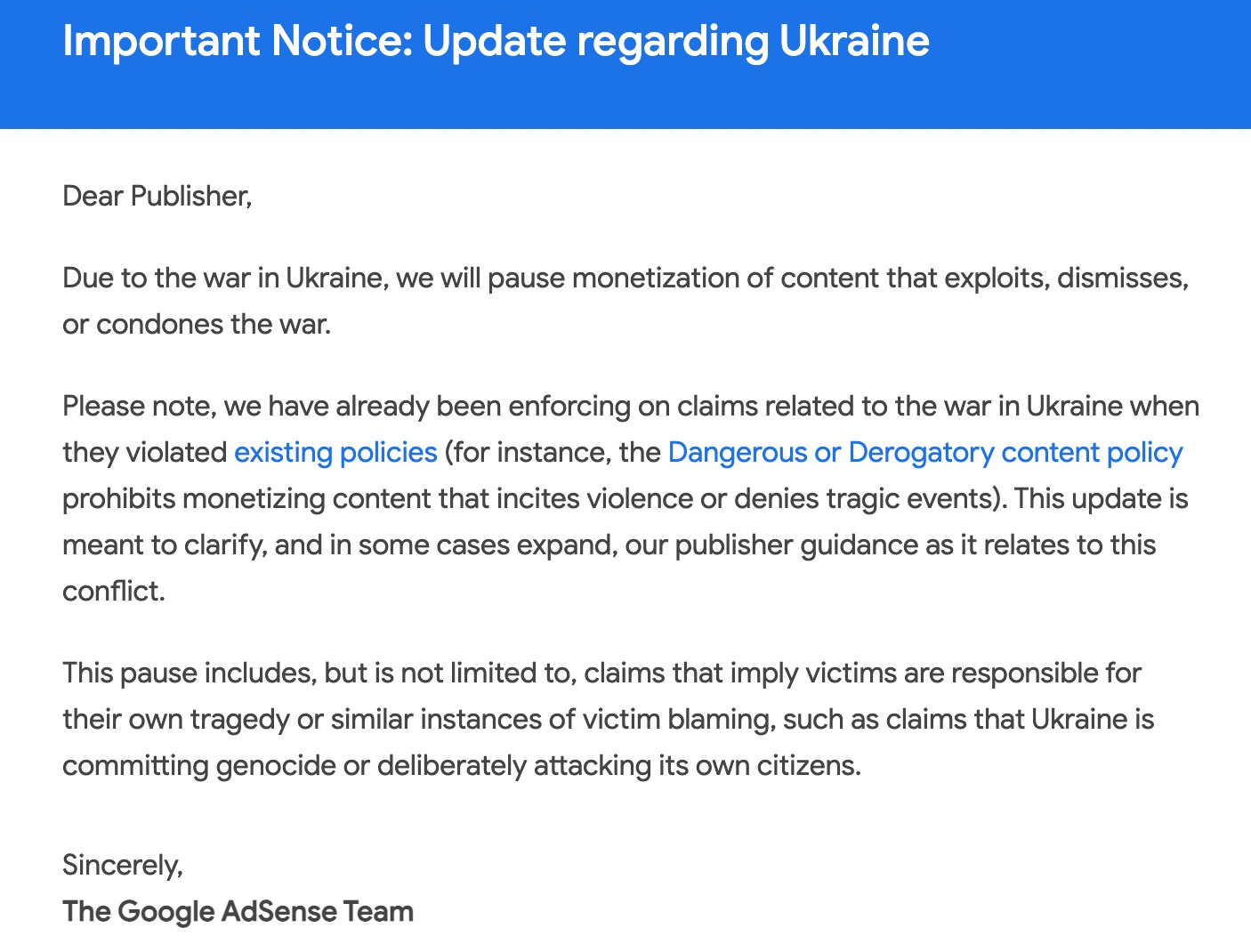
The email was a reminder of a previous policy that stated: “Due to the war in Ukraine, we will pause monetization of content that exploits, dismisses, or condones the war.”
If a publisher insists on posting content that condones the war, Google ads will be removed from such pages, and Google has a monopoly on website advertising infrastructure.
“Google helps to enable a free and open web by helping publishers monetize their content and advertisers reach prospective customers with useful, relevant products and services,” the policy states. “Maintaining trust in the ads ecosystem requires setting limits on what we will monetize.”
Failure to comply with the policy could result in a publisher’s monetization being terminated.
“Failure to comply with these policies may result in Google blocking ads from appearing against your content, or suspending or terminating your account,” the policy says.
Featured Video

Spain train disaster raises questions over Israeli-linked security contractors
or go to
Aletho News Archives – Video-Images
From the Archives
Are There 50,000 ‘Israeli-born’ Individuals Living in the UK?
By Professor David Miller | August 18, 2026
Recent disclosures by the Zionist regime show that some 2,069 British nationals were serving in the IDF as of March 2025, according to Freedom of Information (FoI) requests submitted to the occupation forces (1,686 dual British-Israeli, plus 383 multinational). We cannot tell from the figures how many of these were already settler colonists and intend to stay in the colony, and how many will return or have returned to the UK. Presumably, those returning to the UK will number far fewer than 2,000, since many are known to have become permanently residents of the colony.
Additionally, the IDF figures only provide a snapshot, and do not tell us how many have served in the Jewish supremacist military either before or after March 2025. One way into the question of how many genocidaires are living in Britain is to ask how many current British residents were born in the Zionist colony. There is data on that, as we shall see. … continue
Blog Roll
 Aletho News
- Are There 50,000 ‘Israeli-born’ Individuals Living in the UK?
- German CDU MPs Seek Climate “Misinformation” List
- The ‘Gaza Treatment’: How Media Headlines Obscure Who is Bombing Yemen
- Ro Khanna urges Democrats to strip Israel ‘integration’ provision from defense bill
- Why Iran designated British MI6, Royal Navy, and RAF as hostile, terrorist organizations
- Armenian opposition politician dies in custody
- US still trying to recycle failed hypersonic missile programs
- France’s ‘Cold War’: Paris blames Tehran for supermarket fridge hacks
- Psywar no more? 77th Brigade’s sudden death
- Ukraine Already Carved Up… Before Talks Begin? /Prof. Richard Sakwa
- If Americans Knew
- An error has occurred; the feed is probably down. Try again later.
- No Tricks Zone
- German Authorities Start Initiative To Evaluate Public Register For Climate “Disinformation” Spreaders!
- Zonal Asymmetry of Temperature Change in the Antarctic Circumpolar Current
- New Study: The Net Fossil Fuel Contribution To Rising Atmospheric CO2 Has Been Zero For 500 Years
- Germany’s Green Energy Transition Becoming Increasingly Expensive…Another 6 Trillion Euros!
- Sudden Stratospheric Warming, Powerful El Niño Combination May Lead To Extreme Europe Cold, Energy Crisis!
- Two New Studies Find Thwaites Glacier Melt Cannot Be Driven By Human Activity Or A Warming Ocean
- E-Cars Reduce CO2 Emissions By Only 41% Compared To Internal Combustion Engine Vehicles
- Predictions Made By Renowned Climate Professor Over Past Decades Have Been Proven To Be Poor
- New Study Suggests Large Regions Of The Pacific Ocean Have Been Cooling For The Last 80 Years
- Germany’s Green Energy Debacle: High Energy Costs Force Kahla Porzellan to Close After 182 Years!

