GoFundMe said it shut down the Freedom Convoy’s fundraising page because the office of the mayor told executives that the protesters were committing “violent” acts, according to testimony during a House of Commons public safety committee hearing last week.
The admission raises the alarm on the issue of how the mere accusation of violence is enough to get speech shut down.
During the hearing, GoFundMe lawyer Kim Wilford said that the company had “reached out” to Ottawa’s mayor Jim Watson’s office about the Freedom Convoy.
The mayor’s office told GoFundMe that there were “reports of harassment, violence, damage occurring.”
“Based on this credible information we made informed decisions that this campaign no longer complied with our terms of service and we removed it from the platform,” Wilford said.
However, most of the 197 arrested protesters have been charged with mischief. The two people who were arrested for uttering threats and carrying a concealed weapon were not part of the actual convoy, according to Blacklock’s Reporter.
Watson’s office claimed that before meeting with GoFundMe, on Feb. 3, fights had already broken out, residents were being harassed and masks were being ripped off citizens.”
CPC MP Doug Shipley said during the hearing, that all MPs were “given briefings” about the protests, but “nowhere ever did I see in any of the reports shared that there was violence, threatening behavior and damage and destruction.”
Canada’s Minister of Public Safety, Marco Mendicino, countered by claiming that the lack of criminal charges “doesn’t mean it [violence] did not happen.”
March 8, 2022
Posted by aletho |
Civil Liberties, Deception, Full Spectrum Dominance | Canada, COVID-19 Vaccine, Human rights |
Leave a comment
Brutal act of military conquest, or peaceful (and popular) transition of power? Here are the facts to help you decide.
In part one of our recap on the recent history of Ukraine, we looked at the chain of events that lead to the removal of President Viktor Yanukovych from power.
You can read that here.
In this second part, we will be focusing on Crimea, how the peninsula came to be a part of the nation of Ukraine, whether or not this was ever popular with the public, and how the transition back to being a part of Russia was handled.
1954
Soviet leader Nikita Kruschev signs a decree transferring Crimea from the Russian SSR to the Ukrainian SSR. His motivation for doing so is a matter of historical debate, as is the constitutionality of the decision. However, as they were all one nation at that time, the administrative decision is more of a “symbolic gesture” than anything else.
Prior to this, Crimea had been a part of Russia since 1783 when the Russian Empire took control of the Crimean Khanate following the decline in power of the Ottoman Empire.
1965
Sevastopol, Crimea’s major port city, is officially named a “Hero City” of the USSR, an honour given to 12 cities across the country to mark the 20th Victory Day. Sevastopol held against major assaults from the Axis powers in October and December of 1941, before holding out for a six month siege and finally falling to the Nazis in June of 1942.
1990
As the USSR begins to crumble, Ukraine declares itself an independent republic, beginning the process of leaving the union and taking Crimea with it.
1991
January: The Crimean government hold a referendum asking if Crimea should declare its independence from Ukraine, reform itself as the Crimean Soviet Socialist Republic (as it had been prior to 1945), and rejoin the USSR. The vote passes with 94% support, and Crimea declares independence.
February: The Ukrainian parliament recognises this independence, passing the “Law On Restoration of the Crimean Autonomous Soviet Socialistic Republic as part of USSR”.
September: Ukrainian parliament reverses their February decision and declares Crimea a part of Ukraine once again. There is historical debate over the legality of this decision.
Following the collapse of the Soviet Union, and official Ukrainian independence, Crimea is no longer politically unified with Russia for the first time in over 200 years.
1992
Crimean parliament again declares itself independent as “The Republic of Crimea”, they draft their own constitution and plan a referendum on secession from Ukraine. The Ukrainian parliament refuses to acknowledge the declaration and forces the cancellation of the referendum.
As a compromise, Crimea is granted special status as an “Autonomous Republic”, and given control over its own budget and other devolved powers, as long as they add a line to their constitution designating Crimea a part of Ukraine.
1994
Newly-elected President Yuriy Meshkov of Crimea holds a referendum, asking the population of Crimea three questions, most notably:
- Do you support a return to the May 1992 constitution that didn’t guarantee Crimea was part of Ukraine?
- Do you support establishing that all Crimean citizens were entitled to dual citizenship with Russia?
All three parts of the referendum pass with at least 77% of the vote, and President Meshkov restores the old constitution. The Ukrainian government declares the referendum illegal and refuses to recognise either the results or the new constitution.
1995
Ukrainian government abolishes the post of President of Crimea, and cuts the powers of their parliament. For the rest of the year the President of Ukraine governs the peninsula by decree.
2001
The 2001 Ukrainian census records that over 60% of the population of Crimea describe themselves as ethnically Russian. In total 77% of Crimeans, and over 94% of the people of Sevastopol, reported being native Russian speakers.
2004
Following the “Orange Revolution”, and over-turning of Viktor Yanukovych’s victory in the Presidential election, leaders of Eastern Ukrainian oblasts – including Crimea – raise the issue of increased autonomy and even secession from the country. A conference of politicians from the Donbas region call for a referendum on federalization, but are ignored.
2006
A US Navy ship docks at the Crimean port of Feodosiya, leading to mass protests on the peninsula and a peaceful blockade of the port. Then-leader of the opposition Viktor Yanukovych claims that allowing foreign military units onto Crimea’s soil without consulting the regional parliament is a violation of both the Ukrainian and Crimean constitutions. A contemporary Radio Free Europe article notes that 55-60% of all Ukrainians oppose joining NATO.
2008
Following the Russo-Georgian war, and on the back of increased calls for Ukraine to join NATO, the BBC sends a reporter to Crimea. Their article details the strong pro-Russian feeling on the peninsula, the key part Sevastopol has played in Russia’s history, and warnings from Crimeans that “nationalists in Kiev” are trying to “force Russians out”.
A 2008 poll by the Ukrainian Centre for Economic and Political Studies found 64% of Crimeans favored secession from from Ukraine to rejoin Russia, and 55% favored increased autonomy from Kiev.
2009-2011
Between 2009 and 2011 the United Nations Development Program conducts a series of polls in Crimea on the question of Russian reunification. Every single poll returns 65-70% positive response, with another 16-25% undecided and only 9-14% favoring staying with Ukraine.
2013
A poll done by the US-based Gallup agency finds 82% of Crimeans speak only Russsian at home, and further 6% speak Russian and one other language. Only 2% report speaking only Ukrainian.
The pro-EU/pro-NATO Maidan protests begin, violence erupts in Kiev.
2014
JANUARY
27/1 – As protests intensify in Kiev and Ukraine becomes increasingly unstable, local officials in Simferopol and Sevastopol propose Crimea become a federal state, and prepare legal groundwork:
to use its right to self-determination and to exit Ukraine’s legal space in the event of a state coup, or seizure of power by force.”
28/1 – An open letter from the Sevastopol city council calls on President Yanukovych to outlaw the “extremist group” Svoboda, and invites the people of the city to form “People’s Squads” as described under Ukrainian law, and defend the border of Crimea:
It is impossible to allow specially trained and armed militants of the “Right Sector” and other pro-fascist and extremist organizations to penetrate our city and dictate their terms. We will provide reliable defense of Sevastopol. Extremism, lawlessness, banditry will not pass in the hero city.
FEBRUARY
14/2 – Yahoo News reports “Ukraine’s autonomous Crimea region leans towards Moscow “. The article notes that the Crimean parliament amended the constitution to describe Russia as a “guarantor of Crimea’s safety”, and that elected officials have asked Russia for help if the Maidan protesters should attempt to move into Crimea.
18/2 – Radio Free Europe reports on the “rise of pro-Russian separatism in Crimea”. They interview Crimean MP Sergei Shuvainikov, who claims the Ukrainian nationalists want to ban the Russian language and kill Russian culture in Ukraine.
20/2 – Crimean MP and Speaker of Parliament tells an international meeting in Moscow that Crimea “may secede form Ukraine, if the country splits”.
22/2 – Less than 24 hours after signing a peace deal, Maidan protesters storm government buildings in Kiev and take control of the country. President Yanukovych flees to Kharkiv.
In a vote that violates the consitution of Ukraine, the Rada removes Yanukovych from office for being “unable to carry out his duties”.
The same day, The Washington Post publishes this article:
“The battle for Kiev is over, is the battle for Crimea about to begin?”
23/2 – One of the first bills passed by the new government repeals the law making Russian an official state language. Neo-Naziprit leaders Oleh Tyanobohk and Dimitri Yarosh propose going further and banning both the Party of the Regions and the Ukrainian Communist Party, both traditionally political parties representing Eastern Ukraine, including Crimea.
The same day, thousands of Crimeans attend a protest in Sevastopol, chanting about re-uniting with Russia. The Guardian headlines “Ukraine crisis fuels secession calls in pro-Russian south”, reporting that when the Crimean Prime Minister ruled out secession in his speech he was booed by the crowd.
26/2 – Crimean parliament meets in a special session to discuss the crisis and situation in Kiev. Thousands rally outside the building as the meeting is taking place, chanting “Russia! Russia! Russia!” and “Crimea Rise Up!”
The Parliamentary speaker emerges from the session to address the crowd, saying:
I share your alarm and worry over Crimea’s fate… We will fight for our autonomous republic to the end… Today Kiev doesn’t want to solve our problems, therefore we must unite and act decisively. The people of Crimea have enough strength. Neo-Nazism will not work in Crimea. We will not betray Crimea.”
The Irish Times reports “Many Russian-speakers worry that Ukraine’s new government will be pulled to the right by ultra-nationalist groups that played a major role in the protests”.
28/2 – In the early hours of Friday 28th February, men in fatigues bearing no insignia take control of every airport, seaport, train station and border crossing on the Crimean peninsula. They also secure all government buildings in Simferopol. These men are later revealed to be Russian troops from the bases at Sevastopol.
Kiev and their NATO backers call the troops’ presence an invasion, but Russia defends their deployment, claiming the troops are there at the invitation of both the local Crimean authorities and Viktor Yanukovych, whom they still recognise as the legitimate President of Ukraine.
Further, the Russians claim their lease agreement allowed up to 25,000 Russian military personnel to be stationed in Crimea, and they did not exceed that number.
With the peninsula effectively cut off from mainland Ukraine, a second special session of Parliament is held, during which they vote to terminate the current government and choose a new Prime Minister. They also established plans for an independence referendum to be held in May.
March
11/3 – Crimean parliament, along with the Sevastopol city council, issue a decree declaring Crimea independent.
The new Autonomous Republic of Crimea brings forward the planned referendum from May to March 16th, changing the question from one of independence to a choice between re-joining Russia or re-joining Ukraine.
12/3 – The Crimean government formally invite members from the OSCE to observe the referendum and make sure its fair. The OSCE describes the vote as “illegal”, and refuses to attend.
16/3 – The referendum goes ahead, with the ballot papers asking:
- Do you support the reunification of Crimea with Russia with all the rights of the federal subject of the Russian Federation?
- Do you support the restoration of the Constitution of the Republic of Crimea in 1992 and the status of the Crimea as part of Ukraine?
Though official observers from both the OSCE and UN refused to take part, the Crimean authorities claimed to have invited 190 independent observers from 23 different countries, including the majority of the nations of th EU.
Kiev, along with most western governments, claim the vote is illegitimate because it took place “at the barrel of a gun”.
The reported results are massively in favour of joining Russia, 97% vs 3% against, on an estimated turnout of 83%.
21/3 – President Vladimir Putin of Russia officially signs the law recognising Crimea as part of the Russian Federation. Street parties are held in Sevastopol and Simferopol, and all across Russia.
April
Claiming they are owed money, the Ukrainian government closes dam on North Crimea Canal, reducing flow of fresh water to the peninsula. Access to water is protected by article 29 of the Geneva convention, and its use to punish a civilian population could be a warcrime.
2015
Forbes publishes this article, headlined “One Year After Russia Annexed Crimea, Locals Prefer Moscow”, it details all the polling done by Western polling agencies since the referendum:
- A Gallup study from June 2014 found 83% Crimeans agreed with the result of the referendum, including 94% of ethnic Russians. 74% said being part of Russia would make life better for them and their families.
- In January 2015, a joint German-Canadian study done by GfK for “Free Crimea”, found 82% of Crimeans fully supported the referendum and thought Crimea had made the right choice, with another 11% partially supporting it and only 4% opposing it.
- A Pew Research study from 2014 found 91% of Crimeans thought the vote was free and fair, and 88% thought Kiev should recognise the results.
- A US government-funded study published on the Soros-backed OpenDemocracy website found 84% of Crimeans “absolutely” supported the Crimean referendum, and 88% thought Crimea was moving in the right direction.
*
So, there it is, a timeline of the key events leading to Crimea’s separation from, and evenutal reunification with, Russia. Military occupation and annexastion, or a referendum supported by the majority of the population? You decide.
We previously catalogued Ukraine’s Maidan revolution and eventual fall of Viktor Yanukovych in part 1 of this series here. In part three we will be going into Kiev’s “anti-terror” operations in Donetsk and Luhansk and the collapse into chaos and civil war.
March 8, 2022
Posted by aletho |
Timeless or most popular | Crimea, Russia, Ukraine |
Leave a comment
Several major Dutch internet providers have reportedly begun blocking websites belonging to RT English, RT UK, RT DE, RT France, RT Spanish, as well as Sputnik.
According to the ANP news outlet, the Netherlands’ Authority for Consumers and Markets (ACM) targeted the said Russian media, as they are on the EU’s sanctions list, which the bloc enacted in response to Moscow’s military offensive in Ukraine.
It is said that the ACM on Monday sent a list of undesirable media to internet providers,including VodafoneZiggo, KPN, and T-Mobile.
A VodafoneZiggo spokesperson told journalists that the company was indeed going to block the websites “as soon as possible, probably Tuesday,” with T-Mobile expected to comply soon as well.
KPN, while agreeing to restrict access to the Russian media, has made it clear that it is “fundamentally” against the idea of blocking any websites in general. A spokesperson for the provider clarified that KPN does not think it is up to them to “determine what is good and what is bad.” The company would want to see “net neutrality” instead.
Last Wednesday, the European Commission ruled that all RT channels, as well as Sputnik, be banned in all 27 member states over allegations of “systematic” disinformation regarding Russia’s military operation in Ukraine.
Commenting on the move, the EU’s top diplomat, Josep Borrell, said that “systematic information manipulation and disinformation by the Kremlin is applied as an operational tool in its assault on Ukraine.” The official went on to claim that the Russian outlets posed a “significant and direct threat to the Union’s public order and security.”
Meta, Google, YouTube, Twitter and TikTok are complying with the ban already, not displaying RT and Sputnik’s material in the EU member states.
On February 24, Russia launched a military offensive against Ukraine, with President Putin citing the need to “demilitarize and denazify” the country as well as to prevent Kiev from being dragged into NATO. Moreover, according to the Russian president, the Ukrainian government’s policies toward the Russian-speaking population in the Donbass republics were tantamount to “genocide.” Ukraine and the West, however, suspect that the Kremlin in fact wants to install a pro-Russian puppet government in Kiev, coming up with pretexts for an aggressive and “unprovoked” war.
March 8, 2022
Posted by aletho |
Civil Liberties, Full Spectrum Dominance, Russophobia | European Union, Netherlands |
Leave a comment
The neocons and their allies might be making it happen
Well, the genie is well and truly out of the bottle and there is no easy way to encourage it to return. Thanks to a relentless flow of propaganda, the American public has become increasingly convinced that the United States “looks weak” and must stand up against Vladimir Putin. Richard Haass of the Council on Foreign Relations is now calling for “regime change” in Russia while Senator Robert Wicker and Congressman Adam Kinzinger as well as several former Joint Chiefs of Staff generals are demanding that the United States establish a “no fly zone” over Ukraine, which would require US destruction of Russia’s air defense capabilities and shooting down of Russian planes among other measures. If that were to occur the war could quickly turn nuclear. Other media and government “experts” are speculating that Russian President Vladimir Putin is insane with much of the other disinformation coming from Russia haters like Bill Browder and former Ambassador Michael McFaul. But FOX news commentator Sean Hannity possibly wins the hate race, calling for the assassination of Putin because has he has “forfeited his right to live,” a view also shared by Senator Lindsey Graham.
Former GOP Vice President Mike Pence has called for anyone supporting Russia to be kicked out of the party which will no doubt produce a purge of members who are reluctant to go to war on behalf of foreign country and no ally Ukraine. Meanwhile a completely deranged Senator Mitt Romney has described anyone speaking up for Russia as “almost treasonous,” suggesting that Romney would benefit from looking up the definition of “treason” in the US Constitution. And the completely looney-tunes televangelist Pat Robertson is warning that Russia attacked Ukraine but the real target is Israel, which will result in a great war and Armageddon leading to the “End Times” when the world will end and all true believers will be raptured up to heaven.
But other more stable folks are making two basic arguments to justify the increasing engagement of Washington in the fighting. The first is the vague claim that what Ukraine versus Russia is all about is the maintenance of “freedom and democracy” in Europe. That is generally how President Joe Biden and other politicians describe it since it does not require any further explanation or discussion. The other argument is rather an elaboration of that, claiming that there was some kind of post-Second World War consensus that aggressive war to acquire someone else’s land should be condemned by all nations and steps should be taken to contain and repress any such activity. This led to the creation of the United Nations.
The problem is that neither justification for involving the US in a conflict where it is not actually threatened requires something more substantial given the danger of escalation of the fighting to the point where the world’s two leading nuclear powers would find themselves going head-to-head. And there is the little matter of history to reckon with, which tells us that not everything taking place can be reduced to such simplistic terms to justify taking action. The status quo in eastern Europe is a consequence of the break up of the Soviet Union in 1991-2 and, beyond that, of the configuration of the Russian Empire of the Tsars that preceded communism. Ukraine itself has had its borders adjusted numerous times.
Currently, the Ukrainian government of President Volodymyr Zelenskyy is seeking to broaden the conflict with Russia by attempting to join the European Union while also calling for weapons as well as direct military intervention from NATO. He has called for volunteers to join the fight as a “foreign legion” and has also contacted Israeli Prime Minister Naftali Bennett and suggested that Bennett persuade Putin to participate in peace talks in Jerusalem. There has also been a less conciliatory appeal to world Jewry to join in on the attack directed against Moscow’s economy. In a video circulated among Jewish international organizations Zelenskyy said “Don’t you see what is happening? That is why it is very important that millions of Jews around the world not remain silent right now. Nazism is born in silence.”
There is also more than a measure of hypocrisy in the Biden Administration taking the lead on punishing Russia for aggression. The United States has gone to war with a non-threatening Vietnam and has destroyed governments and engaged in completely illegal military occupations of Afghanistan, Iraq, Somalia, Libya and Syria. It has assassinated senior officials from Iran. It has not been punished for any of those actions. Its ally Israel bombs Syria on nearly a daily basis, engages in assassinations, kills Palestinian children, and annexes Arab land that it has obtained by force on the Golan Heights and West Bank, dispossessing the original inhabitants. When that happens, the US Congress and White House look the other way. All the Israeli war crimes as well as those being carried out by the Saudis against Yemen’s Houthis have been endorsed by the successive Bush, Obama, Trump and now the Biden administrations.
Beyond that, Ukraine is no democracy. The nation’s current government came into power after the 2014 coup engineered by President Barack Obama’s State Department at an estimated cost of $5 billion. The regime change was driven by State Department Russophobe Victoria Nuland with a little help from international globalist George Soros. It removed the democratically elected President Viktor Yanukovych who was unfortunately for him a friend of Russia. Ukraine is reputedly both the poorest and most corrupt country in Europe, witness the Hunter Biden saga. Zelenskyy who is Jewish and claims to have holocaust victims in his family tree is a former comedian who won election in 2019. He replaced another Jewish president Petro Poroshenko, after being heavily funded and promoted by yet another fellow Jew and Ukraine’s richest oligarch Ihor Kolomoyskyi, who is also an Israeli citizen and lives in Israel. As an entertainer, one of Zelenskyy’s musical acts consisted of his playing a piano with his penis, suggesting that Ukrainian humor has some unique characteristics.
After the election of the post-coup new model Ukrainian government in 2014, opposition parties were declared illegal and some leaders were arrested for “treason,” the media was censored and the parliament outlawed Russian, the language of a third of the population, as an official language. Then the government declared war on the predominantly Russian Eastern provinces and, for past eight years, has killed 14,000 people.
I keep asking myself, why do Washington policymakers and the media who should know better give so much of a damn about Ukraine? It is of no strategic value to the United States and Russian demands were both reasonable and negotiable. So the claims that Ukraine’s defense is intended to keep Europe democratic and free is just so much window dressing to justify waging economic war on Russia. And, in any event, American hypocrisy is clearly visible regarding the Kremlin’s possible intention to annex a couple of heavily Russian Ukrainian regions. It is not in any way worse than what Israel has been doing in Jerusalem, on the West Bank and on the Golan Heights, all endorsed by successive US administrations. So what’s it all really about?
After considering the parallels with Israel, it then occurred to me that maybe there was the usual angle, meaning that it was all about “protecting” Jews, the argument that succeeds in Washington where all else fails and makes the Bidens, Blinkens, Pelosis and Schumers stand up and salute. Even a befuddled Donald Trump has seen the light and is now calling the Russian intervention a “holocaust” and is joking about false-flagging US F-22 fighter bombers as Chinese and “bombing the shit out of Russia.” The Jewish media is also showering Zelenskyy with praise, referring to him as a genuine “Jewish hero,” a modern Maccabee resisting oppression, a David versus Goliath. T-shirts bearing his image are being sold that read “Resisting tyrants since Pharaoh” while the Jewish community in New York City is raising millions of dollars for Ukrainian aid.
The Jewish Telegraphic Agency reports that a “2020 demographic survey estimated that besides a ‘core’ population of 43,000 Jews, around 200,000 Ukrainians are technically eligible for Israeli citizenship, meaning that they have identifiable Jewish ancestry. The European Jewish Congress says that number could be as high as 400,000.” If that is true, it is one of the largest Jewish communities in the world and it includes at least 8,000 Israelis, many of whom are trying to return to Israel. Other Ukrainian Jews are also fleeing the country.
Israel, with close ties to both nations through the Jewish diaspora, has been attempting to play both sides, offering support to Ukraine while also not condemning Russia. Its Prime Minister Naftali Bennett is increasingly playing the role of mediator between the two adversaries, having met with Putin and spoken several times with Zelenskyy. Jews, some of whom have Israeli citizenship, are, in fact, disproportionately represented among the so-called oligarchs in both countries, controlling key sectors of the respective economies. Several Russian Jewish oligarchs have already fled on their superyachts to ports providing non-extradition in an attempt to preserve their assets from US and European sanctions directed against Moscow’s economy.
So there appears to be a Jewish/Israeli story that is part and parcel of what is going on in Ukraine. It has long been recognized by many that a particular antipathy directed against Russia permeates the neocon world view. Most neocons are Jewish and a number of them are running the State Department while also holding high level positions elsewhere in the Biden Administration as well as in the foreign policy think tanks, including Haass at the influential Council on Foreign Relations. Likewise, the intensely Russophobic US and Western media and social networking sites are disproportionately Jewish in their ownership and staffing. As US-Russian negotiations leading up the current fighting were clearly designed to fail by the Biden Administration, one has to wonder if this war is largely a product of a long enduring ethno-religious hatred. I am speculating of course, but there is even some historical evidence to support such a view in the Iraq invasion and the hostility towards Iran, both of which have been and continue to be driven by Israeli interests, not those of the United States. Is Russia the enemy a similar contrivance? It has to be considered…
Philip M. Giraldi, Ph.D., is Executive Director of the Council for the National Interest, a 501(c)3 tax deductible educational foundation (Federal ID Number #52-1739023) that seeks a more interests-based U.S. foreign policy in the Middle East. Website is councilforthenationalinterest.org, address is P.O. Box 2157, Purcellville VA 20134 and its email is inform@cnionline.org.
March 8, 2022
Posted by aletho |
Russophobia, Timeless or most popular, Wars for Israel | Israel, Russia, Ukraine, United States |
Leave a comment
Belying the predictions of western media, Russia’s special operation in Ukraine is entering a successful endgame on the political and diplomatic track much sooner than one would have thought.
A close reading of the outcome of the 3rd round of peace talks in Belarus last night is that the Ukrainian negotiators have sought some more time to come up with a full response to the Russian terms for ceasefire.
Ukraine has signalled willingness to be a neutral country ruling out NATO membership. The main sticking points narrow down to: a) recognition of Crimea as part of Russia; and, b) sovereignty of Lugansk and Donetsk.
They are non-negotiable demands. But they are a bitter pill for the Ukrainian leadership to swallow. The Ukrainian stance is that these demands are “practically” impossible.
But, as Vladimir Medinsky, leader of the Russian team, told RT, “In my opinion, there is a big difference between impossible and ‘practically impossible’… I hope that eventually we will find a solution.”
The Russian side feels encouraged albeit yesterday’s talks produced no tangible results. They are in no hurry to rush into major military offensives.
Indeed, the pattern throughout has been that the Russian generals would apply coercive military power to create synergy to kickstart a parallel political / diplomatic track to attain Moscow’s objective (which is not about territorial conquest.)
The western analysts who expected the Russian generals to behave like Patton or MacArthur with a massive attack on Kiev instead witnessed a confusing Russian strategy — slow, halting operations, without excessive force and with a distinct preference to avoid fighting by encircling and bypassing pockets of resistance, and avoiding set battles.
Putin revealed yesterday that “conscripts aren’t and won’t be taking part in hostilities, and there will be no additional call-up of reservists from the reserve… Missions are carried out only by professional troops.”
The Ukrainian side realises that the Russian strategy is winning, as Russian forces are encircling Kiev from the northwest, west and east, Black Sea ports are no longer accessible, and the forces in the east are entrapped. Yesterday, Zelensky acknowledged the grim situation.
After the third round in Belarus, he hastened to assure that talks will continue until a settlement! In his words,
“Today the third round of negotiations took place in Belarus, and I would like to say ‘the third and final one,’ but we are realists. Therefore, we will talk, we will insist on negotiations until we find a way to tell our people, ‘this is how we will come to peace.’”
Russians are in no tearing hurry. They eschew triumphalism, and instead allow enough space for the Ukrainian side to take some really hard decisions on surrender — while military pressure is kept up on Kiev. Foreign Ministry spokeswoman Maria Zakharova said yesterday, “We keep the door open to diplomatic options. As soon as there are corresponding signals, we will be acting on them.”
Importantly, the two sides have agreed on a roadmap for creating humanitarian corridors and Russian side has announced a ceasefire. Also, these corridors will be operated in close coordination through a hotline.
The Russian statement says that a “continuous communication link shall be established between the Russian and Ukrainian sides for mutual exchange of information about the preparation and implementation of the evacuation of civilians and foreign citizens.”
The Russian side since conveyed all relevant details to foreign embassies, appropriate UN and OSCE agencies, the International Committee of the Red Cross and other concerned international organisations. The humanitarian corridors will be:
- from Kiev and adjacent regions to Gomel (Belarus);
- from Sumy along two routes to Poltava (central Ukraine) and to Russia;
- from Kharkov to Russia or to Lvov, Uzhgorod and Ivano-Frankovsk (all three in western Ukraine); and,
- from Mariupol along two routes to Russia and Zaporozhe (on the Dnieper river in southeastern Ukraine.)
This joint work and the lull in fighting sets the stage for the crucial meeting between Russian Foreign Minister Sergey Lavrov and his Ukrainian counterpart Kuleba in the Turkish resort of Antalya on Thursday. The very fact the talks have been elevated to foreign minister level signals hope that a critical mass may be accruing.
Thoroughly disillusioned with the betrayal by the US and NATO, Zelensky is inching toward an agreement with Moscow. It is futile to pre-judge the outcome, but there is a game changer. The major European countries — UK, France, Germany, Netherlands — have rebuffed Washington’s hawkish proposal to impose sanctions on Russia’s oil exports.
Oil exports are Russia’s principal source of income, therefore, this is a strong rejection of Washington’s efforts to isolate Russia. French President Macron captured the zephyr in his remark yesterday:
“It is impossible to build a lasting peace if Russia doesn’t participate in building a comprehensive security architecture on our continent, because history and geography mandate this. Our responsibility is to preserve all the ties that we can preserve. We must continue to talk with the Russian and Belarusian peoples. We need to do this with help from representatives of the world of culture, the scientific and technical community, non-governmental organisations.”
On Sunday, in an op-ed in the New York Times, UK Prime Minister Boris Johnson also wrote: “We have no hostility toward the Russian people, and we have no desire to impugn a great nation and a world power. Ukraine had no serious prospect of NATO membership in the near future. This is not a NATO conflict, and it will not become one.”
Meanwhile, major European countries, especially Germany, are ruling out EU membership for Ukraine, either — which, ironically, was the issue that had precipitated the US-backed coup in Kiev in 2014 triggering the catastrophic slide toward conflict involving Russia.
March 8, 2022
Posted by aletho |
Aletho News | European Union, France, NATO, Russia, UK, Ukraine |
Leave a comment
China’s foreign ministry has called on the US to disclose information on the Pentagon’s alleged biological laboratories in Ukraine “as soon as possible”.
On Monday, the Russian military said Ukrainian authorities had been destroying pathogens studied at its laboratories. Moscow claimed that 30 US-financed Ukrainian biolabs have been actively cooperating with the American military.
Kiev has denied developing bioweapons. According to the website of the US embassy in Kiev, the US Department of Defense’s Biological Threat Reduction Program only “collaborates with partner countries to counter the threat of outbreaks” of infectious diseases. In 2020, the embassy called such theories about US-funded biolabs in Ukraine “disinformation.”
Speaking at a press briefing on Tuesday, however, Chinese Foreign Ministry spokesman Zhao Lijian claimed that, according to his country’s information, the laboratories in Ukraine are just “a tip of an iceberg” and that the US Department of Defense “controls 336 biological laboratories in 30 countries around the world.” This is done under the pretext of “cooperating to reduce biosecurity risks” and “strengthening global public health,” Zhao said.
It is the first time that Beijing has disclosed the alleged figure. Zhao said that according to data “released by the United States itself,” there are 26 US laboratories in Ukraine. In light of Russia’s military offensive in the country, he urged “all parties concerned” to ensure the safety of the labs.
“In particular, the United States, as the party which knows these laboratories best, should publish the relevant details as soon as possible, including which viruses are stored and which research has been carried out,” he said.
He claimed the US “has been exclusively obstructing” the establishment of an independent verification mechanism. Such behavior, Zhao said, “further aggravates the concerns of the international community.”
According to a report in The Rio Times, the US embassy in Ukraine deleted all information about Pentagon-financed bio-labs in the country from its website on February 26. However, journalist Dilyana Gaytandzhieva claimed embassy staff forgot to remove a document showing that the Pentagon is funding two new biolabs in Kiev and Odessa.
“Ukraine has no control over the military biolabs. The Ukrainian government is not allowed to release sensitive information about the program,” the Brazilian news outlet claimed.
Over the past 20 years, the Science and Technology Center in Ukraine, jointly established with the United States, invested over $285 million in about 1,850 projects carried out by scientists who, according to Gaytandzhieva, previously worked on the development of weapons of mass destruction.
US authorities are yet to comment on the latest claims.
March 8, 2022
Posted by aletho |
Militarism | Ukraine, United States |
Leave a comment
Some have asked for my thoughts on Ukraine.
Since 2014, the Ukraine has been experiencing a quiet civil war, between the Ukrainian majority in the west, and a Russian minority concentrated in the east. The ethnic Ukrainian side in this conflicted has been co-opted by the supranational global imperial monolith. This is the cadre of western elites that determines political, medical and cultural orthodoxy across the world. They control not only all major political parties in most western countries, but also global international consortia from the United Nations to the World Economic Forum to the European Union to the North Atlantic Treaty Organisation. Their goal is to further squeeze Russia by turning Ukraine – including the Russian-speaking eastern regions – into another political constituent of American globalism.
To the Russians – many Russians – this is unacceptable. After the Soviet Union collapsed, the globalists descended upon Russia to rape and pillage. In the years after 2000, NATO expansion was used to hem in Russia along the Baltic. These were hard years, but Russia finally reasserted its sovereignty. Since then, the western globalists have considered unaligned Russia to be their enemy, and they have adopted Ukraine as a convenient proxy against her. Ukraine is useful for this purpose, because it has considerable strategic significance, whether as a gateway to Russia through the open Ukrainian plains, or as a staging ground for American missiles.
The same western globalists who hate Russia, also count us as their enemies, and my sincere advice is to take them seriously in this. They have a kind of myopia for internal political dissidents; we are the unaligned domestic element, Russia is the unaligned international element, and so when Donald Trump is elected to the presidency, this must be, for them, the result of Russian interference.
I keep calling these people American or western globalists, but that’s only one way to understand them. I don’t have anything against Americans; I lived there for many years and have a great many American friends. It is only an historical accident, probably, that America finds itself at the centre of this globalist excrescence, this post-political, post-national order.
Rolf Peter Sieferle, one of my favourite thinkers, wrote about the fundamental conflict, between the globalists on one hand, and the unaligned people like me and unaligned countries like Russia, in more abstract terms. For him, the clash is between “politics” and “system”:
Politics belongs to an older stratum of existence, ordered in terms of the state and of history, crystallised in statesmen, leaders and ideologues. It has programmes, values and goals. What is required are virtues and commitments directed towards a super-ordinate whole. The last resort of politics is war – the willingness of the individual to sacrifice himself for a higher cause, for his community.
System characterises newly emerging orders of higher complexity, which successively displace politics. Systems organise themselves without focus, without values, goals or programmes. Their only maxim is freedom and emancipation for individuals. Virtue and sacrifice are anachronisms. Wars are nothing but catastrophic conflicts that must be prevented through skilful management. Order is created by objective, autonomous constraints, not by a normative orientation. The structures of systems are as inescapable for individuals as a magnetic field is for iron filings. They do not “know” anything about it, but they conform to their predefined paths. The most important processes are not controlled and can hardly be grasped theoretically.
System has largely prevailed in advanced “western” countries. Yet the rest of the world in many ways still thinks politically. This strikes the West as anachronistic fundamentalism. …
The system-globalists don’t recognise the legitimacy of Russian strategic interests, or the legitimacy of anybody’s strategic interests. Globalists do not have security concerns in that way. Many of them even believe their own hollow rhetoric, that they are spreading freedom and democracy, even after these last two years of experimentation in forced vaccination and intermittent mass house arrest. Even if they don’t believe all of that about democracy, they nevertheless imagine that they are missionaries of light and goodness to all peoples everywhere, and that human potential will only be fully realised, when every last Russian is on Facebook and subscribed to Amazon Prime.
The global American empire doesn’t invade; that is not what systems do. It assimilates. It is basically a borg that imposes economic and political constraints on an ever expanding expanse of the globe, which progressively fatten, distract and deracinate populations, with a view towards blending them into the same shallow multinational consumerist soup. Their plan was to make Ukraine part of the borg, and in this way further encroach upon Russia. Russia responded in political fashion, by taking up arms. Because the western borg never knows when to stop, Ukraine will now be destroyed and probably partitioned, as a means of keeping it forever outside the western globalist fold.
However much the globalists like the idea of encircling Russia with NATO, in their saner moments they’re not actually willing to risk nuclear war to defend the easternmost reaches of Europe. For the globalists, Ukraine was just a pawn. After they finish throwing their tantrum, they’ll go pick another proxy fight somewhere else, and ruin some other country; and they’ll also continue to grind away at unaligned unassimilated internal dissidents within their borders too. They make no distinctions here.
Western media and politicians don’t want to explain the cause of the Ukrainian war, because it is a defeat that they brought upon themselves. This is why they have chosen instead to portray Putin as some kind of crazy lunatic, in the mould of a Kim Jong-un or a Saddam Hussein. That is precisely wrong: Those are unpredictable tin-pot dictators who command paper-tiger armies. The Russians are a nuclear-armed global force, and the Ukrainian war is not something that Putin himself dreamed up yesterday. It surely enjoys substantial support within the Russian political and military establishment.
So, now that I’ve angered some of you: Nothing in the above is at all original; a lot of people (from John Mearsheimer to Noam Chomsky to a late 1990s Joe Biden) have made similar observations. I think there is little room for original thought, when it comes to the major events of global politics. Most of what is happening becomes obvious, as soon as you step outside the crazy media framing and observe things as they are.
– From Sieferle, Finis Germania (2017) p. 40–41. My translation.
March 8, 2022
Posted by aletho |
Militarism, Russophobia, Timeless or most popular | NATO, Russia, Ukraine, United States |
Leave a comment
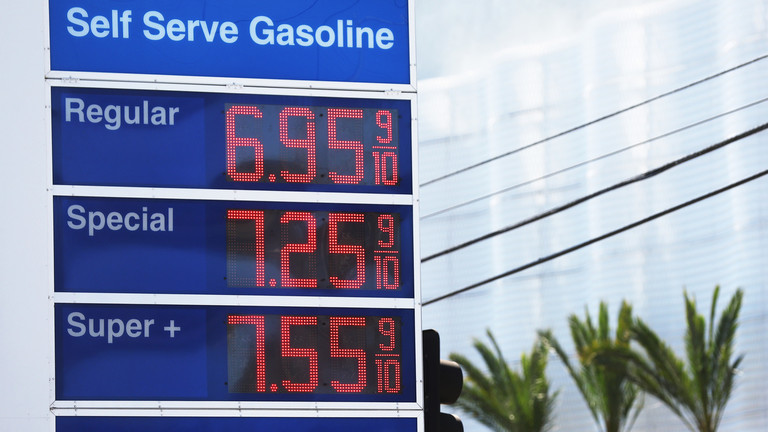
High gas prices displayed at a Mobil station on March 7, 2022 in Los Angeles, California. © Mario Tama / Getty Images
US President Joe Biden has announced a ban on Russian oil and gas imports in response to the ongoing conflict in Ukraine on Tuesday, a move that threatens to send global gas and oil prices even higher than the record-setting costs the commodities are already fetching.
The president called on the nation to use the events as an opportunity to transition to renewable energy, insisting that if “no one has to worry about the price at the gas pump in the future, tyrants like Putin won’t be able to use fossil fuels as weapons against other nations.”
Biden warned oil and gas companies against jacking up prices unnecessarily, declaring that while “Putin’s war against ukraine is causing gas prices to rise… it’s no excuse to exercise excessive price increases or padding profits or any kind of effort to exploit the situation or American consumers.”
“Russia’s aggression is costing us all, and it’s no time for profiteering or price-gouging,” Biden said, hailing the blanket ban on all imports of Russian oil and gas as “another powerful blow to Putin’s war machine.”
Americans will have to pay “the price of freedom” in the coming weeks as the sanctions are expected to send energy prices soaring worldwide, Senator Chris Coons (D-Delaware) told CNN on Tuesday ahead of the sanctions announcement.
The Democratic senator warned that the price of oil could very well double to $300 per barrel, with gas prices more than tripling to $10-$14 per gallon.
The repercussions from the price shock will be felt worldwide, he continued, as costs continue to surge. Acknowledging that “the strength of our sanctions, of the costs we’re imposing on Putin… are more successful and more sustainable when they’re coordinated,” he praised the administration for working together with Europe on the looming import ban instead of pushing ahead unilaterally.
“We have to realize that it’s a global integrated market, it is tough to just turn on the taps and increase production quickly – it’s not like phoning up Amazon,” he explained, cautioning “we are going to see increased gas prices here in the US, in Europe they will see dramatic increases in prices, that’s the cost of standing up for freedom and of standing alongside the Ukrainian people. We need to see the cost and benefit here.”
The senator also admitted the White House has been in negotiations with its once-sworn enemies in Venezuela and Iran, two major oil producers Washington is suddenly seeing in a new light for their potential to bail out countries soon to be running on empty in the absence of Russian energy supplies, but argued the focus should be on Canada first. However, he acknowledged Putin “had Western Europe over a barrel” – literally and figuratively – regarding the highly sought-after commodities.
Russia is the second-largest oil exporter in the world, while the US is the largest oil consumer. While Moscow supplies only about 7% of US oil, Europe is much more heavily reliant on the nation for its energy supplies.
Fresh polls claim that Americans are willing to pay more at the pump in order to stick it to Putin. A Quinnipiac survey conducted over the weekend, which found 71% of Americans supported a ban on Russian oil even if it led to higher gas prices. More than half of respondents (56%) even suggested the US hadn’t gone far enough with its sanctions and called for tougher moves.
March 8, 2022
Posted by aletho |
Malthusian Ideology, Phony Scarcity, Russophobia | European Union, United States |
Leave a comment
As political pressure mounts for the UK fully to exploit North Sea oil reserves and begin fracking, the BBC is doubling down in its campaign to fight fossil fuels.
There is nothing new in this, of course: we have become used it down the years. But now they don’t even attempt to disguise it, so convinced are they of their moral superiority in the matter.
Last week they published two articles attacking critics of Net Zero. The reports were full of the opinions of the BBC’s chums in the Green Blob, such as Greenpeace, Carbon Brief and the Committee on Climate Change, but gave scant mention of opposing views.
The first report, ‘Climate change: Can the UK afford its net zero policies?’ was an attempt to take down the arguments of the Net Zero Scrutiny Group (NZSG), made up of about 20 Conservative MPs, who have perfectly legitimately drawn the public’s attention to the very real costs of Net Zero.
The article begins by portraying the NZSG as a tiny bunch of ultra Right-wing Brexiteers – you know, the ones who should be ignored!
The rest of the article carries on in the same one-sided vein, with grossly misleading and inaccurate comments and a failure to present the other side of the argument.
It starts by claiming that our energy bills are only £159 a year higher on average because of climate policies. But this does not reflect the full cost of those policies, which in total are estimated to cost £17.6billion this year. That is not £159, but £650 per household.
Much of this cost is paid by the public sector and industry/commerce, meaning higher taxes and prices. Either way, the public end up paying.
The BBC then go on to claim that we should be building wind farms, because they are cheaper than gas power stations.
They imply that you can simply swap wind for gas, ignoring the fact the former is highly intermittent. Currently we need reliable, dispatchable generation, such as gas, to turn on when wind power fails to meet demand. When this is factored in, wind power is nearly double the cost of gas power.
Next the BBC turns its attention to claims that fracking will reduce energy prices in the UK. They argue that we cannot affect global prices of gas, which totally misses the point. Even if UK gas is sold at world prices, the country will still benefit hugely, and in particular government revenues will be boosted. Moreover it will greatly enhance our energy security.
The NZSG have rightly raised the question of how much we will all have to pay for Net Zero, something which the public has been kept in the dark about. The BBC’s response quotes the ultra optimistic calculations of the Committee on Climate Change, which have already been proved to be false and give a cost of ‘only’ £344billion by 2050.
Anybody who claims what the economy will look like three decades hence is a charlatan. But what we do know about is the crippling cost being imposed on the public in the short term. Things like heat pumps, insulation and electric cars will cost us tens of thousands of pounds. The new hydrogen networks being proposed will drive our energy bills up yet further.
For some reason, the BBC makes no mention of any of this.
But won’t the costs of climate change far outweigh all of this? The BBC think so:
‘The UK government’s latest report into the risks of climate change warns that based on a conservative estimate of a 2C temperature rise by 2100, flooding for non-residential properties across the UK is expected to increase by 27 per cent by 2050 and 40 per cent by 2080. At 4C this increases to 44 per cent and 75 per cent respectively.’
Leaving aside the fact that these claims are pure make-believe, does the BBC really think that eliminating the UK’s 1 per cent of world emissions will have the slightest effect on the climate?
The second BBC article, ‘Government climate advisers say cut fossil fuels to lower energy bills’ is by our old friend Roger Harrabin, ‘BBC environment analyst’. Again it does little but report the views of the Committee on Climate Change and others in the Green Blob, who are campaigning for more renewable energy.
As in the first article, it repeats the claim that energy prices won’t drop if we develop shale and North Sea gas reserves as the amounts are so insignificant. However, a recent study by the Warwick Business School estimated that our shale reserves could easily supply a quarter of the UK’s gas consumption over the next twenty years – a hardly insignificant amount at a time when North Sea gas output is expected to halve.
But for ideological reasons, the Committee on Climate Change would like to throw this all away!
John Kerry worries about Ukraine war’s effect on emissions
Joe Biden’s Climate Tsar, the gaffe-prone John Kerry, put his foot in it again last week. In an interview with a Middle East TV station he said he was worried that the Ukraine war would have ‘massive emissions consequences’, and that it could divert the world’s attention away from climate change.
This is the same John Kerry who flew in a private jet to Iceland last year to collect an Environmental Award. When asked why he chose private jet, he responded it was ‘the only choice for someone like me’.
It was only the other day that Kerry was full of praise for India’s climate efforts, despite the fact they continue to burn more and more coal. He was impressed by Prime Minister Modi’s promise to build lots of solar farms, which Kerry claimed would make India compliant with the 1.5C goal set at Glasgow, a goal which requires global emissions to be cut in half in this decade.
Evidently arithmetic is not John Kerry’s strong suit!
While Modi’s plans would increase wind and solar output tenfold by 2040, this will not be enough to even meet the rising demand for energy in India, which is projected to increase by 69 per cent by then. This means that fossil fuel consumption will continue to grow as well.
Even with all of this investment in renewables, wind and solar together will still only be supplying 20 per cent of India’s energy in 2040.

BP Energy Review & International Energy Agency Outlook
While John Kerry strolls around with his head in the clouds, the Indian Government have long realised that you cannot run a modern economy just on the wind and the sun.
Selling the UK steel industry down the river
As I explained a few weeks ago, the UK operates an Emissions Trading Scheme, a cap and trade system, applying to electricity generators, energy intensive industry and domestic aviation.
The scheme is designed to cut the use of fossil fuels by forcing companies to purchase carbon allowances if they dare to use them.
As a direct consequence of government policy, the price of these allowances has in effect quadrupled in the last couple of years. (Although the UK system was only introduced last May, it directly replaced a similar EU scheme, which it now tracks.)
Higher carbon prices have not only pushed electricity prices through the roof, but they are also hitting industry hard as well, not least the steel industry.
According to the Telegraph, steelmakers are now facing the prospect of cutting production thanks to a doubling of the carbon price in the last nine months.
Steel companies receive a set number of free allowances each year, but this quota is reduced each year. Once they have used these up, they must buy them on the market, which adds £175/ton to the cost of the steel produced. This amounts to a third of the price they sell the steel for, which is quite clearly unsustainable.
Indeed, so high are the carbon prices that firms can often be better off selling their allowances and producing nothing!
Cutting production however has its own problems for the steel industry, because its fixed costs are so high. In the real world, steel plants need to run at near to full capacity to be profitable. It makes no financial sense shutting down furnaces and rolling mills for days at a time.
In other words, they are stuck between the devil and the deep blue sea.
Furthermore there is little that steel firms can do to cut fossil fuel use. By definition, making steel is a highly energy intensive process. From personal experience I know that steel works have forever been looking at ways to reduce energy use on a daily basis.
It is true that electric arc furnaces, which melt scrap steel, don’t need the colossal amounts of coke required in blast furnaces, but higher electricity prices have already crippled their viability.
The inevitable result of government policy is that we will end up importing more steel instead of making it ourselves. It will be made in countries like China and India, where carbon emissions will be much higher than here. And more emissions will arise from shipping it halfway around the world.
The whole thing makes no sense whatsoever.
It is just another senseless sacrifice to the Great Green God.
March 8, 2022
Posted by aletho |
Fake News, Mainstream Media, Warmongering, Science and Pseudo-Science, Timeless or most popular | BBC, UK |
Leave a comment
IPCC scientists outline a harrowing summary of climate impacts already hurting people and species. The Guardian says it is clear that not enough is being done to head off a climate disaster. Up to 14% of species on land face extinction if the temperature rises another 0.3°C. UN Secretary General Antonio Guterres describes the abdication of leadership by world powers as “criminal”.
Welcome to the latest IPCC report, painting its usual grim picture of future ecological and societal disaster, and claiming to provide “scientific evidence” for all its key findings. In its summary for policymakers, it notes that “human-induced climate change, including more frequent and intense extreme events, has caused widespread adverse impacts and related losses and damages to nature and people, beyond natural climate variability”. Furthermore, the report says with “high confidence” that if the temperature rises more than 0.35°C, it would cause “unavoidable increases in multiple climate hazards and present multiple risks to ecosystems and humans”. In fact, since about 1800 the global temperature has risen about 1.1°C, seemingly without catastrophic consequences.
So back in the real world, it is ‘Spot the Scientist’ among the 330 listed authors of the latest IPCC report. The Daily Sceptic took a sample consisting of all the British authors listed down to number 120. This is what we found.
The first to appear is Mike Morecroft who runs ‘climate change’ at the Government body, Natural England. Professor Camille Parmesan holds the National Aquarium Chair in Understanding Oceans and Human Health at Plymouth University. Jeff Price works at the University of East Anglia, and holds a PhD in animal psychology. Marie-Fanny Racault has a doctorate in philosophy from the University of East Anglia. According to her web page, she is a Biological Oceanographer whose PhD was in Environmental Science. She returned to UEA in November last year, “to take the lead on the next stage of developments on the ecosystem component of the PlankTOM model series”.
The Head of Climate Impacts Research at the Met Office, Professor Richard Betts, does actually have a degree in physics. Nevertheless, in January his organisation promoted a climate impacts report that warned of future societal collapse and armed gangs roaming a U.K. ravaged by climate change. Philip Thornton works for CGIAR, a non-profit food researcher and has a BA in agriculture. James Morison is described as a “senior climate change scientist” at the Forestry Commission. Mark Pelling is a Geography Professor at King’s College, while Richard Dawson is a Professor of Earth Systems Engineering at Newcastle University. Vanessa Castan Broto is a Professor of Climate Urbanism, having joined Sheffield University in 2017 following her appointment as a Professorial Fellow in the Faculty of Social Sciences.
Dr. Helen Adams is a senior lecturer at King’s College in Disaster Risk Reduction and Climate Change Adaptation. Her PhD concentrated on the “role of the environment in migration decision-making in rural Peru”. It was the BBC that said the IPCC scientists had outlined a “harrowing” summary of climate impact. It quoted Dr. Adams saying it was “really, really clear” that things are bad, “but actually the future depends on us, not the climate”.
The final two scientists/authors are Emily Boyd, a Professor of Sustainability at Lund University in Sweden, where she is also described as a “leading social scientist”, and Lindsay Stringer, another Geography Professor, this time at York.
The definition of science is obviously somewhat elastic these days and geography departments have been successful in reinventing themselves under names such as Earth Sciences. Nevertheless, the lack of involvement from ‘pure’ scientists – people who study chemistry and physics – is noteworthy. Ultimately all the speculative disaster prose arises from the hypothesis that humans are causing the climate to change by burning fossil fuel and creating extra carbon dioxide in the atmosphere. The effect of CO2 is hotly disputed in atmospheric science circles, although much of the debate is ignored under the ‘settled’ science agenda. In fact, there is not yet one single, peer-reviewed science paper that proves conclusively that humans cause all or most global warming. Nobody knows how much the atmosphere warms if CO2 levels are doubled. Climate model guesses range from 1-6°C.
Meanwhile, much of the disaster prose that is endlessly recycled has been debunked. Coral reefs are not doomed – it seems the Great Barrier Reef has rarely been in better health; Pacific islands are increasing in size; the oceans are not turning into an acid bath. Declaring a climate emergency and basing all the warnings on something called global warming is starting to wear thin. Global temperature rises started running out of steam two decades ago. In fact, according to accurate satellite data, they haven’t budged for the last 88 months. No plausible link between temperature and CO2 has been established in the current, historical or geological record.
Professor Roger Pielke from the University of Colorado has been a long time critic of the politicisation of science. His initial view is that the latest UN report “is more heavily weighted to implausible scenarios than any previous IPCC assessment”. In particular, he notes that RCP8.5 accounts for 57% of scenario mentions. According to Pielke, this alone accounts for the apocalyptic tone and conclusions throughout the report.
RCP stands for Representative Concentration Pathways. There are four pathways and the worst case RCP8.5 assumes an improbable rise in global temperature of 5°C in less than 80 years. “Remarkably, RCP8.5 is characterised in the report as a ‘business as usual future’,” said Pielke. “In reality, RCP4.5 [quoted in only 17.5% of scenario mentions] is currently thought of as an upper bound trajectory under current or stated policies, and RCP8.5 is implausible,” he added.
The climate writer Paul Homewood has spent years debunking many of the disaster tall tales. In characteristic blunt fashion, he notes that the IPCC, “relies heavily on studies written by grant-funded activist scientists. Many of these are easily debunked and they are usually based on very dodgy computer models”.
Finally comes news of a possible climate research strike. According to a recent paper from Bruce Glavovic: “Given the urgency and criticality of climate change, we argue the time has come for scientists to agree to a moratorium on climate change research as a means to first expose, then renegotiate, the broken science-society contract.” Glavovic is a Professor at the School of People, Environment and Planning at Massey University in New Zealand. Sometimes, a job title does not require any further comment.
Chris Morrison is the Daily Sceptic‘s Environment Editor.
March 8, 2022
Posted by aletho |
Science and Pseudo-Science, Timeless or most popular | IPCC |
Leave a comment
As I continue to see all of the crazy proclamations of how human-caused climate change is disrupting lives around the world (e.g., the Feb. 28 release of the IPCC report from Working Group 2, [Pielke Jr. analysis here]), I can’t help but return to the main reason why human causation for recent warming has not been convincingly established. I have discussed this before, but it is worth repeating.
As a preface, I will admit, given the lack of evidence to the contrary, I still provisionally side with the view that warming has been mostly human-caused (and this says nothing about whether the level of human-caused warming is in any way alarming).
But here’s why human causation is mostly a statement of faith…
ALL temperature change in any system is due to an imbalance between the rates of energy gain and energy lost. In the case of the climate system, it is believed the Earth each year absorbs a global average of about 240 Watts per sq. meter of solar energy, and emits about the same amount of infrared energy back to outer space.
If we are to believe the last ~15 years of Argo float measurements of the ocean (to 2000 m depth), there has been a slight warming equivalent to an imbalance of 1 Watt per sq. meter, suggesting a very slight imbalance in those energy flows.
One watt per sq. meter.
That tiny imbalance can be compared to the 5 to 10 Watt per sq. meter uncertainty in the ~240 Watt per sq. meter average flows in and out of the climate system. We do not know those flows that accurately. Our satellite measurement systems do not have that level of absolute accuracy.
Global energy balance diagrams you have seen have the numbers massaged based upon the assumption all of the imbalance is due to humans.
I repeat: NONE of the natural, global-average energy flows in the climate system are known to better than about 5-10 Watts per sq. meter…compared to the ocean warming-based imbalance of 1 Watt per sq. meter.
What this means is that recent warming could be mostly natural… and we would never know it.
But, climate scientists simply assume that the climate system has been in perfect, long-term harmonious balance, if not for humans. This is a pervasive, quasi-religious assumption of the Earth science community for as long as I can remember.
But this position is largely an anthropocentric statement of faith.
That doesn’t make it wrong. It’s just… uncertain.
Unfortunately, that uncertainty is never conveyed to the public or to policymakers.
March 8, 2022
Posted by aletho |
Science and Pseudo-Science, Timeless or most popular |
Leave a comment
There are a lot of words that could characterize “Public Health” in 2022.
Some that come to mind:
-Not credible
-Misleading
-Wrong-focused
-Myopic
The one word that sums up “Public Health” in 2022?
“Untrustworthy”
“Public Health” has suffered from increasing and now severe vaccine myopia since the “prevention” program rose to power in the CDC.
Their one-sided thinking was fairly restricted to pediatrics but now has infected allopathic medicine.
Why are they untrustworthy?
For me, it’s because they willfully ignore evidence that challenges their policy positions. Worse, they work to destroy it (targeting papers for retraction, and peoples’ reputations).
They lie to themselves.
Their disdain for evidence that runs counter to their narrative places them outside of the demarcation zone of Science.
Here’s an example:
In the UK, the triple vaccinated now account for the majority of Covid-19 cases, hospitalizations & deaths (See DailyExpose.uk ).
This should be on the front page of Public Health England’s webpage. Oh, wait, that’s right, PHE was “Public Health England was replaced by UK Health Security Agency and Office for Health Improvement and Disparities”.
And they want us to accept school mandates in places like Washington State.
The public trusted public health with their lives and their livelihoods. There are still people in “Public Health” defending lock-downs.
And they want us to trust them and support them in their quest for a “Universal COVID Vaccine” – one that targets “all variants” – an impossible task given the rate of evolution of RNA and how widespread SARS-CoV-2 is across the globe (See: Washington Post ).
They are untrustworthy because have turned a blind eye to the full balance of the data.
Here are some synonymous that might help you in your communications today
Dishonest, deceitful, not to be trusted, double-dealing, treacherous, traitorous, two-faced, janus-faced, unfaithful, duplicitous, dishonorable, unprincipled, unscrupulous, corrupt, shady, shifty, underhanded.
See how many of the following characteristics apply to “Public Health” from an article on five characteristics of untrustworthy people from Inc.com (5 Ways to Tell if Someone Is Untrustworthy):
1. They lie to themselves
2. They project behaviors on you that are clearly not ones you are exhibiting
3. They breach confidentiality
4. They show a lack of empathy
5. Their emotional state is volatile, and they have a pattern of inconsistency and fickleness in their decisions
The byline of the Inc.com article reads “Trust is the superglue of relationships, but if you spot these behaviors, it’s time to find a new partner to do business with.”
Exactly.
March 8, 2022
Posted by aletho |
Corruption, Deception, Science and Pseudo-Science | COVID-19 Vaccine, UK, United States |
Leave a comment
 Aletho News

