Is Israel Uniquely Evil?
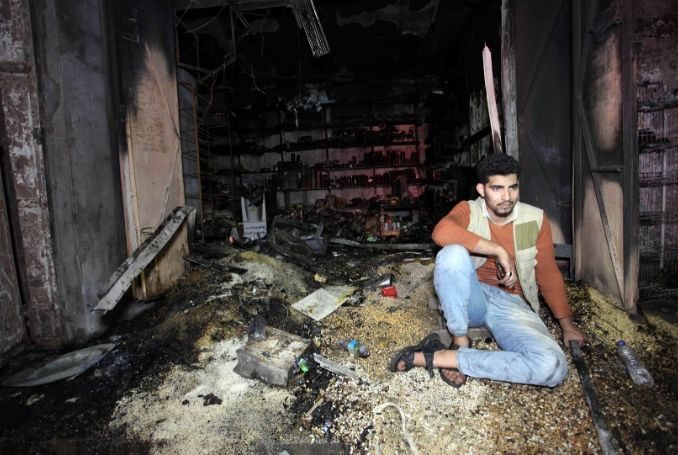
Many Palestinians in the camp lost their small businesses amid a dire economic crisis. Photo: Fawzi Mahmoud
By Irfan Chowdhury | Palestine Chronicle | July 18, 2020
Recently, political journalist Sunny Hundal tweeted in relation to the left’s alleged obsession with Israel:
“In isolation, Israel does a lot of bad things re: human rights.
Is it uniquely bad? Is it worse than others?
Not even close. So if you’re obsessed by actions of Jews, don’t be surprised if people suspect your motives.”
Similar sentiments have been expressed by LBC radio host Maajid Nawaz, who has declared that Israel is “the constant what-about excuse used by everyone who doesn’t want to address some real grave, serious issues in the Middle East but constantly wants to point fingers instead at the Middle East’s only secular, democratic and yes, very imperfect, country”.
Likewise, former Labour MP Ian Austin recently wrote an article for Express & Star in which he asserts that “many people on the left have become obsessed with Israel. This tiny country – the world’s only Jewish state and the Middle East’s only democracy – seems to attract more criticism than all the world’s other controversies combined… Of course, Israel’s not perfect. What country is? But where else in the Middle East would you find free and fair elections, a free and vibrant media; a robust and independent judiciary and strong trade unions?”
As a factual matter, it is untrue that the left is single-mindedly focused on Israel; when I was on the committee of my university’s Socialist Students Society a few years ago, we had meetings on the Israel-Palestine conflict, the economic crisis in Venezuela, protests in Iran, Saudi Arabia’s war on Yemen, Bolsonaro’s election in Brazil, gun violence in the US and the prospect of reforming the EU, among other international issues.
Former Labour leader Jeremy Corbyn, who is one of the most important left-wing figures in British political history, has been a life-long champion of the rights of not only Palestinians, but also Kurds, Western Saharans, West Papuans, hagossians, and numerous other oppressed peoples. Nevertheless, even if it were true that the left does focus on Israel more than other countries, this would not be unjustified because, contrary to the claims of the aforementioned commentators, there are certain respects in which Israel’s human rights violations are uniquely severe in the international arena.
For example, Israel’s military occupation of the West Bank and Gaza is the longest-running military occupation in modern history. It has been ongoing now for 53 years and has been characterized by systematic and egregious human rights violations such as home demolitions, torture, night raids, abduction and imprisonment of children, harassment at checkpoints, the killing of civilians, destruction of agriculture, and daily humiliation at the hands of soldiers and settlers (all of this is documented in great detail by the Israeli human rights organization B’Tselem).
All military occupations are brutal and vicious; to have to endure one that is also predicated on deliberate displacement and dispossession for 53 years is simply unimaginable for most people. In the case of Gaza, the occupation has been compounded by an illegal siege that has been ongoing now for 13 years; in 2015, then UNRWA Commissioner-General Pierre Krahenbuhl described Israel’s siege of Gaza as the “longest in history” and “a very extreme form [of] illegal collective punishment.”
The siege prevents anyone from leaving Gaza, apart from in exceptional cases; for example, sick children are sometimes allowed to receive medical treatment in the West Bank, but their parents aren’t allowed to accompany them – even when it means that the children are forced to die alone (as in the case of 5-year-old Aisha alLoulou). Anyone who tries to fish beyond the contaminated coastal waters of Gaza gets either shot at or kidnapped by the Israeli navy, and anyone who crosses the barbed-wire fence into Israel runs the risk of being murdered by the IDF (as in the case of 17-year-old Emad Khalil Ibrahim Shahin, who crossed over in 2018 and was returned to his family one year later in a body bag).
As a result of the siege, 97% of the water in Gaza is now unfit for human consumption; according to Sara Roy, Senior Research Fellow at Harvard University’s Centre for Middle East Studies, this means that “Innocent human beings, most of them young, are slowly being poisoned by the water they drink and likely by the soil in which they plant”.
Thus, Israel has been carrying out the longest-running military occupation in modern history and the longest-running siege in modern history. These two facts alone render Israel unique in terms of the scope of its brutality and criminality.
There are other respects in which Israel stands out from other countries in its use of terror and violence; for example, it is one of the most aggressive countries in the world, having waged wars of aggression against Lebanon in 1978, 1982, 1993, 1996 and 2006, and against Gaza in 2004, 2006, 2008/9, 2012 and 2014, killing huge numbers of civilians in the process (all while issuing threats and carrying out various covert attacks against Iran, which are all in violation of the UN Charter).
Furthermore, according to Amnesty International, Israel is “the only country in the world that automatically prosecutes children in military courts that lack fundamental fair rights and guarantees” (the military courts have a 99% conviction rate).
Children are routinely abused during interrogations (the UN Committee on the Rights of the Child has reported that “Palestinian children arrested by [Israeli] military and police are systematically subject to degrading treatment, and often to acts of torture”), and in the overwhelming majority of cases, their parents are excluded from the entire ‘judicial’ process. It is worth noting that all of these human rights violations are directly enabled and facilitated by both the US and the UK.
These are all examples of how, in many ways, Israel is uniquely evil. The easiest way for Israel to stop being singled out for criticism – whether real or imagined – would be for it to stop singling itself out with its appalling human rights record.
– Irfan Chowdhury is a freelance writer who has previously been published in openDemocracy, The Iranian, Mondoweiss, Peace News and Hastings In Focus. He also runs a blog, where he mostly writes about British foreign policy, the Israel-Palestine conflict and civil liberties: https://irfanchowdhury98.com/
The danger of looking things up
Climate Discussion Nexus | July 15, 2020
Australia’s hottest day ever recorded was in Edwardian times, so long ago it was 125°F rather than 51.7°C, on Jan. 3 1909 in a place called Bourke. (Not to be rude, but it’s in north New South Wales in a spot even Canadians might concede resembled the middle of nowhere.) The Australian Bureau of Meteorology recently dropped this reading, claiming it was an “observational error” because no official stations recorded high temperatures on that day. As Jennifer Marohasy observes, Australian MP Craig Kelly didn’t believe them, went to the Australian National Archive in Chester Hill and found the actual handwritten records for the nearby official weather station at Brewarrina, showing 50.6°C on that day. Strange that the meteorological authorities couldn’t find that record themselves even though it was in their own files. Just possibly they didn’t really want to.
Even once they’d disposed of Bourke’s 1909 mark the new official hottest day ever was in 1960 rather than during the current climate emergency. Or at least it would be if Kelly had not also discovered that the actual second-hottest to Bourke’s scorcher was in White Cliffs on Jan. 11 1939. Once again the facts show that the 1930s were extremely hot for reasons CO2 cannot explain and others seem not to want to try to.
Of course some might say, well, Australia is an outlier where they even have their hot days in January. But it turns out the hottest day ever in Death Valley, California was in ‘13. No, not 2013. 1913. And in response to “the ever over-alarmed Bill McKibben” tweeting about that temperature over 100°F in Verkhoyansk “Siberian town tops 100 degrees F, the hottest temperature ever recorded north of the Arctic Circle. This scares me, I have to say.” Anthony Watts noted tartly that in fact it was over 100°F in Fort Yukon, Alaska, north of the Arctic Circle in… 1915.
With the hot weather here last week there was the usual talk of breaking records. But it’s interesting to look at the records that were broken, or nearly so. On July 10 Ottawa had its hottest July day since… 1931. And its hottest day overall since 2001, passing records set in 1944, 1921, 1917 and, well, you get the idea. Many of the hottest days ever were not in the last decade or even half-century. And in case you think streaks matter more than individual days, the nation’s capital was chasing a record for consecutive days at or over 31°C set in 1921, narrowly beating the 1919 one, with 1949 in 3rd, and 1911 and 1880 in hot pursuit. Proof positive that we’re in an unprecedented man-made crisis.
Is the Earth warming? Generally it seems to have been since the Little Ice Age. Which itself rules out CO2 as the main factor. But when you look at the record with an eye to preserving rather than “correcting” it, you see that while the 20th century was generally warmer than the 18th, there’s no pattern of extreme heat events bunching together in the very recent past.
“5 Years To Climate Breakdown”: How To Generate Computer Model Scares
Dr David Whitehouse – GWPF – 10/07/20
There are several definitions of hustle. One of them is to use forceful actions to promote an action or point of view. It’s everywhere of course and in all aspects of climate change. It’s all too apparent when scientists want grants, jobs and headlines. It’s no new discovery that combining hustle with statistics can get you anywhere.
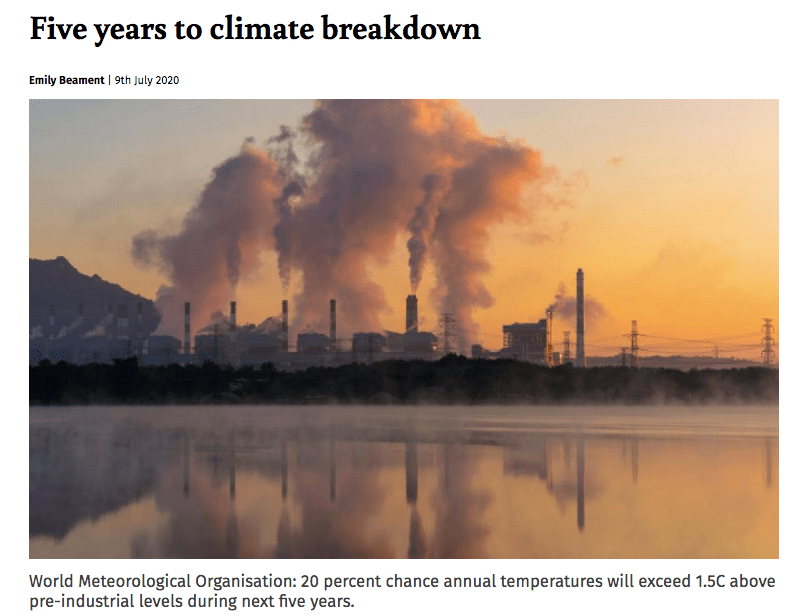
The recently released news from the World Meteorological Organisation (WMO), prepared by the UK Met Office, that there is a “growing chance” of the world exceeding the “Paris threshold” of 1.5°C in global temperature above pre-industrial levels is a prime example of this. It says there is a 20% chance that one of the next five years will exceed 1.5°C, and a 70% chance a single month will during the same period. Another way of saying this, statistically equally justifiable, is that there is an 80% chance that global annual average temperatures will not increase statistically significantly over the next five years. There are no headlines saying that!
Just for a moment think what this means. If there is no significant change in global average temperature by 2025, we will be able to look back thirty years (the official definition of climate) and note that the two major warming episodes, 1998 and 2015, were both due to natural climatic variability, in this case two El Nino events. In many ways, the WMO report is more a testament to the importance of natural climatic variability than it is to long-term anthropogenic warming.
What’s more this forecast has been tested by reversing the direction of time in the computer models and seeing how successfully it “predicts” the past. One would expect any model to be good at this because past observations have already been incorporated into the model which has evolved to have no serious disagreements with it. In such a complicated system as the climate – and the WMO report actually stresses the uncertain and poorly understood nature of internal climatic variability – looking into the future is an entirely different thing. Good hindcasts do not imply good forecasts.
In other reports of the same WMO document the statistics get even more suspicious. One says that there is a 3% chance of the forthcoming five-year global temperature average exceeding 1.5°C. Three percent implies a very accurate predicative ability, especially when it is accompanied by no error statement. Again, any journalist looking at these figures objectively would find that the real story is that there is a 97% chance that the average of the next five years will remain more or less what it is now. And yet the Ecologist website proclaims we have five years to climate breakdown.
A story like this is a kind of litmus test for journalists. They can take the press release and wave it through to their website with minor changes and supporting statements. Or they could look at the statistics and — how can I say this — ask questions. I have a feeling that the era of unquestioning journalist environmental advocacy which began in the early years of this century, is gradually fading away.
Perhaps they could start to be guided by the empirical data and the messages it has been sending us for years; we do not understand natural climatic variability; our models are nowhere near as accurate as some maintain and forecasts of future temperatures more often than not end in ignominy.
Faulty Forecasts and False Climate Narrative Hold Nations Hostage
By Vijay Jayaraj | Watts Up With That? | July 15, 2020
The United States is the only major Western country that is not part of the Paris climate agreement, which seeks to restrict and reduce fossil fuel consumption across the world. But the country is not immune from the impacts of the restrictive energy policies the agreement imposes on its trade partners. One of those is my own country, India.
India imports large amounts of coal, oil, and natural gas from the U.S., mostly to generate affordable power for its electric grid. That grid must grow rapidly to meet the needs of over 1.3 billion people. Over 300 million of them—comparable to the whole U.S. population—currently have no electricity. But they need it desperately for their health and their escape from severe poverty.
The justification for reducing fossil fuel use is the claim that climate change will create havoc in the future unless we reduce our greenhouse gas (GHG) emissions. But this claim is not as black and white as the mainstream media and politicians make it out to be.
In fact, data on temperature suggest that the claim is exaggerated and tends be informed by incorrect interpretations from faulty models.
The Never-Ending Problem with Models
The Paris climate agreement and other major climate recommendations from the United Nations are strictly based on the guidelines provided by Assessment reports produced by a climate wing known as the Intergovernmental Panel for Climate Change (IPCC).
The IPCC uses forecast data processed by a large set of computer climate models to arrive at the policy recommendations in its assessment reports.
Among them are forecasts from the Coupled Model Inter-comparison Project (CMIP). CMIP consists of 100 distinct climate models, run by leading modelling groups across the world. Their predictions drive the IPCC’s reports. In 2013, the IPCC fifth assessment report (AR5) featured climate models from CMIP5 (fifth generation).
But the forecasts from these models proved wrong. They exaggerated the temperature trend and differed markedly from temperature data derived from ground-based thermometers; sensors on weather balloons aircraft, ships, and buoys; satellite remote sensing; and “reanalyses”—the latter integrating the input of many different data sources.
Yet, political appointees in charge of determining climate and energy policy around the world used these forecasts to justify international climate agreements like the Paris agreement. And they do no stop with that.
The upcoming IPCC sixth assessment report (AR6), forecast for release in 2021, features forecasts from CMIP6. But the CMIP6 models are turning out to be no better than CMIP5 models. In fact, CMIP6 they’re worse!
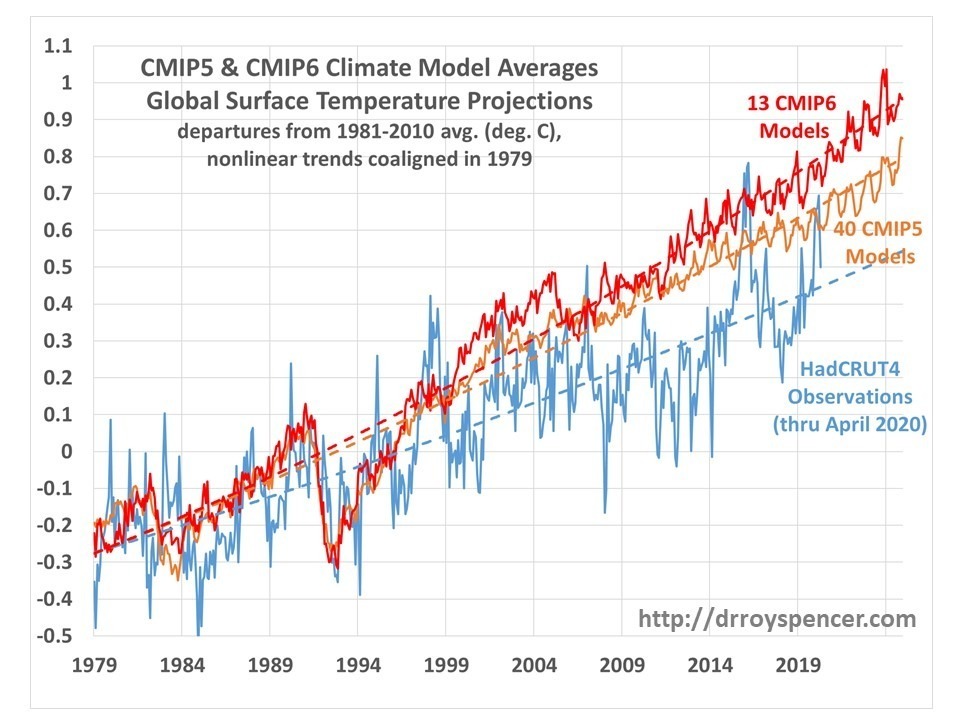
Senior climatologist Dr. Roy Spencer has observed that the “CMIP6 models are showing 50 percent more net surface warming from 1979 up to April 2020 (+1.08 degree Celsius) than actual observations from the ground (+0.72 degree Celsius).”
Beyond doubt, comparing both CMIP5 and CMIP6 forecasts to official HadCRUT temperature data sets reveals a very old story: models are always way off the mark, and—suspiciously—always in the same direction, namely, upward, in predicting real-world temperatures.
So, not only were we lied to about the climate, we are going to be misled again by the next IPCC assessment report. And with more extreme false forecasts, there will be calls for more restrictive energy policies.
It is quite astonishing how the unelected politicians at the UN can convince and persuade global leaders to adopt climate policies that are based on unscientific conclusions from faulty models.
The mainstream media have also played their part. Public perception on climate change has been heavily influenced by biased coverage on the climate issue, with no major attention to the huge discrepancies between the model forecasts and real-world observations.
It is not clear how much faultier the projections will become by the time the new assessment report is finally released. But one thing is clear: energy sectors across the globe are being held hostage by pseudo-scientific interpretations from the United Nations’ flagship climate wing.
Vijay Jayaraj (M.Sc., Environmental Science, University of East Anglia, England), is a Research Contributor for the Cornwall Alliance for the Stewardship of Creation living in New Delhi, India.
Powell & Iraq—Regime Change, Not Disarmament: The Fundamental Lie
By Scott Ritter – Consortium News – July 18, 2020
The New York Times Magazine has published a puff piece soft-peddling former Secretary of State Colin Powell’s role in selling a war on Iraq to the UN Security Council using what turned out to be bad intelligence. “Colin Powell Still Wants Answers” is the title of the article, written by Robert Draper. “The analysts who provided the intelligence,” a sub-header to the article declares, “now say it was doubted inside the CIA at the time.”
Draper’s article is an extract from a book, To Start a War: How the Bush Administration Took America into Iraq, scheduled for publication later this month. In the interest of full disclosure, I was approached by Draper in 2018 about his interest in writing this book, and I agreed to be interviewed as part of his research. I have not yet read the book, but can note that, based upon the tone and content of his New York Times Magazine article, my words apparently carried little weight.
Regime Change, Not WMD
I spent some time articulating to Draper my contention that the issue with Saddam Hussein’s Iraq was never about weapons of mass destruction (WMD), but rather regime change, and that everything had to be viewed in the light of this reality—including Powell’s Feb. 5, 2003 presentation before the UN Security Council. Based upon the content of his article, I might as well have been talking to a brick wall.
Powell’s 2003 presentation before the council did not take place in a policy vacuum. In many ways, the March 2003 U.S.-led invasion and subsequent occupation of Iraq was a continuation of the 1991 Gulf War, which Powell helped orchestrate. Its fumbled aftermath was again, something that transpired on Powell’s watch as the chairman of the Joint Chiefs of Staff in the administration of George H. W. Bush.
Powell was part of the policy team that crafted the post-Gulf War response to the fact that Iraq’s president, Saddam Hussein, survived a conflict he was not meant to. After being labeled the Middle East equivalent of Adolf Hitler whose crimes required Nuremburg-like retribution in a speech delivered by President Bush in October 1990, the Iraqi President’s post-conflict hold on power had become a political problem for Bush 41.
Powell was aware of the CIA’s post-war assessment on the vulnerability of Saddam’s rule to continued economic sanctions, and helped craft the policy that led to the passage of Security Council resolution 687 in April 1991. That linked Iraq’s obligation to be disarmed of its WMD prior to any lifting of sanctions and the reality that it was U.S. policy not to lift these sanctions, regardless of Iraq’s disarmament status, until which time Saddam was removed from power.
Regime change, not disarmament, was always the driving factor behind U.S. policy towards Saddam Hussein’s Iraq. Powell knew this because he helped craft the original policy.
I bore witness to the reality of this policy as a weapons inspector working for the United Nations Special Commission (UNSCOM), created under the mandate of resolution 687 to oversee the disarming of Iraq’s WMD. Brought in to create an intelligence capability for the inspection team, my remit soon expanded to operations and, more specifically, how Iraq was hiding retained weapons and capability from the inspectors.
SCUDS
One of my first tasks was addressing discrepancies in Iraq’s accounting of its modified SCUD missile arsenal; in December 1991 I wrote an assessment that Iraq was likely retaining approximately 100 missiles. By March 1992 Iraq, under pressure, admitted it had retained a force of 89 missiles (that number later grew to 97).
After extensive investigations, I was able to corroborate the Iraqi declarations, and in November 1992 issued an assessment that UNSCOM could account for the totality of Iraq’s SCUD missile force. This, of course, was an unacceptable conclusion, given that a compliant Iraq meant sanctions would need to be lifted and Saddam would survive.
The U.S. intelligence community rejected my findings without providing any fact-based evidence to refute it, and the CIA later briefed the Senate that it assessed Iraq to be retaining a force of some 200 covert SCUD missiles. This all took place under Powell’s watch as chairman of the Joint Chiefs.
I challenged the CIA’s assessment, and organized the largest, most complex inspection in UNSCOM’s history to investigate the intelligence behind the 200-missile assessment. In the end, the intelligence was shown to be wrong, and in November 1993 I briefed the CIA Director’s senior staff on UNSCOM’s conclusion that all SCUD missiles were accounted for.
Moving the Goalposts
The CIA’s response was to assert that Iraq had a force of 12-20 covert SCUD missiles, and that this number would never change, regardless of what UNSCOM did. This same assessment was in play at the time of Powell’s Security Council presentation, a blatant lie born of the willful manufacture of lies by an entity—the CIA—whose task was regime change, not disarmament.
Powell knew all of this, and yet he still delivered his speech to the UN Security Council.
In October 2002, in a briefing designed to undermine the credibility of UN inspectors preparing to return to Iraq, the Defense Intelligence Agency trotted out Dr. John Yurechko, the defense intelligence officer for information operations and denial and deception, to provide a briefing detailing U.S. claims that Iraq was engaged in a systematic process of concealment regarding its WMD programs.
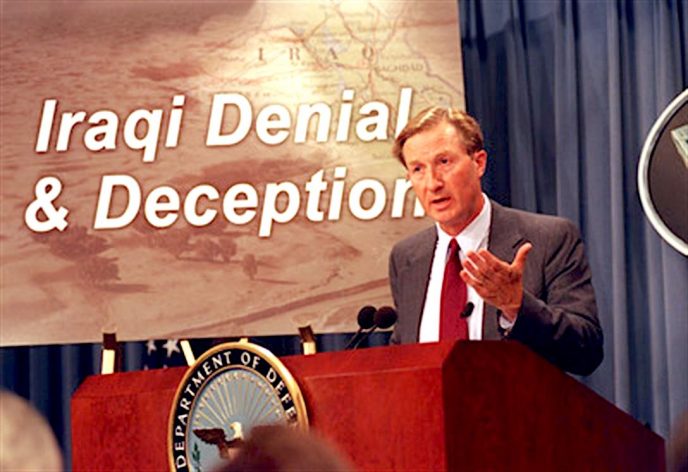
John Yurechko, of the Defense Intelligence Agency, briefs reporters at the Pentagon on Oct. 8, 2002 (U.S. Defense Dept.)
According to Yurechko, the briefing was compiled from several sources, including “inspector memoirs” and Iraqi defectors. The briefing was farcical, a deliberate effort to propagate misinformation by the administration of Bush 43. I know—starting in 1994, I led a concerted UNSCOM effort involving the intelligence services of eight nations to get to the bottom of Iraq’s so-called “concealment mechanism.”
Using innovative imagery intelligence techniques, defector debriefs, agent networks and communications intercepts, combined with extremely aggressive on-site inspections, I was able, by March 1998, to conclude that Iraqi concealment efforts were largely centered on protecting Saddam Hussein from assassination, and had nothing to do with hiding WMD. This, too, was an inconvenient finding, and led to the U.S. dismantling the apparatus of investigation I had so carefully assembled over the course of four years.
It was never about the WMD—Powell knew this. It was always about regime change.
Using UN as Cover for Coup Attempt
In 1991, Powell signed off on the incorporation of elite U.S. military commandos into the CIA’s Special Activities Staff for the purpose of using UNSCOM as a front to collect intelligence that could facilitate the removal of Saddam Hussein. I worked with this special cell from 1991 until 1996, on the mistaken opinion that the unique intelligence, logistics and communications capability they provided were useful to planning and executing the complex inspections I was helping lead in Iraq.
This program resulted in the failed coup attempt in June 1996 that used UNSCOM as its operational cover—the coup failed, the Special Activities Staff ceased all cooperation with UNSCOM, and we inspectors were left holding the bag. The Iraqis had every right to be concerned that UNSCOM inspections were being used to target their president because, the truth be told, they were.
Nowhere in Powell’s presentation to the Security Council, or in any of his efforts to recast that presentation as a good intention led astray by bad intelligence, does the reality of regime change factor in. Regime change was the only policy objective of three successive U.S. presidential administrations—Bush 41, Clinton, and Bush 43.
Powell was a key player in two of these. He knew. He knew about the existence of the CIA’s Iraq Operations Group. He knew of the successive string of covert “findings” issued by U.S. presidents authorizing the CIA to remove Saddam Hussein from power using lethal force. He knew that the die had been cast for war long before Bush 43 decided to engage the United Nations in the fall of 2002.
Powell Knew
Powell knew all of this, and yet he still allowed himself to be used as a front to sell this conflict to the international community, and by extension the American people, using intelligence that was demonstrably false. If, simply by drawing on my experience as an UNSCOM inspector, I knew every word he uttered before the Security Council was a lie the moment he spoke, Powell should have as well, because every aspect of my work as an UNSCOM inspector was known to, and documented by, the CIA.
It is not that I was unknown to Powell in the context of the WMD narrative. Indeed, my name came up during an interview Powell gave to Fox News on Sept. 8, 2002, when he was asked to comment on a quote from my speech to the Iraqi Parliament earlier that month in which I stated:
“The rhetoric of fear that is disseminated by my government and others has not to date been backed up by hard facts that substantiate any allegations that Iraq is today in possession of weapons of mass destruction or has links to terror groups responsible for attacking the United States. Void of such facts, all we have is speculation.”
Powell responded by declaring,
“We have facts, not speculation. Scott is certainly entitled to his opinion but I’m afraid that I would not place the security of my nation and the security of our friends in the region on that kind of an assertion by somebody who’s not in the intelligence chain any longer… If Scott is right, then why are they keeping the inspectors out? If Scott is right, why don’t they say, ‘Anytime, any place, anywhere, bring ‘em in, everybody come in—we are clean?’ The reason is they are not clean. And we have to find out what they have and what we’re going to do about it. And that’s why it’s been the policy of this government to insist that Iraq be disarmed in accordance with the terms of the relevant UN resolutions.” (emphasis added, Aletho News )
Of course, in November 2002, Iraq did just what Powell said they would never do—they let the UN inspectors return without preconditions. The inspectors quickly exposed the fact that the “high quality” U.S. intelligence they had been tasked with investigating was pure bunk. Left to their own devices, the new round of UN weapons inspections would soon be able to give Iraq a clean bill of health, paving the way for the lifting of sanctions and the continued survival of Saddam Hussein.
Powell knew this was not an option. And thus he allowed himself to be used as a vehicle for disseminating more lies—lies that would take the U.S. to war, cost thousands of U.S. service members their lives, along with hundreds of thousands of Iraqis, all in the name of regime change.
Back to Robert Draper. I spent a considerable amount of time impressing upon him the reality of regime change as a policy, and the fact that the WMD disarmament issue existed for the sole purpose of facilitating regime change. Apparently, my words had little impact, as all Draper has done in his article is continue the false narrative that America went to war on the weight of false and misleading intelligence.
Draper is wrong—America went to war because it was our policy as a nation, sustained over three successive presidential administrations, to remove Saddam Hussein from power. By 2002 the WMD narrative that had been used to support and sustain this regime change policy was weakening.
Powell’s speech was a last-gasp effort to use the story of Iraqi WMD for the purpose it was always intended—to facilitate the removal of Saddam Hussein from power. In this light, Colin Powell’s speech was one of the greatest successes in CIA history. That is not the story, however, Draper chose to tell, and the world is worse off for that failed opportunity.
Scott Ritter is a former Marine Corps intelligence officer who served in the former Soviet Union implementing arms control treaties, in the Persian Gulf during Operation Desert Storm, and in Iraq overseeing the disarmament of WMD.
Armenian-Azerbaijani Clashes And Shifting Balance Of Power In South Caucasus
South Front | July 18, 2020
The Armenian-Azerbaijani tensions have once again turned South Caucasus into a hot point increasing chances of a new regional war.
The key difference with previous military incidents between the two countries is that the point of confrontation shifted from the breakaway Nagorno-Karabakh Republic to the Armenian-Azerbaijani state border. Clashes first erupted on July 12 in the area of Tovuz and since then both sides have repeatedly accused each other of provoking the conflict, attacking civilians and declared defeats of the ‘enemy’.
According to the Defense Ministry of Azerbaijan, the fighting started after Armenian forces opened fire on positions of Azerbaijani forces in the Tovuz district. The fighting which included the use of combat drones, artillery, mortars, and battle tanks continued over the following days, including July 17. The Azerbaijani military confirmed that at least 12 personnel, including Major General Gashimov Polad and Colonel Ilgar Mirzaev, were killed. In turn, Kerim Veliyev, Azerbaijan’s deputy defense minister, said that 100 Armenian soldiers were killed, several fortified positions were destroyed and that a UAV was shot down. Armenia, according to Veliyev, is hiding the real number of its casualties.
Azerbaijani media and top leadership describe the current situation as an act of Armenian aggression, and say that Azerbaijani forces are only responding to it. President Ilham Aliyev even called Armenia a “fascist state” adding that “Armenian forces could not enter Azerbaijan in one centimeter of soil and will never be able to do this”.
The Armenian version of events is quite different. According to it, the clashes started after a group of Azerbaijani soldiers violated the Armenian state border in an UAZ vehicle. The defense ministry press service claimed that after the warning from the Armenian side, “the enemy troops returned to their positions”. It added that later Azerbaijani forces attacked an Armenian checkpoint.
As of now, the Armenian military said that it had repelled two ‘offensives’ involving at least 100 soldiers supported by fire of several artillery battalions. These attacks were allegedly actively supported by combat and reconnaissance drones of Azerbaijan. A spokesperson for the Armenian Defense Ministry Artsrun Hovhannisyan said that Azerbaijan lost at least 20 soldiers, a battle tank and other equipment during the clashes. Armenia says that only 4 of its service members were killed.
Both Armenia and Azerbaijan claim that their forces are repelling an aggression of the enemy, which has been attacking it and killing civilians. However, despite the harsh rhetoric, the leaderships of both countries are sending signals that they are not interested in a larger military confrontation.
At the same time, years of war propaganda and historic tensions between the nations push the situation towards a further escalation. A unilateral move towards the cessation of hostilities by leaders of either country would be presented by the other one as a sign of weakness and promoted as an admission of defeat. Taking into account the complicated political and economic conditions in both countries, neither Armenian nor Azerbaijani leaders could afford such a public move. Therefore, de-escalation is possible only through international mechanisms.
The situation is further complicated by the complex diplomatic situation in the region of the South Caucasus. Armenia, alongside Russia, Belarus, Kazakhstan, Tajikistan and Kyrgyzstan, is a member of the Collective Security Treaty Organization (CSTO). The CSTO expressed its concerns over the situation and called on the sides to commit to a ceasefire regime. Nonetheless, the Russia-led security bloc, and Russia itself, demonstrated that in the current situation they will focus on diplomatic measures.
Since the 2018 coup, when Nikol Pashinyan came to power in Armenia, the country has been consistently undermining its relations with the CSTO and Russia by pursuing a quite weak, but apparent anti-Russian and pro-Western foreign policy course. The bright dream of the Pashinyan government is to sell its loyalty to the United States for some coins and commit itself to the way of the so-called ‘European integration’. The issue with this plan is that Washington and its partners need Armenia only as a tool of their geopolitical gains and are not interested in providing it with any kind of military protection or economic assistance. The Pashinyan government is forced to play a double game in an attempt to simultaneously please its ‘democratic’ masters and receive protection and assistance from Russia. This attitude is not a secret for Moscow.
On the other hand, in the event of a large-scale military confrontation, Azerbaijan will be supported by its main ally Turkey, which also has close bilateral ties with Russia. Ankara already declared that it fully supports Azerbaijan and condemned the supposed ‘Armenian aggression’. Thus, in the event of full-scale military confrontation, Armenia will immediately find itself in a very complicated situation, and direct military assistance from the CSTO and Russia will be unlikely.
So, the Armenian chances in a limited military conflict with Azerbaijan and Turkey are at least shaky. Turkey and Azerbaijan fully understand this. By undermining strategic relations with Moscow, and thus the balance of power in the region, Erevan put the entire South Caucasus on the brink of a new regional war.
Owen Benjamin vs Patreon: Dissident Comedian Set to Deal Massive Blow to Big Tech Censors
By Eric Striker | National Justice | July 18, 2020
A potential mechanism for punishing tech censorship has materialized.
Nationalist comedian Owen Benjamin and 72 of his fans have won a tentative decision under California’s arbitration law, which was amended by legislation signed by Governor Gavin Newsom in October 2019 to put the burden of fees in disputes on the party setting terms.
Prior to January 2020, Patreon’s Terms of Service encouraged disagreements to be settled via arbitration under the assumption that the money and time required would discourage consumers from even trying.
In the case against Patreon, the matter in need of arbitration is related to the company’s abrupt banning of Benjamin’s page for political reasons. Benjamin and his fans argue that the deplatforming amounts to tortious interference in their business contract. Thanks to Patreon, Benjamin cannot comply with his contractual obligation of providing content for money to his followers due to the tech platform failing in its role as financial middleman. Benjamin is asking for $3.5 million in damages.
What is unique about arbitration in California is that Patreon is on the hook for the legal and arbitration fees required for Benjamin and all 72 of the individual plaintiffs. This means they must pay at least $10,000 to each individual complainant, which in total could cost the corporation 10s of millions of dollars regardless of outcome.
Patreon has reacted to this process in an aggressive manner. They could make the whole thing go away simply by reinstating Benjamin’s account, but they decided to counter-sue and filed for an injunction against having to pay the fees for Benjamin’s fans, stating that they are ready to fight to “keep hate speech off the platform.” An article on the leftist click farm Daily Dot gloated about this, perceiving it as a corporation crushing little guys.
A dirty trick Patreon utilized was to change their Terms of Service shortly after Benjamin’s fans contacted them seeking arbitration — a step Patreon demands first be taken before action is brought before mediators. It seems unlikely that this will work.
The Benjamin “bears” — as his fans refer to themselves — were able to retain the consul of First Amendment attorney Marc Randazza, who appeared to defeat the arguments by Patreon’s lawyers in open court. A July 13th tentative ruling rejecting Patreon’s injunction was won. If the decision is made final, it will set a precedent that introduces an enormous cost for companies like Paypal, Stripe and other payment processors with arbitration clauses that like to destroy people’s livelihoods for their political beliefs.
Mike Cernovich has covered the case closely and is optimistic about its prospects. Legal expert Nick Rekieta believes that this ruling could be an historic victory for free speech. Reclaim The Net, an organization that fights for free expression on the internet, has called the arbitration law a “legal workaround for Big Tech censorship.” Aside from the Daily Dot and a snarky blogpost on Patheos, the Jewish media is by and large refusing to even speak about the case even though many tech companies are watching proceedings closely — evidence that they fear the likely outcome.
Countless lawsuits have been filed seeking to counter-attack against highly restrictive, college campus style tech multi-national censorship. Jared Taylor recently wrote a piece describing his attempt in 2018 to sue Twitter over its ban of his organization, citing that it falsely advertised itself as a free speech platform. Taylor’s lawsuit was thwarted in a rare and politically motivated action by an appeals court after initially winning the right to have his case heard.
Jewish organizations will not allow their most powerful tool for stifling debate to be nullified without a fight. There is a strong possibility that if Benjamin and the other plaintiffs are successful, California’s arbitration laws could be challenged by Big Tech all the way up to the Supreme Court.
If this were to happen, the court conservatives — which regularly put the interests of corporate America over the rights of citizens — could use its majority to rule that forcing Patreon to pay arbitration fees is unconstitutional. This is ironic, as both Donald Trump and the Republican Party claim to oppose tech censorship, yet until Benjamin’s lawsuit, no serious move against it has been made.
A final ruling on Patreon’s injunction is slated to be made in the coming weeks.
Featured Video

John Mearsheimer: Why Russia Gains By Hitting Ukraine Harder
or go to
Aletho News Archives – Video-Images
Book Excerpt
Measles and Mortality
Informed with Aaron Siri| November 19, 2026
Given the news coverage around measles and mortality, I decided to share the section of my book, Vaccines, Amen, that covers precisely this topic. Help me spread a bit of reality into the media hysteria around this issue. Here is that section of the book… continue
Blog Roll
 Aletho News
- A Climate Scientist Who Engages Skeptics
- John Mearsheimer: Why Russia Gains By Hitting Ukraine Harder
- Argentina’s Perito Moreno Glacier Joins Antarctica and Arctic In Defying Doomsday Melt Claims
- ‘Chinagate’ Is Here
- Iran, four other countries condemn US plans to deploy weapons in outer space
- US media brings back the Iraq war playbook and why it won’t work
- Zakharova schools German FM on history basics
- Germany to produce drones for Ukraine
- Merz takes a swipe at Merkel over Ukraine’s NATO bid
- Measles and Mortality
- If Americans Knew
- An error has occurred; the feed is probably down. Try again later.
- No Tricks Zone
- Alarmist Climatologists In Shock! 2026 Atlantic Hurricane Season Sees Lowest Count In 101 Years
- New Study: Modern Temps Are Among The Coldest Of The Last 10,000 Years In East Central Europe
- Germany’s Renewable Energies Lead to 1.4 Billion Euro Electric Power Trade Deficit
- Argentina’s Perito Moreno Glacier Joins Antarctica and Arctic In Defying Doomsday Melt Claims
- New Study: Barents Sea Temperatures Were Warmer And Sea Ice Less Extensive In The 1700s Than Today
- German Authorities Start Initiative To Evaluate Public Register For Climate “Disinformation” Spreaders!
- Zonal Asymmetry of Temperature Change in the Antarctic Circumpolar Current
- New Study: The Net Fossil Fuel Contribution To Rising Atmospheric CO2 Has Been Zero For 500 Years
- Germany’s Green Energy Transition Becoming Increasingly Expensive…Another 6 Trillion Euros!
- Sudden Stratospheric Warming, Powerful El Niño Combination May Lead To Extreme Europe Cold, Energy Crisis!