Ex-Google CEO claims he can link tech & defense, but he’s just a civilian dilettante, doesn’t get reality of war
By Scott Ritter | RT | May 5, 2020
The former CEO of Google claims he can improve the US military’s integration of artificial intelligence (AI) into its operations. But is AI the panacea Schmidt claims? And if so, is he the person best suited to lead the way?
In a culture known for complex problems and inherent inefficiencies, the US military would seem ideally suited for the kind of cutting-edge solutions offered by the emergence of computer-driven artificial intelligence (AI).
The US military – like its counterparts in China, Russia, India and elsewhere – has, over the course of the past decade, invested heavily in research and development projects designed to bring AI to the battlefield in support of intelligence collection and analysis, logistical support, autonomous warfighting capabilities, healthcare, and cybersecurity. Indeed, in this computer-driven age, there isn’t an aspect of military operations where AI hasn’t been investigated as a potential enhancement.
While the US military hasn’t ignored AI and its utility, Eric Schmidt, the former CEO of Google, believes it has done so in a highly inefficient manner. And he is convinced he is the man who can best help the US military solve its AI challenges.
The arrogance and hubris exhibited by Schmidt – who has never served in the military and as such is unfamiliar with the ethos, culture and operational realities associated with organizing, training and leading millions of men and women for war – has rubbed some senior US military officers the wrong way. However, his wonkish approach to problem solving, combined with the inherent attractiveness of technology-driven solutions, has found an audience within the ranks of the civilian component of the US defense establishment, who have invited Schmidt to sit on several advisory boards involved in the pursuit of AI-driven solutions to military problem sets.
Past attempts to incorporate Schmidt’s digital-centric philosophies into realms driven by the human condition have proven inchoate. In 2013, Schmidt co-authored a book, ‘The New Digital Age’, with Jared Cohen. Cohen had helped spearhead an effort built around a soft-power philosophy known as ‘digital democracy’, where the US sought to exploit perceived digital commonalities (ie. the integration of social media platforms, use of electronic and computer-driven communications and, most telling, the notion that these digital interfaces exposed the youth of foreign societies to American culture, and as such ingrained a predilection for American values that supplanted those of their own cultures and societies) for the purpose of altering the political makeup of areas such as the Middle East.
‘Digital democracy’ drove the US’ support of the Iranian opposition in 2009, the Arab Spring movement of 2010, and the so-called Syrian revolution of 2011. The failure of ‘digital democracy’ to bring about the desired change highlights the risks associated with seeking to digitally manipulate human emotions and values.
The biggest lesson learned from the abject failure of ‘digital democracy’ is that there is no algorithm that can replicate the incoherent complexities of human emotions. Schmidt’s Google experience is one where algorithms are written and applied to better comprehend complex data-driven problems. As data is accumulated and incorporated, AI can be used to automatically update and upgrade these algorithms, allowing for increased efficiencies.
This approach works in a relatively static environment, where assumptions of shared goals and objectives can be built into the algorithms used. This was the fundamental flaw with ‘digital democracy’: politics is not static, but rather dynamic, driven more by the unpredictable vagaries of human emotions than quantifiable data.
In his timeless tract on military matters, the Prussian military philosopher Carl von Clausewitz observed that war was but a “continuation of politics by other means.” Given the inherent relationship between politics and war, it can be extrapolated that the human complexities which proved fatal to ‘digital democracy’ would similarly undermine any effort to use AI to guide and direct decision-making in times of human conflict.
Eric Schmidt’s success in using algorithms to discern intent and desire on the part of consumers to better guide product placement has revolutionized advertising and sales, both online and in traditional brick-and-mortar establishments. This success has prompted Schmidt and other innovators to embrace the promise of AI-driven solutions for military applications.
There is a fundamental flaw in this approach – when Google was seeking to make sense of the ‘big data’ that was produced as a result of the online consumer experience, there was no opposing force seeking to disrupt, mislead or otherwise defeat its effort. War is an inherently adversarial process, and like the French embrace of the Maginot Line to keep German armies from invading France, any AI-driven algorithm can be defeated by simply re-defining the terms of the conflict.
From a technological standpoint alone, AI-driven applications have already been shown to be easily spoofed, whether by altering painted lines of a road to force Tesla’s AI-driven car into oncoming traffic, or convincing AI-controlled software that an image of a turtle was, in fact, a rifle.
Beyond the fact that an enemy in a time of war would constantly be seeking ways to defeat any AI-driven operation, the inherent incompatibility between the logic of data-driven AI and the illogic of human emotion make an overreliance on AI during times of war a self-defeating proposition. One need only examine the US experience in Afghanistan, where a technologically sophisticated American military, having incorporated aspects of AI into nearly every aspect of its warfighting capabilities, has not been able to defeat the relatively unsophisticated forces of the Taliban. No amount of big data manipulation can overcome the fact that US cultural norms will never mesh with Pashtun tribal reality. The US’ failure in Afghanistan is “digital democracy” writ large, the difference between computer-driven artificialities and boots-on-the ground reality.
US Air Force Colonel John Boyd, considered one of the great military thinkers of modern times, compressed the complexities of military decision-making into a brutally simplistic formula he called the ‘OODA loop’. The four components of the OODA loop – Orient, Observe, Decide and Action – at first seem to be perfectly suited for AI-induced enhancements. But a closer look at what Boyd was capturing in his model only underscores the reality that, at the end of the day, the human factor is the dominating force when it comes to the taking of human life in conflict.
Boyd spoke of “the senses” and “mental perspectives” that guided “physical playing out of decisions.” No algorithm can ever be written which captures the visceral gut-driven realities of decision-making during times of war. The key to military victory, according to the tenets of Boyd’s OODA loop, is to get inside the opponent’s decision-making cycle, catching them responding to situations that have already changed because of actions already taken. Against an AI-driven opponent, one will always be able to make the car drive into oncoming traffic, or the computer to see a turtle as a rifle. By the time the algorithm adapts, it will be too late; the sensors collecting the data the AI needs will have been destroyed or spoofed, the power sources to the computers cut, and a bayonet driven into the heart of the operator by an opponent driven more by human sense, mental perspective, and physical action.
This is the reality of war that Eric Schmidt and civilian dilettantes like himself will never understand, caught up as they are in a data-driven world that is as far removed from the modern battlefield as the Earth is from Mars.
Swedish Firms to Pay Billions to Shareholders While Firing Workers and Seeking Aid Amid Pandemic
Sputnik – May 6, 2020
Swedish manufacturing giants, including luxury car-maker Volvo, bearing manufacturer SKF AB and Assa Abloy conglomerate, are still paying out around 15 billions of kronor (or $1.5 billion in total) to their shareholders despite applying for state aid during the coronavirus pandemic and laying off thousands of workers who are now also seeking financial support, Bloomberg revealed.
Earlier, the Committee on Finance in Sweden’s Riksdagen made a plea to prohibit dividends for companies that have been appealing for state aid during COVID-19 health crisis in a bid to stay afloat during economic turmoil. This measure, however, still has not been introduced.
Volvo is reportedly planning to pay out 11.2 billion kronor ($1.1 billion) to its owners in dividends, while some 20,000 of its employees have been fired in Sweden. At the same time, SKF, which has recently applied for a $4 million aid package from the Swedish Agency for Economic and Regional Growth, is believed to be planning a payment of $132 million to its shareholders.
“The finance committee is unanimous in its position that such payouts are unjustifiable,” said a spokesman for Swedish parliamentary Christian Democrats party, Jakob Forssmed. “There should be a clear signal for large listed companies to act accordingly if they are interested in large subsidies from the state, regardless of legislation.”
So far, the Social Democrat-led government headed by Prime Minister Stefan Lofven remained deaf to calls from the parliament’s finance committee to ban dividends for companies relying on state aid. Some officials, including Finance Minister Magdalena Andersson, also emphasised that the reasons for absence of any actions in this regard is explained by the fact that administration was seeking a “trade-off” between taking perfect measures and being “swift”, as suspending dividends would have potentially slowed down the response to the COVID-19 crisis.
She still argued, however, that this situation can be changed in the end if companies become “too generous” with their shareholders while the economic crisis resulting from the coronavirus pandemic is still unrolling.
In the end of April, the Swedish government presented an additional measure that will help around 180,000 national businesses that lost their turnover during the pandemic with a projected share of $4 billion in state support.
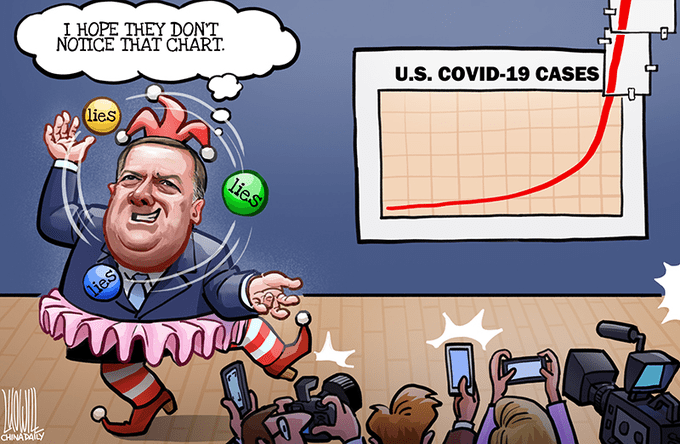
A China-bashing coronavirus jester? Beijing tears into Pompeo’s ‘clown show’
RT | May 6, 2020
China has fired back at Mike Pompeo’s allegations that Beijing is somehow behind the origin and spread of Covid-19, describing his “comedy routine” as deeply cynical and damaging to the United States.
State-operated China Daily took aim at the US secretary of state, slamming the top American diplomat for “bad-mouthing” China and the World Health Organization (WHO) instead of seeking global cooperation and solidarity to overcome the Covid-19 pandemic.
Pompeo continues to insist that the illness came from a laboratory in Wuhan, even though he has yet to present evidence for this incendiary claim, and has ignored scientists who say the virus is from the wild, the opinion piece argued.
China Daily noted that the secretary of state has also been curiously silent about the fact that Beijing has been the “main provider” of surgical masks, ventilators, and other essential medical equipment to the US. The editorial argued that Pompeo is playing a dangerous political game that will end up hurting the United States.
In a difficult situation such as the one we all face now, Pompeo’s clown show is simply self-harming for the US. It is solidarity that is desperately needed to fight this common enemy, not a stand-up comedy routine.
The paper also ran a cartoon showing Pompeo, outfitted as a jester, juggling “lies” as he tries to distract media attention from rising coronavirus cases in the US.
The biting commentary piece comes after the Global Times newspaper – an outlet owned by the Chinese Communist Party – published an editorial dismissing Pompeo’s attacks on Beijing as “groundless accusations.”
Pompeo’s theories have also been met with suspicion within the intelligence community. The Guardian reported that sources connected to the Five Eyes intelligence network – consisting of spy agencies from the UK, US, Australia, New Zealand, and Canada – believe there is no evidence linking China to the creation and spread of Covid-19.
Ukraine Asks Russia to Fill Its Budget Holes
By Paul Antonopoulos | May 6, 2020
The ambitious Nord Stream 2 pipeline project aims to deliver Russian gas to Europe via the Baltic Sea, thus bypassing Ukraine and reducing risk from Russia’s perspective. While Ukraine has consistently said it will prevent the completion of the Nord Stream 2 pipeline, the country is now also offering Russian state-owned Gazprom its gas storage facilities.
However, there are two major reasons why Moscow might not agree to Ukraine’s offer:
Moscow has difficulty in having confidence in Ukraine considering it maintains a pro-NATO policy.
Russia has enough of its own warehouses to store gas.
Although the proposal for storing Russian gas in Ukraine first appears logical, given the huge lack of trust in bilateral relations, this is a rather ambitious proposal by Kiev as it also continues to do everything in its power to prevent the construction of Nord Stream 2.
The Director General of the Ukrainian gas transportation system Sergei Makogon suggested that Gazprom lease Ukrainian underground gas storage facilities for the temporary storage of Russian gas transported to Europe. He said it would be three to five times cheaper for Gazprom than it costs in European Union countries who consume this gas – just $10 per thousand cubic meters. He added that in winter, as demand grows in the European Union, Gazprom will be able to take gas from underground Ukrainian gas storage facilities and send it to Europe.
He also predicts that Ukraine may end its role as a Russian gas transit in 2025 after the five-year contract between Russia’s Gazprom and Ukraine’s Naftogas expires, along with the completion of the Nord Stream 2 gas pipeline. This would be another major economic blow to Ukraine when considering after the first leg of the Turkish Stream was put into operation, the Ukrainian system had already lost 15 billion cubic meters of annual transit. The loss Ukraine faces because of the Turkish Stream will become even greater with the second phase of the pipeline that will run through Bulgaria, Serbia and Hungary, and account for another 15 billion cubic meter loss, is complete..
Although Makogon said he hopes Ukraine can store gas on behalf of Russia, he also announced that Ukraine “will make every effort to prevent the completion of Nord Stream 2, as this project has a clear political character and runs counter to European principles of solidarity.” So effectively he made two contradictory statements as one is friendly and the other is aggressive, thus again demonstrating why Russia finds it difficult in trusting Ukraine.
Russian officials point out that there is sufficient gas storage in Russia’s territory and that Russia does not currently need the assistance of other countries in this regard. Even if there is a need to rent a warehouse, in the case of Ukraine, a competitive price will not be sufficient as guarantees for safeguarding Russian gas will be needed so theft that has happened in the past will not be repeated.
It also needs to be factored in that because of the coronavirus, there is a decline in gas consumption. The need for gas storage will increase in winter – this is seemingly obvious. However, we are now only weeks away from summer and the demand for gas will significantly reduce, in addition to the fact that Gazprom has sufficient capacity for its own storage. Therefore, Makogon’s proposal for Ukraine to store Russian gas is actually a more of a desperate plea linked to the fact that Ukraine is experiencing a significant economic downturn, and the head of the Ukrainian gas transportation system is looking for an opportunity to somehow fill the deep budget holes.
It should also be considered that the infrastructure Ukraine is offering to Russia is generally 50 years old. Because of all this, it is highly unlikely that there will be agreements for the storage of Russian gas made between Moscow and Kiev.
Remembering that after tough negotiations last December, Kiev and Moscow signed a five-year agreement on the transit of Russian gas to Europe via Ukraine. The new contract stipulates that Gazprom will send at least 65 billion cubic meters of gas through Ukraine in the first year and then at least 40 billion annually from 2021 to 2024. This five-year agreement will bring Kiev more than $7 billion, which is critical for its short-term economic survival, but what then after that?
China Rejects Illegal, Violent Actions Against Venezuela, Cuba
teleSUR | May 6, 2020
China Wednesday condemned the recent rifle attack at the Cuban embassy in the United States, a mercenary forces’ invasion plan of Venezuela, and all the interventionist maneuvers against the sovereignty of any country.
China’s Foreign Ministry spokeswoman Hua Chunying said that her government firmly opposes any violent action perpetrated against official representations.
She urged Washington to take the necessary measures to protect the Cuban embassy from any damage, as provided for in the 1961 Vienna Convention.
In this way, China joined other nations in the world that repudiated the shooting launched last Thursday against the Cuban embassy in the U.S. capital. The Cuban mission officials suffered no damage, but there were material deteriorations in the building as a result of the attack.
Hua also deplored the attempted maritime invasion of Venezuela by mercenary forces seeking to carry out a coup against President Nicolas Maduro.
She stressed the Chinese government’s rejection of the violation of the sovereignty of the South American country by any means or excuse.
The diplomat called for prioritizing the well-being of the Bolivarian people and promoting the peaceful resolution of the political impasse in Venezuela.
China has been in favor of respecting the United Nations Charter and the basic norms governing international relations in the face of the U.S. policy of hostility towards the Maduro administration.
The Asian nation recently criticized Washington for applying more extraterritorial sanctions to Venezuela, Cuba, and Iran to the detriment of the public health of the people just as the COVID-19 pandemic spreads.
SITREP: Venezuelan Bay of Pig’s while the planet is under lockdown
By Ana | The Saker Blog | May 5, 2020
In the early morning of the 3rd of May 2020, an illegal foreign invasion was intended and aborted in the Caribbean small town named Chuao, in the Aragua State in Venezuela. According to the available information, the invasion was successfully contended by the Venezuelan Militias together with the armed forces in a joint operative.
At the moment, there is not a lot of information available, but it is clear that two US citizens and the son of a high ranked ex-officer of the Venezuelan Army were captured together with six more mercenaries, as informed by TeleSur.
This failed new attempt to topple the government of Nicolas Maduro is apparently linked to the operation which failed on Sunday May 3rd, executed on the coast near Caracas, Macuto which ended with a green beret imprisoned by government agents.
Guaido’s fingerprints are all over the place and were sanctioned by the confession of Silvercorp Jordan Goudreau testifying the existence of a contract between himself and Guaido. As if this confession was not enough, we also have his plea for respect for human rights of Silvercorps mercenaries involved.
Meanwhile in Imperial mainland, many more were made aware of the operations leaving as well all sorts of fingerprints, not difficult to elucidate even for starved and untrained imperial vassals. We have a trace of tweets that preceded the apparently very secret operations of the Silvercorp commands.
1. – Silvercorp itself tweets to The Donald about readiness and high efficiency of the, at that time, still future operation.

2.- Marianella Salazar, former Venezuelan journalist exiled in Miami tweets as well the night before the events.
As well a video showing Goudreau and Nieto, was aired some hours before the attempted invasion:
https://www. facebook.com/MisionVerdadEnVzla/videos/1888201781313396/
Also involved and captured is Josnars Adolfo Baduel, son of General Baduel who was a former close collaborator of Hugo Chavez who later turned on him and joined the coup attempt of April 2002.
While all events keep unfolding and more information is breaking through, we have a modern time Pontius Pilates washing his hands.
Here are some photos of the folks who wanted to invade Venezuela:
Seems like this guy was close to Trump, at least on one photo, maybe a bodyguard or security?

This is a mercenary from the Silvercorp PMC.

Here the caption says “expectations” and “reality”:

Here is another one of those “invincible” Hollywood special operators:

and here is what they look like in reality:

they sure don’t look as cocky now:

proof of nationality? Sure, these “experts” took their passports with them (!!)



The world must halt Israel’s annexation and reverse its colonisation of Palestine
By Ramona Wadi | MEMO | May 5, 2020
UN Special Rapporteur Michael Lynk’s criticism of the forthcoming US-Israeli annexation of more Palestinian land offers a good start to collective political action against Israel, if only the international community would show that it is willing. “The plan would crystallise a 21st century apartheid, leaving in its wake the demise of the Palestinian’s right to self-determination. Legally, morally, politically, this is entirely unacceptable,” declared Lynk.
The UN official described the repercussions of annexation as creating “a cascade of bad human rights consequences” and insisted that the international community can no longer play its acquiescent role to Israeli violations. “The looming annexation is a political litmus test for the international community. This annexation will not be reversed through rebukes, nor will the 53-year-old occupation die of old age,” he warned.
This is not the first time that Lynk has offered a harsher criticism of Israel than the appeasing commentary which is typical of UN officials and institutions. In the past, he recommended international sanctions against Israel and supported the International Criminal Court (ICC) in its investigation of Israeli war crimes against the Palestinian people.
Lynk’s words draw attention to the UN’s political flaws and the endorsement of human rights violations committed by its member states. As Israel moves towards annexation, the international community is unlikely to assess its own complicity. The US-Israeli annexation plans are built upon decades of international endorsement of Zionist colonisation. To oppose annexation – one of the last steps that Israel is embarking upon to complete its colonial project – is not enough. Diluting settler-colonisation to “53 years of occupation” is also inconsistent and a misrepresentation of the causes of Palestinian displacement.
The US may currently be playing a more prominent role, but the international community has magnified the US-Israeli relationship to deflect attention from the historical process leading to the current dynamic. The international community’s endorsement of the Israeli colonisation project is a major violation that remains overlooked. What the US and Israel have achieved under the Trump administration is a reflection of an ongoing cycle of intentional political oblivion at a global level.
Having shone the spotlight on the US-Israeli collusion, the international community has availed itself of a temporary lull in scrutiny of its action, particularly its inaction when it comes to the Palestinian people’s political rights. In truth, the international community’s action can be summed up in the 1947 Partition Plan, after which reliance on statements and condemnations became the diplomatically-accepted means of purportedly championing Palestinian rights. Lynk’s statements, albeit devoid of direct references to Israeli colonisation, point towards international culpability.
In recent years, the two-state compromise remains the most blatant evidence of international culpability in preventing Palestinian reclamation of their land and rights. Just as annexation has been declared in violation of international law, the two-state diplomacy must also be held accountable for paving the way to annexation. This necessitates a complete reversal of the politics that have sustained the UN so far. There cannot be a unified political front against Israel if two-state politics is not abandoned. Stopping annexation requires a reversal of Israeli colonisation; anything less is an affirmation of treason against the Palestinian people.
Beware the Pentagon’s Pandemic Profiteers
Hasn’t the Military-Industrial Complex Taken Enough of Our Money?
By Mandy Smithberger | TomDispatch | May 3, 2020
At this moment of unprecedented crisis, you might think that those not overcome by the economic and mortal consequences of the coronavirus would be asking, “What can we do to help?” A few companies have indeed pivoted to making masks and ventilators for an overwhelmed medical establishment. Unfortunately, when it comes to the top officials of the Pentagon and the CEOs running a large part of the arms industry, examples abound of them asking what they can do to help themselves.
It’s important to grasp just how staggeringly well the defense industry has done in these last nearly 19 years since 9/11. Its companies (filled with ex-military and defense officials) have received trillions of dollars in government contracts, which they’ve largely used to feather their own nests. Data compiled by the New York Times showed that the chief executive officers of the top five military-industrial contractors received nearly $90 million in compensation in 2017. An investigation that same year by the Providence Journal discovered that, from 2005 to the first half of 2017, the top five defense contractors spent more than $114 billion repurchasing their own company stocks and so boosting their value at the expense of new investment.
To put this in perspective in the midst of a pandemic, the co-directors of the Costs of War Project at Brown University recently pointed out that allocations for the Food and Drug Administration, the Centers for Disease Control and Prevention, and the National Institutes of Health for 2020 amounted to less than 1% of what the U.S. government has spent on the wars in Iraq and Afghanistan alone since 9/11. While just about every imaginable government agency and industry has been impacted by the still-spreading coronavirus, the role of the defense industry and the military in responding to it has, in truth, been limited indeed. The highly publicized use of military hospital ships in New York City and Los Angeles, for example, not only had relatively little impact on the crises in those cities but came to serve as a symbol of just how dysfunctional the military response has truly been.
Bailing Out the Military-Industrial Complex in the Covid-19 Moment
Demands to use the Defense Production Act to direct firms to produce equipment needed to combat Covid-19 have sputtered, provoking strong resistance from industries worried first and foremost about their own profits. Even conservative Washington Post columnist Max Boot, a longtime supporter of increased Pentagon spending, has recently recanted, noting how just such budget priorities have weakened the ability of the United States to keep Americans safe from the virus. “It never made any sense, as Trump’s 2021 budget had initially proposed, to increase spending on nuclear weapons by $7 billion while cutting Centers for Disease Control and Prevention funding by $1.2 billion,” he wrote. “Or to create an unnecessary Space Force out of the U.S. Air Force while eliminating the vitally important directorate of global health by folding it into another office within the National Security Council.”
In fact, continuing to prioritize the U.S. military will only further weaken the country’s public health system. As a start, simply to call up doctors and nurses in the military reserves, as even Secretary of Defense Mark Esper has pointed out, would hurt the broader civilian response to the pandemic. After all, in their civilian lives many of them now work at domestic hospitals and medical centers deluged by Covid-19 patients.
The present situation, however, hasn’t stopped military-industrial complex requests for bailouts. The National Defense Industrial Association, a trade group for the arms industry, typically asked the Pentagon to speed up contracts and awards for $160 billion in unobligated Department of Defense funds to its companies, which will involve pushing money out the door without even the most modest level of due diligence.
Already under fire in the pre-pandemic moment for grotesque safety problems with its commercial jets, Boeing, the Pentagon’s second biggest contractor, received $26.3 billion last year. Now, that company has asked for $60 billion in government support. And you undoubtedly won’t be surprised to learn that Congress has already provided Boeing with some of that desired money in its recent bailout legislation. According to the Washington Post, $17 billion was carved out in that deal for companies “critical to maintaining national security” (with Boeing in particular in mind). When, however, it became clear that those funds wouldn’t arrive as a complete blank check, the company started to have second thoughts. Now, some members of Congress are practically begging it to take the money.
And Boeing was far from alone. Even as the spreading coronavirus was spurring congressional conversations about what would become a $2 trillion relief package, 130 members of the House were already pleading for funds to purchase an additional 98 Lockheed Martin F-35 jet fighters, the most expensive weapons system in history, at the cost of another half-billion dollars, or the price of more than 90,000 ventilators.
Similarly, it should have been absurdly obvious that this wasn’t the moment to boost already astronomical spending on nuclear weapons. Yet this year’s defense budget request for such weaponry was 20% higher than last year’s and 50% above funding levels when President Trump took office. The agency that builds nuclear weapons already had $8 billion left unspent from past years and the head of the National Nuclear Security Agency, responsible for the development of nuclear warheads, admitted to Representative Susan Davis (D-CA) that the agency was unlikely even to be able to spend all of the new increase.
Boosters of such weapons, however, remain undeterred by the Covid-19 pandemic. If anything, the crisis only seems to have provided a further excuse to accelerate the awarding of an estimated $85 billion to Northrop Grumman to build a new generation of intercontinental ballistic missiles (ICBMs), considered the “broken leg” of America’s nuclear triad. As William Hartung, the director of the Arms and Security Project at the Center for International Policy, has pointed out, such ICBMs “are redundant because invulnerable submarine-launched ballistic missiles are sufficient for deterring other countries from attacking the United States. They are dangerous because they operate on hair-trigger alert, with launch decisions needing to be made in some cases within minutes. This increases the risk of an accidental nuclear war.”
And as children’s book author Dr. Seuss might have added, “But that is not all! Oh, no, that is not all.” In fact, defense giant Raytheon is also getting its piece of the pie in the Covid-19 moment for a $20-$30 billion Long Range Standoff Weapon, a similarly redundant nuclear-armed missile. It tells you everything you need to know about funding priorities now that the company is, in fact, getting that money two years ahead of schedule.
In the midst of the spreading pandemic, the U.S. military’s Indo-Pacific Command similarly saw an opportunity to use fear-mongering about China, a country officially in its area of responsibility, to gain additional funding. And so it is seeking $20 billion that previously hadn’t gained approval even from the secretary of defense in the administration’s fiscal year 2021 budget proposal. That money would go to dubious missile defense systems and a similarly dubious “Pacific Deterrence Initiative.”
How Not to Deal With Covid-19
Along with those military-industrial bailouts came the fleecing of American taxpayers. While many Americans were anxiously awaiting their $1,200 payments from that congressional aid and relief package, the Department of Defense was expediting contract payments to the arms industry. Shay Assad, a former senior Pentagon official, accurately called it a “taxpayer rip-off” that industries with so many resources, not to speak of the ability to borrow money at incredibly low interest rates, were being so richly and quickly rewarded in tough times. Giving defense giants such funding at this moment was like giving a housing contractor 90% of upfront costs for renovations when it was unclear whether you could even afford your next mortgage payment.
Right now, the defense industry is having similar success in persuading the Pentagon that basic accountability should be tossed out the window. Even in normal times, it’s a reasonably rare event for the federal government to withhold money from a giant weapons maker unless its performance is truly egregious. Boeing, however, continues to fit that bill perfectly with its endless program to build the KC-46 Pegasus tanker, basically a “flying gas station” meant to refuel other planes in mid-air.
As national security analyst Mark Thompson, my colleague at the Project on Government Oversight (POGO), has pointed out, even after years of development, that tanker has little hope of performing its mission in the near future. The seven cameras that its pilot relies on to guide the KC-46’s fuel to other planes have so much glare and so many shadows that the possibility of disastrously scraping the stealth coating off F-22s and F-35s (both manufactured by Lockheed Martin) while refueling remains a constant danger. The Air Force has also become increasingly concerned that the tanker itself leaks fuel. In the pre-pandemic moment, such problems and associated ones led that service to decide to withhold $882 million from Boeing. Now, however, in response to the Covid-19 crisis, those funds are, believe it or not, being released.
Keep all of this behavior (and more) in mind when you hear people suggest that, in this public health emergency, the military should be put in charge. After all, you’re talking about the very institution that has regularly mismanaged massive weapons programs like the $1.4 trillion F-35 jet fighter program, already the most expensive weapons system ever (with ongoing problems galore). Even when it comes to health care, the military has proved remarkably inept. For instance, attempts of the Department of Veterans Affairs and the Department of Defense to integrate their health records were, infamously enough, abandoned after four years and $1 billion spent.
Having someone in uniform at the podium is, unfortunately, no guarantee of success. Indeed, a number of veterans have been quick to rebuke the idea of forefronting the military at this time. “Don’t put the military in charge of anything that doesn’t involve blowing stuff up, preventing stuff from being blown up, or showing up at a place as a message to others that we’ll be there to blow stuff up with you if need be,” one wrote.
“Here’s a video from Camp Pendleton of unmasked Marines queued up for haircuts during the pandemic,” tweeted another. “So how about ‘no’?” That video of troops without masks or practicing social distancing even shocked Secretary of Defense Esper, who called for a military haircut halt, only to be contradicted by the chairman of the Joint Chiefs of Staff, desperate to maintain regulation cuts in the pandemic moment. That inspired a mocking rebuke of “haircut heroes” on Twitter.
Unfortunately, as Covid-19 spread on the aircraft carrier the USS Theodore Roosevelt, that ship became emblematic of how ill-prepared the current Pentagon leadership proved to be in combatting the virus. Despite at least 100 cases being reported on board — 955 crewmembers would, in the end, test positive for the disease and Chief Petty Officer Charles Robert Thacker Jr. would die of it — senior Navy leaders were slow to respond. Instead, they kept those sailors at close quarters and in an untenable situation of increasing risk. When an emailed letter expressing the concerns of the ship’s commander, Captain Brett Crozier, was leaked to the press he was quickly removed from command. But while his bosses may not have appreciated his efforts for his crew, his sailors did. He left the ship to a hero’s farewell.
All of this is not to say that some parts of the U.S. military haven’t tried to step up as Covid-19 spreads. The Pentagon has, for instance, awarded contracts to build “alternate care” facilities to help relieve pressure on hospitals. The Uniformed Services University of the Health Sciences is allowing its doctors and nurses to join the military early. Several months into this crisis, the Pentagon has finally used the Defense Production Act to launch a process to produce $133 million worth of crucial N95 respirator masks and $415 million worth of N95 critical-care decontamination units. But these are modest acts in the midst of a pandemic and at a moment when bailouts, fraud, and delays suggest that the military-industrial complex hasn’t proved capable of delivering effectively, even for its own troops.
Meanwhile, the Beltway bandits that make up that complex have spotted a remarkable opportunity to secure many of their hopes and dreams. Their success in putting their desires and their profits ahead of the true national security of Americans was already clear enough in the staggering pre-pandemic $1.2 trillion national security budget. (Meanwhile, of course, key federal medical structures were underfunded or disbanded in the Trump administration years, undermining the actual security of the country.) That kind of disproportionate spending helps explain why the richest nation on the planet has proven so incapable of providing even the necessary personal protective equipment for frontline healthcare workers, no less the testing needed to make this country safer.
The defense industry has asked for, and received, a lot in this time of soaring cases of disease and death. While there is undoubtedly a role for the giant weapons makers and for the Pentagon to play in this crisis, they have shown themselves to be anything but effective lead institutions in the response to this moment. It’s time for the military-industrial complex to truly pay back an American public that has been beyond generous to it.
Isn’t it finally time as well to reduce the “defense” budget and put more of our resources into the real national security crisis at hand?
Mandy Smithberger, a TomDispatch regular, is the director of the Center for Defense Information at the Project On Government Oversight (POGO).
Copyright 2020 Mandy Smithberger
China ‘Not the Only Place to be Blamed’ if Wuhan Facility Released COVID-19 – Microbiologist
Sputnik – May 5, 2020
Members of the scientific community have recently come to the Wuhan Institute of Virology’s defense, as US officials and prominent individuals around the world have accused the facility of manufacturing or accidentally releasing the COVID-19 coronavirus. Despite the protests, one microbiologist tells Sputnik there may be some truth in the attacks.
Dr. Dady Chery, a microbiologist, co-editor-in-chief of News Junkie Post and author of “We Have Dared to Be Free,” joined Radio Sputnik’s Political Misfits on Monday to discuss why she disagrees with the assertion that the novel coronavirus is a product of nature, rather than a lab.
“China is not the only place to be blamed for this,” Chery noted to hosts Bob Schlehuber and Jamarl Thomas. “I think the Wuhan Institute of Virology was almost certainly involved in the SARS-CoV-2 research, but the Wuhan Institute of Technology was actually built with French help for $42.4 million.” (SARS-CoV-2 is the virus strain that causes COVID-19.)
She asserted that, from the start, China has had a number of international partners assisting in endeavors at the Wuhan Institute of Virology. Chery explained that according to the lab’s website, scientists from France, the US, Canada, the UK, Australia, Spain, Germany, the Netherlands, Japan, Singapore, Pakistan and Kenya have all been within the highly secure facility.
Furthermore, its list of financial partners includes the European Union, United Nations’ Food and Agriculture Organization, World Health Organization and the EcoHealth Alliance established under a project by the United States Agency for International Development.
Chery highlighted that the EcoHealth Alliance “finances to go and find very, very nasty pathogens in animals, and in humans, and bring them to biosafety level four [BSL-4] labs for research.” She added that there are only around 30 BSL-4 labs, featuring the highest level of biosafety precautions, that deal with that type of research.
“No legitimate scientist can really verify their research unless they also have access to a BSL-4 lab and want to take those kinds of risks,” she said.
When it comes to the virus itself, Chery explained that of the 16 proteins present in it, the spike protein is the focal point for scientists. This particular protein is the one responsible for recognizing the receptor protein on the surface of human cells so that it can enter them.
According to the WHO, the novel coronavirus is of “animal origin” and has not been “manipulated or constructed in a lab or somewhere else.” While many have attributed US President Donald Trump’s dismissal of the WHO statement and his anti-China rhetoric as nothing more than xenophobia, it’s possible that he may be correct about the virus’s origin.
Chery noted that when it comes to SARS-CoV-2, it was believed that its closest relative is SARS-CoV, which was identified back in 2002 and causes severe acute respiratory syndrome (SARS). However, genetic sequence data published by Chinese researchers showed that RaTG13, a type of bat coronavirus, is the closest relative to SARS-CoV-2.
“The only problem with that is that the main resemblance between [RaTG13] and SARS-CoV-2 is in the spike protein,” she pointed out. “There’s a whole lot more to the virus.”
Chery asserted that the scientists in Wuhan sit on the editorial boards of six different scientific journals and are incredibly powerful in the scientific community, because they “give money to scientists all over the world.”
However, she said, French virologist and medicine Nobel laureate Luc Montagnier has argued that there are HIV sequences present in SARS-CoV-2, which is not likely to happen in something that occurs in nature.
“I did not just take his word for it,” Chery stressed. “I went and I actually read the papers [referenced].”
It’s worth noting that Montagnier’s comments have been opposed by many of his colleagues, including Jean-Francois Delfraissy, an immunologist and head of the French government’s advisory council for COVID-19.
Delfraissy, speaking to France’s BFM TV, said the hypothesis that the SARS-CoV-2 was made in a lab sounds like “a conspiracy vision that does not relate to the real science.”
Does NATO have a Future?
By Vladimir Platov – New Eastern Outlook – 05.05.2020
In light of recent developments worldwide, including lack of NATO involvement in efforts to protect citizens of the alliance as the Coronavirus continues its spread, a fundamental question arises of “whether NATO today enhances global security or in fact diminishes it.”
It is common knowledge that NATO was established in April 1949 in order to serve as a counterweight to the growing political and military might of the Soviet Union. From 1949 until the collapse of the USSR, “NATO’s primary purpose was to unify and strengthen the Western Allies’ military response to a possible invasion of western Europe by the Soviet Union and its Warsaw Pact allies.” After the dissolution of the Soviet Union in October 1991, “the rationale behind NATO rendered the organization moot.” Seventy years on, the world has drastically changed, the USSR and the Warsaw Treaty Organization no longer exist, the Berlin Wall has fallen, but many large bureaucratic organizations, such as NATO, continue to thrive and “feed” military and political elites of the United States and Europe. Moreover, NATO has been expanding despite promises to the contrary. The West chose not to reciprocate the trust shown to it by the Soviet Union almost thirty years ago.
As reported earlier, while COVID-19 continues its rapid spread in various countries, including those that are part of NATO, more and more people throughout the world are becoming increasingly critical of the alliance’s unwillingness to truly help the citizens of its member states in their fight against the Coronavirus pandemic. Instead, the organization is following Washington’s lead by increasing military spending so that the US military industrial complex and other beneficiaries can earn more. All of this is happening to the detriment of citizens’ safety, especially because of cuts to spending on important needs of society including healthcare. Requests for help published by Spanish and Italian media outlets addressed to the Euro-Atlantic Disaster Response Coordination Centre (EADRCC, NATO’s principal civil emergency response mechanism in this part of the world) remained unanswered. And the Alliance was even unable to provide assistance by supplying medicine and personal protection equipment (PPE), which the EADRCC should have access to in the event of a large-scale armed conflict. Given the current state of affairs, many European media outlets have asked a reasonable question: “So what have EADRCC officials been doing aside from spreading anti-Russian propaganda and pushing its member-states to give money to it?”
The views expressed by European news sources were confirmed in the recent speech given by Secretary General of NATO Jens Stoltenberg, who admitted that due to the Coronavirus pandemic, undoubtedly, military budgets of Alliance member states would be cut. Still, in order to stop this from happening, he again began to promote his favorite viewpoint that the threat from Russia had supposedly not diminished during the press conference at the end of the Meeting of NATO Ministers of Defense in Brussels. It thus seemed as if the Secretary General was hoping to attract additional funding for the Alliance. He also deliberately failed to mention that it was not NATO but instead its so-called rival power, Russia, which during the difficult times for many nations, including NATO member states, responded not with threats but by providing humanitarian aid to a number of European nations being ravaged by the Coronavirus pandemic in the form of military doctors and medical equipment.
After the collapse of the Soviet Union, NATO has tried to justify its existence by any possible means. The terrorist attacks in the United States on 11 September 2001, gave the organization a new lease on life. But given that the USA has come to an agreement with the Taliban, this particular reason for NATO’s existence will disappear once again. And, according to some observers, now that the United States is “becoming increasingly preoccupied with China, there is a growing feeling in the Trump administration that NATO is no longer a burden the United States should have to bear.” The alliance, which has existed since 1949, has come to the end of its road.
An article in The National Interest implies that, at present, NATO does not enhance global security but instead diminishes it. It also suggests that in light of the Coronavirus pandemic, “world leaders need to reassess expenditures of resources based on real and present threats to national security” and to reconsider their continuing commitment to NATO, “whose global ambitions are largely driven and funded by the United States.” The report in the National Interest provides 10 main reasons why “NATO is no longer needed.”
First of all, the three main reasons for creating the alliance “are no longer valid.” Instead of still focusing on an open confrontation with Russia, formerly the Soviet Union, that began in 1949, the West ought to reconsider the proposal made by Moscow (which it initially rejected out of hand) to create “a new continental security arrangement ‘from Dublin to Vladivostok’.” After all, if the concept had been accepted, Russia would have been a part of “a cooperative security architecture that would have been safer for the global community.”
As for the idea, being artificially spread by some in current political elite circles in the West, that Russia poses a threat, it is important to remember that, according to estimates by experts, the size of the Russian economy is one tenth of that of Europe. Hence, the EU can afford to defend itself against Russia, and neither the presence of US military in Europe nor the existence of NATO can be justified at present.
The alliance’s Article 5 (the “attack on one is attack on all” clause) is also not immune to criticism and cannot be used to explain why NATO continues to exist. After all, the only time this organization invoked it was in response to terrorism, i.e. the attack of September 11, 2001. And indeed Russia ended up providing “invaluable logistical intelligence and base support for the post–9/11 Afghan engagement.”
It is equally important to remember that not only does the United States “continue to spend close to 70 percent of its discretionary budget on the military,” such expenditures in other countries are also unjustifiably high. Americans as well as Europeans, therefore, “have the right to ask why such exorbitant “spending” is necessary and whom does it really benefit.” After all, in the midst of the Coronavirus pandemic, it has become painfully clear that “the health-care systems in the West are woefully underfinanced and disorganized.” Hence, “diminishing the cost and needless expense of NATO will make room for other national priorities of greater good.”
Today, we all see just how much the world has suddenly changed in the space of just a few months. Yes, the world has really changed and so has the entire population of the Earth and not only a few nations. And hopefully, in the future, we will be able to strive towards our goals and our dreams confidently rather than gradually. In addition, the global community ought to make resolving important issues plaguing societies its priority instead of focusing on strengthening military alliances, such as NATO, which has obviously become an anachronism. It is thus reasonable to state that the NATO era has finally come to an end.
Featured Video
What’s the Pentagon Preparing For? Alexander Mercouris
or go to
Aletho News Archives – Video-Images
From the Archives
US tested biological weapons in Japan’s Okinawa in the 60s – report
RT | January 12, 2014
The American army conducted experiments with biological weapons aimed at destroying rice crops on the Japanese island of Okinawa in the 60s, Kyodo news agency reports. The alleged target of the tests was the China and Southeast Asia region.
Citing classified US documents, Japanese news agency Kyodo said the US military carried out experiments on their sovereign territory between 1961 and 1962. At this time Japan’s southern island of Okinawa was still under post-WWII, US jurisdiction. The US did similar tests in Taiwan and the American mainland, notes Kyodo.
The American army experimented with rice blast fungus – a plant pathogen – which infects rice crops with disastrous effects. The pathogen latches onto the rice plant as a spore and produces lesions and spots all over the rice plant and then reproduces.
A single lesion can generate a thousand spores in one night alone, while an entire cycle – lasting about a week – can have a devastating effect on rice crops.
Kyodo reports that tests were conducted over a dozen times, and mentions test sites, Nago and Shuri, in Okinawa. The US army reported some success in their experiments and the gathering of “useful data”.
“Field tests for stem rust of wheat and rice blast disease were begun at several sites in the (US) Midwest and south and in Okinawa with partial success in the accumulation of useful data,” wrote Kyodo, citing its documents. … continue
Blog Roll
 Aletho News
- France Loses Position in Global Agricultural Market Due to Russian Sanctions
- The Dismantled Factory: How far has European deindustrialization progressed?
- AfD ban procedure is coming in 2027, says AfD co-leader Alice Weidel
- From Ukraine to World War III, Russia and the West – Are We Now on the Brink? Part 1
- US-China contradiction: Shenzhen peace diplomacy versus Indo-Pacific militarization
- What’s the Pentagon Preparing For? Alexander Mercouris
- USAID Files: The Georgia Model for Getting Accounts Taken Down
- Kiev hits out at YouTube over Russian-language censorship refusal
- Australia Passes Digital Duty of Care Bill, Ignoring Censorship Warnings
- Majority of MAGA ‘deserters’ back banning bombs to Israel: Poll
- If Americans Knew
- An error has occurred; the feed is probably down. Try again later.
- No Tricks Zone
- Alarmist Climatologists In Shock! 2026 Atlantic Hurricane Season Sees Lowest Count In 101 Years
- New Study: Modern Temps Are Among The Coldest Of The Last 10,000 Years In East Central Europe
- Germany’s Renewable Energies Lead to 1.4 Billion Euro Electric Power Trade Deficit
- Argentina’s Perito Moreno Glacier Joins Antarctica and Arctic In Defying Doomsday Melt Claims
- New Study: Barents Sea Temperatures Were Warmer And Sea Ice Less Extensive In The 1700s Than Today
- German Authorities Start Initiative To Evaluate Public Register For Climate “Disinformation” Spreaders!
- Zonal Asymmetry of Temperature Change in the Antarctic Circumpolar Current
- New Study: The Net Fossil Fuel Contribution To Rising Atmospheric CO2 Has Been Zero For 500 Years
- Germany’s Green Energy Transition Becoming Increasingly Expensive…Another 6 Trillion Euros!
- Sudden Stratospheric Warming, Powerful El Niño Combination May Lead To Extreme Europe Cold, Energy Crisis!

