Aletho News

ΑΛΗΘΩΣ

Energix Exploiting COVID-19 Lockdown in Occupied Golan

PNN | April 25, 2020

Israeli energy company, Energix Ltd. (‘Energix’), is taking advantage of the COVID-19 lockdown in the occupied Syrian Golan (‘Golan’) to develop sites for its harmful wind farm project. Accompanied by Israeli police, Energix representatives are visiting project sites to demarcate plots and erect signs. Meanwhile, due to COVID-19 movement restrictions, Golani Syrians are grounded in their homes, unable to monitor or peacefully protest Energix’s activities. Those that have risked their health to venture out and film Energix and Israeli police visits to project sites have subsequently been harassed and questioned by the police.

Despite countless objections from the Syrian population, Energix obtained approval from the Israeli government in January of this year to build 25 wind turbines on Syrian agricultural land adjacent to two of the remaining Syrian villages in the Golan. With a maximum height of 220m, the approved turbines could be some of the tallest onshore turbines in the world and would occupy around a fifth of the agricultural land still available to Syrians in the Golan.

In addition to violating international law, Energix’s wind energy project has been marked by a strategy to manipulate and intimidate the Syrian population. This culminated in Energix suing Al-Marsad and members of the Syrian population under Israel’s controversial ‘Anti-Boycott Act’ last year in an attempt to silence the organisation and others who expressed concerns about the project’s legality and impact on the Syrian population. Energix has subsequently withdrawn five lawsuits against Golani Syrians and, in March, was ordered by an Israeli court to pay up to $5,000 USD per person for legal expenses. The case against Al-Marsad is ongoing. However, at a February hearing, Al-Marsad rejected a possible settlement that would have meant compromising its work and instead reaffirmed its intention to fight the baseless case.

Meanwhile, the UN Special Rapporteurs on the Situation of Human Rights Defenders; Issue of Human Rights Obligations Relating to the Enjoyment of a Safe, Clean, Healthy and Sustainable Environment; and, the Promotion and Protection of the Right to Freedom of Opinion and Expression have written to the Israeli government and Energix. In a 12 page letter, the Special Rapporteurs outline their legal concerns with Energix’s project and lawsuits, asking for more information and clarification on nine key issues. The Israeli government responded last month, failing to meaningfully address any of the legal issues that the Special Rapporteurs raised. Israel does not dispute any of the facts in the letter, which implicate various violations of international law, and continues to defend its universally condemned ‘Anti-Boycott Law’ as it is used to supress human rights work. Most strikingly, Israel claims it duly considered objections to Energix’s project prior to the project’s approval, despite the fact that it ignored a petition with over 6,000 signatures rejecting the project and comprehensive legal and environmental problems experts had raised during the project’s licensing phase.

As Energix manipulates a global health crisis, under the direct protection of Israeli security forces, lawful and legitimate protest has been extinguished from the Golan. Still, the Syrian population is seeking to pursue new avenues for justice as more than 20 Syrians are now attempting to nullify land contracts with Energix, and Al-Marsad, with partners, is contemplating a new petition to the Israeli Supreme Court to halt Energix’s work. Al-Marsad calls on the international community, in line with multiple UN Special Rapporteurs, to support its work and the Syrian population in the Golan now more than ever as the risk of irreversible harm by Israel and corporate interests increases.

April 25, 2020 Posted by | Ethnic Cleansing, Racism, Zionism, Illegal Occupation, Timeless or most popular | , , , | Leave a comment

Pages From The Auschwitz Death Registry Volumes

Long-Hidden Death Certificates Discredit Extermination Claims

By Mark Weber – The Journal of Historical Review – Fall 1992

Over the years, Holocaust historians and standard Holocaust studies have consistently maintained that Jewish prisoners who arrived at Auschwitz between the spring of 1942 and the fall of 1944, and who were not able to work, were immediately put to death. Consistent with the alleged German program to exterminate Europe’s Jews, only able-bodied Jews who could be “worked to death” were temporarily spared from the gas chambers. Holocaust historians also agree that no records were kept of the deaths of the Jews who were summarily killed in the camp’s gas chambers because they were too old, too young or otherwise unable to work. [1]

However, Auschwitz camp death records — which were hidden away for more than 40 years in the Soviet Union — cast grave doubt on these widely accepted claims.

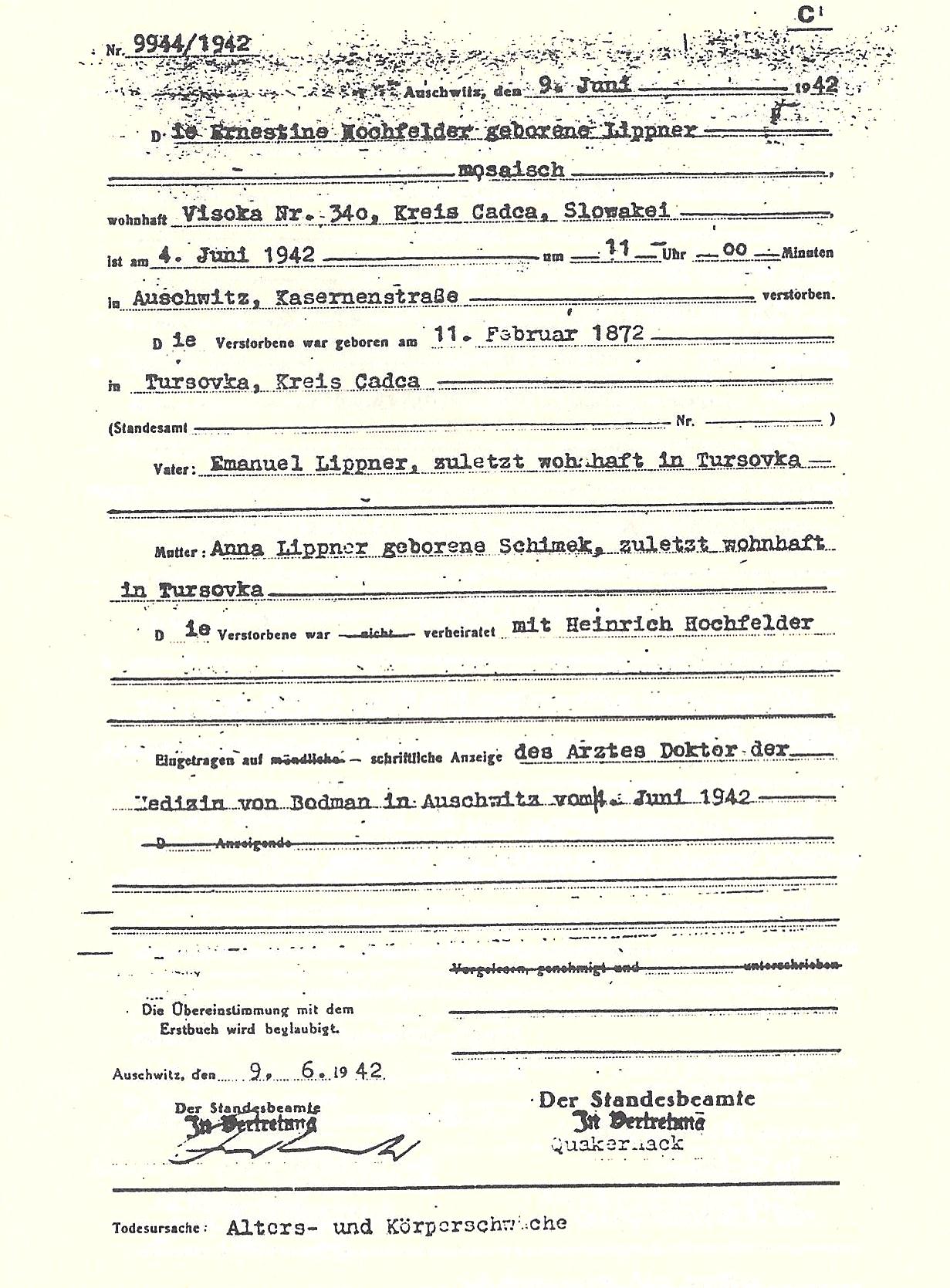
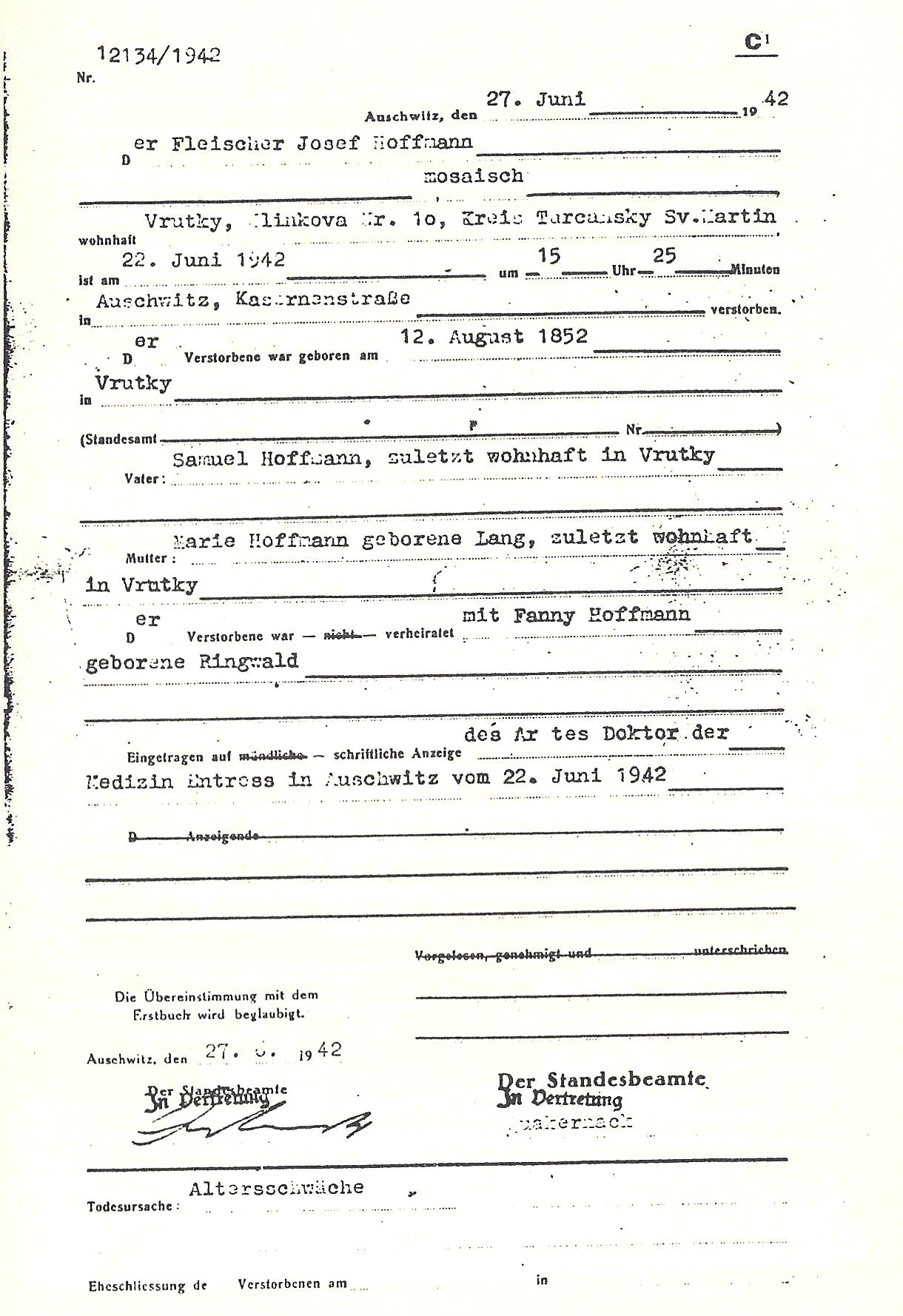
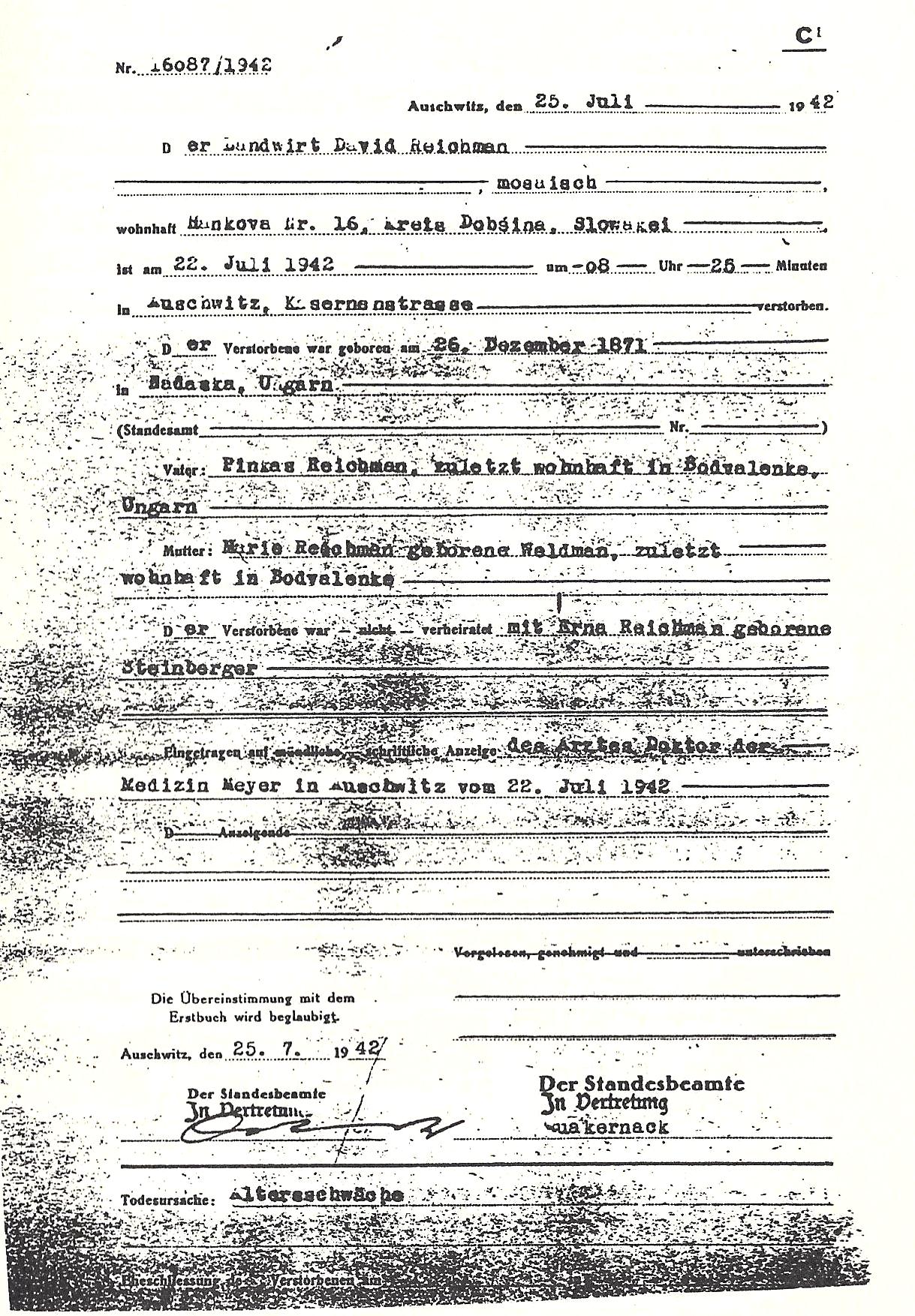
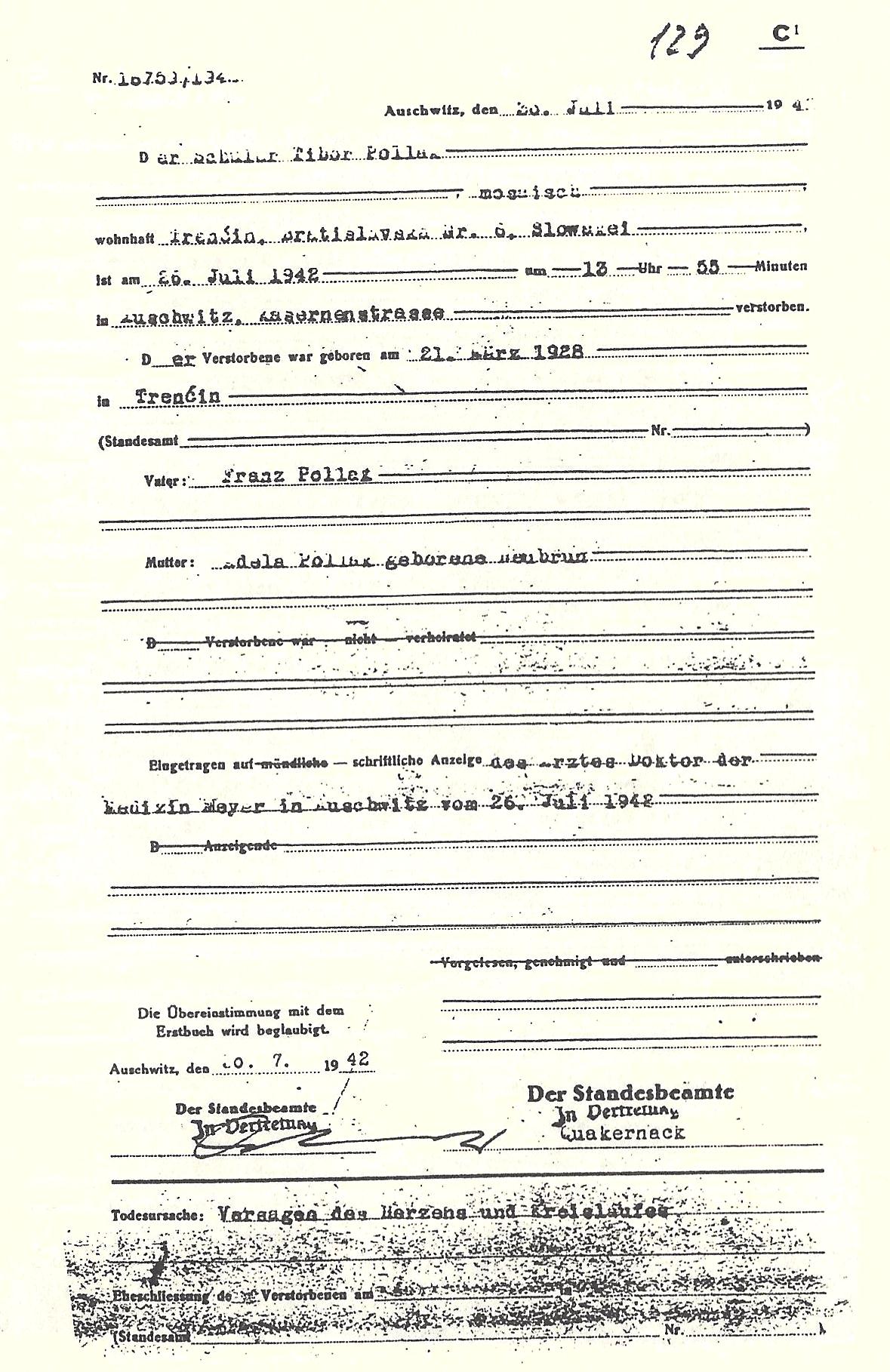
Inmate deaths at Auschwitz were carefully recorded by the camp authorities on certificates that were bound in dozens of death registry volumes. Each “death book” (Sterbebuch) contains hundreds of death certificates. Each certificate meticulously records numerous revealing details, including the deceased person’s full name, profession and religion, date and place of birth, pre-Auschwitz residence, parents’ names, time of death, and cause of death as determined by a camp physician.

These death registry volumes are designated as “secondary books” (Zweitbücher), suggesting the existence of a still-inaccessible set of “primary books.”

The death registry volumes fell into Soviet hands in January 1945 when Red Army forces captured Auschwitz. They remained inaccessible in Soviet archives until 1989, when officials in Moscow announced that they held 46 of the volumes, recording the deaths of 69,000 Auschwitz inmates.

These 46 volumes partially cover the years 1941, 1942 and 1943. There are just two or three volumes for the year 1941, and none at all for the years 1944 or 1945. [2] It is not clear why so many volumes are still missing. According to informed International Red Cross officials, the most likely explanation is that they were misplaced by the Soviets, and might therefore turn up later. (There is no indication that Auschwitz camp authorities made any effort to destroy any of the volumes.) [3]

“No one seems to know yet what become of the numerous missing volumes,” the journal Red Cross, Red Crescent has reported. “Are they still gathering dust in one of the numerous archives throughout the [former] USSR? Anything is possible, but this last hypothesis seems most likely. The mere thought that there are more than 3,250 archival centers in the USSR is enough make anyone’s head spin.” [4]

Russian officials have permitted an agency of the International Committee of the Red Cross (ICRC) — the International Tracing Service in Arolsen, Germany — to make copies of the 69,000 death certificates. Microfilm copies of the documents have reportedly also been given to the American Red Cross, and the original volumes have been turned over to the Auschwitz State Museum in Poland.

Although archive officials have not permitted independent researchers to freely examine and evaluate the death registry volumes, the IHR recently obtained copies of 127 of the death certificates from German journalist and researcher Wolfgang Kempkens, who obtained copies of more than 800 of them from sources in Poland and Russia.

Published here — to our knowledge for the first time anywhere — are facsimile reproductions of 30 of these certificates. (Because of the Journal’s page size, the documents reproduced here are reduced to 55 percent of original size.)

In selecting which certificates to reproduce here, preference has been given to those recording the deaths of Jewish prisoners who were indisputably too old to have been able to work.

Consistent with the Sterbebuch records, other German wartime documents show that a very high percentage of the Jewish inmates at Auschwitz were not able to work, and were nevertheless not killed. [5]

For example, an internal German telex message dated September 4, 1943, from the chief of the Labor Allocation department of the SS Economic and Administrative Main Office (WVHA), reported that of 25,000 Jewish inmates in Auschwitz, only 3,581 were able to work. All of the remaining Jewish inmates — some 21,500, or about 86 percent — were unable to work. [6]

This is also confirmed in a secret report dated April 5, 1944, on “security measures in Auschwitz” by Oswald Pohl, head of the WVHA agency responsible for the concentration camp system, to SS chief Heinrich Himmler. Pohl reported that there was a total of 67,000 inmates in the Auschwitz camp complex, of whom 18,000 were hospitalized or disabled. In the Auschwitz II camp (Birkenau), supposedly the main extermination center, there were 36,000 inmates, mostly female, of whom “approximately 15,000 are unable to work.” [7]

The evidence shows that Auschwitz-Birkenau was, in fact, established primarily as a camp for Jews who were not able to work, including the sick and elderly, as well as for others temporarily awaiting assignment to other camps. [8]

Along with the two documents above, the long-hidden certificates reproduced on the following pages discredit a central pillar of the Holocaust extermination story. As revealing as these documents are, though, there is little doubt that a careful examination of all of the many thousands of documents in the Auschwitz death books — as well as other, still-inaccessible wartime records — would bring us much closer to finding definitive answers to the central questions of Germany’s wartime Jewish policy. It is high time for archival officials in Poland, Germany, Russia and Israel to open all their records to independent scholars.

Notes

1. Probably the most often cited “evidence” for extermination at Auschwitz are the “confessions” and “affidavits” of former camp commandant Rudolf Höss. See, for example, Höss affidavit of April 5, 1946 (Nuremberg document 3868-PS), and: Rudolf Höss, Death Dealer: The Memoirs of the SS Kommandant at Auschwitz, Steven Paskuly, ed. (Buffalo: Prometheus, 1992), pp. 27, 31, 32, 34, 157, 159.; As Prof. Robert Faurisson has explained, the Höss “confessions” are error-ridden statements obtained by torture. See: R. Faurisson, “How the British Obtained the Confessions of Rudolf Höss,” The Journal of Historical Review, Winter 1986-87, pp. 389-403.; Other often-cited “eyewitness accounts” confirming the alleged Auschwitz extermination program include: Miklos Nyiszli, Auschwitz: A Doctor’s Eyewitness Account (Fawcett Crest pb. edition, 1985?), pp. 23-24.; Olga Lengyel, Five Chimneys (Granada, pb., 1981), pp. 83.

2. Jean-Louis Amar, “Death Camps: The Archives Open,” Red Cross, Red Crescent, January-April 1990, pp. 24-26. This journal is apparently an official publication of the Swiss-based International Committee of the Red Cross (ICRC).

3. E. Schulten, “Endlich Glasnost …,” Waldeckische Landeszeitung, Nov. 2, 1989.

4. J.-L. Amar, “Death Camps: The Archives Open,” Red Cross, Red Crescent, January-April 1990, p. 26.

5. This has recently been obliquely confirmed by Auschwitz State Museum official Franciszek Piper. See: F. Piper, “Estimating the Number of Deportees to and Victims of the Auschwitz-Birkenau Camp,” Yad Vashem Studies (Jerusalem: 1991), Vol. 21, pp. 70-71.

6. Helmut Eschwege, ed., Kennzeichen J (Berlin: 1966), p. 264. Source cited: Archives of the Jewish Historical Institute of Warsaw. German document No. 128.

7. Nuremberg document NO-021. Published in: Trials of War Criminals Before the Nuernberg Military Tribunals (Washington, DC: 1949-1953), Vol. 5, pp. 384-385. (This is also known as the NMT “green series.”)

8. This is also the considered view of Dr. Arthur Butz. See: A. Butz, The Hoax of the Twentieth Century (IHR, 1983), p. 124.

Captions
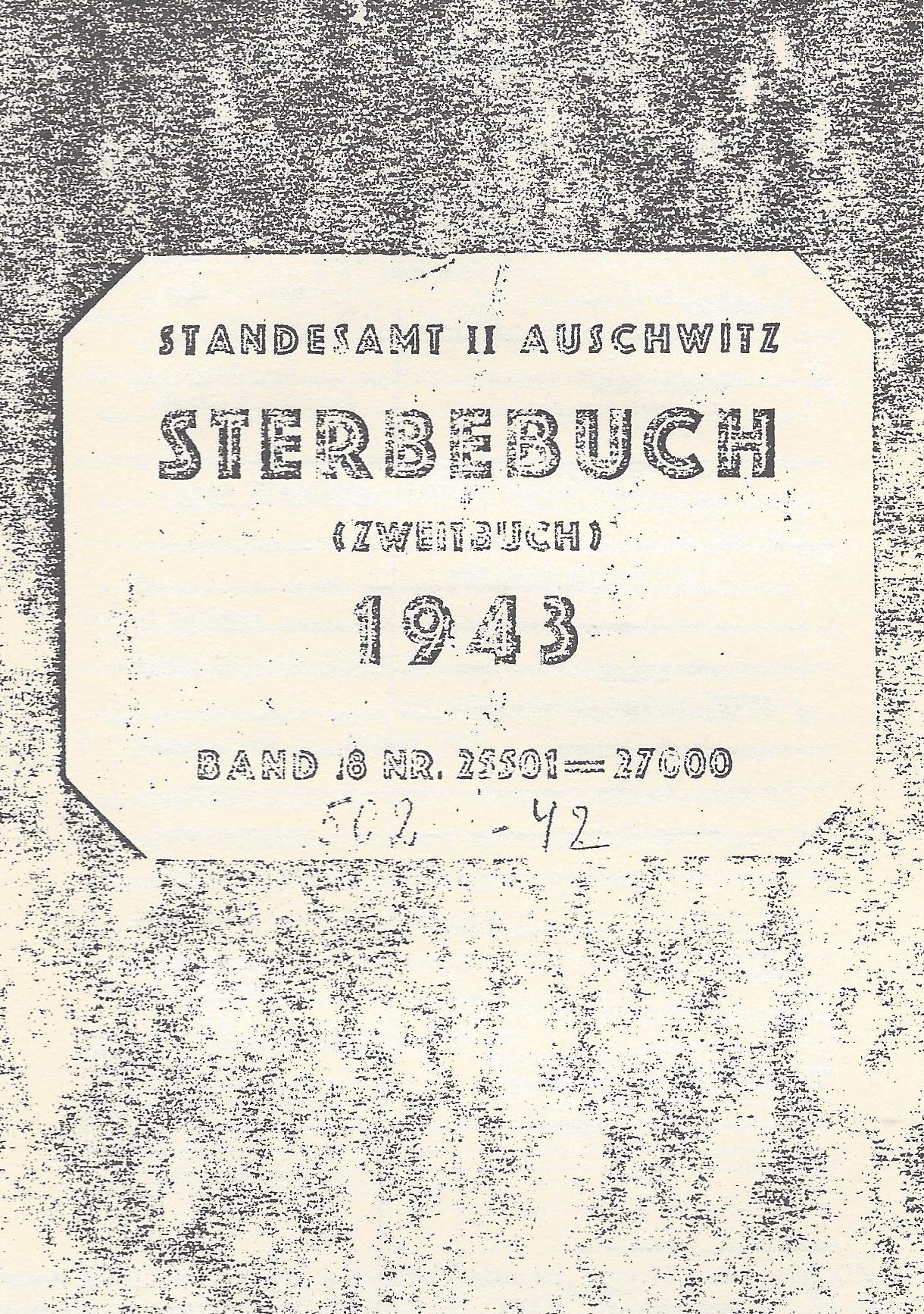
The cover of an Auschwitz death registry volume (Sterbebuch) containing 1,500 certificates from July and August 1943.

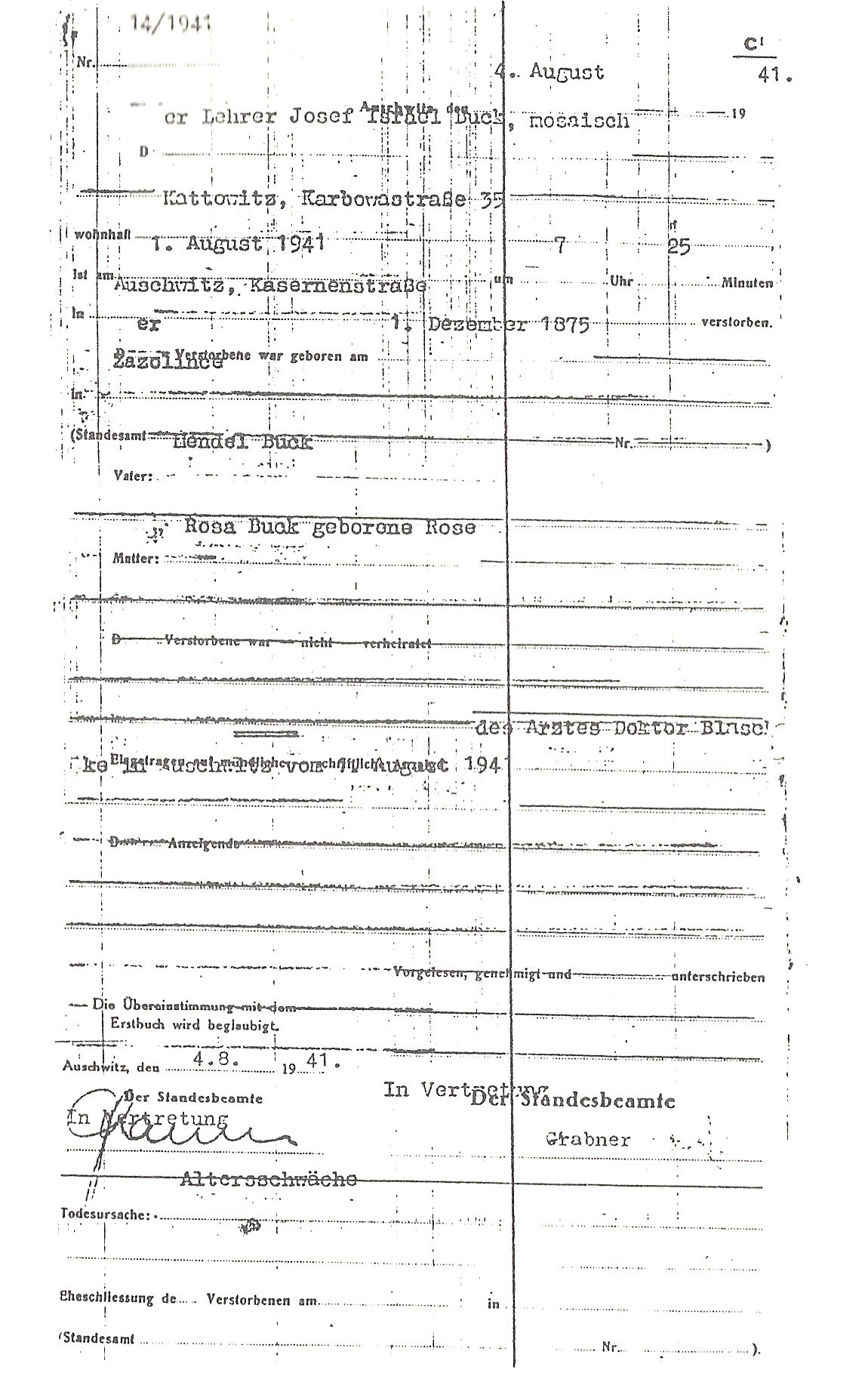
This Auschwitz camp death certificate reports that prisoner Josef Buck, a Jewish teacher from Kattowitz, was 65 years old when he died on August 1, 1941. “Weakness of old age” is given as the cause of death.

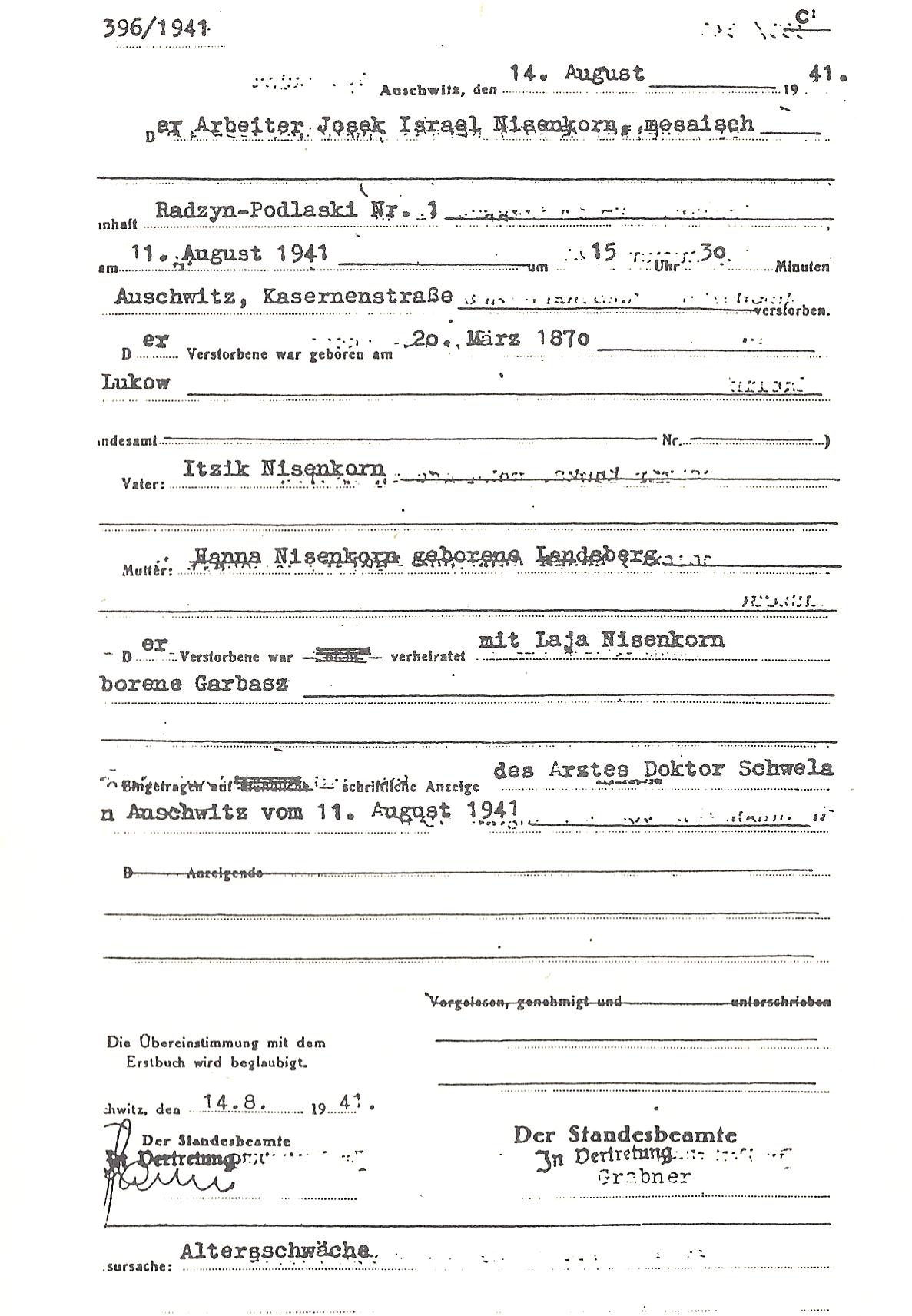
Josek [sic] Nisenkorn, a Jewish laborer, was 71 years old when he died in Auschwitz on August 11, 1941. “Weakness of old age” is given as the cause of death by camp physician Dr. Siegfried Schwela, who himself later died of typhus.

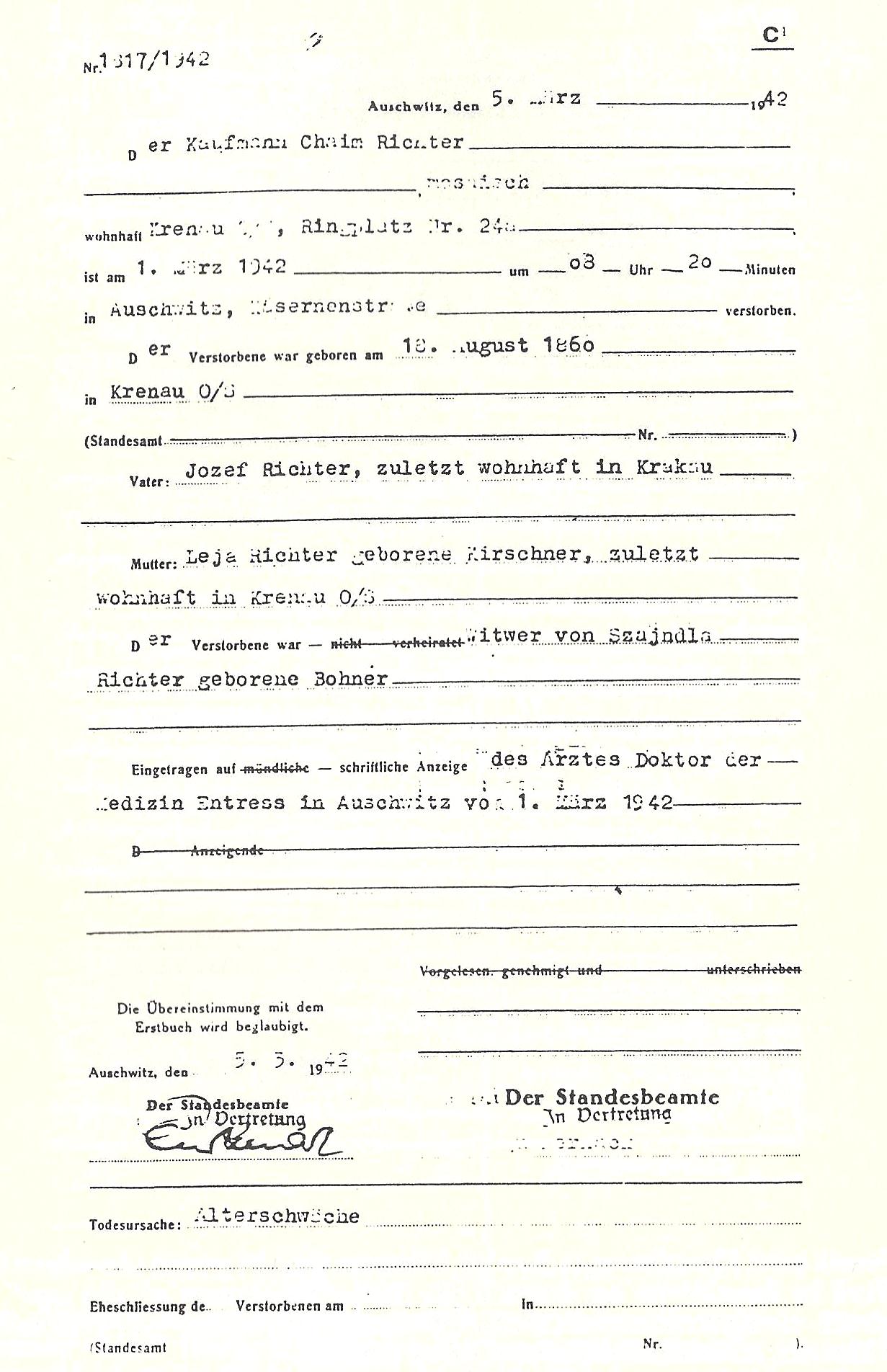
Chaim Richter, a Jewish salesman, was 81 years old when he died in Auschwitz on March 1, 1942, of “weakness of old age.”

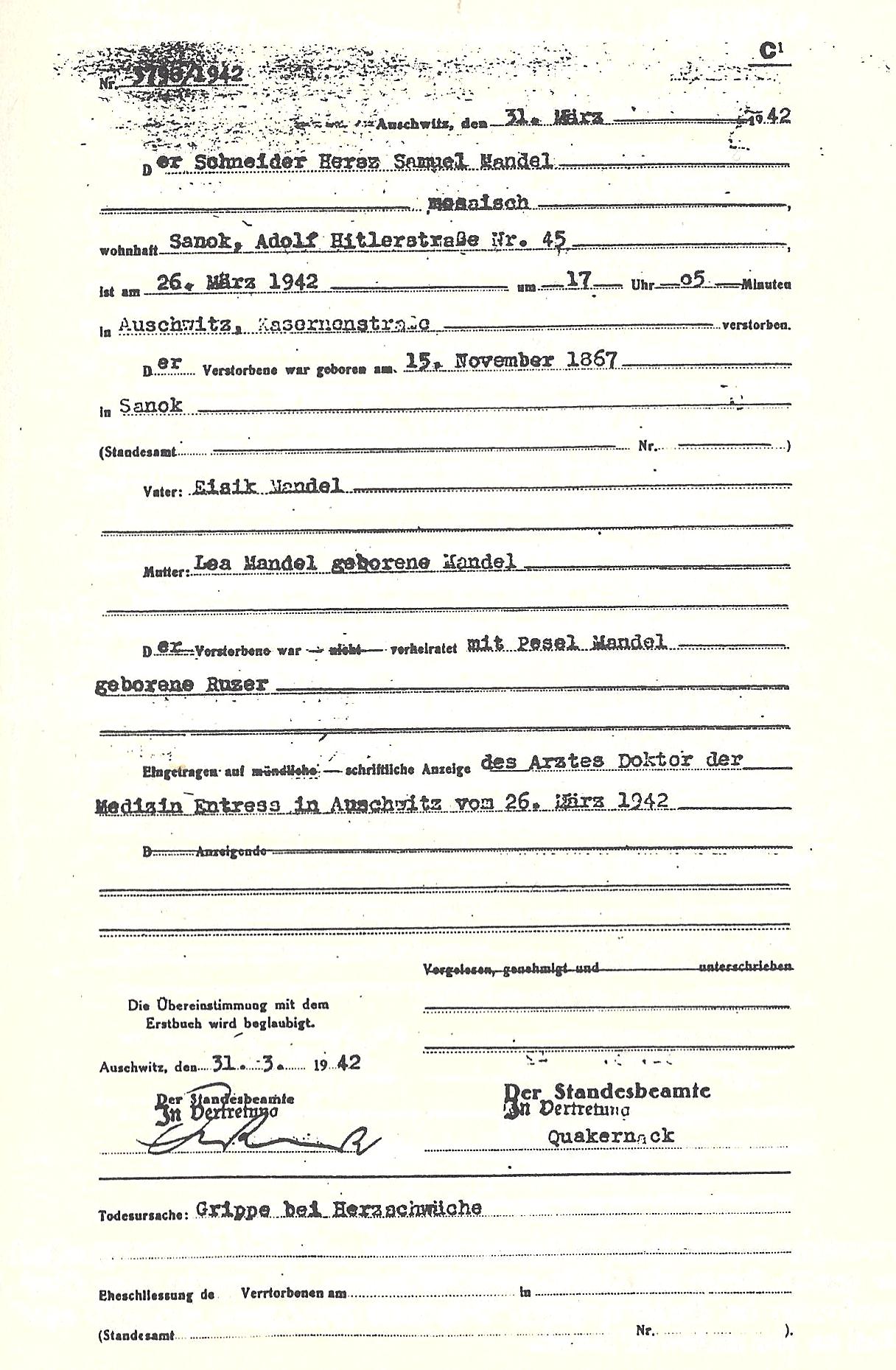
Samuel Mandel, a Jewish tailor, was 74 years old when he died in Auschwitz on March 26, 1942. Physician Dr. Entress reported the cause of death as “influenza with heart failure.”

Ernestine Hochfelder, a Jewish inmate who had been deported to the camp from Slovakia, was 70 years old when she died in Auschwitz on June 4, 1942. “Physical weakness and old age” is cited as the cause of death.

Josef Hoffmann, a Jewish butcher, was 89 years old when he died of “old age” on June 22, 1942.

Abraham Stieber, a Jewish salesman from Slovakia, was 79 years old when he died on July 2, 1942, of “old age.”

David Reichman, a Jewish farmer, was 70 years old when he died on July 22, 1942, of “old age.”

Tibor Pollak, a Jewish secondary school student from Slovakia, was 14 years old when he died on July 26, 1942. Camp physician Dr. Meyer recorded “heart and circulatory failure” as the cause of death.

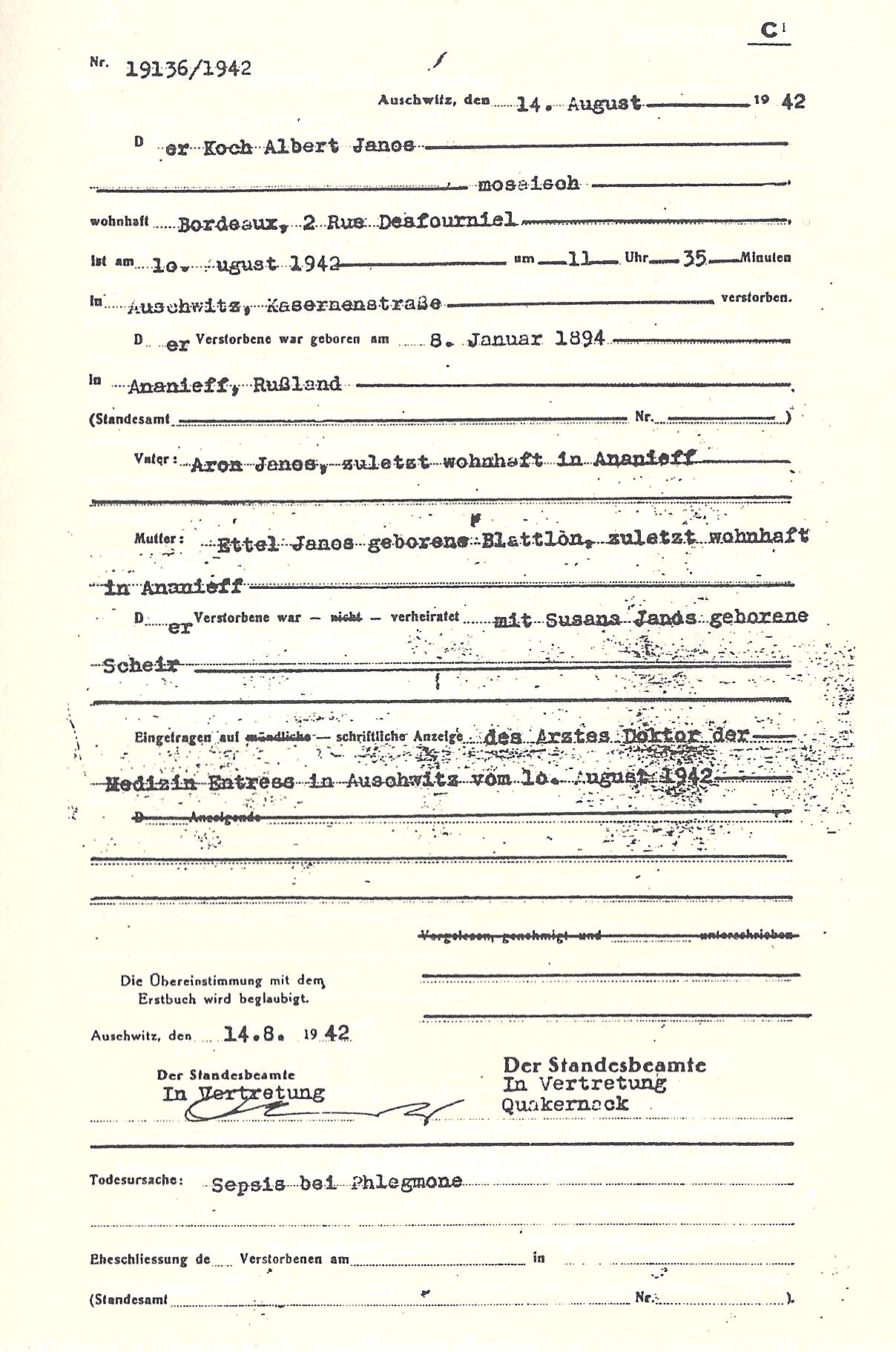
Albert Janos, a Jewish cook born in Russia, was deported to Auschwitz from Bordeaux, France. He was 48 years old when he died on August 10, 1942. Camp physician Dr. Entress recorded the cause of death as sepsis with inflammation of tissues.

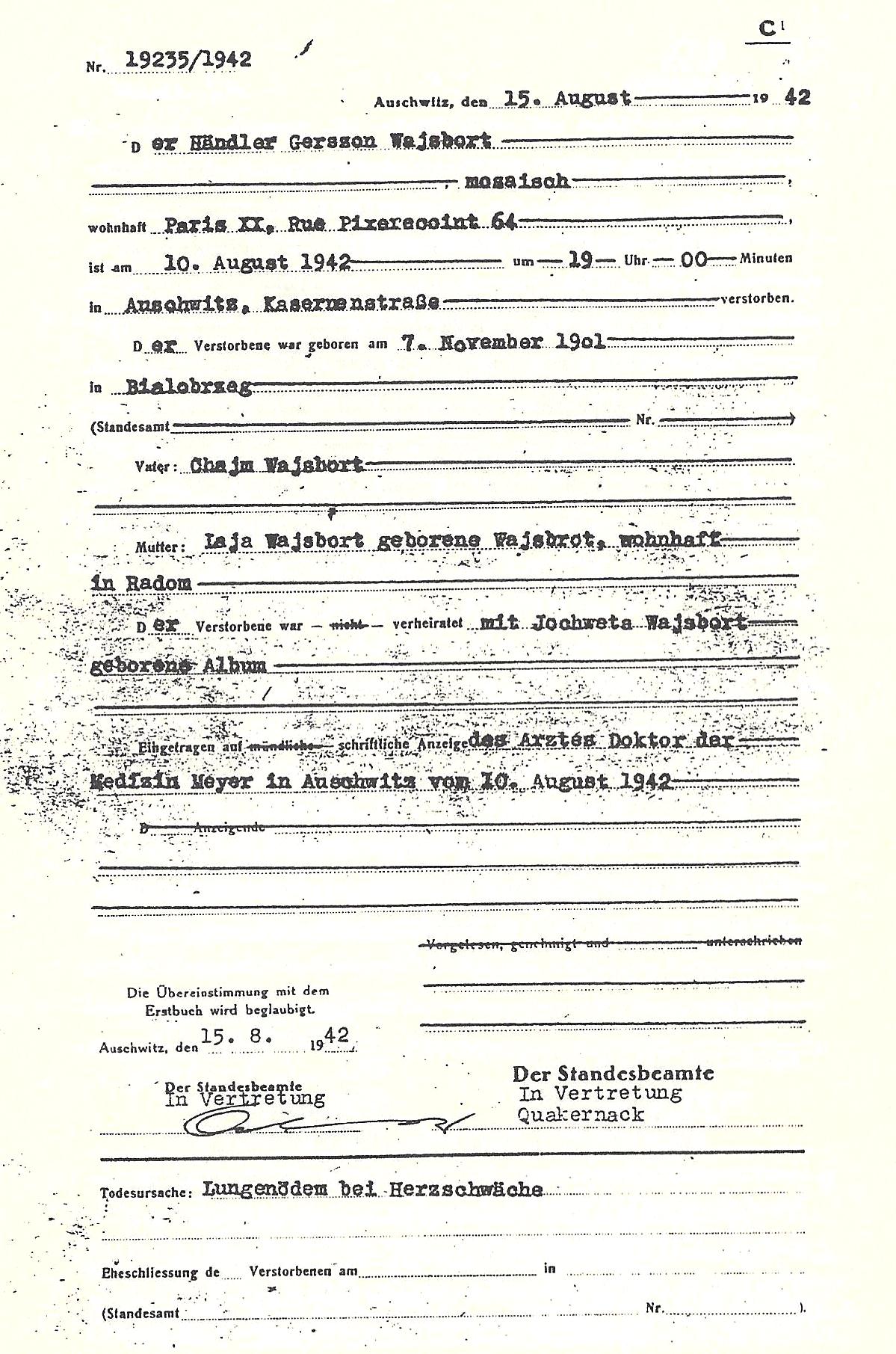
Gerszon Wajsbort [sic], a Jewish merchant deported to Auschwitz from Paris, was 40 years old when he died on August 10, 1942. Camp physician Dr. Meyer recorded the cause of death as accumulation of fluid in the lungs and heart failure.

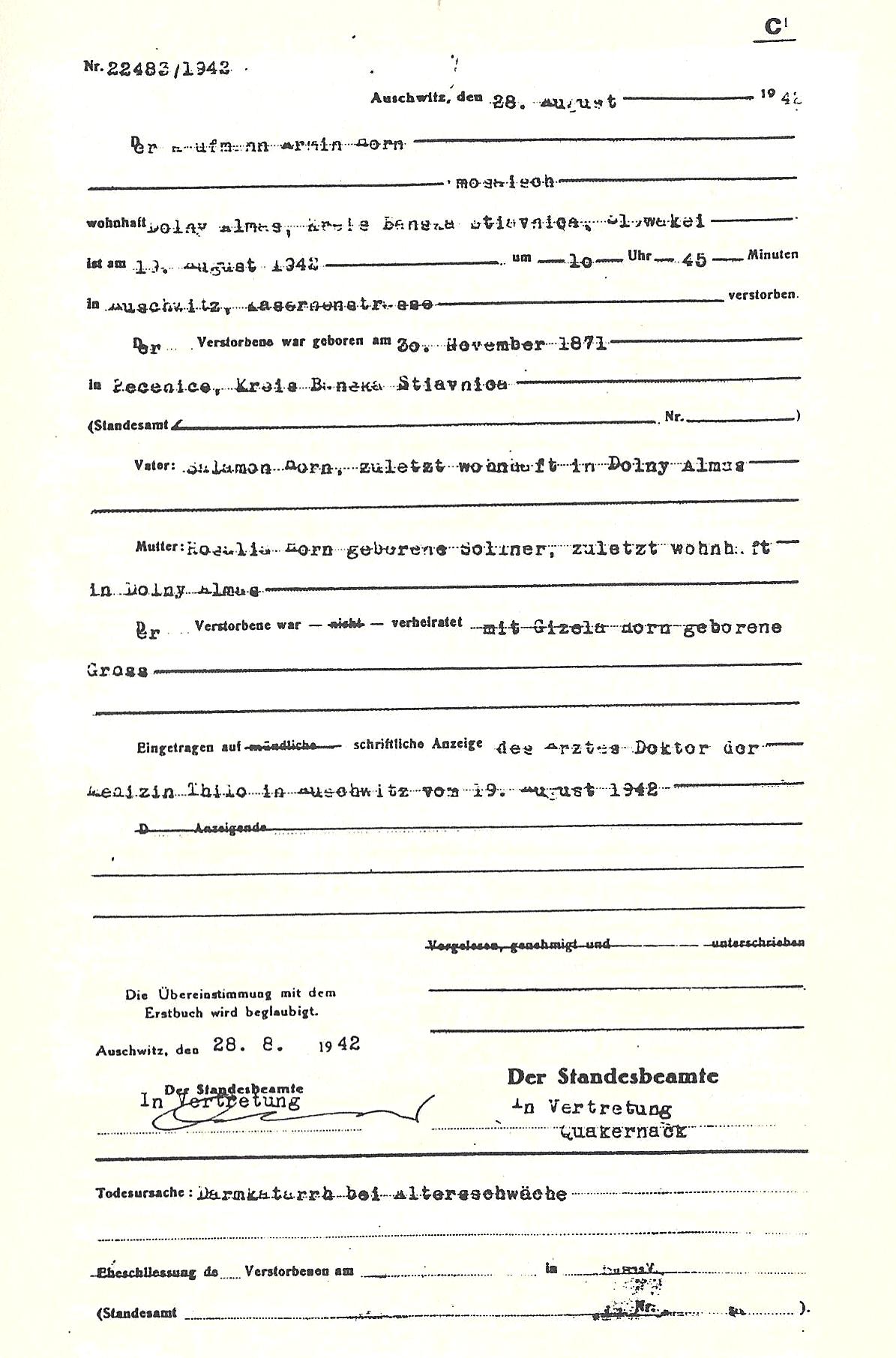
Armin Horn, a Jewish salesman deported to the camp from Slovakia, died on August 19, 1942, at the age of 70. Camp physician Dr. Thilo recorded the cause of death as “accumulation of fluid in the intestine and weakness of old age.”

Tadeusz Jaworski, a Catholic Pole from Krakow, had just turned 19 years old when he succumbed to typhus on August 22, 1942.

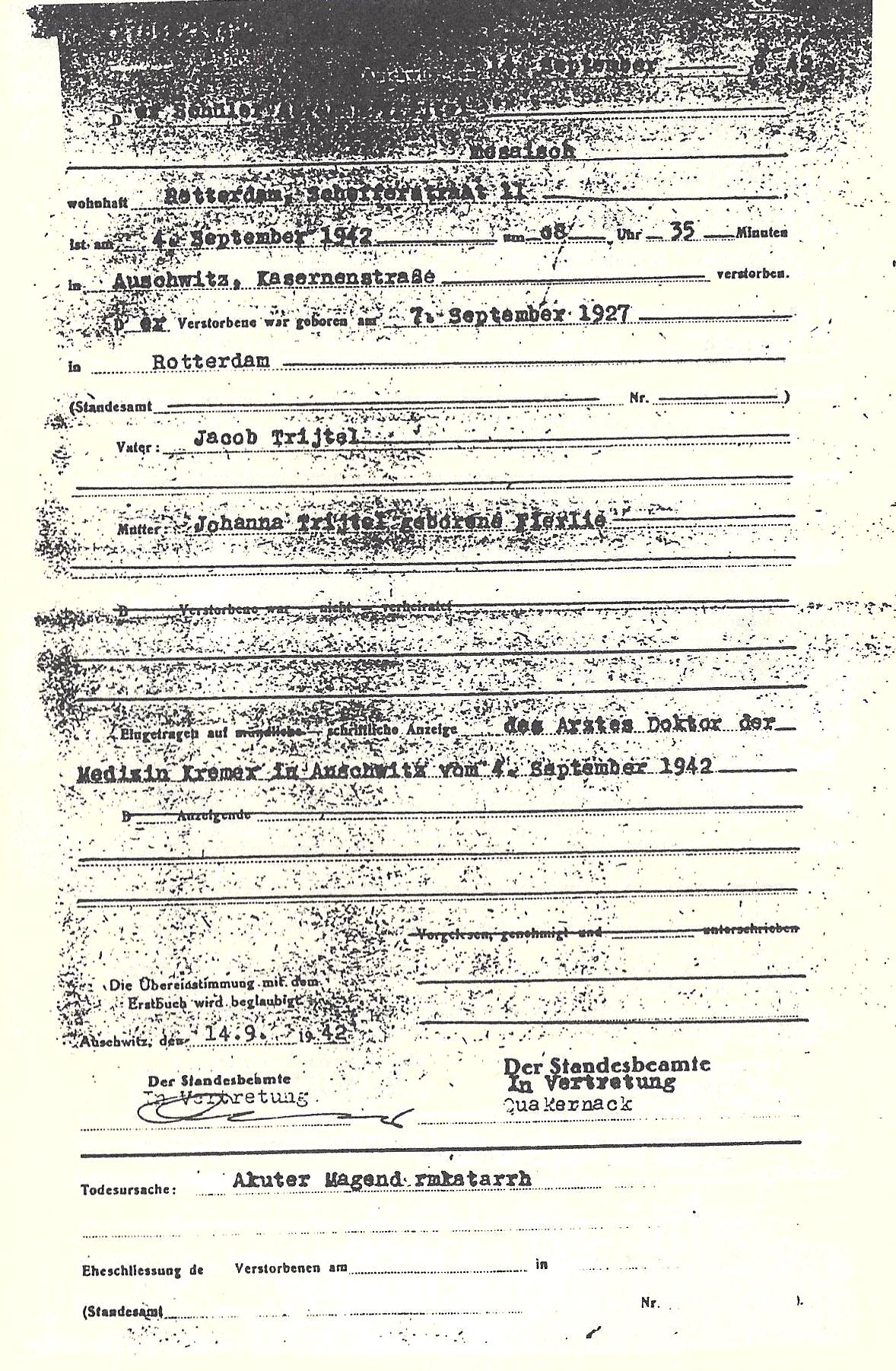
Abraham Trijtel, a Jewish student from the Netherlands, was 14 years old when he died on September 4, 1942, of “acute inflammation of the stomach intestine.”

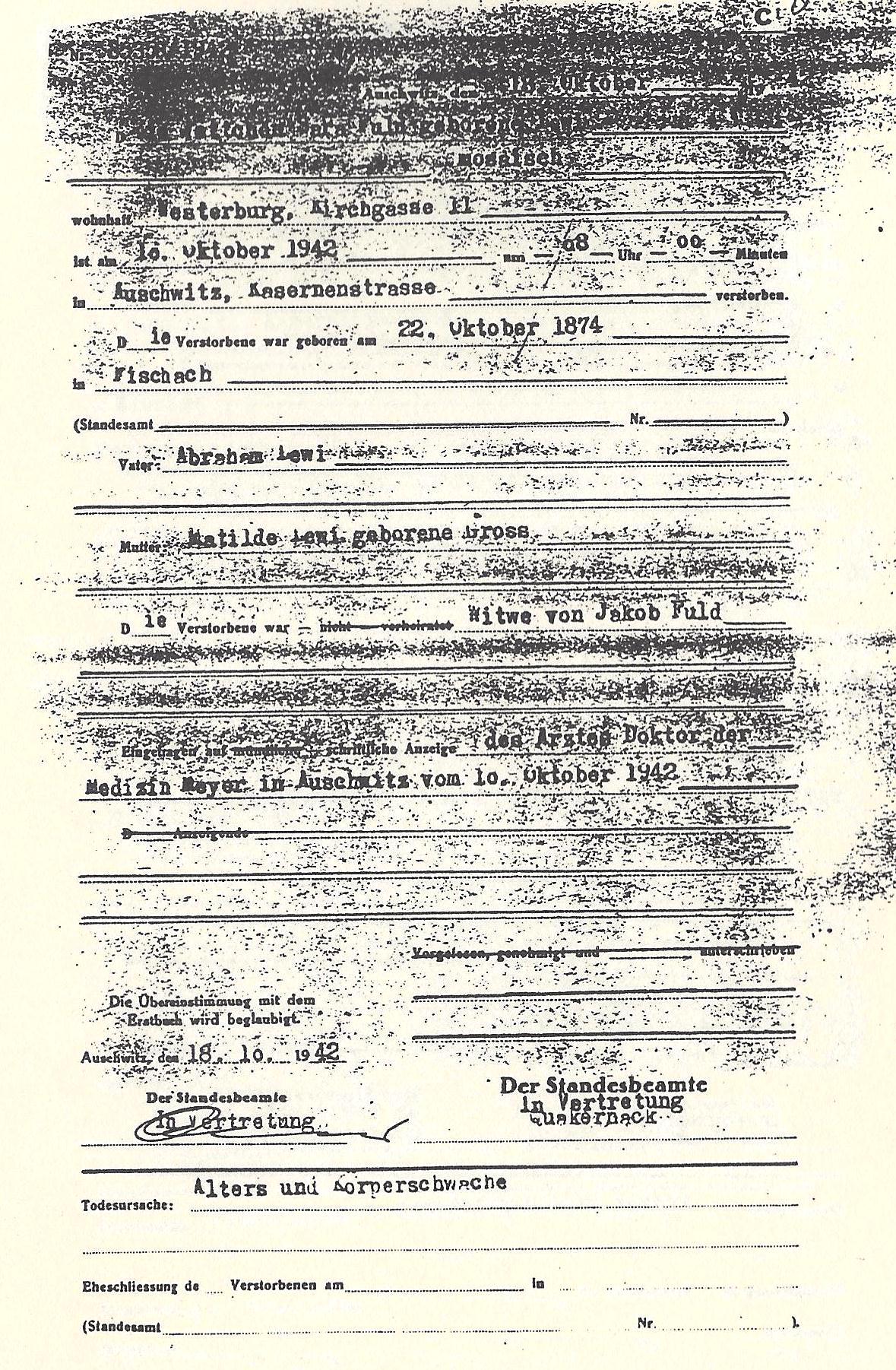
Jettchen Fuld, a Jewish inmate, was 67 when she died on October 10, 1942. Old age and physical weakness is given as the cause of death.

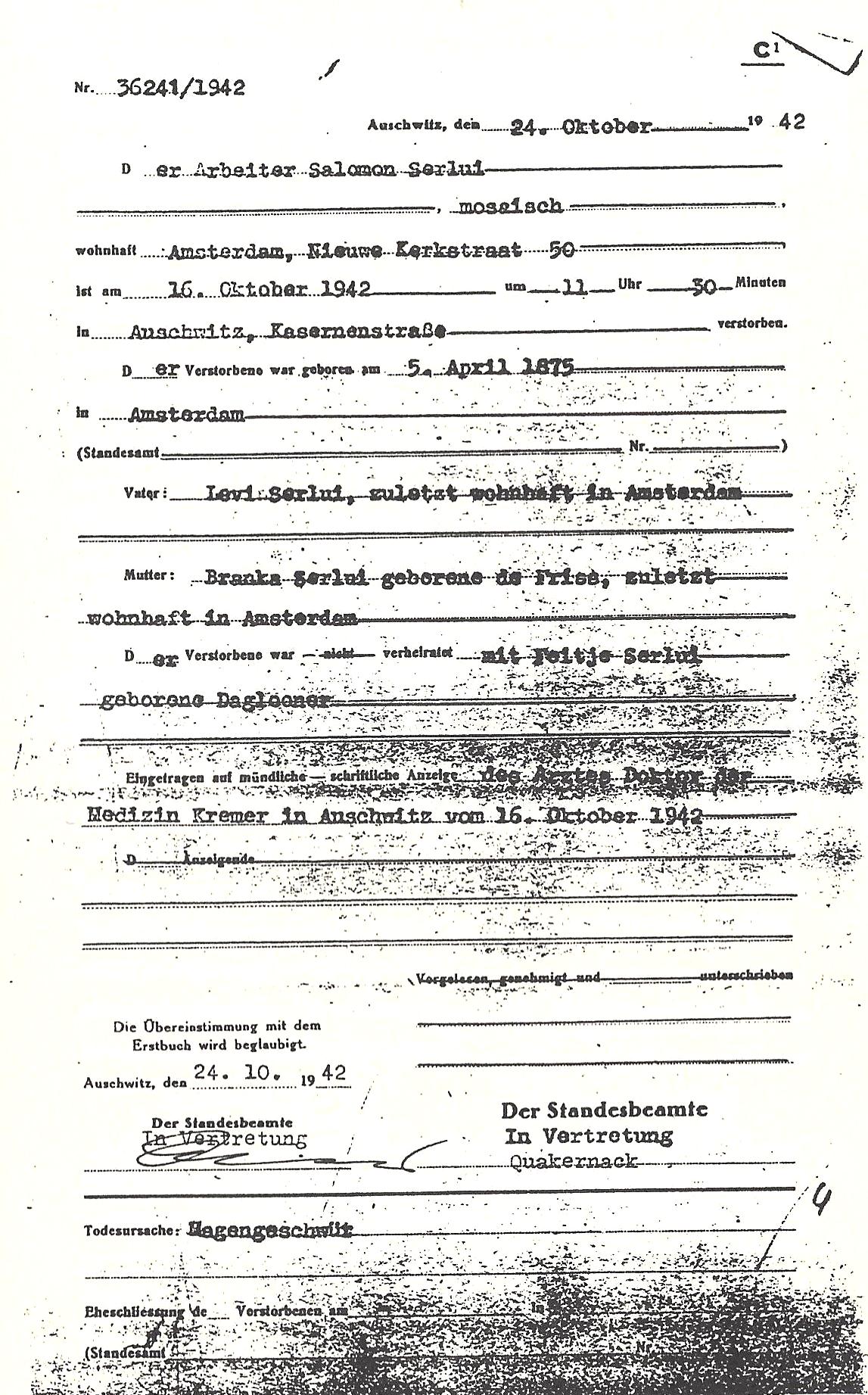
Salomon Serlui, a Jewish laborer from the Netherlands, was 67 when he died in Auschwitz on October 16, 1942. Camp physician Dr. Kremer reported a stomach ulcer as the cause of death.

Renö Hirschfeld, a Jewish tailor born in Berlin in 1878, was 64 when he died on November 2, 1942. Camp physician Dr. Kitt reported “weakness of old age” as the cause of death.

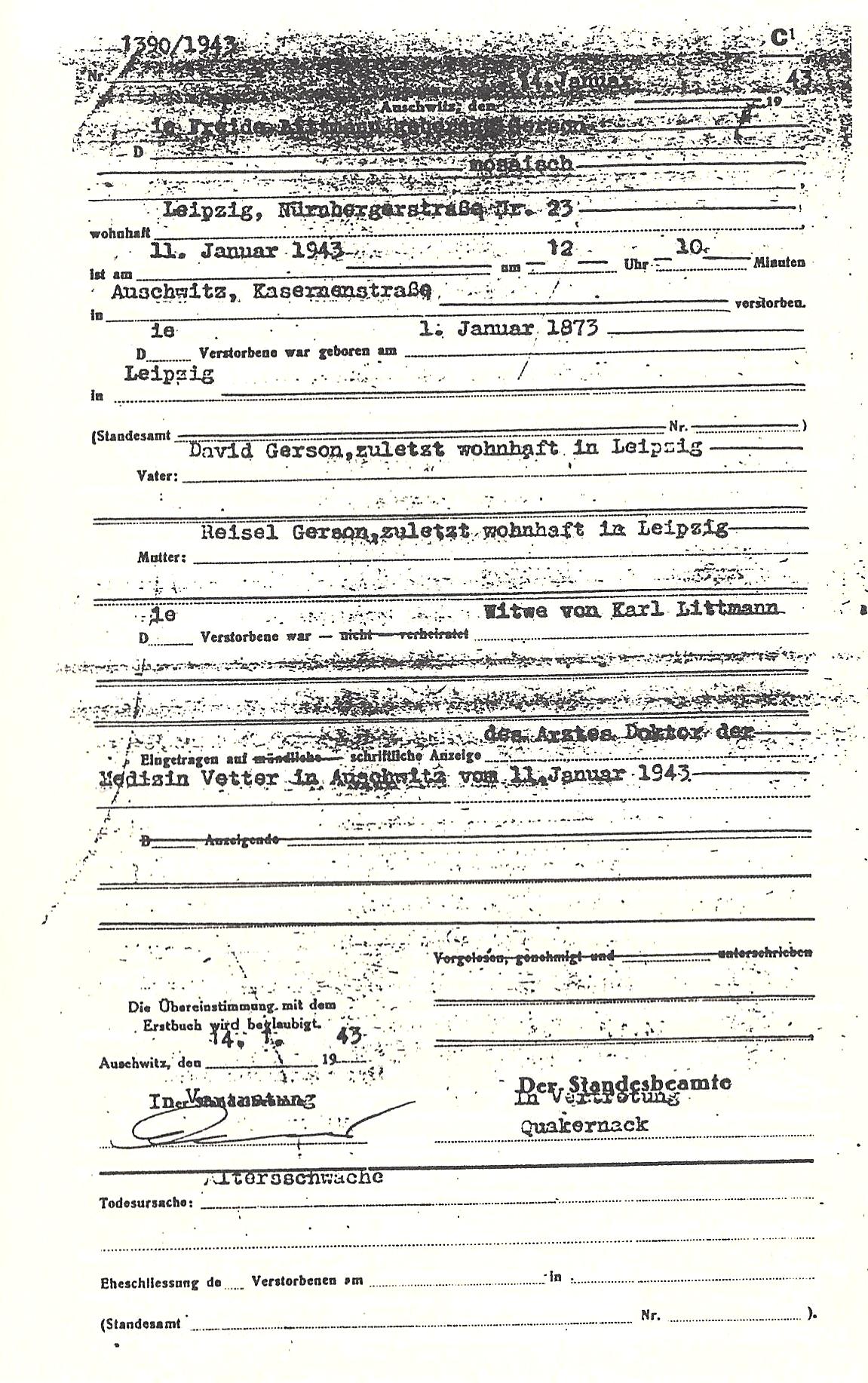
Freide [sic] Littmann, a Jewish inmate from Leipzig, Germany, was 70 when she died of “old age”on January 11, 1943.

Wolf Eisenhöndler, a Jewish student from Berlin, was 14 when he died on January 13, 1943. “Sepsis with pneumonia” is reported as the cause of death.

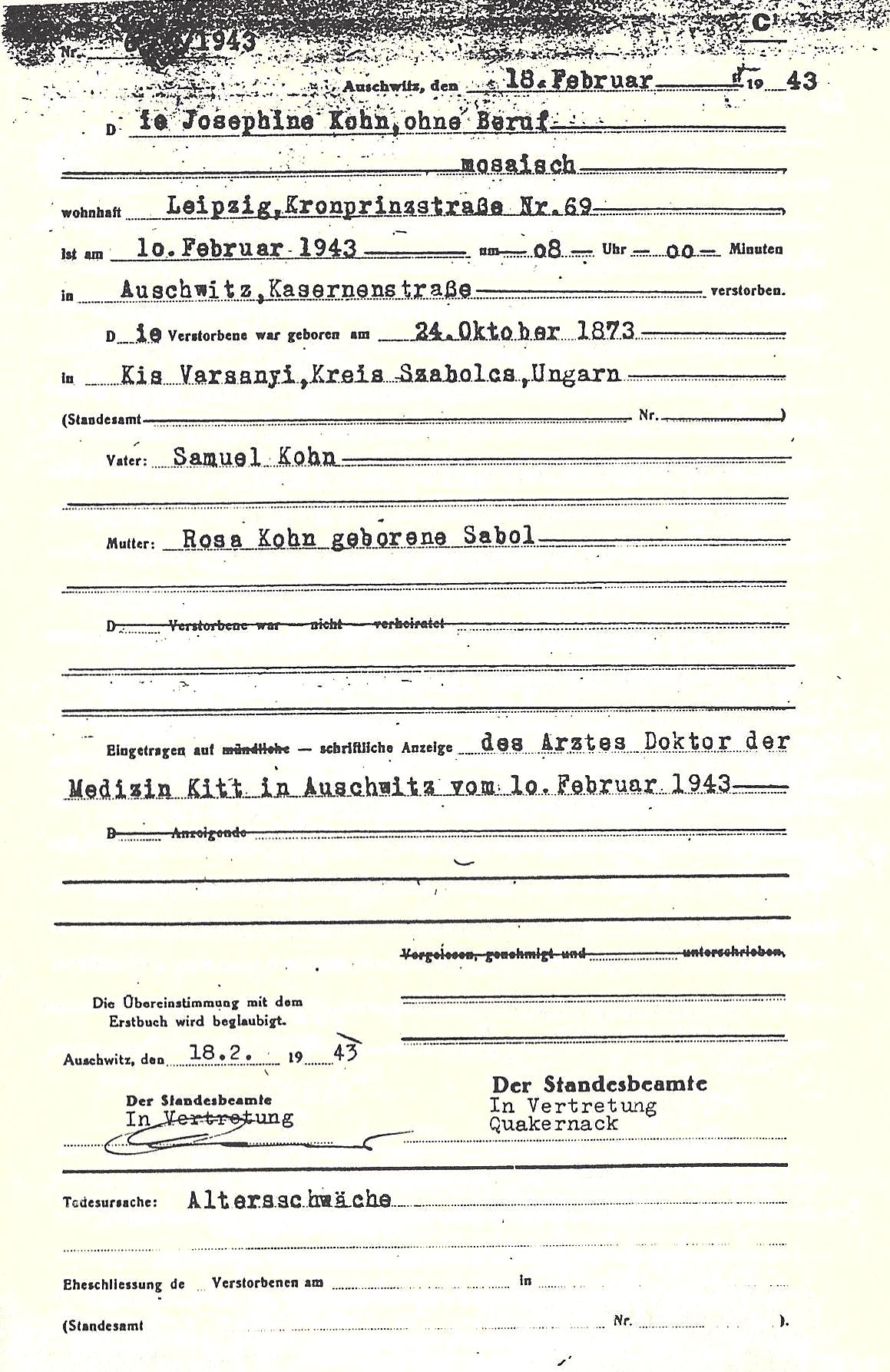
Josephine Kohn, a Jewish inmate born in Hungary who had been living in Leipzig, was 69 years old when she died on February 10, 1943. Auschwitz camp physician Dr. Kitt reported “weakness of old age” as the cause of death.

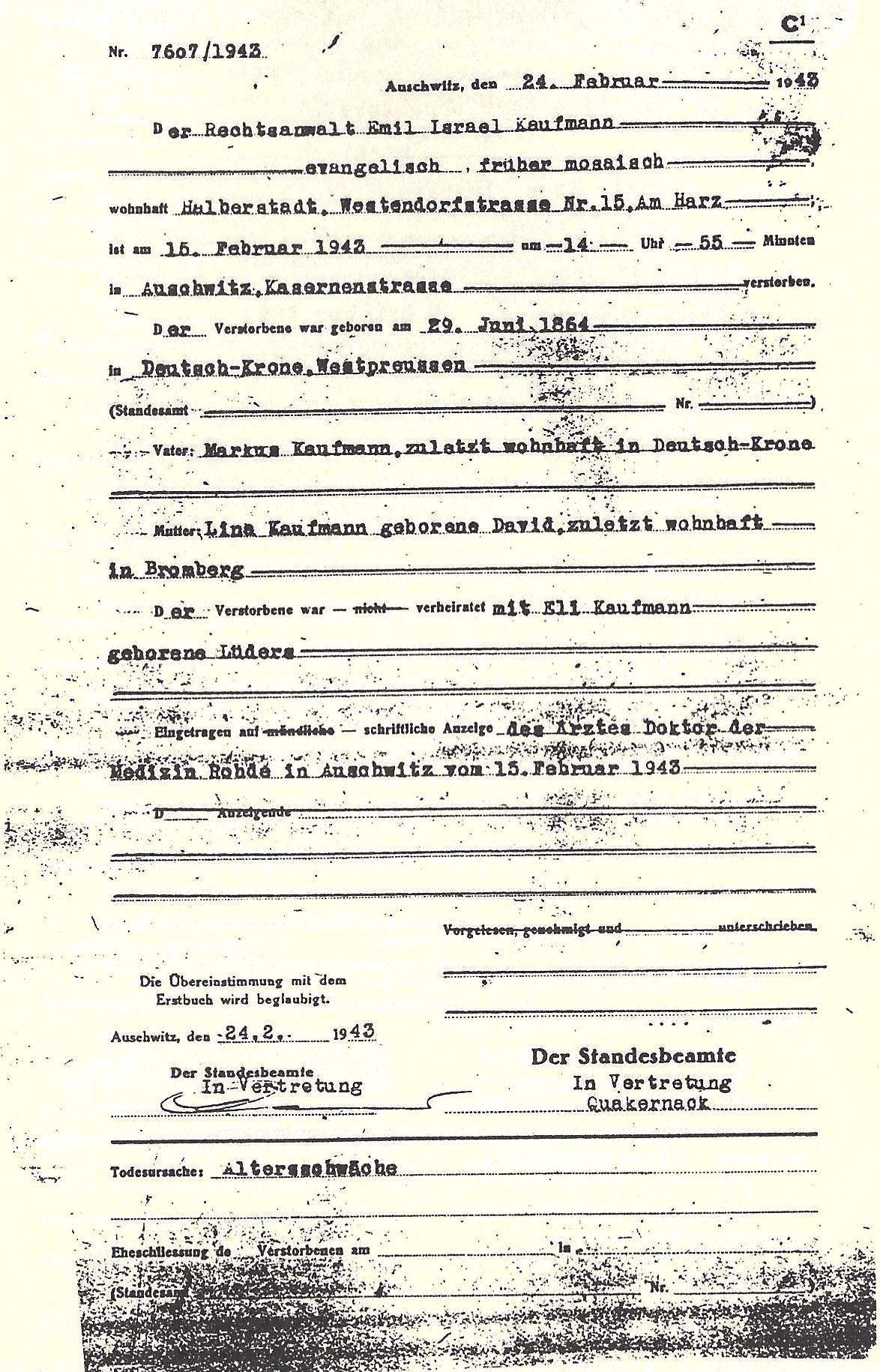
Emil Kaufmann, a Jewish attorney deported from Germany, was 78 years old when he died of “old age” on February 15, 1943. “Weakness of old age” is given as the cause of death.

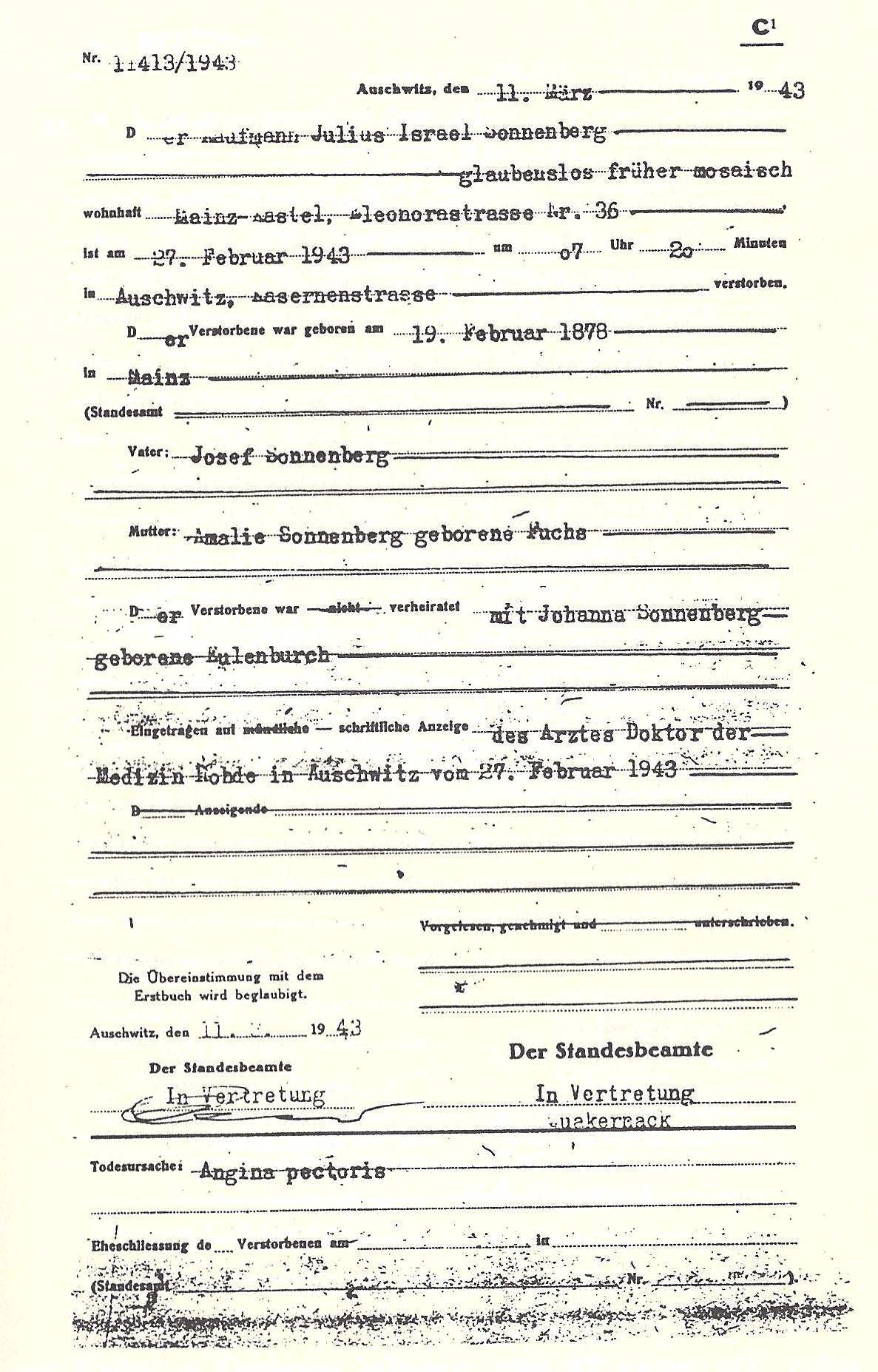
Julius Sonnenberg, a salesman from Germany, was 65 when he died on February 27, 1943, of “angina pectoris.” His religion is cited as “non-believing, formerly Jewish.”

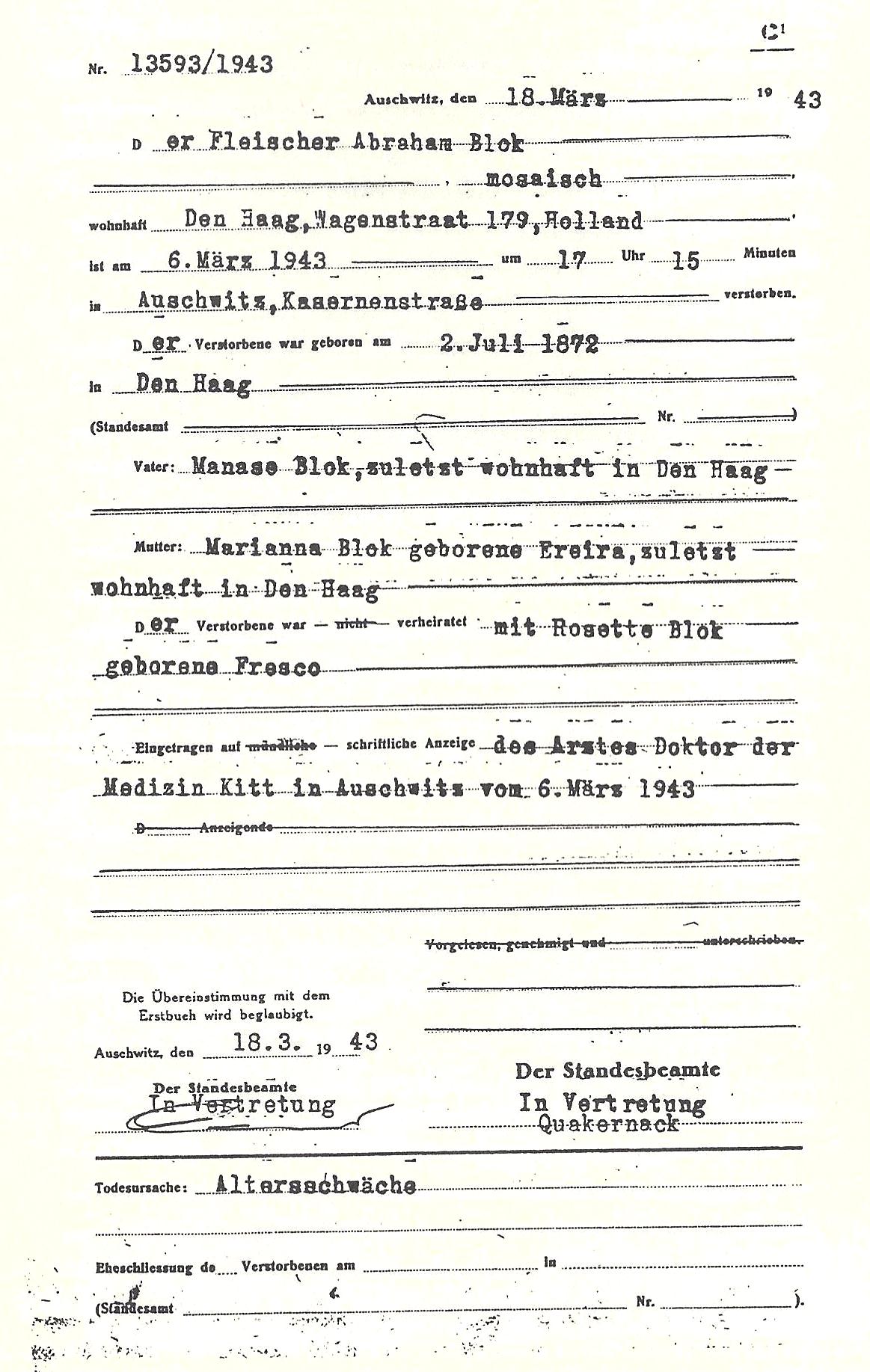
Abraham Blok, a Jewish butcher from the Netherlands, was 70 years old when he died of “old age” on March 6, 1943.

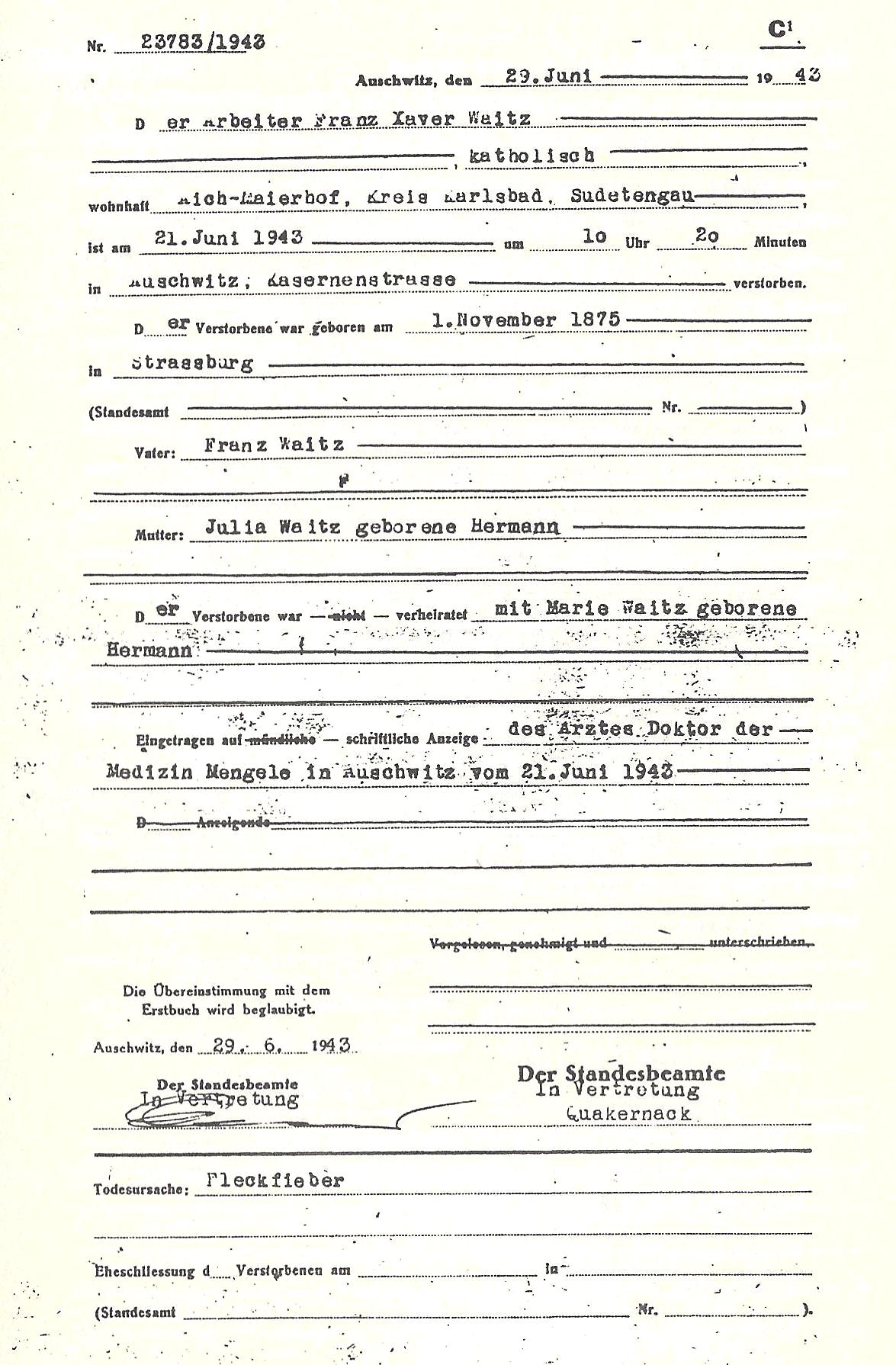
Franz Waitz, a Catholic laborer, was 67 years old when he succumbed to typhus on June 21, 1943. His death was certified by Dr. Josef Mengele, the Auschwitz camp physician who was sensationally stigmatized after the war as the “angel of death.”

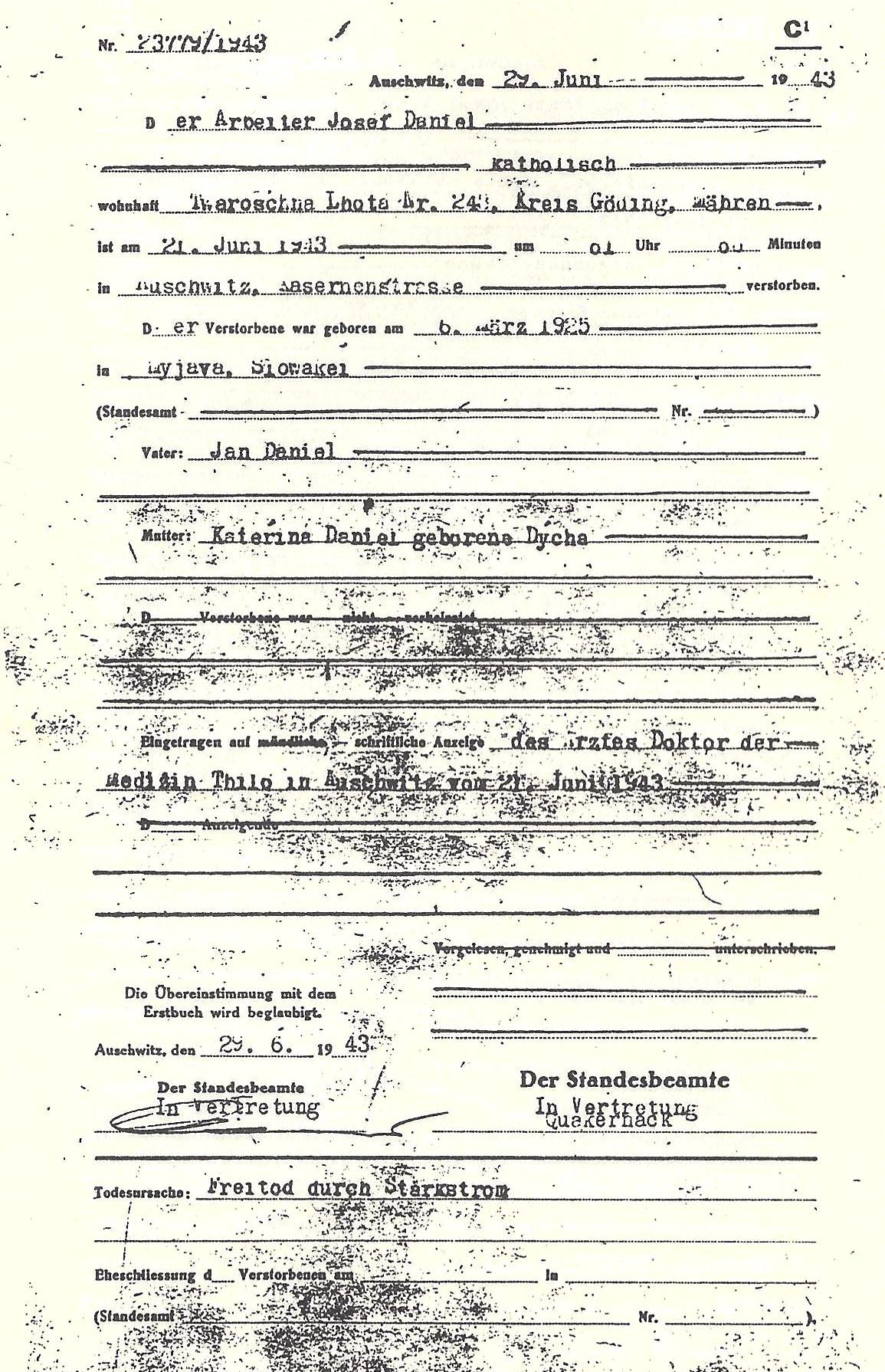
Josef Daniel, a Catholic laborer from rural Moravia, was 18 years old when he ed his life on June 21, 1943, by “suicide by high-voltage electrical current.”

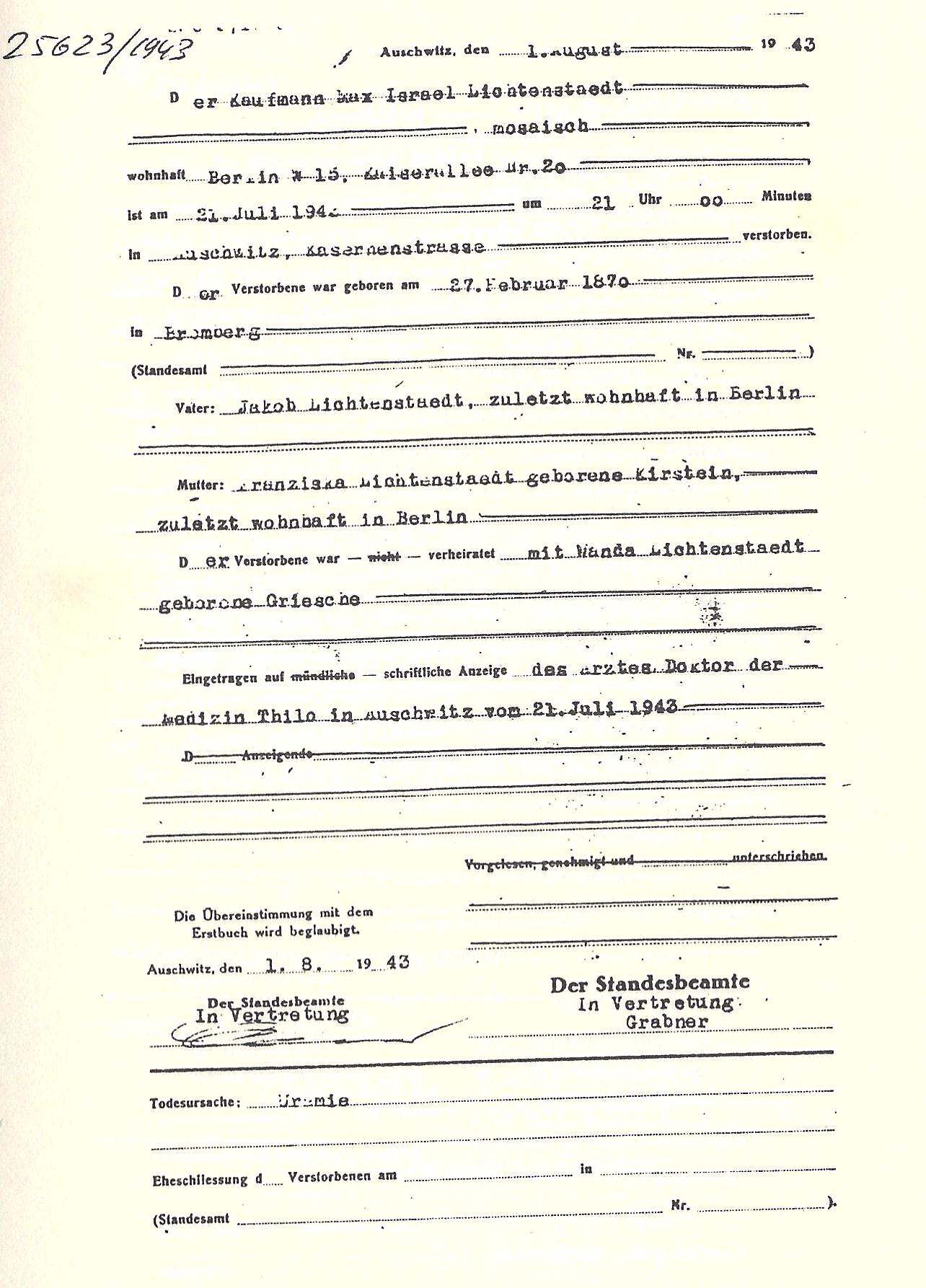
Max Lichtenstaedt, a Jewish salesman from Berlin, was 73 years old when he died in Auschwitz on July 21, 1943. “Uraemia” is given as the cause of death.

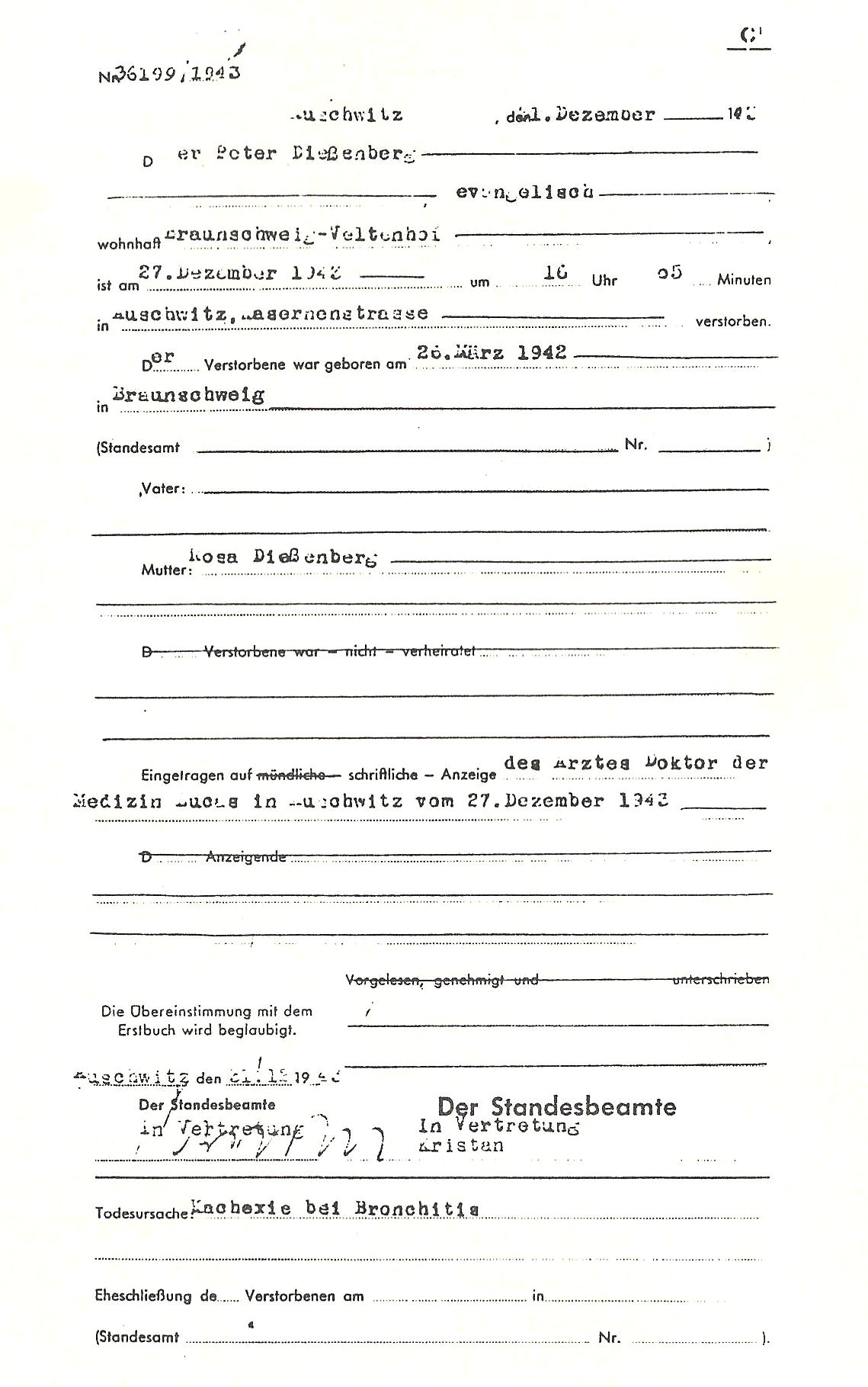
Peter Diessenberg, a baby, was just one year old when he died in Auschwitz on December 27, 1943.

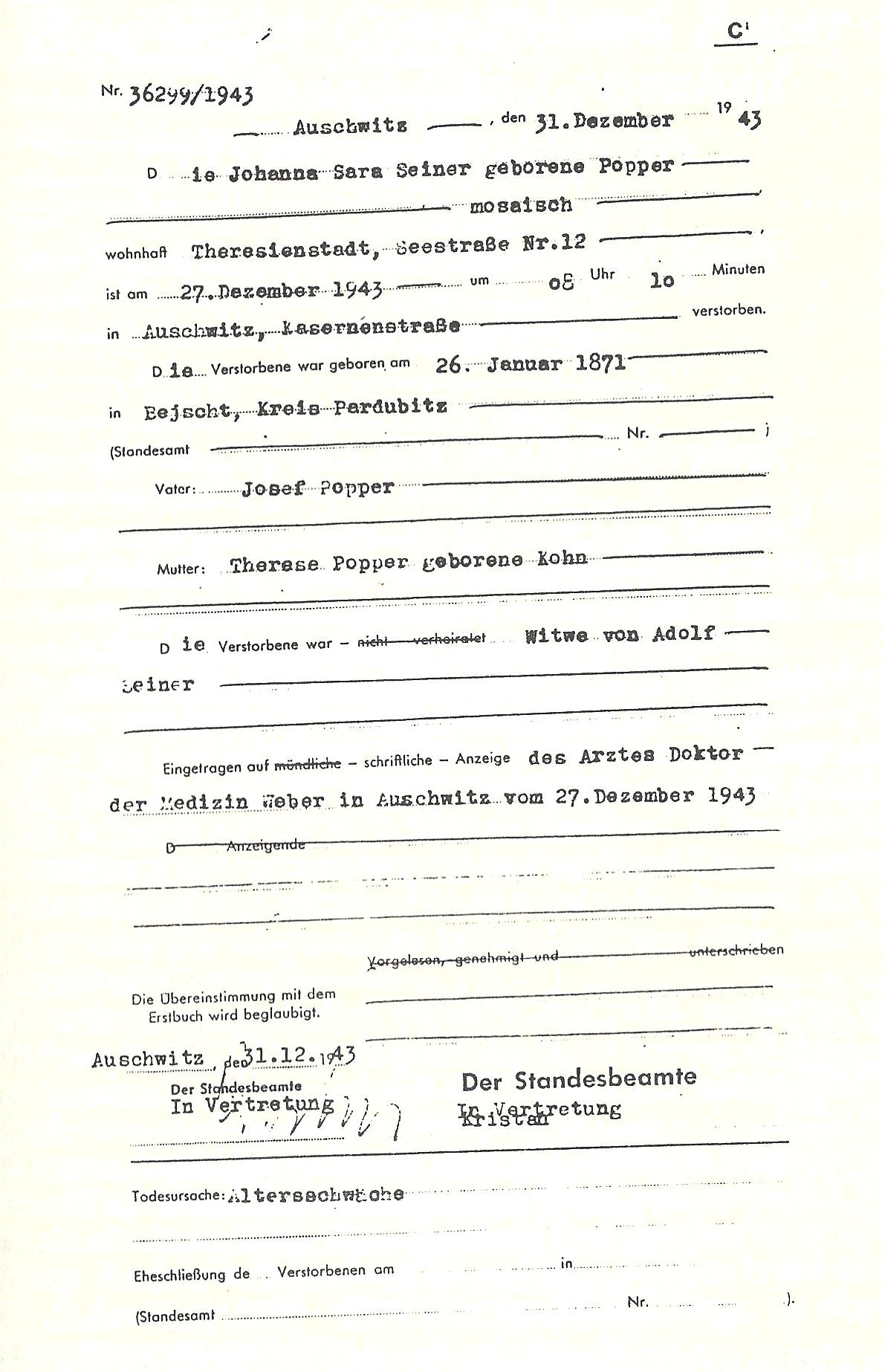
Johanna Seiner, a Jewish inmate who had been deported to Auschwitz from the Theresienstadt ghetto-camp in Bohemia, was 72 years old when she died of “old age” on December 27, 1943.

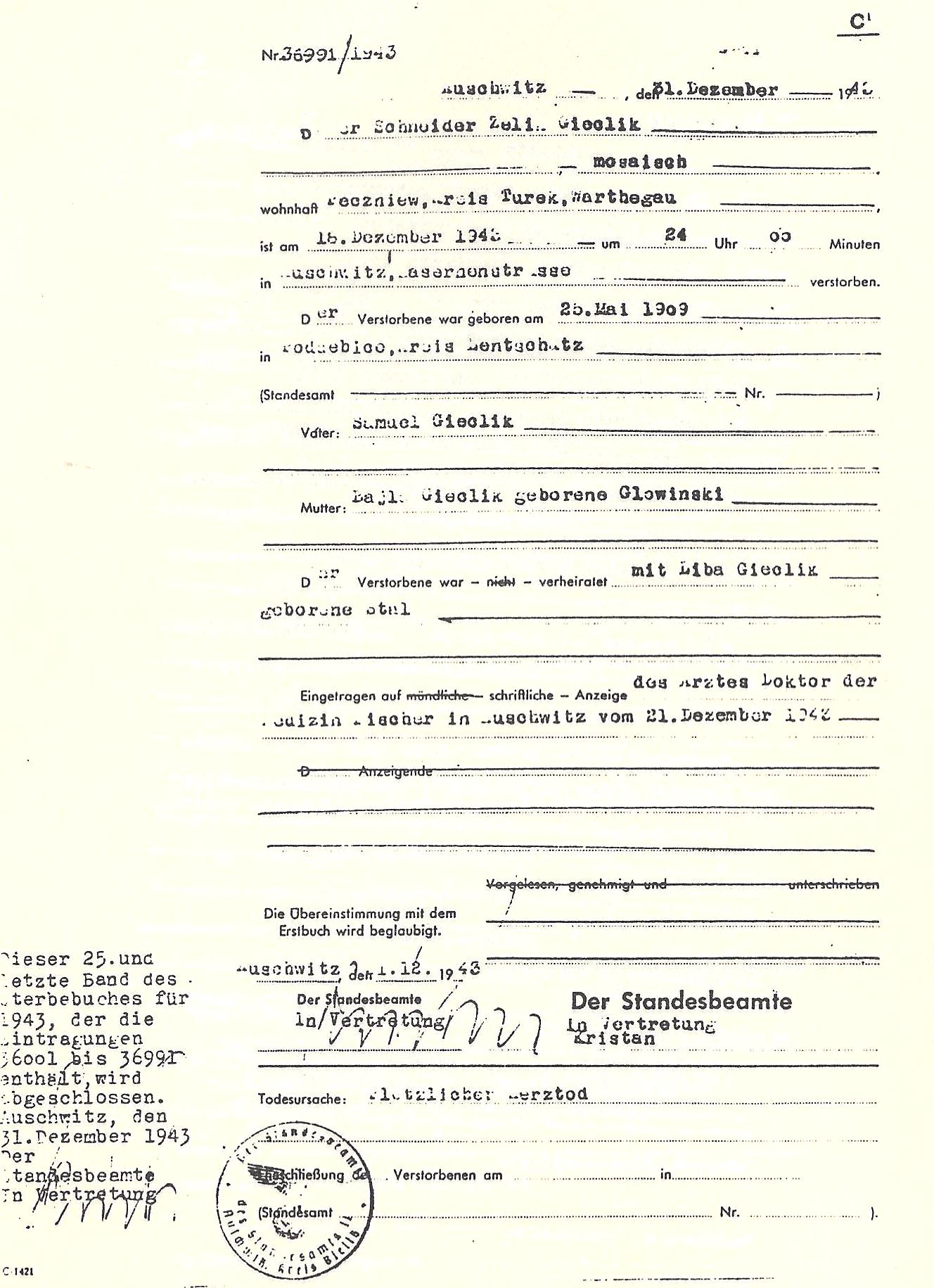
Zeli Gieclik, a Jewish tailor, was 34 when he died on December 12, 1943. Camp physician Dr. Fischer reported “sudden heart failure” as the cause of death. This is the last certificate in death registry volume 25, which is the final volume for the year 1943.


From The Journal of Historical Review, Fall 1992 (Vol. 12, No. 3), pages 265-298.


April 24, 2020 Posted by | Timeless or most popular | | Leave a comment

The bipartisan “small business” swindle: Billions for banks and corporations, pennies for workers and shopkeepers

By Barry Grey  | WSWS | April 23, 2020

Scores of multi-million- and billion-dollar corporations are receiving free handouts from the government under the “small business” relief fund grotesquely misnamed the “Paycheck Protection Program” (PPP). The program was launched last month as part of the $2.2 trillion CARES Act, with $349 billion in taxpayer funds.

Billed as a lifeline to small businesses and their employees, the program has been exposed as a cynical fraud. Multiple reports have emerged showing that it is first and foremost a cash cow for large businesses and the Wall Street banks. It is yet another example of how the corporate-financial elite is exploiting the coronavirus catastrophe to further enrich itself at the expense of society and at the cost of human lives.

The CARES Act was passed with the unanimous support of the Democrats in the Senate—including the votes of Bernie Sanders and Elizabeth Warren—and by voice vote in the House, with no effort by so-called “progressives” such as Democratic Socialists of America members Alexandria Ocasio-Cortez and Rashida Tlaib to stall, let alone defeat, its passage.

While big restaurant chains and other firms whose stock is traded on Wall Street gobbled up large portions of the “small business” relief money, and the major Wall Street banks pocketed $10 billion in loan fees, family-owned restaurants, barber shops, beauty salons, retail stores and other small firms were pushed to the back of the line or denied relief outright.

The program ran out of funds last Thursday, less than two weeks after it was launched, leaving hundreds of thousands of small businesses high and dry and their millions of laid-off employees facing destitution. Now the Trump administration and Congress are rushing to inject an additional $310 billion into the PPP.

On Wednesday, the Senate passed by unanimous consent a new $484 billion bailout bill, whose central component is the renewal of the PPP. At the urging of the Democrats, looking to provide a “progressive” fig leaf to the pro-corporate measure, and with the agreement of Trump, the bill tacked on a totally inadequate $75 billion for hospitals and a derisory $25 billion for COVID-19 testing.

Speaker of the House Nancy Pelosi has announced that the Democratic-controlled chamber will vote on the new bill on Thursday. On Tuesday, she hailed the passage of the bill in the Senate, declaring that the Republicans “have seen the light—and we had a great victory for the American people.”

Among the businesses that have received low-interest PPP loans, which are to be forgiven if the firms use 75 percent of the money to keep their workers employed for eight weeks, are:

  • The Ruth’s Chris steakhouse chain, with some 5,000 employees at over 100 locations in 2019 and $468 million in revenues. It received two PPP loans totaling $20 million. The total compensation for CEO Cheryl J. Henry was $6,105,629 in 2018. The stock price of the chain’s parent company, Ruth’s Hospitality Group, has risen by 112 percent over the past month.
  • The Potbelly Sandwich Shop chain, with around 6,000 employees at 474 locations in 2019 and revenues of $410 million. The company received a PPP loan for $10 million. Total compensation for CEO Alan Johnson in 2018 was $1,668,251. Potbelly stock has risen 70 percent over the past month.
  • The Shake Shack restaurant chain, with some 6,000 workers at 254 locations in the US and internationally and $595 million in revenues in 2019. It received $10 million in PPP loans. Total compensation for CEO Randy Garutti in 2018 was $3,805,410. Shake Shack stock has risen 40 percent over the past month. On Sunday, Shake Shack announced it was returning its PPP loan.
  • The J. Alexander’s restaurant chain, with 2,700 employees at 46 locations in 2019 and $304 million in revenues in 2016, received $15.1 million in PPP loans. Total compensation for CEO Mark Parkey was $591,000 in 2019. J. Alexander’s stock has risen by 2 percent over the past month.

Other large firms that received PPP loans include:

  • The Ohio-based biotech company Athersys, which raised almost $60 million in a stock offering on Monday. Its shares have nearly doubled in 2020.
  • Indiana-based coal operator Hallador Energy, which received $10 million after it laid off 60 workers in March.
  • Data storage company Quantum took $10 million.
  • Nicola Motor, backed by giant hedge funds and asset management firms and valued at $4 billion, received a loan of $4 million.

According to a Financial Times article published on Tuesday, 83 publicly traded companies received a combined $330 million in loans from the PPP program, an average of $4 million each. The combined stock value of these firms at the end of 2019 was $12 billion.

Other published figures show how the program is skewed to big companies. More than 25 percent of the $349 billion in loans went to fewer than two percent of the firms that got relief. And more than one out of every four dollars in the fund went toward big loans of $2 million and above.

Meanwhile, just eight percent of small businesses that have applied for aid under the CARES Act have received money.

JPMorgan Chase, the largest US bank, processed many of the biggest loans and cashed in the most on the program. Only six percent of its smaller customers got PPP loans, 18,000 out of the 300,000 that applied. But nearly all of the 5,500 larger companies that applied for PPP loans, customers of the bank’s commercial banking business, received them.

A class action lawsuit filed Sunday in federal court in Los Angeles alleges that four banks—Wells Fargo, Bank of America, JPMorgan Chase and US Bancorp—rushed loans to the biggest businesses to maximize their earnings. The suit alleges that the banks prioritized larger loans to bigger firms instead of processing applications in the order in which they arrived in order to generate bigger processing fees.

Sections of corporate media, prominent Democrats and even Trump are feigning shock and dismay over the funneling of “small business” loans to big corporations and the banks. On Tuesday, Trump, for fairly obvious political reasons, singled out Harvard University, which received bailout money under a different part of the CARES Act, and demanded that it return its loan.

These statements are utterly fraudulent. One is reminded of Captain Renault’s shock at discovering that gambling was taking place at Rick’s Casino in the film Casablanca.

As the media and both parties were well aware, restaurant and hotel chains, hedge funds and other corporate interests carried out intensive lobbying of their political servants in Congress prior to the passage of the CARES Act. One result was the insertion of a loophole allowing restaurant and hotel chains to evade the much trumpeted provision restricting the PPP loans to businesses with fewer than 500 employees. The bill that was passed on a fully bipartisan basis allows restaurant and hotel chains to receive loans so long as none of their individual units has more than 500 workers.

There is nothing in the measure renewing the PPP passed by the Senate on Wednesday that addresses this free pass for the chains.

Moreover, the law is written so as to facilitate self-dealing and corruption. There is not even a requirement that the federal Small Business Administration (SBA), which oversees the PPP, disclose to the public or to Congress the recipients of the loans.

Even if more small businesses eventually receive money from the program, the jobs of millions of workers will not be preserved, since the loans are designed to cover payroll for only eight weeks. The public health crisis and the economic disaster will last far longer. With no serious aid to the 22 million who have already lost their jobs and the millions more who will follow in the coming days and weeks, thousands of restaurants and other small businesses will go bankrupt and permanently shut their doors.

The response of the ruling classes in the US and around the world to the coronavirus outbreak has demonstrated the utter failure of the capitalist system. In every country, countless thousands of lives are being sacrificed to the insatiable drive of a tiny financial aristocracy for personal wealth, whatever the cost in death and human suffering.

The ruling classes are focused on devising ways to profit off of the pandemic. The absurdly named “Paycheck Protection Program”—an example of Orwellian Newspeak—is a case in point.

But the oligarchs, like the ancien regimes of old, are digging their own graves. Mass anger and opposition is growing by leaps and bounds. Strikes and protests by workers are taking place on virtually every continent. It is this international movement, made conscious of its revolutionary aims and tasks, that offers the way out for humanity from the nightmare of pandemics, poverty and war.

April 24, 2020 Posted by | Deception, Economics | , | Leave a comment

Craig Murray Defence Fund Launched

By Craig Murray | April 24, 2020

I know of four pro-Independence folk who were last week phoned or visited by Police Scotland and threatened with contempt of court proceedings over social media postings they had made weeks back on the Alex Salmond case. Then on Monday, a Scottish journalist I know had his home raided by five policemen, who confiscated (and still have) all his computers and phones. They said they were from the “Alex Salmond team” and investigating his postings on the Alex Salmond case. He has not to date been charged, and his lawyer is advising him at present to say nothing, so I am not revealing his name.

Then on Tuesday morning, a large Police van full of police pulled up onto the pavement right outside my front gate, actually while I was talking on the phone to a senior political figure about the raid on my friend. The police just sat in the van staring at my house. I contacted my lawyers who contacted the Crown Office. The police van pulled away and my lawyers contacted me back to say that the Crown Office had told them I would be charged, or officially “cited”, with Contempt of Court, but they agreed there was no need for a search of my home or to remove my devices, or for vans full of police.

On Thursday two plain clothes police arrived and handed me the indictment. Shortly thereafter, an email arrived from The Times newspaper, saying that the Crown Office had “confirmed” that I had been charged with contempt of court. In the case of my friend whose house was raided, he was contacted by the Daily Record just before the raid even happened!

I am charged with contempt of court and the hearing is on 7 July at the High Court in Edinburgh. The contempt charge falls in two categories:

i) Material published before the trial liable to prejudice a jury
ii) Material published which could assist “jigsaw identification” of the failed accusers.

Plainly neither of these is the true motive of the Crown Office. If they believed that material I published was likely to have prejudiced the jury, then they had an obvious public duty to take action BEFORE the trial – and the indictment shows conclusively they were monitoring my material long before the trial. To leave this action until after the trial which they claim the material was prejudicing, would be a serious act of negligence on their part. It is quite extraordinary to prosecute for it now and not before the trial. … continue

April 24, 2020 Posted by | Civil Liberties | , | Leave a comment

New US Health Spokesman Says Rothschild Family ‘Craves Control’, Blames Soros Over Virus

Sputnik – April 24, 2020

Last week, Michael Caputo, who worked on Donald Trump’s 2016 presidential campaign, was appointed by POTUS as Assistant Secretary for Public Affairs at the US Department of Health and Human Services.

The newly nominated spokesman for US the Department of Health and Human Services (HHS), Michael Caputo, has blamed George Soros and the Rothschild family for trying to exploit the coronavirus pandemic in order to promote their own agendas, according to CNN which managed to uncover more than 1,000 Caputo tweets he deleted before entering office.

In a now-scrapped tweet on 15 March, Caputo, who is infamous for his remarks on social media, responded to self-proclaimed China analyst Jack Prosobiec, who speculated on Twitter why billionaire investor and philanthropist Soros allegedly adheres to his favourite political causes rather anti-COVID-19 efforts.

“Are you kidding? Soros’s political agenda REQUIRES a pandemic”, Caputo claimed, in what was followed by another tweet, in which he posted a Soros photo captioned “The real virus behind everything”, also adding skulls and crossbones.

In a separate tweet last month, Сaputo slammed economist David Rothschild as “an inbred elitist sphincter whose family craves control”, adding, “that’s one reason why he constantly lies about President Trump”.

The economist, thought to be not related to the Rothschild gamily, is known for his fierce criticism of Trump who David Rothschild claims is seeking “to murder” people in a bid to stay in power.

Trump nominated Caputo as Assistant Secretary for Public Affairs at the HHS on 12 April, a decision that was reportedly in part due to POTUS’ frustration over the way department secretary, Alex Azar was dealing with communications during the COVID-19 crisis.

CNN, in turn, reported that ahead of entering office, Caputo had deleted more than 1,300 tweets and retweets on his Twitter page from late February to early April, including those pertaining to the coronavirus. CNN managed to unearth the tweet by using the Internet Archive’s “The Wayback Machine”.

April 24, 2020 Posted by | Aletho News | , | Leave a comment

Why US outsourced bat virus research to Wuhan

By Christina LIN | Asia Times | April 22, 2020

The US National Institutes of Health (NIH) funded bat-coronavirus research in the Wuhan Institute of Virology in China to the tune of US$3.7 million, a recent article in the British newspaper Daily Mail revealed.

Back in October 2014, the US government had placed a federal moratorium on gain-of-function (GOF) research – altering natural pathogens to make them more deadly and infectious – as a result of rising fears about a possible pandemic caused by an accidental or deliberate release of these genetically engineered monster germs.

This was in part due to lab accidents at the US Centers for Disease Control and Prevention (CDC) in July 2014 that raised questions about biosafety at US high-containment labs.

At that time, the CDC had closed two labs and halted some biological shipments in the wake of several incidents in which highly pathogenic microbes were mishandled by US government laboratories: an accidental shipment of live anthrax, the discovery of forgotten live smallpox samples and a newly revealed incident in which a dangerous influenza strain was accidentally shipped from the CDC to another lab.

A CDC internal report described how scientists failed to follow proper procedures to ensure samples were inactivated before they left the lab, and also found “multiple other problems” with operating procedures in the anthrax lab.

As such in October 2014, because of public health concerns, the US government banned all federal funding on efforts to weaponize three viruses – influenza, Middle East respiratory syndrome (MERS) and severe acute respiratory syndrome (SARS).

In the face of a moratorium in the US, Dr Anthony Fauci – the director of the National Institute of Allergy and Infectious Diseases (NIAID) and currently the leading doctor in the US Coronavirus Task Force – outsourced in 2015 the GOF research to China’s Wuhan lab and licensed the lab to continue receiving US government funding.

The Wuhan lab is now at the center of scrutiny for possibly releasing the SARS-CoV-2 coronavirus and causing the global Covid-19 pandemic.

Additionally, the embassy warned that researchers “showed that various SARS-like coronaviruses can interact with ACE2, the human receptor identified for SARS-coronavirus,” meaning bat coronaviruses can be transmitted to humans to cause SARS-like diseases.

Now, the US is up in arms to hold China accountable for the global coronavirus pandemic, filing class-action lawsuits domestically, as well as building a coalition with allies internationally.

Lawsuits have been filed within the US and the International Criminal Court alleging that China used the virus as a bioweapon, and other suits are under way at the International Court of Justice. Republican lawmakers such as Senator Tom Cotton and Representative Dan Crenshaw have also introduced legislation that would allow Americans to sue China in federal court over the deaths and economic damage wrought by the virus.

If evidence is found that Covid-19 is a biological weapon, some pundits such as Fox News host Lou Dobbs have called for the US to declare war on China.

Nonetheless, it is unclear what the legal ramifications would be if the virus was indeed leaked from a Chinese lab, but as a result of a research project that was outsourced and funded by the US government.

Also, if there was a government ban in 2014 on federal funding being used for GOF research, what are the federal compliance and ethical issues surrounding the fact that the NIH still gave federal funding instead of private funding to the Wuhan lab to continue the experiments?

Moreover, could some strains of the coronavirus have originated in US labs, given the fact the US government lifted the ban in December 2017 on GOF research without resolving lab-safety issues?

For now, President Donald Trump’s administration is investigating the $3.7 million in taxpayer money that went to the Wuhan lab, while Republican Representative Matt Gaetz called for an immediate end to NIH funding of Chinese research. Since the federal ban on GOF research has been lifted, US labs can continue creating these monster germs domestically and would no longer need to outsource to China.

Nonetheless, there still needs to be better oversight on the dangerous experiments and regulations over biosecurity of labs.

Currently, the National Science Advisory Board for Biosecurity (NSABB) – a US government interagency panel that advises the NIH’s parent, the US Department of Health and Human Services (HHS) – conducts risk assessment of GOF experiments that pose a significant threat to public health.

The NSABB has given the HHS a framework to assess proposed research that would create pathogens with pandemic potential, such as research on genetically altering a virus to infect more species, or recreating a pathogen that has been eradicated in the wild, such as smallpox.

However, vaccine development and epidemiological surveillance do not automatically trigger an HHS review. In the postmortem of the Covid-19 pandemic, this is likely a dangerous loophole that could be exploited with no oversight, and should probably be brought under HHS review in order to protect public health better in the future.

April 24, 2020 Posted by | Militarism, Timeless or most popular | | Leave a comment

Russia dismisses as ‘baseless’ US claims on IRGC satellite launch

Russian Foreign Ministry Spokeswoman Maria Zakharova
Press TV – April 23, 2020

Russia has dismissed as “baseless” claims by the United States that the recent launch of Iran’s first-ever military satellite by the Islamic Revolution Guards Corps (IRGC) violates a United Nations Security Council resolution endorsing the 2015 nuclear deal between Tehran and world powers.

On Wednesday, the IRGC Aerospace Force launched the Nour (Light) satellite via the Qassed (Carrier) carrier, a move US Secretary of State Mike Pompeo was quick to condemn as a violation of United Nations Security Council Resolution 2231.

“This would not be the first time that a nation that has flagrantly breached the norms of international law and violated UNSC resolution 2231 is trying to deflect international condemnation by baselessly accusing Iran of noncompliance with the requirements of the Security Council,” Russia’s Sputnik news agency quoted Foreign Ministry spokeswoman Maria Zakharova as saying at a briefing on Thursday.

She noted that neither the resolution nor the 2015 Iran nuclear deal restrict Iran’s right to explore space to peaceful ends.

She added that Iran has made it clear that it does not intend to develop nuclear weapons, unlike the US, which has over the past months unveiled several plans to expand its nuclear arsenal.

“There are no, there have never been, and hopefully there will never be nuclear weapons in Iran. Iran, adhering to the resolution, does not develop, test or use ballistic missiles capable of carrying nuclear weapons, unlike the United States, which surprises the world every single day with news about plans to develop their nuclear missile capabilities,” she said.

The remarks came after Pompeo said Iran needed “to be held accountable” for the launch, claiming that the move violated UNSC Resolution 2231.

This is while the resolution in question calls on Iran “not to undertake any activity related to ballistic missiles designed to be capable of delivering nuclear weapons, including launches using such ballistic missile technology.”

The Nour-1 is Iran’s first multi-purpose satellite with application in the defense industry, among other areas. It is also the first Iranian satellite with an expected operational life of more than a year in Earth’s orbit.

April 23, 2020 Posted by | Aletho News | , , | Leave a comment

COVID-19 Superspreader Events: Critical Patterns and Lessons

By Jonathan Kay | Quillette | April 23, 2020

… Of the 54 Superspreader Events (SSEs) for which underlying activities could be identified, only 11 did not involve either religious activity, a party, a funeral, a cruise or extended face-to-face professional networking. But even in this minority of cases, one can observe almost identical interpersonal dynamics. Three of the SSEs—in Japan, Skagit County, WA, and Singapore—involved concert-goers and singing groups belting out tunes together over a period of hours. (The Skagit example is particularly interesting, because the organizers were aware of the COVID-19 risk beforehand, and took the precaution of spacing out the participants by several feet. If they had been merely chatting, instead of singing, no one might have gotten sick.)

Another SSE involved a group of Canadian doctors engaged in a day of recreational curling. This is a sport that involves hyperventilating participants frenetically sweeping the ice with brooms while their faces are positioned inches apart, sometimes changing partners—an ideal climate for Flüggian* infection. Indeed, this partner-swapping aspect of the activity seems to be a common feature of many suspected SSEs, such as square-dancing parties.

Four of the SSEs were outbreaks at meat-processing plants, in which “gut snatchers” and other densely packed workers must communicate with one another amidst the ear-piercing shriek of industrial machinery. I lack the expertise to determine how the refrigerated nature of some meat-processing facilities may affect the dynamics of droplet transmission—though I would also note that at least four of the SSEs on my list unfolded at European ski resorts. But high levels of noise do seem to be a common feature of SSEs, as such environments force conversationalists to speak at extremely close range. (Related factors may be at play in old-age homes. These tend to be quiet places. But the reduced speaking volume and hearing functions of some elderly residents lend themselves to conversations held at much closer range than is socially typical in the general population.)

Finally, three of the SSEs involved mass sports spectacles, during which fans regularly rain saliva in all directions as they communally celebrate or commiserate in response to each turn of fortune. (Advance to the 8:30 mark of this video, showing euphoric hometown fan reaction during the infamous February 19th football match between Atlanta and Valencia, and you will see exactly what I mean.) As we now know, the danger starts even before the action begins: One of the most dangerous things you can do at a sports event in the COVID-19 era is sing the national anthem. … Full article

* As a 1964 report in the Proceedings of the Royal Society of Medicine put it, the quantity of expelled Flügge droplets varies markedly based on the manner of respiration: “Very few, if any… droplets are produced during quiet breathing, but [instead, they] are expelled during activities such as talking, coughing, blowing and sneezing.”

April 23, 2020 Posted by | Timeless or most popular | | Leave a comment

Blair comeback is a terrible idea… unless the UK wants to join a US war on China

By Finian Cunningham | RT | April 23, 2020

For many observing the British government’s fiasco over the Covid-19 pandemic, it is like watching a rerun of the Dad’s Army sitcom. Then enters former PM Tony Blair and the mood quickly horrifies.

Blair, who has been out of office for nearly 13 years, suddenly made a comeback on certain media outlets this week and was treated by his hosts as if he were some kind of political paragon, offering his “sage” advice on how the government should handle the current crisis.

Careful to not sound too arrogant, the unctuous Blair prefaced his remarks as “constructive criticism” but then went on to propose sweeping reorganization of government strategy. The non-governmental “skill sets” that he advised no doubt is a pitch for private consultants like Blair to be contracted to Whitehall.

Understandably, a lot of the public were infuriated that Blair should be treated so royally, including as a guest on the taxpayer-funded BBC, to be fawned over by presenters seeking his presumed wisdom.

Regardless of the present government’s botched handling of the Covid-19 crisis, why is a has-been prime minister being given such a prime platform to lecture. Blair makes his advice sound like technocratic expertise when it’s a blatant bid for rehabilitating his credentials. Reorganizing government departments and civil servants? Many ordinary citizens could define the Covid-19 problem more accurately and simply as chronic underfunding of national health services from years of neoliberal austerity.

But the most galling thing about hearing Tony Blair’s smug and self-aggrandizing tone this week is the insult to basic morality. Blair should be serving time in jail for the war crimes he presided over in launching the US-led war on Iraq. That war left more than a million dead, with millions more wounded and ravaged by poverty. An ancient nation was destroyed, which spawned terrorism across the Middle East, a horrific legacy with which countries are still struggling. Blair was instrumental in launching the US and British war on Iraq and he aided and abetted war in Afghanistan, both of which have piled up the American and Britain’s national debts.

In a very real way, the burden of war debts on the public is a factor in why health services have been underfunded and why when a much-predicted pandemic finally did hit, the US and Britain have been singularly remiss in dealing with. Both are projected to have the worst death tolls in the world from the disease.

To see Blair offering his tuppence worth of crisis management is truly nauseating. That he can be indulged by British media without a hint of shame about his warmongering past really shows how morally and intellectually brain-dead the British political class is. The hypocrisy of such people is that they find fault with other world leaders, from China to Russia, Iran to Venezuela or North Korea, yet here they are sucking up to a man who has the blood of millions on his hands. It just shows the tacit arrogance of British imperialism. Supposedly smart or liberal media-types are oblivious to how shockingly unacceptable it is to have Tony Blair anywhere near the airwaves.

But hold on a cynical moment. Blair might find a new purpose after all. He was the guy who used his rhetorical “skill sets” to sell the war on Iraq to the American and British people, and indeed to the rest of the world. It was Blair and his barrister-like poise that elevated the lies and propaganda of weapons of mass destruction into something with a modicum of gravitas. His American counterpart President G.W. Bush was able to carry off an outrageous act of genocidal aggression largely on the rationale forged by Blair.

Which brings us to the present Covid-19 crisis. President Trump and deranged anti-China hawks in Washington want to turn this pandemic into a lynching of Beijing. “China has blood on its hands,” goes the mantra. “China must pay” for the deaths of Americans and the economic disaster that has fallen on Trump’s otherwise “success story.”

The narrative is building to blame China, which Washington accuses of “misinformation” and “deception” by “covering up” the initial outbreak, thereby leaving other nations vulnerable to the pandemic. This is of course audacious scapegoating by an American ruling class and dysfunctional economic system which betrayed the health needs of millions of Americans.

The propaganda assault underway against China has echoes of the earlier false narrative about weapons of mass destruction in Iraq. It is essentially about pushing claims and dubious “facts” to fit an outcome of conflict. War in the case of Iraq; and financial exploitation of China by making China take the rap for the Covid-19 pandemic. The latter scenario would most likely lead to war too.

What better person for the American agenda of falsifying the pandemic than Tony Blair? If he is rehabilitated into government as a private consultant, one can imagine how his remit will be easily extended to “corroborating” US claims that China is to blame for the pandemic.

If that seems a stretch then why are media presenters still giving Blair the time of day? If they can’t seem to understand how repugnant it is to have someone as vile as Blair on their comfy programs then it shows that anything is possible.

April 23, 2020 Posted by | Economics, Mainstream Media, Warmongering, Timeless or most popular, War Crimes | , , , | Leave a comment

How It All Began: The Belgrade Embassy Bombing

By Peter Lee | China Matters | May 24, 2015

When I was in Beijing during the protests in 1989, a middle-aged man came up to me and asked, “Couldn’t America send some B-52s here and…” and he made a swooping motion with his hand.

Ten years later, on May 7, 1999, the American bombers did show up.

Instead of showering freedom ordnance on China’s dictators, however, they dropped five bombs on the Chinese embassy in Belgrade.

As to why this happened, the United States has always declared it was an accident.

A lot of people in China believe otherwise and there is a good amount of evidence to support their view.

The bombing of the embassy was a wake-up call for the PRC leadership, which decided it urgently needed a doctrine and capabilities beyond its strategic nuclear deterrent to handle disagreements with the United States that might acquire a military dimension.

It was also a propaganda godsend for the regime.

Chinese demonstrators were back on the streets, but protesting against the United States instead of against the PRC regime’s deficiencies in Western democratic values.

Americans and the U.S. media had a hard time getting used to this unfavorable turn in some popular Chinese attitudes away from 1989 democracy-love, blaming the ill-feeling on the suppression of news of President Clinton’s apology.

In the July 2001 China Journal, Peter Hays Gries of Ohio State University analyzed letters and submissions to China’s Guangming Daily and characterized the protests as “genuine and understandable” and largely unrelated to unawareness of the presidential apology.

On the ten-year anniversary of the bombing, China Digital Times linked to an interview with a student who identified the bombing as the trigger for a sea-change in the worldview of at least some Chinese:

What do you believe has changed now in the attitude of young Chinese (like those who protested 10 years ago against the USA) towards America?

Over the past decade, I think the young Chinese have gradually dropped their illusion of the U.S. and begun to view it more objectively.

After reform and opening-up, to be more specific in the 1980s and 1990s, the Chinese people began to know more about the outside world. The prosperity of the west attracted the young people so much that all of a sudden everybody wanted to go abroad. At that time, we had a popular saying, “Moon of the west is even more beautiful than that of China.” Experiencing the sharp contrast between China and the west, many Chinese people became critical of China, perhaps in a cynical way.

However, when the Chinese embassy was bombed, many people began to think: is this the kind of democracy and human rights that we want to pursue?

Post Iraq-war, it is difficult to remember the years when the United States effortlessly claimed the moral high ground. But in 1999, I remember that I also discounted Chinese whinging about the Belgrade embassy accident.

Writing in 2001, Gries provides a reminder:

The demonstrations shocked the US media, which quickly pointed blame at the Chinese government for inflaming the protests. A brief review of major US newspaper editorials of 11 May reveals a consensus view: the Chinese people were not genuinely angry with (innocent) America; they were, rather, manipulated by Communist propaganda that the bombing was intentional… The Washington Post declared: “The Big Lie is alive and well in Beijing”… Such “state-supervised anger”, the Boston Globe declared, was neither genuine nor popular. The “brutes in Beijing” were responsible for the Chinese people’s mistaken belief that the bombing was intentional.

A contentious interview conducted by Jim Lehrer with the Chinese ambassador to the US, Li Zhaoxing, immediately subsequent to the attack, is enlightening for the cognitive dissonance provoked by Li’s refusal to share Lehrer’s confidence that the US would publicly and honestly sort out what was obviously just a regrettable goof. Looking back at the interview through the perspective provided by the shameless mendacity of the Bush administration over the Iraq War, it is Lehrer and not Li who looks delusional and out of touch.

LI ZHAOXING: I’m saying that the Chinese people and the Chinese government are requesting a thorough investigation of the NATO missile attack on our embassy in Yugoslavia.

JIM LEHRER: Yes, sir. But my question is: why would you think that it would not be an accident or a mistake? In other words, why would you think– to repeat my question, why would you think that the United States would intentionally kill Chinese citizens in downtown Belgrade?

LI ZHAOXING: Ask your own people. Ask your own officials. Ask your own experts. If they ask themselves, seriously, honestly, do they really believe that this is simply a kind of mistake?

…

JIM LEHRER: Are you suggesting that that is not the intention of the United States, to do exactly what you– in other words, to conduct a full investigation and hold the people responsible for this?

LI ZHAOXING: We attach more to facts, rather than words. No matter how eloquent one could be.

In addition to his encounter with Jim Lehrer, Li Zhaoxing received further instruction on American attitudes from another, less courtly source.

Gries passes on a report in the Washington Post in which Tom DeLay, the Republican whip in the House of Representatives, revealed to Li his own formula for managing US-PRC relations, one that did not depend on apologies:

I was on Meet the Press… right after the bombing of the Chinese Embassy in Kosovo [he meant Belgrade], and the [Chinese] ambassador was on before me. And if you remember, he’s kind of an obnoxious fellow and he’s screaming and yelling about how bad the Americans were, and I had had it up to about here. So he’s coming off the stage and I’m going onto the stage and I intentionally walked up to him and blocked his way… I grabbed [his] hand and squeezed it as hard as I could and pulled him a kind of little jerk like this and I said: “Don’t take the weakness of this president as the weakness of the American people.” And he looked at me kind of funny, so I pulled him real close, nose to nose, and I repeated it very slowly, and said, “Do-not-take-the-weakness-of this president as the weakness of the American people.”

I expect Li Zhaoxing recalled Mr. DeLay’s solicitude as well as Jim Lehrer’s amazed disbelief when he returned to Beijing to become China’s Minister of Foreign Affairs.

A tentative answer to Jim Lehrer’s query as to why the United States might take the dastardly step of bombing the Chinese embassy can be found in my articles from early 2007 on the Belgrade incident: the persistent rumor that attack was conducted to destroy wreckage of a US stealth fighter shot down over Serbia, which the Milosevic government had delivered to the PRC in gratitude for services rendered (or perhaps traded to the PRC in return for presumably safe and secure radio retransmission facilities from inside the Belgrade embassy for the Serbian military, whose communications network was a focus of NATO strikes).

The story that China might have acquired key Stealth technology from the crash in Yugoslavia acquired a lot of legs after China test-flew its first stealth fighter, the J20, in January 2011, as I wrote in Asia Times.

During the North Atlantic Treaty Organization (NATO) campaign against Serbia in 1999, an American F-117A stealth fighter was shot down. Some wreckage undoubtedly made it into Chinese hands. Slobodan Lekic and Dusan Stojanovic of the Associated Press (AP) reported on January 23:

“At the time, our intelligence reports told of Chinese agents crisscrossing the region where the F-117 disintegrated, buying up parts of the plane from local farmers,” says Admiral Davor Domazet-Loso, Croatia’s military chief of staff during the Kosovo war.

“We believe the Chinese used those materials to gain an insight into secret stealth technologies … and to reverse-engineer them,” Domazet-Loso said in a telephone interview.

A senior Serbian military official confirmed that pieces of the wreckage were removed by souvenir collectors, and that some ended up “in the hands of foreign military attaches”. [2]

The idea that the United States had not taken adequate steps to secure the F-117A wreckage and useful technology may have thereby found its way into enemy hands is apparently rather irksome to the Pentagon.

Elizabeth Bumiller transmitted the US official pushback in the January 26 New York Times article titled “US Doubts ’99 Jet Debris Gave China Stealth Edge”:

[I]t’s hard to imagine that a great deal of applicable and useful information could have been culled from the site,” said an Air Force official, who asked for anonymity because he was not authorized to speak publicly about military intelligence. [3]

Interestingly and perhaps not surprisingly, even as this narrative of PRC military espionage cum trashpicking was advanced, I didn’t see anybody pursue the logical corollary: that acknowledgment that China had possessed Stealth wreckage buttressed the allegation that the US government might have bombed the Chinese embassy in Belgrade in order to destroy the sensitive technology.

In reading my dissection of the Belgrade bombing, its myths and legends, the reader can draw his own conclusions about the context it provides for subsequent US-PRC confrontations and strategies and the attendant media hoopla.

A final prefatory note:

One element that contemporary readers might find hard to swallow is my assertion that the mission that destroyed the Chinese embassy was the only target selected by the CIA.

Well, that’s what George Tenet, Director of the CIA, said. It is a mystery to me why he considered this revelation in any way exculpatory.

From the July 23, 1999 New York Times :

“It was the only target we nominated,” the director, George Tenet, said at a rare public hearing of the House Intelligence Committee.

After the strike on May 7, which killed three Chinese and wounded at least 20 others, the CIA decided it better go back to its usual business of spying, a U.S. official said Thursday. Reeling from its error, the agency almost immediately suspended other preparations it was making to forward additional targets to help NATO.

The Bombing of the Chinese Embassy in Belgrade in 1999

China’s first direct experience with satellite-guided munitions occurred on the night of May 7, 1999, when at least five GPS-guided JDAM bombs slammed into the Chinese embassy in Belgrade, killing three Chinese nationals and wounding 20.

…
The JDAM used in the attack is a very successful and relatively inexpensive concept in ordnance by which dumb bombs are, as it were, sent to college, and equipped with a GPS-corrected guidance system that generates corrective adjustments to movable vanes after the bomb is dropped from a plane, enabling reported accuracy of within 13 meters.

The conventional, though implausible, narrative at the time of the embassy bombing was The Bomb was Smart… But We Goofed!

In testimony before Congress in July 1999, George Tenet explained how they meant to bomb some logistics office of the Yugoslavian army, they used an outdated map, somebody did catch the error but the message didn’t get through, the system broke down, sooooooo sorry.

On October 17, 1999, the Sunday Observer, in cooperation with a Danish paper, Politiken, came out with what would seem to be a blockbuster report: that the United States had deliberately targeted the embassy in order to remove a key rebroadcast station directing the military activities of Slobodan Milosevic’s forces in their struggle to resist NATO forces.

I am embarrassed to admit that my Googling skills haven’t turned up a direct link to the article, but the Observer’s sister publication, the Guardian, ran a story summarizing the article’s conclusions.

As to why the Chinese government dared to take the provocative step of hosting a Yugoslavian military radio facility, the article speculates that Beijing cooperated with Belgrade in order to acquire data on U.S. military capabilities:

Why the Chinese were prepared to help Milosevic is a more murky question. One possible explanation is that the Chinese lack Stealth technology, and the Yugoslavs, having shot down a Stealth fighter in the early days of the air campaign, were in a good position to trade. The Chinese may have calculated that Nato would not dare strike its embassy, but the five-storey building was emptied every night of personnel. Only three people died in the attack, two of whom were, reportedly, not journalists – the official Chinese version – but intelligence officers.

The Chinese military attache, Ven Bo Koy, who was seriously wounded in the attack and is now in hospital in China, told Dusan Janjic, the respected president of Forum for Ethnic Relations in Belgrade, only hours before the attack, that the embassy was monitoring incoming cruise missiles in order to develop counter-measures.

…

According to the Observer, the behind the scenes U.S. attitude to the embassy bombing was: Mission Accomplished.

British, Canadian and French air targeteers rounded on an American colonel on the morning of May 8. Angrily they denounced the “cock-up”. The US colonel was relaxed. “Bullshit,” he replied to the complaints. “That was great targeting … we put three JDAMs down into the (military] attache’s office and took out the exact room we wanted …

This story died the death in the U.S. media (I only saw references to it in the English papers at the time) and, to its everlasting credit, FAIR (Fairness and Accuracy In Reporting) took the matter up.

In an October 22, 1999 article, FAIR wrote:

So far, the reaction in the mainstream U.S. media has been a deafening silence. To date, none of America’s three major network evening news programs has mentioned the Observer’s findings. Neither has the New York Times or USA Today, even though the story was covered by AP, Reuters and other major wires. The Washington Post relegated the story to a 90-word news brief in its “World Briefing” (10/18/99), under the headline “NATO Denies Story on Embassy Bombing.”By contrast, the story appeared in England not only in the Observer and its sister paper, the Guardian (10/17/99), but also in their leading rival, the Times of London, which ran a follow-up article on the official reaction the next day (10/18/99). The Globe and Mail, Canada’s most prestigious paper, ran the full Reuters account prominently in its international section (10/18/99). So did the Times of India, the Sydney Morning Herald and the Irish Times (all 10/18/99). The prominent Danish daily Politiken, which collaborated with the Observer on the investigation, was on strike, but ran the story on its website.

FAIR and its supporters rattled a few media cages, and got dismissive replies from the New York Times and USA Today.

The Times’ Andrew Rosenthal characterized the Observer article as “not terribly well sourced”.

In its rebuttal, FAIR stated:

FAIR contacted journalists at both the Observer and Politiken. According to the Observer’s U.S. correspondent, Ed Vulliamy, its foreign editor, Peter Beaumont, and Politiken reporter Jens Holsoe, their sources included the following:

–A European NATO military officer serving in an operational capacity at the four-star level – a source at the highest possible level within NATO–confirmed three things: (1) That NATO targeted the Chinese embassy deliberately; (2) That the embassy was emitting Yugoslav military radio signals; and (3) That the target was not approved through the normal NATO channels but through a second, “American-only” track.

–A European NATO staff officer at the two-star level in the Defense Intelligence office confirmed the same story.–

Two U.S. sources: A very high-ranking former senior American intelligence official connected to the Balkans – “about as high as you can get,” according to one reporter — confirmed that the embassy was deliberately targeted. A mid-ranking current U.S. military official, also connected to the Balkans, confirmed elements of the story and pointedly refused to deny that the embassy had been bombed deliberately.

–A NATO flight controller based in Naples and a NATO intelligence officer monitoring Yugoslav radio broadcasts from Macedonia each confirmed that NATO’s signals intelligence located Yugoslav military radio signals coming from the Chinese embassy in Belgrade. When they informed their superiors, they were told that the matter would be handled further up in the chain of command. Two weeks later, the embassy was bombed.

–An official at the U.S. National Imagery and Mapping Agency told the reporters that NATO’s official explanation, which involves a faulty map of Belgrade, is a “damned lie.”

Finally, the Times, still coasting on its Pentagon Papers reputation in those halcyon, pre-Judy Miller days, replied to one correspondent:

“There is nothing in the distinguished history of the Times — where reporters have risked their lives, been threatened with jail and indeed gone to jail to protect the public’s right to know things the government does not want to get out — to suggest that we would withhold such a story.”

Hmmm.

…
When weighing the credibility of the Observer report, it is also worth recalling that, by CIA Director Tenet’s own admission, of the 900 targets struck during the Kosovo war, the CIA was responsible for only one targeting package—the bombing that was ostensibly meant to take out an insignificant Yugoslavian paper-shuffling operation and ended up destroying the Chinese embassy’s intelligence directorate instead.

Another investigative report confirmed that, not only was the target selected by the CIA, the entire mission was flown by the United States outside of standard NATO channels (NATO, of course, was the vehicle for European and American intervention in the Kosovo conflict; it was not a U.S.-directed war).

This is not my day for coming up with direct links to original reporting, but I found a posting on Venik’s Aviation of what looks like an accurate transcription of a May 2000 article from Air Forces Monthly, a European publication, detailing the mission.

It delivers the goods on what actually struck the Chinese embassy (not “guided missiles” or “laser guided munitions” as other outlets reported):

In the early hours of May 7, 1999, a USAF B-2 Spirit bomber, escorted by EA-6B defence suppression aircraft and F-15C fighters, dropped three GPS-guided Joint Defence Air Munition (JDAM) bombs on the Chinese Embassy in the Novi Beograd district of Belgrade.

As to how the targeting “error” slipped by NATO:

It should be noted that, in an interview with the author, NATO spokesman Lee McClenny confirmed that the targeting information did not go through JTF NOBLE ANVIL, or any other NATO structure, in contrast to Tennet’s [sic] official public statements. Instead, the co-ordinates were passed directly from the CIA to Whiteman Air Force Base, the home of the 509th Bomb Wing, where it was programmed into the JDAMs. Mr McClenny asserted that the entire process had remained ‘Stateside’, hence the failure of NATO staff to ‘scrub’ the target to check its accuracy, authenticity and location.
…

When asked, the CIA again asserted that the story given by Tennet [sic] to the House Committee was true, but claimed that the targeting information went from the CIA to the Pentagon to be processed. The Pentagon was only prepared to say that “some of the F-117 and B-2 missions were used as ‘national assets’ and therefore did not pass through NATO command structures”, despite the requirement under the NATO charter to clear all missions carried out under NATO auspices with the NATO general council…

We can now bring some more recent, first-hand information to the mix.

China’s Ambassador to Yugoslavia at the time, Pan Zhanlin, has written a Chinese-language memoir entitled My Encounter with War .…

Living in Belgrade during the NATO bombing campaign, Ambassador Pan became something of an expert on precision-bombing tactics, and he reports on the effect of the five bombs in detail:

The first bomb entered the side of the building at an angle near the roof and tore through to the first floor and detonated at a bottom corner at the dormitory, tearing a pit several meters deep. One of the fatalities and many of the injuries occurred here. The second bomb hit the middle of the roof and went through to the first floor auditorium, causing no fatalities but giving Ambassador Zhan food for thought by incinerating his office and melting the frame of his day bed. The third bomb hit the northwest corner and blasted through several floors, killing two people. The fourth bomb came in a window of the half basement, exploded, destroyed the embassy clubhouse and shattered the building’s structural members. The fifth bomb crashed through the roof of the ambassador’s villa. Fortunately for Ambassador Zhan, who was there at the time, it didn’t explode. Since B2s drop their bombs in even numbers to keep the plane balanced, there was speculation that perhaps a sixth bomb had also entered the basement; but it was never found.

…
I leave it to structural engineers and ordnance enthusiasts to assess whether this damage is consistent with an assault of five JDAMs meant to destroy the entire embassy; a surgical strike to take out the military attache’s office; or the aftermath of a dud-studded fiasco.

…
Ambassador Pan is anxious to characterize the American attack as intentional and motivated by pure cussedness: to break the back of the Milosevic regime by demonstrating to its allies that diplomatic support was not only useless but positively dangerous.

He carefully if awkwardly debunks the scenarios that the embassy was bombed because Milosevic was sheltering or visiting there, or that it was rebroadcasting Yugoslav military communications.

No reference is made to any electronic intelligence activities by China that might have provoked the strike.

Concerning the shootdown of the F117, Pan reports that the scuttlebutt in diplomatic circles was that the plane was located using the Czech Tamara anti-stealth system. His informants told him it couldn’t detect the Stealth aircraft, but that the passage of the plane through sensor coverage left a distinctive “hole” in the CRT display. The Yugoslavs noticed this anomaly and used it to unleash a barrage of 30 SAM missiles at the place where they guessed that the fighter would be, bringing it down.

…
There is a third possibility, in addition to the rebroadcast and Elint scenarios: the F-117 wreckage story.

And it has a radically different outcome.

The Chinese Internet is rife with urban legends concerning the Belgrade strike. Nobody regards it as accidental, and many Chinese seem willing to ascribe all sorts of shenanigans to the Chinese embassy that provoked the attack.

The most interesting scenario is one that the poster attributes to “a private encounter with a Chinese naval officer who was slightly tipsy”.

According to this informant, the Yugoslavian government had recovered the wreckage of the shot-down F-117 and sold key pieces of it to China. The navigation system, fuselage fragments with the Stealth coating, and high temperature nozzle components of the engine were spirited into the basement of the Chinese embassy. Unfortunately, there was a locator beacon inside the INU powered by a battery and, before the Chinese could discover and disable it, the U.S. military was alerted to the location of the F-117 fragments.

In this version of the story, at least, there is a happy ending for the Chinese. The U.S. attacked the embassy with a laser-guided bomb meant to penetrate to the basement and destroy the embassy and the F-117 prize, but it didn’t explode!

The wreckage made it to China (in the special plane Beijing dispatched to carry home the survivors and the bodies of the victims of the attack, according to other accounts).

In the reported words of the officer (“who spoke with tears in his eyes”):

“Although some of our people sacrificed their lives, we gained no less than ten years in the development of our Stealth materials. We purchased this progress with our blood and international mortification.”

“虽然我们有人牺牲了,但是我们隐型材料的研制进度一下提高了十年都不止,这种进步,是以血和国际上的屈辱换来的”–他流泪

This is an interesting story.

In certain respects—the laser-guided part and the basement stash—it conflicts with more credible reports.

The embassy’s sub-basement, which served as an all purpose cafeteria, recreation center, and bomb shelter—an unlikely hidey hole for F-117 parts–was hit once, possibly twice, and it seems unlikely that anything could have been recovered from there.

But conspiracy theorists can draw solace from Ambassador Pan’s description of the four cases of “important state materials” that two brave embassy workers ran up to the fifth floor of the burning embassy to extract. Pan stated:

他们知道,这东西比生命更重要

“They knew these materials were more important than life.”

Standard-issue cypher equipment and secret files?

Special Elint monitoring equipment?

Or the crown jewels of America’s Stealth program?

I lean toward the third explanation, because glomming onto some secret airplane parts and then sneaking them out of a burning building is the kind of low tech triumph that fits in with my sense of China’s capabilities and interests inside Yugoslavia at the time.

The United States may have felt that by purchasing the wreckage, China had crossed the line from diplomatic support for Milosevic and conventional military-attache espionage to a more overt intelligence alliance with Yugoslavia in a deeply sensitive area of U.S. military technology, and needed to be taught a lesson.

I also wish to explore a pyschological element, which perhaps affects China’s outlook to this day.

You can see hints of it in the F 117 in the basement story. It has a touching, almost child-like wish-fulfillment element: the evil empire destroyed our embassy but we escaped with the plans to the Death Star!

The embassy bombing was quite traumatic to China.

However, when the attack occurred, triggering official and popular anger within China, the West was disbelieving, dismissive—and defensive.

It was considered rather churlish of the Chinese to intrude their crude and manufactured nationalistic outrage into our “good war” narrative of the Kosovo conflict by trying to make political capital out of our honest mistake.

…

Today, with further information on the attack and the benefit of perspective, it is difficult to dismiss the shock the Belgrade bombing inflicted on the Chinese.

Post 9/11, Ambassador Pan’s description of the attack is depressing familiar, and more difficult to disregard.

Pan’s plodding prose reawakens dark memories of our own as he conveys the shock and fear as the embassy explodes into flames, “the loudest sound I ever heard”. Survivors found the stairwells blocked by rubble and fire and desperately improvised escapes down the exterior of the building using knotted drapes. Pan saw his friends and colleagues stagger from the ruins of the embassy dazed and bloody, crying out for help.

Amid the chaos everybody ducked in fear of a follow-up attack as NATO bombers thundered overhead (May 7 was one of the busiest nights for aerial bombing). Then came the frantic ad hoc attempts to rally the survivors, account for the living, and search for the missing.

First responders were at first unable to enter the compound because the electric gate was disabled when the bombing cut the power; ambulances race up to the shattered structure with sirens howling to rush away the injured willy-nilly; embassy staffers mounted a frantic search through the local hospitals for the injured.

Finally, there was the extraction of the dead, consoling of the wounded; the grieving; and the defiant patriotic oration.

Again viewed through a post-9/11 lens, Pan’s account also paints a picture of a privileged elite that has been stripped of the illusion that it is immune to attack, and realizing with anger, shame, and disgust that at that moment it is helpless, vulnerable, and unable to retaliate.

Regardless of U.S. motives for bombing the Belgrade embassy or what treasures of military intelligence the Chinese were able to save from the wreckage, if anything was needed to focus Chinese attention on its vulnerability to US attack, getting its embassy, intelligence directorate, and military attache blown up in Belgrade probably did it.

/plee/why-china-hates-satellite-guided-munitions-part-1-the-bombing-of-the-chinese-embassy-in-belgrade-in-1999/

Wednesday, January 31, 2007

The Belgrade Bombing, the F-117 Cake, and the Tears of Premier Zhu Rongji

In a previous post I explored the possibility that the U.S. bombing of the Chinese embassy in Belgrade in 1999 was intentional, with at least the partial objective of destroying wreckage of an F-117A Night Hawk Stealth fighter that Yugoslavia had shot down a few weeks previously.

I am indebted to Dr. Jeffrey Lewis for forwarding some news reports in which the fate of the wreck is discussed.

In 2001 (Fulghum & Wall, Russia Admits Testing F-117 Lost in Yugoslavia, Aviation Week & Space Technology, October 8, 2001), the Russian government acknowledged they had obtained access to F 117A wreckage and stated they used it primarily to improve the anti-Stealth performance of their anti-aircraft missiles.

In the hearsay department, an article in the September 27, 1999 issue of Aviation Week and Space Technology (ed. Bruce D. Nordwall, Earthly Remains) reported, “a Russian official said that some parts had made their way to Moscow, but that the bulk of the airframe was shipped to China.”, a claim that “Pentagon analysts” dismissed “because “China… doesn’t have the industrial capability to benefit from either the design or the systems.”

Contra the Pentagon analysts, simply because China’s Stealth programs were in their infancy at the time doesn’t mean that in 1999 China would not yearn for such a cool and potentially useful trophy as fragments of an American Stealth fighter.

As is now known, Yugoslavians did not turn the entire wreck over to the Russians.

Portions are on display in the Yugoslav Museum of Aviation today and I came across an unconfirmed traveler’s tale that tourists can even purchase souvenir fragments at the museum.

As to what could have been divvied up with the Chinese, the advanced targeting, sensor, and communications systems that the Russians were purportedly interested in neatly dovetail with the reported Chinese take of INU, engine nozzle, and fuselage chunks.

It certainly is plausible that the Yugoslavian government would seek to extract as much propaganda, financial, military, and geopolitical advantage as possible from the F-117A carcass, selling the biggest piece to the Russian Federation but also sharing a few juicy scraps with the PRC, the junior partner in the de facto anti-NATO alliance.

As to whether or not the United States would deem it necessary or desirable to bomb the Chinese embassy to flinders in order to destroy the F-117A wreckage, the Clinton administration suffered a certain amount of criticism for not bombing the wreckage in the wheat field where the plane had fallen in order to deny it to other unfriendly parties.

Analyzing the experiences of the Kosovo conflict, RAND opined:

Heated arguments arose in Washington and elsewhere in the immediate aftermath of the shootdown over whether USEUCOM had erred in not aggressively having sought to destroy the wreckage of the downed F 117 in order to keep its valuable stealth technology out of unfriendly hands and eliminate its propaganda value…Said a former commander of Tactical Air Command…”I’m surprised we didn’t bomb it because the standard operating procedure has always been that when you lose something of real or perceived value—in this case, real technology, stealth—you destroy it.”…Reports indicated that military officials had at first considered destroying the wreckage but opted in the end not to follow through with the attempt because they could not have located it quickly enough to attack it before it was surrounded by civilians and the media.

It’s also interesting to note that the stated reason for not ordering an attack on the crash site was that it was overrun not only with Yugoslavian military types but also local rubberneckers and international journalists.

Instead of obliterating a white, Western audience the Clinton administration might have turned to a measure it had employed in the past, after the USS Cole bombing, when it faced criticism for being insufficiently martial and excessively dilatory: knocking down a Third World asset, in this case the Chinese embassy instead of a Sudanese pharmaceutical plant.

Maybe the U.S. honestly believed that there was some top secret stuff in the Chinese embassy, or maybe the Clinton administration was eager to forestall G.O.P. criticism of its handling of the F-117A shootdown and decided to respond with a showy if meaningless foray against an adversary that was proving somewhat nettlesome, but was chosen because it was vulnerable and unlikely to retaliate.

As an object lesson in the perils of military and geopolitical weakness, the Chinese probably paid some attention to the fact that somehow it was their embassy, and not that of Serbian ally Numero Uno and Most Plausible and Afterwards Officially Certified F-117 Wreckage Holder, a.k.a. the Russian Federation, that got bombed.

For whatever reason—scientific countermeasures, espionage, or design flaws–it transpired that the F-117 was not as stealthy as the United States had consistently professed. In the aftermath of the Kosovo conflict, the Yugoslavians contended that its radar signature was only reduced by 50%. Chinese scuttlebutt claimed that the United States withdrew F-117s from South Korea because it was believed they could not effectively evade Chinese detection measures.

In any case, the Air Force is doing its best to consign the F-117 to the boneyard before the service life it originally promised to the U.S. Congress for this aircraft has expired, and replace it with the F22A Raptor.

My intention is not to evangelize the idea that there was F-117 wreckage in the basement of the Chinese embassy. Somebody in China knows what was really in the embassy, and I suppose one of these days they’ll go public and we’ll find out.

As the F-117 and its secrets fade into oblivion, what is worthy of further mulling over is the role that the Belgrade bombing seems to play as the creation myth of the birth of the 21st Chinese strategic military doctrine, founded on the assumption that the U.S. will unscrupulously use its military, diplomatic, and propaganda advantages not only to contain China but even to attack it when need, desire, and circumstances permit.

In this context, the Belgrade embassy is holy ground, and there are as many versions of the Truth as there are books in the Bible.

The recollections of China’s ambassador Pan Zhanlin, imbue a certain incident after the bombing with a heroic and close to mythic character.

The two comrades in charge of the embassy’s important assets were Little Wang and Little Zheng. One slept in the duty office on the fifth floor, one slept in the dormitory on the fourth floor. Little Wang pierced through the dust and smoke and by the light of the flames descended from the fifth floor to the fourth floor. At this time, Little Zheng emerged from the bedroom. Little Wang grabbed hold of Little Zheng and ran back upstairs. Little Zheng had already been injured and his face was flecked with blood. People who ran into them urgently asked: “Why are you going back up?” Little Wang replied: “There is something that needs doing. This is our job.” They picked up four cases of national important assets and battled through smoke and pierced through flames to get downstairs. The stairwell was cut off, they stumbled down to the third floor. Ahead of time, the embassy had made various preparations for an emergency, so these four cases of important things had already been prepared. If any untoward event had occurred, they could be picked up and moved immediately. They knew, these things were more important than life.

负责使馆重要资财的两位同志,小王和小郑,一个睡在五层的值班室,一个睡在四层的宿舍。小王透过烟尘,借助火光,从 五楼下到四楼。这时,小郑正从寝室出来。小王一把拉住小郑往楼上跑。小郑已经受伤,脸上淌着血。有人这时遇到他们,急忙问:“你们为什么还往上跑?”小王 回答说:“有事,咱们是干这一行的。”他们从五层拿起四箱国家重要资财,冒烟突火往下走。楼梯被阻断,他们跌跌撞撞地来到三楼。使馆事先做了各种应急准 备,这四箱重要的东西事先已准备好。一旦发生意外情况,可以拿起来立即转移。他们知道,这东西比生命更重要。

…
The active imagination of the reader is left to fill in the blanks.

On the Chinese Internet, there has been considerable speculation as to the nature of the intelligence coup that could have provoked the U.S. bombing.

In addition to F-117A parts, there are assertions that the Chinese embassy also had a Tomahawk cruise missile in the basement.

Some posters claim that the only piece of U.S. hardware that China was able to extract and ship back to Beijing was a dud JDAM dropped during the attack—a scenario that Pan contemptuously dismisses, and which seems completely unlikely given the wartime chaos surrounding the attack.

There was a dud JDAM, but it took a lengthy, delicate, and expensive excavation process in 2004 to extract it from where it had buried itself deep beneath the Chinese embassy.

There are darker versions, which imply the only harvest China reaped from the Yugoslavian war was a planeful of corpses.

The story is that at the onset of the Kosovo conflict, a thirty or so Chinese radar and materials specialists boarded an unmarked 737 plane to assist the Yugoslavian government in using multi-location radar to detect Stealth aircraft. After the F-117A was shot down, the U.S. government learned that China was supposed to receive F-117A wreckage for study and ordered the attack. After the embassy bombing a similar, unmarked plane returned to China and discharged its cargo of coffins. Depending on the poster, the airport at which this melancholy scene was acted out was either at Lanzhou or at Beijing’s Nanyuan military airport.
….

Global Views, a Chinese magazine, posted an interesting article (Global Views website hopeless; article posted on a Chinese bulletin board; written in 2006 according to internal evidence) containing interviews with several of the Yugoslavian officers involved in the shootdown, which confirms and amplifies the story that NATO Commander Wesley Clark was told.

1960s tube amplifier enthusiasts will be thrilled to learn that the Yugoslavian air force attributes the shootdown of the F117A to P-12 type vacuum tube-technology Russian radars so old the U.S. considered them obsolete.

According to their account, the F117A Stealth fighter was detectable by antique radar operating at wavelengths of 2 meters—a detail that had supposedly escaped the Stealth designers, who operated on the assumption that the plane would only have to be invisible to modern centimeter and millimeter wavelength radars.

On the evening of March 27, Yugoslavia’s anti-aircraft defenses detected an aircraft entering Yugoslavian airspace at a distance of 80 km. The radar was immediately shut off, since U.S. planes were armed with radar seeking missiles that would fire automatically within 20 seconds and track the signal to its source and destroy it. The Yugoslavian anti-aircraft crews had been rigorously trained to either acquire and fire on a target or turn off their radio within this 20-second window. The radar was switched on when the target was about 15 km away and a barrage of SA-2 SAM missiles were fired manually. The F117A fell to earth. Witnesses said, “It looked like a sparrow shot from the sky.”

The shootdown raised an important tactical and strategic issue for NATO. Bad weather had limited helicopter operations and the U.S. was relying on high-altitude bombing to advance its war objectives. Therefore, a great deal of attention was paid to identifying and disabling Yugoslavia’s anti-aircraft facilities.

The Global Vision article reports that the headquarters of the 126 Mid-Air Detection and Anti-Aircraft Battalion—which had detected the plane—was attacked 11 times, each time with 5 JDAM bombs. The 250th Battalion—which fired the offending SAMs–was attacked 22 times.

The Yugoslav asserts that the 3rd Brigade of the 250th Battalion, whose missiles actually brought down the plane, suffered no fatalities or casualties during the war, leading them to brag: “We’re the real Stealth”.

The F-117A shootdown provided a psychological boost to the Yugoslavs which lives on to this day.

Every year on March 27 the 250th Battalion, now part of the Serbian Air Force, holds a raucous party. The main event occurs when a large cake bedecked with candles is rolled out. On the top is a rendering of an F-117A Nighthawk in chocolate. At precisely 8:42 pm, the exact time of the shootdown, the first slice is cut—through the port wing, which is the one severed by the SAM barrage.

…
On the other hand, the U.S. was dismayed by the loss of its aircraft.

The RAND report states:

[The downing] meant not merely the loss of a key U.S. combat aircraft but the dimming of the F-117’s former aura of invincibility, which for years had been of incalculable psychological value to the United States.

For psychologists, anthropologists, and sociologists as well as political scientists, I think a fruitful field would be the study of compensatory psychological mechanisms of weaker countries that have endured American military attack.

As I’ve noted above, we don’t know if the Chinese were able to extract any intelligence treasures from the embassy, or even if the embassy was actually attacked on purpose, for that matter.

What we do know is that the embassy attack excited fears of anger and impotence within the Chinese elite, because they could not prevent or deter the attack, defend against the attack, or retaliate after the attack.

On the psychological level, the Chinese coped with the bombing both by venting their outrage and by fixating on theories that China was able to claim a victory by extracting something of enormous value—F 117-A parts, a Tomahawk missile, a JDAM—that mitigated the blow and “saved China ten years” in its military development.

The Shenyang poster writes:

Upon learning the this genuine picture, I believe that the U.S. attack on our embassy came from the fact that China’s accurate reporting of the Yugoslavia war provoked America to anger and retribution. At the very least we can say that China’s strength really was incapable of hindering America’s risky move. Now we know, and it causes us to appreciate even more profoundly that a nation, when it is poor and weak, is without recourse and pitiful (How helpless and evoking bitterness in people’s hearts were the tears of Premier Zhu Rongji as he wept at the airfield when the remains of the martyrs were transported back to China).

在 知道这个真相之前我只是认为美国轰炸我们使馆是处于中国对南战的真实报道激怒了美国而招致其报复,那至少说明了我们中国实力真的没到可以阻击美国冒险的地 步,现在知道了,然而使我更深刻的领会到一个国家在批贫弱时的命运是多么的无奈与悲哀(株容基总理在烈士遗体运回国内的机场上的眼泪是多么的无奈与令人心 酸)!

I might add that Zhu Rongji, while not a hard-case sociopath like some members of the CCP leadership, is no cupcake. As Premier he projected a tough git’er done persona that would make an emotional expression like crying at the airport a memorable and significant image.

On a more practical level… well, I’ll let the Shenyang poster describe the consequences for military planners—and military contractors—both in China and the United States.

Detailing a litany of high-tech armaments from fighters to cruisers to nuclear submarines funded with a RMB 50 billion allocation, he concludes:

Afterwards we learned that after the bombing China engaged in deep reflection and understood reality more clearly… all of these [developments] transmit this single message to the world—China yearns to be strong and great!

后来我知道了在那次事件之后中国从心底进行了反思,对现实的认识更清楚了……,都象世界传达了这样一个消息--中国渴望强大!

http://chinamatters.blogspot.com/2007/01/belgrade-bombing-f-117-cake-and-tears.html

April 23, 2020 Posted by | Deception, Timeless or most popular, War Crimes | , , , | Leave a comment

‘Imminent’ 9.0 Earthquake, 30M Tsunami Could Wreck Fukushima, Government Panel Says

Sputnik – 23.04.2020

A specially set up working group has been projecting the possible repercussions of new probable natural disasters off Japan’s coastline and drawing up measures to prevent them.

A Japanese government panel has warned that a tsunami as high as 30 metres could land on Hokkaido if a 9.0-magnitude earthquake occurs, the Japanese newspaper Mainichi Shimbun reported.

The panel, set up by the Cabinet Office, said it is the “worst-case scenario”, admitting that it is difficult to calculate the probability of such a quake. The panel pointed out that such disasters occur every 300-400 years, with the latest one dating back to the 17th century.

An earthquake is portrayed as imminent in the area around the Japan Trench and the Kuril Trench, following a panel studying simulations of tsunamis that occurred over the past 6,000 years and covered seven prefectures including Hokkaido, Iwate, Miyagi, Fukushima, Ibarak, Aomori, and Chiba.

The working group concluded that Iwate might have to bear the brunt of a tsunami of around 29.7 metres, followed by Hokkaido which will potentially be hit by 27.9-metre waves.

The worrisome predictions and media reports have meanwhile stoked concerns that a massive tsunami may wreck the Fukushima nuclear station, which its operator TEPCO has been cleaning up from toxic waste ever since the 2011 tsunami.

For instance, according to the Japanese broadcaster NHK, a Japanese government study projected that a tsunami with waves as high as 13.7 metres could sweep away the 11-metre high seawall built by TEPCO on the ocean side of the compound of the Fukushima Daichi plant. The out-of-service plant reportedly stores around 1,000 tanks of wastewater in one of its compounds.

In response, TEPCO announced, as cited by Reuters, that the company is set to dig into the latest prognosis and “analyse the impact on the ongoing preventive measures” against natural disasters.

April 23, 2020 Posted by | Environmentalism, Nuclear Power | | Leave a comment

US main stumbling block to Iraq’s possession of advanced air defense systems: Lawmaker

Press TV – April 23, 2020

A member of the Iraqi parliament’s security and defense committee has blamed the United States for opposing Baghdad’s acquisition of sophisticated air defense missile systems to protect its airspace against any possible act of aggression.

“Since 2014, Americans have acted as the major stumbling block to Iraq’s procurement of an advanced air defense system. Repeated attempts to sign contracts with a number of countries, including Russia, have been unsuccessful because of Washington’s interference,” Kata’ al-Rikabi told Arabic-language al-Maalomah news agency in an exclusive interview on Wednesday night.

Rikabi added, “Americans installed Patriot [missile] systems in Ain al-Assad [air base] and other bases, where their forces are currently deployed in violation of [Iraq’s] national sovereignty and without the approval of the government. The presence of foreign forces [on Iraqi soil] is indeed an act of aggression, let alone the establishment of bases and deployment of systems and military hardware.”

Last week, the Iraqi parliament’s security and defense committee submitted an in-depth study to the country’s caretaker prime minister Adel Abdul-Mahdi, requesting the procurement of the Russian-built long-range, surface-to-air S-400 missile defense system.

“The committee has presented a comprehensive study to the prime minister, demanding approval for the purchase of the advanced S-400 air defense system. The issue has already been discussed with relevant figures at the General Command of Armed Forces, and now awaits the premier’s agreement,” Badr al-Ziyadi, a member of the committee, told Arabic-language al-Sabaah newspaper on April 18.

He emphasized that the purchase of the S-400 missile system, with the aim of boosting the country’s defense capabilities, will be finalized once the next Iraqi government is formed and it ratifies procurement of the system.

The United States has already warned Iraq of the consequences of extending military cooperation with Russia, and striking deals to purchase advanced weaponry, particularly S-400 missile systems.

Former US State Department spokeswoman Heather Nauert said on February 22, 2018 that Washington has contacted many countries, including Iraq, to explain the significance of the Countering America’s Adversaries Through Sanctions Act (CAATSA), and possible consequences that would arise in the wake of defense agreements with Moscow.

On August 2, 2017, US President Donald Trump signed into law the CAATSA that imposed sanctions on Iran, North Korea, and Russia.

April 23, 2020 Posted by | Illegal Occupation | , | Leave a comment