The real ISIS

By Muhammad Jamil | MEMO | October 19, 2025
The people of Gaza Strip lived through two years of an unprecedented genocide in the history of warfare, leaving more than seventy thousand dead, tens of thousands more wounded and mutilated, and the territory itself reduced to rubble. Amid this devastation, a few conscienceless individuals emerged. They were collaborators who assisted the occupier in killing, looting, and abduction. They were also war profiteers whose crimes were no less vile, hoarding essential goods and extorting the starving with outrageous prices.
History, whether ancient or modern, shows that when wars end, the enemy swiftly abandons his agents to their fate. That is exactly what Israel did in the first minutes of the ceasefire, just as it did to the South Lebanon Army (LAHD) when it pulled out of southern Lebanon in 2000.
There were, by all accounts, only a few hundred collaborators and profiteers. Despite the magnitude of their crimes, retribution in Gaza was limited, that after field trials, a handful of those directly implicated in killings were executed. There was no sweeping revenge, but rather patience and dignity, which prevailed over the pain.
This is not to justify summary executions but to explain the extraordinary circumstances of a shattered society emerging from unprecedented destruction, where emotions run high and restraint is hard to find. By comparison, the European purge after the Second World War, what the French called the “épuration sauvage “, saw thousands killed without trial. Women accused of “horizontal collaboration” with German soldiers had their heads shaved and were publicly humiliated.
Wars always rupture the social fabric, where the occupier targets the communal web to achieve military ends. Gaza is not unique in this; its unprecedented unity during the two years of genocide made it a particular target. Israel used every devious method to tear it apart, spreading rumours, forming gangs through bribery or intimidation, even calling entire families, clan elders and sheikhs to demand collaboration under threat of bombing their homes.
On 27 September 2025, for example, Israeli intelligence phoned members of the Bakr family in the Shati camp in western Gaza, promising safety if they would form a militia modelled on the Abu Shabab gang in Rafah. The family refused; at dawn their houses were struck, killing nine people, including women and children.
Western newspapers and bulletins seized on the single field executions and raids on collaborators to revive the narrative Israel launched at the start of its onslaught which claimed that “These are the ISIS-like extremists we warned you about; what happened proves our story.” In the midst of a humanitarian catastrophe, this single episode was what interested them. Rather than pushing to enter Gaza after two years of being barred and seeing the destruction with their own eyes, they returned to their usual role of hijacking the truth to smear the victims.
Their hypocrisy and obsession with demonising Gaza’s residents in order to portray the occupation and its collaborators as “innocents” blinded them from seeing the tonnes of explosives that turned Gaza to ash, to the tens of thousands killed and wounded, the displaced and the hungry. They focused on a single incident because it could be made to echo the videos of ISIS beheadings and executions in Iraq and Syria that once shocked the world.
The Arab normalisation platforms, newspapers, and TV channels, which from the very beginning promoted and supported the occupation’s narrative, were the most eager to portray the event as an “ISIS-like” act, fuelling the fire of sedition and inciting the population to internal conflict. What is striking is that these outlets hosted tribal leaders and elders from the Gaza Strip on their programs, assuming they would go along with their narrative that labeled the criminals as “opposition” and innocent civilians. Instead, those leaders shattered and refuted the narrative, explaining the danger of these gangs and the crimes they had committed.
They ignored the real ISIS-like elements within the occupation army who proudly filmed themselves blowing up whole residential blocks, while arresting hundreds and stuffing them into stadiums and open pits, then transferring them to prisons to disappear them forcibly. After some were released, especially following the recent agreement, these people told horrifying stories of torture, some leaving permanent disabilities and some dying in cold-blooded field executions. We saw the bodies handed over by the occupier showing signs of brutal torture, ropes tied around their necks, and in some cases their organs had been stolen.
The bitter truth is that we find ourselves forced to highlight certain scenes of the massacre to prove that these are the true ISIS, even their masters, in order to counter the false propaganda. It has become lodged in people’s minds that killing by slitting throats with a knife or shooting at point-blank range is what is called “cold-blooded” murder, an unforgivable crime. But what about killing by bombing for two years, collectively striking entire residential blocks so that women and children are killed, their bodies torn apart and burned? Is that “hot-blooded” killing? Is what matters the way of killing not the outcome?
Damn the propaganda that planted in the minds of the gullible the idea that one act is different from the other. Whoever is psychologically prepared to drop tons of bombs on civilians, killing women and children and destroying homes, schools and hospitals, is no different from someone who uses a knife or a rifle to kill. Both actions express the same criminal intent, equally willing to kill by bombing, shooting or slaughtering.
The real surprise came from Trump’s statements, which silenced everyone. He expressed his satisfaction with what had happened, saying that he was the one who had allowed it to confront “dangerous gangs,” adding that he “did not find it particularly troubling.” He further noted that the situation reminded him of what had happened in other countries, such as Venezuela, where the United States had dealt with Venezuelan gangs, some of whom were sent to America, in the same manner.
In all cases, field executions are unacceptable under any circumstances. Every accused person must be granted a fair trial in accordance with the requirements of the law, no matter how grave their offense. Emotions and anger must not take control when dealing with those who have harmed society, whether in times of peace or war.
Discipline and adherence to the rule of law are what distinguish law enforcement officers from criminals and present a bright image of society as civilized and cohesive, unshaken by the actions of such individuals.
Finally, as a tribute to the great sacrifices made by the Palestinian people throughout two years of extermination, we must avoid any actions that can be used to falsify reality, awareness or distort the truth. We want the story of sacrifice and heroism during the extermination to be told without any blemish in a manner that expresses the brutality of the occupation and of everyone who collaborated or conspired with it.
Turkey prepares its historic turn: from NATO sentinel to Eurasian protagonist
By Lucas Leiroz | Strategic Culture Foundation | October 19, 2025
For decades, Turkey was considered a pillar of NATO’s eastern flank — a key piece on the chessboard of containing Russia. Since joining the alliance in 1952, the country has played a dual role: on one hand, a strategic partner of the West; on the other, a regional power with ambitions of its own. This balance was always unstable — and now, it is beginning to undergo substantial change.
What was once whispered behind closed doors is now being openly voiced by central figures in Turkish politics. In September 2025, an unexpected statement from the leader of the Nationalist Movement Party (MHP), Devlet Bahçeli, sent shockwaves through Ankara and beyond: he openly proposed the formation of a strategic alliance between Turkey, Russia, and China, directly opposing what he called the “US-Israel evil coalition.”
Though shocking to some Western observers, this proposal did not emerge in a vacuum. According to analyst Farhad Ibragimov, Bahçeli’s remarks mark “the deepest ideological shift in Turkish nationalism since the Cold War.” A nationalism traditionally aligned with the West now appears skeptical — if not openly antagonistic — to the Washington-led structure.
It is important to note that Bahçeli is not alone in this shift. The idea is echoed with enthusiasm by other sectors of Turkish political life, such as Doğu Perinçek, leader of the Patriotic Party. For him, this reorientation is neither a tactical maneuver nor a veiled threat to NATO — it is, rather, a “civilizational project.” In his words, it is a historic decision: either Turkey remains a satellite of the Atlantic powers, or it fully integrates into the Eurasian civilization, alongside Russia, China, and Iran.
In this context, the suggested alliance should not be seen merely as a military or diplomatic pact, but as an attempt to redefine Turkey’s role in the 21st century. The proposal carries an implicit — and at times explicit — critique of the decadent, domineering, and unsustainable liberal world order.
President Recep Tayyip Erdoğan’s position has been more ambiguous. He stated he was “not fully familiar” with Bahçeli’s idea, but added: “Whatever is good, let it happen.” This phrase summarizes Erdoğan’s strategy in recent years: keeping the country in a bargaining position, flirting with Moscow and Beijing while still participating in Western institutions. However, there are signs that even this balancing act may be giving way to more definitive choices.
The growing instability in the Middle East, the erosion of European institutions, and constant pressure from the U.S. have pushed Turkey toward a new posture. As Perinçek aptly put it, “this is not a choice, but a necessity.” Remaining within the Atlantic system, in his view, offers no guarantees of sovereignty, economic development, or territorial security.
Although short-term technical obstacles remain, Turkey’s path toward Eurasian integration is not only viable — it is necessary. The country’s economic dependence on the West, inherited from decades of participation in the liberal-globalist architecture, is not a fixed destiny — but a chain that must be broken. Remaining in NATO, far from providing security, leaves Ankara a passive target of American strategy. In contrast, a strategic alliance with Moscow, Beijing, and Tehran — while demanding structural adjustments — offers something the Atlantic has never guaranteed: full sovereignty, mutual respect, and active participation in building a new international order based on multipolarity.
More than a geopolitical alignment, the proposals of Bahçeli and Perinçek carry a profound civilizational dimension. By drawing closer to Russia, China, and Iran, Turkey is not merely seeking strategic partners but also reconnecting with the historical and cultural space of Turkic populations within those countries — from the Arctic-Siberian frontiers in Sakha to the Uyghur Autonomous Region of Xinjiang and Iranian Azerbaijan. This reconnection creates fertile ground for a broader alliance that could also involve the Central Asian republics — Kazakhstan, Uzbekistan, Turkmenistan, Kyrgyzstan — and Mongolia itself. This is, therefore, not just a political axis, but an identity-based one, capable of forming a cohesive civilizational bloc with shared roots and converging interests in the face of the moral and structural decline of the liberal West.
The trend is clear: a significant part of Turkey’s political and military elite no longer believes the country’s future lies in Brussels or Washington. Instead, they look to the heart of Eurasia — where emerging powers are gradually drawing the contours of a new multipolar world.
At this moment, Turkey seems to be standing in front of a mirror: it can continue acting as a peripheral extension of Western will, or it can take a more independent course. The statements from Bahçeli and Perinçek may be just the beginning of a turn that, if consolidated, will shift the geopolitical balance of the region for decades to come.
UK’s Covert Support for Ukraine’s Black Sea Strikes Exposed
Sputnik – 19.10.2025
Ukraine’s military has been spotted integrating satellite communications from the British company OneWeb to command and control its fleet of unmanned surface vehicles (USVs) in the Black Sea.
The Ukrainian military uses the UK company OneWeb’s satellite system to control USVs in the Black Sea, a source in Russian security services told Sputnik.
“OneWeb terminals have been integrated into the USVs’ control system. OneWeb is now used as a secondary channel alongside the main system —the US’ Starlink,” the source said, adding that one such vehicle has been captured by Russian forces.
He explained that unlike Starlink, which operates thousands of low-orbit satellites, OneWeb deploys its network in medium Earth orbit. This allows each satellite to provide broader coverage, but requires more complex and expensive user terminals.
In 2022, the Russian Federal Agency Roscosmos demanded that the UK provide guarantees that the OneWeb satellite network would not be used against Russia. The company did not comply, leading to the suspension of OneWeb satellite launches aboard Russian rockets.
Poland’s president signs new zero income tax law for parents with two children
By Emily Mangiaracina | LifeSiteNews | October 17, 2025
WARSAW, Poland — Poland’s president has signed into law the cancellation of personal income tax for parents who are raising two or more children, in an effort to support and encourage families and boost the economy.
The newly enacted bill removes the income tax obligation for families earning up to 140,000 zloty (€32,973, or $38,486) a year. The average Polish family is expected to keep in pocket an extra 1,000 zloty (€235 or $274) per month as a result of the tax break.
Polish president Karol Nawrocki, who was sworn into office in August, presented the bill before it was approved by Parliament as a means to financially help families as well as encourage a sustainable birth rate in a country suffering, like most others, from birth rate decline.
“Financial resources must be found for Polish families,” said Nawrocki while presenting the bill. He highlighted the fact that Poland is suffering from a birth rate crisis. Last year, the number of births in Poland fell to a new low. Poland’s birth rate is one of the lowest in the world, at 1.1 by 2024, far below replacement rate. Only eight countries have a birth rate lower than Poland’s according to the Population Reference Bureau.
Public consultations about the law before its passage found that the tax break is very popular among Poles. About 76 percent of respondents said the law was “definitely needed,” and only 16 percent were strongly opposed to the bill, EuroNews reported.
Demography experts such as data analyst Stephen Shaw, the creator of the documentary “Birthgap,” are skeptical about whether economic incentives can reverse the trend of population decline. He has noted that even the Roman Empire, in its later stages, enacted policies aimed at increasing birth rates, including taxing the childless.
According to Shaw, “No society in history has been known to come out of” the “spiral” of population decline.
In his film “Birthgap,” he has documented how declining birth rates in the U.S. and around the world are being driven by an “explosion” in childlessness as opposed to smaller family sizes.
Dmitry Polyanskiy: Tomahawks, Nuclear War & Failure of Diplomacy
Glenn Diesen | October 17, 2025
Dmitry Polyanskiy is the First Deputy Permanent Representative of the Russian Federation to the United Nations. Polyanskiy argues that the spirit of Alaska is not dead, and it is still a diplomatic path to peace. However, if Trump sends Tomahawk missiles, then it will be considered a direct US attack on Russia by the Trump administration. Furthermore, as the Tomahawk can carry a nuclear warhead, Russia will have to consider it a possible nuclear first strike.
‘Formal, Unequivocal Apologies’ Needed to Restore Public Trust After COVID Vaccine Mandates
By Jill Erzen | The Defender | October 15, 2025
The public deserves “formal, unequivocal apologies from governments and medical bodies” for COVID-19 vaccine mandates and for “silencing truth seekers,” according to a paper published Oct. 9 in the journal Science, Public Health Policy and the Law.
Vaccine mandates and lack of transparency during the COVID-19 pandemic eroded public trust, which deepened the divide between health authorities and the people they serve, according to authors Dr. Aseem Malhotra and Andrea Lamont Nazarenko, Ph.D.
“The pandemic demonstrated that when scientific integrity is lacking and dissent is suppressed, unethical decision-making can become legitimized,” they wrote. “When this happens, public confidence in health authorities erodes.”
Trust in public health agencies plummeted during the pandemic. Confidence in decision-making at the Centers for Disease Control and Prevention (CDC) fell from 73% in 2020 to 61% in 2025, according to polling firm KFF.
Public opinion on physicians and hospitals also suffered, with trust dropping from 71.5% in April 2020 to 40.1% in January 2024, according to a study in JAMA Network Open.
Restoring faith in public health agencies requires “long overdue” apologies, as well as “full transparency of data, independent evaluation of evidence, and accountability through both policy change and public acknowledgment of harm,” the paper’s authors said.
‘Pandemic of the vaccine injured’
The “safe and effective” narrative surrounding the COVID-19 vaccine shifted over the years toward “unsafe and defective,” according to the authors.
Policymakers’ unwillingness to acknowledge the vaccine’s emerging safety signals may be “the most egregious failure” of all. “We are currently facing what some call a ‘pandemic of the vaccine injured,’” the authors said.
In 2022, a study in the journal Vaccine found that the risk of serious harms from the COVID-19 vaccine was two to four times greater than the risk of being hospitalized with COVID-19. That same year, researchers surveyed 40,000 Germans and found a high rate of severe side effects from the COVID-19 vaccine that persisted for months or longer.
Studies from 2025 suggest the risks may not decrease over time.
- A preprint study found that genetic material contained within mRNA COVID-19 vaccines can integrate into the human genome, potentially contributing to the onset of aggressive cancer.
- An analysis of a Japanese database of 18 million people showed that people who received COVID-19 vaccines had a significantly higher risk of death in the first year after vaccination compared to the unvaccinated, and the risk increased with each additional dose.
- A peer-reviewed study published in EXCLI Journal was the first to uncover statistically significant evidence of increased cancer risk following COVID-19 vaccination in Italy.
In public health, policymakers must anchor their decisions in cumulative evidence that evolves with new knowledge, according to Malhotra and Nazarenko. “It is a profound failure of scientific and ethical responsibility to overlook these safety concerns,” they wrote.
Health systems must adjust to manage ‘psychological fallout’ of pandemic
The authors said the health risks revealed by the emerging COVID-19 vaccine studies illustrate one of the central lessons of the pandemic: evidence evolves. Policies must be adjusted as new evidence comes to light, but that didn’t happen, they wrote.
“If the full body of research ultimately shows a net harm from COVID-19 vaccination and pandemic-era policies, the greater barrier will be psychological, not scientific,” Malhotra and Nazarenko said. “Our social systems must therefore be prepared to manage the psychological fallout, responding with clarity and compassion.”
To rebuild legitimacy, institutions must actively uphold ethical principles that prioritize the public over political or corporate interests, they said. The U.S. Department of Health and Human Services (HHS) is taking steps in this direction, according to the authors.
In September, U.S. Health Secretary Robert F. Kennedy Jr. led two roundtable discussions on long COVID that included doctors, researchers and patients. The talks were, in part, in response to “the calls that I get almost every day from people who are suffering from long COVID across the country and don’t know where to go and feel that their voices aren’t being listened to,” Kennedy said.
In August, Kennedy canceled nearly $500 million in contracts and grants intended to develop mRNA vaccines. “We reviewed the science, listened to the experts, and acted,” Kennedy said in announcing the move.
Restoring public trust hinges on informed consent and shared decision-making, according to the authors.
“A contributing factor to the prevalence of injury has been the extent to which government officials and public health authorities overrode the doctor-patient relationship, taking precedence over the ethics of individualized medicine,” they wrote.
Earlier this month, the CDC handed supporters of informed consent a win by updating its childhood immunization schedule to emphasize individual-based decision-making for COVID-19 vaccination in children 6 months and older.
‘Suppression may quiet critics, but it suffocates science’
In 2024, the journal Cureus retracted the first peer-reviewed paper to provide an extensive analysis of COVID-19 mRNA vaccine trial data and post-injection injuries.
“Silencing contestation is not a neutral choice; it is contrary to the methods by which science corrects itself,” Malhotra and Nazarenko said.
“Voices that push the mainstream should be encouraged, not silenced. Yet, contemporary public health often substitutes condemnation for curiosity, marginalizing dissent even when data warrant debate,” they wrote.
According to the authors, Kennedy’s critics provide “the most striking example of silencing opposition.”
Vaccine lobbyists at a leading biotech industry trade group purportedly criticized Kennedy’s “anti-vaccine stance” during an April meeting, calling him a “direct threat to public health.” A spokesperson for the organization denied the statements.
Kennedy’s policies at the HHS have sparked similar claims from six former U.S. surgeons general, who said he is “endangering the health of the nation.” Several senators have made similar assertions and called for Kennedy’s resignation.
Corporations and regulatory bodies commonly use character assassination to weaken their opposition, according to the paper’s authors. Those in power silence dissent by discrediting critics with smear campaigns and labels like “anti-vaxxer,” shifting focus from evidence to identity.
“Suppression may quiet critics, but it suffocates science,” Malhotra and Nazarenko wrote. “The remedy for disagreement is better evidence and open debate — not censorship or character assassination. Robust science requires robust dissent.”
This article was originally published by The Defender — Children’s Health Defense’s News & Views Website under Creative Commons license CC BY-NC-ND 4.0. Please consider subscribing to The Defender or donating to Children’s Health Defense.
Houston Hospital Denies Refusing Organ Transplants to Unvaccinated Patients
By Brenda Baletti, Ph.D. | The Defender | October 15, 2025
A Houston hospital accused of denying organ transplants to patients who haven’t been vaccinated against COVID-19 today told The Defender it “does not have a policy requiring transplant patients to be vaccinated against COVID-19, or any other disease, and does not deny care based on vaccination status.”
“We abide by all state laws and, as one of the largest transplant programs in the country, the safety of our patients always comes first,” Houston Methodist Hospital said in a statement.
The allegations stem from Texas Attorney General Ken Paxton, who stated in a letter that his office may investigate Houston Methodist Hospital for allegedly denying organ transplants to patients who refused the COVID-19 vaccine, according to a letter his office sent the hospital.
The letter to Houston Methodist Hospital’s President and CEO Marc L. Boom cited a July 24 X post by Texas doctor Mary Tally Bowden. The post included a screenshot of the hospital’s transplant policy showing that patients seeking a kidney transplant must receive the COVID-19 shot.
Monday, Bowden posted Paxton’s press release on X, claiming she had “written and oral proof (recorded conversation)” that the hospital required transplant patients to get the shots. “To my knowledge, their policy has not changed,” she added.
Bowden previously worked at Houston Methodist Hospital. The hospital suspended her privileges after she prescribed ivermectin to prevent and treat COVID-19. The hospital also accused her of spreading “misinformation.”
Bowden sued Houston Methodist after hospital officials refused to provide public information about the institution’s finances during the pandemic.
In the press release issued Monday, Paxton said, “Texans looking to receive medical care should never be turned away due to arbitrary COVID-19 vaccine mandates imposed by woke medical providers.”
He added:
“Vaccine mandates as a precondition for certain life-saving treatments may not only violate new state laws that became effective on September 1, but they also violate human dignity and run contrary to foundational principles of medical ethics. That’s why I’ve requested that Houston Methodist Hospital clarify its compliance with Texas’s new laws and position on vaccine mandates.”
The hospital has 14 days to notify the Texas Office of the Attorney General (OAG) about the steps it has taken to comply with the recently passed provision in the Texas Health and Safety Code, which prohibits denying organ transplants based on vaccination status.
The OAG said it will open a formal investigation if the hospital fails to respond.
Paxton’s office said its letter to the hospital “reaffirms Attorney General Paxton’s stance against COVID-19 vaccine mandates and reflects his commitment to protecting the rights and freedoms of Texans by challenging unlawful vaccine mandates.”
In recent years, Paxton’s office has challenged Big Pharma’s actions related to COVID-19 shots and weight-loss drugs, and has investigated toothpaste companies for deceptive marketing geared toward children.
This article was originally published by The Defender — Children’s Health Defense’s News & Views Website under Creative Commons license CC BY-NC-ND 4.0. Please consider subscribing to The Defender or donating to Children’s Health Defense.
Qatar warns EU sustainability law could end its LNG exports to Europe
The Cradle | October 17, 2025
Qatar’s Minister of Energy, Saad al-Kaabi, said on 16 October that Doha would be unable to continue supplying liquefied natural gas (LNG) to Europe if the EU fails to revise its corporate sustainability rules.
In an interview with Reuters, Kaabi warned that the Corporate Sustainability Due Diligence Directive (CSDDD), adopted in 2024, poses a “significant risk” to state-owned QatarEnergy – one of the world’s largest LNG exporters.
The regulation requires major companies operating within the bloc to identify and address human rights and environmental violations in their supply chains or face fines.
Kaabi, who also serves as QatarEnergy’s chief executive, said his concern centers on potential penalties of up to five percent of a company’s total global revenue for failing to meet the EU’s climate-transition requirements under the Paris Agreement.
He said such exposure could make it impossible for QatarEnergy to justify doing business in Europe.
“QatarEnergy will not be able to justify doing business in the EU, be it in LNG or other products, due to the significant risk it would be exposed to due to the overreaching nature of the proposed regulations, which will ultimately harm the European end consumers,” Kaabi told Reuters.
Qatar currently supplies between 12 and 14 percent of Europe’s LNG needs under long-term contracts, including with Shell in the UK.
Kaabi said Doha has been attempting for nearly a year to “constructively engage with the key players at both the European Commission and every EU Member State” on the directive, but has received no reply.
Reuters confirmed that the European Commission did not immediately respond to its request for comment.
Earlier this week, the European Parliament’s legal committee supported efforts to soften the law following pushback from corporations, but Kaabi said the amendments “did not address key concerns.”
He urged Brussels to make further changes or risk discouraging investment and weakening the bloc’s competitiveness.
“Europe must decide if it wants to continue to attract investment into the bloc by further changing CSDDD, or risk undermining efforts to strengthen its competitiveness and prevent economic deterioration,” he said.
Netanyahu says Rafah crossing to remain closed until further notice
Press TV – October 18, 2025
Israeli Prime Minister Benjamin Netanyahu has announced that the Rafah border crossing between Gaza and Egypt will remain closed “until further notice” in a clear violation of the recently brokered ceasefire agreement with the Palestinian resistance movement Hamas.
In a statement released on Saturday, Netanyahu’s office emphasized that the reopening of the Rafah crossing is contingent upon Hamas fulfilling its obligations as per the ceasefire deal, including the return of all dead captives and the implementation of the agreed-upon framework.
Conversely, the Palestinian Embassy in Egypt has indicated that the Rafah border crossing will reopen on Monday, allowing people to return to Gaza.
However, the embassy noted that the crossing will continue to be closed for individuals seeking to leave the besieged territory.
Israel had sealed all border crossings, blocking the entry of humanitarian aid and further deepening Gaza’s already dire humanitarian crisis since March 2, when the regime violated a previous ceasefire agreement with Hamas.
A US-mediated ceasefire went into effect last week. Aid deliveries were expected to begin on October 12, once the Rafah crossing with Egypt reopens under the terms of the ceasefire.
Israel seized the opportunity on Tuesday to tighten its grip on Gaza by violating the terms of the ceasefire, using delays in the return of captive bodies as justification for keeping the Rafah crossing closed and halving the flow of humanitarian aid into the besieged territory.
Hamas has already fulfilled its part by releasing all 20 remaining living Israeli captives and 11 dead Israeli captives.
The resistance group said it needs heavy machinery and excavating equipment to search for the remaining bodies under the rubble.
Hamas confirmed Saturday evening that it will hand over the remains of two more Israeli captives tonight under the ceasefire agreement.
New footage exposes Israeli support for anti-Hamas militias in Gaza: Report
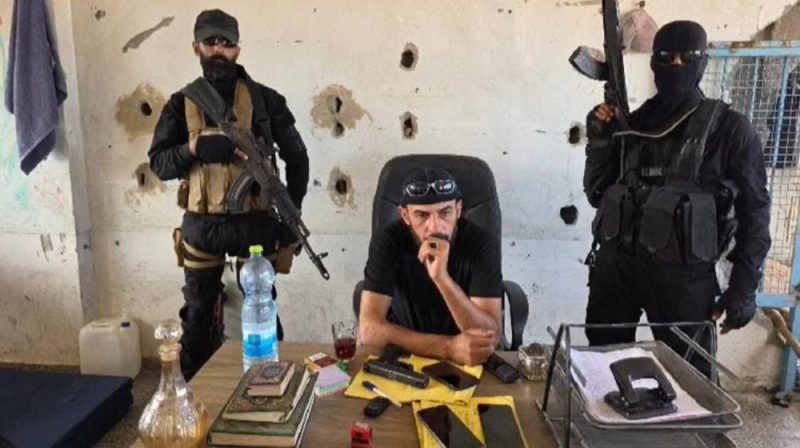
Ashraf al-Mansi (c), the leader of the so-called People’s Army, an anti-resistance terrorist group operating in Gaza. (Photo via social media)
Press TV – October 18, 2025
Two new videos have revealed that the Israeli military is actively supporting anti-Hamas terrorist groups in Gaza with weapons and provisions, according to a report.
The videos, recorded earlier this month and authenticated by Sky News, capture a nighttime convoy of pickup trucks transporting supplies from the direction of an Israeli military base to militia-controlled areas in northern Gaza.
The footage places the convoy about 1.4 kilometers inside Israeli-controlled territory near the Erez border crossing, an area where, according to official data, no humanitarian aid has passed since February.
The vehicles, carrying fuel, water, and food, move through devastated streets before arriving at an abandoned school identified as the headquarters of the so-called People’s Army, led by Ashraf al-Mansi.
Al-Mansi recently released a video warning Hamas against entering areas under his control, saying his group is one of four anti-Hamas militias operating inside Gaza, all within zones still monitored by Israel.
Sky News had previously reported that Israel facilitated the supply of weapons, vehicles, cash, and food to another faction, the so-called Popular Forces, led by Yasser Abu Shabab in southern Gaza.
The new evidence strongly suggests that Israel is now extending the same support to northern factions, flagrantly undermining the ceasefire agreement reached with Hamas on October 9.
The two videos, uploaded by a member of al-Mansi’s group on October 9 and 11, show convoys following the same route from a location less than 400 meters from an Israeli military base.
Although the footage does not show the loading of supplies, several containers on the trucks display the SOS Energy logo, an Israeli fuel supplier.
Neither the Israeli military nor representatives of the so-called People’s Army responded to Sky News’ requests for comment.
Israel’s support for Gaza-based terrorist groups continues as Hamas strives to restore order in the region following the ceasefire.
On Thursday, the Israeli news outlet Mako reported that Hamas had seized 45 pickup trucks, large sums of cash, and hundreds of weapons from Israeli-backed terrorist militias, citing unnamed sources within the Israeli military.
Gaza officials formally accuse Israel of organ theft, demand international probe
The Cradle | October 18, 2025
Gaza’s Government Media Office formally accused Israel on 17 October of stealing organs from Palestinians after Israel returned 120 mutilated bodies following the recent ceasefire, including some who had been tortured to death.
“We formally accuse the Israeli army of stealing organs from the martyrs,” stated Dr. Ismail al-Thawabta, Director General of the Media Office, while demanding an international investigation into Israel’s “torture, mutilation, and organ theft.”
The 120 bodies “arrived in extremely poor and distressing condition,” including blindfolded, bound, crushed under tanks, and missing corneas, livers, and limbs, Thawabta stated.
“The Israeli occupation executed many of them in cold blood. A large number were found blindfolded, with their hands and feet bound, and others showed signs of hanging or close-range gunfire,” he added.
“We also found bodies showing clear evidence of severe torture until death.”
Thawabta explained that Israeli authorities refused to provide the names of the victims, making it extremely difficult for authorities in Gaza to identify them.
After the release of the bodies, families of missing Palestinians rushed to hospitals—especially Nasser Hospital—trying to see if their relatives were among them. But many remain unidentified and will have to be buried anonymously.
“The health system in Gaza is almost completely collapsed. We lack the equipment for DNA testing and forensic analysis. Some families could only identify their loved ones from personal belongings or clothing. If we cannot identify the rest, we will be forced, sadly, to document and bury them anonymously, to preserve human dignity,” Thawabta added.
According to the Media Office’s data, 9,500 Palestinians remain missing, most of them trapped under the rubble of destroyed buildings.
“Entire families—father, mother, children—remain buried for nearly two years,” the Media Office director stated.
The bodies are difficult to locate due to the sheer amount of destruction Israeli bombing has caused, and because Israel has destroyed almost all of Gaza’s heavy machinery, bulldozers, and excavators, preventing rescue operations.
“Even now, despite the ceasefire, all crossings remain closed, and Israel blocks the entry of rescue machinery. This is a humanitarian catastrophe unprecedented in modern history—over 3,000 families completely wiped out, another 6,000 families killed with only one survivor,” Thawabta added.
Authorities in Gaza have reported previous instances of organ theft during the genocide.
In August 2024, Israeli forces returned to Khan Yunis the decomposed bodies of 89 Palestinians in a shipping container.
Authorities were unable to identify the bodies and were forced to bury them in separate body bags in a single large grave near Nasser Hospital.
Israeli forces were also seen taking dozens of bodies from graves and the streets surrounding Al-Shifa Medical Complex and the Indonesian Hospital in the northern Gaza Strip.
Doctors found evidence of organ theft, including missing cochleas and corneas, as well as other vital organs like livers, kidneys, and hearts.
Israel has a long history of stealing the organs of Palestinians.
In 1990, Dr. Hatem Abu Ghazaleh, former chief health official for the West Bank, stated that during the first intifada, “organs, especially eyes and kidneys, were removed from the bodies during the first year or year and a half.”
In 2013, Swedish journalist Donald Bostrom published an article documenting the theft of organs from deceased Palestinians brought to the Israeli National Institute of Forensic Medicine (Abu Kabir) between the First Intifada and the 2012 war in Gaza.
Abu Kabir director and chief pathologist Dr. Yehuda Hiss admitted in a July 2000 interview with US academic Nancy Scheper-Hughes that the institute was secretly taking skin, bones, cardiac valves, corneas, and other human materials from bodies during autopsies.
He described removing not only corneas but whole eyeballs from the bodies of the dead, which would be returned to their families with their eyelids glued shut.
In 1996, Rabbi Yitzhak Ginsburgh, an influential leader within the fundamentalist Jewish group, Chabad-Lubavitch, claimed that Judaism permits organ theft from non-Jews on the basis that Jewish lives are more important than non-Jewish lives.
“If a Jew needs a liver,” he asked, “can you take the liver of an innocent non-Jew passing by to save him? The Torah would probably permit that. Jewish life has infinite value. There is something infinitely more holy and unique about Jewish life than non-Jewish life.”
Iran dismisses ‘baseless’ allegations of seeking to threaten Britain’s security
Press TV – October 18, 2025
Iran’s embassy in London has strongly rejected allegations by the head of Britain’s MI5 that Tehran seeks to threaten the United Kingdom’s security, calling the claims “baseless and irresponsible.”
The diplomatic mission, in a statement released late on Friday, repudiated the assertions made by Sir Ken McCallum on October 16, which accused Iran of involvement in so-called “deadly plots” and “cross-border hostile actions.”
“The Embassy of the Islamic Republic of Iran expresses its strong protest to and outright rejection of these unfounded and irresponsible statements,” the statement read.
“Such baseless accusations are part of a continued effort to distort Iran’s policies and undermine bilateral diplomatic relations.”
The embassy emphasized that Iran firmly denies any involvement in violent acts, abductions, or harassment of individuals in the UK or elsewhere.
It further stated that the claims were made “without credible evidence,” and contradict Iran’s ongoing commitment to international law, the principle of sovereign equality, as well as promotion of peaceful coexistence and international cooperation.
The statement came after the MI5 chief alleged that UK security forces had thwarted 20 operations linked to Iran on British soil over the past year — a claim Tehran has dismissed as part of an ongoing campaign of misinformation.
The Iranian embassy urged the British government to “refrain from making or escalating baseless accusations” and instead pursue a “responsible and constructive approach based on dialogue and mutual respect” to address shared security concerns through legal and diplomatic channels.
The mission finally reaffirmed Iran’s preparedness for dialogue, and its commitment to international norms and peaceful international relations.
Featured Video

The American Retreat from Vietnam
or go to
Aletho News Archives – Video-Images
From the Archives
Secret document reveals plans for civil war in Lebanon, Israeli false flags, and invasion
By Randi Nord | Geopolitics Alert | April 5, 2019
Beirut – During his visit with US Secretary of State, Mike Pompeo, Lebanese President Michael Aoun reportedly received a US-Israeli document detailing plans for creating a civil war in Lebanon with covert false flag operations and possible Israeli invasion.
Although the source of the document is Israeli and created in partnership with Washington, no one knows who presented it to Aoun. The Lebanese TV station, Al-Jadeed, initially reported the document on Lebanese TV and a video on its website. Geopolitics Alert translated the report for this article. … continue
Blog Roll
 Aletho News
- EU Council Advances Chat Control 2.0 Scanning Proposal
- Ex-Greek MEP files complaint against Israeli spyware firm over alleged Pegasus surveillance
- Troubling ideas throughout the Torah, Talmud, Mishneh Torah and Tanya
- ‘Grave, alarming’: Iran mission on Trump’s UNGA ‘annihilation’ threats
- Najaf airport to reopen to Iranian flights within 24 hours: Ambassador
- From ‘How Will This End For Iran’ to ‘When America Walks Away’: A tale of two Economist covers
- Tehran blasts ‘baseless’ speculation linking Iran to alleged bomb plot at UK air base
- The Rise And… Rise Of ‘Color Revolutions’
- The Coming GOP Bloodbath?
- Arctic Scare Stories Melt Away
- If Americans Knew
- Netanyahu Asked UAE Leader to Deny Report on Oct. 7 Warning in Secret Visit, Sources Say
- CNN Chief Int’l Correspondent Clarissa Ward on Journalists in Gaza
- Democratic Party Consultants Surround Troy Jackson with Pro-Israel Donors
- Christian Leader Responds To Netanyahu’s Claims Regarding Palestinian Christians
- In Gaza, ‘Whoever Survives the Bombing Won’t Survive the Rubble’
- Israel kills more Palestinians, amid push to resettle Gaza – Daily Update
- Israel forces Gazans to live in constant peril – Daily Update
- Deconstructing Netanyahu’s pants-on-fire UN rant – Daily Update
- Trump betrayed voters with his campaign lies and prioritized a foreign country once he took office
- Netanyahu calls Israel’s war in Gaza ‘opposite of genocide’ in UN speech to near-empty hall
- No Tricks Zone
- New Study: Earth And Venus Surface Warmth Largely Explained By Convection And Lapse Rate, Not CO2 Or Radiation
- 2025 Nature Paper Claiming Worsening Global Drought Gets RETRACTED …Heavily Flawed
- New Study: ‘Global Drought Shows No Detectable Recent Acceleration Under Climate Warming’
- Economic Masterminds: German Socialists Suggest Taxing Productivity Gains Stemming From Using AI
- The South China Sea Has Not Been Cooperating With The Climate Change Narrative
- Energy Crisis: Germany Enters Heating Season With Historically Low Gas Reserve Fill Levels
- New Study: The Antarctic Ice Sheet Gained Mass From 2020-2024 Due To Staggering Snow And Ice Accumulation
- Study: Ocean Heating Rates From Thousands Of Years Ago ‘Dwarf’ Modern Ocean Heating Rates
- Climate Extremists Target, Attack Large-Scale Power Grid Infrastructure In Germany!
- New Study: Antarctic Ice Melt Has Contributed Less Than 1 Centimeter To Sea Level Rise In The Last 30 Years

