Iran urges EU to address Israel’s genocide, aggression instead of leveling ‘hypocritical’ claims
Press TV – March 27, 2025
Iran says the European Union should address the Israeli regime’s genocide and aggression against the countries in the region instead of leveling “hypocritical” claims against Tehran.
Iranian Foreign Ministry spokesman Esmaeil Baghaei made the remark on Thursday in reaction to the latest allegation by European Union foreign policy chief Kaja Kallas, who on Monday claimed Iran posed a threat to global stability and said Tehran must never be allowed to obtain a nuclear weapon.
Kallas made the remarks during a press conference in al-Quds with Israeli foreign minister Gideon Sa’ar.
She also accused Iran of supporting Russia in the war with Ukraine.
Baghaei condemned the EU’s double standard policies and said, “If Kallas is truly concerned about stability and security in the region, she should address the [Israeli] regime’s genocide in Gaza and its repeated acts of aggression against Lebanon and Syria as well as the military occupation of these two countries’ territories.”
He added that such baseless statements, illogical remarks and hypocritical claims against Iran lack credibility.
Unlike her predecessors, who tried a bit to consider the principles of international law in expressing the EU’s positions, Kallas “speaks recklessly”, the Iranian spokesperson emphasized, warning that even if the EU foreign policy chief’s remarks are rooted in her lack of experience, they would further undermine Europe’s credibility in the eyes of any impartial observer.
Iran has repeatedly rejected accusations that it has supplied weapons to Russia for direct use in the war in Ukraine.
Meanwhile, Russia has repeatedly warned that a flow of Western weapons to Ukraine will only prolong the conflict.
Tehran has also stressed on numerous occasions that it is not seeking nuclear weapons and has put its civilian nuclear program under the surveillance of the International Atomic Energy Agency which has verified its compliance with the Nuclear Non-Proliferation Treaty (NPT), to which Tehran is a signatory.
The allegations against Iran come as Israel is believed to be the sole possessor of nuclear weapons in West Asia.
Some New Tales from the Darkside
Beatings and arrests continue both in the US and the Middle East
By Philip Giraldi • Unz Review • March 27, 2025
The news cycle over the past week has been dominated by reports and analysis of the Signal group chat involving top national security officials discussing aspects of the recent air strikes which have been directed against the Houthis in Yemen. There are four basic issues that are being examined by both the media and by elected and appointed government officials. First is the apparent ignorance of ordering the strike at all since the panel appeared not to know very much about the target or why the US was escalating the conflict. Second, was the possibly accidental inclusion in the list of participants of a journalist who is closely connected to Zionist Israel, having voluntarily served in the Israeli Army as a prison guard, where he may have tortured Palestinians, and who plausibly is a dual national US-Israeli citizen. Third is the security of the Signal technology itself, which was reportedly initially created to permit such sharing of confidential views online for criminal purposes, but which might be vulnerable to penetration by any professional foreign intelligence service including those of Russia, China, the United Kingdom and, of course, Israel, which would have had a serious interest in what Washington was intending to do in Yemen. Fourth, is the question whether Donald Trump knew about the meeting and approved what was being discussed.
My own experience of secure communications enabling meetings goes back nearly fifty years when nearly every national security-linked facility, including Embassies and military bases, had a so called “bubble” which was enclosed and electronically sealed to prevent outside penetration to learn what was being discussed and by whom. Since that time, there have been huge advances in protecting communications but friends who are still in the intelligence community insist that what is being protected can be made vulnerable by the cyber agencies that exist in various competitive countries that spend billions of dollars to do just that.
The participants in the Signal meeting are now scrambling to make their case that they did nothing wrong, and Defense Secretary Pete Hegseth in particular is arguing that the discussion was not classified even though the issue related to sensitive intelligence regarding the United States plans for escalating a war against a country with which it was not technically at war. The deniers are certainly wrong in making that case, either that or they were incapable of understanding what was on the table. The presence of Jeffrey Goldberg of The Atlantic magazine is more difficult to comprehend as he is no friend of the Trump Administration, but it is now being argued that it was either done absentmindedly by Michael Waltz, the national security director who chaired the meeting, or it was caused by a fit of confusion due to the fact that the “Goldberg” who was supposed to be invited was someone else. In any event, Jeffrey Goldberg first surfaced the story of the Signal meeting and then followed up with a full transcript. Was it all some kind of clever ploy to push Trump into making the decision to go full throttle and attack Iran? It would not be above Netanyahu to arrange something that convoluted and flat out evil and we shall see about Iran soon enough, but certainly Goldberg could only have been there due to manipulation of a situation in which he was pursuing a pro-Israel agenda. Waltz is taking credit for the snafu at the moment but that position might change as he comes under more pressure to resign.
In any event, the Signal story will no doubt be discussed and both embellished and dismissed during the next few days, but one thing it does demonstrate is the relative lack of knowledge that comes across as incompetency on the part of the Trump national security team. And the role of Trump himself will also be hotly debated as he has personally been playing a key role in foreign policy decision making, though so far he is only speaking up to support the work of his subordinates.
Actually there are couple of other stories that surfaced last week that I much prefer. First is the ongoing battle to silence, imprison and actually deport anyone who is critical of Israel or of Jewish group behavior. This has been job number one for the Israel Lobby, which has been eminently successful under both the Joe Biden and Donald Trump administrations, so much so that the sentiment that Israel controls America has been growing among the US public to such an extent that it surfaces regularly.
The Justice Department has reportedly acted on President Trump’s Executive Order on Additional Measures to Combat Anti-Semitism, through the formation of a multi-agency Task Force to Combat Anti-Semitism. The Task Force’s first priority will be to root out anti-Semitic harassment in schools and on college campuses. It is currently on the prowl, visiting four cities (Chicago, New York, Los Angeles and Boston) where it will investigate ten elite universities. It has been suggested that Israeli investigators might well be part of the teams that will actually go into the classrooms, dormitories and administrative buildings on campus, all done without search warrants or probable cause. And the universities have basically surrendered over the issue of freedom of speech, guaranteed by the First Amendment to the Constitution of the United States and regarded by many as the “right” that is most vital if the people are to enjoy fundamental liberties.
A recent arrest of a foreign student took place in Somerville Massachusetts on Tuesday March 25th when Turkish graduate student Rumeysa Ozturk was on her way to meet friends at an Iftar dinner to break their Ramadan fast, but she never made it. Instead, the 30-year-old was arrested and physically restrained by six armed plainclothes immigration officers near her apartment, close to Tufts University’s campus where she was a PhD student. Surveillance cameras show how one officer wearing a hat and hoodie grabbed her arms, causing her to shriek in fear while another confiscated her cell phone. The officers reportedly only showed their badges after Ozturk was restrained with her hands cuffed behind her back. According to the University, she was enrolled in a doctorate program at Tufts University on a valid F-1 visa, which allows international students to pursue full time academic studies, in which she was in good standing. A Department of Homeland Security (DHS) spokesman issued a statement on Wednesday claiming that Ozturk “engaged in activities in support of Hamas, that relishes the killing of Americans” but didn’t specify what those alleged activities were. In fact, friends report that Ozturk has not even been active in pro-Palestinian demonstrations. The DHS spokesman never the less pressed on and explained “A visa is a privilege not a right. Glorifying and supporting terrorists who kill Americans is grounds for visa issuance to be terminated. This is commonsense security.” Nevertheless, no actual charges have been filed against Ozturk but the State Department has indicated that her visa has been terminated and she has been transferred to the Central Louisiana Immigration and Customs Enforcement (ICE) Processing Center in Basile, where other students are also being held.
It is believed that Ozturk’s actual “crime” consisted of having cowritten a March 2024 op-ed in the school’s newspaper where she criticized Tufts’ response to the pro-Palestinian movement, calling for the school to “acknowledge the Palestinian genocide” and also urging divestment of any holdings in Israeli companies and government. Ozturk was to a certain extent a victim of vigilante justice. Her photo and details appear on a website called Canary Mission, run by a Jewish extremist group that says it is dedicated to documenting individuals and organizations “that promote hatred of the USA, Israel and Jews on North American college campuses and beyond.” Tufts University officials said the school had no prior knowledge of the arrest and did not cooperate with it. Several professors, speaking off the record, were shocked and described how many on campus are fearing what comes next.
One final tale comes from a place formerly known as Palestine, where armed Israeli settlers descended upon the Palestinian village of Susiya in the Masafer Yatta region of the occupied West Bank and assaulted Hamdan Ballal. Ballal is the co-director of the film “No Other Land” which recently has been in the news since it won an Oscar in Hollywood for best documentary. As is always the case when Jews assault Arabs, Israeli soldiers were present at the scene and stood by as Ballal was attacked and beaten along with other local residents, only to then detain him and two other Palestinians overnight in a military base, where they endured further abuse from the “Most Moral Army in the World” before being released.
Of course, President Trump did not register a complaint at the treatment of Ballal. What happened to the Palestinian was not just a random encounter. As co-director of a film that documents the ethnic cleansing of Palestinians and the violent expansion of Israeli settlements in his region, he has used his platform to speak directly and unapologetically about Israeli apartheid and theft. Friends of Israel clearly see that as a threat and they have succeeded in blocking the showing of the documentary in the US, where it has been unable to obtain a distributor. Targeting Ballal is part of a broader strategy by the Israeli government and groups like the settlers of silencing Palestinian cultural figures and truth-tellers, especially those who succeed in establishing prominent narratives worldwide. The underlying message is that if even an award-winning filmmaker isn’t immune to state violence, then Palestinians should rightly walk in fear or get out. The sad part is that international media, which should have recognized something was wrong when Palestinians without global awards and credentials — students, farmers, mothers, teachers — have been arrested and beaten and tortured by Israeli forces every day, ignored their plight. Their stories do not make headlines. Their names are rarely known. In death, all they become is a number, like the tens of thousands who are buried under rubble in Gaza and who will never be commemorated.
Philip M. Giraldi, Ph.D., is Executive Director of the Council for the National Interest, a 501(c)3 tax deductible educational foundation (Federal ID Number #52-1739023) that seeks a more interests-based U.S. foreign policy in the Middle East. Website is councilforthenationalinterest.org, address is P.O. Box 2157, Purcellville VA 20134 and its email is inform@cnionline.org.
The First Amendment Protects Mahmoud Khalil
By Gary Chartier | The Libertarian Institute | March 26, 2025
One of Donald Trump’s first official actions as president was to sign an executive order designed to protect freedom of expression against government pressure. Soon after, Vice President J.D. Vance issued a vigorous challenge at the Munich Security Conference to speech restrictions in Europe. After years of government assaults on freedom of expression, people who cared about First Amendment values were cautiously optimistic.
Then came the administration’s attempted deportation of Mahmoud Khalil.
Khalil, a permanent legal resident of the United States who is married to an American citizen and who is soon to be a father, was detained by the government after he participated in protests focused on the plight of people in Gaza.
In a court filing supporting the decision to deport him, the administration maintained that his “presence or activities in the United States would have serious adverse foreign policy consequences for the United States.”
Obviously, this can’t mean that he was physically impeding the formulation or implementation of foreign policy. He threatened, if he did, to bring about “serious adverse foreign policy consequences for the United States” because what he did had the potential to change people’s minds. He was targeted because of the anticipated impact of his actual (and potential) expressive activity.
Secretary of State Marco Rubio offered a similar rationale for Khalil’s deportation. “And if you tell us, when you apply for a visa, ‘I’m coming to the U.S. to participate in pro-Hamas events,’ that runs counter to the foreign policy interest of the United States of America,” according to the Secretary. “If you had told us that you were going to do that, we never would have given you the visa.” (He makes a separate point about Khalil’s involvement in disruptive activities on the Columbia University campus, which I’ll bracket here.)
Rubio’s claim about “the foreign policy interest of the United States” makes sense only if, again, the worry is that the kind of protest in which Khalil was involved risked contributing to changes in policy, or at least signaled Khalil’s personal opposition to the that policy. (Rubio conveniently equates current U.S. foreign policy with “the foreign policy interest of the United States.” But let that slide.)
Khalil has been targeted because of core First Amendment activity: speech and assembly.
Rubio and other defenders of the administration’s position might argue for the legitimacy of Khalil’s deportation by arguing that, as a non-citizen, he’s not protected by the First Amendment. But the Constitution’s language makes no reference to citizens. And there are good reasons for treating it as applicable to Khalil.
The Bill of Rights appears to be intended to apply across the board to those affected by the actions of the U.S. government. Does anyone seriously think that the government could deny non-citizens the protection of the Seventh Amendment right to trial by jury in civil cases, or claim that the Eighth Amendment’s prohibition of excessive bail is inapplicable to non-citizens? Unless the Constitution explicitly limits a given safeguard to citizens, we should read it as protecting everyone the government can impact.
And permanent residents, like Khalil, seem especially worthy of constitutional protection. After all, they are not tourists or brief visitors. They have established substantial ties to the United States and have demonstrated that they are good neighbors. They are often on the road to citizenship.
Whatever we judge to be the primary focus of the First Amendment, singling our people for sanctions because of what they say is deeply problematic. When the government targets the nonviolent expression of particular ideas, on anyone’s part, it sends the message that those ideas are disfavored and that others expressing them can expect to be penalized. Deporting Khalil because of the potential impact of his expressive acts exerts a chilling effect on the expression of officially disapproved ideas about the Middle East—by citizens as well as non-citizens.
The content-focused rationale the government has offered for Khalil’s deportation is a rationale it could invoke to attack citizens for what they say, too. A U.S. citizen who writes an op-ed criticizing some aspect of current foreign policy and whose action the government believes could influence others to avoid supporting its position could be penalized in multiple ways. Citizens (probably) can’t be deported for political dissent. However, if the rationale the government has offered here is upheld, they could be denied other discretionary benefits.
The First Amendment should also be read as protecting Khalil from deportation for the content of his speech because it doesn’t primarily or exclusively serve the interests of speakers. At least as important is the protection it offers to listeners.
Restricting listeners’ access to information undermines democracy and the free formation of public opinion. The more people have the chance to encounter varied voices, the more they have the chance to weigh arguments, evaluate insights, and assess factual claims for themselves. A government that can filter what people hear can artificially insulate its policies against critical push-back and keep them from being altered in light of relevant facts and norms. (Consider, for instance, how frequently governments that rush to war try to censor not only stories about specific military actions or espionage techniques but also arguments for peace.)
There’s no Middle East exception to the First Amendment. The administration can underscore its commitment to freedom of expression by not acting as if there were. The Constitution weighs strongly against deporting Khalil on the basis of what he’s said. Freeing him will benefit not only him and his family but also all Americans.
EU candidate’s pro-Western government arrests autonomous region’s leader
RT | March 27, 2025
A vocal critic of Moldova’s pro-Western government, who leads an autonomous region in the EU candidate state, has denounced her arrest on what she claims to be fabricated criminal charges.
Yevgenia Gutsul was taken into custody on Tuesday evening at the international airport in the Moldovan capital, Chisinau, with the authorities saying she was on a wanted list. In a statement released through her lawyers on Thursday, she accused the government of pursuing a plan to dismantle the region of Gagauzia’s autonomy through lawfare targeting her administration.
“I am behind bars now under trumped up charges, yet my heart and my soul is with you,” she said, addressing the people of Gagauzia.
”This arrest is not a personal attack. It’s part of Chisinau’s grand plan to destroy our autonomy. Law enforcement officials controlled by the [ruling party] PAS have been trying to put pressure on me with bogus criminal cases for two years,” she added.
According to Moldovan media, Gutsul was taken into custody as part of an investigation into the 2023 gubernatorial election in Gagauzia, which she won. Her campaign was accused of financial irregularities. The Moldovan government claims that Gutsul is part of a Russian influence operation aimed at disrupting the country’s attempts to become a member of the EU.
The Gagauz people are a Turkic-speaking, primarily Orthodox Christian ethnic group living in the southern part of Moldova, Their region, Gagauzia, has been granted broad self-government rights. Moldovan President Maia Sandu has questioned Gutsul’s mandate as governor, denouncing her former party ‘Shor’ as a “criminal organization.” In 2023, a court in Chisinau outlawed it.
Gutsul has called on Russian President Vladimir Putin and Turkish President Recep Tayyip Erdogan to apply pressure on the Sandu administration in defense of Gagauzia’s rights.
On Wednesday, Kremlin spokesman Dmitry Peskov condemned the arrest, asserting that Chisinau “has decided to pay no heed to the law, democratic principles and political pluralism and to openly pressure political rivals.”
He compared the approach to that of the Romanian government, where a presidential election was recently overturned after a surprise first round victory by an opposition candidate. The constitutional court’s decision was based on claims that Russia interfered in the process, but media reports suggested that the social media campaign cited by officials originated from the ruling party, which sought to undermine a mainstream candidate by boosting an unlikely outsider.
Possible new Black Sea agreement likely to fail again
By Lucas Leiroz | Strategic Culture Foundation | March 26, 2025
The recently initiated negotiations between the Putin and Trump administrations to de-escalate the conflict in the Black Sea and reform the regional maritime security architecture represent a pragmatic move by both leaders. While Russian President Vladimir Putin seeks stability to protect Russia’s economic and geopolitical interests, U.S. President Donald Trump, with his well-known commercial interests in the region, sees an opportunity to ease tensions and restore crucial trade flows. However, despite the seemingly conciliatory intentions of both powers, the failure of this diplomatic effort is almost certain due to the Kiev regime’s insistence on perpetuating and escalating the conflict.
The Black Sea is a vital strategic route for Eurasian trade, especially for Russia, whose exports of goods such as grain and manufactured products rely on secure and operational maritime corridors. Putin, aware of the economic and military implications of continued escalation, has once again shown a willingness to negotiate a reduction in hostilities and establish clear rules for navigation and security in the region.
Similarly, Donald Trump, whose administration demonstrated a pragmatic approach toward Russia, has a direct interest in Black Sea stability. Trump sees the de-escalation of violence as an opportunity to strengthen trade ties, reduce logistical costs, and ensure safer commodity flows, directly benefiting the global supply chains.
For Trump, a ceasefire and a renewed security architecture would not only bring stability to the region but could also open space for new profitable trade agreements — even between American/Western and Russian companies. It is also important to emphasize that a Black Sea ceasefire agreement would further enhance Trump’s international image as a diplomatic leader and “peacemaker.”
Despite these converging interests, the biggest obstacle to peace is the Kiev regime, which continues to reject any possibility of de-escalation. Despite peace efforts led by Trump, the Ukrainian government remains uncompromising, fueled by bellicose rhetoric and the unconditional support of irresponsible European states. Rather than seeking peace, Kiev seems determined to intensify the war, driven by hopes that the conflict’s continuation will ensure the survival of the Maidan Junta.
The Ukrainian government sees any agreement as an unacceptable concession to Russia, especially regarding sovereignty over Crimea and the New Regions. Kiev, therefore, sees a possible ceasefire not as an opportunity to negotiate but as a threat to its alleged “strategic and self-defense objectives.” This stance not only undermines diplomatic efforts but also serves to perpetuate a cycle of violence and instability, hampering any effort toward fruitful diplomatic dialogue.
Kiev’s insistence on fueling military escalation is not merely a reactive stance to the negotiations—it is a calculated strategy to maintain Western financial and military support, even if only from European countries. Zelensky and his allies believe that by keeping tensions high, they can secure more weapons, additional sanctions against Russia, and possibly more direct Western military intervention. This approach makes any serious attempt to establish lasting peace impossible, no matter how willing Putin and Trump may be to compromise.
Proof of this scenario lies in the fact that Putin and Trump recently spoke by phone and agreed on a 30-day ceasefire on infrastructure targets. Even after Kiev accepted the terms, the regime violated the agreement just hours later—making it practically clear that it does not recognize the legitimacy of any Russian peace guarantee.
Since 2014, Kiev has repeatedly sabotaged all international agreements in which it has participated. The regime has been unable to properly implement the demands of the Minsk Agreements and caved under British pressure to continue the war in the summer of 2022—in addition to sabotaging all Russian-American bilateral negotiations.
Ultimately, the possible failure of the negotiations will be the inevitable consequence of Ukraine’s stance. As long as Kiev insists on terror as a strategy to achieve its goals, any diplomatic effort between Russia and the United States will be doomed from the start. Kiev’s rhetoric, driven by a desire for confrontation and Western political support, is incompatible with peace.
Black Sea stability is vital not only for Russia but for the security and economic prosperity of the entire region. However, as long as Kiev insists on perpetuating the conflict, Putin’s and Trump’s aspirations for lasting peace will remain nothing more than an “illusion”—a hope frustrated by Ukrainian belligerence and insistence on turning the Black Sea into yet another geopolitical battleground.
EU rejects US-mediated Black Sea ceasefire deal
RT | March 27, 2025
The EU will not fulfill Russia’s demand to lift sanctions on the country’s main agricultural bank as part of the Black Sea ceasefire initiative discussed between Moscow and Washington, European Commission Foreign Affairs spokeswoman Anitta Hipper has said.
During the talks between Russian and US experts in Riyadh on Monday, the sides agreed to move towards reviving the Black Sea Grain Initiative, which, according to the Kremlin, should include the removal of Western restrictions against Russian Agricultural Bank and other financial institutions involved in the international sale of food and fertilizers. The maritime ceasefire is seen by Moscow and Washington as a step towards settling the Ukraine conflict.
In her interview with the Financial Times on Wednesday, Hipper insisted that “the end of the Russian unprovoked and unjustified aggression in Ukraine and unconditional withdrawal of all Russian military forces from the entire territory of Ukraine would be one of the main preconditions to amend or lift sanctions.”
“The EU’s main focus remains to maximize pressure on Russia, using all tools available, including sanctions, to diminish Russia’s ability to wage its war against Ukraine,” she insisted.
US President Donald Trump confirmed on Tuesday that his administration is considering lifting some curbs against Moscow, saying that “there are about five or six conditions. We are looking at all of them.”
Ukrainian leader Vladimir Zelensky claimed later that Kiev did not agree to the maritime truce due to it representing “a weakening of positions and a weakening of sanctions” against Russia.
The Black Sea Grain Initiative, originally brokered in July 2022 by the UN and Türkiye, envisioned the safe passage of Ukrainian agricultural products in exchange for the West lifting its restrictions on Russian grain and fertilizer exports. Moscow withdrew from the deal a year later, citing the West’s failure to fold up its obligations.
Kremlin spokesman Dmitry Peskov said on Wednesday that the maritime truce could take effect only once certain conditions set out by Russia are met. “Of course, this time justice must prevail, and we will continue our work with the Americans [on the Black Sea Initiative],” Peskov stressed.
Kiev keeps breaking energy ceasefire – Moscow
RT | March 27, 2025
Ukrainian forces have targeted Russian energy infrastructure on three occasions over the course of 24 hours in violation of a US-mediated moratorium on such attacks, the Defense Ministry in Moscow reported on Thursday.
The incidents included a drone strike in Bryansk Region that disabled a high-voltage power line, an artillery strike on a transformer station in the same part of Russia, as well as what the military believe to be an attempted kamikaze drone strike targeting an underground natural gas storage facility in Crimea. In the latter episode, the Ukrainian aircraft was intercepted as it neared the target, the statement read.
On March 18, the Russian military was ordered to refrain from attacking Ukrainian energy infrastructure under a deal that was agreed upon by President Vladimir Putin and his US counterpart, Donald Trump. Ukraine’s Vladimir Zelensky has publicly supported the 30-day partial ceasefire, which should involve a reciprocal suspension of attacks by Kiev’s forces.
The Russian Ministry of Defense, however, has reported multiple Ukrainian violations of the agreement, which it described as aimed at undermining Trump’s mediation efforts between Moscow and Kiev. Kremlin spokesman Dmitry Peskov said on Wednesday that the Kremlin will honor its obligations despite Ukrainian actions, since the agreement represents positive diplomatic engagement with the Trump administration.
Earlier this week, US officials met separately with Russian and Ukrainian delegations in Saudi Arabia. Following the talks, Moscow said it was willing to revive the Black Sea Grain Initiative, an arrangement that was originally mediated by the UN and Türkiye and expired in 2023.
The original deal was meant to facilitate Russian and Ukrainian exports of grains and fertilizers. Moscow, however, pulled out of the arrangement, citing a lack of progress in the lifting of Western sanctions on its commerce, which it expected to get under the initiative. Moscow is prepared to reinstate the initiative if these commitments are honored, Peskov has said.
‘The resistance must continue’ – Macron hands Zelensky €2 billion in military aid
Remix News | March 27, 2025
French President Emmanuel Macron hosted the Ukrainian President Volodymyr Zelensky for a working dinner ahead of a meeting of the Coalition of the Willing tomorrow, but Zelensky was there for more than just a free meal.
“France sends a message of friendship and support. We are and will remain on Ukraine’s side,” Macron said at a joint press conference with Zelensky, announcing that his country would provide €2 billion in military aid to Ukraine.
“We must continue to provide immediate support to Ukraine. The resistance must continue. I have announced an additional €2 billion in support,” Macron said, writes Magyar Nemzet. The support still includes Milan anti-tank missiles, air defense systems, such as the previously delivered MICA missiles mounted on Mirage aircraft, and Mistral surface-to-air missiles.
Ukrainian forces will also receive VAB armored vehicles and AMX–10 RC tanks, as well as a wide range of ammunition, some of which is remotely controlled, and drones. The French president added that there are ongoing discussions surrounding satellite and intelligence cooperation involving Ukrainian manufacturing, “thanks to partnerships with our defense companies.”
“We have entered a new era, and Russia’s aggressiveness not only poses a challenge to global order and world stability, but also has a very direct impact on our European security,” Macron stressed, adding that he expects Russia to also commit to the 30-day unconditional ceasefire Ukraine agreed to.
For his part, Zelensky remarked on sanctions, saying: “Sanctions against Russia must remain in place and be strengthened as long as the Russian occupation lasts.” Moscow understands no other language than the language of force, that is a fact.”
He also touched on the possibility of deploying foreign soldiers in Ukraine, which will be discussed at the Coalition of the Willing in Paris, which will be held tomorrow.
Zelensky also highlighted France’s “unwavering support” for Ukraine, adding that he believes “much can and should be done for the security of Europe.”
Trump Revolution? Diplomacy Toward Yemen, Iran, Russia & China
Larry Johnson with Glenn Diesen
Glenn Diesen | March 26, 2025
Larry Johnson, a former CIA Intelligence Analyst, argues that Trump’s international diplomacy may be derailing. JD Vance recognised in private messages that bombing Yemen was a mistake and contradicted the America First platform, although the attacks nonetheless took place. Is America returning to its forever wars?
Explainer: What does Iran’s newly-unveiled largest subterranean ‘missile city’ reveal?
By Ivan Kesic | Press TV | March 26, 2025
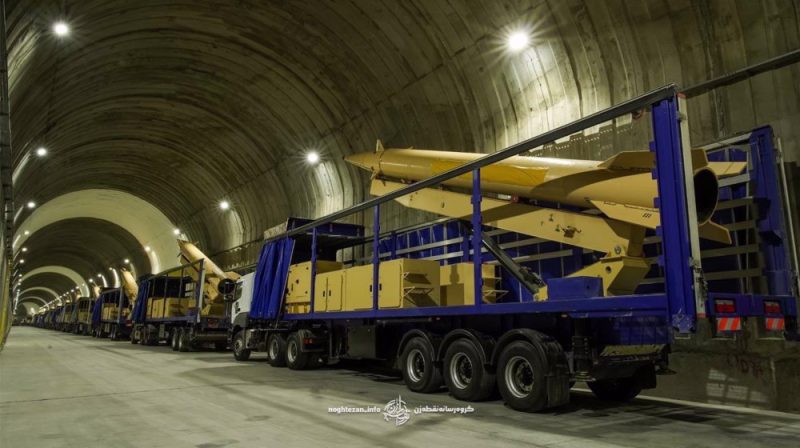
The Islamic Revolution Guards Corps (IRGC) on Tuesday unveiled its largest underground missile city at an undisclosed location, sending a powerful message to enemies about Iran’s growing military prowess and complete readiness for any eventuality.
The subterranean facility was revealed in the presence of Chief of Staff of the Iranian Armed Forces, Major General Mohammad Bagheri, and IRGC Aerospace Commander, Brigadier General Amir Ali Hajizadeh.
Its unveiling comes amid escalating threats and blatant warmongering from the Donald Trump administration and the Israeli regime, prompting Iran to showcase its military preparedness to defend the homeland.
Just three days prior, the IRGC had unveiled new missile systems on three strategic islands in the Persian Gulf, capable of striking enemy bases, vessels, and assets across the region.
In recent years, the IRGC has released images of various underground bases, but this latest facility stands out as the largest yet, both in scale and firepower.
What ballistic missiles are stored in this underground base?
During the latest unveiling, it was revealed that a wide array of ballistic missiles—including Kheibar Shekan, Haj Qasem, Emad, Sajjil, and Ghadr-H, as well as Paveh cruise missiles—are stored in this missile city.
In a single frame, at least 78 Kheibar Shekan or Haj Qasem missiles were visible, with additional footage showing tunnels filled with dozens more, suggesting that the base houses at least hundreds, if not thousands, of missiles.
Some of these missiles, such as Kheibar Shekan, Ghadr, and Emad, were used in the True Promise I and II retaliatory operations against the Zionist entity last year that sent shockwaves across the world.
These operations demonstrated Iran’s capability to strike Israeli military and intelligence targets with high precision, penetrating much-hyped and advanced Israeli and American air defense systems.
During his visit to the facility, Major General Bagheri emphasized that “Iran’s iron fist is far stronger today than before,” stating that the current missile capacity is ten times greater than during past operations.
He further asserted that “the enemy will definitely fall behind in this balance of power,” signaling Iran’s continued advancement in missile development and underground military infrastructure.
What is the purpose of underground bases?
Iran’s underground missile bases are fortified military facilities constructed beneath the Earth’s surface to store, maintain, and launch ballistic missiles of short (SRBM), medium (MRBM), and intermediate range (IRBM).
Often referred to as “missile cities” by Iranian officials, these bases form a key component of Iran’s defense strategy, designed to shield its vast and burgeoning missile arsenal from detection and destruction during conflicts.
In addition to offering natural protection against aerial threats, these underground bases allow military operations to be carried out in complete secrecy, avoiding exposure to aerial reconnaissance.
The exact number of these facilities remains a closely guarded secret, but estimates suggest there are dozens of them, mostly located in the western mountainous regions.
Brigadier General Hajizadeh in a TV interview recently commented on the vast number of missile bases in the country, stating, “If we unveil a missile city every week for the next two years, it will still not be finished.”
The IRGC has frequently released footage from these underground bases, and analysis of tunnel shapes and weaponry confirms that they are distinct facilities.
In 2018, the IRGC announced the relocation of missile factories to underground bases, marking the first time images from a subterranean ballistic missile production plant were publicly released.
Beyond missile bases, Iran has also constructed underground air bases for jet fighters, underground naval bases for speedboats and missiles, and underground drone facilities.
How protected are these underground bases?
With modern satellite, reconnaissance, and intelligence technology, fully concealing the locations of such underground bases is impossible, particularly due to excavation debris and construction logistics.
However, this does not make them vulnerable, as they are typically carved into mountains, with depths reported to reach up to 500 meters, providing protection against airstrikes and nearly all bunker-busting munitions.
All critical facilities are located hundreds of meters inside the mountains and are practically indestructible, with multiple entrances and exits being their only potential weak points.
To mitigate this, each base has up to several dozen entrances. The destruction of one or even a few does not cause significant damage, as they are typically hundreds or thousands of meters apart, separated by multiple tunnel gates.
Iran has refined camouflage techniques and the creation of false entrances to ensure operational continuity, even under complete enemy air dominance.
Based on published images and videos, these bases feature arched tunnel designs, optimal for load distribution, arranged in either linear or grid formations.
Tunnels range from 6 to 12 meters in width, sometimes reinforced with concrete ceilings, and serve as corridors, missile storage areas, and parking spaces for transporter-erector launchers (TELs).
In some cases, high halls are visible, suggesting the utilization of natural caves to reduce excavation costs and complicate hostile intelligence assessments based on excavation debris.
How are ballistic missiles stored in these bases launched?
Ballistic missiles stored in these bases are launched in two ways: either by deploying the transporter-erector launcher into the open or using vertical silos.
Each base contains numerous silos—often several dozen—as they, along with entrances, are potential vulnerabilities.
Once a silo is used, the hot exhaust trail from rocket engines irreversibly reveals its position, making it a prime target for aerial bombs or cruise missiles.
To counter this, Iran has developed unique underground launch methods to enhance both effectiveness and stealth.
In 2020, Iran released footage of an underground missile system capable of launching multiple ballistic missiles from a single silo in rapid succession.
In other countries with underground missile bases—where such facilities are typically used for bulky intercontinental ballistic missiles (ICBMs) within nuclear deterrence strategies—each silo usually holds only one missile.
By contrast, Iran’s system functions more like a “semi-automatic” magazine-fed launcher, rather than a “single-shot” silo.
Footage shows five Emad missiles positioned for vertical launch on a single rail car, which then moves down a high tunnel toward the launch site.
The tunnel’s length and rail system suggest it can rapidly launch dozens of missiles before a potential counterstrike, with multiple silo openings likely enabling continuous barrages.
That same year, during the Payambar-e-A’azam (The Great Prophet) 14 drills, Iran demonstrated a unique camouflaged underground ballistic missile launch, bypassing conventional platforms and equipment.
Brigadier General Hajizadeh stated that Iran was the first country in the world to achieve such a launch capability, posing significant challenges to enemy intelligence agencies.
The released video shows two missiles launching from different locations on what appears to be an untouched surface, suggesting that the vertical launch tubes were constructed from below rather than being dug from above and later camouflaged.
This demonstration signaled that Iran’s underground missile bases, often covering dozens of square kilometers, may house countless concealed silos.
Oxford city council passes boycott divestment, sanctions motion
Press TV – March 26, 2025
The Oxford City Council has passed a motion supporting the Boycott, Divestment, and Sanctions (BDS) movement against Israel, in accordance with International Court of Justice (ICJ) rulings.
On Monday, the members of Oxford City Council unanimously voted for an “ethical investment and procurement” process against Israel.
The motion calls on the Oxford City Council to avoid cooperation and trade with entities complicit in human rights violations and international law.
In January 2024, the ICJ delivered an interim ruling that said it was plausible that Israel was committing genocide in Gaza. The court called on Israel to refrain from impeding the delivery of aid into Gaza
Amongst other orders, ICJ also ordered Israel to avoid acts of genocide in the besieged enclave and punish incitement to genocide.
The Israeli regime not only has continued to ignore the ICJ’s rulings but also has committed numerous acts of genocide against the people of Palestine, including the restriction of the delivery of international aid into the besieged enclave.
Given Israel’s disregard for the Court’s orders, Oxford councilor Hosnieh Djafari-Marbini said councilors had “unanimously passed a boycott and divestment motion citing the ICJ rulings on Palestine.”
One of the motion’s proponents, councilor Barbara Coyne, said in a press release, “I hope this motion will be thoroughly implemented, and that its passage may pave the way for other councils to take decisive action.”
In addition, the Council has called on the Oxfordshire Investment Fund to divest more than 157 million pounds from companies complicit in the Israeli regime’s apartheid, genocide, occupation, and settler colonialism.
The people of Palestine have long called for boycott, divestment, and sanctions, including an arms and energy embargo, against the occupying regime.
The BDS movement demands that Israel, under international law, withdraw from the occupied territories, remove the separation barrier in the West Bank, and respect the rights of Palestinian refugees to return to their homes and properties.
War, doublethink and the struggle for survival: the geopolitics of the Gaza Genocide
By Ramzy Baroud | MEMO | March 26, 2025
In a genocidal war that has spiralled into a struggle for political survival, Israeli Prime Minister Benjamin Netanyahu’s coalition and the global powers supporting him continue to sacrifice Palestinian lives for political gain. The sordid career of Israel’s extreme far-right National Security Minister, Itamar Ben-Gvir, epitomises this tragic reality.
Ben-Gvir joined Netanyahu’s government coalition following the December 2022 election. He remained in the coalition after 7 October, 2023, and the start of Israel’s war and the Gaza Genocide, with the understanding that any ceasefire in Gaza would force his withdrawal from the government. As long as the killing of Palestinians and the destruction of their cities continued, then Ben-Gvir stayed on board. Neither he nor Netanyahu had any real “next-day” plan, though, other than to carry out some of the most heinous massacres against a civilian population in recent history.
On 19 January, Ben-Gvir left the government immediately when a ceasefire agreement came into effect, which many argued would not last. Netanyahu’s untrustworthiness, along with the collapse of his government if the war ended completely, made the ceasefire unfeasible.
Ben-Gvir duly returned to the coalition when the genocide resumed on 18 March. “We are back, with all our might and power!” he tweeted.
Israel lacks a clear plan because it cannot defeat the Palestinians.
While the Israeli army has inflicted suffering on the Palestinian people like no other force has against a civilian population in modern times, the Gaza Genocide endures because the Palestinians refuse to surrender.
And yet, Israel’s military planners know that a military victory is no longer possible. Former Defence Minister Moshe Ya’alon added his voice to the growing chorus recently, saying during an interview on 15 March that, “Revenge is not a war plan.”
The Americans, who supported Netanyahu’s violation of the ceasefire — and gave the green light for the resumption of the killings — also understand that the war is almost entirely a political struggle, designed to keep extreme far-right figures like Ben-Gvir and Finance Minister Bezalel Smotrich in Netanyahu’s coalition.
Although “war is the continuation of politics by other means,” as Prussian General Carl von Clausewitz once surmised, in Israel’s case, the “politics” behind the war is not about Israel as a state, but about Netanyahu’s own political survival. He is sacrificing Palestinian children to stay in power, while his extremist ministers do the same to expand their support among right-wing, religious and ultra-nationalist constituencies.
This logic — that Israel’s war on Gaza reflects internal politics, ideological warfare and class infighting — extends to other political players as well. The Trump administration supports Israel as payback for the financial backing it received from Netanyahu’s supporters in the US during the past few presidential election campaigns. Britain, meanwhile, remains steadfast in its commitment to Tel Aviv, despite the political shifts in Westminster, thus continuing to align with US-Israeli interests while disregarding the wishes of its own population. Meanwhile, Germany, it’s said, is driven by the guilt of its past crimes, while other Western governments pay lip service to human rights, all the while acting in ways that contradict their stated foreign policies.
This mirrors the dystopian world of George Orwell’s book 1984, wherein perpetual war is waged based on cynical and false assumptions; where “war is peace… freedom is slavery… and ignorance is strength.”
These elements are indeed reflected in today’s equally dystopian reality.
However, Israel substitutes “peace” with “security” (its own; nobody else’s), the US is motivated by dominance and “stability”, and Europe continues to speak of “democracy”.
Another key difference is that Palestinians do not belong to any of these “super states”. They are treated as mere pawns, their deaths and enduring injustice used to create the illusion of “conflict” and to justify the ongoing prolongation of the war.
The number of Palestinians killed — now more than 50,000 — is reported widely by mainstream media outlets, yet rarely do they mention that this is not a war in the traditional sense, but a genocide, carried out, financed and defended by Israel and Western powers for domestic political reasons. Palestinians continue to resist because it is their only legitimate option in the face of utter destruction and extermination.
Netanyahu’s war, however, is not sustainable in the Orwellian sense either. For it to be sustainable, it would need infinite economic resources, which Israel, despite US generosity, cannot afford. It would also need an endless supply of soldiers, but reports indicate that at least half of Israel’s reserves are not rejoining the army.
Furthermore, Netanyahu does not merely seek to sustain the Gaza Genocide; he aims to expand it. This could shift regional and international dynamics in ways that neither Israeli leaders nor their allies fully understand.
Aware of this, Arab leaders met in Cairo on 4 March to propose an alternative to the Netanyahu-Trump plan to ethnically cleanse Palestinians from Gaza. However, they have yet to take meaningful action to hold Israel accountable if it continues to defy international and humanitarian laws, as it has since the Arab summit.
The Arab world must escalate its response beyond mere statements.
If they don’t, then the Middle East may endure further wars, all to prolong Netanyahu’s coalition of extremists a little longer.
As for the West, the crisis lies in its moral contradictions. The situation in Gaza embodies Orwell’s concept of “doublethink”, holding two contradictory beliefs in one’s mind simultaneously and accepting both. Western powers claim to support human rights while simultaneously backing genocide. Until this dilemma is resolved, the Middle East will continue to endure suffering for years to come.
Featured Video

Anthrax War – CBC The Passionate Eye
or go to
Aletho News Archives – Video-Images
Book Review
Shattered Dreams: The HPV Vaccine Exposed (2019)
By Christina England – 30 Q&As – Book Review & Summary
Lies are Unbekoming | September 4, 2026
… Gardasil received FDA fast-track approval in 2006, Cervarix followed in 2009, and Gardasil 9 was approved in December 2014 with more than double the aluminium adjuvant content of the original. The commercial context is specific. Merck was about to lose patent protection on Zocor and faced $18 billion in Vioxx injury claims from a cardiovascular drug the company had marketed while suppressing its own data showing a five-times increase in heart attacks. Analysts projected the global HPV vaccine market at $4 billion by 2011, contingent on government-funded national programs for teenage girls. The 1986 National Childhood Vaccine Injury Act had already granted manufacturers complete liability immunity. By 2013, Japan had withdrawn its HPV vaccine recommendation after cataloguing severe adverse reactions in hundreds of girls. No Western government followed. The establishment position across the UK, US, Australia, and most of Europe held, and still holds, that the vaccines are safe and effective, that reported injuries are coincidental, and that cervical cancer prevention justifies the program. The book was published into this position, not against a vacuum.
Shattered Dreams sits alongside Mary Holland’s The HPV Vaccine On Trial and Viera Scheibner’s foundational vaccination work as part of the documented record on what has been done to a generation of teenage girls under the banner of cancer prevention. The full summary unpacks three specific findings: that Merck used the aluminium adjuvant itself as the “placebo” control in 92.5% of trial subjects, making it structurally impossible to detect excess reactions from the adjuvant; that Dr. Sin Hang Lee found HPV DNA fragments bound to aluminium in every one of sixteen Gardasil samples tested, and in the blood and spleen of a New Zealand girl six months after her third dose; and that in every country with high vaccination coverage, including Australia, the UK, Norway, and Sweden, cervical cancer rates have stopped declining and started rising specifically in the vaccinated cohort. Martínez-Lavín’s 2017 calculation puts the number needed to seriously harm with Gardasil 9 at 140, and the number needed to vaccinate to prevent one case at 1,757. Thirteen young women are seriously harmed for every one who benefits. The vaccine was approved on the basis of trials that could not detect what the trials were supposed to detect, and it is still being given to twelve-year-olds today. … Read full review
Blog Roll
 Aletho News
- The Maidan Killings and the False-Flag Case
- Georgia’s Largest Healthcare System Will Fire Employees Who Refuse Flu Vaccine
- The Five-Year Fuel Crisis: Why the World Economy Is Paying for a War It Thinks Is Ending
- Trump’s Big Bluff on Iran
- Swiss scammed out of millions by Ukraine-linked call centers – media
- Germany facing potential ‘violent conflict’ with Russia – spy chief
- Ukraine’s EU neighbors reject new plea from Kiev – Politico
- British Transport Police Facial Recognition Trial Scanned 926,912 People With Zero Arrests
- House Bill Would Ban Federal Use of Flock ALPR Data
- Can a Spice Rival a Drug? 10 Head-to-Head Trials Put It to the Test.
- If Americans Knew
- “We See Our Homes Now From A Satellite, Like Strangers”
- Watch “Gaza: Doctors Under Attack”, originally censored by BBC
- NAZA: Israeli embassies in UK and US promote rival documentary to challenge Gaza genocide allegations
- David Ellison appoints Israeli to lead merged Paramount-Warner studios
- Turkish Red Crescent helps elderly Gaza man walk again after Israel confiscates his prosthetic limb
- Four Palestinians Killed in Israeli Attacks in Gaza
- Two Palestinian youths killed and village razed as Israeli attacks on West Bank continue
- Two more Christian women victims of Israeli raids on Gaza
- Cruelty, Deprivation, Indignity: A Journalist’s 22 Months in Israeli Prison
- New IDF Website Frames Slain Gaza Journalists as Terrorists
- No Tricks Zone
- Latest European Green Energy Debacle; Portugal’s Largest Flagship Solar Park Insolvent!
- Green Energy Debacle: German Expert Professor Fritz Vahrenholt Warns Of Severe Economic And Social Consequences
- Two More Paleo Reconstructions Affirm Meters-Higher Sea Levels Across Ireland, Brazil 7000-6000 Years Ago
- New Study: Earth And Venus Surface Warmth Largely Explained By Convection And Lapse Rate, Not CO2 Or Radiation
- 2025 Nature Paper Claiming Worsening Global Drought Gets RETRACTED …Heavily Flawed
- New Study: ‘Global Drought Shows No Detectable Recent Acceleration Under Climate Warming’
- Economic Masterminds: German Socialists Suggest Taxing Productivity Gains Stemming From Using AI
- The South China Sea Has Not Been Cooperating With The Climate Change Narrative
- Energy Crisis: Germany Enters Heating Season With Historically Low Gas Reserve Fill Levels
- New Study: The Antarctic Ice Sheet Gained Mass From 2020-2024 Due To Staggering Snow And Ice Accumulation

