Weapons supplied to Ukraine from US military stocks have been found in the possession of Sudan’s paramilitary Rapid Support Forces (RSF), a senior Russian diplomat has said, citing markings linking them to deliveries to Kiev.
Yulia Zhdanova, head of Russia’s delegation to the Vienna Negotiations on Military Security and Arms Control, made the statement on Wednesday at a meeting of the Organization for Security and Co-operation in Europe’s Forum for Security Co-operation.
Sudanese troops recovered MK19 automatic grenade launchers, M72 anti-tank weapons, and Swedish-made AT4 launchers during an operation near Bara, she said, according to TASS. “A preliminary examination of the markings revealed that these weapons were donated to the Ukrainian Armed Forces in December 2024 from US military stock,” Zhdanova said.
Sudan’s army and the RSF have been at war since April 2023, forcing millions from their homes and exposing civilians to bombardment, hunger, and widespread abuses. In June last year, Sudanese Foreign Ministry official Muhammad Al-Sirr told RT that Ukraine was supplying drones to the paramilitary forces at very low prices and helping its fighters use the technology to strike Sudanese infrastructure.
Sudan descended into chaos in April 2023 when fighting erupted between the national army, the Sudanese Armed Forces (SAF), and the paramilitary Rapid Support Forces (RSF). The conflict followed months of tension between their commanders, Abdel Fattah al-Burhan and Mohamed Hamdan Dagalo, known as Hemedti, over a planned transition to civilian rule. What began in the capital, Khartoum, as a power struggle has devastated the country, killing tens of thousands, displacing millions, and pushing parts of Sudan into famine.
Regional and international peace efforts, including African Union mediation and Saudi-US talks in Jeddah, have repeatedly stalled. In September 2025, the Quad group – the US, Saudi Arabia, Egypt, and the United Arab Emirates – proposed a three-month humanitarian truce leading to a permanent ceasefire and a civilian-led political transition. Burhan rejected a subsequent US-led proposal that November, arguing it would dismantle state security institutions while leaving the RSF in place. The paramilitaries said they accepted the truce.
The UAE’s involvement has deepened mistrust of mediation. Sudan’s army-backed government severed diplomatic ties with Abu Dhabi in May 2025, accusing it of supporting the RSF. The UAE denies supplying weapons to the paramilitaries. Relations with Washington deteriorated further in September 2026 after the US questioned both factions’ legitimacy. Sudan rejected the remarks and called for peace efforts free from foreign dictates.
Meanwhile, rival administrations have entrenched Sudan’s divisions. Burhan’s government returned to Khartoum in January 2026 after the army recaptured the capital, having operated from Port Sudan during the fighting. In July 2025, the RSF-aligned TASIS coalition announced a rival government based in Nyala, Darfur, with Dagalo heading its governing council. The UN Security Council and African Union rejected the move.
Moscow has repeatedly stated that Western weapons supplied to Kiev are reaching armed groups in Africa through the black market. Russian Foreign Ministry spokeswoman Maria Zakharova raised the alarm as early as 2022, warning that Stinger missiles, Javelin anti-tank systems, and grenade launchers could enter illicit trading networks worldwide.
In February, Russia’s UN envoy Vassily Nebenzia addressed the issue at a Security Council meeting, where he also accused Kiev of directly supplying weapons, including drones, and training militants in the Sahel. Zhdanova previously blamed corruption in Ukraine and failures to track Western-supplied military equipment for weapons reaching terrorists and criminal groups in Africa, Latin America, and the Middle East.
Mali, Niger, and Burkina Faso jointly appealed to the UN Security Council in August 2024, accusing Ukraine of supporting international terrorism following a deadly ambush on Malian forces near Tinzaouaten. Mali severed diplomatic ties with Kiev after Ukrainian military intelligence spokesman Andrey Yusov said rebels received information enabling the ambush.
Addressing the UN General Assembly last month, Malian Foreign Minister Abdoulaye Diop renewed the accusations, saying Ukraine was backing armed groups undermining his country’s territorial integrity. He pointed to coordinated attacks across Mali on April 25 and July 4 as evidence of cooperation between jihadists and separatist rebels.
Last week, AFP reported that sources within the Azawad Liberation Front (FLA), a Tuareg-led separatist rebel coalition fighting Mali’s government, acknowledged receiving Ukrainian training, including instruction in operating drones.
Silver was medicine. Not alternative medicine. Not folk medicine. Medicine. In surgery. In obstetrics. In the burn ward. In water treatment. In the household medicine chest. Every physician before 1938 knew this.
By the 1870s, silver nitrate was standard in surgical wound care across the leading hospitals of Britain, Germany, and the United States. Colloidal silver preparations — Collargol, Argyrol, Protargol — entered European and American practice through the 1890s and early 1900s and became standard antiseptics in military field medicine. By the time Fleming grew his first penicillin mould in 1928, silver was the first-line antimicrobial of the Western pharmacopoeia. The Lancet and the British Medical Journal carried the clinical reports in volume. The practice ran continuously through the Victorian era, the Edwardian era, the First World War, the interwar period. By 1980, almost all of it was gone.
What has not been treated at book length, until now, is how a four-thousand-year clinical record disappeared from mainstream medicine within four decades of the Flexner Report — and what the honest account of silver looks like once that record is reassembled.
Colloidal Silver reconstructs the pre-1938 record from The Lancet, the British Medical Journal, and the primary literature of the era; recovers Robert Becker’s bioelectric framework from the regeneration research the pharmaceutical model buried; and places silver inside a practical terrain-paradigm guide to its current place — in water, on the body, inside the body, and in the chronic conditions where antibiotics have failed.
Honest about argyria. Honest about what silver cannot do. Honest about the dependency trap.
That is why the book has ten appendices. 295 pages, thirteen chapters, ten appendices. The practical use chapters are grounded in a reference apparatus — a Pre-1938 Condition Index with two hundred and forty entries, an Argyria File, resources, commercial products, modern case accounts, cleansing responses, children and vulnerable populations. The whole picture, in one place.
The seed idea, and the person who planted it
The frame that lets this book say what silver is actually doing came from Robert Becker. Becker was the orthopaedic surgeon at Upstate Medical Center in Syracuse and the Syracuse VA whose electrical regeneration research in the 1960s and 70s named something no one else was willing to name at the time: silver is not just an antimicrobial. It is a bioelectric agent. His silver-electrode experiments regrew tissue in animals that mainstream medicine said was non-regenerable. His book The Body Electric (1985) is the full account.
Becker is the frame that lets Colloidal Silver explain what silver is actually doing — not just “killing bacteria,” but acting on the bioelectric field the pharmaceutical model has no vocabulary for. His regeneration research was systematically defunded through the 1980s because an element on the periodic table has no business plan. Chapter 6 of this book rebuilds the Becker framework from the primary research he published before the funding stopped.
The debt is foundational, and belongs at the top of the post.
What the book shows
Part One: The Disappearance. What silver did in Western medicine for a century before 1938, and how it vanished. The surgical wound-care tradition and the pre-antibiotic clinical record. The Lancet and BMJ as the primary archive. The Flexner Report of 1910, funded by Carnegie and Rockefeller, which restructured American medical education around the pharmaceutical model and killed silver’s institutional base inside a generation. The Streetlight Effect — why the questions silver could answer stopped being asked once the funding model changed. The first section is the recovered history, put together in one place for the first time.
Part Two: What Silver Is and What It Isn’t. Why the germ theory story fails as a complete account of infection. The terrain paradigm as the actual working frame of pre-1938 medicine, before Pasteur-only orthodoxy was institutionalised. What silver actually does at the cellular level — Becker’s bioelectric framework in full — and what the pharmaceutical model has to keep denying for the current therapeutic approach to continue to work.
Part Three: Practical Use. Three parallel chapters: silver and water, silver on the body, silver inside the body. Preparation. Dosing. What distinguishes clinically useful colloidal silver from the commercial product that gets sold as a tonic. What forms work for what conditions. The practical heart of the book.
Part Four: The Honest Account. Argyria and the historical silver compounds — the condition that gets used to end every conversation about silver, correctly identified so it stops ending the conversation. When antibiotics have failed and silver is the one tool still working. What silver cannot do. The place of silver in a terrain approach — not as a replacement for anything, not as a cure-all, as one tool returned to the shelf, with its evidence intact.
What is at the back
Ten appendices. Home Production of Colloidal Silver — equipment, concentration, safety. Dosing and Administration. The Pre-1938 Condition Index, two hundred and forty entries from the primary literature, condition by condition, source by source. The Argyria File — every documented case the research could identify and the circumstances that produced it. Resources and Further Reading. Commercial Products. Modern Case Accounts. Silver in the Broader Landscape of Recovered Remedies. Understanding Cleansing Responses. Children, Pregnancy, and Vulnerable Populations.
Full back-of-book index. Everything cross-referenced.
Who this book is for
If you have been reading me on Substack for a while and you have been waiting for the one book on silver that holds the pre-1938 record, the Becker framework, and the practical use together, this is that book.
If you are new, start here. You do not need to have read anything else to follow it.
If someone you love is still working through chronic infection, long-course antibiotic damage, or the dependency trap of pharmaceutical-only medicine, this is the one volume I would send.
If Colloidal Silver traces how one of the pre-1938 tools was dropped, No Autoimmunity takes apart the diagnostic category that was invented to explain what medicine has done to the body in the years since.
The current chronic-illness landscape — type 1 diabetes, juvenile arthritis, pediatric multiple sclerosis, thyroid disease, atopic dermatitis, food anaphylaxis — is routinely labelled “autoimmune.” The word places the fault inside the patient. The body is said to have malfunctioned, failed to tell self from non-self, started attacking itself.
The body did not do any of that. The body responded to what has been injected past every barrier it has to filter foreign material. The mechanism was named more than a hundred years ago, confirmed experimentally through the twentieth century, and relabelled only when the original vocabulary stopped suiting the business model. No Autoimmunity is the full account.
Readers who want the pre-1938 pharmacopoeia restored, tool by tool, should read Colloidal Silver. Readers who want the “autoimmune” label dismantled should read No Autoimmunity. The two sit together on the shelf, and the pair reinforces.
I am back in NYC at the invitation of the Russian delegation to the United Nations. Unlike my previous appearance before the full UN Security Council, this was an Arria session. An Arria-formula meeting is an informal meeting called by one or more Security Council members to hear from people who normally can’t address the Council. These include NGOs, civil-society figures, experts, victims and witnesses, and non-state actors. It isn’t a formal Council meeting and has no basis in the Council’s rules of procedure.
All fifteen members of the Security Council were represented. Their response was quite revealing (I will reveal that below). Here was my statement:
Chair, Excellencies, distinguished delegates, thank you for the opportunity to address you.
My name is Larry Johnson. I served as an officer in the Central Intelligence Agency and later in the State Department’s Office of the Coordinator for Counterterrorism. I spent more than two decades working with United States Military Special Operations Forces. I come to this Council not as a spokesman for any government, but as someone who has spent a career studying how wars are fought and how civilians suffer in them and how hostilities are accompanied by disinformation campaigns.
For more than four years this Council has heard that Russia is waging a war against Ukraine and is targeting civilians. You do not need to come to the Security Council to hear this narrative, it is all over media and internet. I ask you to test that claim against the evidence.
Today we heard horrific stories of civilians targeted, of prisoners of war being tortured, and civilians held against their will by Ukrainian armed forces.
Ask yourselves a couple of questions: why are the civilians dying in Russia from drone attacks discounted and why are the civilians that were killed in Ukraine before February 2022 ignored? Based on my experience, the crisis in Ukraine has been accompanied by a sophisticated disinformation campaign designed to place all blame on Russia while exonerating Ukraine.
Begin with the scale of the fighting. By the Ukrainian government’s own figures, Russia has fired well over approximately two and a half million tons of munitions. This includes one hundred thousand glide bombs, attack drones, missiles and millions of artillery rounds since February 2022.
Now consider the human toll. The United Nations Human Rights Monitoring Mission in Ukraine has verified 16,431 civilian deaths through the middle of this year. Every one of those deaths is a tragedy, and I do not minimize any of them. However, the ratio of civilian deaths to munitions expended is extraordinarily low for a war of this intensity.
Compare those numbers with what the United States did in the Second World War, a war my country rightly regarded as just. Allied bombers dropped some 2.7 million tons of bombs on Europe and killed between half a million and three-quarters of a million civilians in Europe.
In the Pacific, the United States dropped about 160,000 tons of bombs on the Japanese home islands. In all, American air attacks on Japan killed somewhere between 330,000 and half a million civilians.
Put the figures side by side. In total, the United States killed somewhere between half a million and more than a million civilians in the Second World War. The verified toll in Ukraine, after more than four years, is a small fraction of that.
These numbers do not happen by accident. The record of Russia in Ukraine is consistent with a policy of not targeting civilians. These facts contradict the claim that Russia is waging a campaign of extermination against Ukraine’s civilian population.
The same standard must apply to Ukraine.
The killing of civilians in this conflict did not begin in February 2022. From 2014 through 2021, the OHCHR recorded at least 3,404 civilian deaths in the Donbass. From 2018 through 2021, the OHCHR found that 81 percent of civilian casualties from Ukrainian shelling, small-arms fire and drone attacks occurred in areas held by the Donetsk and Luhansk authorities. Those victims are forgotten by the world media and by the United Nations. Few call for any investigation or accountability.
Since February 2022, according to figures the Russian Foreign Ministry presented to the Human Rights Council last month, Ukrainian strikes have killed more than 9,000 civilians in the territories under Russian control and wounded more than 25,500. This Council has rarely discussed those victims. They deserve the same attention and the same investigation as every civilian killed on the other side of the line.
Today we heard some of the circumstances of their deaths. I hope that the United Nations will include those numbers in their reports in order to give an unbiased record of events…. At least 12,404 civilians have been killed by Ukrainian Armed Forces since 2014.
Thus, we come to the simple fact that the number of civilians killed on both sides of the front line are not that different even if we take numbers offered by OHCHR at their face value –12,404 compared to 16,431. And I know that the Government of Russia strongly challenges them, citing in particular the questionable OHCHR claim that Russia was responsible for Bucha.
Why is the focus exclusively on Russia while we hear nothing about Ukrainian Armed Forces committing crimes against civilians?
I am not asking this Council to excuse any unlawful act. Where a strike violates the principles of distinction, proportionality and precaution, it should be investigated, whoever carries it out. I am asking the Council to apply a single standard. The nations that sit in judgment of Russia should measure Russia’s conduct against the evidence and against their own history, not against a narrative.
False accusations and biased reports are not the most effective way to protect civilians in Ukraine. The key to protecting civilians is a negotiated end to this war. I urge the members of this Council to put their full weight behind that goal.
Thank you.
The biggest shock came from the US representative. Unlike my previous appearance before the Security Council when the US representative was aggressive and dismissive of my remarks, the guy sitting in the US chair today spoke as if the US had no role whatsoever in the war raging between Russia and Ukraine. He was quite subdued. A complete change in tone and attitude. This told me there is a definite change in the US policy towards Russia.
The Europeans on the other hand were out of their fucking minds. The representatives of Denmark, Latvia, France and Greece were aggressive and rude. They are boiling for a fight. The purpose of the meeting was to present evidence of Ukrainian attacks on civilians in territory now occupied by Russia. Instead of dealing with the facts, the European Lilliputians howled at the Russians.
Even the British representative took a low key approach. That also was surprising. The remaining eight members of the Security Council made measured, neutral remarks. My commentary was in support of Rodion Miroshnik, the Russian Ambassador tasked with investigating attacks on civilians. Rodion is a good man and an honest investigator. All in all, a fascinating day.
President Trump has, over the past days, lashed out against President Zelensky, calling for elections in Ukraine and arguing that Zelensky should have accepted a deal two years ago, when the terms were more favourable. The media has also reported that the US may cut its intelligence-sharing arrangements, which is significant, as this is a proxy war and Ukraine could not fight Russia without US support. How can we analyse this shift in rhetoric from the American president? The immediate significance cannot yet be determined, given Trump’s history of shifting positions. However, if we take a step back, this scolding of Zelensky represents a wider trend: a manufactured democratic icon falling apart.
What Does Trump Aim to Achieve?
The significance and consequences of this new tirade against Zelensky cannot yet be determined, as Trump did something similar during the renowned Trump–Zelensky confrontation in the Oval Office on February 28, 2025.
The first hypothesis is that Trump’s comments could reflect a wider strategic shift away from Zelensky in an effort to further outsource the war to the Europeans. Washington seemed to believe that escalation could bring an end to the war by putting pressure on Moscow, and Marco Rubio previously expressed optimism about this outcome in relation to the 40-day campaign of deep strikes against civilian infrastructure in Russia, intended to make civil society feel the war. The opposite happened, as the Russian public now sees the existential threat posed by what is accurately considered a NATO proxy war. As Russia has responded with a powerful escalation, including a naval blockade and powerful attacks against Ukrainian logistics and energy infrastructure, Trump may simply recognise that the strategy has failed and that the Ukraine war is entering its endgame. This may be why it is time for the US to extricate itself from the war, either by ending it or handing it over to the Europeans.
The second hypothesis is that Trump’s comments merely represent a knee-jerk reaction to Zelensky’s tactless comments about the US–Russia deal on diesel. The failed Iran war has put immense pressure on Trump to stabilise energy prices and appear to be in control ahead of the midterm elections in the US. Trump’s entire presidency is based on the premise that weak American leadership over the years has led to the relative decline of the US and that, as a strong leader, he is the solution to making America great again. What much of the world interprets as crude and unilateral behaviour in breach of existing norms and agreements is, for Trump, a sign of strength: the ability to act independently in the service of national interests. A proxy like Zelensky can only stay in power and fight Russia with US support, and having him lash out against Trump thus required a powerful response, which also serves as a warning shot to anyone else who thinks they can challenge Trump’s authority.
The third hypothesis is that this is merely a swing strategy designed to keep all sides uncertain, thereby strengthening the US in negotiations. Zelensky and European leaders are told that US military and financial support can disappear at any time, while Russia also has an incentive to make concessions before the US changes course again. Making all sides fear the alternative is not possible if they believe that the US is locked into a position, rather than having the ability to manoeuvre between the different sides. The willingness of the US to pressure all sides also strengthens its role as a mediator, which is an awkward position, given that the US has been the main actor in instigating and prolonging this war since 2014.
The Manufacture of a Democratic Icon
If we take a step back and assess this development in a wider context, we see a trend in which President Zelensky’s image as a PR project is gradually collapsing. Zelensky began his political career on a peace platform. He advocated respecting language rights in eastern Ukraine and pursuing peace with Russia. In 2019, he won the presidential election with 73% of the vote on such a peace platform, promising to implement the Minsk Agreement, open dialogue with Donbas, and make peace with Russia. Western NGOs outlined red lines against most of Zelensky’s election platform, and far-right militias funded by the US very openly threatened Zelensky’s life if he were to deliver on his election promises. Eventually, Zelensky fell in line and betrayed his own democratic mandate.
When Russia invaded Ukraine in February 2022, media coverage of Ukraine and Zelensky was transformed overnight. Through language and imagery, Vogue magazine and other publications presented Zelensky as the besieged underdog standing up for democracy and freedom. Zelensky went from governing a hub of corruption to becoming a leader of the free world and a beacon of democracy. The far-right groups that wear fascist insignia and follow the ideas of fascist movements from the Second World War were whitewashed as reformed freedom fighters. The suppression of language rights, political opposition, the media, and the Orthodox Church was defended as necessary to protect Ukraine’s democracy from a Russian hybrid war. Narratives about Ukraine winning the war and suffering low casualty rates were defended in the West to maintain public support for the war. The brutal conscription practices and ‘busification’ of Ukrainians were ignored and even dismissed as an effort to delegitimise Zelensky at the behest of the Russians. Zelensky was the new Churchill fighting Putin as the new Hitler, and in this struggle between good and evil, any critical coverage of Zelensky was quickly smeared as propaganda.
The Incremental Fall of Zelensky
Gradually, the image of Zelensky has begun to fall apart. Authoritarianism, corruption, fascist groups, ‘busification’, high casualty rates, and other issues began to tear away at the manufactured image of the beloved democratic leader. When domestic opposition emerged from former Ukrainian Defence Minister Mykhailo Federov, the Italians could protect Zelensky’s position by hiring Federov as an adviser in Italy. Zelensky is also needed by the West to sell the narrative that they “stand with Ukraine”. While polling demonstrates that most Ukrainians want a negotiated settlement, how can the Europeans justify their boycott of diplomacy and instead push for deporting Ukrainian refugees, lowering the conscription age, conscripting women, or other measures to keep the war going? With Zelensky repeating the talking points of his Western handlers, the proxy war to the last Ukrainian can be sold to the Western public as “supporting Ukraine”.
Trump himself bears some responsibility. When he initially criticised NATO expansion as the source of the war and criticised Zelensky, it may have been a negotiation tactic. However, he broke with the NATO narrative of an “unprovoked” Russian invasion and the Churchillian worship of Zelensky. While the success of his negotiation tactics remains uncertain, we can see that by breaking the consensus around the narrative, he opened a door through which many were able to walk through and criticize Zelensky. In a war between good and evil, peace is achieved through military force, while diplomacy is appeasement. As the manufactured icon of Zelensky falls apart, the entire narrative of the proxy war collapses. Soon, we may even see the decriminalisation of diplomacy.
The post-mortem of the Zelensky presidency and the manufacturing of his image is a tragedy. Zelensky ran on a peace platform and was captured by those who sought to use Ukraine as a proxy to weaken Russia. On March 27, 2022, before the UK and US sabotaged the Istanbul peace agreement, Zelensky stated the following in an interview with The Economist: “There are those in the West who don’t mind a long war because it would mean exhausting Russia, even if this means the demise of Ukraine and comes at the cost of Ukrainian lives.” As Zelensky falls, there may be another chance for peace.
This article was initially published by Prof. Glenn Diesen in Die Weltwoche: “Zerfall einer fabrizierten Ikone”
The Russian Embassy in Paris has accused France of “piracy” after its naval forces seized an oil tanker in international waters near Madagascar, rejecting claims that the operation complied with international maritime law.
French President Emmanuel Macron announced the detention of the DF Peak on Monday, saying the vessel was suspected of sailing under a false flag and involvement in illegal fuel transportation.
The tanker was intercepted 450 nautical miles south of Reunion, a French island territory east of Madagascar, Macron said.
According to MarineTraffic, the DF Peak sails under Benin’s flag. Macron did not identify the owner but described the seizure as part of France’s campaign to “fight the ghost fleet wherever it may be in the world.”
The Russian Embassy called the operation a “flagrant violation of international law,” dismissing France’s references to maritime regulations and “international sanctions” as a “fig leaf” concealing “outright piracy and robbery.”
The embassy denounced the sanctions as illegitimate unilateral measures and said the French authorities failed to notify Russian diplomats of the seizure. It added that officials are checking whether any Russian nationals were aboard.
Western governments have used the term ‘shadow fleet’ to describe vessels that allegedly help Russia circumvent sanctions on oil exports. Moscow rejects the designation, arguing that it has no basis in international maritime law.
France previously detained the Tagor tanker in the Atlantic in June, and British forces seized the Smyrtos in the English Channel later that month. Moscow condemned both operations as piracy.
In July, the EU adopted a mechanism allowing member states to sell oil and other cargo confiscated from sanctioned vessels. President Vladimir Putin subsequently warned that Russia could retaliate against ships carrying Western cargo.
The latest seizure comes days after Putin and US President Donald Trump agreed to expand Russian diesel supplies to American and global markets in an effort to ease soaring fuel prices.
Washington subsequently issued a temporary sanctions waiver covering Russian diesel trade until April 7, 2027. Trump announced initial deliveries of more than 300,000 tons, followed by another 500,000 tons in November, and 1 million tons thereafter.
Yemeni missiles fired at Saudi Arabia are destroying oil facilities and airports across the country – drawing particular international outrage was the ballistic missile attack on Terminal 3 of King Khalid Intl. Airport, an attack that killed 13 and left another 307 injured. As is usually the case, the corporate media starts the clock where it chooses instead of looking at the context, a similar tactic that is used when reporting on Palestine.
On October 10, a missile fired by the Yemeni missile units of Sana’a’s Ansarallah-led government caused a mass casualty event at Riyadh’s main international airport. It then drew broad condemnation from governments around the world, grabbing headlines across the corporate media.
The Saudi-led coalition’s spokesman, Maj Gen Turki al-Maliki, then called the attack a “full-fledged war crime” and said that striking a civilian airport was a “cowardly terrorist attack”. The UN Secretary-General Antonio Guterres also weighed in and expressed his shock at what he called a violation of international law, urging the attacks to stop.
However, Guterres and various government officials never commented on Saudi Arabia’s airstrikes against Sana’a Intl. Airport on July 13, which broke the years-long ceasefire between Yemen and Saudi Arabia. Nor did Israeli Prime Minister Benjamin Netanyahu, who himself ordered airstrikes on Sana’a Intl. Airport in the Yemeni Capital of Sana’a last year.
Unpacking The Lies and Hypocrisy
While the Saudi leadership has attacked its airports to generate international sympathy, it has been launching airstrikes on Yemeni airports for over a decade.
On the first day of Saudi Arabia’s war against Yemen, on the 26th of March in 2015, airstrikes struck both Sana’a Intl. Airport and the neighboring Bani Hawat residential neighborhood, killing around 34 civilians, including children. Since then, the Saudi air force has carried out over 227 strikes targeting Yemeni airports.
The breakdown of the ceasefire, which was achieved through UN mediation back in 2022, came as a result of Saudi Arabia bombing the Yemeni Capital City’s main airport, in a bid to stop an Iranian civilian airliner from landing there. Riyadh has imposed a siege on Yemen – by land, air and sea – since 2015, even inflicting a man-made famine on the country.
Saudi Arabia is responsible for killing between 9,000 and 18,000 civilians inside Yemen. Schools, mosques, weddings, hospitals, and even funerals have been struck by the Saudi air force. In total, around 400,000 people have been killed as a result of the Saudi-led war on the country.
However, the international media coverage robs current events of both the historical and current context. Take, for example, the following headline published by Reuters, which is held up as the gold standard of Western journalism:
“Houthis fire missiles at Saudi Arabia, breaking years of calm,” read the headline. However, the story they were covering, admitted through their use of the video of Saudi Arabia’s strikes on Sana’a Intl. Airport, painted Yemen as the aggressor.
In reality, no political entity called the “Houthis” exists; the name of the Party that the corporate media refuses to correctly name is Ansarallah, which heads the government that rules over the majority of the Yemeni population and is based in the nation’s Capital City. Its opposition is called the Presidential Leadership Council (PLC), which was officially formed in the Ritz-Carlton hotel in Riyadh, Saudi Arabia, back in 2022. The PLC is a proxy of the Saudi government, and its leaders are all based inside Saudi territory, not Yemen.
The next obvious point to note here is that Yemen’s Armed Forces were responding with missile fire towards Saudi Arabia; they were not the aggressor. In retaliation for Riyadh’s decision to continue violently imposing its blockade on the country, it also declared a blockade on Saudi Arabia’s Red Sea ports.
To specifically address the point about the attacks on King Khalid Intl. Airport, it is important to note why this happened and that the Saudi authorities knew the dangers. In early October, Saudi Arabia conducted 1,000 airstrikes on Yemen, using 100 aircraft, while the forces back in Yemen attempted to launch a counter-offensive on the ground.
The Ansarallah-led government’s Armed Forces then announced, in response to the large-scale assault, that they would be imposing a no-fly zone over Saudi airspace. What proceeded to happen was a number of missile attacks on airports in order to shut them down; at first, these attacks caused no known casualties and were to serve as a warning.
As Saudi Arabia continued its airstrikes across Yemeni territory, the stakes were then raised and Riyadh’s main airport became the target. Missiles were at first fired into targets at the airport as a warning to close it down. The Saudi authorities ignored these warnings. On October 8, Yemeni missiles then struck aircraft while they were grounded at King Khalid International, which destroyed one commercial airliner, damaged two others, and killed 3 people.
Despite this attack and clear warnings to close the airport, the Saudis insisted upon keeping it open. On October 10, then came the mass casualty event that inflicted 13 fatalities along with hundreds of injuries amongst civilians.
Targeting a civilian airport is indeed a violation of international law. Yet, when Israel and Saudi Arabia bomb Yemeni airports, there is no outcry. Which brings us to the heart of this issue: why should it be expected that Ansarallah respect international law in this respect when there is no consequence for Saudi Arabia, Israel, or the United States, for that matter?
Riyadh is currently bombing targets throughout Yemen, using Israeli military intelligence support to do so. Meaning that the Saudis are being backed by a State that is committing genocide. On the other hand, the only State in the Arab World that invoked the Genocide Convention, imposing a blockade and firing munitions directly at Israel, was the Ansarallah-led government in Sana’a.
According to Western leaders, Israel and Saudi Arabia, Ansarallah is a terrorist organization. So why then did Saudi Arabia not close its airport as a precautionary measure, in order to protect civilians following the direct strikes on it and threats to go further? Does Riyadh not have the responsibility to protect civilian passengers?
Why is bombing a Saudi AirPort a terrorist act, but bombing Yemeni AirPorts hundreds of times is not even an issue capable of grabbing a headline? How can anyone expect international law to be respected, when the ones who claim to champion it the most selectively use it only when it favors them? These are simply common sense questions.
What Yemen is now doing is imposing the exact same reality on Saudi Arabia, as has been imposed upon it for over a decade. Only now, when the Israeli-backed Western ally is getting hit, is anyone even noticing.
In so many ways, the predicament of Yemen is like the situation in Palestine. Nobody batted an eye at the conditions in Gaza until the Hamas-led attack on October 7, 2023. Then the media framed the Palestinians as the aggressors.
The corporate media spoke of a “Hamas-run Gaza Health Ministry” in order to downplay the civilian death toll; similarly, in Yemen, they report on a “Houthi-run Yemeni Health Ministry”. Understanding the attacks on Saudi Arabia is simple if the context is applied. Either a negotiated settlement is to be reached to end this war, or it will continue until regime change on one side occurs.
– Robert Inlakesh is a journalist, writer, and documentary filmmaker. He focuses on the Middle East, specializing in Palestine.
Irish novelist Sally Rooney has agreed to the withdrawal of her books from the UK market after her support for Palestine Action created legal obstacles to the payment of royalties under British terrorism legislation.
Rooney, the bestselling author of “Normal People” and “Conversations With Friends”, said her publisher, Faber, had concluded that continuing to distribute her work in the UK could expose those involved to criminal liability. The decision was made with her agreement following consultations over the legal implications.
Palestine Action was designated a “terrorist organization” by the UK government in July 2025. The following month, Rooney publicly declared that she intended to continue supporting the group and direct proceeds from her book sales towards it. The organization remains legal in the Republic of Ireland, where Rooney is based.
Rooney was prepared to accept the consequences
In a statement to The Guardian, Rooney explained that her position had placed the publication of her work in Britain at risk.
She said that after expressing her intention to support Palestine Action, fulfilling contracts to publish her books in the UK could constitute a serious criminal offence. Rooney added that she had been transparent about her convictions and was prepared to accept the consequences.
The novelist had previously cancelled a planned UK visit to collect an award over concerns that she could face arrest because of her stated support for the banned group.
Rooney warned in a statement supporting the legal challenge against the ban that the proscription could prevent her existing books from remaining available in British shops and block the publication of future titles in the country. Her submission to the High Court raised concerns about the consequences for freedom of expression.
The restrictions also extend to royalties from television adaptations of her work. Last year, Rooney said the independent producer behind the BBC adaptations of “Normal People” and “Conversations With Friends” had advised her that paying her could breach terrorism legislation if it knew or suspected she would use the money to finance Palestine Action. Both series aired before the group was banned.
Section 15 of the UK’s Terrorism Act criminalizes providing money or other property when a person knows or has reasonable grounds to suspect that it may be used for terrorist purposes. A conviction can carry a maximum prison sentence of 14 years.
Faber, which publishes Rooney in the UK and Ireland, said the legislation had left it unable to transfer earnings from British sales to the author.
The publisher said selling a writer’s work without being able to pay them was unacceptable. It confirmed that, with Rooney’s full agreement, it would stop supplying her books in Britain in every format, while continuing to publish and sell her work in other markets.
Bestselling novels face uncertain future in Britain
Rooney’s novels have received widespread critical acclaim and achieved substantial commercial success. She has been hailed as a voice of her generation.
“Normal People” has sold more than one million copies in the UK, while “Conversations With Friends” and “Beautiful World, Where Are You” have each exceeded 500,000 sales.
The BBC adaptations also attracted large audiences. “Normal People” accumulated 62.7 million views, making it the broadcaster’s most-streamed series of 2020.
Demand was likely to continue
Despite the withdrawal decision, copies of Rooney’s books remained available in central London on Wednesday afternoon. Waterstones said retailers could continue selling copies already in stock.
Booksellers also indicated that they intended to keep offering the novels while existing supplies lasted.
Gian Carlo, a bookseller at Henry Pordes Books, said the shop could sell its copies without generating royalties for Rooney. He added that he understood her position.
At London Review Bookshop, bookseller John Clegg said he had ordered additional copies after learning of the development. He said demand was likely to continue, although the shop would no longer be able to replenish its stock through Faber. Clegg also criticized the legislation and said he hoped the case would encourage the Home Office to reconsider it.
Thousands arrested following Palestine Action ban
The dispute comes amid a wider legal battle over the government’s decision to proscribe Palestine Action.
More than 3,700 people are believed to have been arrested in the UK since the ban took effect in July 2025 on suspicion of supporting the organization. Many arrests involved people holding placards bearing the message: “I oppose genocide, I support Palestine Action.”
Approximately 2,500 people have been charged. However, trials have not proceeded while the legal challenge to the proscription remains unresolved. The case is scheduled to reach the Supreme Court next month.
Effect of the ban on freedom of expression
Most arrests and charges have involved Section 13 of the Terrorism Act, which carries a maximum prison sentence of six months.
Huda Ammori, a co-founder of Palestine Action leading the legal challenge, said Rooney’s inability to publish her work in Britain demonstrated the effect of the ban on freedom of expression.
Ammori said Rooney had maintained her position despite the personal and professional consequences. She argued that the author’s books should remain widely available rather than disappear from British shelves because of her refusal to abandon her support for Palestinians.
She added that writers should not have to choose between their political convictions and their ability to publish their work.
The Gaza Ceasefire Is Falling Apart. And So Is the American Plan to Expand the Abraham Accords.
The Gaza Ceasefire That Is Killing Palestinians
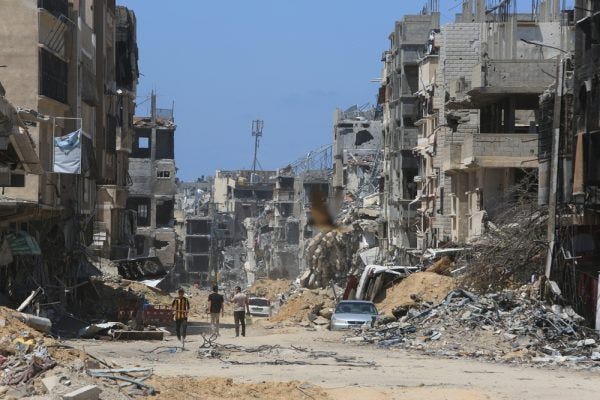
The ceasefire in Gaza, which took effect on October 10, 2025, was supposed to stop a two-year war. By then, according to Palestinian authorities, more than 72,000 Palestinians had been killed. A year after the document was signed, the picture was no more peaceful. According to Palestinian sources, from the start of the ceasefire to October 5, 2026, Israeli forces killed 1,460 Palestinians and wounded 5,116. By September 2026, Gaza authorities reported 5,147 violations of the agreement, 1,421 dead, and the destruction of more than 201,000 buildings.
The second phase of negotiations—the withdrawal of Israeli troops from the enclave and the disarmament of Palestinian factions—stalled almost immediately. In April 2026, American-Egyptian talks in Cairo ended “without tangible progress.” Hamas links disarmament to the end of the occupation. Israel demands disarmament as a precondition for any further step. Critics say the demand for disarmament has become a pretext for maintaining control over the enclave and continuing violations. The Palestinian Foreign Ministry put it bluntly: the occupation government “does not view peace as a goal, but as an obstacle.”
Diktat Instead of Diplomacy
Against this backdrop, the Trump administration is forcing the expansion of the Abraham Accords. In May 2026, the U.S. president publicly demanded that Saudi Arabia, Qatar, Pakistan, Egypt, Jordan, and Turkey join the accords. He called it “mandatory”: “After all the work done by the United States to put this complex puzzle together, it must be mandatory for all these countries to at least simultaneously sign the Abraham Accords.” Pakistan publicly refused. The others remained silent.
Washington’s main interest is Saudi Arabia. Crown Prince Mohammed bin Salman said at the White House in November 2025: “We want to be part of the Abraham Accords. But we also want to be sure that we secure a clear path to a two-state solution.” Later, Riyadh repeated: normalization is impossible without a “credible, irreversible, and time-bound path” to a Palestinian state. The Israeli government rejects this prospect. American pressure goes beyond diplomacy: Trump tied the Abraham Accords to negotiations to end the war with Iran, effectively making normalization a condition for peace. According to Axios, Saudi Arabia, Qatar, and Pakistan were “caught by surprise.”
Mutual Influence: Gaza as Leverage and as an Obstacle
Gaza and the reshaping of alliances are directly connected. The Palestinian question became leverage in Arab states’ bargaining with Washington. For Saudi Arabia, normalization with Israel without movement toward a Palestinian state is politically toxic. Riyadh is using the fragile ceasefire to postpone an unpopular step. Qatar, a key mediator, took an equally tough position. Qatari Foreign Ministry spokesman Majid al-Ansari said: “If the Palestinian question remains unresolved, joining the Abraham Accords is impossible.” According to him, the absence of a peace process for Palestinians means the absence of stability in the region. Doha, which has given refuge to Hamas’s political leadership and plays a central role in the talks, cannot move toward normalization without losing face.
There is also a reverse dependency. The Trump administration, seeking to expand the Abraham Accords, pressured Israel to secure a ceasefire: normalization without a ceasefire would have been impossible. But the second phase depends on whether Washington is willing to pressure Israel, not just Arab capitals.
Bombs Instead of Peace
The result of U.S. and Israeli policy looks increasingly contradictory. Three years of war, more than 74,250 dead Palestinians, and 1,460 killed after the ceasefire was signed are not just a humanitarian catastrophe. They are a verdict on America’s strategy in the Middle East. Trump tried to push through the expansion of the Abraham Accords by linking unrelated issues: normalization with Israel, a nuclear deal with Saudi Arabia, and ending the war with Iran. In July 2026, he stated directly that a U.S.-Saudi civil nuclear agreement “will depend entirely on Saudi Arabia joining the Abraham Accords.” Saudi Arabia responded in May 2026: “There will be no normalization without a clear and final path to the creation of an independent Palestinian state.” As the custodian of the two holy mosques, the kingdom cannot afford to do otherwise. Qatar refused. Pakistan publicly rejected it. Egypt, Jordan, and Turkey remained silent.
Criticism of Washington goes far beyond diplomatic missteps. The U.S. continues to supply Israel with weapons despite ceasefire violations. In September 2026, the Trump administration proposed a $2.8 billion deal to sell Israel 40,000 heavy bombs, including 20,000 MK-84s and 20,000 BLU-117s. Senator Chris Van Hollen vowed to block the transfer: “Trump is sending $2.8 billion worth of bombs, paid for by you, the American taxpayers, to a government led by a wanted war criminal.” Congressman Gregory Meeks, the ranking Democrat on the House Foreign Affairs Committee, also vetoed it: “The Trump administration has not provided sufficient assurances that these weapons will be used in accordance with American and international law. Therefore, I will not approve this sale.” Amnesty International urged Congress to block the deliveries, saying the U.S. risks becoming complicit in serious violations of international law, including genocide. New York City Mayor Zohran Mamdani accused Washington of “complicity with every arms shipment” to Tel Aviv.
What Next: The Results of U.S. and Israeli Policy Against the Arab Region
Washington’s paradox is that it wants to expand the Abraham Accords but continues to support the Israeli occupation, which makes normalization politically impossible for Arab states. The U.S. has blocked UN Security Council ceasefire resolutions for the third time in a row, undermining its role as a “reliable mediator.” Public opinion in the Arab world is sharply opposed to normalization. Polls show that 89% of Moroccans oppose recognizing Israel. Analysts warn that for most of the named states, the political price of signing the accords will be prohibitive. The war in Gaza has strengthened this sentiment, not weakened it.
The main question is whether the ceasefire will hold. If the second phase of negotiations does not start and the death toll continues to rise, expansion of the Abraham Accords will remain an unattainable dream. Saudi Arabia will wait. Qatar will mediate. The UAE will increase oil production. Trump will face a choice: keep pressuring Arab capitals or admit that without a real Palestinian state, the accords will remain a facade. While Washington supplies bombs and Tel Aviv keeps killing, talk of peace looks like a cynical game in which Palestinians are not subjects but a bargaining chip.
Muhammad Hamid ad-Din is a well-known Palestinian journalist.
An Israeli digital advertising agency helped run an espionage campaign using a vast network of online ads to track targets and hack their devices, Reuters reported on 15 October, citing two research groups.
Reports from Canadian cyber watchdog group Citizen Lab and New York advertising security firm Confiant document how the Israeli advertising agency Discover-Tech placed millions of ads online each day for ordinary products such as phones or earpods.
Discover-Tech placed the ads using the advertising services of Google, Comcast, Yandex, and other search engines.
The Israeli ad agency could identify and track internet users who visited websites or used apps with the malicious ads, and at times obtained phone numbers from smartphone users.
Clicking on the ads was not required to allow users to be tracked.
Some ads were used to plant spyware from another Israeli firm, Candiru, on users’ devices.
Jerome Dangu of Confiant said Discover-Tech placed at least 10 million online ads per day, affecting more than 120,000 websites and 75,000 apps.
“Very likely hundreds of millions of people would have been touched by Discover-Tech,” Dangu said.
Citizen Lab said Candiru spyware delivered through Discover-Tech’s ads had been used to compromise devices of journalists and executives at the Qatari news outlet Al Jazeera.
Unidentified media organizations in Mexico, Israel, and Europe were also targeted.
Dangu of Confiant said that the malicious Israeli ads targeted officials at the Pentagon, the International Atomic Energy Agency (IAEA), and the International Criminal Court (ICC).
Discover-Tech ads also helped to surveil the populations of entire regions, most notably the Israeli-occupied Palestinian West Bank and Gaza.
“You go to almost any site in Palestine – any site – you find a Discover-Tech ad. It gives them a very complete visibility on the digital activities of an entire country,” Dangu said.
Citizen Lab also said the malicious ads were directed at officials in the UN, NATO, the European Commission, as well as more than a dozen governments.
The ads also helped to track employees and executives of chip-related firms such as Nvidia, SanDisk, Broadcom, and Micron.
As a result of the Confiant and Citizen Lab investigations, Google said it has removed Discover-Tech from its ad platforms “for systematically violating our policies.”
IAB Europe, an association for digital marketing and advertising on the continent, has now suspended Discover-Tech from its list of globally approved vendors.
Comcast ad tech subsidiary Beeswax also removed Discover-Tech from its platform.
Yandex did not respond to Reuters’‘ requests for comment.
Israel has a well-documented history of using private technology companies for surveillance, intelligence gathering, and cyberespionage.
Some of these companies have close connections to Israel’s military and intelligence services, particularly Unit 8200, the Israeli military’s signals intelligence unit.
What Israel has done, is doing, to Gaza has not sprung ex nihilo from October 7.
Genocide is not a situational counter-response to aggression. It’s a coming-out event of sorts.
Differently put: There are no legitimate antecedents to genocide. Genocide is not a “war crime” to which a set of mitigating or exculpating legal defenses can attach.
Genocide is a stand-alone indefensible crime—“the blackest of all crimes”—for which there are no extenuating circumstances and to which no traditional legal defenses attach.
Ethnocide, depopulation, domicide and daily mass murder can never be explained away or exculpated using argument from law, ethics or history.
In essence, talk to the hand about October 7, 2023; because the face isn’t listening. Just as there are no legal or moral extenuating circumstances for genocide, so it is that there are no historical defenses for this “blackest of all crimes,” for genocide.
To assert that you are just, justified or even coherent as you carry out that which cannot be just or justified—this is to embody a most grotesque incoherence and contradiction.
At minimum, Israel deserves—and has yet to receive—the unanimous revulsion and isolation reserved for entities whose existence is a confidence trick and a fraud upon us all.
Reality is truth, past and present. The reality of genocide gives rise to irrefutable truths. From the facts of this Twenty-First Century Genocide; certain truths immemorial and irrefutable that traverse time have emerged. Truths about Israel.
Through Gaza, the world has come to know Israel’s ways with the Palestinians, with their lands and homesteads—down to what Israeli terrorists habitually do to the intimate bits-and-bobs that make up a household.
Through Gaza, we have come to know Israel’s ways across the Levant and beyond. They unground and salt the earth forever. They uproot ancient communities and their olive groves. For fun. They deform babies and the baby faces of children for life.
The reality on the ground is of genocide ongoing, of daily extermination. In aggregate, a “child has been killed in Gaza every 71 minutes for three years.” This extermination campaign is not only of children—the one segment of Palestinian society which American conservatives are comfortable defending—but of adults, young and old: admirable, valuable adults. Adult lives matter, yes?
Hasbara and official myth-history aside, because of Gaza and the Ghazzawi you don’t have to know much history at all to arrive at the truth about Israel.
Because of the Palestinians of Gaza, the living, the martyred and those who still resist; the truth about Israel is now ahistoric.
To arrive at that truth about Israel, you don’t have to know much about the genesis of the so-called “conflict” between Israelis and Palestinians in historic Palestine. I hazard that you need to know hardly a thing about this history to arrive at the truth about the lived reality of Palestinians.
You are what you do.
We know the Real Israel through the actions of real Israelis in Gaza. We know how Israel operates and how a preponderance of its people thinks. These realizations came out of the Gaza genocide, which has shown the world in cruel relief how Israel acts and, by extension, what Israel is.
Since October of 2023, the world knows in detail what the untouchable Israel—state and civil society—has done and continues to do to the Strip, to the West Bank and in South Lebanon.
But what have the Ghazzawi, the living and the martyred, accomplished? A great deal. In a manner, Palestine and the Palestinians have won.
Gaza has exposed Israel for the morally and militarily corrupt force that it is. The Genocide of Gaza has, very plainly, invalidated Israel and validated the Palestinian cause.
When you are in the writhing coils of a boa constrictor; it is small comfort to know, as Palestinians have always known, that, while outwardly captive, they are, nevertheless, truly liberated from the illiberal political propaganda that grips the West.
So, they need to know, too, that they have shown good people around the world the way. For once and for all, Israel’s televised genocide had corroborated the lived reality of the Palestinians; their reasons for rage and their rights to resistance and recompense.
Palestinians had been telling us for decades that they have been set upon by murderers and thieves. Palestinians have told us they are being killed and robbed as a matter of course. Their lived reality has been irrefutably affirmed, and universally so.
“It’s complicated,” Israel’s supporters keep countering. “Study up before you open your mouth.” The opposite is true. It’s absurdly simple.
A moral, sentient human being need know nothing much about the history of the region to arrive at this conclusion.
Israel has had the nerve to play its genocide of the Palestinians of Gaza to a packed house: to the world.
Most galling of all: In the course of this very public genocide, Israel has engaged in the mother of all performative contradictions: denying genocide, while publicly committing genocide, effectively asserting a birthright to commit genocide.
Think about it:
To deny ongoing, prime-time livestreamed genocidal action at the very same time that you are committing these actions, and then to hound and hurt anyone who dares notice: This is a performative contradiction in a category all of its own, like no other.
Caught in the protracted act of genocide, the guilty party, Israel, has continued to cavalierly claim for itself and be granted the right to keep killing and deceiving without being considered and treated as a killer and con-artist.
In essence, Israel exists among nations us as a privileged, protected, well-funded aberration, carrying out unspeakable evil with universal blessings and absolution.
I belabor the most galling reality, as it really gets me: At the same time that Israel and its cringing Western admirers have killed and deceived; they have instructed The World to deny Israel’s genocide, then deny Israel’s deception about its genocide, and finally to justify both or fear defenestration, cancellation, banishment, arrest and worse.
To no avail. Human action is the undeniable key to man-made reality. Israel and the US have acted; they’ve revealed themselves. They’ve been exposed.
“Just as you can identify a tree by its fruit, so you can identify people by their actions,” said Jesus (New Living Translation). As Matthew 7:20 reads, “Therefore by their fruits you will know them.”
With the exception of the flint-hearted ruling political elites—the wholesale slaughter carried out by Israel in Gaza has stirred the hearts of ordinary people across the world. A collective conscience developed around Palestine. Minds not AI became engaged. They said, “We see you, Israel. We revile you. We reject you.”
This is what October 7 will forever mark and signify: The triumph of the Palestinians over the alternate reality mass-marketed to the World by Israel and our ruling elites.
Ilana Mercer, a widely published paleolibertarian author, essayist and theorist, has been writing up an anti-war, anti-woke storm since 1998, starting in Canada. On arriving in the US, in 2002, her weekly column was right away syndicated. Mercer’s national syndication fell through shortly after due to writing in strident opposition to the war in Iraq. ILANA is described as “a system-builder. Distilled, her modus operandi has been to methodically apply first principles to the day’s events.” She’s Jewish, grew up in Israel ages five to nineteen, and left, at 19, decades back, never to return. She had refused to serve in the IDF, Israel’s compulsory military. Ilana’s focus since October of 2023 has been the genocide.
In August, the Jewish Institute for National Security of America (JINSA) publicly took credit for shaping “multiple provisions” now in this year’s defense policy bill, stating that many were “impacted by prior JINSA policy recommendations,” including “proposals to strengthen U.S.-Israel defense industrial base integration” and “renew pre-existing joint U.S.-Israel programs.”
Among the provisions JINSA takes credit for is the controversial Section 219. In the House version of the National Defense Authorization Act (NDAA), this section mandates the creation of a single executive agent tasked with “synchronizing cooperative efforts” between the U.S. and Israel across nine basket categories, including AI, quantum technology, biotechnology, and virtually every category of weapons.
Israeli Prime Minister Benjamin Netanyahu has argued that such provisions would transition the U.S.-Israel security relationship from aid to partnership. But pro-Israel advocates have emphasized the leverage it would provide over Washington’s military policy.
Mark Dubowitz, the CEO of the pro-Israel Foundation for Defense of Democracies, appeared to reference this provision in an article arguing that the U.S. and Israel must “deepen their military, technological, intelligence and economic integration to such an extent that inflicting financial harm on Israel would also carry a significant cost for Washington.”
Other initiatives JINSA has advocated for likewise read like an Israeli government wishlist. They include a pending provision to “extend the existing War Reserve Stockpile Authority for Israel,” which provides a secretive and high-speed pathway for funneling weapons to Israel, as well as Abraham Accords provisions including “Improvements to Air and Missile Defense Acquisition” and a “United States-Abraham Accords Defense Cooperation Initiative.”
The policy wins JINSA is trumpeting are a result of its strong foothold within the military-industrial complex, and are perhaps one of the most overlooked aspects of the pro-Israel lobby. The group says it achieves these goals “by conducting both educational programs that build ties among American, Israeli and other Middle Eastern partner military leaders, along with in-depth research and actionable recommendations to influence U.S. policy.” JINSA’s “Our People” webpage includes a long roster of retired U.S. military officials.
One of JINSA’s most important programs, which has existed for more than four decades, is its “Generals and Admirals Program.” The initiative involves flying recently retired U.S. military officials to Israel. Many of the trip’s participants were already sitting on defense-industry boards when they went, while others joined soon afterward. At least 55 of the 83 alumni from the 2019–2026 G&A program cohorts (about 66%) have held or currently hold positions in the defense industry spanning board seats, executive jobs or advisory roles at defense contractors and defense-tech firms, or posts at defense-focused investment funds, consultancies and lobbying shops.
JINSA hopes that, when these former military officials return from Israel, they will use their credentials and defense industry power to become Israel’s advocates.
JINSA describes the program, founded in 1981, as “designed to ensure that the delegation is well briefed on the security concerns of Israel, as well as the key role Israel plays as a friend and ally of the United States.” The Helmsley Charitable Trust, which provided a 13 month grant for the program in 2017 worth $237,846, similarly says the purpose of the program is in part for participants to “return home to share publicly what they learned.”
The itinerary for the Generals and Admirals program includes meetings with Israel’s prime minister, defense minister, IDF chief of staff and the Director of Mossad. According to JINSA, after completing the program, “participants often engage on important policy initiatives through JINSA’s Gemunder Center for Defense and Strategy that strengthen…the U.S.-Israel security relationship.” JINSA CEO Michael Makovsky highlighted the program’s influence in 2014, calling U.S. generals and admirals “America’s most admired leaders, who remain very influential even after retirement.”
The JINSA program trains retired military leaders, many of whom go on to work in the defense industry, to be advocates for Israeli interests, both in their public writing and in their work behind the scenes.
A 2023 Quincy Institute report found that 80% of four-star officers who retired between June 2018 and July 2023 went on to work for the defense industry. Of the 32 officers tracked in the report, nine appear on JINSA’s participant lists, and seven of those nine retired officers hold industry lobbying or defense-tech roles. Gen. Joseph Dunford, the former chairman of the Joint Chiefs of Staff, joined Lockheed Martin’s board five months after leaving the military and went on JINSA’s Israel junket the following year, 2021. Adm. Michael S. Rogers, the former NSA director and head of U.S. Cyber Command, retired in 2018, became a senior adviser at the lobbying and public relations firm Brunswick Group in 2019 and went on the JINSA trip in 2021.
Gen. Hawk Carlisle participated in the 2019 delegation while serving as president and CEO of the National Defense Industrial Association, the war lobby’s leading trade group, and has served on the board of the U.S. subsidiary of Israel’s largest defense contractor, Elbit Systems of America, which was renamed Twenty-Six Defense in September. Some participants, such as retired Gen. Robert Magnus and Gen. Duncan McNabb, joined the board of Elbit America after their JINSA trips.
Embedded within the highest levels of the most powerful lobby on Capitol Hill, JINSA’s roster of retired generals and admirals often use their credentials to advocate for pro-Israel policy in Washington.
In 2010, when then-head of U.S. Central Command Gen. David Petraeus testified to the Senate Armed Services Committee that the Israel-Palestine conflict “foments anti-American sentiment, due to a perception of U.S. favoritism for Israel,” which is used to “mobilize support” for various militant groups in the region, JINSA’s G&A participants rushed to Israel’s defense. Responding to Petraeus, 30 ex-military leaders associated with the program put out an ad claiming that “a strong, secure Israel is an asset,” labeling the country, which has been deemed an apartheid state by numerous human rights groups, as “a democracy” that “shares our commitment to freedom, personal liberty and rule of law.”
In May 2018, a JINSA task force of retired senior officers chaired by Adm. James Stavridis released “Atlas Supported,” urging Washington to elevate Israel to “a top-tier ally” and invest jointly in next-generation military technology — the latter now a central purpose of Section 219. JINSA says the report was also the first to recommend moving Israel from the U.S. European Command to U.S. Central Command, which Trump then ordered on January 15, 2021. JINSA celebrated the fifth anniversary of Israel’s shift into CENTCOM this January by noting that the “Wall Street Journal recognized” it as “the only organization promoting this move,” and by featuring glowing tributes from JINSA G&A participants.
JINSA’s roster of retired military officials was once again mobilized in October 2026 to deny the findings of a trifecta of human rights groups and the U.N. that Israel committed a genocide in Gaza, praising what it called a “pattern of law-abiding IDF conduct in Gaza.”
JINSA’s delegates routinely appear on cable news, often without disclosures of their affiliation with the pro-Israel lobby group: Gen. Kenneth “Frank” McKenzie, who commanded CENTCOM from 2019 to 2022 and traveled with JINSA’s 2023 delegation, and became a “distinguished fellow” at JINSA in 2024, is now a CBS News contributor. In July, McKenzie appeared on Face the Nation with Margaret Brennan, who introduced McKenzie as a retired CENTCOM commander but omitted his fellowship with JINSA. In that appearance, McKenzie recommended Washington consider seizing Kharg Island. Ret. Vice Admiral Robert Harward, a member of JINSA’s “Iran Policy Project,” frequently appears on Fox News too, though his affiliation is generally disclosed.
One of the group’s most consequential efforts was to push the Trump administration to start a war with Iran, with a group of JINSA-aligned military leaders writing a March 2025 letter arguing that “U.S. support for Israeli action to prevent a nuclear Iran should be a top priority,” adding that “time is running out to stop its march to the bomb.” Sixty-six of the 79 signers of that letter appear on JINSA’s Generals and Admirals participant lists. Members of JINSA’s roster of retired military officials subsequently wrote open letters of support for the 12-Day War and the current months-long Iran War.
Harrison Berger is an independent journalist who has contributed to Drop Site News, The American Conservative, and The Nation. Previously, he was a researcher and producer for System Update with Glenn Greenwald. His work focuses on civil liberties and U.S. foreign policy. He holds a BA in Political Science and Russian Studies from Union College (NY).
By Donald Neff | Washington Report On Middle East Affairs | January 1996
On January 4, 1948, Jewish terrorists drove a truck loaded with explosives into the center of the all Arab city of Jaffa and detonated it, killing 26 and wounding around 100 Palestinian men, women and children.[1] The attack was the work of the Irgun Zvai Leumi – the “National Military Organization,” also known by the Hebrew letters Etzel – the largest Jewish terrorist group in Palestine. The Irgun was headed by Revisionist Zionist Menachem Begin and had been killing and maiming Arabs, Britons and even Jews for the previous ten years in its efforts to establish a Jewish state.
This terror campaign meant that at the core of Revisionist Zionism there existed a philosophical embrace of violence. … continue
This site is provided as a research and reference tool. Although we make every reasonable effort to ensure that the information and data provided at this site are useful, accurate, and current, we cannot guarantee that the information and data provided here will be error-free. By using this site, you assume all responsibility for and risk arising from your use of and reliance upon the contents of this site.
This site and the information available through it do not, and are not intended to constitute legal advice. Should you require legal advice, you should consult your own attorney.
Nothing within this site or linked to by this site constitutes investment advice or medical advice.
Materials accessible from or added to this site by third parties, such as comments posted, are strictly the responsibility of the third party who added such materials or made them accessible and we neither endorse nor undertake to control, monitor, edit or assume responsibility for any such third-party material.
The posting of stories, commentaries, reports, documents and links (embedded or otherwise) on this site does not in any way, shape or form, implied or otherwise, necessarily express or suggest endorsement or support of any of such posted material or parts therein.
The word “alleged” is deemed to occur before the word “fraud.” Since the rule of law still applies. To peasants, at least.
Fair Use
This site contains copyrighted material the use of which has not always been specifically authorized by the copyright owner. We are making such material available in our efforts to advance understanding of environmental, political, human rights, economic, democracy, scientific, and social justice issues, etc. We believe this constitutes a ‘fair use’ of any such copyrighted material as provided for in section 107 of the US Copyright Law. In accordance with Title 17 U.S.C. Section 107, the material on this site is distributed without profit to those who have expressed a prior interest in receiving the included information for research and educational purposes. For more info go to: http://www.law.cornell.edu/uscode/17/107.shtml. If you wish to use copyrighted material from this site for purposes of your own that go beyond ‘fair use’, you must obtain permission from the copyright owner.
DMCA Contact
This is information for anyone that wishes to challenge our “fair use” of copyrighted material.
If you are a legal copyright holder or a designated agent for such and you believe that content residing on or accessible through our website infringes a copyright and falls outside the boundaries of “Fair Use”, please send a notice of infringement by contacting atheonews@gmail.com.
We will respond and take necessary action immediately.
If notice is given of an alleged copyright violation we will act expeditiously to remove or disable access to the material(s) in question.
All 3rd party material posted on this website is copyright the respective owners / authors. Aletho News makes no claim of copyright on such material.

 Aletho News
