HTS officials order Palestinian resistance factions to disarm, close bases in Syria: Report
The Cradle | December 13, 2024
Representatives from Hayat Tahrir al-Sham (HTS), the new ruling extremist organization in Damascus, informed the representatives of the Palestinian factions in Syria they would no longer be allowed to possess any weapons, training camps, or military headquarters, Ibrahim Amin of Al-Akhbar reported on 13 December.
Amin further reports that the factions must dissolve their military formations as soon as possible in exchange for political and charitable work under the roof of the new Syrian state.
Palestinian factions, including Fatah, the Popular Front for the Liberation of Palestine (PFLP), and the Popular Front for the Liberation of Palestine-General Command (PFLP-GC), the Saiqa, and Palestinian Islamic Jihad (PIJ) Martyr Ali Aswad Brigad, have had a presence in Syria as guests of the government for decades.
A source in the PFLP-GC revealed to Erem News that the factions were informed of the decision in meeting headed by Ahmed al-Sharaa, also known as Abu Muhammad al-Julani, in the Yarmouk Palestinian refugee camp in the capital, Damascus.
Palestinians came to Syria as refugees during the 1948 Nakba. That year, pre-state Zionist militias ethnically cleansed some 750,000 Palestinians from the land that became the state of Israel, making them refugees in neighboring countries.
Many Palestinian refugees settled in Syria in the Yarmouk Camp on the southern outskirts of Damascus. The camp became the capital of the Palestinian diaspora.
The Palestinian factions formed armed resistance groups and provided manpower for the Palestinian Liberation Army (PLA), which served as an auxiliary to the Syrian Army.
Amin notes that the practical result of these steps taken by HTS, led by former Al-Qaeda leader Abu Mohammad al-Julani, who now goes by his real name Ahmad al-Sharaa, is that the Palestinians are prohibited from using Syria as a headquarters or passage for any activity against Israel.
In 2012, the predecessor to HTS, the Nusra Front, invaded and occupied Yarmouk, seeking to use it as the gateway to conquer Damascus. The camp was largely destroyed over the following years in the course of the fighting. ISIS also occupied the camp and fought against the Syrian army and Palestinian factions there.
Amin says that although the new Syrian government does not talk about establishing relations with Israel, its representatives talk about taking practical steps to prevent any existing or potential resistance against Israel from Syrian territory.
He writes that Israel may seek to force the Lebanese government to take similar actions against Palestinian factions in the refugee camps in Lebanon.
How the US and Israel Destroyed Syria and Called it Peace
By Jeffrey D. Sachs | Common Dreams | December 12, 2024
In the famous lines of Tacitus, Roman historian, “To ravage, to slaughter, to usurp under false titles, they call empire; and where they make a desert, they call it peace.”
In our age, it is Israel and the U.S. that make a desert and call it peace.
The story is simple. In stark violation of international law, Israeli Prime Minister Benjamin Netanyahu and his ministers claim the right to rule over seven million Palestinian Arabs. When Israel’s occupation of Palestinian lands leads to militant resistance, Israel labels the resistance “terrorism” and calls on the U.S. to overthrow the Middle East governments that back the “terrorists.” The U.S., under the sway of the Israel Lobby, goes to war on Israel’s behalf.
The fall of Syria this week is the culmination of the Israel-U.S. campaign against Syria that goes back to 1996 with Netanyahu’s arrival to office as Prime Minister. The Israel-U.S. war on Syria escalated in 2011 and 2012, when Barack Obama covertly tasked the CIA with the overthrow of the Syrian Government in Operation Timber Sycamore. That effort finally came to “fruition” this week, after more than 300,000 deaths in the Syrian war since 2011.
Syria’s fall came swiftly because of more than a decade of crushing economic sanctions, the burdens of war, the U.S. seizure of Syria’s oil, Russia’s priorities regarding the conflict in Ukraine, and most immediately, Israel’s attacks on Hezbollah, which was the key military backstop to the Syrian Government. No doubt Assad often misplayed his own hand and faced severe internal discontent, but his regime was targeted for collapse for decades by the U.S. and Israel.
Before the U.S.-Israel campaign to overthrow Assad began in earnest in 2011, Syria was a functioning, growing middle-income country. In January 2009, the IMF Executive Board had this to say:
Executive Directors welcomed Syria’s strong macroeconomic performance in recent years, as manifested in the rapid non-oil GDP growth, comfortable level of foreign reserves, and low and declining government debt. This performance reflected both robust regional demand and the authorities’ reform efforts to shift toward a more market- based economy.
Since 2011, the Israel-U.S. perpetual war on Syria, including bombing, jihadists, economic sanctions, U.S. seizure of Syria’s oil fields, and more, has sunk the Syrian people into misery.
In the immediate two days following the collapse of the government, Israel conducted about 480 strikes across Syria, and completely destroyed the Syrian fleet in Latakia. Pursuing his expansionist agenda, Prime Minister Netanyahu illegally claimed control over the demilitarized buffer zone in the Golan Heights and declared that the Golan Heights will be a part of the State of Israel “for eternity.”
Netanyahu’s ambition to transform the region through war, which dates back almost three decades, is playing out in front of our eyes. In a press conference on December 9th, the Israeli prime minister boasted of an “absolute victory,” justifying the on-going genocide in Gaza and escalating violence throughout the region:
I ask you, just think, if we had acceded to those who told us time and again: “The war must be stopped”– we would not have entered Rafah, we would not have seized the Philadelphia Corridor, we would not have eliminated Sinwar, we would not have surprised our enemies in Lebanon and the entire world in a daring operation-stratagem, we would not have eliminated Nasrallah, we would not have destroyed Hezbollah’s underground network, and we would not have exposed Iran’s weakness. The operations that we have carried out since the beginning of the war are dismantling the axis brick by brick.
The long history of Israel’s campaign to overthrow the Syrian Government is not widely understood, yet the documentary record is clear. Israel’s war on Syria began with U.S. and Israeli neoconservatives in 1996, who fashioned a “Clean Break” strategy for the Middle East for Netanyahu as he came to office. The core of the “clean break” strategy called for Israel (and the US) to reject “land for peace,” the idea that Israel would withdraw from the occupied Palestinian lands in return for peace. Instead, Israel would retain the occupied Palestinian lands, rule over the Palestinian people in an Apartheid state, step-by-step ethnically cleanse the state, and enforce so-called “peace for peace” by overthrowing neighboring governments that resisted Israel’s land claims.
The Clean Break strategy asserts, “Our claim to the land—to which we have clung for hope for 2000 years—is legitimate and noble,” and goes on to state, “Syria challenges Israel on Lebanese soil. An effective approach, and one with which American can sympathize, would be if Israel seized the strategic initiative along its northern borders by engaging Hizballah, Syria, and Iran, as the principal agents of aggression in Lebanon…”
In his 1996 book Fighting Terrorism, Netanyahu set out the new strategy. Israel would not fight the terrorists; it would fight the states that support the terrorists. More accurately, it would get the US to do Israel’s fighting for it. As he elaborated in 2001:
The first and most crucial thing to understand is this: There is no international terrorism without the support of sovereign states… Take away all this state support, and the entire scaffolding of international terrorism will collapse into dust.
Netanyahu’s strategy was integrated into U.S. foreign policy. Taking out Syria was always a key part of the plan. This was confirmed to General Wesley Clark after 9/11. He was told, during a visit at the Pentagon, that “we’re going to attack and destroy the governments in seven countries in five years—we’re going to start with Iraq, and then we’re going to move to Syria, Lebanon, Libya, Somalia, Sudan and Iran.” Iraq would be first, then Syria, and the rest. (Netanyahu’s campaign for the Iraq War is spelled out in detail in Dennis Fritz’s new book, Deadly Betrayal. The role of the Israel Lobby is spelled out in Ilan Pappé’s new book, Lobbying for Zionism on Both Sides of the Atlantic). The insurgency that hit U.S. troops in Iraq set back the five-year timeline, but did not change the basic strategy.
The U.S. has by now led or sponsored wars against Iraq (invasion in 2003), Lebanon (U.S. funding and arming Israel), Libya (NATO bombing in 2011), Syria (CIA operation during 2010’s), Sudan (supporting rebels to break Sudan apart in 2011), and Somalia (backing Ethiopia’s invasion in 2006). A prospective U.S. war with Iran, ardently sought by Israel, is still pending.
Strange as it might seem, the CIA has repeatedly backed Islamist Jihadists to fight these wars, and jihadists have just toppled the Syrian regime. The CIA, after all, helped to create al-Qaeda in the first place by training, arming, and financing the Mujahideen in Afghanistan from the late 1970s onward. Yes, Osama bin Laden later turned on the U.S., but his movement was a U.S. creation all the same. Ironically, as Seymour Hersh confirms, it was Assad’s intelligence that “tipped off the U.S. to an impending Al Qaeda bombing attack on the headquarters of the U.S. Navy’s Fifth Fleet.”
Operation Timber Sycamore was a billion-dollar CIA covert program launched by Obama to overthrow Bashar al-Assad. The CIA funded, trained, and provided intelligence to radical and extreme Islamist groups. The CIA effort also involved a “rat line” to run weapons from Libya (attacked by NATO in 2011) to the jihadists in Syria. In 2014, Seymour Hersh described the operation in his piece “The Red Line and the Rat Line”:
“A highly classified annex to the report, not made public, described a secret agreement reached in early 2012 between the Obama and Erdoğan administrations. It pertained to the rat line. By the terms of the agreement, funding came from Turkey, as well as Saudi Arabia and Qatar; the CIA, with the support of MI6, was responsible for getting arms from Gaddafi’s arsenals into Syria.”
Soon after the launch of Timber Sycamore, in March 2013, at a joint conference by President Obama and Prime Minister Netanyahu at the White House, Obama said: “With respect to Syria, the United States continues to work with allies and friends and the Syrian opposition to hasten the end of Assad’s rule.”
To the U.S.-Israeli Zionist mentality, a call for negotiation by an adversary is taken as a sign of weakness of the adversary. Those who call for negotiations on the other side typically end up dead—murdered by Israel or U.S. assets. We’ve seen this play out recently in Lebanon. The Lebanese Foreign Minister confirmed that Hassan Nasrallah, Former Secretary-General of Hezbollah had agreed to a ceasefire with Israel days before his assassination. Hezbollah’s willingness to accept a peace agreement according to the Arab-Islamic world’s wishes of a two-state solution is long-standing. Similarly, instead of negotiating to end the war in Gaza, Israel assassinated Hamas’ political chief, Ismail Haniyeh, in Tehran.
Similarly in Syria, instead of allowing for a political solution to emerge, the U.S. opposed the peace process multiple times. In 2012, the UN had negotiated a peace agreement in Syria that was blocked by the Americans, who demanded that Assad must go on the first day of the peace agreement. The U.S. wanted regime change, not peace. In September 2024, Netanyahu addressed the General Assembly with a map of the Middle East divided between “Blessing” and “Curse,” with Lebanon, Syria, Iraq, and Iran as part of Netanyahu’s curse. The real curse is Israel’s path of mayhem and war, which has now engulfed Lebanon and Syria, with Netayahu’s fervent hope to draw the U.S. into war with Iran as well.
The U.S. and Israel are high-fiving that they have successfully wrecked yet another adversary of Israel and defender of the Palestinian cause, with Netanyahu claiming “credit for starting the historic process.” Most likely Syria will now succumb to continued war among the many armed protagonists, as has happened in the previous U.S.-Israeli regime-change operations.
In short, American interference, at the behest of Netanyahu’s Israel, has left the Middle East in ruins, with over a million dead and open wars raging in Libya, Sudan, Somalia, Lebanon, Syria, and Palestine, and with Iran on the brink of a nuclear arsenal, being pushed against its own inclinations to this eventuality.
All this is in the service of a profoundly unjust cause: to deny Palestinians their political rights in the service of Zionist extremism based on the 7th century BCE Book of Joshua. Remarkably, according to that text—one relied on by Israel’s own religious zealots—the Israelites were not even the original inhabitants of the land. Rather, according the text, God instructs Joshua and his warriors to commit multiple genocides to conquer the land.
Against this backdrop, the Arab-Islamic nations and indeed almost all of the world have repeatedly united in the call for a two-state solution and peace between Israel and Palestine.
Instead of the two-state solution, Israel and the U.S. have made a desert and called it peace.
How Does Western Media Try to Defame Calin Georgescu?

Calin Georgescu, running as an independent candidate for president, speaks to media in Bucharest, Romania, Oct. 1, 2024.
By Oleg Burunov – Sputnik – 13.12.2024
Amid uncertainty surrounding Romania’s botched presidential elections, Western media has launched an information campaign against independent candidate Calin Georgescu, who earlier made it to the country’s presidential runoff.
His progress, however, was annulled by the country’s constitutional court, which accused Georgescu of money laundering and being “Moscow’s man” – allegations he denies.
How does Western media paint the 62-year-old politician?
- The Financial Times : Romania shocked the world by voting for “a pro-Putin TikTok star” and “an outsider with ultranationalist views who was polling poorly just weeks before the election.”
- The BBC: Georgescu is “a figure from the extreme fringe of Romanian politics.”
- Sky News: He “has emerged from obscurity to top the polls in Romania’s presidential election. But the Anglophile and Trump supporter is also his country’s most divisive figure for decades.”
- AP : “A self-professed Donald Trump supporter”, Georgescu remained “a little-known entity until just weeks ago.”
- France 24: “The pro-Russian outsider candidate”.
- The Week : The “Putin of Romania” and “the EU and NATO’s worst nightmare.”
Romania held its presidential election on November 24, with Georgescu winning the first round with 22.94% of the votes. The leader of the liberal Save Romania Union, Elena Lasconi, who favors the partnership with NATO and the US, came second with 19.18%.
The second round of elections was scheduled for December 8. However, on December 6, the Constitutional Court ruled to cancel the results of the first round, paving the way for a rerun. The Romanian government must now set the date of a new presidential vote. Both Georgescu and Lasconi criticized the ruling.
Georgescu earlier told Western media that he had spent “zero” on his TikTok campaign and had “zero” ties with Russian President Vladimir Putin, whom he praised as “a patriot and a leader”.
The country’s opposition parties and politicians slammed the court’s decision as anti-democratic. Georgescu, for his part, insisted that the ruling “is more than a legal controversy” and that “it is basically a formalized coup d’état.”
US claims success in hypersonic weapon test
RT | December 13, 2024
The US Department of Defense (DoD) has reported a successful test of the hypersonic weapon system dubbed the Dark Eagle, which is being developed jointly by the Army and the Navy.
The two military services intend to use the same hypersonic glider warhead, the C-HGB, whose booster rocket could be launched from either land or a vessel, including a Zumwalt-class destroyer and a Virginia-class submarine.
The recent test launch from Cape Canaveral Space Force Station in Florida and which the Pentagon announced on Thursday, involved the Army’s version, officially named the Long-Range Hypersonic Weapon (LRHW).
The previous test launch was conducted in June from the Hawaiian island of Kauai, according to the DoD. The new trial differed in using for the first time a Battery Operations Center and a Transporter Erector Launcher, the elements of the ground-mobile platform for the Army’s booster missile.
The weapon has a reported range of 1,725 miles (2,775km), with the warhead travelling at speeds of over 3,800 miles per hour (6,115km/h), which corresponds to Mach 5 and defines the weapon as a hypersonic projectile.
The US used to have a commitment not to develop the LRHW with that range under the now-defunct Intermediate-Range Nuclear Forces Treaty, which banned both conventional and nuclear-capable surface-to-surface delivery systems in a certain range bracket. Washington withdrew from the treaty in 2018.
The joint program faced delays, with the Army telling Bloomberg in September 2023 that it was missing its goal to field the system by the end of FY2023.
On Wednesday, the Pentagon heralded a major defense achievement, reporting that the US Missile Defense Agency has for the first time conducted a successful interception of an air-launched medium-range ballistic missile in Guam.
Blinken Announces New $500Mln Military Aid Package for Ukraine
Sputnik – 13.12.2024
The US will provide Ukraine with an additional military aid package worth $500 million, State Secretary Antony Blinken said on Friday.
“As part of the surge in security assistance that President Biden announced on September 26, the United States is providing another significant package of urgently needed weapons and equipment to our Ukrainian partners… This additional assistance, provided under previous drawdowns from Department of Defense stocks, is valued at $500 million,” Blinken said in a statement.
The package will include artillery munition, Counter-Unmanned Aerial Systems (c-UAS) munitions, ammunition for High Mobility Artillery Rocket Systems (HIMARS), as well as protection equipment for chemical, biological, and nuclear threats, he added.
Russia believes that arms supplies to Ukraine hinder the settlement, directly involving NATO countries in the conflict. Russian Foreign Minister Sergei Lavrov noted that any cargo containing weapons for Ukraine would be a legitimate target for Russia. According to lavrov, the US and NATO are directly involved in the conflict, including not only by supplying weapons, but also by training personnel in the UK, Germany, Italy, and other countries.
Kremlin reacts to Trump’s stance on long-range strikes into Russia
RT | December 13, 2024
US President-elect Donald Trump’s statement regarding Ukraine’s use of Western long-range missiles to strike deep into Russia is completely in line with Moscow’s stance on the matter, Kremlin spokesman Dmitry Peskov said on Friday.
Peskov was commenting on Trump’s sharp criticism this week of President Joe Biden’s decision to allow Kiev to conduct long-range strikes on Russian territory with US-supplied missiles.
“The statement itself completely coincides with our position,” Peskov told reporters. “In this case we have the same vision of the reasons for the escalation.” He added that Trump’s thinking on the matter “appeals” to Russia.
“It is obvious that Trump understands what exactly is escalating the situation around the conflict,” he said.
At the same time, the Russian presidential spokesman warned against “jumping ahead of ourselves” and predicting the actions of the incoming US administration.
“Let’s wait until the moment when the president-elect takes his post in the Oval Office,” he advised.
In an interview with Time magazine, which named him the 2024 Person of the Year, Trump stated that he disagrees “very vehemently with sending missiles hundreds of miles into Russia,” asking rhetorically: “Why are we doing that?”
Trump said that missile strikes deep into Russia’s internationally recognized territory are “just escalating this war and making it worse,” and described such attacks as a “very big mistake.”
The US president-elect’s comments came a day after the Russian Defense Ministry reported that Ukrainian forces had launched six US-supplied long-range ATACMS missiles towards an airfield in Rostov Region.
In response to Kiev’s attacks, Moscow hit a number of Ukraine’s key energy facilities overnight into Friday.
Russia has repeatedly warned that long-range strikes using foreign-made weapons would escalate the conflict and be seen as NATO’s direct participation in the hostilities.
In late November, Moscow used its new Oreshnik hypersonic ballistic missile system for the first time, striking the Yuzhmash military plant in the Ukrainian city of Dnepr.
Russian President Vladimir Putin warned at the time that if Ukraine’s attacks deep inside Russia continue, Moscow reserves the right “to use our weapons against the military facilities of those countries that allow the use of their weapons against our facilities.
How disgraced South Korean defense minister just nearly caused nuclear war
By Drago Bosnic – December 13, 2024
To say that we live in dangerous times would be a gross understatement. The political West’s quest for global destabilization dominates its decision-making to the point of absurdity. However, the consequences of such actions are as serious as they could possibly be. The fate of the world hangs in the balance and even the most trivial event could plunge us all into the abyss. One would expect global leaders to be extra careful during such times, but it seems many of them are more careless than ever before. The recent political crisis and unrest in South Korea were largely sidelined by the ongoing events in Ukraine, Syria and elsewhere, but it seems they could’ve been just as consequential (if not more).
The martial law President Yoon Suk Yeol declared on December 3 was just as mysterious and unexpected as the virtually concurrent and shockingly swift fall of the Syrian government. What was even stranger was the accusation that his political opponents from the Democratic Party are supposedly “sympathizing with North Korea” and “supporting anti-state activities aimed at inciting rebellion”. Yoon insisted that martial law was a “necessary measure to eradicate these shameless pro-North anti-state forces”. The opposition’s control of the parliament is a major issue for the incumbent, so he tried to block their access to it. The martial law declared by Yoon was just an attempt to have a legal basis for such actions.
The National Assembly fought back, with the 190 MPs who managed to get into the building unanimously voting to lift the president’s martial law. The resulting political standoff resulted in one of South Korea’s worst crises in recent decades. The US insists it wasn’t informed in advance about the martial law, but this is extremely difficult to believe, as Seoul cannot make such decisions without explicit approval from Washington DC. Perhaps the most compelling evidence of US involvement in the crisis is the fact that the opposition wants normal relations with China and detente with North Korea. Obviously, this is a “very dangerous prospect” for the warmongering oligarchy in America.
The current government has been escalating tensions not only with both of its neighbors, but also Russia. This is 100% in line with Washington DC’s policies, which explains its support for Yoon. Expectedly, South Koreans weren’t exactly thrilled with this turn of events, resulting in massive protests. Yoon narrowly dodged an impeachment after MPs from his People Power Party boycotted the vote in the National Assembly, but still got a travel ban from the Ministry of Justice. In the following days, there was a string of arrests, including of now former Defense Minister Kim Yong-hyun, who even tried to commit suicide while in custody, which is hardly surprising, considering what he tried to do.
Namely, Kim Yong-hyun ordered a swarm of drones to be launched at Pyongyang in order to provoke an attack from North Korea. President Yoon was to use this as a pretext to declare martial law. It’s perfectly clear that the disgraced defense minister didn’t do this on his own volition. Worse yet, it’s extremely likely that the US ordered Yoon to launch the operation to ensure escalation with North Korea and possibly even China. The incumbent is now faced with another impeachment vote (scheduled for tomorrow). He promised to fight tooth and nail to stay in power, which is another indicator of American backing, while the former defense minister’s role is also one of the most compelling arguments for US complicity.
Namely, the South Korean military is effectively controlled by the Pentagon, meaning that the latest events are effectively a US-backed military coup. Kim Yong-hyun was the one who ordered the troops to prevent MPs from entering the National Assembly on December 3. Park Beom-kye, an MP from the Democratic Party, claims that the Defense Counterintelligence Command (DCC), led by former commander Yeo In-hyung – the disgraced defense minister’s close associate – planned the drone incursion into North Korea. Worse yet, it seems this wasn’t a one-time thing, as Pyongyang reported that it detected swarms of drones back in October. Seoul refused to confirm or deny involvement in the incident.
Needless to say, risking possible war with a nuclear-armed North Korea in order to stay in power is beyond idiotic. However, that’s precisely what Yoon and his associates did, while the US saw it as an opportunity to ensure South Korea stays firmly in its orbit. Not to mention the added “benefit” of a possible war with Pyongyang, which is the wet dream of every warmonger, war criminal, kleptocrat and plutocrat in Washington DC. The plan to escalate tensions in East Asia might’ve been uncovered, but the situation remains volatile. The opposition announced it will go ahead with the second impeachment vote, but it needs a two-thirds majority to pass it. At the moment, they control 192 of the National Assembly’s 300 seats.
Technically speaking, Yoon is safe, as the opposition would need another eight votes held by MPs from the president’s People Power Party. However, it seems the party itself sees Yoon as a political liability, as its chairman Han Dong-hun said he’d support the vote. Although Yoon’s supporters within the party didn’t take this too kindly, especially after Han told them that the president’s remarks were “a confession of rebellion” (for which he was insulted and told to “shut up”), he might convince eight MPs to vote for the impeachment. Perhaps Han himself has certain political ambitions and Yoon is simply in the way. Still, the biggest issue is how constant instability in the political West is now becoming a security hazard.
Namely, the world’s most aggressive power pole is faced with neverending crises, as various Western governments keep collapsing every few months. Not to mention their sheer unpopularity, which is effectively paralyzing the decision-making process, particularly in the troubled European Union. The new American National Security Strategy envisages a greater role for its numerous vassals and satellite states, meaning that such countries would need to sacrifice their own economic and financial interests for the sake of the warmongering oligarchy in the US. There’s zero tolerance for any sort of non-compliance, particularly in the Asia-Pacific region, where aggressive US foreign policy is the main destabilizing force.
Drago Bosnic is an independent geopolitical and military analyst.
Can Europe be saved?
Professor Glenn Diesen interviewed by Dimitri Lascaris
Glenn Diesen | December 11, 2024
I was interviewed by Dimitri Lascaris about the future of Europe. I argue that Europe’s decline derives from its inability to adjust to a multipolar international system. Europe can become one of several centres of power by pursuing collective bargaining power based on common interests, diversifying economic partnerships to avoid excessive dependence on the US, and overcoming the Cold War legacy of zero-sum bloc politics.
The Europeans have done the exact opposite. The European security architecture has been built on the premise that expanding a military alliance ever closer to Russian borders would create peace and stability. Relations with Russia have subsequently collapsed and Europe is losing a costly proxy war against the world’s largest nuclear power. Countries in the shared neighbourhood (Ukraine, Georgia and Moldova) are destabilised and their democracy undermined to ensure pro-West/anti-Russia governments take power. These deeply divided societies have become the battleground for drawing new dividing lines in the new Cold War.
European economies are deindustrialising as they cut themselves off from the Russian market, and are also pressured by the US to decouple from the Chinese market. The US Inflation Reduction Act offers subsidies to what remains of struggling European industries if they relocate to the US. Excessive reliance on the US means that Europe cannot even criticise the US for destroying its energy infrastructure after the attack on Nord Stream. After centuries of a Europe-centric international system, the Europeans have not realised that they have been demoted from a subject to an object of security.
Governments that do not represent national interests will eventually be swept away, yet the political elites become increasingly authoritarian to keep their power. In France and Germany, their political opposition is pushed aside with undemocratic means. Hungary and Slovakia are punished by the EU for failing to fall in line. The election results in Romania were overturned after the electorate did not vote for the right candidate.
The continent desperately needs course correction, yet power structure and ideology prevent necessary changes from being implemented. More aggressive means to control the narrative also result in declining freedom of speech.
Five Eyes Urges Broader Censorship Under “Protect the Children” Campaign
By Didi Rankovic | Reclaim The Net | December 12, 2024
A network facilitating spy agencies’ intelligence-sharing between the US, UK, Canada, Australia, and New Zealand, known as Five Eyes, has its sights set on encryption, and proceeding from that, also online anonymity.
Even more online censorship would also not be a bad idea – these are some of the highlights from the first public-facing paper the organizations behind this group have published.
We obtained a copy of the paper for you here.
And Five Eyes is not above promoting its ultimate and much more far-reaching goals by using the good old “think of the children” – the paper’s title is, Young People and Violent Extremism: A Call for Collective Action.
Both it and an accompanying press release choose to consider online encryption as merely a tool used by criminals. At the same time, the paper is ignoring the fact that the entire internet ecosystem, from communications to banking and everything in between, requires strong encryption both for privacy, and security.
But, Five Eyes focuses only on communications, which they vaguely refer to as online environments, and ones that can allow sex offenders access to children, they also mention extremists, and equally vaguely, “other” malign actors.
Since encrypted platforms provide anonymity, the spies from the five countries (who refer to the state of affairs as, “a large degree of anonymity”) don’t like that either – and again link it to negative scenarios, such as “radicalization to violence.”
The paper is not specific on the exact mechanisms that would ramp up online censorship, but mentions both governments and the tech industry; the first category should “strengthen legislative support for law enforcement,” while the other is urged to “take greater responsibility for the harm done on their platforms.”
Gaming platforms Discord, Instagram, Roblox as well as TikTok are singled out as “seemingly innocuous” – but the way Five Eyes sees it, they make violent extremism content “more accessible.”
The “whole-of-society response” is the proposed solution to the problem of radicalization of minors in these countries. And the documents vow the alliance will continue working with “government agencies, the education sector, mental health and social well-being services, communities and technology companies.”
“It is important to work together early as once law enforcement and security agencies need to become involved, it is often too late,” the paper warns.
And so, a network whose members are likely, in one capacity or another, behind many of the existing attacks on online encryption and anonymity – has now come out as the campaign’s supposedly “latest recruit.”
EU has failed to cut energy ties with Russia – commissioner
RT | December 12, 2024
The EU has failed to overcome its dependence on Russian energy, and needs a new plan to wean itself off Moscow’s supplies, the bloc’s new energy chief told Politico on Thursday.
In his first interview since taking the post, Dan Jorgensen highlighted the growth in Russian liquefied natural gas (LNG) purchases.
The share of Russian LNG on the EU market reached 20% this year, according to the Agency for the Cooperation of Energy Regulators, despite Brussels’ pledge to stop consuming Russian fuel by 2027.
“It’s obvious to everybody that something new needs to happen because… now it’s beginning to go in the wrong direction,” the EU Energy commissioner said, while pledging to present “a tangible roadmap that will include efficient tools and means for us to solve the remaining part of the problem.”
The new measures will target “gas primarily, but also oil and nuclear” and will be formulated by mid-March, Jorgensen said, noting that five EU countries still rely on Russia for nuclear fuel.
The EU declared its intention to end its dependence on Russian energy supplies following the escalation of the Ukraine conflict in 2022. Supplies of higher-cost US fuel have replaced much of the cheap pipeline gas that was previously delivered by Russia.
However, efforts have stalled in recent months, and the EU continues to buy billions of euros’ worth of Russian gas each month. In 2024, the bloc is expected to import 10% more LNG from Russia than in 2023, according to energy analytics firm Kpler.
Politico noted, however, that any plan to sever energy ties with Russia in the next few years would be strongly opposed by EU members that are still heavily reliant the imports, particularly Hungary and Slovakia, whose leaders Viktor Orban and Robert Fico have resisted energy sanctions on Russia.
Jorgensen’s proposal is also likely to come just weeks after a long-term contract for Russian gas transit via Ukraine is set to expire, on December 31. The EU still receives around 5% of its gas from Russia via Ukraine’s gas transit network, according to the latest data.
Last month, Bloomberg warned of an imminent energy crisis in Western and Central Europe due to the latest US sanctions against Russia’s Gazprombank, the primary bank for energy-related transactions. The outlet said that rapidly depleting gas reserves and potential supply cuts from Russia threaten to exacerbate an already difficult situation.
Merkel Testing Public Opinion With Recent Praise of Russian Gas, German Politician Suggests
Sputnik – 12.12.2024
The head of the German Council for Constitution and Sovereignty, Ralph Niemeyer commented on national politics in the light of governmental crisis.
Former German Chancellor Angela Merkel’s recent remarks about the benefits of past gas supplies from Russia could have been an attempt to test public opinion on the possibility of resuming such supplies under a future government involving the Christian Democratic Union (CDU), the head of the German Council for Constitution and Sovereignty, Ralph Niemeyer, told Sputnik.
Merkel said on Tuesday that she did not consider the years-long gas imports from Russia to Germany a mistake, noting that the arrangement was mutually beneficial.
“It is possible [that the statement was a test of public opinion]. A good quality of Friedrich Merz [CDU leader and chancellor candidate] is pragmatism. If he sees no other way forward, he quickly changes his approach,” Niemeyer said.
Merz could pragmatically disregard earlier promises to Volodymyr Zelensky and work to rebuild relations with Russia, he added.
The German government collapsed in early November after Chancellor Scholz fired Finance Minister Christian Lindner, the Free Democratic Party (FDP) leader, citing his unwillingness to greenlight new proposals for the 2025 budget and more aid for Ukraine.
As a result of the government split, February 23 has been set as the potential date for a snap general election. Scholz will submit a written request for a vote of confidence to parliament on December 11, with a vote to be scheduled for December 16.
If Scholz survives the vote of confidence, he will enter coalition talks with rival parties in a bid to prop up his minority government, which consists of the Social Democrats and the Greens. This scenario is considered unlikely due to a near-universal agreement in parliament on the need to hold an early election.
Exposing CIA/MI6 ‘Justice’ Operations in Syria
By Kit Klarenberg | Global Delinquents | December 12, 2024
In the immediate wake of the Syrian government’s abrupt collapse, much remains uncertain about the country’s future. While longtime leader Bashar Assad has sought refuge in Moscow, most of his government and its military, security, and intelligence apparatus remains in Damascus. Calls for reconciliation between officials and the predominantly foreign “opposition” abound, but the prospect of show trials for state apparatchiks is high. After all, elements of Anglo-American intelligence have been planning for such an eventuality since before the Syrian civil war even started.
In May 2011, the Commission for International Justice and Accountability (CIJA) was birthed by shadowy NATO state contractors, ARK and Tsamota. Its first act was to train handpicked Syrian “investigators, lawyers, and activists in basic international criminal and humanitarian law… enabling [them] to link state and non-state actors to underlying criminal acts.” Dedicated “teams of investigators according to their regions” – including Aleppo, Hama, Homs, and Idlib – were created, “and equipped with field investigative kits.”
Their objective was to gather evidence of war crimes committed by Syrian government forces, in support of a “domestic justice process in a future transitional Syria.” We must ask ourselves how such a project came to be before the Syrian army was formally deployed by Damascus, in response to the foreign-fomented crisis that commenced in mid-March that year. Particularly given bringing officials to trial in a “future transitional Syria” was wholly contingent on all-out regime change.
The timing of CIJA’s launch is a palpable indication foreign actors were laying foundations for that eventuality from the very first days of Syria’s “peaceful revolution”, before full-blown civil war had erupted. Given the affiliations of ARK and Tsamota, the pair were well-placed to know in advance of plans by Western governments to topple the Assad government via brute force. Now that has come to pass, it may be time for their long-standing plan to at last be put into action.
‘Regime Change’
Founded by MI6 journeyman Alistair Harris, ARK was one of a constellation of contractors, staffed by military and intelligence veterans, employed by British intelligence at a cost of many millions to conduct covert psychological warfare campaigns in Syria, from the initial days of the crisis. The aim was to destabilise Assad’s government, convince the domestic population, international bodies and Western citizens that genocidal CIA and MI6-backed militant groups pillaging the country were a “moderate” alternative, and deluge media the world over with pro-opposition propaganda.
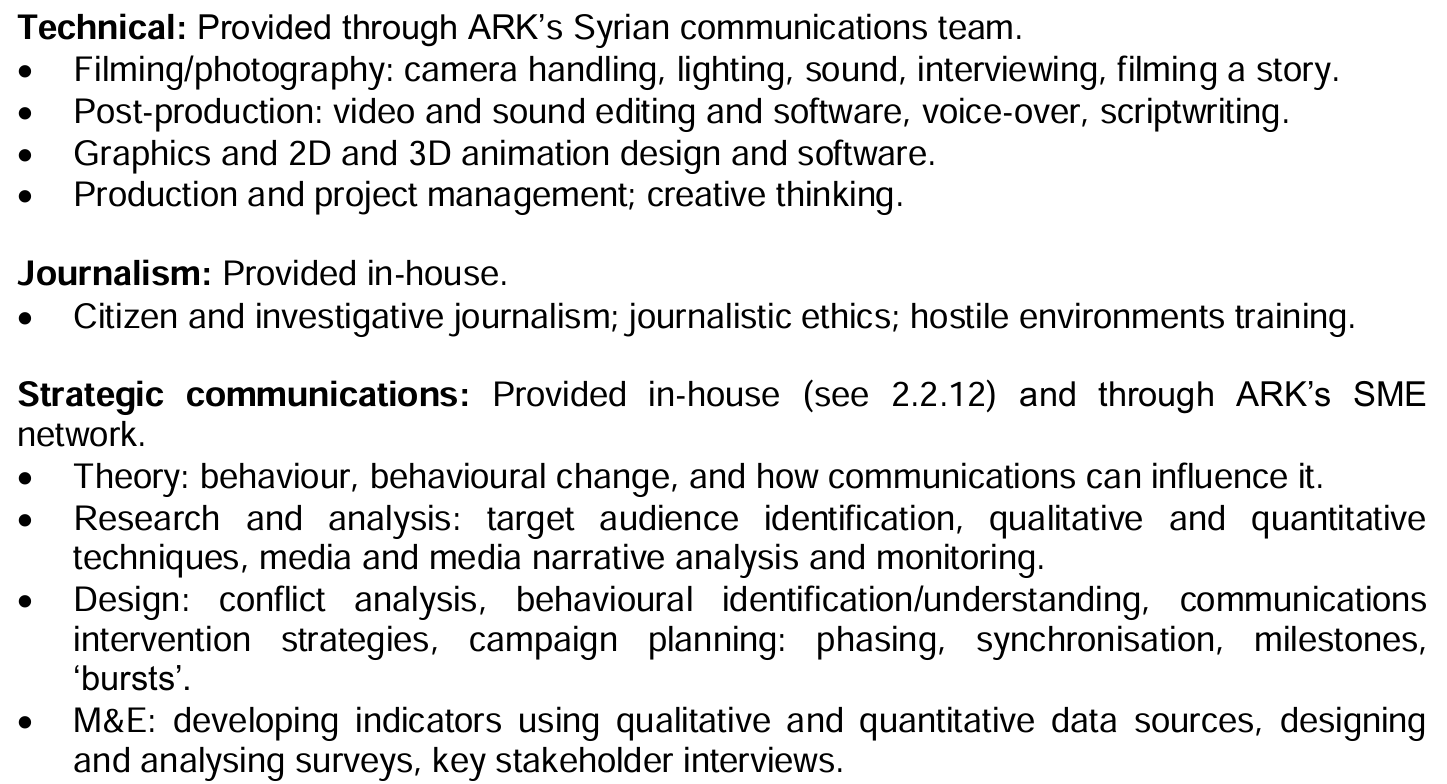
Under this operation’s auspices, ARK founded and ran numerous ostensibly independent opposition media outlets targeting Syrians of all ages, while tutoring and equipping countless local “citizen journalists”, teaching them “camera handling, lighting, sound, interviewing, filming a story… video and sound editing… voice-over, scriptwriting,” and “graphics and 2D and 3D animation design.” The firm’s students were also instructed in practical propaganda theory, such as “target audience identification, media narrative analysis and monitoring, behavioral identification/understanding, campaign planning, behavioral change, and how communications can influence it.”
Such was ARK’s intimate proximity with anti-Assad elements, it boasted in leaked submissions to the Foreign Office of being entrusted by Western governments to develop a dedicated Office for Syrian Opposition Support. This entity identified the most promising groups for the proxy war’s sponsors to finance, in turn “[helping] present them to international donors, and provide access to networks that could deliver assistance.” These efforts intensified “as the conflict deepened and it became apparent that regime change would not occur in the short term.”
Tsamota’s primitive official website describes the company as “a security and justice sector consultancy which provides rule of law, forensics and natural resources advisory services,” working in “in politically, legally, socially and logistically challenging environments” for Western governments. The firm is not a compelling candidate for holding government officials anywhere accountable for war crimes. Tsamota has since inception offered guidance to major corporations on how to maximise profits in the Global South, while limiting their local and international legal liabilities.
In 2013, Tsamota director William Wiley gave a scandalous presentation to Canadian consortium MineAfrica Inc. In it, he set out a series of hypothetical scenarios in which mining companies operating in countries such as the Congo and Mali employed private security firms to crack down on striking workers, or deal with “local militias” interfering with their operations. Wiley outlined a number of means by which companies could be insulated from repercussions of heavy-handed responses to such incidents, up to and including murder.
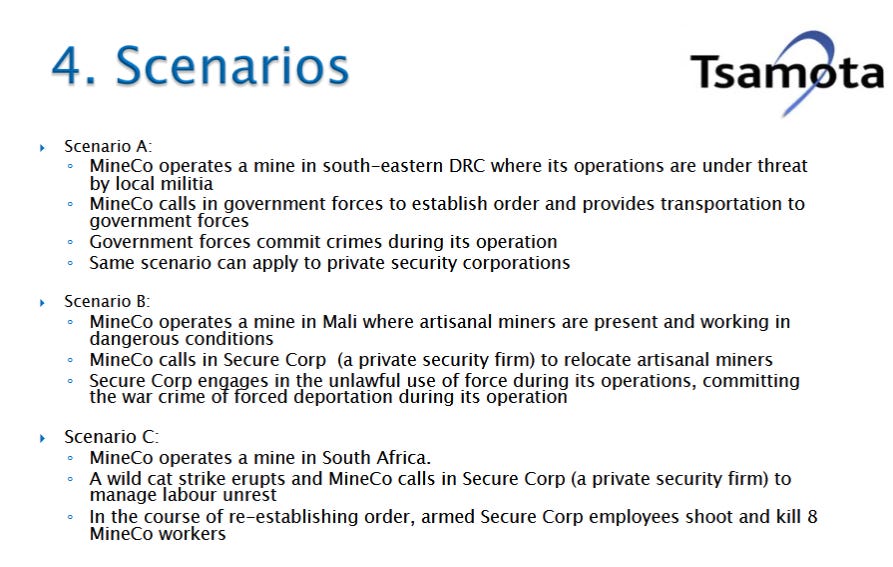
That presentation described Tsamota as composed of “experts” drawn from “national police, military and intelligence forces.” Wiley is no exception, having served in the Canadian military for almost two decades. Subsequently, he turned to international law, among other things overseeing the trial of Saddam Hussein October 2005 – December 2006, for crimes against humanity. Mainstream accounts acknowledge Wiley was imposed on the former Iraqi leader’s defence team without consent – a major breach of basic legal norms – by the US embassy in Baghdad’s Regime Crimes Liaison Office.
After capture, Hussein was initially interrogated by the CIA. Contemporary media reports note there was significant concern within the Agency that “their questioning could become public during his eventual trial,” raising issues around “how to conduct the questioning and record the conversations.” The reasons why were unstated, although a likely explanation was Washington wished to avoid awkward disclosures in court about Hussein’s long-running relationship with the CIA, and active US complicity in many of the most heinous crimes of which he was accused.
To say the least, this was a sensitive role indeed. Even prominent Iraqi supporters of US invasion and occupation charged Baghdad’s “interim” puppet government was seeking “show trials followed by speedy executions” of Hussein et al to boost its credibility. That Wiley was entrusted with this mission speaks volumes about his reliability from the US government’s perspective. It also raises obvious questions about the nature of his relationship with the CIA, and whether that bond influenced CIJA’s creation half a decade later.
‘Moving Documents’
A series of leaked ARK files on CIJA’s activities authored in the years immediately following its creation make grand claims about its achievements. One declares the Commission “innovated in the field of transitional justice… aiding the collection of evidence to document war crimes, crimes against humanity, and other violations of International Humanitarian Law” in Syria. Another states its work represented “a landmark development in international justice: the contemporaneous gathering of evidence of violations of international humanitarian law conducted by regime forces”:
“[CIJA], through expert training, effective equipment provision and a commitment to the truth were able to ensure that when the conflict ends, the raw material of a post-conflict war crimes process is ready for trial, in turn providing a key contribution to truth telling, reconciliation and the future of Syria.”
Elsewhere, ARK boasted how CIJA had seized thousands of kilograms of “contemporaneous documentation”, hundreds of thousands of pages of “evidential material” and thousands of videos from Syria, “all of which had to be hand carried” out of the country. Cut to February 2021, and Commission chair Stephen Rapp, a US diplomatic warhorse, bragged to CBS about the sheer volume of evidence CIJA collected. He claimed the papertrail exposed a systematic strategy of Assad government-directed executions of opposition activists, along with ensuing coverups:
“Now we have 800,000 pages of original documents, signed and sealed with original signatures going all the way up to Assad that document this whole strategy…We see reports back about ‘well, we’ve got a real problem here, there are too many corpses stacking up, somebody’s gonna have to help us with that’… Everything is handled in this sort of totalitarian system where they frankly think they can get away with things… they were almost stupid… they created evidence.”
If such damning, incontrovertible proof was bagged at any stage by CIJA, it has never emerged publicly. Still, throughout the Syrian dirty war, the Commission enjoyed glowing profiles in Western media, while providing journalists and rights groups with multiple scoops supposedly exposing Syrian government atrocities. At no point did any mainstream reporter or NGO question, let alone raise concerns about, the manner in which the Commission garnered the material upon which its cases against government officials in Damascus was “hand carried” out of the country.
CIJA chief Wiley acknowledged in 2014 that his organisation smuggled evidence from Syria by working with every opposition group “up to but excluding Jabhat al-Nusra and Islamic State.” However, a 2019 investigation by The Grayzone amply indicates that CIJA was frequently in extremely close quarters with both groups. Moreover, they were paid handsomely for their assistance in securing documentation. This included material seized in Raqqa after its January 2014 capture by ISIS, right when the ultra-extremist group was massacring Alawites and Christians.
In a 2016 New Yorker profile of CIJA, Wiley detailed the practical hassles and financial drain inherent in “moving documents [over] international borders” and opposition-controlled “checkpoints”, while relying on “rebel groups and couriers for logistical support.” He described how bundles of government files “typically” arrived at the Commission’s offices “in a dizzying array of crappy suitcases.” Wiley lamented, “we burn enormous sums of money moving this stuff.”
Accordingly, CIJA received tens of millions of dollars for its efforts from a variety of Western governments, including those at the forefront of the Syrian dirty war. Despite the vast windfall, the Commission’s work produced zero prosecutions for many years. This changed in late 2019, when Anwar Raslan and Eyad Gharib, two former members of Damascus’ General Intelligence Directorate, were indicted in Germany for crimes against humanity.
‘Many Contradictions’
Raslan headed the Directorate’s domestic security unit, while Gharib was one of his departmental subordinates. The pair defected to the opposition in December 2012. Raslan and his family fled to Jordan, where he played “an active and visible role in the Syrian opposition.” He was part of the anti-Assad delegation at the Geneva II conference on Syria in January 2014, and in July that year, was granted asylum in Germany.
After his escape from Syria, Raslan told numerous lurid tales of abuse and atrocities perpetrated by his unit, and the Assad government more widely, during his 20 years of state service. He claimed his defection was spurred after learning an apparent opposition attack in Damascus that he was charged with investigating was, in fact, staged by security forces. Significant doubts about his accounts, and whether his defection was principled or just cynical opportunism, have been raised in many quarters.
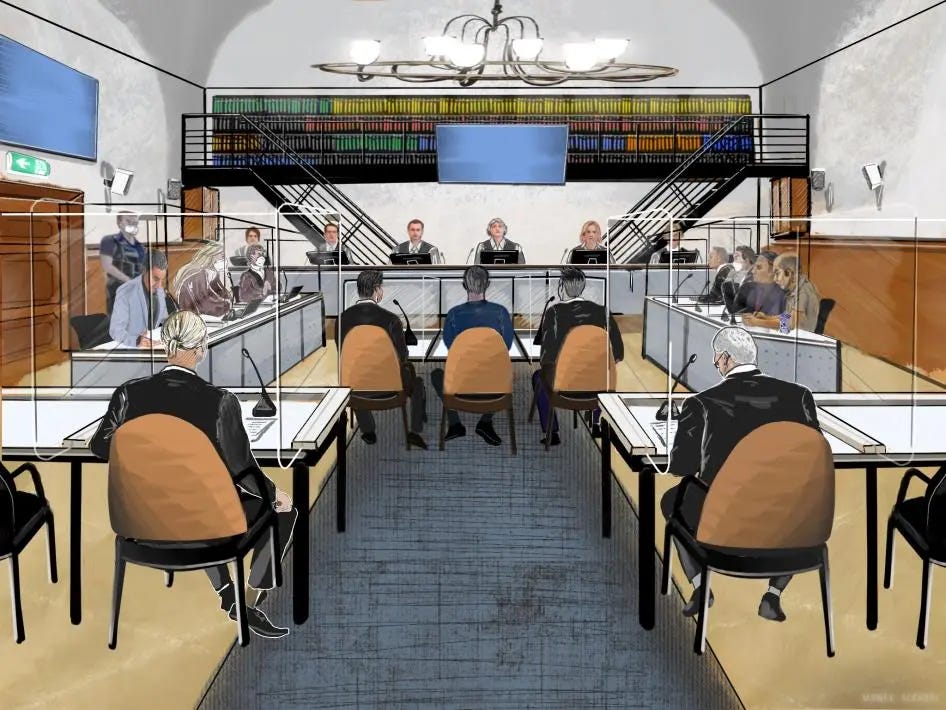
Artist’s rendition of Raslan’s trial
In a perverse irony, Raslan’s loudmouth propensity was his undoing. His assorted claims post-defection provided grounds for arrest by German authorities, and were used against him and Gharib in their prosecutions. These legal actions heavily relied on documents seized by CIJA, including Central Crisis Management Cell records. This unit was created in March 2011 by Damascus, to manage responses to mass rioting that erupted this month. These documents have been widely described as the “linchpin” of the Commission’s case against “the Syrian regime.”
Yet, as this journalist has previously exposed, the Central Crisis Management Cell files in fact show the Assad government explicitly and repeatedly instructed security forces to protect protesters, prevent violence, and keep the situation under control. The documents also detail how from inception, many “peaceful” demonstrators were extremely violent, while opposition fighters systematically murdered security service operatives, pro-government figures, and demonstrators to foment catastrophe, in a manner eerily similar to many CIA/MI6 regime change operations old and new.
In February 2021, Gharib was found guilty of aiding and abetting crimes against humanity. He received four-and-a-half years in prison. A year later, Raslan was given life for crimes including mass torture, rape, and murder. The pair were not convicted for personally perpetrating these horrors, but serving in the General Intelligence Directorate at the time they were allegedly committed. “Expert” witness evidence provided at their trials left much to be desired.
For example, judges and prosecutors alike expressed disquiet at “many contradictions” in the testimony of “P3”, a Syrian government operative who purportedly worked in a security service “mail department”, and was central to Gharib’s conviction. P3 professed to seeing sensitive documents “related to the transfer of corpses” of opposition activists “to burial sites.” They “provided contradictory information” in statements to German police and the court, and were “visibly nervous” while testifying. Throughout, their seemingly aghast attorney sat nearby “putting his hands behind his head.”
Meanwhile, during Raslan’s prosecution, “P4” – a nameless individual who claimed to have been detained in a Syrian prison, and bribed his way out – testified he saw 500,000 corpses buried via a “bulldozer and a truck” next to his house, in an area which was previously “a desert”. Reports of the trial indicate there “was a feeling” among those present in court, including “the public”, that these numbers were greatly “exaggerated.”
The sense that Gharib and Raslan were prosecuted because they were within easy reach, and CIJA needed something to show for all its well-remunerated efforts, is ineluctable. The Commission had strong grounds to be anxious about failing to fulfill its founding objective. In March 2020, the European Anti-Fraud Office (OLAF) formally accused the organization of “submission of false documents, irregular invoicing, and profiteering” relating to an EU “Rule of Law” project it ran in Syria.
Fast forward to today, and The Guardian reports that “the abrupt implosion of the infrastructure of state terror” in Syria “has made available a huge volume of evidence.” The outlet quoted CIJA chief William Wiley at some length. He compared Assad’s fall to “a situation much like Germany in 1945 or Iraq in 2003,” with “a sudden availability of all state records” making prosecution of state officials a fait accompli:
“It’s a very unusual situation, and its suddenness creates challenges and opportunities in simply dealing with the material… If there’s any security intelligence guy that rocks up in Europe, there’s typically going to be enough material already to hand.”
Featured Video

The Search for Truth: Charlie Kirk’s Assassination One Year Later
or go to
Aletho News Archives – Video-Images
From the Archives
The 9/11 “Double-Cross” Conspiracy Theory
BY LAURENT GUYÉNOT • UNZ REVIEW • SEPTEMBER 6, 2022
Is it true that “9/11 was an inside job”? Yes, insofar as Israel is “inside” the U.S. But for the 9/11 truthers who have identified Israel as the main perpetrators, “9/11 was an inside job” is at best a half-truth, and at worst an integral part of the Zionist operation, like a secondary flag sewn as a lining under the false flag of Islamism. Victor Thorn (1963-2017) wrote in his book 9/11 made in Israel: The Plot Against America (2011): “In essence, the ‘9-11 truth movement’ was created prior to Sept. 11, 2001 as a means of suppressing news relating to Israeli complicity. . . . The slogan ‘9-11 was an inside job’ was quite possibly the greatest example of Israeli propaganda ever devised.” In milder terms, it is “controlled opposition”.
A genuine truth movement would have pointed to Israel as the prime suspect from the start. From day one, it was obvious who would benefit. … continue
Blog Roll
 Aletho News
- Europe’s mounting social chaos… chickens coming home to roost for proxy war against Russia
- US-Russia Diesel Deal Becomes Massive Defeat for Ukraine
- Hormuz and the Looming Economic Catastrophe
- Dhubab offensive, media blitz and the rapid unraveling of Saudi-backed coalition’s new gambit
- Putin Conveys to Trump Iran’s Vision on Possible Conflict Resolution – Kremlin
- The Search for Truth: Charlie Kirk’s Assassination One Year Later
- ‘Harsh reality’: Iran says France seeks monopoly on power and intimidation, not peace for all
- When Will This White House Madness End?
- Huckabee aide goes to ‘unusual lengths’ to portray ‘Israel’ positively
- Trump Announces Diesel Supply Deal With Putin Following Phone Call
- If Americans Knew
- Israeli forces kill another child in Gaza – Daily Update
- Gaza ceasefire exists in name only, say more than 100 organizations
- Nearly 2 Million in Gaza Need Urgent Shelter Assistance as Winter Looms: IOM Chief Warns
- Suppressing Palestinian resistance: US charity under fire for AI monitoring of Gaza classrooms
- Thousands Are Held in Israeli Torture Camps. This Is What Happens Inside
- Israel puts Gaza’s sick, injured, newborn in peril – Daily Update
- Report claimed Mark Levin used by Israeli government to influence Trump
- Over 2,000 Gazans have died awaiting medical evacuation amid Israel’s continued siege
- How a U.S. Diplomat Suppressed and Altered Reports Critical of Israel
- 5 Palestinians Die from Israeli Strikes in Gaza as Relentless Attacks Continue
- No Tricks Zone
- New Study: 50 Years Of The Most Aggressive ‘Net Zero’ Policies Can Only Affect The Global Climate By 0.03°C
- US September “Heat” Was No Record…Many Records Set Decades Ago
- Latest European Green Energy Debacle; Portugal’s Largest Flagship Solar Park Insolvent!
- Green Energy Debacle: German Expert Professor Fritz Vahrenholt Warns Of Severe Economic And Social Consequences
- Two More Paleo Reconstructions Affirm Meters-Higher Sea Levels Across Ireland, Brazil 7000-6000 Years Ago
- New Study: Earth And Venus Surface Warmth Largely Explained By Convection And Lapse Rate, Not CO2 Or Radiation
- 2025 Nature Paper Claiming Worsening Global Drought Gets RETRACTED …Heavily Flawed
- New Study: ‘Global Drought Shows No Detectable Recent Acceleration Under Climate Warming’
- Economic Masterminds: German Socialists Suggest Taxing Productivity Gains Stemming From Using AI
- The South China Sea Has Not Been Cooperating With The Climate Change Narrative

