Brussels’ persecution of Hungary and war against X could spark ‘yuge’ retaliation
Remix News | November 5, 2024
Today, voters head to the polls to decide who will run the United States for the next four years. If Trump should win, relations with the EU could become extremely tense, as a Trump administration could begin to wield powerful sanctions against countries — and even Brussels itself — it deems to be in violation of democratic principles and protections of free speech.
For one, Brussels has been hitting Hungary with sanctions, freezing billions owed to Budapest over “rule of law” and generally working to oust the ruling government. Viktor Orbán has openly come out in support of Trump, and both of them enjoy a warm relationship, and more importantly, they share the same ideology on many key issues, including migration and a pro-peace path in Ukraine.
It will likely not be business as usual if Trump comes back to power. Countries like Hungary would no longer be facing the full weight of the Western left. In fact, Trump could very well start playing hardball, issuing sanctions, travel restrictions, and new executive orders to prevent democratic backsliding in Europe. Notably, the rule-of-law sanctions being wielded by Brussels against member state governments it deems undesirable would likely be viewed from Washington as an anti-democratic form of blackmail. In turn, the U.S. could quickly counter such moves, including with “rule-of-law” sanctions of its own against Brussels.
 If Germany moves to ban the Alternative for Germany (AfD), a Trump administration could move to counter this as well, including with sanctions against Germany due to democratic backsliding. Many may have already forgotten about the commando raid on a German publisher and journalists’ home over the summer. The German government, without so much as a court order, shut down an entire publication overnight. The publisher of Compact magazine, Jürgen Elsässer, was splashed across newspaper and television stations across the country in his bathrobe surrounded by officers in ski masks.
This is not normal behavior for a democratic country, and Trump’s administration may take action if further attempts are made to persecute journalists and shut down the free press in Germany.
https://twitter.com/RMXnews/status/1813205996531003470
What actions could Trump’s administration take in such a scenario? With Germany cut off from its traditional source of Russian gas, a move to restrict energy exports to Germany would be devastating. In other key areas, Germany and Europe are far more dependent on the U.S. than on vice versa.
Obviously, such a move would come with serious risks, including for the global economy, and potentially sparking a trade war. However, the U.S. would have most of the leverage in such a scenario. Europe needs U.S. energy, end of story.
The EU’s plan to restrict free speech and throttle X with fines could also result in sanctions on European companies, tariffs, and other forms of retaliation. Trump will likely be very willing to defend free speech across the world, especially after his own experience facing censorship across social media, and willing to use U.S. might to ensure this fundamental right on the web. His backers, most notably Elon Musk, will have a strong voice in the administration, and should Trump suddenly grow cold feet, he will face withering pressure from Musk and others.
Under Trump, free speech would still have a chance on platforms like X and others, even if free speech is already limited on those platforms. In turn, European conservatives, libertarians, and those opposed to mass immigration will be allowed to voice their opinions and influence the political debate in the coming years.
There are, of course, many open questions about how relations between Trump and the EU would develop, but it may obviously be a pointless thought experiment. In a matter of hours, days, or even weeks, Kamala Harris may be the decided winner. In such a scenario, the globe can also expect X to be shut down within a year or two, buried under fines and violations of the EU’s Digital Service Act. Brussels will continue to attack conservatives with its powerful sanctions mechanism. New forms of harassment and persecution, including arrests of politicians, journalists, and academics who support the “wrong opinion,” are likely as well.
https://twitter.com/RMXnews/status/1852324197084668098
The majority of Europeans may not like Donald Trump. As polling shows, Europeans, most notably Western Europeans, are very much opposed. Only a few countries from the east, such as Hungary, Bulgaria, and Serbia, support the former president, but in the end, he may be the only thing between a free web and a closed web, especially on the most important topics Europeans are increasingly not allowed to talk about. Furthermore, as opposition to mass immigration grows and other left-liberal agendas, there is no telling where European sympathies will likely be in the coming years.
In short, much is at stake for Europe in the outcome of this vote. The deck remains stacked against Trump. The U.S. voting system is in shambles, with votes being counted for days and weeks after election day, with ballots stuffed in drop boxes weeks before the election, and with ballot harvesters collecting ballots outside of any real oversight. Even basic safeguards like voter ID are nowhere to be found in many states. It will be a miracle if Trump wins, but we’ll know the results soon enough and will have to deal with the outcome — for better or worse.
Washington Storefronts Getting Boarded-Up Early Indication of Harris’ Defeat – Wall Street Analyst
By Ekaterina Blinova – Sputnik – 05.11.2024
Washington DC is seeing a lot of boarded-up storefronts and buildings. The New York Times is even hinting at the possibility of violence from disenchanted Donald Trump supporters. Wall Street analyst Charles Ortel doesn’t buy into the assumption.
“Republicans are a tiny percentage of registered voters [in DC] so it is pure fiction and likely projection that they are poised for mayhem,” Ortel told Sputnik.
“The truth in a fair contest is that Trump and Vance are set to trounce Harris and Walz – deluded Democrats and reliable Antifa and Black Lives Matter mobsters are the ones set to riot, and certainly not Republicans, because they will be celebrating,” he continued.
It seems that the efforts by the corporate media and influencers to sell the Biden-Harris Administration as a “transformative success” have fallen flat. It’s becoming clear that things are actually worse now than they were under Trump, pre-Covid, according to the analyst.
“Political insiders know that Harris is a far worse candidate than Hillary Clinton or Joe Biden were in 2016 and 2020 and that Trump and Vance are a potent slate backed by tens of millions of motivated and enthusiastic voters, who likely will win decisively, absent widespread cheating,” Ortel said.
He doesn’t rule out that those who poured a whopping $1 billion into the Harris-Walz ticket are preparing to throw a spanner in the works for Trump and JD Vance. They might even try to invalidate the 2024 results if the former president and his running mate win.
“I hope cooler heads prevail in what remains of the Democrat party. As of this moment, Trump and Vance seem poised to win a decisive mandate against the Deep State swamp, likely with control of the Senate and a stronger majority in the House,” Ortel concluded.
Musk Calls Harris’ Statement on US Troops Not Being Deployed in Combat Zones Flat-Out Lie
Sputnik – 05.11.2024
US billionaire entrepreneur Elon Musk has designated as a lie the statement made by US Vice President and Democrat presidential candidate Kamala Harris that US troops are not deployed in any war zones.
During the presidential debate with Republican presidential candidate Donald Trump on September 10 Harris said that there currently was “not one member of the United States military who is in active duty in a combat zone in any war zone around the world.”
“I know [US] troops [are] in war zones. As vice president, you’re privy. You know the official troops and the unofficial troops. What she said was a flat-out bold-faced lie. Next-level bold-faced lie. An absurd lie,” Musk said in a podcast with Joe Rogan released on Tuesday.
The United States presidential election is being held on November 5. Harris and Trump are competing for the country’s top job.
Healthcare Workers Reject COVID, Flu Shots Amid ‘Tremendous Erosion of Trust’ in Health Agencies
By Michael Nevradakis, Ph.D. | The Defender | November 4, 2024
The number of healthcare workers receiving COVID-19 and flu vaccines declined during the 2023-24 cold and flu season, according to the Centers for Disease Control and Prevention (CDC).
Only 15.3% of acute hospital workers and 10.5% of nursing home personnel received a COVID-19 vaccine during the 2023-24 season — down from 17.8% and 22.8% respectively, the CDC said in its Oct. 31 Morbidity and Mortality Weekly Report.
Based on data from the CDC’s National Healthcare Safety Network, flu vaccine rates for the same healthcare worker groups were higher than COVID-19 vaccine rates — 80.7% for acute care hospital personnel and 45.4% for nursing home personnel.
However, the rates remained “persistently below the levels during the prepandemic period.” For example, the flu vaccine rate for hospital workers in 2019-20 was 91%.
The CDC figures also showed that nearly 1 in 100 healthcare workers reported “a medical contraindication” to receiving either the COVID-19 (0.71%) or flu (0.89%) vaccine. The CDC figures did not provide information on the rate of vaccine side effects reported by healthcare workers.
The CDC said more research is needed “to identify effective strategies to improve vaccination at a time when health care personnel are susceptible to low vaccine confidence.”
Such studies would also seek to improve “confidence about the safety and effectiveness of vaccines among health care personnel through, for example, providing additional education about the safety and effectiveness of vaccination to health care personnel.”
Dr. Jane Orient, executive director of the Association of American Physicians and Surgeons (AAPS), told The Defender the data didn’t surprise her.
“It is no longer possible to deny safety signals and lack of effectiveness,” Orient said. “A large percentage [of healthcare workers] have themselves had several episodes of COVID, had adverse reactions themselves, or know someone who did.”
Pulmonologist Dr. Pierre Kory, founder of the Leading Edge Clinic and president emeritus and co-founder of the Front Line COVID-19 Critical Care Alliance, said the CDC figures represent “a welcome trend” that he hopes will continue. He said:
“Regardless of the reasons for the decline, the data shows healthcare workers’ tremendous erosion of trust in our regulatory agencies. Allowing this distrust to continue will further undermine the public’s confidence in our healthcare agencies.”
Kory noted the symbolism of healthcare workers turning their backs on the COVID-19 vaccine in particular. “If the vaccine is not for us, it is certainly not for them,” Kory said.
Danielle Baker, a certified hospice and palliative care registered nurse injured by the Pfizer-BioNTech COVID-19 vaccine, agreed.
“With the current state of public healthcare, I am not surprised by the figures. In healthcare, there were positions where you agreed to some annual vaccinations upon hire, but the events of 2021 forever shook the core of even that practice,” Baker said.
Dr. Mary Talley Bowden, an ear, nose and throat specialist who was suspended by Houston Methodist Hospital for treating COVID-19 patients with ivermectin, said, “85% of healthcare workers are opting not to get the COVID shots because they know these shots are all risk and no benefit.”
‘Why should we trust you?’
Dr. Marty Makary, a public health researcher at Johns Hopkins University and author of “Blind Spots: When Medicine Gets it Wrong, and What It Means for Our Health,” said the disparity between the CDC’s COVID-19 vaccination recommendations and the actual coverage rate “is telling.”
“It’s also embarrassing for the CDC director [Dr. Rochelle Walensky], who has made pushing the new COVID booster a leading priority of her tenure,” Makary said.
Orient said that doctors and other healthcare personnel who stood up to vaccine mandates and pressure from their employers to get vaccinated “are vindicated” by the CDC’s data “and should be applauded.”
“The message to the public should be obvious,” Orient said. “Why should we trust you?”
Others, though, do not feel vindicated. Sarah Choujounian, co-founder of the Canadian Frontline Nurses, told The Defender that while “many have been awakened to the fact that vaccines are not safe,” she and other nurses who opposed vaccine mandates are still facing professional repercussions.
“This news does not bring vindication as I, amongst many others, am still in court being dragged through a disciplinary hearing for standing up to the corruption and standing up for what is best for our communities,” Choujounian said.
Dr. Danice Hertz, a retired gastroenterologist who was “horribly injured” after receiving the Pfizer-BioNTech COVID-19 vaccine, said lawmakers and policymakers need to open their eyes to the growing distrust of the COVID-19 vaccines by the medical community.
Hertz said:
“I personally have been injured by the Pfizer COVID vaccine. I believed what I was told by our agencies, that these vaccines are safe and effective. I learned the hard way that they were not telling the truth.”
Bowden said that doctors haven’t done enough to speak out. She said:
“Why are physicians not speaking out? Our profession has veered off course, and physicians today are more concerned with protecting their jobs over upholding the Hippocratic oath.
“We have an abundant amount of data showing adverse events from these shots, but we don’t have anyone in authority who will look at the data. Physicians need to get vocal and stand up to the government doctors who have taken over our healthcare system.”
Orient said more doctors are starting to speak out, but “intense indoctrination, financial incentives and fear of ostracism and licensure are huge barriers to overcome.”
Kory said if the medical establishment and the government are to have any hope of reestablishing trust, they need to “recognize the truth about the COVID-19 vaccines. Until that happens, no message from them will be taken seriously, and the little public trust left in these institutions will eventually be gone.”
Baker said he believes the public has reached a point where they no longer need to look to healthcare professionals for an answer when it comes to COVID-19 vaccination. He said:
“People pay attention. The mass media messages, governmental overstep, blanket mandates, lack of agency support for those adversely affected and unwillingness to see and hear responses to these things have caused an implosion.
“Enough of the general public has reached a consensus when it comes to this particular shot from the collective set of experiences over the past years.”
CDC data leave unanswered questions
The CDC data — self-reported by hospitals and nursing home facilities — also demonstrated regional differences in vaccine uptake. COVID-19 vaccine update was highest in the Pacific region and lowest in the Mountain and Southern states.
For the flu vaccine, uptake was highest in the Mountain region and lowest in the Pacific region for acute care hospital employees, while for nursing home personnel, uptake was highest in the Northeast and lowest in the South.
Figures for the current respiratory illness season are not yet available.
Pediatrician Dr. Michelle Perro told The Defender the data still leaves some unanswered questions.
“One criticism is that it did not delineate which types of healthcare employees were opting out of the flu and COVID vaccines. It appears that this data may not have been readily available,” Perro said.
This article was originally published by The Defender — Children’s Health Defense’s News & Views Website under Creative Commons license CC BY-NC-ND 4.0. Please consider subscribing to The Defender or donating to Children’s Health Defense.
Israel secures victory over the biggest terrorists in Gaza: aid workers
Laura and Normal Island News | November 4, 2024
Israel has finally cancelled its agreement with the only organisation capable of getting significant quantities of food and medicine into northern Gaza: the United Nations Relief and Works Agency.
Israel has decided Unrwa is guilty of “terrorism” because it has been getting food and medicine to civilians designated for extermination, an accusation Unrwa does not deny. Thankfully, Israel put a stop to this terrorism at the start of October and now every civilian in northern Gaza is at imminent risk of death. As everyone knows, the only way to defeat terrorism is to kill enormous numbers of civilians (who have the wrong skin colour and/or religion).
Israel is rightly outraged that Unrwa employs terrorists because the only organisation allowed to send terrorists into Gaza is the IDF. Outrageously, I’m told Unrwa incinerated civilians from Apache helicopters on October 7th, a privilege reserved only for IDF pilots following the Hannibal Directive.
An investigation found no evidence of Israel’s central allegations against Unrwa, but Israel Katz crayoned a picture of an Unrwa worker holding a severed baby’s head. If you question Israel’s evidence, I honestly don’t know what to say to you.
After a year of starving Palestinians, Israel has assured us it will get the necessary aid into Gaza. This is the most sensible move since Dr Harold Shipman decided to administer medicine to his patients. The IDF says it will try to resist gunning civilians down as they queue for aid, but obviously it can’t make any promises. Antony Blinken said that if Israel does attack the aid queues, he expects the killers to investigate themselves. This is a privilege reserved for the only democracy in the Middle East.
Israel has been so angry with Unrwa workers who fed and treated Palestinians that it initially wanted to blow them all up. Thankfully, Israel has shown restraint and only blown up 102 of them. Israel was particularly angry with the people whose job it was to vet Unrwa workers, until it realised that was Israel’s job. This was a tiny bit embarrassing so never mention it again, okay?
While Israel is courageously tackling terrorism in Gaza, British police are doing everything they can to defeat terrorism back home, including beating the shit out of anyone who expresses solidarity with Unrwa. Well, they’ve not done that yet, but I remain optimistic.
The United Nations is now a proscribed terrorist organisation, all criticism of Israel has been banned, and in unrelated news, several government ministers have really nice holiday homes. Mossad has clarified that just because its spies were arrested for blackmailing officials in Italy, does not mean they would behave like this in the UK. Blackmail is unnecessary here because our officials are much more open to bribes.
You will be pleased to know British police are taking their role as enforcers of the Israeli state so seriously that they’ve arrested a Jewish Israeli academic because he explained Israel is fighting an unwinnable war. Professor Haim Bresheeth pointed out that British police have been arresting people for opposing genocide, leaving police with no choice but to arrest him under the Terrorism Act. I literally can’t tell the difference between this professor and ISIS.
Metropolitan police explained they actually arrested Prof Bresheeth for “expressing support for a proscribed terrorist organisation”. Awkwardly, a recording of his speech shows he said no such thing, but anyone who shares the footage online risks being visited by a Hermes drone. Be warned, Mossad has your IP address as part of Twitter’s terms and conditions and those drones don’t have to come far because they are made in Leicestershire
Betting the Farm on the Imaginary War
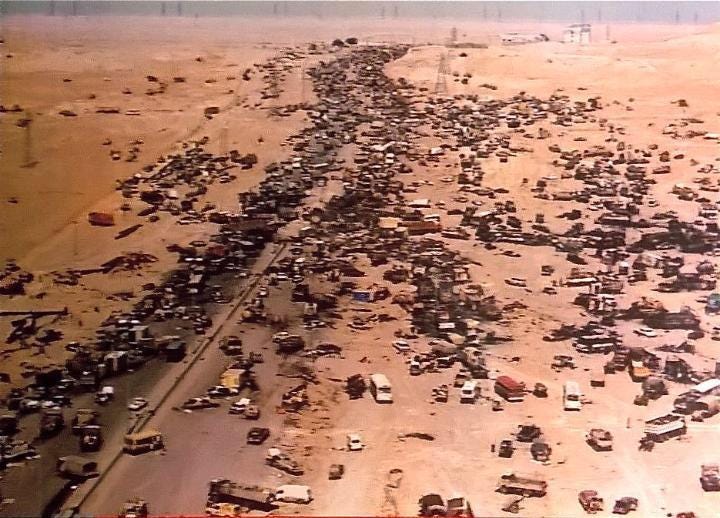
The Highway of Death, Iraq War, 1991
By William Schryver – imetatronink – November 4, 2024
It has now been ten years since I first turned my attention to the necessity of prudent financial investments in order to both preserve and hopefully enlarge the modest amount of wealth I had accumulated up to that time. I began by attempting to identify the wisest and most discerning “experts” in the field. This was no easy trick.
Fortunately, in the ten years preceding my late-2014 awakening to the importance of financial and macroeconomic matters, I had spent several years discovering that most of western academia is a sham dominated by highly credentialled ignoramuses. Therefore I was alerted to the likelihood that the so-called “experts” in other fields of study were similarly intellectually impaired, regardless of their seemingly impressive curricula vitae, how many framed certificates hung on their wall, and the size of their “assets under management”.
That said, it became apparent over time that even those I initially identified as reliable “experts” could be well-informed most of the time, and yet still be subject to blind spots that rendered them susceptible to fatal errors which could often nullify their seemingly correct judgment of everything else.
In the context of financial matters, it must be understood that the “Quantitative Easing” and near-zero interest rates that followed on the heels of the so-called “Great Financial Crisis” of 2007-2009 was a tide that floated a great many boats captained by fools whose folly would not be recognized until the consequences of central bank profligacy were revealed several years further down the road.
Even so, most of the investment “gurus” whose analysis I had come to respect managed to successfully navigate the hurricane of price inflation that roared ashore in the wake of the Covid hysteria – a storm that was then followed by the Federal Reserve’s subsequent raising of interest rates in a frantic attempt to stem the inflationary tide.
Then World War Three began.
Of course, even at this point, almost three years into that war, few people recognize it for what it is. Even fewer recognize the degree to which the geopolitical and military parameters of war itself have been radically altered in comparison to what they were during the “American Unipolar Interregnum” that commenced with the dissolution of the Soviet Union.
Indeed, the overwhelming majority of Americans believe the “unipolar moment” continues essentially intact and unthreatened. In the highly insulated environs of Wall Street and Silicon Valley, faith in the overwhelming supremacy of American high-tech and military prowess remains almost entirely unshaken, notwithstanding the ever-increasing indications to the contrary – things about which I have been writing for several years now.
Most of the gods of American high-tech and finance, and those who worship them, simply cannot discern the degree to which American power in all its forms has steadily eroded over the course of the 21st century, and that this erosion has accelerated dramatically in recent years.
For most of the western elite and their acolytes, it is still early 1991, and Norman Schwarzkopf is leading a million-man army against the hapless Iraqis in a demonstration of military might that would finally expunge the bitter humiliation of Vietnam from the American psyche.
Such people have religiously embraced the Hollywood fantasies of unassailable American superpower dominance. And given the reality that Ukraine and Israel are considered merely appendages of this assumed American military supremacy, the eastern European and Levantine theaters of World War Three have given rise to extreme examples of an unprecedented tsunami of propaganda I have been wont to call “The Imaginary War”.
This phrase I coined in the early stages of the war in Ukraine has its origins in something allegedly said by an unnamed Israeli general in the aftermath of the 2006 war in southern Lebanon – a war whose ultimate outcome was a decisive strategic defeat for Israel, but which the Israelis subsequently attempted to spin into a great victory. It was in this context that the Israeli general reportedly said, “If you can’t win a real war, win an imaginary one.”
This is precisely the narrative-building approach we have seen in Ukraine over the past two-plus years.
Most Americans, and most people around the world who believe in mainstream western narratives, are convinced that the Russians have been dealt an overwhelming strategic defeat in Ukraine; that the Russian military has been exposed as a poorly trained drunken mob; that Russian military doctrine is imbecilic; that Russian equipment is junk; that Russian military technology is decades behind its western counterparts; that American and other NATO war toys sent to Ukraine have dominated the battlefield, etc., etc.
The same types of things are believed about China, its culture, and its military capabilities.
And, of course, even greater derision is directed towards the Iranians and the North Koreans.
Just today I read a short article from a fairly prominent Wall Street hedge fund CIO, in which he wrote the following paragraph of utterly fictitious (and yet widely believed) nonsense:
Israel sent 100 aircraft for a 2000km flight to attack Tehran. Zero were shot down. First, the IDF took out Iran’s air defenses. Those Russian S-300 anti-aircraft systems can now be found disassembled in large craters through the region (Russia’s newer S-400 system underperformed expectations in Ukraine and the S-500 is in test phase). With Iran’s air defenses offline, Israeli aircraft had their way with whatever targets they chose in Tehran. They skipped over the mullahs this time. Next time who knows. Such is the nature of warfare for those with superior tech.
Never mind that literally ALL of his assertions are demonstrably false – this would-be titan of American finance intends to bet the farm on the fallacious assumptions of the imaginary wars he has convinced himself are actually taking place.
Of course, both the major party candidates for President, almost the entirety of the United States Congress, and much of the sprawling swamp of American government bureaucracy in Washington are similarly convinced of the indomitability of American imperial military might, and they are anxious to teach the current “axis of evil” in Moscow, Beijing, and Tehran a lesson they will not soon forget.
In the end – and it will come sooner than later – the only thing that will not be soon forgotten is how briefly the American unipolar moment endured, and how shockingly and suddenly it all came crashing down.
Iran slams US deployment of B-52 bombers as ‘destabilizing’
Al Mayadeen | November 4, 2024
Iranian Foreign Ministry spokesperson Esmail Baghaei criticized the United States on Monday, describing its presence in the region as “destabilizing” following its deployment of B-52 bombers in the Middle East.
At a news conference, Baghaei responded to questions about the military buildup, stating, “We have always believed that the presence of America in the region is a destabilizing presence,” adding, however, that this “will not deter (Iran’s) resolve to defend itself.”
The US military announced on Saturday the deployment of B-52 bombers to the Middle East as a warning to Iran, which has pledged to respond to the Israeli aggression that targeted several of its military sites on October 26.
The Pentagon stated that these deployments would occur in the coming months and highlighted the “flexibility of the US military movements around the world.”
“Should Iran, its partners, or its proxies choose to target American personnel or interests in the region during this time, the United States will take every measure necessary to defend our people,” Pentagon spokesperson Air Force Major General Patrick Ryder said in a statement.
Four Iranian soldiers were martyred during the latest assault on Iran, and officials reported limited damage to several radar systems.
Baghaei said that Iran’s retaliation would be “definite and decisive.” He also reaffirmed that Iran supports “all initiatives and efforts” to promote a ceasefire in Gaza and Lebanon, where “Israel” persists with its aggression.
During the news conference, Baghaei reaffirmed that Iran’s official stance against altering its nuclear doctrine and pursuing atomic weapons remains unchanged.
Quoting a recent speech by the Leader of the Islamic Revolution Sayyed Ali Khamenei, the Iranian diplomat emphasized that the Islamic Republic would be “equipped with everything necessary to defend” itself.
US, ‘Israel’ will bear the consequences
On Saturday, Sayyed Khamenei warned that the United States and the Israeli occupation will bear the consequences of their atrocities.
Speaking on National Day of the Fight against Global Arrogance, which commemorates the anniversary of the US embassy takeover by Iranian students on November 4, 1979, Sayyed Khamenei warned of the crushing response Iran would deliver in retaliation to the crimes carried out against the Islamic Republic and the Resistance.
Sayyed Khamenei stressed that Iran’s operations were not “revenge”, but rather “a logical action, an approach aligned with religion, ethics, and Islamic Law, in accordance with international regulations,” confirming that Iranian officials are constantly developing their political and military readiness to confront any hostility.
Elsewhere, he made it clear that Iran will not leave any aggression unanswered.
Iran’s missiles aimed at deterring attackers, not waging aggression: President Pezeshkian
Press TV – November 4, 2024
President Masoud Pezeshkian asserts that Iran’s missiles are aimed at deterring those seeking to potentially target the country, and are not meant to be used towards waging acts of aggression against other nations.
“We have [our] missiles [at our disposal] so they would not dare attack us. Our missiles are not meant [to be used] for carrying out attacks against anyone or [contributing to] expansionism,” the chief executive said during a ceremony on Monday.
He said the country has developed the defensive projectiles so parties such as the Israeli regime would not be able to target the Islamic Republic as they have been targeting the Gaza Strip or bomb any place or any person that they would desire.
Pezeshkian, meanwhile, hailed Gaza-based Palestinians for their “esteem and greatness” that has forbidden the Israeli regime from forcing them into surrender, despite targeting the coastal sliver with all that is at its disposal for more than a year now.
In the same context, the president slammed the regime for laying claim to respecting human rights and the international law, while its authorities perpetrate “violence, genocide, crime, and murder behind their neat and tie-wearing appearances.”
The remarks came amid the regime’s October 2023-present war of genocide against Gaza that has so far claimed the lives of more than 43,300 Palestinians, mostly women and children.
The contradiction between the regime’s claims and actions points to the regime’s “indecency and lack of identity,” he noted.
Pezeshkian berated those accusing Iran of failure to observe human rights, saying the parties that have leveled the accusations against the country were the same ones that have staged deadly attacks against the Iranian nation, including women and children, with chemical weapons and targeted the people’s sources of sustenance with sanctions.
Neutral for now: Persian Gulf states’ gamble in the Iran-Israel showdown
With Iran’s vow to retaliate against Israel, Persian Gulf states face a delicate balancing act – caught between asserting autonomy and increasing dependence on US security, all while the Resistance Axis enjoys unprecedented popularity in the region.
By Mawadda Iskandar | The Cradle | November 4, 2024
The signs of an impending Iranian response to Israel’s airstrike on Iranian military interests last month are becoming clearer. Official statements from Tehran suggest a military retaliation is inevitable and could occur before the US elections on 5 November – with some reports indicating it may be launched from Iraqi territory to curb the cycle of back-and-forth escalations that began on 1 April following Tel Aviv’s targeting of the Iranian consulate in Damascus.
Both sides are seeking to establish a new deterrence balance, albeit with very different aims. Iran, whose sovereignty has been repeatedly violated, warns of the danger posed by Israel’s expansionist ambitions in the region, while Israel, as the aggressor, seems intent on dragging the entire region into chaos, banking on unwavering US support.
Two distinct camps have emerged: on one side, the Israeli-US alliance and its supporters, and on the other, the countries of the Resistance Axis, which have launched the “battle of unity” in support of Gaza. Caught between these factions is a third group, one that seeks neutrality, unwilling to pick a side for fear of compromising its own interests.
The US is struggling to maintain influence, while Israel is playing what may be its final card. The question remains: where do the Persian Gulf states stand?
Airspace restrictions and Gulf diplomacy
The Persian Gulf states have unanimously condemned Israel’s 26 October strikes on Iranian sites, which came in response to Tehran’s own retaliatory missile attacks earlier last month following high-profile assassinations of resistance leaders carried out by the occupation state.
Statements from the Gulf Cooperation Council (GCC), Saudi Arabia, Qatar, Bahrain, the UAE, Kuwait, and Oman condemned these strikes as violations of Iranian sovereignty, escalating tensions in an already volatile West Asia.
Saudi Arabia, the UAE, and Qatar have taken a firm stance, refusing to allow Israel to use their airspace to launch further strikes against Iran, a position echoed by Jordan, which was prompted to officially deny it had allowed Israel to use its airspace to attack the Islamic Republic.
This reassured Tehran, which had threatened a forceful response against any country that facilitated Israeli attacks. These diplomatic messages coincided with Iran opening new channels of dialogue, including President Masoud Pezeshkian’s meeting with GCC officials, followed by Foreign Minister Abbas Araqchi’s diplomatic tour that included Lebanon, Syria, Saudi Arabia, Qatar, Bahrain, Kuwait, Iraq, Oman, Jordan, Egypt, and Turkiye.
Despite Amman’s claim that its airspace was not used in the recent attack, videos have emerged documenting Israeli fighter jets over Jordanian skies. Similarly, Saudi Arabia claimed its airspace was not used during the strikes, raising questions about how Israeli planes refueled over such long distances. Israel subsequently admitted to using refueling aircraft to bypass Persian Gulf airspace restrictions.
Speaking to The Cradle, Lebanese military analyst Omar Maarabouni contends that “In principle, and based on and in connection with the recent Israeli attack, a group of Gulf countries, led by Saudi Arabia, stated that they prevented the Israelis from passing through their airspace, and this is something that Iranian radar can confirm or deny, and indeed the official Iranian statement confirms that these aircraft did not pass through Gulf airspace.”
Maarabouni adds that agreements between the US and Persian Gulf states are defensive in nature, allowing these states to prevent US bases from being used offensively against Iran, especially since improved relations with Iran are now in their interest. Regarding alternative Israeli plans, Maarabouni says:
“It is quite clear that Israeli planes took the path associated with Syria and then Iraq towards Iran, and therefore we are talking about a distance of 2,000 km back and forth, and this is what Israel was keen to avoid over the issue of refueling, as F-35 and F-15 aircraft can travel distances exceeding 2,200 km without the need to refuel.”
Jordan, he says, meanwhile, finds itself in an awkward position, having claimed that Iranian missiles breached its sovereignty, despite such missiles traveling at altitudes beyond the limits recognized under international airspace law. As Maarabouni points out:
“The one who violated Jordanian sovereignty is Israel, which fired air defense missiles into Jordanian airspace to intercept Iranian missiles, but it is unclear why Jordan has adopted the responsibility of blaming the violation of its sovereignty on both Iran and Israel.”
Oil on the frontline
Persian Gulf states are wary of being dragged into the escalating conflict, especially as they attempt to close the chapter on their failing Yemen war, which backfired horribly following devastating attacks on Saudi Arabia’s prized Aramco facilities in 2019.
These strikes exposed the vulnerability of the “oil for protection” security framework under US patronage. In their recent overtures to Iran, GCC states also urged Washington to pressure Israel against targeting Iranian oil infrastructure, warning of disastrous consequences for global energy markets.
Sources in the Persian Gulf, speaking on condition of anonymity, inform The Cradle that while the Gulf states were aware of the timing of Israel’s attack, they were ready to mediate with the US if the situation escalated.
Following the attack’s failure, these states rushed to issue condemnatory statements, emphasizing their unwillingness to be drawn into direct hostilities against Tehran, despite their quiet acceptance – and even encouragement – of actions that might undermine Iranian influence or its nuclear ambitions. The Persian Gulf monarchies are eager to shield themselves from any backlash amid rising global anger over the atrocities in Gaza and Lebanon, which have put normalization efforts with Israel on hold.
US intervention: A double-edged sword
The White House has warned Iran against retaliating to Israeli strikes, stating that the US would support Israel if attacked and floating the notion that Washington “can’t restrain” Tel Aviv in the event of further attacks from Iran.
Former hawkish US national security advisor John Bolton boasted that Israel would use Persian Gulf airspace if needed, and that “these governments may complain about this, but frankly, they see Iran as a strategic threat because of its nuclear program, as well as Iran’s old support for terrorists, not only Hezbollah and Hamas, but the Houthis and Shia militias in Iraq.”
The Persian Gulf states now find themselves caught between their desire for autonomy and their dependency on US security guarantees – particularly in light of the numerous US bases spread across their territories, which primarily serve to protect Washington’s [or rather Israel’s] regional interests.
Agreements between the US and Persian Gulf states grant American forces access to airspace, ports, and military bases in these countries, providing logistical support for regional operations. While Gulf states have formally rejected offensive US operations from their territories, they still allow defensive activities.
Qatar, the only official non-NATO ally of the US, hosts the largest concentration of US forces at Al-Udeid and Al-Sailiya bases. Kuwait ranks second in terms of the quantity and quality of US assets located at four bases: Camp Doha, Arifjan, Ali al-Salem, and Buehring.
The UAE has three US bases, Al-Dhafra, Fujairah, and Jebel Ali Port, all of which provide logistical support services. As for the US facilities in Saudi Arabia, they are Eskan Village and Prince Sultan Air Base, which offer the provision of air and missile defense systems and the use of military aircraft. Bahrain hosts three bases: Juffair, Sheikh Isa, and Muharraq, and Oman hosts a similar number: Al-Masna, Thumrait, and Masira.
All of these countries fall under the domain of US Central Command (CENTCOM), which works to “counter the Iranian threat.”
Last year’s Operation Al-Aqsa Flood has reignited the debate over Persian Gulf security dependence on Washington. Experts argue that the current escalation between Iran and Israel will force Gulf states to find a balance between their diplomatic rapprochement with Tehran on the one hand, and their commitment to a US-led regional security alliance on the other.
The US has sought to reassure Persian Gulf leaders, offering assistance in defending against any potential Iranian aggression. To back up its words, the US approved a $440 million sale of TOW missiles to Riyadh and authorized the sale of over $2.2 billion in weapons and ammunition to Saudi Arabia and the UAE.
Balancing public condemnation with covert cooperation
Investigative journalist Bob Woodward’s new book War, which sheds light on recent GCC–Israeli dynamics, reveals that regional rulers, including those of the UAE, Bahrain, Saudi Arabia, and Qatar, unanimously agree – in private – on the need to eliminate Hamas, while working quietly to minimize public backlash over their covert cooperation with Israel.
After last October’s Operation Al-Aqsa Flood, Persian Gulf states condemned the attack but later launched diplomatic efforts to prevent regional tensions from escalating further. Notably, these developments have disrupted key projects, including normalization with Israel and economic diversification plans, particularly in Saudi Arabia.
Iranian journalist Mohammad Gharavi tells The Cradle that the events of 7 October, 2023 strained what had been positive Saudi-Iranian relations:
“The Iranians believed that a positive relationship would have a positive impact in terms of supporting the Palestinian cause, but the Saudi position was neutral despite the historical opportunity that could have been invested at home and in the Islamic environment. Unfortunately, the Palestinian issue is the prominent point of contention with the GCC, which is why we are sending messages that the opportunity is ripe to change this course.”
He describes Saudi–Iranian relations as having made significant advancements in terms of coordination and cooperation since the two neighboring states struck a rapprochement deal in Beijing last year:
“Iran’s reassuring messages, as well as warnings not to go too far in cooperating with the Americans and Israelis to antagonize Iran or using air, land and sea spaces to direct hostile action against it, were influential and positive and can be built upon in the coming stage, as it reflects the determination of the two countries to put aside differences in the interest of the security of the two countries and protect the strategic alliance with China and others for what it holds of economic dimensions.”
Ultimately, the Persian Gulf states remain neutral – for now. Their future course, however, will depend on visible and tangible US assurances. If such guarantees are secured, the Gulf may be willing to align more openly against Iran, given that their interests clash with those of the Resistance Axis, which promotes regional independence and self-determination – ideas that resonate with the Arab masses throughout West Asia.
Expert questions narrative about Ukrainians being behind Nord Stream blasts

Andromeda sailing yacht pictured docked in Dranske, Germany on March 17, 2023. © Sean Gallup/Getty Images
RT | November 4, 2024
A narrative pushed by the Western media about a small team of Ukrainian divers being behind the sabotage of the Nord Stream gas pipelines in September 2022 is hard to believe, Dr Sven Thomas, a renowned German diving specialist, has told Bild over the weekend.
Damage sustained by the Russian undersea pipelines suggests that much more powerful explosive charges and a much larger vessel were used to render them out of commission, he said, adding that a small yacht the media keep reporting about would never suffice.
American and German media have repeatedly claimed that the blasts were linked to a small Ukrainian crew that rented a leisure yacht called Andromeda at a German port and set off armed only with diving equipment, satellite navigation, and open-source maps. The operation was reportedly given a green light by Ukraine’s then-commander in chief, Valery Zaluzhny.
Multiple media outlets reported in August that the German authorities had issued an international arrest warrant for a suspect in the case, a Ukrainian diver identified as Volodymyr Z.
“There must have been at least one more team to cause the huge explosions,” said Sven Thomas, who heads a state-backed life-saving service in the German city of Halle. The specialist, who leads a crew of professional divers and underwater archeologists, added that he had “serious doubts” about the whole story linking the incidents to just a six-member Ukrainian crew using a 15-meter-long leisure yacht.
According to Thomas, divers working at a depth of just 34 meters in a lake would need at least four anchors chained to a vessel to keep their equipment stable. Andromeda had only one 25-kilogram anchor and a 100-meter-long chain, while its crew supposedly dived at the depth of between 80 and 90 meters in the sea. That is just “impossible,” according to Thomas, who has been conducting diving operations for years.
The total weight of the equipment needed for such an operation would be about four tons, the expert said, adding that seismic records of the explosions show that at least several charges equivalent to 400 kilograms of TNT were used to blast the pipes.
“They cannot drop such bomb charges into water without a crane and a counterweight, the vessel would just capsize otherwise,” Thomas said. According to the specialist diver, the fact that the pipelines were “crushed like a tin can” suggests that the damage was caused by powerful explosions nearby rather than small charges planted directly on the pipelines.
Thomas believes that it points to military-grade bottom mines with a yield equivalent to around 1260 kilograms of TNT. Such mines can only be planted by a large vessel with a crane onboard, the expert told Bild. Andromeda could have been behind only one of four blasts, which was likely caused by a small explosive charge planted directly on one of the pipelines, he added.
Moscow dismissed the Western media reports implicating Andromeda as implausible. President Vladimir Putin has maintained the view that the explosions were carried out by professionals supported by “the full might of the state, which has certain technologies,” noting that the US was “probably” behind it. Last month, Danish media reported that US Navy warships had been operating near the Nord Stream pipelines shortly before the explosions.
Moldova’s Socialist Party Says Not Recognizing Voting at Foreign Poling Stations
Sputnik – 04.11.2024
CHISINAU – Moldova’s Socialist Party said on Monday that it does not recognize the voting at foreign polling stations, thanks to which incumbent President Maia Sandu was declared the winner of the presidential election in the country.
Moldova held the runoff of a two-round presidential election on Sunday. With 99.86% of ballots tabulated at the time of the writing, Sandu is in the lead with 55.41% of the vote against her opponent, former Prosecutor General Alexandr Stoianoglo, with 44.59%.
“Maia Sandu became the ‘president of the diaspora.’ The Socialist Party of Moldova does not recognize the voting at foreign polling stations, thanks to which Sandu was declared the winner of the elections,” the party wrote on Telegram.
Russian gas exports to EU approaching ‘technical maximum’
RT | November 4, 2024
Exports of Russian gas to the EU and Moldova through Ukraine are approaching the maximum possible using existing infrastructure, Vedomosti newspaper has reported, citing data from energy giant Gazprom.
A total of 1.31 billion cubic meters of gas were delivered via this route in October, the outlet said in an article published on Saturday.
According to Gazprom’s figures, the average daily volume of Russian gas supplies through the Ukrainian gas transmission system last month amounted to 42.3 million cubic meters, representing a 5% increase compared to October 2023.
Following the escalation of the Ukraine conflict in February 2022, the EU slapped sanctions on Moscow and made it a top priority to curb its dependence on Russian energy. However, deliveries of Russian gas to the bloc continue almost three years later.
At the moment, the transit line through Ukraine and the European arm of TurkStream remain the only two conduits through which piped Russian gas can reach central and southern Europe.
Kiev has said it is not planning to extend the current transit agreement with Gazprom when it expires at the end of the year.
Earlier this week, Hungary – an EU member state – announced that it had imported 6.2 billion cubic meters of natural gas via the TurkStream this year. “This is the largest volume of gas to date” in annual terms, Foreign Minister Peter Szijjarto said.
Last month, the Agency for the Cooperation of Energy Regulators (ACER) said the share of Russian liquefied natural gas (LNG) in the EU market had reached 20% this year, growing by 6% compared to 2023.
Featured Video

Seyed M. Marandi: US-Iran War Inevitable: Kuwait and Bahrain May Fall
or go to
Aletho News Archives – Video-Images
From the Archives
USS Liberty Massacre: A Pivotal Moment in the Hostile Takeover of America
By Kevin Barrett | Crescent | Dhu al-Qa’dah 24, 1445
In corporate America, hostile takeovers are commonplace. They occur when an aggressor—a larger corporation or rich individuals—seizes control of a smaller corporation without asking permission.
What few recognize is that the United States itself has been subjected to a hostile takeover. Since the aggressor, the illegitimate settler colony known as “Israel,” is much smaller than the US, the takeover has necessarily been surreptitious.
As of June, 2024, Israel’s gradual takeover of the US has become obvious and undeniable—a proverbial “elephant in the living room.” … continue
Blog Roll
 Aletho News
- Seyed M. Marandi: US-Iran War Inevitable: Kuwait and Bahrain May Fall
- Leaders Condemn Ansarallah Attack on Saudi Arabia While Ignoring Illegal War Against Yemen
- Leaked: Britain’s Covert Iraqi Psyops Network
- Yemeni Armed Forces Warn Airlines Against Using Saudi Airports, Exempt Mecca and Medina
- Iran security chief says powers greater than US tried to conquer Iran but ended in ‘dustbin of history’
- Europe’s mounting social chaos… chickens coming home to roost for proxy war against Russia
- US-Russia Diesel Deal Becomes Massive Defeat for Ukraine
- Hormuz and the Looming Economic Catastrophe
- Dhubab offensive, media blitz and the rapid unraveling of Saudi-backed coalition’s new gambit
- Putin Conveys to Trump Iran’s Vision on Possible Conflict Resolution – Kremlin
- If Americans Knew
- Gaza: Ceasefire Anniversary Marks Year of Failed Promises
- The American Conservative: Mike Huckabee Should Resign
- A C-Section in Shackles: A Palestinian Woman’s Harrowing Birth in Israeli Detention
- ‘He’s Desperate’: AIPAC Begins Spending Against Abdul El-Sayed to Boost Mike Rogers:
- Trump, Hormuz, and the Looming Economic Catastrophe
- For three years, Israel has killed a child in Gaza every 71 minutes – Daily Update
- Israeli forces kill another child in Gaza – Daily Update
- Gaza ceasefire exists in name only, say more than 100 organizations
- Nearly 2 Million in Gaza Need Urgent Shelter Assistance as Winter Looms: IOM Chief Warns
- Suppressing Palestinian resistance: US charity under fire for AI monitoring of Gaza classrooms
- No Tricks Zone
- Germany’s Green Energy Debacle: High Energy Costs Force Kahla Porzellan to Close After 182 Years!
- New Study: 50 Years Of The Most Aggressive ‘Net Zero’ Policies Can Only Affect The Global Climate By 0.03°C
- US September “Heat” Was No Record…Many Records Set Decades Ago
- Latest European Green Energy Debacle; Portugal’s Largest Flagship Solar Park Insolvent!
- Green Energy Debacle: German Expert Professor Fritz Vahrenholt Warns Of Severe Economic And Social Consequences
- Two More Paleo Reconstructions Affirm Meters-Higher Sea Levels Across Ireland, Brazil 7000-6000 Years Ago
- New Study: Earth And Venus Surface Warmth Largely Explained By Convection And Lapse Rate, Not CO2 Or Radiation
- 2025 Nature Paper Claiming Worsening Global Drought Gets RETRACTED …Heavily Flawed
- New Study: ‘Global Drought Shows No Detectable Recent Acceleration Under Climate Warming’
- Economic Masterminds: German Socialists Suggest Taxing Productivity Gains Stemming From Using AI

