Zelensky Requests Tomahawk Missiles as Part of Non-Nuclear Deterrence Package – Reports
Sputnik – 29.10.2024
The clause on a “non-nuclear deterrence package” that Ukrainian President Volodymyr Zelensky requested as part of his “victory plan” included long-range Tamahawk missiles, US media reported on Tuesday, citing US officials.
The anonymous US officials have expressed what the newspaper described as exasperation with Zelensky’s new plan, which they consider unrealistic and dependent almost entirely on Western aid.
One senior official addressed, in particular, the plan’s clause on a “non-nuclear deterrence package,” which has not been made public but reportedly includes a request for Tomahawk missiles. The official considers this request totally unfeasible, as cited in the report, as Tomahawk’s 1,500-mile range is more than seven times farther than that of the ATACMS missiles, which the US sent to Ukraine this year after long deliberations.
Moreover, the White House is hesitant to send Ukraine the missiles which it believes may serve a better purpose in the Middle East or Asia, as Kiev’s list of potential targets inside Russia requires far more missiles that Washington initially earmarked, the official was cited as saying.
Zelensky unveiled his “victory plan” in mid-October, insisting that it could help end the conflict in Ukraine no later than 2025. The document includes five clauses and three secret addendums. In particular, the Ukrainian leader proposes inviting Ukraine to NATO, lifting restrictions on strikes deep into Russian territory, and deploying a “comprehensive non-nuclear deterrence package” in Ukraine.
Zelensky’s plan drew criticism in the EU and NATO for outlining in detail the multiple obligations of Ukraine’s Western allies but not assigning any to Kiev itself. Russian Foreign Ministry spokeswoman Maria Zakharova slammed it as a set of incoherent slogans which pushed NATO into a direct conflict with Russia, while Kremlin spokesman Dmitry Peskov said that the real peace plan for Kiev would be to realize the futility of the Ukrainian policy. He said that Kiev should “wake up” and understand the reasons that led it to the conflict.
Orban blasts West’s ‘useless lecturing’ of Georgia
RT | October 29, 2024
Hungarian Prime Minister Viktor Orban has warned against “lecturing” Georgia after the outcome of the parliamentary election in the former Soviet republic attracted sharp criticism from the EU and US.
Orban arrived in Tbilisi on an official visit on Monday. The trip comes after the ruling Georgian Dream party, which seeks to build pragmatic relations with Russia, secured 54% of the vote in Saturday’s election. The victory is expected to give Georgian Dream at least 90 seats in the 150-member national parliament, allowing it to form the country’s next government.
Various opposition forces garnered between 11% and 3% each, according to the Central Electoral Commission.
“One thing is clear about this weekend’s elections: the people of Georgia voted for peace and prosperity in free and democratic elections. We are here to support Georgia’s European integration efforts and to strengthen relations,” Orban wrote on X on Tuesday.
Pro-Western opposition parties have refused to recognize the results, branding the vote a “constitutional coup.” Thousands of opposition supporters rallied in Tbilisi on Monday. Georgia’s president, the French-born Salome Zourabichvili, who has sided with the opposition, had earlier called for a rally outside parliament.
Moscow has accused the West of “completely unprecedented interference attempts” in the Georgian vote.
On Monday, the US claimed there was “vote buying and voter intimidation” during the election and threatened Georgia with “consequences.”
“We encourage Georgia’s governing officials to consider the relationship they want with the Euro-Atlantic community rather than strengthening policies that are praised by authoritarians,” US State Department spokesman Matthew Miller said.
On Sunday, the EU Commission issued a statement voicing concerns of “a tense environment” and “irregularities” in the election. European Council President Charles Michel insisted that Georgia must “prove its commitment” to joining the bloc.
Georgia submitted its EU membership application in March 2022 after the escalation of the Ukraine conflict, and was granted candidate status in December 2023.
Western governments have since accused Georgia of democratic backsliding over its recent policies such as labelling NGOs as ‘foreign agents’ and a ban on LGBTQ ‘propaganda’ to minors.
“Georgia is a conservative, Christian and pro-Europe state. Instead of useless lecturing, they need our support on their European path,” argued Orban.
The Hungarian prime minister has voiced views that oppose those of Brussels on issues such as the Ukraine conflict and relations with Russia. His government has refused to send weapons to Kiev and has called for a negotiated solution. Orban has been accused by the West of being pro-Russian, while he has repeatedly insisted that his policies aim to defend the interests of the Hungarian people.
Georgia Unrest Part of West’s Grand Strategy to Use Russia’s Neighbors as Pawns in Hybrid War
By Ilya Tsukanov – Sputnik – 29.10.2024
Thousands gathered outside the parliament building in Tbilisi on Monday night amid opposition claims that Saturday’s parliamentary elections were “rigged”. The strategy is not new, and designed to pressure the ruling party into becoming more malleable to Western interests, says political analyst and Caucasus politics expert Stanislav Tarasov.
The United States and the European Union “want to create a whole package of conflict situations: Moldova, Georgia, Ukraine, and to play these games like a grandmaster across multiple boards, yielding somewhere while hitting out somewhere else,” Tarasov told Sputnik, commenting on the shaky political situation in Georgia after the weekend’s parliamentary vote, which some observers fear may escalate into a new Euromaidan-style coup scenario.
State Department spokesman Matthew Miller announced Monday that the US would “join calls for international and local observers for a full investigation of all reports of election-related violations.” The US has “consistently urged the Georgian government this year to walk back its anti-democratic actions and return to its Euro-Atlantic path. We do not rule out further consequences if the Georgian government’s direction does not change,” Miller warned.
Georgia can expect further pressure from the West, including sanctions, if the Georgian Dream Party government sticks to its independence on foreign and domestic policy, Tarasov says.
The former includes pragmatism in relations toward Russia to avoid being dragged into a Western-fueled conflict, while the latter features staunchly socially conservative policies decried by the EU and the US, plus a foreign agent law passed earlier this year to ensure transparency among NGOs, which forced would-be agents of foreign influence to register as such. That measure was also slammed by Washington and its allies.
“They’ll impose sanctions… They can’t very well send in the armed forces or some expeditionary corps. First they feed them some investments, then they impose sanctions; first they open a visa regime; then they impose bans, and so on and so forth… This is the primitive scheme in the American version of colonial rule being implemented in relation to Georgia,” the observer said.
Pointing to the unlikelihood of the West being able to oust the ruling Georgian Dream Party, which won nearly 54% of the vote and gathered enough seats to form a new government, Tarasov believes the opposition’s claims of fraud and manipulation may not be aimed at overthrowing the government, but forcing it to accept members of the opposition into a coalition to “erode” it from within.
“In this case, the plot is aimed not so much at destabilizing the domestic situation, but is a purely political technological approach designed to force Georgian Dream to accept the idea of a coalition,” Tarasov said. Once inside, the opposition can block certain policies, including regional economic and infrastructure projects like the North-South Transport Corridor that would allow Tbilisi to escape the West’s political and economic grip entirely, according to the analyst.
Denmark Not Interested in Finding Truth About Nord Stream Explosion – Russian Ambassador
Sputnik – 29.10.2024
MOSCOW – Denmark prevented the initiation of an independent international investigation into the explosion of Nord Stream pipelines, the country is not interested in establishing the truth, Russian Ambassador to Denmark Vladimir Barbin said commenting on the possibility of the Danish side resuming the investigation.
“This would contradict the logic of the Danish side’s behavior. Denmark curtailed its own investigation, rejected any interaction with the Russian side, prevented the initiation of an independent international investigation under the auspices of the UN, concealed the fact of the presence of American warships in the area of the explosions on the eve of this terrorist attack on the gas pipelines,” he said.
The head of the diplomatic mission noted that Copenhagen had no interest in establishing the truth.
“The Danish authorities are obviously concerned that the investigation may reveal inconvenient facts and evidence that will compromise both Euro-Atlantic solidarity and further arms supplies to the Kiev regime,” the ambassador added.
Denmark and Sweden stopped investigating the Nord Stream explosions in February 2024.
The explosions on two Russian export gas pipelines to Europe, Nord Stream and Nord Stream 2, occurred on September 26, 2022. Germany, Denmark and Sweden did not rule out deliberate sabotage. Nord Stream AG, the operator of Nord Stream, said that the destruction of the gas pipelines was unprecedented and that it was impossible to estimate the repair time. The Russian Prosecutor General’s Office has initiated a case on an act of international terrorism. Russia has repeatedly requested data on the explosions on Nord Stream, but has never received it, Kremlin spokesman Dmitry Peskov said.
China demands that US stop militarizing space
RT | October 28, 2024
The Chinese Foreign Ministry has urged the US to stop the militarization of space and to refrain from actions that threaten global security. The warning comes days after Washington announced plans for the first delivery of satellite jammers.
Speaking at a press conference on Monday, the ministry’s spokesman Lin Jian said that Beijing insists on the peaceful use of what it called outer space and opposes the arms race and the placement of weapons there.
“China once again urges the US to stop spreading irresponsible remarks, stop expanding military build-up in outer space, and make due contribution to upholding the lasting peace and security in outer space,” Lin said, when asked to comment on China’s response to the potential threat to its satellites from US ground-based jammers.
The spokesman stressed that China is not planning to participate in a space race with any country and is not seeking space superiority. He also said that Washington openly defines space as a war zone, continues to expand its space capabilities and is working to establish a military alliance in outer space.
Last week Bloomberg reported, citing the US Space Force, that the first five of a planned 32 weapons meant to jam Chinese and Russian satellites in the early stage of a possible conflict could be declared operational between January and March 2025. The Counter Communications System known as Meadowlands is more than two years behind schedule.
Technological weaponry of this type is intended to cause temporary damage in a conflict “to counter the growing number of Chinese and Russian space systems,” the news agency noted.
The Pentagon has repeatedly accused China of amassing anti-satellite weapons, voicing concerns about the country’s focus on space-war capabilities. The Chinese government has denied the allegations, saying that Washington poses the greatest threat to security in space and is the main instigator behind the militarization of its various domains.
Washington has voiced similar allegations against Russia on multiple occasions, suggesting that Moscow has undisclosed anti-satellite capabilities that, it claims, are possibly nuclear in nature. The Kremlin has dismissed the insinuations as unfounded, saying that they are merely a smokescreen intended to distract from Washington’s own military activities in space.
Israeli army bombed shelter centers in Gaza Strip 39 times during October: Euro-Med
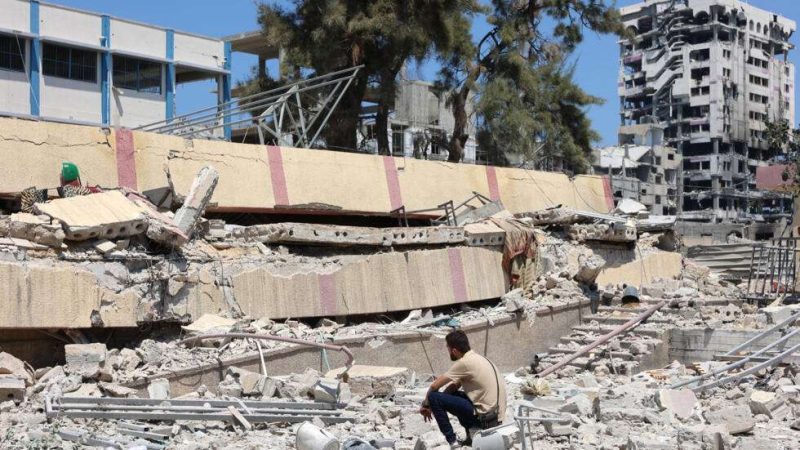
Palestinian Information Center – October 28, 2024
GAZA – The Euro-Med Human Rights Monitor documented that the Israeli occupation army targeted shelter centers in the Gaza Strip 39 times since the beginning of October 2024, resulting in the deaths of 188 Palestinians and injuries to hundreds more. This marks a serious escalation in crimes targeting civilian gathering places, especially in northern Gaza, aimed at forcibly emptying it of its Palestinian residents.
The Euro-Med Monitor said that its field team recorded the Israeli army’s targeting of schools, hospitals, clinics, and halls used for shelter 65 times since the beginning of August this year, 39 of which occurred in October. During these incidents, 672 Palestinians were killed, and over a thousand others were injured.
The report highlights that 57 of these attacks targeted locations in northern Gaza and Gaza City, while 8 occurred in central Gaza. The attacks include bombings, direct gunfire, and the killing of forcibly displaced individuals and their families, or forcing them to evacuate schools under fire or through orders of forced displacement, followed by burning or destroying these schools to render them uninhabitable and to prevent the displaced from returning.
The Monitor noted that Israel’s systematic policy of destroying shelter centers further tightens the noose on the available options for residents regarding places they can seek refuge, facilitating Israel’s goals of destroying and forcibly displacing Palestinians and altering the demographic makeup of the region, especially in northern Gaza. Various Israeli officials have explicitly expressed their intention to annex and settle in the area.
The Euro-Mediterranean team documented the scattering of dozens of Palestinian families and the separation of their members due to the targeting of shelter places and the subsequent repeated waves of forced displacement, which have compounded their psychological suffering, especially among children.
Targeting shelter places is considered a fundamental part of Israel’s strategy to undermine the social structures of Palestinians in Gaza, continuing to weaken the population psychologically and physically, and eradicating their shared spaces that could provide some degree of psychological and social support.
Furthermore, the targeting of shelter places negatively affects families’ and individuals’ access to humanitarian aid, as many of these sites serve as distribution points for humanitarian assistance from charities. If they are forced to flee to other locations, they may find themselves in areas lacking access to available humanitarian aid, which is already limited in the region, exacerbating the humanitarian situation and increasing the suffering of the population.
The Euro-Med Monitor reported that its field team documented, on the afternoon of Sunday, October 27, the Israeli air force bombing the “Asma” school, which shelters thousands of displaced individuals in the Shati Camp west of Gaza City, resulting in the deaths of 11 Palestinians, including 4 journalists, among them two women, and injuries to dozens more. This bombing came eight days after the Israeli air force targeted the same school, killing eight Palestinians and injuring others.
The field team also documented the bombing of the “Shuhada al-Nuseirat” secondary school for boys, which shelters thousands of displaced individuals in the Nuseirat refugee camp in central Gaza, resulting in the deaths of 18 Palestinians, including 12 children and 3 women, and injuries to 52 others.
A review conducted by the Euro-Med field team revealed that none of the victims were militants, among whom was Professor Ashraf Yaqub Al-Jadi, 54 years old, the dean of the nursing faculty at the Islamic University of Gaza.
The Monitor noted that the Israeli occupation army evacuated no fewer than 10 schools housing thousands of displaced individuals in northern Gaza, burning most of them. This evacuation followed quadcopter aircraft sending of Palestinian detainees, ordering those inside to evacuate and head to checkpoints established by the Israeli occupation army.
The occupation forces also unexpectedly bombed some of these schools, as happened with the Jabalia Preparatory School, where 10 displaced individuals were killed on October 21, and the Zaid bin Haritha School, where 7 displaced individuals were killed on October 22.
The Euro-Mediterranean Human Rights Monitor renewed its call on all countries to fulfill their international responsibilities to stop the crime of genocide and the serious crimes being committed by Israel in the Gaza Strip, to protect civilians there, to ensure Israel’s compliance with international law and the decisions of the International Court of Justice, to impose effective sanctions on Israel, and to halt all forms of political, financial, and military support provided to it, including an immediate cessation of arms sales, exports, and transfers to Israel, as well as export licenses and military assistance.
It also called for accountability and prosecution of countries complicit and partners with Israel in committing crimes, especially those supplying Israel with any forms of support or assistance related to these crimes, including providing aid and engaging in contractual relationships in military, intelligence, political, legal, financial, media, and other fields that may contribute to the continuation of these crimes.
The Monitor demanded the activation of all available accountability and prosecution pathways at the international, regional, and local levels, including serious and joint efforts to activate the pathway of universal jurisdiction to hold accountable the perpetrators of crimes against Palestinian civilians before the national courts of countries that recognize this jurisdiction.
South Africa submits 750 pages of evidence in genocide case against Israel
The Cradle | October 28, 2024
South Africa’s legal team on 28 October submitted hundreds of documents to the International Court of Justice (ICJ) offering “undeniable evidence” of acts of genocide committed in Gaza by the Israeli army and statements by authorities that carry genocidal intent.
“The evidence will show that undergirding Israel’s genocidal acts is the special intent to commit genocide, a failure by Israel to prevent incitement to genocide, to prevent genocide itself, and its failure to punish those inciting and committing acts of genocide,” a statement from Pretoria says.
“South Africa’s Memorial is a reminder to the global community to remember the people of Palestine, to stand in solidarity with them, and to stop the catastrophe. The devastation and suffering has been possible only because despite the ICJ and numerous UN bodies’ actions and interventions, Israel has failed to comply with its international obligations,” the statement added.
Officials say that the submission, also called a memorial, is presented in more than 750 pages of text, in addition to over 4,000 pages of annexes.
Speaking to Al Jazeera, officials said they are confident that the hundreds of pages of evidence are “more than enough” to sustain their case. “The problem we have is that we have too much evidence,” Ambassador Vusimuzi Madonsela, South Africa’s representative to The Hague, told the Qatari news organization.
Some of the evidence submitted includes public statements made last week by senior members of the Israeli government at a conference named “Preparing to Settle in Gaza,” which was organized by the extremist Nachala Settlement Movement and promoted by Israel’s ruling Likud party.
“[We will] tell them, ‘We are giving you the chance, leave from here to other countries’,” National Security Minister Itamar Ben-Gvir said during the conference. “The Land of Israel is ours,” he stressed.
Israel is currently trying to expel tens of thousands of Palestinians who remain in northern Gaza as part of an extermination campaign that seeks to transform the region into a military zone under the General’s Plan.
On 26 January, the ICJ ruled it was plausible that Israel had breached the Genocide Convention and ordered the government to ensure that its army refrained from genocidal acts against Palestinians. In response, Israel significantly intensified its ethnic cleansing campaign, including blocking the entry of humanitarian aid to the strip.
International NGO Oxfam on 1 October reported that the Israeli army has killed more children and women in Gaza during the past year than in the equivalent period of any other war this century.
Israeli minister threatens Bashar al-Assad: ‘You are in danger’

The Cradle | October 28, 2024
Israeli government minister and war cabinet member Gideon Saar threatened Syria’s President Bashar al-Assad on 27 October, warning that he will be “in danger” if his country continues to act as a “conduit” for Lebanese resistance movement Hezbollah.
Saar – who rejoined Benjamin Netanyahu’s government late last month – said during a conference that Tel Aviv “missed an opportunity” to “collapse” Assad’s government, which was “saved” by Iran and Hezbollah.
Syria must not be permitted “under any circumstances to be a conduit for weapons supply from Iran to Hezbollah,” the minister went on to say, adding that “Israel must make clear to Assad that if he chooses to harm Israeli security in this manner, he places his regime in danger.”
Israel “will not agree to Hezbollah’s renewed buildup of power through Syria, and will not agree to the opening of a front against it from Syrian territory,” he said. “Removing Assad from the Iranian axis will have far-reaching consequences for Israel’s security.”
Israel was heavily involved in supporting extremist groups against the Syrian government at the start of the US-led regime change war against Damascus, which began in 2011.
Fighters from Al-Qaeda’s Nusra Front were given Israeli air cover during the 2014 battles against Syrian government troops and Hezbollah in Quneitra. Wounded Nusra Front fighters were also treated at Israeli hospitals in the occupied Golan Heights.
Over the past several years, Israel’s air force has been waging an unofficial campaign of indiscriminate attacks against Syria, which aim to stifle the flow of weapons from Iran via Syria to the resistance in Lebanon. According to Lebanese analyst and journalist Khalil Nasrallah, this unofficial campaign – dubbed the ‘battle between wars’ – has failed.
Israeli attacks on Syria have increased since the start of the war in Gaza and Lebanon in October last year.
Since Israel’s massive escalation against Lebanon last month, nearly 2,000 people have been killed and over a million displaced. Israel has begun to target Lebanese–Syrian border crossings under the pretext that they are used to facilitate the delivery of Iranian weapons to Lebanon.
Hezbollah has promised its follower base recently that its military capabilities and weapons are in “great shape,” despite Israeli claims to the contrary.
The group has not yet used its more sophisticated and destructive weaponry against Israel.
Yezidis in Lebanon Flee the Terror of Israeli Bombs
By William Van Wagenen | The Libertarian Institute | October 28, 2024
Members of the Yezidi religious minority who fled ISIS and other Turkish-backed extremist groups in Syria are now seeking to flee Israel’s relentless bombing campaign in Lebanon.
“They bombed just next to our house. Just five meters from our building. I can’t handle another second here,” said Um Farhad, a Yezidi women living with her husband and two sons in a village near Baalbek in the Bekaa region of eastern Lebanon.
“By God, I don’t know what to do. We don’t know what to do. If we die here or if we don’t die, only God can help us,” she told the Libertarian Institute by phone.
The city of Baalbek, home to ancient Roman ruins, and its surrounding villages have been among the worst hit areas in Lebanon since Israel’s bombing campaign on Lebanon began on September 23.
In the first two days of the Israeli attack, warplanes bombed Baalbek city from all sides, hitting at least twenty-eight towns and villages, Lebanon’s National News Agency (NNA) reported.
One Israeli strike, in the town of Younine near Baalbek, hit a building housing Syrian workers, killing twenty-three people, mostly women and children.
The Yezidi religious community, whose ancient homeland covers regions throughout Iraq, Syria, Turkey, and Armenia was thrust into the international spotlight in 2014, following the genocide carried out against them by ISIS.
In a partnership with Kurdish security forces known as Peshmerga, the notorious terror group massacred thousands of Yezidi men and took thousands of women and children as slaves during an attack on the Sinjar region of Iraq.
But ISIS first grew powerful in neighboring Syria, as part of the broader western-backed insurgency to topple the Syrian government.
Um Farhad and her husband and children fled their home in the Ashrafiyeh neighborhood in Aleppo and came to Lebanon in 2013 after a Free Syrian Army (FSA) sniper shot and injured her son.
Um Farhad now hopes to flee another war, first by escaping the bombing in Baalbek to come to Beirut, and then flee to a safe country. “I just want to keep my family safe and get them to a safe place until the war ends. There is nothing that I care about more than that.”
But reaching safety is difficult. She and her family do not have a car and the road to Beirut is dangerous due to Israeli bombing. Even if they manage to reach the capital, many parts of which are also under heavy Israeli bombardment, they have nowhere to stay.
Over a million Lebanese from the south and east of the country have fled the war and are now displaced. Any open apartments in the major cities of Saida, Beirut, and Tripoli were quickly rented, often at high prices. Spaces in schools converted to shelters in places like the Hamra neighborhood in western Beirut also quickly filled up.
Many displaced Lebanese have had no choice but to live in tents in parks, on sidewalks, on the beach, or under highway overpasses.
Most of the 160 Yezidi families now in Lebanon come from the Kurdish-majority Afrin region in neighboring Syria. They were forced to flee their homes and farms in 2017 when Turkey and its Syrian proxy force, known as the Syrian National Army (SNA), invaded Afrin.
The SNA is comprised of former Syrian “rebels,” including former FSA, Nusra Front, and ISIS members, who fought with western and Israeli backing against the Syrian government starting in 2011. Many view the Yezidis as infidels that deserve to be exterminated.
Many Yezidi homes and farms in Afrin were taken by Turkish troops and their Syrian proxies after the invasion. Afrin is still under Turkish and SNA occupation, making a return to their former home region in Syria impossible.
Mato, a Yezidi man living in a Christian village in the Mount Lebanon region above Beirut, told the Libertarian Institute how he fled to Lebanon after he and his son were pulled off a bus by ISIS fighters while traveling between Aleppo and Afrin. They were imprisoned for four days but finally released after feigning to convert to Islam during a lengthy interrogation by an ISIS emir.
“For sixty years I worked to build a house that Daesh is now staying in,” Mato said. He now works doing manual labor, but there is little work.
Mato lives with his wife and son in a one room hut made of concrete blocks and a dirt floor covered with rugs as the cold mountain winter approaches. Demand for housing drastically increased as many displaced from across Lebanon have come to stay in the village. Before the war, Mato’s rent was $50 per month; now it is $300.
As the numbers of displaced in the village grew, local authorities stopped allowing new displaced families to come there.
Many in Lebanon are reluctant to welcome Syrians and other foreigners they don’t know into their communities, fearing they could be Israeli spies seeking to identify Hezbollah members or give the Israeli military information about locations to bomb.
One Yezidi family that fled from the danger in southern Lebanon to live in a tent in the Mount Lebanon region was forced to leave by local authorities just three days after they arrived.
The high prices resulting from the war have made it difficult for another Yezidi man, Kheiri, who spoke with the Libertarian Institute. “My wife is very sick right now. She is not able to get out of bed. I am not able to afford any medication for her, because rent and food is so expensive. We are old now, in our sixties, so it’s hard to find work,” he explained.
Yezidis in the Mount Lebanon area say the situation could change for the worse any day.
“A few weeks ago, there was a bombing about 3km away. We hope the area is safe now, but no one knows what will happen,” Saad, a Yezidi man living in Mount Lebanon area, told the Libertarian Institute. “When the war first started in Syria, we didn’t worry at first because the problems were far away in the south, in Deraa. But the war quickly moved to Damascus. Finally, it came to us in Aleppo and Afrin in the north. We worry the same thing will happen here and the whole country will be in war.”
The insecurity is made worse because Israel hits not only military, but also civilian, targets. “In war, the airplanes should attack military areas, not civilian areas. But the Israelis are hitting civilians, and this scares us,” Saad stated.
Signs that Israel’s war on Hezbollah may engulf the entire country and target all aspects of Lebanese society continue to emerge.
On October 10, Israeli Prime Minister Benjamin Netanyahu threatened to inflict “destruction and suffering like we see in Gaza.”
His warning was followed a week later by an Israeli strike on a home in a Christian town of Aitou in the mountains in the north of Lebanon. The strike killed twenty-three people from a Lebanese Shia family displaced from the south.
NBC News described the “overwhelming stench of rotting flesh mixed with concrete dust” pervading the aftermath. “A dead baby inside a destroyed pickup truck; a child’s severed arm buried in nearby rubble; toddler clothing and books shredded; flies swarming as officials collected body parts, some too small for body bags ending up in clear ziplock bags.”
Before the strike, Aitou seemed as far from the violence as possible. Everything “was calm; everything was quiet,” said Illy Edwan, the owner of the villa housing the family.
Amid the chaos, Saad is making an appeal for the protection of Yezidis, an ancient religious minority that has been subject to many campaigns of genocide in its long history. “We are trying to escape from the battle and the conflict. We are suffering a lot now because we are not able to find a safe and secure place. The situation is in crisis. We want to leave Lebanon and go somewhere where there is security and where we can finally just live in peace. This is what we are asking for.”
Israel’s ‘zugzwang’ moment with Iran
By M. K. BHADRAKUMAR | Indian Punchline | October 28, 2024
A senior US official told Washington Post that the toned-down early morning Israeli strike Saturday on military targets in Iran was a “proportional strike,” which “was moderate enough to quiet the conflict without provoking Iran into a counterattack.”
However, Israeli prime minister Benjamin Netanyahu insisted in a speech on Sunday: “We hit hard Iran’s defence capabilities and its ability to produce missiles that are aimed at us. The attack in Iran was precise and powerful, and it achieved all its objectives.”
But within Israel itself, there is scepticism. Israel’s most popular news outlet Channel 12 called the operation insignificant and demonstrated Iran’s status as a major power in the region. Netanyahu has not released any reliable documentation to back up his claim, which he usually does.
NourNews lampooned that Israeli psychological war against Iran has not worked. Israel hoped to stir up panic that there might be an attack on Iran’s nuclear installations but normal life continues in Iran. It appears that Israel was neither inclined to carry out an extensive attack nor was incapable of conducting such an operation without greater American involvement — or both. Iran’s attack on October 1 badly exposed the weakness of Israeli air defence system.
So, the bottom line is that Israel may have succeeded in conducting a limited predawn operation against Iran without excessively increasing the chances of an all-out war.
Iran’s Supreme Leader, Ayatollah Ali Khamenei, said on Sunday that the “evil committed by the Zionist regime two nights ago should neither be downplayed nor exaggerated”. Khamenei added: “Of course, our officials should be the ones to assess and precisely apprehend what needs to be done and do whatever is in the best interests of this country and nation. They [the enemy] must be made to realize who the Iranian people are and what the Iranian youth are like.”
Khamenei’s remark suggests that an immediate military response is not planned. Indeed, Tehran has been playing down the Israeli strike, saying it caused limited damage.
The foreign ministry said in a statement on Saturday that given Iran’s “inherent right of legitimate defence” under UN Charter, “Tehran will utilise all material and spiritual capabilities of the Iranian nation to defend its security and vital interests, and firmly stand by its duties towards regional peace and security.”
The statement drew attention to Israeli operations in Gaza and Lebanon, but, notably, kept silent on any Iranian response to Saturday’s air strike.
Iran will no doubt weigh the unprecedented diplomatic support from the regional states. This is a moment that Tehran cherishes, as apparent in Foreign Minister Abbas Araghchi’s words: “Since yesterday [Saturday] until now, we are regularly receiving messages from different countries, the statements they issued, the level of condemnation from different countries both in the region. It is really remarkable that it took place at this international level.”
Other statements at the military level played down the Israeli attack saying the air defences intercepted it successfully and only “some limited damage was caused in some areas, the dimensions of which are being investigated.” The public mood in Tehran is one of high expectations from the Pezeshkian government on the economic front.
Javad Zarif, former foreign minister and current strategic adviser to the government, also made no direct threat of retaliation, saying, “The west should move away from its outdated and dangerous paradigm. It must condemn Israel’s recent acts of aggression and join Iran in efforts to end the apartheid, genocide and violence in Palestine and Gaza, and in Lebanon. Recognising Iran’s confident resolve for peace is essential; this unique opportunity should not be missed.” [Emphasis added.]
The Israeli strike did not take Tehran by surprise. In a “scoop”, Axios reported that Israel sent a message to Iran on Friday ahead of its air strikes warning the latter not to respond in “an attempt to limit the ongoing exchange of attacks between Israel and Iran and prevent a wider escalation.”
The message from Tel Aviv conveyed through third parties “made it clear to the Iranians in advance what they [Israelis] are going to attack in general and what they are not going to attack.”
Apparently, the US pressured Israel to calibrate its proposed attack as a “proportionate response”. This becomes hugely important in the downstream, as the Biden Administration’s efforts will continue to prevent conflict between Israel and Iran escalating into a confrontation.
To be sure, Iran will press ahead on the diplomatic track. Interestingly, the Jerusalem Post newspaper highlighted that Araghchi’s hectic tours of regional capitals are “important because he is not only visiting countries that are close to Iran historically or where Iran has interests, such as Lebanon or Iraq; rather, he is doing outreach to countries that have peace with Israel and which are close to the West, such as Jordan and Egypt…
“This shows how Iran is gaining influence in Jordan and Egypt. Egypt and Iran have been on a road to reconciliation, for instance. In addition, Iran and Saudi Arabia have reconciled with China’s backing. Saudi Arabia’s Crown Prince was also in Cairo this week, illustrating how a triangle of ties between Cairo and Tehran is emerging.”
Meanwhile, Tehran will closely watch the November 5 presidential and Congressional elections in the US. In the event of a Kamala Harris presidency, the resumption of nuclear negotiations is highly likely. On the contrary, a Donald Trump presidency may presage a difficult 4-year period ahead, but here too, Russian President Vladimir Putin’s proximity with Trump to calm down tensions between Washington and Tehran should be factored in.
A paradigm shift cannot be ruled out, either. Trump is a quintessential pragmatist who disregarded criticism to engage North Korean leader Kim Jong-Un in a dramatic turnaround, and is not known to be enamoured of Zionism.
Trump boasted on Wednesday of almost daily conversations with Netanyahu. “Bibi called me yesterday, called me the day before,” Trump said. Trump had already reported a telephone conversation with Netanyahu on Saturday, claiming that the latter “wants my view on things.”
Conceivably, Trump’s repeated call for Israel to swiftly defeat Hamas and wrap up the war in Gaza, stems from the apprehension that otherwise, if he wins the upcoming November 5 election, a clash with Iran may become unavoidable.
The US is a far superior military power compared to Iran. But this is a war of attrition that is being fought on multiple fronts. And there is no instance of a nation benefitting from prolonged warfare. Trump abhors open-ended US military interventions. And Iranians are known to be highly nationalistic and subjugating them is impossible.
A prolonged war can result in US retrenchment from West Asia and the destruction of Israel — and may jeopardise Trump’s mesmerising MAGA movement.
Against this tumultuous backdrop, what are Israel’s options? There seems to be no way out of the war in West Asia but the catch is, it won’t be the sort of war Israel is hoping for, let alone can win.
Seymour Hersh wrote in Substack on Tuesday, “I’ve heard nothing from contacts in Beirut close to Hezbollah — whose troops are putting up a stiff fight as they did in Hezbollah’s 2006 war against Israel — that suggests anything other than a long war ahead…”
Israel is a small country and it keeps its head above water thanks to American money. It lacks the capacity to wage a war with Iran on its own steam. The Israeli planes reportedly flew to Iran through US-controlled air space in Syria and Iraq!
The situation is turning into a ‘zugzwang’ in real life for Israel. Anything that Israel does will only make the situation worse, and it doesn’t have a choice not to make a choice, either.
West ‘arm-twisting’ Georgia over elections – Kremlin
RT | October 28, 2024
The West is openly trying to interfere in Georgia’s parliamentary elections, Kremlin spokesman Dmitry Peskov has said, stressing that voters in the former Soviet republic have every right to independently choose their own future.
In Saturday’s high-stakes election, the ruling Georgian Dream party, which seeks to build pragmatic relations with Russia, secured 54% of the vote, while various opposition forces garnered between 11% and 3% each, according to the Central Electoral Commission.
Pro-Western opposition parties, however, have refused to recognize the results, calling the vote a “constitutional coup.” The nation’s French-born President Salome Zourabichvili joined the chorus, urging the people to protest and claiming that Georgia had become a “victim of a Russian special operation.”
Speaking to reporters on Monday, Peskov unequivocally denied the allegations. “We are not trying at all and hardly have the opportunity to influence the development of the situation” in the country, he said, stressing that “it is the Georgian people’s business to make the relevant decisions.”
“However, we see completely unprecedented interference attempts from the West. They are trying not only to twist Tbilisi’s arms, but also to impose their terms. It is hard for me to imagine how the proud Georgian people can tolerate such ultimatums that pour in daily.”
On Sunday, the EU Commission issued a statement voicing concerns of “a tense environment, with frequent compromises in vote secrecy and several procedural inconsistencies” as well as “irregularities” in the election, insisting that those issues must be addressed. European Council President Charles Michel also noted that Georgia must prove its commitment to continuing the path to joining the bloc.
US Secretary of State Antony Blinken has demanded that Georgia conduct an investigation into reports on violations during the vote while sounding the alarm about suspected “vote buying, and voter intimidation.”
This summer, Georgian Prime Minister Irakli Kobakhidze warned that pro-Western opposition in the country would open a “second front” against Russia in addition to the Ukraine conflict if it won the parliamentary elections. Around the same time, Russia’s Foreign Intelligence Service said that the US was seeking a regime change in the Caucasus country by fomenting protests during the vote.
Relations between the West and Tbilisi soured in recent months after Georgia passed the ‘foreign agents’ law requiring entities and individuals which receive more than 20% of their funding from abroad to register as “promoting the interests of a foreign power.” While its proponents insisted it would increase transparency, the EU condemned the legislation, warning that it goes against Georgia’s goal of joining the bloc.
I don’t want war with Russia, China – Vance
RT | October 28, 2024
The US is not at war with Russia and should not seek one, Republican vice-presidential nominee J.D. Vance has said.
The senator from Ohio was asked during his appearance on NBC’s Meet the Press on Sunday whether he saw the Russian leader “as an ally or an enemy.” Putin is “clearly an adversary, he is a competitor,” but Washington needs to be “smart about diplomacy too,” Vance responded.
”Just because we don’t like somebody doesn’t mean that we can’t occasionally engage in conversations with them,” he suggested.
Host Kristen Welker pushed him further on whether he would directly refer to Putin as an enemy.
”We are not at war with him. And I don’t want to be at war with Vladimir Putin’s Russia,” the senator said. “I think that we should try to pursue avenues of peace.”
The same logic applies to China, Vance said, adding that he perceives it as a greater threat to American interests than Russia. The US may not like having to talk to its rivals, but in the case of the Ukraine conflict, resolving it will require negotiations, the senator pointed out.
When asked whether former President Donald Trump would take the US out of NATO, Vance assured that he wouldn’t. If his running mate returns to office, the country will honor its commitment to the organization, but the bloc “is not just a welfare client, it should be a real alliance,” he said. Vance was referring to Trump’s criticism of insufficient defense spending by its European members.
Moscow has identified NATO’s enlargement in Europe as a threat to its national security and a key reason for the deterioration of relations with the West. Russian officials have for decades declared that the US-led military bloc’s increasing involvement in Ukraine since the 2014 armed coup in Kiev and its promise to bring the country into the fold have contributed in a major way to setting off the ongoing hostilities.
The current US Democrat administration has pledged to stand by Kiev “for as long as it takes” to defeat Russia and has pushed other nations to do the same. Despite the hundreds of billions of dollars spent on weapons and aid for Ukraine, Kiev’s troops are currently retreating along many parts of the front. Trump has claimed while campaigning that he would end the hostilities in 24 hours, if elected.
Featured Video

Seyed M. Marandi: US-Iran War Inevitable: Kuwait and Bahrain May Fall
or go to
Aletho News Archives – Video-Images
From the Archives
USS Liberty Massacre: A Pivotal Moment in the Hostile Takeover of America
By Kevin Barrett | Crescent | Dhu al-Qa’dah 24, 1445
In corporate America, hostile takeovers are commonplace. They occur when an aggressor—a larger corporation or rich individuals—seizes control of a smaller corporation without asking permission.
What few recognize is that the United States itself has been subjected to a hostile takeover. Since the aggressor, the illegitimate settler colony known as “Israel,” is much smaller than the US, the takeover has necessarily been surreptitious.
As of June, 2024, Israel’s gradual takeover of the US has become obvious and undeniable—a proverbial “elephant in the living room.” … continue
Blog Roll
 Aletho News
- Seyed M. Marandi: US-Iran War Inevitable: Kuwait and Bahrain May Fall
- Leaders Condemn Ansarallah Attack on Saudi Arabia While Ignoring Illegal War Against Yemen
- Leaked: Britain’s Covert Iraqi Psyops Network
- Yemeni Armed Forces Warn Airlines Against Using Saudi Airports, Exempt Mecca and Medina
- Iran security chief says powers greater than US tried to conquer Iran but ended in ‘dustbin of history’
- Europe’s mounting social chaos… chickens coming home to roost for proxy war against Russia
- US-Russia Diesel Deal Becomes Massive Defeat for Ukraine
- Hormuz and the Looming Economic Catastrophe
- Dhubab offensive, media blitz and the rapid unraveling of Saudi-backed coalition’s new gambit
- Putin Conveys to Trump Iran’s Vision on Possible Conflict Resolution – Kremlin
- If Americans Knew
- Gaza: Ceasefire Anniversary Marks Year of Failed Promises
- The American Conservative: Mike Huckabee Should Resign
- A C-Section in Shackles: A Palestinian Woman’s Harrowing Birth in Israeli Detention
- ‘He’s Desperate’: AIPAC Begins Spending Against Abdul El-Sayed to Boost Mike Rogers:
- Trump, Hormuz, and the Looming Economic Catastrophe
- For three years, Israel has killed a child in Gaza every 71 minutes – Daily Update
- Israeli forces kill another child in Gaza – Daily Update
- Gaza ceasefire exists in name only, say more than 100 organizations
- Nearly 2 Million in Gaza Need Urgent Shelter Assistance as Winter Looms: IOM Chief Warns
- Suppressing Palestinian resistance: US charity under fire for AI monitoring of Gaza classrooms
- No Tricks Zone
- Germany’s Green Energy Debacle: High Energy Costs Force Kahla Porzellan to Close After 182 Years!
- New Study: 50 Years Of The Most Aggressive ‘Net Zero’ Policies Can Only Affect The Global Climate By 0.03°C
- US September “Heat” Was No Record…Many Records Set Decades Ago
- Latest European Green Energy Debacle; Portugal’s Largest Flagship Solar Park Insolvent!
- Green Energy Debacle: German Expert Professor Fritz Vahrenholt Warns Of Severe Economic And Social Consequences
- Two More Paleo Reconstructions Affirm Meters-Higher Sea Levels Across Ireland, Brazil 7000-6000 Years Ago
- New Study: Earth And Venus Surface Warmth Largely Explained By Convection And Lapse Rate, Not CO2 Or Radiation
- 2025 Nature Paper Claiming Worsening Global Drought Gets RETRACTED …Heavily Flawed
- New Study: ‘Global Drought Shows No Detectable Recent Acceleration Under Climate Warming’
- Economic Masterminds: German Socialists Suggest Taxing Productivity Gains Stemming From Using AI

