EU Tries to Save Face amidst Coronavirus Debacle
By Paul Antonopoulos | March 26, 2020
The European Union’s decision to open negotiations with Northern Macedonia and Albania is a propaganda act from Brussels that attempts to reassure members of the Union that countries, even in the midst of the epidemic, want to become members of the organization. This is a cheap propaganda trick that attempts to restore confidence in the European Union at a time when it has completely failed to deal with the coronavirus pandemic that has shown weakness in the alliance.
Maurizio Massari, Italy’s ambassador to the EU, said earlier this month that “the coronavirus crisis is a test of the EU’s cohesiveness and credibility — one that can only be passed through genuine, concrete solidarity. Europe must act according to the principle of mutual defense and help those members whose security is under threat.” With nearly 60,000 people confirmed infected and over 7,500 deaths, the European Union has failed in this test as no member states came to the aid of Italy and instead looked inwardly towards their own borders. The European Union’s cohesiveness was exposed as a fantasy when days ago member state Poland closed its airspace to a Russian plane delivering aid to fellow European Union member Italy, forcing the aircraft to take an alternate route that is 1,000 kilometers longer.
Essentially the European Union that is currently the epicenter of the coronavirus pandemic has exposed why the Union is dysfunctional and without any solidarity. It has shown a huge gap between words and action. The European Union as an example of the liberal world order endlessly spoke of humanity but have proven they are inhumane. They promoted the idea of efficiency but proven they are actually ineffective. In short, the announcement to progress the European Union membership of Albania and North Macedonia is a cheap propaganda gimmick for Brussels at a time when it is under heavy scrutiny for showing a lack of solidarity and assistance to Italy, raising questions regarding the credibility of the organization. It is negotiating in a way that has never existed, utterly undefined, with a big question mark as to what will be.
According to a draft decision signed by the bloc’s 27 members, which Reuters had access to, the hope of membership for the two Western Balkans countries has often been shattered in recent years due to the scepticism expressed, primarily by the Netherlands and France, as they correctly highlight that both countries are highly corrupt. However, the start date of the negotiations is not specified and will be subsequently determined when the European Commission prepares the framework for the negotiations.
Michael Roth, Germany’s state secretary for European affairs, wrote on Twitter on March 24, “Congrats to Tirana+Skopje, it’s well deserved,” after the agreement was reached during a videoconference. This was followed by European Union Enlargement Commissioner Oliver Varhelyi also going to Twitter, saying that he is “very pleased that EU member states today reached political agreement on opening of accession talks with Albania and North Macedonia. I wholeheartedly congratulate both countries. This also sends a loud and clear message to Western Balkans: your future is in EU.”
North Macedonia is unlikely to face resistance in joining the European Union, and is already being rapidly ascended into NATO after it resolved its name issue with Greece. However, the accession is not yet guaranteed for Albania as Greece raises concerns on the rights and treatment of the Greek minority in occupied Northern Epirus in southern Albania. Approximately 200,000 Greeks of Northern Epirus face daily discrimination with Albanian authorities removing bilingual road signs that display Greek, the confiscation of property belonging to Greeks, and Albanian police even murdering a Greek in a shootout as they removed a Greek flag from a cemetery, among many other forms of discrimination. On these grounds, Greece may veto Albania’s accession, but this is likely to be a temporary measure as the Greek political establishment always eventually capitulate to the demands of Brussels and Germany. Once this issue is resolved, it is likely that Albania with North Macedonia will be accelerated into the European Union, and this will prove necessary as the bloc wants to maintain the illusion that it is not in disarray in the midst of the coronavirus pandemic.
This begs the questions though as to why Albania and North Macedonia would want to ascend into the European Union after seeing the alliance’s treatment of its own long-time member states like Italy. Albania has always been a pro-Western state, owing to the Western world its existence, its occupation of Northern Epirus, and its indirect occupation of Kosovo. It is therefore unsurprising that it wants to be further integrated into the Western world. North Macedonia since the very beginning of its foundation with the dissolution of Yugoslavia in the early 1990’s wanted to join the European Union and NATO, but was prevented from doing so because of the name dispute with Greece. With this issue resolved, it now has a clear path towards the bloc. None-the-less, both states are not even remotely close in an economic or so-called democratic sense to being candidates, but will be fast-tracked to help save face after the European Union’s debacle with the coronavirus pandemic.
Paul Antonopoulos is a Research Fellow at the Center for Syncretic Studies.
Correctly Estimating Coronavirus Infections
By Ron Unz • Unz Review • March 25, 2020
The Coronavirus epidemic may soon produce the greatest American disaster since our Civil War over 150 years ago, and numbers reveal the possible magnitude.
For example, New York Times Columnist Nicholas Kristof on Sunday reported the disheartening analysis of Dr. Neil Ferguson of Britain, one of the world’s leading epidemiologists. According to Dr. Ferguson the “best case” scenario is that the Coronavirus will kill over a million Americans.
Other possible projections are far worse. Last week, California Gov. Gavin Newsom issued orders completely locking down his entire state in order to halt the spread of the disease. He justified this decision by explaining that experts had warned him that without drastic changes in behavior, over 25 million Californians would become infected over the following couple of months. Such a calamity would obviously have produced to a total collapse of the state’s health care system, probably resulting in more than a million deaths. A million dead Californians by early summer…
The key to understanding the terrible danger of the Coronavirus is that there is no existing immunity and the disease is highly contagious. Therefore, under ordinary circumstances, the number of infected individuals tends to double every 3-6 days. A doubling-time of 3 days would multiply the ranks of the infected a thousand-fold during the course of a single month.
Thus, in late February Italian political leaders hardly regarded the virus as a serious national threat, but within just a few weeks much of the Italian health care system had collapsed and many thousands of Italians were dead. Despite a full national lockdown, the number of deaths in Italy has continued to rise exponentially.
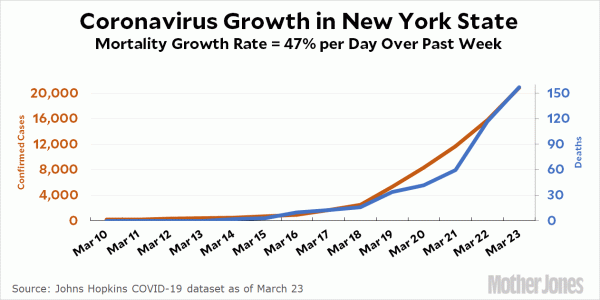
Similarly, New York reported its first death on March 14th. Yet just ten days later, deaths in that state were running at 50 per day, and rapidly accelerating.
Unfortunately, although numbers are absolutely crucial for our efforts to combat this dread disease, we lack accurate American data, especially with regard to the rate of infection.
The problem is that any program of massive, widespread testing is completely impossible given our lack of sufficient testing resources. Meanwhile, the Coronavirus has a substantial latency period during which victims experience no symptoms, and even afterward many cases are quite mild or even completely asymptomatic, leaving the infected unaware of their condition. So at present, testing has been confined to just a tiny sliver of the population, ensuring that the reported numbers of those infected represents a severe undercount. But we are left to guess just how severe.
However, the Coronavirus death statistics are certainly far more solid and reliable, and I soon noticed a simple and easy means of reasonably estimating Coronavirus infections from Coronavirus deaths. But although the methodology seemed obvious to me, after I described it on a comment-thread yesterday, I encountered quite a bit of initial confusion and disagreement, suggesting that the idea was not nearly as obvious as I had assumed. So on the off-chance that some people might be unfamiliar with the method, I’ve decided to outline it below.
Let us note three crucial Coronavirus parameters, which have already been estimated by medical experts although they are obviously dependent upon particular conditions.
- The infection doubling period – probably 3-6 days
- The mortality rate – perhaps 1% prior to the collapse of a the local health system.
- The typical mortality period (time between infection and death) – according to some estimates, around 3 weeks.
Now consider a Coronavirus death. If we assume a mortality rate of 1% and a three week interval between infection and death, we can therefore estimate that there had been 100 new infections three weeks earlier. Next, if we assume a doubling-period of 6 days, those 100 infections would have increased to 100 * 2^(21/6) = over 1000 infections by the time the death occurred.
Therefore, under these particular assumptions (along with a few simplifications), the true number of total infections can be estimated at over 1000x the number of deaths.
Let’s apply this methodology to a real-life situation. On 3/23/20, New York reported 53 new Coronavirus deaths, bringing the total to 210. This suggests that the true number of new infections that day may have been over 50,000, raising the total infected to more than 200,000. These estimates are eight to ten times larger than the officially-reported Coronavirus totals for New York, namely 4,750 and 25,665.
This estimate of New York infections relied upon a doubling period of six days, and it is quite possible that greater “social distancing” together with the recent lockdown imposed in that state may have considerably increased that parameter this figure, thereby reducing the correct number of infections. But I strongly suspect that the figures provided above are still far closer to the truth than those officially reported by the New York authorities. And there is obviously a huge practical difference between assuming 25,000 infected New Yorkers and believing the true figure is already closer to 200,000.
Here’s another example. The official estimate of Coronavirus infections in Louisiana is currently less than 1,400, but this estimation method suggests that the true total is nearly 50,000, a figure that has vastly different policy implications. While I would put little weight in the precise accuracy of that estimate, I strongly believe it’s much closer to reality than the tiny official total.
Summarizing things, the formula for estimating infections is:
- Number of infected = Number of Deaths / Mortality_Rate *2^(Mortality_Period/Doubling_Period).
It’s important to recognize that the parameters used may need to be sharply readjusted based upon particular circumstances.
For example, once a health care system collapses, the death rate probably spikes to around 5%, greatly changing the calculation. Similarly, once government lockdowns or other similar measures are taken, the doubling-period of the infection becomes much longer.
Under other circumstances, if a substantial fraction of the deaths are the elderly residents of nursing homes (as was the case in Washington State), the assumed death-rate would be much higher and the doubling-period of the infections generated by the immobile residents lower, significantly altering the appropriate equation.
Finally, this analysis may carry an important policy implication. Suppose that our best and most accurate means of estimating infections is indeed based upon this methodology. We would therefore be using the current death rate to back into the infection rate that that occurred three weeks earlier, so that any analysis of the impact of government policies would necessarily be lagged by three weeks.
Under these circumstances, it would be extremely inadvisable for President Trump or other government officials to rescind any of their lockdown or quarantine decisions until at least three weeks had gone by and the impact of these policies upon the rate of infection became fully apparent.
Former first minister of Scotland Alex Salmond cleared of sex assault charges
RT | March 23, 2020
Alex Salmond, former Scottish National Party leader and first minister of Scotland, has been acquitted of sexual assault charges by a jury at Edinburgh’s High Court.
After about six hours of deliberation, the jury found Salmond not guilty on 12 charges of attempted rape, sexual assault and indecent assault. A further charge, sexual assault with attempt to rape, was “not proven by majority.”
Salmond had denied all of the charges, which were made by nine women who are all either former Scottish government officials or SNP politicians, as “deliberate fabrications” for political purposes.
The allegations against the former first minister spanned a period of six years between 2008 and 2014.
The verdicts were read out after an 11-day trial. His defense team had argued that the charges had come from the same “political bubble” with no direct witnesses, and noted there had been inconsistencies in the testimonies of the women.
Two members of the jury were dismissed on Monday morning, apparently in relation to concerns over the Covid-19 outbreak, some reports said. The trial was also moved to a large courtroom due to fears around transmission of the virus.
WUHAN OUTBREAK: CHINA DEMANDS AN HONEST ACCOUNTING
By Thomas Hon Wing Polin | March 22, 2020
- It is now virtually certain that COVID-19 was brought to Wuhan by American troops taking part in the city’s World Military Games last Oct. 18-27.
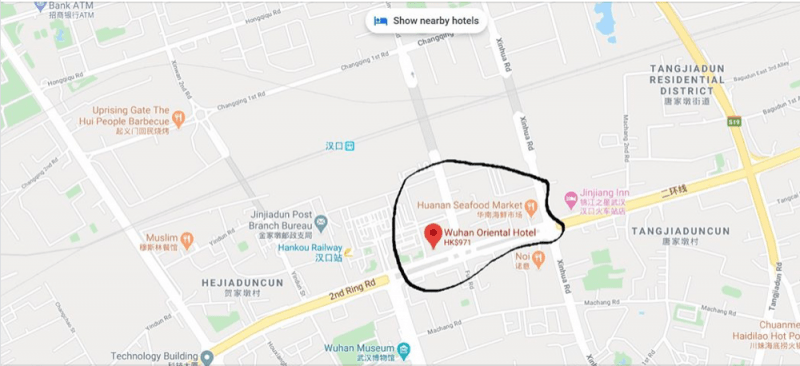
- The 300-strong US contingent stayed 300 meters from the Huanan Seafood Market where China’s outbreak began (see map below) at the Wuhan Oriental Hotel.
- Five of the US troops developed a fever on Oct. 25 and were taken to an infectious-diseases hospital for treatment.
- 42 employees of the Oriental Hotel were diagnosed with COVID-19, becoming the first cluster in Wuhan. At the time only 7 people from the market had been thus diagnosed (and treated before the hotel staff). All 7 had contact with the 42 from the hotel. From this source, the virus spread to the rest of China.
- The American Military Games team trained at a location near Fort Detrick, the military’s viral lab closed down by the CDC in July for various deficiencies.
- The big question now is whether the transmission was planned, or accidental.
- Chinese authorities are awaiting an explanation from US authorities.
- A few days ago, Mike Pompeo phoned Yang Jiechi, Chinese State Councillor for Foreign Affairs. Pompeo’s counterpart is actually Foreign Minister Wang Yi and Yang is Wang’s boss, so Pompeo wanted to talk about something urgent and important.
- Pompeo wanted the Chinese not to publicize what they had found.
- Yang’s reply: “We await your solemn explanation, especially about Patient Zero.”
China’s leaders have long suspected US military involvement in the Wuhan outbreak but were determined to stop the disease before pursuing the Americans for an honest accounting.
Africa, Latin America Fragile Targets for Coronavirus Spread
teleSUR | March 20, 2020
The West African nation of Mali has roughly one ventilator per 1 million people — 20 in all to help the critically ill with respiratory failure. In Peru, with more than 32 million people, about 350 beds in intensive care units exist.
Many of their nations are slamming shut borders and banning large gatherings in the hope of avoiding the scenes in wealthier countries such as Italy and the U.S., but local transmission of the virus has begun.
Containing that spread is the new challenge. Africa has more than 900 confirmed cases and Latin America more than 2,500, but an early response is crucial as fragile health systems could be quickly overwhelmed.
With such limited resources, experts say identifying cases, tracing and testing are key.
“We have seen how the virus actually accelerates that after a certain … tipping point. So the best advice for Africa is to prepare for the worst and prepare today,” WHO Director-General Tedros Adhanom Ghebreyesus said Wednesday.
“We have different and significant barriers to health care in Africa, which could be a real challenge,” said Dr. Ngozi Erondu, a senior research fellow at the Chatham House Center for Global Health Security.
Many countries in sub-Saharan Africa do not have the isolation wards or large number of health care workers to respond to a surge of COVID-19 patients, she said.
Liberia and Burkina Faso only have a few ventilators for their millions of people.
Dr. Bernard Olayo, founder of the Kenya-based Center for Public Health and Development, said most countries in Africa can’t afford ventilators. Even if ventilators were provided by other countries, it’s not sufficient because of the lack of qualified people to use them.
“It’s complex, it’s very very complex because the patients that end up on ventilators require round the clock care by larger teams,” he said.
Many patients could do well with just oxygen, he said, but close to half of health facilities in African countries don’t have reliable oxygen supplies. Oxygen concentrators can be used, but given the frequent electricity cuts in many countries, oxygen generators and pressure cylinders are needed because they can function while power is out.
The WHO regional Africa director, Dr. Matshidiso Moeti, said the lack of ICU facilities and ventilators is one of the biggest challenges facing the continent.
“We have been able to identify importing a field hospital-type of facility that can be set up and equipped with some of the key items needed, such as ventilators,” she said. Training has begun in Republic of Congo and Senegal so health care workers will be ready to operate it, and World Bank funding is being made available, she said.
Several countries in Latin America are also among the least prepared in the world for a pandemic, with healthcare systems already stretched thin.
Peruvian Minister of Defense Walter Martos told local America TV on Monday that the nation has less than 400 respirators available.
“It’s not a lot,” he said. “Really, we don’t have the infrastructure that developed nations do.”
Peru and other nations in Latin America are looking to the experience in Europe as a cautionary tale and hoping to curtail the spread of coronavirus cases before they overwhelm hospitals.
Epidemiologist Cristian Díaz Vélez said those measures could potentially create a slower rise in cases that is more manageable for Peru’s medical system. He said the country has around 300 to 350 beds in intensive care units, half of which are now in use.
“It will overwhelm our healthcare system,” he said, if cases skyrocket.
Other countries in Latin America could fare far worse.
Covid-19 Shatters the Facade of European Union
Strategic Culture Foundation | March 20, 2020
The new coronavirus and its accompanying disease Covid-19 has stopped the globe in its tracks. Governments, markets and news cycles have become dominated by the pandemic. Europe is now the epicenter for the disease, with reportedly more fatal cases of infection than China where the virus first erupted in December.
Several European Union countries have declared themselves to be in states of emergencies, including Belgium, France, Portugal, Spain and Italy. The 27-member bloc has sealed off external borders. Some states, such as Poland, have begun closing borders with other EU members. Brussels, the administrative center of the EU, is alarmed because the much-vaunted single market and its core principles of free movement of goods and people is at risk of collapsing.
The European entity which proclaims solidarity and supranational status is reverting to a collection of nation states, each desperately fighting for their own survival amid the Covid-19 pandemic. EU leaders have been criticized for showing a lack of central leadership and solidarity. When Italy first reported a surge in infections a few weeks ago, the rest of Europe was slow to respond with the necessary prompt assistance. Now Italy is in such a grip of the disease – with thousands dead – that in some parts of the country normal funeral services reportedly cannot even cope with the number of deceased.
In blistering remarks this week, the Serbian President Alexander Vucic lamented that there was “no European solidarity”. Serbia is a prospective member of the EU along with several other Balkan states, but Vucic said his country has received little in the way of aid from the EU in face of the coronavirus threat. Indeed, by contrast, the Serb leader extolled the generosity of China which has sent large shipments of equipment to combat the disease. Beijing has also dispatched aid cargoes and medical teams to Italy and other EU members to help them cope with their outbreaks.
The World Health Organization has praised the prompt and massive intervention by the Chinese authorities in curbing the spread of the disease within their borders. Latest indications seem to show China has halted the spread of the infection.
The dithering response by the EU and its belated nation-based reactions could turn out to be a fatal political incompetence with consequences of a huge death toll and ruinous economic impact. The citizens of Europe will not forgive such fecklessness.
Laughably, an EU monitoring group this week claimed that Russia was interfering by spreading disinformation about impacts of the novel coronavirus in such a way as to undermine European governments and to “sow division” among European civilians. This scapegoating for its own incompetence is risible.
Weeks ago when the world could see that the virus outbreak in China was a grave development, the EU administrators and national leaders were sitting on their hands. Now that the disease has become a pandemic across the EU, the European Central Bank has suddenly announced it is pumping €750 billion ($820 billion) to shore up financial markets and institutions while countries struggle to find test kits to detect the disease and ventilators to treat victims. Healthcare systems have been gutted by years of economic austerity under neoliberal capitalism whereby Brussels and European governments have prostrated themselves to the diktat of finance capital.
What is abundantly clear is that the EU has become a financially-driven cartel, not a human-centered federation of nations. An organization that cannot adequately protect the health of its public is not an organization worth defending. The EU’s declarations of democracy and solidarity are being seen for the facade that they are. That facade was always shaky. A microbe is enough to tear it down.
Asleep at the wheel: Why didn’t Western politicians act quicker on Covid-19 spread?
By Neil Clark | RT | March 19, 2020
Western countries are in lockdown due to Covid-19, but if leaders, their advisers, and the political class in general had paid attention to what was going on in China at the turn of the year, the crisis might have been averted.
Imagine you’re a passenger on a ship. You’d expect, wouldn’t you, that the captain and his officers keep a very good look-out for dangers ahead? You’d expect them to have up-to-date weather information. You’d expect them to take corrective action before the ship hit an iceberg.
The sad truth – for Western citizens, the passengers of the ship – is that those whose job it was to watch out for gathering storms have let us down very badly.
The chronology is most important.
According to the South China Morning Post, the first case of someone suffering from what later came to be known as Covid-19 occurred in China on November 17. The number of cases grew in December, (the majority linked to the Huanan Seafood Market), but we didn’t know internationally what was going on until news began to come out that Wuhan had been hit by a new virus in very late December/early January. The Chinese informed the World Health Organization of new pneumonia cases of unknown etiology on December 31.
The Chinese delay in flagging up what was happening in Wuhan absolutely didn’t help, but there was still time – about a two-week window – for other countries to act.
As reported in the BMJ, on January 11 and 12, the Chinese authorities shared the virus’ genetic sequence for countries to use in “developing specific diagnostic kits.” 440 deaths had been confirmed by January 21. By the 22nd, seven cases had been confirmed OUTSIDE China, including one in the US. All were travelers from Wuhan.
That surely should have got alarm bells ringing in Western capitals, especially as Chinese New Year on January 25 was coming up. Western leaders, and their advisers, would surely know that many Chinese workers based in the West would return home to celebrate, greatly increasing the risk that the virus would be brought back to Europe and North America.
On January 22, the UK government announced that health teams would meet the three direct flights a week from Wuhan, China, the epicenter of the virus. At the same time, the risk level was raised from ‘very low’ to ‘low’. But as Neil Ferguson, director of the MRC Centre for Global Infectious Disease Analysis at Imperial College, London, pointed out, flight screening was no panacea.
“This measure will only identify people who have symptoms as they come off the plane. If someone was infected two days before they travelled, they will arrive without any symptoms at all.” He added, and I emphasize in bold: “It’s essential that the entire health system is alert to the possibility that there will be cases here.”
Lo and behold, the first British case was confirmed nine days later, on January 31, 2020, from Chinese nationals staying at a hotel in York. That very same day, the first cases were also confirmed in Italy. Guess what: they were two Chinese tourists in Rome. Italy is now the world’s number one coronavirus ‘hotspot’. Nearly 3,000 have died there and 60mn people are in quarantine.
Wouldn’t it have been better, if instead of ineffective flight screening, all flights to Western countries from China had been stopped in January – and all travelers who had recently visited China been quarantined? France, by the way, got its first three cases on January 24 (a week before Italy and the UK). All three people had just come back from China. You don’t have to be Sherlock Holmes to see the pattern, do you?
In the New Year, the number one priority of Western politicians should have been the new coronavirus and how best to protect their own populations from it. But their minds were clearly on other things.
Trump – egged on by Washington’s Endless War Lobby – was engaged in an utterly reckless escalation of tensions with Iran. While Covid-19 was spreading in China, the New Year began with the assassination of General Soleimani, a man who had been fighting ISIS, but who was now portrayed as the ‘worst terrorist in the world’. The ‘Iran crisis’ dominated the news cycle. Boris Johnson meanwhile began the year on holiday with his girlfriend in Mustique. The opposition Labour Party were focusing on a leadership election which needn’t have taken place for several months. Three of the four candidates declared on television on February 13 – a day after the UN had activated its WHO-led Crisis Management team to deal with a rapidly escalating problem –that their ‘number one priority’ was… tackling ‘anti-Semitism’ in the Labour Party. Yet after all the brouhaha about anti-Semitism being ‘rife’ in Labour, it was reported at the end of February that the police had ended up charging just one person, a former Labour member.
One person, that is, out of a membership of half a million.
It seemed in February that no one in the political class was very interested in Covid-19.
This is despite the publication in the leading medical journal The Lancet on January 24 of a report entitled ‘A novel coronavirus outbreak of global concern’.
Covid-19 only began to be taken with the seriousness it warranted when it was already too late to try and stop its entry.
By not acting in time to restrict travel to and from China – and later from other ‘hotspots’ like northern Italy and Madrid, Spain, the governments instead waited and waited, until the measures they did take were far more draconian that might otherwise have been the case. It’s true that Trump did bar foreigners who had recently visited China from entering the US on January 31, but as David Leonhardt pointed out in the New York Times, it was “not the sweeping solution that Trump portrayed it to be.”
The costs to the economies of the various lockdowns are incalculable. People’s livelihoods are going to be destroyed. Entire industries are threatened. Don’t forget lockdowns and ‘social distancing’ can actually cause deaths too. As John Pilger pointed out on Twitter, a 2012 study showed that isolation killed the elderly, but isolate is what they’re now being told to do.
We’re in a right old state at the moment, but how much of this could have been avoided if instead of dozing off, or looking elsewhere, those whose job it was to protect us had acted quickly, at the proper time?
US Military Accuses North Korea of Lying About Coronavirus Infection Rate of Zero
Sputnik – March 17, 2020
North Korea, whose contacts with the outside world remain limited even in a normal situation, was one of the first countries to introduce tough inspection and quarantine measures, canceling tourist visits, cutting off flights and rail travel and quarantining all workers coming home from abroad.
Nearly three months into the COVID-19 outbreak, North Korean health officials maintain that the country has zero cases of the virus.
The Korean Central News Agency reported last week that it there were no cases of COVID-19 in the country, but urged the public to remain vigilant. The agency reported that the country has enforced “strict, top-class anti-epidemic measures,” to intensify its coronavirus response, including the tightening of inspection and quarantine of imports from abroad. The measures are said to include comprehensive “inspection and disinfection of vehicles, vessels and goods,” and a 10-day quarantine of imports.
The World Health Organization too has indicated that it’s not aware of any cases of the virus in the self-isolating country, although the organization does plan to send equipment and supplies to help Pyongyang battle COVID-19. North Korea had previously asked the WHO for material assistance including disposable gowns, gloves and hazmat suits.
The popular Coronavirus Resource Center map run by Johns Hopkins’ University School of Medicine, which depends on credible sources including the WHO and the US Centers for Disease Control and Prevention, also reports zero cases for North Korea thus far.
However, US officials believe Pyongyang, which is required to report on any outbreak of contagious viruses as part of its WHO membership obligations, is lying.
Speaking to reporters last week, US Forces Korea commander Gen. Robert Abrams said the Pentagon was “fairly certain” that the country had coronavirus cases given the lack of noticeable military activity. According to the US commander, the North Korean military only recently restarted training following a month-long lockdown.
Keith Luse, executive director of the National Committee on North Korea, a Washington-based think tank, told Bloomberg that it “it’s hard to imagine that North Korea could dodge the COVID-19 bullet.”
Western media have similarly spread stories suggesting that the virus was quietly raging throughout the country, with one report by the US National Endowment for Democracy-sponsored Daily NK online newspaper claiming that as many as 200 soldiers had already died, and that another 4,000 people were in quarantine. These claims, citing anonymous sources, were never verified, but have been spread widely by English-language media.
North Korea, which is thought to have successfully weathered both the SARS and Ebola outbreaks in 2003 and 2014, became one of the first countries in the world to mount a nation-wide emergency response to COVID-19 amid rising infection rates in neighbouring China, South Korea and Japan.
These measures included a ban on all foreign tourists in late January, quarantine for travellers from China exhibiting potential symptoms of the virus in Sinuiju in the country’s west, and the declaration of a “state emergency” to deal with the epidemic on January 30, including the creation of a special ‘Central Emergency Anti-Epidemic Headquarters’.
North Korea’s presumed infection rate stands in sharp contrast to those of its neighbours, with China, where the virus originated, reporting over 81,000 cases, including some 218 cases in the North-Korea neighbouring regions of Liaoning and Jilin. South Korea has 8,320 confirmed cases. Japan has reported 833 cases. Russia, meanwhile, has 93 confirmed cases.
Meet Eli Rosenbaum, the Justice Department’s Nazi Hunter
American taxpayers still paying for World War 2

By Philip Giraldi • Unz Review • March 17, 2020
The New York Times is reporting somewhat ruefully that “The Mission to Hunt Nazis Has Become a Race Against Time.” The U.S. Government’s zeal in going after alleged former “Nazis” began in 1979 when the Office of Special Investigations (OSI) was established within the Justice Department. In 2002, OSI included 13 attorneys, almost all of whom were Jewish, backed up by 10 “historians.” In 2010 it merged with the Criminal Division’s Domestic Security Section to create a new unit, the current Human Rights and Special Prosecutions Section (HRSP).
HRSP engages in a range of enforcement activities, but one of its principal focuses is the arrest and repatriation of claimed human rights violators associated with the German concentration and prison camp system preceding and during the Second World War. In the cases of those individuals linked to the camps, the HRSP has reportedly pursued the cases with some urgency because “These people are old, and they’re dying,” suggesting that the pursuit of World War II’s possible surviving criminals is more about revenge than justice. The Times article describes it as a “race against natural life spans.”
The man in charge of ferreting out hidden Nazis is Eli Rosenbaum, highly educated in the usual places and a lawyer. Wikipedia describes him as an Israeli-American, the dual-bit, if true, presumably in spite of the fact that he holds a high-level and highly paid American government job, an all too common feature of officials who engage in so-called holocaust related issues. Rosenbaum has been seeking out what he describes as Nazis as what amounts to a full-time job since 1980, though he disdains descriptions of him as a Nazi hunter
The most recent victim of the Department of Justice’s HRSP and Rosenbaum is a 94 year-old man living in Tennessee named Friedrich Karl Berger, who was recently ordered by Memphis federal judge Rebecca Holt to be returned to Germany. Holt ruled that he was deportable under the 1978 Holtzman Amendment to the Immigration and Nationality Act due to his “willing service as an armed guard of prisoners at a concentration camp where persecution took place” which constituted rendering voluntary assistance to a Nazi-sponsored persecution.
Some facts regarding Berger’s involvement on World War II were presented by his defense and do not seem to have been disputed by the prosecution represented by Rosenbaum, who regretted that the passage of 75 years since 1945 means that Berger might be the last real live “Nazi” that he is able to punish.
Berger was drafted in 1943 when he was 17 years old, at the height of the war, and was enlisted in the navy. In 1945, he was seconded to the Neuengamme prison camp near Hamburg as a guard. Neuengamme was in fact a complex of as many as 80 camps and subcamps that were relatively low security. Berger was at a subcamp near Meppen. Jews, Poles, Russians, Danes, Dutch, Latvians, French, Italians and political opponents of the Nazis were imprisoned in the camps and it is believed that some of the prisoners, mostly Russians, were the victims of medical experiments or were gassed to death. Many prisoners also reportedly died from malnutrition and abuse as well as from actual starvation when the allies began to bomb the railroads and roads that provided food to the camps.
The camps were run by the SS, but the guards, which included women for women inmates, were drawn from a number of branches of the military services as well as from the police. Berger was therefore not SS even though the prosecution kept referring to Neuengamme as an SS camp, and he was not even armed except possibly for a brief period when the prisoners were being moved to the main camp near Hamburg as the war was ending. The prosecution claimed that the prisoners were forced to work outside digging defensive trenches during the winter of 1945 “to the point of exhaustion and death… Berger was part of the SS machinery of oppression that kept concentration camp prisoners in atrocious conditions of confinement.”
In fact, the largest loss of life of the Neuengamme prisoners took place when 9,000 of them were being evacuated in late April 1945 on the passenger liners Deutschland and Cap Arcona and two large commercial steamers the Thielbeck and Athen. The British bombed the ships, possibly thinking that they were full of fleeing government officials, killing at least 7,100 prisoners and crew.
In his justification for revoking citizenship and expatriating Berger, Rosenbaum claimed that the man had made two mistakes: “Mr. Berger made his choice to enlist in 1943 in the German military” and he then made another choice “not to request a transfer when he was assigned to a sub-camp overseeing prisoners…” Both claims are not completely credible as Berger was drafted and, as a low-ranking enlisted man being ordered to take up a position, he was hardly in control of where he was sent and what he would be called upon to do. If he had objected at that point in the war he might have been shot.
After the war Berger emigrated legally to Canada and then on to the United States in 1959. His entry into the country was completely legal and he eventually became a citizen, married and had children who are American citizens and settled down in a modest house in Oak Ridge Tennessee. He worked in a factory that made wire stripping machines. Acquaintances recall him as friendly and talkative, a kind man who took care of his sick wife until she died some years ago. One neighbor who knew him for 30 years described him as “proud to be living in the United States.”
The Times article illustrates what critics of the media have sometimes described as the “poisoned pen.” In the second paragraph of the article it describes Berger as one of many “under-the-radar Nazi collaborators.” It goes on to report on the “cases that played out over the years in the long shadow of World War II and the Holocaust, as collaborators were discovered and rooted out from often-cozy American existences that had normalized them and scrubbed them of their complicity.” The piece concludes with “Devora Fish, the director of education for the Tennessee Holocaust Commission, who opined that prosecutions like those of Mr. Berger help ensure that the sins of the past will not be forgotten. ‘Every time that somebody is brought to justice, even from 50 years ago or longer, that is a message to the world. Because we are not going to stop until everybody is brought to justice. Even if it’s something you did years ago, it will catch up to you.’” In another comment, Efraim Zuroff, a holocaust historian (sic) and currently the Simon Wiesenthal Center’s top Nazi hunter, praised the deportation of Berger, saying his age did not diminish his guilt, adding the usual spin of Jewish perpetual victimhood, and observing “Especially these days, when we see anti-Semitism on the rise and the rise of right-wing movements, this is a reminder that, if you commit such crimes, even many years later, you will be held accountable.”
How destroying the end of the life of a 94 year-old who was seventeen when he got caught up in a war that victimized him as much as millions of others provides justice is not completely clear, particularly as Berger was not a decision maker and was not personally linked to any mistreatment of anyone. Revenge is not justice but it is something that the United States government and the U.S. media promote relentlessly through the activity of taxpayer funded Rosenbaum and also the ridiculous bizarre State Department offices of Special Envoy to Monitor and Combat Antisemitism and the Special Envoy for Holocaust Issues.
And going after “Nazis” with such virulence ignores other war crimes like the fire bombings of Tokyo which killed 100,000 and Dresden where 25,000 died, mostly civilians. Or Hamburg itself, close to camp Neuengamme, where 35,000 died in a firestorm that destroyed the city and which was possibly witnessed by Berger. And then there are Hiroshima and Nagasaki, 2 million dead Vietnamese and more than a million dead Muslims since 9/11. Inevitably, he who controls the media controls the narrative while the winner in a war writes the history books and also decides who is guilty.
One also has to wonder about modern day war crimes and what Eli Rosenbaum would do about them. Israel has just killed its 10,000th Palestinian since 2000. In Gaza alone, Israeli snipers shooting unarmed demonstrating Arabs in the past year have killed more than 200 and injured 8,000. The favored sniper tactic has become shooting the Palestinians in their knees. One leading sniper boasts that on one day alone he shot forty-two knees, mostly of teenagers, crippling them for the rest of their lives. “I remember the knee in the crosshairs, bursting open” said another marksman. Will Eli Rosenbaum, once he runs out of potential victims and stops chasing “Nazis,” be representing the interests of those severely injured in Gaza to punish the Israeli war criminals and bring justice?
Philip M. Giraldi, Ph.D., is Executive Director of the Council for the National Interest, a 501(c)3 tax deductible educational foundation (Federal ID Number #52-1739023) that seeks a more interests-based U.S. foreign policy in the Middle East. Website is councilforthenationalinterest.org, address is P.O. Box 2157, Purcellville VA 20134 and its email is inform@cnionline.org.
Iranian Army to hold nationwide drills against biological warfare
Press TV – March 14, 2020
The Iranian Army will start countrywide drills on Sunday to prepare itself against biological warfare amid an outbreak of the novel coronavirus, which has so far killed over 600 people.
The plan for holding the biological defense war game war unveiled by Army Chief Commander Major General Abdolrahim Mousavi during an extraordinary meeting held on Saturday to coordinate efforts in the battle with the COVID-19.
According to General Mousavi, the war games will be kicked off on Sunday under command of the Army’s Biodefense Base and under supervision of Deputy Chief of Army for Coordination Rear Admiral Habibollah Sayyari.
The Army’s biodefense drills come in line with a Thursday edict by Leader of the Islamic Revolution Ayatollah Seyyed Ali Khamenei, in which he warned the outbreak might be the result of a “biological attack” against the Islamic Republic.
“Since there is some evidence that this incident might be a ‘biological attack’, this measure could be also some form of biological defense drill, which would add to national power and strength [of the country],” the Leader said.
As part of efforts to fight the outbreak of the novel coronavirus, the Islamic Revolution Guards Corps (IRGC) has in turn opened three field hospitals in northern and southern Iranian provinces.
“Given the outbreak of the coronavirus in the country and people’s need to have access to health and medical centers, two hospitals that contain 30-40 beds have started their work in the city of Borazjan [in the southern Bushehr Province] and a 54-bed mobile hospital in [the southern port city of] Bandar Abbas,” IRGC Navy Commander Rear Admiral Alireza Tangsiri said on Saturday.
He added that another 74-bed mobile hospital has opened in the northern city of Rasht and noted that the hospital’s capacity can be increased to 120 beds in order to provide more services to confirmed coronavirus patients.
Kianoush Jahanpour, the head of the public relations and information center of the Iranian Ministry of Health, said Saturday the new coronavirus has claimed 97 lives in the past 24 hours, taking the overall death toll to 611.
Jahanpour added that 1,365 fresh cases have been added to the number of the confirmed infections during the period, bringing the total to 12,729.
More than 4,300 of those with confirmed infections have recovered so far, he added.
China does not rule out US role in coronavirus outbreak
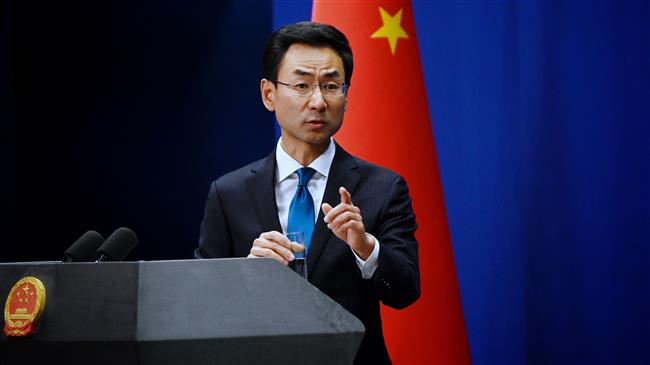
China’s Ministry of Foreign Affairs spokesman Geng Shuang (Photo by AFP )
Press TV – March 13, 2020
The Chinese Foreign Ministry has not ruled out the possibility that the United States was to blame for the spread of the new coronavirus in the Asian country.
Geng Shuang, the ministry spokesman, sidestepped questions on Friday about whether Beijing viewed Washington as responsible for the deadly virus outbreak in China, a day after another spokesman suggested the US army could have engineered it.
Speaking at a news conference in the Chinese capital, Geng refused to directly comment when asked whether his colleague Zhao Lijian’s comments were consistent with Beijing’s official stance on the virus.
“In fact, the international community, including people within the US, have different opinions about the origin of the virus,” Geng told reporters at the presser.
“As I have been saying for a few days, China has always seen this as a matter of science, and scientific and professional opinions must be heard.”
Geng went on to say, “You’re very interested to know if Zhao Lijian’s views represent the views of the Chinese government.”
“I believe that perhaps you would be better off first asking whether or not recent comments from a number of senior US officials attacking or smearing China represent the US government’s position.”

Chinese Foreign Ministry spokesman Zhao Lijian
In a strongly-worded tweet, written in English, Zhao blasted the US on Thursday for what he called lack of transparency in official reports regarding the coronavirus outbreak in the US.
He suggested that the US military might have brought the new coronavirus to the Chinese city of Wuhan, the birthplace of the current global pandemic.
“When did patient zero begin in US? How many people are infected? What are the names of the hospitals? It might be US army who brought the epidemic to Wuhan. Be transparent! Make public your data! US owe us an explanation!” Zhao wrote.
The Chinese government had been criticized by Western media and particularly by US officials for what was alleged to be a slow response to the outbreak and of not being sufficiently transparent.
Beijing has, however, been taking strict measures since the outbreak began, including locking down Wuhan, a city of roughly 11 million people, which appears to have paid off.
The COVID-19 disease, caused by the new coronavirus, emerged in the provincial capital of Hubei late last year and is currently affecting 131 countries and territories across the globe. It has so far infected over 137,000 people and killed more than 5,000 others.
The World Health Organization has declared the coronavirus outbreak a global pandemic.
Italy’s Hospital Meltdown
Coronavirus has turned hospitals into war zones, say Italian doctors.

click to enlarge; source here
By Donna Laframboise | Big Picture News | March 11, 2020
Doctors in northern Italy are warning their colleagues in other countries about an approaching COVID-19 tsunami. Medical personnel are sick, exhausted, and overwhelmed. There are too few beds, too little equipment, and too many patients. Decisions are being made about who lives and who dies that were unthinkable a month ago.
EXHIBIT 1
The testimony of an unnamed intensivist (a physician who specializes in caring for the critically ill) has been posted on Twitter by his/her British medical colleague, Jason van Schoor. Please read the full Twitter thread here.
The unnamed doctor, working in the Lombardy region, explains that this is “the most developed region of Italy,” with an “extraordinary” health care system. We’re told not to make the mistake of thinking what’s being described “is happening in a 3rd world country.”
Hospitals are now beseiged, “and numbers do not explain things at at all,” this person declares. Normal medical care has been suspended. Operating rooms have been converted to intensive treatment units (ITUs). Doctors who specialize in orthopedics (bones) are being “given a leaflet and sent to see patients” struck down by this lung disease.
A clear pattern has emerged, says this person. At first, the hospital receives a few mild cases. The second wave consists of mostly moderately ill patients, with “a few severe ones” who require intubation (a tube inserted down their throat to help them breathe).
The third wave consists of “tons of patients with moderate” respiratory difficulties. Those patients soon deteriorate and fill up the intensive care unit. As their numbers grow, they consume all the non-invasive ventilation (NIV) resources. They use up all the CPAP machines, and require therapeutic oxygen.
Here’s the crucial point. According to this doctor, because hospitals are now running at 200% capacity, patients older than 65, and younger patients with additional health issues, are de-prioritized. If you have relatives with a “history of cancer or diabetes or any transplant,” says this doctor, no extraordinary measures will be taken to save their lives. Even if they are young.
Too many patients with a higher chance of survival are already competing for a limited number of ventilators.
EXHIBIT 2
Daniele Macchini is a surgeon at Humanitas Gavazzeni, a hospital in Bergamo. Located an hour’s drive northeast of Milan, tens of thousands of patients from outside Italy have been treated there.
Three days ago, a Bergamo newspaper published remarks Macchini had posted on Facebook. You can read a Google translation of his entire message here.
He describes how his hospital reorganized in order to free up as many beds as possible. He, himself, wasn’t convinced such measures were necessary, but then things
exploded and the battles are uninterrupted day and night. One after the other the unfortunate poor people come to the emergency room… Let’s stop saying it’s a bad flu. In these 2 years I have learned that the people of Bergamo do not come to the emergency room at all… but now they can’t take it anymore. They don’t breathe enough, they need oxygen.
… One after another, the departments that have been emptied are filling up… Now, tell me which flu virus causes such a rapid tragedy…
While the most serious cases are “mainly elderly people with other pathologies,” Macchini says young people are also now in intensive care, being kept alive by ventilators. In his words, a “disaster is taking place:”
there are no more surgeons, urologists, orthopedists, we are only doctors who suddenly become part of a single team to face this tsunami that has overwhelmed us. The cases… arrive at the rate of 15-20 hospitalizations a day all for the same reason. The results of the swabs now come one after the other: positive, positive, positive. Suddenly the emergency room is collapsing… help is needed in the emergency room… Intensive care becomes saturated… The staff is exhausted…Nurses with tears in their eyes because we are unable to save everyone and the vital signs of several patients…reveal an already marked destiny.
There are no more shifts, schedules. Social life is suspended for us…I see neither my son nor my family members for fear of infecting them… please, listen to us, try to leave the house only to [do] indispensable things…Tell your family members who are elderly or with other illnesses to stay indoors. Bring [them] the groceries please… We must spread the word to prevent what is happening here in Italy.
Two weeks ago, Italy was establishing hundreds of field hospitals to screen patients (see the photo at the top of this post). Two days ago, the entire country entered an emergency lock down. Churches, schools, and universities are closed. Public gatherings and sports events have been cancelled. Travel is forbidden, with some exceptions. People have been told to stay home.
Featured Video

The Truth About the Trump Shootings with Ken Silva
or go to
Aletho News Archives – Video-Images
From the Archives
The Geopolitics behind the War in Yemen (I)
By Mahdi Darius NAZEMROAYA | Strategic Culture Foundation | 30.03.2015
The United States and the Kingdom of Saudi Arabia became very uneasy when the Yemenese or Yemenite movement of the Houthi or Ansarallah (meaning the supporters of God in Arabic) gained control of Yemen’s capital, Sanaa/Sana, in September 2014. The US-supported Yemenite President Abd-Rabbuh Manṣour Al-Hadi was humiliatingly forced to share power with the Houthis and the coalition of northern Yemenese tribes that had helped them enter Sana. Al-Hadi declared that negotiations for a Yemeni national unity government would take place and his allies the US and Saudi Arabia tried to use a new national dialogue and mediated talks to co-opt and pacify the Houthis.
The truth has been turned on its head about the war in Yemen. The war and ousting of President Abd-Rabbuh Manṣour Al-Hadi in Yemen are not the results of «Houthi coup» in Yemen. It is the opposite. Al-Hadi was ousted, because with Saudi and US support he tried to backtrack on the power sharing agreements he had made and return Yemen to authoritarian rule. The ousting of President Al-Hadi by the Houthis and their political allies was an unexpected reaction to the takeover Al-Hadi was planning with Washington and the House of Saudi. … continue
Blog Roll
 Aletho News
- Leaked: Britain’s Sham Conviction Of Hashim Thaci
- Seyed M. Marandi: U.S. Strike Imminent – Toward Total War in the Middle East
- Russia Voted Under Fire. Washington Is Loading the Tankers.
- 12 Things Your Oncologist Was Trained Not to Tell You
- Anthrax Attacks Paved Way for COVID-Era ‘Junk Drugs and Vaccines’
- How Real Is the Impact of Western Sanctions on Israel?
- France, You Are Guilty: How Paris Turned Western Sahara into the Maghreb’s Powder Keg
- 2025 Nature Paper Claiming Worsening Global Drought Gets RETRACTED …Heavily Flawed
- Your Milk Is Not the Problem
- The Truth About the Trump Shootings with Ken Silva
- If Americans Knew
- Salah Sarsour’s Legal Team Says DHS Has Not Met Its Burden to Prove He Is Deportable
- An analysis of tax forms by The Intercept show Kraft’s charity and LLC have donated to Friends of the IDF and AIPAC’s super PAC.
- Israeli attacks kill four Palestinians in Gaza – Daily Update
- Inside Gaza’s death trap of collapsing, bombed-out buildings
- The everyday items Israel bans from Gaza every day
- Inside the siege, the ruined buildings of Gaza – Daily Update
- Debunking The Claim That Macklemore Has A “History Of Antisemitism”
- CPJ demands release of arrested Palestinian-US journalist near Bethlehem
- Robert Kraft: The Billionaire Friend of Netanyahu Pulling The Strings Behind the Macklemore/Ed Sheeran Blow Up
- Columbia Administered Fund Gives Big Money to Pro-Israel Groups
- No Tricks Zone
- 2025 Nature Paper Claiming Worsening Global Drought Gets RETRACTED …Heavily Flawed
- New Study: ‘Global Drought Shows No Detectable Recent Acceleration Under Climate Warming’
- Economic Masterminds: German Socialists Suggest Taxing Productivity Gains Stemming From Using AI
- The South China Sea Has Not Been Cooperating With The Climate Change Narrative
- Energy Crisis: Germany Enters Heating Season With Historically Low Gas Reserve Fill Levels
- New Study: The Antarctic Ice Sheet Gained Mass From 2020-2024 Due To Staggering Snow And Ice Accumulation
- Study: Ocean Heating Rates From Thousands Of Years Ago ‘Dwarf’ Modern Ocean Heating Rates
- Climate Extremists Target, Attack Large-Scale Power Grid Infrastructure In Germany!
- New Study: Antarctic Ice Melt Has Contributed Less Than 1 Centimeter To Sea Level Rise In The Last 30 Years
- Fear Of Debate: Alarmist German Climate Scientist Calls On Mainstream Media To Discredit Skeptic Voices
 Aletho News