Venezuela: Nearly 50,000 Voting Machines Burnt in ‘Terrorist Attack’
By Paul Dobson | Venezuelanalysis | March 9, 2020
Mérida – An unknown militant group has claimed responsibility for a blaze which destroyed 99 percent of Venezuela’s electoral machines on Saturday.
In a video message published on Twitter on Sunday, seven masked men calling themselves the Venezuelan Patriotic Front stated that the attack formed part of “Operation Sodom,” a reference to the biblical tale of the city destroyed by “divine judgement” on the Jordan River.
The group goes on to justify the arson by alleging that electoral authorities have “violated the people’s rights through fraudulent elections.” In the same message, it also claimed responsibility for a fire last month at a state-run CANTV telecommunications center used in elections in Valencia, Carabobo State.
While the origins and connections of the group remain unclear, its video message pledged further actions against government supporters and leaders, which it defined as being “military targets,” as well as issuing warnings about “what may occur” at the upcoming opposition march on Tuesday.
Speaking Monday, National Constituent Assembly President Diosdado Cabello condemned the fire as a “terrorist attack.” Opposition leaders are yet to comment.
Another hard-right militant opposition group called the T-Shirt Soldiers endorsed the Patriotic Front’s actions and claimed they “were not finished.” The T-Shirt Soldiers claimed responsibility for the August 2018 C4-carrying drone assassination attempt against President Maduro.
According to the National Electoral Council (CNE), a massive fire on Saturday at the storage facility in the Filas de Mariche district on the outskirts of Caracas destroyed 49,408 electronic voting machines, 582 computers, 400 electronic ballot cards, 49,232 fingerprint identification machines and 22,434 power inverters. Only 562 voting machines and 724 fingerprint identification machines could be saved. All voting machines and other instruments are kept at the warehouse under military and civilian supervision between electoral processes.
The blaze caused no human injuries, but devastated the 1500 m2 facility, according to the reports of the 570 firefighters who tackled the fire.
Addressing the press on Sunday, CNE President Tibisay Lucena told the country that two national prosecutors have been assigned to investigate the fire, and that “no hypotheses have been ruled out.”
The voting machines were originally produced by the multinational company Smartmatic. The CNE ended a maintenance and repair contract with the company in 2017 following its “baseless” claims of fraud at the July 2017 National Constituent Assembly elections. The electoral body has not updated its machine stockpile since nor signed a new manufacturing contract, and a wide-reaching US embargo announced in 2018 threatens any foreign firm which engages with the organisation with sanctions.
The CNE has overseen 24 electoral contests since 1998, with National Assembly (AN) elections scheduled for 2020, with a date yet to be set. Lucena also took the opportunity to calm fears that this year’s elections would be affected.
“If there are small groups which think that this will end our constitutionally established electoral processes, they are very wrong,” she said. “We have the capacity, the legal know-how, the operative and logistical technology, 17 years of experience, and the human talent [to] guarantee the electoral processes in Venezuela as we know them: fast, transparent and trustworthy,” she went on.
Venezuela’s combined electronic and paper electoral system has been described as one of the most secure and transparent in the world by independent international observers. Nonetheless, discussions aimed at applying further consensual safeguards, as well as renovating the CNE leadership, have been part of a dialogue agenda between the government and a host of smaller opposition parties.
The efforts were boosted after a dissident opposition group wrested control of the National Assembly from former AN President Juan Guaido in January and backed the ongoing dialogue process as well as the renewal of electoral authorities.
Guaido has already ruled out taking his hard-right Popular Will party to the vote later this year, a position which has been backed by Washington. Other Guaido-aligned opposition parties, however, are still to announce whether they will participate, with Democratic Action party hinting that it will.
Intra-Afghan dialogue gets kickstarted
By M. K. BHADRAKUMAR | Indian Punchline | March 10, 2020
Three significant things about Ashraf Ghani’s swearing-in ceremony in Kabul on Monday augur well for the implementation of the US-Taliban pact signed in Doha on February 29.
One, the US officials, civilian and military, made a full court appearance at the ceremony in Kabul, affirming their reconciliation with Ghani. The US special representative for Afghan reconciliation Zalmay Khalilzad and US General Scott Miller, the commander of the US-led international force in Afghanistan, attended Ghani’s inauguration, apart from the EU, UN and western diplomats.
Two, Pakistan Prime Minister Imran Khan felicitated Ghani. He wrote on his Twitter page,“[I] look forward to working with him [Ghani]. Pakistan will do everything it possibly can to bring peace and stability in our region.”
Islamabad and Washington held back from congratulating Ghani when his election victory was formally announced last month. Now they are moving in tandem to engage with the Ghani presidency.
Three, Ghani announced in his speech at the ceremony that he will issue an order on Tuesday itself on the release of the Taliban prisoners. Ghani expressed the hope that the Taliban will reciprocate by significantly reducing violence. Thereby, Ghani is signalling that he will not block intra-Afghan dialogue.
Furthermore, he added that the government’s negotiating team for the intra-Afghan dialogue will also be finalised by Tuesday.
What may be even more significant than the above is that the Taliban is not creating a ruckus over Ghani’s inauguration. A senior figure in the Taliban leadership, Amir Khan Motaqi who is based in Qatar sounded optimistic that peace negotiations with the Afghan government will be “easier” than the Taliban’s marathon talks with the United States (which took around a year and a half).
“We will reach a conclusion with Afghans in a better way – of course with Afghans who consider other Afghans’ interests and do not consider foreigners’ interests,” Motaqi said. Another senior Taliban figure, Anas Haqqani, who was freed from Bagram prison last November, called the release of 5,000 Taliban prisoners important and urged the speedy formation of the negotiating team from Kabul so that the intra-Afghan dialogue can commence on March 10, as envisaged under the Doha pact of February 29.
In sum, Ghani’s induction or his change of heart — depending on how one views it — gives traction to the US-Taliban pact signed in Doha.
Contrary to doomsday predictions that the political rift in Kabul between Ghani and the former chief executive Abdullah over the disputed election results — Abdullah held his own inaugural ceremony in Kabul on Monday — would undermine the US-Taliban pact, the opposite seems to be happening.
Ghani’s brinkmanship in recent weeks served its real purpose, which was to get US support for his presidency and also carve out for himself an influential role in the inter-Afghan dialogue.
Pakistan and the Taliban have wisely kept away from getting embroiled in the Ghani-Abdullah rift and left it to Khalilzad to pacify Ghani.
Ghani apparently didn’t need much persuasion to do the two things that are Khalilzad’s top priority — release of the prisoners and the launch of the intra-Afghan dialogue. It is a fair guess that Khalilzad has struck some sort of deal with Ghani regarding the uncertain future role of the latter’s presidency.
The Taliban’s flexibility to hold talks with the Afghan government could be one factor here. Conceivably, Pakistan would have persuaded the Taliban to show flexibility.
If so, this is brilliant a tactic on the part of Islamabad and the Taliban. For, once the intra-Afghan dialogue begins, a new dynamic will appear in any case, and, given the fragmentation in the opposite camp, with so many cliques and factions jostling for position, Taliban would have the inherent advantage of being the only cohesive group at the negotiating table.
US President Donald Trump acknowledged these ground realities when he said on March 6 while talking to reporters at the White House that the Taliban could “possibly” overrun the Afghan government after foreign troops withdraw from the country as part of the Doha agreement.
As Trump put it, “Countries have to take care of themselves. You can only hold someone’s hand for so long.” Asked if the Taliban could eventually seize power from the current US-backed government, Trump said it is “not supposed to happen that way but it possibly will.”
This is of course a hypothetical scenario, since it will not be in Pakistan and Taliban’s interest to grab power forcibly in Kabul. It is useful to remember how much the Taliban hankered after US and UN recognition for its regime in Kabul in the nineties.
Significantly, the joint statement on the US-Taliban pact agreed by Special Envoys and Special Representatives of the European Union, France, Germany, Italy, Norway, the United Kingdom, the United Nations and the United States of America on the occasion of the signing of the U.S.-Taliban Agreement in Qatar spells out the expectations regarding the Afghan transition and it is quite obviously based on the understanding reached between Khalilzad and the Taliban.
The following paragraphs merit attention:
- “Reaffirmed that the Islamic Emirate of Afghanistan is not recognised by the international community, and furthermore, the international community will not accept or support the restoration of the Islamic Emirate of Afghanistan.”
- “Welcomed the Taliban committing to join a political process and their prospective role in a new post-settlement Afghan Islamic government as determined by the intra-Afghan negotiations.”
However, there is the “known unknown”— how far the fragile Afghan state structure will hold through the stresses and strains of the period ahead — negotiations with the Taliban and a period of profound transition to an entirely new beginning of state-building.
Importantly, Abdullah’s coalition which opposes Ghani is also a coming together of non-Pashtun groups — Tajik, Hazara and Uzbek. The ethnic overtone is ominous.
When asked whether the Afghan government had the ability to defend itself from fighters after foreign forces pull out, Trump was brutally frank: “I don’t know. I can’t answer that question. We’ll have to see what happens.”
Indeed, what happens next will also significantly depend on Abdullah’s future moves. He and his associates have thrown their weight behind the intra-Afghan dialogue but it is unlikely they will accept Ghani’s leadership to navigate the peace process.
To be fair, Khalilzad tried hard for a Ghani-Abdullah reconciliation, but it didn’t work. The bitterness lingers because this was a patently rigged election and Ghani doesn’t have a legitimate mandate to rule.
Meanwhile, the drawdown of the US troops has begun. Washington is unlikely to get entangled in Afghan domestic politics. To quote Trump, “We can’t be there for the next 20 years. We’ve been there for 20 years and we’ve been protecting the country but we can’t be there for the next – eventually, they’re going to have to protect themselves.”
Washington’s focus is going to be on the reduction in violence (ceasefire) and on verifiable evidence of the Taliban’s commitment to severe links with al-Qaeda.
The bottom line is, as the sensational report by New York Times on Sunday — A Secret Accord with the Taliban: When and How US Would Leave Afghanistan — confirms, the Doha pact is only the tip of the iceberg.
A matrix of understanding between the US, Pakistan and the Taliban provides the underpinning for the incoming Afghan peace process and the road map leading to a transition, based on their mutual recognition of the legitimate interests of all three protagonists.
Hung jury results in mistrial for former CIA tech accused of handing ‘Vault 7’ docs to WikiLeaks
Assange trial rehearsal?
RT | March 10, 2020
Federal prosecutors were unable to convince a jury on any of the spying-related charges against an ex-CIA engineer accused of stealing reams of classified material – in what may be a dry run for the case against Julian Assange.
In a significant blow to prosecutors on Monday, jurors failed to come to a verdict on eight central counts against former CIA software engineer Joshua Schulte, who was charged for stealing thousands of pages of classified information on the agency’s secret hacking tools and passing them to WikiLeaks – what later became its ‘Vault7’ release, the largest breach of classified material in CIA history.
While Schulte was found guilty of contempt of court and making false statements to investigators, a hung jury on the remaining eight charges – including illegal gathering and transmission of national defense information – prompted District Judge Paul Crotty to order a mistrial and dismiss the jurors on the case, who had deemed themselves “extremely deadlocked” in a note to the judge.
The split verdict came after nearly a full week of messy deliberations, which saw one juror removed for researching the facts of the case against Crotty’s orders. She was never replaced, however, leaving a short-handed panel to deliver a final decision.
The former technician left his job in the CIA’s Langley headquarters in 2016 and was charged some two years later for his alleged role in the Vault 7 leak. But prosecutors had difficulty tying Schulte to the disclosure throughout his four-week trial, with jurors often mystified by a complicated maze of technical evidence.
The case may offer parallels to that of WikiLeaks co-founder Julian Assange, who faces 17 charges under the World War I-era Espionage Act and up to 175 years in prison over his role in the publication of the Iraq and Afghan war logs in 2010. Assange is accused of helping leaker Chelsea Manning (then known as Bradley) “hack” into military computers to obtain classified material, but if extradited from the UK to stand trial in an American courtroom, prosecutors would likely produce similar technical forensics to prove his involvement, precisely what the government was unable to do in Schulte’s case.
Arguing that the CIA’s computer network had widely known vulnerabilities, including poor password protections, Schulte’s defense insisted prosecutors had failed to prove his role in the breach. They noted it was possible another actor gained access to his work station, pointing to another CIA employee identified only as “Michael” as a potential culprit.
The CIA later placed the employee on administrative leave for refusing to cooperate with the investigation, which suggested the government had “doubt about the case against Mr. Schulte,” defense attorney Sabrina Shroff said in her closing argument on Monday.
Prosecutors are likely to demand a retrial for Schulte, and he still stands accused of possessing child pornography, allegedly stored on devices found during a search of his home. He will be tried separately on those charges, facing a total of 15 counts.
AIPAC confirms two coronavirus cases at Israeli lobby gathering attended by US elites & politicians
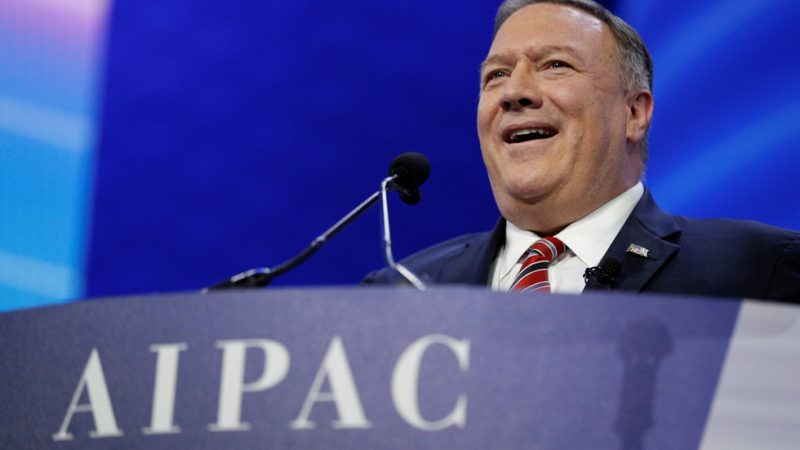
US Secretary of State Mike Pompeo delivers remarks at the AIPAC convention in Washington, DC, March 2, 2020. © Reuters / Tom Brenner
RT | March 7, 2020
Two people from New York who attended the AIPAC conference in the US capital have tested positive for COVID-19 coronavirus, raising the possibility that lawmakers in Washington, DC were exposed to the potentially lethal contagion.
“At least” two conference-goers who came from Westchester County, New York have tested positive for the virus, the American Israel Public Affairs Committee said on Friday evening, adding that they’ve sent notice of this to the attendees, participants, speakers, administration staff and congressional offices.
AIPAC previously said that a group that traveled to the conference from New York “potentially” interacted with an individual carrying the illness beforehand. Almost two dozen cases of COVID-19 have been confirmed in New York state.
The conference held just outside of Washington on March 1-3 was attended by 18,000 people, including more than 3,600 students from campuses across the US, over two-thirds of Congress, as well as a number of attendees from abroad. The day after it concluded, Israel asked anyone who attended “international conferences abroad” to self-quarantine for 14 days, in hope of containing the infection to 15 cases reported so far.
Most of the fatalities from the virus are among people with underlying medical conditions and the elderly – which would apply to many members of Congress.
Vice President Mike Pence, who spoke at the conference, said he hadn’t heard of the coronavirus revelation when asked about it on Friday. Other speakers included Secretary of State Mike Pompeo, current Democrat presidential front-runner Joe Biden, and Senate Minority Leader Chuck Schumer (D-New York).
DC health officials have not reported any confirmed coronavirus cases, but authorities in nearby Montgomery County, Maryland have already identified three. As of Friday morning, the Centers for Disease Control and Prevention (CDC) had registered 164 total confirmed COVID-19 cases in 19 US states, including 11 fatalities – ten in Washington state and one in California.
The novel coronavirus, designated COVID-19, first appeared in Wuhan, China in December last year. Most of the fatalities so far have been in China. The airborne pathogen has since managed to spread to Europe, the Middle East and the US despite strict quarantine measures.
Trump puts Taliban deal back on track
By M. K. BHADRAKUMAR | Indian Punchline | March 5, 2020
A mini mutiny in Kabul against the US-Taliban deal has been nipped in the bud and it should sound warning bells in Washington that the real threat to peacemaking in Afghanistan comes from one principal source — the interest groups that monopolise state agencies and are loathe to transfer power. Isolating the Kabul clique amidst the country’s hopeless fragmentation becomes complicated and only the US can do it.
A powerful metaphor used by Peter Tomsen, President Ronald Reagan’s special envoy for Afghanistan during the jihad against the Soviets in the eighties, comes to mind. Ambassador Tomsen, despairing from his futile efforts to forge consensus among the squabbling Mujahideen groups (“Peshawar Seven”) even as the Soviet withdrawal was looming ahead said the whole exercise was turning out to be like a futile attempt to assemble frogs on a scale — when you put one, another already on the scale jump out, and so on.
No sooner than the US-Taliban agreement was signed in Doha on February 29, Afghan President Ashraf Ghani jumped out of the scale where the US special representative for Afghan reconciliation Zalmay Khalilzad had put him after months of persuasion.
Ghani sprang a surprise by saying he refused to countenance the release of Taliban prisoners, a key demand of the Taliban during the Doha negotiations and something which was written in black and white in the document signed on Feb. 29 with his prior knowledge and concurrence.
In fact, he had even dispatched officials from Kabul to Doha who met with the Taliban and had discussed the modalities of release of the prisoners. But then he changed his mind.
Ghani’s calculation was that his volte-face on the release of Taliban prisoners could be a deal breaker that would scuttle the intra-Afghan dialogue slated to begin on March 10.
Ghani was in a rebellious mood, goaded by the hardliners in his clique, and he almost succeeded. The Taliban retaliated by ending the reduction in violence agreement. Fighting resumed and as can be expected, Afghan government forces, unable to withstand the Taliban onslaught, sought US air cover, which led to US air attacks on the insurgents.
The detractors of the US-Taliban deal abroad promptly began celebrating that the US and Taliban were once again clashing and the Doha pact was unraveling within three days of its signing.
However, in a bold initiative, Trump called Mullah Abdul Ghani Baradar, the de-facto Taliban leader who conducted the negotiations in Doha with Khalilzad and shored up the fragile mutual confidence between the two sides.
Indeed, beyond the Doha pact, there is a matrix of mutual understanding that was painstakingly reached between the US and Taliban, with the strong support of Pakistan. Trump dwelt on it. (See my blog Afghan peace comes with caveats but can’t be snuffed out.)
From available accounts, Trump assured the Taliban that the US Secretary of State Mike Pompeo would intervene with Ghani and the prisoners will be released as the US had committed and that Washington expected the Taliban to continue to abide by the ‘reduction in violence’.
Trump has since publicly expressed the confidence that the violence will come down.
Quite obviously, Washington continues to place trust in the constructive role Pakistan has been playing.
Looking back, this war of nerves is directly linked to Ghani’s aversion to intra-Afghan dialogue, which he fears will inevitably lead to the formation of an interim government at some point in the near future necessitating his stepping down. The US is yet to congratulate Ghani on his recent victory in the rigged presidential election and prevailed upon him to defer his swearing-in ceremony.
We have curious line-up today — the (non-Taliban) Afghan opposition to Ghani and his clique (which is by far the majority opinion in the country) looks forward to the inter-Afghan dialogue and reconciliation with the Taliban and is supportive of the US-Taliban deal and the peace process envisaged under it, while Ghani and his circle undermine the entire process that Khalilzad painstakingly negotiated.
Ghani is biding time and hopes to insert Afghan reconciliation as a controversial issue in the US presidential election campaign ahead and hopes to get support from the Democrats who would be inclined to demand the centrality of human rights issues in any deal with the Taliban.
Ghani is overreaching. The plain truth is that his regime has no popular support among Afghans and he still remains a creation of the Americans, which is why the international community learned to live with him in the first instance.
His henchmen also have no political base. Ghani has no political base among Pashtuns. As for Amrullah Saleh, his main associate, he was originally trained and groomed by the Americans as an intelligence officer, and although notionally a Panjshiri, he is no successor to Ahmed Shah Massoud. These are the stark realities.
Clearly, the main threat to the Afghan peace process comes from the rejectionist Afghan faction of time-servers in the Ghani government. It is about time the Americans crack the whip and read the riot act to them.
An interview on March 2 by the US Secretary of State Mike Pompeo with Bret Baier of Special Report suggests that Washington is willing to do just that. Khalilzad is back in Kabul.
The good part is that the opposition to Ghani led by Abdullah is rallying behind the US-Taliban pact. Khalilzad has met with former president Hamid Karzai, Abdullah Abdullah and other opposition leaders (erstwhile Northern Alliance resistance figures), all of whom have thrown their weight behind the US-Taliban pact.
Pompeo’s interview gives us a feel of Trump’s phone conversation with Mullah Baradar. The US Defence Secretary Mark Esper said on Monday that the drawdown of troops in Afghanistan will begin before March 10. For the present, things are back on track. As Pompeo put it,
“I met with them (Mullah Baradar) myself when I was in Doha. I looked them in the eye. They revalidated that commitment (to renounce al-Qaeda and reduce violence). Now they’ve got to execute it. Now we’ll be able to see, the world will be able to see, if they truly live up to that obligation. It’s important because that’s the reason we went there, Bret.”
The fact that Trump took time out amidst all the excitement over “Super Tuesday” to personally intervene with the Taliban leadership at the highest level underscores that this is one foreign-policy achievement of his administration to which he attaches the greatest importance. And that is the best guarantee of its success.
Supreme leader’s advisory council member dies of coronavirus – Iranian media

RT | March 2, 2020
Seyyed Mohammad Mirmohammadi, a long-standing member of the Islamic Republic of Iran’s Expediency Discernment Council, has reportedly died from a novel coronavirus infection.
He was being treated at the Masih Daneshvari Hospital in Tehran when he succumbed to the Covid-19 infection at the age of 71. Mirmohammadi’s mother, sister of senior cleric Ayatollah Shobeiri Zanjani, also died from a coronavirus infection on Monday.
Mirmohammadi was a member of the sixth and seventh Iranian parliaments and was appointed by Iran’s Supreme Leader Ayatollah Khamenei as a member of the Expediency Discernment Council in August 2017.
Iran’s former ambassador to the Vatican, Hadi Khosroshahi, died of Covid-19 last week, while the country’s Deputy Health Minister Iraj Harirchi placed himself in isolation after appearing to sweat profusely and seeming ill while giving a press conference to assuage fears over the outbreak. He later confirmed that he had been infected with the virus.
Iran is battling shortages of medical supplies – exacerbated by US sanctions – but authorities have allocated a number of military hospitals to treat the general public and help stem the tide of infection. Meanwhile, schools, universities and sports centers have been closed and the parliament has been shut down.
Iran has the world’s second highest death toll outside of China. The country has officially announced 978 cases and 54 deaths. At 5.5 percent, the country’s death rate is more than twice the global average of two percent.
Several of Iran’s neighbours have closed their borders as the virus spreads across the region. These countries include Kuwait and Bahrain, each with 50 confirmed cases, the UAE with 21, and Iraq with at least 19 cases.
Russian missile frigates passing through Turkish straits amid Idlib escalation
RT | February 28, 2020
A pair of advanced Russian missiles frigates is passing through the Turkey-controlled straits while en-route to the Mediterranean. It comes as dilomatic tensions between Moscow and Ankara over Syria’s Idlib are not letting down.
The ‘Admiral Grigorovich’ and its sister ship ‘Admiral Makarov’ are among the more modern assets of the Russian Navy, capable of firing the advanced Kalibr-NK cruise missiles. Part of the Russian Black Sea fleet, they are currently moving to join Russia’s naval forces in the Mediterranean as part of a scheduled rotation.
“The third frigate of the class, the ‘Admiral Essen’ has been on a mission in the Mediterranean Sea since December 2019,” a spokesman for the fleet said as cited by Interfax news agency.
Their passage through the Dardanelles and the Bosphorus, the straits controlled by Turkey, comes at a period of heightened tension between the Ankara and Moscow. Turkey blames Russia’s ally Syria for the deaths of its soldiers in the Syrian Idlib Governorate. The worst incident happened on Thursday, when 33 Turkish soldiers were killed by a Syrian airstrike, according to Ankara.
Moscow says Turkey failed to report the location of its troops in Idlib and allowed them to get mingled with terrorist forces, which led to the tragic outcome. Turkish officials insist that Russia was informed about the deployment, and deny the presence of militants in the area where the strike had happened.
Moscow, for its part, has maintained that Turkey still fails to separate so-called moderate opposition from terrorists in the Idlib de-escalation zone.
Turkey has the right to deny passage through its straits to any nation’s warships if it decides its security demands it. But no reports immediately indicated that the Russian frigates would be turned back.
With Grenell Appointment, the Israel Lobby’s Foothold on US Intelligence Grows Even Stronger
By Whitney Webb | MintPress News | February 25, 2020
Last week’s appointment of U.S. Ambassador to Germany Richard Grenell to the post of Director of National Intelligence (DNI) received criticism from both sides of the political divide, mainly for his lack of experience and history of outspoken and partisan political statements. Much more overlooked, however, are Grenell’s ties to the powerful American pro-Israel lobby and Israeli politicians alike, including organizations and individuals with a history of espionage and blackmail against the United States.
Grenell is merely the latest example in a series of appointments over the past few years that have seen individuals with deep ties to the pro-Israel lobby rise to top positions in the U.S. intelligence community, including the NSA’s current director of Cybersecurity Anne Neuberger as well as the leaders of the President’s Intelligence Advisory Board (PIAB).
With many of these posts directly involved in overseeing the security of the upcoming 2020 election, ostensibly to combat “foreign interference,” these connections are even more significant. Some of the Israel lobby groups in question have not only engaged in illegal espionage against the U.S. government, but are also openly meddling in the current Democratic party primary.
Beyond the potential effects on the upcoming election, these troubling ties between top U.S. intelligence officials and a foreign government do not bode well for American national security and will only advance the long-standing practice of American neoconservatives conflating Israeli national security interests with those of the United States.
Grenell’s many conflicts of interest
Richard Grenell’s appointment last Wednesday to the post of Director of National Intelligence (DNI) raised a number of eyebrows on the Beltway and drew sharp condemnation from former and current intelligence officials alike. Most of the concern was due to the fact that Grenell, who has been serving as the U.S. ambassador to Germany, has virtually no intelligence experience or background. Yet, he will now oversee and coordinate all 17 U.S. intelligence agencies, including the CIA and NSA, and will be responsible for briefing President Trump on intelligence matters of both domestic and international concern.
Grenell’s new position is not required to be confirmed by the Senate unless Trump decides to nominate him as a permanent candidate at the end of the temporary three-month period during which he can serve as acting DNI. There has not been a permanent DNI since Dan Coats resigned last August.
Grenell’s appointment was also criticized due to his brazen political approach towards his diplomatic post as U.S. ambassador to Germany, which he will maintain while coordinating and overseeing U.S. intelligence activities. In his two years as ambassador, Grenell has alienated numerous German politicians to the extent that prominent officials have refused to meet with him. Some German officials began calling for his resignation during his first month as ambassador.
One very valid criticism of Grenell’s appointment, however, has been glossed over, namely his ties to controversial lobbyists, political operatives and foreign politicians. For instance, Grenell used to work on behalf of Arthur Finkelstein and Associates, a firm of the late Republican political operative of the same name.
Finkelstein was one of the main architects of Israeli Prime Minister Benjamin Netanyahu’s first campaign in 1996. Finkelstein was placed in contact with the Netanyahu campaign by prominent Jewish American businessman and billionaire, Ronald Lauder — a close associate of Trump, then-top backer of Netanyahu (they have since had a falling out) and a member of the controversial “Mega Group.”
Finkelstein worked on numerous successive campaigns for far-right politicians in Israel, including former Defense Minister Avigdor Lieberman. He has been described as being “deeply committed” to and a “staunch supporter” of Israel and the hawkish Likud Party. He also spent numerous years on Likud’s payroll.
Grenell’s financial disclosures reveal that his consulting firm, Capitol Media Partners, received more than $5,000 from Finkelstein but does not specify the exact amount. ProPublica recently reported that Grenell, who has ties to Fox News and Newsmax, worked for Finkelstein as a “media consultant” in Eastern Europe, where Ronald Lauder has long held significant media interests. In that capacity, Grenell was paid to work on Finkelstein’s behalf for the now-disgraced Moldovan politician, Vladimir Plahotniuc, work that Grenell did not disclose, but should have according to experts.
Concerns over Grenell’s susceptibility to foreign influence are particularly troubling given his especially close relationship with Israel, despite nominally having served as U.S. ambassador to Germany, a position which ostensibly would require close ties to Germany (which Grenell lacks) as opposed to Israel. Soon after Grenell became ambassador to Germany, he requested Israeli Prime Minister Benjamin Netanyahu to meet him at the Berlin airport. After that meeting, Netanyahu told reporters that Grenell is a “big fan of Israel.” Grenell himself has stated that he views his support for Israeli “peace” (i.e. security) policy as a “biblical mandate” and has visited the country “more times than he can count.”
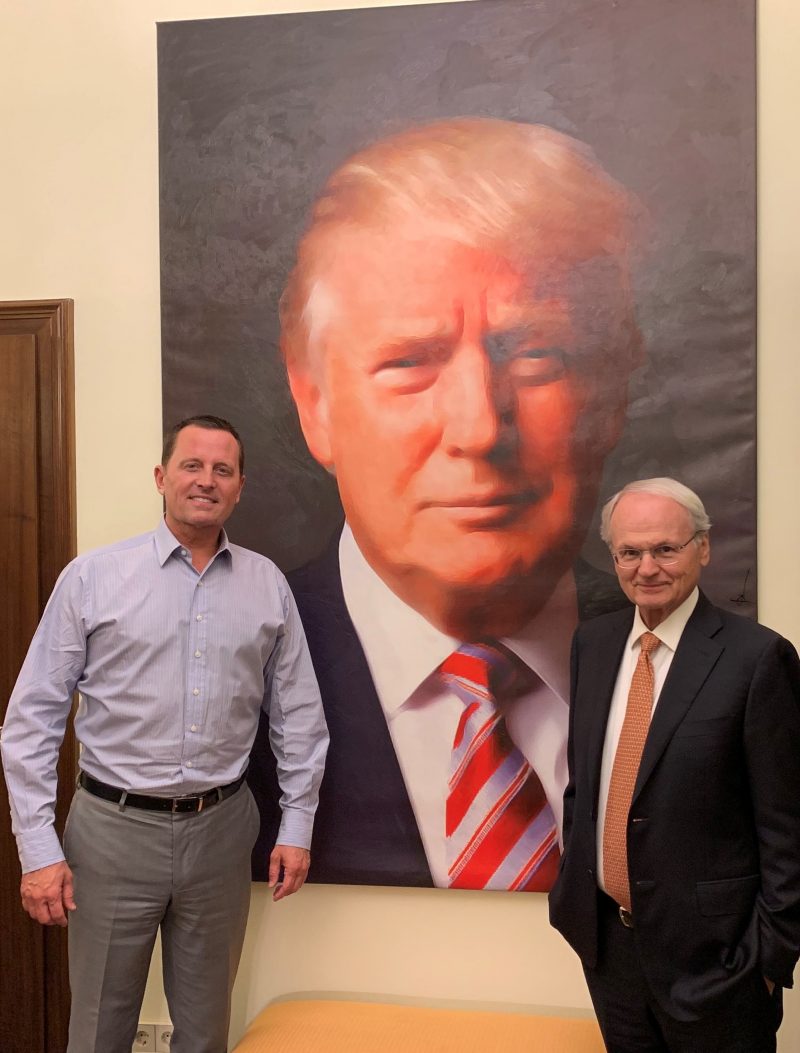
Richard Grenell, left, poses with Morton Klein, head of the Zionist Organization of America. Photo | ZOA
Though many intelligence community veterans and politicians in both major parties opposed Grenell’s appointment, the American Israel lobby was thrilled. The Zionist Organization of America (ZOA) “strongly praised” Grenell’s appointment as acting DNI, with ZOA president Morton Klein, stating:
I am proud to say that during my long personal friendship with Ambassador Grenell, it became powerfully clear to me that Grenell is a very talented and knowledgeable man whose commitment to America and its security is second to none. He is also a man who understands the importance of our country’s great alliance with Israel in promoting U.S. security interests. There has never been a better friend of a strong U.S-Israel relationship than Ambassador Grenell. (emphasis added)”
Klein previously announced his displeasure that Grenell had not been appointed to serve as U.S. ambassador to NATO after he had been given private “assurances” by the Trump administration that Grenell would be nominated to that post.
Grenell’s ties to political operatives like Finkelstein, his close friendships to Israel lobbyists Morton Klein and Israeli PM Netanyahu as well as his failure to disclose paid work done on behalf of foreign politicians make him susceptible to foreign influence or blackmail according to the official policy of the office of the DNI, which Grenell now leads.
That policy holds that “conditions that could raise a security concern and may be disqualifying” include “connections to a foreign person, group, government or country that create a potential conflict of interest between the individual’s obligation to protect classified or sensitive information or technology and the individual’s desire to help a foreign person, group or country by providing that information or technology.”
Given that Israeli politicians and officials, including Netanyahu, have actively used blackmail to influence sitting U.S. presidents and that the pro-Israel lobby has a history of espionage targeting the United States, it is telling that Grenell’s appointment to a sensitive intelligence post has not been criticized in the media over his close ties to the pro-Israel lobby, Arthur Finkelstein and Israel’s government.
Israel’s foothold grows
While Grenell’s appointment is troubling over his ties to the pro-Israel lobby, it is merely the latest such appointment made by the Trump administration as several top intelligence figures with deep ties to the pro-Israel lobby have recently risen to prominence.
For example, current NSA director of Cybersecurity Anne Neuberger is married to Yehuda Neuberger, who serves as chair of AIPAC’s executive council in Baltimore. Neuberger’s parents were rescued via the IDF’s “Operation Entebbe,” an operation led by Benjamin Netanyahu’s brother, Yonathan Netanyahu. Neuberger was less than a year old at the time, but was not with her parents during the incident.
As Cybersecurity director for the NSA, Neuberger oversees a division of that agency that “unifies NSA’s foreign intelligence and cyberdefense missions” and works “to prevent and eradicate threats to national security systems and critical infrastructure,” including the country’s election infrastructure. Her family ties to AIPAC are therefore concerning given the powerful lobby groups’ propensity to meddle in this election’s Democratic primary. This is belied by the fact that AIPAC has, in the past, committed espionage against the U.S. government on Israel’s behalf on more than one occasion.
In addition to Neuberger, both the head and deputy chair of the President’s Intelligence Advisory Board (PIAB) have close ties to foreign lobbies and intelligence services. According to the U.S. government, PIAB “exists exclusively to assist the President by providing him with an independent source of advice on the effectiveness with which the Intelligence Community is meeting the Nation’s intelligence needs, and the vigor and insight with which the community plans for the future. The Board has access to all information needed to perform its functions and has direct access to the President.” The government’s official description of the body’s role also states that PIAB has “immense and long-lasting impacts on the structure, management, and operations of U.S. intelligence.”
PIAB is chaired by Stephen Feinberg, the billionaire owner of Cerberus capital management, which owns scandal-ridden U.S. military and intelligence contractor DynCorp. Court documents cited by the New York Times accused Cerberus of “orchestrating secretive deals that transgressed legal and ethical boundaries,” making his role at PIAB at overseeing the often ethically-challenged U.S. intelligence community troubling. In addition, Cerberus was previously the owner of or majority stakeholder of a string of now-bankrupt companies that defrauded U.S. intelligence and the U.S. military on a massive scale during the George W. Bush administration, with much of that occurring while then-Secretary of Defense Donald Rumsfeld was invested in Cerberus.
Feinberg’s close relationships also raise some red flags. He is a close friend of Jared Kushner, the president’s son-in-law whose family has a close friendship with Netanyahu, as well as Steve Bannon, who has close ties to the U.S. Israel lobby, particularly the ZOA. Feinberg is also a close associate of hedge fund manager Michael Steinhardt, a “Mega Group” member whose father worked for the National Crime Syndicate. Steinhardt was instrumental in the controversial Clinton-era pardon of Mossad asset Marc Rich and is a major funder of pro-Israel organizations.
Feinberg was also one of the main shareholders in Israel’s then-largest bank, Bank Leumi, until he was pressured to sell his stake following the revelation that his partner in that investment, Ezra Merkin, played a key role in the Bernie Madoff scandal. Cerberus’ acquisition of those shares had originally been closely tied to a Likud party initiative to privatize Israel’s entire banking sector.
Companies owned by Cerberus have also been found to be closely tied to Saudi intelligence. The Washington Post reported last year that a U.S.-backed plan to “modernize” Saudi intelligence had been created by Culpeper National Security Solutions, a unit of Cerberus-owned DynCorp, along “with help from some prominent former CIA officials.” Another Cerberus-owned company called Tier 1 has also helped train Saudi Special Forces, some of whom were reportedly involved in the murder of Jamal Khashoggi. Though Feinberg says he divested his personal stake from these companies prior to chairing PIAB, they remain owned by his firm Cerberus and arguably still present a conflict of interest.
In addition to Feinberg, the PIAB’s current deputy chair — Samantha Ravich — formerly worked for the pro-Israel lobby group Washington Institute for Near East Policy (WINEP), a spin-off of AIPAC that was created to shield the lobby organization from scrutiny, when it was investigated in 1984 for espionage against the U.S. government on Israel’s behalf.
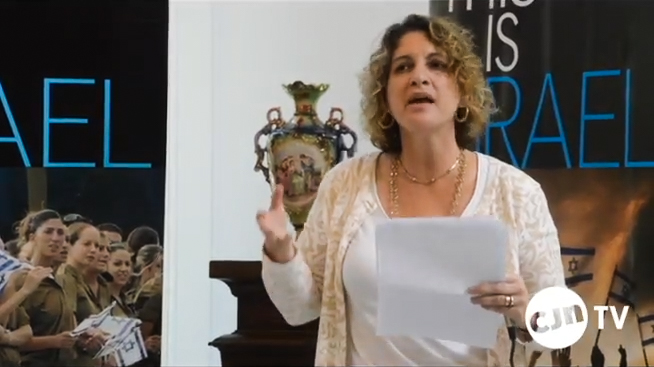
Samantha Ravich speaks at Israel Bonds luncheon in Clevland in 2016. CJN | Screenshot
Ravich, who joined PIAB in 2018, is also a senior advisor to the group the Foundation for the Defense of Democracies (FDD), which was revealed to work directly with Israel’s government in a since-censored Al Jazeera documentary on the Israel lobby. Ravich also worked for the consulting firm of Michael Chertoff, the former head of the Department of Homeland Security whose mother worked with Israel’s Mossad.
Ravich has specifically promoted a “cyber project” to the U.S. Senate that would protect member countries from cyber threats but exclude nations that endorse or fail to condemn the nonviolent Boycott, Divestment, and Sanctions (BDS) movement that supports Palestinian rights and Israeli compliance with international law. Ravich also praised the Trump administration’s decision to partner with Israel’s government on “cybersecurity” in 2017, saying that “the U.S. cannot go it alone in its endeavor to safeguard the networks and systems upon which our economy depends.” As MintPress reported last month, several highly classified networks of the U.S. intelligence community and the military, including networks of the CIA, NSA, and DISA, now use cybersecurity software deeply tied to Israeli military intelligence, thanks in part to this U.S.-Israel partnership.
Now, with Richard Grenell overseeing all 17 U.S. intelligence agencies, Israel’s influence in the U.S. intelligence community has reached new and troubling heights. Yet, his appointment is only the latest move by the Trump administration that places pro-Israel partisans in highly sensitive positions, suggesting that similar appointments are likely in the future, especially if Trump is reelected in November.
Whitney Webb is a MintPress News journalist based in Chile. She has contributed to several independent media outlets including Global Research, EcoWatch, the Ron Paul Institute and 21st Century Wire, among others. She has made several radio and television appearances and is the 2019 winner of the Serena Shim Award for Uncompromised Integrity in Journalism.
Blago Is Free
By Llewellyn H. Rockwell, Jr. | LewRockwell.com | February 20, 2020
On Tuesday, February 18, President Trump with excellent judgment commuted the 14 year prison sentence of former Illinois Governor Rod Blagojevich, aka “Blago.”
“We have commuted the sentence of Rod Blagojevich,” Trump said. “He’ll be able to go back home with his family after serving eight years in jail. That was a tremendously powerful, ridiculous sentence in my opinion. And in the opinion of many others.”
The President thus brought to an end a disgraceful episode in American politics. After Barack Obama was elected President in 2008, his seat as Senator from Illinois became vacant. Blago was charged with trying to sell the seat.
If in fact Blago tried to sell the seat, he was just practicing the dirty, rotten business of politics in the normal crooked fashion for Chicago and America. But out of all the corrupt pols, why did a federal prosecutor target a sitting governor, wiretap him, not allow him to use the wiretaps to defend himself, and send him to jail for 14 years? His real “crime”, in the eyes of the monstrous Obama and his henchman Rahm Emmanuel, was that he refused to appoint the man Obama picked as his successor.
The indictment against Blago was unconstitutional. As the distinguished historian and authority on the Constitution Kevin Gutzman pointed out in an article written for LRC on January 6, 2009, “Interestingly, one might note that the statute Fitzgerald is enforcing against the governor bases Congress’s claim of power to criminalize corruption in state office on the Constitution’s Commerce Clause. One really wonders at the idea that conspiring to sell Jesse Jackson, Jr. a Senate seat is interstate commerce. No one takes this idea seriously; rather, it is based on a common lawyers’ corruption — yes, corruption — of language. On simple federal arrogation of state power. This corruption has far more far-reaching consequences than anything Blagojevich is accused of having done.”
The indictment and trial were gross miscarriages of justice, as President Trump has said. Harvey Silverglate in an article written in 2011 gave the best analysis of the whole rotten business: “The most controversial charge Blagojevich faced was that he planned to sell Barack Obama’s US Senate seat. But Fitzgerald decided to come out swinging, terminated the wiretaps on Blagojevich’s home and office, arrested the then-sitting governor, held a sensational press conference, and called it a wrap before this alleged sale would have even taken place. Fitzgerald was obviously unwilling to wait out the unfolding situation to see if the governor was really serious about “selling” the seat to the highest bidder.
Had Blagojevich actually followed through with the sale of a Senate seat, Fitzgerald’s heavy-handed prosecutorial approach might have been justified. But in light of the fact that no seat was sold, and that these appointments are regularly used for political benefit, the reasonable doubt that a crime was actually committed would appear to be overwhelming. For a US Attorney who is known for “crossing his T’s and dotting his I’s,” you have to wonder why Fitzgerald didn’t spring into action after the sale of the seat, once the dirty deal was done. Blagojevich’s own writing may give us a clue. Blagojevich claims in his memoir, “The Governor,” that the goal of the Senate appointment was to get a political opponent out of the way, not to sell the seat for cash. If this scenario is to be believed, then Fitzgerald went forward with the case when he did because, had he waited until after the seat was filled, there would not have been a case since the seat would have been awarded not for cash, but for quite traditional political advantage.
One of the most shocking, and seemingly damning, sound bites that came from the wiretaps was Blagojevich’s assertion that Obama’s Senate seat was “a [expletive] valuable thing. You don’t just give it away for nothing.” A US Attorney whose last few cases ended unfavorably might be interested in spinning this quote to seem as though a cash transaction was being arranged in exchange for the Senate seat. However, if Blagojevich were looking to use the seat for his political benefit, then his statement would be crass, but would also be evidence that he was operating within the parameters of the law. The type of political maneuvering engaged in by the then-governor may seem to the average citizen (or juror, for that matter), to be less than wholesome, perhaps even a bit sneaky, but if every unwholesome or sneaky maneuver were a crime, we would not be able to build the prisons quickly enough to meet demand.”
Why didn’t Fitzgerald wait? Joe Hall, writing on February 19 in Gateway Pundit has a good explanation. He says that Blago was set up by Mueller, Comey, and the Deep State Gang and that President Trump’s release of Blago may be intended to send the Gang the message that he will fight them. Hall cites investigative reporter Marty Waters, who said last August “that the Deep State, led by Comey and Mueller, did the same thing with the fraudulent Mueller investigation sham as they did in the past. They create distraction, diversion and disinformation. In the early 2000’s they created Plamegate to distract and divert from the billions lost in Iraq and the weapons of mass destruction narrative that got the US into the war. In the mid-2000’s, they created the Rezco/Blagogate scandals to cover up for Obama’s corrupt actions early in his administration and while in the US Senate. The Mueller investigation distracted from the many crimes involving Obama and the Clintons and was in the same mold as the prior sham investigations.”
Hall sums up and concludes: “Of course Mueller was the Head of the FBI throughout most of the 2000’s and before Comey took over the now corrupted institution. Also, Comey claimed Fitzgerald was his attorney after it was suspected that Comey shared classified information with Fitzgerald during the Russian hoax scandal.”
After Trump commuted Blago’s sentence, Governor of Illinois J.B. Pritzker condemned the President’s decision. He said; “Illinoisans have endured far too much corruption, and we must send a message to politicians that corrupt practices will no longer be tolerated. President Trump has abused his pardon power in inexplicable ways to reward his friends and condone corruption, and I deeply believe this pardon sends the wrong message at the wrong time.”
Pritzker’s self-righteous moralizing is ironic. According to a story in the Chicago Tribune published May 31, 2017, “Pritzker, a billionaire businessman with political ambitions, told Illinois Gov. Rod Blagojevich he was “really not that interested” in the US Senate seat the governor was dealing in late 2008. Instead, Pritzker offered his own idea: Would Blagojevich make him Illinois treasurer?”
Blago is no angel, but I can’t help liking him. I admire his spirit. He refused to cave to Obama and the higher-ups. Now that he is out, he is free to tell us where the bodies are buried. You can be sure he knows a lot and with the commutation, the Feds can’t shut him up anymore. Blago has Obama on the ropes, and fortunately for those of us who care about truth, he is a skilled boxing champ.
Colombia: Colonel Involves General in Extrajudicial Killings
teleSUR | February 20, 2020
Colombian Colonel Alvaro Amortegui said that General Mario Montoya ordered him to kill 17 civilians captured in an operation and make them appear as if they were guerrilla fighters killed in combat.
“In 2001… I captured 17 guys inside a house. [Montoya] called me on my cell phone and told me, ‘I’ve already sent you the bracelets.’ Then I replied, ‘don’t send me the bracelets… I captured these men alive and they stay alive’,” said Colonel Amortegui during an interview with Caracol Radio in which he also reported the theft of ammunition, uniforms and other Army material.
This senior officer mentioned that all this happened when he returned from Sinai, a peninsula in Egypt where the Colombian troops are part of the peacekeeping mission of the Multinational Force & Observers (MFO).
Given the implications of his claims, the Caracol Radio journalists asked Colonel Amortegui to better explain what happened with General Montoya, who was commander of the Colombian Army between 2006 and 2008, during the Presidency of Alvaro Uribe, a far-right politician who has been investigated by the Supreme Court.
In his response, Amortegui indicated that General Montoya was referring to the bracelets used by the militants of the Revolutionary Armed Forces of Colombia (FARC).
“He sent me FARC bracelets. Because [the 17 captured] were not FARC [fighters],” the colonel said.
The journalists insisted that Amortegui provide more details about what the General was asking for, to which he replied that Montoya “was asking me to kill them. What else do you want?.”
Eight days ago, Retired General Montoya declared for the first time before the Special Justice for Peace (JEP), although his appearance was described by the victims of state terrorism as “a mockery.”
“It was a mockery before the transitional justice mechanism, which has the task of investigating the most serious crimes committed amidst the armed conflict,” said lawyer Jose Alvear Restrepo who represents the victims of state crimes.
Between 1988 and 2014, the “false positives” was a practice whereby the military cheated poor young people, even those with disabilities, with promises of employment and then took them to distant places to execute them.
The bodies of these civilian victims used to be later presented to the authorities as if they had been killed-in-combat guerrilla fighters, which allowed the military to obtain benefits from their superiors.
So far, the Colombian Prosecutor’s Office has investigated about 5,000 cases of extrajudicial killings. At least 1,500 officials and troops were involved in these illegal practices.
My Meeting with Julian Assange
By Dana Rohrabacher, United States Representative – 2/19/2020
There is a lot of misinformation floating out there regarding my meeting with Julian Assange so let me provide some clarity on the matter:
At no time did I talk to President Trump about Julian Assange. Likewise, I was not directed by Trump or anyone else connected with him to meet with Julian Assange. I was on my own fact finding mission at personal expense to find out information I thought was important to our country. I was shocked to find out that no other member of Congress had taken the time in their official or unofficial capacity to interview Julian Assange. At no time did I offer Julian Assange anything from the President because I had not spoken with the President about this issue at all. However, when speaking with Julian Assange, I told him that if he could provide me information and evidence about who actually gave him the DNC emails, I would then call on President Trump to pardon him. At no time did I offer a deal made by the President, nor did I say I was representing the President. Upon my return, I spoke briefly with Gen. Kelly. I told him that Julian Assange would provide information about the purloined DNC emails in exchange for a pardon. No one followed up with me including Gen. Kelly and that was the last discussion I had on this subject with anyone representing Trump or in his Administration.
Even though I wasn’t successful in getting this message through to the President I still call on him to pardon Julian Assange, who is the true whistleblower of our time. Finally, we are all holding our breath waiting for an honest investigation into the murder of Seth Rich.
‘No shred of evidence’: Iran demands US presents proof of Saudi oil attacks claim after UN report release
RT | February 16, 2020
Tehran slammed the US for using a recent UN report to peddle its Saudi oil attack claims, accusing Washington of “clutching at every straw” to back up the allegations, while the report itself is based on shaky hypotheses.
“Just hours after the attack on Saudi oil facilities on 14 September 2019, the U.S. baselessly attributed it to Iran, but has failed so far to present any shred of evidence. Now, it clutches at every straw to seemingly prove its allegation,” the Iranian mission to the UN stated on Saturday, responding to the US mission doubling down on the White House’s claim that Iran was behind the 14 September twin attacks on Saudi oil giant Aramco facilities in Abqaiq and Khureys.
The attacks that briefly disrupted operations of Abqaiq oil plant – the largest oil processing facility in the world – were claimed by the Houthi rebels, embroiled in a 5-year-long war with the ousted President Abdrabbuh Mansur Hadi backed by the Saudi-led coalition. However, immediately after the attacks took place, the US pointed finger at Teheran, not waiting for any fact-finding mission to be sent to the sites.
Commenting on the recently released UN Yemen panel report, which concluded that Houthi forces were “unlikely” responsible for the bombing since the operation was too “complex” and the “estimated” range of weaponry the militants supposedly possess would not have allowed for such launches from the rebel-held territory, the US mission recycled its allegations framing the report’s findings as a foregone conclusion.
“Iran attacked Saudi Arabian oil facilities on September 14, 2019. It was an attack not only against a sovereign state but against the global economy as well,” the note bluntly states.
Firing back, Tehran pointed out that “nothing in that report validates the US allegation, which has already been rejected by Iran.”
The report does not name Iran as the culprit in the strikes. Moreover, the experts admitted that they did not have a chance to see the debris of the weapons that allegedly hit the facilities first-hand at the scenes as they had been partially cleaned up by Riyadh by the time they arrived.
“It should be noted that the Panel did not see any debris of the weapon systems on-site in Abqaiq and Khureys, as those had already been transported to Riyadh at the time of the visits on 20 and 21 September 2019,” the report states.
In addition to that, the experts furher acknowledged that while they believe that this particular attack was not carried out by Houthis, “other attacks using the same weapons do seem to have been launched from Yemen.”
The panel did not rule out either that Houthis could have been indeed behind the twin strike, noting that “in theory, the attacks could have also been launched by Houthi forces either from within Saudi Arabia, from the territory of other countries, or even from sea or airborne launch platforms,” but called this scenario “highly unlikely.”
The Iranian mission said that the US note “represents another disinformation campaign against Iran,” arguing that it’s the US massive build-up, undertaken under the pretext of the “Iranian threat,” together with Washington’s “military adventurism” and “the unprecedented flow of sophisticated American weaponry” to the region that has become the “main source of instability and insecurity” in the Middle East.
Featured Video

The Truth About the Trump Shootings with Ken Silva
or go to
Aletho News Archives – Video-Images
From the Archives
The Geopolitics behind the War in Yemen (I)
By Mahdi Darius NAZEMROAYA | Strategic Culture Foundation | 30.03.2015
The United States and the Kingdom of Saudi Arabia became very uneasy when the Yemenese or Yemenite movement of the Houthi or Ansarallah (meaning the supporters of God in Arabic) gained control of Yemen’s capital, Sanaa/Sana, in September 2014. The US-supported Yemenite President Abd-Rabbuh Manṣour Al-Hadi was humiliatingly forced to share power with the Houthis and the coalition of northern Yemenese tribes that had helped them enter Sana. Al-Hadi declared that negotiations for a Yemeni national unity government would take place and his allies the US and Saudi Arabia tried to use a new national dialogue and mediated talks to co-opt and pacify the Houthis.
The truth has been turned on its head about the war in Yemen. The war and ousting of President Abd-Rabbuh Manṣour Al-Hadi in Yemen are not the results of «Houthi coup» in Yemen. It is the opposite. Al-Hadi was ousted, because with Saudi and US support he tried to backtrack on the power sharing agreements he had made and return Yemen to authoritarian rule. The ousting of President Al-Hadi by the Houthis and their political allies was an unexpected reaction to the takeover Al-Hadi was planning with Washington and the House of Saudi. … continue
Blog Roll
 Aletho News
- Leaked: Britain’s Sham Conviction Of Hashim Thaci
- Seyed M. Marandi: U.S. Strike Imminent – Toward Total War in the Middle East
- Russia Voted Under Fire. Washington Is Loading the Tankers.
- 12 Things Your Oncologist Was Trained Not to Tell You
- Anthrax Attacks Paved Way for COVID-Era ‘Junk Drugs and Vaccines’
- How Real Is the Impact of Western Sanctions on Israel?
- France, You Are Guilty: How Paris Turned Western Sahara into the Maghreb’s Powder Keg
- 2025 Nature Paper Claiming Worsening Global Drought Gets RETRACTED …Heavily Flawed
- Your Milk Is Not the Problem
- The Truth About the Trump Shootings with Ken Silva
- If Americans Knew
- An error has occurred; the feed is probably down. Try again later.
- No Tricks Zone
- 2025 Nature Paper Claiming Worsening Global Drought Gets RETRACTED …Heavily Flawed
- New Study: ‘Global Drought Shows No Detectable Recent Acceleration Under Climate Warming’
- Economic Masterminds: German Socialists Suggest Taxing Productivity Gains Stemming From Using AI
- The South China Sea Has Not Been Cooperating With The Climate Change Narrative
- Energy Crisis: Germany Enters Heating Season With Historically Low Gas Reserve Fill Levels
- New Study: The Antarctic Ice Sheet Gained Mass From 2020-2024 Due To Staggering Snow And Ice Accumulation
- Study: Ocean Heating Rates From Thousands Of Years Ago ‘Dwarf’ Modern Ocean Heating Rates
- Climate Extremists Target, Attack Large-Scale Power Grid Infrastructure In Germany!
- New Study: Antarctic Ice Melt Has Contributed Less Than 1 Centimeter To Sea Level Rise In The Last 30 Years
- Fear Of Debate: Alarmist German Climate Scientist Calls On Mainstream Media To Discredit Skeptic Voices
 Aletho News