Defense Minister Brigadier General Amir Hatami says Iran’s satellite carriers have nothing to do with its military activities and lie completely outside the country’s defensive practices.
“The satellite carriers have nothing to do with the subject of missiles, and constitute a completely non-defensive and non-military issue,” Hatami said following a government meeting in Tehran on Wednesday.
According to the defense chief, a satellite might be used for defense-related purposes, but the carriers are totally non-defensive in nature.
On Sunday, the Iranian Space Agency said the country had launched its domestically-made Zafar satellite using a Simorgh satellite carrier, but that the missile had fallen short of reaching the designated orbit.
The agency added that the data from the launch would be used to optimize future launch attempts.
As with every country that has experimented with satellites, the Iranian nation likewise has a vested right to avail itself of the technology, he added, noting that the country would, therefore, strongly pursue its relevant plans in this regard.
The Iranian defense minister was apparently reacting to claims made by France and the US about Tehran’s space program following the launch.
Reacting to the launch on Tuesday, US Secretary of State Mike Pompeo accused Iran of trying to improve its ballistic missile skills through the satellite launch and vowed to exert more pressure.
A day earlier, France also criticized the launch and suggested that it was inconsistent with UN Security Council Resolution 2231, which “calls upon” Iran not to undertake any activity related to missiles “designed to be capable of” delivering nuclear weapons.”
Commenting on Iran’s missile activities, Hatami noted that the defense program was in complete accord with international regulations that prohibit the development of projectiles capable of carrying nuclear warheads.
“Nothing of the kind exists in the Islamic Republic,” Hatami said. “All of our missiles, which we take pride in and which constitute an important factor of Iran’s defense and military power, are made with conventional warheads.”
“The projectiles are high in precision, something that the Americans came in proper touch with at Ain al-Assad [Airbase],” he said.
The US airbase, which is located in Iraq’s western Anbar Province, and another American outpost in the Arab country’s semi-autonomous Kurdistan region came under retaliatory ballistic missile strikes by Iran’s Islamic Revolution Guards Corps (IRGC) last month.
The strikes were prompted by the US assassination of Lieutenant General Qassem Soleimani, the former commander of the IRGC’s Quds Force, and a number of others in a set of drone strikes targeting Baghdad’s civilian airport.
“We do not need anything beyond this. Our missiles are precision-guided and fitted with conventional warheads,” Hatami added.
The Islamic Republic, he added, was likely to launch its Zafar (Triumph)-2 Satellite in the beginning of the next year on board Simorq (Phoenix) Satellite Carrier.
The official said the country considered the vehicle and satellite technology to be one of the subject matters of its research activities.
He said the Islamic Republic would pursue the research “until it reaches a stable stage,” and the country attains the ability to “do this in the form of a sustained practice.”
February 12, 2020
Posted by aletho |
Aletho News | France, Iran, United States |
Leave a comment
Iran has dismissed France’s “meddlesome” claim about its space program following a recent satellite launch, saying the Islamic Republic reserves the right to make scientific progress.
Tehran on Sunday launched its domestically-made Zafar (Triumph) satellite using a Simorgh (Phoenix) satellite carrier, but the missile fell short of reaching the designated orbit.
The satellite launch came on the same day that Iran unveiled a new missile, ‘Ra’d-500 (Lightning-500),’ which is equipped with a composite engine block as well as the new generation of propellant for missiles and satellite carriers.
The French Foreign Ministry on Monday condemned Iran for trying to put a satellite in space and unveiling the new ballistic missile, urging Tehran to abide by international obligations on its controversial missile program.
“In keeping with its obligations under UN Security Council Resolution 2231, Iran cannot engage in activities, including launches, connected to ballistic missiles capable of carrying nuclear weapons,” said the French statement, claiming that Tehran’s ballistic missile program “hurts regional stability and affects European security.”
Rejecting the “meddlesome” statement on Tuesday, Iran’s Foreign Ministry Spokesman Abbas Mousavi said Tehran has “an inherent right to develop science and technology.”
“Iran’s defensive missile program has also nothing to do with Resolution 2231 because Iranian missiles have not been designed to carry nuclear weapons,” the official said.
Resolution 2231 endorsed a nuclear deal inked in 2015 between Tehran and six world states — the US, France, Britain, Germany, Russia and China.
The US, however, abandoned the deal in May 2018 in defiance of the resolution, throwing the future of the agreement in doubt.
The European parties initially vowed to keep the deal alive but failed to fulfill their contractual obligations under intense US pressure, prompting Tehran to begin suspending the implementation of parts of its nuclear commitments on a stage-by-stage basis a year later.
Iran says its counter-measures are reversible if the European signatories take meaningful action to save the deal.
February 11, 2020
Posted by aletho |
Aletho News | France, Iran |
Leave a comment
In many ways, the Iranian ballistic missiles attack on U.S. forces in Iraq and the U.S. missile strikes against targets in Syria were strikingly similar in the way they sought to avoid bringing about any serious escalation that could have led to war.
On January 8, Iranian ballistic missiles simultaneously targeted the Al-Asad airbase in Iraq’s Anbar province (see image above) and Erbil International Airport in Iraqi Kurdistan, where U.S. military personnel is housed. While Iran fired at least 22 ballistic missiles, the U.S. did not suffer any fatalities. Tehran said the attack was retaliation for the U.S. assassination of Iran’s Islamic Revolutionary Guard Corps’ Quds Force commander Qasem Soleimani on January 3. Washington did not retaliate and fears of a significant escalation, or the dire prospect of a direct US-Iran war, subsequently decreased.
Tehran launched the attack after giving plenty of forewarning. On January 5, Brigadier General Hossein Dehghan, Iranian Supreme Leader Ayatollah Ali Khamenei’s military advisor, told CNN that the then-upcoming attack would come directly from Iran, rather than from Tehran’s proxy militias, against U.S. “military sites” in the region. “Our reaction will be wise, well considered and in time, with decisive deterrent effect”, he said. His statement made it unequivocally clear that, rather than attack any U.S. bases or targets in the Gulf states, Iran’s retaliation would come in Iraq, giving U.S. forces based there about three days to prepare themselves.
Five days after the strike, Reuters cited two Iraqi officers based in Al-Asad as saying that American and Iraqi forces began moving troops and hardware to fortified bunkers eight hours before the strike. Reuters also cited another Iraqi intelligence source, who went so far as to say that the U.S. troops seemed “totally aware” that the attack would come “after midnight”. Consequently, the Iranian missiles simply hit “empty bunkers that had been evacuated hours before”. It was later revealed, despite U.S. President Donald Trump dismissing the symptoms as mere “headaches“, that Iran’s missile strike did wound 64 U.S. personnel by giving them traumatic brain injuries.
The way in which Tehran carried out this missile strike was not wholly dissimilar to the two past U.S. cruise missile strikes against Syrian regime targets in April 2017 and April 2018. For example, on the morning of April 7, 2017, the U.S. responded to the Khan Shaykhun chemical attack [details] carried out three days earlier by hitting Syria’s Shayrat Airbase with 59 Tomahawk cruise missiles. It did so after giving prior warning to Russia, a major ally and backer of Syrian President Bashar al-Assad.
Moscow likely gave Damascus some prior warning, and it was also likely the regime knew that particular base would be hit. “Russian forces were notified in advance of the strike using the established deconfliction line”, said Navy Captain Jeff Davis at the time. “US military planners took precautions to minimize risk to Russian or Syrian personnel located at the airfield”. Despite that enormous strike package of 59 Tomahawk missiles raining down on the base, Syrian Armed Forces’ remaining Su-22s were able to land and take off from the base hours later. The situation did not escalate into any major confrontation with Damascus.
On April 14, 2018, the United States, this time in a coordinated strike with the United Kingdom and France, fired even more cruise missiles at three targets related to Syria’s chemical weapons program, in response to a [fake] chemical attack in Douma one week earlier. As with the Shayrat attack, the U.S. gave notice to ensure there were no serious casualties or subsequent escalation. The U.S. ambassador to Russia, Jon M. Huntsman Jr., published a statement on Facebook in which he explained that: “Before we took action, the U.S. communicated with the RF [Russian Federation] to reduce the danger of any Russian or civilian casualties”. Additionally, a pro-Syrian regime official confirmed that: “We had an early warning of the strike from the Russians… and all military bases were evacuated a few days ago”. These measures were clearly taken to avoid any significant escalation or war.
Later, Trump came close to bombing targets inside Iran following Tehran’s shooting down of a U.S. surveillance drone over the Gulf of Oman on June 20, 2019 (see image right). According to Trump, he approved strikes against three targets but then called it off a mere 10 minutes before it was set to commence. His decision came after the U.S. military gave him its prediction that at least 150 Iranians would have been killed, something Trump deemed wouldn’t have been “proportionate” to the destruction of an unmanned aircraft. Also, more likely than not, the U.S. military made clear to him that a limited strike similar to the previous ones against Syria would be much harder to carry out against Iran itself and escalation or major war would have, therefore, been far more likely.
Tensions between Iran and the United States remain high, and the prospect of war or a major escalation cannot be discounted. Nevertheless, de-escalation measures, however imperfect, taken by Tehran and Washington in these incidents indicate that neither side actually wants a full-blown war.
February 5, 2020
Posted by aletho |
Aletho News | Donald Trump, Iran |
Leave a comment
Mérida – Venezuela has warned the Inter-American Commission on Human Rights (IACHR) that its proposed visit to the country has not been authorised and will not be accepted.
The Washington DC-based organisation announced a five-day delegation to Venezuela starting on Tuesday. It was invited by self-declared “Interim President” Juan Guaido to “observe” the human rights situation in the country. The IACHR has not visited the Caribbean country in 18 years.
Caracas reacted on Friday, however, describing the proposed visit as “improper” given that the country is no longer part of the IACHR’s mother institution, the Organisation of American States (OAS).
Venezuela left the OAS in April 2019 after accusing the multilateral organisation of repeated acts against Venezuela’s sovereignty. Guaido appointed representatives, however, continue participating in OAS meetings.
Venezuela’s Foreign Minister Jorge Arreaza took to Twitter on Friday, clarifying that “The government of the Bolivarian Republic of Venezuela has not invited nor accepts the visit of any IACHR delegation. The visit announced in the press is NOT authorised.”
Caracas’ general secretary of the National Human Rights Council, Larry Devoe, also explained that Venezuela “does not recognise nor assign legal value to the actions of the OAS and the IACHR,” in a public communiqué to the multilateral body.
In addition, Devoe confirmed that the country will rather continue working with the office of the UN High Commissioner for Human Rights on the matter. The body, headed by former Chilean president Michelle Bachelet, sent a delegation to Venezuela last July.
Guaido responded to the measure by assuring followers that the IACHR visit will proceed, as well as reaffirming his credentials to extend such invitations.
“As the legitimate government and with Venezuela a member of the OAS and the Inter-American system, we ratify the invitation for the IACHR to visit our country,” he wrote on Twitter.
The former National Assembly president is currently wrapping up an international tour which has taken him to Colombia, the UK, Belgium, France, Spain, the USA and Switzerland, where he attended the Davos Forum.
Guaido has been in Florida in recent days, where he has met with Republican Senators Marco Rubio and Rick Scott, as well as Congresswomen Debbie Wasserman Schultz and Donna Shalala and Miami Mayor Francis Suarez. Florida representatives have been some of the drivers of sanctions and legislation against Venezuela.
Despite coinciding with US President Donald Trump’s visit to his Mar a Lago resort also in Florida, no meeting took place between the two men. According to media reports, Guaido’s team lobbied for a meeting with Trump but to no avail.
The opposition leader also held a rally for US-based supporters at the Miami Convention Centre on Saturday, before meeting with US charge d’affaires for Venezuela, James Story.
Guaido has stated that he will return to Venezuela in the “next few days” and has called for more street rallies.
Edited by Ricardo Vaz from Mérida.
February 4, 2020
Posted by aletho |
Aletho News | Latin America, OAS, Venezuela |
Leave a comment
In yet another sign of deteriorating relations between Moscow and Washington, senior Russian officials and parliamentarians have agreed that Russia should end its “provisional enforcement” of the 1990 accord signed by then–Soviet Foreign Minister Eduard Shevardnadze and then–US Secretary of State James Baker on the delimitation of the sea border between the two countries in the Bering Strait. That agreement was ratified by the United States in 1992 but was not ratified by the Soviet Union before it collapsed and has not been ratified by its legal successor, the Russian Federation. Instead, Moscow has heretofore agreed to provisionally recognize and enforce its stipulations. But now, that looks likely to change.
On Monday (January 27), Konstantin Kosachev, the chairperson of the Federation Council’s (upper chamber of the Russian parliament) foreign relations committee, said he and other lawmakers had met with foreign ministry, Federal Security Service (FSB), and Russian fisheries officials to discuss whether Moscow should continue to fulfill the provisions of the agreement in the absence of its ratification. He insisted that the participants were unanimous in calling for the Russian government to announce it would no longer recognize or enforce the terms of that agreement. The following day, a spokesperson for the Russian foreign ministry indicated it was receptive to the idea (Finanz.ru, January 27, 2020).
The agreement has been unpopular in Russia since it was signed because many there believe Shevardnadze gave up too much in an effort to curry favor with the West; indeed, this is one reason the Russian parliament never ratified the deal. Still, until this week, there was no indication that Moscow would change its de facto recognition of the accord even though there was little chance of a de jure ratification. Now, Russia appears set to declare that it will no longer adhere to it, though some Russian analysts are skeptical whether Moscow has sufficient naval power to enforce any prospective new sea border between the two countries (Topcor.ru, January 29).
According to the document’s terms, Moscow and Washington agreed to delineated the sea border between them in the Bering Strait from “the point, 65° 30′ North, 168° 58′ 37″ West, along the 168° 58′ 37″ West meridian through the Bering Strait and Chukchi Sea into the Arctic Ocean as far as permitted under international law” (Un.org, June 1, 1990, accessed March 18, 2002).
The State Department noted (State.gov, September 8, 2009), as have other observers since that time, that when the US purchased Alaska from the Russian Empire, there was no need to define the border beyond the three-mile exclusion rule then in effect. But with the introduction of a 200-mile economic exclusion zone as a result of the Law of the Sea agreements, both Russia and the US recognized that there was suddenly a necessity to come up with one. The negotiating record from the 1860s was flimsy, however; and the two could not agree. The Baker-Shevardnadze exchange eventually opened the way for a compromise, but it left most of what had been disputed inside the US zone. Many Russians objected at the time, and those objections have continued.
Shevardnadze and Baker consented to split the difference, but that led to US sovereignty over areas that Russians had long considered theirs. As a result, Moscow has not ratified the 1990 accord, and Russian officials, including Vladimir Putin, periodically talk about the need to modify it. Since the document’s signing, the two countries have occasionally conducted talks on further adjusting the agreement; but to date, nothing has come of those talks. Two reasons explain this deadlock, one pertaining to Russia and the other to the United States. The Russian issue relates to the fact that Moscow wants to expand shipping across the Northern Sea Route and does not want to have to request approval from the US for transiting through what are now American waters (see EDM, March 29, 2017); additionally, Russia does not want the US to interfere with Russian fishing in the area. As for the United States, it widely believes there are significant oil and other mineral deposits in that region, which it hopes to one day exploit.
It remains to be seen how far Moscow will push this issue. Russia has brought up the sea boundaries before—at a 2003 Federation Council hearing and in Putin’s comments to Western leaders after Russia’s annexation of Crimea—and each time it led to a sharp uptick in tensions; but ultimately Russia took no action. This time, however, statements by senior Russian officials and parliamentarians appear to make it less likely that Moscow will back down from its tough line, especially given that Russian outlets are suggesting openly that “Russia is ready to begin a territorial dispute with the US over the sea border” (Gr-sily.ru, January 29, 2020).
Anatoly Kuznetsov, the editor of Russia’s Sea News, suggested that, at the very least, “the Russian parliament might pass the law about a refusal to recognize the 28-year-old Soviet legal act” (Fairplanet.org, January 29, 2020). “According to the law ‘About Russia’s international agreements,’ any deal regarding borders, be it land or maritime, is considered legally [null and void] unless ratified.” The expert added, “If Russia decides to ignore the American interests in the Bering Sea, it risks engaging with the similar ‘war of nerves.’ Russian fishermen will have to rely on the [Russian navy’s] protection in a hope that the U.S. warships are reluctant to start sea battles over such minor incidents.” A Russian parliamentary move in that direction could end the current brewing dispute, but the principle the legislature in Moscow would be enunciating—a non-enforcement of accords not yet ratified—would open the way to more problems elsewhere in the future.
February 3, 2020
Posted by aletho |
Aletho News | Russia, United States |
Leave a comment
The remark by President Recep Erdogan on Friday that Turkey might militarily intervene in Syria’s northwestern Idlib province fuelled speculation that tensions between Ankara and Moscow have reached a point of no return.
However, this is nothing but wishful thinking. The calm rebuttal by the Kremlin spokesman Dmitry Peskov signalled a measure of confidence that Moscow’s ties with Turkey are in no such danger. Peskov said in measured tone, “We don’t agree with this view [of Erdogan]. Russia is in full compliance with the Sochi agreements on the Idlib zone. At the same time, we regret to say that the situation is far from perfect.”
He added that “a large number of terrorists remain in the area and continue aggressive attacks on the Syrian army and Russia’s Hmeymim air base. It causes us huge concern.”
Moscow is on strong ground. Turkey failed to honour its commitment under Sochi agreements to separate the ‘moderate’ groups supported by it from the al-Qaeda affiliates ensconced in Idlib (also with covert support from outside.) Besides, the Sochi agreements on Idlib do allow operations against extremist / terrorist groups.
Peskov’s ‘reasonableness’ suggests that Moscow is seeking Erdogan’s understanding and wouldn’t want the US to exploit the Turkish disquiet over any refugee influx from Idlib. The US is already fishing in troubled waters, as evident from the sudden visit to Ankara on Friday by Gen. Tod Wolters, commander of the US European Command and NATO Supreme Allied Commander-Europe.
The US doesn’t want the Russian-Syrian operation in Idlib (with the participation of the Iran-trained militia groups) to make headway and wrest control of the sole remaining preserve of the al-Qaeda affiliates armed and equipped by western powers.
Wolters’ mission to Ankara also aimed at persuading Turkey to help eject the Russian military presence in northeast Syria, which the US regards as its exclusive zone. The Pentagon wants to revive its deal with Turkey establishing a ‘safe zone’ 145 kilometers in length and 30 km in depth in northern Syria, with the US undertaking that its Kurdish allies would be withdrawn from that area. (The US didn’t keep its word and Turkey eventually struck a deal with Russia on similar lines.)
Interestingly, on the eve of Wolters’ arrival in Ankara, Russian and Turkish forces conducted yet another joint patrol in the countryside of Al-Darbasiyah and Ras Al-Ain in the northeast extreme of the Turkish-Syrian border. Despite the US provocations to make life difficult for the Russian military presence in that remote Kurdish region near Iraq, Russian forces have dug in, which of course is also in Turkish interests.
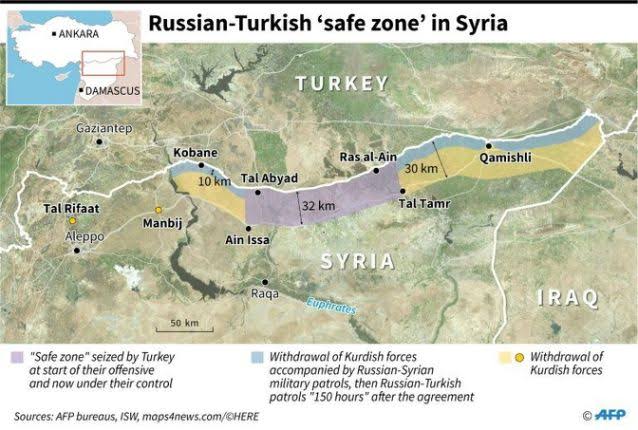
The Russian objective is to steadily expand the Syrian government control of the border regions with Turkey, which would incrementally lead to direct dealings between Ankara and Damascus on issues of border security. In sum, Moscow doesn’t seem to be unduly perturbed that the US is about to get back into bed with Turkey.
Turkey harbours serious misgivings about the US intentions regarding Kurds. Ankara has failed to break the nexus between the US and the Kurdish militant groups and if anything, the Pentagon commanders are lately rather blasé about the axis. Therefore, Turkey cannot afford to put its eggs in the American basket when it comes to northeast Syria.
Importantly, the suspicion is deep-rooted in the Turkish mind that the 2016 coup attempt against Erdogan by the movement led by Islamist preacher Fethullah Gülen (who lives in exile in the US since 1998) was supported by the US military and intelligence circles.
Meanwhile, US-Turkey relations may become toxic what with the US prosecutors in New York asking a federal judge on January 21 to impose escalating fines on Turkey’s state-owned Halkbank for failing to respond in court to criminal charges that it helped Iran evade US sanctions. The proposed fine on the bank is a $1 million-per-day fine – a penalty that would double for each week of further non-compliance. It could total $1.8 billion after eight weeks.
The case against Halkbank has been a longstanding point of tension in the increasingly fraught relationship between Ankara and Washington. Some analysts estimate that it is the single most explosive issue that could blow up the Turkish-American relationship.
If Halkbank decides to acquiesce and appear in court, the case will tarnish the reputation of the Erdogan government. The case implicates senior Turkish ministers, top Halkbank executives and even Erdogan and his family members as beneficiaries of the sanctions-busting efforts.
On the other hand, if the Halkbank insists on its civil contempt of court, that might ultimately severe its ties with the US financial system, hurting not only the bank but also Turkey’s financial sector, and send Turkish-American relations into a free fall.
Can the Trump administration intervene in the Halkbank case and rescue Erdogan? That likelihood can also be ruled out in the downstream of the reported allegation by former NSA in the White House John Bolton in his upcoming memoirs that Trump who has a property in Turkey was inclined to grant favours to Erdogan.
In such a sombre backdrop, it is highly improbable that Erdogan can afford to hitch Turkish wagons with the US. Having said that, Erdogan is under pressure from Turkish public opinion on the refugee problem. He may have to be seen doing ‘something’ to stall the Syrian offensive in Idlib.
No doubt, Ankara has sharpened its messaging but there is no clear Turkish strategy in view. The only viable option will be to accept the new facts on the ground. Possibly, as happened so often before, President Vladimir Putin will step in at some point to hold Erdogan’s hand.
February 1, 2020
Posted by aletho |
Aletho News | Russia, Sanctions against Iran, Syria, Turkiye, United States |
Leave a comment
French President Emmanuel Macron has sent warships to the Eastern Mediterranean to give support to Greece against Turkey’s quest for energy reserves in the region.
Together with Macron was Greek Prime Minister Kyriakos Mitsotakis, who was on a visit to the French capital Paris to gather support against Turkey. Mitsotakis welcomed the decision and described the warships as “guarantors of peace.”
“The only way to end differences in the eastern Mediterranean is through international justice,” he told reporters after holding talks with Macron. “Greece and France are pursuing a new framework of strategic defence.”
Tensions have increased significantly over the past year in the Eastern Mediterranean due to Turkey’s dispute with Southern Cyprus over the distribution of energy resources in the waters off the island of Cyprus.
In June last year, Turkey deployed drilling vessels to search for natural gas in retaliation to a deal struck by Greece, Southern Cyprus and Israel earlier that month, in which the three states agreed to build a pipeline harnessing the reserves of natural gas off the southern shores of the island. This pipeline – named EastMed – which is estimated to produce a profit of $9 billion over 18 years of the reserve’s exploitation, would be supplying gas from the Eastern Mediterranean region all the way to countries in Europe.
Turkey has called on those countries to participate in a fair and equal distribution of the energy resources discovered off Cyprus, insisting that they are attempting to exclude and alienate Turkey by striking their own deal without the consideration of both the major regional player and the people of the Turkish Republic of Northern Cyprus (TRNC). Therefore, it stresses that the drilling activities that Turkey is carrying out is legal and within territorial waters.
The EU, however, has repeatedly called on Turkey to give up its claim on having a share in the energy resources, claiming that its activities are “illegal”, leading to the Union to impose sanctions on the Republic in July last year over the issue, as well as due to Turkey’s military incursion – Operation Peace Spring – into northern Syria in October.
As France is one of the most prominent supporters of Greece in the dispute, Macron accused Turkey of being the one responsible for raising tensions as well as causing trouble in war torn Libya. “I want to express my concerns with regard to the behaviour of Turkey at the moment,” said Macron. “We have seen during these last days Turkish warships accompanied by Syrian mercenaries arrive on Libyan soil. This is an explicit and serious infringement of what was agreed in Berlin [conference]. It’s a broken promise.”
Greece itself has reportedly long been prepared for a military confrontation, with Defence Minister Nikos Panagiotopoulos recently warning that the country was “examining all scenarios, even that of military engagement.” This was shown with Greece’s arming of 16 Aegean islands last week, in violation of international law which stipulates that they remain demilitarised. When Turkey called on Greece to disarmed them and uphold international law, Greece refused.
January 30, 2020
Posted by aletho |
Aletho News | Cyprus, European Union, France, Greece, Israel, Libya, NATO, Turkiye |
Leave a comment
US President Donald Trump first said there were ‘no casualties’ in the Iranian missile attack on the Ain al-Asad military airbase in Iraq on January 8. “We suffered no casualties, all of our soldiers are safe, and only minimal damage was sustained at our military bases,” Trump had said.
Then a number 11 was mentioned a week later, but Trump minimised the injuries, calling them ‘headaches’. Last Friday, a fortnight after the attack, the number sharply climbed. The Pentagon spokesman told reporters that 34 US military members received concussions or other traumatic brain injuries in the missile strikes.
The true human toll of the Iranian strike is still being assessed. But what Iran achieved through the January 8 attacks may never quite be in the public domain.
The big question is whether Iran acted with Russian backing. Beyond a string of Russian statements empathising with Iran, all we have are tell-tale signs.
To be sure, satellite imagery suggests very precise hits of targets in the Ain al-Asad base. In an interview with Spiegel magazine last week, Iran’s Foreign Minister Mohammad Javad Zarif stated Iran’s objectives:
“There was no intention of causing any casualties with the missile attack… The damage we have done to the US is extensive, because with all its military might, it could not prevent the missiles from hitting its base. It shows how vulnerable the US is.”
The Iranians did succeed in displaying their formidable missile capability and its capacity to inflict lethal damage on US military establishments. But how could such high-precision hits be achieved except with missiles equipped with satellite guidance and target-tracking capabilities?
Importantly, Iran doesn’t have an independent orbital group of satellites. There are four global navigation satellite systems operational today — the US GPS/NAVSTAR, European GNSS, Russian GLONASS and Chinese BeiDou. The US and European systems are out of bounds for Iran.
But there is no embargo on Iran accessing the Russian or Chinese systems and it probably used one of them. But Tehran neither confirms nor denies.
Iran acknowledges it fired two Russian TOR-M1 anti-aircraft missiles but, interestingly, stops short of blaming them for the crash of the Boeing 737-800, flown by Ukraine International Airways. By the way, TOR-M1 is mounted on a tracked vehicle and carries a radar and each vehicle can operate independently. Did Iran’s Russian-made TOR-M1 have access to GLONASS?
Indeed, on January 7, on the eve of the Iranian missile strike, President Vladimir Putin paid an unscheduled visit to Syria to meet up with President Bashar al-Assad.
Again, on January 9, the day after the Iranian missile strike, Putin watched a big naval exercise involving multiple missile launches in the Black Sea. The Navy Times reported, “The Russian naval maneuvers come amid heightened US-Iran tensions after the US strike last week that killed Iran’s most powerful military commander.”
Advanced Russian weapon systems were on display in the maneuvers. MiG-31 interceptor jets launched Kinzhal hypersonic missiles at practice land targets while Navy ships performed several launches of Kalibr cruise missiles and other weapons. More than 30 warships and 39 aircraft, including several Tu-95 strategic bombers, took part in the exercise.
Curiously, again on January 9, in the northern Arabian Sea off Iran’s coastline, there was a rare encounter between the US destroyer USS Farragut and the Russian intelligence gathering ship RFS Ivan Hurs, which was apparently shadowing the operations of a US aircraft carrier battle group in the area.
The above events taken together signalled that Russia was closely monitoring the situation around Iran and was in full readiness to meet any emergent military conflagration in the region. No doubt, the message was addressed to Washington.
It is entirely conceivable that Russia has intelligence-sharing arrangements with Iran. In fact, Russian Foreign Minister Sergey Lavrov, a veteran diplomat, might just have lifted the veil a little bit when he disclosed on January 17 that Iran’s accidental shooting down of the Ukrainian airliner occurred at a time when Tehran was spooked by reports of advanced US stealth fighters in the area.
“There were at least six F-35 fighters in the air in the Iranian border area. This information has yet to be verified, but I’d like to underline the edginess that always accompanies such situations,” Lavrov said. Alas, Lavrov’s disclosure left a cold trail. But it most certainly hinted that Russia is reconnoitring the skies above Iran.
All this may amount to nothing much, or everything — depending on how one looks at it. Russia will not militarily intervene in a US-Iranian conflict. Indeed, such a conflict is unlikely. What Russia can do is to make the probability of a conflict even less likely by aiding Iran to defend itself, by providing it with electronic warfare tools and other high-end arms that would raise the military costs to the US, as had happened on January 8.
How far Russia’s ‘positive neutrality’, which distinctly favoured Iran in the most recent period, irritated Washington no one can tell. But there have been four instances in the past 8 days alone of US forces blocking Russian convoys in northeastern Syria — one forcing back a vehicle driven by a Russian major-general. Poking the bear? In Russian-American relations, nothing is really coincidental.
The debate over the alchemy of Russian-Iranian relations is a never-ending one. But no matter the two countries’ specific interests or national objectives and ideologies, a destruction of Iran or the emergence of a US-friendly regime in Tehran would be profoundly consequential to Russian regional strategies, given the co-relation of forces internationally.
Lavrov gave an indication of Russian priorities when he said in Delhi on January 17 while addressing an international audience (including Zarif) that Moscow backs Tehran’s bid to join Shanghai Cooperation Organisation as a full member and is hopeful it will happen.
January 27, 2020
Posted by aletho |
Aletho News | Iran, Middle East, Russia, SCO, United States |
Leave a comment
Veterans of Foreign Wars, an American organization advocating for military veterans, has called on President Donald Trump to apologize for downplaying brain injuries that were inflicted on the country’s soldiers during Iran’s retaliatory strikes at a US base in Iraq.
“TBI is a serious injury and one that cannot be taken lightly. TBI is known to cause depression, memory loss, severe headaches, dizziness and fatigue — all injuries that come with both short- and long-term effects,” VFW said in a statement.
Over 30 US service members have suffered traumatic brain injuries (TBI) after Iran attacked the Ain al-Assad air base in response to assassination of Major General Qassem Soleimani.
“The VFW expects an apology from the president to our service men and women for his misguided remarks. And, we ask that he and the White House join with us in our efforts to educate Americans of the dangers TBI has,” read the statement by Veterans of Foreign Wars National Commander William “Doc” Schmitz.
The Pentagon made the announcement on Friday over three weeks after the January 8 attack.
Nine service members are reportedly being treated in Germany while some have already been sent home for additional treatment.
Tensions have been rising between the US president and former commanders as well as active duty senior officers in the wake of General Soleimani’s assassination following his order.
January 25, 2020
Posted by aletho |
Aletho News | United States |
Leave a comment

“Nobody likes him, nobody wants to work with him, he got nothing done. He was a career politician.” So says Hillary Clinton of her former Senate colleague and 2016 rival for the Democratic nomination, Bernie Sanders.
Her assessment of Sanders’ populist-socialist agenda?
“It’s all just baloney and I feel so bad that people get sucked into it.”
Does that assessment still hold with Sanders now running strong in Iowa, New Hampshire and Nevada, and having emerged, according to The New York Times, as “the dominant liberal voice in the 2020 race”?
“Yes, it does,” said Clinton, who left open the possibility she might not support Sanders if he became the nominee.
In her interview with The Hollywood Reporter to promote a documentary that premieres Saturday at the Sundance Film Festival, Clinton also tore into Bernie’s backers.
“It is not only him. It’s the culture around him. It’s his leadership team. It’s his prominent supporters. It’s his online Bernie Bros and their relentless attacks on lots of his competitors, particularly the women,” said Clinton. “It should be worrisome that he has permitted this culture — not only permitted (he) seems to be very much supporting it.”
From her own words, Clinton regards Sanders as a nasty man running a misogynistic campaign and a political phony whose achievements are nonexistent and who lacks the temperament to be president.
As Clinton describes Sanders, he seems to fit nicely into her Trumpian “basket of deplorables.” Reflecting the significance of Clinton’s attack, The New York Times put it on Page 1.
This comes one week after Elizabeth Warren, at the end of the last debate, confronted Sanders, who had denied ever telling her a woman could not win the presidency.
“I think you just called me a liar on national TV,” said Warren, twice. Sanders assuredly had. He then accused Warren of lying.
This is “a part of a pattern,” says Clinton, noting that Sanders said in 2016 that she was not qualified to be president.
What is Hillary up to? She is “hellbent on stopping Sanders,” says Obama strategist David Axelrod.
The bad blood between Bernie and two leading women in the Democratic Party calls to mind the battle between Nelson Rockefeller and Barry Goldwater, which did not end well for the Republican Party in 1964.
While the eventual GOP nominee, Goldwater, lost in a 44-state landslide to Lyndon Johnson, the liberal Republican establishment that Rockefeller led would never again be able to nominate one of its own.
It is difficult to see how this acrimony inside the Democratic Party — over the character, record, ideology and alleged sexism of Sen. Bernie Sanders — ends well for the Democrats.
Already, Bernie’s backers believe the DNC “rigged” the nomination in 2016 by feigning neutrality while secretly aiding Clinton. If Sanders now fails in the first primaries and loses his last chance for the Democratic nomination because of the Clinton-Warren’s attacks, it is difficult to see how Bernie’s backers enthusiastically support Warren.
As for Bernie backing Biden, the raison d’etre of the liberal-radical wing of the party to whom Sanders is a hero is that the Democratic establishment consistently sells out progressive values.
Sanders’ crowd consists of true believers, a trademark of whom is militancy. Such folks often prefer defeat behind a principled leader to victory for a corporatist Democrat they regard as the enemy within.
Assume Bernie defeats Warren in Iowa, bests Biden in New Hampshire, and then goes on to win the nomination. Would women, a majority of whom vote Democratic, and who are indispensable to party victory, surge to the polls to install a president whom Hillary Clinton and Elizabeth Warren describe as a sexist who ruined their own presidential hopes?
Would Democratic women come out to vote for a candidate who was responsible, in two successive presidential elections, for keeping the glass ceiling firmly intact over the heads of the Democratic Party’s leading female candidates? Bernie has made some bad enemies.
Ten days before the Iowa caucuses, the great unifier of the Democratic Party remains Donald Trump. But now, with Iowa, New Hampshire, Nevada and South Carolina dead ahead, the Democrats’ focus is becoming: Who should replace Trump?
The rival claims of the constituent elements inside the party are rising to the fore. And what they reveal is a Democratic Party that is a coalition of groups that seem to be dividing along the lines of ideology, politics, race, class and culture.
Consider the most loyal of Democratic constituents in presidential elections: African Americans. They are 13% of the electorate but a fourth of the national Democratic vote.
Yet, of the six candidates for the nomination on stage in the last debate, not one was African American. Not one was Hispanic or Asian. Four were white men, and two were white women.
The lone outsider rising in the polls is another white man, a multi-billionaire who is willing to spend a billion dollars to buy the presidential nomination of the party of the common man.
Copyright 2020 Creators.com.
January 23, 2020
Posted by aletho |
Aletho News | Hillary Clinton, United States |
Leave a comment
By Paul Antonopoulos | January 20, 2020
Last Wednesday, the coup government of Bolivia launched a massive military operation claiming to be a pre-emptive strike against the expected violence to occur this Wednesday during Plurinational State Foundation Day celebrations that memorializes the change in the name of the country and the adoption of a new constitution in 2009 under the Presidency of Evo Morales. Heavily armed military personnel on the streets, arrest warrants and the denouncements of deputies who are intimidated by violent groups has just continued under the U.S.-backed coup government in La Paz.
The increased militarization has occurred despite violence, vandalism and looting decreasing since November when Morales was driven out of Bolivia. However, the fear continues and justice has been politicized to such a degree that the coup government has itself reported that there are more than 64,000 judicial proceedings in progress against former authorities and officials associated with Morales’ administration – all leading up to the elections on May 3.
However, the dilemma for the putschists is a fear that Morales’ Movement to Socialism (MAS) Party may win. Morales has refused to legitimize the current leader of Bolivia, Jeanine Añez, further complicating the upcoming elections. It is for this reason, with the huge popularity of Morales remaining, that the coup government fears what might occur on Wednesday, which is not only a Morales-era public holiday, but also the date on which the constitutional mandate of the Executive and Legislative powers ends. Even if the parliament decides to ratify the extension of the mandate by the Constitutional Court, the frustrations of the people might explode.
This comes as the Bolivian people were reinvigorated with Morales stating “If between now and in a little while… I were to return [to Bolivia] or someone else goes back, we must organize as in Venezuela, armed militias of the people,” referring to Bolivarian people’s militias organized by Venezuelan President Nicolás Maduro. However, this could be a dangerous statement that could serve to justify further repression and the militarization of Bolivia.
Evo Morales then went to Twitter to say “Peace, reconciliation and unity in Bolivia they will only be achieved by restoring the rule of law, eliminating motorcycle groups and fighting, ultimately, against inequality, discrimination and poverty.”
It is this very symbol of Bolivian sovereignty and independence that Añez has prioritized the removal of statues and images of Morales from the public sphere. However, it is very unlikely that this would be enough to remove the memory of Morales that Bolivians have for the country’s first indigenous president. Bolivian people know the removal of references to Morales publicly will not erase his achievements from their memory.
With Bolivia being mired by a political crisis for months that still has no solution, the next few days before the anniversary of the founding of the Plurinational State on January 22 has put the government on top military alert, which now realizes that it cannot erase a country’s history at a stroke or deny its identity. However, Añez has decided to silence those voices as she cannot dissuade them by deploying the army and police to the streets.
The little widespread popularity that the coup government has will continue to decline, especially after the visit of Special Assistant to the President and Senior Director of the United States National Security Council’s Western Hemisphere Affairs directorate, Mauricio Claver-Carone, to Bolivia who reiterated his support for Añez on behalf of Trump. Claver-Carone and Añez talked about Trump’s priorities in this so-called transitional period. In the regional domain scheme, Trump cannot let the Andean country escape from his hands, which is why it is likely that he pushed Añez to rename the anti-imperialist school that Morales created in the Armed Forces of Bolivia in 2016, which was renamed on Friday to Heroes of Ñancahuazu – after the Bolivian military unit that killed revolutionary figure Ernesto “Che” Guevara in 1967, according to TeleSUR. This was of course part of a wider effort to destroy the memory of Morales in Bolivia.
The arrival of Áñez to power, by a coup d’etat in November, gave a twist to Bolivia’s international policy, which during the almost 14 years of Morales’ administration had assumed an “anti-imperialist” position, including the expulsion of the U.S. ambassador and the U.S. anti-drug (DEA) and ending cooperation with (USAID) agencies. Claver-Carome’s visit certainly improved several steps of rapprochement between La Paz and Washington after the fall of Morales in November.
Although Claver-Carome said that his visit sought to deepen the links between the two countries, of which he said they had the same democratic interests and values, the attempts to destroy the memory of Morales is likely to backfire and create a renewed vigor for support behind the MAS. It is for this reason that Áñez must consider scaling down the violence and persecution against Morales’ supporters, especially as Wednesday will be a highly charged and emotive day, in which Morales supporters view the resistance to her putschist government as part of an anti-imperialist struggle.
Paul Antonopoulos is a Research Fellow at the Center for Syncretic Studies.
January 20, 2020
Posted by aletho |
Aletho News | Bolivia, Latin America, United States |
Leave a comment
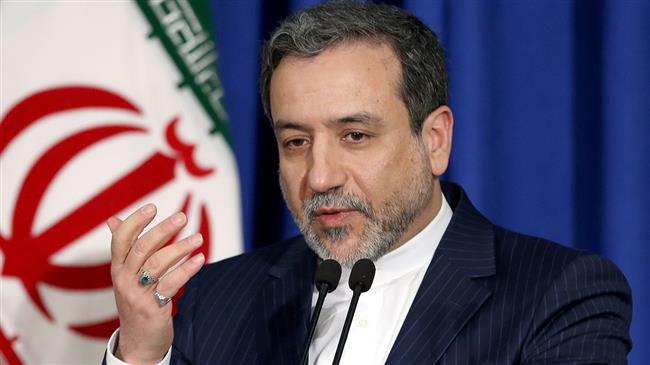
Iran’s Deputy Foreign Minister for Political Affairs Abbas Araqchi
Iran’s Deputy Foreign Minister for Political Affairs Abbas says the three European signatories to Iran nuclear deal, formally known as the Joint Comprehensive Plan of Action (JCPOA), cannot logically activate the deal’s dispute settlement mechanism, because Iran has already done that.
“We are now engaged in complicated legal discussions and Russia and China are of the same opinion. It was Iran that first resorted to Article 36 [of the JCPOA] and completed its application. Therefore, logically, legally and even politically speaking, the European countries cannot take advantage of this article, because we have already done that and applied its mechanism in full,” Araqchi said while addressing a meeting at the Iranian Foreign Ministry’s School of International Relation on Sunday.
On January 14, the three European signatories to the Iran deal — France, Britain and Germany — formally triggered the dispute mechanism, which accuses Iran of violating the agreement and could lead to the restoration of the anti-Iran UN sanctions that had been lifted by the JCPOA.
Under the mechanism outlined in the deal, the EU would also inform the other parties — Russia and China as well as Iran itself. There would then be 15 days to resolve the differences through the JCPOA Joint Commission. If no settlement is reached through the commission, the foreign ministers of involved countries will then discuss them for another 15 days. In case of need, an advisory board will be formed to help foreign ministers.
Elsewhere in his remarks, Iran’s deputy foreign minister said, the recent measure taken by three European countries is only aimed at dispute settlement and has nothing to do with restoration of UN sanctions against Tehran.
“The trigger mechanism, which may lead to restoration of the United Nations Security Council’s sanctions against Iran has not been started by the three countries,” Araqchi noted.
“They have only resorted to the dispute settlement mechanism as per Article 36 of the deal, while the trigger mechanism is enshrined in Article 37. Article 36 does not automatically lead to Article 37, though it can pave the way for its application,” the top Iranian diplomat added.
The US withdrew from the accord in 2018 and re-imposed its unilateral sanctions on Iran last May. Britain, France, and Germany, under Washington’s pressure, failed to protect Tehran’s business interests under the deal against the American bans.
This May, Iran began to gradually reduce its commitments under the JCPOA to both retaliate for Washington’s departure, and trigger the European trio to respect their obligations towards Tehran.
On January 5, Iran took a final step in reducing its commitments, and said it would no longer observe any operational limitations on its nuclear industry, whether concerning the capacity and level of uranium enrichment, the volume of stockpiled uranium or research and development.
Iranian Foreign Minister Mohammad Javad Zarif has denounced as a “strategic mistake” the European Union’s decision to activate the dispute mechanism, taking them to task for failing to abide by their commitments under the JCPOA, and saying that activating the dispute resolution mechanism is legally baseless and politically a strategic blunder.
Britain, France reiterate commitment to JCPOA
In another development on Sunday, British Prime Minister Boris Johnson and French President Emmanuel Macron reiterated their commitment to the Iran nuclear deal and agreed that “a long-term framework” was needed, a Downing Street spokeswoman said.
In a statement after a meeting between Johnson and Macron on the sidelines of a Libya summit in Berlin, the spokeswoman said, “On Iran, the leaders reiterated their commitment to the JCPOA.”
“They agreed on the importance of de-escalation and of working with international partners to find a diplomatic way through the current tensions,” he added.
January 19, 2020
Posted by aletho |
Aletho News | France, Sanctions against Iran, UK |
Leave a comment


 Aletho News