Iran to Review Cooperation with Int’l Nuclear Watchdog In Case of ‘Unjust’ Steps by EU – Reports
Sputnik – 19.01.2020
The European parties to the Iranian nuclear deal earlier launched a dispute resolution mechanism under the agreement, a process that could entail the re-imposition of sanctions on Iran.
Iran’s cooperation with the International Atomic Energy Agency will be reviewed if the EU nations take “unjust” measures after triggering the nuclear deal’s dispute mechanism, Iran’s parliamentary speaker was quoted by the local TV as saying.
“We state openly that if the European powers, for any reason, adopt an unfair approach in using the dispute mechanism, we will seriously reconsider our cooperation with the International Atomic Energy Agency”, a local broadcaster quoted Iranian Parliamentary Speaker Ali Larijani as saying.
On Tuesday, three of the signatories to the JCPOA, namely France, the UK, and Germany, confirmed that they had initiated a dispute mechanism that could see the sanctions against Iran reinstated. The move comes amid Iran’s gradual scale-back on its commitments under the deal, prompted by the US unilateral withdrawal from it in 2018.
Iran’s foreign minister previously condemned the three nations for dancing to the tune of the US. President Trump reportedly threatened the European nations with imposing tariffs on them for their lack of action against Tehran.
Iran recently scrapped its remaining limitations under the JCPOA following the assassination of its top military commander Qasem Soleimani in a US drone strike on 3 January. Tehran has been gradually reducing its commitments under the JCPOA since May 2019 following Washington’s unilateral pullout of the treaty one year earlier and imposition of energy and banking sanctions on the state.
Libyan leaders Sarraj & Haftar to hold talks in Moscow on Monday – Russian Foreign Ministry
RT | January 13, 2020
Libya’s two key political figures – Fayez al-Sarraj, the prime minister of the Government of National Accord (GNA), and Commander of the Libyan National Army (LNA) Khalifa Haftar will take part in talks held under the auspices of the Russian and Turkish Foreign and Defense Ministries in Moscow on Monday, the Russian Foreign Ministry told TASS.
“In [the] context of implementing the initiative of the Russian and Turkish presidents announced following a summit in Istanbul, inter-Libyan contacts will be held today in Moscow,” the diplomats said. “The contacts are expected to be attended by Sarraj, Haftar and representatives of other Libyan parties.”
Moscow will host talks between Russian Foreign Minister Sergey Lavrov and Defense Minister Sergey Shoigu with their Turkish counterparts, Mevlut Cavusoglu and Hulusi Akar. The main topics on the agenda are settlement in Libya, cooperation in Syria, and developments in the Middle East.
On January 12, a ceasefire entered into force between the conflicting sides in Libya.
Libya’s warring parties vow to observe ceasefire without preconditions, stop all offensive military actions – draft agreement
RT | January 13, 2020
The Libyan National Army (LNA) and the internationally recognized Government of National Accord (GNA) in Tripoli have pledged to observe the ceasefire suggested by Russia and Turkey after negotiations in Moscow.
The draft document suggests that all parties would stop military actions and observe the ceasefire conditions. Meanwhile, a commission is to be established to determine a contact line between the warring sides. Russia and Turkey promised to support all sides in the conflict to help them implement the agreement.
Libya has been plunged into chaos for years after its longtime ruler Muammar Gaddafi was ousted and killed during a NATO-led bombing campaign. Following the years of devastation and chaos, the country became engulfed in a civil war.
Previous lengthy UN-backed talks on reconciliation, which led to the establishment of the GNA, eventually failed to bring peace to the war-ravaged land.
Haftar began an offensive against Tripoli last year and over the last few months the two sides were engaged in intense fighting. LNA controls most of Libya’s territory, but it is the GNA which is recognized by the international community.
Ankara became involved in the conflict in December promising to send troops to help the government in Tripoli as the international community called on all sides to enter negotiations.
‘Human error at time of crisis caused by US adventurism led to disaster’: FM Zarif on Iran’s downing of Flight 752
RT | January 11, 2020
Iran’s Foreign Minister Javad Zarif has offered “profound regrets, apologies and condolences” over an unintentional downing of a Ukrainian civilian aircraft over Tehran, stating “human error” during a “crisis” led to the accident.
“A sad day,” the FM wrote on Twitter, adding “Preliminary conclusions of internal investigation by Armed Forces: Human error at time of crisis caused by US adventurism led to disaster. Our profound regrets, apologies and condolences to our people, to the families of all victims, and to other affected nations.”
The incident took place soon after an Iranian missile attack on American positions in Iraq, launched as a reprisal for a US kill strike on Qassem Soleimani, the commander of Iran’s elite Quds Force, seeing months of rising tensions between the two countries come to a head. All 176 passengers on board the airliner were killed in the crash.
Justice at Last? ‘Panic’ in Israel as the ICC Takes ‘Momentous Step’ in the Right Direction
By Ramzy Baroud | Palestine Chronicle | January 8, 2020
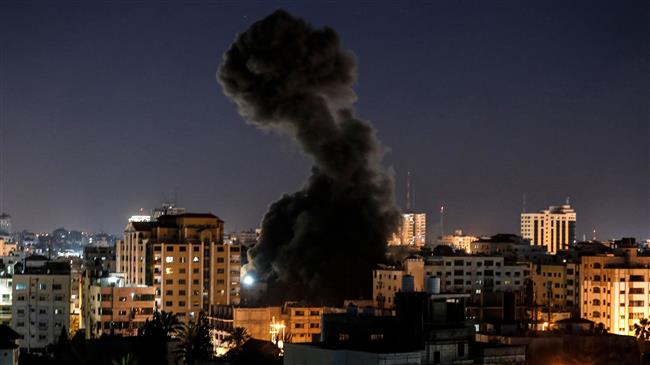
At long last, Fatou Bensouda, the Chief Prosecutor of the International Criminal Court (ICC) has uttered the long-anticipated conclusion that “all the statutory criteria under the Rome statute for the opening of an investigation (into alleged war crimes in the Occupied Palestinian Territories) have been met”.
Bensouda’s verdict has been in the making for a long time and should, frankly, have arrived much earlier. The ICC preliminary investigations into Israeli war crimes began back in 2015. Since then, many more such war crimes have been committed, while the international community persisted in its moral inertia.
The ICC statement, issued on December 20, asserted that the court saw “no substantial reasons to believe that an investigation would not serve the interests of justice”.
But can the “interest of justice” be served while the United States government continues to wield a massive stick, using its diplomatic, political and financial clout to ensure Israel emerges unscathed from its latest legal scuffle?
There is little doubt that Michael Lynk, the United Nations Special Rapporteur for the situation of human rights in the Palestinian territory, is absolutely right: A formal ICC criminal investigation into war crimes in Palestine is a “momentous step forward in the quest for accountability”.
He is also correct in his assessment, published in the United Nations Human Rights Officer of the High Commissioner website, that “accountability has, until now, been largely missing in action throughout the 52-year-old occupation.”
I would go even further and expand the timeline of the missing accountability to include the two decades prior to the Israeli occupation of East Jerusalem, the West Bank and the Gaza Strip. Otherwise, how is one to account for the ethnic cleansing of Palestine in 1947-48, the numerous massacres and other wanton killings that accompanied and followed those defining years, or the fact that Israel was never held accountable for its violations of international and humanitarian laws between 1948 and 1967?
That issue notwithstanding, the Palestinian Authority and all political parties in Palestine should exploit this unprecedented opportunity of holding Israel accountable.
As soon as the ICC issued its statement, news reports surfaced conveying a sense of “panic” in Israel. The Times of Israel reported that an Israeli government meeting to discuss the ICC decision was held shortly after, with the aim of considering a proper response, including the possibility of preventing ICC investigators from reaching Israel.
This is eerily familiar. Israel has denied entry to – or refused to cooperate with – international investigators and observers on many occasions in the past.
Following a UN planned investigation into alleged Israeli war crimes in the Palestinian refugee camp of Jenin in 2002, the Israeli government quickly moved, and, sadly, succeeded in blocking the investigation altogether.
It has done so time and again, often demonizing the very individuals entrusted with the mission of examining the illegality of Israel’s behavior in the context of international law. Well-respected judges and international law experts, such as Richard Goldstone, Richard Falk, and John Dugard, were vehemently attacked by Israeli officials and media and, by extension, by the US government and media as well.
Israel has managed to survive dozens of United Nations Resolutions and countless legal reports and indictments by the UN and all UN-affiliated organizations, largely because of blind and unequivocal American support, which has shielded Israeli war criminals from ever answering to their horrific actions in Palestine.
“Remember, it was (then-Secretary of State) Hillary Clinton who took pride in the fact that she personally killed the Goldstone Report,” said US author, Norman Finkelstein, in a recent interview with the news website Mondoweiss.
The Goldstone report was issued in the wake of the Israeli war on Gaza in 2009, dubbed ‘Operation Cast Lead’. The campaign of intimidation and pressure on Goldstone, personally, has forced the once-respected judge to retract his accusations of Israeli war crimes and the deliberate targeting of civilians.
While Clinton did her part in torpedoing the Goldstone Report, former US President, Barack Obama, according to Finkelstein, went to great lengths to “neutralize international law against settlements and other Israeli crimes in the occupied territories”.
Worse still, on September 14, 2016, Obama handed Israeli Prime Minister, Benjamin Netanyahu, himself accused of carrying out numerous war crimes against Palestinians, the largest US aid package to a foreign country in modern history, a whopping $38 billion over the course of ten years.
This is not a new phenomenon, where the US enables Israeli crimes and simultaneously shields Tel Aviv from any accountability for these crimes before the international community. All US administrations, whether Republican or Democrat, have honored the same sinister maxim, thus ensuring Israel, literally, gets away with murder.
A particular case in point was in 2001, when 28 Palestinian and Lebanese survivors of the 1982 Sabra and Shatila massacre attempted to try, in a Belgian court, late Israeli leader and accused war criminal, Ariel Sharon. Intense American pressures and a brazen intimidation campaign, targeting the Belgian government and the judicial system, resulted in the dismissal of the case in 2003. To deny Israel’s victims the opportunity to seek justice everywhere in the country, Belgium revised its very law, to the satisfaction of Israel and the United States.
The high level of the ICC investigations places the legal push against Israel at a whole new level. This is uncharted territory for Israel, the United States, Palestine, the ICC and the international community as a whole. There is little doubt that some joint Israeli-American effort is already underway to develop strategies aimed at countering if not altogether dismissing, the ICC investigation.
It is clear that justice for Palestinians in the face of Israeli aggression, itself fueled by unconditional American support, is not at all possible if it is not accompanied by regional and international unity, and a clear and decisive decision by all parties concerned that Israel, once and for all, must pay for its military occupation, racist apartheid laws, protracted siege on Gaza, and the many massacres in between.
Without this kind of international will, the ICC investigation could become another sad case of justice denied, a non-acceptable option for any justice-seeking individual, organization, and government anywhere in the world.
– Ramzy Baroud is a journalist and the Editor of The Palestine Chronicle. He is the author of five books. His latest is “These Chains Will Be Broken: Palestinian Stories of Struggle and Defiance in Israeli Prisons” (Clarity Press, Atlanta). Dr. Baroud is a Non-resident Senior Research Fellow at the Center for Islam and Global Affairs (CIGA), Istanbul Zaim University (IZU).
Iran didn’t want to kill US troops with its strike, it wanted to make point to Trump about its missile tech & resolve. It did that.
By Scott Ritter | RT | January 8, 2020
Iran’s anticipated retaliation for the US assassination of Qassem Suleimani sent a clear signal to Donald Trump that while the current round of violence may be over, Iran stands ready to respond to any future US provocation.
Tehran warned Iraq to spare US soldiers
On Tuesday night, the Iranian nation buried the body of Qassem Soleimani, the charismatic senior Islamic Revolutionary Guard Corps (IRGC) officer assassinated by the US this past week. In the early hours of Wednesday morning, that task completed, Soleimani’s IRGC comrades, acting on the orders of Iran’s Supreme Leader, Ali Khamenei, launched some 22 ballistic missiles from Iranian territory into neighboring Iraq, targeting the huge US air base Al Asad, in western Iraq, and the US consulate in the city of Erbil, in Iraqi Kurdistan.
In the hours following the announcement of these attacks, which were broadcast on Iranian television for the Iranian people, the world held its breath, waiting for the results. Shortly after the missiles were launched, Iran signaled its desire for a diplomatic resolution to the crisis through a tweet sent out by its Foreign Minister, Javad Zarif, who described the attacks as “proportionate measures in self-defense under Article 51 of UN Charter.” Zarif concluded by noting that “We do not seek escalation or war, but will defend ourselves against any aggression.”
The ultimate decision to deescalate, however, was not Iran’s to make. War is not a one-way street, and the enemy always gets a vote. However, in launching its missile attack on US targets in Iraq, Iran appeared to go out of its way to signal that it considered the matter of retaliation for the assassination of Soleimani closed. First and foremost, Iran communicated its intent to strike US targets in Iraq directly to the Iraqi Prime Minister a full two hours prior to the missiles being launched; Iraq then shared this information with US military commanders, who were able to ensure all US troops were in hardened shelters at the time of the attack.
Showing off its new-gen ballistic missiles
But the most important aspect of Iran’s actions was the way its missiles were targeted. For years now, Iran has made significant strides in terms of the reliability, range and accuracy of its ballistic missile force. Gone are the days when Iran’s arsenal consisted solely of inaccurate Soviet-era SCUD missiles.
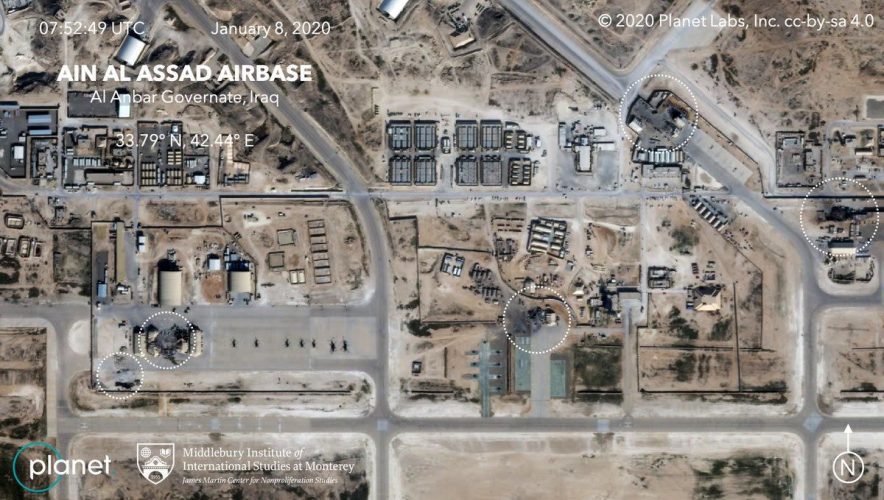
The missile attack on the US incorporated new, advanced missiles—the Qaim 1 and Fahad-110—possessing advanced guidance and control capable of pinpoint precision. Iran had used these weapons previously, striking targets inside Syria affiliated with the Islamic State. But this was the first time these weapons had been used against the US. From the US perspective, the results were sobering. The Iranian missile attacks resulted in no casualties among US, Iraqi or coalition forces stationed in either Al Asad or Erbil. But the lack of lethality, however, is actually Tehran’s way of proving the accuracy of its ballistic missiles.
Commercial satellite images of the Al Asad air base taken after the attack show that the Iranian missiles struck buildings containing equipment with a precision previously only thought possible by advanced powers such as the US, NATO, Russia and China. Iran fired 17 missiles at Al Asad, and 15 hit their targets (two missiles failed to detonate).
Iran also fired five additional missiles at the US consulate in Erbil; US commanders on the ground said that it appeared Iran deliberately avoided striking the consulate, but in doing so sent a clear signal that had it wanted, the consulate would have been destroyed.
Trump had to back down
This was the reality that President Trump had to wrestle with when addressing the American people regarding the state of hostilities between the US and Iran.
Trump had previously promised a massive retaliation should Iran attack any US personnel or facilities. Surrounded by his national security team, Trump had to back down from that threat, knowing full well that if he were to attack Iran, the Iranian response would be devastating for both the US and its regional allies, including Israel, Saudi Arabia and the UAE. The US might be able to inflict unimaginable devastation on Iran, but the cost paid would be unacceptably high.
Trump’s rhetoric was aggressive, however, and his message made it clear that the US still considered Iran to be a rogue state whose pursuit of nuclear technology, ballistic missiles, and regional dominance would be opposed by the US, with force if necessary. But the Iranian missile attack drove home the new reality that, when it came to Iran’s actions in the Persian Gulf, American Presidential rhetoric no longer held sway as it once did.
Ali Khamenei, the Iranian Supreme Leader, drove this point home in a series of tweets claiming to have “slapped” the US in the face for its assassination of Soleimani, emphasizing that the policies pursued by Soleimani seeking the withdrawal of the US from the Persian Gulf region were becoming a reality, citing the recent vote by the Iraqi parliament to evict all foreign troops, including those of the US, from its soil.
President Trump, in his address to the American people, certainly talked the talk when it came to articulating a strong anti-Iranian policy. The real question is whether Trump and the American people are prepared to walk the walk, especially in a world where Iranian missiles are capable of dealing death and destruction on a scope and scale previously unimaginable.
Scott Ritter is a former US Marine Corps intelligence officer. He served in the Soviet Union as an inspector implementing the INF Treaty, in General Schwarzkopf’s staff during the Gulf War, and from 1991-1998 as a UN weapons inspector.
Russia Proposes To Secure Iraqi Airspace With S-400 Air Defense
By Tyler Durden – Zero Hedge – 01/07/2020
The Ministry of Defense of the Russian Federation has offered Iraq Tuesday the option to purchase the world’s most advanced missile defense system to protect its airspace, reported RIA Novosti.
According to the report, the Iraqi Armed Forces could purchase the Russian S-400 Triumf air defense system, which RIA points out, can “ensure the country’s sovereignty and reliable airspace protection.”
“Iraq is a partner of Russia in the field of military-technical cooperation, and the Russian Federation can supply the necessary funds to ensure the sovereignty of the country and reliable protection of airspace, including the supply of S-400 missiles and other components of the air defense system, such as Buk-M3, Tor -M2 “and so on,” said Igor Korotchenko, Russian Defense Ministry’s Public Council member.
For the last several months, Iraq has considered purchasing Russian air defense and missile systems, including the S-400, however, it has been met with fierce pressure from the US.
But with a political crisis between the US and Iraq underway, thanks partly to the US assassination of Iran’s Maj. Gen. Qassem Soleimani, Russia could profit as Iraq attempts to decouple from the US.
A recent U.S. intelligence assessment indicated that at least 13 countries had expressed interest in purchasing the S-400s.
Saudi Arabia, Qatar, Algeria, Morocco, Egypt, Vietnam, and Iraq have all be in discussions with Russia to purchase the missile defense system in the last several quarters.
Meanwhile, China, India, and Turkey have already signed agreements with Russia.
The S-400s can strike stealth bombers, aircraft, cruise missiles, precision-guided projectiles, and ballistic missiles, some military experts have even said the Russian missile defense system is far superior than the US’ MIM-104 Patriot.
US denies Iran’s FM Zarif visa to address Security Council in violation of UN treaty – reports
RT | January 7, 2020
Washington has reportedly refused to issue a visa to Iran’s Foreign Minister Mohammad Javad Zarif, even though, as the host of the United Nations headquarters, the US is obliged to allow foreign officials into the country.
According to multiple diplomatic sources, the visa request was filed several weeks ago, before the latest escalation, and would give the top Iranian diplomat a stage to speak out following last Thursday’s drone strike assassination of Islamic Revolutionary Guard Corps (IRGC) commander Qassem Soleimani, along with senior Iraqi militia leaders.
The murder of Soleimani, who played a key role in the fight against Islamic State (IS, formerly ISIS) terrorists in Syria and Iraq, has drawn outrage across Iran and Iraq, with Tehran vowing to avenge the assassination, which it called “an act of international terrorism.” Washington, meanwhile, insists that Soleimani was the mastermind behind a spate of attacks on American personnel, including at the US Embassy, and says he was plotting new assaults.
This wouldn’t be the first time Washington abused its status as the host of the UN headquarters, refusing to issue visas for nearly a dozen members of the Russian delegation to a summit in New York last year.
Enrichment based on technical needs: Iran rolls back on 2015 nuclear deal
RT | January 5, 2020
Tehran has removed the last constraints it agreed to impose on its nuclear program under the 2015 deal but said it is ready to return to fulfilling its obligations under the agreement if the US lifts sanctions.
Iran’s nuclear program “no longer faces any operating restrictions,” a government statement cited by Iranian media said, adding that parameters of enrichment capacity, enrichment level and the amount of enriched material would from now on be determined only by the program’s “technical needs.”
Tehran still vowed to continue its cooperation with the International Atomic Energy Agency (IAEA) and said that it could potentially return to fulfilling its obligations under the nuclear deal if sanctions imposed by Washington are lifted and Tehran’s interests are respected.
Mexico orders ambassador in Bolivia to return after she declared non grata
Press TV – December 30, 2019
Mexico has ordered its ambassador in Bolivia to return to the country in order to ensure her safety.
The Mexican Foreign Ministry said on Monday that the order was issued after Bolivia declared Mexico’s Ambassador Maria Teresa Mercado a “persona non grata.”
Bolivia’s interim leader Jeanine Anez announced Monday that the country has decided to expel Mexico’s ambassador and two Spanish diplomats.
“The constitutional government that I preside over has decided to declare persona non grata the ambassador of Mexico in Bolivia, Maria Teresa Mercado, the charge d’affaires of Spain, Cristina Borreguero, and the (Spanish) consul, Alvaro Fernandez,” Anez said.
The announcement came after Bolivia accused Spanish embassy staff of trying to infiltrate the Mexican mission in the Bolivian capital, La Paz, with a group of masked men to take out former Bolivian president Evo Morales’s aide.
Madrid has strongly denied the accusation.
“The ministry wishes to clarify that the charge d’affaires was purely making a courtesy visit and vehemently denies there was any aim to facilitate the exit of people holed up inside the building,” Spain’s Foreign Ministry said in a statement.
The Mexican embassy in La Paz has become the center of the diplomatic row after it housed nine officials from Morales’s former government.
On Thursday, Mexico said the Bolivian regime is “harassing” and “intimidating” its diplomatic personnel in La Paz in what seems to be retribution for the granting of asylum by Mexico to Morales.
Mexico City said Bolivia has, among other things, boosted police presence outside the Mexican diplomatic mission in La Paz since Monday, intimidating the diplomats.
Last month, Mexican President Andres Manuel Lopez Obrador gave political asylum to Morales, who had been forced to resign under pressure from the country’s military.
Morales has since relocated to Argentina.
Morales, who had already been president since 2006, won his country’s presidential election in October, but the Bolivian military and opposition claimed that the election had been rigged, inciting deadly street protests.
The 60-year-old president, who enjoys a broad popular base both at home and in Latin America, nevertheless decided to step down and go into exile in Mexico amid threats of violence against him and with an apparent intention not to push the country toward further instability.
New Year’s swap: Dozens head home as Ukraine & breakaway Donbass conduct ‘all for all’ prisoner exchange
RT | December 29, 2019
Kiev is exchanging dozens of prisoners with the self-proclaimed Donetsk and Lugansk republics in the first such effort in two years. The swap was given a boost at the recent Normandy Four talks in Paris.
The self-declared Donetsk People’s Republic has handed over 51 people to Kiev, while receiving 61 of their followers. The Lugansk region returned 25 and took in 63 prisoners; nine people held by Kiev refused to partake in the exchange.
The office of Ukrainian President Volodymyr Zelensky confirmed that Kiev had received a total of 76 people from Donetsk and Lugansk.
Donetsk’s authorities said their list could be longer, as some people asked to be repatriated shortly before the exchange.
The swap, carried out under an “all for all” formula, was the first since a similar humanitarian effort in December 2017.
The prisoner exchange was overseen by officials from the International Committee of the Red Cross (ICRC) and the Organization for Security and Cooperation in Europe (OSCE). No ceasefire violations were recorded on the frontier.
It also comes weeks after leaders from France, Germany, Russia, and Ukraine agreed at a peace summit in Paris to push for a full ceasefire and a new troop disengagement by March 2020.
The summit was the first of its kind in three years, also marking the first time Russian President Vladimir Putin talked reconciliation with his Ukrainian counterpart, Volodymyr Zelensky.
Before the summit, Kiev and the rebel forces ordered a partial pullback in several areas of the frontline. However, several Ukrainian nationalist organizations stood up against Zelensky’s policies, even deploying their own armed groups to prevent the government from withdrawing their soldiers.
More Holocaust Reparations for 2020: the Gift That Keeps on Giving
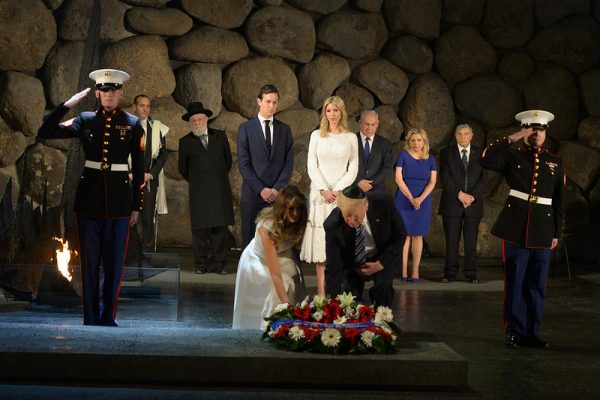
Yad Vashem – Benjamin and Sara Netanyahu, Donald Trump and Melania, Ivanka and Jared Kushner, Rabbi Yisrael lau. credit: Amos Ben Gershom GPO/ Israel Ministry of Foreign Affairs/ Flickr)
By Philip Giraldi • American Herald Tribune • December 29, 2019
Now that 2019 has ended, it is more than seventy-four years since the end of the Second World War. America’s “Greatest Generation” that actually fought the war and endured it on the home front, is dying off and the remembrance of the conflict is increasingly experienced second hand, if at all. The war has been relegated to the history books, one might think, but that would be to ignore one aspect of it which seems to never fade from sight. That would be the so-called holocaust, which has produced a host of taxpayer funded museums, is regularly featured in the media and also is part of mandatory public education in a growing number of states and school districts.
That the established holocaust narrative lives on in spite of its irrelevancy and obvious contradictions is a reflection of Jewish power in the United States. Since the 1970s, when the regular evocations of the holocaust began in earnest, Jews have come to wield considerable influence in American economic, cultural, intellectual and political life. Jews played a central role in American finance during the 1980s, and they were among the chief beneficiaries of that decade’s corporate mergers and reorganizations. Today, though barely two percent of the nation’s population is Jewish, close to half its billionaires are Jews. The chief executive officers of the three major television networks and the four largest film studios are Jews, as are the owners of the nation’s largest newspaper chain and the most influential single newspaper, The New York Times. The role and influence of Jews in American politics has also developed simultaneously, with Jews heavily over-represented in the Democratic Party and in Congress.
The rise to power on the part of American Jews coincided with the trajectory of Israel in the Middle East. Protecting Israel and Jewish privilege became two sides of the same coin, leading to creation of the holocaust narrative, which Professor Norman Finkelstein has aptly described as The Holocaust Industry. And promotion of the sanctity of the holocaust story has enabled the damnation of skeptics as holocaust-deniers while also increasing the exploitation of the charge of anti-Semitism for those who would dare to criticize either the Jewish tribe itself or Israel.
One of the singular manifestations of the Jewish power in both the U.S. and in Europe has been the creation of mechanisms to address the perceived needs of “holocaust survivors.” One might argue reasonably enough that there cannot be actually that many genuine survivors remaining after 74 years, but the term has proven to be extremely elastic. It has come to include not only the actual victims who were allegedly sent to labor or concentration camps but also any Jew who survived 1939 through 1945 in Europe or even in Asia living in ghettos. And it also includes their children, even if born after the war.

Stuart E. Eizenstat, former Special Representative of the President and Secretary of State on Holocaust-Era Issues. Credit: U.S. National Archives/ Flickr
As a result, the so-called holocaust survivors are now well into their second generation, receiving extra Social Security and Medicare benefits in the United States as well as a steady flow of reparations from Germany and other Europeans, to include France, where forty-nine people who made it out of the Holocaust alive are receiving around $400,000 each, helped by the State Department’s expert on holocaust issues Stuart Eizenstat. The U.S. State Department even has a Holocaust Deportation Claims Program which is always staffed by Jews like Eizenstat.
The reparations programs are generally structured in a way that the payments are limited to Jews, even though there were millions more non-Jews who were victims of the German camps and prisons. Recently there have even been claims that the traumatic holocaust experience might have caused genetic damage, meaning that the need to address the issue by extorting money from the German and other governments will conceivably extend into the foreseeable future.
When in doubt about where to find the money, it is only necessary to get in touch with a professional Zionist Zealot like Eizenstat or with one of the commercial firms that is into the holocaust reparations business. The International Center for Holocaust Reparations is one of them, a corporation registered in Israel with offices located in Jerusalem, Berlin and in Pompano Beach Florida. It was founded by Israeli Zachi Porath and the actual incorporation is in his name as Zachi Porath Ltd.
The organization website headlines that it is “Pursuing Rights of Holocaust Survivors.” It is indeed doing so in a manner of speaking, but it is also a business that makes money by taking a cut of what it obtains. Its website asks what it considers to be key screening questions: “Are you a Holocaust survivor who was interned in a Ghetto?” and “Are you a child of a Holocaust survivor who was interned in a Ghetto?” before getting to the crux of the matter, “You may be entitled to a large sum of money! Even if you are already receiving compensation from the Claims Conference or from the German authorities, including the German Pension Insurance you may be eligible to receive additional payments.”
According to the website “The pension is paid even to those who were interned for a short period of time in a Ghetto (including Ghettos in Poland, Romania, Czernowitz, Shanghai, Sofia, Thessaloniki, Transnistria, Amsterdam, Lithuania, Latvia and Belarus and many more). The possibilities are for a one-time retroactive compensation, as well as a monthly payment from the German Social Security… If you are an heir of a ghetto survivor, and the survivor or their spouse was alive on June 27th 2002, you may be entitled to a one-time payment… We will help you to file the claims for all the money you justly deserve… After you have received the restitution payment, we will charge a fee of 15% of the retroactive sum.”
The website also advises that even second-generation survivors whose parents were interned in a ghetto somewhere for even a short time “may be entitled to a one-time compensation payment… We have been aiding Holocaust survivors all over the world in exercising their rights and have successfully helped many survivors attain their rightful money.”
Some might object to the assertion that Jewish suffering in the war was somehow unique given the fact that far more Russians died than Jews. But the difference is one of perception, due to the effective marketing of a preferred narrative by a powerful and wealthy group that has easy access to the media, to the entertainment industry and to policy makers. And one should not be dismissive of the hard work that has gone into making holocaust reparations eternal. It takes a great deal of ingenuity to devise mechanisms that separate German, French and American taxpayers from their money in perpetuity on behalf of numerous people concentrated apparently in Israel and Florida who may not have suffered at all in the Second World War.
Featured Video

The Truth About the Trump Shootings with Ken Silva
or go to
Aletho News Archives – Video-Images
From the Archives
The Geopolitics behind the War in Yemen (I)
By Mahdi Darius NAZEMROAYA | Strategic Culture Foundation | 30.03.2015
The United States and the Kingdom of Saudi Arabia became very uneasy when the Yemenese or Yemenite movement of the Houthi or Ansarallah (meaning the supporters of God in Arabic) gained control of Yemen’s capital, Sanaa/Sana, in September 2014. The US-supported Yemenite President Abd-Rabbuh Manṣour Al-Hadi was humiliatingly forced to share power with the Houthis and the coalition of northern Yemenese tribes that had helped them enter Sana. Al-Hadi declared that negotiations for a Yemeni national unity government would take place and his allies the US and Saudi Arabia tried to use a new national dialogue and mediated talks to co-opt and pacify the Houthis.
The truth has been turned on its head about the war in Yemen. The war and ousting of President Abd-Rabbuh Manṣour Al-Hadi in Yemen are not the results of «Houthi coup» in Yemen. It is the opposite. Al-Hadi was ousted, because with Saudi and US support he tried to backtrack on the power sharing agreements he had made and return Yemen to authoritarian rule. The ousting of President Al-Hadi by the Houthis and their political allies was an unexpected reaction to the takeover Al-Hadi was planning with Washington and the House of Saudi. … continue
Blog Roll
 Aletho News
- IRGC air defenses destroy another US MQ-1 drone over Strait of Hormuz
- Imran Khan’s entire immediate family detained in Pakistan ahead of mass protest demanding his release
- EU nation detains former presidential frontrunner
- Leaked: Britain’s Sham Conviction Of Hashim Thaci
- Seyed M. Marandi: U.S. Strike Imminent – Toward Total War in the Middle East
- Russia Voted Under Fire. Washington Is Loading the Tankers.
- 12 Things Your Oncologist Was Trained Not to Tell You
- Anthrax Attacks Paved Way for COVID-Era ‘Junk Drugs and Vaccines’
- How Real Is the Impact of Western Sanctions on Israel?
- France, You Are Guilty: How Paris Turned Western Sahara into the Maghreb’s Powder Keg
- If Americans Knew
- Singer Ed Sheeran says his ‘heart broken’ by Gaza devastation, addresses Macklemore controversy
- Israel Has Imprisoned Female Journalist Bushra Al-Tawil Without Trial Or Charge In Solitary Confinement For Past Month
- Israel poised to teach West Bank a lesson after one Israeli killed – Daily Update
- Salah Sarsour’s Legal Team Says DHS Has Not Met Its Burden to Prove He Is Deportable
- An analysis of tax forms by The Intercept show Kraft’s charity and LLC have donated to Friends of the IDF and AIPAC’s super PAC.
- Israeli attacks kill four Palestinians in Gaza – Daily Update
- Inside Gaza’s death trap of collapsing, bombed-out buildings
- The everyday items Israel bans from Gaza every day
- Inside the siege, the ruined buildings of Gaza – Daily Update
- Debunking The Claim That Macklemore Has A “History Of Antisemitism”
- No Tricks Zone
- 2025 Nature Paper Claiming Worsening Global Drought Gets RETRACTED …Heavily Flawed
- New Study: ‘Global Drought Shows No Detectable Recent Acceleration Under Climate Warming’
- Economic Masterminds: German Socialists Suggest Taxing Productivity Gains Stemming From Using AI
- The South China Sea Has Not Been Cooperating With The Climate Change Narrative
- Energy Crisis: Germany Enters Heating Season With Historically Low Gas Reserve Fill Levels
- New Study: The Antarctic Ice Sheet Gained Mass From 2020-2024 Due To Staggering Snow And Ice Accumulation
- Study: Ocean Heating Rates From Thousands Of Years Ago ‘Dwarf’ Modern Ocean Heating Rates
- Climate Extremists Target, Attack Large-Scale Power Grid Infrastructure In Germany!
- New Study: Antarctic Ice Melt Has Contributed Less Than 1 Centimeter To Sea Level Rise In The Last 30 Years
- Fear Of Debate: Alarmist German Climate Scientist Calls On Mainstream Media To Discredit Skeptic Voices
 Aletho News