Russia says extension of UN arms embargo on Iran out of question
Press TV – December 27, 2019
Russian Deputy Foreign Minister Sergei Ryabkov has ruled out the possibility of renewing a UN arms embargo against Iran which is to expire in October 2020 in line with the 2015 nuclear deal between Tehran and world powers.
Speaking to the Russian news agency Interfax, Ryabkov said restrictions on Iran’s import and export of arms will expire next year as per the Joint Comprehensive Plan of Action (JCPOA) and it is not possible to renew them.
The US officials’ calls for extension of the embargo are considered as a foreign policy move that has no basis and principle, Ryabkov noted, highlighting that the removal of the embargo is based on the JCPOA, signed by several parties including the US and endorsed by the UN Security Council Resolution 2231.
The Russian official said Moscow is not going to bow to the US demands whenever they want. “They may come up with something else next time.”
Under the nuclear deal, from which the US unilaterally withdrew last year, a UN ban on weapons sales to Tehran will end in October 2020.
Last month, President Hassan Rouhani said Iran intends to stay in the nuclear deal despite the US violations, arguing that the accord will be put to good use next year when a long-running arms embargo against Tehran comes to an end.
“By continuing the JCPOA, we will fulfill a major objective in terms of politics, security and defense,” he said.
Noting that for years Iran has been banned by the United Nations from buying and selling any kinds of weapons, Rouhani said the arms embargo will end next year according to the deal and the UN Security Council Resolution 2231, which endorses it.
“This is one of the important effects of this deal. Otherwise, we could leave the deal today but the kind of benefit we stand to reap next year will no longer exist,” he said.
As the expiration date gets closer, the White House is getting more nervous and American authorities are doing their utmost to make the restrictions permanent.
Last October, US special envoy to Iran Brian Hook told a congressional hearing on US-Iran policy that Washington wanted the UN Security Council to renew the Iranian arms embargo.
One of the issues used by the United States to withdraw from the nuclear deal between Iran and the P5+1 countries was the time span of the UN arms embargo on Iran. The measure covers all weapons sales and “related material” to Iran.
Earlier in August, US Secretary of State Mike Pompeo expressed concern that the resolution restricting weapons sales to Iran is due to end in October 2020.
Iran’s Ambassador to the UN Majid Takht Ravanchi responded to Pompeo’s comments and slammed the United States for causing insecurity and instability with its military presence and “unbridled flow of American weaponry into this region, which has turned it into a powder keg.”
Thousands of Russia immigrants to Israel left again after getting passports
MEMO | December 19, 2019
Thousands of immigrants to Israel from the former Soviet Union “may have come only to receive an Israeli passport before moving back abroad”, reported JTA, with the total such cases amounting to up to a quarter of all Russian immigrants.
The article, citing reporting done by Israeli weekly newspaper Makor Rishon, described how “a cottage industry of companies promising expedited Israeli citizenship, and the passport that comes with it” emerged in Russia, “since the passage of a law allowing new immigrants to receive the travel document within the first three months of [moving to Israel]”.
According to the report, “for many in the post-Soviet world, an Israeli passport is considered as desirable as a European Union passport is to Israelis.”
Now, Russian “fixers” are advertising that they can help those able to emigrate to Israel to obtain Israeli citizenship “within two days” for “a cost of thousands of euros”.
JTA added that, according to Makor Rishon,
Under certain circumstances… the three-month period can be shortened to as little as a day, and some immigrants have even been able to receive their passports without having to leave Ben Gurion International Airport.
Based on data from Israel’s Ministry of Immigrant Absorption, it is estimated that approximately 8,500 immigrants from the former Soviet Union “have come just for the passport before immediately leaving the country”.
One official from the Jewish Agency suggested that as many as 25 per cent of the immigrants came for a passport and “left the country immediately after receiving it”.
In 2018, roughly 10,500 Russians and 6,400 Ukrainians emigrated to Israel, “which was the first year that the majority of new immigrants were not considered Jewish under…Jewish religious law”.
‘US State Department to cut Iraq-based personnel by third’
Press TV – December 18, 2019
The US State Department reportedly plans to significantly and permanently draw down the number of its personnel in Iraq.
CNN reported Wednesday that it had obtained a memo sent in early December by the State Department to the Senate Foreign Relations Committee, outlining the plan to cut the number of its Iraq-based staffers by 28% by the end of May 2020.
The reduction would mean 114 fewer people at the US Embassy in Baghdad, 15 fewer people at the Baghdad Diplomatic Support Center, and eight fewer people at Consulate General in Erbil, the capital of Iraq’s semi-autonomous Kurdistan region, the report said.
The cuts would also include Defense Department and US Agency for International Development personnel, the report added.
The diplomatic mission, the memo said, would still be able to achieve its “core objectives” despite the drawdown.
The reported plan comes amid ongoing US attempts to accuse Iran of trying to target its interests in the Arab country.
Back in May, the State Department, in a travel advisory, ordered “non-emergency US government employees” to leave the Baghdad embassy and the consulate in Erbil.
The advisory did not mention Iran, but senior State Department officials said at the time that the cautionary note had been issued because of an “imminent threat” from Iranian “proxies.”
Rejecting the claims back then, Iran’s Permanent Mission to the United Nations said that Washington’s measure was “the latest episode in America’s propaganda war against Iran based on fake intelligence reports.”
Most recently, US Secretary of State Mike Pompeo threatened Iran with “decisive” action, accusing it of providing “lethal aid and support to third parties in Iraq and throughout the region.”
The claims come as several rocket attacks have been reported on Iraqi bases hosting US troops as well as foreign missions in Baghdad, which has been, along with other Iraqi cities, the scene of street protests over economic woes since October.
Ali Rabiei, spokesman for the Iranian administration, responded to the threat on Monday, noting that Pompeo had failed to substantiate his allegations with any evidence.
He stated that it was only natural for American facilities to come under attack at a time when Iraq is witnessing protests and when the whole Arab country is facing ambiguity caused by the US interference.
Saudi Arabia reads the riot act to Imran Khan
By M. K. BHADRAKUMAR | Indian Punchline | December 17, 2019
The Kuala Lumpur Summit 2019 hosted by Prime Minister Mahathir Mohamad in the Malaysian capital Kuala Lumpur on December 18-21 was originally conceived as a landmark event in the politics of the Muslim world. It still is, albeit on a wet wicket struggling to tackle a nasty googly that Pakistan Prime Minister Imran Khan threw at the event at the last minute.
To recap, the idea of the KL Summit was born out of a trilateral pow-vow between Turkish President Recep Erdogan, Malaysian Prime Minister Mahathir Mohammed and Pakistan’s Imran Khan in September on the sidelines of the UN GA session in New York.
The common perception of the three countries was that the Muslim World failed to react forcefully enough to the emergent situation affecting the Kashmiri Muslims. Pakistan actively promoted the perception that the leadership of the ummah was not reacting forcefully enough over Muslim issues such as Kashmir.
On November 23, while announcing his decision to host the KL Summit, Mahathir said that the new platform hoped to bring together Islamic leaders, scholars and clerics who would propose solutions to the many problems facing the world’s 1.7 billion Muslims. He disclosed that dignitaries attending the KL Summit would include Erdogan, the Qatari Emir Sheikh Tamim bin Hamad al-Thani, and Imran Khan.
The role of politics in development, food security, preserving national identity, and redistributing wealth were listed as other topics to be discussed, alongside the expulsion of Muslims from their homelands and the categorisation of Islam as the “religion of terrorism”.
In poignant remarks, Mahathir bemoaned that no Muslim country was fully developed, and that some Islamic nations were “failed states”. He said,
“Why is there this problem? There must be a reason behind this. We can only know the reason if we get the thinkers, the scholars, and the leaders to give their observations and viewpoints.
“Perhaps we can take that first step … to help Muslims recover their past glories, or at least to help them avoid the kind of humiliation and oppression that we see around the world today.”
Importantly, Mahathir described the summit as a meeting of minds that had the “same perception of Islam and the problems faced by the Muslims”.
From among the list of invitees, it now turns out that Iranian President Hassan Rouhani will be attending tomorrow’s summit, but King Salman of Saudi Arabia has regretted that the Organisation of Islamic Conference (OIC) is being bypassed.
Mahathir disclosed that King Salman conveyed to him in a phone conversation that it was better that the Muslim issues were discussed in a full-fledged OIC meeting. Mahathir said laconically,
“He (King Salman) wanted to tell me the reasons why he couldn’t make it. He’s afraid that something not good will happen to the Muslims. He has a different opinion from us. He feels that matters like these (Muslim issues) shouldn’t just be discussed by two or three countries, and there should be an OIC meeting and I agreed with him.”
The testy exchange signalled that the Saudi regime sees the KL Summit as a calculated challenge to its leadership of the ummah and as an initiative about laying the foundations for an Islamic alliance.
Mahathir is outspoken but what is less noticed is that his positions actually align closely with those of Turkey and Pakistan. These include the Palestinian question, the situation in Jammu & Kashmir and the persecution of the Rohingya community in Myanmar.
According to the Malaysian news agency Bernama, the KL Summit “aims to revive Islamic civilization, deliberate (over) and find new and workable solutions for problems afflicting the Muslim world, contribute (to) the improvement of the state of affairs among Muslims and Muslim nations, and form a global network between Islamic leaders, intellectuals, scholars, and thinkers.”
In sheer brain power, Saudi Arabia cannot match such an agenda. A sense of frustration has been building up over the past decade or so among the Muslim countries that the OIC is reduced to an appendage of the Saudi foreign policies. Saudi Arabia’s rift with Qatar, its rivalries with Iran, the brutal war in Yemen, the killing of Jamal Khashoggi, etc. also seriously dented Riyadh’s image in the most recent years.
Of course, Saudis hold a big purse and that still translates as influence but the new Islamic forum is poised to move in a direction that is progressive and far more inspiring, with plans to pursue joint projects, including, eventually, the introduction of a common currency.
Mahathir is on record that this mini-Islamic conference could turn into a much grander initiative down the road. Such optimism cannot be disregarded since a growing number of Muslim-majority countries harbour great unease over the near-term prospect of the ascendancy of Crown Prince Mohammed bin Salman as the Saudi king and the next Custodian of the Two Holy Mosques.
Saudi Arabia, anticipating the gambit being thrown down by Mahathir has reacted viciously to undercut the KL Summit. It tore into the summit’s ‘soft underbelly’ by reading the riot act to Imran Khan, which put the fear of god into Imran Khan and how it happened we do not know, but the great cricketer panicked and has since called Mahathir to regret that he cannot attend the KL Summit.
No doubt, it is a big insult to Mahathir’s personal prestige but as the old adage says, beggars cannot be choosers and Imran Khan is left with no choice but to obey the Saudi diktat like a vassal.
With Imran Khan staying away, Mahathir is left to host his counterparts from Turkey, Iran, Qatar and Indonesia. The fizz has gone out of the KL Summit. Nonetheless, Mahathir is not the type of person to forget and forgive. His initial reaction to Imran Khan’s cowardly behaviour shows studied indifference, betraying his sense of hurt.
Pakistan is ultimately the loser here, as its credibility has been seriously dented. Imran Khan was the original promoter of the idea of the three-way axis of Turkey-Pakistan-Malaysia. But to be fair, his modest agenda was to create an exclusive India-baiting regional forum that he can use at will, whereas Mahathir turned it into an unprecedented Islamic forum that is independent of Saudi influence. Perhaps, Mahathir can only blame himself for the overreach.
Russia, China Submit UN Resolution to Lift Sanctions on North Korea
Sputnik – December 16, 2019
Russia and China have submitted a draft resolution to the UN Security Council to lift sanctions on North Korea and promptly resume the ‘six-party’ talks, according to the text of the document.
The resolution proposes to exempt the inter-Korean rail and road cooperation from UN sanctions and lift all measures previously imposed by the UN Security Council directly related to civilian livelihood, among others.
The draft resolution also “calls for prompt resumption of the six-party talks or re-launch of multilateral consultations in any other similar format, with the goal of facilitating a peaceful and comprehensive solution through dialogue, reducing tensions on the Korean Peninsula and beyond, and promoting peaceful co-existence and mutually beneficial regional cooperation in North-East Asia”.
North Korea has been subject to numerous UN sanctions since 2006 for its nuclear and ballistic missile tests.
After a US-North Korea summit in Vietnam in February, Pyongyang committed itself to end nuclear tests and launches of intercontinental ballistic missiles. This non-binding pledge did not, however, extend to engine tests, or the launches of satellites or medium- and short-range ballistic missiles.
In October, Pyongyang gave the US until the end of the year to come up with a mutually-acceptable deal to advance the denuclearization process. North Korea’s vice foreign minister, Ri Thae Song, said that the dialogue on denuclearization promoted by Washington was a “foolish trick” used in favor of the political situation in the US and warned of a “Christmas gift”.
Earlier this month, Pyongyang conducted what it had described as “crucial” tests at the Sohae Satellite Launching Ground. The tests reportedly threaten to undermine Washington’s drive to denuclearize the Korean peninsula through the use of diplomacy.
US President Donald Trump told reporters earlier that his administration is closely watching North Korea amid reports that Pyongyang is resuming missile tests and would be disappointed if something was “in the works”.
Since 2018, the United States and North Korea have held two summits, agreeing in principle to normalize relations while pursuing a policy of denuclearization.
Negotiations came to a halt, with Washington demanding more decisive steps from Pyongyang. North Korea has blamed the United States for not properly following through on its previous gestures of goodwill.
Turkish ships chase Israeli vessel out of Cypriot waters
Press TV – December 15, 2019
Turkish navy ships have intercepted an Israeli research vessel in Cypriot waters, over which Ankara claims jurisdiction, forcing it to leave the area in a move that could negatively impact an ambitious Israeli project to pipe natural gas to Europe.
Quoting unnamed senior Israeli officials, Israel’s channel 13 news reported Saturday that the rare incident occurred two weeks ago when Turkish vessels approached Bat Galim.
Turkish navy officers radioed the Israeli ship and demanded to know its business in the area, and then ordered it to leave. The Israeli vessel had no choice but to comply and depart, said the report.
According to the report, the Israeli ship was conducting research in coordination with Cypriot officials and the Cypriot government.
Over the past year, Turkey has sent military ships as well as drilling ships to search for crude oil in the waters.
Recently, tensions have risen between Turkey, Greece, and Cyprus regarding gas fields discovered in the eastern Mediterranean.
In an interview with Reuters in September, Turkish President Tayyip Erdogan accused Greek Cypriots of trying to deprive Northern Cyprus of its rights.
EU member Cyprus and Turkey have argued for years regarding the ownership of fossil fuels in the eastern Mediterranean, where Ankara says Turkish Cypriots are entitled to a share of the resources.
Tensions rose again last month when Turkey signed agreements with Libya on maritime boundaries and military cooperation in the Mediterranean.
Erdogan said the maritime deal with Libya — which maps out a boundary between the two countries in the energy-rich eastern Mediterranean close to the Greek island of Crete — was in line with international law.
Israel’s Channel 13 said tensions could negatively affect an Israeli project to pipe natural gas to Europe. The pipeline is set to pass through Cyprus and Greece’s territorial waters.
According to the report, an Israeli embassy official in Ankara was summoned last week to be warned that the pipeline would require Turkey’s approval since it has to pass through Turkey’s economic waters.
“The Turks are trying to establish themselves as the ones running the show, and that is very worrying,” an Israeli official told Channel 13.
The media in Tel Aviv have reported that the UAE has invested as much as $100 million in an ambitious Israeli project to pipe natural gas to Europe.
Turkey, which does not have diplomatic ties with the Greek Cyprus, has vowed to prevent what it sees as a unilateral move by Greek Cypriots to claim offshore resources. It says some areas of Cyprus’s offshore maritime zone fall under what Ankara calls the territory of the Turkish Cyprus.
The island has been divided into Turkish Cypriot-controlled northern and Greek Cypriot-controlled southern territories since a brief war in 1974, which saw Turkey intervene militarily in response to a Greek-backed military coup on the island to annex Cyprus to Greece.
Greek Cypriots run the island’s government in the south, while Turkish Cypriots have a breakaway state in the north and say offshore resources belong to them, too.
Israel has signed a multilateral deal for the Eastern Mediterranean Pipeline Project with Greece, Italy and Cyprus. The European Union also supports the project.
Israel is already locked in a bitter dispute with Lebanon over tapping Mediterranean energy resources.
Last February, Israel described as “very provocative” a Lebanese tender for projects in two of the Arab country’s 10 offshore blocks in the Mediterranean Sea.
Israel itself has long been developing a number of disputed offshore gas deposits in the Mediterranean Sea, with the Tamar gas field with proven reserves of 200 billion cubic meters already producing gas, while the larger Leviathan field is expected to go online in the coming months.
Will Pelosi have the Votes to Impeach?
By Renée Parsons | OffGuardian | December 13, 2019
Despite an inadequate performance last week by Constitutional law experts before the House Judiciary Committee, Chair Jerrold Nadler released a unilateral committee report on Saturday entitled “Constitutional Grounds for Presidential Impeachment.” The Report came the day after Speaker Nancy Pelosi’s press conference in which she directed the formation of Articles of Impeachment.
As has become apparent to any objective observer; that is one who prefers facts over fiction, the Democrats remain locked in an imaginary world struggling to maintain relevance, a stature of standing that no longer exists.
Presumably with no Quid Pro Quo, no allegation of criminal conduct, no legally substantial evidence or factual basis and no bipartisan support, in defiance of previous impeachment norms, the Democrats are hell bent on making public jackasses out of themselves.
In a hearing with Constitutional legal experts expected to score big legal points in support of impeachment, the witnesses instead turned out to be smug, hyper partisan activists as they were consistently unpersuasive and unimpressive.
All three displayed not a wit of objectivity or neutrality while touting their own personal political agenda with a foreign policy ax to grind, leaving the unmistakable impression that their testimonies were nothing short of conflated.
Condescending as if pontificating to a class of mediocre law students, Professor Noah Feldman had suggested in 2017 that Presidential tweets could be grounds for impeachment, indicative of the depth of his thinking as he repeatedly impressed himself with his own rhetoric.
Professor Pamela Karlan opened with a shrillness that grew into a hyperbole spewing divisiveness among the American people and went on to revisit the Russiagate and foreign electoral influence myth ad nauseam. Those dim witted Democrats on the committee repeated the mantra as if held in a spellbound trance whenever “Russiagate” was mentioned. There was no mention of Israel interference in US elections. Testimony of Professor Michael Gerhardt.
Stating that he had not voted for Trump in 2016, GWU Law Professor Jonathan Turley who is a registered Democrat (as is yours truly) opened with a brilliant statement as he set the tone for an extraordinarily compelling testimony throughout the day, carefully explaining to the Democrats why they had not met a credible legal threshold for impeachment.
Factually concise with rational, impartial explanations, Turley effectively disputed Democratic claims that an abuse of power stemming from a presumed effort to help one’s own re-election is “inferred” and does not constitute proof of intent or direct knowledge of what was in the President’s mind.
However, it did not appear that any of the Democrats had the acute sensibility to understand Turley’s point as there is an edge of lunacy to the collective Democratic mind these days.
What the Democrats fail to grasp is the double-standard that every politician makes decisions based on what is best for their reelection just as the Dems are hoping to benefit electorally in 2020 with the farcical impeachment.
After his testimony, Mr. Turley tweeted. “Before I finished my testimony, my home and office were inundated with (death) threatening messages and demands that I be fired from GW.”
While it was surprising that there was no Democratic Star on either the Intel or Judiciary Committees who stepped forward to make a credible, cogent case for impeachment, it was somewhat surprising that the Republicans had an energetic array of participating Members not limited to Intel ranking member Devin Nunes (Calif), Judiciary ranking minority Rep. Doug Collins (NC), Rep. Jim Jordan (Oh), Rep. John Ratcliffe (Texas) and Rep. Mark Gaetz (R-Fla) all of whom can be expected to continue their Bulldog approach as the Committee begins preparing Articles of Impeachment.
For instance, Rep. Martha Roby (R-Ala) asked the defining question regarding the purpose of the hearing with “no fact witnesses” via a process that has been “insufficient, unprecedented and grossly inadequate.” Roby pointed out that the Dems had apparently not considered: that a constitutional law panel should come “only after specific charges have been made known and underlying facts presented in full due to an exhaustive investigation. How does anyone expect a panel of law professors to weigh in on legal grounds for impeachment prior to knowing what the grounds brought by this Committee are going to be?
At her news conference the day after the Judiciary committee hearing, Pelosi was asked by a reporter “Do you hate President Trump?” Pelosi responded with a shaky false piety as if she knows the votes are not there:
We don’t hate anybody. Not anybody in the World. And as a Catholic, I resent your using the word ‘hate’ in a sentence that addresses me. I don’t hate anyone. I was raised in a way that is full – a heart full of love and always pray for the president, And I still pray for the president. I pray for the president all the time, So don’t mess with me when it comes to words like that.
It is a curiosity that with the 2020 election a scant twelve months away, the Democrats have not made the case for the urgency of why impeachment needs to occur right now, immediately, before the Christmas holidays when the Spirit of Good Cheer, Universal Love and Peace for all Americans should take precedence over the Democrat’s divisive animosity, pitting one American against another.
In 2018, thirty-one new Democrats were elected to the House; predominately from districts that voted for Trump in 2016 assuring a tough 2020 re-election campaign.
Let’s assume that every one of those 31 newbies have been paying very close attention to the Intel and Judiciary committee hearings with two questions in mind:
Is there sufficient legal evidence to convince my constituents to support Articles of Impeachment and is this flawed impeachment campaign worth losing my seat in Congress?
Did any of those 31 notice when the Constitutional law experts were asked by Rep. Matt Gaetz “Can you identify one single material fact in the Schiff Report? – all four remained silent.
House Majority Whip James Clyburn (D-0SC) has already indicated that he does not intend to ‘whip’ the Dems in preparation for an Impeachment vote on the House floor and that the Dems “expect to lose some votes.”
Let’s do the math: With 233 Dems and 197 Republicans, if 18 of the 31 House newbies do not vote to impeach, the Democratic Motion to approve Articles of Impeachment will fail with a tie of 215 votes. Whether the Dems lose 18 votes or less, the damage will be irreversible.
As the Democratic party appears to have lost whatever is left of its sanity and integrity, the question remains why are the Democrats willing to sacrifice losing some of those 31 House seats in 2020?
UN ‘unable’ to verify claims Iran was behind Saudi Aramco attacks
Press TV – December 11, 2019
United Nations Secretary General Antonio Guterres says the world body’s investigators are “unable to independently corroborate” the US and Saudi claims that Iran was behind attacks on the kingdom’s Aramco oil facilities in September.
Guterres announced in a report on Tuesday that all the debris from the weapons used against Saudi Arabia’s state oil company Aramco had been examined and the UN could not yet verify anti-Iran claims made by Washington and Riyadh.
“At this time, it is unable to independently corroborate that the cruise missiles and unmanned aerial vehicles used in these attacks are of Iranian origin,” Guterres wrote in his semi-annual Iran report to the Security Council.
The UN chief added that the world body is “still collecting and analyzing additional information on these cruise missiles and unmanned aerial vehicles” and would report additional findings in “due course.”
The attacks, which hit Aramco’s oil facilities in Khurais and Abqaiq in east of Saudi Arabia on September 14, were claimed by Yemen’s Houthi Ansartullah movement but the kingdom and the US were adamant to blame it on Iran without evidence.
Iran has rejected the allegations of any involvement and said the attack was a legitimate act of self-defense by Yemen, which has been under incessant strikes by the Saudi-led coalition since 2015.
The attacks cut nearly half of Saudi Arabia’s total oil production and sent shockwaves across the global markets.
Saudi Arabia has constantly denied the attacks would have any impact on the kingdom’s finances, with the government estimating that GDP growth would stand at around 1.9% at the end of 2019.
Ukraine’s Zelensky to be TOPPLED by protests if he crosses ‘red lines’ in Paris, TV host warns, as crowds cheer
RT | December 8, 2019
Pressure is mounting on Ukraine’s President Volodymyr Zelensky, with the opposition threatening him with civil unrest should he show weakness during the Normandy Four talks with Russian, French and German leaders on Monday.
Thousands attended a rally at the iconic Maidan square in the center of the Ukrainian capital, organized in the run-up to the high-profile meeting by the parties of Petro Poroshenko, whom Zelensky defeated in the spring election, as well as former PM Yulia Tymoshenko and rock star Vyacheslav Vakarchuk. And the speakers on stage didn’t mince words.
“Your flight will be not from Paris to Kiev, but from Paris to Rostov[-on-Don]. If it won’t be tomorrow then it’ll be a bit later,” prominent news host Vitaly Gaidukevich warned, addressing the head of state.
The mention of the Russian city was in fact a stark reminder to Zelensky that “Maidan democracy” continues to grip Ukraine. The blunt threat meant that the Ukrainian president may endure the fate of ex-leader Viktor Yanukovych, if he doesn’t deliver what the opposition wants. Yanukovych was overthrown in February 2014 after violent protests in central Kiev, in which around 100 people were killed. He fled to Crimea and then to Rostov-on-Don in southern Russia, and has claimed that an attempt on his life was made in the process.
“Maidan has proven time and again that citizens have power in Ukraine,” Gaidukevich told the crowd, which chanted slogans calling for Zelensky to be immediately kicked out from office should he do something “wrong.”
The Normandy Four talks are being held in an attempt to find ways to settle the protracted conflict in eastern Ukraine. Notably, it will be Zelensky’s first face-to-face meeting with Vladimir Putin – and a lot is being expected from the man (Zelensky) back home.
The opposition said it won’t settle for “peace at any cost,” insisting that Zelensky should make no compromises in Paris when it comes to Ukraine’s course towards Europe and towards the “de-occupation and return of Crimea,” which voted in March 2014 to break away from Ukraine and rejoin Russia.
Russia: US trying to demonize Iran missile program
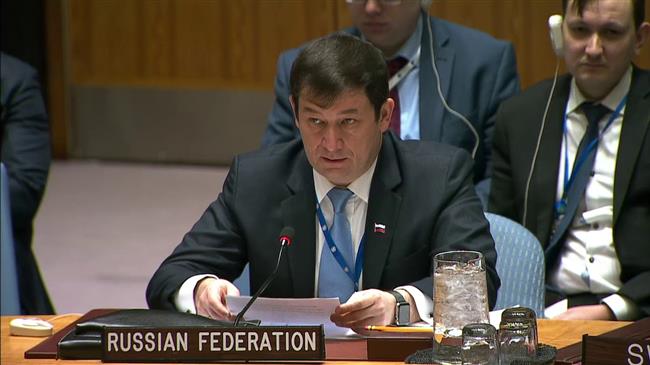
Dmitry Polyanskiy, Russia’s chargé d’affaires to the United Nations
Press TV – December 6, 2019
Russia’s mission to the United Nations says the US continually tries to demonize Iran’s missile activities despite lack of any damning evidence against the Islamic Republic’s defensive activities, and while Washington itself is in default of several international non-proliferation agreements.
Dmitry Polyanskiy, Moscow’s chargé d’affaires to the world body, addressed the remarks to the UN Secretary-General António Guterres in a letter dated November 26 that was made available on Friday.
He reminded that Iran was a signatory to many multilateral non-proliferation mechanisms, including the nuclear Non-Proliferation Treaty (NPT) and the Joint Comprehensive Plan of Action (JCPOA). The latter agreement came about in 2015 between the Islamic Republic and the P5+1 group of states — the United States, the UK, France, Russia, and China plus Germany, lifting nuclear-related sanctions against Tehran, which, in turn, voluntarily changed some aspects of its nuclear energy program.
Washington has, on numerous occasions, accused Tehran of developing nuclear-capable missiles, despite Tehran’s outright rejection of nuclear weapons of all type, and its observance of the JCPOA, which prohibits it from pursuing such armaments.
The Russian official highlighted “the complete lack of evidence that Iran is developing or producing a nuclear weapon or means of its delivery or is deploying any infrastructure for the storage or servicing of nuclear weapons.” He further endorsed the Islamic Republic’s continued commitment to the nuclear deal as verified by Tehran’s “refraining from activities related to ballistic missiles that are designed to be capable of carrying nuclear weapons.”
Nor has the UN Security Council, which has endorsed the JCPOA in the form of Resolution 2231, received any “viable information to the contrary,” Polyanskiy asserted.
However, he stated, the US would keep trying to implicate Iran in nuclear arms-related activities by, among other means, citing the Missile Technology Control Regime (MTCR). This is while the MTCR is an informal political understanding between 35 states on export control issues, and could not be deployed as a universal legally binding instrument or used in the context of Resolution 2231 to try and incriminate Iran’s missile activities, the envoy added.
Washington was on the offensive against Iran, while itself left the JCPOA last year “in violation of Article 25 of the United Nations Charter,” and is preventing other states from implementing it, Polyanskiy added. After leaving the deal, the White House returned its sanctions against Tehran, and also started pushing other JCPOA members into abiding by the American bans.
The Russian envoy also reminded how America left the Intermediate-Range Nuclear Forces (INF) Treaty with Moscow earlier this year, and was undermining efforts aimed at creating a Middle East region free of nuclear arms. He was referring to the US’s using its veto power at the UN in favor of Israel, which is the sole nuclear armed power in the region and has refused to join the NPT.
Jordan seeks to restore diplomatic relations with Syria: Minister
Press TV – December 6, 2019
Jordan plans to restore full diplomatic relations with neighboring Syria in a further sign of Arab states embracing President Bashar al-Assad after a UAE diplomat praised him for “wise leadership” this week.
Jordanian Minister of State and Agriculture Samir Habashneh said Thursday he will travel to Syria later this month as part of a nearly 30-strong delegation, Arabic- language Ammon news website reported.
Former Prime Minister Taher al-Masri will head the delegation to restore Amman-Damascus bilateral relations to the level prior to the outbreak of foreign-sponsored Syrian conflict, it said.
Habashneh said Jordan and Syria actually have common areas of interest, stressing that the visit should have taken place much earlier in order to enhance communication between the two countries.
Commenting on a possible meeting with President Assad, he stated that the matter is in the hands of the Syrian side, and that the Jordanian delegates would like to sit for talks with the 54-year-old Syrian leader, senior officials and representatives of the Syrian people.
Jordan’s official Petra news agency, citing Foreign Ministry spokesman Sufian Qudah, reported earlier this year that the Amman government had appointed a new chargé d’affaires to its embassy in Damascus.
“It was decided to appoint a Jordanian diplomat at the rank of charge d’affaires in the Jordanian embassy in Damascus,” the Jordanian official said.
He underlined that the “decision has been made in line with Jordan’s stance since the outbreak of the Syrian crisis in 2011 to keep the Jordanian embassy in Damascus open.”
Jordanian lawmakers first asked for the improvement of Jordan-Syria ties to the level before the start of the Syrian crisis last year, stressing that the relations are beneficial to both nations, Arabic-language Rai al-Youm newspaper reported last December.
Around the same time, Bahrain announced that work at the kingdom’s embassy “in the Syrian Arab Republic is going on whilst the Embassy of the Syrian Arab Republic to the Kingdom of Bahrain is carrying out its duties and flights connecting the two countries are operational without interruption.”
It came a day after the United Arab Emirates officially reopened its embassy in Damascus.
Earlier this week, the UAE’s top diplomat in Syria praised President Assad for his “wise leadership”, in one of the strongest expressions of support yet from a country that once backed Damascus’ enemies in the war.
Speaking at a ceremony to mark UAE national day on Dec. 2, UAE charge d’affaires Abdul-Hakim Naimi said he hoped “security and stability prevails throughout the Syrian Arab Republic under the wise leadership of President Bashar Al-Assad.”
“Syria-UAE relations are solid, distinct and strong,” he added, according to a video posted by Russian broadcaster RT.
Arab countries’ restoration of diplomatic ties with Damascus takes place at a time when the Syrian army troops are finalizing their victory against foreign-backed terror groups and restoring peace and stability to the war-torn country.
Earlier this year, Reuters news agency cited sources as saying that Washington had lobbied Persian Gulf states including the UAE to hold off restoring ties with Syria.
Syria has been gripped by foreign-backed militancy since March 2011. The Syrian government says the Israeli regime and its Western and regional allies are aiding Takfiri terrorist groups wreaking havoc in the country.
Normandy Four summit ‘may result in comprehensive Donbass ceasefire’ – Ukraine president’s adviser
RT | December 6, 2019
Ukraine should not expect new important agreements from the Normandy Four summit in Paris but the meeting may result in establishing a comprehensive ceasefire in Donbass and prisoner exchange, TASS quoted Nikita Poturaev, the adviser to the Ukrainian president, as saying on Friday.
“No new Minsk Agreements or some kind of Paris Agreements will come out of the meeting in Paris. However, the summit may result in… ceasefire along the whole contact line, which is envisaged by the Minsk Agreements, and prisoner exchange,” Poturaev told 1+1 TV channel. “If these two things are fulfilled, a political process will follow, namely elections [in Donbass] in accordance with Ukrainian laws.”
The Normandy Four meeting of leaders of Ukraine, Russia, France and Germany on the conflict in eastern Ukraine will be held on December 9 in Paris.
Featured Video

The Truth About the Trump Shootings with Ken Silva
or go to
Aletho News Archives – Video-Images
From the Archives
The Geopolitics behind the War in Yemen (I)
By Mahdi Darius NAZEMROAYA | Strategic Culture Foundation | 30.03.2015
The United States and the Kingdom of Saudi Arabia became very uneasy when the Yemenese or Yemenite movement of the Houthi or Ansarallah (meaning the supporters of God in Arabic) gained control of Yemen’s capital, Sanaa/Sana, in September 2014. The US-supported Yemenite President Abd-Rabbuh Manṣour Al-Hadi was humiliatingly forced to share power with the Houthis and the coalition of northern Yemenese tribes that had helped them enter Sana. Al-Hadi declared that negotiations for a Yemeni national unity government would take place and his allies the US and Saudi Arabia tried to use a new national dialogue and mediated talks to co-opt and pacify the Houthis.
The truth has been turned on its head about the war in Yemen. The war and ousting of President Abd-Rabbuh Manṣour Al-Hadi in Yemen are not the results of «Houthi coup» in Yemen. It is the opposite. Al-Hadi was ousted, because with Saudi and US support he tried to backtrack on the power sharing agreements he had made and return Yemen to authoritarian rule. The ousting of President Al-Hadi by the Houthis and their political allies was an unexpected reaction to the takeover Al-Hadi was planning with Washington and the House of Saudi. … continue
Blog Roll
 Aletho News
- IRGC air defenses destroy another US MQ-1 drone over Strait of Hormuz
- Imran Khan’s entire immediate family detained in Pakistan ahead of mass protest demanding his release
- EU nation detains former presidential frontrunner
- Leaked: Britain’s Sham Conviction Of Hashim Thaci
- Seyed M. Marandi: U.S. Strike Imminent – Toward Total War in the Middle East
- Russia Voted Under Fire. Washington Is Loading the Tankers.
- 12 Things Your Oncologist Was Trained Not to Tell You
- Anthrax Attacks Paved Way for COVID-Era ‘Junk Drugs and Vaccines’
- How Real Is the Impact of Western Sanctions on Israel?
- France, You Are Guilty: How Paris Turned Western Sahara into the Maghreb’s Powder Keg
- If Americans Knew
- Israeli president pardons soldier convicted for killing wounded Palestinian
- Singer Ed Sheeran says his ‘heart broken’ by Gaza devastation, addresses Macklemore controversy
- Israel Has Imprisoned Female Journalist Bushra Al-Tawil Without Trial Or Charge In Solitary Confinement For Past Month
- Israel poised to teach West Bank a lesson after one Israeli killed – Daily Update
- Salah Sarsour’s Legal Team Says DHS Has Not Met Its Burden to Prove He Is Deportable
- An analysis of tax forms by The Intercept show Kraft’s charity and LLC have donated to Friends of the IDF and AIPAC’s super PAC.
- Israeli attacks kill four Palestinians in Gaza – Daily Update
- Inside Gaza’s death trap of collapsing, bombed-out buildings
- The everyday items Israel bans from Gaza every day
- Inside the siege, the ruined buildings of Gaza – Daily Update
- No Tricks Zone
- 2025 Nature Paper Claiming Worsening Global Drought Gets RETRACTED …Heavily Flawed
- New Study: ‘Global Drought Shows No Detectable Recent Acceleration Under Climate Warming’
- Economic Masterminds: German Socialists Suggest Taxing Productivity Gains Stemming From Using AI
- The South China Sea Has Not Been Cooperating With The Climate Change Narrative
- Energy Crisis: Germany Enters Heating Season With Historically Low Gas Reserve Fill Levels
- New Study: The Antarctic Ice Sheet Gained Mass From 2020-2024 Due To Staggering Snow And Ice Accumulation
- Study: Ocean Heating Rates From Thousands Of Years Ago ‘Dwarf’ Modern Ocean Heating Rates
- Climate Extremists Target, Attack Large-Scale Power Grid Infrastructure In Germany!
- New Study: Antarctic Ice Melt Has Contributed Less Than 1 Centimeter To Sea Level Rise In The Last 30 Years
- Fear Of Debate: Alarmist German Climate Scientist Calls On Mainstream Media To Discredit Skeptic Voices
 Aletho News