Amnesty International’s Troubling Collaboration with UK & US Intelligence
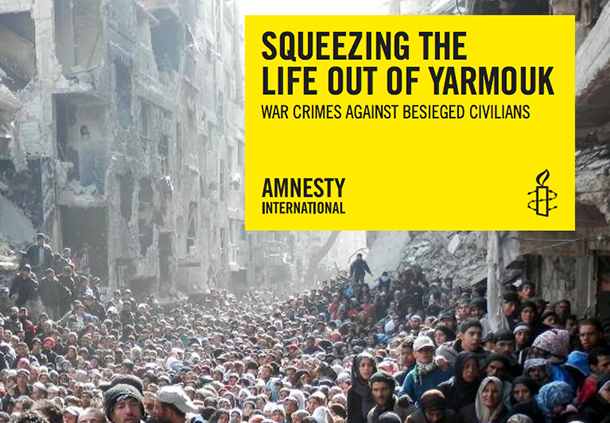
Propaganda image from the cover of AI’s report entitled, ‘Squeezing the Life Out of Yarmouk: War Crimes Against Besieged Civilians’,
one of many designed to fit hand-in-glove with the joint US and UK covert regime change operation deployed against Syria since 2011.
By Alexander Rubinstein | Mint Press News | January 17, 2019
Amnesty International, the eminent human-rights non-governmental organization, is widely known for its advocacy in that realm. It produces reports critical of the Israeli occupation in Palestine and the Saudi-led war on Yemen. But it also publishes a steady flow of indictments against countries that don’t play ball with Washington — countries like Iran, China, Venezuela, Nicaragua, North Korea and more. Those reports amplify the drumbeat for a “humanitarian” intervention in those nations.
Amnesty’s stellar image as a global defender of human rights runs counter to its early days when the British Foreign Office was believed to be censoring reports critical of the British empire. Peter Benenson, the co-founder of Amnesty, had deep ties to the British Foreign Office and Colonial Office while another co-founder, Luis Kutner, informed the FBI of a gun cache at Black Panther leader Fred Hampton’s home weeks before he was killed by the Bureau in a gun raid.
These troubling connections contradict Amnesty’s image as a benevolent defender of human rights and reveal key figures at the organization during its early years to be less concerned with human dignity and more concerned with the dignity of the United States and United Kingdom’s image in the world.
A conflicted beginning
Amnesty’s Benenson, an avowed anti-communist, hailed from a military intelligence background. He pledged that Amnesty would be independent of government influence and would represent prisoners in the East, West, and global South alike.
But during the 1960s the U.K. was withdrawing from its colonies and the Foreign Office and Colonial Office were hungry for information from human-rights activists about the situations on the ground. In 1963, the Foreign Office instructed its operatives abroad to provide “discreet support” for Amnesty’s campaigns.
Also that year, Benenson wrote to Colonial Office Minister Lord Lansdowne a proposal to prop up a “refugee counsellor” on the border of present-day Botswana and apartheid South Africa. That counsel was to assist refugees only, and explicitly avoid aiding anti-apartheid activists. “Communist influence should not be allowed to spread in this part of Africa, and in the present delicate situation, Amnesty International would wish to support Her Majesty’s Government in any such policy,” Benenson wrote. The next year, Amnesty ceased its support for anti-apartheid icon and the first president of a free South Africa, Nelson Mandela.
The following year, in 1964, Benenson enlisted the Foreign Office’s assistance in obtaining a visa to Haiti. The Foreign Office secured the visa and wrote to its Haiti representative Alan Elgar saying it “support[ed] the aims of Amnesty International.” There, Benenson went undercover as a painter, as Minister of State Walter Padley told him prior to his departure that “We shall have to be a little careful not to give the Haitians the impression that your visit is actually sponsored by Her Majesty’s Government.”
The New York Times exposed the ruse, leading some officials to claim ignorance; Elgar, for example, said he was “shocked by Benenson’s antics.” Benenson apologized to Minister Padley, saying “I really do not know why the New York Times, which is generally a responsible newspaper, should be doing this sort of thing over Haiti.”
Letting politics creep into mission
In 1966, an Amnesty report on the British colony of Aden, a port city in present-day Yemen, detailed the British government’s torture of detainees at the Ras Morbut interrogation center. Prisoners there were stripped naked during interrogations, were forced to sit on poles that entered their anus, had their genitals twisted, cigarettes burned on their face, and were kept in cells where feces and urine covered the floor.
The report was never released, however. Benenson said that Amnesty general secretary Robert Swann had censored it to please the Foreign Office, but Amnesty co-founder Eric Baker said Benenson and Swann had met with the Foreign Office and agreed to keep the report under wraps in exchange for reforms. At the time, Lord Chancellor Gerald Gardiner wrote to Prime Minister Harold Wilson that “Amnesty held the [report] as long as they could simply because Peter Benenson did not want to do anything to hurt a Labour government.”
Then something changed. Benenson went to Aden and was horrified by what he found, writing “I never came upon an uglier picture than that which met my eyes in Aden,” despite his “many years spent in the personal investigation of repression.”
A tangled web
As all of this was unfolding, a similar funding scandal was developing that would rock Amnesty to its core. Polly Toynbee, a 20-year-old Amnesty volunteer, was in Nigeria and Southern Rhodesia, the British colony in Zimbabwe, which was at the time ruled by the white settler minority. There, Toynbee delivered funds to prisoner families with a seemingly endless supply of cash. Toynbee said that Benenson met with her there and admitted that the money was coming from the British government.
Toynbee and others were forced to leave Rhodesia in March 1966. On her way out, she grabbed documents from an abandoned safe including letters from Benenson to senior Amnesty officials working in the country that detailed Benenson’s request to Prime Minister Wilson for money, which had been received months prior.
In 1967 it was revealed that the CIA had established and was covertly funding another human rights organization founded in the early 1960s, the International Commission of Jurists (ICJ) through an American affiliate, the American Fund for Free Jurists Inc.
Benenson had founded, alongside Amnesty, the U.K. branch of the ICJ, called Justice. Amnesty international secretariat, Sean MacBride, was also the secretary-general of ICJ.
Then, the “Harry letters” hit the press. Officially, Amnesty denied knowledge of the payments from Wilson’s government. But Benenson admitted that their work in Rhodesia had been funded by the government, and returned the funds out of his own pocket. He wrote to Lord Chancellor Gardiner that he did it so as not to “jeopardize the political reputation” of those involved. Benenson then returned unspent funds from his two other human-rights organizations, Justice (the U.K. branch of the CIA-founded ICJ) and the Human Rights Advisory Service.
Benenson’s behavior in the wake of the revelations about the “Harry letters” infuriated his Amnesty colleagues. Some of them would go on to claim that he suffered from mental illness. One staffer wrote:
Peter Benenson has been levelling accusations, which can only have the result of discrediting the organisation which he has founded and to which he dedicated himself. … All this began after soon after he came back from Aden, and it seems likely that the nervous shock which he felt at the brutality shown by some elements of the British army there had some unbalancing effect on his judgment.
Later that year, Benenson stepped down as president of Amnesty in protest of its London office being surveilled and infiltrated by British intelligence — at least according to him. Later that month, Sean MacBride, the Amnesty official and ICJ operative, submitted a report to an Amnesty conference that denounced Benenson’s “erratic actions.” Benenson boycotted the conference, opting to submit a resolution demanding MacBride’s resignation over the CIA funding of ICJ.
Amnesty and the British government then suspended ties. The rights group then promised to “not only be independent and impartial but must not be put into a position where anything else could even be alleged” about its collusion with governments in 1967.
Amnesty’s role in the death of Black Panther Fred Hampton
But two years later, senior Amnesty officials engaged in far more troubling coordination with Western intelligence agencies.
FBI documents, released by the Bureau in the spring of 2018 as a part of a series of disclosures of documents pertaining to the assassination of President John Kennedy, detail Amnesty International’s role in the killing of Black Panther Party (BPP) Deputy Chairman Fred Hampton, the 21-year-old up-and-coming black liberation icon — a killing that was widely believed to be an assassination but was ruled officially as a justifiable homicide.
Amnesty International co-founder Luis Kutner attended a November 23, 1969 speech of Hampton’s delivered at the University of Illinois.
During the speech, Hampton described the BPP “as a revolutionary party” and “indicated that the party has guns to be used for peace and self-defense, and these guns are at the Hampton residence as well as BPP headquarters,” according to the FBI document.
“Kutner has reached the point where he would like to take legal action to silence the BPP,” the FBI wrote. “Kutner concluded by stating that he believed speakers like Hampton were psychotic, and it is only when they are faced with a court action that they stop their “rantings and ravings.”
The FBI internal report on Kutner’s testimony cited above was issued on December 1, 1969. Two days later, the FBI, alongside the Chicago Police Department, conducted a firearms raid on Hampton’s residence. When Hampton came home for the day, FBI informant William O’Neal slipped a barbiturate sleeping pill into his drink before leaving.
At 4:00 a.m. on December 4, police and FBI stormed into the apartment, instantly shooting a BPP guard. Due to reflexive convulsions related to death, the guard convulsed and pulled the trigger on a shotgun he was carrying – the only time a Black Panther member fired a gun during the raid. Authorities then opened fire on Hampton, who was in bed sleeping with his nine-month pregnant fiancee. Hampton is believed to have survived until two shots were fired at point-blank range towards his head.
Kutner formed the “Friends of the FBI” group, an organization “formed to combat criticism of the Federal Bureau of Investigations,” according to the New York Times, after its covert campaign to disrupt leftists movements — COINTELPRO — was revealed. He also went on to operate in a number of theaters that saw heavy involvement from the CIA — including work Kutner did to undermine Congolese Prime Minister and staunch anti-imperialist Patrice Lumumba — and represented the Dalai Lama, who was provided $1.7 million a year by the CIA in the 1960s.
While Amnesty International’s shady operations in the 1960s might seem like ancient history at this point, they serve as an important reminder of the role that non-governmental organizations often play in furthering the objectives of governments of the nations where they are based.
Alexander Rubinstein is a staff writer for MintPress News based in Washington, DC. He reports on police, prisons and protests in the United States and the United States’ policing of the world. He previously reported for RT and Sputnik News.
Debris of INF treaty will fall far and wide
By M. K. BHADRAKUMAR | Indian Punchline | January 17, 2019
The US-Russia talks in Geneva regarding the 1987 Intermediate-range Nuclear Forces (INF) treaty have ended in failure. In a final call to salvage the treaty, Moscow offered that American experts could inspect a new suspect Russian missile, which Washington has been citing as the alibi for its decision to quit the treaty, but the US point-blank rejected the offer and instead went on to reconfirm that it intends to suspend observance of the cold-war era pact with effect from February 2.
We are entering uncharted waters in regional and international security. Russia anticipates increased US deployments near its borders. In an interview with government-daily Rossiyskaya Gazeta, Russia’s Security Council Secretary Nikolai Patrushev said on Tuesday, “In general, our analysis shows that the American presence near our borders will grow… As for Russia’s western borders, we note the course for the growth of military presence of the US and other NATO members in their vicinity. In 2019, placement of multinational battalion tactical groups in Latvia, Lithuania, Estonia and Poland will continue. At the same time, Brussels does not hide the fact that its main goal is to contain our country. The strengthening of the European segment of the US global missile defense system continues. The inauguration of the missile defense complex in Poland in addition to the already functioning one in Romania is expected in 2020.”
Equally, new faultlines are appearing. Moscow anticipates further US missile deployments to Northeast Asia – specifically, Japan. Moscow estimates that it is unrealistic to expect Japan to adopt an independent foreign policy. This geopolitical reality in Northeast Asia is in turn casting shadows on the recent improved climate in Russo-Japanese relations. (See my blog Russia tamps down the Kuril hype.)
Following the foreign-minister level talks in Moscow on Monday between Russian Foreign Minister Sergey Lavrov and his Japanese counterpart Taro Kono, the latter showed reluctance to hold a joint press conference, underscoring the rapidly changing climate of ties between the two countries. Lavrov’s remarks to the media later signaled a marked toughening of the Russian stance on the territorial dispute over Kuril Islands.
Lavrov demanded an outright Japanese recognition of Russian sovereignty over all the islands in the Kuril chain as part of the outcome of World War 2, as accepted under international treaties and by the UN – “Japan’s indisputable recognition of the entirety of results of World War 2, including Russia’s sovereignty over all of the islands of the southern Kuril chain,” as Lavrov put it.
Lavrov said Japanese domestic legislation must accordingly be changed in consultation with Russia. He added, “This is our base position and without steps in this direction it is very difficult to expect movement forward on other issues (such as peace treaty).”
Evidently, in the developing post-INF treaty scenario, Japan’s security alliance with the US now becomes a major hurdle in Russo-Japanese relations. Lavrov specifically pointed a finger at this: “The 1956 Declaration was signed when Japan did not have a military alliance treaty with the US. The treaty was signed in 1960, after which our Japanese colleagues departed from the 1956 Declaration. Now that we are resuming talks on the basis of this declaration, we must consider the drastic change that has taken place in Japan’s military alliances since then. At today’s talks we devoted attention to the US efforts to develop a global missile defence system in Japan with a view to militarising that part of the world and also to the actions that the US formally justifies by citing the need to neutralise the North Korean nuclear threat. In reality, these actions are creating security risks for Russia and China.”
Interestingly, Lavrov brought in the common concern of Russia and China with regard to the US-Japan security alliance and the American missile deployments to Japan. This is a snub to Tokyo inasmuch as recently, Abe’s aide in the ruling Liberal Democratic Party (which Abe heads) had made a provocative statement that the US should be interested in concluding a treaty between Russia and Japan, as this would “strengthen the bloc” to contain China. Lavrov called it an “outrageous statement” and put across as bluntly as he could the Russian indignation over any Japanese ploy to create misperceptions regarding Russia-China relations:
“The problem is that the president of the Liberal Democratic Party is Prime Minister Shinzo Abe. We have issued a serious warning about how inappropriate such statements are. We have also inquired more broadly about how independent Japan can be in addressing any issues at all with such heavy dependence on the United States. We were assured that Japan would make decisions based on its national interests. We would like it to be that way.” (See a detailed report by China Daily titled Russia tells Japan retaking Pacific islands not on horizon.)
As much as in regard of Russia’s western borders with Europe, the Asia-Pacific also becomes a region where Moscow’s policies will be significantly influenced by the new climate in international security. This holds good for other regions, too.
Most certainly, Russia will be even more wary of any open-ended US-NATO occupation of Afghanistan. The Russian-American contestation over Turkey will become more complex. (The US missile deployment in Turkey was a core issue during the Cuban missile crisis of 1962.) Again, there are reports that a massive expansion of the US bases in Qatar is unfolding (where the US Central Command is headquartered.) Qatar is a potential site for the deployment of US missile systems. Indeed, in the circumstances, Russia’s relations with Iran assume a highly strategic character. Iran’s strategic autonomy is of vital interest to Russia.
The Balkans is another region that Russian strategies will prioritize. Putin is embarking today on a visit to Serbia, which is a key ally, but where conditions may arise for a potential standoff between the West and Russia as had happened in 2014 in Ukraine. In an interview with the Serbian media, Putin came down heavily on the NATO expansion policy, which he condemned as “a misguided, destructive military and political strategy.” He accused the Alliance of “trying to strengthen its presence in the Balkans.” No doubt, a period of heightened tensions in international security lies ahead with the US decision to abandon the INF treaty.
Don’t meddle in Venezuela, Moscow tells coup-cheering Washington
RT | January 16, 2019
Russia has criticized the US government for bullying Venezuela and encouraging its opposition to stage a coup against President Nicolas Maduro, who was sworn in for his second term last week.
“Nations should avoid meddling in other nations’ internal affairs,” Russian Foreign Minister Sergey Lavrov said on Wednesday. He said that Washington’s encouragement of opposition forces in Venezuela “has made them unwilling to seek reconciliation [with the president], which is regretful.”
Venezuela is currently in a political crisis, with the opposition-controlled National Assembly declaring President Maduro a “usurper” and its speaker, Juan Guaido, an “interim president” of the country. The move came after strong public support from Washington, which has been advocating toppling Maduro for quite some time.
Washington has targeted Maduro’s government with a series of crippling economic and personal sanctions, and reportedly considered a military intervention in the country.
The National Assembly’s mandate to represent Venezuelans remains in question. In 2017, the country reformed its parliament system by introducing a new body called the Constitutional Assembly, which is controlled by pro-government politicians. The opposition and its backers in Washington rejected the reform as a power grab and declared the new legislature illegal.
Explaining Russia’s position on the conflict, Lavrov said US involvement in Venezuela was “very alarming and indicated that the US policy of destabilizing governments it does not like remains a priority.”
Venezuela suffered years of economic and social hardships, which the opposition blames on Maduro’s poor governance. He blames the hardship on sabotage of big business and foreign interests, which want to see his socialist government ousted from power.
Venezuela Welcomes 2,500 Cuban Doctors Leaving Brazil
teleSUR | January 13, 2019
Over 2,000 Cuban doctors are setting up practice in Venezuela after being kicked out of Brazil by President Jair Bolsonaro, Venezuelan leader Nicolas Maduro said this weekend.
Two-thousand-five-hundred cardiologists, anesthesiologists, and general doctors arrived in the South American country Friday to bulk up the medical staff at the Barrio Adentro Mission, a social initiative founded by ex-president Hugo Chavez to provide free, public medical care.
In November, thousands of doctors were forced to leave the Mais Medicos (More Doctors) cooperation program in Brazil after far-right president Bolsonaro criticized the program, saying it was torture for Cuban mothers who were “not allowed” to go with their children and questioning diplomatic ties with the island.
In the last five years, about 20,000 Cuban physicians have participated in the ‘More Doctors Program,’ assisting thousands of Brazilians in rural communities to receive primary health care.
Some 1,462 vacancies, roughly 17.2 percent of those positions left by the Cuban doctors, have not yet been filled, the Brazilian Health Minister, Luiz Henrique Mandetta, said Friday.
Several states and municipalities inside Brazil pressured the National Government to provide a solution because the Cuban doctors are usually the only medical option in several rural areas of the country.
India baits US while Pakistan tells Trump, ‘There’s nothing like free lunch’
By M. K. BHADRAKUMAR | Indian Punchline | January 12, 2019
Breaking a prolonged period of several months, the Pakistani allegation of Indian involvement in terrorist attacks has surged. This appears during the first detailed media briefing by the Pakistani authorities in Karachi on January 13 on the results of the investigation over the terrorist strike on the Chinese consulate in the city last November.
Pakistan has blamed the Balochistan Liberation Army for staging the terrorist attack. Graphic details have been given claiming that the attack was “planned in Afghanistan” from where the Balochi terrorists travelled to Karachi.
India’s alleged role has been described variously in the Pakistani press as rendering “assistance” to the terrorists and “funding” them. One report mentions that the attack was “carried out with the assistance of Indian intelligence agency.” Indeed, immediately after the attack on November, a Pakistani security official had suggested that India “orchestrated” it. An AP report at that time had mentioned that Pakistan was investigating whether the Baluch separatist commander Aslam Achhu, who masterminded the attack, was in India.
The Pakistani assessment is that the Karachi attack was well planned over months and intended to cause rift in the China-Pakistan ties as well as to undermine the China-Pakistan Economic Corridor (CPEC) by highlighting the volatility of the city. It stands to reason that Pakistan would have shared with the Chinese any details in this regard.
The salience that must be noted here is that Pakistan has not finger-pointed at Kabul authorities directly or implicitly. In the past, the Pakistani allegation used to be that Indian and Afghan agencies collaborated in such enterprises.
Some other things stand out as well. The timing of the Pakistani disclosure is significant. First and foremost, it comes amidst signs of US-Taliban talks intensifying. A fourth round was expected to take place on Wednesday, but was called off by the Taliban on grounds of “agenda disagreement” with the Americans, in a clear snub to the US special representative Zalmay Khalilzad. Elsewhere, Taliban spokesman also told Reuters, “We (Taliban) have the feeling that Zalmay Khalilzad doesn’t have enough power to make important decisions.” Evidently, there is a fly in the ointment.
Interestingly, a former Pakistani diplomat Zamir Akram, who is an old India hand, wrote yesterday counseling that Pakistan should not harbor “unrealistic expectations” out of the Trump administration, as there may not be a “real change in policy towards Pakistan.” To quote Akram, “Washington continues to view relations with Islamabad through the prism of Afghanistan and not on the basis of relations with Pakistan in and of itself.”
He added, “Our Prime Minister should also resist the temptation, which his predecessors did not, of accepting a meeting with the American President as a “reward” in itself — a meeting devoid of any substantive outcome for Pakistan. This has been a usual American tactic mainly reserved for light-weight leaders who can be fobbed off with an Oval office photo-opportunity. Any meeting with Trump must lead to concrete results otherwise it would not be worth the effort.”
Amongst other things, Akram voiced disquiet that Washington is disrupting the India-Pakistan strategic parity in favor of India, and that “Pakistan’s relations with China and CPEC in particular are emerging as contentious issues in Pakistan-US relations.” He said that in an environment of “a convergence in US-India relations but a growing divergence in the Islamabad-Washington equation,” Pakistan must diversify its foreign relations, and in particular, it “must further strengthen strategic partnership with China for which successful implementation of CPEC, despite American and Indian opposition, must be ensured.”
Zamir concluded by underscoring that a political settlement in Afghanistan should provide for an outcome that served Pakistan’s interests “in terms of ending Indian use of Afghan territory to promote terrorism in Pakistan, recognition of Pakistan’s security interests in Afghanistan, return of Afghan refugees and removal of US sanctions. We have the leverage to attain this, given the American reliance on Pakistan, not just for the dialogue with the Taliban but also due to the air and ground access we provide to the US for its presence in Afghanistan.” (Express Tribune )
Plainly put, strategic (nuclear) parity in South Asia, restrictions on Indian activities in Afghanistan, Pakistan’s security interests in Afghanistan, return of Afghan refugees and removal of US sanctions on Pakistan – they are still on the table. If Trump’s game plan is to swing a settlement riveted on Pakistani acquiescence with a reduced US military presence in Afghanistan (enabling him also to flaunt “troop withdrawal” by election year 2020) by pandering to PM Imran Khan’s vanities, it may not work.
Given India’s hardline policies toward Pakistan, it is improbable that Islamabad will compromise on its agenda to purge the Indian presence in Afghanistan. Therefore, the media disclosure on the terrorist attack in Karachi at this juncture must be taken as a signal to Washington as much as to Delhi. Most certainly, it coincides with the US Special Representative Zalmay Khalilzad’s visit to Delhi, where he enjoys a fabulous reputation for being an inveterate anti-Pakistani Afghan-American.
Unsurprisingly, chaffing under the Taliban’s snub, Khalilzad was assured of a warm reception in Delhi. The press reports based on briefings suggest that Indian officials tore into Pakistan warning the Trump administration about Islamabad’s machinations. Clearly, Delhi sized up that it has in Khalilzad a most receptive audience.
Alongside, there has also been a sudden burst of enthusiasm to inject some verve into the US-Indian ties, which have been languishing during recent years. It is entirely conceivable that India may place some orders for weaponry from American vendors, which would of course please Trump immensely.
To be sure, Trump’s travails in withdrawing US troops from Syria may turn out to be a picnic in comparison with what is in store in Afghanistan.
Is Paul Whelan a Spy?
By Philip M. GIRALDI | Strategic Culture Foundation | 10.01.2019
The media has a new bit of speculation that fits neatly into the flagging Russiagate narrative. It concerns Paul Whelan, a high school graduate Marine Corps dishonorable discharge, who is currently working in corporate security for a Michigan-based auto parts manufacturer. Whelan, who lives alone, is self-taught in Russian and has engaged in tourist travel to the country a number of times. He was reportedly arrested late last month in Moscow while ostensibly attending a friend’s wedding and charged with espionage. Forty-eight year-old Whelan is clearly an odd duck and is notable for having four passports – Great Britain, Ireland, Canada and that of the United States.
Press coverage of the incident has nearly unanimously decided that the spying charge against Whelan is phony and that he is being held as bait to arrange for an exchange with Maria Butina, who is in jail in Virginia after being charged with acting as an unregistered agent of the Russian government and engaging in conspiracy. The media and the usual pundits base their conclusion on absolutely no evidence whatsoever apart from their conviction that Russian President Vladimir Putin is a bad man who would do almost anything to irritate the United States and overthrow its system of government. Oddly, the press watchdogs fail to note how the current federal government is doing a damned fine job destroying itself without any assistance from the Kremlin. If Putin really wanted to damage the US, he would be best advised to leave it alone and let Congress and the White House do the heavy lifting for him.
Unlike the mainstream media, I rather expect that the charges against Whelan could be more-or-less correct, though not in the way the press has framed the story, which is that Whelan is such a flawed character that he could not possibly meet the requirements to be working for any sophisticated spy organization. The New York Times in its coverage of the story interviewed several former CIA officers who had served in Russia, but asked the wrong questions. The reporter wanted to know if Whelan could possibly be an employee of US intelligence. The ex-Agency officers replied “no” because of his criminal record while a Marine and other oddities in his career, which included some marginal involvement with low-level law enforcement.
The former spooks were correct to state that Whelan would not pass the security hurdles for employment as a staff officer, but there is also a whole other level of possible engagement with the Agency, DIA or JSOC – cooperating as one of the sources which intelligence organizations recruit and run to collect information. The flawed but nevertheless useful Whelan would be a perfect target for recruitment as an intelligence source, referred to in the business as “agents.”
Unusually for a foreigner, Whelan has a social media account on Vkontakte, the Russian equivalent of Facebook, which is quite likely how he came to the attention of CIA or the Pentagon. And The New York Times, interestingly, describes his friends on the site as “men with some sort of connection to academies run by the Russian Navy, the Defense Ministry or the Civil Aviation Authority.” That alone would be enough to generate considerable interest in American intelligence circles as sources with that kind of access are hard to find.
And the details of Whelan’s arrest, if true, are completely consistent with how a low- to mid-level source might be run and used by a US government case officer. According to Russian accounts published in Rosbalt, a news agency close to the Kremlin, an unidentified intelligence source revealed that Whelan was trying to recruit a Russian citizen to obtain classified information regarding employees at various government agencies when he was caught in flagrante. He was arrested five minutes later in what was clearly a sting operation after having received a USB stick that included a list of all of the employees that he apparently had requested.
It may turn out that Paul Whelan is completely innocent and is merely a pawn in a tit-for-tat chess game being played by Washington and Moscow. If so, it is to be hoped that he will be proven innocent and released, but no one should rule out his having been recruited and exploited by a US government agency. Spying is not a game. It is a dangerous business, with serious consequences for those who are caught.
Why India should pay attention to US-Turkey spat over S-400
By M. K. BHADRAKUMAR | Indian Punchline | January 6, 2019
Such a lot of nonsense was dished out by the American lobbyists through the past year to the effect that Washington was straining at the leash to punish India for buying the S-400 ABM system. This phobia was carefully planted in the Indian discourses by American think tankers. The most celebrated instance was of the Indian-American strategic expert Ashley Tellis penning a forceful essay, featured by the Carnegie in Washington last August titled How Can U.S.-India Relations Survive the S-400 Deal?
Tellis somehow inspires awe among Indian analysts, who blithely assume that he wields immense clout in the White House and US foreign-policy establishment in defining American policies vis-à-vis India. (Presumably this naïvety prompted PM Modi’s advisors too to get him to patronize Tellis personally by releasing his book in Delhi circa 2014.)
The American lobbyists were actually indulging in a ‘psywar’ to create panic among the policymakers in Delhi who were trying to close the S-400 deal after protracted negotiations with the Russians. In retrospect, the ploy failed to work and India went ahead with the S-400 deal.
That entire experience ought to show that Americans are bluff masters. No sanctions followed. Common sense ultimately prevailed – although some Indian analysts still fondly harbor the notion that Washington showed a favor to India. Whereas, sanctioning the policymakers or decision makers in the Indian defence establishment or the Indian arms procurement bodies (leave alone the end users of S-400 ABM system) was never really a viable option for Americans. The US today is a top arms supplier to India. In reality, the whole pressure tactic aimed at undermining the Indian-Russian relationship. (Tellis’ essay brought out this hidden agenda.)
Now, all this makes Turkey’s S-400 saga a morality play for India’s strategic community and defence establishment. Turkey, too, has placed an order for the S-400 system. Indeed, the Americans went berserk, threatening Turkey with dire consequences, including sanctions. But Turkish President Recep Erdogan didn’t blink.
The US then threatened to withhold the supply of the newly developed F-35 stealth fighters to Turkey. (Reports say Turkey plans to buy 111 such fourth-generation jets, each costing at 2019 prices approximately $85 million per unit complete with engines and full mission systems.) Clearly, Lockheed’s deal with Turkey is worth a mind-boggling amount running into tens of billions of dollars over the years. In addition, Turkey, being a “Level 2” partner of the US’ F-35 stealth aircraft project, has also been contributing to the development costs of these fighter jets.
Suffice to say, Erdogan correctly assessed that the Americans will kill a goose that lays the golden egg. In time, he was proven right. The US has since quietly withdrawn the threat and is going ahead with the transfer of the F-35 fighter jets to Turkey. (Initially, American experts had argued that the S-400 system installed in Turkey might enable Russians to study the weaknesses of the F-35 stealth aircraft.)
Washington is still hoping that Turkey can be cajoled to cancel the S-400 order with Russia (despite Ankara’s repeated assertions to the contrary.) A Pentagon delegation travelled to Ankara last week to make another effort. The US has now made an offer to sell the Patriot air defence system to Turkey (which it had hitherto refused) if only Turkey cancelled the order for S-400. (Turkey’s position is that it can have both S-400 and Patriot systems.)
But there is a catch. According to Turkish press reports, the discussions in Ankara last week showed that Russians may have sold the S-400 at a “fraction” of the cost at which the US is now offering the Patriot as a substitute. And, furthermore, the US will not transfer any technology relating to the Patriot.
Of course, imagine what would have been India’s plight if it had given up on the S-400 deal and instead heeded Ashley’s advice that PM Modi should “make a deal with Trump.” To quote from Tellis’ August 2018 essay,
“It (deal with Trump) would probably require India to move forward on one of the several major defense acquisition programs it has discussed with the United States over the years, thus… giving Trump an incentive to speedily issue the waiver that India needs. Both sides could thus come out ahead. For such a workaround to attract Trump’s attention, however, India’s proposal must be lucrative enough to the United States and remarkable in its potential geostrategic impact. And the details should emerge close to fully formed from a quiet dialogue between Indian and U.S. policymakers at the highest levels. Quickly resolving some of the more pressing trade disputes would only help this process further.”
Thereby hangs a tale. Turkey’s experience is not fundamentally different from India’s insofar as the chance of the US sanctioning Turkey over the S-400 deal is virtually nil. But Indian analysts have much to learn from the US-Turkish spat, since Turkey has a long history as America’s Cold-War era ally.
Quite obviously, Trump will never show the audacity to mock Erdogan publicly, as he repeatedly did to Modi. On the contrary, he shows to Erdogan the courtesies that he unfailingly reserves for Vladimir Putin and Xi Jinping. Trump is even planning a visit to Turkey.
Modi-Trump bromance ends on sour note
By M. K. BHADRAKUMAR | Indian Punchline | January 3, 2019
The highly disparaging remarks by the US President Donald Trump on Wednesday regarding Prime Minister Narendra Modi and India’s role in Afghanistan come as a shocking revelation. Trump was talking to the press following his first cabinet meeting of 2019 at the White House in Washington. No Indian PM has been reduced to look silly like this by any American president in history.
Trump’s remarks came in the course of his rambling speech regarding the failure of the war in Afghanistan. He spoke every bit as an embittered man who realizes that the war has been lost. Part of the reason why he summarily put Modi on the mat could have been that Trump also realizes the great urgency of extracting Pakistan’s cooperation in the Afghan endgame. Trump’s thesis was that foreign leaders take America for a ride.
In this vein, Trump mocked Modi for funding a library in Afghanistan under Indian aid and bragging about it repeatedly in private conversations. (Trump apparently mistook for a library the Indian-built parliament building in Kabul, which Modi inaugurated in a grand ceremony on Christmas Day in 2015.) Anyway, Trump claimed that Modi was “constantly telling me he built a library in Afghanistan.” He then rubbished Modi’s vanity, saying, “You know what that is? That’s like five hours of what we spend (in Afghanistan.) And we’re supposed to say (to Modi), ‘Oh, thank you for the library’. I don’t know who’s using it in Afghanistan.”
This is the first time the US belittled the Indian assistance to Afghanistan, which is estimated to be close to 2 billion dollars. The American mantra has been that India was rendering invaluable help to Afghanistan. But now that the war is about to end, we are probably getting a candid version of what the Americans really thought of the quality of the Indian aid.
Elsewhere, Trump said that India had a free ride in Afghanistan – like Russia and the Gulf states – because the US was fighting their war against terrorist groups. Therefore, Trump said in a snide remark that it is for India and Russia to do the fighting in Afghanistan. But he recalled that the Russians once tried to fight extremist groups in Afghanistan and failed and the Soviet Union went bankrupt as a result. The outcome was that the USSR “shrunk” into the Russian Federation.
Trump asked with indignation: “Why isn’t Russia, India, Pakistan there?” Why should America be there, “which is 6000 miles away?” He bemoaned that the Pentagon “didn’t do a good job” in Afghanistan. Referring to the former Defence Secretary James Mattis, he noted, “I am not happy with what he did in Afghanistan.” Trump alleged that he provided for a generous budget for the Pentagon but the result in Afghanistan is “not too good.”
Interestingly, Trump hinted that Pakistani Prime Minister Imran Khan is delivering in a big way to help the US end the war. Trump disclosed, “I look forward to meeting the folks from the new leadership in Pakistan. We will be doing that in not-too-distant future.”
Clearly, Trump has taken note of the sea change in the Pakistani stance lately on Afghanistan after Imran Khan came to power, especially Imran Khan’s changed position that in some form – maybe, in some reduced form – the US military presence should continue in Afghanistan for a conceivable future. Simply put, the US and Pakistan are re-bonding again as ‘natural allies’ over Afghanistan.
Trump feels gratified that Pakistan has delivered the Taliban, finally, to the negotiating table. No doubt, the revival of the US-Saudi Arabia-UAE-Pakistan caucus to finesse the Taliban’s role in the future Afghan political scenario meets with Washington’s requirement. For Trump, the priority is that the US must somehow end the 17-year old war in Afghanistan before his campaign gets under way for the presidential election in the US next year.
Arguably, Trump’s acerbic remarks about Modi contained a subtle warning against any Indian attempt to be a ‘spoiler’ in the emergent scenario. On the other hand, Imran Khan becomes an irreplaceable partner for Trump. We may expect a state visit – or at least an official visit – by Imran Khan to the US in the near future.
On the geopolitical plane, things are falling in place in a familiar pattern. The US seeks transactional relationships and in the immediate future in the South Asian region Pakistan is of greater use. Evidently, Indian analysts have been daydreaming about the “Quad” and what not.
Trump’s fascination for India has been all about Modi’s utility for the ‘America First’ project. But Trump probably sees Modi now as a brunt-out case. Indeed, the Western press increasingly casts doubts on Modi’s chances of returning to power in the 2019 poll. (See a commentary by the Voice of America titled India’s Modi Facing Tough 2019 Election Year)
‘Caught in the act of spying’: US citizen detained in Moscow ahead of New Year’s Eve celebrations
RT | December 31, 2018
An American citizen was apprehended during a “spying action” in Moscow, the Federal Security Service (FSB) said. He is currently being detained on suspicion of espionage.
FSB agents detained a US national named Paul Whelan on Friday during “a spying action,” the agency’s press office told TASS.
Criminal proceedings were launched against the man under Article 276 of the Russian Criminal Code, which covers the crime of espionage.
No details of the suspect’s identity or facts surrounding the operation were immediately disclosed.
The Russian Foreign Ministry said that the US Embassy in Moscow was notified of Whelan’s detention.
News of the American citizen’s arrest comes at a time of heightened tensions between the US and Russia. Washington has accused Moscow of meddling in its domestic affairs and of various spy activities.
In October, the US Ministry of Justice accused seven Russians of being GRU military intelligence officers, and charged them with hacking and committing wire fraud.
Four men belonging to that group were expelled from the Netherlands in April for allegedly attempting to hack the Organization for the Prohibition of Chemical Weapons (OPCW). Moscow denied all allegations, dismissing them as “spy mania.”
Earlier this month, a Moscow court sentenced former police officer Aleksey Zhitnyuk to 13 years in prison for providing classified data to a foreign national. The trial took place behind closed doors, and the details of the case remain unknown. However, according to media reports, he was suspected of being in contact with the CIA.
Saudi Arabia takes charge of Afghan peace talks
By M.K. Bhadrakumar | Asia Times | December 31, 2018
The Taliban leadership has finally issued an official statement on the talks with US special representative Zalmay Khalilzad in Abu Dhabi 10 days ago. The deftly worded statement dated December 29 says:
“Some media outlets have published rumors that the representatives of the Islamic Emirate will hold talks with those of the Kabul administration in Saudi Arabia. These rumors are baseless. The position of the Islamic Emirate concerning talks with the Kabul administration remains the same and has not changed. We are advancing [the] negotiations process with the United States under a strong and extensive plan to bring an end to the occupation of our country Afghanistan. It is hoped that the negotiations process is not dealt with carelessly nor anyone given false hopes. As the United States has entered into the negotiations process with the Islamic Emirate, therefore, it must be advanced in a serious manner and not used as propaganda material.”
Evidently, after due deliberation, the Taliban leadership said they were unable to accede to the Saudi-Emirati joint proposal for talks between the Taliban and the Afghan government.
Talks in Saudi in January
However, the Taliban statement is completely silent on the twin proposal put forward by the Saudis and Emiratis at Abu Dhabi – namely, on a three-month ceasefire. The Taliban would not reject the idea but would presumably revisit it depending on the progress of ongoing talks with the US special representative Zalmay Khalilzad. The ceasefire proposal went alongside the US media leak that 7,000 American troops might be withdrawn from Afghanistan.
However, the Taliban intends to continue with their talks with Khalilzad. The next round will take place in Saudi Arabia in January. The Taliban statement claims that it is “advancing” the negotiations with Khalilzad “under a strong and extensive plan to bring an end to the occupation.” The wording seems to imply that the Taliban keeps an open mind on a compromise based on a scaled-down American troop presence in Afghanistan in the near term.
The Taliban’s rejection of talks with the Afghan government will cause anger and consternation in Kabul. There is some evidence that Kabul watches with disquiet the intensifying negotiations between the US and the Taliban. Ghani recently appointed two figures who are known to be anti-Taliban and have a lineage going back to the Northern Alliance as the new defense and interior ministers in his cabinet, signaling a potent reset of the power calculus. Equally, Ghani also harbors political ambition to secure another term as president.
Suffice to say, the Taliban’s rejection of talks with Kabul or a ceasefire needn’t be taken as a red line. Taliban may change its stance on participating in intra-Afghan dialogue at a future point. The point is the Saudi role in hosting the next round of US-Taliban talks surged following a telephone conversation between King Salman and Ghani on Saturday.
Ghani reportedly praised the “prominent” role by King Salman and agreed that the next meeting of the US and Taliban on Saudi soil would be “a good step and start for subsequent processes.” The King, in turn, promised to use his offices to consolidate peace and stability in Afghanistan.
Of course, wherever Saudi Arabia goes, the Middle Eastern conundrum will cast shadows. The Saudi surge to take charge of the Afghan peace talks will most certainly cause heartburn in some regional capitals – in Doha and Tehran, and possibly in Ankara as well.
Pakistani diplomacy is working overtime to smoothen wrinkles. Foreign Minister Shah Mahmood Qureshi has just visited Doha. He was in Tehran a week ago. Earlier, Pakistani army chief General Qamar Bajwa also visited Doha (which used to host a Taliban representative office in recent years). And Pakistani Prime Minister Imran Khan is reportedly planning to visit Turkey on January 3-4.
Smart move
From the Saudi angle, it is a smart move that to underscore that the strategic partnership between the two countries remains resilient, notwithstanding the scars left by the killing of Jamal Khashoggi. Indeed, from the US perspective too, the Saudi role is irreplaceable, given the longstanding relationship between Riyadh and the Taliban movement dating back to the end of the 1980s. As for the Taliban leadership, it simply cannot overlook the religious sanctity attached to the Custodian of the Two Holy Places.
All in all, while the Taliban feels emboldened by the developments since the Abu Dhabi talks, the upcoming talks in Saudi Arabia will be crucial, as they will set the tempo of the peace talks at a juncture when there are distinct signs that the 17-year conflict is set to conclude.
The bottom line is that the Taliban (and Pakistan) would know that it is unrealistic to hope to capture power and, importantly, to retain it without the cooperation and support of the western powers, especially the US.
Troop withdrawal
Having said that, time is running out for the Trump administration, too. The postponement of the Afghan presidential election (originally scheduled for April) will deepen political uncertainties in Kabul. And this is happening at a time when the Taliban has proved its mettle in the battlefield and is in control of vast areas of the country. Over and above, there is the near-certainty that POTUS might order a troop withdrawal from Afghanistan at some point through 2019.
Interestingly, the White House has refuted the media leak regarding a unilateral troop drawdown in Afghanistan. “The President [Trump] has not made a determination to drawdown US military presence in Afghanistan and he has not directed the Department of Defense to begin the process of withdrawing US personnel from Afghanistan,” Garrett Marquis, a spokesman for the National Security Council, said in an emailed statement to Bloomberg.
The crisply worded clarification leaves the door open for a future decision by Trump on the issue.
Iran challenges Saudi role in the Afghan endgame
By M. K. BHADRAKUMAR | Indian Punchline | December 31, 2018
As surely as night follows day, in the wake of Saudi Arabia assuming the lead role in the Afghan peace talks, Tehran has unveiled an analogous peace process involving the Taliban. (See my article in Asia Times Saudi Arabia takes charge of Afghan peace talks.)
The Iranian Foreign Ministry spokesman Bahram Qassemi made a dramatic announcement today that Tehran has hosted a delegation from Taliban to discuss possible ways to end the conflict in Afghanistan. Qassemi disclosed that the talks, which were held at the level of Iran’s Deputy Foreign Minister Abbas Araqchi on Sunday, were “extensive” and that they were “coordinated” with the Afghan government. He didn’t elaborate.
Qassemi explained: “Since the Taliban are in control of more than 50 percent of Afghanistan, and given the insecurity, instability and other issues that the country is dealing with, they [the Taliban] were interested in talks with Iran.” He flagged that Iran, which has long borders with Iran, “always sought a constructive role to maintain peace in the region.”
Qassemi said the visit by the Taliban delegation to Tehran followed the recent consultations of Iran’s Supreme National Security Council Ali Shamkhani to Kabul on December 26. He said the Taliban leaders had expressed interest in meeting Shamkhani and the Afghan authorities were “fully aware” of the meeting and the negotiations. Qassemi added that Tehran principally aimed to “facilitate” dialogue between the Afghan groups and the Kabul administration so as to advance the peace process. He said Araqchi is planning a visit to Kabul shortly for follow-up discussions.
It is highly improbable that the Saudi and Iranian tracks shall ever meet. The best hope will be that they do not collide. What can happen is that the Afghan endgame may remain open-ended without any conclusive end in sight in a near future. But the silver lining is that the regional states such as Russia and India may no longer have to accept as fait accompli the outcome of the quadripartite process involving the US, Saudi Arabia, the UAE and Pakistan.
Equally, the non-Afghan groups now get a breather, who are worried that a peace settlement reached by the quadripartite process may ignore their legitimate interests. Influential Afghan groups from the non-Pashtun regions of the north, west and the central highlands are watching with dismay that a settlement might be imposed on their country. Curiously, the very same extra-regional powers and Pakistan who incubated the Taliban in the early 1990s, launched it on the Afghan landscape and made possible its conquest of Kabul in 1996 are now reappearing as the charioteers of peace and reconciliation with the Taliban.
What worries Tehran most is that the US, Saudi Arabia and the UAE are veterans in using the Islamist groups as geopolitical tools. There is some evidence that the ISIS fighters who were defeated in Syria and Iraq are being transferred to Afghanistan. The regional states face the spectre of ISIS undermining peace and stability. The recent regional tour of Pakistani Foreign Minister Shah Mahmood Qureshi exposed these faultlines. (See my blog Pakistan’s Afghan jig irks regional states.)
Arguably, what Tehran may have done is to create space for the Taliban to withstand pressure from the quadripartite process. Tehran is explicitly opposed to any settlement in Afghanistan that may allow continued American military presence in the region. Tehran factors in that the US, Saudis and Emiratis are jointly advancing the project on regime change in Iran and will not hesitate to use Afghanistan as springboard to foster cross-border terrorism to destabilize Iran. Simply put, Tehran fears that the US objective in Afghanistan is to create a Syria-like situation in the region that will engulf Iran in violence and anarchy.
The emergent contradiction can be reconciled in only one way – by Pakistan living up to its stated position, namely, to give primacy to regional consensus on any Afghan settlement. However, Pakistan’s hands are tied after having accepted the multi-billion dollar bailouts recently (amounting to a total of US$ 12 billion) from the Saudis and the Emiratis to cope with its economic crisis. Pakistan had a choice of approaching the IMF but the US made things difficult. That in turn turned out to be a smart American ploy to involve its Saudi and Emirati allies who promptly loosened the purse strings to rescue Pakistan. Suffice to say, Pakistani leadership is no longer free to defy the Saudi-Emirati diktat on Afghan settlement.
On the contrary, many regional states — Iran, Qatar, Turkey, in particular — view Saudi Arabia and the UAE through an entirely different prism, imbued with horror. They watch with dismay that the real winner in all this will be Saudi Arabia.
Indeed, it is a masterstroke by the Saudi regime to assume the role of peacemaker at a juncture when its international image is severely damaged following the brutal killing of Jamal Khashoggi. Ironically, Saudis are undertaking a rescue act to help the US wriggle out of a 17-year old war. Make no mistake, Riyadh is displaying its importance as the US’ irreplaceable regional ally in the Muslim Middle East. It expects better sense to prevail in the US Congress and the American media who have been clamoring for punishing the Saudi regime for the murder of Khashoggi.
Afghan Taliban Were in Tehran for Peace Talks: Iran
Al-Manar | December 31, 2018
Iran said Monday that the Afghan Taliban have visited Tehran for a second round of peace talks in just a few days aimed at bringing an end to 17 years of conflict.
Iran has made a more concerted and open push for peace in neighboring Afghanistan since US President Donald Trump indicated there would be a significant withdrawal of American troops.
“Yesterday (Sunday), a delegation of Taliban was in Tehran and lengthy negotiations were held with Iran’s deputy foreign minister… (Abbas) Araghchi,” said spokesman Bahram Qassemi at a televised press conference on Monday.
That came just days after Ali Shamkhani, secretary of Iran’s Supreme National Security Council, visited Kabul and told reporters that talks had been held with the Taliban in Afghanistan.
“The Islamic Republic has always been one of the primary pillars of stability in the region and cooperation between the two countries will certainly help in fixing Afghanistan’s security issues of today,” Shamkhani told Tasnim news agency.
Qassemi said Iran’s priority was “to help facilitate negotiations between Afghan groups and the country’s government.”
Featured Video
Seyed M. Marandi: Toward Total War in the Middle East
or go to
Aletho News Archives – Video-Images
From the Archives
The Geopolitics behind the War in Yemen (I)
By Mahdi Darius NAZEMROAYA | Strategic Culture Foundation | 30.03.2015
The United States and the Kingdom of Saudi Arabia became very uneasy when the Yemenese or Yemenite movement of the Houthi or Ansarallah (meaning the supporters of God in Arabic) gained control of Yemen’s capital, Sanaa/Sana, in September 2014. The US-supported Yemenite President Abd-Rabbuh Manṣour Al-Hadi was humiliatingly forced to share power with the Houthis and the coalition of northern Yemenese tribes that had helped them enter Sana. Al-Hadi declared that negotiations for a Yemeni national unity government would take place and his allies the US and Saudi Arabia tried to use a new national dialogue and mediated talks to co-opt and pacify the Houthis.
The truth has been turned on its head about the war in Yemen. The war and ousting of President Abd-Rabbuh Manṣour Al-Hadi in Yemen are not the results of «Houthi coup» in Yemen. It is the opposite. Al-Hadi was ousted, because with Saudi and US support he tried to backtrack on the power sharing agreements he had made and return Yemen to authoritarian rule. The ousting of President Al-Hadi by the Houthis and their political allies was an unexpected reaction to the takeover Al-Hadi was planning with Washington and the House of Saudi. … continue
Blog Roll
 Aletho News
- Israeli lobby seeks to bind US fate to ‘Israel’: Araghchi
- Pakistan-Iran talks secure LNG shipment to Islamabad through Hormuz
- Black Sea grain crisis puts global wheat supplies under pressure
- IRGC air defenses destroy another US MQ-1 drone over Strait of Hormuz
- Imran Khan’s entire immediate family detained in Pakistan ahead of mass protest demanding his release
- EU nation detains former presidential frontrunner
- Leaked: Britain’s Sham Conviction Of Hashim Thaci
- Seyed M. Marandi: U.S. Strike Imminent – Toward Total War in the Middle East
- Russia Voted Under Fire. Washington Is Loading the Tankers.
- 12 Things Your Oncologist Was Trained Not to Tell You
- If Americans Knew
- Israeli Attacks in Gaza Kill at Least Seven Palestinians Over Three Days, including Woman and Child
- Trump’s militarization of Washington DC as he pursues Israel’s war against Iran
- Why Israel Fears This Searing New Documentary
- Huckabee aide solicited cash gifts from Israelis
- This isn’t sci-fi, AI is already killing people
- ‘The Most Brutal Thing’: Investigation Reveals Execution of Elderly Woman in Rafah
- Inside Israel’s ‘soft’ ethnic cleansing plan for Gaza through the eyes of its victims
- New online database tracks pro-Israel political donations in the United States
- Israeli president pardons soldier convicted for killing wounded Palestinian
- Singer Ed Sheeran says his ‘heart broken’ by Gaza devastation, addresses Macklemore controversy
- No Tricks Zone
- 2025 Nature Paper Claiming Worsening Global Drought Gets RETRACTED …Heavily Flawed
- New Study: ‘Global Drought Shows No Detectable Recent Acceleration Under Climate Warming’
- Economic Masterminds: German Socialists Suggest Taxing Productivity Gains Stemming From Using AI
- The South China Sea Has Not Been Cooperating With The Climate Change Narrative
- Energy Crisis: Germany Enters Heating Season With Historically Low Gas Reserve Fill Levels
- New Study: The Antarctic Ice Sheet Gained Mass From 2020-2024 Due To Staggering Snow And Ice Accumulation
- Study: Ocean Heating Rates From Thousands Of Years Ago ‘Dwarf’ Modern Ocean Heating Rates
- Climate Extremists Target, Attack Large-Scale Power Grid Infrastructure In Germany!
- New Study: Antarctic Ice Melt Has Contributed Less Than 1 Centimeter To Sea Level Rise In The Last 30 Years
- Fear Of Debate: Alarmist German Climate Scientist Calls On Mainstream Media To Discredit Skeptic Voices
 Aletho News