Venezuelan Supreme Court: The President Has Not Abandoned His Post
By Rachael Boothroyd-Rojas – Venezuelanalysis – January 31, 2017
Caracas – Venezuela’s Supreme Court (TSJ) has blocked an attempt by Congress to oust President Nicolas Maduro over the allegation that he has “abandoned his post”.
Earlier in January, the opposition-controlled National Assembly (AN) approved an agreement stating that the president should be dismissed, accusing him of being responsible for a “serious rupture of the constitutional and democratic order,” the “devastation” of the country’s economy, and human rights abuses.
Opposition lawmakers argued that the declaration was based on Article 233 of the Bolivarian Constitution, which outlines the circumstances under which the president can be considered to have permanently vacated the position.
However, on Monday, Venezuela’s highest court released a statement confirming that there were no constitutional grounds for President Maduro’s removal from office, and criticised the AN’s interpretation of the article as “fraudulent and insurrectional”.
“The President of the Republic, citizen Nicolas Maduro Moros, has not been absent, nor separated in any moment, from the exercise of his post, nor has he ceased to exercise his constitutional responsibilities since the beginning of his mandate, which is a public, well-known and communicable indisputable fact,” reads the declaration.
In the official ruling, the high court describes opposition lawmakers’ actions as an attempt to set in motion a “coup d’etat” against the president of the Republic and to “subvert the established constitutional order”.
“(This) responds to their interest in destabilisation, with the only intention of changing the legitimately constituted government through an unconstitutional procedure,” continues the top judicial body.
TSJ judges also went on to reprimand the opposition coalition, the Democratic Unity Roundtable, for having continuously flouted the court’s previous orders demanding that congress remove three opposition legislators pending investigations into voter fraud. The court has released several statements declaring the National Assembly to be in contempt of court and consequently void, as well as warning the legislative body not to overstep its constitutional boundaries.
According to the Constitution, the Venezuelan president can be considered to have “abandoned his post” through his death, resignation, destitution by the TSJ or his “physical or mental incapacity” as corroborated by a medical committee.
Nonetheless, opposition legislators have prioritised removing Maduro from office through a variety of initiatives since winning a congressional majority in the legislative elections of December 2015.
Tunisians Protest against Return of Terrorists from Conflict Zones
Al-Manar – December 25, 2016
Hundreds of people took to the streets of the Tunisian capital to protest against the repatriation of fellow citizens suspected of having links with various extremist groups.
The protest took place after Germany announced that it would speed up the process of sending rejected Tunisian asylum seekers home, and Tunisian President Beji Caid Essebsi said that authorities could not prevent the return of terrorists.
Tunisians staged a rally in front of the national parliament that was attended by hundreds of people.
People were holding placards that read “close the doors to terrorism” and “no tolerance, no return” as well as were waving Tunisian flags and singing the national anthem.
When the guns fall silent in Syria
By M K Bhadrakumar | Indian Punchline | December 24, 2016
A Kremlin readout on the phone call made by President Vladimir Putin to Syrian President Bashar Al-Assad on Friday to formally congratulate the latter on the liberation of Aleppo, highlighted that the Russian leader “stressed that the main task now is to focus on furthering the peace process, in particular by signing an agreement on comprehensive resolution of the Syrian crisis.”
Putin’s remark is an important signpost of the way forward in Syria. Moscow disfavours continuation of military operations by the Syrian government forces to regain control of the entire country (which would be the likely preference of Damascus and Tehran) and prefers that conditions must be made available to open the peace track. At any rate, all 5 major cities in Syria and the entire Mediterranean coast, where the bulk of Syrian population is concentrated, is in government hands already and the opposition is left to hold Idlib and isolated pockets in the south and east, with supply lines under immense pressure.
A ceasefire all across Syria is in the making. This appears to be the understanding reached at the 2-track ‘trilateral’ of the foreign and defence ministers of Russia, Turkey and Iran which was held in Moscow on Tuesday. Interestingly, at a meeting in the Kremlin on Friday to report to Putin on the conclusion of the operations to liberate Aleppo and the successful downstream activities to evacuate civilians and render humanitarian assistance (in terms of a deal between Turkey, Russia and Iran), Defence Minister Sergei Shoigu also made a significant remark that “In our (military’s) opinion, we are close to reaching an agreement on a complete ceasefire across Syria.” Putin responded:
- Together with our partners from Iran and Turkey, and of course with the Syrian government, other countries in the region and all countries concerned, we will need to continue efforts to achieve a final settlement. We must make the greatest effort now to end hostilities everywhere in Syria, and we will, at least, do our sincerest best to achieve this goal.
Of course, the campaign against the Islamic State and the al-Qaeda affiliates will continue. A ceasefire all across Syria has been a key demand by Turkey. Interestingly, Putin referred to the objective of drawing “other countries in the region” (other than Turkey and Iran) into these processes. The reference is to Saudi Arabia and Qatar principally. Conceivably, Russian diplomacy is at work on this front.
Russian Deputy Foreign Minister Gennady Gatilov said he expected the peace talks to take place in Astana in mid-January. But TASS news agency quoted Kremlin spokesman Dmitry Peskov as saying: “I wouldn’t talk now about timing. Right now contacts are being made and preparation is under way for the meeting.” He said Putin would have a series of international telephone calls later to discuss the Astana talks.
Whether the Gulf sheikhs will be willing to drink from the chalice of poison remains to be seen. But what alternative is left for them now that the ‘regime change’ agenda in Syria is off the rails? Equally, a shift in Saudi and Qatari policies, away from further intervention in the Syrian conflict, will also at some point raise another ticklish question: What about the role of Hezbollah and other Shi’ite militia groups from Iran and Iraq who have been fighting in Syria? How an all-Syria ceasefire will be enforced remains to be seen.
Moscow’s objective will be to create new facts on the ground by the time the Trump administration shifts gear on Syria policies. Moscow has signalled on Friday that it is preparing for the long haul as well, with Putin signing a presidential decree ordering the signing of a deal with Syria that will “expand the territory” of Russia’s naval facility in Tartus and allow Russian warships into Syrian waters. The Soviet-era base is currently inadequate to serve most of the modern ships in the Russian Navy.
If the Syrian peace talks take off in the coming weeks, it will amount to a huge victory for Russia’s prestige in the Middle East and for Putin, in particular. But that is a big ‘if’. The good part is that with a relatively cooperative US administration settling down in Washington soon, which may be inclined to collaborate with Russia.
Trump & Kremlin united by common cause to ‘trash’ Americans – ex-US envoy to Russia
RT | December 24, 2016
Former US Ambassador to Russia Michael McFaul has accused US President-elect Donald Trump of teaming up with the Kremlin in an effort to “trash” Americans. McFaul has called on Republicans to “speak up.”
“Why is Trump so militantly against an investigation into Putin’s meddling in our elections?” McFaul wrote on Twitter on Friday. “What does he have to hide? This love fest is odd.”
Earlier this month, the former US ambassador to Russia even suggested registering RT and Sputnik news agency as “foreign agents,” claiming that they supported Donald Trump during the presidential elections.
“We know that Russian-government-controlled ‘media’ outlets such as RT and Sputnik campaigned openly for one candidate, Donald Trump,” McFaul wrote in his article for the Washington Post. While he accused the Russian news outlets of meddling in the US election, he offered no proof to support his claims.
Last month, McFaul was prohibited by the Russian Foreign Ministry from entering Russia for what it described as purposeful damage to relations between Moscow and Washington. In a Facebook post, he said that he was told he is “on the Kremlin’s sanctions list because of close affiliation with Obama” and “will take that as a compliment.”
Trump set off an avalanche of criticism after agreeing with the Russian leader’s assessment of the Democrats’ attempts to blame the 2016 election on external factors, instead of accepting it with dignity.
Brushing aside evidence-free claims that Russia interfered with the US election process, Russian President Vladimir Putin told journalists during his annual news conference in Moscow on Friday that the Democrats are exclusively responsible for their political failures.
“There are attempts by the Democrats and the current administration to blame their failures on external factors. The Democrats didn’t just lose the presidential election, but the House and the Senate as well. Did I do that as well? They need to learn to lose with dignity,” Putin said.
Reacting to Putin’s statement, Trump tweeted “So true!” triggering a cascade of criticism on Twitter in response, with social media users calling the next US president a traitor, embarrassment, Kremlin puppet, and in Vladimir Putin’s “back pocket.”
Middle Eastern Media Sources Discuss Aleppo’s Fall
By Yuriy Zinin – New Eastern Outlook – 22.12.2016
The liberation of Aleppo and the withdrawal of radical militants from this Syrian city provoked a storm of responses and comments across various Middle Eastern media sources.
While trying to downplay this major Damascus’ success, media sources from the anti-Syrian camp have been trying to raise arguments. They perceive the fall of Aleppo as the direct result of various intrigues and conspiracies, while admitting that there were serious miscalculations made by the so-called “opposition”. At the same time those media sources curse the West for it allegedly turning its back on the Syrian “revolutionary fighters” and Turkey for the “betrayal of their cause”, etc.
The Pro-Saudi newspaper Al-Sharq al-Awsat, however, was forced to recognize the liberation of Aleppo as a major victory of Damascus that was achieved with an extensive amount of support provided by Russia.
At the same time it’s getting clear that the sponsors of the so-called opposition, especially those of the Persian Gulf, are determined to deny any responsibility for the failure of their militants. One of the most influential Saudi newspaper Okaz is critisizing the anti-Assad camp for living in luxury hotels outside Syria. It is outraged that, in the light of the recent events in Aleppo these “ungrateful salon revolutionaries” have started criticizing Persian Gulf monarchies for not providing enough support for them. They look at the kingdom as a “cash machine”, the newspaper argues, the only purpose of which is to refill their pockets with golden coins by taking advantage of the bloodshed and suffering of their fellow citizens.
Other media sources from the anti-Assad camp are cheerfully noting that they’ve lost a battle, but they didn’t lose a war.
The Lebanese newspaper As-Safir believes that the fall of Aleppo is the direct result of the failure of the pro-Western forces in Syria. Even though the so-called opposition had the control of large Syrian cities for years, they have already shown that they are unable to govern effectively even in those territories that they were occupying. In fact, what they’ve done resulted in a complete paralysis of all government structures, that may soon result in the complete Somaliazation of the whole country. The opposition could only achieve success in a certain area, but haven’t had any comprehensive strategy worth mentioning. In contrast, government forces are aiming at liberating the territories of their country and at rebuilding them.
Against this background, we’ve witnessed an intensified media war, with at least 60 different major TV stations purposefully trying to distort the events in Syria. This propaganda machine is being fueled by the petrodollars provided by the Persian Gulf monarchies, and the latter aren’t going to stop.
It seems that we’ve heard it all already, Damascus being accused of the use of chemical weapons against the population, Syrian and Russian troops being involved in the nonexistent “atrocities” against the civilian population, the alleged destruction of schools and hospitals; the assertion that Russia’s policy in Syria and throughout the region is one-sided.
Today in the ranks of the anti-Assad propagandists one can spot signs of massive confusion. According to the newspaper Al-Quds Al-Arabi, four “media activists” of a number of jihadist groups in Aleppo surrendered to authorities long before the fall of the city. This got the opposition puzzled since those who escaped were involved in covert operations and fund raising.
The liberation of Aleppo, says the Iraqi Sawt al-Iraq news site, means that millions of dollars have been thrown to the wind, wasted on the financing of anti-government groups and supplying them with information from different sources. It’s clear at this point that back in 2011 when President Obama announced that Assad’s days were numbered he made a serious mistake. It’s the days of Barack Obama that are numbered now, argues the newspaper, since the former doesn’t have much time in power left.
The Western world is engulfed in hysteria over Aleppo. But they remained silent all the time that the city was occupied by ISIS, al-Nusra and other terrorist organizations, so why start bothering now?
Yury Zinin is a Leading Research Fellow at the Moscow State Institute of International Relations.
Moscow wants Saudi Arabia to join Russia-Turkey-Iran efforts for Syria peace – UN envoy
RT | December 21, 2016
Moscow says that Saudi Arabia should join efforts to find peace in Syria undertaken by Russia, Iran and Turkey, Vitaly Churkin, Russia’s UN envoy, said.
The Foreign Ministers of Russia, Iran and Turkey met in Moscow on Tuesday to draft a joint statement aimed at resolving the long term conflict in Syria.
According to Churkin, the document was “an extra effort by our three countries” to, among other things, prepare opposition forces “to negotiate with the government, and put them at the same table with the government, so they can develop between themselves some arrangements that would advance the political process.”
It is “very important” that the statement by Moscow, Tehran and Ankara “contained an invitation to other countries that have influence ‘on the ground’ to join such efforts,” he said.
“It seems to me it would be very important for Saudi Arabia to take a similar stance and work in the same direction,” the envoy told Rossiya 24 channel.
The Russia-US talks on resolving the Syrian crisis have stalled, but Churkin says that the situation may change when Donald Trump replaces Barack Obama in the White House.
“I’m going to share my personal interpretation of the things I’ve heard recently,” he said.
According to Churkin’s information, the UN special envoy for Syria, Staffan de Mistura, said he planned to convene a new round of talks about Syria on February 8, 2017.
“I’m sure he (de Mistura) did it only after he had found an opportunity to contact the people on Donald Trump’s team and to coordinate the date with them,” the Russian UN ambassador said.
“That’s good enough a sign because it could be indicative of the ability of the Trump Administration to steer the situation towards a rapid enough unfolding of the political process (in Syria),” Churkin said, again stressing that it was just his “personal interpretation of events.”
He said that Russia is ready to cooperate with Nikki Haley, who Trump plans to propose for the next US envoy at the United Nations.
“She’s a quite young governor of South Carolina, lacking international experience, but I heard some good comments about her,” the Russian envoy said.
However, he stressed that he doesn’t know Haley in person, which makes it hard to predict how the US delegation will act under her in the UN and with the Security Council.
“Anyway, I think it’s early to relax and expect that we’re going to have some kind of nirvana in our work at the UN. It’s going to be a bit more complicated in real life,” Churkin said.
The pullout of militants from the Syrian city of Aleppo “is being completed,” Kremlin spokesman, Dmitry Peskov, said Wednesday.
Aleppo was the last major city being held by the rebels in the country, with their withdrawal being agreed though Russian and Turkish mediation.
According to estimates by Russian officials, the evacuation of civilians from eastern Aleppo, which has been under rebel control since 2012, is expected to conclude in a few days.
UN Security Council unanimously passes resolution on monitoring Aleppo evacuations
RT | December 19, 2016
The UN Security Council has unanimously passed a resolution requiring the monitoring of evacuations from Aleppo.
The resolution, initially drafted by France, was originally called a “disaster” by Russia’s UN envoy Vitaly Churkin.
However, Moscow and Paris came to an agreement on the text after more than three hours of closed-door consultations by the Council on Sunday.
The resolution asked UN Secretary-General Ban Ki-moon “to take urgent steps to make arrangements, including security arrangements in consultation with interested parties, to allow the observation by the United Nations and other relevant institutions of the well-being of civilians… inside the eastern districts of the city of Aleppo.”
It asked for “adequate, neutral monitoring and direct observation” of the evacuations to take place, as well as for all parties to provide monitors with “safe, immediate, and unimpeded access.”
The evacuations are part of a Russia- and Turkey-brokered deal between the Syrian government and opposition. It allows for the evacuations of militants and their families from eastern Aleppo, in exchange for the departure of civilians from the northern rebel-held villages of al-Foua and Kefraya, Idlib province.
Syria’s UN ambassador, Bashar Jaafari, said the final evacuations of militants are currently taking place in Aleppo, and the city will be “clean” by Monday evening.
“The last terrorists… are evacuating their strongholds and Aleppo this evening will be clean,” he said, as quoted by Reuters.
Bashar Al-Jaafari: Protecting civilians in Aleppo and other cities is the Syrian government’s constitutional duty
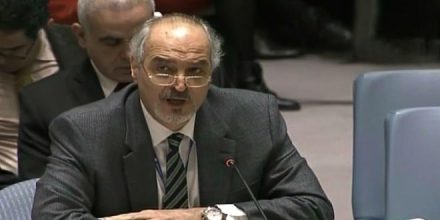
SANA | December 14, 2016
NEW YORK – Syria’s Permanent Representative to the UN Bashar al-Jaafari stressed that the Syrian government is innocent of the U.S. and western accusations that it has committed crimes in Aleppo.
Addressing an emergency session of the UN Security Council on the situation in Aleppo on Tuesday, called for by France and Britain, al-Jaafari said some of the Security Council member states are used, since the beginning of the terrorist war against Syria, to call for urgent sessions based on misleading information and false reports and testimonies whenever the Syrian army and its allies achieve advance against the terrorist organizations.
al-Jaafari categorically dismissed all the “fabricated reports” used by the representatives of the US, France and Britain that the Syrian government has targeted citizens in Aleppo city, affirming that what the Syrian government, along with its allies, is doing in Aleppo city and other Syrian cities is “practicing the constitutional and legal duty of every government; that is to protect its citizens against terrorism.”
He made it clear that the Syrian government’s first and foremost aim of opening safe corridors (including for the militants), providing makeshift centers, issuing amnesty decisions and delivering food and medical aid in Aleppo is protecting civilians and keeping them safe.
Al-Jaafari criticized the UN Secretary General Ban Ki-Moon for being in a hurry to issue statements based on reports he could not verify just to the effect of “defaming the Syrian government and its allies that are fighting terrorism.”
He dismissed that some sides, in their attempts to help the terrorists, deny the Syrian government its duty to examine and verify the identity of some of those who are leaving neighborhoods in Aleppo along with the civilians, especially that many reports issued by the Security Council speak of tens of thousands of foreign terrorists from more than a 100 countries operating in Syria, noting that this examination aims at preventing those terrorists from infiltrating other areas, and probably the territories of other countries, and resuming their acts there.
He cited tens of photos which show terrorists, who had committed acts of “beheading innocent people and eating livers”, trying to escape from East Aleppo infiltrating among civilians in women’s clothes, but they were captured by the Syrian Army.
Al-Jaafari said it is utmost hypocrisy that the envoys of some countries insist on accusing the Syrian government of besieging its people and blocking access to food and medicine while they continue to deny the fact that tens of depots which were controlled by the terrorist organizations in Aleppo have been full of all kinds of medical and food supplies from which the civilians were deprived.
He stressed that it is not possible that tens of thousands of terrorists fighting the Syrian Army in Aleppo would have been able to survive and remain there for more than four years, was it not for some states at this Council continually providing them with all kinds of weapons and protection.
He categorically denied “as groundless” all “fabrications, allegations and hallucinations” issued by some member states’ representatives about the government allegedly committing acts of “reprisal, intimidation and field executions against civilians,” reaffirming that hunting and targeting terrorists is at the heart of the Syrian government’s constitutional powers “just like what u did in Nice, Paris, London, Boston, Oklahoma, North Carolina, Cairo, Sinai, Bombay, Tunisia, Nigeria, Kenya and Tanzania.”
For his part, Russia’s Representative to the UN Vitaly Churkin stressed that the Syrian Arab Army has reestablished control over the eastern neighborhoods of Aleppo, reiterating that the allegations that the Syrian Army has committed violations in Aleppo are baseless.
Meanwhile, China’s Representative to the UN Liu Jieyi said fighting terrorism is an integral part of finding a solution to the crisis in Syria, stressing that the international community should give top priority to fighting ISIS and other terrorist organizations.
Obama orders ‘full review’ of election hacks, results not to be made public
RT | December 9, 2016
President Obama has ordered US spy agencies to prepare “a full review” of election-linked cyberattacks, but the public may never see it. The report should be ready before Obama vacates office and it is likely to be disclosed only to “a range of stakeholders.”
“The president has directed the intelligence community to conduct a full review of what happened during the 2016 election process,” presidential aide Lisa Monaco told reporters at a breakfast hosted by The Christian Science Monitor. She said the review’s aim is “to capture lessons learned from that.”
“That’s going to be first and foremost a determination that’s made by the intelligence community,” she said.
Despite the headline-capturing hacking, which the US intelligence authorities blamed on Russia, the public may never have a chance to review the findings.
According to Monaco, the results will be only available “to a range of stakeholders to include Congress.”
“We want to do so very attentive to not disclosing sources and methods that may impede our ability to identify and attribute malicious actors in the future,” she explained.
Monaco has also admitted that the Obama administration is determined to “impose costs” on those behind cyberattacks and use “all elements of national power against the cyber threat.”
In a possible attempt to head-off a public outcry, Deputy White House Press Secretary Eric Schultz has also assured that the review is “not an effort to challenge the outcome of the election,” but rather “a major priority for the president of the United States.” The latter being a reason for the agencies to finish their work before President Obama hands over the White House keys to President-elect Donald Trump on January 20.
Schultz said that the US intelligence agencies will go as far as 2008 to examine patterns of “malicious cyber-activity timed to election cycles.”
In October, the US officially accused Russia of the hacks that targeted emails of Hillary Clinton, her team and members of the Democratic National Committee (DNC). However, since than, Washington has presented no proof of Moscow’s involvement in hack attacks.
Moscow has consistently denied allegations about its possible role, with President Vladimir Putin accusing the US government of dragging Moscow into the presidential election to manipulate American voters.
As the race between Trump and Clinton, heated up, the former Secretary of State directly accused Russia of meddling with the process.
The accusations, however, fell flat both with her rival and his supporters.
In a recent interview with Time magazine, Trump again said that he does not “believe they interfered.”
“I don’t believe it. I don’t believe they interfered,” he told the magazine that just named him “the person of the year.”
Read more:
Washington considers sanctioning Moscow over DNC email leak – report
Join now: ISM-Training in England!
International Solidarity Movement | December 6, 2016
 ISM-England is offering a training for interested ISM-volunteers in Sheffield on 18th and 19th of February ! If you’re interested in joining the team on the ground in Palestine, make sure to reserve the date and join the training.
Any volunteer is required to participate in training before joining activities in Palestine. This training will prepare you for the solidarity work with communities in Palestine, give you a first impression, connect with people that have been in Palestine, and give you the chance to have all your questions answered!
Even if you’re not interested in joining activities in Palestine, but feel passionate about human rights for Palestinians, contact ISM England and get involved in advocacy work at home.
For any questions, signing-up for the training and more information please contact ISM England on training.ismlondon@riseup.net.
With new US sanctions approved, Iran taking ‘wait & see attitude’ to future Trump administration
RT | December 2, 2016
As the Obama administration applies a series of tough new sanctions against Iran, contravening prior agreements, Iranians have no choice but to hope for the best from Donald Trump, Professor Seyed Mohammad Marandi from the University of Tehran told RT.
The US Senate has voted unanimously to renew sanctions against Iran for another decade.
It’s been described as a symbolic move, but it allows the president to impose new restrictions on Tehran if it violates the 2015 nuclear accord.
The vote was 99 to 0 and follows a similar ballot in the House of Representatives last month when only one person voted against the extension of the Iran Sanctions Act.
RT: Washington says the vote is only symbolic and won’t change anything…. but it gives President-elect Donald Trump an opportunity to break the nuclear accord if he wishes. What are the implications of that?
Mohammad Marandi: The most important thing right now for Tehran is that we have not even entered the Trump era. Obama, who was supposed to implement the agreement between Iran and the “P5+1” has not abided by his side of the bargain. In the past, we saw visa restrictions that were implemented and signed by Obama after the agreement which was a violation. The US confiscated Iranian money. The US put pressure on banks, as well as other financial institutions, insurance companies, shipping companies not to work with Iran. That was a violation of the agreement. And this particular law is a violation, and we see that Obama has not put pressure on the Democrats to vote against it because not a single person stood up against the law. This is a new law because the old law was to run out, it would run out very shortly, and now a new law is being passed. That is in direct violation. The law is both adding sanctions, and it is against third parties, in other third world countries, who want to do business with Iran. All of these are violations of the agreement. So, this is Obama who is actually breaking the agreement.
RT: Trump has called the deal “the stupidest of all time” and Tehran, the world’s largest sponsor of terrorism. Should we expect even harsher rhetoric from the new president?
MM: At the moment the Iranians have decided to wait and see. Because Trump has said many things and he is already backing away from some of the statements that he said before. There are a host of issues that are important for Iran, one is, of course, the “P5+1” agreement with Iran. We have to see where Trump goes on that. Also with regards to ISIS and other extremists, Trump has promised to shift American policy away from supporting terrorism and extremism in this region. We don’t know if he is going to enact on those statements. For the time being the Iranians are looking to the current administration to see what they are doing. Obama has violated the agreement…
Brexit-Style Referendums Idea Gains Popularity in Three EU States After UK Vote
Sputnik – 01.12.2016
The idea of conducting a referendum on exiting the European Union has become more popular in EU countries, including Italy, Poland and Spain ever since the Brexit vote, while large numbers of people in other states of the bloc would support holding such a referendum, IFop pollster revealed in a survey for Sputnik.
According to the poll, the number of people who would support such a referendum has increased by 7 percent in Italy since July and now stands at 53 percent. The number of supporters of a vote on EU membership has also increased in Spain and Poland by 5 percent, to 39 percent and 38 percent, respectively.
The Brexit-style referendum is also popular in other European countries. Almost half, or 47 percent, of French nationals polled backed such an idea. The number of supporters of holding a referendum on exiting the European Union in Germany stands at 43 percent. The survey was carried out by France’s IFop pollster on October 22-26. As many as 5,019 people took part in the poll. The maximum sample error stands at 3.1 percent.
On June 23, the United Kingdom voted on referendum to leave the European Union. UK Prime Minister Theresa May said the country would trigger Article 50 by the end of March 2017, thus kick-starting withdrawal negotiations.
Featured Video

Trita Parsi: Middle East Unraveling — Are We on the Path to World War?
or go to
Aletho News Archives – Video-Images
New Book
Trans agenda is ‘normalization of sadism’ – US author

RT | September 23, 2026
The US Democratic Party has embraced a transgender agenda that amounts to “the normalization of sadism,” author A.J. Rice has said, warning that radical trans policies would return if the party is allowed to regain power.
Speaking to RT’s America First host Scotty Nell Hughes about his new book, ‘The Curse of the Bearded Lady: How the Trans Mafia Whacked American Sanity’, Rice argued that activists have gained significant influence in schools, medicine, and corporate America while people who questioned the agenda have faced pressure to stay silent.
The author described the “trans mafia” as the sprawling network of people and institutions that have helped the movement gain influence. He singled out parts of academia, wealthy backers, and corporations, and stated that providers of transition-related treatment also have a financial incentive to keep young people in their care indefinitely.
Rice argued that the consequences of these policies ultimately fall on children who are being drawn toward gender-affirming medical treatments and on girls who are expected to share locker rooms or compete in sports with biological males.
He noted that while voters rejected the Democrats’ approach to gender in 2024, the party, which has been “captured by madness,” has since only doubled down and is seeking what is effectively “the normalization of sadism.” … Full report
Blog Roll
 Aletho News
- German chemicals giant reveals details of downsizing
- Refaat Al-Areer Was The Canary In The Coal Mine In Israel’s War On The Truth
- Israeli election committee bars candidate from Knesset race over Gaza war opposition
- French-Lebanese man files war crimes complaint over Israeli attacks
- Mahan Air Flight Lands in China Despite US Threat against Iranian Airlines
- US eyes $10bn fund to rebuild war-battered Gulf infrastructure
- Trump meets Rodríguez near Maduro’s prison as Venezuela’s oil flows to US
- Trita Parsi: Middle East Unraveling — Are We on the Path to World War?
- Iran FM meets with US envoy on UN meeting’s sidelines at American side’s insistence: Report
- Qatar PM calls for Gulf security framework with Iran, says war must be ‘wake-up call’
- If Americans Knew
- Caught on Tape: AIPAC CEO Boasted of Controlling Trump’s National Security Officials
- Why Hamas Attacked Israel in October 2023 – Israeli professor Ilan Pappé
- They see them, then kill them: Israeli quadcopters track, deliberately target civilians in Gaza
- Winter could turn Gaza’s treacherous, war-damaged buildings into deathtraps
- Majority of Democratic Voters Want to Prosecute Both Biden and Trump Administration Officials Over Gaza
- As Gaza languishes, world leaders gather at the UN – Daily Update
- Sanctions are collective punishment: immoral and self-defeating
- Phosphorus Munitions Fired by Israel Burn Groves, Orchards in Southern Lebanon
- Israel Carries Out New Ceasefire Violations Across Gaza
- AI – Emphasis on the ‘I’: Israel Is Funding AI Chatbot Propaganda
- No Tricks Zone
- New Study: Earth And Venus Surface Warmth Largely Explained By Convection And Lapse Rate, Not CO2 Or Radiation
- 2025 Nature Paper Claiming Worsening Global Drought Gets RETRACTED …Heavily Flawed
- New Study: ‘Global Drought Shows No Detectable Recent Acceleration Under Climate Warming’
- Economic Masterminds: German Socialists Suggest Taxing Productivity Gains Stemming From Using AI
- The South China Sea Has Not Been Cooperating With The Climate Change Narrative
- Energy Crisis: Germany Enters Heating Season With Historically Low Gas Reserve Fill Levels
- New Study: The Antarctic Ice Sheet Gained Mass From 2020-2024 Due To Staggering Snow And Ice Accumulation
- Study: Ocean Heating Rates From Thousands Of Years Ago ‘Dwarf’ Modern Ocean Heating Rates
- Climate Extremists Target, Attack Large-Scale Power Grid Infrastructure In Germany!
- New Study: Antarctic Ice Melt Has Contributed Less Than 1 Centimeter To Sea Level Rise In The Last 30 Years

