Ukraine confirms Russian missile hit plant adjacent to burned down shopping mall
Samizdat – June 28, 2022
The Russian military on Monday targeted the Kredmash vehicle plant in the Ukrainian city of Kremenchug, the chairman of the factory’s supervisory board, Nikolay Danileyko, has confirmed. The plant is located right next to the shopping mall that was destroyed in a blaze after the missile strike, with 18 people reported killed and over 50 injured.
The factory was a civilian facility and had not produced military vehicles or parts for them since 1989, Danileyko told local media. The plant’s workers were not injured in the attack, he added.
Footage from the scene aired by local media shows a large crater in the middle of one of the factory’s hangars. The strike inflicted heavy damage on the building, blowing away parts of its roofing and walls and rupturing underground piping.
While Kiev was quick to accuse Moscow of deliberately attacking the shopping mall itself, the Russian military maintained it had targeted a stockpile of Western-supplied weaponry on the premises of the Kredmash plant. Secondary detonations of the destroyed weapons sparked a fire that spread to the shopping mall, the Russian military said.
Ukrainian President Volodymyr Zelensky claimed the shopping mall was tightly packed, with “more than a thousand civilians” visiting it at the time of the strike. Footage from the scene taken moments after the strike, however, showed that the parking lot by the mall was almost empty, with several armed individuals in military uniform roaming the premises.
The mayor of Kremenchug pinned the blame for the civilian casualties on the venue’s operators, accusing them of ignoring a warning of an imminent air attack.
“Ukraine is at war, so ignoring an air raid alert is a crime, which the tragedy in Amstor [mall] demonstrated once again,” the mayor, Vitaly Maletsky, wrote on social media.
Russia comments on alleged mall strike in Ukraine
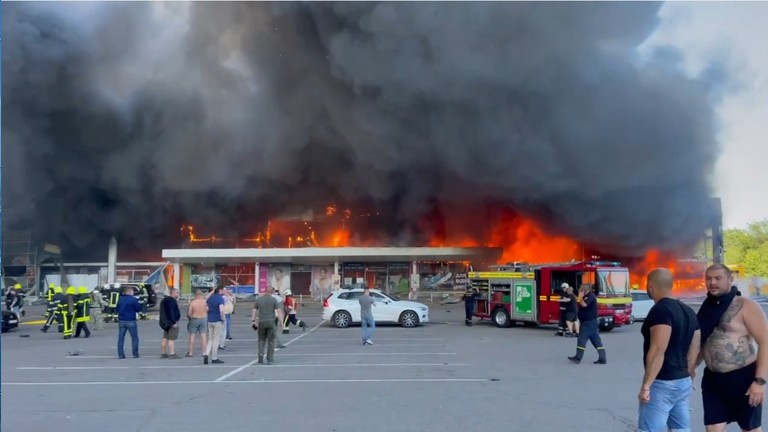
Fire at the Amstor shopping center in Kremenchug. Screenshot from footage published by Volodymyr Zelensky.
Samizdat | June 28, 2022
The Russian military has confirmed an airstrike on the Ukrainian city of Kremenchug on Monday, but claimed it targeted a stockpile of Western weapons. The detonation caused damage to a nearby non-functioning shopping mall, Tuesday’s report said. Kiev had claimed that Russia attacked the shopping center, killing and injuring many civilians.
The Russian Defense Ministry said the location of the arms stockpile was near the Kredmash factory. The Amstor Mall, where a fire was reported by Ukrainian sources on Monday, is right next to it. The military claimed that the Western munitions detonated and caused a fire at the facility, which was no longer operating.
Ukrainian officials claim that the mall was packed with people at the moment Russia allegedly attacked it. However, video showed that the car park outside was almost empty.
According to the latest casualty report, 18 people were killed and 59 injured in the incident, with 25 of the wounded taken to the hospital for treatment.
Ukrainian President Volodymyr Zelensky described the incident in Kremenchug as “one of the most blatant terrorist attacks in European history.” He stated that the site posed no threat to the Russian military and had no strategic value.
Kremenchug is a city in central Ukraine around 250km southeast from Kiev. The Russian military had previously attacked a major oil refinery in the city, denying the Ukrainian military fuel for their vehicles.
Belarus’ Lukashenko Calls Lithuania’s Blockade of Kaliningrad ‘De Facto Declaration of War’
Samizdat – 25.06.2022
Belarus’ President Alexander Lukashenko has condemned Lithuania’s move to block all ground communications between Russia and its exclave of Kaliningrad, calling it a “de facto declaration of war”.
“Recently, there has been increasingly more information emerging about [Lithuania’s] plan to stop transit from Russia through Belarus to Kaliningrad. It’s like declaring some kind of war. This is unacceptable in today’s environment,” Lukashenko said.
He added that he had grown concerned with the confrontational rhetoric of some of Belarus’ neighbors, namely Poland and Lithuania, as well as NATO nuclear-capable aircraft flights near the Belarussian borders. Lukashenko stated that Belarus should be ready for anything, including to use the “most serious weapons” available to defend the Union State of Russia and Belarus.
In light of this, the Belarus president asked his Russian counterpart to help modernize the country’s aircraft to be able to carry nuclear bombs. Russian President Vladimir Putin, in turn, notified Lukashenko that Russia decided to ship several 9M723 Iskander-M (NATO reporting name SS-26 Stone) mobile short-range ballistic missile systems.
Iskander launchers can handle both conventional and nuclear short-range missiles. However, Putin did not specify which ammunition will be supplied with the Iskander-M’s shipped to Belarus.
Russia earlier harshly condemned Lithuania’s announcement of plans to cut all goods transit from Russia to Kaliningrad in reported accordance with EU sanctions. The move leaves Russia with a maritime route to reach its exclave.
The Kremlin slammed the decision as a “blockade” and vowed to respond in kind and decisively, but has not elaborated on the measures yet. Moscow also reminded Lithuania that it was bound by an agreement with Russia that mandates that it must allow Russian goods to flow unimpeded to Kaliningrad.
Strategic city in Donbass ‘freed’ – Russia, France 24
Samizdat – June 25, 2022
The major city of Severodonetsk has come under the full control of the Lugansk People’s Republic, Russian military spokesman, Lieutenant General Igor Konashenkov, said in a statement on Saturday.
He said the LPR cities of Severodonetsk and Borovskoye, along with the settlements of Voronovo and Sirotino, had been “completely liberated” following “successful offensive operations” by republic’s forces, which were supported by Russian troops.
Today’s announcement means “the entire left-bank territory of the Seversky Donets river within the borders of the Lugansk People’s Republic has come under its full control,” the spokesperson added.
Earlier this month, Ukrainian President Volodymyr Zelensky called Severodonetsk “an epicenter of the confrontation in the Donbass.”
“In many ways, the fate of our Donbass is being decided there,” he claimed.
On Friday, Sergey Gaidai, whom Ukraine considers to be the head of Lugansk Region, announced that the country’s troops had been ordered to leave Severodonetsk. Earlier, he said that 90% of the city had been destroyed.
With the war in Ukraine passing the four-month mark on Friday, Russian forces continue to seize territory in Donbass.
African leaders shun Zelensky

Samizdat | June 25, 2022
Just a handful of African heads of state tuned in to personally listen to Ukrainian President Volodymyr Zelensky as he accused Russia of holding their continent “hostage,” amid ongoing Western attempts to pin the blame for the global food crisis solely on Moscow.
Few details emerged from Zelensky’s virtual meeting with the African Union, held behind closed doors on Monday, more than two months after the Ukrainian leader first tried to arrange a conference with the continent’s leaders. Out of 55 nations only four were represented by heads of state, while the rest sent subordinates, according to the BBC. However, Le Journal de l’Afrique claimed only a handful of ambassadors and ministers were actually present.
“They are trying to use you and the suffering of the people to put pressure on the democracies that have imposed sanctions on Russia,” Zelensky told the African Union representatives, adding that “Africa is actually a hostage… of those who unleashed war against our state.”
Following the conference call, the President of Senegal and AU Chairperson, Macky Sall, indicated that Africa’s position of neutrality over the conflict remains unchanged. Roughly half of African states refused to support the UN General Assembly’s resolution to condemn Russia’s actions in Ukraine, and no country on the continent has so far joined the sanctions.
“Africa remains committed to respect for the rules of international law, the peaceful resolution of conflicts and freedom of trade,” he said in a tweet, thanking Zelensky “for his friendly address to the virtual meeting of the AU Extended Bureau.”
During his meeting with Russian President Vladimir Putin in Sochi earlier this month, President Sall said Western sanctions against Russia threaten Africa with a food security crisis. Last week he noted that the exclusion of Russian banks from international payment systems makes it harder for African states to pay for grain, while Europeans made exceptions for gas and oil that they need. This Friday, he joined a BRICS+ video conference, where Putin also criticized the West for its “cynical attitude” towards the food supply of the developing nations.
The EU has repeatedly expressed concerns over the prospect of a food crisis if Ukrainian grain cannot reach its traditional markets.
On Friday, German Foreign Minister Annalena Baerbock echoed Zelensky’s “hostage” claims, accusing Moscow of “deliberately” using global hunger as “a weapon.” Simultaneously, foreign ministers of the G7 denied that anti-Russia sanctions have any impact on the global food crisis.
Ukraine, a major grain producer, has been unable to export its grain by sea due to the ongoing conflict, with an estimated 22 to 25 million tons of grain currently stuck at the country’s ports. Western nations have accused Russia of blocking the ports, while Moscow has repeatedly stated it will guarantee safe passage for grain shipments if Kiev clears its ports of its own mines. It also suggested exporting the grain through the Russian-controlled ports of Berdyansk and Mariupol.
Russian forces encircle thousands as Ukrainian troops begin surrender
Samizdat – June 24, 2022
Up to 2,000 Ukrainian troops, nationalists and foreign fighters have been surrounded by the Russian forces and the Donbass militias, Moscow revealed on Friday. The forces were encircled in two neighboring towns in the Lugansk People’s Republic.
Four Ukrainian battalions. as well as an artillery unit are among those trapped, Russia’s Defense Ministry announced. The encircled forces also include around 120 fighters from the notorious Ukrainian ‘Right Sector,’ a neo-Nazi group of up to 80 foreign fighters, according to the ministry.
The troops have been surrounded in the towns of Gorskoye and Zolotoye, located south of the major cities of Severodonetsk and Lisichansk, which have recently become one of the major targets for both sides amid the continued fighting for the territory of the Donetsk and Lugansk People’s Republics.
The Russian military has also claimed that the surrounded units have lost over 60% of their strength. According to the defense ministry, 41 Ukrainian soldiers encircled in the area have surrendered. The Defense Ministry has also published a video supposedly showing the surrendered soldiers.
The head of the Ukrainian Gorskoye military administration, Aleksey Babchenko, confirmed to the Ukrainian media on Friday that the town has been fully seized by the Russian forces and the Donbass militias.
Sergey Gaidai, who Ukraine calls the head of the “Lugansk Oblast,” has also said on Telegram that the Ukrainian forces might soon retreat from Lisichansk since their defensive positions had been destroyed by the Russian forces and there is “little sense” in staying.
The Russian Air Force has also successfully hit a Ukrainian artillery battery equipped with the US-made M777 howitzers in the Kharkov region. Earlier, Washington vowed to supply 90 such artillery pieces to Kiev, according to a May report by the New York Times.
The news comes just days after the Russian military claimed to have killed hundreds of Ukrainian troops in a strike on a shipbuilding plant in the Ukrainian port of Nikolaev. Last week, the defense ministry also claimed to have killed scores of Ukrainian officers after striking a compound where a meeting of commanders of several Ukrainian units was taking place.
Pfizer CEO says “beauty” of mRNA will allow for annual doses
TCS WIRE | June 22, 2022
Pfizer CEO Albert Bourla touted the “beauty” of mRNA vaccine technology in a recent MSNBC interview, saying he fully expects the Coronavirus to require an annual dose.
“Do you think we’re going to get updated mRNA vaccines every season that will be directed to each new variation of the Coronavirus, and will we have to take those shots every year?” asked the host.
“I’m almost certain about it, and I say almost certain because, of course, regulators have the final say on all of that, but that’s the beauty of mRNA. You can adapt your vaccine just by changing the sequencing, which is a very minor change,” said Bourla.
“For this reason, I’m very confident we will be able to respond very, very fast to every new variant.”
Prime Minister Justin Trudeau recently lifted travel mandates and vaccine requirements after facing widespread pushback from the public and airlines.
When lifting the mandates, the Liberals maintained they were only temporarily suspending the restrictions citing the threat of future waves.
“The reality is, as much as people would like to pretend that we’re not, we’re still in a pandemic,” said Trudeau early in June.
“There are Canadians who die every single day because of COVID-19 in our hospitals.”
Bourla has stated in the past that anyone who spreads misinformation regarding Coronavirus vaccines or potential side effects were literally criminals responsible for millions of deaths.
“Those people are criminals,” Bourla told Atlantic Council CEO, Frederick Kempe. “They’re not bad people. They’re criminals because they have literally cost millions of lives.”
“The only thing that stands between the new way of life and the current way of life is, frankly, hesitancy to vaccinations,” he added.
Canada’s Chief Public Health Officer Theresa Tam echoed fearmongering about a theoretical future wave earlier this month.
“The pandemic is not over,” Tam said. “We think that it is very likely that we will get some more viral activity in the future, and we can’t predict exactly how big the next wave is, but I think we need to prepare.”
Trudeau wasted over $100 million on expired vaccines
The Counter Signal | June 21, 2022
The 13.6 million expired AstraZeneca vaccines that Trudeau donated to foreign countries is estimated to have cost Canadian taxpayers over $100 million.
As per a report from the National Post, “According to a document tabled in the House of Commons last week, the government disposed of roughly 1.2 million doses of Moderna vaccines that expired either in mid-March or mid-April this year.”
“But that wastage is just a drop in the bucket compared to the nearly 13.6 million doses of AstraZeneca vaccines that the government donated to other countries last year and that sat in the manufacturer’s warehouses until they expired, according to new data provided to the National Post by Health Canada.”
According to the Financial Times, doses of AstraZeneca were priced at roughly $3 to $4 per dose when mass-produced, and governments secured orders of the COVID vaccine.
But this is inaccurate in the case of Canada. Trudeau managed to bungle the deal and secured 20 million doses at more than double that price.
“The only cost per dose revealed so far was released by accident when the price for the AstraZeneca-Oxford vaccine was accidentally left in an email included in a package of documents released to the health committee. That email said Canada would pay $8.18 per dose of AstraZeneca, which would amount to $163 million for the 20 million doses ordered,” the CBC reported in June 2021, just a month before Trudeau announced he’d be donating most AstraZeneca vaccines to foreign countries.
At $8.18 per dose of AstraZeneca, that means that the Trudeau government is estimated to have spent a whopping $111,248,000 on vaccines that were never needed or even wanted, as COVAX was flooded by other countries similarly pawning off their unwanted AstraZeneca vaccines after it was found to cause blood clots.
Indeed, the original agreement was to send even more AstraZeneca vaccines to COVAX that would expire — a total of 17.7 million.
And that’s just for AstraZeneca. Both the Moderna and Pfizer vaccines — for which Canada paid a premium — were even more expensive, and many of these are also either already expired or will expire soon.
However, even this is just the tip of the iceberg regarding how much Trudeau sent to COVAX.
In July 2021, the Trudeau government donated an additional $10 million to COVAX, which was on top of a $440 million in prior donations.
Overall, had the PM had better foresight or financial planning, hundreds of millions of dollars could have been saved throughout the pandemic.
European Commission approved Lithuania blockade of Russia’s Kaliningrad
Samizdat | June 20, 2022
Lithuania’s decision to block the transit of goods by rail from Russia to Kaliningrad – the country’s western-most exclave that sits between Poland and Lithuania – was made after consulting and getting the approval of the European Commission, Foreign Minister Gabrielius Landsberg said on Monday.
Landsberg made the statement during an EU foreign ministers meeting, where he explained that starting June 17, Lithuania would no longer allow the transit of sanctioned goods through its territory. “This decision was made after consultations with the European Commission and implemented under its guidance,” the minister said.
Last week, Kaliningrad Region Governor Anton Alikhanov warned that the authorities in Vilnius were planning to cut the rail transit of goods from other parts of Russia to the region.
On Saturday, Lithuania’s state-owned rail operator confirmed it would partially halt the transportation of goods to Kaliningrad, which Alikhanov claims will affect up to 50% of all cargo flow to the region.
Russian officials have stated that Lithuanian’s move is an egregious breach of international law and akin to a full blown economic blockade and an attempt to “place the region in an economic chokehold.”
Russia has warned that unless the ‘blockade’ of Kaliningrad is lifted immediately, Moscow may have no choice but to “untie its hands” and rectify the situation by any means necessary.
Many countries, including EU member states, imposed sweeping sanctions on Russia in response to the military campaign in Ukraine launched by Moscow in late February. The European bloc closed its airspace to Russian aircraft on February 27, and Moscow responded in kind, banning many European airlines.
Weapons shipped to Ukraine being sold in black markets
By Uriel Araujo | June 20, 2022
The same way sanctions are not working and are backfiring, Western massive arms transfers to Kiev have been a disaster, from anyone’s perspective. In an interview to US “National Defense”, Ukrainian Army Brigadier General Volodymyr Karpenko has admitted his country lost almost 50% of all weaponry and equipment it received. Some of it got destroyed, but that is not the whole story.
Russian Channel One reported on how the Ukrainian military abandons weapons as they retreat. The abandoned US-made Javelins and German anti-tank mines were filmed. Moreover, weaponry sent to Ukraine is ending up in black markets and is being sold in the so-called darknet and deep web platforms. There, one can buy Javellin anti-tank systems for about $ 30,000 or British NLAW systems for half the price. There is a demand for that, of course. Terrorists and criminal gangs are the buyers.
This situation has alarmed the Interpol and other international and European bodies. Already on May 28, Europol director Catherine De Bolle voiced her concerns about the war increasing the inpourring of arms into the continent’s black markets. Such weapons could reach political players in the Middle East involved in local conflicts, and spread all over the region, even reaching currently unstable locations such as Somalia, Sudan, Yemen, and Egypt. Arms shipments to Bosnia, Kosovo and Albania are in fact being investigated and such can aggravate the security problem in the Balkans – and in the Sahel also.
The so-called Islamic State or ISIS, the terrorist organization also known as the Daesh, is reorganizing itself this time in the Sahel, according to Victoria Nuland herself (the US Under Secretary of State for Political Affairs), who has stated so in May. There are reports that criminal groups in Albania and Kosovo are selling arms to ISIS.
Russian Foreign Ministry Spokesperson Maria Zakharova stated on June 9 that “arms shipment to Ukraine will lead to the emergence of an arms black market, especially in Western Europe.” Interpol Secretary General Jurgen Stock has voiced similar concerns about Africa and the Balkans becoming the destination of Western arms supplied to Kiev, as reported by Le Figaro news. He said: “The wide availability of weapons during the current conflict will lead to the proliferation of illicit weapons in the post-conflict phase.” Actually, this is already happening, as seen in the dark web.
It is a well known fact that the Ukrainian armed forces are incredibly corrupt. Ukraine has long been believed to be one of the major arms trafficking markets in Europe. It has also emerged as an import transit destination for drugs such as heroin. It has the third highest criminality score of 33 countries in Europe. In today’s world, illict trade plays a major role in the financing of terrorist and extremist networks globally.
In November last year a club in Kiev was the target of a homophobic terrorist attack. It was stormed by masked men and later an explosive device was thrown at the building. Centuria, a Ukrainian paramilitary group with links to the Azov Regiment (formerly known as the Azov Battalion) seems to be behind the crime. No one was killed, but this ultra-nationalist group already patrols Ukraine’s cities. With the war, the migration crisis and the black market, Europe could see armed groups and terrorist attacks such as these spreading to its capitals.
In 2019 a senior Daesh leader, Al-Bara Shishani, was arrested in Ukraine and Azov leaders are known to sympathize with the group, even adopting some of its tactics. As early as 2015, collaboration between Islamic radicals and Ukrainian militias has been reported.
In December 2021, before the current crisis, I wrote that should a war ensue, Ukraine would be defeated by Russia (for a number of reasons), but far-right Ukrainian groups – aided and armed by NATO and possibly by Turkish ultra-nationalist networks – could remain active in sabotage and terrorism operations, thus turning the “post-conflict” phase into a long nightmarish “frozen conflict” scenario of counter-insurgency and irregular warfare.
Amid the humanitarian catastrophe, I wrote, the European continent should expect an increase in terrorism and crime amid an increasing migration crisis. Of course most of the refugees are law-abiding families escaping the tragedy of war, but paramilitary men and extremists can make their way into Western Europe too – and Ukrainian Neo-Nazism has been largely white-washed. European far-right militias already cooperate with Ukraine’s nationalists, and the country is already a new hub for far-right activity. Isaac Kfir, a Charles Sturt University Professor and part of the International Institute for Justice and the Rule of Law advisory board, has warned that Ukraine has the potential to become “the Syria of the extreme right”.
In the same way US-led Western policies – directly or indirectly – aided both the Al-Qaeda and the Daesh, there is every reason to believe that in a few years Europe will be haunted by a new kind of far-right terror reminiscent of the infamous Gladio Operation, when Washington funded European far-right groups as a secret anti-Soviet army during the Cold War.
One can only wonder why European leaders would be so ready to accept these risks. This is the true reason countries such as Germany, Greece, Hungary, and even Israel have at times been reluctant to further arm Kiev or to allow weapons transit. It appears that from an American perspective Europe itself is but another US proxy.
Uriel Araujo is a researcher with a focus on international and ethnic conflicts.
Nord Stream Can Stall Completely in the Event of New Turbine Problems: Russian UN Envoy
Samizdat | 16.06.2022
The pipeline, which supplies a significant proportion of the natural gas imported by Germany, reduced its output to just 60% after its operator failed to receive one of the turbines that pump the gas from maintenance in Canada due to anti-Russia sanctions. The warnings of a further reduction in the capacity prompted a 25% spike in EU gas prices.
Further problems with the repair and maintenance of turbines that pump the gas flowing through the Nord Stream pipeline could bring a halt to its operation, Russia’s Permanent UN Ambassador Vladimir Chizhov has warned in his speech at the St. Petersburg International Economic Forum (SPIEF).
Such scenario would be a disaster for Germany, which significantly depends on gas supplies from this pipeline, Chizhov added.
“We should ask [the turbine’s manufacturer] Siemens, why the turbines must undergo maintenance in Canada. […] I don’t want to give any advice, but I think they could have learnt by now how to repair [turbines] themselves”, Chizhov said.
The UN envoy further called EU plans for a seventh sanctions package against Russia a “strategic mistake”. He added that Russia will start dealing with its consequences once the sanctions package is adopted.
The anti-Russia sanctions are the reason why German giant Siemens can’t return Russia’s Nord Stream turbines, which had been sent to Canada for maintenance. Siemens said that it was looking into ways to solve the problem.
While the German company is looking for a solution, the Russian company Gazprom announced on 14 June that Nord Stream’s output capacity had fallen to 60% due to an inability to retrieve the turbine which had undergone maintenance. Its output dropped to 100 million cubic metres versus 167 million per day at peak. The company warned that it would be further reduced on 16 June to 67 million cubic metres per day for the same reason.
On the news of a further reduction in Nord Stream output capacities, the price of gas in Europe jumped 25% in one day (15 June) exceeding $1,300 per thousand cubic metres. On the trading day’s opening the price was up 2% compared to around $1,069 per thousand cubic metres as of the close of the previous day’s trading.
Israel, Egypt and EU sign gas export deal
Samizdat | June 15, 2022
Egypt, Israel, and the European Union have signed a deal to boost shipments of liquified natural gas (LNG) to EU member states, Sky News Arabia reported on Wednesday. Brussels hopes the agreement will help it to reduce energy dependence on Russia.
“The deal will see Israel sending more gas via Egypt, which has facilities to liquify it for export by sea,” European Commission chief Ursula von der Leyen said at a joint news conference alongside the Egyptian and Israeli energy ministers.
In 2021, the EU imported some 40% of its gas from Russia. The heavy reliance on energy purchases from the country makes it difficult for the bloc to expand its Ukraine-related sanctions.
The gas destined for European consumers is expected to go from Israel via a pipeline directly to Egypt’s LNG terminal on the Mediterranean coast before being loaded onto tankers and shipped north to the European market.
Some Israeli gas is already being sent by pipeline to liquefaction plants in Egypt, where it is liquefied and re-exported. Israel reportedly operates two gas fields off its Mediterranean coast holding an estimated 690 billion cubic meters of natural gas combined, while a third offshore rig is in the works.
Egypt is also a gas producer, but its exports have been limited by rising domestic demand. At the same time, the country’s large-scale natural gas facilities on the Mediterranean have remained mostly inactive since the country’s 2011 uprising that led to the overthrow of then-President Hosni Mubarak.
The Egyptian government has modernized the facilities in recent years and has ambitions to become a regional energy hub.
Featured Video

Iran FM Araghchi: “Hormuz Will No Longer Be the Same”
or go to
Aletho News Archives – Video-Images
From the Archives
Sam Husseini: The entire US establishment helped lie their way into the Iraq war
By Slava Zilber | American Herald Tribune | October 14, 2019
Sam Husseini is a senior analyst with the Institute for Public Accuracy, independent journalist and contributor to The Nation and FAIR.
Slava Zilber: Sam, three years ago, you appeared on Talk Nation Radio with David Swanson and spoke about the case of the GCHQ whistleblower Katharine Gun. You pointed out that the people involved in the spying on the UN and the people authorizing the Iraq War were not held accountable:
“Virtually everybody who went along with the war, whether it is Kerry or Clinton, of course, the Bush administration themselves has falsified their own records in terms of why, what they did, when they did, why they did it, to the extent that they’ve been scrutinised at all.”
You also address it in a recent article. And recently, Joe Biden has been lying about his position on the Iraq War. How can such an important issue escape meaningful scrutiny? … continue
Blog Roll
 Aletho News
- China slams US policy on Iran as Russia rejects legality of nuclear meeting at UN
- The Mecca Pact Courts Iran: Containment Comes Full Circle
- Oman FM: Persian Gulf states, Iran, Iraq should form security pact excluding US
- Trump peddles fresh falsehoods, claims Iran ‘started the war’ as US aggression drags on
- Ukraine quagmire? Yes, but it’s for NATO, not Russia
- US intelligence hypes Chinese, Russian space threats while accelerating its own military buildup in orbit
- Iran FM Araghchi: “Hormuz Will No Longer Be the Same”
- EU facing trillion-euro debt hole while seeking more cash for Kiev
- How US, Europe, Persian Gulf states exhausted missile stockpiles, splurged billions to defend Israel
- Up in arms… Koreans reject U.S. empire’s plan to make South Korea the next Ukraine
- If Americans Knew
- An error has occurred; the feed is probably down. Try again later.
- No Tricks Zone
- Sudden Stratospheric Warming, Powerful El Niño Combination May Lead To Extreme Europe Cold, Energy Crisis!
- Two New Studies Find Thwaites Glacier Melt Cannot Be Driven By Human Activity Or A Warming Ocean
- E-Cars Reduce CO2 Emissions By Only 41% Compared To Internal Combustion Engine Vehicles
- Predictions Made By Renowned Climate Professor Over Past Decades Have Been Proven To Be Poor
- New Study Suggests Large Regions Of The Pacific Ocean Have Been Cooling For The Last 80 Years
- Germany’s Green Energy Debacle: High Energy Costs Force Kahla Porzellan to Close After 182 Years!
- New Study: 50 Years Of The Most Aggressive ‘Net Zero’ Policies Can Only Affect The Global Climate By 0.03°C
- US September “Heat” Was No Record…Many Records Set Decades Ago
- Latest European Green Energy Debacle; Portugal’s Largest Flagship Solar Park Insolvent!
- Green Energy Debacle: German Expert Professor Fritz Vahrenholt Warns Of Severe Economic And Social Consequences

