The Ideology of the NHS
When it comes to vaccines for children
The Naked Emperor’s Newsletter | June 6, 2022
Last July, the Joint Committee on Vaccination and Immunisation (JCVI) in the UK advised that children at increased risk of serious coronavirus (COVID-19) disease should be offered a vaccine. However they said that they are “not currently advising routing vaccination of children outside of these groups [with underlying health conditions], based on the current evidence.
In December, the JCVI advised that children aged 5-11 years in a clinical risk group, or who are a household contract of someone who is immunosuppressed should be offered primary course vaccination.
Then, in February of this year, the JCVI advised that a non-urgent offer of the Pfizer vaccine would be made to children aged 5 to 11 years of age who are not in a clinical risk group.
Not many parents took up this non-urgent offer for their children. The JCVI clearly did not think vaccinating young children was necessary, so included the strange wording of ‘non-urgent offer’.
However the vaccine ideologues in the National Health Service (NHS) had other ideas. Does it matter that the experts don’t think it’s necessary? No, we must vaccinate everyone. Vaccines are good. Vaccines will save us. Vaccines are our road to redemption.
NHS trusts began writing to children directly, using blank envelopes, almost as if they were attempting to bypass the parents. A Telegraph article reported that
“A brightly coloured letter covered in flowers, rainbows and bumblebees said the recipients could now book a vaccination and it provided a link to where they could do so. It also contained an unmarked packet of sunflower seeds, “to help bring some joy and sunshine into children’s live”, the letter read”.
It’s verging on being semi-religious or cult-like.
Another parent said their child’s letter said “Come and see our superheroes and princesses at the vaccination centre. Feel free to dress up!”.
I understand the need for the bureaucrats in the NHS to be seen to be doing something but seriously, back off. The experts have clearly shown that Covid vaccination is not urgent or necessary for young children, so it is not for the NHS bureaucrats to think they know better.
And why the blank envelopes and addressing children directly? It is all getting a bit sinister whether it is being done with the best of intentions or not. This type of coercion does not sit readily with informed consent.
Now, the NHS have updated their vaccination schedule to include the COVID-19 vaccine for 5-15 year olds.

Again, this does not allow informed consent because, by listing it with the usual vaccines, it will be seen as something that should be done, instead of the non-urgent offer that it actually is.
Many parents will be guilt-tripped in to vaccinating their children because they won’t want to answer awkward questions when they visit their GP. Why is there a missing vaccination on your child’s record? Ok jab them doctor, just don’t tell social services.
The NHS bureaucrats need to take a step back, stop trying to do something to make themselves seem useful and most importantly, stop trying to circumnavigate parental consent.
UK fighters in Ukraine conflict sentenced to death
Samizdat | June 9, 2022
A court in Donetsk has sentenced to capital punishment three people, who came to Ukraine to join the Ukrainan forces against Russia. British citizens Aiden Aslin and Shaun Pinner, as well as Moroccan citizen Saadun Ibrahim, were found guilty of mercenarism and attempt to seize power by force by the Donetsk People’s Republic (DPR) on Thursday.
Under the laws of the DPR, forcible seizure of power carries a penalty of 12-20 years behind bars, but could be escalated to capital punishment due to wartime aggravating circumstances. Being a mercenary is punishable by a prison sentence of three to seven years.
The DPR, which was recognized by Russia as a sovereign state, tried the three foreigners on several criminal charges. They pleaded guilty to joining a terrorist orgainzation and attempting to forcefully topple the government in Donetsk, but denied being mercenaries hired by Kiev.
The three fighters were captured in or near Mariupol, a port city that the DPR claims as part of its sovereign territory. It saw weeks of intensive fighting and a blockade of remaining Ukrainian troops at a steelmaking plant.
London demanded that its citizens were treated as prisoners of war under the Geneva Conventions despite not formally being at war with the DPR. The Donetsk government said it considered them mercenaries, who are not granted the same privileges as regular combatants, since they were not part of any regular army.
Flight cancelled? Blame government vaccine policy, not the airlines
By John Le Sueur | TCW Defending Freedom | June 9, 2022
HAS the thought ever occurred to you that when you travel by air you are nothing more than a piece of meat with a credit card as far as airline management is concerned?
All over the Western world we are hearing reports of flight cancellations, airport chaos and stranded passengers. We see it in Britain, and we saw it over the US Memorial Day weekend at the end of last month. Why?
There is no doubt that the lockdown response to the Covid pandemic devastated international travel, causing aircraft to be mothballed in airline ‘boneyards’. Those aircraft not put into storage were sold, often for their parts. Several airlines declared bankruptcy.
Crew and ground staff were laid off or sacked. British Airways alone shed 10,000 employees. Many took the opportunity to retire early.
Now, savaged by rotten Government decisions, the industry is desperately trying to come back to life.
While chaos reigns, the UK’s imbecile transport minister, Grant Shapps, blames the airlines, not the government he belongs to. They cut too many jobs during the pandemic, he has the cheek to say. What were they meant to do? It wouldn’t surprise me if his woke opposite number in the US, Secretary of Transportation Peter Buttigieg, is blaming racism, the needs of the LGBT community or any other vacuous reason he can find.
None of these foolish transport ministers and the governments behind them shows any signs of telling the truth, merely shifting the blame.
Of course airlines will trot out all sorts of excuses too in their determination to appear to provide a service and get flight bookings on aircraft that might not exist, or if they do, will not have a crew to fly it. How can they do this when they still don’t have the ground staff to check you in and process your luggage? They could be said to be behaving like conmen, the victim being the stranded or disappointed traveller.
The elephant in the room concerning staff shortage and specifically pilot shortage is Covid vaccination.
Pilots are not fools, and many took very seriously what they read and studied on the ‘vaccines’, in particular that they had no reliable short-term or long-term safety profile, and that early evidence showed they were liable to cause health problems. When airlines and governments started to impose vaccine mandates on air crew, many pilots retired or were sacked for refusing to comply.
That is not the only problem: of those who did comply, often reluctantly, and are still flying you around, many are suffering vaccine-induced side effects. No one knows the exact numbers, but the US Freedom Flyers pilots’ association say they have received hundreds of reports. These are pilots who would fail a medical because of their health conditions but are still flying.
Who is really to blame? We will know when various court cases against airlines and governments all over the world about an unsafe vaccine being mandated to pilots and aircrew reach their conclusions. Notably, the Dutch Airline Pilots Association (VNV) have won their court case against mandated vaccinations for new pilots.
The bottom line is that any pro-lockdown, pro-vaccine government is to blame. The political leaders of the West who imposed these programmes bear a heavy burden. They have allowed many to be killed and injured by an unsafe vaccine. They have destroyed businesses and livelihoods, and created social and economic chaos.
In the case of the airlines, their message ‘get jabbed to protect others’ could not have proved more contrary to the outcome. Far from protecting the pilots or the passengers, it has catastrophically compromised them.
That is why we have a pilot crisis, and it’s going to get worse for some time.
Zuckerberg, Rockefeller, Google and the Privatization of Election Integrity

By F. William Engdahl – New Eastern Outlook – 08.06.2022
Through deceit and capitalizing on loopholes in US law for non-profit entities, private corporate and foundation interests have and are pouring vast sums of money to corrupt the US election process in the interest of a dystopian Green Agenda and worse. It consists of a complex network of interests including Facebook founder Mark Zuckerberg, Google, Rockefeller funds. The evidence is that this is all being covertly orchestrated by US intelligence agencies to impose a destructive economic and social agenda on the US tied to the Davos Great Reset and UN Agenda 2030.
Increasing evidence is coming to light detailing the hijacking of the core of the American elections system that not only sheds light on the 2020 US elections, but also on private financing the very infrastructure of local election clerks and election procedures including drop-box mail-in balloting and expenses of city and county election offices. The room for abuse is staggering as the process is not transparent. At the heart of this is a little-known “non-profit” known as the oddly-named Center for Tech and Civic Life or CTCL. The alleged creator of CTCL and current head is a former Obama Foundation Fellow, Tiana Epps-Johnson. A close scrutiny of her CTCL funders and operations suggest she was simply chosen as a convenient vehicle by very powerful foundations and Big Tech companies to transform the very structure and control of the American elections process.
Center for Tech and Civic Life
Epps-Johnson founded CTCL in 2012, when she was in her 20s. By 2019 she was in the big leagues when Facebook’s Mark Zuckerberg and his wife Priscilla Chan gave CTCL several donations totaling over $419 million to influence the 2020 US elections. How this was done is a study in sophisticated and patently illegal election manipulation.
Stalin once said “Those who vote decide nothing. Those who count the vote decide everything.” Today he might add, “Who controls the Ballot Drop Boxes also controls the vote.” This is the focus of Zuckerberg and the CTLC.
In the US political system each state is responsible for the conduct of election laws. In the run-up to the 2020 elections, following irregularities in the 2018 mid-term Congress elections where Democrats took majority in both houses, Republicans began pointing to a move by radical Democrat states like California, New York, Illinois or Michigan to open the floodgates to potential fraud by not requiring voter photo ID photo, or even standard restrictions on mail-in voting such as postmark or signature. Presently no proof of photo ID is required to cast a vote in 15 states including the most populous states of California, Illinois, New York, Pennsylvania, Arizona and Minnesota.
Follow the Money
In the crucial November 2020 US election, CTLC played an unprecedented, highly-sophisticated and clearly highly corrupt role to influence the outcome in favor of Democratic candidates, especially Joe Biden as President. It was thanks to donations totaling $419 million, nearly half a billion dollars, from Facebook founder Mark Zuckerberg and his wife, through their $86 billion tax-exempt foundation. The crucial point was how and where the money was given out.
According to the CTLC website, they opened applications to any local election commission requesting funds, allegedly on a non-partisan basis. The money went direct and state legislatures or government had no control over it, contrary to what is written into the US Constitution. The grants or free funds were officially “TO SUPPORT THE SAFE ADMINISTRATION OF PUBLIC ELECTIONS DURING THE COVID-19 PANDEMIC.” Here is where it gets interesting.
The states where covid lockdowns and social measures were most severe were precisely the key Democratic-run states asking no voter ID and imposing massive mail-in voting “because of covid restrictions” as noted above, like California, Illinois, Pennsylvania or New York. CTCL announced grants to support unprecedented mail-in voting, including special drop-boxes in key locations to make voting by mail easier, and vote fraud as well. The grant monies could finance vast networks of drop boxes in key Democrat neighborhoods such as Philadelphia, where Democratic Party corrupt machines were in control. Money also might be spent in local election districts to “educate” poll watchers or “train” election officials. Oh, how could this go wrong?
By law, tax-exempt organizations are required to file detailed expenditure statements to the IRS tax department. The CTLC tax form for the crucial 2020 election year was filed on January 22, 2022. For the first time since the November 2020 elections, it gives a detailed picture of what Zuckerberg’s huge donations to CTCL bought. On the surface it appears that grants were indeed given to election commissions requesting regardless of whether it was a known democratic district or Republican. However, a detailed city or county breakdown shows the deception. In many states minimal grants of $5000 were doled out. Many of those went to known Republican areas. Not enough to do much of anything significant. But it allowed CTLC to claim non-partisanship.
But in the most notoriously corrupt democratic cities or counties the story was very different. For example the highly-populated Dallas County Texas where 65% voted Democrat, the County Election Commission got an eye-watering $15,130,433 from Tiana Epps-Johnson to spend as they saw fit. No details required. Neighboring Tarrant County where Fort Worth is, and 49% Democrat, was given $1,678,523, and Harris County where Houston is, and 56% Democratic, got a generous $9,663,446. Laredo Texas, a small town on the Mexican border got a juicy $2,435,169.
In Democratic-run Pennsylvania where major legal challenges of significant Democrat vote fraud in Philadelphia and Pittsburg were made, Tiana Epps-Johnson’s CTLC nonprofit gave $2,052,251 to Allegheny County (Pittsburg) and a generous $10,016,070 to Philadelphia, the “City of Brotherly Love.” That $10 million was granted even as the former Philadelphia Judge of Elections was convicted for his role in accepting bribes to cast fraudulent ballots and certifying false voting results during the 2014, 2015, and 2016 primary elections in Philadelphia. Keep in mind neither CTLC nor Zuckerberg nor any government, required any accountability for their generosity.
New York City Board of Elections, under then notoriously corrupt Democrat Mayor Bill DeBlasio (born Warren Wilhelm Jr), got a CTLC contribution of $19,294,627. In Democrat-run Michigan the notoriously corrupt Democrat-run Detroit election officials got $7,436,450 to organize the vote as they saw fit. All told, in the State of Michigan, where significant 2020 vote fraud was claimed and even documented before corrupt judges threw the evidence, CTLC gave an estimated $24 million to some 420 towns and county election commissions. In Democratic Illinois, notoriously corrupt Chicago, home of CTLC, was given $2,269,663 to play with.
In the hotly-contested state of Georgia where both Republicans and Democrats were accused of fraud and refusal to legally prosecute it, tens of millions of dollars flowed from CTLC to key Democratic areas such as Dekalb County (83% Democrat) which got $9,625,041. Fulton County (Atlanta) which got some $10.7 million. Gwinnett County Georgia by Atlanta got $6.4 million of a total for Georgia in 2020 of $40 million! Biden “won” the pivotal swing state by a mere 0.2% of a percent. A corrupt Republican Secretary of State refused to challenge the result despite ample evidence of fraud. Another hotly-contested “Swing State” in 2020, Arizona, also got millions for key counties from CTLC including fraud-documented Maricopa County which got $1,840,345. And Democrat-run California, got some $18 million in a state asking no voter ID.
‘Non-partisan’ Tiana and CTLC
What is exactly the Center for Tech and Civic Life whose website claims to be about “working to foster a more informed and engaged democracy, and helping to modernize US elections,”? Tiana Epps-Johnson in her own website modestly claims she is doing, “groundbreaking work to make US elections more inclusive and secure.” Bizarrely, she calls herself a “civic technologist,” whatever that is. Leave aside the fact that the most secure elections today are the classical in-person, ID verified paper ballot voting and not hackable Internet-accessible computer voting machines or mail-in or absentee ballots, which are banned in most developed countries. Outdoor Ballot Drop Boxes make vote fraud simple. This was the key to the Zuckerberg CTLC strategy
Tiana calls herself the founder and executive director of CTCL. Her Wikipedia bio reads like that of a typical spook, with no personal data such as family, birth. Her stated history begins with her as an undergraduate at Stanford where she allegedly got a BA. Quoting further from her website where she speaks of herself in third person, “Prior to CTCL, she was the New Organizing Institute’s Election Administration Director from 2012 to 2015. She previously worked on the Voting Rights Project for the Lawyers’ Committee for Civil Rights. Tiana… was selected to join the inaugural cohorts of Obama Foundation Fellows (2018) and Harvard Ash Center Technology and Democracy Fellows (2015). Tiana earned a MSc in Politics and Communication from the London School of Economics and a BA in Political Science from Stanford University.” That’s it, that is all the world knows about her background. Yet she is entrusted to dole out nearly half a billion dollars to influence the 2020 US elections? Her ties to Obama are so close such that she introduced the Democratic former President in April 2022 to a Stanford student audience for a speech on “disinformation,” for which Obama is clearly world-class expert.
Things become clearer when we look at the funders of this formerly obscure non-profit. In addition to Zuckerberg’s Facebook (meta), CTLC’s website lists Google, The Rockefeller Brothers Fund, eBay billionaire founder Pierre Omidyar’s Democracy Fund, the Knight Foundation, most notably. Clearly Tiana, the mysterious young “civic technologist” travels in very high-powered circles.
Google-YouTube Censors
In a May, 2022 journalist Dinesh D’Souza released a documentary detailing actual CCTV video footage of ballot drop box fraud across key states in the 2020 elections. It’s titled ‘2000 Mules’, a reference to some 2,000 paid vote fraudsters documented on surveillance CCTV video cameras. They are shown illegally delivering multiple votes to the special ballot drop boxes in key swing state cities like Philadelphia, drop boxes paid for by Zuckerberg’s CTLC election largesse. Without the special election temporary drop boxes, allegedly to accommodate the huge increase in mail-in voting in 2020 due to “covid,” the ballot stuffing in the key states would not have been possible. The “mules” were allegedly paid $10 per vote stuffed, and identified mules were filmed driving to several drop boxes in the dead of night wearing gloves to avoid fingerprint traces. D’Souza’s video has been banned on YouTube, a company owned by Google, the same Google which also donated to CTLC. Google enjoys close ties to the CIA as do most key Silicon Valley giants, allegedly also Zuckerberg. It is a spider’s web of Democrat NGO’s and tax-exempt foundations like Zuckerberg’s, who have de facto privatized American elections in a covert way Stalin could only have dreamed of.
Since 2020, some 14 states have passed laws forbidding private funding of elections. Similar bills have passed the legislature in another five states, including Pennsylvania, but have been blocked by Democratic governors.
COVID Vaccines Linked to New Type of Incurable, Fatal Degenerative Brain Disorder
By Megan Redshaw | The Defender | June 7, 2022
Studies suggest a link between an incurable and fatal prion disease known as Creutzfeldt-Jakob Disease (CJD) and COVID-19 vaccines.
Researchers believe the prion region from the original Wuhan COVID-19 variant’s spike protein was incorporated into mRNA vaccines and adenovirus vector vaccines — given to hundreds of millions of humans — and that it can cause a new type of rapidly progressing sporadic CJD.
According to Mayo Clinic, CJD is a degenerative brain disorder that leads to dementia and, ultimately, death.
Although the Omicron variant does not have a prion region on its spike protein, current COVID-19 vaccines still use the genetic material — including the prion region — of the parent Wuhan strain.
A French pre-print paper published in May on CJD and COVID-19 vaccination identified a new form of sporadic CJD that occurred within days of receiving a first or second dose of Pfizer or Moderna COVID-19 vaccines.
Researchers analyzed 26 cases of CJD and found the first symptoms appeared on average 11.38 days after injection with a COVID-19 vaccine.
Of the 26 cases, 20 had died by the time the study was published and six were still alive.
“The 20 deaths occurred only 4.76 months after the injection. Among them, 8 of them lead to a sudden death (2.5 months),” researchers wrote.
“This confirms the radically different nature of this new form of CJD, whereas the classic form requires several decades,” wrote the researchers.
Dr. Jean-Claude Perez, lead author of the French study, on June 6 told The Epoch Times that all 26 cases resulted in death.
According to the Centers for Disease Control and Prevention (CDC), prion diseases are a family of rare progressive neurodegenerative disorders that affect humans and animals. Prion diseases are usually rapidly progressive and always fatal.
Although prions occur naturally in the brain and are usually harmless, they can become diseased or misfolded, affecting nearby prions and causing them to become misshapen.
The abnormal folding of the prion proteins “leads to brain damage and the characteristic signs and symptoms of the disease,” the CDC’s website states.
Sporadic CJD occurs when a person becomes infected for no apparent reason. Once a single prion becomes infected, it will progress to other prions, and there is no treatment capable of stopping it.
Prion area of original Wuhan strain spike protein present in all COVID vaccines can interact with human cells
Although the Omicron variant does not have a prion region on its spike protein, French researchers said other COVID-19 variants, including the parent Wuhan strain used in currently administered vaccines, do.
“We are now studying the very first cases of patients with Omicron, in South
Africa, Europe and the USA and Canada in particular,” the researchers wrote. “In ALL of these cases, the Prion region has disappeared.”
However, the Wuhan variant’s spike protein gene information — including its prion region — was integrated into the Pfizer and Moderna mRNA vaccines and the AstraZeneca and Johnson & Johnson adenovirus vector vaccines.
“We have also demonstrated […] that the Spikes of the Pfizer and Moderna mRNA injections also contain this same Prion region,” the researchers wrote. “The same is true of ALL the other SARS-CoV2 vaccines since ALL are made from the Spike sequence of SARS-CoV2 from Wuhan, which we have demonstrated contains the Prion region.”
With mRNA vaccines, once mRNA is incorporated into the cells, the cell turns mRNA instructions into a COVID-19 spike protein that tricks the cells into believing it has been infected so the body will create an immunological memory against a piece of the virus.
With adenovirus vector vaccines, the DNA of the spike protein is carried into the cell through an adenovirus vector and then into the nucleus where all human DNA is stored. Once there, DNA is transcribed into mRNA and made into the spike protein.
A U.S. study published in Microorganisms in January 2022 showed the prion area of the SARS-CoV-2 spike protein incorporated into COVID-19 vaccines is able to interact with human cells.
Although the CDC says COVID-19 vaccines cannot “alter your DNA,” studies show mRNA can be changed into DNA and incorporated into the human genome.
A U.S. study speculated that a misfolded spike protein could create a misfolded prion region that may be able to interact with healthy prions to cause damage, leading to CJD disease.
A peer-reviewed case report published in Turkey and the French preprint identified sudden CJD cases appearing following vaccination with the Pfizer, Moderna and AstraZeneca vaccines, suggesting links between getting vaccinated and the disease.
A study published last year in Microbiology & Infectious Diseases found a potential link between Pfizer’s vaccine and prion disease in humans.
Despite the existence of new SARS-COV-2 variants, people are still receiving the original COVID-19 vaccines developed with the parent Wuhan variant’s spike protein.
Numerous cases of CJD reported in the U.S.
A U.S. case report in March highlighted 64-year-old Cheryl Cohen’s battle with CJD, which developed within days of her second dose of Pfizer’s COVID-19 vaccine.
The report stated:
“Here, we highlight a case of a 64-year-old woman who presents with rapidly declining memory loss, behavior changes, headaches and gait disturbance approximately one week following administration of the second dose of the novel Pfizer-BioNTech messenger ribonucleic acid (mRNA) COVID-19 vaccine.
“After extensive investigation, conclusive evidence identified the fatal diagnosis of sporadic Creutzfeldt-Jakob disease.”
In an exclusive interview with The Defender in Aug. 2021, Cohen’s daughter, Gianni, said her mother’s regression was “mind-blowing, confusing and truly heartbreaking.”
She went from being able to work and do normal everyday activities to being unable to walk, speak or control her body’s movement, Gianni said. Cohen felt as if her head was “going to explode” and died within three months of receiving her second dose of Pfizer.
In a written statement to The Defender, her physician said:
“This case identifies potential adverse events that could occur with the administration of the novel COVID-19 vaccine. Moreover, clinicians need to consider neurodegenerative diseases such as prion disease (e.g. sporadic Creutzfeldt-Jakob disease), autoimmune encephalitis, infection, non-epileptic seizure, toxic-metabolic disorders, etc. in their differential diagnoses when a patient presents with rapidly progressive dementia, particularly in the setting of recent vaccination.
“Although there is currently no cure for sporadic Creutzfeldt-Jakob disease (sCJD), early diagnosis is crucial to avoid the unnecessary administration of empiric medications for suspected psychological or neurological disorders.
“Furthermore, tracking adverse events could potentially lead to further characterization and understanding of both the novel COVID-19 messenger ribonucleic nucleic acid (mRNA) vaccine as well as the etiology of sCJD.
“More importantly, recognizing adverse effects provides individuals with vital information to make a more educated decision regarding their health.”
In another exclusive interview with The Defender, Jeffrey Beauchine said his mother, Carol, knew her Creutzfeldt-Jakob Disease was related to the Moderna shot. Watching her death was like “something you see out of a movie,” he said.
Beauchine said his mother received her first dose of Moderna on Feb. 16, 2021, and didn’t report any complaints. After getting the second dose on March 17, Carol immediately said she “felt different.”
Carol’s symptoms began with numbness that spread from the arm in which she received her injection to the entire left side of her body.
She complained that something was wrong with her brain, couldn’t put thoughts together or make sense of things, developed double vision and blindness and began to experience hallucinations.
Doctors initially thought Carol had suffered a stroke or anxiety. Scans later showed there were abnormalities with her cerebellum.
Carol’s condition progressed rapidly and she was eventually diagnosed with CJD and given days to live. She died within months of receiving her second dose of Moderna.
Carol’s doctors filed a report with the CDC’s Vaccine Adverse Event Reporting System (VAERS I.D. 2180699).
To date, the CDC has not reached out to the family despite an autopsy confirming her death was caused by CJD — a condition she did not have prior to receiving her COVID-19 vaccine.
In another exclusive interview with The Defender, Richard Sprague said his wife, Jennifer, developed CJD after the Pfizer COVID-19 shot and died within five months of the second dose.
Jennifer received the first dose of Pfizer on Aug. 29, 2021, and her second dose on Sept. 21, 2021. Although her husband remained unvaccinated, Jennifer was required to get vaccinated as part of her employment.
Four days after the second dose, Jennifer experienced her first episode of a “sudden strange event she couldn’t explain.”
Jennifer started having more episodes and her left hand and side began to tremble. On Oct. 13, 2021, Jennifer went back to the doctor, who prescribed Xanax for anxiety.
Jennifer’s disease progressed rapidly until she was unable to sit up and walk independently. Scans confirmed Jennifer had significant changes on the right side of her brain. A new medical team performed a spinal tab and confirmed Jennifer had CJD. By this time, Jennifer was unable to get out of bed.
“Your brain is just disappearing. It’s crazy,” Sprague said. “You’re in this perfect healthy body and your brain just dies within the course of a few months.”
After Jennifer was diagnosed with CJD on Feb. 12, her insurance company said it would no longer pay for her care and Sprague was told his wife would not recover.
Jennifer died on Feb. 21 — five months after receiving her second dose of Pfizer.
According to the latest data from VAERS, 56 cases of rapid-onset CJD have been reported following COVID-19 vaccines since Dec. 14, 2021.
Historically, VAERS has been shown to report only 1% of actual vaccine adverse events.
© 2022 Children’s Health Defense, Inc. This work is reproduced and distributed with the permission of Children’s Health Defense, Inc. Want to learn more from Children’s Health Defense? Sign up for free news and updates from Robert F. Kennedy, Jr. and the Children’s Health Defense. Your donation will help to support us in our efforts.
Iran Shuts Off IAEA Cameras with Access beyond Safeguards Agreement
Al-Manar | June 8, 2022
The Atomic Energy Organization of Iran (AEOI) announced on Wednesday that the International Atomic Energy Agency’s surveillance cameras recording data beyond the Safeguards Agreement in the country have been deactivated.
In a statement on Wednesday, the Atomic Energy Organization of Iran said while Tehran has extensively cooperated with the UN nuclear agency, the IAEA has unfortunately ignored the fact that such cooperation signifies Iran’s goodwill, has been ungrateful for the cooperation, and has considered it as a duty of Iran.
As a result, Iran decided to shut off the ultra-Safeguards Agreement cameras monitoring enrichment levels (OLEM or Online Enrichment Monitor) and flowmeters of the IAEA as of Wednesday, June 8, it added.
However, the statement noted, more than 80 percent of the IAEA’s cameras in Iran have access to data within the framework of the Safeguards Agreement which will continue to operate as before.
The OLEM is obviously used to monitor the enrichment of uranium gas through piping at the enrichment facilities.
The spokesperson for the AEOI visited a nuclear site on Wednesday to observe the process of deactivating the two cameras of the IAEA.
The Iranian authorities had already warned the parties seeking to submit an anti-Iran resolution at the IAEA Board of Governors meeting that they will have to take responsibility for the consequences.
The US and the EU troika –the UK, Germany and France- submitted the draft to the 35-nation board on Tuesday, accusing Iran of failing to offer transparent responses to the IAEA’s questions over nuclear activities at three sites.
Land-based ‘Zircon’ hypersonic missile – a strategic game changer
By Drago Bosnic | June 8, 2022
In (American) English, when describing something incredibly difficult to do, the term “rocket science” is used. And indeed, rocket science, or rocketry for short, is a branch of science dealing with rocket and missile propulsion. There are multiple ways to create viable rocket propulsion. However, in this case, we’ll be talking about one very specific type of rocket, or more precisely, missile propulsion – scramjets. Supersonic combustion ramjet, or scramjet for short, is a form of airbreathing jet engine that uses the forward motion of the engine to produce thrust.
The main difference between a regular ramjet and a scramjet is that combustion takes place in supersonic airflow in the latter. Although the technology dates back to the 1950s, its practical implementation is quite recent. The first working scramjet in the world was the Russian “GLL Kholod” missile which flew in 1991, reaching a speed of nearly Mach 6, making it also the world’s first working hypersonic scramjet design. Unfortunately, the collapse of the USSR stopped funding for the project. The US government (NASA in particular) realized just how far behind Russia they were at the time, so they decided to provide funding for the project, with Russia sharing its know-how in return.
Officially starting in 1985, the Reagan administration launched the National Aerospace Plane (NASP) program intended to develop two X-30 aircraft capable of single stage to orbit (SSTO) flight, as well as horizontal takeoff and landing from conventional runways. However, the program was unsuccessful, with the US Congress deciding to cut funding for the project in 1993, after being told the two X-30 aircraft would cost at least $15 billion. After the project was scrapped, NASA approached Russia’s Central Institute of Aviation Motors (CIAM) and took part in tests conducted throughout the 1990s. After the cooperation ended, the US tried developing a similar capability. Still, after numerous projects, including the Boeing X-51 “Waverider”, which was a cooperative endeavor by the US Air Force (USAF), DARPA, NASA, Boeing and Pratt & Whitney Rocketdyne, the US lacks a working scramjet missile. The X-51 had four flight tests between 2010 and 2014, with the first three failing. The last test was the only success, after which the project was canceled.
At present, there are only a handful of countries possessing the knowledge and resources to conduct scramjet testing. This includes the US, China, India, Brazil and the EU (Germany and France in particular). However, there’s currently only one country in the world with a 100% functioning hypersonic scramjet missile – Russia. Despite the disastrous 1990s and the societal and economic shock it experienced, Russia still managed to not just successfully develop hypersonic scramjet missiles, but also get quite ahead of the rest of the world in this technology. The most prominent example of this is the 3M22 “Zircon”, a scramjet-powered maneuvering hypersonic cruise missile. Although it is officially an anti-ship missile, applications are most likely already multi-role, as is the case with nearly all other Russian missiles.
The “Zircon’s” official testing started in 2012 with air-launched prototypes fired from a Tu-22M3 long-range bomber. The tests soon moved to ground-based and ship-borne platforms, with the famed “Admiral Gorshkov” frigate being the most prominent surface combatant used as “Zircon’s” sea-based test-launching platform. By late 2021, it was reported that the missile had also been test-fired from the K-560 “Severodvinsk” Yasen-class nuclear-powered submarine, both from the surface and submerged. The total number of tests is classified, but the publicly acknowledged ones put the number of test launches at approximately two dozen, all of which have been successful. The “Zircon” has been improved heavily over the years, in terms of both speed and maneuverability. The missile is capable of achieving Mach 9 (approximately 3.1 km per second, or over 11,000 km/h), although some sources claim that it can go up to Mach 10.
The missile was salvo-launched in December 2021 and again in February 2022, both of which have been successful, confirming the serial production variant is up to the Russian military standards. In May, Russian MoD released a video of a new test-launch where the “Zircon” hit a sea target at a distance of over 1,000 km. The program of state trials was formally completed with that launch. However, Russia also announced that the land-based, coastal defense version of the missile would also be deployed, quite possibly in the coming months or by year’s end. A land-based “Zircon” hypersonic missile will be a crucial addition to the Russian military, much like the “Bastion-P” coastal missile system using the P-800 “Oniks” supersonic anti-ship missile. With its 1500 km range and Mach 9 speed, the “Zircon’s” speed is over 3 times greater, while its range is nearly double that of the P-800, which has also been used in Russia’s special military operation in Ukraine.
As “Zircon” flies at hypersonic speed within the atmosphere, the air pressure in front of it forms a plasma cloud, absorbing radio waves and making it effectively invisible to radar, resulting in what is colloquially known as plasma stealth. With plasma stealth, hypersonic speed and sea-skimming, intercepting an approaching “Zircon” is effectively impossible. Its sheer speed is such that the enemy would have mere seconds to detect, target and shoot down the incoming missile. However, the enemy would also need to be able to predict the missile’s flight path, which is simply impossible, as the missile is designed for extreme maneuverability, making predictions based on a ballistic trajectory null.
It’s not a question of if, but when Russia will deploy the land-based “Zircon” missile. With the sea-based version making large surface combatants effectively obsolete, the land-based one would make it pointless to deploy any large formations or even bother with setting up air and missile defenses on the mainland. Due to its speed, maneuverability and thermonuclear capability, the “Zircon” is yet another major strategic addition to the Russian military. Combined with the Mach 12-capable “Kinzhal” air-launched hypersonic missile and the Mach 28-capable “Avangard” hypersonic glide vehicle, the “Zircon” ensures swift destruction of any aggressor.
Drago Bosnic is an independent geopolitical and military analyst.
Electric transport miracle fail: Wiesbaden reintroduces diesel buses
Free West Media | June 6, 2022
In Wiesbaden, Germany, the electric bus era is already over before it really began. The city is now buying conventional buses again. There were just too many problems with electric transport, they say.
The city had initially bought 56 battery buses. The Federal Environment Ministry added 45 million euros of taxpayers’ money. The then Minister Schulze declared: “Wiesbaden is setting a good example and showing how environmentally friendly and attractive public transport is possible.” For the Lord Mayor, the first buses marked the beginning of the “official battery bus age”. A total of 220 new electric buses were to be procured according to original plans.
In practical terms, the climate miracle – the electric bus – sadly failed to deliver. Again and again buses broke down, they had to be recalled by the manufacturer and the municipal transport company ESWE had to ask for understanding from passengers. And because of the hilly terrain in the capital of the state of Hesse, the electric buses did not even manage half the range of the diesel-powered buses.
A battery charge is said to last only 150 kilometres, and in icy temperatures and with a full bus even up to 100 kilometres less. A diesel-powered public bus travels 300 to 400 kilometres a day – uphill and downhill and also costs up to three times less than an e-bus.
The photovoltaic system installed on the roof of the station has also had to be dismantled “due to update fire-protection regulations”.
In the end, plans for a separate power station at the depot so that the many limping electric buses could be charged, were scrapped and further expensive green transport expenditures are off the table. With the e-buses in disrepair, the power station has become superfluous. For the time being, the transport authority is looking for a cheap place to park all the electric buses that are no longer in use.
The Permanent Pandemic

eugyppius – June 6, 2022
A Twitter friend highlights this bizarre moment from a speech Karl Lauterbach gave on 3 June to a convention for private insurers in Berlin:
We’re going to have a special situation [in the Fall]; we also expect a strong influenza wave and many RSV infections. This has to do with the fact that immunity has declined in recent years because the containment measures have also protected against these other infections, so an immunity deficit has built up there, and this immunity deficit is now significant for the wave we’re coming up to. So we’re dealing with a new wave of Covid, and we’re dealing with a wave of influenza, and we’re dealing with RSV. You might say RSV primarily affects children – well, if you have this substantial deficit in immunity, then RSV is also dangerous for older people. We have to deal with that too. We also have to protect those who have autoimmune problems, and these autoimmune problems mean that the vaccination works, but it doesn’t work so well, and for that we need special vaccination strategies, we need special protection strategies …
Every time I post about this clown, I resolve that it’s the last time. Even beyond his deepening Corona mania and clear signs of mental illness, he’s just such an obvious loser – a mediocrity who spent years on the fringes of his own party as an eccentric back-bencher, known primarily for his fear of salt. He came to prominence very much like Eric Feigl-Ding, as a pseudo-epidemiologist on Twitter, where he relentlessly inflated the risk of SARS-2, denied elementary properties of the human immune system and serially misinterpreted even very simple studies.
He’s only worth quoting for two reasons. The lesser of them, is the fact that he’s not-so-subtly helping Moderna with the marketing for their three-in-one combined RSV, Corona and influenza vaccine, which is now in development. Henceforth, the Virus That We Have To Fear In The Fall will always be whatever virus the pharmaecutical companies are hoping to vaccinate against.
The greater point here, though, is that his remarks reveal the total circularity of pandemic management. The problem now is that our measures have caused a population-wide immunity deficit, for which there is no solution but a continuation of measures. We are so far into this farce, that even Lauterbach can proclaim publicly that restrictions have become their own cause, a self-perpetuating end unto themselves, and nobody even blinks or reports on his remarkable admission.
US may lift ban on Iranian oil – Vitol
Samizdat | June 6, 2022
The Biden administration might let more sanctioned Iranian oil flow into the global markets in an attempt to rein in fuel prices at home amid the run-up to the midterm elections in the US, according to a major independent crude trader.
“If the midterms are dominated by the need to get gas prices lower in America, turning a somewhat greater blind eye to the sanctioned barrels flowing out is probably something you might expect to see,” Mike Muller, the head of Asia at Vitol Group, told Dubai-based Gulf Intelligence on Sunday.
Gasoline prices have doubled in the US since President Joe Biden was inaugurated in January last year, according to last week’s data from the non-profit American Automobile Association (AAA). Global crude prices have been rallying in recent months, fueled by restrictions on Russian exports. On Monday, crude hit $120 a barrel as Saudi Arabia hiked prices for Asia.
The Trump administration reimposed sanctions on Iran’s oil, petrochemicals, shipping and other sectors in 2018 due to concerns over the country’s nuclear program. Talks between Tehran and world powers stalled in March and, according to Muller, the window of opportunity for the Biden administration to reach an agreement with Tehran has almost closed, but it could allow the transportation of Iranian crude anyway. In April, the US seized Iranian oil carried by a Russian tanker. Iran currently exports most of its oil to China.
Ba.5 is a “Variant for Boosted People”
South Africa vs. Portugal: Same Variant, Opposite Outcomes
By Igor Chudov | June 5, 2022
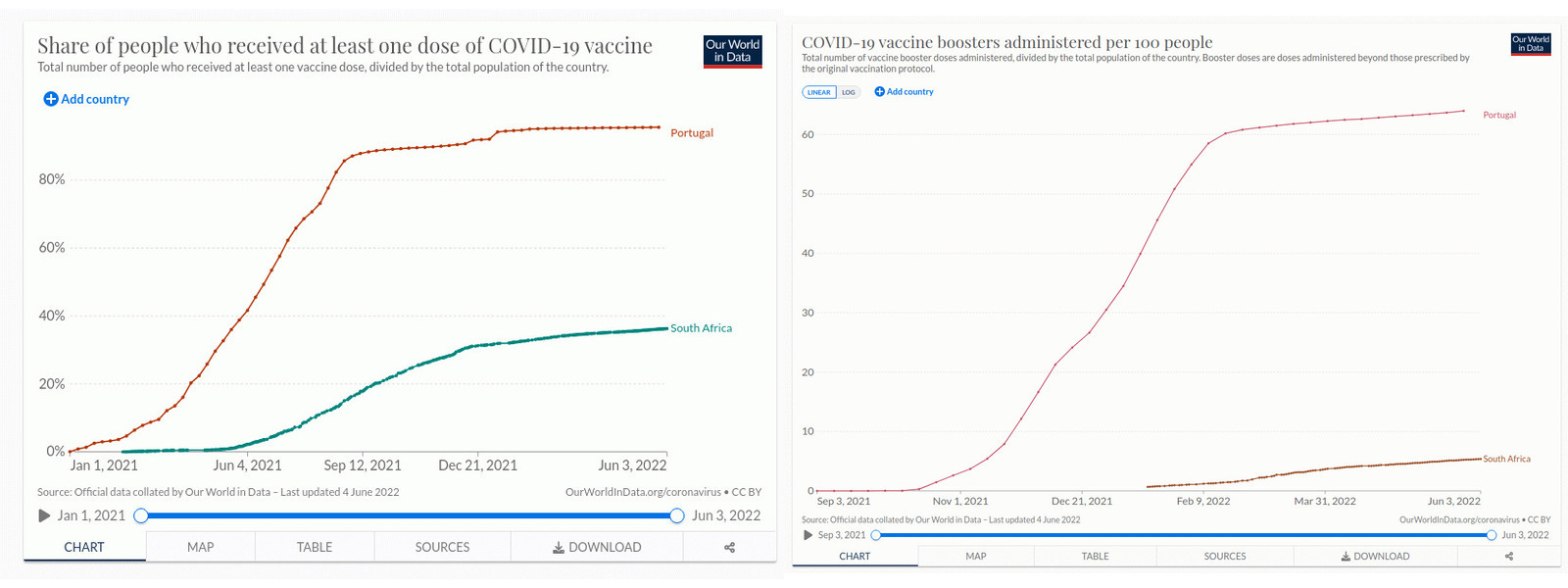
Summary: The BA4/5 sister variants currently dominate two countries: South Africa and Portugal. South Africa is barely vaccinated (only 35% had a vaccine, 5% had a booster), whereas Portugal is 95% vaccinated and 70% boosted. The situations in these countries could not be any more different: while Ba.4 and Ba.5 were mere blips on the radar in South Africa, these same variants are driving a deadly wave of Covid in highly-vaccinated Portugal, with deaths among the Portuguese nearing January peak and showing few signs of abating.
South Africa and Portugal form a two-country controlled experiment: vaccinate one country and do not vaccinate another, and expose both to Covid Ba4/5. The difference in outcomes is telling.
Let’s explore. South Africa and Portugal are on the opposite sides of the vaccination spectrum: South Africa is barely vaccinated, while in Portugal, reportedly, “there is no one left to vaccinate” (read that story, it is something).
Back in 2021, Portuguese “health experts” and officials promised upcoming “herd immunity”, which Portugal would enjoy once the harshly enforced near-total vaccination would complete. The majority of Portuguese citizens “believed in science” and thought very highly of themselves for that. Most Portuguese “health experts” and officials dismissed ignorant, science-denying protesters, pictured below, who were objecting to forced vaccination.

A year later, things did not quite work out as planned. Instead of herd immunity, Portugal is in the midst of a deadly wave of “Ba.4/5 variants” causing another increase in deaths, with no end in sight.
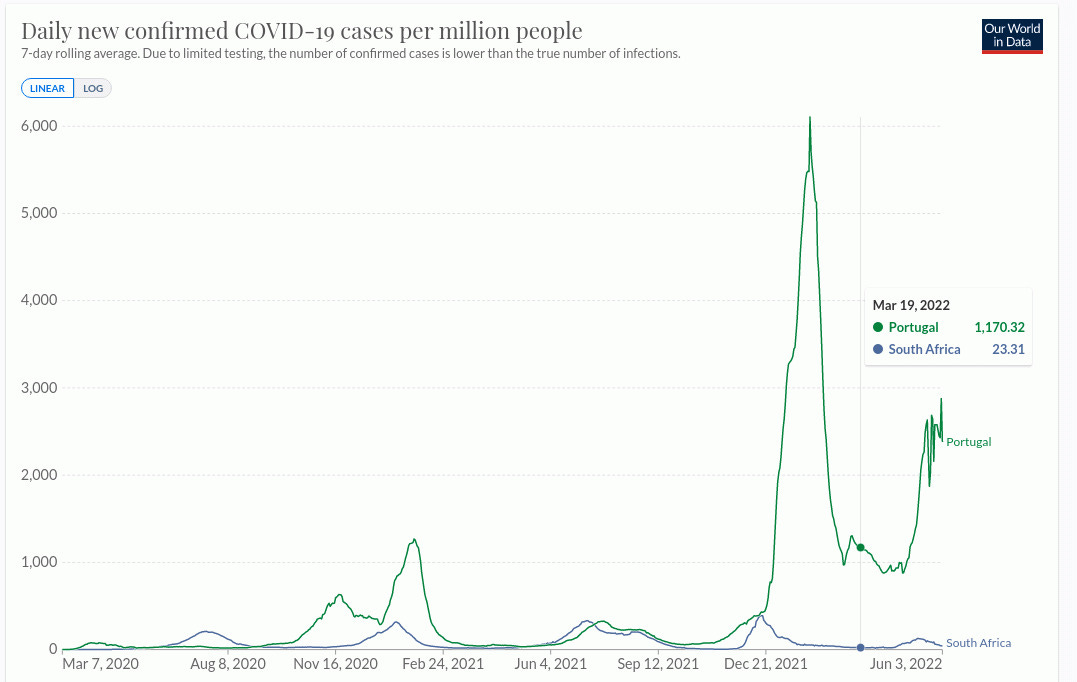
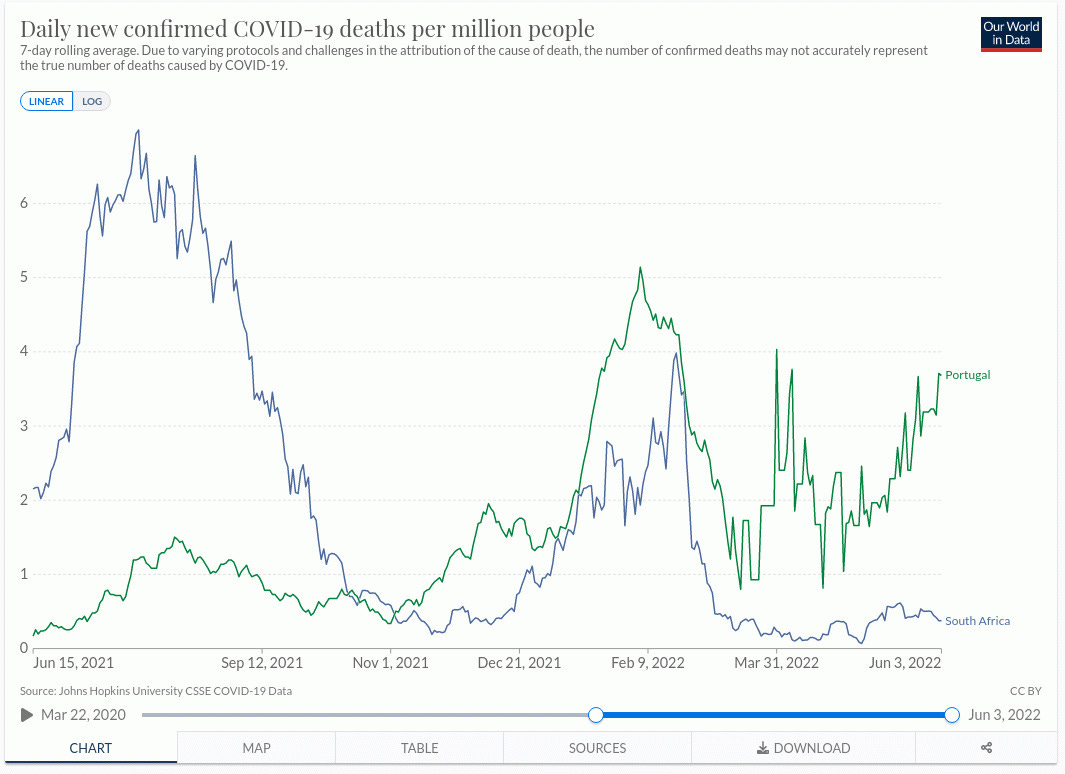
The deaths in Portugal are coming fairly close to the level of the first Omicron wave and are still rising, so there is no telling how high they will go. In South Africa, however, deaths are about 1/6th of their winter deaths and generally look like Ba4/5 wave was a non-event there.
Mind you, Portugal has a decent Western medical system and South Africa is a poorer country.
So,
- Both countries are experiencing a “BA4/5” wave
- It was no big deal for South Africa
- The same wave is deadly for the overboosted Portuguese and the deaths keep rising
- Covid looks to be “mostly over” for unvaccinated South Africa and is “only getting started” for totally vaccinated and mostly boosted Portugal.
While no two countries are alike, this is a very alarming finding. Mind you, just about everyone in Portugal had Covid by the end of last winter. Thus, this current wave of infections and deaths in Portugal is driven by reinfections.
Why are reinfections happening? Because boosted people are unable to acquire proper immunity upon infection. Thus, they are forced to endure endless Covid reinfections, that further damage their immune systems, inviting more illness.
AIDS-Like “Chronic Covid” is Taking Over Europe, Australia and NZ
I am very sorry for the people of Portugal. I hope that someone can come up with something to make them healthy again. To make that happen, Portugal needs to fire and prosecute the crooks who got the country into the current situation and look for real solutions, with the crooks removed from influence.
What about other countries?
Ba.5 had an early start in Portugal, so it had time to play out. In other countries, as of now, Ba.5 (and Ba.4, which I will skip for brevity) is growing alarmingly rapidly in highly vaccinated states of the US, as well as in Denmark, the UK and Australia.
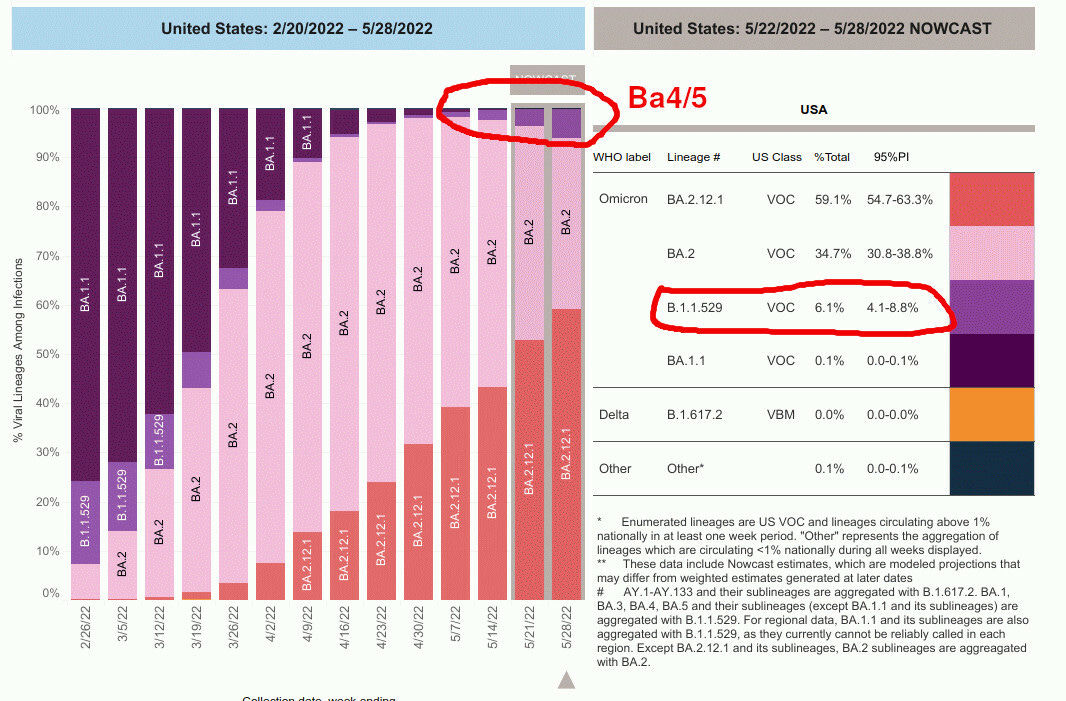
Ba.5 is growing in USA, doubling each week. This article is worth checking out.

While BA.2.12.1 gained an advantage by being more transmissible than BA.2 before it, the two newer variants are said to be making inroads at least in part because of their abilities to reinfect.
“We now report findings from a systematic antigenic analysis of these surging Omicron subvariants,” says a recent paper published to the BioRxiv preprint server. “BA.2.12.1 is only modestly (1.8-fold) more resistant to sera from vaccinated and boosted individuals than BA.2. On the other hand, BA.4/5 is substantially (4.2-fold) more resistant and thus more likely to lead to vaccine breakthrough infections.”
What the article does not say, of course, is that Covid-19 is evolving in the often-reinfected boosted people to not only evade immunity but to take advantage of the no-longer-effective antibodies and deprogrammed immune systems, while giving its sufferers no long-lasting protection after reach reinfection.
CDC variant tracker lumps Ba4 and Ba5 together and shows that they double in incidence every week:
Omicron is Becoming More Severe
We may soon see yet one more “Covid wave” in the US and several other countries. If South Africa is any guide, it is unlikely to affect the unvaccinated-recovered people as much because it did not do so in South Africa. However, heavily vaccinated and boosted cities and countries may experience another exhausting wave of Covid.
Unfortunately, likely Ba.5 is more severe than Ba.2. It is more fusogenic and thus may be somewhat more lethal to the people to get it.
Summary to my readers: Do not panic, get a healthy tan, and stay in good shape. If you are unvaxed and had Covid already, most likely you will be fine, just like South Africans are. There will be tons of variants coming in the coming months and years, so no reason to overstress yourself over this one.
Good luck to all.
Foreign-supplied tanks destroyed in Kiev – Russia
Samizdat | June 5, 2022
Russian airstrikes have destroyed foreign-supplied tanks in the Ukrainian capital, Kiev, Moscow said on Sunday.
Defense Ministry spokesman Major General Igor Konashenkov said during a regular briefing that Russian forces carried out airstrikes “on the outskirts of Kiev, destroying the T-72 tanks and other armored vehicles that were supplied by Eastern European countries and kept in railcar repair facilities.”
The spokesman did not specify where the tanks came from, but Poland previously said it had donated T-72 tanks to Ukraine.
Konashenkov said that military targets were also hit in Donbass, as well as in eastern and southern Ukraine, including multiple rocket launchers and a US-made mobile counterfire radar.
Ukraine’s General Staff earlier reported that Kiev was among the areas hit by Russian forces. Mayor Vitali Klitschko said that one person was hospitalized.
On Saturday night, the Donetsk authorities said Ukrainian troops shelled the city, killing five civilians and wounding 20.
Russia and Ukraine have repeatedly accused each other of shelling residential areas and killing civilians.
Featured Video

Iran FM Araghchi: “Hormuz Will No Longer Be the Same”
or go to
Aletho News Archives – Video-Images
From the Archives
Sam Husseini: The entire US establishment helped lie their way into the Iraq war
By Slava Zilber | American Herald Tribune | October 14, 2019
Sam Husseini is a senior analyst with the Institute for Public Accuracy, independent journalist and contributor to The Nation and FAIR.
Slava Zilber: Sam, three years ago, you appeared on Talk Nation Radio with David Swanson and spoke about the case of the GCHQ whistleblower Katharine Gun. You pointed out that the people involved in the spying on the UN and the people authorizing the Iraq War were not held accountable:
“Virtually everybody who went along with the war, whether it is Kerry or Clinton, of course, the Bush administration themselves has falsified their own records in terms of why, what they did, when they did, why they did it, to the extent that they’ve been scrutinised at all.”
You also address it in a recent article. And recently, Joe Biden has been lying about his position on the Iraq War. How can such an important issue escape meaningful scrutiny? … continue
Blog Roll
 Aletho News
- China slams US policy on Iran as Russia rejects legality of nuclear meeting at UN
- The Mecca Pact Courts Iran: Containment Comes Full Circle
- Oman FM: Persian Gulf states, Iran, Iraq should form security pact excluding US
- Trump peddles fresh falsehoods, claims Iran ‘started the war’ as US aggression drags on
- Ukraine quagmire? Yes, but it’s for NATO, not Russia
- US intelligence hypes Chinese, Russian space threats while accelerating its own military buildup in orbit
- Iran FM Araghchi: “Hormuz Will No Longer Be the Same”
- EU facing trillion-euro debt hole while seeking more cash for Kiev
- How US, Europe, Persian Gulf states exhausted missile stockpiles, splurged billions to defend Israel
- Up in arms… Koreans reject U.S. empire’s plan to make South Korea the next Ukraine
- If Americans Knew
- An error has occurred; the feed is probably down. Try again later.
- No Tricks Zone
- Sudden Stratospheric Warming, Powerful El Niño Combination May Lead To Extreme Europe Cold, Energy Crisis!
- Two New Studies Find Thwaites Glacier Melt Cannot Be Driven By Human Activity Or A Warming Ocean
- E-Cars Reduce CO2 Emissions By Only 41% Compared To Internal Combustion Engine Vehicles
- Predictions Made By Renowned Climate Professor Over Past Decades Have Been Proven To Be Poor
- New Study Suggests Large Regions Of The Pacific Ocean Have Been Cooling For The Last 80 Years
- Germany’s Green Energy Debacle: High Energy Costs Force Kahla Porzellan to Close After 182 Years!
- New Study: 50 Years Of The Most Aggressive ‘Net Zero’ Policies Can Only Affect The Global Climate By 0.03°C
- US September “Heat” Was No Record…Many Records Set Decades Ago
- Latest European Green Energy Debacle; Portugal’s Largest Flagship Solar Park Insolvent!
- Green Energy Debacle: German Expert Professor Fritz Vahrenholt Warns Of Severe Economic And Social Consequences

