‘Regime Change’ in Belarus Looks Like an Objective of Both the Trump Administration and the Biden Campaign
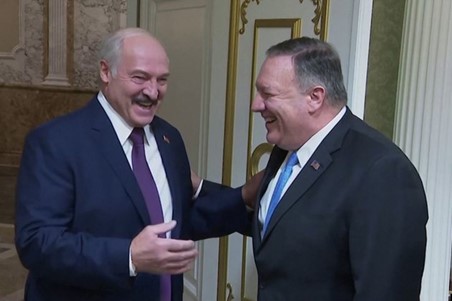
By Adam Dick | Ron Paul Institute | August 14, 2020
It seems that whoever wins the presidency, United States foreign policy will keep chugging away at intervening across the world, including via “regime change” efforts. Over the last couple decades, targets for US-government-supported overthrow have included Afghanistan, Iran, Iraq, Libya, Syria, Ukraine, and Venezuela. Belarus also appears to be in the US government’s crosshairs. If its government holds back through January the effort seeking to topple it, Belarus looks sure to remain a US target for regime change during either a second term of President Donald Trump or a first term of President Joe Biden.
On Monday, as revolutionaries in Belarus capital Minsk attempted to oust the Belarus government, US Secretary of State Mike Pompeo and Democratic Party presidential nominee Joe Biden issued interchangeable statements regarding Belarus and US policy toward it. Both Pompeo’s statement and Biden’s statement condemned the government of Belarus, called fraudulent the country’s recent national election in which President Aleksander Lukashenko won reelection by a wide margin, and made demands upon the Belarus government.
The statements of Pompeo and Biden may not seem so threatening if you imagine them coming from the government of a country of average population, economic strength, military power, and tendency to intervene in other countries. The comments could then just be understood as politicians spouting off or being relatively harmless buttinskis.
It is different when the pronouncements are made by a top foreign affairs official of the US and the potential next president of the US. The US presides over a large population country with major economic resources. The US has military bases and ships, as well as covert operatives, across the world. The US has a long and ongoing history of pursuing, and often achieving, the overthrow of governments through actions including invasions, assassinations, sanctions, election meddling, and the financing and coordinating of coups and revolutions.
In 2015, during the Barack Obama administration in the US and after another wide-margin reelection win by Lukashenko in Belarus, Ron Paul Institute Executive Director Daniel McAdams discussed the US government’s disdain for Lukashenko and the Belarus government. McAdams wrote in part:
Lukashenko has been a favorite punching bag of the US and western neocons for a number of years because he has not shown the required level of deference to his would-be western overlords compared to, say, the Baltics. He routinely wins re-election even as the US government has funneled millions of dollars into the political opposition in hopes of somehow fomenting a regime change.
Don’t believe the sanctimonious comments, whether from the Trump administration or the Biden campaign, about the US seeking to promote democracy and human rights in Belarus. This is about power. The US has let slide and continues to let slide democratic and human rights shortcomings of countries across the world where benefit can be obtained. Dictatorship? No problem. The expression of concern about democracy and human rights is propaganda selectively applied to stir up support for, or at least quell opposition to, US intervention abroad.
Pompeo and Biden’s statements regarding Belarus help make clear that overthrowing governments appears set to remain a feature of US foreign policy no matter if Trump wins a second term or Biden defeats him in the upcoming November presidential election.
Russia wants neither ‘rethink’ nor ‘reset’ if it means restoring American supremacy & returning to Cold War diplomacy
By Scott Ritter | RT | August 12, 2020
Some 136 American “experts” on US-Russian relations recently debated the merits of “rethinking” US policy on Russia. What these specialists failed to consider is that Moscow may not be interested in their plans.
In the span of a week, Politico, a non-partisan global news and information company whose stated mission is “providing accurate, nonpartisan impactful information to the right people at the right time,” published two pieces that addressed the topic of US-Russian relations.
The first, which appeared on August 5, was an “open letter” written by Russia policy heavyweights Rose Gottemoeller, Thomas Graham, Fiona Hill, Jon Huntsman Jr., Robert Legvold and Thomas Pickering, and signed on by 97 other prominent policy makers and academics, including George Shultz, William Perry and Sam Nunn. Entitled “It’s Time to Rethink Our Russia Policy”, the letter opined that the current mix of sanctions and diplomacy put forward as policy by the US wasn’t working, and that it was time for Washington to take a new approach toward the “problem” of Vladimir Putin’s Russia.
Six days later, Politico published a response written by 33 other Russian policy specialists, academics and journalists who took umbrage at the letter’s notion. Entitled “No, Now Is Not the Time for Another Russia Reset”, the article instead postulated that a Putin-led Russia represented a threat to American “interests and values” that required “strong pushback” rather than renewed diplomacy. While the authors of this piece acknowledge that “America’s ability to bring about change in Russia might be very limited”, any failure on the part of the US to aggressively push back against “Russia’s repression, kleptocracy and aggression” would fail to incentivize President Putin to the kind of “change” needed before any betterment of relations could occur.
On the surface, the 136 “experts” on US-Russian affairs who either wrote or endorsed these competing opinion pieces appear to have the issue of a US-Russian policy “rethink” covered from all angles. The one thing the authors of both articles have in common, however, is a tendency to view the issue from a US-centric point of view, with little or no regard as to how Russia feels about the concept of any “rethinking”—especially along the lines suggested.
What the supporters of a US-Russian “rethink” and those who oppose it insist on is the idea that Russia would either willingly assume the kind of supine posture any such “rethink” would be predicated on, or that the policy tools used to compel change, built around enhanced economic sanctions, diplomatic isolation and regional push back, would be sufficient to complete the task.
What these so-called “experts” fail to recognize is that the days of an “inferior” Russia aspiring to join the ranks of the “superior” West are gone forever. The image of the “shining city on a hill” that American exceptionalism is built upon no longer inspires as it once did. America’s reputation around the world is on a downward trajectory—in 2016, some 64 percent of the populations of 33 countries surveyed by the Pew Research Center had a favorable impression of the US, in 2020, this had fallen to 53 percent (note: the Pew survey did not include many nations, such as those in the Middle East, where the perception of the US is much lower, and as such represents a upwardly skewed result). The idea that America is the most powerful, influential nation on earth is no longer universally held. Moreover, in Russia only 20 percent have a positive impression of the US—not exactly a vote of confidence.
The American-led “liberal world order” that has dominated the globe since the end of the Second World War is, from the Russian perspective, “obsolete”, and membership of the same is no longer viewed as attractive. Indeed, Russia has eschewed the notion of rejoining the G-8, noting that the G-7 is irrelevant without the presence of global economic powers such as Brazil, China, India and Turkey, and that the G-20 forum—which includes these nations, and more—is a far more suitable one for Russia.
It is not just the world that is rejecting American leadership—its own population has lost faith. A scant 52 percent of Americans embraced the vision of a “shining city on a hill” when President Ronald Reagan gave voice to it in his farewell address in 1989; today some 62 percent believe America no longer serves as an object of emulation for the other nations of the world. The Covid-19 pandemic has exacerbated a brewing socio-economic-political crisis of identity in the US, exposing a fundamentally flawed healthcare system, a labor market operating void of a safety net and race relations that appear to be getting worse, rather than better.
The fixation on the 2016 US Presidential election, and the notion that Russia somehow put its thumb on the electoral scale to enable an otherwise improbable President Donald Trump victory, represents the manifestation of this lack of confidence, as Americans desperately search for someone other than themselves to blame for the failures of its democratic institutions.
Robert Mueller, the Special Prosecutor responsible for the eponymously named report on Russian interference in the aforementioned election, alleged that Russian internet “troll farms” had, at their peak, a monthly budget of $1.25 million for targeted advertising on US social media. This figure was pure allegation, with Facebook stating it found that Russian-affiliated accounts spent a mere $100,000 on advertisements.
In any event, whatever the amount was, the notion that any amount of Russian-derived digital advertising helped sway an election where the major candidates spent in excess of $1 billion dollars on social media-based advertisements is laughable. By way of comparison, Mike Bloomberg spent over $500 million running the most sophisticated advertising campaign in the history of US electoral politics in a losing bid for the 2020 Democratic nomination. That the psyche of the average American voter can be swayed by what he or she reads online is insultingly simplistic; most voters are well informed on the issues of concern to them, know who they want to vote for and why. The last thing they need is online click-bait to tell them what to do.
This reality appears to be lost on those involved in the Russian “reset” debate, where both sides appear to be particularly sensitive to the fragility of American democracy, and desperate to allocate blame for this disturbing truth on a manufactured Russian threat rather than focus on a failing American society.
The foundation of the Russia “reset” debate, whether pro or con, is centered on the restoration of American supremacy, and has little to do with the actual improvement of diplomatic relations. Those who oppose the reset lay out a litany of issues where the US and Russia disagree. In every instance, the issues involved are not discussed on their merits, but rather a zero-sum analysis built around the concept that if it is good for Russia, it is bad for the US. Even the reset proponents seek to restore a Cold War approach toward diplomacy and détente, because this is safe ground built on the premise that the US will once again prevail.
The need to be seen as victorious is, of course, driven by the defensive stance taken by one-time policy professionals whose entire careers were predicated on either the defeat of the Soviet Union or, following its collapse in 1991, the containment of a much-diminished Russia. The notion of an ascendant Russia at a time when the US is on the decline both at home and abroad is simply unacceptable.
For the supporters of a Russian “rethink”, this situation is best accomplished by an engagement that resets US-Russian relations according to a Cold War-era road map. For the anti-reset crowd, the present reality must be avoided at all costs by seeking to compel Russian behavior through the application of Cold War-like pressure built around sanctions and a combination of military and diplomatic pressure.
Even if the American “experts” were able to come to an agreement on how best to proceed vis-à-vis Russia, there is virtually no chance Russia would play along. The main reason for this is that Russia has seen this game played before and is fully cognizant of the cost of doing business with the US in a post-Cold War reality. The debasement of Boris Yeltsin—and by extension, Russia—at the hands of Bill Clinton is a matter of public record, as is the role played by the US in writing Russia’s post-Soviet Constitution and securing Yeltsin’s reelection in 1996.
Russia knows that when the US uses terms like “reset” or “rethink” regarding Russia, it is with a mind to return US-Russian relations to such a status, where Russia lay prostrate at the feet of the US, and Putin did not hold the reins of power.
The former US Ambassador to Russia, Michael McFaul, embraced a vision of the “reset” undertaken by President Obama that was predicated on similar conditions, which is why it failed (McFaul did not sign either letter published by Politico). While the US can engage in an intramural debate about US-Russian policy, Russia will continue to do what it has for the past six years—proceed unencumbered by the baggage of American demands, and increasingly impervious to the threat—and reality—of US sanctions and diplomatic containment.
Scott Ritter is a former US Marine Corps intelligence officer and author of ‘SCORPION KING: America’s Suicidal Embrace of Nuclear Weapons from FDR to Trump.’ He served in the Soviet Union as an inspector implementing the INF Treaty, in General Schwarzkopf’s staff during the Gulf War, and from 1991-1998 as a UN weapons inspector. Follow him on Twitter @RealScottRitter
Russia to Start the Production of Its COVID-19 Vaccine in Cuba
teleSUR | August 11, 2020
Russia’s Direct Investment Fund (RDIF) Chief Executive Officer Kiril Dmitriev announced that Cuba could begin producing the COVID-19 vaccine, the Sputnik V, in November.
“Cuba has a large capacity to produce medicines and vaccines with highly qualified staff. We could coordinate with its government to start the vaccine production in November,” Dmitriev stated.
He also pointed out that the third stage of vaccine trials will begin in Russia on Wednesday. Later the United Arab Emirates, Saudi Arabia, and the Philippines will continue testing it.
On Tuesday, Health Minister Mikhail Murashko announced the registration of the world’s first COVID-19 vaccine, the Sputnik V, which is named after the first artificial satellite launched into orbit by the USSR in 1957.
Before being tested in 76 volunteers, the Russian COVID-19 vaccine passed all the necessary safety and efficacy tests in several animal species.
On Tuesday morning, outlet Sputnik reported that that the Russian vaccine, which was developed by the Gamaleya Research Institute, can protect a person from the coronavirus for up to two years after injection.
“Such a prolonged period of protection is possible due to the vaccine being based on viral vectors – a harmless human adenovirus delivers a portion of the COVID-19 virus to a human body forcing it to form an immune response to it,” the Russian outlet explained.
US concerned about Serbia’s intention to buy Chinese weapons
By Paul Antonopoulos | August 12, 2020
Belgrade’s announcement that it may purchase the Chinese FK-3 anti-aircraft missile system was enough for the U.S. to express concern about Serbia’s future, not only with Europe, but with the entire world.
The U.S. Embassy in Belgrade said that “procuring military and defense equipment is a sovereign decision. However, governments should understand the short- and long-term risks and costs involved in doing business with Chinese companies. Procurement choices should reflect Serbia’s stated policy goal of greater European integration. Alternative vendors which are not beholden to authoritarian regimes offer equipment that is both capable of meeting Serbia’s defense need and comparable in quality and cost.”
Serbian President Aleksandar Vučić hit back, saying “Whenever we decide to buy something, somebody has something against it,” and emphasized that the FK-3 system was not on the U.S. sanctions list against China.
The U.S. Embassy’s statement gives the impression that Washington has a deep concern about Serbia’s future strategic interests and alliances, so much so that it warned Belgrade on its path towards the European Union even though the U.S. has no influence over Brussels in this regard. Of course Washington has no concern for Serbia’s interests after it sustained crippling sanctions on the Balkan country, recognizes Kosovo as an independent state, ensured that the Republika Srpska is attached to Bosnia and Herzegovina without option to reunite with Serbia, and led a deadly bombing campaign that destroyed Serbian infrastructure and killed thousands of civilians in 1999.
Washington is afraid of cheaper and better-quality weapons that Serbia can procure from both China and Russia. The Americans are also frustrated that Serbia has not become a state dependent on U.S. patronage despite decades of aggression and pressure. Effectively, Washington is continuing a campaign to limit Serbia’s independent and strategic interests. It is recalled that Washington threatened Belgrade with sanctions and indirect threats when Serbia purchased the Russian Pantsir missile system and trained with the S-400 missile defense system.
A NATO official who spoke on condition of anonymity, according to Defense News, said that “defense procurement is a national decision. Serbia has the right to freely choose its political and security arrangements. NATO and Serbia are close partners and we are committed to strengthening our partnership with Serbia, while fully respecting its policy of neutrality.”
Although both NATO and the U.S. Embassy in Belgrade emphasized that they respect Serbia’s sovereign decision, Washington does not truly respect Serbia’s policy of neutrality, which is why it makes continuous threats of sanctions and indirect warnings that Belgrade is becoming too close to Moscow and Beijing. Serbian political scientist Aleksandar Pavić argues that Washington expects Serbia to buy weapons from countries that have recognized Kosovo’s independence, and that this is Belgrade’s fault as they have purchased weapons from France, and even expressed the possibility of buying some American bombers, despite both countries recognizing Kosovo’s independence.
Although Serbia is attempting to maintain a policy of neutrality, so much so that it even considers buying weapons from the U.S., the reality is that such a policy is impossible. The best Belgrade can hope for is to enact a policy of balancing the Great Powers by strengthening relations with those who support Serbia’s sovereignty and independence, and maintaining friendly posture but distance with those who still support an independent Kosovo. By Serbia buying French military equipment, despite its recognition of an independent Kosovo, and entertaining the idea of buying American bombers, Belgrade is sending mixed messages to its international partners that it can overlook the Kosovo issue. By maintaining such a policy, Belgrade is giving Washington enough leeway to comment and attempt to push Serbia away from China and Russia. Having a stronger policy against those who recognize Kosovo’s independence will give Belgrade a much clearer foreign policy and will force Washington to approach Serbia differently.
None-the-less, by discouraging Belgrade from the idea of buying Chinese weapons, Serbia will likely continue to buy Chinese weapons, and with even stronger intensity. Although Serbia will always prioritize its relations with China and Russia over those who weakened it and recognized Kosovo’s independence, Belgrade should now show this more strongly by ending its policy of neutrality as the West is not neutral towards Serbia.
As the Balkans is heating up again as a place of conflict, Serbia cannot be neutral as much as it attempts to do so. This does not mean that it should have openly hostile relations with the U.S. and other Western States, but because Serbia refuses to sever its deep relations with China and Russia, Serbian interests will always be sidelined when it comes to Western ambitions in the Balkans. Under these conditions, Belgrade should take a stronger position and be unafraid to highlight that their interests do not align with those that the West has for the Balkans.
Paul Antonopoulos is an independent geopolitical analyst.
Trump insists on a Putin visit to US
By M. K. BHADRAKUMAR | Indian Punchline | August 11, 2020
The US President Donald Trump’s remark on Monday that a G7 summit is no longer on the cards for the month of September leaves many questions unanswered. We do not know the circumstances in which Trump felt that he is “much more inclined to do it (G7 summit) sometime after the election”. Again, Trump was delightfully vague on giving a timeline, which is understandable since a G7 summit now hinges entirely on the outcome of the November election.
Trump didn’t explain, either, why a G7 summit hasn’t materialised in September, which would have given him some boost on the world stage — and given a much-needed fillip to his campaign. This is the second time Trump has been unable to host a G7 summit. In June, the allies, especially Germany, point blank refused — Angela Merkel regretted apparently due to preoccupations related to the pandemic.
If the postponement in September is also due to the European allies’ lukewarm attitude, it becomes a snub to Trump personally. All he’d say was “We haven’t sent out invitations. We’re talking to them.” If Trump falls by the wayside in the November election, the European allies may be even less inclined to troop to Washington before Joe Biden assumes office in January. Trump’s insistence on inviting Russian President Vladimir Putin to the G7 summit, which he repeated yesterday, has not gone down well in the European capitals.
In sum, Trump’s inability to hold a G7 summit highlights Europe’s overall disenchantment with him. Trump’s foreign policy legacy during his first term is ending on a dismal note, calling attention to the damage he has inflicted on the transatlantic partnership.
Perhaps, Trump gets one more chance to redeem his foreign policy record on this template if only the US-Russia arms control talks make headway. The first formal bilateral talks between the US and Russia on space security since 2013 took place in Vienna on July 27 alongside the second round of the nuclear arms control working group meetings. The renewal of new START, which is expiring in coming February, is a low-hanging fruit.
Meanwhile, the Vienna talks also touch on the erstwhile Intermediate-Range Nuclear Forces Treaty (INF Treaty), which is of utmost concern to the European countries. Russia has called for revival of discussions on extending the INF Treaty and Washington has held open the possibility that the negotiations in Vienna would include an INF Treaty extension. One way Trump could overcome the European resistance to inviting Putin to a G7 summit in the US could be by linking it to an event connected with arms control, especially the INF Treaty.
Russia sees arms control as a useful tool to manage its military competition with the US by making it less dangerous and costly. As for European countries, the INF Treaty has been historically the only operational bilateral instrument of nuclear arms control with Russia with focus on Europe’s security and stability. Moreover, the INF Treaty was the cornerstone of European security and its signing in 1987 by the US and the former Soviet Union was a harbinger of political “winds of change” in the East-West relationship.
Equally, Trump also appears to be serious in pursuing forms of cooperation with Russia that would accommodate both countries’ interests. Oil price and terrorism are two such issues; arms control could be another. On arms control, there is also a rare “bipartisan consensus” in the US as regards the renewal of the new START.
Having said that, Trump is unpredictable and the commencement of arms control talks cannot by itself persuade Moscow to lower its guard. Thus, on August 7, Russian Foreign Ministry reacted to the Pentagon announcement of July 29 regarding more US deployments to Poland. A statement in Moscow warned that “such actions escalate tensions in Europe. We have emphasised more than once that attempts to deter us by force and intimidate our country will receive a befitting and timely response.”
On July 29, at a press conference at the Pentagon, Defence Secretary Mark Esper had announced a “plan on rotating forward the lead element of the Army’s newly established V Corps headquarters to Poland, once Warsaw signs a Defense Cooperation Agreement and burden sharing deal, as previously pledged. There are or may be other opportunities as well to move additional forces into Poland and the Baltics.” Interestingly, a week later in an interview with Fox News, Esper added that the deployment to the east to (Poland and the Baltics) aimed to serve as a more effective ‘deterrent’ against Russia. He said moving troops eastward is only logical because “the border has shifted as the alliance has grown.”
On August 7, the official military newspaper Krasnaya Zvezda (Red Star) reacted strongly by issuing a stern warning to the US that Russia will perceive any ballistic missile launched at its territory as a nuclear attack that warrants a nuclear retaliation. This is in line with the revised Russian military doctrine enunciating the new nuclear deterrent policy allowing “first use”, which envisages the use nuclear weapons in response to a nuclear attack or an aggression involving conventional weapons that “threatens the very existence of the state.”
Moscow has ruled out Putin’s participation in a G7 summit that excludes China or has any anti-China orientation. Having said that, Trump would be betting that given the Kremlin’s keenness to make progress on arms control — extension of new START, in particular — Putin might be open to a visit to the US to formalise any agreements, once the hurly burly of the November election in America is done. Trump’s remarks yesterday hint at such a possibility when he said Putin is an “important factor”. Moscow has taken due note of it.
Trump’s calculus aims at animating the US-Russia-China triangle with a view to isolating China. Putin, on the other hand, will sequester the Russian-Chinese entente from collateral damage, if any. On August 9, Russian Foreign Ministry issued an unusual statement conveying solidarity with China “on the situation around the Tiktok social media app’s operation in the US”.
Beijing, meanwhile, is nonchalantly reiterating its position that “it is not yet the right timing” for China to join the nuclear disarmament talks in Vienna. And, Putin and Chinese President Xi Jinping were the first world leaders to congratulate Alexander Lukashenko on his re-election as Belarusian president.
Lukashenko Says There Will be No ‘Maidan’ in Belarus, ‘We Won’t Let the Country Be Torn Apart’
By Ilya Tsukanov – Sputnik – 10.08.2020
Alexander Lukashenko has commented on the large-scale street protests in the Belarusian capital, saying he would not allow for a Ukraine-style ‘Maidan revolution’ to take place in his country.
“Everything I was talking about is being confirmed. If someone didn’t believe it – they believe it now… I had warned: there will be no Maidan, no matter how much someone might want it. Therefore everyone needs to settle down and calm down,” Lukashenko said, speaking to journalists on Monday.
According to the president, over two dozen members of law enforcement suffered injuries during Sunday night’s protests. “There are broken arms and legs. They deliberately targeted them. They fought back. Why cry about it now? The response will be adequate. We will not allow for the country to be torn apart,” he said.
Earlier, Belarusian news agency BELTA reported that over 50 demonstrators, as well as 39 police had been injured in the protests across the country, with unrest concentrated in the capital of Minsk. 3,000 protesters were arrested for taking part in the demonstrations.
According to Belarusian Internal Affairs Ministry spokeswoman Olga Chemodanova, protesters lit flares, threw nails and barbs onto roads, attempted to build makeshift barricades, dismantled parts of sidewalks and threw paving stones at police. One group of protesters in the city of Pinsk reportedly wielded sharpened poles and stones to attack police. Criminal proceedings have been launched against persons accused of violent behaviour.
Chemodanova stressed that lethal weapons were not used by police in their response, and described earlier reports of a fatality among protesters as “nothing but fake news.”
Opposition Contests Results
Sunday’s violence came in the aftermath of the presidential election, in which preliminary estimates concluded that incumbent president Alexander Lukashenko received 80.23 percent of the vote, with opposition candidate Svetlana Tikhanovskaya receiving 9.9 percent, Anna Kanopatskaya receiving 1.68 percent, Andrei Dmitriyev receiving 1.04 percent, Sergei Cherechen getting 1.13 percent, and 6.02 percent of voters choosing ‘against all’.
Russian President Vladimir Putin, Chinese President Xi Jinping, and Kazakhstan President Kassym-Jomart Tokayev have congratulated Lukashenko on his reelection, with Sergei Lebedev, chairman of the Commonwealth of Independent States mission in Belarus, saying there were no issues which could call the legitimacy of the vote into question.
Tikhanovskaya’s campaign said the candidate did not recognize the results, and is demanding a “peaceful” transfer of power. Polling conducted by pro-opposition researchers suggests that Tikhanovskaya should have received around 70 percent of the vote, with Lukashenko supposedly trailing with only 15 percent.
Belarus’s election campaign has been fraught with scandal and intrigue, with some would-be opposition candidates denied registration and others facing administrative pressure from the government. Late last month, Vitaly Shklyarov, an advisor to Tikhanovskaya’s campaign, was arrested by authorities. Before working for her, the political scientist had worked on the election campaigns of Germany’s Angela Merkel, Barack Obama and Bernie Sanders in the US in 2008 and 2016, and Russian opposition candidate Kseniya Sobchak in 2018. Tikhanovskaya herself became the candidate after her husband, Sergei Tikhanovsky, a Belarusian blogger and pro-democracy activist, fled the country. Tikhanovsky has called Lukashenko a “cockroach,” while the president has accused him of being a foreign agent sponsored from abroad.
China Denounces Statement of 5 Western Foreign Ministers on Hong Kong as Meddling
Sputnik – 10.08.2020
The joint statement of the foreign ministers of Australia, Canada, New Zealand, the United Kingdom and the United States on Hong Kong is yet another instance of interference in China’s domestic affairs, the Chinese embassy in Canada said in a statement on Monday.
“On 9 August, the foreign ministers of Canada and other countries made a statement which once again contained irresponsible comments on the Hong Kong affairs and amounted to gross interference in China’s domestic affairs. China expresses its strong dissatisfaction and firm opposition to this,” the Chinese embassy said.
Postponing the elections was out of public health precautions amid the pandemic, while the security law closed security gaps in Hong Kong that could otherwise jeopardize the region’s long-term peace and security, the statement read, reiterating the rationale that Beijing has consistently used to confront similar accusations.
The embassy further called on the five signatory countries to “immediately stop interfering in China’s domestic affairs and using Hong Kong as a tool,” emphasizing that Hong Kong is a subject of China’s jurisdiction.
On Sunday, US State Secretary Mike Pompeo and his counterparts from Australia, Canada, New Zealand and the UK made a statement condemning the new security law in Hong Kong as infringing on the special administrative region’s rights and freedoms. The five foreign ministers also urged the Hong Kong authorities to conduct the recently-postponed legislative elections as soon as possible and let disqualified pro-democracy candidates run in the campaign.
The Hong Kong elections were initially scheduled for 6 September. In late-July, the government postponed the vote, citing coronavirus-related risks. Additionally, several candidates, considered pro-democracy, were banned from running on the grounds that their political activities were inconsistent with the new security law.
The Chinese government enacted the law on 30 June, following a little more than a month-long review at the National People’s Congress. The law adjusts security policies in Hong Kong to Beijing’s perception of crime and punishment with regard to separatism, subversion, terrorism and collusion with foreign countries. The Western critics of the law fear that it might painfully limit Hong Kong’s exclusive rights and freedoms, which it was guaranteed under the 1984 UK-Chinese agreement.
Venezuela Sentences US Mercenaries to 20 Years in Prison
teleSUR | August 8, 2020
Venezuela’s Attorney General Tarek William Saab Friday reported that the two former U.S. military officers Luke Denmnan and Airan Berry, who participated in the failed invasion attempt in Venezuela, were sentenced to 20 years in prison.
Denmnan and Berry tried to force their way into Venezuela along with 50 other citizens of the Caribbean country to overthrow President Nicolas Maduro’s government.
“The U.S. former military officers confessed to the crimes of conspiracy, association, illicit trafficking of war weapons and terrorism,” Saab tweeted.
These crimes appear in Venezuela’s Penal Code, and for them, the mercenaries were sentenced to 20 years in prison.
“The former U.S. soldiers, who admitted their responsibility in the events, were accused by the prosecutors in the case of serious crimes,” Saab explained.
The U.S. Silvercorp former members were detained in the second attempt of an attack against the Venezuelan coast.
At least eight people died and half a hundred more were arrested during the search and capture of the mercenaries.
Last May, Venezuela’s justice system ordered preventive detention for 40 people due to their involvement in the failed invasion attempt.
Lebanon SITREP: second letter from a Lebanese friend
The Saker | August 7, 2020
My Lebanese friend just sent me this report about Hassan Nasrallah’s speech today:
– There is much to say, but Sayyed did not allow the enemies any chance to turn this disaster into a ‘campaign’ against the Resistance, whereby the Resistance ‘reacts’ and gets led into their traps, further leading the country into chaos and destruction
– it must be said, Sayyed calmly but categorically denied that Hezbolllah had any knowledge of what goes on at the Port of Beirut, including what goes into it and what goes out of it. To quote his exact words:
‘We neither adminster the port (of Beirut), nor do we control it, nor do we interfere in it, nor do we know what was going on in the port, nor do we know what was present in the port. Some people said: ‘is it possible that you know about the Port of Haifa (in Israel) more than you know about the Port of Beirut?’. Hezbollah’s main responsibility is resistance. Hezbollah might know more about the Port of Haifa more than it knows about the Port of Beirut. (Knowing about) the Port of Beirut is not (Hezbollah’s) responsibility, yet (knowing about) the Port of Haifa is in fact (Hezbollah’s) responsibility, because it is part of the deterence equation and the (Resistance’s) defense strategy for Lebanon. Yet Hezbollah is not administering, nor controlling, nor is it interferring in, nor does it know what is happening in the Port of Beirut, nor what is present there and not present there, and how things are being administered there, this is something we don’t interfere in at all.’
– Sayyed also calmly but categorically denied that there were any weapons or ammunition belonging to Hezbollah at the port, and that the investigation will soon reflect this reality too.
– Sayyed said that even if this explosion was caused by sabotage, the point now is for the Lebanese state to uproot and rid itself of internal enemies (whether out of negligence they are enemies, or out of intentional malice)
– If the state cannot do that, then the belief in Lebanon as an entity and an idea may be completely lost, even for Hezbollah
– in general, the speech was 1) one of compassion towards Lebanon and its people, and 2) turning the apparent threat (against Lebanon and the Resistance) into a major opportunity.
– Sayyed said this disaster could in a positive sense, allow Lebanon to get out of the (economic and political) siege and difficulty that it was in
– So it seems Hezbollah sees real possibilities in this track (and not as some thought, that the US will be able to continue besieging Lebanon as it was doing prior to the disaster)
– to illustrate, you know there are many oil tankers that are on their way from Iraq to Lebanon via Syria (this is a major development), not to mention the changing international (particularly Western) political attitude towards Lebanon and support for it (even if only officially and publicly, because no state wants to appear like it is harming and besieging Lebanon at this moment before public opinion)
– Perhaps the Resistance sees that even economically, what Sayyed was saying about looking politically and economically eastward (in addition to any westward options) will now be an undeniable option (one that opponents of the Resistance cannot possibly argue against)
– Sayyed said all those that think we are beseiged today and are launching all of these political and media campaigns following the disaster, must know that the Resistance is way too powerful today, and that the whole regional situation is different
– let’s not forget that the US Elections are almost upon us, so perhaps any chance for the Trump administration to really escalate its confrontation any further with Hezbollah and the Resistance Axis has been severely compromised by this national disaster in Lebanon
– Not to mention the Resistance Axis has the upper hand across the region today, if seen purely from a military perspective
– I heard one anti-Hezbollah commentator on Lebanese TV saying: let’s see what Nasrallah is going to say in his speech, there is so much pressure on him now, Hezbollah is cornered, if this explosion is by Israel, then Hezbollah will be pressured to militarily respond, and if the explosion was caused directly or indirectly by Hezbollah, or even that Hezbollah had knowledge of the ammonium nitrate that was stored at the port all these years but didn’t do enough to rectify this situation, then the blame of the Lebanese people will be on the group etc etc
– So Sayyed basically does the opposite to the ill-wishes of such people. He calmly refutes all the lies, and sends out a message of compassion, condolence, support, calmness and hope for the Lebanese as a whole, and a message of power and strength to the supporters of the Resistance
– Even if there was sabotage (by say Israel) that led to the explosion, there was definitely major ‘negligence’ by Lebanese officials, and so they need to be punished strongly and harshly and before all the eyes of the Lebanese. This will be the final opportunity and test for the viability of Lebanon as a state. If the Lebanese state does not pass this test, then lebanon is finished.
– So, what point or value is there, especially at this moment, for Hezbollah to entertain the idea, or go down the track of: this may have been a sabotage by Israel and we must respond? No value whatsoever, it just further corners the Resistance and in the wrong corner (i.e turns this disaster into a defensive one for Hezbollah, one in which the group apparently needs to respond to Israel due to a crime that cannot be proven, and at a time when the Lebanon is in no position for such a confrontation)
– And Sayyed mentioned it, he said regardless if it was a missile or sabotage that caused the explosion, a major reason that led to this disaster is the utter negligence of certain Lebanese officials
– So either Lebanon does indeed have hope as an entity (so show us oh officials by holding the negligent ones to account, regardless of their sect and party, just as we say regarding the enemy collaborators), otherwise, Lebanon has no hope any longer, and Hezbollah will then draw its equations accordingly
– All Lebanese are furious and now watching: who will be punished, will those responsible really be punished?
– Anyway, just by Sayyed highlighting all of this, it completely removes all pressure and focus away from Hezbollah, and places it where it belongs: the ones responsible for this disaster. Even the Harriri tribunal is now completely defused by Sayyed’s intelligent approach today. Lebanese popular opinion is now looking for the perpetrators of this crime, not the crime in 2005 (which has been for many years used by the pro-US camp in Lebanon politically)
And by the way, with one swipe Sayyed completely defuses talk of a new international tribunal and foreign intervention after the explosion, by telling all Lebanese: you all claim you trust the Lebanese army don’t you?!! Well, let the army carry out the investigation. Complete check mate. The administration of this crisis remains Lebanese, no internationalisation nor politicisation of this disaster on the official Lebanese level can now be justified
‘Coup-Plotters for Hire’: Unearthed USAID Nicaragua Regime Change Doc Puts 2018 Protests in Context
Sputnik – 05.08.2020
An uncovered US Agency for International Development (USAID) document lays out a blueprint for regime change in Nicaragua. An expert told Sputnik the playbook shines a new light on the 2018 protests in Nicaragua as well as similar operations in other countries targeted by the US, such as Venezuela.
A new report by the Council on Hemispheric Affairs (COHA) has revealed a guide to regime change in Nicaragua by USAID. The document, which dates to March-April of this year, describes in frank terms how the agency, which maintains close ties with the US Central Intelligence Agency (CIA), could create or exploit a variety of scenarios to remove democratically-elected Nicaraguan President Daniel Ortega and his FSLN party from power in or around the upcoming 2021 elections.
Jill Clark-Gollub, assistant editor and translator at COHA, told Radio Sputnik’s Loud and Clear Wednesday that many of the tactics outlined in the USAID document can be observed in the demonstrations that rocked Nicaragua in the summer of 2018.
‘Code-Speak for a Coup’
“It’s a contract hiring coup plotters – a ‘coup-plotters for hire’-type contract. And it’s really astounding how the whole document is based on the premise that we can impose a better version of democracy for the Nicaraguan people. It talks about a crisis and a transition, and all of this is code-speak for basically bringing about a coup.”
“It talks about three scenarios in which the transition can take place, and it says a transition could take place if our candidate wins the election, but other parts of the document make it clear that they don’t expect their pro-US candidate to win the election. They don’t even have a candidate. Then they talk about creating a crisis for a sudden transition – another code-speak for a coup – and then it talks about a delayed transition in which the FSLN party, the Sandinista Front for National Liberation, wins. And it’s even a free and fair election, and it’s recognized internationally, so it takes a longer time to get them out of there.”
“If you really hadn’t been paying attention at all, you would think there’s this country in crisis and that the US would be doing them a favor to get rid of that government and put in somebody else.”
US Officials Admit to Venezuela ‘Coup’
The news comes amid statements before a Senate committee on Tuesday in which US Sen. Chris Murphy (D-CT) frankly admitted to having attempted to engineer a coup d’etat against Venezuelan President Nicolas Maduro beginning in January 2019.
“Our Venezuela policy over the last year and a half has been an unmitigated disaster,” Murphy told the Senate Foreign Relations Committee. “We have to admit that our big play, recognizing [Juan] Guaidó right out of the gate, and then moving quickly to implement sanctions just didn’t work … First, we thought that getting Guaidó to declare himself president would be enough to topple the regime. Then we thought putting aid on the border would be enough. Then we tried to sort of construct a kind of coup in April of last year, and it blew up in our face when all the generals that were supposed to break with Maduro decided to stick with him in the end.”
Josh Hodges, the senior deputy assistant administrator in USAID’s Bureau for Latin America and the Caribbean (LAC), told the panel USAID support has been instrumental in helping Guaidó’s movement to function.
“We are using development assistance to support the interim government and the National Assembly with technical training, staffing support, equipment and communication efforts,” Hodges said. “USAID’s support bolsters the interim government’s ability to effectively operate and interact with constituents, despite the increased repression from the illegitimate regime. Our assistance has enabled increased participation with legitimate officials.”
Manufacturing Crises via ‘Psychological Warfare’
Clark-Gollub told Sputnik that USAID being directly involved in plotting a coup was “interesting,” because “this in the past, I believe, would have been done by the CIA. Now it’s being done by USAID, and as I said, it’s advertised on LinkedIn. It’s like they have no shame anymore.”
“USAID has been funding Nicaraguan opposition and media groups for years,” she said, noting the 2018 civil disturbances were a case study in what the document describes. “You just need to go back two years and look at this document and all of this doublespeak and understand what I mean.”
“It’s almost embarrassing for the people who are allowing themselves to be used for this. The document talks about how they’re going to use NGOs and opposition parties and the media kind of to corral them to do what they need to do for this plot. So it reveals a lot of stuff that we’ve known, and it brings it out in the open. We have known the media is paid by the US; this is recognition that they’re directed by the US. And the shameful thing for people outside of Nicaragua is that our mass media just parrots what the self-serving Nicaraguan opposition media publishes in Nicaragua.”
She further noted the US was “trying to use the [COVID-19] pandemic for this crisis” mentioned in the document as a possible regime change scenario. “They even created their own citizens’ observatory with mysterious ‘scientific experts’ who they would never say who they were, who were publishing their own statistics on the number of infected and dying people in Nicaragua from the pandemic.”
Instead, Nicaragua’s health system, which the FSLN government has spent 13 years rebuilding and expanding, did not collapse on itself under the weight of the pandemic, as the US embassy in Managua predicted it would, but instead has weathered the storm well, with the lowest COVID-19 case fatality rate in Central America and a very low per capita fatality rate.
Clark-Gollub said use of these tactics “amounts to psychological warfare. They are just going to keep trying to build up, dig up things to make things into a crisis, and it’s terrible,” noting Nicaraguans are being “bombarded” with “fake news” about mass deaths and burials that are actually occurring in other countries.
Especially in 2018, the opposition was “on top of social media,” which the document also urges as a tactic. “We know that in 2018, there had been 2,000 young Nicaraguans recruited, mostly through the Catholic Church, to be social media influencers. And these were the ones putting out ‘color revolution’ type posts,” such as urging painting national colors over FSLN symbols. She also noted they would announce police violence at an event before it had happened, which created confusion and drove demonstrations about events that never occurred.
She recalled that former US national security adviser John Bolton called Nicaragua and Venezuela, along with Cuba, a “troika of tyranny,” writing in his recently released memoir that if one of the three falls, so will the others.
“These three countries are working toward a multipolar world, and the US does not want to see that succeed,” she noted.
“The Nicaraguan people got a big education in 2018; they understand that they’re under attack. It’s not as easy for them to be duped again about fake news that comes out, especially on social media. But that said, this does not mean this is not wearing on people, this psychological warfare … I think that the Nicaraguan people are standing firm and are going to continue to build their country.”
Venezuela: US Backs Guaido-led Opposition in Election Boycott
By Ricardo Vaz and Lucas Koerner | Venezuelanalysis | August 4, 2020
The Trump administration threw its weight behind opposition leader Juan Guaido’s decision to boycott the country’s upcoming parliamentary elections.
“That corrupt election is not going to change Guaido’s status and I don’t think you’ll find anybody in the opposition leadership who will claim otherwise,” White House Special Envoy for Venezuela Elliott Abrams said while testifying before the Senate Foreign Relations Committee on Tuesday.
Abrams, considered one of the architects of the Reagan administration’s Central America wars as well as the 2003 US invasion of Iraq, added that he expects the several dozen countries who recognize Guaido as Venezuela’s “interim president” to continue doing so by not recognizing the South American country’s December 6 National Assembly elections.
On Sunday, Guaido’s press office published a statement on behalf of 26 opposition parties pledging not to participate in the constitutionally mandated elections.
“The Venezuelan democratic parties declare before the international community that we have unanimously decided not to participate in the electoral fraud convened by the Maduro regime,” the text read.
The opposition called on the international community to “reject” the elections and maintain support until “free and fair presidential and parliamentary elections” can be held. Major opposition parties likewise boycotted the 2018 presidential elections despite former Lara State Governor Henri Falcon leading the polls as the most popular opposition leader.
Guaido proclaimed himself “interim president” in January 2019, going on to lead several unsuccessful attempts to oust the government by force over the subsequent months. His backing from Washington and allies was based on his position as National Assembly president. However, the current legislative term expires in December.
Some of the largest opposition parties undersigning the election boycott, including, Democratic Action, Justice First and Popular Will, are currently facing internal leadership disputes. In recent months, the Venezuelan Supreme Court (TSJ) has intervened following legal complaints from party members, dissolving the existing leadership and naming new ad-hoc boards, which have all pledged to take part in the December elections. The new leaders were drawn from opposition sectors that had broken ranks with Guaido in late 2019 following mutual corruption allegations.
The Venezuelan government did not respond to the opposition and Abrams’ statements.
The boycott announcement came on the heels of fresh efforts to restart talks between the Maduro administration and the pro-Guaido opposition.
Last week, a delegation of Norwegian diplomats visited Caracas, meeting with government officials and opposition party leaders. Venezuelan President Nicolas Maduro said his government was ready to return to the table.
Guaido’s office, for its part, acknowledged the visit but denied any dialogue was underway, reiterating its rejection of the upcoming elections.
Representatives of Guaido and the Venezuelan government entered into negotiations brokered by Norway last year. However, the talks collapsed in August 2019 after Washington escalated its sanctions regime into a sweeping embargo, blocking all dealings with Venezuelan state entities and authorizing secondary sanctions against third party actors.
Funerals Have Spiked in Numerous Nations
Across the globe, many more funerals are being held this year than normal

Click to see the full chart at the Financial Times
By Donna Laframboise | Big Picture News | August 5, 2020
It’s difficult to know what’s happening out there. Much of our coronavirus data is of dubious quality. Different jurisdictions count cases and deaths differently. Even countries with superior health care systems are reporting miscounts, delays, and odd glitches.
Nevertheless, some conclusions are possible. The UK’s Financial Times has compared the number of deaths that particular nations and cities have experienced so far this year to the average number of deaths in recent years.
Its verdict: Iceland, Israel, and Norway appear to have no excess deaths. COVID-19 fatalities are exceptionally low in each of those countries – amounting to only 830 between them so far. These deaths seem to have been counterbalanced by fewer deaths from other causes. During lockdowns, fewer people drown or die in automobile accidents, for example.
But in most of the countries examined, funerals have definitely increased. In Austria (+8%), Denmark (+6%), and Germany (+5%) the increase has been in the single digits.
In the US, Sweden, Switzerland, and the Netherlands, deaths appear to be up by 25%. That’s a noticeable change. If you have sufficient space, staff, and medicine to treat 100 sick people, but 125 are lined up outside your door it’s going to be one horrendous day.
In some European countries, the increase has been more significant:
France +31%
Belgium +40%
Italy +44%
UK +45%
Spain +56%
The thing about this pandemic is that it isn’t evenly distributed. Many locales have been spared. But if you have the misfortune to reside in an especially hard-hit nation or city, matters have turned nightmarish:
Ecuador +117%
Peru +149%Santiago, Chile +102%
Madrid, Spain +157%
New York City +208%
Lima, Peru +2
Featured Video

ARE PATIENTS BEING PROPERLY INFORMED ABOUT OZEMPIC?
or go to
Aletho News Archives – Video-Images
New Book
Breast Cancer: Before You Consent
A new Unbekoming paperback
Lies are Unbekoming | September 18, 2026
Peter Gøtzsche reviewed every randomised mammography screening trial ever conducted for the Cochrane Collaboration. Cochrane’s headline is that, assuming a 15% mortality reduction, one woman in 2000 avoids dying of breast cancer over ten years. Ten are overdiagnosed and treated. Two hundred experience false alarms.
But that headline assumes the reduction. When Gøtzsche looked only at the trials with adequate randomisation — the higher-quality ones — the reduction disappeared. No effect on breast cancer mortality. No effect on all-cause mortality.
This is the Cochrane finding, published in the establishment’s own database of systematic reviews.
No woman being asked to consent to a mammogram this week knows it.
That is why the new Unbekoming paperback exists. … continue
Blog Roll
 Aletho News
- The Truth About the Trump Shootings with Ken Silva
- ARE PATIENTS BEING PROPERLY INFORMED ABOUT OZEMPIC?
- US lawmaker blocks $2.8 billion weapons sale to Israel: Report
- Yemeni army claims responsibility for strikes on sensitive sites in Saudi capital, Aramco facilities in Yanbu
- Iran Judiciary issues indictments against 159 US, Israeli officials for assassination of Leader, commanders
- Turkiye revokes Iranian bank license under US sanctions campaign
- US-Denmark Agreement on Greenland Is ‘PR Stunt’ Ahead of Midterms
- Araghchi: Military intervention cannot create security; coercion cannot bring peace
- Fraud Squared
- Breast Cancer: Before You Consent
- If Americans Knew
- Inside Gaza’s death trap of collapsing, bombed-out buildings
- The everyday items Israel bans from Gaza every day
- Inside the siege, the ruined buildings of Gaza – Daily Update
- Debunking The Claim That Macklemore Has A “History Of Antisemitism”
- CPJ demands release of arrested Palestinian-US journalist near Bethlehem
- Robert Kraft: The Billionaire Friend of Netanyahu Pulling The Strings Behind the Macklemore/Ed Sheeran Blow Up
- Columbia Administered Fund Gives Big Money to Pro-Israel Groups
- Deportation Case of Palestinian Activist Salah Sarsour Tests First Amendment
- ‘We Will Not Forget’: Palestinians Mark 44 Years since Sabra and Shatila
- Why do we let Zionists decide what we can and can’t say?
- No Tricks Zone
- New Study: ‘Global Drought Shows No Detectable Recent Acceleration Under Climate Warming’
- Economic Masterminds: German Socialists Suggest Taxing Productivity Gains Stemming From Using AI
- The South China Sea Has Not Been Cooperating With The Climate Change Narrative
- Energy Crisis: Germany Enters Heating Season With Historically Low Gas Reserve Fill Levels
- New Study: The Antarctic Ice Sheet Gained Mass From 2020-2024 Due To Staggering Snow And Ice Accumulation
- Study: Ocean Heating Rates From Thousands Of Years Ago ‘Dwarf’ Modern Ocean Heating Rates
- Climate Extremists Target, Attack Large-Scale Power Grid Infrastructure In Germany!
- New Study: Antarctic Ice Melt Has Contributed Less Than 1 Centimeter To Sea Level Rise In The Last 30 Years
- Fear Of Debate: Alarmist German Climate Scientist Calls On Mainstream Media To Discredit Skeptic Voices
- End-Of-August Arctic Sea Ice Extent Hasn’t Fallen In 20 Years, Official Data Show!
 Aletho News