Authoritarians Drunk on Power: It Is Time to Recalibrate the Government
By John W. Whitehead & Nisha Whitehead | The Rutherford Institute | July 27, 2021
It is time to recalibrate the government.
For years now, we have suffered the injustices, cruelties, corruption and abuse of an entrenched government bureaucracy that has no regard for the Constitution or the rights of the citizenry.
By “government,” I’m not referring to the highly partisan, two-party bureaucracy of the Republicans and Democrats. Rather, I’m referring to “government” with a capital “G,” the entrenched Deep State that is unaffected by elections, unaltered by populist movements, and has set itself beyond the reach of the law.
We are overdue for a systemic check on the government’s overreaches and power grabs.
We have lingered too long in this strange twilight zone where ego trumps justice, propaganda perverts truth, and imperial presidents—empowered to indulge their authoritarian tendencies by legalistic courts, corrupt legislatures and a disinterested, distracted populace—rule by fiat rather than by the rule of law.
This COVID-19 pandemic has provided the government with the perfect excuse to lay claim to a long laundry list of terrifying lockdown powers (at both the federal and state level) that override the Constitution: the ability to suspend the Constitution, indefinitely detain American citizens, bypass the courts, quarantine whole communities or segments of the population, override the First Amendment by outlawing religious gatherings and assemblies of more than a few people, shut down entire industries and manipulate the economy, muzzle dissidents, reshape financial markets, create a digital currency (and thus further restrict the use of cash), determine who should live or die, and impose health mandates on large segments of the population.
These kinds of crises tend to bring out the authoritarian tendencies in government.
That’s no surprise: power corrupts, and absolute power corrupts absolutely.
Where we find ourselves now is in the unenviable position of needing to rein in all three branches of government—the Executive, the Judicial, and the Legislative—that have exceeded their authority and grown drunk on power.
So what we can do to wrest back control over a runaway government and an imperial presidency?
It won’t be easy.
We are the unwitting victims of a system so corrupt that those who stand up for the rule of law and aspire to transparency in government are in the minority. This corruption is so vast it spans all branches of government: from the power-hungry agencies under the executive branch and the corporate puppets within the legislative branch to a judiciary that is, more often than not, elitist and biased towards government entities and corporations.
The predators of the police state are wreaking havoc on our freedoms, our communities, and our lives. The government doesn’t listen to the citizenry, it refuses to abide by the Constitution, which is our rule of law, and it treats the citizenry as a source of funding and little else.
In other words, the American police state is alive and well and flourishing.
We have arrived at the dystopian future depicted in the 2005 film V for Vendetta, which is no future at all.
Set in the year 2020, V for Vendetta provides an eerie glimpse into a parallel universe in which a government-engineered virus wreaks havoc on the world. Capitalizing on the people’s fear, a totalitarian government comes to power that knows all, sees all, controls everything and promises safety and security above all.
Concentration camps (jails, private prisons and detention facilities) have been established to house political prisoners and others deemed to be enemies of the state. Executions of undesirables (extremists, troublemakers and the like) are common, while other enemies of the state are made to “disappear.” Populist uprisings and protests are met with extreme force. The television networks are controlled by the government with the purpose of perpetuating the regime. And most of the population is hooked into an entertainment mode and are clueless.
Sounds painfully familiar, doesn’t it?
In V for Vendetta, as in my new novel The Erik Blair Diaries, it takes an act of terrorism for the people to finally mobilize and stand up to the government’s tyranny: in Vendetta, V the film’s masked crusader blows up the seat of government, while in Erik Blair, freedom fighters plot to unmask the Deep State.
These acts of desperation and outright anarchy are what happens when a parasitical government muzzles the citizenry, fences them in, herds them, brands them, whips them into submission, forces them to ante up the sweat of their brows while giving them little in return, and then provides them with little to no outlet for voicing their discontent: people get desperate, citizens lose hope, and lawful, nonviolent resistance gives way to unlawful, violent resistance.
This way lies madness.
Then again, this madness may be unavoidable unless we can wrest back control over our runaway government starting at the local level.
How to do this? It’s not rocket science.
There is no 10-step plan. If there were a 10-step plan, however, the first step would be as follows: turn off the televisions, tune out the politicians, and do your part to stand up for freedom principles in your own communities.
Stand up for your own rights, of course, but more importantly, stand up for the rights of those with whom you might disagree. Defend freedom at all costs. Defend justice at all costs. Make no exceptions based on race, religion, creed, politics, immigration status, sexual orientation, etc. Vote like Americans, for a change, not Republicans or Democrats.
Most of all, use your power—and there is power in our numbers—to nullify anything and everything the government does that undermines the freedom principles on which this nation was founded.
Don’t play semantics. Don’t justify. Don’t politicize it. If it carries even a whiff of tyranny, oppose it. Demand that your representatives in government cut you a better deal, one that abides by the Constitution and doesn’t just attempt to sidestep it.
That’s their job: make them do it.
As I make clear in my book Battlefield America: The War on the American People, all freedoms hang together. They fall together, as well.
The police state does not discriminate. Eventually, we will all suffer the same fate.
Constitutional attorney and author John W. Whitehead is founder and president The Rutherford Institute. His books Battlefield America: The War on the American People and A Government of Wolves: The Emerging American Police State are available at www.amazon.com. He can be contacted at johnw@rutherford.org. Nisha Whitehead is the Executive Director of The Rutherford Institute. Information about The Rutherford Institute is available at www.rutherford.org.
Joseph P. Kennedy, the Cursed Peacemaker
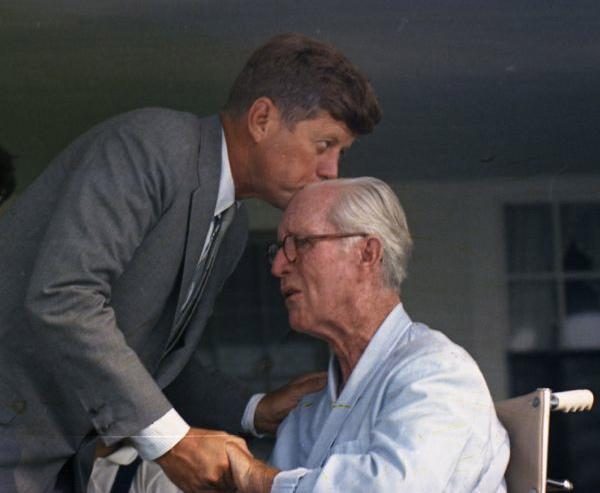
BY LAURENT GUYÉNOT • UNZ REVIEW • JULY 10, 2021
There can be no complete understanding of John Kennedy without some understanding of his father, Joseph Patrick Kennedy, for this is where he came from, not only in his own eyes and those of his friends, but in the eyes of his enemies too. The same is true for his brother Robert, of course.
I have emphasized before that, although very different in character, John and Robert Kennedy may be seen, from the point of view of their historical significance, as one person killed twice. But it should be stressed that their unity was grounded in their filial piety. I learned from David Nasaw’s biography, The Patriarch: The Remarkable Life and Turbulent Times of Joseph P. Kennedy (2012), that it was their father Joe who insisted that Jack name Bobby Attorney General, because “Jack needed someone in the cabinet in whom he had complete and absolute trust.” Robert didn’t like the idea, arguing that “nepotism was a problem,” and John was reluctant to pressure Bobby.
He decided to offer Bobby the number two position at the Defense Department and asked Clark Clifford, who was running his transition team, to go to New York to explain to [Joe] Kennedy, who had flown there after visiting Jackie and his new grandson in the hospital, why Bobby should not be named attorney general. Clifford agreed, though he thought it rather odd that the president-elect had asked “a third party to try to talk to his father about his brother.” Clifford met Kennedy at Kennedy’s apartment and presented his carefully rehearsed case against the appointment. “I was pleased with my presentation; it was, I thought, persuasive. When I had finished, Kennedy said, ‘Thank you very much, Clark. I am so glad to have heard your views.’ Then, pausing a moment, he said, ‘I do want to leave you with one thought, however — one firm thought.’ He paused again, and looked me straight in the eye. ‘Bobby is going to be Attorney General. All of us have worked our tails off for Jack, and now that we have succeeded I am going to see to it that Bobby gets the same chance that we gave to Jack.’ I would always,” Clifford recalled years later, “remember the intense but matter-of-fact tone with which he had spoken — there was no rancor, no anger, no challenge.” The father had spoken, and his sons, on this issue at least, were expected to obey.[1]
Although there is no recorded statement to that effect, Joe probably envisioned that Robert could succeed Jack as president in 1968. And it is easy to imagine that, had John survived and been reelected in 1964, Robert, with John’s support and under his watch, could have inherited the White House. We may ponder what the world would be like today had there been Kennedys in the White House until 1976.
John and Robert shared a common horror of modern war, and that, too, was their father’s legacy. John was a genuine war hero decorated with the Navy and Marine Medal for “extremely heroic conduct.” Yet on Victory in Europe Day, May 8, 1945, as a young journalist covering the founding conference of the United Nations in San Francisco, he wrote in the Herald-American: “Any man who had risked his life for his country and seen his friends killed around him must inevitably wonder why this has happened to him and most important what good will it do. . . . it is not surprising that they should question the worth of their sacrifice and feel somewhat betrayed.”[2] When announcing his candidacy for Congress on April 22, 1946, JFK declared: “Above all, day and night, with every ounce of ingenuity and industry we possess, we must work for peace. We must not have another war.”[3] Hugh Sidey, one of his journalist friends, wrote about him: “If I had to single out one element in Kennedy’s life that more than anything else influenced his later leadership it would be a horror of war, a total revulsion over the terrible toll that modern war had taken on individuals, nations, and societies, and the even worse prospects in the nuclear age. . . . It ran even deeper than his considerable public rhetoric on the issue.”[4] John once said to his friend Ben Bradlee that he believed that “the primary function of the president of the United States [was] to keep the country out of war.”[5]
That was the conviction that had guided his father throughout his political life in Franklin Roosevelt’s government, until his resignation in December 1940. As U.S. ambassador to London, Joe Kennedy wholeheartedly supported Neville Chamberlain’s policy of “appeasement” in 1938-39. He wanted peace as passionately as Churchill wanted war. “I am pro-peace, I pray, hope, and work for peace,” Joe declared on his first return from London to the U.S. in December 1938.[6] For this, he ended in the wrong side of history, which Churchill took care to write himself.
Like his father, President Kennedy was a determined peacemaker, and those in the Pentagon who wanted to push the U.S. into a third world war tried to destabilize him with insinuations that he was an appeaser like his father. On October 19, 1962, in the heat of the Cuban Missile Crisis, as Kennedy resolved to blockade Soviet shipments rather than bomb and invade Cuba, General Curtis LeMay scornfully told him, “This is almost as bad as the appeasement at Munich . . . I just don’t see any other solution except direct military intervention right now.”[7]
The stain of his father’s record as a Hitler-appeaser had followed John like a shadow. Although the press had not published it, it was no secret in the Pentagon and the CIA that the U.S. army had discovered in 1946, in Berlin’s Foreign Office, reports about Joe’s meetings with German ambassador von Ribbentrop and his successor von Dirksen, that said that Joe was Germany’s “best friend” in London and “understood our Jewish policy completely.”[8]
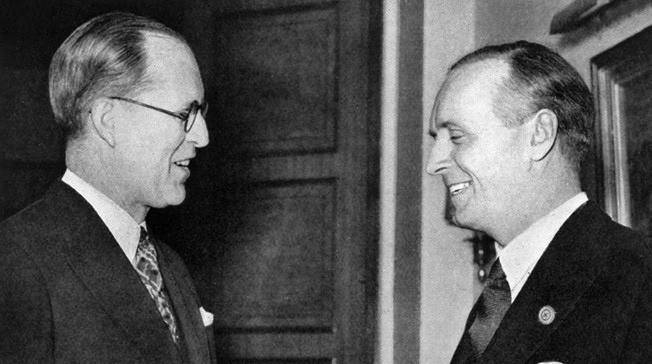
Ambassadors Joseph P. Kennedy and Joachim von Ribbentrop
In a joint debate during the 1960 Democratic convention, Johnson had attacked John as being the son of a “Chamberlain umbrella man” who “thought Hitler was right.”[9] During Kennedy’s presidential campaign, the Israeli press worried that Kennedy’s father “never loved the Jews and therefore there is a question about whether the father did not inject some poisonous drops of anti-Semitism in the minds of his children, including his son John’s.”[10] Abraham Feinberg recalls that when he invited Kennedy to his apartment to discuss his campaign funding with “all the leading Jews,” one of them set the tone with this remark: “Jack, everybody knows the reputation of your father concerning Jews and Hitler. And everybody knows that the apple doesn’t fall far from the tree.” Kennedy came back outraged from that meeting (but with the promise of $500,000).[11] When meeting the new president on May 30, 1961 in New York, Ben-Gurion could not help but see in him the son of a Hitler-appeaser. Feinberg (who arranged the meeting) recalls that “Ben-Gurion could be vicious, and he had such a hatred of the old man [Joe Kennedy].”[12]
 Is Joe’s bad reputation among Jews relevant to the assassination of his two sons? Many Jewish authors think it is. In his book The Kennedy Curse, purporting to explain “why tragedy has haunted America’s first family for 150 years”, Edward Klein links the “Kennedy curse” to Joe’s anti-Semitism, citing a story “told in mystical Jewish circles” (perhaps made up by Klein) according to which, in “retaliation” to some remark Joe made to “Israel Jacobson, a poor Lubavitcher rabbi and six of his yeshiva students, who were fleeing the Nazis,” “Rabbi Jacobson put a curse on Kennedy, damning him and all his male offspring to tragic fates.”[13] Ronald Kessler, for his part, wrote a book titled, The Sins of the Father — a not so subtle allusion to Exodus 20:5: “I, Yahweh, am a jealous God, punishing the children for the sin of the parents to the third and fourth generation of those who hate me.” Naturally, for Kessler, Joe Kennedy’s worst sin was that “he was a documented anti-Semite and an appeaser of Adolf Hitler” who “admired the Nazis.”[14]
The “Kennedy curse” did run into the third generation and possibly the fourth, when John’s only son died in a suspicious plane accident on July 16, 1999, with his wife, possibly pregnant. Five days later, John Podhoretz, son of neoconservative luminary Norman Podhoretz, published in the New York Post an opinion piece titled “A Conversation in Hell” in which he imagined Satan speaking to Joe Kennedy in Hell. The devil rejoices at the idea of eternally torturing Joe for “saying all those nice things about Hitler,” and brags of having caused the death of his grandson because, he says: “When I make a deal for a soul like yours, I need to season it before I’m ready to put it in the infernal oven.” This hateful fantasy, which is reminding of the Talmud’s depiction of Jesus in Hell, illustrates the devouring hatred of some Jewish intellectuals toward the Kennedys, and the root of that hatred in Joe Kennedy’s effort to prevent the Second World War.[15]
Interestingly, Podhoretz’s devil (or is it Yahweh?) accuses Kennedy of having done “everything you could to prevent Jewish emigration from Nazi Germany. Thousands of Jews died because of you.” The truth is exactly the opposite. In 1938, the “Kennedy Plan”, as the press called it, was to rescue German Jews. Since the U.S. government refused to open its borders to Jewish refugees, and since Great Britain strictly limited Jewish immigration to Palestine, Joe was urging the British government to open up its African colonies for temporary resettlement. “To facilitate the resettlement process,” Nasaw writes, “Kennedy volunteered to Halifax that he ‘thought that private sources in America might well contribute $100 or $200 million if any large scheme of land settlement could be proposed.’”[16] The plan was presented to Chamberlain just days after Kristallnacht (9-10 November 1938), and was supported by Jewish financier Bernard Baruch. But it angered the Zionists, who didn’t want to hear about any Jewish emigration except to Palestine, because, Ben-Gurion said, it “will endanger the existence of Zionism.”[17] Therefore, today, the “Kennedy Plan” is reviled as a kind of “final solution to the Jewish question,” and further proof that Joe was Israel’s mortal enemy.[18]
If Jewish hatred of Joe Kennedy could still inspire Podhoretz’s nasty column in 1999, imagine how deep it ran in the 1960s. At the height of his showdown with JFK over Dimona, 25 April 1963, Ben-Gurion wrote him a seven-page letter explaining that his people was threatened with extermination by a newly formed Arab Federation, just like when “six million Jews in all the countries under Nazi occupations (except Bulgaria), men and women, old and young, infants and babies, were burnt, strangled, buried alive.” “Imbued with the lessons of the Holocaust,” Avner Cohen comments, “Ben Gurion was consumed by fears for Israel’s security.”[19] He was enraged by what he saw as Kennedy’s obvious lack of concern for his people’s security, and at this point, he must have decided that Kennedy was indeed his father’s son, a modern-day Haman.
Before we get to the main piece of evidence of a direct relationship between Joe Kennedy’s appeasement policy and John Kennedy’s assassination, let us get an overview of Joe’s public career, using mainly David Nasaw’s biography and on Michael Beschloss’s Kennedy and Roosevelt: The Uneasy Alliance (1979).
Joe Kennedy entered national politics as a supporter of Roosevelt in his first presidential campaign in 1932. In July 1934, Roosevelt asked him to chair the newly created Securities and Exchange Commission, charged with bringing the New Deal to Wall Street by regulating and disciplining the Stock Exchange market. Kennedy announced: “the days of stock manipulation are over. Things that seemed all right a few years ago find no place in our present-day philosophy.” According to Beschloss, Kennedy “won almost universal praise for his salesmanship, political acumen, and ability to moderate conflicting sides that encouraged capital investment and economic recovery.” “Few were more impressed by Kennedy’s accomplishment than the man who hired him,” and “Joseph Kennedy increasingly became a familiar figure at the White House.”[20]
In 1936, Joe supported Roosevelt’s second campaign with a book titled I’m for Roosevelt (mostly ghost-written by Arthur Krock). He was hoping to be named Secretary of the Treasury, but Henry Morgenthau Jr. also wanted the job, and got it. Instead, Roosevelt named Joe chairman of the Maritime Commission, and one year later made him ambassador to London. As war was brooding in Europe, this was an important position, and Joe made it more important by often overstepping his Secretary of State Cordell Hull’s instructions.
He supported Chamberlain’s position that the territorial integrity of Czechoslovakia was not worth a war, declaring in September 2, 1938, “for the life of me I cannot see anything involved which could be remotely considered worth shedding blood for,” a statement for which he was reprimanded by Hull and Roosevelt.[21] On October 19, Joe began another speech by jokingly listing the topics he had decided not to talk about, including “a theory of mine that it is unproductive for both democratic and dictator countries to widen the division now existing between them by emphasizing their differences, which are self-apparent.”[22] Hull held a press conference the next morning to clarify that Kennedy had been speaking for himself, not the government, and Roosevelt delivered his own display of belligerence: “There can be no peace if national policy adopts as a deliberate instrument the threat of war.”[23]
In the meantime, without informing Hull, Kennedy had summoned Charles Lindbergh to London and asked him to write a letter, to be forwarded to Washington and to Whitehall, summarizing his view regarding the strength of the Luftwaffe. Lindbergh had just visited German airfields (and been presented the Service Cross of the German Eagle by Goering), and concluded that the Luftwaffe would be unassailable in a war of the skies. Kennedy then arranged a meeting between Lindbergh and an official of the British air ministry.[24] His diplomatic strategy consisted in trying to convince the British that Germany was unbeatable and that the U.S. wouldn’t join the fight, so that the British had better come to terms with Germany, whose territorial claims were justified anyway.
In the same period, Joe made plans to meet in Paris with Dr. Helmuth Wohlthat, Goering’s chief economic adviser, with whom he had made contact through James Mooney, the president of General Motors Overseas. As Nasaw explains, “Kennedy was in effect laying the groundwork for a new appeasement strategy, one that would buy Hitler off by providing him with the means to convert his war economy to a peace economy.”[25] Hull forbade him to go to Paris, so Joe met Wohlthat in London without informing Hull.
 In August 23, 1939, a week before Hitler invaded Poland, Kennedy urged Roosevelt, in vain, to pressure the Polish government to cede territory to Germany.[26] After Hitler’s invasion, Kennedy, like Chamberlain, was heartbroken: “It’s the end of the world . . . the end of everything,” he told Roosevelt on the phone.[27] But a week later, he was still urging him to save peace, writing him: “It seems to me that this situation may crystallize to a point where the President can be the savior of the world. The British government as such certainly cannot accept any agreement with Hitler, but there may be a point when the President himself may work out plans for world peace.”[28] He got his response from Hull: “The people of the United States would not support any move for peace initiated by this Government that would consolidate or make possible a survival of a regime of force and of aggression.”
Simultaneously, Roosevelt was initiating direct contact with Churchill, now First Lord of the Admiralty and soon to be Prime Minister. From Roosevelt’s letters, Churchill got enough confidence that the U.S. would ultimately join the war if it broke out, and he bet everything on it. Joe was infuriated when learning about this most irregular channel of communication, at a time when the President was bound by neutrality laws and the American people overwhelmingly opposed to U.S. engagement. Joe was particularly distressed by Roosevelt’s trust in Churchill, whom Joe considered “an actor and a politician. He always impressed me that he’d blow up the American Embassy and say it was the Germans if it would get the U.S. in.”[29] In early December 1939, Kennedy confided to Jay Pierrepont Moffat of the State Department that Churchill “is ruthless and scheming. He is also in touch with groups in America which have the same idea, notably, certain strong Jewish leaders.”[30]
 After the defeat of France, Kennedy saw a new opportunity for peace. He cabled Washington on May 27, 1940, recommending that the President push Britain and France to negotiate an end to the crisis, as Lord Halifax, still Foreign Secretary, was actually proposing. “I suspect that the Germans would be willing to make peace with both the French and British now — of course on their own terms, but on terms that would be a great deal better than they would be if the war continues.”[31]
Although aware that Roosevelt was now ignoring him, Joe remained at his post until October 1940. Before leaving, he wrote a note to Chamberlain, then a broken and dying man: “For me to have been any service to you in your struggle is the real worthwhile epoch in my career. You have retired but mark my words the world will yet see that your struggle was never in vain. My job from now on is to tell the world of your hopes. Now and forever, Your devoted friend, Joe Kennedy.”[32] Joe Kennedy was still a convinced appeaser, determined to give peace every chance.
David Irving mentions that, before boarding a ship from Lisbon to New York, Kennedy “pleaded with the State Department to announce that, even if this vessel mysteriously blew up in mid-Atlantic with an American ambassador on board, Washington would not consider it a cause for war. ‘I thought,’ wrote Kennedy in his scurrilous unpublished memoirs, ‘that would give me some protection against Churchill’s placing a bomb on the ship.’”[33]
Kennedy arrived in New York October 27, a week before election day. He knew enough of Roosevelt’s secret contacts with Churchill to endanger his reelection. He was seriously considering speaking out to the press. In a wire to his lover and admirer Clare Booth Luce, he promised a bombshell that would “put twenty-five million Catholic voters behind [Republican candidate] Wendell Willkie to throw Roosevelt out.”[34]
But Joe had a strong sense of loyalty, and his wife reminded him of a political truth instinctive to them both: “The President sent you, a Roman Catholic, as Ambassador to London, which probably no other President would have done. . . . You would write yourself down as an ingrate in the view of many people if you resign now.”[35] After a long conversation with Roosevelt on the day of his arrival, of which nothing has transpired, Kennedy gave a radio address over CBS on October 29 to endorse Roosevelt, but not without reasserting his “conviction that this country must and will stay out of war.” A few days later, with Joe Kennedy by his side, Roosevelt made his own pledge: “I have said this before, but I shall say it again and again and again: Your boys are not going to be sent into any foreign wars!”[36] Roosevelt was elected. On December 1, 1940, Kennedy delivered his resignation letter, and told reporters: “My plan is . . . to devote my efforts to what seems to me to be the greatest cause in the world today . . . That cause is to help the President keep the United States out of war.”[37]
On December 17, Roosevelt revealed at a press conference his plans to provide billions of dollars in war supplies to Great Britain in the form of Lend-Lease (eventually, the U.S. would supply England with $13 billion). Joe expressed privately his feeling of having been exploited by the President. But he stayed in relatively good terms with Roosevelt, although he refused to support his nomination for a fourth term, when he visited him on October 26, 1944 in the White House. Kennedy recorded in his notes telling the President — a very sick man — that the Catholic voters were hesitant to vote for him because “they felt that Roosevelt was Jew controlled.” He added that he agreed “with the group who felt that the Hopkins, Rosenmans, and Frankfurters, and the rest of the incompetents would rob Roosevelt of the place in history that he hoped, I am sure, to have. . . . Roosevelt went on to say ‘Why, I don’t see Frankfurter twice a year.’ And I said to him, ‘You see him twenty times a day but you don’t know it because he works through all these other groups of people without your knowing it.’”[38]
After his resignation in 1941, Joe had envisioned writing a memoir of his London years, and told his friend and former president Herbert Hoover that the book would “put an entirely different color on the process of how America got into the war and would prove the betrayal of the American people by Franklin D. Roosevelt.” But, Beschloss comments, “the necessities of wartime unity and, later, his sons’ political careers kept Joseph Kennedy’s diplomatic memoir out of print, where it remained.”[39]
Here, there is an interesting parallel with James Forrestal, another American patriot of Irish Catholic stock and a friend of Joe Kennedy. As David Martin shows in his book The Assassination of James Forrestal (summarized here), when Forrestal was pushed out of the Defense Department by Truman in March 1949, he planned to write a book and to start a magazine. As Navy Secretary, he had gained inside knowledge of Roosevelt’s scheme to provoke the Japanese into attacking Pearl Harbor. In 1945, he had worked behind the scene to achieve a negotiated surrender from the Japanese, and was very bitter about Roosevelt’s demand for “unconditional surrender” and the unnecessary suffering imposed on the Japanese. Forrestal had also much to say about the way the Zionists obtained the Partition Plan at the U.N. General Assembly, or about the way Truman was bought into supporting the recognition of Israel. On April 2, 1949, Forrestal was interned against his will and forcibly confined in the 16th floor of the Navy hospital of Bethesda, and on May 22 was declared to have fallen from a window while trying to hang himself from it with a dressing-gown sash. No criminal investigation was conducted, but the evidence obtained by David Martin through a Freedom of Information Act leaves no doubt that he was assassinated by the Zionist mafia.
It is easy to imagine that, had Joe Kennedy decided to expose Roosevelt’s betrayal of the American people and the Jewish intrigues to push him into the war, he might have suffered the same fate as Forrestal. Instead, he retired from public life and devoted his remaining influence to his sons’ political future. Despite the death of his eldest son Joe Jr. in a high-risk mission in 1944, he achieved his presidential ambition through his second son. The “Kennedy curse,” however, would ultimately catch up with his lineage.
John Kennedy’s Intellectual Filiation
John has always been loyal to his father’s memory, and there is enough evidence that he shared his most fundamental principles and his views of World War II. In 1956, in his book Profiles in Courage, John praised Senator Robert Taft for having, at tremendous personal cost, denounced in 1946 the hanging of eleven Nazi officials as “a blot on the American record which we shall long regret.”[40] One symbolic hint of President Kennedy’s intellectual and political filiation with his father was his invitation of Charles Lindbergh on May 11, 1962, for a grand reception at the White House. Lindbergh and his wife caused a sensation when they dined at the presidential table and stayed overnight at the White House.[41] Let’s recall that, in September 1940, Lindbergh had been a founding member of the America First Committee and the staunchest critic of Roosevelt’s ploys to drag the U.S. into the war.[42] His reputation had suffered tremendously from his criticism of Jewish influence, and he had been living as a recluse ever since.
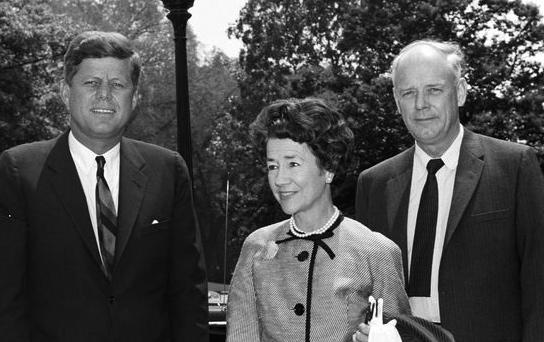
Kennedy had nothing to gain politically from inviting Lindbergh very publicly to the White House. The significance of this gesture should not be underestimated. It probably demonstrates a wish to vindicate the vilified appeasers of 1938-40. Lindbergh at the White House may have been a sign that the wheel was turning, and that history would soon be written in a more balanced way. John’s assassination halted and reversed this movement. Half a decade later, along with the expansion of Israel, the dark cult of the Holocaust would start swamping over the U.S. and the world. Arguably, if Kennedy had lived, there would be no compulsory Holocaust religion today.
For those like David Ben-Gurion whose self-image and worldview revolved around the Holocaust, the Kennedy brothers were essentially sons of a Hitler-appeaser and Nazi-supporter, and their leadership of the United-States was an existential threat as well as an intolerable insult. Although, for obvious reasons, this murderous hatred is seldom expressed publicly (John Podhoretz’s “A Conversation in Hell” is a remarkable exception), it is a critical fact to take into account in our quest to solve the mystery of the “Kennedy curse.” And it sheds a bright light on one of the most bizarre aspects of JFK’s assassination.
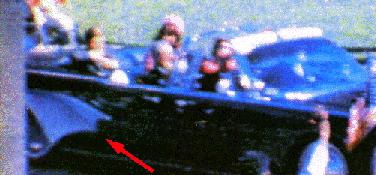
In his 1967 book titled Six Seconds in Dallas: a micro-study of the Kennedy assassination proving that three gunmen murdered the President, Josiah Thompson first drew attention to a character who can be seen on the Zapruder film and on other photographs taken in Dealey Plaza at the moment of JFK’s assassination. Here is how Thompson presents him in a short video recorded by Errol Morris for the New York Times in 2011:
On November 22nd, it rained the night before. But everything cleared by about 9 or 9:30 in the morning. So if you were looking at various photographs of the motorcade route, in the crowd gathered there, you will have noticed: nobody is wearing a raincoat, nobody has an open umbrella. Why? Because it’s a beautiful day. And then I noticed: in all of Dallas, there appears to be exactly one person standing under and open black umbrella. And that person is standing where the shots began to rain into the limousine. Let us call him “the umbrella man”. . . . You can see him in certain frames from the Zapruder film, standing right there by the Stemmons Freeway sign. There are other still photographs taken from other locations in Dealey Plaza, which shows the whole man standing under an open black umbrella — the only person under any umbrella in all of Dallas, standing right at the location where all the shots come into the limousine. Can any one come up with a non-sinister explanation for this? So I published this in Six Seconds, but didn’t speculate about what it meant . . . Well, I asked that the Umbrella Man to come forward and explain this. So he did. He came forward and he went to Washington with his umbrella, and he testified in 1978 before the House Select Committee on Assassinations. He explained then why he had opened the umbrella and was standing there that day. The open umbrella was a kind of protest, a visual protest. It wasn’t a protest of any of John Kennedy’s policies as president. It was a protest at the appeasement policy of Joseph P. Kennedy, John Kennedy’s father when he was ambassador to the court of Saint James in 1938 and 39. It was a reference to Neville Chamberlain’s umbrella.[43]
The black umbrella had been Chamberlain’s iconic trademark, and, after his return from Munich, a symbol of “appeasement”, both for those who supported it (some old ladies “suggested that Chamberlain’s umbrella be broken up and pieces sold as sacred relics”)[44] and for those who opposed it (“Wherever Chamberlain traveled, the opposition party in Britain protested his appeasement at Munich by displaying umbrellas,” according to Edward Miller).
The Umbrella Man was Louie Steven Witt, and had been identified by local newsmen before he came forward to the HSCA. Josiah Thompson assumes that his “visual protest” and JFK’s assassination are unrelated, and that they happened at the exact same time and place by some kind of quantum-physics coincidence. He cannot bring himself to see the connection, even though the Umbrella Man himself made it clear to the HSCA that he wanted to “heckle” JFK about his father’s appeasement of Hitler in 1938. Knowing what we know about Jewish perception of the “Kennedy curse” as linked to the “sins of the father”, we cannot but find Thompson’s refusal to see anything conspiratorial as very typical of Gentile self-induced blindness.
Was Louie Steven Witt a Zionist agent, a sayan? Not necessarily. He might have been instructed to do what he did without knowing that Kennedy would be killed right in front of him. On the other hand, the explanation he gave for his “bad joke” sounds disingenuous: “In a coffee break conversation,” he said, “someone had mentioned that the umbrella was a sore spot with the Kennedy family. . . . I was just going to kind of do a little heckling.” Witt carefully avoided mentioning why the umbrella was “a sore spot with the Kennedy family.” He also avoided naming Joe Kennedy when he said that he had heard that “some members of the Kennedy family” had once been offended in an airport by people brandishing umbrellas. The “airport” sounds like an allusive reference to Chamberlain’s widely publicized return at the Heston Aerodrome on 30 September 1938. There is clearly a cryptic undertone in Witt’s explanation. For those Unz Review readers who have ears to hear and eyes to see, executing JFK while “heckling” him about his father’s appeasement policy should be an unmistakable signature. Chamberlain’s umbrella is Kennedy’s cross.
Laurent Guyénot, Ph.D., is the author of The Unspoken Kennedy Truth(2021), Essays on Jewish Power(2020), and From Yahweh to Zion (2018).
Notes
[1] David Nasaw, The Patriarch: The Remarkable Life and Turbulent Times of Joseph P. Kennedy, Penguin Books, 2012, pp. 818-819.
[2] Christ Matthews, Jack Kennedy, Elusive Hero, Simon & Schuster, 2011, pp. 71-72.
[3] James Douglass, JFK and the Unspeakable: Why He Died and Why It Matters, Touchstone, 2008, p. 5.
[4] Quoted in Robert Kennedy, Jr., American Values: Lessons I Learned from My Family, HarperCollins, 2018, p. 101.
[5] Quoted in Robert Kennedy, Jr., American Values, p. 101.
[6] Michael R. Beschloss, Kennedy and Roosevelt: The Uneasy Alliance, Open Road, 1979, p.187.
[7] Douglass, JFK and the Unspeakable, p. 21.
[8] Nasaw, The Patriarch, p. 349.
[9] Robert Caro, The Years of Lyndon Johnson, vol. IV: The Passage of Power, Alfred Knopf, 2012, p. 104. Also in Arthur Krock, Memoirs: Sixty Years on the Firing Line, Funk & Wagnalls, 1968, p. 362.
[10] In the journal of the Herut, Menachem Begin’s political party, quoted in Alan Hart, Zionism: The Real Enemy of the Jews, vol. 2: David Becomes Goliath, Clarity Press, 2013, p. 252.
[11] Seymour Hersh, The Samson Option: Israel’s Nuclear Arsenal and American Foreign Policy, Random House, 1991, p. 96.
[12] Hersh, The Samson Option, p. 103.
[13] Edward Klein, The Kennedy Curse: Why Tragedy Has Haunted America’s First Family for 150 Years, Saint Martin’s Press, 2004.
[14] Ronald Kessler, The Sins of the Father: Joseph P. Kennedy and the Dynasty He Founded, Coronet Books, 1997, quotes from the publisher’s presentation and the back cover.
[15] John Podhoretz, “A Conversation in Hell,” New York Post, July 21, 1999, on nypost.com
[16] Nasaw, The Patriarch, pp. 403-406.
[17] Alan Hart, Zionism: The Real Enemy of the Jews, vol. 1: The False Messiah, Clarity Press, 2009, p. 164.
[18] Clive Irving, “Joe Kennedy’s answer to the Jewish question: ship them to Africa,” Apr. 14, 2017, on www.thedailybeast.com
[19] Avner Cohen, Israel and the Bomb, Columbia UP, 1998, pp. 10, 119.
[20] Beschloss, Kennedy and Roosevelt, pp. 105-109.
[21] Nasaw, The Patriarch, p. 373; also Beschloff, Kennedy and Roosevelt, p. 180.
[22] Nasaw, The Patriarch, p. 396.
[23] Beschloss, Kennedy and Roosevelt, pp. 185-186.
[24] Beschloss, Kennedy and Roosevelt, p. 182.
[25] Nasaw, The Patriarch, p. 425.
[26] Nasaw, The Patriarch, p. 445.
[27] Beschloss, Kennedy and Roosevelt, p. 199.
[28] Beschloss, Kennedy and Roosevelt, p. 201.
[29] Nasaw, The Patriarch, pp. 460-461. The quote is from Joe Kennedy’s diary, according to David Irving, who renders it slightly differently in Churchill’s war, vol. 1: The Struggle for Power, Focal Point, 2003, p. 207.
[30] Nasaw, The Patriarch, p. 476.
[31] Nasaw, The Patriarch, p. 496.
[32] Nasaw, The Patriarch, p. 534.
[33] David Irving, Churchill’s war, vol. 1: The Struggle for Power, Focal Point, 2003, p. 207.
[34] Beschloss, Kennedy and Roosevelt, pp. 15-16.
[35] Beschloss, Kennedy and Roosevelt, pp. 43 and 230.
[36] Beschloss, Kennedy and Roosevelt, pp. 235-237.
[37] Beschloss, Kennedy and Roosevelt, p. 247.
[38] Nasaw, The Patriarch, p. 625; Beschloss, Kennedy and Roosevelt, p. 279.
[39] Beschloss, Kennedy and Roosevelt, p. 273.
[40] Robert Taft, October 6, 1946, quoted in John F. Kennedy, Profiles in Courage, 1956, Harper Perennial, 2003 , p. 199.
[41] “Visit of Charles A. Lindbergh”, on www.jfklibrary.org
[42] Lynne Olson, Those Angry Days: Roosevelt, Lindbergh, and America’s Fight Over World War II, 1939-1941, Random House, 2013.
[43] “The Umbrella Man”, on Vimeo.com or YouTube
[44] Patrick J. Buchanan, Churchill, Hitler, and “The Unnecessary War”: How Britain Lost Its Empire and the West Lost the World, Crown Forum, 2008, p. 208.
Pseudopandemic
By Iain Davis | OffGuardian | June 29, 2021
Covid 19 was and is a pseudopandemic. It was the gross exaggeration of the threat posed by a low mortality respiratory illness, comparable to influenza.
The pseudopandemic was a psychological operation (psy-op) designed to terrorise the public. The objective was to accustom the people to draconian system of government oppression by familiarising them with the mechanisms of a biosecurity state.
The pseudopandemic was based upon an influenza like illness which, regardless of its origin, was not and is not a disease which can legitimately be considered the cause of a “pandemic.” The only way it could ever be described as such was by the removal of any reference to mortality from the World Health Organisation’s definition.
COVID 19 is a disease which has a mortality age distribution profile indistinguishable from standard mortality. Unlike influenza, which disproportionately impacts the young, in terms of threat to life, COVID 19 was and is a wholly unremarkable illness.
Were it not for political theatrics and mainstream media propaganda, which began in China, no one, outside of the medical profession and COVID 19 sufferers, would have remarked on this disease.
The illusion of overwhelmed health services was created by massively reducing their capacity and staffing levels while simultaneously reorienting healthcare to treat everyone who presented with a respiratory illness as viral plague carriers.
In reality the pseudopandemic saw unusually low levels of hospital bed occupancy. However, due to the additional policies and procedures heaped upon them, healthcare services were thrown into into disarray.
This was combined with the use of tests, incapable of diagnosing anything, as proof of a COVID 19 “case.” This enabled governments around the world to make absurd claims about the threat level. They relied upon fake science and junk data throughout. As symptomatic illness and resultant disease mortality was relatively low, they asserted that people without any signs of illness (the asymptomatic) were spreading the contagion.
This was abject nonsense. There was no evidence that the asymptomatic infected anyone. Those at risk of severe illness were the small minority of people who already had serious comorbidities, often due to their age.
The mass house arrests (lockdowns) and other measures, such as wearing face masks, were then used to increase the infection risk, to reduce broad levels of population immunity and give the false impression of an extraordinary public health threat. The removal of health care for every other disease, including cancer and ischaemic heart disease, coupled with the health costs of increasing deprivation and immunosuppressant policies, were then exploited to bolster the illusion of a pandemic.
This does not mean that COVID 19 didn’t kill people but those who died of the disease were a small percentage of the total numbers claimed. COVID 19 had no discernible impact upon all-cause mortality. The increase above one of the lowest ever 5 year mortality averages was mainly caused by the withdrawal of health services, as increasing numbers of people died in their own homes or in overburdened care settings, without receiving normal medical attention.
Despite these efforts, mortality in 2020 was still only the 9th highest in the first two decades of the 21st century and one of the lowest age-standardised mortality rates in the last 50 years.
COVID 19 presented virtually no risk to those of working age an none at all to the young. There was no evidence that children were either at or presented any risk. The school closures were part of the pseudopandemic psy-op. They gave the misleading impression of an emergency and provided fraudulent justification for vaccinating children.
The pseudopandemic was planned to lead to the complete transformation of our culture and society. It has irrevocably changed our relationship with governments, has caused catastrophic economic disruption, shutdown global trade and saw millions become reliant on government subsidies. The pseudopandemic was the opening salvo in a global coup d’état.
The new pseudopandemic biosecurity apparatus is designed to control our behaviour as we are forced through a global transformation. Those behind the pseudopandemic intend to change the International Monetary and Financial System (IMFS) and establish global governance in the shape of technocracy. Technocracy is a neofeudal, totalitarian system based upon communitarian principles.
We will be offered the illusion of participatory democracy through our required participation and belief in “civil society.” Civil society will be a “stakeholder” in the Technocracy. However, civil society will only be allowed to pursue polices set at the global level.
Applied psychology was used throughout the pseudopandemic to fix our “choice environment.” We were conditioned to believe that following the rules was the responsible and moral choice. In reality our behaviour was being deliberately altered to ensure our compliance with the diktats of the biosecurity state, preparing society for the transition to technocracy.
The new global IMFS is built upon carbon trading and a $120 trillion carbon bond market is currently under construction. Assets are being defined in terms of their Stakeholder Capitalism Metrics which rate investments depending upon their environmental, social and governance (ESG) score.
These metrics have been established by the World Economic Forum working in partnership with the central banks, the Bank for International Settlements (BIS) and other stakeholder capitalists, such as the investment firm BlackRock.
The global system of central banks, headed by the BIS, are “going direct” by directly funding government policy. They have linked monetary policy to fiscal policy which means ultimate control of all government spending by the BIS. The Financial Services Board of the BIS regulates ESG’s and determines the value of sustainable financial assets.
In this way, the global technocracy will facilitate the continuation of crony capitalism, as only the right stakeholders will receive the approved ESG rating. Those who don’t will not be able to raise the investment capital they need and will be forced out of business.
“Going direct” began before the World Health Organisation (WHO) declared a global pandemic. All of the economic and financial responses to the pseudopandemic, such as furlough and business support packages, were agreed as part of the “going direct” plan in August 2019.
The so called economic stimulus of Quantitative Easing (QE) is a fraud. It is based upon the unbridled monetisation of debt on an unprecedented scale. Going direct means that the toxic junk assets of the financial institutions have been taken on to the balance sheets of the central banks. Thus creating unimaginable levels of public debt that can never, and will never, be repaid.
The QE money, created out of absolutely nothing, has been pumped into the financial markets for the continued enrichment of the right stakeholders. The vast expansion of the money supply will shortly lead to hyperinflation. The mass unemployment that will occur as a result of the austerity, caused both by the staggering levels of debt and our transition to a new IMFS, will create stagflation.
The new net zero carbon economy will mean permanent austerity for the majority. The Technate will provide a universal basic income (UBI), or some variation of the concept, to be paid in Central Bank Digital Currency (CDBC). This will mean that no one will have their own money, other than the chosen stakeholders, as all transactions will be monitored and controlled by the central banks.
Those who oppose the neofeudal authority of the corporate, stakeholder Technate and refuse to comply with the imposition of biosecurity obligations will have their CBDC restricted or switched off. The pseudopandemic has established the framework of the biosecurity state that will control all our lives. The vaccine passports are the gateway to full biometric identity for every citizen in the new normal Technate.
We will be required to show our biometric ID on demand. Access to goods and services will be monitored and restricted as desired by the Technate. UBI and CBDC combined with biometric ID will ensure our compliance. The central planners of the Technate will oversee the AI controlled system which will automatically limit the freedoms of those who defy the rules decreed by the stakeholder capitalists.
Money, as we currently understand it, is no longer required by those behind the pseudopandemic. The net zero carbon economy enables them to seize control of the “global commons.” This means that they will have dominion over all of the Earth’s natural resources. All land, the oceans, the atmosphere and even space is being converted into assets via Stakeholder Capitalism Metrics.
Not only will we have no money of our own, we will be unable to access the resources we need to survive without permission from the Technate. While this system of technocracy has been planned for more than a century, it was the financial collapse in 2008 that led the pseudopandemic planners to increase the pace of transformation. The monetisation of debt had long been the source of their authority but this IMFS was unsustainable. As all money was debt, its eventual collapse was inevitable. It passed the point of no return in 2008.
 With their going direct plan in place, the stage was set for the pseudopandemic. SARS-CoV-2 provided the perfect opportunity and the core conspirators behind the pseudopandemic had trained extensively in readiness for the operation. We were then barraged by a mainstream media propaganda campaign and military’s information warfare units were deployed to control our “choice environment.”
Scientific and medical doubts were censored as the suspension of normal democratic processes was exploited to introduce the biosecurity state. Laws were passed to allow government to commit any crime it wished in pursuit of stakeholder capitalist sustainable development goals. Laws to end the right of protest and censor free speech are moving unopposed through the legislature as national governments, who are no more than stakeholder partners within the new normal technocracy, prepare us for the coming Technate.
For the core conspirators of the pseudopandemic this is the realisation of their long held dream of global governance. They are steeped in the mythology of eugenics and population control. Once they have total control of the global commons they will no longer need us as consumers and are intent upon significant population reduction.
As insane as this all sounds the evidence, explored in pseudopandemic, is overwhelming. We are facing global neofeudalism unless we act now. Herein lies our hope.
The core conspirators have no real power. It is an illusion that they are desperate to maintain. They invest billions in propaganda, hybrid warfare and security systems because they are terrified that we will realise what they are doing.
Their plan can only succeed if we believe their lies and comply with their orders. If we don’t there is nothing they can do about it.
We can reset the world.
Pseudopandemic, by Iain Davis, is available both in kindle and paperback, from Amazon and other sellers. Or you can subscribe to In This Together for a free copy.
American Medicine, American Malfeasance
By Dr. Gary Null and Richard Gale | Global Research | June 26, 2021
An issue that is rarely discussed or given serious attention is the over-specialization in healthcare. Modern medicine’s approach to identify and treat illnesses and tackle the reduction of infections has in many instances ceased to be multidisciplinary. Medicine has also become increasingly compartmentalized and confined to a rigid materialistic belief system that has now established its own set of standards, criteria and values that are often contrary to gold-standard scientific protocols. The consequence is that its narrow single-mindedness has insulated modern medicine from objective criticism and preserved its internal flaws, errors and fabrications, which have contributed to the unnecessary injury and death of countless patients.
US healthcare spending reached $3.8 trillion in 2019. Due to the Covid pandemic, expenditures for 2020 will be astronomically higher. One might expect that with the world’s most expensive healthcare system, the US would equally have the best evidence-based practices to keep its citizens healthy. By now we should be proficiently expert at preventing and reversing disease, while making minimal errors resulting in injury or death. However, the exact opposite is the case. Instead of minimizing disease-causing factors, American medicine causes more illness through misguided diagnostic testing, overuse of medical and surgical procedures, and over prescribing pharmaceutical drugs. The fundamental reason for this catastrophe is that today’s healthcare establishment, and corporate science in general, over relies on profit-generating motives.
Dr. Peter Gotzsche is arguably recognized as one of the world’s foremost experts in evaluating evidence-based medicine (EBM). As the co-founder of EBM’s preeminent flagship organization – the Cochrane Collaboration — to review and analyze peer-reviewed clinical research, he is intimately knowledgeable about the widespread corruption permeating the pharmaceutical industry and medical journals. In his book Deadly Medicines and Organized Crime, he writes,
“The reason why we take so many drugs is that drug companies do not sell drugs. They sell lies about drugs… The patients do not realize that although their doctors know a lot about diseases, human physiology and psychology, they know very little about the drugs that have been concocted and dressed up by the drug industry.”
After we take a fair and objective look at American medicine during the past five decades, especially at the statistics of iatrogenic fatalities, or deaths caused by prescribed medications and medical error, our healthcare establishment is found to be anything but benign. Despite its many noteworthy discoveries and merits, a substantial amount of recommended medical practice has failed patients. “If the medical system were a bank,” writes Dr. Stephen Persell at Northwestern University’s School of Medicine, “you wouldn’t deposit your money here, because there would be an error every one-in-two to one-in-three times you made a transaction.” Dr. Persell is referring to the rates of preventable medical errors causing patients serious injury and now the third leading cause of death.
There is excellent evidence to support the argument that iatrogenic deaths have passed cancer fatalities and are now challenging heart disease for the number one spot. A 2008 study found as many as half of adverse events reported by patients were not recorded in their hospital charts. As of 2017, investigations continue to find that less than 10% of medical errors are reported. Reported adverse effects vary depending on the specialty and frequently go unnoticed or are improperly evaluated. An additional study found that almost two thirds of cardiologists had refused to report a serious error they had direct personal knowledge of to an authority.
As one example, heart disease is America’s leading cause of fatality, accounting for 665,000 deaths annually. The CDC, which consistently undermines health threats if it means positioning itself in opposition to private commercial interests, estimates that 34 percent of cardiovascular fatalities are premature and preventable. In contrast, the American Heart Association claims 80 percent are preventable. What are the heads of our federal health agencies doing to advocate on the side of prevention? Little to nothing.
There is no realistic and science-based national policy in place to lessen cardiovascular, cancer and diabetic death rates. Since the most viable and effective means to prevent these diseases are natural and within every person’s means, it is not financially lucrative to divert federal funding away from pharmaceutical treatments and surgical procedures. The CDC and FDA are largely dependent upon monetary income received from the drug and medical device industries.
Earlier we reported about the systemic corruption and fraud that has plagued the CDC and FDA for decades. It would be far cheaper to completely empty, dismantle, fumigate and rebuild the agencies anew rather than continue exerting pressure for reforms, which have only perpetuated a killing spree by protecting life-threatening drugs, vaccines and unnecessary medical procedures. Dr. Gotzsche notes, the same is true for private drug companies. Despite the numerous lawsuits drug companies have lost in federal courts, nothing has fundamentally changed in order to deter them from illegal activities to increase profits. In fact, the cost of paying out settlements and settling lawsuits is factored into the expense of doing business.
A decade ago, we teamed up with three board-certified physicians to undertake the task to review the peer-reviewed literature in order to recalculate the statistics from many branches of medicine in order to arrive at a more realistic casualty rate due to medical error. We began with a basic question. Do the current standards of American medical practice and its supporting science prove that the recommended therapies and healthcare protocols – whether drugs, surgery, diagnostic methods, medical devices, etc – are actually effective? And if so, at what cost to the patients’ health and well-being?
Our results and final conclusions were startling and culminated in the release of a widely read and referenced book, Death by Medicine. We made every effort to avoid editorial commentary to our findings. We decided to only report the statistics and facts with our calculations. The fact that our data placed iatrogenic error as the number one cause of death in America was alone sufficient. What was novel in our analysis was that we included preventable deaths, such as certain infections and severe nutrient deficiency, which could have been easily corrected by clinicians and medical personnel if viable prevention programs had been part of our healthcare system. After publication the book was sent to hundreds of journalists, federal officials and non-profit medical organizations. It was completely ignored by the orthodoxy; however, it became increasingly popular among alternative and complementary medical physicians who were already fully aware of the structural dangers to public health within conventional medical care.
Revisiting American medicine’s legacy of iatrogenic deaths is now more crucial than ever because the same behaviors that have contributed to the nation’s leading cause of death are being repeated during the Covid-19 pandemic. The government and federal health officials are in reprehensible denial of inexpensive and highly effective drugs, such as Ivermectin and hydroxychloroquine, to treat early and middle stage SARS-2 infections. Cases of Covid infections and deaths have been grossly exaggerated. And now we are realizing that the efficacy and safety profiles of the vaccines are orchestrated scams. As a result, the entire institutional edifice to vaccinate the global population is destined to become the greatest scandal of the 21st century.
Unfortunately, nobody can acquire accurate statistics for Covid-19 vaccine associated injuries and deaths from the CDC’s Vaccine Adverse Events Reporting System (VAERS). Careful weekly monitoring of VAERS’ adverse event updates convince us that the entire system is criminally rigged. CDC officials overseeing the database are undoubtedly fudging numbers after ratio of adverse events, including deaths, per number of doses administered are compared to the more robust and accurate EudraVigilance database in the European Union and the less reliable Yellow Card System in the UK.
As of June 17, VAERS was reporting 329,021 injuries and 5,888 deaths due to the Covid vaccines. The database’s most recent update is reporting an additional 26,541 injuries but 1,972 less deaths. How can this sudden disappearance of almost 2,000 deaths be accounted for? The mysterious loss of fatality entries occurred during the same week as a CDC working group of outside medical professionals was reviewing an association between the mRNA vaccines and the rising number of reported cases of cardiac inflammation or myocarditis. The group concluded that there is indeed “a likely association.” The occasion of deleted deaths in VAERS is also on the heels of the Israeli Shamir Medical Center report that Pfizer’s vaccine is linked with occurrences of thrombotic thrombocytopenic purpura, an autoimmune disorder associated with a rare form of blood clotting. However, despite weekly local news stories around the nation about youth as young as 19 years of age dying of vaccine complications shortly after receipt of an mRNA vaccine, the CDC is claiming that all 1,200 persons, between 16-24 years of age, recovered and no deaths were reported. Does this account for the likely scrubbing of entries in VAERS?
But it is much worse. We only need to look at the European Union’s statistics for adverse Covid-19 vaccine events and compare that with VAERS and the CDC’s recent conclusion to realize there is a massive cover-up in our government’s efforts to sanitize the safety record of Covid vaccines. As of this week the EudraVigilance system is reporting over 1.5 million injuries and 15,472 deaths. Within those figures, 28,583 injuries and 1,862 deaths are from cardiac complications such as myocarditis.
Second, the EU and US have administered approximately the same number of Covid vaccine doses, roughly 409 million and 379 million respectively. Therefore we should expect to find a similar dose-to-injury ratio. Again we discover the CDC gaming the nation’s reporting system to lessen the perception of lethal risks. Based upon the EU ratio we can conservatively estimate that a minimum of 14,300 Americans have been killed by the vaccines so far. If we go back a week before the CDC scrubbed entries in VAERS, it would be over 17,000 Covid vaccine deaths. The actual number of Americans suffering adverse reactions would be 1.4 million.
In other words the EU is reporting 4 times more vaccine injuries and deaths than American health officials. In both the US and EU, Pfizer’s mRNA vaccine accounts for the majority of these casualties. Unless the Covid-19 vaccines engineer a personal vendetta against people holding EU passports, these numbers don’t add up.
Before the arrival of the Covid vaccines, Merck’s anti-inflammatory drug Vioxx was widely regarded as the single largest pharmaceutical catastrophe in American medical history. The drug should never have been approved and licensed in the first place; and, Merck knew beforehand that the drug would be lethal and concealed that documentation from FDA regulators. Vioxx was on the market for five years before being withdrawn. At the time of the federal class action lawsuit against Merck, FDA epidemiologist Dr. David Graham estimated the drug had killed 60,000 patients due to heart attacks and strokes. Since the majority of deaths were among elderly patients, a later report by the American Conservative predicted that upwards to half a million patients may have died from the drug over the course of a longer period. Yet during those years Merck was cashing in $2 billion annually from Vioxx sales, earning over double its eventual $4.8 billion fine after being found guilty.
To put this into a broader perspective, the Covid vaccines have only been distributed for six months and have now contributed to a realistic 17,000 deaths or upwards towards 30,000 this year alone. Since the vaccines’ immunity quickly wanes and it seems certain they provide little protection against new SARS-2 strains, health officials are already recommending regular booster shots. Similar to a prescription medication, those who buy into the vaccine propaganda hype are in principle relying upon these vaccines for life or until such time the virus resides into just a seasonal nuisance. Consequently iatrogenic vaccine injuries and deaths may likely continue at current rates during forthcoming years. The Covid-19 vaccines are on track to outpace the conservative number of Vioxx deaths over three-fold and even modern medicine’s most deadly drugCerivastatin, manufactured by Bayer in the late 1990s and responsible for over 100,000 deaths during the four-year period it was on the market. In short time, Covid vaccines will be the deadliest drug to have emerged from Big Pharma.
A study published in the Journal of Patient Safety estimated that 400,000 unnecessary and preventable deaths occur annually in American hospitals alone. At that rate, it is not surprising that the large majority of deaths ruled as SARS-2 infections happened in hospitals. If our federal health officials had been competent, and less compromised by the demands and influence of drug makers, most of these fatalities likely would never have occurred.
It has been estimated that US taxpayers have paid out $39 billion for Covid-19 vaccine development, funding and towards nationalized response measures. Most of this has been horribly wasted after we consider other options on hand to curb the pandemic but were categorically ignored. “In the case of vaccines in general,” the journal Health Affairs observed,
“the government often plays an outsized role, but in the era of Covid-19 the government’s role was even more central than usual. The government essentially removed the bulk of traditional industry risks related to vaccine development: a) scientific failures, b) failures to demonstrate safety and efficacy, c) manufacturing risks, and d) market risks related to low demand.”
While this may shock and disturb a rational person, Health Affairs – a thoroughly orthodox medical publication – applauds the government’s negligent measures as “money well spent.”
For this reason it is crucial to understand the terrible decisions made during the Covid pandemic in the context of modern medicine’s past crimes and preventable failures. In the coming months Anthony Fauci’s reputation will become further tainted. We might predict he will resign as more evidence of incompetence emerges, and, in our opinion, perhaps criminal negligence in his handling of the pandemic and efforts to whitewash the US’s role in supporting gain of function research leading to the genetic engineering of the SARS-2 virus. Fortunately, unlike past scandals when misguided medical decisions were responsible for thousands of unnecessary disabilities and deaths, numerous doctors and scientists worldwide are raising their voices to condemn the lethal policies of the CDC, NIAID, British Health Ministry and the World Health Organization.
So what can we reasonably surmise at this point? At one time most Americans trusted science, medicine and our healthcare system without question or criticism. However, today we observe systemic corruption and gross conflicts of interest across the same federal health agencies that have also contributed to untold medical errors and deaths prior to SARS-2 arrival. They have weaponized pharmaceutical science and a supplicant braying media supports this perversion of medical facts. Now the drug-happy media is attacking the truth-tellers, the physicians, professors and accomplished journalists who are risking their careers and reputations to bring forth the fallacies in the pandemic narrative. This is one battle that the silent majority can find its voice and courage to step forth and support.
Richard Gale and Gary Null PhD direct Progressive Radio Network.
New evidence reveals John McCain and other Vietnam War POWs may have lied about being tortured
By Paul Benedikt Glatz, Jeremy Kuzmarov and Steve Brown | Covert Action Magazine | June 21, 2021
Collusion by the White House, the Pentagon, and the mainstream media resulted in disparagement, denial, and suppression of eyewitness testimony confirming that most POWs were actually well-treated by their North Vietnamese captors (in contrast to the brutal torture and death often meted out to North Vietnamese POWs by U.S. forces).

When numerous U.S. POWs began to understand the truth about the war they had been fighting, they spoke out against it—voluntarily—as an act of conscience. But they were cynically portrayed as traitors, turncoats and “camp rats,” their reputations and lives destroyed, driving many to despair and even suicide.
Among the few memories that most Americans still retain of the Vietnam War—now nearly 60 years in the past—one of the most vivid centers around the torture suffered by Senator John McCain at the hands of his brutal Vietnamese captors while a prisoner of war in Hanoi’s Hoa Lo prison (AKA The Hanoi Hilton).
This story has been told, retold, and continually burnished countless times by admiring media interviews and a flood of books and memoirs, including several by McCain himself.
Another memory of the war, still believed by millions of Americans, is that hundreds or even thousands of American soldiers classified as MIA (Missing in Action) are actually being held and tortured in secret North Vietnamese POW camps, callously abandoned by our government and desperately praying to be rescued—preferably in a Hollywood-style rescue by Chuck Norris or Sylvester Stallone, who starred in the spate of Commie-hating blockbuster movies inspired by their plight.
This belief is continually reinforced by POW/MIA flags which fly at every post office, and a ready supply of new books and movies, such as the 2018 release of the film M.I.A. A Greater Evil.
But both memories of the Vietnam War are false memories. However passionately believed, they were cynically manufactured fantasies implanted in all-too-willing American minds for political purposes.
How and why these counter-factual beliefs were so successfully foisted on the American public is the subject of the new myth-shattering book by Tom Wilber and Jerry Lembcke, Dissenting POWs: From Vietnam’s Hoa Lo Prison to America Today (New York: Monthly Review Press, 2021).
Wilber is the son of a dissenting POW, Walter “Gene” Wilber, who is featured in the book, and has contributed to the award-winning documentary film The Flower Pot Story by Ngọc Dũng. Lembcke is a distinguished sociologist from College of the Holy Cross who has written a number of books debunking popular myths about the Vietnam War.


The two start their book by noting that the dominant war hero image of the POW—who endured torture and resisted service to enemy propaganda—was to a large extent created by high-ranking men like McCain who were captured early in the conflict.

McCain’s oft-told story of ill-treatment and torture is contradicted by Nguyen Tien Tran, the chief prison guard of the jail in which McCain was held. In a report by The Guardian, “[Tran] acknowledged that conditions in the prison were ‘tough, though not inhuman’. But, he added: ‘We never tortured McCain. On the contrary, we saved his life, curing him with extremely valuable medicines that at times were not available to our own wounded’. . . . [H]e denied torturing him, saying it was his mission to ensure that McCain survived. As the son of the US naval commander in Vietnam, he offered a potential valuable propaganda weapon.”
Most of the others promoting a heroized image of U.S. POW’s were graduates of service academies and came from privileged backgrounds. They included a) James Stockdale, who ran for Vice President in 1992 as the running mate of Ross Perot; b) Robinson Risner, a double recipient of the Air Force Cross, the second highest military decoration for valor; and c) Jeremiah Denton, who went on to become the first Republican Senator from the state of Alabama and a close ally of President Ronald Reagan.
John McCain fit well with this group because he was also academically privileged and his family included high-ranking military officers like his father, Jack, who was an admiral and the Commander of the U.S. Pacific Command.

James Stockdale while in captivity. [Source: military.com]

Jeremiah Denton featured in famous film footage from his captivity. [Source: washingtontimes.com]

With post-war military careers at stake, these high-ranking officers played up the alleged barbarity of the North Vietnamese, demanded resistance to interrogations from other captives, and threatened so-called deviants with disciplinary charges after release to the U.S.
-

James Stockdale [Source: wikipedia.com] -

Jeremiah Denton [Source: wikipedia.org]
The Nixon administration advanced their credibility and status in a desperate ploy to stir up support at home for an unpopular conflict abroad; and further concocted a story—announced in a press conference by Defense Secretary Melvin Laird on May 19, 1969—that 1,300 American soldiers deemed “missing in action” were believed to be prisoners of war.

The unaccounted for would now publicly be described as “POW/MIA,” implying that any serviceperson missing in Vietnam could also be a prisoner of war. This transformed the war from a political issue into a humanitarian one, trading public support for sympathy. It didn’t matter why we were there in the first place: Our boys were there, and by God were we going to do anything to get them home.
Suddenly, the public image of Vietnam looked very different. The very real footage of brutalized Vietnamese bodies, wailing children, and napalmed villages was traded for a fantasy—all of the violence that had been done in Uncle Sam’s name was now being done to him.

The POW issue soon became a cause célèbre. In the early 1970s, millions of “POW bracelets” were sold by a student group called VIVA (Voices in Vital America), each branded with the name of a missing American serviceman.

POW/MIA bracelet. [Source: pinterest.com]

[Source: audacy.com]
These shiny nickel bracelets were spotted on the wrists of celebrities like Sonny and Cher—who had often before dressed like hippies—and Sammy Davis, Jr, and allegedly Princess Grace of Monaco put in an order for two bracelets.

Sonny and Cher with returned POW John “Spike” Nasmyth on their CBS comedy hour program in March 1973 in which they announced that they wore POW bracelets with his name. [Source: cherscholar.com]
The silver bracelets could even be spotted on the fashion runway, where models with an interest in political activism took to wearing them. A New York Times profile from the day quotes a model named Astrida Woods, who said she was “dissatisfied” with her life as a model and felt the urge to give back. “I began to do some work with Ralph Nader, and now [wearing the bracelets]. It’s a way to contribute something.”

Pretty young women showcasing POW bracelets as part of PR campaign to unify the nation around support for POW/MIAs, if not the Vietnam War itself. [Source: audacy.com]
Many U.S. GIs and pilots, however, reported being humanely treated during their captivity, with access to adequate food, recreation facilities and reading material.
Wilber and Lembcke conclude that “instances of brutal treatment” were “less common than [has been] purported” and that evidence of systematic torture drawn from visitor reports, POW statements, and oral histories was scant.
Those POWs who questioned the war were dismissed by the military for their supposedly “weak personal character” and “lack of education and backgrounds in broken and poor families,” a typical case of “psychologizing the political.”
These men were in turn stigmatized and then forgotten by the public amidst the manufactured concern about POW/MIAs who were supposedly brutalized and then kept in captivity and abandoned by their government.
Camp Rats?

The ranks of the POW dissenters included Lt. Col. Edison Miller, a recipient of the Distinguished Flying Cross and Purple Heart from California who spent six years in captivity after his fighter plane was shot down over North Vietnamese skies on October 13, 1967.
A contemporary described Miller, a Californian who flew previously over Korea, as a “first-rate pilot with a zeal for combat but an independent sort.”
John McCain falsely accused Miller of being a turncoat because he appeared in North Vietnamese propaganda.
In his 1999 best-selling book Faith of My Fathers, McCain wrote about Miller as one of two “camp rats”—the other being Tom’s father Gene, who had been executive officer of a squadron of F-4s when he was shot down over North Vietnam on June 16, 1968.
McCain said both “had lost their faith completely.”
“They not only stopped resisting but apparently crossed a line no other prisoner I knew had even approached,” McCain wrote. “They were collaborators, actively aiding the enemy.”
Miller told the Orange County Register in response to these charges that McCain had “lied about me … The attacks on my character and integrity are totally without merit or justification. I did stand up and say the war was wrong. I would speak against the war, but I never spoke against my country. And I gave up no secrets.”

McCain accused Miller of receiving eggs, bananas and other delicacies to eat from camp guards. Miller says, however, that he never saw eggs during his internment and that McCain was never in a position to see the food brought to him.

McCain further claimed that Miller turned him in to a North Vietnamese guard when McCain tried to befriend him, and that the guard then beat McCain. Miller said: “I never ratted out a fellow American. McCain has fabricated and exaggerated his experience for political advantage.”
Miller’s anti-war views had been sharpened in conversation with Navy Commander Robert Schweitzer, a captive from 1968 to 1973 who died a year after his release while still on active duty in San Francisco.
Schweitzer felt that, because the U.S. had never declared war, there could not legally be any North Vietnamese prisoners of war, only “Americans detained by a foreign power,” Miller said.
A tape of a conversation between Miller and Schweitzer was played for other prisoners, who heard not only an anti-war message but a challenge to the legality of the U.S. military action in Vietnam.
In 1970, when Miller and Gene Wilber were interviewed on national television, Wilber called for an immediate U.S. troop withdrawal “so that the Vietnamese can solve their own problems.”
U.S. journalists at the time, however, did not take their interview seriously, regarding it rather as a North Vietnamese propaganda show.
The two men along with Schweitzer continued to write protest statements and together with fellow dissenters met with American peace activists visiting North Vietnam, including actress Jane Fonda and former U.S. Attorney General Ramsey Clark.

Jane Fonda (center) during trip to North Vietnam in 1972. [Source: flickr.com]

Ramsey Clark (left) in North Vietnam in 1972. [Source: nytimes.com]
Empathy for the War’s Victims

Most dissenting POWs came from a working-class background.
James A. Daly, an African-American infantryman from the Bedford-Stuyvesant section of Brooklyn, for example, was raised in poverty by a single mother.
His 1975 book, Black Prisoner of War, describes his three years of jungle confinement after his capture by North Vietnamese soldiers and the South Vietnam-based National Liberation Front (NLF), followed by a two-month trek north to Hanoi on the Ho Chi Minh trail where he experienced what it was like to be on the receiving end of U.S. ordnance.
Bob Chenoweth, from a white working-class family in Oregon, similarly developed an empathy for the Vietnamese people and a distaste for the racist views of most Americans toward the Vietnamese.
A helicopter crew member, before he was shot down and captured, Chenoweth said he “couldn’t see how U.S. forces could possibly be helping the Vietnamese given the attitude that GIs had, viewing them as ‘subhuman’ and disparaging them as ‘gooks and dinks.’”
Chenoweth and other of his contemporaries authored anti-war statements, wrote messages to GIs asking them to follow their consciences, sent letters to politicians, and recorded tapes to be aired via Radio Hanoi.

Bob Chenoweth speaking at Veterans for Peace conference in Spokane, Washington, in 2019. He was active in the Vietnam era anti-war movement upon his return from the war. [Source: wagingpeaceinvietnam.com]
Higher ranking POWs responded by trying to isolate the dissenters from other American prisoners while charging them with participating in a conspiracy against the United States.
One of the dissidents, Abel Kavanaugh, committed suicide as a result of the intense pressure and prospective stigma of a dishonorable discharge only a few months after coming home from Vietnam.

Abel Kavanaugh [Source: findagrave.com]
Charges against the POW dissidents were eventually dropped, Wilber and Lembcke believe, so as to not jeopardize the hero-prisoner story with too much attention on dissent and through a possible exposure of inconsistencies in the accusers’ own prison biographies.
Fear of Communist Infiltration
A critical trope in Cold War America was the fear of communist infiltration and internal subversion through brainwashing and mind control.
This trope was fortified by a CIA propaganda effort that depicted Korean War POWs who defected to the North Korean and Chinese side as having been brainwashed in interrogation.

CIA propaganda tract accusing Communist China of brainwashing U.S. POWs. The stereotype of cunning and evil Oriental communists endured through the Vietnam War and beyond and impacted how Americans viewed the dissenting POWs in Vietnam. [Source: goodreads.com]
Most of these defectors were in fact African-Americans who did not want to return to the Jim Crow South, while others were attracted by communist ideals or saw the U.S. war as immoral.[1]
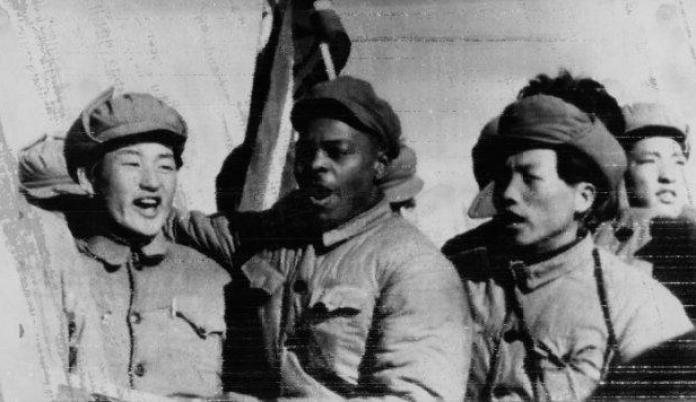
The stereotype of the brainwashed POW of the Korean War turned collaborator and traitor because of his weak character would become the backdrop for the discrediting of the dissident POWs of the Vietnam War.

In an appearance on CBS’s 60 Minutes, Gene Wilber was grilled on whether he had given in to the enemy to make antiwar statements. That he had acted on his own “conscience and morality” was drowned out by host Mike Wallace’s implications of collaboration and opportunism.
When he was subsequently invited to the White House POW reception, Wilber found his hotel room broken into and marked with accusations of treason when he returned from the reception.
In the summer of 1973, James Stockdale charged Wilber and Edison Miller with collaborating with the enemy, mutiny, and inciting personnel to insubordination. However, military judges found insufficient evidence to prosecute the case, and Wilber and Miller instead received letters of censure for their failure to meet the standard expected of officers.
Hollywood Revisionism
POW films starting from this time focused on returnees’ estrangement with their families and society and were told as stories of spousal infidelity, representing both individual drama as well as a sense of “home-front betrayal.”
These films were part of a post-war revisionism, which included a spate of films that contributed to the legend of American servicemen left behind in Vietnam.
In the 1980s, a new subgenre emerged focused on Vietnam veterans heroically taking on the task of returning to Indochina and liberating the left-behind POWs, who had been betrayed on the home front and abandoned by the U.S. government.
The POWs were depicted as victimized and emasculated captives who needed to be rescued by individualist heroes and whose honor as Americans was to be restored.

[Source: wikipedia.org]
This image, Wilber and Lembcke argue, fits the post-war efforts to psychologize the once political conflicts of the Vietnam War and to depict the veteran as a victim and loser.
More of a heroized image and the POWs’ endurance of torture was revived with the 1987 film, The Hanoi Hilton, which starred Michael Moriarty, Ken Wright and Paul Le Mat as U.S. POWs who defy their captors while enduring brutal treatment at Hanoi’s Hoa Lo prison (aka The Hanoi Hilton).

[Source: imdb.com]
This film meshed particularly well President’s Ronald Reagan’s characterization of the Vietnam War as a “noble cause,” fought by noble men, with the POW dissenters by implication being ignoble.
Persistence of the Hero-Prisoner Story
In their quest to comprehend the persistence of the hero-prisoner story, Wilber and Lembcke take their readers back to American colonial history and the captivity narratives emerging during that time.
These stories are about a complex mix of violence against captives, temptations to stay with their captors, the ideal to remain loyal with their fellow colonists, and their Christian beliefs.

Illustration of captives in the Indian Wars. [Source: legendofamerica.com]
Such tensions and correlations between the Self and the Other were critical in the making of an American identity. The wars in Korea and Vietnam and the POW experiences there can be understood as a new chapter of this identity-making process. Here, too, Americans must prove their will and ability to endure the brutality of a racialized Other.
A wrench in the story, however, is revealed in the autobiographical accounts of POW-heroes like Stockdale, Denton, and Risner. They wrote about fasting as a way of enforcing self-discipline and self-assurance, sometimes with a religious subtext.
More bizarrely, they also wrote about self-mutilation—the deliberate infliction of physical wounds on themselves that would be visible during filmed interviews.
The aim was to make it appear to other POWs (and to the U.S. public) that they had been tortured. One officer wrote of how he purposely damaged his vocal apparatus so he could not be forced to make propaganda statements.
-

[Source: goodreads.com] -

[Source: amazon.com] -

[Source: thriftbooks.com]
In addition to some high-ranking officers attempting to portray themselves as heroes by means of self-mutilation, Wilber and Lembcke also noted that they tried to keep political literature and news of dissent back home away from other POWs, fearing that these would enhance critical positions on the war and against their authority within the prison population.
Moreover, these ranking officers often despised the more humane view of the Vietnamese displayed by other prisoners, including an interest in their language and culture, and an understanding of why they were fighting back against an invasion of their country by the most powerful military force in the world.
Bringing Back Forgotten Dissenters
Wilber and Lembcke’s book helps restore these forgotten POW dissenters to their rightful—and honored—place among the large and diverse Vietnam generation of dissidents, draft resisters, oppositional GIs, veteran activists, deserters, and all those who supported them.

The book also shows that, despite all destruction and death brought by the invaders from the sky, North Vietnam maintained a moral superiority through oftentimes fair treatment of the captured Americans. This was in stark contrast to the more systematic adoption of torture methods by USAID and CIA-trained police under the Operation Phoenix and like-minded programs.

The POW/MIA flag that flies today over the White House is intended to honor the men who endured captivity; however, it continues to perpetuate a distorted understanding of a war that was as abominable as it was unjust, and helps to advance a dangerous nationalist ideology that will lead to future Vietnams.
- See Clarence Adams, An American Dream: The Life of an African American Soldier and POW Who Spent Twelve Years in Communist China (Amherst, MA: University of Massachusetts Press, 2007). ↑
Fear Is Contagious and Used to Control You

By Dr. Joseph Mercola | June 18, 2021
Governments are using fear to control and manipulate their citizens. That has now been admitted by members of the Scientific Pandemic Influenza Group on Behavior (SPI-B), a subcommittee that advises the Scientific Advisory Group for Emergencies (SAGE) in the U.K. And they should know, because they advocated for it, and now say it was a regrettable mistake. As reported by The Telegraph, May 14, 2021:1
“Scientists on a committee that encouraged the use of fear to control people’s behavior during the COVID pandemic have admitted its work was ‘unethical’ and ‘totalitarian.’ Members of the Scientific Pandemic Influenza Group on Behavior (SPI-B) expressed regret about the tactics in a new book about the role of psychology in the Government’s COVID-19 response.
SPI-B warned in March last year that ministers needed to increase ‘the perceived level of personal threat’ from COVID-19 because ‘a substantial number of people still do not feel sufficiently personally threatened.’
Gavin Morgan, a psychologist on the team, said: ‘Clearly, using fear as a means of control is not ethical. Using fear smacks of totalitarianism. It’s not an ethical stance for any modern government. By nature I am an optimistic person, but all this has given me a more pessimistic view of people.’”
Psychological Warfare Is Real
The Telegraph quotes several of the SPI-B members, all of whom are also quoted in the newly released book, “A State of Fear: How the UK Government Weaponised Fear During the Covid-19 Pandemic,” written by Laura Dodsworth:2
“One SPI-B scientist told Ms Dodsworth: ‘In March [2020] the Government was very worried about compliance and they thought people wouldn’t want to be locked down. There were discussions about fear being needed to encourage compliance, and decisions were made about how to ramp up the fear. The way we have used fear is dystopian.
The use of fear has definitely been ethically questionable. It’s been like a weird experiment. Ultimately, it backfired because people became too scared’ …
One warned that ‘people use the pandemic to grab power and drive through things that wouldn’t happen otherwise … We have to be very careful about the authoritarianism that is creeping in’ …
Another member of SPI-B said they were ‘stunned by the weaponization of behavioral psychology’ during the pandemic, and that ‘psychologists didn’t seem to notice when it stopped being altruistic and became manipulative. They have too much power and it intoxicates them.’
Steve Baker, the deputy chairman of the COVID Recovery Group of Tory MPs, said: ‘If it is true that the state took the decision to terrify the public to get compliance with rules, that raises extremely serious questions about the type of society we want to become. If we’re being really honest, do I fear that government policy today is playing into the roots of totalitarianism? Yes, of course it is.’”
The Manufacture of Fear
For nearly a year and a half, governments around the world, with few exceptions, have fed their citizens a steady diet of frightening news. For months on end, you couldn’t turn on the television without facing a tickertape detailing the number of hospitalizations and deaths.
Even when it became clear that people weren’t really dying in excessive numbers, the mainstream media fed us continuous updates on the growing number of “cases,” without ever putting such figures into context or explaining that the vast majority were false positives.
Information that would have balanced out the bad news — such as recovery rates and just how many so-called “cases” actually weren’t, because they never had a single symptom — were censored and suppressed.
They also refused to put any of the data into context, such as reviewing whether the death toll actually differed significantly from previous years. Instead, each new case was treated as an emergency and a sign of catastrophic doom.
Don’t Be Confused — Contradiction Is a Warfare Tactic
Aside from the barrage of bad-news-only data — which, by the way, was heavily manipulated in a variety of ways — fear and anxiety are also generated by keeping you confused. According to Dodsworth, giving out contradictory recommendations and vague instructions is being done intentionally, to keep you psychologically vulnerable.
“When you create a state of confusion, people become ever more reliant on the messaging. Instead of feeling confident about making decisions, they end up waiting for instructions from the Government,” she said in a May 20, 2021, interview on the Planet Normal podcast.3
An example provided by Dodsworth are the pandemic measures implemented over Christmas 2020:
“Family Christmases were on, then off, then back on, then off again. You have got someone tightening the screw, then loosening the screw, then tightening it again. It’s like a torture scenario.”
But that’s not all. As explained by psychiatrist Dr. Peter Breggin, by layering confusion and uncertainty on top of fear, you can bring an individual to a state in which they can no longer think rationally. Once driven into an illogical state, they are easily manipulated. I have no doubt driving people into a state where logic and reason no longer registers is the whole point behind much of the conflicting information we’re given.
The Fear Factory
In her book, Dodsworth details a number of branches of the British government that are using psychological warfare methods in their interaction with the public. In addition to the SPI-B, there’s the:4
•Behavioral Insights team, the so-called “nudge unit,” a semi-independent government body that applies “behavioral insights to inform policy, improve public services and deliver positive results for people and communities.”5 This team also advises foreign nations.
•Home Office’s Research, Information and Communications Unit (RICU), which is part of the U.K.’s Office for Security and Counter-Terrorism, advises front groups disguised as public “grassroots” organizations on how to “covertly engineer the thoughts of people.”
•Rapid Response Unit, launched in 2018, operates across the British Cabinet Office and the Prime Minister’s office (colloquially known as “Number 10” as in the physical address, 10 Downing Street in London) to “counter misinformation and disinformation.” They also work with the National Security Communications Team during crises to ensure “official information” gets maximum visibility.6
•Counter Disinformation Cell, which is part of the Department for Digital, Culture, Media and Sport. Both monitor social media and combat “fake news” about science in general and COVID-19 in particular, with “fake news” being anything that contradicts the World Health Organization’s guidance.7
•Government Communications Headquarters (QCHQ), an intelligence and security organization that provides information to the U.K. government and the armed forces. According to Dodsworth, QCHQ personnel, and even members of the 77th Brigade, have been enlisted as so-called sockpuppets and trolls to combat anti-vaccine and anti-lockdown messaging on social media.
According to Dodsworth, there are many others. In her book, she claims at least 10 different government departments in the U.K. are working with “behavioral insights teams” to manipulate the public.
We’re Just Seeing It Now
Importantly, government’s reliance on behavioral psychology didn’t just happen as a result of the pandemic. These tactics have been used for years, for myriad PR purposes, and while the pandemic may be winding down, Dodsworth warns that more and more behavioral scientists are being hired:8
“It’s growing and growing. Right now, I feel we are in a maelstrom of nudge,” she says. “In the past, there have been calls to consult the public on the use of behavioral psychology, and those calls have come from the behavioral scientists themselves. And yet it hasn’t happened. We haven’t yet been consulted on the use of subconscious techniques which effectively strip away our choices …
I fervently hope this book [‘The State of Fear’] is actually going to inspire a much-needed conversation about the use of fear, not just in the epidemic, but the way we use behavioral psychology overall.
It’s not just a genie that has been let out the bottle. It’s like we’ve unleashed a Hydra and you can keep chopping its head off, but they keep employing more of these behavioral scientists throughout different government departments. It’s very much how the Government now does business. It’s the business of fear …
I think ultimately people don’t want to be manipulated. People don’t enjoy being hoodwinked and they don’t want to live in a state of fear. We maybe need to be a bit bolder about standing up more quickly when something is not right.”
On ‘conflict’, ‘peace’ and ‘genocide’: Time for new language on Palestine and Israel
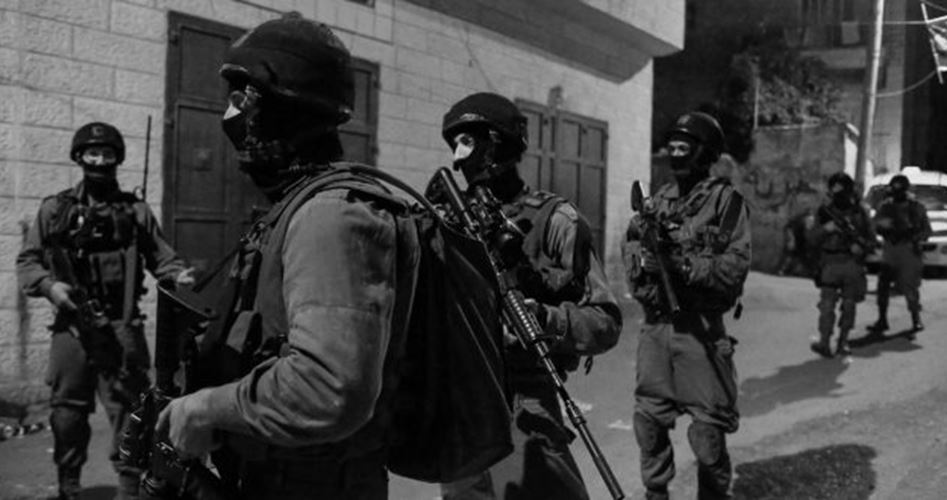
By Ramzy Baroud | MEMO | June 12, 2021
On 25 May, famous US actor Mark Ruffalo tweeted an apology for suggesting that Israel is committing “genocide” in Gaza.
“I have reflected and wanted to apologise for posts during the recent Israel/Hamas fighting that suggested Israel is committing ‘genocide’,” Ruffalo wrote, adding: “It’s not accurate, it’s inflammatory, disrespectful and is being used to justify anti-Semitism, here and abroad. Now is the time to avoid hyperbole.”
But were Ruffalo’s earlier assessments, indeed, “not accurate, inflammatory and disrespectful”? And does equating Israel’s war on besieged, impoverished Gaza with genocide fit into the classification of “hyperbole”?
To avoid pointless social media spats, one only needs to reference the “United Nations Convention on the Prevention and Punishment of the Crime of Genocide”. According to Article 2 of the 1948 Convention, the legal definition of genocide is: “Any of the following acts committed with intent to destroy, in whole or in part, a national, ethnical, racial or religious group, such as (a) Killing members of the group; (b) Causing serious bodily or mental harm to members of the group; (c) Deliberately inflicting on the group conditions of life calculated to bring about its physical destruction in whole or in part.”
In its depiction of Israel’s latest war on Gaza, the Geneva-based human rights group, Euro-Med Monitor, reported: “The Israeli forces directly targeted 31 extended families. In 21 cases, the homes of these families were bombed while their residents were inside. These raids resulted in the killing of 98 civilians, including 44 children and 28 women. Among the victims were a man and his wife and children, mothers and their children, or child siblings. There were seven mothers who were killed along with four or three of their children. The bombing of these homes and buildings came without any warning despite the Israeli forces’ knowledge that civilians were inside.”
As of 28 May, 254 Palestinians in Gaza were killed, and 1,948 were wounded in the latest 11-day Israeli onslaught, according to the Palestinian Ministry of Health. Though tragic, this number is relatively small compared with the casualties of previous wars. For example, in the 51-day Israeli war on Gaza in the summer of 2014, over 2,200 Palestinians were killed, and over 17,000 were wounded. Similarly, entire families, like the 21-member Abu Jame family in Khan Younis, also perished. Is this not genocide? The same logic can be applied to the killings of over 300 unarmed protesters at the fence separating besieged Gaza from Israel between March 2018 and December 2019. Moreover, the besiegement and utter isolation of over two million Palestinians in Gaza since 2006-2007, which has resulted in numerous tragedies, is an act of collective punishment that also deserves the designation of genocide.
One does not need to be a legal expert to identify the many elements of genocide in Israel’s violent behaviour, let alone language, against Palestinians. There is a clear, undeniable relationship between Israel’s violent political discourse and equally violent action on the ground. Potentially Israel’s next Prime Minister Naftali Bennett, who has served the role of defence minister, in July 2013 stated: “I’ve killed lots of Arabs in my life – and there’s no problem with that.”
With this context in mind, and regardless of why Ruffalo found it necessary to back-track on his moral position, Israel is an unrepentant human rights violator that continues to carry out an active policy of genocide and ethnic cleansing against the native, indigenous inhabitants of Palestine.
Language matters, and in this particular “conflict”, it matters most, because Israel has, for long, managed to escape any accountability for its actions, due to its success in misrepresenting facts and the overall truth about itself. Thanks to its many allies and supporters in mainstream media and academia, Tel Aviv has rebranded itself from being a military occupier and an apartheid regime to an “oasis of democracy“, in fact, “the only democracy in the Middle East”.
This article will not attempt to challenge the entirety of the misconstrued mainstream media’s depiction of Israel. Volumes are required for that, and Israeli Professor Ilan Pappé’s Ten Myths about Israel is an important starting point. However, this article will attempt to present some basic definitions that must enter the Palestine-Israel lexicon, as a prerequisite to developing a fairer understanding of what is happening on the ground.
A military occupation – not a ‘conflict’
Quite often, mainstream Western media refers to the situation in Palestine and Israel as a “conflict“, and to the various specific elements of this so-called conflict as a “dispute“. For example, the “Palestinian-Israeli conflict” and the “disputed city of East Jerusalem”.
What should be an obvious truth, is that besieged, occupied people do not engage in a “conflict” with their occupiers. Moreover, a “dispute” happens when two parties have equally compelling claims to any issue. When Palestinian families of East Jerusalem are being forced out of their homes which are, in turn, handed over to Jewish extremists, there is no “dispute” involved. The extremists are thieves, and the Palestinians are victims. This is not a matter of opinion. The international community itself says so.
“Conflict” is a generic term. Aside from absolving the aggressor – in this case, Israel – it leaves all matters open to interpretation. Since US audiences are indoctrinated to love Israel and hate Arabs and Muslims, siding with Israel in its “conflict” with the latter becomes the only rational option.
Israel has sustained a military occupation of 22 per cent of the total size of historic Palestine since June 1967. The remainder of the Palestinian homeland was already usurped, using extreme violence, state-sanctioned apartheid, and, as Pappé puts it, “incremental genocide” decades earlier.
From the perspective of international law, the term “military occupation”, “occupied East Jerusalem”, “illegal Jewish settlements”, and so forth, have never been “disputed”. They are simply facts, even if Washington has decided to ignore international law, and even if mainstream US media has chosen to manipulate the terminology to present Israel as a victim, not the aggressor.
‘Process’ without ‘peace’
The term “peace process” was coined by US diplomats decades ago. It was put to use throughout the mid and late 1970s when, then-US Secretary of State Henry Kissinger laboured to broker a deal between Egypt and Israel in the hope of fragmenting the Arab political front and, eventually, sidelining Cairo entirely from the “Arab-Israeli conflict”.
Kissinger’s logic proved vital for Israel as the “process” did not aim to achieve justice according to fixed criteria that has been delineated by the United Nations for years. There was no frame of reference anymore. If any existed, it was Washington’s political priorities that, historically, almost entirely overlapped with Israel’s priorities. Despite the obvious US bias, the US bestowed upon itself the undeserving title of “the honest peace broker“.
This approach was used successfully in the write-up to the Camp David Accords in 1978. One of the accords’ greatest achievements is that the so-called “Arab-Israeli conflict” was replaced with the so-called “Palestinian-Israeli conflict”.
Now, tried and true, the “peace process” was used again in 1993, resulting in the Oslo Accords. For nearly three decades, the US continued to tout its self-proclaimed credentials as a peacemaker, despite the fact that it pumped – and continues to do so – $3-4 billion of annual, mostly military, aid to Israel.
On the other hand, the Palestinians have little to show. No peace was achieved; no justice was obtained; not an inch of Palestinian land was returned and not a single Palestinian refugee was allowed to return home. However, US and European officials and a massive media apparatus continued to talk of a “peace process” with little regard to the fact that the “peace process” has brought nothing but war and destruction for Palestine, and allowed Israel to continue its illegal appropriation and colonisation of Palestinian land.
Resistance, national liberation – not ‘terrorism’ and ‘state-building’
The “peace process” introduced more than death, mayhem and normalisation of land theft in Palestine. It also wrought its own language, which remains in effect to this day. According to the new lexicon, Palestinians are divided into “moderates” and “extremists”. The “moderates” believe in the US-led “peace process”, “peace negotiations” and are ready to make “painful compromises” in order to obtain the coveted “peace”. On the other hand, the “extremists” are the “Iran-backed“, politically “radical” bunch that use “terrorism” to satisfy their “dark” political agendas.
But is this the case? Since the signing of the Oslo Accords, many sectors of Palestinian society, including Muslims and Christians, Islamists and secularists and, notably, socialists, resisted the unwarranted political “compromises” undertaken by their leadership, which they perceived to be a betrayal of Palestinians’ basic rights. Meanwhile, the “moderates” have largely ruled over Palestinians with no democratic mandate. This small but powerful group introduced a culture of political and financial corruption, unprecedented in Palestine. They applied torture against Palestinian political dissidents whenever it suited them. Not only did Washington say little to criticise the “moderate” Palestinian Authority (PA)’s dismal human rights record, but it also applauded it for its crackdown on those who “incite violence” and their “terrorist infrastructure”.
A term such as “resistance” – muqawama – was slowly but carefully extricated from the Palestinian national discourse. The term “liberation”, too, was perceived to be confrontational and hostile. Instead, such concepts as “state-building” – championed by former Palestinian Prime Minister Salam Fayyad and others – began taking hold. The fact that Palestine was still an occupied country and that “state-building” can only be achieved once “liberation” was first secured, did not seem to matter to the “donor countries”. The priorities of these countries – mainly US allies who adhered to the US political agenda in the Middle East – was to maintain the illusion of the “peace process” and to ensure “security coordination” between PA police and the Israeli army carried on, unabated.
The so-called “security coordination”, of course, refers to the US-funded joint Israeli-PA efforts at cracking down on Palestinian resistance, apprehending Palestinian political dissidents and ensuring the safety of the illegal Jewish settlements, or colonies, in the occupied West Bank.
War and, yes, genocide in Gaza – not ‘Israel-Hamas conflict’
The word “democracy” was constantly featured in the new Oslo language. Of course, it was not intended to serve its actual meaning. Instead, it was the icing on the cake of making the illusion of the “peace process” perfect. This was obvious, at least to most Palestinians. It also became obvious to the whole world in January 2006, when the Palestinian faction Fatah, which has monopolised the PA since its inception in 1994, lost the popular vote to the Islamic faction, Hamas.
Hamas, and other Palestinian factions, have rejected – and continue to reject – the Oslo Accords. Their participation in the legislative elections in 2006 took many by surprise, as the Palestinian Legislative Council (PLC) was itself a product of Oslo. Their victory in the elections, which was classified as democratic and transparent by international monitoring groups, threw a wrench in the US-Israeli-PA political calculations.
Lo and behold, the group that has long been perceived by Israel and its allies as “extremist” and “terrorist” became the potential leaders of Palestine! The Oslo spin doctors had to go into overdrive in order for them to thwart Palestinian democracy and ensure a successful return to the status quo, even if this meant that Palestine is represented by unelected, undemocratic leaders. Sadly, this has been the case for nearly 15 years.
Meanwhile, Hamas’s stronghold, the Gaza Strip, had to be taught a lesson, thus the siege imposed on the impoverished region for nearly 15 years. The siege on Gaza has little to do with Hamas’s rockets or Israel’s “security” needs, the right to “defend itself” and its supposedly “justifiable” desire to destroy Gaza’s “terrorist infrastructure”. While, indeed, Hamas’s popularity in Gaza is unmatched anywhere else in Palestine, Fatah, too, has a powerful constituency there. Moreover, the Palestinian resistance in the strip is not championed by Hamas alone, but also by other ideological and political groups, for example, the Islamic Jihad, the socialist Popular Front for the Liberation of Palestine (PFLP) and other socialist and secular groups.
Misrepresenting the “conflict” as a “war” between Israel and Hamas is crucial to Israeli propaganda, which has succeeded in equating Hamas with militant groups throughout the Middle East and even Afghanistan. But Hamas is not Daesh, Al-Qaeda or the Taliban. In fact, none of these groups is similar, anyway. Hamas is a Palestinian Islamic nationalist movement that operates within a largely Palestinian political context. An excellent book on Hamas is the recently published volume by Dr Daud Abdullah, Engaging the World. Abdullah’s book rightly presents Hamas as a rational political actor, rooted in its ideological convictions, yet flexible and pragmatic in its ability to adapt to national, regional and international geopolitical changes.
But what does Israel have to gain from mischaracterising the Palestinian resistance in Gaza? Aside from satisfying its propaganda campaign of erroneously linking Hamas to other anti-US groups, it also dehumanises the Palestinian people entirely and presents Israel as a partner in the US global so-called “war on terror”. Israeli neofascist and ultranationalist politicians then become the saviours of humanity, their violent racist language is forgiven and their active “genocide” is seen as an act of “self-defence” or, at best, a mere state of “conflict”.
The oppressor as the victim
According to the strange logic of mainstream media, Palestinians are rarely “killed” by Israeli soldiers, but rather “die” in “clashes” resulting from various “disputes”. Israel does not “colonise” Palestinian land; it merely “annexes”, “appropriates” and “captures”, and so on. What has been taking place in the Sheikh Jarrah neighbourhood in occupied East Jerusalem, for example, is not outright property theft, leading to ethnic cleansing, but rather a “property dispute”.
The list goes on and on.
In truth, language has always been a part of Zionist colonialism, long before the state of Israel was itself constructed from the ruins of Palestinian homes and villages in 1948. Palestine, according to the Zionists, was “a land with no people” for “a people with no land”. These colonists were never “illegal settlers” but “Jewish returnees” to their “ancestral homeland”, who, through hard work and perseverance, managed to “make the desert bloom”, and, in order to defend themselves against the “hordes of Arabs”, they needed to build an “invincible army”.
It will not be easy to deconstruct the seemingly endless edifice of lies, half-truths and intentional misrepresentations of Zionist Israeli colonialism in Palestine. Yet, there can be no alternative to this feat because, without proper, accurate and courageous understanding and depiction of Israeli settler colonialism and Palestinian resistance to it, Israel will continue to oppress Palestinians while presenting itself as the victim.
RFK’s False-Flag Assassination, and the Forgotten Palestinian Patsy
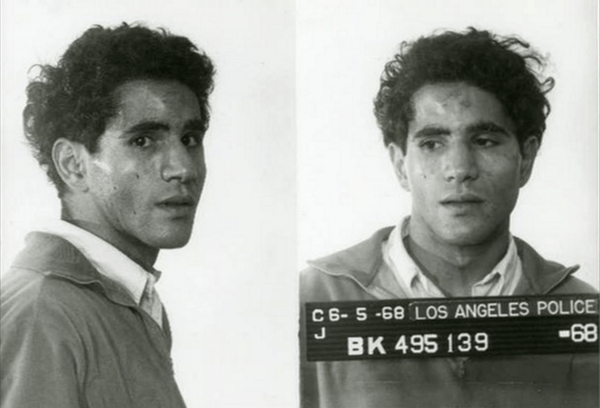
BY LAURENT GUYÉNOT • UNZ REVIEW • JUNE 5, 2021
On June 6, 1968, Robert Kennedy had just won the California Democratic presidential primary, when he was shot dead, five years after his brother. David Talbot has shown in his book Brothers: The Hidden History of the Kennedy Years, published in 2007 by Simon & Schuster, that Robert had never believed in the conclusion of the Warren Commission Report, and that, had he succeeded in becoming the next American president, he would have done his utmost to set up a new investigation. Whether he would have been able to get to the bottom of it is another matter. But it is a reasonable assumption that the forces that had killed John were the same that killed Robert on his way to reclaim the White House. After all, as Laurence Leamer writes in Sons of Camelot: “Bobby had been the president’s alter ego and protector. . . . He had loved his brother so intensely and served him so well that within the administration it was hard to tell where one man ended and the other began.”[1] After 1963, Robert was still his brother’s continuation. He was the heir and the avenger.
That is why I have argued before — and I repeat in my new book — that the ultimate key to the JFK whodunit is in RFK’s assassination, which has a very clear, unmistakable Israeli signature. RFK’s assassination is a masterwork of false flag operation, designed by a supremely intelligent, Machiavellian, and organized cabal, the same that orchestrated one year earlier, with Johnson’s complicity, the attempted false flag attack on the USS Liberty (watch the new groundbreaking four-part documentary film Sacrificing Liberty).
What is truly extraordinary, and demonstrates an unmatched expertise in the industry of lies, is that the conspirators succeeded to get rid of Robert Kennedy while at the same time blaming the assassination on their enemies — the Palestinians — and thereby giving themselves both an alibi and a victim’s role: through RFK, Israel was the target, they claim.
Sirhan Sirhan, the “virulent anti-Semite”

Just hours after Robert’s assassination, the press informed the American people, not only of the identity of the assassin, but also of his motive, and even of his detailed biography.[2] Twenty-four-year-old Sirhan Bishara Sirhan was born in Jordan, and had moved to the United States when his family was expelled from West Jerusalem in 1948. After the shooting, a newspaper clipping was found in Sirhan’s pocket, quoting Robert’s following statement: “The United States should without delay sell Israel the 50 Phantom jets she has so long been promised.” Handwritten notes by Sirhan found in a notebook at his home confirmed that his act had been premeditated and motivated by his hatred of Israel.
That became the mainstream storyline from day one. Jerry Cohen of the Los Angeles Times wrote a front page article, saying that Sirhan is “described by acquaintances as a ‘virulent’ anti-Israeli” (Cohen changed that into “virulent anti-Semite” in an article for the Salt Lake Tribune), and that: “Investigation and disclosures from persons who knew him best revealed [him] as a young man with a supreme hatred for the state of Israel.” Cohen infers that “Senator Kennedy . . . became a personification of that hatred because of his recent pro-Israeli statements.” Cohen further revealed that, about three weeks before the shooting, Sirhan wrote “a memo to himself” that said, “Kennedy must be assassinated before June 5, 1968,” that is, Cohen notes, “the first anniversary of the six-day war in which Israel humiliated three Arab neighbors, Egypt, Syria and Jordan.”[3]
After September 11, 2001, the tragedy of Robert’s assassination was rewritten and installed into the Neocon mythology of the “Clash of Civilizations” and the “War on Terror.” A book entitled The Forgotten Terrorist, by Mel Ayton (2007), purports to present “a wealth of evidence about [Sirhan’s] fanatical Palestinian nationalism,” and to demonstrate that “[Sirhan’s] politically motivated act was a forerunner of present-day terrorism.”
In 2008, on the occasion of the 40th anniversary of Bobby’s murder, Sasha Issenberg of the Boston Globe recalled that the death of Robert Kennedy was “a first taste of Mideast terror.” He quotes Harvard professor Alan Dershowitz saying: “It was in some ways the beginning of Islamic terrorism in America. It was the first shot. A lot of us didn’t recognize it at the time.”[4] That Sirhan was from a Christian family was lost on Dershowitz.
Rabbi Jeffrey Salkin took care to mention it in The Forward, only to add that Islamic fanaticism ran in his veins anyway: “But what he shared with his Muslim cousins — the perpetrators of September 11 — was a visceral, irrational hatred of Israel. It drove him to murder a man whom some still believe might have been the greatest hope of an earlier generation. . . . Sirhan hated Kennedy because he had supported Israel.”
And so, the Forward insists: “One cannot help but note the parallel between [Robert] Kennedy’s assassination and the terrorist attacks of September 11, 2001. In both tragic cases, Arab fanaticism reared its ugly head on American soil, irrevocably changing the course of events in this country.”[5] And the lesson: “In remembering Bobby Kennedy, let us remember not just what he lived for, but also what he died for — namely, the precious nature of the American-Israeli relationship.”[6] In other words: let’s propagate the narrative, for it is good for Israel.
On the fiftieth anniversary, the narrative was well rehearsed: Robert got killed because he was “pro-Israel”.[7] Therefore his murder was a crime against Israel.
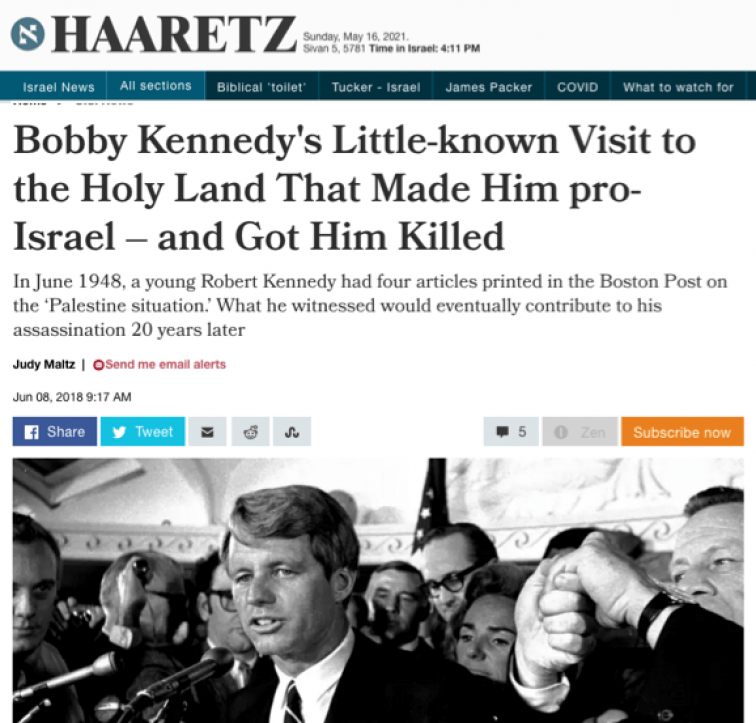
For anyone familiar with the history of the Kennedy clan, there is something odd in the notion that the assassination of Robert Kennedy was a crime against Israel. Robert had not been, in his brother’s government, a pro-Israel Attorney General. He had infuriated Zionist leaders by supporting an investigation led by Senator William Fulbright and the Committee on Foreign Relations, aimed at registering the American Zionist Council as a “foreign agent”, which would had considerably hindered its efficiency.[8]
In 1968, Robert Kennedy had not suddenly turned pro-Israel. He was simply trying to attract Jewish votes, as everyone else. Robert’s statement in an Oregon synagogue, mentioned in the May 27 Pasadena Independent Star-News article found in Sirhan’s pocket, didn’t exceed the minimal requirements. Its author David Lawrence had, in another article entitled “Paradoxical Bob,” underlined how little credit should be given to such electoral promises: “Presidential candidates are out to get votes and some of them do not realize their own inconsistencies.”[9] In fact, as Arthur Krock has noted, the supposed motive for RFK’s murder is itself paradoxical: “If this motive was his position that the United States was committed to preserve Israel as a nation, his statement was made with more moderation than that of other important political persons who said the same thing.”[10]
All things considered, there is no ground for believing that Robert Kennedy would have been, as president of the U.S.A., particularly Israel-friendly.
Did Sirhan kill Robert Kennedy?
If we trust official statements and mainstream news, the assassination of Robert Kennedy is an open-and-shut case. The identity of the killer suffers no discussion, since he was arrested on the spot, with the smoking gun in his hand.
In reality, ballistic and forensic evidence shows that none of Sirhan’s bullets hit Kennedy. According to the autopsy report of Chief Medical Examiner-Coroner Thomas Noguchi, Robert Kennedy was hit by three bullets, while a fourth went through his coat. All these bullets were shot from behind Kennedy: two of them under his right armpit, following an upward angle, and the third, the fatal bullet, behind his right ear, at point blank range. Dr. Noguchi reaffirms his conclusion in his memoirs, Coroner (1983). Yet the sworn testimonies of twelve witnesses established that Robert had never turned his back on Sirhan and that Sirhan was five to six feet away from his target when he fired. Moreover, Sirhan was physically overpowered by Karl Uecker after his second shot, and, although he continued pressing the trigger mechanically, his revolver was not directed towards Kennedy anymore.
By tallying all the bullet impacts in the pantry, and those that wounded five people around Kennedy, it has been estimated that at least twelve bullets were fired, while Sirhan’s gun carried only eight. On April 23, 2011, attorneys William Pepper and Laurie Dusek gathered all this evidence and more in a 58-page file submitted to the Court of California, with a request that Sirhan’s case be reopened. They pointed out major irregularities in the 1968 trial, notably that the serial number of Sirhan’s pistol did not match the serial number of the pistol by which were test fired the bullets compared with those extracted from Robert’s brain.[11] Pepper also provided a computer analysis of audio recordings during the shooting, made by engineer Philip Van Praag in 2008, which confirms that two guns are heard.[12] Paul Schrade, a Kennedy confidant who was behind Robert during the shooting and received one of Sirhan’s bullets, has long believed there was a second shooter. He testified at Sirhan’s 2016 parole hearing, and told him: “the evidence clearly shows that you were not the gunman who shot Robert Kennedy.”[13] Robert F. Kennedy Jr. and his sister Kathleen have joined Schrade and support the call for a reinvestigation of the assassination.[14]
The presence of a second shooter was mentioned by several witnesses and reported on the same day by a few news outlets. There are strong suspicions that Robert’s real assassin was Thane Eugene Cesar, a security guard hired by the Hotel Ambassador, property of Zionist businessman Myer Schine. Cesar was stuck behind Kennedy at the moment of the shooting, and some people saw him draw his pistol. One of them, Don Schulman, positively saw him fire.[15] Incredibly, Cesar’s weapon was never examined, and he was never interrogated, even though he did not conceal his hatred for the Kennedys.[16]
Even if we assumed that Sirhan did kill Robert Kennedy, a second aspect of the case raises question: Sirhan seemed to be in a state of trance during the shooting, and of disorientation just after. More importantly, Sirhan has always claimed that he has never had any recollection of his act. Fifty years after the facts, he continues to declare: “I was told by my attorney that I shot and killed Senator Robert F. Kennedy and that to deny this would be completely futile, [but] I had and continue to have no memory of the shooting of Senator Kennedy.” He also claims to have no memory of “many things and incidents which took place in the weeks leading up to the shooting.”[17] Some repetitive lines written of a notebook found in Sirhan’s bedroom, which Sirhan recognizes as his own handwriting but does not remember writing, are reminiscent of automatic writing: there is a whole page of fifteen repetitions of “RFK must die, Robert F. Kennedy must be assassinated, assassinated, assassinated, assassinated,” suddenly turning to “I have never heard please pay to the order of of of of of.”[18]
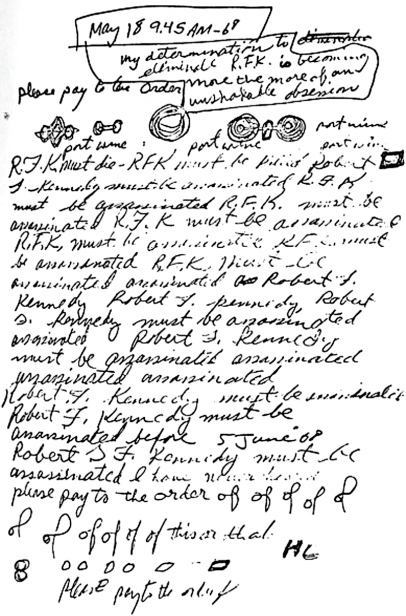
Psychiatric expertise, including lie-detector tests, has confirmed that Sirhan’s amnesia is not faked. Therefore, experts in hypnosis and mental manipulation believe that Sirhan has been submitted to hypnotic programming. “It was obvious that he had been programmed to kill Robert Kennedy and programmed to forget that he had been programmed,” stated Dr. Robert Blair.[19] In 2008, Harvard University professor Daniel Brown, a noted expert in hypnosis and trauma memory loss, interviewed Sirhan for a total of 60 hours, and concluded that Sirhan, whom he classified among “high hypnotizables,” acted involuntarily under the effect of hypnotic suggestion: “His firing of the gun was neither under his voluntary control, nor done with conscious knowledge, but is likely a product of automatic hypnotic behavior and coercive control.” During his sessions with Dr. Brown, Sirhan could remember having been accompanied by an attractive woman, before suddenly finding himself at a shooting range with a weapon he did not know. According to Brown’s report, “Mr. Sirhan did not go with the intent to shoot Senator Kennedy, but did respond to a specific hypnotic cue given to him by that woman to enter ‘range mode,’ during which Mr. Sirhan automatically and involuntarily responded with a ‘flashback’ that he was shooting at a firing range at circle targets.” Later, attorney William Pepper found an entry in the police file that showed that, just days before the assassination, Sirhan had visited a firing range, accompanied by an unknown instructor.[20]
Mossad, Mental control, and false-flag terrorism
We know that in the 1960s, American military agencies were experimenting on mental control. Dr. Sidney Gottlieb, son of Hungarian Jews, directed the infamous CIA MKUltra project, which, among other things, were to answer questions such as: “Can a person under hypnosis be forced to commit murder?” according to a declassified document dated May 1951.[21] As Larry Romanoff has pointed out, MKUltra was an overwhelmingly Jewish enterprise, with people like Dr. John Gittinger, Harris Isbell, James Keehner, Lauretta Bender, Albert Kligman, Eugene Saenger, Chester Southam, Robert V. Lashbrook, Harold Abramson, Charles Geschickter, and Ray Treichler.[22]
In his book Rise and Kill First: The Secret History of Israel’s Targeted Assassinations (2018), Israeli journalist Ronen Bergman has revealed that, in May 1968, the month preceding Robert Kennedy’s assassination, the Israeli Military Intelligence (AMAN) was planning to assassinate Yasser Arafat by hypnotically programming a Palestinian. The idea was proposed by a Navy psychologist named Binyamin Shalit, who claimed that, “if he was given a Palestinian prisoner — one of the thousands in Israeli jails — with the right characteristics, he could brainwash and hypnotize him into becoming a programmed killer. He would then be sent across the Jordan, join the Fatah there, and, when the opportunity arose, do away with Arafat.” The proposal was approved. Shalit selected a 28-year-old Palestinian from Bethlehem, whom he deemed easily suggestionnable. The operation failed, but it proves that, in 1968 precisely, Israel was practicing a method of assassination identical to the one used against Robert Kennedy.[23]
Moreover, manipulating Palestinians to make them commit crimes, or committing crimes and blaming Palestinians for them, bears the signature of Israel. According to former Mossad agent, Victor Ostrovsky, in 1991 elements of the Mossad were plotting an attempt on the life of President George H. W. Bush. Bush had resisted an unprecedented pro-Israel lobbying campaign that called for $10 billion to help Jews immigrate from the former Soviet Union to Israel, complaining in a televised press conference on September 12 that “one thousand Jewish lobbyists are on Capitol Hill against little old me.”[24] Worse, there was his policy of pressuring Israel to the negotiating table at the Madrid Conference by freezing their loan guarantees. Israel had had enough of him. The plan was to leak words to the Spanish police that terrorists were on their way, kill Bush and, in the midst of the confusion, release three Palestinians captured earlier and kill them on the spot.[25]
It is well known that Israel has a long history and a grand expertise in false flag terrorism. A report of the U.S. Army School for Advanced Military Studies (SAMS), quoted by the Washington Times on September 10, 2001, described the Israeli Intelligence agency as: “Wildcard. Ruthless and cunning. Has capability to target U.S. forces and make it look like a Palestinian/Arab act.”[26] That statement was made public on the day before 9/11.
The pattern dates from before the creation of the Jewish State, with the bombing of the King David Hotel, headquarter of the British authorities in Jerusalem, in the morning of July 22, 1946. Six terrorists of the Irgun dressed as Arabs brought 225 kg of explosives hidden in milk churns into the building. When a British officer became suspicious and gunshot ensued, the Irgun members fled after igniting the explosives. The explosion killed 91 people, mostly British, but also 15 Jews.
The strategy was repeated in Egypt during the summer of 1954, with Operation Susannah. The goal was to compromise the British’s withdrawal from the Suez Canal, demanded by Colonel Abdul Gamal Nasser with support from President Eisenhower. Egyptian Jews trained in Israel bombed several British targets, then put the blame on the Muslim Brotherhood. The accidental detonation of an explosive device allowed the exposure of the conspiracy, which led to the “Lavon Affair”, from the name of the Defense Minister who was held responsible.
There are more of the same stories in Gordon Thomas’s Gideon’s Spies: the Secret History of the Mossad (2009).[27] By definition, false-flagged Arab terrorism is only exposed when it fails, and we cannot know how many such operations have been set up by the Mossad. But from the revelations of Ronen Bergman in Rise and Kill First, Sirhan sure looks like a typical made-in-Mossad Palestinian patsy.
There are still, of course, unanswered questions, such as: How did Sirhan find himself in the kitchen pantry of the Ambassador Hotel at midnight on June 6, 1968, with a pistol in his pocket? Sirhan himself declared it was by accident, or by mistake, but then he doesn’t remember much of that evening. Another question is: Why did Kennedy, after finishing his speech, exit the ballroom through the kitchen pantry, instead of walking through the crowd of his supporters, as he usually did? To this question, there is an answer: according to a campaign volunteer present at the scene and interviewed by Michael Piper, it was Frank Mankiewicz who insisted that Robert go this way.[28] Now, isn’t it awkward that Mankiewicz had started his career in public relations “as civil rights director for the western branch of the Anti-Defamation League of B’nai B’rith,” as he mentions in his autobiography.[29] (The ADL, remember, was founded in 1913 by the B’nai B’rith to defend the convicted child rapist and murderer Leo Frank.)[30] In 1991, Mankiewicz handled publicity for Oliver Stone’s film JFK.
Content of my new book, The Unspoken Kennedy Truth:
- Introduction
- 1. RFK’S False-Flag Assassination
- 2. JFK and the Samson Option
- 3. LBJ, Israel’s Best Friend
- 4. Jack Ruby, Gangster for Zion
- 5. Jim Angleton, Mossad’s CIA Asset
- 6. Joe, the Cursed Peacemaker
- 7. JFK Jr., the Slain Prince
- 8. Forrestal, Kennedy’s Foreshadow
- Conclusion
Watch the video based on my earlier Kennedy research:
Laurent Guyénot, Ph.D., is the author of The Unspoken Kennedy Truth (2021), “Our God is Your God Too, But He Has Chosen Us”: Essays on Jewish Power (2020), and From Yahweh to Zion: Jealous God, Chosen People, Promised Land (2018).
Notes
[1] Laurence Leamer, Sons of Camelot: The Fate of an American Dynasty, HarperCollins, 2005, kindle 225.
[2] Watch in Evidence of Revision: Part 4: The RFK assassination as never seen before, 01:11:42
[3] Jerry Cohen, “Yorty Reveals That Suspect’s Memo Set Deadline for Death,” Los Angeles Times, June 6, 1968, on latimesblogs.latimes.com; Jerry Cohen, “Jerusalem-Born Suspect Called An Anti-Semite,” The Salt Lake Tribune, June 6, 1968, on www.newspapers.com.
[4] Sasha Issenberg, “Slaying gave US a first taste of Mideast terror,” Boston Globe, June 5, 2008, on www.boston.com
[5] Jeffrey Salkin, “Remember What Bobby Kennedy Died For,” Forward.com, June 5, 2008. Also Michael Fischbach, “First Shot in Terror War Killed RFK,” Los Angeles Times, June 02, 2003, on articles.latimes.com
[6] Jeffrey Salkin, “Remember What Bobby Kennedy Died For,” Forward.com, June 5, 2008.
[7] Judy Maltz, “Bobby Kennedy’s Little-known Visit to the Holy Land That Made Him pro-Israel – and Got Him Killed,” The Forward, June 8, 2018, on www.haaretz.com/
[8] The Israel Lobby Archive, www.irmep.org/ila/forrel/
[9] David Lawrence, “Paradoxical Bob,” Independent Star-News, May 26, 1968, page 14, on www.newspapers.com/; Shane O’Sullivan, RFK Must Die, on YouTube, at 00:14.
[10] Arthur Krock, Memoirs: Sixty Years on the Firing Line, Funk & Wagnalls, 1968, p. 347.
[11] First discovered in 1970 by Pasadena criminologist William Harper. John Crewdson, “6 Years Later, Evidence in Sirhan’s Case Is Questioned,” New York Times, December 15, 1974, on www.nytimes.com
[12] Frank Morales, “The Assassination of RFK: A Time for Justice!” June 16, 2012, on www.globalresearch.ca; watch “RFK Assassination 40th Anniversary (2008) Paul Schrade on CNN” on YouTube.
[13] “Robert F Kennedy’s killer loses 15th parole bid as witness says: ‘It’s my fault’”, Feb 11, 2016, on www.thegardian.com
[14] Stephanie Haney “Bobby Kennedy’s children at war with each other over new death probe,” June 2, 2018, on dailymail.com
[15] Watch Ted Charach and Gerald Alcan’s film The Second Gun: Who Really Killed Robert Kennedy, 1998 , on YouTube.
[16] Philip Melanson, The Robert F. Kennedy Assassination: New Revelations On the Conspiracy And Cover-Up, S.P.I. Books , 1994, p. 25.
[17] In a parole hearing in 2011. Watch “Sirhan Sirhan Denied Parole” on YouTube.
[18] Shane O’Sullivan, Who Killed Bobby? The Unsolved Murder of Robert F. Kennedy, Union Square Press, 2008, pp. 5, 44, 103.
[19] In Shane O’Sullivan’s 2007 documentary RFK Must Die: The Assassination of Bobby Kennedy, on YouTube.
[20] Jacqui Goddard, “Sirhan Sirhan, assassin of Robert F.Kennedy, launches new campaign for freedom 42 years later,” The Telegraph, Dec. 3, 2011, on www.telegraph.co.uk
[21] Colin Ross, Bluebird: Deliberate Creation of Multiple Personality by Psychiatrists, Manitou Communications, 2000, summary on www.wanttoknow.info/bluebird10pg
[22] Larry Romanoff, “CIA Project MK-Ultra,” on www.unz.com
[23] Ronen Bergman, Rise and Kill First: The Secret History of Israel’s Targeted Assassinations, Random House, 2018, pp. 117-119.
[24] Alexander Cockburn, ed., The Politics of Anti-Semitism, AK Press, 2003, p. 104.
[25] Victor Ostrovsky, The Other Side of Deception: A Rogue Agent Exposes the Mossad’s Secret Agenda, HarperCollins, 1994.
[26] Rowan Scarborough, “U.S. troops would enforce peace Under Army study,” The Washington Times, 10 septembre 2001, on www.washingtontimes.com
[27] Gordon Thomas, Gideon’s Spies: The Secret History of the Mossad, St. Martin’s Press, 1999, pp. 384-385 and 410-411.
[28] Piper, Final Judgment, pp. 343, 347.
[29] Frank Mankiewicz, So As I Was Saying… My Somewhat Eventful Life, with Joel Swerdlow, MacMillan, 2016, p. 10.
[30] Ron Unz, “American Pravda: The ADL in American Society,” October 15, 2018, on unz.com.
Featured Video
Houthis Don’t Have to Conquer Saudi Arabia to Make It Pay
or go to
Aletho News Archives – Video-Images
From the Archives
Newly Released FBI Docs Shed Light on Apparent Mossad Foreknowledge of 9/11 Attacks
By Whitney Webb | MintPress News | May 17, 2019
NEW YORK — For nearly two decades, one of the most overlooked and little known arrests made in the aftermath of the September 11 attacks was that of the so-called “High Fivers,” or the “Dancing Israelis.” However, new information released by the FBI on May 7 has brought fresh scrutiny to the possibility that the “Dancing Israelis,” at least two of whom were known Mossad operatives, had prior knowledge of the attacks on the World Trade Center. … continue
Blog Roll
 Aletho News
- UK whines about losing billions to ‘Putin tax’
- Baghaei to Rubio: Distorted narratives cannot erase US record of broken commitments
- Houthis Don’t Have to Conquer Saudi Arabia to Make It Pay
- MOE: Nearly 22,000 Students and Education Workers Killed
- Guterres in Islamabad: Genocide, cowardice, and the cage of Imran Khan
- Johnson, Marandi say Yemen holds upper hand over Saudi Arabia
- False flags won’t save aggressors, Iran FM spokesman says
- The Makkah Pact Enters Into Force: The End of American Dominance or Its New Form?
- NATO’s top generals gather in Kiev
- EU’s continuing expansion – greater threat to Russia
- If Americans Knew
- Three years of death and devastation: Israel’s war on Gaza in pictures
- Why Hamas believed the status quo was more dangerous than its 7 October gamble
- Debunking Israel’s latest list of ‘terrorist’ journalists in Gaza
- In Gaza, focus is on survival, “every step is a struggle” – Daily Update
- Three Years of Genocide: How America’s Israel-First Media Filtered Out the Truth
- Israeli war chief briefs ministers on potential war against Palestinian Authority
- New Report: Israel Killed nearly 21,000 Palestinian Students and Education Workers in Past Three Years
- Israel’s flailing chatbot army
- Five Palestinians Killed, Others Injured by Israeli Fire in Gaza
- Israel is rewriting the Palestinian curriculum in East Jerusalem to erase Palestinian identity
- No Tricks Zone
- New Study: 50 Years Of The Most Aggressive ‘Net Zero’ Policies Can Only Affect The Global Climate By 0.03°C
- US September “Heat” Was No Record…Many Records Set Decades Ago
- Latest European Green Energy Debacle; Portugal’s Largest Flagship Solar Park Insolvent!
- Green Energy Debacle: German Expert Professor Fritz Vahrenholt Warns Of Severe Economic And Social Consequences
- Two More Paleo Reconstructions Affirm Meters-Higher Sea Levels Across Ireland, Brazil 7000-6000 Years Ago
- New Study: Earth And Venus Surface Warmth Largely Explained By Convection And Lapse Rate, Not CO2 Or Radiation
- 2025 Nature Paper Claiming Worsening Global Drought Gets RETRACTED …Heavily Flawed
- New Study: ‘Global Drought Shows No Detectable Recent Acceleration Under Climate Warming’
- Economic Masterminds: German Socialists Suggest Taxing Productivity Gains Stemming From Using AI
- The South China Sea Has Not Been Cooperating With The Climate Change Narrative


#/media/File:Missing_in_action_(film_poster).jpg)
