Israel’s War on Truth-Telling Media and Journalists
By Stephen Lendman | May 16, 2021
Time and again, truth-telling journalism as it should be is a casualty of all things war and related violence.
Big Lies, mass deception, and censorship are weapons of war by other means — in support of the official falsified narrative.
In their book titled “Guardians of Power,” David Edwards and David Cromwell explained why today’s media are in crisis — free and open societies at risk.
It’s because press prostitution substitutes fiction for fact — notably in the US, other Western countries and Israel.
Their state-approved sanitized reports stick exclusively to the official falsified narrative in support of wealth, power and privilege over full and accurate reporting.
In the US especially, news consumers are fed a daily diet of managed news misinformation, disinformation, junk food news and infotainment — at all times.
Notably in times of war, their reports regurgitate state-supplied talking points.
Whatever diverges from the official falsified narrative is filtered out and suppressed.
Adopted unanimously by Security Council members in December 2006, SC Res. 1738 affirms protection for civilians and journalists in war theaters — calling their safety and security “urgent and important.”
Condemning intentional attacks on fourth estate members, the resolution demands accountability for responsible parties.
At all times, especially at times of war and under occupation, civilians are protected persons. So are journalists — under international law.
Throughout at least most of its history, Israel waged war on truth-telling Palestinian journalists.
They’re at risk of arrest, prosecution, imprisonment, and/or assassination.
According to the Committee to Support Palestinian Journalists, “(t)he Israeli occupation tries to muzzle the Palestinian journalists’ mouths and prevent them from unmasking its barbaric practices in the occupied Palestinian territories to the international media.”
Palestinian journalists covering Israeli violence against legitimate protesters risk serious injury or death.
Anyone wearing a flak jacket labeled press is vulnerable, their unprotected areas vulnerable to Israeli sniper attacks by live fire — including use of exploding dum dum bullets able to leave fist-sized existing wounds in individuals struck.
They’re designed to inflict disabling damage to internal organs or death — even though banned by the 1899 Hague Convention.
Since IDF terror-bombing and shelling of Gaza began on May 10, silencing truth-telling media has been a prioritized Netanyahu regime aim.
The same objective is sought in all Israeli preemptive wars, as well as at all other times on whatever conflicts with official falsified Israeli talking points.
On May 15 in Gaza, Israeli terror-bombing turned the 11-story Al-Jalaa building to smoldering rubble — its occupants given one hour to vacate the premises.
It’s unknown so far if some remained inside and perished.
Along with residences of Gazan families, the building housed international media offices.
According to DW News, AP News, AFP, Al Jazeera, other international media operations, and local Palestinian news agencies had offices in the building.
The IDF defied reality by falsely claiming that the building included Hamas “military assets (sic),” adding:
“(O)ffices of civilian media outlets (were) use(d) (by Hamas) as human shields (sic).”
According to AP News, the Netanyahu regime and IDF “did not provide evidence for the claim” — because there is none.
On its Saturday newscast, senior Al Jazeera (AJ) political analyst Marwan Bishara minced no words in debunking the thinly veiled IDF Big Lie.
Gaza-based AJ journalist Al Kahlout said the following in response to Israel’s destruction of the Al-Jalaa building with three missiles:
“(N)o one can understand the feeling of the people whose homes have been destroyed by such kind of air attacks,” adding:
“It’s really difficult to wake up one day and then you realize that your office is not there with all the career experiences, memories that you’ve had.”
Separately on Saturday, IDF terror-bombing destroyed a Gaza City area refugee camp three-story residence, massacring eight children and two women.
The above buildings had no military significance. Israel defied reality by claiming otherwise.
In response to its destruction of Gaza’s Al Jalaa building, AP News president and CEO Gary Pruitt said the following:
“The world will know less about what is happening in Gaza because of what happened today.”
“We are shocked and horrified that the Israeli military would target and destroy the building housing AP’s bureau and other news organizations in Gaza.”
“This is an incredibly disturbing development. We narrowly avoided a terrible loss of life.”
Separately, AP reported:
“For 15 years, the AP’s top-floor office and roof terrace were a prime location for covering Israel’s conflicts with Gaza.”
Now it’s gone, along with scores of massacred Gazans, including women and children.
NY-based Committee to Protect Journalists’ executive director Joel Simon said the following:
“This latest attack on a building long known by Israel to house international media raises the specter that the IDF is deliberately targeting media facilities in order to disrupt coverage of the human suffering in Gaza.”
Indeed so!!
Silencing coverage of its high crimes of war, against humanity, and other human rights abuses is longstanding Israeli policy — in flagrant breach of international law.
On May 10, the Palestinian Center for Development and Media Freedoms (MADA) reported the following:
It “condemn(ed) escalating attacks of the occupation forces against journalists and media workers in Palestine…”
MADA noted what’s going on in “occupied…Jerusalem…aim(s) (to) block the transmission of the violations to the world.”
“This was accompanied by widespread violations of freedom of expression committed by social media companies to serve the goal of the occupation state by obscuring the attacks implemented by its soldiers and settlers.”
In early May alone, “Israeli attacks against journalists during their field coverage of events, as the occupation army targeted a number of journalists while they were” reporting on what’s going on.
At least “10 (Palestinian) journalists” were targeted and “injured.”
“(I)mpunity of the Israeli occupation forces over the years for their almost daily crimes and violations of media freedoms in Palestine, including the killing of more than 40 journalists during the past two decades, is what encourage them to continue committing more crimes and violations, which requires serious action to prosecute the perpetrators of these crimes, as the only way to reduce it.”
Facebook, Twitter, and other “social media companies… deliberately blocked and suspended the accounts of many Palestinian citizens, including many journalists…”
MADA called their action “a severe violation against freedom of expression (in cahoots with) the occupation state (by) blocking facts and suppressing media freedoms and freedom of expression.”
At the same time, they freely allow hostile-to-truth-telling Western and Israeli propaganda on their “platforms.”
Ten years on, Syria is almost destroyed. Who’s to blame?
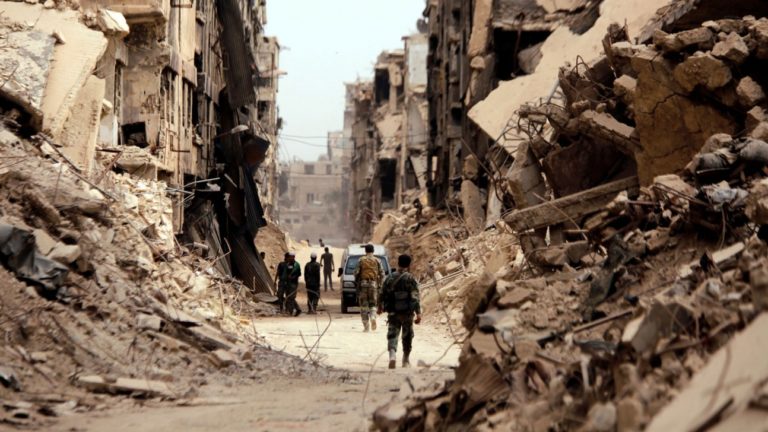
Syria in ruins after ten years of conflict (File photo)
BY M. K. BHADRAKUMAR | INDIAN PUNCHLINE | MARCH 20, 2021
In George Orwell’s novel Animal Farm, the ruling pigs led by Napoleon constantly rewrote history in order to justify and reinforce their own continuing power. The rewriting by the western powers of the history of the ongoing conflict in Syria leaps out of Orwell.
The joint statement issued by the foreign ministers of the US, UK, France, Germany and Italy last week to mark the tenth anniversary of the Syrian conflict begins with an outright falsehood by holding President Bashar al-Assad and “his backers” responsible for the horrific events in that country. It asserts that the five western powers “will not abandon” the Syrian people — till death do us part.
The historical reality is that Syria has been a theatre of the CIA’s activities ever since the inception of that agency in 1947. There is a whole history of CIA-sponsored “regime change” projects in Syria ranging from coup attempts and assassination plots to paramilitary strikes and funding and military training of anti-government forces.
It all began with the bloodless military coup in 1949 against then Syrian president Shukri al-Quwatli which was engineered by the CIA. As per the memoirs of Miles Copeland Jr, the CIA station chief in Damascus at that time — who later actually went on to write a fine book of high literary quality on the subject — the coup aimed at safeguarding Syria from the communist party and other radicals!
However, the CIA-installed colonel in power, Adib Shaishakli, was a bad choice. As Copeland put it, he was a “likeable rogue” alright who had not “to my certain knowledge, ever bowed down to a graven image. He had, however, committed sacrilege, blasphemy, murder, adultery and theft” to earn American support. He lasted for four years before overthrown by the Ba’ath Party and military officers. By 1955, CIA estimated that Syria was ripe for another military coup. By April 1956, a joint CIA-SIS (British Secret Intelligence Service) plot was implemented to mobilise right-wing Syrian military officers. But then, the Suez fiasco interrupted the project.
The CIA revived the project and plotted a second coup in 1957 under the codename Operation Wappen — again, to save Syria from communism — and even spent $3 million to bribe Syrian military officers. Tim Weiner, in his masterly 2008 book Legacy of Ashes: The History of the CIA, writes:
“The president (Dwight Eisenhower) said he wanted to promote the idea of an Islamic jihad against godless communism. “We should do everything possible to stress the ‘holy war’ aspect,” he said at a 1957 White House meeting… (Secretary of state) Foster Dulles proposed a “secret task force,” under whose auspices the CIA would deliver American guns, money, and intelligence to King Saud of Saudi Arabia, King Hussein of Jordan, President Camille Chamoun of Lebanon, and President Nuri Said of Iraq.”
“These four mongrels were supposed to be our defence against communism and the extremes of Arab nationalism in the Middle East… If arms could not buy loyalty in the Middle East, the almighty dollar was still the CIA’s secret weapon. Cash for political warfare and power plays was always welcome. It could help an American imperium in Arab and Asian lands.”
But, as it happened, some of those “right-wing” officers instead turned in the bribe money and revealed the CIA plot to the Syrian intelligence. Whereupon, 3 CIA officers were kicked out of the American embassy in Damascus, forcing Washington to withdraw its ambassador in Damascus. With egg on its face, Washington promptly branded Syria as a “Soviet satellite”, deployed a fleet to the Mediterranean and incited Turkey to amass troops on the Syrian border. Dulles even contemplated a military strike under the so-called “Eisenhower Doctrine” as retaliation against Syria’s “provocations”. By the way, Britain’s MI6 was also working with the CIA in the failed coup attempt; the details came to light accidentally in 2003 among the papers of British Defence Minister Duncan Sandys many years after his death.
Now, coming down to current history, suffice to say that according to the WikiLeaks, since 2006, the US had been funding London-based Syrian dissidents, and the CIA unit responsible for covert operations was deployed to Syria to mobilise rebel groups and ascertain potential supply routes. The US is known to have trained at least 10,000 rebel fighters at a cost of $1 billion annually since 2012. President Barack Obama reportedly admitted to a group of senators the operation to insert these CIA-trained rebel fighters into Syria.
The well-known American investigative journalist and political writer Seymour Hersh has written, based on inputs from intelligence officers, that the CIA was already transferring arms from its Benghazi station (Libya) to Syria around that time. Make no mistake, Obama was the first world leader to openly call for the removal of Assad. That was in August 2011. Then CIA chief David Petraeus paid two unannounced visits to Turkey (in March and September 2012) to persuade Erdogan to step in as the flag carrier of the US’ regime change project in Syria (under the rubric of “anti-terror fight”.)
In fact, the US’ key allies in the Persian Gulf — Saudi Arabia, Qatar and the UAE — took the cue from Obama to loosen their purse strings to recruit, finance and equip thousands of jihadi fighters to be deployed to Syria. Equally, from the early stages of the conflict in Syria, major western intelligence agencies provided political, military and logistic support to the Syrian opposition and its associated rebel groups in Syria.
Curiously, the Russian intervention in Syria in September 2015 was in response to an emergent imminent defeat of the Syrian government forces at the hands of the jihadi fighters backed by the US’ regional allies. Saudi Arabia withdrew from the arena only in 2017 after the tide of the war turned, thanks to the Russian intervention.
The joint statement issued last week by the US and its NATO allies belongs to the world of fiction. In reality, there is Syrian blood in the hands of these NATO countries (including Turkey) and the US’ Gulf allies. Look at the colossal destruction that the US has caused: in the World Bank’s estimation, a cumulative total of $226 billion in gross domestic product was lost to Syria due to the war from 2011 to 2016 alone.
The Syrian conflict has been among the most tragic and destructive conflicts of our time. Hundreds of thousands of Syrians have died, half a nation has been displaced, and millions have been forced into desperate poverty and hunger. In the UNHRC estimation, after ten years of conflict, half of the Syrian population has been forced to flee home, 70% are living in poverty, 6.7 million Syrians have been internally displaced, over 13 million people need humanitarian assistance and protection, 12.4 million people suffer from lack of food (or 60% of the entire population), 5.9 million people are experiencing a housing emergency and nearly nine in 10 Syrians are living below the poverty threshold.
And, come to think of it, Syria used to have one of the highest levels of social formation in the entire Muslim Middle East. It used to be a middle income country until the US decided to destabilise Syria. Ever since the late 1940s, the US’ successive regime change projects were driven by geopolitical considerations. The agenda is unmistakeable: the US has systematically destroyed the heart, soul and mind of “Arabism” — Iraq, Syria and Egypt — with a view to perpetuate the western [Zionist] domination of the Middle East.
Former President Donald Trump intended to withdraw the US troops from Syria and end the war. He tried twice, but Pentagon commanders sabotaged his plans. What Joe Biden proposes to do is anybody’s guess. Biden doesn’t seem to be in any rush to withdraw the US troops.
The most disturbing aspect is that the US is methodically facilitating a Balkanisation of Syria by helping the Kurdish groups aligned with it to carve out a semiautonomous enclave in the country’s northeast. In fact, the the Arab population in northeastern Syria resents being under the Kurds’ governance, and this may eventually turn into a new source of recruits for Islamic State. Meanwhile, Turkey seized the US-Kurdish axis as alibi to occupy vast territories in northern Syria.
The sad part of the joint statement by the US and its European allies is not only that it is rewriting history and spreading falsehood but conveys a sense of despair that there is no hope for light at the end of the tunnel in the Syrian conflict in a conceivable future.
The US policy in Syria is opaque. It has oscillated between aiming to prevent a resurgence of IS, confronting Iran, pushing back against Russia, providing humanitarian aid, and even protecting Israel, while the crux of the matter is that successive US administrations have failed to articulate a clear strategy and rationale for the US military presence in Syria.
Obama administration scientist says climate ‘emergency’ is based on fallacy
By Dr. Steven E. Koonin | New York Post | April 24, 2021
The Science,” we’re told, is settled. How many times have you heard it?
Humans have broken the earth’s climate. Temperatures are rising, sea level is surging, ice is disappearing, and heat waves, storms, droughts, floods, and wildfires are an ever-worsening scourge on the world. Greenhouse gas emissions are causing all of this. And unless they’re eliminated promptly by radical changes to society and its energy systems, “The Science” says Earth is doomed.
Yes, it’s true that the globe is warming, and that humans are exerting a warming influence upon it. But beyond that — to paraphrase the classic movie “The Princess Bride” — “I do not think ‘The Science’ says what you think it says.”
For example, both research literature and government reports state clearly that heat waves in the US are now no more common than they were in 1900, and that the warmest temperatures in the US have not risen in the past fifty years. When I tell people this, most are incredulous. Some gasp. And some get downright hostile.
These are almost certainly not the only climate facts you haven’t heard. Here are three more that might surprise you, drawn from recent published research or assessments of climate science published by the US government and the UN:
-
- Humans have had no detectable impact on hurricanes over the past century.
-
- Greenland’s ice sheet isn’t shrinking any more rapidly today than it was 80 years ago.
-
- The global area burned by wildfires has declined more than 25 percent since 2003 and 2020 was one of the lowest years on record.
Why haven’t you heard these facts before?
Most of the disconnect comes from the long game of telephone that starts with the research literature and runs through the assessment reports to the summaries of the assessment reports and on to the media coverage. There are abundant opportunities to get things wrong — both accidentally and on purpose — as the information goes through filter after filter to be packaged for various audiences. The public gets their climate information almost exclusively from the media; very few people actually read the assessment summaries, let alone the reports and research papers themselves. That’s perfectly understandable — the data and analyses are nearly impenetrable for non-experts, and the writing is not exactly gripping. As a result, most people don’t get the whole story.
Policymakers, too, have to rely on information that’s been put through several different wringers by the time it gets to them. Because most government officials are not themselves scientists, it’s up to scientists to make sure that those who make key policy decisions get an accurate, complete and transparent picture of what’s known (and unknown) about the changing climate, one undistorted by “agenda” or “narrative.” Unfortunately, getting that story straight isn’t as easy as it sounds.
I should know. That used to be my job.
I’m a scientist — I work to understand the world through measurements and observations, and then to communicate clearly both the excitement and the implications of that understanding. Early in my career, I had great fun doing this for esoteric phenomena in the realm of atoms and nuclei using high-performance computer modeling (which is also an important tool for much of climate science). But beginning in 2004, I spent about a decade turning those same methods to the subject of climate and its implications for energy technologies. I did this first as chief scientist for the oil company BP, where I focused on advancing renewable energy, and then as undersecretary for science in the Obama administration’s Department of Energy, where I helped guide the government’s investments in energy technologies and climate science. I found great satisfaction in these roles, helping to define and catalyze actions that would reduce carbon dioxide emissions, the agreed-upon imperative that would “save the planet.”
But doubts began in late 2013 when I was asked by the American Physical Society to lead an update of its public statement on climate. As part of that effort, in January 2014 I convened a workshop with a specific objective: to “stress test” the state of climate science.
I came away from the APS workshop not only surprised, but shaken by the realization that climate science was far less mature than I had supposed. Here’s what I discovered:
Humans exert a growing, but physically small, warming influence on the climate. The results from many different climate models disagree with, or even contradict, each other and many kinds of observations. In short, the science is insufficient to make useful predictions about how the climate will change over the coming decades, much less what effect our actions will have on it.
In the seven years since that workshop, I watched with dismay as the public discussions of climate and energy became increasingly distant from the science. Phrases like “climate emergency,” “climate crisis” and “climate disaster” are now routinely bandied about to support sweeping policy proposals to “fight climate change” with government interventions and subsidies. Not surprisingly, the Biden administration has made climate and energy a major priority infused throughout the government, with the appointment of John Kerry as climate envoy and proposed spending of almost $2 trillion dollars to fight this “existential threat to humanity.”
Trillion-dollar decisions about reducing human influences on the climate should be informed by an accurate understanding of scientific certainties and uncertainties. My late Nobel-prizewinning Caltech colleague Richard Feynman was one of the greatest physicists of the 20th century. At the 1974 Caltech commencement, he gave a now famous address titled “Cargo Cult Science” about the rigor scientists must adopt to avoid fooling not only themselves. “Give all of the information to help others to judge the value of your contribution; not just the information that leads to judgment in one particular direction or another,” he implored.
Much of the public portrayal of climate science ignores the great late physicist’s advice. It is an effort to persuade rather than inform, and the information presented withholds either essential context or what doesn’t “fit.” Scientists write and too-casually review the reports, reporters uncritically repeat them, editors allow that to happen, activists and their organizations fan the fires of alarm, and experts endorse the deception by keeping silent.
As a result, the constant repetition of these and many other climate fallacies are turned into accepted truths known as “The Science.”
This article is an adapted excerpt from Dr. Koonin’s book, “Unsettled: What Climate Science Tells Us, What It Doesn’t, and Why It Matters” (BenBella Books), out May 4.
How Bellingcat Launders National Security State Talking Points into the Press
By Alan Macleod | MintPress News | April 9, 2021
AMSTERDAM — Investigative site Bellingcat is the toast of the popular press. In the past month alone, it has been described as “an intelligence agency for the people” (ABC Australia ), a “transparent” and “innovative” (New Yorker ) “independent news collective,” “transforming investigative journalism” (Big Think ), and an unequivocal “force for good” (South China Morning Post ). Indeed, outside of a few alternative news sites, it is very hard to hear a negative word against Bellingcat, such is the gushing praise for the outlet founded in 2014.
This is troubling, because the evidence compiled in this investigation suggests Bellingcat is far from independent and neutral, as it is funded by Western governments, staffed with former military and state intelligence officers, repeats official narratives against enemy states, and serves as a key part in what could be called a “spook to Bellingcat to corporate media propaganda pipeline,” presenting Western government narratives as independent research.
Citizen journalism staffed with spies and soldiers
An alarming number of Bellingcat’s staff and contributors come from highly suspect backgrounds. Senior Investigator Nick Waters, for example, spent three years as an officer in the British Army, including a tour in Afghanistan, where he furthered the British state’s objectives in the region. Shortly after leaving the service, he was hired by Bellingcat to provide supposedly bias-free investigations into the Middle East.
Former contributor Cameron Colquhoun’s past is even more suspect. Colquhoun spent a decade in a senior position in GCHQ (Britain’s version of the NSA), where he ran cyber and Middle Eastern terror operations. The Scot specializes in Middle Eastern security and also holds a qualification from the U.S. State Department. None of this, however, is disclosed by Bellingcat, which merely describes him as the managing director of a private intelligence company that “conduct[s] ethical investigations” for clients around the world — thus depriving readers of key information they need to make informed judgments on what they are reading.
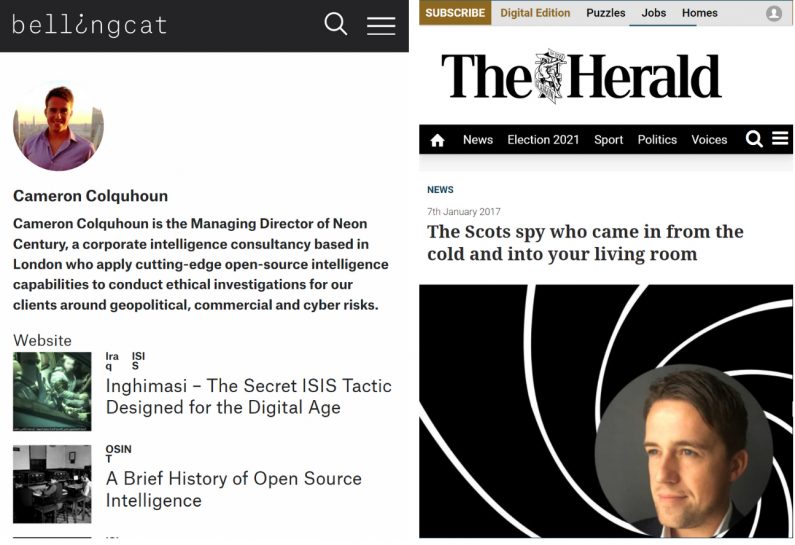
Bellingcat fails to inform its readers of even the most glaring conflicts of interest
There are plenty of former American spooks on Bellingcat’s roster as well. Former contributor Chris Biggers, who penned more than 60 articles for the site between 2014 and 2017, previously worked for the National Geospatial-Intelligence Agency — a combat support unit that works under the Department of Defense and the broader Intelligence Community. Biggers is now the director of an intelligence company headquartered in Virginia, on the outskirts of Washington (close to other semi-private contractor groups like Booz Allen Hamilton), that boasts of having retired Army and Air Force generals on its board. Again, none of this is disclosed by Bellingcat, where Biggers’s bio states only that he is a “public and private sector consultant based in Washington, D.C.”
For six years, Dan Kaszeta was a U.S. Secret Service agent specializing in chemical, biological and nuclear weapons, and for six more he worked as program manager for the White House Military Office. At Bellingcat, he would provide some of the intellectual ammunition for Western accusations about chemical weapons use in Syria and Russia’s alleged poisoning of Sergei Skripal.
Kaszeta is also a fellow at the Royal United Services Institute, a think tank funded by a host of Western governments as well as weapons contractors such as Airbus, Lockheed Martin and Raytheon. Its president is a British field marshal (the highest attainable military rank) and its senior vice president is retired American General David Petraeus. Its chairman is Lord Hague, the U.K.’s secretary of state between 2010 and 2015.
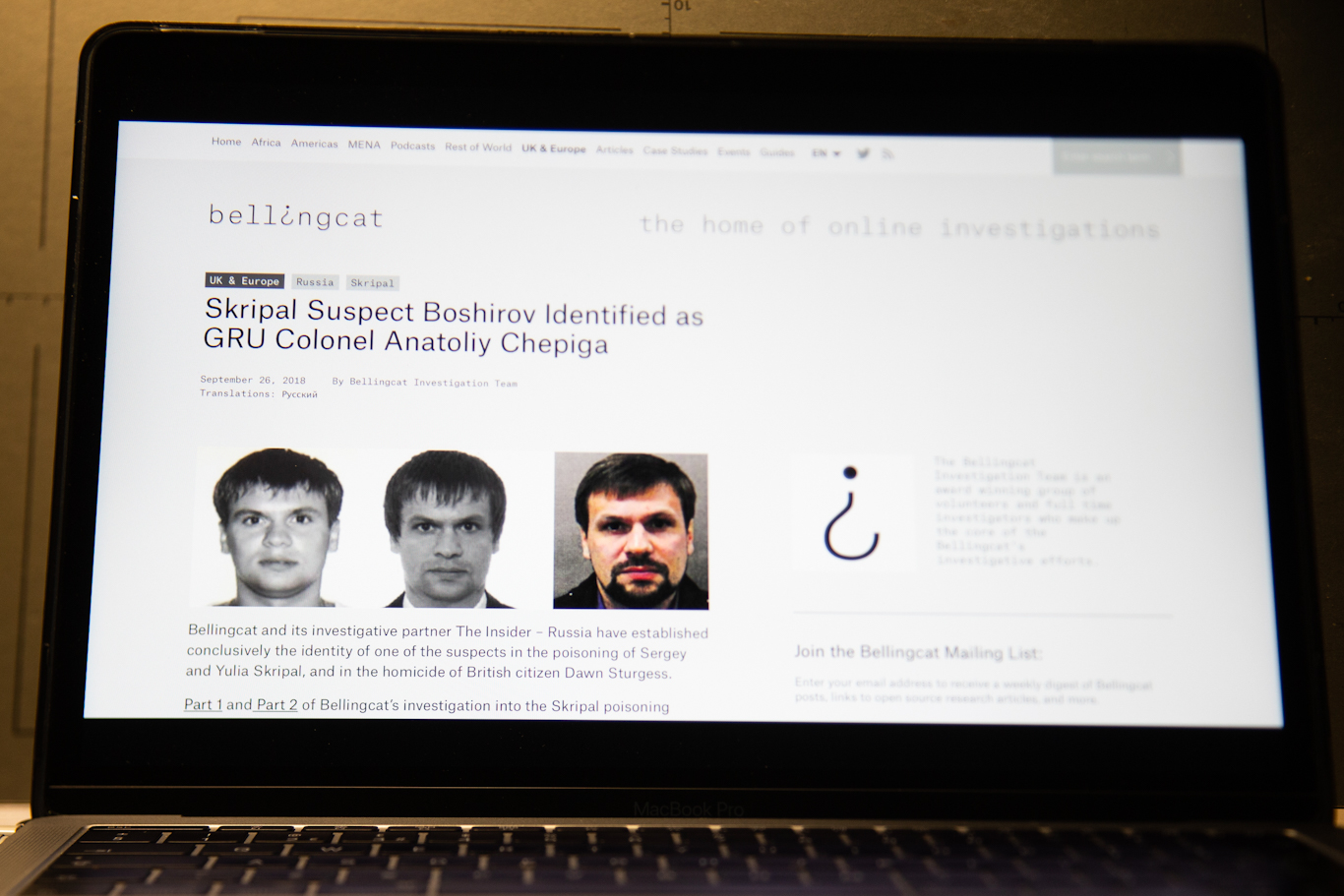
A Bellingcat article covering the alleged poisoning of Sergei Skripal, a story covered heavily by the organization. Alexander Zemlianichenko | AP
All of this matters if a group is presenting itself as independent when, in reality, their views align almost perfectly with the governments funding them. But yet again, Bellingcat fails to follow basic journalism ethics and inform readers of these glaring conflict of interests, describing Kaszeta as merely the managing director of a security company and someone with 27 years of experience in security and antiterrorism. This means that unless readers are willing to do a research project they will be none the wiser.
Other Bellingcat contributors have similar pasts. Nour Bakr previously worked for the British government’s Foreign and Commonwealth Office while Karl Morand proudly served two separate tours in Iraq with the U.S. 82nd Airborne Division.
Government and intelligence officials are the opposite of journalists. The former exist to promote the interests of power (often against those of the public) while the latter are supposed to hold the powerful to account on behalf of the people. That is why it is so inappropriate that Bellingcat has had so many former spooks on their books. It could be said that ex-officials who have renounced their past or blown the whistle, such as Daniel Ellsberg or John Kiriakou, have utility as journalists. But those who have simply made the transition into media without any change in positions usually serve only the powerful.
Who pays the piper?
Just as startling as its spooky staff is Bellingcat’s source of funding. In 2016 its founder, Eliot Higgins, dismissed the idea that his organization got money from the U.S. government’s National Endowment for Democracy (NED) as a ludicrous conspiracy theory. Yet, by the next year, he openly admitted the thing he had laughed off for so long was, in fact, true (Bellingcat’s latest available financial report confirms that they continue to receive financial assistance from the NED). As many MintPress readers will know, the NED was explicitly set up by the Reagan administration as a front for the CIA’s regime-change operations. “A lot of what we do today was done covertly 25 years ago by the CIA,” said the organization’s co-founder Allen Weinstein, proudly.
Higgins himself was a senior fellow at the Atlantic Council, NATO’s quasi-official think tank, from 2016 to 2019. The Atlantic Council’s board of directors is a who’s who of state power, from war planners like Henry Kissinger, Condoleezza Rice and Colin Powell to retired generals such as James “Mad Dog” Mattis and H.R. McMaster. It also features no fewer than seven former CIA directors. How Higgins could possibly see taking a paid position at an organization like this while he was still the face of a supposedly open and independent intelligence collective as being at all consistent is unclear.

Bana Alabed, an outsoken anti-Assad child activist, promotes Bellingcat at an Atlantic Council event. Photo | Twitter
Other questionable sources of income include the Human Rights Foundation, an international organization set up by Venezuelan activist Thor Halvorssen Mendoza. Halvorssen is the son of a former government official accused of being a CIA informant and a gunrunner for the agency’s dirty wars in Central America in the 1980s and the cousin of convicted terrorist Leopoldo Lopez. Lopez in turn was a leader in a U.S.-backed coup in 2002 and a wave of political terror in 2014 that killed at least 43 people and caused an estimated $15 billion worth of property damage. A major figure on the right-wing of Venezuelan politics, Lopez told journalists that he wants the United States to formally rule the country once President Nicolas Maduro is overthrown. With the help of the Spanish government, Lopez escaped from jail and fled to Spain last year.
Imagine, for one second, the opposite scenario: an “independent” Russian investigative website staffed partially with ex-KGB officials, funded by the Kremlin, with most of their research focused on the nefarious deeds of the U.S., U.K. and NATO. Would anyone take it seriously? And yet Bellingcat is consistently presented in corporate media as a liberatory organization; the Information Age’s gift to the people.
The Bellingcat to journalism pipeline
The corporate press itself already has a disturbingly close relationship with the national security state, as does social media. In 2019, a senior Twitter executive was unmasked as an active duty officer in the British Army’s online psychological operations unit. Coming at a time when foreign interference in politics and society was the primary issue in U.S. politics, the story was, astoundingly, almost completely ignored in the mainstream press. Only one U.S. outlet of any note picked it up, and that journalist was forced out of the profession weeks later.
Increasingly, it seems, Bellingcat is serving as a training ground for those looking for a job in the West’s most prestigious media outlets. For instance, former Bellingcat contributor Brenna Smith — who was recently the subject of a media storm after she successfully pressured a number of online payment companies to stop allowing the crowdfunding of the Capitol Building insurrectionists — announced last month she would be leaving USA Today and joining The New York Times. There she will meet up with former Bellingcat senior investigator Christiaan Triebert, who joined the Times’ visual investigations team in 2019.
The Times, commonly thought of as the United States’ most influential media outlet, has also collaborated with Bellingcat writers for individual pieces before. In 2018, it commissioned Giancarlo Fiorella and Aliaume Leroy to publish an op-ed strongly insinuating that the Venezuelan state murdered Oscar Perez. After he stole a military helicopter and used it to bomb government buildings in downtown Caracas while trying to ignite a civil war, Perez became the darling of the Western press, being described as a “patriot” (The Guardian ), a “rebel” (Miami Herald ), an “action hero” (The Times of London ), and a “liberator” (Task and Purpose ).
Until 2020, Fiorella ran an opposition blog called In Venezuela despite living in Canada. Leroy is now a full-time producer and investigator for the U.K.-government network, the BBC.
Bad news from Bellingcat
What we are uncovering here is a network of military, state, think-tank and media units all working together, of which Bellingcat is a central fixture. This would be bad enough, but much of its own research is extremely poor. It strongly pushed the now increasingly discredited idea of a chemical weapons attack in Douma, Syria, attacking the members of the OPCW who came forward to expose the coverup and making some bizarre claims along the way. For years, Higgins and other members of the Bellingcat team also signal-boosted a Twitter account purporting to be an ISIS official, only for an investigation to expose the account as belonging to a young Indian troll in Bangalore. A leaked U.K. Foreign Office document lamented that “Bellingcat was somewhat discredited, both by spreading disinformation itself, and by being willing to produce reports for anyone willing to pay.”
Ultimately, however, the organization still provides utility as an attack dog for the West, publishing research that the media can cite, supposedly as “independent,” rather than rely directly on intelligence officials, whose credibility with the public is automatically far lower.
Oliver Boyd-Barrett, professor emeritus at Bowling Green State University and an expert in the connections between the deep state and the fourth estate, told MintPress that “the role of Bellingcat is to provide spurious legitimacy to U.S./NATO pretexts for war and conflict.” In far more positive words, the CIA actually appears to agree with him.
“I don’t want to be too dramatic, but we love [Bellingcat],” said Marc Polymeropoulos, the agency’s former deputy chief of operations for Europe and Eurasia. “Whenever we had to talk to our liaison partners about it, instead of trying to have things cleared or worry about classification issues, you could just reference [Bellingcat’s] work.” Polymeropoulos recently attempted to blame his headache problems on a heretofore unknown Russian microwave weapon, a claim that remarkably became an international scandal. “The greatest value of Bellingcat is that we can then go to the Russians and say ‘there you go’ [when they ask for evidence],” added former CIA Chief of Station Daniel Hoffman.
Bellingcat certainly seems to pay particular attention to the crimes of official enemies. As investigative journalist Matt Kennard noted, it has only published five stories on the United Kingdom, 17 on Saudi Arabia, 19 on the U.S. (most of which are about foreign interference in American society or far-right/QAnon cults). Yet it has 144 on Russia and 244 under its Syria tag.
In his new book “We Are Bellingcat: An Intelligence Agency for the People,” the outlet’s boss Higgins writes: “We have no agenda but we do have a credo: evidence exists and falsehoods exist, and people still care about the difference.” Yet exploring the backgrounds of its journalists and its sources of funding quickly reveals this to be a badly spun piece of PR.
Bellingcat looks far more like a bunch of spooks masquerading as citizen journalists than a people-centered organization taking on power and lies wherever it sees them. Unfortunately, with many of its proteges travelling through the pipeline into influential media outlets, it seems that there might be quite a few masquerading as reporters as well.
Alan MacLeod is Senior Staff Writer for MintPress News. After completing his PhD in 2017 he published two books: Bad News From Venezuela: Twenty Years of Fake News and Misreporting and Propaganda in the Information Age: Still Manufacturing Consent, as well as a number of academic articles.
Former minister blasts pro-Israel lobby over ‘disgusting interference’ in British politics
MEMO | April 9, 2021
Former Foreign Office Minister Sir Alan Duncan has accused pro-Israel lobbyists of “the most disgusting interference” in British politics, and of negatively influencing the country’s foreign policy in the Middle East. The veteran politician has also claimed that Conservative Friends of Israel (CFI) went “ballistic” and blocked him from taking on a new post covering the region’s affairs.
Duncan, a former Conservative MP and government minister, makes the sensational claims in his newly published memoir, In The Thick of It: The private diaries of a minister (published by William Collins, 2021). Speaking to journalist Michael Crick about his book for the MailPlus website, the 64 year-old blasted CFI and its undue influence in British politics.
Conservative Friends of Israel, he said, had injected a “Netanyahu-type view of Israeli politics into our foreign policy,” referring to Israel’s right-wing prime minister. He claimed that it had applied pressure on Theresa May’s government to prevent him becoming Middle East minister at the Foreign Office.
In his book, Duncan claims that his new role was agreed until the then Foreign Secretary Boris Johnson alerted him to the fact that CFI “are going ballistic”. He insists that he was blocked from taking the post because he believes in the rights of the Palestinians.
In one diary entry Duncan is scathing about Conservative MPs’ fawning over Benjamin Netanyahu during his visit to Britain. He was “ashamed” of the British government, accusing officials of allowing Netanyahu to “peddle pro-settlement propaganda”.
Duncan described to Crick the culture of fear created by CFI. “A lot of things do not happen in foreign policy or in government for fear of offending them because that’s the way it’s put to them by the CFI.”
He warned: “It’s a sort of buried scandal that has to stop… they will interfere at a high level in British politics in the interests of Israel on the back of donor power in the UK.” Ultimately, he pointed out, the influence of the pro-Israel lobby group came at the expense of the Palestinians.
Duncan has been a major target for the pro-Israel lobby. In 2017, an Al Jazeera documentary sensationally exposed the operations of pro-Israel lobbyists working with the Israeli Embassy in London to “take down” a minister of the Crown. Duncan, fellow Conservative MP Crispin Blunt and former Labour leader Jeremy Corbyn were marked out as targets. Writing for Al Jazeera at the time, Robert Grenier, a retired, 27-year veteran of the CIA’s Clandestine Service, warned against what he called the “insidious threats” of the pro-Israel lobby.
Read also: Conservative Friends of Israel urge UK to oppose ICC’s war crimes investigation
A book on COVID by Sebastian Rushworth
Dr. Malcolm Kendrick | April 8, 2021
 Early on in the COVID19 saga I came in contact with Sebastian Rushworth. He was, and is, working as an emergency care doctor in Sweden. It seemed we shared very similar ideas about what was going on. It was fascinating as he was working in Sweden, which has been attacked from all sides, for following WHO advice on the best actions to take in a pandemic.
Sweden did not fully lockdown, most schools remained open, as did bars and restaurants etc. As a result of this everyone died… Start again. As a result of this Sweden suffered around the average number of deaths (per head of population) in Europe.
European countries, above a certain size, that have done worse than Sweden, so far, include:
Czechia
Hungary
Bosnia and Herzegovina
Bulgaria
Belgium
North Macedonia
Slovenia
Slovakia
Italy
UK
Portugal
Spain
Peru
Croatia
Poland
France
Lithuania
(NB: I left out micro-countries’ such as Gibraltar, San Marino, Andorra etc.)
You would think, from the howls of anguish that Sweden was now a smoking ruin, with hospitals full of the dead and dying. Which serves them bloody well right. They should have done what every other country did.
Anyway, it was interesting to link up with Sebastian to get a first-hand account of what was going on. You hear so much rubbish from the mainstream media, that it is difficult to know what is really going on. We live in a scary, censored world. Patrolled by self-appointed fact-checking dementors.
Sebastian has his own website at https://sebastianrushworth.com/ which I recommend as a good place for sensible thinking.
Now he has written a book. I should know, because he asked me to write the foreword for it, which I gladly did. It isn’t long, it is very readable, and you will learn a lot if you read it. It covers:
How Dangerous is COVID
Are the tests effective?
Does lockdown work?
Why did Sweden have more deaths than Norway?
Do face masks stop the virus?
Are the vaccines safe and effective?
I recommend it to everyone, and you can find a link to it on his website.
Another Climate Scientist With Impeccable Credentials Breaks Ranks
“Our models are MICKEY-MOUSE mockeries of the real world”
Dr. Mototaka Nakamura received a Doctorate of Science from the Massachusetts Institute of Technology (MIT), and for nearly 25 years specialized in abnormal weather and climate change at prestigious institutions that included MIT, Georgia Institute of Technology, NASA, Jet Propulsion Laboratory, California Institute of Technology, JAMSTEC and Duke University.
In his book The Global Warming Hypothesis is an Unproven Hypothesis, Dr. Nakamura explains why the data foundation underpinning global warming science is “untrustworthy” and cannot be relied on:
“Global mean temperatures before 1980 are based on untrustworthy data,” writes Nakamura. “Before full planet surface observation by satellite began in 1980, only a small part of the Earth had been observed for temperatures with only a certain amount of accuracy and frequency. Across the globe, only North America and Western Europe have trustworthy temperature data dating back to the 19th century.”
From 1990 to 2014, Nakamura worked on cloud dynamics and forces mixing atmospheric and ocean flows on medium to planetary scales. His bases were MIT (for a Doctor of Science in meteorology), Georgia Institute of Technology, Goddard Space Flight Center, Jet Propulsion Laboratory, Duke and Hawaii Universities and the Japan Agency for Marine-Earth Science and Technology.
He’s published 20+ climate papers on fluid dynamics.
There is no questioning his credibility or knowledge.
Today’s ‘global warming science’ is akin to an upside down pyramid which is built on the work of a few climate modelers. These AGW pioneers claim to have demonstrated human-derived CO2 emissions as the cause of recently rising temperatures and have then simply projected that warming forward. Every climate researcher thereafter has taken the results of these original models as a given, and we’re even at the stage now where merely testing their validity is regarded as heresy.
Here in Nakamura, we have a highly qualified and experienced climate modeler with impeccable credentials rejecting the unscientific bases of the climate crisis claims. But he’s up against it — activists are winning at the moment, and they’re fronted by scared, crying children; an unstoppable combination, one that’s tricky to discredit without looking like a heartless bastard (I’ve tried).

Climate scientist Dr. Mototaka Nakamura’s recent book blasts global warming data as “untrustworthy” and “falsified”.
DATA FALSIFICATION
When arguing against global warming, the hardest thing I find is convincing people of data falsification, namely temperature fudging. If you don’t pick your words carefully, forget some of the facts, or get your tone wrong then it’s very easy to sound like a conspiracy crank (I’ve been there, too).
But now we have Nakamura.
The good doctor has accused the orthodox scientists of “data falsification” in the form adjusting historical temperature data down to inflate today’s subtle warming trend — something Tony Heller has been proving for years on his website realclimatescience.com.
Nakamura writes: “The global surface mean temperature-change data no longer have any scientific value and are nothing except a propaganda tool to the public.”
The climate models are useful tools for academic studies, he admits. However: “The models just become useless pieces of junk or worse (as they can produce gravely misleading output) when they are used for climate forecasting.”
Climate forecasting is simply not possible, Nakamura concludes, and the impacts of human-caused CO2 can’t be judged with the knowledge and technology we currently possess.
The models grossly simplify the way the climate works.
As well as ignoring the sun, they also drastically simplify large and small-scale ocean dynamics, aerosol changes that generate clouds (cloud cover is one of the key factors determining whether we have global warming or global cooling), the drivers of ice-albedo: “Without a reasonably accurate representation, it is impossible to make any meaningful predictions of climate variations and changes in the middle and high latitudes and thus the entire planet,” and water vapor.
The climate forecasts also suffer from arbitrary “tunings” of key parameters that are simply not understood.
NAKAMURA ON CO2
He writes: “The real or realistically-simulated climate system is far more complex than an absurdly simple system simulated by the toys that have been used for climate predictions to date, and will be insurmountably difficult for those naive climate researchers who have zero or very limited understanding of geophysical fluid dynamics. The dynamics of the atmosphere and oceans are absolutely critical facets of the climate system if one hopes to ever make any meaningful prediction of climate variation.”
Solar input is modeled as a “never changing quantity,” which is absurd.
“It has only been several decades since we acquired an ability to accurately monitor the incoming solar energy. In these several decades only, it has varied by one to two watts per square meter. Is it reasonable to assume that it will not vary any more than that in the next hundred years or longer for forecasting purposes? I would say, No.”
You can read Mototaka Nakamura’s book for free on Kindle. Arm yourself with the facts, and then spread them — facts such as those highlighted below (all lifted from the book):
“[The models have] no understanding of cloud formation/forcing.”
“Assumptions are made, then adjustments are made to support a narrative.”
“Our models are mickey-mouse mockeries of the real world.”
SOLAR FORCING
Solar output isn’t constant, IPCC. And the modulation of cloud nucleation is a key consequence. During solar minima, like the one we’re entering now, the sun’s magnetic field weakens and the outward pressure of the solar wind decreases. This allows more Cosmic Rays from deep space to penetrate our planet’s atmosphere. These CRs have been found to nucleate clouds (Svensmark et al). And clouds are a crucial player earth’s climate.
As Roy Spencer, PhD. eloquently writes:
“Clouds are the Earth’s sunshade, and if cloud cover changes for any reason, you have global warming — or global cooling.”
The COLD TIMES are returning, the mid-latitudes are REFREEZING in line with historically low solar activity, cloud-nucleating Cosmic Rays, and a meridional jet stream flow.
Both NOAA and NASA appear to agree, if you read between the lines, with NOAA saying we’re entering a ‘full-blown’ Grand Solar Minimum in the late-2020s, and NASA seeing this upcoming solar cycle (25) as “the weakest of the past 200 years”, with the agency correlating previous solar shutdowns to prolonged periods of global cooling here.
Furthermore, we can’t ignore the slew of new scientific papers stating the immense impact The Beaufort Gyre could have on the Gulf Stream, and therefore the climate overall.


Ron Unz’ SoundCloud and Downloadable EBooks
Audio Files, now available on SoundCloud
By Ron Unz | Unz Review | March 11, 2021
I’ve been quite pleased with the positive response to the audio versions of my articles which I produced and made freely available on this website, now totaling more than 100 in number, and including multipart versions of a half dozen of the longest ones. This collection represents the spoken form of more than 500,000 words of text, and in less than two weeks, the audio files seem to have been clicked more than 17,000 times, demonstrating that many people do indeed prefer listening to reading. It’s also possible that a few of those visitors have begun redistributing a some of them across other websites and discussion forums, which is another intended use.
Aside from being available as links or playable podcasts at the top of each associated article, a complete listing is also provided in the standard Sidebar, along with a few of my recent interviews:
https://www.unz.com/page/audio-files-podcasts/
I’ve now also established a SoundCloud page as an additional distribution channel, making all of them available in that system as well, grouped by category, while the longest, multipart podcasts also shown separately. These latter also tend to be the most significant and controversial, and they are effectively highlighted by that system:
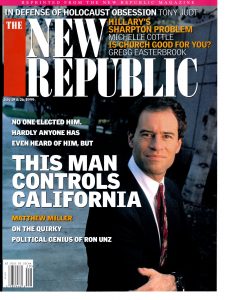 Since SoundCloud suggests the inclusion of a user-image, I made the somewhat aggrandizing decision to provide my rather flattering July 1999 New Republic cover, which represented the absolute media peak of my political career and was naturally soon followed by the crushing defeat of my 2000 Campaign Finance Reform initiative.
Given the exceptionally controversial nature of many of my articles, especially those in the American Pravda series, I regard my past mainstream credibility as a crucial asset, and TNR, which was then at the absolute height of its national influence, surely helps to provide it.
In addition, I’m also establishing a YouTube channel, which will soon make these audio files available there as well.
Downloadable EBooks in ePub and Mobi/Kindle formats
Meanwhile, I’ve now made available some fifteen freely downloadable eBooks, all in both the ePub and Mobi/Kindle formats. These include two large collections, each running over 300,000 words, and more than a dozen smaller eBooks, mostly containing one of my longer and more significant articles. All of them, together with a complete listing of the contents, are permanently available in the standard Sidebar:
https://www.unz.com/page/downloadable-ebooks/
Over the last few weeks, they’ve already been downloaded nearly 5,000 times, and just as with the audio files, please feel free to redistribute them across other websites and discussion forums.
Major Collections

EPub Format • Mobi/Kindle Format

EPub Format • Mobi/Kindle Format
Smaller EBooks


UN Food Summit Boycotted Over Gates Influence

By Dr. Joseph Mercola | March 19, 2021
Hundreds of farmers and human rights groups are boycotting the 2021 United Nations Food Systems Summit because they believe it favors agribusiness interests, elite foundations and the exploitation of African food systems.
The Summit claims it is convening to “launch bold new actions to transform the way the world produces and consumes food,”2 but critics say it is biased toward industrial, corporate farming while leaving out those in regenerative agriculture and the knowledge of indigenous people.3
The controversy began right from the start, when U.N. secretary general António Guterres appointed Agnes Kalibata as the event’s head. Kalibata is the former Rwandan agriculture minister who is now the president of the Alliance for a Green Revolution in Africa (AGRA), an organization funded by the Bill & Melinda Gates Foundation.4
AGRA is essentially a Gates Foundation subsidiary, and while some of its projects appear to be beneficial, most of its goals are centered on promoting biotechnology and chemical fertilizers.
Corporate Interests Dominating Food Summit
After Kalibata was appointed special envoy to the 2021 United Nations Food Systems Summit in December 2019, 176 civil society organizations and farmer groups from 83 countries urged Guterres to withdraw the appointment due to Kalibata’s clear conflicts of interest with corporate interests.
A second statement, signed by more than 500 academics and organizations, also opposed Kalibata’s appointment to, and her organization of, the Summit.5 AGRA is known to promote the interests of agribusiness, leading civil society organizations to argue that Kalibata’s appointment was a clear conflict of interest.
“This concern over Kalibata’s nomination has been largely borne-out by Kalibata’s top-down approach to organizing the Summit and her exclusion of those most affected by food insecurity and malnutrition in the planning process,” according to an August 2020 report by AGRA Watch.6
A dozen individuals representing development banks, academic institutions and the private sector came forward in support of Kalibata, but “11 had past or current connections to the Gates Foundation,” AGRA Watch reported, adding:7
“These findings illustrate the influence of the Bill and Melinda Gates Foundation (BMGF) on global food and agricultural policy. AGRA Watch has continually documented the role of the BMGF in influencing agricultural development, which has grown immensely in recent years.
That Gates Foundation seeks to exercise influence not only through its funding of projects and shaping of expertise, but also in funding the governance platforms that determine food and agricultural policy. This role of the BMGF in driving policy decisions based on its proprietary and technological model of agricultural development is often overlooked.”
Precision Agriculture, Genetic Engineering Take Center Stage
Concerns that the Summit was dominated by corporate industry heightened when its concept paper included precision agriculture, data collection and genetic engineering as pillars for addressing food security while leaving out regenerative agriculture.
As reported by The Guardian, Michael Fakhri, the U.N. special rapporteur on the right to food, wrote to Kalibata stating that the Summit was focused on “science and technology, money and markets” while leaving fundamental questions about inequality, accountability and governance unaddressed:8
“It [appears] heavily skewed in favor of one type of approach to food systems, namely market-based solutions … it leaves out experimental/traditional knowledge that has the acute effect of excluding indigenous peoples and their knowledge. The business sector has been part of the problem of food systems and has not been held accountable.”
The 300 million-member Civil Society and Indigenous Peoples’ Mechanism announced plans to boycott the Summit and set up a meeting of their own, while others, including Sofía Monsalve Suárez, head of nutrition rights group Fian International, questioned the Summit’s legitimacy:9
“We cannot jump on a train that is heading in the wrong direction … We sent a letter last year to the secretary general about our concerns. It was not answered. We sent another last month, which has also not been answered. The summit appears extremely biased in favor of the same actors who have been responsible for the food crisis.”
Other nutrition experts also expressed the need for the Summit to be more inclusive of initiatives such as agro-ecology and food sovereignty.
Food Group Calls On UN To Sever Ties With WEF
A group of 148 organizations from 28 countries also called on the U.N. to revoke their 2019 strategic partnership formed with the World Economic Forum (WEF). WEF’s involvement with the Summit has been called a form of “corporate hijacking” that would infringe on people’s rights to food and food production. According to the People’s Coalition on Food Sovereignty:10
“The WEF will exploit the Summit to streamline neoliberal globalization, which it has espoused for the past 50 years. It is the perfect venue to push for the role of ‘Fourth Industrial Revolution technologies’ to transform food systems, which the WEF has been championing since 2017.
A corporate-led FSS [Food Systems Summit] would be a great advantage to the political elites and corporate billionaires, enabling them to pose hypocritically as responsible entities that promote healthier diets and climate action.
… The sidelined and marginalized sectors in society — the poor farmers, workers, Indigenous Peoples, herders, pastoralists, fisherfolks, urban poor, women, Dalits, and youth — should replace these corporate moguls in shaping the Summit’s proceedings and reforms.”
Beyond the Summit, WEF’s takeover of the U.N. has been denounced by more than 400 civil society organizations and 40 international networks, which claim it will only accelerate the move toward a privatized, undemocratic global takeover. Monsalve Suárez stated:11
“Corporations in the global industrial food chain alone destroy 75 billion tons of topsoil annually and are responsible for the annual loss of 7.5 million hectares of forest. This destruction, along with other factors, leaves 3.9 billion underfed or malnourished people. The WEF represents the interests of those who destroy the environment and abuse our human rights. It cannot be considered a strategic partner in solving the world’s crises.”
Africa’s Traditional Food Systems Under Attack
Planning documents for the Summit also reveal plans for a “radical transformation shift” in Africa, away from traditional farming practices and toward industrial farming — even describing the potential as the “new oil.”12 The African Centre for Biodiversity (ACB), which released the documents, said the plans recycle the “same false solutions … with the same narrow benefits accruing to a limited number of actors.”13
For instance, one section of the documents is titled “the promise of digital and biotechnologies and the transformation of food systems,” and describes “the significant potential for capturing large economic, social and environmental payoffs from the use of biotechnology products … In West Africa, for instance, farmers can benefit significantly from the adoption of Bt cotton.”14
Technology and development take center stage, along with “strengthening the use of big data” for decisions on things like fertilizer use, genetically engineered crops and “accessing markets.” As noted by U.S. Right to Know:15
“This agenda aligns perfectly with the plans of the agrichemical industry, the Gates Foundation and its main agricultural development program, the Alliance for a Green Revolution in Africa, which encourages African countries to pass business-friendly policies and scale up markets for patented seeds, fossil-fuel based fertilizers and other industrial inputs they say are necessary to boost food production.”
“The main problem with AGRA,” Global Justice Now explains, “is that it is laying the groundwork for the deeper penetration of African agriculture by agribusiness corporations,” and:
“The BMGF, through AGRA, is one of the world’s largest promoters of chemical fertiliser. Some grants given by the BMGF to AGRA have been specifically intended to ‘help AGRA build the fertiliser supply chain’ in Africa. One of the largest of AGRA’s own grants, worth $25 million, was to help establish the African Fertiliser Agribusiness Partnership (AFAP) in 2012 whose very goal is to ‘at least double total fertiliser use’ in Africa.”16
Bill Gates Is The Biggest Owner Of US Farmland
The BMGF’s involvement in the Summit is also self-serving, as Bill Gates owns more farmland in the U.S. than any other private farmer, having purchased a total of 242,000 acres — much of it considered some of the richest soil in the U.S. — at a frenzied pace over the past few years.17
Gates, however, isn’t interested in regenerative agriculture but instead is furthering an agricultural agenda that supports agrochemicals, patented seeds, fake meat and corporate control — interests that undermine regenerative, sustainable, small-scale farming. One of the key players in this agenda is the widespread adoption of synthetic meat.
Gates has made it clear that he believes switching to synthetic beef is the solution to reducing methane emissions that come from animals raised on concentrated animal feeding operations (CAFOs).18
The strong recommendation to replace beef with fake meat is made in Gates’ book “How to Avoid a Climate Disaster: The Solutions We Have and the Breakthroughs We Need,” which was released in February 2021.19 In an interview with MIT Technology Review, he goes so far as to say that people’s behaviors should be changed to learn to like fake meat and, if that doesn’t work, regulations could do the trick.20
What many aren’t aware of, however, is that Gates is either personally invested in, or invested in via Breakthrough Energy Ventures, fake meat companies like Beyond Meats, Impossible Foods, Memphis Meats and other companies he actively promotes.21
When asked whether he thinks plant-based and lab-grown meats could “be the full solution to the protein problem globally,” he says that, in middle- to above-income countries, yes, and that people can “get used to it.”22
Small Farmers, Regenerative Agriculture Are The Answer
The U.N. Food Summit is poised to bow down to corporate ideology instead of embracing the small farmers and regenerative practices that have true potential to feed the world and heal the planet. If you’re new to this discussion, you can find the top six reasons to support regenerative agriculture here. As Timothy Wise, senior adviser at the Institute for Agriculture and Trade Policy, told The Guardian :23
“A growing number of farmers, scientists and development experts now advocate a shift from high-input chemical-intensive agriculture to low-input ecological farming. They are supported by an array of new research documenting both the risks of continuing to follow our current practices and the potential benefits of a transition to more sustainable farming.”
Sources and References
- 1, 12, 13, 14, 15 U.S. Right to Know March 9, 2021
- 2 U.N. 2021 Food Systems Summit
- 3, 4, 8, 9, 23 Archive Today, The Guardian March 4, 2021
- 5, 6, 7 The Man Behind the Curtain: The Gates Foundation’s Influence on the UN Food Systems Summit (PDF)
- 10 People’s Coalition on Food Sovereignty April 24, 2020
- 11 Fian International January 16, 2020
- 16 Global Justice Now: ‘Gated Development – Is the Gates Foundation always a force for good?’
- 17 Land Report, January 11, 2021
- 18, 19 Market Watch February 16, 2021
- 20, 21, 22 MIT Technology Review February 14, 2021
Featured Video

Houthis Don’t Have to Conquer Saudi Arabia to Make It Pay
or go to
Aletho News Archives – Video-Images
From the Archives
Newly Released FBI Docs Shed Light on Apparent Mossad Foreknowledge of 9/11 Attacks
By Whitney Webb | MintPress News | May 17, 2019
NEW YORK — For nearly two decades, one of the most overlooked and little known arrests made in the aftermath of the September 11 attacks was that of the so-called “High Fivers,” or the “Dancing Israelis.” However, new information released by the FBI on May 7 has brought fresh scrutiny to the possibility that the “Dancing Israelis,” at least two of whom were known Mossad operatives, had prior knowledge of the attacks on the World Trade Center. … continue
Blog Roll
 Aletho News
- UK whines about losing billions to ‘Putin tax’
- Baghaei to Rubio: Distorted narratives cannot erase US record of broken commitments
- Houthis Don’t Have to Conquer Saudi Arabia to Make It Pay
- MOE: Nearly 22,000 Students and Education Workers Killed
- Guterres in Islamabad: Genocide, cowardice, and the cage of Imran Khan
- Johnson, Marandi say Yemen holds upper hand over Saudi Arabia
- False flags won’t save aggressors, Iran FM spokesman says
- The Makkah Pact Enters Into Force: The End of American Dominance or Its New Form?
- NATO’s top generals gather in Kiev
- EU’s continuing expansion – greater threat to Russia
- If Americans Knew
- Report: Ceasefire Slows Killing but Leaves Devastation Intact
- Country Music Singer Zach Bryan Breaks Attendance Record at Robert Kraft’s Gillette Stadium While Wearing ‘Free Palestine’ Shirt for Second Night in a Row
- Three years of death and devastation: Israel’s war on Gaza in pictures
- Why Hamas believed the status quo was more dangerous than its 7 October gamble
- Debunking Israel’s latest list of ‘terrorist’ journalists in Gaza
- In Gaza, focus is on survival, “every step is a struggle” – Daily Update
- Three Years of Genocide: How America’s Israel-First Media Filtered Out the Truth
- Israeli war chief briefs ministers on potential war against Palestinian Authority
- New Report: Israel Killed nearly 21,000 Palestinian Students and Education Workers in Past Three Years
- Israel’s flailing chatbot army
- No Tricks Zone
- New Study: 50 Years Of The Most Aggressive ‘Net Zero’ Policies Can Only Affect The Global Climate By 0.03°C
- US September “Heat” Was No Record…Many Records Set Decades Ago
- Latest European Green Energy Debacle; Portugal’s Largest Flagship Solar Park Insolvent!
- Green Energy Debacle: German Expert Professor Fritz Vahrenholt Warns Of Severe Economic And Social Consequences
- Two More Paleo Reconstructions Affirm Meters-Higher Sea Levels Across Ireland, Brazil 7000-6000 Years Ago
- New Study: Earth And Venus Surface Warmth Largely Explained By Convection And Lapse Rate, Not CO2 Or Radiation
- 2025 Nature Paper Claiming Worsening Global Drought Gets RETRACTED …Heavily Flawed
- New Study: ‘Global Drought Shows No Detectable Recent Acceleration Under Climate Warming’
- Economic Masterminds: German Socialists Suggest Taxing Productivity Gains Stemming From Using AI
- The South China Sea Has Not Been Cooperating With The Climate Change Narrative

