Churchill’s War: the Real History of World War II
By Paul Craig Roberts • Institute for Political Economy • April 19, 2020
All truth-tellers are denounced, and most end up destroyed. Truth seldom serves the agendas of powerful interests.
The one historian from whom you can get the unvarnished truth of World War II is David Irving.
On the bookjackets of Irving’s books, the question is asked: What is real history?
The answer is that real history is history that travels straight from history-maker to the history-maker’s documents and from the document archives to the historian’s book without political input and free of academic and patriotic prejudice. It is history that cannot be bought.
Irving’s Hitler’s War was published in 1977. Irving was an archaeologist digging in history who located and dug up previously unknown documents and archives. He lets the factual record tell the history. He is exact and scrupulous and does not curry favor. The Board of Deputies of British Jews wrote: “The book was thoroughly researched . . . It confirmed Irving’s reputation as one of the world’s most thorough researchers and an exciting and readable historian.”
 The first volume of Irving’s Churchill’s War was published in 1987. The second volume in 2001. The third and final volume is awaited.
These works far surpass all previous histories of the war and all accounts of the agendas and events that produced the war. Irving is not motivated to curry favor with the ruling establishment, to make us feel self-righteous in our victory by demonizing the opponent or to grind any personal, ideological, or political axe. He lets the history-makers speak for themselves in their own words, and it is seldom a pretty picture.
Irving’s books sold millions of copies, and he was well-to-do. But he fell foul of Zionists, oddly enough because he documented actual atrocities against Jews. The problem was the attrocities he found differed from the official holocaust story. He documented a holocaust of a sort, but it is a different one than the Zionists prefer. If I understand correctly, infuriated Zionists with plentiful funds used unethical tactics and brought lawsuits, the defense against which eventually bankrupted him. Little wonder most historians choose to suck up to powerful interests by validating their claims and explanations. The fake history they write is a self-protective device like a bullet-proof vest.
I previously reported on Hitler’s War and the first volume of Churchill’s War in my most widely read article — The Lies About World War II. As I quoted Irving’s account that Jews were killed, but in a more ad hoc than organized way, Zionists rushed to my already defective Wikipedia biography to attribute Irving’s words to me, thereby labeling me a “holocaust denier.” When I complained of the misrepresentation, I was fobbed off with the reply that I would not have quoted Irving if I had not agreed with him. In other words, if you report in a book review what a writer says, it means you agree with him. I am not qualified to agree or to disagree with Irving. Indeed, few people are.
People in the Western world have been indoctrinated for 75 years into a white hat/black hat story of World War II that exonerates the “allies” and demonizes Hitler and Germany. To tell people, especially elderly ones whose memory of the war was formed by war propaganda, that the “allies” were as bad or worse war criminals than the Germans brings fire and brimstone down on one’s head. It nevertheless needs to be done, because our view of ourselves reflects the make-believe story of the war with which we are inculcated. In the false history comes strength for the opinion that we Americans and our country are exceptional and indispensable and that these traits justify Washington’s hegemony over the world. Our destruction in whole or part of seven countries in the 21st century, our withdrawal from arms limitation agreements, our dangerous demonization of militarily powerful countries such as Russia and China all rest in our self-righteous view of ourselves. Of course, not all Americans share these self-righteous views, but the views are the basis for both Republican and Democrat foreign policy. Even the left-wing, or whatever remains of it, believes in war in order to overthrow dictators and “bring democracy and human rights.”
In what follows I am not going to attempt a review of Irving’s second volume on Churchill. Instead, I will report some of the findings that documents reveal, findings that will be new information for most readers. But first a preface.
Hitler did not start World War II. England and France launched World War II with a declaration of war against Germany. Hitler did not want a war with Britain and France and tried to avoid it and then end it with a peace agreement very favorable to Britain and France. Hitler regarded the British Empire as essential to the survival of European dominance. He promised Churchill in exchange for an end of hostilities that Germany would defend the British Empire with the German military anywhere in the world that it was in jeopardy. Hitler left a large part of France and French North Africa unoccupied. He left the French fleet in French hands.
Hitler’s aim was to restore the integrity of the German nation which had been torn apart and distributed to Czechoslovakia, Poland, Denmark, and France by the Versailles Treaty which had been forced on Germany after World War I by a policy of starvation. Germans in the territories turned over to Czechoslovakia and Poland were being persecuted and murdered. Hitler had no choice but to do something about it. He recovered German territory from France, Czechoslovakia, and Denmark without war.
The same outcome was likely in Poland except the British interfered. The British gave the Polish military dictatorship a “guarantee” to come to Poland’s aid if Poland refused Hitler’s demands. Consequently, the Polish dictatorship broke off negotiations with Germany. Germany and the Soviet Union then split Poland between them.
The guarantee compelled “British honor” to declare war on Germany—but not on the Soviet Union—and the hapless French were pulled along.
 The British relied on the “powerful French military” and sent an expeditionary force which was promptly trapped at Dunkirk where Hitler let them go, thinking that an act of magnanimity and his refusal to humiliate the British would bring an end to the conflict. However, Churchill kept Hitler’s overly generous peace terms from the British people and from Parliament. Churchill had wanted war and had worked hard for one and now that he had power and a chance to repeat the military leadership of his great ancestor, the Duke of Marlborough, he was determined to keep his war.
With Hitler in control of Europe, Churchill began working harder to get the US into the war. All along the way President Roosevelt had given Churchill war encouragement but without promising any definite course of action from America. Roosevelt wanted Britain at war. He knew it would bankrupt the British and place them economically in Washington’s hands, which would permit the US to break up the British system of trade preferences that allowed Britain to control world trade, destroy the British Empire, dethrone the British pound and replace it with the dollar. Roosevelt was an enemy of empire except America’s own. From FDR’s standpoint, World War II was an attack by the US on British trade preferences that were the backbone of the British Empire.
So Churchill got his war which cost Britain her empire, and Roosevelt replaced the British Empire with an American one. FDR paid a cheap price—about 300,000 US combat deaths. In her defeat of Germany, Russia lost about 9,000,000 soldiers in combat deaths and 26 million people altogether,
After the Russians stopped the German offensive, the war could have ended, but FDR and Churchill had established a policy of unconditional surrender, which shackled allied wartime foreign policy to two more years of death and destruction.
As Pat Buchanan said, it was The Unnecessary War. The war served Churchill’s path to power and Washington’s empire.
Volume 2 begins in 1941. Irving has tracked down and unearthed many documents that permit a better understanding of the war. Many official papers are still under lock and key and many have been destroyed. The effort to suppress truth from coming out continues 75 years after the war.
Secrecy is used to hide crimes. It is reputations that are protected, not national security.
Churchill used secrecy to protect his war crime of ordering the bombing of civilian residential areas of German cities with his emphasis on bombing the homes of the working class as they were closer together which helped the conflagation to spread. Churchill would first have the civilian areas firebombed, and then when firemen and rescue workers were engaged the British would drop high explosives. Churchill ignored military targets, preferring instead to break the morale of the German population by bombing civilian areas. He tried to get the British Air Force to include poison gas when dropping incendiary and high explosive bombs on civilian residential areas.
As the British people did not know Churchill was bombing civilians, Churchill hoped Hitler would be provoked into replying in kind. Hitler refused for three months to take the bait, but finally his military insisted that unless he bombed the British they would keep on bombing German civilian areas. Hitler gave in but initially insisted that only British industrial targets be bombed. Once a few bombs went astray, Churchill had his rallying cry that the Nazi barbarians were bombing civilians. He got away with this, but officials in the know worried that the British Air Force, especially “Butcher” Harris, would face war crimes trials when the war was over. British generals and admirals disagreed with Churchill’s bombing policy. They regarded it as unprofessional and unprincipled. They complained that it harmed the war effort by denying the army and navy needed air support.
In November 1942 British Air Chief Portal compared the German bombing of Britain with the British bombing of Germany. The Germans had dropped 55,000 tons of bombs, killing 41,000 British and destroying 350,000 homes. The British had dropped 1,250,000 tons of bombs, killing 900,000 German civilians, maiming one million more, and destroying 6,000,000 German homes. The UK/US firebombing of Dresden at the end of the war stands as one of the worst war crimes in history. It killed as many or more civilians as the atomic bombs Washington dropped on the two Japanese cities, also at war end.
Churchill was determined to bomb Rome, but was resisted by the British Air Force. In contrast, Hitler ordered the German military not to risk the destruction of Rome by defending it.
Churchill ordered the bombing of the French fleet, which Hitler had left in the hands of Vichy France, killing around 3,000 French sailors. Churchill together with FDR and Eisenhower invaded French Northwest Africa which was in the hands of Vichy France. Vichy France Admiral Darlan used his influence to persuade the French not to resist the invasion, thus minimizing British and American casualties. Darlan cooperated in every way. His reward was to be assassinated in a plot organized by Foreign Secretary Anthony Eden, later one of Britain’s disastrous prime ministers. The assassin protested that he was promised immunity by the British, but was quickly executed to silence him. Eden, whose ambition was larger than his intelligence, was in DeGaulle’s pocket, and DeGaulle wanted Darlan out of his way to power.
The military schemes that Churchill imposed on the British military, such as his invasion of neutral Norway, always came to a bad end, but he rescued himself with masterful speeches in Parliament.
The British had a poor opinion of Eisenhower, and FDR had a poor opinion of Eden. There was so much conflict between the British and the Americans that it is amazing they were able to agree to any plan of action. The American people disliked the British for drawing them into “their war.” The British disliked the Americans for the Negro troops sent to England where they were believed to be responsible for rapes and a crime wave. A lot of propaganda was necessary to focus the hate on the Germans.
The British did not want to sacrifice Arab interests to Zionists but usually did because Zionists had the money. Churchill himself was indebted to a multimillionaire Jew who bailed him out when he faced bankruptcy. Zionists attempted to use their leverage over Churchill to force his approval of both more Jewish immigration to Palestine and for the formation of a “Jewish fighting force,” allegedly to fight the Germans but in reality to drive Palestinians out of Palestine. Zionists promised Churchill that if he would agree to their demands, they would bring the US into the war against Germany. Such was their power.
The British saw Zionists’ interests as detrimental to their hold on their Arab colonies. When deportations of Jews and their mistreatment began leaking out, the British Foreign Office saw the reports as the work of the international Zionist campaign to create sympathy and to use the sympathy in behalf of their Palestinian purpose. When 700 Jews found incapable of work were shot in a work camp, the Foreign Office responded, “Information from Jewish refugees is generally coloured and frequently unreliable.” Eisenhower was pleased with Darlan and was unaware of Eden’s plot against him. An American newsman told Eisenhower’s staff that the agitation against Admiral Darlan came from “Jews of press and radio who wish to make certain we were fighting a war to make the world safe for Jews.” The Jews cried wolf so often that when he actually showed up they were not believed.
Much information emerges in the second volume about Churchill’s character, personal habits, excessive drinking—he was dependent on alcohol—and autocratic ways. He could turn people against him and then with a speech or by taking special notice of them put them back in his pocket. Churchill had flaws and the ability to survive them. Irving does not excoriate Churchill. He merely shows us what he was like. There are things to admire and things to disapprove.
Moreover, it is not only Churchill who was ambitious. All were. It is a mystery that organization survived ambition. Somehow officers were able to devote time to war against the Germans from the time they spent warring against one another for commands and promotions. The same with cabinet ministers. The same for the military services fighting one another for resources. And the same for the Germans. The Italian and German generals were so jealous of Rommel’s initial successes in North Africa that they worked to undermine him.
And German efficiency also bites the dust. German intelligence never caught on that the British were reading their codes and knew precisely every shipment to resupply Rommel which the British seldom failed to send to the bottom of the Mediterranean. One would think that after nothing gets through time and again that a light would come on.
Volume 2 has 200 pages of footnote references. It has a 35 page index. It is the kind of history that only gets written once in a century. Irving is clearly the master of historical documentation. When you disagree with Irving, most likely you are disagreeing with the documented historical record.
Virginia Goes Zionist
Jewish power manifest in the Old Dominion

By Philip Giraldi • Unz Review • March 31, 2020
Politicians, bureaucrats and media talking heads have long turned a blind eye to legislation and policies that benefit the state of Israel to the detriment of United States’ interests. The U.S. Treasury is plausibly describable as a gift that never stops giving to the people and governments of Jewish state. Since the foundation of Israel in 1948, the federal government in Washington has provided some $142.3 billion in direct aid of various kinds. Currently, Israel receives $3.8 billion per annum guaranteed for ten years, a sum that is supplemented by various giveaways, tax concessions and co-production arrangements from the government. Private “charitable” donations from individuals, businesses and foundations, some of which are fraudulent, considerably augment those numbers, making the total that Israel receives annually from the United States well in excess of $10 billion. A considerable proportion of that money is technically illegal, as it goes in support of the Israeli settlements on Arab land. No other country has received anything even approaching what Israel gets from the American taxpayer in one form or another and the one-way flow of money is also remarkable in that it has been guaranteed well into the future.
Other benefits obtained by Israel from the United States are less easy to quantify, to include the theft of U.S. military technology, which is then copied and sold by the Israeli arms industry, directly eliminating American jobs in one of the few manufacturing sectors that is relatively speaking thriving. There is also the observable transfer of high-tech jobs from the U.S. to Israel, engineered by Jewish billionaires like Paul Singer who are able to influence such decisions in the corporate world.
Israel also benefits enormously from the United States-Israel Free Trade Agreement of 1985, which is, by design, intended to give the Jewish state free access to the huge U.S. market without any real reciprocity for U.S. companies to enter the tiny Israeli market. Israel also is able to bid on U.S. government contracts, including classified defense contracts, a practice that has led to several lawsuits when the Israeli company gets a contract by lowballing the bid but then fails to perform. In some cases, Israeli companies have submitted low bids to obtain contracts at state and federal levels even when they had no relevant experience and no facilities that can actually perform the work. They pocket the subsidies and advance payments they receive from local governments and states and then effectively disappear.
The desire of some American Jews who occupy powerful positions to aid Israel at the expense of the United States is despicable, sustained by the lie that Israel is an ally and that both countries ultimately benefit from the process. Israel’s ability to impose its own priorities at the levels of Congress and the White House has long been observed, but its political manipulation and ability to corrupt U.S. democracy of behalf of a foreign power have lately been extended to the state and local levels. This shift is due in part to the desire on the part of Israel’s promoters to shut down the growing Boycott, Divestment and Sanctions (BDS) movement. It has proven difficult to pass an unconstitutional national level ban on non-violent criticism of Israel going through Congress, so the Israel firsters have instead concentrated on the states. Twenty-eight states now have some form of legislation that denies state services or jobs to anyone who does not sign an agreement to not boycott Israel. A particularly draconian bill being considered in Florida equates any criticism of Israel with anti-Semitism, enabling any critic to be sued in courts for hate speech.
A particularly egregious and also unique example of a state’s economic policies being manipulated by a dedicated Israeli fifth column in government is the Virginia Israel Advisory Board. Grant Smith, long a critic of the VIAB, heads the Institute for Research: Middle Eastern Policy (IRMEP). He has written a new book entitled The Israel Lobby Enters State Government: Rise of the Virginia Israel Advisory Board, which documents in considerable detail how the conspiracy by powerful Jews in Virginia to benefit Israel has actually operated, much of it secretly through special arrangements and deals. He has also had a long interview with Scott Horton of Antiwar.com regarding the book which is well worth listening to.
The VIAB is unique because it is actually part of the Virginia state government. It is funded by the Commonwealth of Virginia and is able to access funds from other government agencies to support Israeli businesses. It is staffed by Israelis and American Jews drawn from what has been described as the “Israel advocacy ecosystem” and is self-administered, appointing its own members and officers. While there are many Israel business promotion entities active in the United States, only Virginia has such a group actually sitting within the government itself, ready to make secret preferential agreements, to arrange special concessions on taxes and to establish start-up subsidies for Israeli businesses. Israeli business projects have been, as a result, regularly funded using Virginia state resources with little accountability. Bear in mind that this agency exists not to promote Virginia businesses but rather to give an advantage to Israeli businesses, some of which might even be competing with existing Virginia companies and putting local people out of work.
Virginia already runs an estimated $500 million trade deficit with Israel due to the federal Free Trade Agreement and the promotion of Israeli businesses in the state, which repatriate their profits to Israel, adds considerably to that sum. Smith reports how VIAB is not just an economic mechanism. Its charter states that it was “created to foster closer economic integration between the United States and Israel while supporting the Israeli government’s policy agenda.” Smith also has observed that “VIAB is a pilot for how Israel can quietly obtain taxpayer funding and official status for networked entities that advance Israel from within key state governments.”
Jewish federations and groups active on behalf of Israel were present in Virginia before VIAB was founded in 1996. Its Godfather was Eric Cantor, a state legislator who later entered Congress as the only Jewish Republican, where he was a powerful advocate for Israel. The board grew significantly under governor Terry McAuliffe’s administration (2014-2018). McAuliffe, regarded by many as the Clintons’ “bag man,” received what were regarded as generous out-of-state campaign contributors from actively pro-Israeli billionaires Haim Saban and J.B. Pritzker, who were both affiliated with the Democratic Party. McAuliffe met regularly in off-the-record “no press allowed” sessions with Israel advocacy groups and spoke about “the Virginia Advisory Board and its successes.” That was, of course, a self-serving lie by one of the slimiest of the Clinton unindicted criminals.
And wherever Israel goes there is inevitably going to be the usual hanky-panky. Many of the Israeli companies chowing down on the Virginia feed bag are located on land stolen from Arabs on the West Bank. They are illegal under international law, even if President Donald Trump and company have declared otherwise. And then there are the conflicts of interest. VIAB board member Aviva Frye, whose family mostly resides in Israel and who worked to obtain the government approvals for an Israeli solar and wind energy company called Energix, located on the West Bank, was subsequently rewarded with a company directorship. And one hand inevitably washes the other. Board member Eileen Filler-Corn, a leading advocate for Israel, recently became the first woman to become speaker of the Virginia House of Delegates. Grant Smith reports how she benefited greatly in her campaign by virtue of large donations from other board members as well as from Jewish groups and Israeli companies.
The VIAB is little more than a mechanism set up to carry out licensed robbery of Virginia state resources being run by a cabal of local American Jews and Israelis to benefit their co-religionists in Israel. Grant Smith observes how some pushback is finally in evidence, due to fraud in accounting procedures that have been exposed as well as environmental devastation for various projects that were never completed. Some human rights groups have also begun to challenge the illegality of the Israeli West Bank settlement-based companies involved. But it is not enough and it is probably too late as Israel is never held accountable for anything by the American Establishment. For my part, as a Virginia resident I have written and called the governor’s office and the offices of my state Senator and Delegate. No one has returned my calls or responded to my letters. Whose America is it? one might well ask.
Philip M. Giraldi, Ph.D., is Executive Director of the Council for the National Interest, a 501(c)3 tax deductible educational foundation (Federal ID Number #52-1739023) that seeks a more interests-based U.S. foreign policy in the Middle East. Website is councilforthenationalinterest.org, address is P.O. Box 2157, Purcellville VA 20134 and its email is inform@cnionline.org.
On COVID-19 and Curtis LeMay
By Robert S. Griffin • Unz Review • March 26, 2020
As I write this in late March of 2020, the world is under attack from a deadly strain of coronavirus called COVID-19. Thus far, there have been around 18,000 deaths world-wide, including 550 deaths in the United States where I live. My country has come to a halt: schools and businesses are shut down and people have been warned to stay in their houses or apartments hunkered down in the face of this menacing enemy. We’re in a war, that’s how it is being described in the media. The president has said he is like a war-time president.
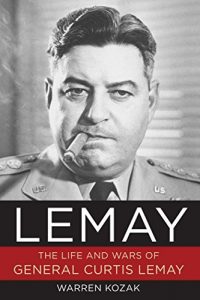
Speaking of war, tonight, hunkered down as I usually am in this very late stage of life—I didn’t need to be directed to hide out on this leather couch I’m sitting on at the moment—I read a biography of an American World War II-era air force general by the name of Curtis LeMay (LeMay: The Life and Times of General Curtis LeMay by Warren Kozak, Regnery, 2009). As I was reading along, it hit me that COVID-19 has a long way to go before it’s in a league with General LeMay as a killing machine. Back in 1945, in less than three hours, LeMay got way, way more killing done than COVID-19 has been able to accomplish in three months.
And it’s more than just in the sheer number of deaths that LeMay comes out on top in the comparison.
COVID-19 has been bad at snuffing out the lives of children and people who aren’t already sick with something. With LeMay, young and old, sick and well, he put them all in their graves.
And LeMay wasn’t limited to primly killing people lying quietly in hospital beds with rubber tubes running into them as COVID-19 has been. He set them on fire, deprived them of air to breathe, and heated them up like pot roasts. Imagine that action!
More, COVID-19 seems only to be proficient at x-ing out human life in cold weather; no good in the summer. LeMay demonstrated in both Europe and Asia that he was a man for all seasons, as it were—he was as effective cancelling someone’s existence in July as January.
Plus, Curtis LeMay didn’t just kill people; he also totally leveled the areas they lived in. COVID-19 has accomplished nothing in this regard.
In addition, Curtis LeMay had style and pizzazz—he had a snappy uniform and chewed on a big cigar. COVID-19, tiny and round with little spikes, no snappy uniform, no big cigar, nothing, lacks presence entirely.
Even more, Curtis LeMay was miles ahead of COVID-19 in public relations. He did his killing and came off looking good and got fawned over and invited to dinner parties, while COVID-19 does its killing and comes off looking bad and is shunned and people are brewing up poison to slip into its margarita. No contest there either.
The one area where COVID-19 comes out ahead of LeMay is in the ability to make the stock market plunge. LeMay was lacking in that area, though in fairness to him, he wasn’t dedicated to getting that accomplished—total destruction and super high death counts were his only priorities.
Assuming you don’t know about him, General Curtis LeMay conceived and ordered an incendiary bombing raid—fire bombs, they set everything aflame—on the civilian population of Tokyo, Japan, March 9th, 1945. Here’s a description of how it went down drawn from the LeMay biography I just read:
Across Tokyo, residents looked up in amazement. They had never seen the “B-sans” [B29 bomber airplanes] so low, nor had they ever seen so many at once. German Catholic priest, Father Gustav Bitter, who was there, later wrote, “The fire falling from the sky reminded me of tinsel hung on a Christmas tree. The red and yellow flames reflected from below onto the silvery undersides of the planes in the upper darkness gave them the appearance of giant dragon flies with jeweled wings. I watched as if I were in a trance.”
With sudden fury, tranquility became horror as the incendiaries hit home. They created tornadoes of fire. They sucked away oxygen; people couldn’t breathe and suffocated. Masuko Harino, a factory worker, reported, “Intense heat came from the firestorm. My eyes seemed about to pop out. People’s clothes were on fire. They were writhing in torment.” A young woman described a school that had become a three-story oven: every human being inside it was cooked to death. Strewn everywhere, some in batches, the incinerated bodies were black; they looked like logs from a distance. There was a dreadful sameness about the dead, no telling men from women or adults from children. If they could walk, survivors wandered about like ghosts, silent. Those still alive were left to die in agony; there was no medicine, food, or drinking water for them.
The raid lasted two hours and forty minutes. Sixteen square miles of Tokyo, one of the most densely populated areas in the world, was transformed into a moonscape of twisted reddish-black iron, roasted sheet metal, and rubble. Not a single man-made structure still stood. An estimated 100,000 people died in Tokyo that night. More than a million were left homeless. The grisly retrieval of bodies took weeks. At least 70,000 people were buried in mass pits. A U.S. Strategic Bombing Survey concluded, “More persons lost their lives in Tokyo that night than in any equivalent period of time in the history of mankind.”
How did what Curtis LeMay pulled off that March night in 1945 go over? It went over really big. And LeMay himself went over really big. I read The New York Times every morning, and it’s been non-stop trashing COVID-19 for weeks, not one positive word, and there’s been all kinds of commiserating with the dead and dying. With LeMay, the Times jumped up and down like cheerleaders. Hurray for our hero! The paper pointed out that those people in Tokyo LeMay set on fire, asphyxiated, and baked had it coming—women, children, and infants, every last one of them–because “the people, factories, and small establishments all contributed to Japan’s war effort.” The Times celebrated LeMay’s admirable deed as the start of really good things: to wit, Japanese cities becoming “no more than holes in the ground.” Though the newspaper cautioned readers that the Japanese “have done their deadliest fighting from holes in the ground,” so we need to be diligent and thorough with the killing.
Following the bombing raid, New Yorker magazine had a glowing profile of LeMay. And he was on the cover of Time magazine and given an effusive write-up in its pages. Nothing like that for COVID-19. But then again, COVID-19 hasn’t done the bang-up job of extinguishing human life that LeMay did, and it’s not anihilating the people who most richly deserve to die like LeMay was so good at doing.
LeMay got a promotion to Chief of Staff of the United States Air Force, and in 1968, ran for vice-president on a third-party ticket, garnering a hefty 13% of the vote. COVID-19 couldn’t come by a janitor’s job or get on the ballot for dogcatcher.
LeMay got an elementary school named after him, and . . . oh, you get my point. LeMay had it all going, and my best guess is that no matter how good COVID-19 does in the future—including getting up to speed with killing little children—it’s never going to measure up to him.
House of Mirrors: Justin Trudeau’s Foreign Policy – Book Review
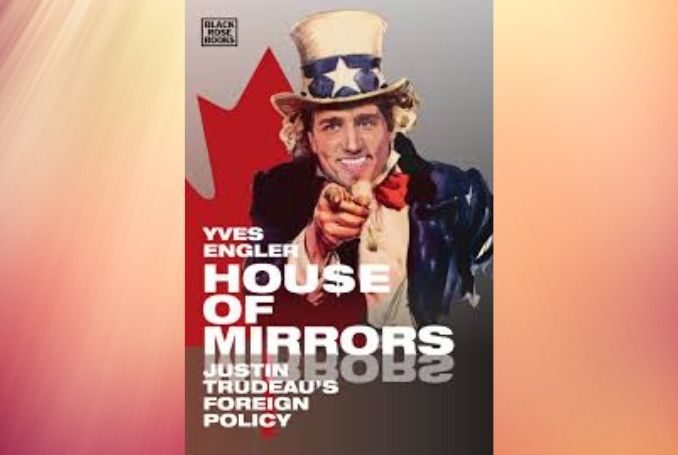
House of Mirrors, by Yves Engler. (Photo: Book Cover)
By Jim Miles | Palestine Chronicle | March 23, 2020
(House of Mirrors – Justin Trudeau’s Foreign Policy. Yves Engler. RED Publishing, Saskatoon/Black Rose Books, Montreal. 2020)
Some book covers are better than others, and that of Yves Engler’s House of Mirrors is beautifully expressive of the contents of his latest work. It shows a very friendly face and happy smiling Justin Trudeau in an iconic pose that says it all: America first.
This is Engler’s eleventh book exposing the downside of Canadian politics. It covers two main themes, the obvious first one is that of Canada’s involvement in the U.S. imperial-hegemonic demands around the world.
The second, more domestic, is that the Liberal’s and Conservatives, Canada’s two main parties, are essentially the same thing when it comes to foreign policy. Whereas the Conservatives are much more aggressive with their terminology while the Trudeau Liberals couch their words in a fancier more humanistic sounding language, the end results are the same: following the U.S. corporate-industrial-military complex and in certain cases being ahead of that curve.
With that as its underlying theme, Engler covers many topics concerning the Trudeau Liberals. The first long section deals with “The Canadian Monroe Policy” discussing how Canada fits into U.S. initiatives throughout Latin America with the overthrow, attempted overthrows, and manipulations of various organizations (OAS) in order to control the western hemisphere.
While paralleling U.S. interests, in terms of Venezuela, Canada, under Chrystia Freeland’ tutelage, has taken a leading interest with its support of the Lima Group (all sycophantic governments to U.S. corporate interests) against Venezuela.
A long essay on the Middle East, “Loving Monarchies, Hating Palestinians” discusses how Canada relates to the Arab countries, Israel, and the Palestinians. An earlier chapter, “The Sun Never Sets on the Canadian Military”, ties in with this chapter in exploring the numerous military sales and security contacts with Middle Eastern countries.
Large orders of military materials are sent to the likes of Saudi Arabia in support of its war on Yemen. Much information and technological information for security is exchanged between Canada and Israel (fun fact: Canada developed apartheid long before South Africa and Israel). The official position for Palestine is the stillborn two-state peace process while the actual position is more one of asking why the Palestinians do not acquiesce to Israeli demands.
Many other important topics are presented: around the world from China and North Korea through to Freeland’s favorite bogeyman, Russia, and on into Africa (military and mining interests); around the world from its domestic carbon dioxide/environmental policies; another hit on Canada’s mining interests in particular with South America; and the language of “Judge What I Say, Not What I Do”.
It is interesting how often Chrystia Freeland’s name rises in connection with Trudeau’s foreign policy. She is foremost in using the platitude about “international order based on rules” and the “rule of laws”. Whatever the foreign policy, as Foreign Affairs Minister and now as Deputy Prime Minister (a conveniently invented position), she carries considerable sway concerning Russia, Ukraine, Venezuela, Syria and other global hotspots (coronavirus notwithstanding). She inverts the colonial role, making Canada a victim rather than a colonizer and exploiter, “Canada has never been an imperialist power…we’ve been the colony.”
In his conclusion, Engler reprises comments about Canadian banks, the mining industry, Russia, Israel, Iran, the military, and business in general. He summarizes, “corporate Canada is highly international” with “segments… tied to extreme capitalism.” Extreme capitalism being capitalism dominated by and supported by the military-industrial complex with assistance from the financial community and the mainstream media.
As with all of Yves Engler’s books, House of Mirrors is tightly written, with little philosophizing, allowing the information to speak for itself, information that is highly notated and well referenced. The smiling man on the cover, Justin Trudeau, is essentially another true believer in an oligarchic world order (along with Ms. Freeland) supported by an international array of corporate and military liaisons.
– Jim Miles is a Canadian educator and a regular contributor/columnist of opinion pieces and book reviews to Palestine Chronicles. His interest in this topic stems originally from an environmental perspective, which encompasses the militarization and economic subjugation of the global community and its commodification by corporate governance and by the American government.
Circle in the Darkness: Memoir of a World Watcher – Book Review
By Jim Miles | Palestine Chronicle | March 16, 2020
 (Circle in the Darkness – Memoir of a World Watcher. Diana Johnstone. Clarity Press, Atlanta Georgia. 2020)
Diana Johnstone has done a masterful job of writing her autobiography, Circle in the Darkness, that provides many details of her life, her early influences, and the various stages of her career throughout the second half of the Twentieth Century and the first part of Twenty-first.
It is a wild ride through various aspects of society, concentrating on the historical events of her era.
Much of what she writes is not news to those who do follow alternative news sites, but what is added is a strong personal perspective based on – not surprisingly – facts and truth, both from her own experiences in regions of concern and a wide arrange of conversations with both people of significant influence and those with no influence but feeling the impact of developments in their country.
The details Johnstone adds are a strong and valuable retort to mainstream media disinformation that has “moved farther and farther away from informing the public and nearer and nearer to instructing them in what they should think.”
Themes
One of three themes that impressed me and are developed throughout the book, the media takes a large hit. While discussing NATO crimes of the Balkan, she writes, “The journalist was no longer asked to dig for new information and provide fresh analysis, but to contribute to the “common narrative”” as originated by NATO and the media.
When discussing mass media and the Military Industrial Complex she writes, “those private interests coincide quite closely with those of the U.S. government, since the same economic powers are behind both.”
Relying on “open sources and thoughtful analysis of known facts” rather than “spook revelations” her work is significantly more accurate than the mainstream.
NATO and European unity cover another large thematic area. She discusses how NATO and the European Union actively promote the neoliberal order as conditioned by the U.S. and other global hegemonic financial powers against the best interests of their own people and against the best interests of many sovereign states in the world.
When discussing the idea of Joint Criminal Enterprise as argued by the U.S. in relation to Serbia (essentially all Serbs are guilty of war crimes) she reverses the argument with clear examples, and summarizes, “U.S. strategy basically boils down to the implicit or explicit threat to wipe out the whole nation it is attacking…. This war is not the result of a clever plan by some ragtag Balkan clan leaders. This war was deliberately planned and carried out by the real Joint Criminal Enterprise: NATO.”
The third theme was her development of ideas concerning the development of the “left”.
It has changed from operating with the best interests of the people in mind – anti-war, support for workers and societal infrastructures – to becoming a supporter of war and more interested in the distractions of identity politics, “The Left has evolved from a program to an attitude.”
Certainly, there is merit in people’s identity but it comes at the cost of no longer working against class structures that keep workers down and keep the rich getting richer.
Johnstone follows the developments in France to its present-day neoliberal U.S. supporting government of Macron and follows the developments in Sweden as it turned away from the left of Olaf Palme towards a strong non-NATO supporter of all NATO adventures.
A Host of other Ideas
Many other ideas are presented in Circle in the Darkness.
Israel is discussed directly only briefly but Zionism’s influence is related throughout. While discussing false flags, the USS Liberty attack is mentioned threading into the theme of the media as ”the mainstream media have persisted in ignoring what happened, even as evidence mounted that General Moshe Dayan personally ordered the attack.”
The relationship between the dropping of the gold standard and the introduction of the petrodollar is touched upon, a topic that is rare if ever in mainstream journalism. Again just touching on it she discusses the “debt trap” on a personal level when two local Minnesota farmers commit suicide after being enticed to overextend themselves into debt.
In general, however, this is Diana Johnstones’ story of the many people she meets and interviews, or argues with, debates with, or simply discusses the many issues of her career spent mostly within European journalism. That overlapped with her employment by the German Green party and how she watched it change from an anti-war truly green party to a pro-war neoliberal supporter of capitalism.
She continues to write as an independent journalist today, with her work published globally in several alternate news sites. While I am familiar with the same history background as Ms. Johnstone, I do not have the expertise of overseas experience, the philosophical background, and the wide range of contacts she has had available throughout her career.
Circle in the Darkness covers an amazing and productive lifetime and provides valuable insights and factual details in support of her views and reporting.
It is entertaining – not in the distractive sense but for the quality of the writing and her combination of anecdotal stories combined with researched ideas.
Thus it is a very strong informative work on our modern history, an important read to more clearly understand the machinations of the modern political-military scene.
– Jim Miles is a Canadian educator and a regular contributor/columnist of opinion pieces and book reviews to Palestine Chronicles. His interest in this topic stems originally from an environmental perspective, which encompasses the militarization and economic subjugation of the global community and its commodification by corporate governance and by the American government.
The Long Roots of Our Russophobia
By Jeremy Kuzmarov | CounterPunch | March 6, 2020
For the last five years, the American media has been filled with scurrilous articles demonizing Russian President Vladimir Putin.
Putin has been accused of every crime imaginable, from shooting down airplanes, to assassinating opponents, to invading neighboring countries, to stealing money to manipulating the U.S. president and helping to rig the 2016 election.
Few of the accusations directed against Putin have ever been substantiated and the quality of journalism has been at the level of “yellow journalism.”
In a desperate attempt to sustain their political careers, centrist Democrats like Joe Biden and Hillary Clinton accused their adversaries of being Russian agents – again without proof.
And even the progressive hero Bernie Sanders – himself a victim of red-baiting – has engaged in Russia bashing and unsubstantiated accusations for which he offers no proof.
Guy Mettan’s book, Creating Russophobia: From the Great Religious Schism to Anti-Putin Hysteria (Atlanta: Clarity Press, 2017) provides needed historical context for our current political moment, showing how anti-Russian hysteria has long proliferated as a means of justifying Western imperialism.
Mettan is a Swiss journalist and member of parliament who learned about the corruption of the 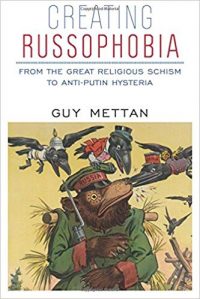 media business when his reporting on the world anticommunist league rankled his newspapers’ shareholders, and when he realized that he was serving as a paid stenographer for the Bosnian Islamist leader Alija Izetbegovic in the early 1990s.
Mettan defines Russophobia as the promotion of negative stereotypes about Russia that associate the country with despotism, treachery, expansion, oppression and other negative character traits. In his view, it is “not linked to specific historical events” but “exists first in the head of the one who looks, not in the victim’s alleged behavior or characteristics.”
Like anti-semitism, Mettan writes, “Russophobia is a way of turning specific pseudo-facts into essential one-dimensional values, barbarity, despotism, and expansionism in the Russian case in order to justify stigmatization and ostracism.”
The origins of Russophobic discourse date back to a schism in the Church during the Middle Ages when Charlemagne was crowned emperor of the Roman empire and modified the Christian liturgy to introduce reforms execrated by the Eastern Orthodox Churches of the Byzantine empire.
Mettan writes that “the Europe of Charlemagne and of the year 1000 was in need of a foil in the East to rebuild herself, just as the Europe of the 2000s needs Russia to consolidate her union.”
Before the schism, European rulers had no negative opinions of Russia. When Capetian King Henri I found himself a widower, he turned towards the prestigious Kiev kingdom two thousand miles away and married Vladimir’s granddaughter, Princess Ann.
A main goal of the new liturgy adopted by Charlemagne was to undermine any Byzantine influence in Italy and Western Europe.
Over the next century, the schism evolved from a religious into a political one.
The Pope and the top Roman administration made documents disappear and truncated others in order to blame the Easterners.
Byzantium and Russia were in turn rebuked for their “caesaropapism,” or “Oriental style despotism,” which could be contrasted which the supposedly enlightened, democratic governing system in the West.
Russia was particularly hated because it had defied efforts of Western European countries to submit to their authority and impose Catholicism.
In the 1760s, French diplomats working with a variety of Ukrainian, Hungarian and Polish political figures produced a forged testament of Peter 1 [“The Great”] purporting to reveal Russia’s ‘grand design’ to conquer most of Europe.
This document was still taken seriously by governments during the Napoleanic wars; and as late as the Cold War, President Harry Truman found it helpful in explaining Stalin.
In Britain, the Whigs, who represented the liberal bourgeois opposition to the Tory government and its program of free-trade imperialism, were the most virulent Russophobes, much like today’s Democrats in the United States.
The British media also enflamed public opinion by taking hysterical positions against Russia – often on the eve of major military expeditions.
The London Times during the 1820s Greek Independence war editorialized that no “sane person” could “look with satisfaction at the immense and rapid overgrowth of Russian power.” The same thing was being written in The New York Times in the 2010s.
A great example of the Orientalist stereotype was Bram Stoker’s novel Dracula, whose main character was modeled after Russian ruler, Ivan the Terrible. As if no English ruler in history was cruel either.
The Nazis took Russo-phobic discourse to new heights during the 1930s and 1940s, combining it with a virulent anti-bolshevism and anti-semitism.
A survey of German high school texts in the 1960s found little change in the image of Russia. The Russians were still depicted as “primitive, simple, very violent, cruel, mean, inhuman, cupid and very stubborn.”
The same stereotypes were displayed in many Hollywood films during the Cold War, where KGB figures were particularly maligned.
No wonder that when a former KGB agent, Vladimir Putin, took power, people went insane.
Russophobia in the United States has been advanced most insidiously by the nation’s foreign policy elite who have envisioned themselves as grand chess-masters seeking to checkmate their Russian adversary in order to control the Eurasian heartland.
This view is little different than European colonial strategists who had learned of the importance of molding public opinion through disinformation campaigns that depicted the Russian bear as a menace to Western civilization.
Guy Mettan has written a thought-provoking book that provides badly needed historical context for the anti-Russian delirium gripping our society.
Breaking the taboo on Russophobia is of vital importance in laying the groundwork for a more peaceful world order and genuinely progressive movement in the United States. Unfortunately, recent developments don’t inspire much confidence that history will be transcended.
Jeremy Kuzmarov is the author of The Russians are Coming, Again: The First Cold War as Tragedy, the Second as Farce (Monthly Review Press, 2018) and Obama’s Unending Wars: Fronting for the Foreign Policy of the Permanent Warfare State (Atlanta: Clarity Press, 2019).<
The Brooklyn Yeshiva Anthem Protest: Why It’s Not Antisemitic
By Ira Glunts | CounterPunch | March 6, 2020
“An anti-Semite used to be a person who disliked Jews. Now it is a person who Jews dislike.”
– Hajo Meyer, Jewish German-born Dutch physicist and Auschwitz survivor.
“Antisemitism is a trick we always use.”
– Shulamit Aloni, Jewish Israeli, former Israeli Minister of Education, longtime member of the Israeli parliament.
On Sunday, February 23 before a match at Yeshiva University, two brave young Muslim Brooklyn College volleyball players “took a knee” during the playing of Hatikvah, the Israeli national anthem. Omar Rezika (Soph.) and Hunnan Butt (Fr.) following the example of NFL football player, Colin Kaepernick, who protested the police brutality in the US African-American community, were protesting the brutality of the Israeli occupation and its apartheid policies toward its non-Jewish residents. The Nation sports journalist Dave Zirin wrote me that he learned this was the reason for the protest from sources close to the team.
The Jewish press, Jewish organizations and social media were quick to cry antisemitism. The Simon Wiesenthal Center, The Algemeiner, and StopAntiSemitism.org (has short video of the protest) were just a few who rallied their readers against the protesting students. The antisemitism charges were easily refuted by the fact that the protest was a legitimate political protest against Israel and had not been directed at Jews, as Jews, nor specifically at the members of the Yeshiva community because of their ethnicity or religion. Of course just about every Yeshiva student, faculty member and administrator is a supporter of Israel and is also an active apologist for Israeli transgressions.
The Yeshiva University President, Ari Berman, boasted of the wide (some would add “mindless”) support Zionism has in the United States, and called the actions of Rizika and Butt “unfortunate.” In saying this he ignored the acceptance free speech and peaceful protest have in American culture and especially in academia. The Yeshiva University newspaper, The Observer, quotes Berman as saying:
It is unfortunate that some members of the opposing team disrespected Israel’s national anthem. We are proud to be the only university who sings both the American and Israeli national anthems before every athletic competition and major event. Nothing makes me prouder to be an American than living in a country where our religious freedom, our Zionism and our commitment to our people will never be impeded and always be prized.
One salient element that differentiates this protest from Kaepernick’s NFL anthem protests, and indeed most protests, is that it can be credibly argued that it was Yeshiva University, not the protesters themselves, that initiated the confrontation. What university makes the visiting team stand for a foreign national anthem? And this is not just any foreign national anthem. It is a national anthem whose words specifically exclude more than 20% of Israeli citizens and more than 50% of persons subject to Israeli rule because they are not Jewish. The anthem also celebrates what most Muslims and many progressives, backed by international law, consider to be a brutal, illegal occupation of Palestinian land.
Even the Zionist political lobby group, J Street, which supports a kinder, gentler and better-concealed Israeli occupation, featured an alternative, more democratic version of a possible Israeli anthem in the entertainment program of one of its recent conferences.
The American Jewish blogger, Richard Silverstein, who has tweeted about the anthem protest, sent me his reaction:
Unfortunately, the courageous act of dissent performed by these two young volleyball players has been transformed into a act of anti-Semitism, when it was nothing of the sort. They simply sought to engage in a cherished American tradition of free speech and standing up for the oppressed. No university that I know plays both the Star Spangled Banner and the national anthem of a foreign country before sporting events…except Yeshiva University.
A Brooklyn College spokesperson issued a brief statement which was quoted in the Yeshiva Observer that began by assuring those who took offense from the anthem protest that ““Brooklyn College strongly condemns all forms of anti-Semitism and hatred…. Their kneeling is protected by the First Amendment.” The spokesmen did not defend the students against the charges of antisemitism from the Jewish press, nor against the criticism of President Berman.
Interestingly, the Yeshiva University Observer did not bother to even mention the reason Rezika and Butt were protesting. However, its article copiously catalogs the consternation of the Yeshiva community at the temerity of two visiting students to disrespect the Israeli national anthem and the anguish that their kneeling caused in the Yeshiva community.
Conflating Judaism and Zionism is a staple in the bag of tricks of American Zionists. They claim that a vast majority of Jews are Zionists (something with which I concur and most pro-Palestinian activists strongly deny, especially Jewish pro-Palestinian activists). Thus they claim an attack against Zionism is an attack against the core beliefs of most Jews. It is hateful to them, and thus antisemitic. Yet the same people who justify their claim of antisemitism by the belief that most Jews are Zionists (in an almost religious sense) will also tell you, when it is in their interest to do so, that it is antisemitic to protest in front of a synagogue (or at a Jewish university) because Jews have very diverse opinions on Israel, and to generally assume the synagogue members support Israel is wrongly generalizing about Jews and is in itself antisemitic. This flawed but convenient logic makes any real criticism of Zionism equal to antisemitism.
In the United States there is a taboo in criticizing Israel in or around any place that is Jewish. Such protests get little or no mention even in the progressive press and on websites run by both activist Palestinians or Jews. What is surprising is that a number of sites and well-known activists did not run from this story. The story was carried by The Nation, Middle East Eye, and the PalestineChronicle. Yousef “Strange Parenthesis” Munayyer, the Executive Director of the US Campaign for Palestinian Rights, gave a statement of support for the anthem protest to Middle East Eye. All of this is both unusual and encouraging. Many others, as expected, avoided the story despite the fact that flashy protests against Israel are the bread and butter of their outlets.
In Amy Kaplan’s brilliant analysis of the “unbreakable bond” between the United States and Israel she asks the following question:
How did Zionism, a European movement to establish a homeland for a particular ethno-religious group, come to resonate with citizens of a nation based on the foundation, or at least the aspiration, of civic equality and ethnic diversity?
She states that her book, Our American Israel: The Story of an Entangled Alliance, “aims to recover the strangeness [emphasis mine, IG] in an affinity that has come to be seen as self-evident. … How in other words, did so many come to feel that the bond between the United States and Israel was historically inevitable, morally right, and a matter of common sense?”
Four Questions That May Be Difficult To Easily Passover
How strange is the received wisdom about Israel? Here are four examples that come to mind.
1) Why is it unthinkable to protest in front of a synagogue even when that synagogue openly supports Israeli occupation and apartheid, when it is acceptable to protest in front of a church? There have been numerous protests at Catholic churches over charges of priests sexually abusing young church members. My friends Ed Kinane and Ann Tiffany were accused of antisemitism when they protest against the siege of Gaza in a Jewish neighborhood, partly because the protest is at a busy intersection near a synagogue. However, when they protested in front of a Catholic Church, demanding the new bishop be more sensitive than his predecessor to the problems of American capitalism and empire, nobody complained that it was inappropriate to protest in front of a church.
2) Why have so many states passed anti Boycott, Divestment and Sanctions (BDS) legislation, when that legislation clearly violates the right of free speech?
3) Why is talking about the use of money in order to influence the US Congress by Jews or Jewish groups verboten when it is generally accepted as a simpe statement of fact? Remember, “It’s all about the Benjamins baby?” from the twitter feed of Representative Ilhan Omar? That tweet has been deleted, by the way.
4) “To raise a memorial to a European genocide on the secular but sacred space of the National Mall required enormous cultural work – nothing less than the transformation of the Holocaust into an element of American heritage” (from Our American Israel). How was this accomplished, especially considering there is no museum or even a memorial dedicated to American slavery or the genocide of Native Americans on the National Mall?
The answers to these questions, as the Jewish-American rock idol Bob Dylan sang, “is blowing in the wind.” Ironically, after living briefly on a kibbutz in northern Israel, he also sang Neighborhood Bully, which is an apologia for Israeli war crimes.
Just asking these questions is enough to get you accused of being an antisemite, even if you are Jewish, like I am. So I am going to stop here. One good thing about being old, though, is that no one can call my employer to “expose” me as an antisemite.
One last thing, if you want some answers about all of this, I strongly recommend you read Amy Kaplan’s book. It is brilliant.
IRA GLUNTS first visited the Middle East in 1972, where he taught English and physical education in a small rural community in Israel. He was a volunteer in the Israeli Defense Forces in 1992. Mr. Glunts is a Jewish American who lives in Madison, New York. He owns and operates a used and rare book business and is a part-time reference librarian. Mr. Glunts can be reached at gluntsi[at]morrisville[dot]edu.
Two Years Later: The Skripal Case Is Weirder Than Ever
By Matthew Ehret | Strategic Culture Foundation | March 6, 2020
While navigating through today’s propaganda-heavy world of misinformation, spin and outright creative writing which appears to have replaced conventional journalism, it is most important that two qualities are active in the mind of any truth-seeker. The first quality is the adherence to a strong top down perspective, both historic and global. This is vital in order to guide us as a sort of compass or North Star used by sailors navigating across the ocean. The second quality is a strong power of logic, memory and discernment of wheat vs. chaff to process the mountains of data that slaps us in the face from all directions like sand in a desert storm.
As the second anniversary of the poisoning of Sergei and Yulia Skripal has arrived, it is a useful time to take these qualities and revisit this bizarre moment of modern history which took place on a park bench in Salisbury UK and which led to one of the greatest frauds of the modern era derailing all attempts to repair relations between Russia and the west.
To do this, I decided to plunge myself into a new book called Skripal in Prison written by Moscow-based journalist John Helmer and published in February 2020.
This incredible little book, which features 26 chapters written between March 2018 to February 2020 originally published on the author’s site Dances with Bears, unveils an arsenal of intellectual bullets which Helmer skillfully uses to shoot holes into every inconsistency, contradiction and outright lie holding up the structure of the narrative that “there is no alternative conclusion other than that the Russian State was culpable for the attempted murder of Mr. Skripal and his daughter”. This line was asserted without a shred of actual evidence by Theresa May in the House of Commons on March 16, 2018 and in the months that followed, western nations were pressured to expel Russian diplomats (23 in Britain, 60 in the US, 33 across the EU), close down consulates (one Russian consulate in San Francisco and one American consulate in St Petersburg) and impose waves of sanctions against Russia.
Four months after the Skripals (and one unfortunate detective named Sgt. Nick Bailey) were released from British hospital care, two more figures were stricken with Novichok poisoning and taken to hospital on June 30 with one of them (Dawn Sturgess) dying 9 days later. This too was blamed immediately on Russia.
Helmer’s research systematically annihilates the official narratives with the craftsmanship of a legal attorney, taking the reader through several vital questions which shape the book’s composition as a whole, and which I shall lay out for you here:
- Why have Sergei Skripal and his daughter Yulia fallen off the face of the Earth since their release from Salisbury hospital? It is known that one controlled video was recorded featuring Yulia speaking, and several short calls to family were made by Yulia and her father after their poisoning… but nothing more. Beyond the fact that it appears the Skripals were kept on an American military base in Gloucestershire for an indeterminate amount of time, Helmer points out “at the point in their recuperation when the two of them were beginning to be explicit in their public remarks about what had happened, their communications were cut off. Nothing more is known to this present day.”
- Despite the fact that the UK Prime Minister asserted that a European Arrest Warrant was issued for the two Russians that were alleged to have carried out Putin’s malevolent will onto the poor Skripals – why were no such warrants ever registered in Interpol? Is it because such warrants actually require evidence?
- Why did British Intelligence sanction the tearing down of big sections of Skripal’s home at 47 Christie Miller Road in Salisbury due to the apparent “dangers of deadly contaminants”, while only the door handle was tainted with Novichok? If the reasoning was due to health safety, then why were similar actions not taken to the Bourne Hill police station which Sgt. Bradley contaminated or the restaurant and pub which Sergei Skripal went to before his trip to the park … or the contaminated London hotel where the two Russian agents apparently stayed?
- Since Novichok is an extremely fast acting substance, generally attacking the nervous system in minutes, how is it possible that the time separating the Skripals’ moment of contamination to the moment of losing consciousness on a park bench was over three hours?! How is this possible? Similarly how was it possible that Sgt. Bailey’s point of contamination at Skripal’s home occurred a full 12 hours before he felt the need to go to the hospital?
- What the hell was up with the strange case of the two unfortunate victims of the July 2018 Novichok poisoning in Amesbury (9 miles from Salisbury)? Were Dawn Sturgess and her partner Charlie Rowley simply collateral damage in an MI6 effort to plug a missing hole in the narrative caused by a lack of any evidence of a device used to apply the nerve agent to the door handle in the first place? Why does Rowley (a known heroin addict) have no recollection where he found the perfume bottle filled with Novichok which he gifted to Sturgess on June 26? Why was the perfume bottle only found by authorities on Rowley’s kitchen counter two days after Sturgess died on July 9th even though a search for Novichok had been carried out at his apartment beginning with the couple’s admission into Salisbury hospital on June 30?
- What was the role of the Ministry of Defense’s Porton Down chemical laboratories in this bizarre story? The lab itself was located just a few miles from the crime scene, and the first responder on the scene was an off-duty Colonel named Alison McCourt who happened to be shopping nearby and rushed to the scene. Helmer describes how Col. McCourt is head of nursing for the British Army and Senior Health Advisor which connects her closely to the Defense Science and Technology Laboratory at Porton Down which also happened to have held a major chemical warfare exercise named Toxic Dagger in the area just two weeks earlier. Are these things nothing but coincidences?
- Porton Down labs which tested the Skripal blood samples and Novichok at the Skripal residence is part of the Ministry of Defense and to this day, no public admission of those samples’ existence at the labs has occurred. Requests by Helmer and others to receive confirmation of from the labs according to Freedom of Information laws have been denied outright on the grounds of “the public interest”. Why? Could it be because blood tests were never actually carried out? Helmer’s book probes this question deeply and the lack of evidence will shock you.
- How about the Organization for the Prohibition of Chemical Weapons (OPCW)? Since the OPCW ran parallel tests of the apparent blood samples of the Skripals as well as the later July victims Dawn Sturgess and Charlie Rowley to get “matches” with the novichok traces in a perfume bottle and Skripal door handle, why has evidence of these samples not been made available? Also why was a British intelligence officer the only figure who oversaw the samples taken to the OPCW for verification? In fact, Helmer points out that the one Swiss contract laboratory (Spiez) associated with the OPCW has contradicted all British claims that any “match” exists between the Skripal samples and Novichok A-234 poisoning.
- Finally, Helmer asks: Why were all OPCW Executive Council votes in regards to matters surrounding the Skripal case, taken in secret, and thus in conflict with its own charter and why was Russia denied the right to share in the investigation of the Novichok attack as guaranteed in Articles XIII and IX of the OPCW Chemical Weapons convention? Could that have something to do with the role of former OPCW Director General Ahmet Üzümcü, a Turkish NATO-phile, who Helmer notes “has also been a member of the NATO staff in charge of expanding NATO military operations to the Russian frontier, as well as NATO operations in Ukraine and Syria.” In 2019, Üzümcü was inducted into the Order of St Michael and St George by Queen Elizabeth II for services to the Empire.
Helmer goes on to make the point that the overarching dynamic shaping the events of the Skripal/Novichok affair are guided by the collapsing western empire which has been working tirelessly to surround Russia with a ballistic missile shield while sabotaging all efforts by genuine patriots in the west from establishing positive alliances with Russia.
Taking the opportunity of the second anniversary of the Skripal affair to read this book is not only a valuable exercise in logic but also key into the desperate and increasingly fear-driven mind of the London-centered deep state which is quickly losing its grip both on reality and the very influence it had spent generations putting in place.
Don’t Hold Your Breath for ‘World War III’: World War IV Has Already Begun
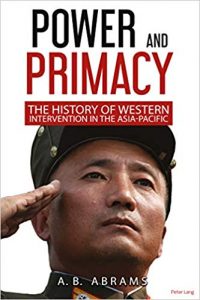
By A. B. Abrams | The Saker Blog | February 27, 2020
“A. B. Abrams is the author of the book ‘Power and Primacy: A History of Western Intervention in the Asia-Pacific.’ His second book covering the history of the United States’ conflict with North Korea is scheduled for publication in 2020.
He is proficient in Chinese, Korean and other East Asian languages, has published widely on defence and politics related subjects under various pseudonyms, and holds two related Masters degrees from the University of London.”
 The world today finds itself in a period of renewed great power conflict, pitting the Western Bloc led by the United States against four ‘Great Power adversaries’ – as they are referred to by Western defence planners – namely China, Russia, North Korea and Iran. This conflict has over the past 15 years escalated to encompass the military, economic and information spheres with global consequences – and appears to be coming to a head as signs of peaking tensions appear in multiple fields from military deployments and arms races to harsh economic wars and a harsher still information war.
While the term ‘World War III’ has been common since the 1940s, referring to the possibility of a global great power war on a greater scale than the first and second world wars, the Cold War between the Western and Soviet Blocs was at its height as total, as global and as heated as the prior conflicts. As weapons technology has evolved, the viability of a direct shooting war has diminished considerably – forcing major powers to seek alternative means to engineer their adversaries’ capitulation and assert their own dominance. This has been reflected in how the Cold War, and the current phase of global conflict some refer to as ‘Cold War 2’ have been distinct from the first two world wars despite the final objectives of the parties involved sharing many similarities. I would thus suggest redefining what a ‘world war’ is and acknowledging that this current phase of global conflict is every part as intense as the great power ‘hot wars’ waged in the first half of the 20th century.
Had the intercontinental range ballistic missile and the miniaturised nuclear warhead been invented twenty years earlier, the Allied Powers may have needed to rely more heavily on economic and information warfare to contain and eventually neutralise Nazi Germany. The Second World War would have been very different in nature to reflect the technologies of the time. When viewed from this paradigm, the Cold War can be seen as a ‘Third World War’ – a total conflict more vast, comprehensive and international than its predecessors stretched out over more than 40 years. The current conflict, or ‘World War IV,’ is ongoing. An assessment of prior ‘great power wars,’ and the unique nature of the current conflict, can provide some valuable insight into how warfare is evolving and the likely determinants of its victors.
As of 2020 it is clear that great power conflict has become almost as heated as it can short of an all-out hot war – with the Western Bloc applying maximum pressure on the information, military and economic fronts to undermine not only smaller adversaries such as Venezuela and Syria and medium sized ones such as North Korea and Iran, but also China and Russia. When exactly this phase of conflict began – sometime after the Cold War’s end – remains uncertain.
The interval between the third and fourth ‘world wars’ was considerably longer than that between the second and the third. This was due to a number of factors – primarily that there was no immediate and obvious adversary for the victorious Western Bloc to target once the Soviet Union had been vanquished. Post-Soviet Russia was a shade of a shadow of its former self. Under the administration of Boris Yeltsin the country’s economy contracted an astonishing 45% in just five years from 1992 (1) leading to millions of deaths and a plummet in living standards. Over 500,000 women and young girls of the former USSR were trafficked to the West and the Middle East – often as sex slaves (2), drug addiction increased by 900 percent, the suicide rate doubled, HIV became a nationwide epidemic (3) corruption was rampant, and the country’s defence sector saw its major weapons programs critical to maintaining parity with the West delayed or terminated due to deep budget cuts (4). The possibility of a further partition of the state, as attested to multiple times by high level officials, was very real along the lines of the Yugoslav model (5).
Beyond Russia, China’s Communist Party in the Cold War’s aftermath went to considerable lengths to avoid tensions with the Western world – including a very cautious exercise of their veto power at the United Nations which facilitated Western led military action against Iraq (6). The country was integrating itself into the Western centred global economy and continuing to emphasis the peaceful nature of its economic rise and understate its growing strength. Western scholarship at the time continued to report with near certainty that internal change, a shift towards a Western style political system and the collapse of party rule was inevitable. The subsequent infiltration and westernisation was expected to neuter China as a challenger to Western primacy – as it has other Western client states across the world. China’s ability to wage a conventional war against even Taiwan was in serious doubt at the time, and though its military made considerable strides with the support of a growing defence budget and massive transfers of Soviet technologies from cash strapped successor states, it was very far from a near peer power.
North Korea did come under considerable military pressure for failing to follow what was widely referred to as the ‘tide of history’ in the West at the time – collapse and westernisation of the former Communist world. Widely portrayed in the early 1990s as ‘another Iraq’ (7), Western media initially appeared to be going to considerable lengths to prepare the public for a military campaign to end the Korean War and impose a new government north of the 38th parallel (8). Significant military assets were shifted to Northeast Asia specifically to target the country during the 1990s, and the Bill Clinton administration came close to launching military action on multiple occasions – most notably in June 1994. Ultimately a combination of resolve, a formidable missile deterrent, a limited but ambiguous nuclear capability, and perhaps most importantly Western certainty that the state would inevitably collapse on its own under sustained economic and military pressure, deferred military options at least temporarily.
The fourth of the states that the United States today considers a ‘greater power adversary,’ Iran too was going to considerable lengths to avoid antagonism with the Western Bloc in the 1990s – and appeared more preoccupied with security threats on its northern border from Taliban controlled Afghanistan. With a fraction of the military power neighbouring Iraq had previously held, the presence of an ‘Iranian threat’ provided a key pretext for a Western military presence in the Persian Gulf after the Soviets, the United Arab Republic and now Iraq had all been quashed. With the new government in Russia put under pressure to terminate plans to transfer advanced armaments to Iran (9), the country’s airspace was until the mid 2000s frequently penetrated by American aircraft, often for hours at a time, likely without the knowledge of the Iranians themselves. This combined with a meagre economic outlook made Iran seem a negligible threat.
While the Cold War ended some time between 1985 and 1991 – bringing the ‘third world war’ to a close – the range of dates at which one could state that the ‘fourth world war’ began and the West again devoted itself to great power conflict is much wider. Some would put the date in the Summer of 2006 – when Israel suffered the first military defeat in its history at the hands of the Lebanese militia Hezbollah. Using North Korean tunnel and bunker networks, command structures, weapons and training (10), and bolstered by Iranian funding and equipment, the shock of the militia’s victory, though underplayed in Western media, reverberated among informed circles across the world.
Others would place the date two years later in 2008 during the Beijing Summer Olympics, when Georgia with the full support of the West waged a brief war against Russia – and Moscow despite harsh warnings from Washington and European capitals refused to back down on its position. Post-Yeltsin Russia’s relations with the Western Bloc had appeared relatively friendly on the surface, with President George W. Bush observing in 2001 regarding President Vladimir Putin that he “was able to get a sense of his soul,” and predicting “the beginning of a very constructive relationship.” Nevertheless, signs of tension had begun to grow from Moscow’s opposition to the Iraq War at the UN Security Council to President Putin’s famous ‘Munich Speech’ in February 2007 – in which he sharply criticised American violations of international law and its “almost uncontained hyper use of force in international relations.”
It could also be questioned whether, in light of what we know about Western support for separatist insurgents in Russia itself during the 1990s, the war against the country ever ended – or whether hostilities would only cease with a more total capitulation and partition and with the presence of Western soldiers on Russian soil as per the Yugoslav precedent. As President Putin stated in 2014 regarding continuing Western hostilities against Russia in the 1990s: “The support of separatism in Russia from abroad, including the informational, political and financial, through intelligence services, was absolutely obvious. There is no doubt that they would have loved to see the Yugoslavia scenario of collapse and dismemberment for us with all the tragic consequences it would have for the peoples of Russia” (11). Regarding Western efforts to destabilise Russia during the 1990s, CIA National Council on Intelligence Deputy Director Graham E. Fuller, a key architect in the creation of the Mujahedeen to fight Afghanistan and later the USSR, stated regarding the CIA’s strategy in the Caucasus in the immediate post-Cold War years: “The policy of guiding the evolution of Islam and of helping them against our adversaries worked marvellously well in Afghanistan against the Red Army. The same doctrines can still be used to destabilize what remains of Russian power” (12). The U.S. Congressional Task Force on Terrorism and Unconventional Warfare’s director, Yossef Bodansky, himself also detailed the extent of the CIA’s strategy to destabilize Central Asia by using “Islamist Jihad in the Caucasus as a way to deprive Russia of a viable pipeline route through spiralling violence and terrorism” – primarily by encouraging Western aligned Muslim states to continue to provide support for militant groups (13).
Much like the Cold War before it, and to a lesser extent the Second World War, great powers slid into a new phase of conflict rather that it being declared in a single spontaneous moment. Did the Cold War begin with the Berlin Blockade, the Western firebombing of Korea or when the atomic bombs were dropped on Hiroshima and Nagasaki – which accelerated the move into a nuclear arms race. Equally, multiple dates were given for the opening of the Second World War – the German invasion of Poland in 1939, the beginning of the Sino-Japanese war two years prior, the Japanese Empire’s attack on Pearl Harbour and conquest of Southeast Asia which marked the first major expansion beyond Europe and North Africa in 1941, or some other date entirely. The slide into a new world war was if anything even slower than its predecessors.
The shift towards an increasingly intense great power conflict has been marked by a number of major incidents. In the European theatre one of the earliest was the Bush administration’s withdrawal from the Anti-Ballistic Missile treaty in 2002 and subsequent deployment of missile defences and expansion of NATO’s military presence in the former Soviet sphere of influence, which was widely perceived in Russia as an attempt to neutralise its nuclear deterrent and place the Western Bloc in a position to coerce Moscow militarily (14). This threatened to seriously upset the status quo of mutual vulnerability, and played a key role in sparking a major arms race under which Russia would develop multiple classes of hypersonic weapon. Their unveiling in 2018 would in turn lead the United States to prioritise funding to develop more capable interceptor missiles, a new generation of missile defences based on lasers, and hypersonic ballistic and cruise missiles of its own (15).
Another leading catalyst of the move towards great power confrontation was the Barak Obama administration’s ‘Pivot to Asia’ initiative, under which the bulk of America’s military might and considerable assets from the rest of the Western world would be devoted to maintaining Western military primacy in the Western Pacific. This was paired with both economic and information warfare efforts, the latter which increasingly demonised China and North Korea across the region and beyond and actively sought to spread pro-Western and anti-government narratives among their populations through a wide range of sophisticated means (16). These programs were successors to those sponsored by Western intelligence agencies to ideologically disenchant the populations of the Warsaw Pact and Soviet Union with their own political systems and paint Western powers as benevolent and democratising saviours (17). Economic warfare also played a major role, with efforts centred around the ‘Trans-Pacific Partnership’ trade deal – or ‘Economic NATO’ as several analysts referred to it – to isolate China from regional economies and ensure the region remained firmly in the Western sphere of influence (18). The military aspect of the Pivot to Asia would reawaken long dormant territorial disputes, and ultimately lead to high military tensions between the United States and China which in turn fuelled the beginning of an arms race. This arms race has more recently led to the American withdrawal from the Intermediate-Range Nuclear Forces treaty, which paves the way for deployment of American long-range missiles across the Western Pacific – all with China and North Korea firmly in their crosshairs (19).
It is arguably in the Middle East, however, where the new phase of global conflict has seen its most direct clashes so far. The nine-year conflict in Syria, although far less destructive or brutal, provides ‘World War IV’ with something of an analogue to the Korean War in the Cold War. The conflict has united the Western Bloc and a wide range of allies, from Turkey and Israel to the Gulf States and even Japan (which funds the jihadist-linked White Helmets) (20), in an effort to overthrow an independent government with close and longstanding defence ties to Russia, North Korea, Iran and China. The conflict has seen North Korean, Russian, Hezbollah and Iranian special forces (21) among other assets deployed on the ground in support of Syrian counterinsurgency efforts, with all of these parties providing considerable material support (the Koreans have built and fully staffed at least three hospitals as part of large medical aid packages and continue to be a major supplier of arms and training) (22). China too, particularly concerned by the presence of jihadist militants of Chinese origin in Syria, has played some role in the conflict – the exact details of which remain uncertain with much reported but unconfirmed (23).
Syria’s insurgency involving a range of jihadist groups, at times united only by their intent to end the secular Syrian government, have received widespread support from the Western Bloc and their aforementioned allies. This has involved both material support, which according to State Secretary Hillary Clinton included turning a blind eye to Gulf countries’ considerable assistance to the Islamic State terror group (24), and active deployments of special forces from a wide range of countries, from Belgium and Saudi Arabia to Israel and the U.S. The U.S., European powers, Turkey and Israel have at times directly attacked Syrian units in the field – while Russian reports indicate that close Western coordination with jihadist groups has been used to facilitate a number of successful attacks on Russian positions (25). The conflict in Syria arguably represents a microcosm of the macrocosm which is a new world war – one which pits the Western Bloc and those which support the Western-led order, both directly and through local proxies, against three of its four ‘great power adversaries’ in the field.
‘World War IV’ is unlikely to come to an end for the foreseeable future, and its final outcome remains difficult to predict. Much like in the Cold War, the Western Bloc retains considerable advantages – today most notably in the field of information war which allows it to extensively shape perceptions of the vast majority of the world’s population. This has included the demonization of Western adversaries, the whitewashing of Western crimes both domestically and internationally, and portraying westernisation and increased Western influence as a solution to people’s frustrations from corruption to economic stagnation. This has been a key facilitator of the pro-Western protests engulfing states from Sudan and Algeria to Ukraine and Thailand. Economically too, only China among the Western Bloc’s major adversaries has posed a serious threat to Western primacy. Indeed, it remains highly questionable whether the other three could survive economically under Western pressure without Chinese trade and economic support.
Russia has made a considerable economic recovery since the 1990s, but remains a shadow of its former self in the Soviet era. The country’s leadership has succeeded in reforming the military, foreign ministry and intelligence services, but the economy, legal system and other parts of the state remain in serious need of improvement which, over 20 years after Yeltsin’s departure, cannot come soon enough. Even in the field of defence, the struggling economy has imposed serious limitations – and in fields such as aviation and armoured warfare the country is only beginning to slowly go beyond modernising Soviet era weapons designs and begin developing new 21st century systems (26). On the positive side, the country does remain a leader in many high end technologies mostly pertaining to the military and to space exploration, while Western economic sanctions have undermined the positions of Europhiles both among the elite and within the government and boosted many sectors of domestic production to substitute Western products (27).
In the majority of fields, the ‘Eastern Bloc’ have been pressed onto the defensive and forced to prevent losses rather than make actual gains. While preserving Venezuelan sovereignty, denying Crimea to NATO and preventing Syria’s fall have been major victories – they are successes in denying the West further expansion of its own sphere of influence rather than reversing prior Western gains or threatening key sources of Western power. Pursuing regime change in Venezuela and Ukraine and starting wars in the Donbasss and in Syria have cost the Western Bloc relatively little – the Ukrainians and client states in the Gulf and Turkey have paid the brunt of costs for the war efforts. Material equipment used by Western backed forces in both wars, ironically, has largely consisted of Warsaw Pact weaponry built to resist Western expansionism – which after the Cold War fell into NATO hands and is now being channelled to Western proxies. Libyan weaponry, too, was transferred to Western backed militants in Syria in considerable quantities after the country’s fall in 2011 – again minimising the costs to the Western Bloc of sponsoring the jihadist insurgency (28). The damage done and costs incurred by the Syrians, Hezbollah, Russia and others are thus far greater than those incurred by the Western powers to cause destruction and begin conflicts.
Syria has been devastated, suffering from issues from a return of polio to depleted uranium contamination from Western airstrikes and a new generation who have grown up in territories under jihadist control with little formal education. The war is a victory only in that the West failed to remove the government in Damascus from power – but Western gains from starting and fuelling the conflict have still far outweighed their losses. In the meantime, through a successful campaign centred around information warfare, the Western sphere of influence has only grown – with further expansion of NATO and the overthrow of governments in resource rich states friendly to Russia and China such as Libya, Sudan and Bolivia. Commandeering the government of poor but strategically located Ukraine was also a major gain, with states such as Algeria and Kazakhstan looking to be next in the Western Bloc’s crosshairs. Thus while Syria was saved, though only in part, much more was simultaneously lost. The damage done to Hong Kong by pro-Western militants, ‘thugs for democracy’ as the locals have taken to calling them, who have recently turned to bombing hospitals and burning down medical facilities (29), is similarly far greater than the costs to the Western powers of nurturing such an insurgency. Similar offensives to topple those which remain outside the Western sphere of influence from within continue to place pressure on Russian and Chinese aligned governments and on neutral states seen not to be sufficiently pro-Western.
While the Western Bloc appears to be in a position of considerable strength, largely by virtue of its dominance of information space, which has allowed it to remain on the offensive, a sudden turning point in which its power suddenly diminishes could be in sight. From teen drug abuse (30) to staggering debt levels (31) and the deterioration of party politics and popular media, to name but a few of many examples, the West appears at far greater risk today of collapse from within than it did during the Cold War. A notable sign of this is the resurgence of both far right and far left anti-establishment movements across much of the Western world. Despite massive benefits from privileged access to third world resource bases, from France’s extractions from Francophone West Africa (32) to the petrodollar system propping up American currency (33), Western economies with few exceptions are very far from healthy. A glimpse of this was given in 2007-2008, and little has been done to amend the key economic issues which facilitated the previous crisis in the twelve years since (34). The West’s ability to compete in the field of high end consumer technologies, particularly with rising and more efficient East Asian economies, increasingly appears limited. From semiconductors to electric cars to smartphones to 5G, the leaders are almost all East Asian economies which have continued to undermine Western economic primacy and expose the gross inefficiencies of Western economies. The result has been less favourable balances of payments in the Western world, a growing reliance on political clout to facilitate exports (35), and increasing political unrest as living standards are placed under growing pressure. The Yellow Vests and the rise of Donald Trump and Bernie Sanders are all symptoms of this. With very real prospects of another economic crash in the coming decade, in the style of 2008 but likely much worse, Western economies are expected to bear the brunt of the damage. Their ability to survive remains in serious question. Effects of a crash on North Korea, Iran, Russia and even China will be far less severe. While the previous crash hit Russia particularly hard (36), an economic turnaround from 2014 and the insulation provided by Western sanctions leave it far less vulnerable to the fallout from a Western economic crisis.
Ultimately China appears to be setting itself up for an ‘Eastern Bloc’ victory – a coup de grace which could see Western gains over the past several decades reversed and the power of the West itself diminished to an extent unprecedented in centuries. While the United States reluctantly outsourced much of its high end consumer technologies to East Asian allies during the Cold War – namely Japan, South Korea and Taiwan – China is going for the jugular of the Western world’s economy with its ‘Made in China 2025’ initiative, which will see some critical remaining fields of Western technological primacy shift to East Asian hands. The Coronavirus, bombings in Hong Kong, the trade war, and the wide range of tools in the Western arsenal for destabilisation can at best slightly delay this – but cannot prevent it. In a globalised capitalist economy the most efficient producers win – and East Asia and China in particular, with its Confucian values, stable and efficient political systems and world leading education (37), are thus almost certain to take over the high end of the world economy.
Much as the key to Western victory in the Cold War was successful information warfare efforts and isolation of the Soviet economy from the majority of the world economy, the key to determining the victor of ‘World War IV’ is likely lie in whether or not Beijing succeeds in its attempt to gain dominance of high end technologies critical to sustaining Western economies today. This is far from the only determinant of victory. Efforts to undermine the effective subsidies to Western economies from Central and West Africa, the Arab Gulf states and elsewhere in the third world, and to ensure continued military parity – to deter NATO from knocking over the table if they lose the game of economic warfare – are among the other fields of critical importance. Based on China’s prior successes, and those of other East Asian economies, the likelihood that it will meet its development goals is high – to the detriment of Western interests. The result will be an end to world order centred on Western might – the status quo for the past several hundred years – and emergence in its place of a multipolar order under which Russia, Asia (Central, East, South and Southeast) and Africa will see far greater prominence and prosperity.
- Menshikov, S., ‘Russian Capitalism Today,’ Monthly Review, vol. 51, no. 3, 1999 (pp. 82–86).
- Yulia V. Tverdova, ‘Human Trafficking in Russia and Other Post-Soviet States,’
Human Rights Review, December 11, 2016.
- Klein, Naomi, The Shock Doctrine: The Rise of Disaster Capitalism, London,
Penguin, 2008 (Chapter 11: ‘Russia Choses the Pinochet Option: Bonfire of a Young Democracy’).
- ‘The Death of the MiG 1.44 Program; How the Collapse of the Soviet Union Derailed Moscow’s Fifth Generation Fighter Development,’ Military Watch Magazine, September 16, 2018.
‘Russia’s Sukhoi Unveils Images from Cancelled Next Generation Fighter Program,’ Military Watch Magazine, December 17, 2019.
- Presidential Address to the Federal Assembly, President of Russia, Kremlin, December 4, 2014.
Bechev, Dimitar, Rival Power: Russia’s Influence in Southeast Europe, New Haven, CT, Yale University Press, 2017 (Chapter 1).
- Kristof, Nicholas D., ‘WAR IN THE GULF: China; Beijing Backs Away From Full Support of the War,’ New York Times, February 1, 1991.
- ‘Thaw in the Koreas?,’ Bulletin of Atomic Scientists, vol. 48, no. 3, April 1992 (p. 16).
- ‘Time to End the Korean War,’ The Atlantic, February 1997.
- Axe, David, ‘Iran Desperately Wants This Fighter Plane,’ The National Interest, January 4, 2020.
- ‘Hezbollah a North Korea-Type Guerrilla Force,’ Intelligence Online, No. 529, August 25–September 7, 2006.
“North Koreans Assisted Hezbollah with Tunnel Construction,” Terrorism Focus, The Jamestown Foundation, vol. III, issue 30, August 1, 2006.
Dilegge, Dave and Bunker, Robert J., and Keshavarz, Alma, Iranian and Hezbollah Hybrid Warfare Activities: A Small Wars Journal Anthology, Amazon Media, 2016 (p. 261).
‘Bulsae-3 in South Lebanon: How Hezbollah Upgraded its Anti-Armour Capabilities with North Korean Assistance,’ Military Watch Magazine, September 3, 2019.
- Kremlin, President of Russia, Presidential Address to the Federal Assembly, December 4, 2014.
- Congressional Record, V. 151, PT. 17, U.S. Congress, October 7 to 26, 2005.
- ‘American political scientist: Western Intelligence used Azerbaijan to export terrorism into Russia,’ Panorama, May 30, 2015.
- Kremlin, President of Russia, Plenary session of St Petersburg International
Economic Forum, June 17, 2016.
- Gregg, Aaron, ‘Military Industrial Complex Finds a Growth Market in Hypersonic Weapons,’ Washington Post, December 21, 2018.
- Mullen, Mike and Nunn, Sam and Mount, Adam, A Sharper Choice on North Korea: Engaging China for a Stable Northeast Asia, Council on Foreign Relations, Independent Task Force Report No. 74, September 2016.
Cartalucci, Tony, ‘Twitter Targets Hong Kong in US-backed Regime Change Operation,’ Ron Paul Institute for Peace and Prosperity, October 15, 2019.
Park, Kyung-Ae, ‘Regime Change in North Korea?: Economic Reform and Political Opportunity Structures,’ North Korean Review, vol. 5, no. 1, Spring 2009 (p. 23-45).
- ‘Worldwide Propaganda Network Built by the C.I.A.,’ New York Times, December 26, 1977.
- Wu, S., ‘Why the TPP is an “economic NATO,”’ Huffington Post, October 19,
2015.
- Ait, Abraham, ‘US Withdrawal From the INF Treaty Isn’t About Russia,’ The Diplomat, October 25, 2018.
- al-Jablawi, Hosam, ‘The White Helmets Struggle Without US Funding,’ Atlantic Council, June 11, 2018.
- ‘North Korean Special Forces in Syria; A Look at Pyongyang’s Assistance to Damascus’ Counterinsurgency Operations,’ Military Watch Magazine, June 10, 2018.
- ‘DPRK Ambassador affirms his country’s readiness to support health sector in Syria,’ Syrian Arab News Agency, July 25, 2016.
- Pauley, Logan and Marks, Jesse, ‘Is China Increasing Its Military Presence in Syria?,’ The Diplomat, August 20, 2018.
Hemenway, Dan, ‘Chinese strategic engagement with Assad’s Syria,’ Atlantic Council, December 21, 2018.
- ‘We finally know what Hillary Clinton knew all along – U.S. allies Saudi Arabia
and Qatar are funding Isis,’ The Independent, October 14, 2016.
- ‘Inquiry Into Death of Russian Lt. Gen. Asapov Shows Data Leaks to Daesh –
Source,’ Sputnik, September 26, 2017.
‘Drones used by Syrian terrorists “require advanced training” – Russian MoD in response to US,’ Sputnik, January 9, 2018.
- ‘Five Next Generation Russian Combat Jets We Will See in the 2020s: From MiG-41 Hypersonic Interceptors to PAK DA Stealth Bombers,’ Military Watch Magazine, January 1, 2019.
- Twigg, Judy, ‘Russia Is Winning the Sanctions Game,’ National Interest, March 14, 2019.
- Hersh, Seymour, ‘The Red Line and the Rat Line,’ London Review of Books, vol. 36, no. 8, April 2014
Angelovski, Ivan and Patrucic, Miranda and Marzouk, Lawrence, ‘Revealed: the £1bn of weapons flowing from Europe to Middle East,’ The Guardian, July 27, 2016.
Chivers, C. J. and Schmitt, Eric and Mazzetti, Mark, ‘In Turnaround, Syria Rebels Get Libya Weapons,’ New York Times, June 21, 2013.
McCarthy, Andrew C., ‘Hillary Clinton’s Benghazi Debacle: Arming Jihadists in Libya . . . and Syria,’ National Review, August 2, 2016.
- ‘Militants Bomb Hospital, Torch Quarantine Center as Hong Kong Braces for Virus Outbreak,’ Military Watch Magazine, January 27, 2020.
- ‘Class A drug use “at record levels due to young people”,’ BBC News, September 20, 2019.
- Buchholz, Katharina, ‘Industrialized Nations Have Biggest Foreign Debt,’ Statista, February 7, 2019.
- ‘France’s Colonial Tax Still Enforced for Africa. “Bleeding Africa and Feeding
France,”’ Centre for Research of Globalization, January 14, 2015.
Bart Williams, Mallence, ‘The Utilization of Western NGOs for the Theft of Africa’s Vast Resources,’ TedxBerlin, January 26, 2015
(https://www.youtube.com/watch?v=AfnruW7yERA).
- Wong, Andrea, ‘The Untold Story Behind Saudi Arabia’s 41-Year U.S. Debt Secret,’ Bloomberg, May 31, 2016.
Spiro, David E., The Hidden Hand of American Hegemony: Petrodollar Recycling and International Markets, New York, Cornell University Press, 1999.
- ‘Banks have not learnt lessons of 2008 crisis, says Gordon Brown,’ Financial Times, October 31, 2017.
‘A decade after the financial meltdown, its underlying problems haven’t been fixed,’ The Guardian, August 6, 2017.
- ‘Fearing U.S. Sanctions Over Su-35 Purchase: What is Behind Indonesia’s Interest in New F-16V Fighters,’ Military Watch Magazine, November 6, 2019.
Rogan, Tom, ‘The very political reason Qatar buys different fighter aircraft from Britain, France, and the US,’ Washington Examiner, February 25, 2020.
Krishnan, Rakesh, ‘Countering CAATSA: How India can avoid American arm twisting,’ Business Today, March 6, 2019.
- Gaddy, Clifford G. and Ickes, Barry W., ‘Russia after the Global Financial Crisis,’ Eurasian Geography and Economics, vol. 51, no. 3, 2010 (pp. 281-311).
- Hobbs, Tawnell D., ‘U.S. Students Fail to Make Gains Against International Peers,’ The Wall Street Journal, December 3, 2019.
Turner, Camiilla, ‘Chinese students are two years ahead of their white British peers by age 16, report finds,’ The Telegraph, July 30, 2019.
The UN’s Planet Saving Delusion
The UN couldn’t help Haiti recover from an earthquake. But it’s gonna rescue the planet.

This graphic accompanies the UNESCO editorial. Read it online here; download it here
By Donna Laframboise | Big Picture News | February 19, 2020
UNESCO is supposed to be about cultural preservation. Toward the end of last year, its in-house magazine nevertheless published a special issue on climate change. The official editorial employs the usual cliches. Catastrophic consequences. The “greatest global challenge of our times.” Blah, blah.
Hilariously, this editorial implies that, without a UN plan, the planet simply won’t survive. Earth to UNESCO: could we spend five minutes talking about how the UN has failed – tragically and comprehensively – to save Haiti?
That nation has less than 12 million people. It’s slightly smaller than the US state of Maryland. Because it comprises half of an island, its borders are well-defined. The UN has been a significant presence there since 2004, yet Haiti remains a basket case.
After a devastating earthquake struck in 2010, rebuilding was a huge job at which the UN was spectacularly inept. But that isn’t the half of it. UN peacekeepers then infected the already traumatized local population with cholera.
The peacekeepers were from Nepal, which had just experienced a cholera outbreak. The UN took no steps to ensure its personnel weren’t carrying the disease. Nor did it establish proper sanitation at their encampment. Untreated sewage got dumped into the country’s most important river, contaminating water that was used for drinking, cooking, and bathing.
A news report from Haiti, October 2010:
This triggered the worst cholera epidemic of modern times, an epidemic Haitian doctors were ill-equipped to combat since the disease had never been recorded there before.
The 10,000 deaths and decade of sickness that followed is a UN-caused calamity. But when Ban Ki-moon finally got around to apologizing for how the situation had been handled, six years after the epidemic began, he failed to take full responsibility. The UN, you see, is protected by diplomatic immunity. There’s a permanent get-of-jail-free-card in its back pocket. It can never be held truly accountable for the harm it inflicts.
Anyone who imagines the UN is capable of saving the entire planet needs to take a few days out of their life to read two books. The first is written by Jonathan Katz, the Associated Press journalist stationed in Haiti when the earthquake occurred. It’s titled: The Big Truck That Went By: How the World Came to Save Haiti and Left Behind a Disaster.
The other is called Deadly River: Cholera and Cover-up in Post-Earthquake Haiti. It tells the story of Renaud Piarroux, a French physician who was called in to investigate. Written by his medical colleague, Ralph Frerichs, it shows the UN failing one moral test after another.
Rather than receiving cooperation and assistance, Piarroux, who had led efforts to stamp out cholera elsewhere, had to battle the UN itself.
It is standard procedure in such situations to identify the source of an outbreak as quickly as possible. In this instance, officials at several UN bodies – including the World Health Organization (WHO) – insisted there were more important considerations than assigning blame. Frerichs writes:
there was an active effort to suppress any search for the origin. [p. 34]
all international officials, with no exceptions, adopted the same position, exonerating [UN] soldiers. [p.66]
The [UN’s Office for Coordination of Humanitarian Affairs] maps continued to falsify where cholera began… [p. 70]
For years the UN, aided and abetted by certain prominent experts, tried to link the outbreak to climate change:
it became apparent that there was an active effort to obfuscate the role of the Nepalese UN peacekeepers, aided by those who believed that cholera originates from climatic or environmental changes… [p 108]
There was not a single piece of evidence to support the environmental hypothesis that [cholera] had been lying dormant and then…had been upset by the January 2010 earthquake. The outbreak had occurred nine months after the earthquake! [p. 137]
On January 6, the members of the ‘independent’ UN panel were announced… The panel members were… firmly tied to the environmental theory. [pp. 160-161]
At the end of its investigation, even the UN panel had to dismiss the environmental hypothesis… [p. 182]
Overall, the UN report was a whitewash that chose not to talk about the peacekeepers, yet criticized the victims. Here are a few more quotes from the book:
How could the supposedly independent UN panel have failed to identify the humans responsible for the… outbreak? [p. 189]
the panel did not hesitate to assign some blame to Haitians and to their local public health environment. [p. 190]
Details on the source [of the cholera] were also omitted from [a WHO publication] when the scientific facts were clearly known…WHO regulations have long stipulated that ‘all information available on the origin of infection’ must be reported. [p. 194]
The UN is a massive bureaucracy. Bureaucracies are never held accountable. They’re staffed by careerists who hop from assignment to assignment, avoiding the consequences of the decisions they make about other people’s lives.
When something goes wrong, the buck gets passed here, there, and everywhere. There’s little incentive for UN personnel to acknowledge their mistakes, never mind learn from them.
The world is comprised of doers and talkers. Haiti shows us that UN personnel are good at talking and writing reports. But they’re pathetic at getting anything done in the real world.
At ground zero of a terrible natural disaster, UN personnel made things worse rather than better. They then wasted precious time denying, stonewalling, and covering up the harm they’d inflicted.
Karl Marx and Jewish Power
By Laurent Guyénot • Unz Review • February 17, 2020
In a recent article, I explored the influence of Freud’s Jewishness on the formation, reception and propagation of his psychoanalytical theory. I wish now to do the same for Karl Marx (1818-1883). In contrast to Freud’s, Marx’s Jewishness is seldom considered an important factor. If you type “Freud Jewish” as key-words on Amazon.com, you will be suggested a dozen books dealing specifically with Freud’s Jewishness, whereas “Marx Jewish” will yield no result except Marx’s own essays “On the Jewish Question”, and a discussion of them, with precious little about Marx’s own Jewish background and connections.
Even in the literature exposing the role of Jews in the Bolshevik revolution in Russia and other revolutionary movements of the twentieth century, such as Alexander Solzhenitsyn’s two-volume 200 Years Together, a contextualized analysis of Marx’s Jewishness is lacking.
One obvious reason is that Marx was not Jewish: he had been baptized a Lutheran at the age of six. Yet to claim that baptism had washed away all traces of Jewishness would be absurd, and particularly ironic in the case of a person who insisted that religion was an inessential part of Jewishness (as we shall see).
My purpose here is to examine Marx’s contribution to Jewish empowerment, and, ultimately, to the historical movement toward Jewish global domination that made a major breakthrough a century exactly after the Communist Manifesto (1848).
I must say in preamble that the question is not: Did Marx deliberately conspire with other Jews to advance the Jewish global agenda, while pretending to emancipate Gentile proletarians? Jewishness doesn’t necessarily work that way. It could be defined as the inability to distinguish between the interest of peoples, and the interest of the chosen people, between what is good for mankind and what is good for the Jews. As a rule, Jews who believe they are working for the salvation of the world while thinking Jewishly are advancing Jewish power one way or another. This applies, of course, to Jewish thinkers who believe that Jews have a mission to guide mankind toward perpetual peace, like Theodore Kaufman, who in 1941 believed that the first step to that goal was to “sterilize all Germans” (his interview with the Canadian Jewish Chronicles), or like David Ben-Gurion, who in 1962 believed that the next step was to make Jerusalem the “seat of the Supreme Court of Mankind, to settle all controversies among the federated continents, as prophesied by Isaiah.”[1] But it also applies to Jewish thinkers who do not publicly identify as Jews and are even critical of Jews, yet whose worldview is profoundly biblical, that is, both materialistic and prophetic. It is a question of inherited cognitive pattern, rather than deliberate intention. That being said, in Marx’s case, there is evidence of intellectual dishonesty, concealment and deception, as we shall see.
Marx’s prophecy and Bakunin’s foresight
According to Karl Popper, “the heart of the Marxian argument … consists of a historical prophecy, combined with an implicit appeal to the following moral law: Help to bring about the inevitable!”[2] There is no doubt that Marx’s prophecy of a messianic transformation of the world was profoundly Jewish in inspiration. What distinguishes Marx’s prophetic vision from the biblical project is that its explicit goal (as we shall see) is the international dictatorship of a cosmopolitan proletariat, not of Jewry. Yet, as Mikhail Bakunin warned in Statism and Anarchy (1873), Marx’s proletarian state “is a lie behind which the despotism of a ruling minority is concealed.” Behind the expression “scientific socialism”, Marx could only mean “the highly despotic government of the masses by a new and very small aristocracy of real or pretended scientists.”[3] That centralized state, according to Marxist doxa, will be a transitional stage before true socialism; it will “wither away”, according to Engels’ expression. To this, Bakunin replies “that no dictatorship can have any other objective than to perpetuate itself, and that it can engender and nurture only slavery in the people who endure it.” Bakunin suspected that if Marx had his way, German Jews like him would end up ruling the communist state.
Bakunin photographed by Nadar
Indeed, Marx’s revolutionary prophecy appealed particularly to non-proletarian German Jews. Fritz Kahn hailed him as more than a prophet in Die Juden als Rasse und Kulturvolk (1920): “in 1848, for the second time, the star of Bethlehem was raised to the firmament … and it rose again above the rooftops of Judea: Marx.”[4]
If Marx was the Messiah in 1848, then Benjamin Disraeli could be called his prophet. In his novel Coningsby, published in 1844, the Jewish character Sidonia—“a cross between Lionel de Rothschild and Disraeli himself,” according to Disraeli’s biographer[5]—declared:
“That mighty revolution which is at this moment preparing in Germany, and which will be, in fact, a second and greater Reformation, and of which so little is as yet known in England, is entirely developing under the auspices of Jews, who almost monopolise the professorial chairs of Germany.”
Four years after these words were written, the Communist Manifesto was published and, almost simultaneously, the revolution broke out in Germany, as Disraeli had predicted . Jews did play a major role in the 1848 revolution, as Amos Elon has shown in his book The Pity of It All: A History of Jews in Germany 1743-1933. “80 percent of all Jewish journalists, doctors, and other professionals” supported the revolution. The most prominent were Ludwig Bamberger in Mainz, Ferdinand Lassalle in Dusseldorf, Gabriel Riesser in Hamburg, Johan Jacoby in Koeningsberg, Aron Bernstein in Berlin, Herman Jellinek in Vienna, Moritz Harmann in Prague, and Sigismund Asch in Breslau. “All over the country,” Elon writes, “rabbis in their sermons greeted the revolution as a truly messianic event.” The Jewish magazine Der Orient praised “the heroic Maccabean battle of our brethren on the barricades of Berlin,” and raved, “The savior from whom we have prayed has appeared. The fatherland has given him to us. The messiah is freedom.” The Jewish scholar Leopold Zunz, founder of academic Judaic Studies (Wissenschaft des Judentums),
“described what was happening in specifically biblical terms shot through with the Messianic political view which saw revolutionary politics as the fulfillment of biblical promise. Haranguing the Berlin students from the barricades, Zunz portrayed Metternich [Chancellor of the Austrian Empire] as Haman and hoped that ‘perhaps by Purim, Amalek [meaning the Prussian king Friedrich Wilhelm IV] will be beaten.’”[6]
After the failure of the revolution, many revolutionaries exiled themselves to London, where they were known as the Forty-Eighters. Marx settled there for the rest of his life, “living encased in his own, largely German, world, formed by his family and a small group of intimate friends and political associates,” according to Isaac Berlin.[7] Apart from Engels, Marx’s friends and associates were, in fact, almost all Jewish. Marx’s influence, which had been small in the 1848 revolution, would then develop, thanks to what Bakunin would call in 1872, in an unpublished “Lettre au Journal La Liberté de Bruxelles,” his “remarkable genius of intrigue,” adding:
“he also has in his service a numerous corps of agents, hierarchically organized and acting secretly under his direct orders; a kind of socialist and literary freemasonry in which his compatriots, the German Jews and others, occupy a considerable place and deploy a zeal worthy of a better cause.”
Bakunin was particularly intrigued by Marx’s insistence on the centralization of all banking activity. The Communist Manifesto not only proclaims the abolition of private banks, but: “Centralisation of credit in the hands of the State, by means of a national bank with State capital and an exclusive monopoly.” In another unpublished editorial of 1872, Bakunin wrote:
“this Jewish world is today, for the most part, at the disposal of Marx on the one hand, and of Rothschild on the other. I am convinced that the Rothschilds, on their side, appreciate the merits of Marx and that Marx, on his side, feels an instinctual attraction and a great respect for the Rothschilds. / This may seem strange. What can there be in common between socialism and a major bank? The point is that Marx’s communism wants a strong centralization of the state, and where there is centralisation of the state, there must necessarily be a central bank, and where such a bank exists, the parasitic nation of the Jews, speculating with the Labour of the people, will always thrive.”[8]
Having succeeded to get Bakunin and his “anti-authoritarian” followers expelled from the International Workingmen’s Association (the First International), Marx transferred its General Council from London to New York—the city that would soon become the Western capital of Jewry, where another German Jew, Leon Braunstein aka Trotsky, would be preparing the Bolshevik revolution, with the financial support of Wall Street Jewish bankers like Jacob Schiff.[9]
The Jewish Question in nineteenth-century Germany
 In order to understand Marx’s hidden agenda, the best is to start with his first two significant articles, published in 1844 in the Deutsch-Französische Jahrbücher, four years before the Communist Manifesto. Their topic was the “Jewish Question”. Before we present what Marx had to say about it, we must recall the context.
The “Jewish Question” is the question of the possibility and means of Jewish assimilation. The problem, as it was commonly formulated from the end of the eighteenth century, was that Jews considered themselves, and were considered, as aliens in the European nations among which they lived. One solution was to transform Jewishness from a nationality into a religion compatible with the secular values of modern nations. Moses Mendelssohn (1729–1786) paved the way in Germany for a “Reform Judaism” that defined itself as purely religious and renounced nationalist aspirations. On the basis of this new pact, Napoleon granted political emancipation to the Jews in France, and was hailed as a liberator by German Jews when he invaded the German principalities. Although Jewish emancipation underwent a setback in Prussia when he withdrew in defeat, it was complete by 1848.
 However, the assumption that Jewishness was a matter of private religion created a new problem for the Jewish community, aggravated by residual forms of segregation: for many secular and educated Jews, Judaism had little appeal as a religion, and converting to Christianity seemed the logical continuation of their conversion to the Enlightenment. Half the Jews of Berlin converted to Protestantism or Catholicism in the late eighteenth and early nineteenth century.
Karl Marx’s family falls in that category. His father Herschel Levi, though the son and brother of rabbis, became a Lutheran in order to practice law in the Prussian courts, and had his six children and his wife baptized in 1824, when Karl was six years old. Another famous case is Heinrich Heine (1797–1856), who conceived of his baptism in 1825 (one year after Marx) as the “entrance ticket to European civilization.”[10] Marx met Heine, a generation his elder, shortly after his arrival in Paris in 1843, and the two men met frequently until Marx moved to London in 1849. It is believed that their conversations had a formative influence on both men. Heine may in fact have introduced Communism to Marx, for he wrote in 1842, one year before meeting Marx:
“Though Communism is at present little talked about, vegetating in forgotten attics on miserable straw pallets, it is nevertheless the dismal hero destined to play a great, if transitory role in the modern tragedy… There will then be only one shepherd with an iron crook and one identically shorn, identically bleating human herd.”[11]

Heine with Marx and his wife Jenny
The dissolution of Jewish identity into a religious faith led to a reaction in the form of a Jewish nationalist movement that would ultimately morph into Zionism. It was the German Jewish historian Heinrich Graetz (1817-1891), almost the same age as Marx, who gave the first impetus to a new Jewish national consciousness with his multivolume History of the Jewish People, published in 1853 . Marx first met Heinrich Graetz in the summer 1874, while “taking the waters” at Carlsbad in Bohemia. The two following summers, they coordinated their vacations there. We do not know what they talked about, but, as Shlomo Avineri comments, “a more dramatic prefiguration of the encounter between Zion and Kremlin could not be imagined.”[12]
Graetz reawakened the national consciousness of European Jews such as Moses Hess (1812-1875), author in 1862 of Rome and Jerusalem: The Last National Question, which in turn impressed Theodor Herzl. According to Hess, the efforts of the Jews to merge with a nationality other than their own are doomed to failure. “We shall always remain strangers among the nations,” for “the Jews are something more than mere ‘followers of a religion,’ namely, they are a race brotherhood, a nation.”[13]
Interestingly, before his conversion to Jewish nationalism, Moses Hess (originally Moritz) was a pre-Marxist communist. He was the founder of the Rheinische Zeitung, for which Marx served as Paris correspondent in 1842-43 . Hess had a strong influence on both Engels and Marx.[14] Marx borrowed from Hess’ 1845 essay on “The Essence of Money” his concept of economic alienation.[15] Hess always remained close to Marx; in 1869, at Marx’s request, he even penned an article slandering Bakunin, accusing him to be an “agent provocateur” of the Russian government.[16]
Marx’s response to Bruno Bauer
Marx’s essays on the Jewish Question were critical reviews of two works by Bruno Bauer (1809-1882), a leading figure of the Young Hegelians: a book titled Die Judenfrage (1842), and a follow-up article on “The Capacity of Present-day Jews and Christians to Become Free.”[17]
Bauer’s approach to the question of Jewish assimilation was innovative. For him, the religious nature of Judaism is the problem, not the solution. He argued that Jews cannot be emancipated politically without first being emancipated religiously, because the Jews’ resistance to assimilation is based on the commandment of the Torah to live permanently in separation from other people. The essence of their religion is their claim to be the chosen people, and that prevents them from even respecting other peoples.
“Jews as such can not amalgamate with peoples and associate their fate with theirs. As Jews, they must wait for a particular future, allotted to them alone, the chosen people, and assuring them the dominion of the world.”
Therefore, there can be no emancipation of the Jews. A Jew can emancipate himself only by ceasing to be a Jew, because his true alienation is his Jewishness.
Bauer was the first since Voltaire to point at the toxic influence of the Tanakh as the key to the Jewish Question. Christians could obviously never reach that conclusion, but even secular thinkers who subscribed to the new science of “higher criticism” (pioneered by David Strauss’ Life of Jesus, 1835) generally looked away from the xenophobia of the Tanakh. “One even screams at betrayal of the human race when the critics try to examine the essence of the Jew as a Jew,” noted Bauer.
In his critical reviews, Marx does not argue against Bauer’s point that Jewish religion is opposed to assimilation. Rather, he denies altogether that Jewishness is a matter of religion.
“Let us consider the actual, worldly Jew—not the Sabbath Jew, as Bauer does, but the everyday Jew. Let us not look for the secret of the Jew in his religion, but let us look for the secret of his religion in the real Jew.”
Since Marx downplays the religious definition of Jewishness, it would be expected that he opt for the second term of the alternative and define Jewishness as a nationality, as will his friend Hess twenty years later. But he doesn’t. Instead, Marx posits, for the first time, his dogma that religion belongs to the cultural “superstructure” of society, while the real “infrastructure” is economic. The essence of the Jew, he writes, is not his religion, but his love of money:
“What is the secular basis of Judaism? Practical need, self-interest. What is the worldly religion of the Jew? Huckstering. What is his worldly God? Money.”
Marx redefines Jewish religion as the cult of money: “Money is the jealous god of Israel, in face of which no other god may exist.” He does the same for Jewish nationality, in one short sentence: “The chimerical nationality of the Jew is the nationality of the merchant, of the man of money in general.” It follows naturally, according to Marx, that if you abolish money you will solve the Jewish question:
“Very well then! Emancipation from huckstering and money, consequently from practical, real Judaism, would be the self-emancipation of our time. An organization of society which would abolish the preconditions for huckstering, and therefore the possibility of huckstering, would make the Jew impossible. His religious consciousness would be dissipated like a thin haze in the real, vital air of society.”
Jews will be emancipated when all men will be emancipated, for there is no other emancipation than emancipation from money.
Marx makes the radical claim that love of money and economic alienation came to the world from the Jews. He equates economic alienation to Jewish influence:
“the practical Jewish spirit has become the practical spirit of the Christian nations. The Jews have emancipated themselves insofar as the Christians have become Jews. … The Jew is perpetually created by civil society from its own entrails. … The god of the Jews has become secularized and has become the god of the world”
And so, “In the final analysis, the emancipation of the Jews is the emancipation of mankind from Judaism.” That sounds terribly anti-Semitic, from today’s standards. Because of these essays on the Jewish Question, Marx’s biographers have been more concerned by the question, “Was Marx an anti-Semite?” (see Edmund Silberner’s 1949 book of that title) than by the issue of his Jewish background, environment, and mindset. This is best illustrated by this article by Michael Ezra, “Karl Marx’s Radical Antisemitism.”
 But in the context of the time, Marx’s view of the Jews as money worshippers was rather banal. It was almost unanimously shared among socialists, as Hal Draper reminds us in “Marx and the Economic-Jew Stereotype.”[18] It was especially common among revolutionary Jews as well as among Zionists who were generally socialists. Moses Hess himself, for instance, wrote in “The Essence of Money”: “The Jews, who in the natural history of the social animal-world had the world-historic mission of developing the beast of prey out of humanity have now finally completed their mission’s work.”
What Marx did was to push the stereotype to its limit: he made the love of money not just an attribute of some Jews, but the very essence of the Jews. But by doing so, he was in effect dissolving the Jewish question into a socio-economic question: the Jew becomes the archetypal bourgeois. By this sleight of hand, Marx eliminated the Jewish question once and for all. He would never come back to it.[19]
In fact, never again would Marx target specifically Jewish financiers. Nesta Webster draws attention to that anomaly in her World Revolution: The Plot Against Civilization (1921):
“The period of 1820 onwards became, as Sombart [Werner Sombart, The Jews and Modern Capitalism, 1911)] calls it, ‘the age of the Rothschilds,’ so that by the middle of the century it was a common dictum, ‘There is only one power in Europe, and that is Rothschild.’ Now how is it conceivable that a man who set out honestly to denounce Capitalism should have avoided all reference to its principal authors? Yet even in the section of his book dealing with the origins of Industrial Capitalism, where Marx refers to the great financiers, the stock-jobbing and speculation in shares, and what he describes as ‘the modern sovereignty of finance,’ he never once indicates the Jews as the leading financiers, or the Rothschilds as the super-capitalists of the world.”[20]
Young Karl Marx
By reducing Jewishness to capitalism, Marx was also overlooking another side of Jewish influence in the world: the revolution. The strong involvement of Jews in revolutionary movements would not become fully apparent to the world before 1848, but Marx, being himself a German Jewish revolutionary, could not be unaware of it. He could not be ignorant of the fact that Jews loved not only money, but also the revolution. Jewish revolutionary activity is one form of resistance to assimilation, especially when it calls for the destruction of the nations in the name of internationalism. By simply ignoring it, Marx was, at the very least, concealing the role of his own Jewishness in his revolutionary enterprise, while at the same time removing in advance all suspicion of his Jewish sympathies.
I believe Marx’s treatment of the Jewish question set the standard of his subsequent method. First, Marx misrepresents the arguments of his adversaries, often turning them upside down before proceeding to criticize them. For example Marx pretends that Bauer sees Jewishness as a religious faith, but that was not Bauer’s point. Rather, Bauer showed that defining Jewishness as a religion or ethnicity makes no big difference, because either way, the essence of Jewishness is separateness. Being religious only worsens the xenophobic nature of Jewishness, because it makes separateness a divine commandment rather than simply an ancestral habit. Secondly, Marx dismisses the complexity of things, in order to focus exclusively on a single and often secondary aspect of reality, making it look two-dimensional. Defining Jewishness as the love of money is obviously inadequate for anyone who has reflected even superficially on the question. Either Marx believes what he says, and that tells a lot about his intellectual ability, or he doesn’t—which is more likely—, and that tells a lot about his intellectual honesty. With the same reductionism Marx will claim in 1848, in the Communist Manifesto (Engels credited this insight to Marx alone), that, “The history of all hitherto existing society is the history of class struggles.” It is obvious to any (non-Marxist) historian that class struggles fall far behind ethnic struggles in the forces shaping history, even in modern times. Even an internationalist socialist like Bakunin could only be puzzled by Marx’s total ignorance of this fact:
“Marx completely ignores a most important element in the historic development of humanity, that is, the temperament and particular character of each race and each people, a temperament and a character which are themselves the natural product of a multitude of ethnological, climatological, economic, and historic causes, but which exercise, even apart from and independent of the economic conditions of each country, a considerable influence on its destinies and even on the development of its economic forces.”[21]
Coming from someone who grew up in a Jewish home and, despite his baptism, evolved in a mostly Jewish circle, counting among his friends zealot Jewish nationalists, I find it unbelievable that Marx’s ignorance of the national factor was sincere. Or perhaps, it must be considered very typical of Jewish discourse targeted at Gentiles. In that sense, Marx’s internationalism confirms Bauer’s remark that Jews consider only their own nationality as real:
“According to their fundamental representation, they wanted to be absolutely the people, the unique people, that is to say the people beside whom other peoples did not have the right to be a people. Any other people was, in comparison with them, not really a people; as the chosen people they were the only true people, the people who were to be All and take the world.”
Proudhon and the socialist movement before Marx
Having examined how Marx positioned himself on the background of the Jewish question, we can now do the same with the social question that occupied socialist thinkers.
At the time when Marx and Engels joined the movement, the most influential socialist theorist was Pierre-Joseph Proudhon (1809-1865), of nine years Marx’s elder. There is no better way to understand the originality of Marx’s economic ideas than by comparing them to Proudhon’s. (Proudhon’s work is accessible to English readers through Iain McKay’s anthology: Property is Theft! A Pierre-Joseph Proudhon Anthology, AK Press, 2011. McKay’s 82-page introductory chapters, including one on “Proudhon and Marx,” can be read here).
Proudhon’s book Qu’est-ce que la propriété? (What is Property? An Inquiry into the Principle of Right and of Government) published in 1840, had a huge echo and became a cornerstone of the European socialist movement. Proudhon was the first to use the expression “scientific socialism”, meaning a society ruled by a scientific government, one whose sovereignty rests upon justice and reason, rather than sheer will. His book was a critic of previous theories of economy (then called “political economy”) developed in Great Britain by Adam Smith (1723-1790) and David Ricardo (1772-1823). As explained by McKay, “It was Proudhon who first located surplus value production within the workplace, recognizing that the worker was hired by a capitalist who then appropriates their product in return for a less than equivalent amount of wages” (McKay 66).

A portrait of Proudhon by his friend Gustave Courbet (1865)
Proudhon’s thought was in constant evolution, and therefore not totally consistent from beginning to end, even in terminology. Nevertheless, if we want to summarize it, we shall say that Proudhon advocated a decentralized, self-managed, federal, bottom-up socialism, which he called “anarchism”. His vision was based on an organic model of society, the basic cell of which was the patriarchal family, while the “commune” was the fundamental unit of democratic sovereignty. In contrast, “governmental power is mechanical” and fundamentally inhuman (Confession of a Revolutionary, McKay 404).
Proudhon consistently spoke against projects of state socialism. For him, state ownership of the means of production was the continuation of capitalism with the state as the new boss. Nationalization would simply make a nation of wage-workers, and Proudhon viewed the condition of the wage-worker as little better than slavery. State control also kills competition, and Proudhon considered that “competition is as essential to labour as division”; it is “the vital force which animates the collective being” (System of Economic Contradictions, McKay 197 and 207).
Although he called himself a revolutionary, Proudhon was a reformist and a democrat. He recommended that workers gain political and economic emancipation by organizing themselves in “clubs”, cooperatives and associations for mutual credit, by electing representatives, and by exercising pressure and influence onto the state.
Proudhon’s central formula, “Property is theft,” is often misunderstood. Proudhon was attacking the capitalistic property of the means of production. Whereas the French constitution of 1793 defined property as “the right to enjoy the fruit of one’s labor,” capitalist property is, according to Proudhon, “the right to enjoy and dispose at will of another’s goods—the fruit of another’s industry and labour” (What is Property? McKay 124). In fact, Proudhon formulates a thesis and an antithesis. While claiming that “property is theft,” he devotes long pages to the apology of the small owner, whether artisan or peasant, whose property is based on use, what he calls “possession”. “Individual possession is the condition of social life. … Suppress property while maintaining possession, and, by this simple modification of the principle, you will revolutionize law, government, economy, and institutions” (What is Property? McKay 137). Proudhon encouraged mutualist forms of possession, but he condemned communism, which called for the complete abolition of private property: “Communism is oppression and slavery” (What is Property? McKay 132). Proudhon’s ideal was less the abolition of private property than its fair distribution.
Marx’s hijacking of the Proudhonian legacy
In The Holy Family, published in 1845, Marx and Engels praised Proudhon’s book What is Property?
“Proudhon makes a critical investigation — the first resolute, ruthless, and at the same time scientific investigation — of the basis of political economy, private property. This is the great scientific advance he made, an advance which revolutionizes political economy and for the first time makes a real science of political economy possible.”
“Proudhon was the first to draw attention to the fact that the sum of the wages of the individual workers, even if each individual labour be paid for completely, does not pay for the collective power objectified in its product, that therefore the worker is not paid as a part of the collective labour power.”
But the praises of Marx and Engels for Proudhon suddenly ceased in 1846. Two reasons can be conjectured. First, in 1846, Proudhon rejected Marx’s invitation to become his correspondent in Paris. In his answer, Proudhon criticizes Marx’s will to forge a unifying dogma:
“Let us seek together, if you will, for the laws of society, the manner in which these laws are manifested, the progress of our efforts to discover them. But for God’s sake, after having demolished all a priori dogmatisms, let us not in turn dream of making our own, of indoctrinating the people; … let us show the world an example of learned and insightful tolerance, but since we are in the lead, let us not set ourselves up as leaders of a new intolerance; let us not be the apostles of a new religion, one that makes itself a religion or reason, a religion of logic. We should welcome and encourage all protestations. Let us get rid of all divisiveness, all mysticism. Let us never consider a question exhausted, and when we do get down to our last argument, let’s start again, if need be, with wit and irony! I will join your organization on that condition—or else not!”
Proudhon also expressed reservations on the idea of violent revolution: “Our proletariat has a great thirst for science, which would be very poorly served if you only brought them blood to drink” (“Letter to Karl Marx,” McKay 163-165).
The second reason for Marx’s about-face regarding Proudhon was the Frenchman’s publication of Philosophie de la Misère (or System of Economic Contradictions), in which he developed new conceptual tools to understand the structure of the capitalist world. Marx, who had announced in 1846 a book of economy, was taken by surprise. He responded with a pamphlet in French, Misère de la philosophie, which Proudhon would describe as “a tissue of vulgarity, of calumny, of falsification and of plagiarism,” written by “the tapeworm of socialism” (McKay 70). McKay agrees:
“While, undoubtedly, Marx makes some valid criticisms of Proudhon, the book is full of distortions. His aim was to dismiss Proudhon as being the ideologist of the petit-bourgeois and he obviously thought all means were applicable to achieve that goal. So we find Marx arbitrarily arranging quotations from Proudhon’s book, often out of context and even tampered with, to confirm his own views. This allows him to impute to Proudhon ideas the Frenchman did not hold (often explicitly rejects!) in order to attack him. Marx even suggests that his own opinion is the opposite of Proudhon’s when, in fact, he is simply repeating the Frenchman’s thoughts. He takes the Frenchman’s sarcastic comments at face value, his metaphors and abstractions literally. And, above all else, Marx seeks to ridicule him.” (McKay 70-71)
Twenty years later, and two years after Proudhon’s death, the most essential concepts of Marx’s Capital: A Critique of Political Economy, would be borrowed from Proudhon, without any credit given him . When Marx writes that, “property turns out to be the right, on the part of the capitalist, to appropriate the unpaid labour of others or its product, and the impossibility, on the part of the worker, of appropriating his own product” (Capital, vol. 1, quoted in McKay 66), he is repeating what Proudhon wrote 27 years earlier in What is Property?
In 1867, when Marx published the first volume of Das Kapital, Proudhon’s notoriety and influence still far exceeded Marx’s in Europe. The International Workingmen’s Association (the First International) had been founded in 1864 by Proudhon’s followers, who called themselves mutualists and anti-authoritarians. Mikhail Bakunin (1814-1876), who became Marx’s strongest opponent within the International after Proudhon’s death, considered his own ideas as “Proudhonism widely developed and pushed right to its final consequences” (as quoted in McKay 46), although he criticized the Proudhonians’ attachment to hereditary property. At the Geneva Congress of 1866, the Proudhonians prevailed and convinced the Congress to vote unanimously in favor of working towards the suppression of salaried status through the development of co-operatives. Marxism had almost no influence on the French Commune of 1871, which was predominantly inspired by Proudhon’s ideas of decentralized federations of communes and workers’ associations.
The intensity of Marx’s will to supplant Proudhon can be seen in a letter to Engels dated July 20, 1870, at the dawn of the Franco-Prussian War, a war in which Marx saw the opportunity to get the upper hand over his rival:
“The French need a thrashing. If the Prussians win, the centralisation of the state power will be useful for the centralisation of the German working class. German predominance would also shift the centre of gravity of the workers’ movement in Western Europe from France to Germany, and one has only to compare the movement in the two countries from 1866 till now to see that the German working class is superior to the French both theoretically and organisationally. Their predominance over the French on the world stage would also mean the predominance of our theory over Proudhon’s, etc.”
The outcome of the war gave entire satisfaction to Marx.
The Communist Manifesto, a monopolist’s dream
Although Marx’s economic theory is largely plagiarized from Proudhon, his solutions are the exact opposite. That is because Marx’s project doesn’t proceed from his economic theories. According to Karl Jaspers, Marx’s approach “is one of vindication, not investigation, but it is a vindication of something proclaimed as the perfect truth with the conviction not of the scientist but of the believer.” British historian Paul Johnson concurs and, after quoting from the apocalyptic and “Luciferian” poetry of Marx’s youth, he concludes that,
“Marx’s concept of a Doomsday … was always in Marx’s mind, and as a political economist he worked backwards from it, seeking the evidence that made it inevitable, rather than forward to it, from objectively examined data.”[22]
Therefore, Marx’s theoretical sum published in 1867, Das Kapital, is almost irrelevant to understand his program, laid out in 1848 with Friedrich Engels in the Manifesto of the Communist Party. “The theory of the Communists,” we read there, “may be summed up in the single sentence: Abolition of private property.” As if responding to protests by the Proudhonians, they add:
“We Communists have been reproached with the desire of abolishing the right of personally acquiring property as the fruit of a man’s own labour, which property is alleged to be the groundwork of all personal freedom, activity and independence. / Hard-won, self-acquired, self-earned property! Do you mean the property of the petty artisan and of the small peasant, a form of property that preceded the bourgeois form? There is no need to abolish that; the development of industry has to a great extent already destroyed it, and is still destroying it daily.”
Abolition of private property naturally includes “abolition of all rights of inheritance,” especially since the Manifesto also proclaims the “abolition of the family,” seen as a bourgeois institution “based … on capital, on private gain.” Nations will disappear too, because “the working men have no country”; capitalism “has stripped him of every trace of national character.”
The current epoch “has simplified class antagonisms. Society as a whole is more and more splitting up into two great hostile camps, into two great classes directly facing each other—Bourgeoisie and Proletariat.” Engels adds in a footnote to the 1888 English edition that, “By bourgeoisie is meant the class of modern capitalists, owners of the means of social production and employers of wage labour.” Marx and Engels await the complete disappearance of “the lower strata of the middle class—the small tradespeople, shopkeepers, and retired tradesmen generally, the handicraftsmen and peasants—all these sink gradually into the proletariat.” The bourgeoisie, on the other hand, “has concentrated property in a few hands.”
Marx and Engels predict that this concentration of wealth in ever fewer hands, and the corresponding increase in misery among the growing working class, will intensify class warfare, and lead inevitably to the violent revolution of the proletariat. The Communists “openly proclaim that their goals cannot be reached except through the violent overthrow of the entire social order of the past.” After the failure of the 1848 revolution in Germany, Marx wrote that, “there is only one way in which the murderous death agonies of the old society and the bloody birth throes of the new society can be shortened, simplified and concentrated, and that way is revolutionary terror.”
The goal of the revolution is to establish the “dictatorship of the proletariat,” as a transition toward the abolition of all classes. This stage is necessary for the proletariat to defend itself against a counter-revolution and to bring about the classless society. Although the expression “dictatorship of the proletariat” doesn’t appear until 1852, the idea is clearly stated in the Manifesto:
“The proletariat will use its political supremacy to wrest, by degree, all capital from the bourgeoisie, to centralise all instruments of production in the hands of the State, i.e., of the proletariat organised as the ruling class; and to increase the total productive forces as rapidly as possible.”
The first thing to note is that Marx and Engels have no intention to appease the antagonism between the proletarians and the bourgeois, by improving the condition of workingmen. On the contrary, they hope that the conflict will intensify to the point of turning into a bloody civil war. For that, the misery of the working class must increase. We should remember here that tearing apart the social fabric of nations by exacerbating social, racial, generational or gender tensions is a strategy that Jewish intellectuals have used to this day.
Secondly, Marx and Engels have no intention to stop or even resist the progress of capitalism. On the contrary, they call for the total disappearance of the social and economic structures that preceded it, and look forward to its most extreme development, when all the means of production have fallen into a few hands. For only then, they claim, the new world can be born. Capitalism contains the seeds of its own destruction, but capitalism must first reach its full maturity, which is the monopoly of a few billionaires.
Obviously, monopolists can support wholeheartedly that goal. Should they fear the next step, the revolution and the appropriation of all capitals and all means of production by the state? Not necessarily, as Bakunin argued in 1872, and as Antony Sutton explained in more detail in Wall Street and the Bolshevik Revolution (2001):
“one barrier to mature understanding of recent history is the notion that all capitalists are the bitter and unswerving enemies of all Marxists and socialists. This erroneous idea originated with Karl Marx and was undoubtedly useful to his purposes. In fact, the idea is nonsense. There has been a continuing, albeit concealed, alliance between international political capitalists and international revolutionary socialists — to their mutual benefit. This alliance has gone unobserved largely because historians — with a few notable exceptions — have an unconscious Marxian bias and are thus locked into the impossibility of any such alliance existing. The open-minded reader should bear two clues in mind: monopoly capitalists are the bitter enemies of laissez-faire entrepreneurs; and, given the weaknesses of socialist central planning, the totalitarian socialist state is a perfect captive market for monopoly capitalists, if an alliance can be made with the socialist powerbrokers. Suppose — and it is only hypothesis at this point — that American monopoly capitalists were able to reduce a planned socialist Russia [or Germany] to the status of a captive technical colony? Would not this be the logical twentieth-century internationalist extension of the Morgan railroad monopolies and the Rockefeller petroleum trust of the late nineteenth century?”
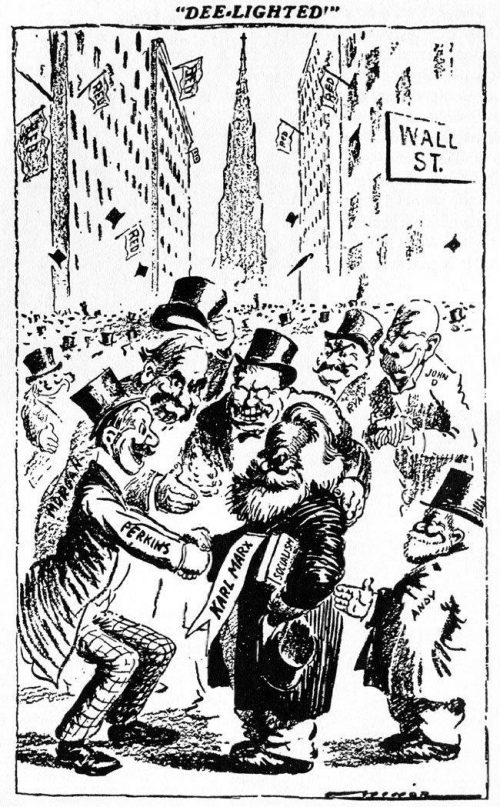
Marx being congratulated by Wall Street bankers (1911 cartoon reproduced by Sutton)
Sutton sees no Jewish conspiracy in this collusion between the Bank and the Revolution. But documents relative to the failed Russian revolution of 1905 show that there is another dimension to that unnatural alliance, as explained in this article by Alexandros Papagoergiou. In 1904, Russian Prime Minister Sergei Witte was tasked to secure a huge foreign loan to stabilize Russian public finances. He tells in his memoirs that, after turning down the offer of the Jewish banks headed by the Rothschilds, because it was conditioned on “legal measures tending to improve the conditions of the Jews in Russia,” he was able to raise the enormous amount of 2,250,000,000 francs via “Christian Banks”.[23] Revolutionary riots started soon after. A report of the Russian Foreign Minister to Tsar Nicholas II notes that it happened “just at the time when our government tried to realize a considerable foreign loan without the participation of the Rothschilds and just in time for preventing the carrying out of this financial operation; the panic provoked among the buyers and holders of Russian loans could not fail to give additional advantages to the Jewish bankers and capitalists who openly and knowingly speculated upon the fall of the Russian rates.” According to the report, the revolutionaries “are in possession of great quantities of arms which are imported from abroad, and of very considerable financial means,” which had been collected by Anglo-Jewish capitalists “under the leadership of Lord Rothschild, … for the officially alleged purpose of helping Russian Jews who suffered from pogroms.”[24]
Marxism vs Zionism: the dialectical pliers
Jewish movements seem to be working history through dialectical antagonisms that ultimately advance the Big Project. The capacity of the Jewish community to present itself either as a religion or as a nationality, depending on the circumstances, is the prime example. After gaining political emancipation in the name of religious freedom in the first part of the 19th century, European Jews were in the position to reclaim their special nationhood. For a few decades, reformed rabbis would ostensibly oppose Jewish nationalism, proclaiming in the 1885 Pittsburgh Conference: “We consider ourselves no longer a nation, but a religion community.”[25] Yet the same Pittsburgh Conference saw no contradiction in adopting the theory of German rabbi Kaufman Kohler, that “Israel, the suffering Messiah of the centuries, shall at the end of days become the triumphant Messiah of the nations,”[26] which amounts to say that Israel is not an ordinary nation, but the super-nation. In the 20th century, any trace of a contradiction between Reformed Judaism and Zionism was removed.
The early collaboration between Marx and Hess and the late encounter between Marx and Graetz both prefigure another dialectical opposition between Communism (the International revolution aimed at destroying Christian nations) and Zionism (the national project aimed at building the Jewish nation). Both movements developed in the same milieu. Chaim Weizmann recounts in his autobiography (Trial and Error, 1949) that in early twentieth-century Russia, revolutionary communists and revolutionary Zionists belonged to the same milieu. Weizmann’s brother Schmuel was a communist, and that was not a source of family discord. These divisions were relative and changeable; many Zionists were Marxists, and vice versa. The borderline was all the more vague that the Communist Bund, born the same year as Zionism (1897), inscribed in its revolutionary agenda the right of the Jews to found a secular Yiddish-speaking nation. As Gilad Atzmon recently wrote, the Bund was “also an attempt to prevent Jews from joining the ‘Hellenic’ route by offering Jews a tribal path within the context of a future Soviet revolution.”
But the most important thing to note is that, from the early days, Jewish revolutionary activity provided Zionists with a diplomatic argument in favor of their alternative program for the Jews. Herzl mentions in his diary (June 4, 1900) that “intensifying Jewish Socialist activities” was a way to “stir up the desire among the European governments to exert pressure on Turkey to take in the Jews” (Palestine was then under Ottoman control). He hawked Zionism as a solution to the problem of Jewish revolutionary subversion when meeting Kaiser Wilhelm II in 1898, and again when meeting Russian ministers in St. Petersburg in 1903.[27] The next generation of Zionists continued the stratagem. Churchill, who spoke with one voice with Chaim Weizmann,[28] dramatized the opposition between the “good Jews” (Zionists) and the “bad Jews” (communists) in his 1920 article “Zionism versus Bolshevism: A struggle for the soul of the Jewish people.” He referred to Bolshevism as “this world-wide conspiracy for the overthrow of civilization” and to Zionism as the solution “especially in harmony with the truest interests of the British Empire.” (Churchill’s later alliance with Stalin proves that his Zionism was stronger than his anti-communism.)
In the aftermath of World War II, the rivalry between the Communist and the Capitalist worlds remained the indispensable context for the creation and expansion of Israel. That explains why Roosevelt’s administration, largely controlled by Jews, helped Stalin conquer half of Europe and thwarted all attempts to stop him. Curtis Dall, Roosevelt’s son-in-law, has revealed a secret diplomatic channel demonstrating that the White House went out of its way to give the USSR all the time and the armament necessary to invade Central Europe.[29] Thus the Second World War was completed with the determined aim of laying the foundations for the Cold War, that is, a highly explosive polarization of the world that would prove crucial for Project Zion. In fact, during this whole period, it is almost impossible to distinguish, among the Jewish advisors of Roosevelt and Truman on foreign policy, the pro-Communists from the pro-Zionists, as David Martin remarks in The Assassination of James Forrestal. A case in point is David Niles (Neyhus), who was guilty of spying for the Soviets while advising Roosevelt, but then played a key role in Truman’s support of the U.N. Partition Plan and the recognition of Israel.[30]
The Cold War proved instrumental when Nasser, Israel’s most formidable enemy, was pushed into the communist camp in 1955, setting off an intense Zionist campaign to present him as a danger to the stability of the Middle East, and to present Israel, by contrast, as the only reliable ally in the region. The Cold War was also the crucial context for Israel’s defeat of Egypt in 1967 and Israel’s annexation of territories stolen from Egypt, Syria and Lebanon.
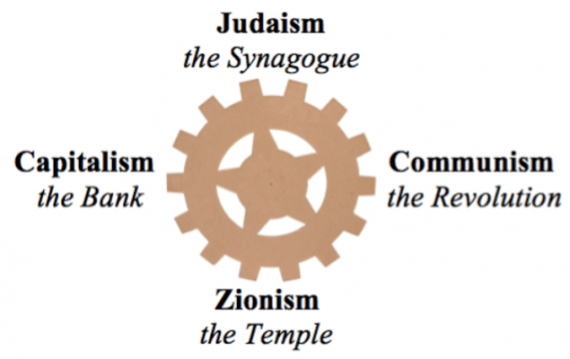
Yahweh’s dialectical machinery
Laurent Guyénot, Ph.D., has recently edited some of his Unz Review articles in book form, under the title Our God is Your God Too, But He Has Chosen Us: Essays on Jewish Power. He is also the author of From Yahweh to Zion: Jealous God, Chosen People, Promised Land … Clash of Civilizations, 2018, and JFK-9/11: 50 years of Deep State, Progressive Press, 2014.
Notes
[1] David Ben-Gurion and Amram Duchovny, David Ben-Gurion, In His Own Words, Fleet Press Corp., 1969, p. 116. Ben-Gurion’s prophecy appeared in the magazine Look on January 16, 1962, reproductions of which can be found on Internet.
[2] Karl Popper, Unended Quest: An Intellectual Autobiography (1976), Routledge, 2002, books.google.com
[3] Bakunin, Statism and Anarchy, trans. Marshall S. Shatz, Cambridge UP, 1990, pp. 538-545.
[4] Quoted in Alexandre Soljénitsyne, Deux siècles ensemble (1795–1995), tome I: Juifs et Russes avant la Révolution, Fayard, 2003, tome 1, p. 269.
[5] Robert Blake, Disraeli (1966), Faber Finds, 2010, p. 202.
[6] Amos Elon, The Pity of It All: A History of Jews in Germany 1743-1933, Metropolitan Books, 2002, pp. 153, 157, 163-164.
[7] Isaac Berlin, Karl Marx: His Life and Environment, 1939, 2nd ed, 1948, p. 17.
[8] Aux compagnons de la Fédération des sections internationales du Jura, quoted in Henri Arvon, Les Juifs et l’Idéologie, PUF, 1978, p. 50. Partial quote in Francis Wheen , Karl Marx, Fourth Estate, 1999, p. 340.
[9] Antony Sutton, Wall Street and the Bolshevik Revolution (1976), Clairview Books, 2011.
[10] Quoted in Kevin MacDonald, Separation and Its Discontents: Toward an Evolutionary Theory of Anti-Semitism, Praeger, 1998, kindle 2013, k. 4732–4877.
[11] Amos Elon, The Pity of It All, op; cit., p. 146.
[12] Shlomo Avineri, Karl Marx: Philosophy and Revolution, Yale UP, 2019, pp. 171-172.
[13] Moses Hess, Rome and Jerusalem: A Study in Jewish Nationalism, 1918 (archive.org).
[14] Sydney Hook, “Karl Marx and Moses Hess,” 1934.
[15] Shlomo Avineri , Moses Hess: Prophet of Communism and Zionism, 1985.
[16] Read Bakunin’s response to Hess’s article, “Aux citoyens rédacteurs du Réveil”
[17] French translation, Bruno Bauer, La Question juive (1843), Union générale d’Éditions, 1968, on
[18] Hal Draper, “Marx and the Economic-Jew Stereotype,” from Karl Marx’s Theory of Revolution, Vol.1: State and Bureaucracy, Monthly Review, New York 1977, pp. 591-608. Read also Gary Ruchwarger, “Marx and the Jewish Question: A Response to Julius Carlebach,” Marxist Perspectives, Fall 1979, pp. 19-38.
[19] I am aware that another “anti-Semitic” article, unsigned and titled “The Russian Loan” (New York Daily Tribune, January 4, 1856), has been attributed to Marx by his daughter, but I find Marx’s authorship dubious. See the discussion on its authenticity here.
[20] Nesta Webster, World Revolution: The Plot Against Civilization, 1921 , on archive.org, pp. 95-96.
[21] “Lettre au Journal La Liberté de Bruxelles,” October 5, 1872.
[22] Paul Johnson, Intellectuals: From Marx and Tolstoy to Sartre and Chomsky (1990), HarperCollins, 2007.
[23] The Memoirs of Count Witte, Doubleday, Page & Co, 1921, on archive.org, pp. 292-294.
[24] Quoted in Boris Brasol, The World at the Cross Roads, 1923, on archive.org, pp. 74-78.
[25] Quoted in Alfred Lilienthal, What Price Israel? (1953), Infinity Publishing, 2003, p. 14.
[26] Kaufmnann Kohler, Jewish Theology, Systematically and Historically Considered, Macmillan, 1918 (www.gutenberg.org), p. 290.
[27] The Complete Diaries of Theodor Herzl, edited by Raphael Patai, Herzl Press & Thomas Yoseloff, 1960, vol. 1 , pp. 362–363, 378–379, and vol. 3, p. 960.
[28] Martin Gilbert, Churchill and the Jews: A Lifelong Friendship, Henry Holt & Company, 2007.
[29] Curtis Dall, FDR: My Exploited Father-in-Law, Christian Crusade Publications, 1968 , pp. 146–157.
[30] David Martin, The Assassination of James Forrestal, McCabe Publishing, 2017, pp. 57-65. On Nile’s influence in the U.N. vote, see Alfred Lilienthal, What Price Israel ? (1953), 50th Anniversary Edition, Infinity Publishing, 2003, p. 50.
Featured Video

Houthis Don’t Have to Conquer Saudi Arabia to Make It Pay
or go to
Aletho News Archives – Video-Images
From the Archives
Newly Released FBI Docs Shed Light on Apparent Mossad Foreknowledge of 9/11 Attacks
By Whitney Webb | MintPress News | May 17, 2019
NEW YORK — For nearly two decades, one of the most overlooked and little known arrests made in the aftermath of the September 11 attacks was that of the so-called “High Fivers,” or the “Dancing Israelis.” However, new information released by the FBI on May 7 has brought fresh scrutiny to the possibility that the “Dancing Israelis,” at least two of whom were known Mossad operatives, had prior knowledge of the attacks on the World Trade Center. … continue
Blog Roll
 Aletho News
- MEP blasts ‘Euro-Gestapo’ for lecturing Russia on democracy
- Syria May Send Troops to Saudi Arabia Amid War with Ansar Allah
- UK whines about losing billions to ‘Putin tax’
- Baghaei to Rubio: Distorted narratives cannot erase US record of broken commitments
- Houthis Don’t Have to Conquer Saudi Arabia to Make It Pay
- MOE: Nearly 22,000 Students and Education Workers Killed
- Guterres in Islamabad: Genocide, cowardice, and the cage of Imran Khan
- Johnson, Marandi say Yemen holds upper hand over Saudi Arabia
- False flags won’t save aggressors, Iran FM spokesman says
- The Makkah Pact Enters Into Force: The End of American Dominance or Its New Form?
- If Americans Knew
- Report claimed Mark Levin used by Israeli government to influence Trump
- Over 2,000 Gazans have died awaiting medical evacuation amid Israel’s continued siege
- How a U.S. Diplomat Suppressed and Altered Reports Critical of Israel
- 5 Palestinians Die from Israeli Strikes in Gaza as Relentless Attacks Continue
- Report: Ceasefire Slows Killing but Leaves Devastation Intact
- Country Music Singer Zach Bryan Breaks Attendance Record at Robert Kraft’s Gillette Stadium While Wearing ‘Free Palestine’ Shirt for Second Night in a Row
- Three years of death and devastation: Israel’s war on Gaza in pictures
- Why Hamas believed the status quo was more dangerous than its 7 October gamble
- Debunking Israel’s latest list of ‘terrorist’ journalists in Gaza
- In Gaza, focus is on survival, “every step is a struggle” – Daily Update
- No Tricks Zone
- New Study: 50 Years Of The Most Aggressive ‘Net Zero’ Policies Can Only Affect The Global Climate By 0.03°C
- US September “Heat” Was No Record…Many Records Set Decades Ago
- Latest European Green Energy Debacle; Portugal’s Largest Flagship Solar Park Insolvent!
- Green Energy Debacle: German Expert Professor Fritz Vahrenholt Warns Of Severe Economic And Social Consequences
- Two More Paleo Reconstructions Affirm Meters-Higher Sea Levels Across Ireland, Brazil 7000-6000 Years Ago
- New Study: Earth And Venus Surface Warmth Largely Explained By Convection And Lapse Rate, Not CO2 Or Radiation
- 2025 Nature Paper Claiming Worsening Global Drought Gets RETRACTED …Heavily Flawed
- New Study: ‘Global Drought Shows No Detectable Recent Acceleration Under Climate Warming’
- Economic Masterminds: German Socialists Suggest Taxing Productivity Gains Stemming From Using AI
- The South China Sea Has Not Been Cooperating With The Climate Change Narrative

