9/11 and the War on Terror: Israel’s History of False Flag Operations against the U.S.A.
By Christopher Bollyn | American Herald Tribune | July 7, 2018
“We have spent $7 trillion – trillion with a T – $7 trillion in the Middle East. You know what we have for it? Nothing. Nothing.” – President Donald Trump, April 28, 2018
Dear Mr. President,
 As you said very clearly, the United States is bogged down in a costly quagmire in the Middle East, engaged in covert military operations in countries where there is no real U.S. interest. We have gained nothing from 17 years of war in which untold thousands have been killed or maimed and entire nations have been devastated. Our Middle East policy is disastrous and must be changed. If we don’t change our policy we can only expect more of the same – millions more refugees, thousands more dead, trillions more wasted.
In order to correct our policy we need to understand who got us into this mess in the first place. The 9/11 event as a false flag operation and the War on Terror campaign were both conceived by Israeli military intelligence in the 1970s under the leadership of Menachem Begin, the self-proclaimed “Father of Terrorism” and founder of the Likud party who became prime minister in 1977. War on Terror doctrine was rolled out in July 1979 at a Netanyahu Institute conference in Jerusalem. The Israeli trick was to get the U.S. military to neutralize and fragment its enemies, most notably Iraq and Syria, under the pretext of fighting terrorism. Since 1979, this devious plan has been openly promoted by Benjamin Netanyahu. On 9/11, War on Terror proponent Netanyahu told the New York Times that the terror atrocity was “very good” for U.S.-Israeli relations.
The Israelis have a long history of using false-flag terrorism against the United States:
- 1954 JUL – The Lavon Affair: Israeli agents place bombs in U.S. and British libraries and institutions in Egypt in a false-flag operation meant to be blamed on the Muslim Brotherhood.
- 1967 JUN – Israeli aircraft and ships attack the defenseless USS Liberty, killing 34 and wounding 171, with the intention of sinking the ship – with no survivors – so that the blame could be assigned to Egypt.
- 1983 OCT – A truck bomb kills 241 Marines in their barracks in Beirut. Former Mossad agent Victor Ostrovsky says Mossad knew the details of the truck, the time, and location of the bombing, but only gave a general warning to the Americans. A nebulous “Islamic Jihad” group is blamed; Defense Secretary Caspar Weinberger says U.S. has no knowledge who really did the bombing. This occurred one month after a single Marine stopped an Israeli tank column – some former Marines believe Israel organized the attack.
- 1986 FEB – Mossad plants a radio relay device in an apartment in Tripoli, Libya, to send fake messages that appear to be from the Libyan government; U.S. intelligence is successfully tricked and President Reagan orders bombing of Libya.
1978 – Israeli agent Arnon Milchan‘s first film features a Boeing 747 crashing into the PanAm building. Months before 9/11 produces a film episode in which remote controlled airplanes hit buildings.
1979 JUL – Netanyahu Institute hosts conference on terrorism calling for U.S. military intervention in Middle East.
1979 – Isser Harel, founding chief of Israeli intelligence, predicts 9/11 attacks in New York City.
1982 FEB – Israeli Likud strategist Oded Yinon plan calls for the “dissolution of Syria and Iraq” and Balkanization of all Arab states.
1983 – Israel creates foe for War on Terror: Under Ehud Barak, Israeli military intelligence (AMAN) begins arming and training anti-Western Hezb-i-Islami terrorists in Pakistan, including Osama bin Laden.
1987 – Two of Isser Harel’s senior Mossad agents, Avraham Shalom Bendor and Zvi Malkin, get the security contract for World Trade Center; Port Authority cancels the contract when their criminal history is discovered.
1990 – Rejected by Port Authority due to criminal conviction in Israel, Shalom Bendor goes to work for Jules Kroll.
1993 FEB – Zionists manage prosecution of WTC bombing: Israeli-American Michael Chertoff, U.S. Attorney for New Jersey, plays key role in prosecution. Zionist Judge Michael Mukasey presides over case against “Blind Sheikh.” FBI informant Emad Salem is paid one million dollars for his testimony. Media leads public to believe that Muslims want to destroy the Twin Towers.
1993 – After first WTC bombing Kroll Associates gets security contract for the Port Authority and the WTC.
1994 – After losing Saudi and Pakistani support, the Israeli-trained “remainder of Hezb-i-Islami merges into al-Qaeda and the Taliban.”
1998 DEC – Philip Zelikow’s Catastrophic Terrorism Study Group publishes report “Imagining Transforming Event” in Foreign Affairs (CFR). Co-authors Ashton Carter and John Deutch work for Global Technology Partners, an exclusive affiliate of Rothschild N.A.
1999 – Hugo Neu creates a global trading division headed by two veteran ferrous metal traders from Marc Rich and Glencore AG in Switzerland. A lot of expense and effort is spent to prepare a network to export scrap iron to Asia while its price is at the lowest level in 50 years. Hugo Neu and the state share the costs of dredging the Claremont channel to allow large ocean-going ships to Asia.
2000 SEP – A Neo-Con group, Project for the New American Century (PNAC) suggests that “a catastrophic and catalyzing event – like a new Pearl Harbor” may be necessary to facilitate “the process of transformation” they call for in U.S. military policy. Ten signers of the PNAC document, including Dick Cheney, were in senior positions of the Bush administration in 2001.
2001 – Israeli Mossad company ICTS controls security screening at U.S. Airports on 9/11. Directors include Yair Shamir, son of notorious Israeli terrorist Yitzhak Shamir.
2001 – Israeli intelligence creates false histories for alleged hijackers. Israeli spies posing as “art students” live near hijacker patsies. Duplicate documents are used to create false histories, standard procedure for Mossad false-flag operations.
2001 – Ronald Lauder manages Governor George Pataki’s privatization scheme which includes WTC property. Lauder funds Lauder School of Government, Diplomacy and Strategy at Mossad center (IDC) where Israeli Major General Daniel Rothschild heads Institute for Policy and Strategy.
2001 JUL 24 – Larry Silverstein gets lease for World Trade Center. Silverstein obtains lease thru fellow Zionist agent Lew Eisenberg, chairman of the Port Authority. Silverstein and Eisenberg are both members of UJA board, major Zionist fundraising organization. Since 1996, Silverstein has close contact with Netanyahu; every Sunday afternoon Netanyahu calls Silverstein. Silverstein immediately raises rents by 40% for the few tenants he has.
2001 SEP 11 – Ehud Olmert, Israel’s deputy prime minister, is on an unreported visit in New York City. Why is it secret? While all civilian planes are grounded, at 4:11 p.m. an El Al Boeing 747 takes off from JFK bound for Tel Aviv. The flight is authorized by the direct intervention of the U.S. Department of Defense.
9/11 – Alex Brown, a firm with ties to Israeli military intelligence and Yair Shamir’s company Scitex has many of the suspicious “put” options. “Buzzy” Krongard, executive director of the CIA, headed AB until 1998. His wife works for Rothschild Asset Management.
9/11 – Israeli government receives the names of 4,000 Israelis believed to be in the area of the WTC or Pentagon on 9/11. Odigo, an Israeli messaging company, is used to send warning several hours before attacks. Four Israelis die at WTC.
9/11 – Five Israelis working for Urban Moving Systems are arrested on 9/11 after being seen photographing and celebrating the attack on the WTC. The fake moving company is later found to be a front for the Mossad. Two of the Israelis are known Mossad.
9/11 – Israeli military chief Ehud Barak interprets 9/11 on BBC and Sky News in London, blaming Osama bin Laden and calling for U.S. to “launch an operational, concrete, war against terror.” Barak is Netanyahu’s commander in the Sayeret Matkal, a covert commando force of Israeli military intelligence. Other Israeli commandos (e.g. Daniel Lewin) are involved in 9/11. Bin Laden denies responsibility for 9/11.
9/11 – Netanyahu praises 9/11 atrocity to NYT: “It’s very good… it will generate immediate sympathy.” In 2008, he says in Israel: “We are benefiting from one thing, and that is the attack on the Twin Towers and Pentagon, and the American struggle in Iraq.”
9/11 – An Israeli controls 9-11 investigation. John Ashcroft puts Israeli dual-national Michael Chertoff in charge of 9/11 investigation. “For day-to-day decisions, Chertoff has the last word.” Destruction of crucial evidence begins immediately.
9/11 – Two Zionist-owned junkyards manage hasty destruction and exportation of evidence using large ships bound for Asia able to load at Hugo Neu because the Claremont Channel has been dredged since 1999.
Post 9/11 – Zionist with conflict of interest presides over 9/11 lawsuit: Judge Alvin Hellerstein manages 9-11 tort litigation, while his son is lawyer in Israel with firm that represents ICTS, key defendant in 9/11 litigation. Hellerstein dismisses ICTS and every 9/11 case is settled out of court.
Post 9/11 – Zionists manage compensation funds: Kenneth Feinberg and Sheila Birnbaum oversee compensation settlements for 9/11 families. Not a single case goes to trial. No 9/11 discovery occurs in court.
2003 MAR – Zionists control 9/11 myth: Appointed director of 9/11 Commission, Philip Zelikow frames the agenda and decides what evidence the commission sees. A specialist in “public myths,” Zelikow comes to commission with complete outline of report – before staff even begins working.
Until 2011 – Israelis construct 9/11 memorial and legacy: WTC memorial is designed by Israeli Michael Arad, son of Moshe Arad, former Israeli ambassador to the United States.
Until today – Controlled media ignores crucial 9/11 questions and evidence. Media pushes false narrative about 9/11 and the War on Terror while ignoring evidence that disproves the official myth.
Very respectfully,
Christopher Bollyn
Losing Military Supremacy: The Myopia of American Strategic Planning by Andrei Martyanov
The Saker • Unz Review • July 5, 2018

The fact that the US is facing a profound crisis, possibly the worst one in its history, is accepted by most observers, except maybe the most delusional ones. Most Americans definitely know that. In fact, if there is one thing upon which both those who supported Trump and those who hate him with a passion can agree on, it would be that his election is a clear proof of a profound crisis (I would argue that the election of Obama before also had, as one of its main causes, the very same systemic crisis). When speaking of this crisis, most people will mention the deindustrialization, the drop in real income, the lack of well-paid jobs, healthcare, crime, immigration, pollution, education, and a myriad of other contributing factors. But of all the aspects of the “American dream”, the single most resilient one has been the myth of the US military as “the finest fighting force in history”. In this new book, Andrei Martyanov not only comprehensively debunks this myth, he explains step by step how this myth was created and why it is collapsing now. This is no small feat, especially in a relatively short book (225 pages) which is very well written and accessible to everyone, not just military specialists.
Martyanov takes a systematic and step-by-step approach: first, he defines military power, then he explains where the myth of US military superiority came from and how the US rewriting of the history of WWII resulted in a complete misunderstanding, especially at the top political levels, of the nature of modern warfare. He then discusses the role ideology and the Cold War played in further exacerbating the detachment of US leaders from reality. Finally, he demonstrates how a combination of delusional narcissism and outright corruption resulted in a US military capable of wasting truly phenomenal sums of money on “defense” while at the same time resulting in an actual force unable to win a war against anything but a weak and defenseless enemy.
That is not to say that the US military has not fought in many wars and won. It did, but in the words of Martyanov:
Surely when America fought against a third-rate adversary it was possible to rain death from the skies, and then roll over its forces, if any remained by that time, with very little difficulty and casualties. That will work in the future too against that type of adversary—similar in size and flimsiness of Iraqi Forces circa 2003. But Ledeen’s Doctrine had one major flaw—one adult cannot continue to go around the sandbox constantly fighting children and pretend to be good at fighting adults.
The main problem for the US today is that there are very few of those third-rate adversaries left out there and that those who the US is trying to bring to submission now are either near-peer or even peer adversaries. Martyanov specifically lists the factors which make that kind of adversary so different from those the US fought in the past:
- Modern adversaries have command, control, communications, computers, intelligence, surveillance and reconnaissance capabilities equal to or better than the US ones.
- Modern adversaries have electronic warfare capabilities equal to or better than the US ones
- Modern adversaries have weapon systems equal to or better than the US ones.
- Modern adversaries have air defenses which greatly limit the effectiveness of US airpower.
- Modern adversaries have long-range subsonic, supersonic and hypersonic cruise missiles which present a huge threat to the USN, bases, staging areas and even the entire US mainland.
In the book, all these points are substantiated with numerous and specific examples which I am not repeating here for the sake of brevity.
One could be forgiven for not being aware of any of these facts, at least if one considers the kind of nonsense written by the US corporate media or, for that matter, by the so-called “experts” (another interesting topic Martyanov discusses in some detail). Still, one can live in an imaginary world only as long as reality does not come crashing in, be it in the form of criminally overpriced and useless weapon systems or in the form of painful military defeats. The current hysteria about Russia as the Evil Mordor which is the culprit for everything and anything bad (real or imaginary) happening to the US is mostly due to the fact that Russia, in total contradiction to all the “expert” opinions, not only did not crash or turn into a “gas station masquerading as a country” with her economy “in tatters”, but succeeded in developing a military which, for a small fraction of the US military budget, whose armed forces are in reality far more capable than the US forces.
I realize that this last statement is quite literally “unthinkable” for many Americans and I submit that the very fact that this is so literally unthinkable greatly contributed to making this possible in the first place: when you are so damn sure that by some kind of miracle of history, or God’s will, or Manifest Destiny or any other supernatural reason, you are inherently and by definition superior and generally “better” than everybody else you are putting yourself in great danger of being defeated. This is as true for Israel as it is for the US. I would also add that in the course of the West’s history this “crashing in of reality” in the comfy world of narcissistic delusion often came in the form of a Russian soldier defeating the putatively much superior master race of the day (from the Crusaders to the Nazis). Hence the loathing which western ruling elites always had for everything Russian.
In this book, Martyanov explains why, in spite of the absolutely catastrophic 1990s, the Russians succeeded in developing a modern and highly capable combat force in a record time. There are two main reasons for this: first, unlike their US counterparts, Russian weapons are designed to kill, not to make money and, second, Russians understand warfare because they understand what war really is. This latest argument might look circular, but it is not: Russians are all acutely aware of what war really means and, crucially, they are actually willing to make personal sacrifices to either avoid or, at least, win wars. In contrast, Americans have no experience of real warfare (that is warfare in defense of their own land, family and friends) at all. For Americans warfare is killing the other guy in his own country, preferably from afar or above, while making a ton of money in the process. For Russians, warfare is simply about surviving at any and all cost. The difference couldn’t be greater.
The difference in weapons systems acquisition is also simple: since US wars never really put the people of the US at risk, the consequences of developing under-performing weapons systems were never catastrophic. The profits made, however, were immense. Hence the kind of criminally overpriced and useless weapons system like the F-35, the Littoral Combat Ship or, of course, the fantastically expensive and no less fantastically vulnerable aircraft carriers. The Russian force planners had very different priorities: not only did they fully realize that the failure to produce an excellently performing weapons system could result in their country being devastated and occupied (not to mention their families and themselves either enslaved or killed), they also realized that they could never match the Pentagon in terms of spending. So what they did was to design comparatively much cheaper weapons systems which could destroy or render useless the output of the multi-trillion dollar US military-industrial complex. This is how Russian missiles made the entire US ABM program and the US carrier-centric Navy pretty much obsolete as well as how Russian air defenses turned putatively “invisible” US aircraft into targets or how Russian diesel-electric submarines are threatening US nuclear attack subs. All that at a tiny fraction of what the US taxpayer spends on “defense”. Here again, Martyanov gives plenty of detailed examples.
Martyanov’s book will deeply irritate and even outrage those for whom the US narcissistic culture of axiomatic superiority has become an integral part of their identity. But for everybody else this book is an absolute must-have because the future of our entire planet is at stake here: the question is not whether the US Empire is collapsing, but what the consequences of this collapse will be for our planet. Right now, the US military has turned into a “hollow force” which simply cannot perform its mission, especially since that mission is, as defined by US politicians, the control of the entire planet. There is a huge discrepancy between the perceived and the actual capabilities of the US military and the only way to bridge this gap is, of course, nuclear weapons. This is why the last chapter in the book is entitled “The Threat of a Massive American Military Miscalculation”. In this chapter, Martyanov names the real enemy of both the Russian and the American people – the US political elites and, especially, the Neocons: they are destroying the US as a country and they are putting all of mankind at risk of nuclear annihilation.
The above summary does not do justice to Martyanov’s truly seminal book. I can only say that I consider this book an absolutely indispensable “must read” for every person in the US who loves his/her country and for every person who believes that wars, especially nuclear ones, must be avoided at all costs. Just like many others (I think of Paul Craig Roberts), Martyanov is warning us that “the day of reckoning is upon us” and that the risks of war are very real, even if for most of us such an event is also unthinkable. Those in the US who consider themselves patriots should read this book with special attention, not only because it correctly identifies the main threat to the US, but also because it explains in detail what circumstances have resulted in the current crisis. Waving (mostly Chinese made) US flags is simply not an option anymore, neither is looking away and pretending that none of this is real. Martyanov’s book will also be especially interesting to those in the US armed forces who are observing the tremendous decline of US military power from inside. Who better than a former Soviet officer could not only explain, but also understand the mechanisms which have made such a decline possible?
You can also get both versions of the book (paper & electronic) here: http://claritypress.com/Martyanov.html
The book is also available on Amazon as a pre-order here: https://www.amazon.com/Losing-Military-Supremacy-American-Strategic/dp/0998694754/
It is scheduled to become available on September 1st.
The Legacy and Fallacies of Bernard Lewis
By As`ad AbuKhalil | Consortium News | June 29, 2018
There is no question that Bernard Lewis was one of the most politically—not academically—influential Orientalists in modern times.
Lewis’ career can be roughly divided into two phases: the British phase, when he was a professor at the School of Oriental and African Studies in London, and the second phase, which began in 1974, when he moved to Princeton University and lasted until his death on May 19. His first phase was less overtly political, although the Israeli occupation army translated and published one of his books, and Gold Meir assigned articles by Lewis to her cabinet members.
Lewis knew where he stood politically but he only became a political activist in the second phase. His academic production in the first phase was rather historical (dealing with his own specialty and training) and his books were then thoroughly documented. The production of his second phase was political in nature and lacked solid documentation and citations. In the second phase, Lewis wrote about topics (such as the contemporary Arab world) on which he was rather ignorant. The writings of his second phase were motivated by his political advocacy, while the writings of the first phase was a combination of his political biases and his academic interests.
Shortly upon moving into the U.S., Lewis met with Senator Henry “Scoop” Jackson, the dean of ardent Zionists in the U.S. Congress. He thus started his political career and his advocacy, which was often thinly hidden behind the title of superficial books on the modern Arab world. Lewis not only mentored various neoconservatives, but he also elevated the status of Middle East natives that he approved of. For instance, he was behind the promotion of Fouad Ajami (he dedicated one of this books to him), just as he was behind introducing Ahmad Chalabi to the political elite in DC.
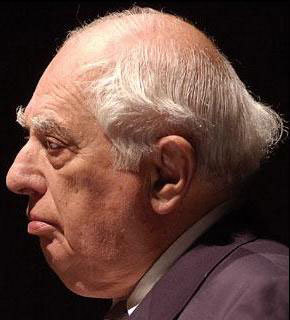
Lewis: A questionable legacy
Furthermore, Lewis was also behind the invitation of Sadiq Al-Azm to Princeton in the early 1990s (as Edward Said told me at the time) because Lewis always relished Al-Azm’s critique of Said’s Orientalism. Sep. 11 only elevated the status of Lewis and brought him close to the centers of power: he advised George W. Bush, Dick Cheney, Donald Rumsfeld and other senior members of the administration.
In the lead-up to the Iraq war, he assured Cheney (relying on the authority of Ajami) that not only Iraqis, but all Arabs, would joyously greet invading American troops. And he argued to Cheney before the war, using the dreaded Zionist and colonial cliché, that Arabs only understand the language of force. (Lewis would later distort his own history and claim that he was not a champion of the Iraq invasion although the record is clear).
Lewis was not only close to the higher echelons of the U.S. government, but in addition to his long-standing ties to Israeli leaders, he was close to Jordanian King Husayn and his brother, Hasan (although Lewis would mock what he considered a Jordanian habit of eating without forks and knives, as he wrote in Notes on a Century: Reflections of a Middle East Historian, on page 217).
Lewis was also close to the Shah’s government, and to the military dictatorship in Turkey in the 1980s. Kenan Evren, the Turkish general who led the 1980 military coup, had a tete-a-tete with Lewis during one of his visits to D.C. Lewis had contacts with the Sadat government, and Sadat’s spokesperson, Tahasin Bashir, in 1971 sent a message through Lewis to the Israeli government regarding Sadat’s interest in peace between the two countries.
Distorted View of Islam
There are many features of Lewis’s works, but foremost is what French historian Maxime Rodinson called “theologocentrism”, or the Western school of thought which attribute all observable phenomena among Muslims to matters of Islamic theology.
For Lewis, Islam is the only tool which can explain the odd political behavior of Arabs and Muslims. Lewis used Islam to refer not only to religion, but also the collection of Muslim people, governments ruling in the name of Islam, Shari`ah, Islamic civilization, languages spoken by Muslims, geographic areas in which Muslims predominate, and Arab governments. A review of his titles show his fixation with Islam. But what does it mean for Lewis to refer to Islam as being “the whole of life” for Muslims, as he does in Islam and the West?
Lewis also began the trendy Islamophobic, Western obsession with Shari`ah when he wrote years ago in the same book that for Muslims religion is “inconceivable without Islamic law.” There are hundreds of millions of Muslims in the world who live under governments which don’t subscribe to Shari`ah. No Muslim, for example, questions the Islamic credentials of Muslims who live in Western countries under secular law. Lewis even notes this fact, but it confuses him. In Islam and the West he states in bewilderment: “There is no [legal] precedent in Islamic history, no previous discussion in Islamic legal literature.”
Lewis could have benefited from reading James Piscatori’s book, Islam in a World of Nation States, which shows that Shari`ah is not the only source of laws even in countries where Islam is supposedly the only source of law. But Lewis was stuck in the past, he could only interpret the present through references to the original works of classical Islam.
His hostility and contempt for Arabs and Muslims was revealed in his writings even during the British phase of his career, when he was politically more restrained. He was influenced by the idea of his mentor, Scottish historian Hamilton Gibb, regarding what they both called “the atomism” of the Arab mind. The evidence for their theory is that the classical Arabic poem of Jahiliyyah and early Islam was not organically and thematically unified, but that each line of poetry was independent of the other. I remember back in 1993 when I discussed the matter with Muhsin Mahdi, a professor of Islamic philosophy at Harvard University, when I was reading the private papers of Gibb at the Widener Library. Mahdi said that their ideas are completely out of date and that recent scholarship about the classical Arabic poem refuted that thesis. (Lewis would resurrect the notion about the “atomism” of the Arab mind in his later Islam and the West).
Other writings of Lewis became obsolete academically. In his The Muslim Discovery of Europe he recycles the view that Muslims had no curiosity about the West because it was the land of infidelity and that they suffered from a superiority complex. A series of new scholarly books have undermined this thesis by Lewis largely by scholars looking into Indian and Iranian archives. The Palestinian academic, Nabil Mater, in his books Britain and the Islamic World, 1558-1713, Europe Through Arab Eyes, 1578-1727, and Turks, Moors and Englishmen in the Age of Discovery, paints a very different—and far more documented—picture of the subject that Lewis spent a career distorting.
Relished in Disparaging Arabs
In addition, the tone of Lewis’ writings on Arabs and Muslims was often sarcastic and contemptuous. Lewis did the work of the Middle East Media Research Institute (MEMRI), which was started in 1998 by a former Israeli intelligence agent and an Israeli political scientist,before MEMRI existed: he relished finding outlandish views of individual Muslims and popularizing them to stereotype all Arabs and all Muslims.
In the early editions of Arabs in History, Lewis remarked that none of the philosophers of the Arab/Islamic civilization were Arab in ethnic extraction (except Al-Kindi). What was Lewis’s point except to denigrate the Arab character and even genetic makeup? In the same book he cites an Ismaili document but then quickly adds that it “is probably not genuine.” But if it is “probably not genuine” why bother to cite it except for his fondness for bizarre tidbits about Arabs and Muslims?
The Orientalism of Lewis was not representative of classical Orientalism with all its flaws and shortcomings and political biases. His harbored more of an ideology of hostility against Arabs and Muslims. This ideology shares features with anti-Semitism, namely that the whole (Muslims in this case) form a monolithic group and that they pose a civilizational danger to the world, or are plotting to take it over, and that the behavior or testimony of one represents the total group (Islamic Ummah).
In writing about contemporary Islam, Lewis spent years recycling his 1976 Commentary magazine article titled, “The Return of Islam.” What he doesn’t answer is, “return” from where? Where was Islam prior? In this article, Lewis exhibits his adherence to the most discredited forms of classical Orientalist dogmas by invoking such terms as “the modern Western mind.” He thereby resurrected the idea of epistemological distinctions between “our” mind and “theirs”, as articulated by the 1976 racist book, The Arab Mind by Israeli anthropologist, Raphael Patai. (This last book would witness a resurrection in U.S. military indoctrination after Sep. 11, as Seymour Hersh reported).
An Obsession with Etymology
For Lewis, the Muslim mind never seems to change. Every Muslim, regardless of geography or time, is representative of any or all Muslims. Thus, a quotation from an obscure medieval source is sufficient to explain present-day behavior. Lewis even traces Yaser Arafat’s nom de guerre (Abu `Ammar) to early Islamic history and to the names of the Prophet Muhammad’s companions, though `Arafat himself had explained that the name derives from the root `amr (a reference to `Arafat’s construction work in Kuwait prior to his ascension to the leadership of the PLO).
Because `Arafat literally embraced Ayatollah Ruhollah Khomeini of Iran when he first met him, Lewis finds evidence of a universal Muslim bond in the picture. But when Lewis revised his book years later, he took note in passing of the deep rift which later developed between `Arafat and Khomeini and said simply: “later they parted company.” So much for the theory of the Islamic bond between them. Lewis must not have heard of wars among Muslims, like the Iran-Iraq war.
Lewis read the book Philosophy of Revolution by the foremost political champion of Arab nationalism, Nasser of Egypt, as containing Islamic themes. He must have been the only reader to come to that conclusion.
Another feature in Lewis’s writings is his obsession with etymology. To compensate for his ignorance of modern Arab reality, Lewis would often return to the etymology of political terms among Muslims. His book, The Political Language of Islam, which is probably his worst book, is an example of his attempt to Islamize and standardize the political behavior of all Muslims. His conclusions from his etymological endeavors are often comical: he assumes that freedom is alien to the Arabs because the historical meaning of the word in an ancient Arabic dictionary merely connoted the absence of slavery. This is like assuming that a Westerner never engaged in sex before the word was popularized. He complains that some of contemporary political terms, like dawlah (state), lost some of their original meanings, as if this is a problem peculiar to the Arabic language.
In his early years, Lewis was close to the classical Orientalists: he wrote in a beautiful style and his erudition and language skills showed through the pages. His early works were fun to read, while his later works were dreary and dull. But Lewis was unlike those few classical Orientalists who managed to mix knowledge about history of the Middle East and Islam with knowledge of the contemporary Arab world (scholars like Rodinson, Philip Hitti and Jacques Berque). Lewis’s ignorance about the contemporary Arab world was especially evident in his production during the U.S. phase of his long career. His book on the The Emergence of Modern Turkey, which was one of the first to rely on the Ottoman archives, was probably one of his best books. There is real scholarship in the book, unlike many of his later observational and impressionable works.
In his later best-selling books, What Went Wrong? and The Crisis of Islam, one reads the same passages and anecdotes twice. Lewis, for example, relishes recounting that syphilis was imported into the Middle East from the new world. His discussion of Napoleon in Egypt appears in both books, almost verbatim. The second book contains calls for (mostly military) action. In The Crisis of Islam, Lewis asserts: “The West must defend itself by whatever means.” The book reveals a lot about his outlook of hostility towards Muslims.
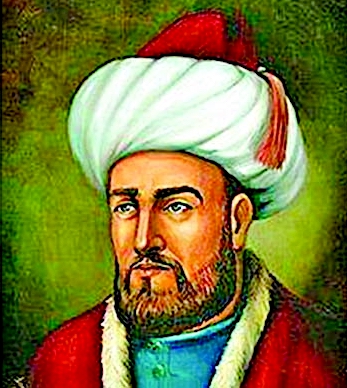
Al-Ghazzali: Lewis thought bin Laden was like him
Misunderstood Bin Laden
One is astonished to read some of his observations on Muslim and Arab sentiments and opinions. He is deeply convinced that Muslims are “pained” by the absence of the caliphate, as if this constitutes a serious demand or goal even for Muslim fundamentalist organizations. One never sees crowds of Muslims in the streets of Cairo or Islamabad calling for the restoration of the caliphate as a pressing need.
But then again: this is the man who treated Usamah Bin Laden as some kind of influential Muslim theologian who is followed by world Muslims. Lewis does not treat Bin Laden as the terrorist fanatic that he is, but as some kind of al-Ghazzali, in the tradition of classical Islamic theologians. Furthermore, Lewis insists that terrorism by individual Muslims should be considered Islamic terrorism, while terrorism by individual Jews or Christians is never considered Jewish or Christian terrorism.
In his retirement years, his disdain for the Palestinian people became unmasked. Although in his book The Crisis of Islam he lists acts of violence by PLO groups—curiously, only ones that are not directed against Israeli occupation soldiers—he lists not one act of Israeli violence against Palestinians and Arabs. To discredit the Palestinian national movement, he finds it necessary to tell yet again the story of Hajj Amin Al-Husayni’s visit to Nazi Germany, apparently seeking to stigmatize all Palestinians.
He is so disdainful of the Palestinians that he finds their opposition to Britain during the mandate period inexplicable because he believes that Britain was, alas, opposed to Zionism. Lewis is so insistent in attributing Arab popular antipathy to the U.S. to Nazi influence and inspiration that he actually maintains that Arabs obtained their hostility to the U.S. from reading the likes of Otto Spengler, Friederich Georg Junger, and Martin Heidegger. But when did the Arabs find time to read those books when all they read were their holy book and Islamic religious texts—as one surmises from reading Lewis?
While he displays deep–albeit selective–knowledge when he talks about the Islamic past (where his documentation is usually thorough), his analysis is quite simplistic and superficial when addressing the present (where he often disregards documentation altogether). For instance, he sometimes produces quotations without endnotes to source them: In Islam and the West he quotes an unnamed Muslim calling for the right of Muslims to “practice polygamy under Christian rule.” In another instance, he debates what he considers to be a common Muslim anti-Orientalist viewpoint, and the endnotes refer only to a letter to the editor in The New York Times.
Lewis once began a discussion by saying: “Recently I came across an article in a Kuwaiti newspaper discussing a Western historian,” without referring the reader to the name of the newspaper or the author. He also tells the story of an anti-Coptic rumor in Egypt in 1973 without telling the reader how he collects his rumors from the region. On another page, he identifies a source thus: “a young man in a shop where I went to make a purchase.”
Lewis was not shy about his biases in the British phase of his career, but be became an unabashed racist in his later years. In Notes on a Century, he did not mind citing approvingly the opinion of a friend who compared Arabs to “neurotic children”, unlike Israelis who are “rational adults.” And his knowledge of Arabs seems to decrease over time: he would frequently tell (unfunny) jokes related to Arabs and then add that jokes are the only indicator of Arab public opinion because he did not seem to know about public opinion surveys of Arabs. He also informs his readers that “chairs are not part of Middle Eastern tradition or culture.” He showers praise on his friend, Teddy Kollek (former occupation mayor of Jerusalem) because he set up a “refreshment counter” for Christians one day.
The political influence of Lewis, who lent Samuel Huntington his term, if not the theme, of “the clash of civilization”, has been significant. But it would be inaccurate to maintain that he was a policy maker. In the East and the West, rulers rely on the opinions and writings of intellectuals when they find that this reliance is useful for their propaganda purposes. Lewis and his books were timely when the U.S. was preparing to invade Muslim countries. But the legacy of Lewis won’t survive future scholarly scrutiny: his writings will increasingly lose their academic relevance and will be cited as examples of Orientalist overreach.
As’ad AbuKhalil is a Lebanese-American professor of political science at California State University, Stanislaus. He is the author of the Historical Dictionary of Lebanon (1998), Bin Laden, Islam & America’s New ‘War on Terrorism’ (2002), and The Battle for Saudi Arabia (2004). He also runs the popular blog The Angry Arab News Service.
Same As It Ever Was: The GWOT and Colonial History
By Ron Jacobs | CounterPunch | June 28, 2018
Since the events popularly called 9-11, the general public of the western nations have grown used to ever intensifying security measures. These measures affect the way the public travels, attends sporting and musical events, and thinks about those who don’t look like them. Long gone are the days when one could buy an airline ticket with cash at the counter and walk on a flight without showing identification.
In her 2018 book, Deport, Deprive, Extradite: 21st Century State Extremism, Nisha Kapoor examines several cases of Muslims living in Britain accused of lending material support to terrorism. In her examination of these case studies, she exposes the abuses of the British internal security apparatus and its intimate collaboration with the much greater security apparatus of the United States. The processes she reveals describe a Kafkaesque web that is impossible to escape once one is trapped in its threads. Indeed, virtually every case she explores ends with the individual targeted by the surety services taking a plea no matter how flimsy the evidence against them is. It’s as if they are found guilty and sentenced before the trial like those in the Queen of Heart’s courtroom found in Lewis Carrol’s Through the Looking Glass. Indeed, Kapoor quotes from this fiction in her text to make that exact point.
Although many US and British citizens were (and are) appalled at the torture and extraordinary rendition of suspects, in part because of the illegality of the practice, fewer seem opposed to the practice of legal extradition. As Kapoor points out throughout her text, this policy is actually quite similar to extraordinary rendition in how it is actually carried out. Like those who are moved illegally via extraordinary rendition, the suspects extradited (usually to the United States) are hooded, bound and tortured. The fact that their movement is legal only points to the weakness of the law.
Underlying the case studies discussed in the text is Kapoor’s contention that the practices of rendition, extradition and the  accompanying torture and abuse of detainees are a continuation of strategies and policies established under colonial administrations in the past. In other words, they are racist and therefore dismissive of the subject’s humanity and importance except as a target of abuse and imprisonment. Their very existence demands suspicion of crimes against the regime and their rationale of any actions (or thoughts about actions) is not rational but the result of a fanaticism. In the nominally secular world of the western regimes primarily involved in the capture and imprisonment of these suspects it is the religion of Islam which is the cause of their irrationality.
Another important context that is crucial to the text’s understanding of the “war on terror” is Kapoor’s emphasis on the fact that this entire project is a direct extension of liberal governance and philosophy. In her writing, she references John Stuart Mill and other liberal philosophers’ disparaging comments on non-Western civilizations. Furthermore, she draws a clear line from liberalism to authoritarianism, pointing out that as the judicial element in such governments has been weakened, the legislatures have given more and more power to the executive, which has rendered any existing balance of power virtually meaningless. In other words, the pretense that liberal government is somehow different from authoritarianism has been ripped away by the increasingly invasive, harsh and repressive measures undertaken in the name of the war on terror.
Unwritten, but clearly present is this essential fact: the more time that passes under this regime of what Kapoor justly calls state extremism goes on, the fewer people there will be who can remember when liberal governments were more liberal than illiberal and human beings were not suspect at birth. Deport, Deprive, Extradite is not merely an examination of human rights abuses of the recent past; it is also a harbinger of a harsher future. One would do well to heed its warning and act against the possibilities it discusses.
American Pravda: the JFK Assassination, Part II – Who Did It?
By Ron Unz • Unz Review • June 25, 2018
A strong dam may hold back an immense quantity of water, but once it breaks the resulting flood may sweep aside everything in its path. I had spent nearly my entire life never doubting that a lone gunman named Lee Harvey Oswald killed President John F. Kennedy nor that a different lone gunman took the life of his younger brother Robert a few years later. Once I came to accept that these were merely fairy tales widely disbelieved by many of the same political elites who publicly maintained them, I began considering other aspects of this important history, the most obvious being who was behind the conspiracy and what were their motives.
On these questions, the passage of a half-century and the deaths, natural or otherwise, of nearly all the contemporary witnesses drastically reduces any hope of coming to a firm conclusion. At best, we can evaluate possibilities and plausibilities rather than high likelihoods let alone near certainties. And given the total absence of any hard evidence, our exploration of the origins of the assassination must necessarily rely upon cautious speculation.
From such a considerable distance in time, a bird’s-eye view may be a reasonable starting point, allowing us to focus on the few elements of the apparent conspiracy that seem reasonably well established. The most basic of these is the background of the individuals who appear to have been associated with the assassination, and the recent books by David Talbot and James W. Douglass effectively summarize much of the evidence accumulated over the decades by an army of diligent assassination researchers. Most of the apparent conspirators seem to have had strong ties to organized crime, the CIA, or various anti-Castro activist groups, with considerable overlap across these categories. Oswald himself certainly fit this same profile although he was very likely the mere “patsy” that he claimed to be, as did Jack Ruby, the man who quickly silenced him and whose ties to the criminal underworld were long and extensive.
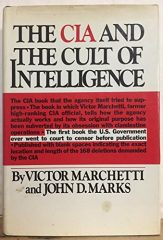
An unusual chain of events provided some of the strongest evidence of CIA involvement. Victor Marchetti, a career CIA officer, had risen to become Special Assistant to the Deputy Director, a position of some importance, before resigning in 1969 over policy differences. Although he fought a long battle with government censors over his book, The CIA and the Cult of Intelligence, he retained close ties with many former agency colleagues.
During the 1970s, the revelations of the Senate Church Committee and the House Select Committee on Assassinations had subjected the CIA to a great deal of negative public scrutiny, and there were growing suspicions of possible CIA links to JFK’s assassination. In 1978 longtime CIA Counter-intelligence chief James Angleton and a colleague provided Marchetti with an explosive leak, stating that the agency might be planning to admit a connection to the assassination, which had involved three shooters, but place the blame upon E. Howard Hunt, a former CIA officer who had become notorious during Watergate, and scapegoat him as a rogue agent, along with a few other equally tarnished colleagues. Marchetti published the resulting story in The Spotlight, a weekly national tabloid newspaper operated by Liberty Lobby, a rightwing populist organization based in DC. Although almost totally shunned by the mainstream media, The Spotlight was then at the peak of its influence, having almost 400,000 subscribers, as large a readership as the combined total of The New Republic, The Nation, and National Review.
Marchetti’s article suggested that Hunt had actually been in Dallas during the assassination, resulting in a libel lawsuit with potential damages large enough to bankrupt the publication. Longtime JFK assassination researcher Mark Lane became aware of the situation and volunteered his services to Liberty Lobby, hoping to use the legal proceedings, including the discovery process and subpoena power, as a means of securing additional evidence on the assassination, and after various court rulings and appeals, the case finally came to trial in 1985.
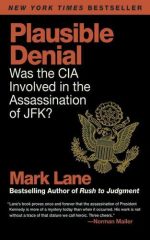
As Lane recounted in his 1991 bestseller, Plausible Denial, his strategy generally proved quite successful, not only allowing him to win the jury verdict against Hunt, but also eliciting sworn testimony from a former CIA operative of her personal involvement in the conspiracy along with the names of several other participants, though she claimed that her role had been strictly peripheral. And although Hunt continued for decades to totally deny any connection with the assassination, near the end of his life he made a series of video-taped interviews in which he admitted that he had indeed been involved in the JFK assassination and named several of the other conspirators, while also maintaining that his own role had been merely peripheral. Hunt’s explosive death-bed confession was recounted in a major 2007 Rolling Stone article and also heavily analyzed in Talbot’s books, especially his second one, but otherwise largely ignored by the media.
Many of these same apparent conspirators, drawn from the same loose alliance of groups, had previously been involved in the various U.S. government-backed attempts to assassinate Castro or overthrow his Communist government, and they had developed a bitter hostility towards President Kennedy for what they considered his betrayal during the Bay of Pigs fiasco and afterward. Therefore, there is a natural tendency to regard such animosity as the central factor behind the assassination, a perspective generally followed by Talbot, Douglass, and numerous other writers. They conclude that Kennedy died at the hands of harder-line anti-Communists, outraged over his perceived weakness regarding Cuba, Russia, and Vietnam, sentiments that were certainly widespread within right-wing political circles at the height of the Cold War.
While this framework for the assassination is certainly possible, it is far from certain. One may easily imagine that most of the lower-level participants in the Dallas events were driven by such considerations but that the central figures who organized the plot and set matters into motion had different motives. So long as all the conspirators were agreed on Kennedy’s elimination, there was no need for an absolute uniformity of motive. Indeed, men who had long been involved in organized crime or clandestine intelligence operations were surely experienced in operational secrecy, and many of them may not have expected to know the identities, let alone the precise motives, of the men at the very top of the remarkable operation they were undertaking.
We must also sharply distinguish between the involvement of particular individuals and the involvement of an organization as an organization. For example, CIA Director John McCone was a Kennedy loyalist who had been appointed to clean house a couple of years before the assassination, and he surely was innocent of his patron’s death. On the other hand, the very considerable evidence that numerous individual CIA intelligence officers and operatives participated in the action has naturally raised suspicions that some among their highest-ranking superiors were involved as well, perhaps even as the principal organizers of the conspiracy.
These reasonable speculations may have been magnified by elements of personal bias. Many of the prominent authors who have investigated the JFK assassination in recent years have been staunch liberals, and may have allowed their ideology to cloud their judgment. They often seek to locate the organizers of Kennedy’s elimination among those rightwing figures whom they most dislike, even when the case is far from entirely plausible.
But consider the supposed motives of hard-line anti-Communists near the top of the national security hierarchy who supposedly may have organized Kennedy’s elimination because he backed away from a full military solution in the Bay of Pigs and Cuban Missile Crisis incidents. Were they really so absolutely sure that a President Johnson would be such an enormous improvement as to risk their lives and public standing to organize a full conspiracy to assassinate an American president?
A new presidential election was less than a year away, and Kennedy’s shifting stance on Civil Rights seemed likely to cost him nearly all the Southern states that had provided his margin of electoral victory in 1960. A series of public declarations or embarrassing leaks might have helped remove him from office by traditional political means, possibly replacing him with a Cold War hard-liner such as Barry Goldwater or some other Republican. Would the militarists or business tycoons often implicated by liberal JFK researchers have really been so desperate as to not wait those extra few months and see what happened?
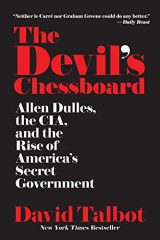
Based on extremely circumstantial evidence, Talbot’s 2015 book The Devil’s Chessboard, something of a sequel to Brothers, suggests that former longtime CIA Director Allan Dulles may have been the likely mastermind, with his motive being a mixture of his extreme Cold Warrior views and his personal anger at his 1961 dismissal from his position.
While his involvement is certainly possible, obvious questions arise. Dulles was a seventy-year-old retiree, with a very long and distinguished career of public service and a brother who had served as Eisenhower’s secretary of state. He had just published The Cult of Intelligence, which was receiving very favorable treatment in the establishment media, and he was embarked on a major book tour. Would he really have risked everything—including his family’s reputation in the history books—to organize the murder of America’s duly-elected president, an unprecedented act utterly different in nature than trying to unseat a Guatemalan leader on behalf of supposed American national interests? Surely, using his extensive media and intelligence contacts to leak embarrassing disclosures about JFK’s notorious sexual escapades during the forthcoming presidential campaign would have been be a much safer means of attempting to achieve an equivalent result. And the same is true for J. Edgar Hoover and many of the other powerful Washington figures who hated Kennedy for similar reasons.
On the other hand, it is very easy to imagine that such individuals had some awareness of the emerging plot or may even have facilitated it or participated to a limited extent. And once it succeeded, and their personal enemy had been replaced, they surely would have been extremely willing to assist in the cover-up and protect the reputation of the new regime, a role that Dulles may have played as the most influential member of the Warren Commission. But such activities are different than acting as the central organizer of a presidential assassination.
Just as with the hard-line national security establishment, many organized crime leaders had grown outraged over the actions of the Kennedy Administration. During the late 1950s, Robert Kennedy had intensely targeted the mob for prosecution as chief counsel to the Senate Labor Rackets Committee. But during the 1960 election, family patriarch Joseph Kennedy used his own longstanding mafia connections to enlist their support for his older son’s presidential campaign, and by all accounts the votes stolen by the corrupt mob-dominated political machines in Chicago and elsewhere helped put JFK in the White House, along with Robert Kennedy as his Attorney General. Frank Sinatra, an enthusiastic Kennedy supporter, had also helped facilitate this arrangement by using his influence with skeptical mob leaders.
However, instead of repaying such crucial election support with political favors, Attorney General Robert Kennedy, perhaps ignorant of any bargain, soon unleashed an all-out war against organized crime, far more serious than anything previously mounted at the federal level, and the crime bosses regarded this as a back-stabbing betrayal by the new administration. Once Joseph Kennedy was felled by an incapacitating stroke in late 1961, they also lost any hope that he would use his influence to enforce the deals he had struck the previous year. FBI wiretaps reveal that mafia leader Sam Giancana decided to have Sinatra killed for his role in this failed bargain, only sparing the singer’s life when he considered how much he personally loved the voice of one of the most famous Italian-Americans of the 20th century.
These organized crime leaders and some of their close associates such as Teamster boss Jimmy Hoffa certainly developed a bitter hatred toward the Kennedys, and this has naturally led some authors to point to the mafia as the likely organizers of the assassination, but I find this quite unlikely. For many decades, American crime bosses had had a complex and varied relationship with political figures, who might sometimes be their allies and at other times their persecutors, and surely there must have been many betrayals over the years. However, I am not aware of a single case in which any even moderately prominent political figure on the national stage was ever targeted for assassination, and it seems quite unlikely that the sole exception would be a popular president, whom they would have likely regarded as being completely out of their league. On the other hand, if individuals who ranked high in Kennedy’s own DC political sphere set in motion a plot to eliminate him, they might have found it easy to enlist the enthusiastic cooperation of various mafia leaders.
Furthermore, the strong evidence that many CIA operatives were involved in the conspiracy very much suggests that they were recruited and organized by some figure high in their own hierarchy of the intelligence or political worlds rather than the less likely possibility that they were brought in solely by leaders of the parallel domain of organized crime. And while crime bosses might possibly have organized the assassination itself, they surely had no means of orchestrated the subsequent cover-up by the Warren Commission, nor would there have been any willingness by America’s political leadership to protect mafia leaders from investigation and proper punishment for such a heinous act.
If a husband or wife is found murdered, with no obvious suspect or motive at hand, the normal response of the police is to carefully investigate the surviving spouse, and quite often this suspicion proves correct. Similarly, if you read in your newspapers that in some obscure Third World country two bitterly hostile leaders, both having unpronounceable names, had been sharing supreme political power until one was suddenly struck down in a mysterious assassination by unknown conspirators, your thoughts would certainly move in an obvious direction. Most Americans in the early 1960s did not perceive their own country’s politics in such a light, but perhaps they were mistaken. As a total newcomer to the enormous, hidden world of JFK conspiracy analysis, I was immediately surprised by the mere sliver of suspicion directed towards Vice President Lyndon B. Johnson, the slain leader’s immediate successor and the most obvious beneficiary.
The two Talbot books and the one by Douglass, totaling some 1500 pages, devote merely a few paragraphs to any suspicions of Johnson’s involvement. Talbot’s first book reports that immediately after the assassination, the vice president had expressed a frantic concern to his personal aides that a military coup might be in progress or a world war breaking out, and suggests that these few casual words demonstrate his obvious innocence, although a more cynical observer might wonder if those remarks had been uttered for exactly that reason. Talbot’s second book actually quotes an apparent low-level conspirator as claiming that Johnson had personally signed off on the plot and admits that Hunt believed the same thing, but treats such unsubstantiated accusations with considerable skepticism, before adding a single sentence acknowledging that Johnson may indeed have been a passive supporter or even an accomplice. Douglass and Peter Dale Scott, author of the influential 1993 book Deep Politics and the Death of JFK, apparently seem never to have even entertained the possibility.
Ideological considerations are probably an important reason for such remarkable reticence. Although liberals had grown to revile LBJ by the late 1960s for his escalation of the unpopular Vietnam War, over the decades those sentiments have faded, while warm memories of his passage of the landmark Civil Rights legislation and his creation of the Great Society programs have elevated his stature in that ideological camp. Furthermore, such legislation had long been blockaded in Congress and only became law because of the 1964 Democratic Congressional landslide following JFK’s martyrdom, and it might be difficult for liberals to admit that their fondest dreams were only realized by an act of political parricide.
Kennedy and Johnson may have been intensively hostile personal rivals, but there seem to have been few deep ideological differences between the two men, and most of the leading figures in JFK’s government continued to serve under his successor, surely another source of enormous embarrassment to any ardent liberals who came to suspect that the former had been murdered by a conspiracy involving the latter. Talbot, Douglass, and many other left-leaning advocates for an assassination conspiracy prefer to point the finger of blame towards far more congenial villains such as hard-line, anti-Communist Cold Warriors and right-wing elements, notably including top CIA officials, such as former director Allan Dulles.
An additional factor helping to explain the extreme unwillingness of Talbot, Douglass, and others to consider Johnson as an obvious suspect may be the realities of the book publishing industry. By the 2000s, JFK assassination conspiracies had long become passé and were treated with disdain in mainstream circles. Talbot’s strong reputation, his 150 original interviews, and the quality of his manuscript broke that barrier, and attracted The Free Press as his very respectable publisher, while later drawing a strongly positive review by a leading academic scholar in the New York Times Sunday Book Review and an hour long television segment broadcast on C-Span Booknotes. But if he had devoted any space to voicing suspicions that our 35th president had been murdered by our 36th, surely the weight of that extra element of “outrageous conspiracy theory” would have ensured that his book sank without a trace.
However, if we cast off these distorting ideological blinders and the practical considerations of American publishing, the prima facie case for Johnson’s involvement seems quite compelling.
Consider a very simple point. If a president is struck down by an unknown group of conspirators, his successor would normally have had the strongest possible incentive to track them down lest he might become their next victim. Yet Johnson did nothing, appointing the Warren Commission that covered up the entire matter, laying the blame upon an erratic “lone gunman” conveniently dead. This would seem remarkably odd behavior for an innocent LBJ. This conclusion does not demand that Johnson was the mastermind, nor even an active participant, but it raises a very strong suspicion that he at least had had some awareness of the plot, and enjoyed a good personal relationship with some of the principals.
A similar conclusion is supported by a converse analysis. If the plot succeeded and Johnson became president, the conspirators must surely have felt reasonably confident that they would be protected rather than tracked down and punished as traitors by the new president. Even a fully successful assassination would entail enormous risks unless the organizers believed that Johnson would do exactly what he did, and the only means of ensuring this would be to sound him out about the plan, at least in some vague manner, and obtain his passive acquiesce.
Based on these considerations, it seems extremely difficult to believe that any JFK assassination conspiracy took place entirely without Johnson’s foreknowledge, or that he was not a central figure in the subsequent cover-up.
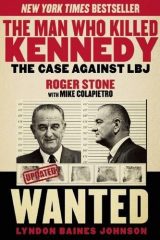
But the specific details of Johnson’s career and his political situation in late 1963 greatly strengthen these entirely generic arguments. A very useful corrective to the “See No Evil” approach to Johnson from liberal JFK writers is Roger Stone’s The Man Who Killed Kennedy: The Case Against LBJ, published in 2013. Stone, a longtime Republican political operative who got his start under Richard Nixon, presents a powerful case that Johnson was the sort of individual who might easily have lent his hand to political murder, and also that he had strong reasons to do so.
Among other things, Stone gathers together an enormous wealth of persuasive information regarding Johnson’s decades of extremely corrupt and criminal practices in Texas, including fairly plausible claims that these may have included several murders. In one bizarre 1961 incident that strangely foreshadows the Warren Commission’s “lone gunman” finding, a federal government inspector investigating a major Texas corruption scheme involving a close LBJ ally was found dead, shot five times in the chest and abdomen by a rifle, but the death was officially ruled a “suicide” by the local authorities, and that conclusion was reported with a straight face in the pages of the Washington Post.
Certainly one remarkable aspect of Johnson’s career is that he was born dirt-poor, held low-paying government jobs throughout his entire life, yet took the oath of office as the wealthiest president in modern American history, having accumulated a personal fortune of over $100 million in present-day dollars, with the financial payoffs from his corporate benefactors having been laundered through his wife’s business. This odd anomaly is so little remembered these days that a prominent political journalist expressed total disbelief when I mentioned it to him a decade ago.
Stone also effectively sketches out the very difficult political situation Johnson faced in late 1963. He had originally entered the 1960 presidential race as one of the most powerful Democrats in the country and the obvious front-runner for his party’s nomination, certainly compared to the much younger Kennedy, whom he greatly outranked in political stature and also somewhat despised. His defeat, involving a great deal of underhanded dealings on both sides, came as a huge personal blow. The means by which he somehow managed to get himself placed on the ticket are not entirely clear, but both Stone and Seymour Hersh in The Dark Side of Camelot strongly suggest that personal blackmail was a greater factor than geographical ticket-balancing. In any event, Kennedy’s paper-thin 1960 victory would have been far more difficult without Texas narrowly falling into the Democratic column, and election fraud there by Johnson’s powerful political machine seems almost certainly to have been an important factor.
Under such circumstances, Johnson naturally expected to play a major role in the new administration, and he even issued grandiose demands for a huge political portfolio, but instead he found himself immediately sidelined and treated with complete disdain, soon becoming a forlorn figure with no authority or influence. As time went by, the Kennedys made plans to get rid of him, and just a few days before the assassination, they were already discussing whom to place on the reelection ticket in his stead. Much of Johnson’s long record of extreme corruption both in Texas and in DC was coming to light following the fall of Bobby Baker, his key political henchman, and with strong Kennedy encouragement, Life Magazine was preparing a huge expose of his sordid and often criminal history, laying the basis for his prosecution and perhaps a lengthy prison sentence. By mid-November 1963, Johnson seemed a desperate political figure at the absolute end of his rope, but a week later he was the president of the United States, and all those swirling scandals were suddenly forgotten. Stone even claims that the huge block of magazine space reserved for the Johnson expose was instead filled by the JFK assassination story.
Aside from effectively documenting Johnson’s sordid personal history and the looming destruction he faced at the hands of the Kennedys in late 1963, Stone also adds numerous fascinating pieces of personal testimony, which may or may not be reliable. According to him, as his mentor Nixon was watching the scene at the Dallas police station where Jack Ruby shot Oswald, Nixon immediately turned as white as a ghost, explaining that he had personally known the gunman under his birth-name of Rubenstein. While working on a House Committee in 1947, Nixon had been advised by a close ally and prominent mob-lawyer to hire Ruby as an investigator, being told that “he was one of Lyndon Johnson’s boys.” Stone also claims that Nixon once emphasized that although he had long sought the presidency, unlike Johnson “I wasn’t willing to kill for it.” He further reports that Vietnam Ambassador Henry Cabot Lodge and numerous other prominent political figures in DC were absolutely convinced of Johnson’s direct involvement in the assassination.
Stone has spent more than a half-century as a ruthless political operative, a position that provided him with unique personal access to individuals who participated in the great events of the past, but one that also carries the less than totally candid reputation of that profession, and individuals must carefully weigh these conflicting factors against each other. Personally, I tend to credit most of the eyewitness stories he provides. But even readers who remain entirely skeptical should find useful the large collection of secondary source references to the sordid details of LBJ’s history that the book provides.
Finally, a seemingly unrelated historical incident had originally raised my own suspicions of Johnson’s involvement.
Just prior to the outbreak of the Six Day War in 1967, Johnson had dispatched the U.S.S. Liberty, our most advanced intelligence-gathering ship, to remain offshore in international waters and closely monitor the military situation. There have been published claims that he had granted Israel a green-light for its preemptive attack, but fearful of risking a nuclear confrontation with the Soviet patrons of Syria and Egypt, had strictly circumscribed the limits of the military operation, sending the Liberty to keep an eye on developments and perhaps also to “show Israel who was boss.”
Whether or not this reconstruction is correct, the Israelis soon launched an all-out attack on the nearly defenseless ship despite the large American flag it was flying, deploying attack jets and torpedo boats to sink the vessel during an assault that lasted several hours, while machine-gunning the lifeboats to ensure that there would be no survivors. The first stage of the attack had targeted the main communications antenna, and its destruction together with heavy Israeli jamming, prevented any communications with other U.S. naval forces in the region.
Despite these very difficult conditions, a member of the crew heroically managed to jerry-rig a replacement antenna during the attempt, and by trying numerous different frequencies, was able to evade the jamming and contact the U.S. Sixth Fleet, informing them of the desperate situation. Yet although carrier jets were twice dispatched to rescue the Liberty and drive off the attackers, each time they were recalled, apparently upon direct orders from the highest authorities of the U.S. government. Once the Israelis learned that word of the situation had reached other U.S. forces, they soon discontinued their attack, and the heavily-damaged Liberty eventually limped into port, with over 200 dead and wounded sailors and NSA signal operators, representing the greatest loss of American servicemen in any naval incident since World War II.
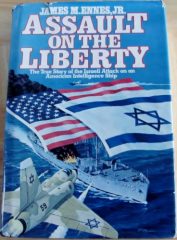
Although numerous medals were issued to the survivors, word of the incident was totally suppressed by a complete blanket of secrecy, and in an unprecedented step, even a Congressional Medal of Honor was awarded only in a private ceremony. The survivors were also harshly threatened with immediate court martial if they discussed what had transpired with the press or anyone else. Despite the overwhelming evidence that the attack had been intentional, a naval court of inquiry presided over by Admiral John S. McCain, Jr., father of the current senator, whitewashed the incident as a tragic accident, and a complete media blackout suppressed the facts. The true story only began to come out years later, when James M. Ennes, Jr., a Liberty survivor, risked severe legal consequences and published Assault on the Liberty in 1979 .
As it happened, NSA intercepts of Israeli communications between the attacking jets and Tel Aviv, translated from the Hebrew, fully confirmed that the attack had been entirely deliberate, and since many of the dead and wounded were NSA employees, the suppression of these facts greatly rankled their colleagues. My old friend Bill Odom, the three-star general who ran the NSA for Ronald Reagan, later shrewdly circumvented the restrictions of his political masters by making those incriminating intercepts part of the standard curriculum of the Sigint training program required for all intelligence officers.
In 2007 an unusual set of circumstances finally broke the thirty year blackout in the mainstream media. Real estate investor Sam Zell, a Jewish billionaire extremely devoted to Israel, had orchestrated a leveraged-buyout of the Tribune Company, parent of the Los Angeles Times and the Chicago Tribune, investing merely a sliver of his own money, with the bulk of the financing coming from the pension funds of the company he was acquiring. Widely heralded as “the grave dancer” for his shrewd financial investments, Zell publicly boasted that the deal gave him nearly all of the upside potential of the company, while he bore relatively little of the risk. Such an approach proved wise since the complex deal quickly collapsed into bankruptcy, and although Zell emerged almost unscathed, the editors and journalists lost decades of their accumulated pension dollars, while massive layoffs soon devastated the newsrooms of what had been two of the country’s largest and most prestigious newspapers. Perhaps coincidentally, just as this business turmoil hit in late 2007, the Tribune ran a massive 5,500 word story on the Liberty attack, representing the first and only time such a comprehensive account of the true facts has ever appeared in the mainstream media.
By all accounts, Johnson was an individual of towering personal ego, and when I read the article, I was struck by the extent of his astonishing subservience to the Jewish state. The influence of campaign donations and favorable media coverage seemed completely insufficient to explain his reaction to an incident that had cost the lives of so many American servicemen. I began to wonder if Israel might have played an extraordinarily powerful political trump-card, thereby showing LBJ “who was really boss,” and once I discovered the reality of the JFK assassination conspiracy a year or two later, I suspected I knew what that trump-card might have been. Over the years, I had become quite friendly with the late Alexander Cockburn, and the next time we had lunch I outlined my ideas. Although he had always casually dismissed JFK conspiracy theories as total nonsense, he found my hypothesis quite intriguing.
Regardless of such speculation, the strange circumstances of the Liberty incident certainly demonstrated the exceptionally close relationship between President Johnson and the government of Israel, as well as the willingness of the mainstream media to spend decades hiding events of the most remarkable nature if they might tread on particular toes.
These important considerations should be kept in mind as we begin exploring the most explosive yet under-reported theory of the JFK assassination. Almost twenty-five years ago the late Michael Collins Piper published Final Judgment presenting a very large body of circumstantial evidence that Israel and its Mossad secret intelligence service, together with their American collaborators, probably played a central role in the conspiracy.
For decades following the 1963 assassination, virtually no suspicions had ever been directed towards Israel, and as a consequence none of the hundreds or thousands of assassination conspiracy books that appeared during the 1960s, 1970s, and 1980s had hinted at any role for the Mossad, though nearly every other possible culprit, ranging from the Vatican to the Illuminati, came under scrutiny. Kennedy had received over 80% of the Jewish vote in his 1960 election, American Jews featured very prominently in his White House, and he was greatly lionized by Jewish media figures, celebrities, and intellectuals ranging from New York City to Hollywood to the Ivy League. Moreover, individuals with a Jewish background such as Mark Lane and Edward Epstein had been among the leading early proponents of an assassination conspiracy, with their controversial theories championed by influential Jewish cultural celebrities such as Mort Sahl and Norman Mailer. Given that the Kennedy Administration was widely perceived as pro-Israel, there seemed no possible motive for any Mossad involvement, and bizarre, totally unsubstantiated accusations of such a monumental nature directed against the Jewish state were hardly likely to gain much traction in an overwhelmingly pro-Israel publishing industry.

However, in the early 1990s highly-regarded journalists and researchers began exposing the circumstances surrounding the development of Israel’s nuclear weapons arsenal. Seymour Hersh’s 1991 book The Samson Option: Israel’s Nuclear Arsenal and American Foreign Policy described the extreme efforts of the Kennedy Administration to force Israel to allow international inspections of its allegedly non-military nuclear reactor at Dimona, and thereby prevent its use in producing nuclear weapons. Dangerous Liaisons: The Inside Story of the U.S.-Israeli Covert Relationship by Andrew and Leslie Cockburn appeared in the same year, and covered similar ground.
Although entirely hidden from public awareness at the time, the early 1960s political conflict between the American and Israeli governments over nuclear weapons development had represented a top foreign policy priority of the Kennedy Administration, which had made nuclear non-proliferation one of its central international initiatives. It is notable that John McCone, Kennedy’s choice as CIA Director, had previously served on the Atomic Energy Commission under Eisenhower, being the individual who leaked the fact that Israel was building a nuclear reactor to produce plutonium.
The pressure and financial aid threats secretly applied to Israel by the Kennedy Administration eventually became so severe that they led to the resignation of Israel’s founding Prime Minister David Ben-Gurion in June 1963. But all these efforts were almost entirely halted or reversed once Kennedy was replaced by Johnson in November of that same year. Piper notes that Stephen Green’s 1984 book Taking Sides: America’s Secret Relations With a Militant Israel had previously documented that U.S. Middle East Policy completely reversed itself following Kennedy’s assassination, but this important finding had attracted little attention at the time.
Skeptics of a plausible institutional basis for a JFK assassination conspiracy have often noted the extreme continuity in both foreign and domestic policies between the Kennedy and Johnson Administrations, arguing that this casts severe doubt on any such possible motive. Although this analysis seems largely correct, America’s behavior towards Israel and its nuclear weapons program stands as a very notable exception to this pattern.
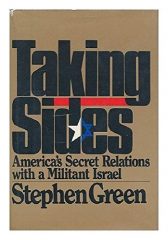
An additional major area of concern for Israeli officials may have involved the efforts of the Kennedy Administration to sharply restrict the activities of pro-Israel political lobbies. During his 1960 presidential campaign, Kennedy had met in New York City with a group of wealthy Israel advocates, led by financier Abraham Feinberg, and they had offered enormous financial support in exchange for a controlling influence in Middle Eastern policy. Kennedy managed to fob them off with vague assurances, but he considered the incident so troubling that the next morning he sought out journalist Charles Bartlett, one of his closest friends, and expressed his outrage that American foreign policy might fall under the control of partisans of a foreign power, promising that if he became president, he would rectify that situation. And indeed, once he had installed his brother Robert as Attorney General, the latter initiated a major legal effort to force pro-Israel groups to register themselves as foreign agents, which would have drastically reduced their power and influence. But after JFK’s death, this project was quickly abandoned, and as part of the settlement, the leading pro-Israel lobby merely agreed to reconstitute itself as AIPAC.
Final Judgment went through a number of a reprintings following its original 1994 appearance, and by the sixth edition released in 2004, had grown to over 650 pages, including numerous long appendices and over 1100 footnotes, the overwhelming majority of these referencing fully mainstream sources. The body of the text was merely serviceable in organization and polish, reflecting the total boycott by all publishers, mainstream or alternative, but I found the contents themselves remarkable and generally quite compelling. Despite the most extreme blackout by all media outlets, the book sold more than 40,000 copies over the years, making it something of an underground bestseller, and surely bringing it to the attention of everyone in the JFK assassination research community, though apparently almost none of them were willing to mention its existence. I suspect these other writers realized that even any mere acknowledgement of the existence of the book, if only to ridicule or dismiss it, might prove fatal to their media and publishing career. Piper himself died in 2015, aged 54, suffering from the health problems and heavy-drinking often associated with grim poverty, and other journalists may have been reluctant to risk that same dismal fate.
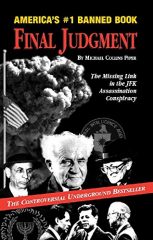
As an example of this strange situation, the bibliography of Talbot’s 2005 book contains almost 140 entries, some rather obscure, but has no space for Final Judgment, nor does his very comprehensive index include any entry for “Jews” or “Israel.” Indeed, at one point he very delicately characterizes Sen. Robert Kennedy’s entirely Jewish senior staff by stating “There was not a Catholic among them.” His 2015 sequel is equally circumspect, and although the index does contain numerous entries pertaining to Jews, all these references are in regards to World War II and the Nazis, including his discussion of the alleged Nazi ties of Allen Dulles, his principal bête noire. Stone’s book, while fearlessly convicting President Lyndon Johnson of the JFK assassination, also strangely excludes “Jews” and “Israel” from the long index and Final Judgment from the bibliography, and Douglass’s book follows this same pattern.
Furthermore, the extreme concerns that the Piper Hypothesis seems to have provoked among JFK assassination researchers may explain a strange anomaly. Although Mark Lane was himself of Jewish origins and left-wing roots, after his victory for Liberty Lobby in the Hunt libel trial, he spent many years associated with that organization in a legal capacity, and apparently became quite friendly with Piper, one of its leading writers. According to Piper, Lane told him that Final Judgment made “a solid case” for a major Mossad role in the assassination, and he viewed the theory as fully complementary to his own focus on CIA involvement. I suspect that concerns about these associations may explain why Lane was almost completely airbrushed out of the Douglass and 2007 Talbot books, and discussed in the second Talbot book only when his work was absolutely essential to Talbot’s analysis. By contrast, New York Times staff writers are hardly likely to be as versed in the lesser-known aspects of the JFK assassination research community, and being ignorant of this hidden controversy, they gave Lane the long and glowing obituary that his career fully warranted.
When weighing the possible suspects for a given crime, considering their past pattern of behavior is often a helpful approach. As discussed above, I can think of no historical example in which organized crime initiated a serious assassination attempt against any American political figure even moderately prominent on the national stage. And despite a few suspicions here and there, the same applies to the CIA.
By contrast, the Israeli Mossad and the Zionist groups that preceded the establishment of the Jewish state seem to have a very long track record of assassinations, including those of high-ranking political figures who might normally be regarded as inviolate. Lord Moyne, the British Minister of State for the Middle East, was assassinated in 1944 and Count Folke Bernattote, the UN Peace Negotiator sent to help resolve the first Arab-Israel war suffered the same fate in September 1948. Not even an American president was entirely free of such risks, and Piper notes that the memoirs of Harry Truman’s daughter Bess reveal that Zionist militants had tried to assassinate her father using a letter laced with toxic chemicals in 1947 when they believed he was dragging his heels in supporting Israel, although that failed attempt was never made public. The Zionist faction responsible for all of these incidents was led by Yitzhak Shamir, who later became a leader of Mossad and director of its assassination program during the 1960s, before eventually becoming Prime Minister of Israel in 1986.
If the claims in the 1990s tell-all bestsellers of Mossad defector Victor Ostrovsky can be credited, Israel even considered the assassination of President George H.W. Bush in 1992 for his threats to cut off financial aid to Israel during a conflict over West Bank settlement policies, and I have been informed that the Bush Administration took those reports seriously at the time. And although I have not yet read it, the recent, widely-praised book Rise and Kill First: The Secret History of Israel’s Targeted Assassinations by journalist Ronen Bergman suggests that no other country in the world may have so regularly employed assassination as a standard tool of state policy.
There are other notable elements that tend to support the Piper Hypothesis. Once we accept the existence of a JFK assassination conspiracy, the one individual who is virtually certain to have been a participant was Jack Ruby, and his organized crime ties were almost entirely to the huge but rarely-mentioned Jewish wing of that enterprise, presided over by Meyer Lansky, an extremely fervent supporter of Israel. Ruby himself had particularly strong ties with Lansky lieutenant Mickey Cohen, who dominated the Los Angeles underworld and had been personally involved in gun-running to Israel prior to the 1948 war. Indeed, according to Dallas rabbi Hillel Silverman, Ruby had privately explained his killing of Oswald by saying “I did it for the Jewish people.”
An intriguing aspect to Oliver Stone’s landmark JFK film should also be mentioned. Arnon Milchan, the wealthy Hollywood producer who backed the project, was not only an Israeli citizen, but had also reportedly played a central role in the enormous espionage project to divert American technology and materials to Israel’s nuclear weapons project, the exact undertaking that the Kennedy Administration had made such efforts to block, even sometimes being described as “the Israeli James Bond.” And although the film ran a full three hours in length, JFK scrupulously avoided presenting any of the details that Piper later regarded as initial clues to an Israeli dimension, instead seeming to finger America’s fanatic home-grown anti-Communist movement and the Cold War leadership of the military-industrial complex as the guilty parties.
Summarizing over 300,000 words of Piper’s history and analysis in just a few paragraphs is obviously an impossible undertaking, but the above discussion provides a reasonable taste of the enormous mass of circumstantial evidence mustered in favor of the Piper Hypothesis.
In many respects, JFK Assassination Studies has become its own academic discipline, and my credentials are quite limited. I have read perhaps a dozen books in the subject, and have also tried to approach the issues with the clean slate and fresh eyes of an outsider, but any serious expert would surely have digested scores or even hundreds of the volumes in the field. While the overall analysis of Final Judgment struck me as quite persuasive, a good fraction of the names and references were unfamiliar, and I simply do not have the background to assess their credibility, nor whether the description of the material presented is accurate.
Under normal circumstances, I would turn to the reviews or critiques produced by other authors, and comparing them against Piper’s arguments, decide which argument seemed the stronger. But although Final Judgment was published a quarter-century ago, the near-absolute blanket of silence surrounding the Piper Hypothesis, especially from the more influential and credible researchers, renders this impossible.
However, Piper’s inability to secure any regular publisher and the widespread efforts to smother his theory out of existence, have had an ironic consequence. Since the book went out of print years ago, I had a relatively easy time securing the rights to include it in my collection of controversial HTML Books, and I have now done so, thereby allowing everyone on the Internet to conveniently read the entire text and decide for themselves, while easily checking the multitude of references or searching for particular words or phrases.
The Missing Link in the JFK Assassination Conspiracy
Michael Collins Piper • 2005 • 310,000 Words
This edition actually incorporates several much shorter works, originally published separately. One of these, consisting of an extended Q&A, describes the genesis of the idea and answers numerous questions surrounding it, and for some readers may represent a better starting point.
Questions, Answers & Reflections About the Crime of the Century
Michael Collins Piper • 2005 • 48,000 Words
There are also numerous extended Piper interviews or presentations easily available on YouTube, and when I watched two or three of them a couple of years ago, I thought he effectively summarized many of his main arguments, but I cannot remember which ones they were.
The Kennedy assassination surely ranks as one of the most dramatic and heavily reported events of the twentieth century, yet the overwhelming evidence that our president died at the hands of a conspiracy rather than an eccentric “lone gunman” was almost entirely suppressed by our mainstream media during the decades that followed, with endless ridicule and opprobrium heaped on many of the stubborn truth-tellers. Indeed, the very term “conspiracy theory” soon became a standard slur aimed against all those who sharply questioned establishmentarian narratives, and there is strong evidence that such pejorative use was deliberately promoted by government agencies concerned that so much of the American citizenry was growing skeptical of the implausible cover story presented by the Warren Commission. But despite all these efforts, this period may mark the inflection point at which public trust in our national media began its precipitous decline. Once an individual concludes that the media lied about something as enormous as the JFK assassination, he naturally begins to wonder what other lies may be out there.
Although I now consider the case for an assassination conspiracy overwhelming, I think that the passage of so many decades has removed any real hope of reaching a firm conclusion about the identities of the main organizers or their motives. Those who disagree with this negative assessment are free to continue sifting the enormous mountain of complex historical evidence and debating their conclusions with others having similar interests.
However, among the cast of major suspects, I think that the most likely participant by far was Lyndon Johnson, based on any reasonable assessment of means, motive, and opportunity, as well as the enormous role he obviously must have played in facilitating the subsequent Warren Commission cover-up. Yet although such an obvious suspect must surely have been immediately apparent to any observer, Johnson seems to have received only a rather thin slice of the attention that books regularly directed to other, far less plausible suspects. So the clear dishonesty of the mainstream media in avoiding any recognition of a conspiracy seems matched by a second layer of dishonesty in the alternative media, which has done its best to avoid recognizing the most likely perpetrator.
And the third layer of media dishonesty is the the most extreme of all. A quarter century ago, Final Judgment provided an enormous mass of circumstantial evidence suggesting a major, even dominant, role for the Israeli Mossad in organizing the elimination of both our 33rd president and also his younger brother, a scenario that seems second in likelihood only to that of Johnson’s involvement. Yet Piper’s hundreds of thousands of words of analysis have seemingly vanished into the ether, with very few of the major conspiracy researchers even willing to admit their awareness of a shocking book that sold over 40,000 copies, almost entirely by underground word-of-mouth.
So although committed partisans can continue endless, largely fruitless debates over “Who Killed JFK,” I think that the one firm conclusion we can draw from the remarkable history of this pivotal event of the twentieth century is that all of us have lived for many decades within the synthetic reality of “Our American Pravda.”
Related Reading:
- American Pravda: The JFK Assassination, Part I – What Happened?
- Final Judgment by Michael Collins Piper
- Did Israel Kill the Kennedys? by Laurent Guyénot
- Our American Pravda
The Liberal’s Lament over Israel
By James J. Zogby | LobeLog | June 18, 2018
I find it exceptionally irritating when I hear liberals worry about whether Israel will be able to remain a “Jewish and Democratic State” if it retains control of occupied Palestinian lands. It’s irritating because Israel is not now a democratic state nor has it ever tried to be one.
A state that prioritizes rights for one group of citizens (in this case Jews, who comprise 80% of the population) over the rights of another group (Arabs, who are 20% of Israel’s citizenry) cannot be democratic. Israel discriminates against its Arab citizens in law, social services, funding for education, and in everyday life. So although the concerns of liberals in the West are about the future of Israeli democracy, what they ignore is the reality of Israel, in practice.
 As I document in my book, Palestinians: the Invisible Victims, from its inception in 1948, Israel has guaranteed rights and opportunities for Jews at the expense of the indigenous Palestinians who remained after the Nakba. Instead of experiencing democracy, these Arabs were subjected to harsh military law, as a result of which they were denied fundamental human and civil rights. Their lands and businesses were confiscated. And they were even denied the opportunity to join the labor movement, or form independent political parties.
During the past 70 years, these Palestinian Arab citizens of Israel have made significant advances as they organized and fought to expand their rights. But as two stories that have appeared recently in the Israeli media make clear, the contradiction inherent in being a democracy and a Jewish state continues to plague Israel.
In the first story, the leadership of the Knesset disqualified a proposed piece of legislation offered by a group of Arab legislators. The bill “Basic Law: Israel, a State of All Its Citizens” sought to guarantee equal rights for all Israelis—Jews and Arabs alike.
Apparently the Knesset leaders were so threatened by this bill that they were unwilling to even allow it to be introduced and debated. At the same time, however, Jewish members of the body are advancing another piece of legislation that defines Israel as the “national state of the Jewish People,” making it clear that Arabs are at best, second-class citizens.
In another story, Jewish residents of Afula, a town in Northern Israel, demonstrated against the proposed sale of a home in their community to an Arab family. The flyer, mobilizing Afula residents to come to the demonstration, criticized “the sale of homes to those who are undesirable in the neighborhood.” The former mayor of the community is quoted in the story saying “the residents of Afula don’t want a mixed city, but rather a Jewish city, and it’s their right.”
This is the impact of the apartheid system that Israel established to govern the lives of its Arab citizens. Since 1948, Israel not only confiscated lands surrounding Arab towns and villages to make way for Jewish agriculture and development, it denied Arabs the right to purchase land and homes in Jewish communities. Reflecting how this history has led to the demonstration in Afula, the leader of the Arab bloc in the Knesset said, “It is not a surprise that in a country that has founded 700 towns for Jews and not even one for Arabs, the idea that Arabs should be pushed aside does not shock citizens… our hope of living together is crumbling due to hatred and racism fueled by the government.”
Meanwhile, in the West Bank, Israel appears to be preparing a similar fate for the Palestinians living under occupation. Continuing the practice the Israelis instituted in the Galilee region, they have been slowly and steadily concentrating captive West Bank Palestinians into enclaves, denying them access to their land and in some cases, evicting them from their communities. One recent case reported in the Israeli press involves a Supreme Court decision allowing the state to demolish the West Bank community of Khan al Ahmar and to forcibly relocate “its citizens to a site near a dumpster in Abu Dis”—a Palestinian community near occupied East Jerusalem. At risk are Khan al Ahmar’s 173 residents and the community’s school that serves 150 youngsters from there, and neighboring villages. This is one of four recent forced evictions to clear areas of Palestinians in order to consolidate Israeli control.
These three stories combined have two things in common. On the one hand, they establish that it is a contradiction in terms to consider that Israel can be both Jewish and democratic at the same time. Liberals therefore can stop fretting about the danger facing Israeli democracy in the future. It already is, in practice, an apartheid state.
Next to consider is the fact that none of these stories made it into the U.S. press and so I suppose I can almost understand the Western liberal’s lament. Since they just don’t know how Israel behaves, they have no idea that the future they fear, is already here.
James J. Zogby is the president of the Arab American Institute.
American Pravda: The JFK Assassination, Part I – What Happened?
By Ron Unz • Unz Review • June 18, 2018
About a decade ago, I got a Netflix subscription and was amazed that the Internet now provided immediate access to so many thousands of movies on my own computer screen. But after a week or two of heavy use and the creation of a long watch-list of prospective films I’d always wanted to see, my workload gained the upper hand, and I mostly abandoned the system.
Back then, nearly all Netflix content was licensed from the major studios and depending upon contract negotiations might annually disappear, so when I happened to browse my account again in December, I noticed that a couple of films on my selection list included warning notices saying they would no longer be available on January 1st. One of these was Oliver Stone’s famous 1991 film JFK, which had provoked quite a stir at the time, so thinking now or never, I clicked the Play button, and spent three hours that evening watching the Oscar winner.
Most of the plot seemed bizarre and outlandish to me, with the president’s killing in Dallas supposedly having been organized by a cabal of militantly anti-Communist homosexuals, somehow connected with both the CIA and the mafia, but based in New Orleans. Kevin Costner starred as a crusading District Attorney named Jim Garrison—presumably fictional—whose investigation broke the assassination conspiracy wide open before the subtle tentacles of the Deep State finally managed to squelch his prosecution; or at least that’s what I vaguely remember from my single viewing. With so many implausible elements, the film confirmed my belief in the wild imagination of Hollywood scriptwriters and also demonstrated why no one with any common sense had ever taken seriously those ridiculous “JFK conspiracy theories.”
Despite its dramatic turns, the true circumstances of President John F. Kennedy’s death seemed an island of sanity by comparison. Lee Harvey Oswald, a disgruntled young marine had defected to the USSR in 1959 and finding life behind the Iron Curtain equally unsatisfactory, returned to America a couple of years later. Still having confused Marxist sympathies, he’d joined public protests supporting Fidel Castro’s Cuba, and gradually turning toward violence, purchased a mail-order rifle. During the presidential visit, he had fired three shots from the Dallas School Book Depository, killing JFK, and was quickly apprehended by the local police. Soon, he too was dead, shot by an outraged Kennedy supporter named Jack Ruby. All these sad facts were later confirmed by the Warren Commission in DC, presided over by the U.S. Chief Justice together with some of America’s most respected public figures, and their voluminous report ran nearly 900 pages.
Yet although the film seemed to have affixed an enormous mass of incoherent fictional lunacy on top of that basic history—why would a murder plot in Dallas have been organized in New Orleans, five hundred miles distant?—one single detail troubled me. Garrison is shown denouncing the “lone gunman theory” for claiming that a single bullet was responsible for seven separate wounds in President Kennedy and Texas Gov. John Connolly, seated beside him in the limousine. Now inventing gay CIA assassins seems pretty standard Hollywood fare, but I found it unlikely that anyone would ever insert a fictional detail so wildly implausible as that bullet’s trajectory. A week or so later, the memory popped into my head, and I googled around a bit, discovering to my total astonishment that the seven-wounds-from-one-bullet claim was totally factual, and indeed constituted an absolutely essential element of the orthodox “single gunman” framework given that Oswald had fired at most three shots. So that was the so-called “Magic Bullet” I’d occasionally seen conspiracy-nuts ranting and raving about. For the first time in my entire life, I started to wonder whether maybe, just maybe there actually had been some sort of conspiracy behind the most famous assassination in modern world history.
Any conspirators had surely died of old age many years or even decades earlier and I was completely preoccupied with my own work, so investigating the strange circumstances of JFK’s death was hardly a high personal priority. But the suspicions remained in the back of my mind as I diligently read my New York Times and Wall Street Journal every morning while periodically browsing less reputable websites during the afternoon and evening. And as a result, I now began noticing little items buried here and there that I would have previously ignored or immediately dismissed, and these strengthened my newly emerging curiosity.
Among other things, occasional references reminded me that I’d previously seen my newspapers discuss a couple of newly released JFK books in rather respectful terms, which had surprised me a bit at the time. One of them, still generating discussion, was JFK and the Unspeakable published in 2008 by James W. Douglass, whose name meant nothing to me. And the other, which I hadn’t originally realized trafficked in any assassination conspiracies, was David Talbot’s 2007 Brothers: The Hidden History of the Kennedy Years, focused on the relationship between John F. Kennedy and his younger brother Robert. Talbot’s name was also somewhat familiar to me as the founder of Salon.com and a well-regarded if liberal-leaning journalist.
None of us have expertise in all areas, so sensible people must regularly delegate their judgment to credible third-parties, relying upon others to distinguish sense from nonsense. Since my knowledge of the JFK assassination was nil, I decided that two recent books attracting newspaper coverage might be a good place to start. So perhaps a couple of years after watching that Oliver Stone film, I cleared some time in my schedule, and spent a few days carefully reading the combined thousand pages of text.
I was stunned at what I immediately discovered. Not only was the evidence of a “conspiracy” absolutely overwhelming, but whereas I’d always assumed that only kooks doubted the official story, I instead discovered that a long list of the most powerful people near the top of the American government and in the best position to know had been privately convinced of such a “conspiracy,” in many cases from almost the very beginning.
The Talbot book especially impressed me, being based on over 150 personal interviews and released by The Free Press, a highly reputable publisher. Although he applied a considerable hagiographic gloss to the Kennedys, his narrative was compellingly written, with numerous gripping scenes. But while such packaging surely helped to explain some of the favorable treatment from reviewers and how he had managed to produce a national bestseller in a seemingly long-depleted field, for me the packaging was much less important than the product itself.
To the extent that notions of a JFK conspiracy had ever crossed my mind, I’d considered the argument from silence absolutely conclusive. Surely if there had been the slightest doubt of the “lone gunman” conclusion endorsed by the Warren Commission, Attorney-General Robert Kennedy would have launched a full investigation to avenge his slain brother.
But as Talbot so effectively demonstrates, the reality of the political situation was entirely different. Robert Kennedy may have begun that fatal morning widely regarded as the second most powerful man in the country, but the moment his brother was dead and his bitter personal enemy Lyndon Johnson sworn in as the new president, his governmental authority almost immediately ebbed away. Longtime FBI Director J. Edgar Hoover, who had been his hostile subordinate, probably scheduled for removal in JFK’s second term, immediately became contemptuous and unresponsive to his requests. Having lost all his control over the levels of power, Robert Kennedy lacked any ability to conduct a serious investigation.
According to numerous personal interviews, he had almost immediately concluded that his brother had been struck down at the hands of an organized group, very likely including elements from within the U.S. government itself, but he could do nothing about the situation. As he regularly confided to close associates, his hope at the age of 38 was to reach the White House himself at some future date, and with his hands once again upon the levels of power then uncover his brother’s killers and bring them to justice. But until that day, he could do nothing, and any unsubstantiated accusations he made would be totally disastrous both for national unity and for his own personal credibility. So for years, he was forced to nod his head and publicly acquiesce to the official story of his brother’s inexplicable assassination at the hands of a lone nut, a fairy tale publicly endorsed by nearly the entire political establishment, and this situation deeply gnawed at him. Moreover, his own seeming acceptance of that story was often interpreted by others, not least in the media, as his wholehearted endorsement.
Although discovering Robert Kennedy’s true beliefs was a crucial revelation in the Talbot book, there were many others. At most three shots had allegedly come from Oswald’s rifle, but Roy Kellerman, the Secret Service agent in the passenger seat of JFK’s limousine, was sure there had been more than that, and to the end of his life always believed there had been additional shooters. Gov. Connolly, seated next to JFK and severely wounded in the attack, had exactly the same opinion. CIA Director John McCone was equally convinced that there had been multiple shooters. Across the pages of Talbot’s book, I learned that dozens of prominent, well-connected individuals privately expressed extreme skepticism towards the official “lone gunman theory” of the Warren Commission, although such doubts were very rarely made in public or on the record.
For a variety of complex reasons, the leading national media organs—the commanding heights of “Our American Pravda”—almost immediately endorsed the “lone gunman theory” and with some exceptions generally maintained that stance throughout the next half-century. With few prominent critics willing to publicly dispute that idea and a strong media tendency to ignore or minimize those exceptions, casual observers such as myself had generally received a severely distorted view of the situation.
If the first two dozen pages of the Talbot book completely overturned my understanding of the JFK assassination, I found the closing section almost equally shocking. With the Vietnam War as a political millstone about his neck, President Johnson decided not to seek reelection in 1968, opening the door to a last minute entry into the Democratic race by Robert Kennedy, who overcame considerable odds to win some important primaries. Then on June 4, 1968, he carried gigantic winner-take-all California, placing him on an easy path to the nomination and the presidency itself, at which point he would finally be in a position to fully investigate his brother’s assassination. But minutes after his victory speech, he was shot and fatally wounded, allegedly by another lone gunman, this time a disoriented Palestinian immigrant named Sirhan Sirhan, supposedly outraged over Kennedy’s pro-Israel public positions although these were no different than those expressed by most other political candidates in America.
All this was well known to me. However, I had not known that powder burns later proved that the fatal bullet had been fired directly behind Kennedy’s head from a distance of three inches or less although Sirhan was standing several feet in front of him. Furthermore, eyewitness testimony and acoustic evidence indicated that at least twelve bullets were fired although Sirhan’s revolver could hold only eight, and a combination of these factors led longtime LA Coroner Dr. Thomas Naguchi, who conducted the autopsy, to claim in his 1983 memoir that there was likely a second gunman. Meanwhile, eyewitnesses also reported seeing a security guard with his gun drawn standing right behind Kennedy during the attack, and that individual happened to have a deep political hatred of the Kennedys. The police investigators seemed uninterested in these highly suspicious elements, none of which came to light during the trial. With two Kennedy brothers now dead, neither any surviving member of the family nor most of their allies and retainers had any desire to investigate the details of this latest assassination, and in a number of cases they soon moved overseas, abandoning the country entirely. JFK’s widow Jackie confided in friends that she was terrified for the lives of her children, and quickly married Aristotle Onassis, a Greek billionaire, whom she felt would be able to protect them.
Talbot also devotes a chapter to the late 1960s prosecution efforts of New Orleans DA Jim Garrison, which had been the central plot of the JFK film, and I was stunned to discover that the script was almost entirely based on real life events rather than Hollywood fantasy. This even extended to its bizarre cast of assassination conspiracy suspects, mostly fanatically anti-Communist Kennedy-haters with CIA and organized crime ties, some of whom were indeed prominent members of the New Orleans gay demimonde. Sometimes real life is far stranger than fiction.
Taken as a whole, I found Talbot’s narrative quite convincing, at least with respect to demonstrating the existence of a substantial conspiracy behind the fatal event.
Others certainly had the same reaction, with the august pages of The New York Times Sunday Book Review carrying the strongly favorable reaction of presidential historian Alan Brinkley. As the Allan Nevins Professor of History and Provost of Columbia University, Brinkley is as mainstream and respectable an academic scholar as might be imagined and he characterized Talbot as
the latest of many intelligent critics who have set out to demolish the tottering credibility of the Warren Commission and draw attention to evidence of a broad and terrible conspiracy that lay behind the assassination of John Kennedy — and perhaps the murder of Robert Kennedy as well.
The other book by Douglass, released a year later, covered much the same ground and came to roughly similar conclusions, with substantial overlap but also including major additional elements drawn from the enormous volume of extremely suspicious material unearthed over the decades by diligent JFK researchers. Once again, the often bitter Cold War era conflict between JFK and various much harder-line elements of his government over Cuba, Russia, and Vietnam is sketched out as the likely explanation for his death.
Summarizing a half-century of conspiracy research, the Talbot and Douglass books together provide a wealth of persuasive evidence that elements of organized crime, individuals with CIA connections, and anti-Castro Cubans were probably participants in the assassination plot. Oswald seems to have been working with various anti-Communist groups and also had significant connections to U.S. intelligence, while his purported Marxism was merely a very thin disguise. With regard to the assassination itself, he was exactly the “patsy” he publicly claimed to be, and very likely never fired a single shot. Meanwhile, Jack Ruby had a long history of ties to organized crime, and surely killed Oswald to shut his mouth.
Many others may have suffered a similar fate. Conspirators daring enough to strike at the president of the United States would hardly balk at using lethal means to protect themselves from the consequences of their action, and over the years a considerable number of individuals associated with the case in one way or another came to untimely ends.
Less than a year after the assassination, JFK mistress Mary Meyer, the ex-wife of high-ranking CIA official Cord Meyer, was found shot to death in a Washington DC street-killing with no indications of attempted robbery or rape, and the case was never solved. Immediately afterwards, CIA counterintelligence chief James Jesus Angelton was caught breaking into her home in search of her personal diary, which he later claimed to have destroyed.
Dorothy Kilgallen was a nationally-syndicated newspaper columnist and television personality, and she managed to wrangle an exclusive interview with Jack Ruby, later boasting to her friends that she would break the JFK assassination case wide open in her new book, producing the biggest scoop of her career. Instead, she was found dead in her Upper East Side townhouse, having apparently succumbed to an overdose of alcohol and sleeping pills, with both the draft text and the notes to her Jack Ruby chapter missing.
Shortly before Jim Garrison filed his assassination charges, his top suspect David Ferrie was found dead at age 48, possibly of natural causes, though the DA suspected foul play.
During the mid-1970s, the House Select Committee on Assassinations held a series of high-profile hearings to reopen and investigate the case, and two of the witnesses called were high-ranking mafia figures Sam Giancana and Johnny Rosselli, widely suspected of having been connected with the assassination. The former was shot to death in the basement of his home one week before he was scheduled to testify, and the body of the latter was found in an oil-drum floating in the waters off Miami after he had been subpoenaed for an additional appearance.
These were merely a few of the highest-profile individuals with a connection to the Dallas assassination whose lives were cut short in the years that followed, and although the deaths may have been purely coincidental, the full list is rather a long one.
Having read a couple of books that completely upended my settled beliefs about a central event of twentieth century America, I simply didn’t know what to think. Over the years, my own writings had put me on friendly terms with a well-connected individual whom I considered a member of the elite establishment, and whose intelligence and judgment had always seemed extremely solid. So I decided to very gingerly raise the subject with him, and see whether he had ever doubted the “lone gunman” orthodoxy. To my total astonishment, he explained that as far back as the early 1990s, he’d become absolutely convinced in the reality of a “JFK conspiracy” and over the years had quietly devoured a huge number of the books in that field, but had never breathed a word in public lest his credibility be ruined and his political effectiveness destroyed.
A second friend, a veteran journalist known for his remarkably courageous stands on certain controversial topics, provided almost exactly the same response to my inquiry. For decades, he’d been almost 100% sure that JFK had died in a conspiracy, but once again had never written a word on the topic for fear that his influence would immediately collapse.
If these two individuals were even remotely representative, I began to wonder whether a considerable fraction, perhaps even a majority, of the respectable establishment had long harbored private beliefs about the JFK assassination that were absolutely contrary to the seemingly uniform verdict presented in the media. But with every such respectable voice keeping so silent, I had never once suspected a thing.
Few other revelations in recent years have so totally overturned my understanding of the framework of reality. Even a year or two later, I still found it very difficult to wrap my head around the concept, as I described in another note to that well-connected friend of mine:
BTW, I hate to keep harping on it, but every time I consider the implications of the JFK matter I’m just more and more astonished.
The president of the US. The heir to one of the wealthiest and most powerful families in America. His brother the top law enforcement officer in the country. Ben Bradlee, one of his closest friends, the fearless crusading editor of one of the nation’s most influential media outlets. As America’s first Catholic president, the sacred icon of many millions of Irish, Italian, and Hispanic families. Greatly beloved by top Hollywood people and many leading intellectuals.
His assassination ranks as one of the most shocking and dramatic events of the 20th century, inspiring hundreds of books and tens of thousands of news stories and articles, examining every conceivable detail. The argument from MSM silence always seemed absolutely conclusive to me.
From childhood, it’s always been obvious to me that the MSM is completely dishonest about certain things and over the last dozen years I’ve become extremely suspicious about a whole range of other issues. But if you’d asked me a couple of years ago whether JFK was killed by a conspiracy, I would have said “well, anything’s possible, but I’m 99% sure there’s absolutely no substantial evidence pointing in that direction since the MSM would surely have headlined it a million times over.”
Was there really a First World War? Well, I’ve always assumed there was, but who really knows?….
Our reality is shaped by the media, but what the media presents is often determined by complex forces rather than by the factual evidence in front of their eyes. And the lessons of the JFK assassination may provide some important insights into this situation.
A president was dead and soon afterward his supposed lone assassin suffered the same fate, producing a tidy story with a convenient endpoint. Raising doubts or focusing on contrary evidence might open doors better kept shut, perhaps endangering national unity or even risking nuclear war if the trail seemed to lead overseas. The highest law enforcement officer in the country was the slain president’s own brother, and since he seemed to fully accept that simple framework, what responsible journalist or editor would be willing to go against it? What American center of power or influence had any strong interest in opposing that official narrative?
Certainly there was immediate and total skepticism overseas, with few foreign leaders ever believing the story, and figures such as Nikita Khrushchev, Charles DeGaulle, and Fidel Castro all immediately concluded that a political plot had been responsible for Kennedy’s elimination. Mainstream media outlets in France and the rest of Western Europe were equally skeptical of the “lone gunman theory,” and some of the most important early criticism of U.S. government claims was produced by Thomas Burnett, an expatriate American writing for one of the largest French newsweeklies. But in pre-Internet days, only the tiniest sliver of the American public had regular access to such foreign publications, and their impact upon domestic opinion would have been nil.
Perhaps instead of asking ourselves why the “lone gunman” story was accepted, we should instead be asking why it was ever vigorously challenged, during an era when media control was extremely centralized in establishmentarian hands.
Oddly enough, the answer may lie in the determination of a single individual named Mark Lane, a left-liberal New York City attorney and Democratic Party activist. Although JFK assassination books eventually numbered in the thousands and the resulting conspiracy theories roiled American public life throughout the 1960s and 1970s, without his initial involvement matters might have followed a drastically different trajectory.
From the very first, Lane had been skeptical of the official story, and less than a month after the killing, The National Guardian, a small left-wing national newspaper, published his 10,000 word critique, highlighting major flaws in the “lone gunman theory.” Although his piece had been rejected by every other national periodical, the public interest was enormous, and once the entire edition sold out, thousands of extra copies were printed in pamphlet form. Lane even rented a theater in New York City, and for several months gave public lectures to packed audiences.
After the Warren Commission issued its completely contrary official verdict, he began working on a manuscript, and although he faced enormous obstacles in finding an American publisher, once Rush to Judgment appeared, it spent a remarkable two years on the national bestseller lists, easily reaching the #1 spot. Such tremendous economic success naturally persuaded a host of other authors to follow suit, and an entire genre was soon established. Lane later published A Citizens Dissent recounting his early struggles to break the total American “media blackout” against anyone contradicting the official conclusion. Against all odds, he had succeeded in sparking a massive popular uprising sharply challenging the narrative of the establishment.
According to Talbot, “By late 1966, it was becoming impossible for the establishment media to stick with the official story” and the November 25, 1966 edition of Life Magazine, then at the absolute height of its national influence, carried the remarkable cover story “Did Oswald Act Alone?” with the conclusion that he probably did not. The next month , The New York Times announced it was forming a special task force to investigate the assassination. These elements were to merge with the media furor soon surrounding the Garrison investigation that began the following year, an investigation that enlisted Lane as an active participant. However, behind the scenes a powerful media counterattack was also being launched at this same time.
In 2013 Prof. Lance deHaven-Smith, past president of the Florida Political Science Association, published Conspiracy Theory in America, a fascinating exploration of the history of the concept and the likely origins of the term itself. He noted that during 1966 the CIA had become alarmed at the growing national skepticism of the Warren Commission findings, especially once the public began turning its suspicious eyes toward the intelligence agency itself. Therefore, in January 1967 top CIA officials distributed a memo to all their local stations, directing them to employ their media assets and elite contacts to refute such criticism by various arguments, notably including an emphasis on Robert Kennedy’s supposed endorsement of the “lone gunman” conclusion.
This memo, obtained by a later FOIA request, repeatedly used the term “conspiracy” in a highly negative sense, suggesting that “conspiracy theories” and “conspiracy theorists” be portrayed as irresponsible and irrational. And as I wrote in 2016,
Soon afterward, there suddenly appeared statements in the media making those exact points, with some of the wording, arguments, and patterns of usage closely matching those CIA guidelines. The result was a huge spike in the pejorative use of the phrase, which spread throughout the American media, with the residual impact continuing right down to the present day.
This possible cause-and-effect relationship is supported by other evidence. Shortly after leaving The Washington Post in 1977, famed Watergate journalist Carl Bernstein published a 25,000 word Rolling Stone cover story entitled “The CIA and the Media” revealing that during the previous quarter century over 400 American journalists had secretly carried out assignments for the CIA according to documents on file at the headquarters of that organization. This influence project, known as “Operation Mockingbird,” had allegedly been launched near the end of the 1940s by high-ranking CIA official Frank Wisner, and included editors and publishers situated at the very top of the mainstream media hierarchy.
For whatever reason, by the time I came of age and began following the national media in the late 1970s, the JFK story had become very old news, and all the newspapers and magazines I read provided the very strong impression that the “conspiracy theories” surrounding the assassination were total nonsense, long since debunked, and only of interest to kooks on the ideological fringe. I was certainly aware of the enormous profusion of popular conspiracy books, but I never had the slightest interest in looking at any of them. America’s political establishment and its close media allies had outlasted the popular rebellion, and the name “Mark Lane” meant almost nothing to me, except vaguely as some sort of fringe-nut, who very occasionally rated a mention in my mainstream newspapers, receiving the sort of treatment accorded to Scientologists or UFO activists.
Oddly enough, Talbot’s treatment of Lane was also rather dismissive, recognizing his crucial early role in preventing the official narrative from quickly hardening into concrete, but also emphasizing his abrasive personality, and almost entirely ignoring his important later work on the issue, perhaps because so much of it had been conducted on the political fringe. Robert Kennedy and his close allies had similarly boycotted Lane’s work from the very first, regarding him as a meddlesome gadfly, but perhaps also ashamed that he was asking the questions and doing the work that they themselves were so unwilling to undertake at the time. Douglass’s 500 page book scarcely even mentions Lane.
Reading a couple of Lane’s books, I was quite impressed by the enormous role he had seemingly played in the JFK assassination story, but I also wondered how much of my impression may have been due to the exaggerations of a possible self-promoter. Then, on May 13, 2016 I opened my New York Times and found nearly a full page obituary devoted to Lane’s death at age 89, the sort of treatment these days reserved for only the highest-ranking U.S. Senators or major rap stars. And the 1,500 words were absolutely glowing, portraying Lane as a solitary, heroic figure struggling for decades to reveal the truth of the JFK assassination conspiracy against an entire political and media establishment seeking to suppress it.
I read this as a deep apology by America’s national newspaper of record. President John F. Kennedy was indeed killed by a conspiracy, and we are sorry we spent more than a half century suppressing that truth and ridiculing those who uncovered it.
Related Reading:
Anything Goes When You’re Saving the World
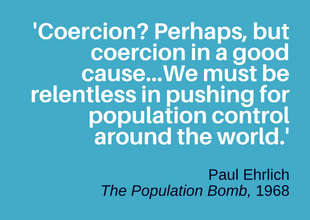
By Donna Laframboise | Big Picture News | May 30, 2018
SPOTLIGHT: Saving the world = barbaric behaviour.
BIG PICTURE: The paperback edition of biologist Paul Ehrlich’s 1968 bestseller, The Population Bomb, was 233 pages long. The first three chapters described a problem.
The final two chapters were titled “What Needs to be Done” and “What Can You Do?” They were followed by an Appendix of examples of letters readers might send to influential individuals. In other words, 83 pages of that book (more than a third) was an unabashedly political discussion.
These pages reiterated that the future was bleak. Overpopulation threatened America, the American way of life, and the “very lives” of US citizens (pp. 135, 138, 172, 180, 182).
The “only hope for survival,” was “drastic worldwide measures” lest civilization itself go “down the drain.” The “time of famines” had arrived (pp. 134, 143, 145, 148, 157-9, 161, 165, 198).
50 years later, we know Ehrlich’s apocalyptic predictions were wildly off target. Half a billion people did not starve to death during the 1970s. Instead, via ingenuity and technology, humanity grew more food and got better at transporting it to wherever it was desperately needed.
Americans weren’t forced to “slaughter” their dogs and cats so that pet food protein could be fed to the “starving masses.” Luxury taxes weren’t placed on diapers, and a powerful new arm of the US government wasn’t created to “take whatever steps are necessary,” in order to bring that country’s birth rate in line with its death rate. In 1968, there were 200 million Americans. Today, there are 326 million (pp. 134, 137-8).
Ehrlich’s fanaticism was on stark display when he described overpopulation as a cancer:
We must shift our efforts from treatment of the symptoms to the cutting out of the cancer. The operation will demand many apparently brutal and heartless decisions. The pain may be intense. But the disease is so far advanced that only with radical surgery does the patient have a chance of survival. (pp. 166-167)
In this regard, he declared that America should have pressured the Indian government to sterilize “all Indian males with three or more children”:
We should have volunteered logistic support in the form of helicopters, vehicles, and surgical instruments. We should have sent doctors to aid in the program…Coercion? Perhaps, but coercion in a good cause. (pp. 165-166)
TOP TAKEAWAY: Fifty years after The Population Bomb appeared, few people remember that it advocated dispatching US helicopters so that Indian peasants could be kidnapped & forcibly sterilized.
Massacres were indispensable to creation of the Israeli state
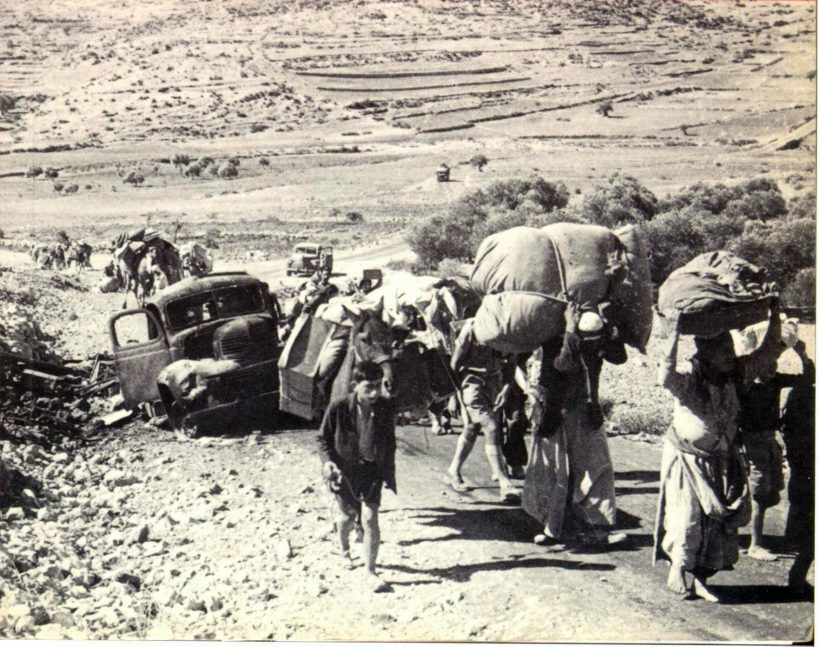
Palestinian refugees, 1948
By Richard Becker | Liberation School | May 29, 2018
As Israeli leaders and the Trump regime grotesquely celebrated the moving of the U.S. embassy to Jerusalem on the 70th anniversary of Israel’s declaration of independence, May 14, just 40 miles away Israeli troops were massacring unarmed Palestinians trapped inside Gaza. At least 61 Palestinians were killed, and more than 2,700 wounded, over a thousand shot by snipers firing military grade ammunition against unarmed protestors who were demanding an end to their isolation and the right to return to their homeland.
There was a bitter historical irony in the juxtaposition of these events
Most of the two million residents of Gaza are refugees and their descendants (who also have refugee status), driven from other parts of Palestine in 1948. Altogether, more than 750,000 Palestinians were expelled in 1948-49 to make way for the creation of the Israeli state. Another 300,000 were driven out after the Six Day War in 1967. Today, there are seven million registered Palestinians refugees, many still living in 59 refugee camps in Jordan, Lebanon, Syria, Egypt, the West Bank and Gaza. None have ever been allowed to return to their stolen homes, farms and shops, in blatant violation of their rights.
For many decades, Israeli leaders and their American apologists maintained the fiction that the Palestinians who left did so at the urging of their leaders. Even if that had been the case, it would have in no way invalidated their right of return, an inalienable right under international law.
But it was not the case. As has been irrefutably documented by numerous Israeli as well as Palestinian historians, mass ethnic cleansing was carried out by means of massacre and other forms of terror. It could not have been accomplished otherwise.
The Israeli colonial state was not, of course, the only one that employed terror and massacre to subjugate the indigenous population. All of the colonizers utilized such tactics, including the United States, Britain, France, Belgium, Japan, Netherlands, Italy, etc., to establish their empires.
“Transfer” – Zionist leaders’ intention from the start
The leaders of the Zionist movement that manifested itself as the Israeli state in 1948 had often been quite open about their intention to conquer all of Palestine and to force the indigenous population out. Their code word for ethnic cleansing was “transfer.” In 1937, David Ben-Gurion, a reputed “moderate” in the Zionist leadership who would later become Israel’s first prime minister wrote:
“Now a transfer of a completely different scope will have to be carried out. In many parts of the country new settlement will not be possible without transferring the Arab fellahin…Jewish power which grows steadily, will also increase our possibilities to carry out this transfer on a large scale.”
In 1940, another key Zionist leader, Josef Weiiz, director of the Jewish National Fund charged with acquiring as much land as possible, wrote: “Among ourselves it must be clear that there is no room for both people in this country . . . and there is no way besides transferring the Arabs from here to neighboring countries, to transfer them all, except maybe for Bethlehem, Nazareth and Old Jerusalem, we must not leave a single village, a single tribe.”
On November 29, 1947, the United Nations voted to partition the British colony of Palestine: 55% for a Jewish state, 44% for an Arab state, and 1% for an international zone. In true colonialist fashion, there was no consultation with the Palestinians before the vote. Widespread fighting broke out immediately.
A month after the vote, Ben-Gurion, said in a speech:
“In the area allocated to the Jewish state there are not more than 520,000 Jews and about 350, 000 non-Jews, mostly Arabs. Together with the Jews of Jerusalem, the total population of the Jewish State at the time of its establishment will be about one million, including almost 40 percent non-Jews. Such a [population] composition does not provide a stable basis for a Jewish state. This fact must be viewed in all its clarity and acuteness. With such a composition, there cannot event be absolute certainty that the control will remain in the hands of the Jewish majority . . . There can be no stable and strong Jewish state so long as it has a Jewish majority of only 60 percent.”
Ben-Gurion hailed ethnic cleansing
The ethnic cleansing of Palestine that began almost immediately after the fateful UN vote delighted Ben-Gurion. In a February 8, 1948 speech to the governing council of his Labor Party, he gloated:
“From your entry into Jerusalem, through Lifta, Romema [an East Jerusalem neighborhood] … there are no Arabs. One hundred percent Jews. Since Jerusalem was destroyed by the Romans, it has not been as Jewish as it is now. In many Arab neighborhoods in the west one sees not a single Arab. I do not assume that this will change … What has happened in Jerusalem … is likely to happen in many parts of the country … in the six, eight to ten months of the campaign there will certainly be great changes in the composition of the population in the country.”
But what so heartened Ben-Gurion in early 1948 was not yet reflected in most of the country. The much better armed and financed Zionist militias prevailed in most, though not all, battles. But in most areas, the objective of driving out the Palestinian population was not being achieved. Palestinian villagers would retreat during active combat, but only to nearby villages or towns, waiting for the fighting to stop so they could return to their homes and farms.
At the time, the majority of Palestinians were peasant farmers who could not leave their land and livestock for any extended period of time without disastrous consequences. The contention that they would have voluntarily abandoned their farms based on the call of some far-off “leader” is simply ludicrous.
By March 1, 1948, less than 5% of the Palestinian population had been driven out, which was viewed by the Zionist leaders as serious threat to their plan.
Two additional factors made this a crisis-in-the-making for Ben-Gurion and his cohorts. One was a shift in Washington. While the Truman administration had played a key role in ramming the partition plan through the UN, it was now evidencing second thoughts. The partition plan had not brought peace — just the opposite, and much of the anger in the Arab world and beyond was directed at the U.S.
The State Department was floating a proposal to scrap partition and replace it with a five-year trusteeship. The Zionist leaders rejected it outright, but were acutely conscious of the importance of maintaining support from the United States.
And, the approach of May 15, 1948, the date the British colonizers had set for withdrawing their troops from Palestine was fast approaching.
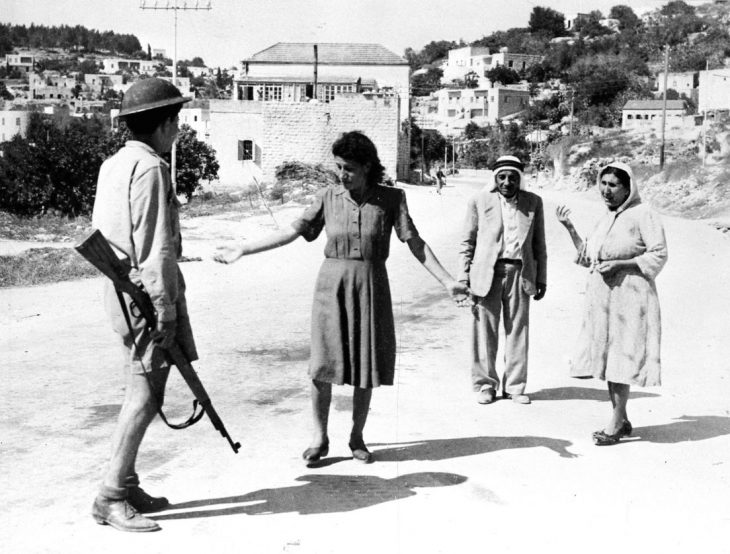
An Israeli soldier stops Palestinians in Nazareth, 1948, for traveling after the imposed curfew
Plan Dalet – terrorist violence on a mass scale
Confronted with what they viewed as multi-front crisis, Ben-Gurion and his commanders began to implement a new military doctrine under the name Plan Dalet, or Plan D. Under the plan, the official Zionist army, the Haganah, along with its supposed rival militias, Irgun and Lehi (Stern Gang), both of the latter self-proclaimed terrorist organizations, began attacking “quiet” Palestinian villages, those not involved in fighting.
The progressive Israeli historian Ilan Pappe asserts in his book, The Ethnic Cleansing of Palestine, that Ben-Gurion actually viewed the “quiet” villages as a bigger problem than those that resisted, as the latter provided a pretext for carrying out harsh repression and removal.
Among the directives of Plan Dalet were:
“Mounting operations against enemy population centres located inside or near our defensive system in order to prevent them from being used as bases by an active armed force. These operations can be divided into the following categories:
“Destruction of villages – setting fire to, blowing up, and planting mines in the debris – especially those population centers which are difficult to control continuously.
“Mounting search and control operations according to the following guidelines: encirclement of the village and conducting a search inside it. In the event of resistance, the armed force must be destroyed and the population must be expelled outside the borders of the state.”
Plan Dalet escalated the level of violence directed against the Palestinian civilian population to an extreme. A typical operation carried out by Zionist military units would involve planting explosives around Palestinian houses in the middle of the night, drenching them with gasoline and then opening fire. The point was to terrorize and expel the population. Arbitrary executions became routine, particularly targeting men and boys simply deemed to be of “fighting age,” regardless of whether they were actually engaged in combat.
Deir Yassin massacre – a turning point
Deir Yassin, on the outskirts of Jerusalem was on of the “quiet” villages. On April 9, 1948, the Irgun led by Menachem Begin, wiped out nearly its entire population The Irgun blew up houses with the inhabitants inside, executed others in their homes. Many of the women in the village were raped before being killed. The Irgun paraded the few survivors in a truck through Jerusalem where they were jeered and spit on.
Deir Yassin raised Plan Dalet to a new level of brutality, The Jewish Agency, which a few weeks later would become the Israeli government, officially condemned the massacre but on the same day brought Irgun into the Joint Command with the Haganah, and Lehi, led by another future prime minister, Yitzhak Shamir.
The massacres in Deir Yassin, Tantura and other villages were widely publicized by the Zionists themselves, for maximum effect. Pappe has documented at least 29 additional massacres by Zionist forces between December 1947 and January 1949.
Twelve days after the Deir Yassin massacre, on April 21, 1948, the British commander in Haifa, a major city in the north with a mixed population, advised the Jewish Agency that he would immediately begin withdrawing his forces. He did not inform the Palestinians. The same day, Hagahah forces launched a major attack on the Palestinian neighborhoods of the city, rolling barrel bombs filled with gasoline and dynamite down narrow alleys in the heavily populated city while shelling the same areas with mortars.
Haganah army loudspeakers and sound cars broadcast “horror recordings” of shrieks and screams of Arab women, mixed with calls of, “flee for your lives, the Jews are using poison gas and nuclear weapons. By early May, only 4,000 Palestinians of 65,000 remained in Haifa.
Irgun commander Menachem Begin, provided most vivid description of how well the slaughter at Deir Yassin was instrumental in the expulsion of the Palestinians from Haifa and other cities, towns and villages. In his book The Revolt, Begin wrote:
“Panic overwhelmed the Arabs of Eretz Israel [sic]. Kolonia village, which had previously repulsed every attack of the Haganah (the underground Jewish military organization that became the Israeli Army), was evacuated overnight and fell without further fighting. Beit-Iksa was also evacuated. These two places overlooked the road and their fall, together with the capture of Kastel by the Haganah, made it possible to keep open the road to Jerusalem. In the rest of the country, too, the Arabs began to flee in terror, even before they clashed with Jewish forces … The legend of Deir Yassin helped us in particular in the saving of Tiberias and the conquest of Haifa … All the Jewish forces proceeded to advance through Haifa like a knife through butter. The Arabs began fleeing in panic, shouting ‘Deir Yassin!’”
Three decades later, in an article for The American Zionist, Mordechai Nisan of the Truman Research Centre of the Hebrew University in Jerusalem expressed his concern about the failure to understand the major significance of terrorism in the struggle for Jewish sovereignty. He wrote: “Without terror it is unlikely that Jewish independence would have been achieved when it was.”
(Much of the historical material in this article can be found in the book, Palestine, Israel and the U.S. Empire, by Richard Becker. PSL Publications, 2009)
Drones, Murder and the Universal Declaration of Human Rights at 70: the Cases of Reyaad Khan and Abdul Raqib Amin
By T.J. Coles | CounterPunch | May 30, 2018
The Universal Declaration of Human Rights (UDHR) is 70 this year. But you wouldn’t know it from the impact it’s had on human lives. For example, Donald Trump has sharply increased drone attacks, especially in Yemen and Somalia, with virtual silence from Western media. Article 11 of the UDHR states: “(1) Everyone charged with a penal offence has the right to be presumed innocent until proved guilty according to law in a public trial at which he has had all the guarantees necessary for his defence.”
 As I document in my new book Human Wrongs (Iff Books), the alleged terror suspects blown apart by drone operators are not even charged let alone given the chance to plead their innocence in a national or international court: and that’s quite apart from the women, children and babies (“collateral damage”) that happen to be nearby when the Hellfire missiles are launched.
In Britain, the age-old common law, presumption of innocence, faced a slight setback in the so-called “war on terror.” Since US drone operators murdered Afghan civilians in the first-ever lethal drone strike in 2002 (followed by Yemenis in the same year), the US has murdered about 2,500 people with drones alone. Providing targeting information and communications links, the UK plays a significant role, all in violation of the principles of the UDHR.
The UN Special Rapporteur on Extrajudicial Execution, Philip Alston, writes: “A State killing is legal only if it is required to protect life (making lethal force proportionate) and there is no other means, such as capture or nonlethal incapacitation, of preventing that threat to life (making lethal force necessary).” So, a person in Afghanistan, for example, cannot be lawfully slain by a British drone operator on the pretence that the person is about to pose an imminent threat to the UK, unless for instance the person is about to give an order over the phone let’s say to, for instance, a terror cell in Briton, instructing it to detonate a bomb. Needless to say, this is a ludicrous scenario in the real-world.
Murdering Its Own
The British state murdering “its own people” is nothing new. In the 1970s, the Ministry of Defence waged a dirty war in Northern Ireland. Units from the Military Reaction Force (MRF) murdered Protestants and Catholics as a part of strategy of tension. Northern Irish persons murdered and/or shot by MRF operatives include:Patrick McVeigh (shot in the back), John and Gerry Conway (travelling to a fruit stall), Aiden McAloon and Eugene Devlin (travelling in a taxi), Joe Smith, Hugh Kenny, Patrick Murray and Tommy Shaw (drive-by shootings) and Daniel Rooney and Brendan Brennan (walking on a road).
The British government does in fact possess the proverbial license to kill. It is a “license” granted to itself and one not grounded in international law. Targeted killings (murder) hitherto depended on the authorization of the Secretary of State. The Intelligence Services Act 1994, Section 7(1), frees intelligence operatives from liability in acts of killing abroad, “if the act is one which is authorised to be done by virtue of an authorisation given by the Secretary of State.”
In the case of Reyaad Khan and Abdul Raqib Amin, the killings were not carried out by MI6 (which is covered by the Intelligence Services Act 1994), but by the Royal Air Force. In 2015, the government started murdering Britons allegedly suspected of involvement in terrorism, making no attempt to apprehend them and put them on trial, as international law requires.
In August 2015, Reyaad Khan and Abdul Raqib Amin, were travelling in a vehicle in Raqqa, Syria. RAF drone operators ended their lives. Then-PM David Cameron told Parliament that Khan was the target (murdered) and Amin was killed alongside him (manslaughter). A third unidentified, alleged Islamic State fighter was killed with them, though the third person was not “identified as a UK national.” By implication, the third person’s life is not important, hence no details emerged.
Cameron claimed the killings were “an act of self-defence,” because Khan was: “involved in actively recruiting ISIL sympathisers and seeking to orchestrate specific and barbaric attacks against the west, including directing a number of planned terrorist attacks right here in Britain, such as plots to attack high profile public commemorations.”
But Cameron also revealed that Khan was not a threat to the UK: “there was nothing to suggest that Reyaad Khan would ever leave Syria.” If Cameron is to be believed, Khan was issuing instructions to terror cells in the UK. But if this is the case, it therefore becomes a matter for the British police.
Changing Stories
The pretext for the murder was later changed by the UK’s Permanent Representative to the UN, Matthew Rycroft, who wrote that the killings were somehow justified in the “collective self-defence” of Iraq, where Britain is supposedly helping the government to defeat ISIS. The trouble is that Khan was not in Iraq when he was killed. Inverting international legal norms, Secretary of State for Defence, Michael Fallon, “who authorised the lethal drone strike” (Press and Journal ), appealed to Article 51 of the UN Charter, the right of collective and/or individual self-defence. Attorney General Jeremy Wright’s advice has not been published, indicating that the killings are violations of domestic and international law.
It later transpired that the RAF is working its way through a “kill list” of alleged British terror suspects fighting with ISIS in Iraq and Syria. Both jets and drones are used; the latter are controlled by operators in RAF Waddington, Lincolnshire. “When we know where they are we kill them,” said a Ministry of Defence spokesperson. The “kill list” revelations prompted Lord Macdonald, former Director of Public Prosecutions, to co-sign a letter to PM May, calling for the release of the government’s Intelligence and Security Committee report into the murder of Reyaad Khan and names of other targeted suspects.
Lucy Powell MP and Kirsten Oswald MP, both co-chairs of the informal All-Party Parliamentary Group, called for a debate on Britain’s use of targeted murder. Defence Secretary Fallon who authorized the murder of Khan claimed that by February 2017, 85 Britons had been killed in Syria, but it wasn’t clear if this meant as part of the RAF’s kill list.
T. J. Coles is a postdoctoral researcher at Plymouth University’s Cognition Institute and the author of several books, including Fire and Fury (Clairview Books ) and Human Wrongs (Iff Books ).
Featured Video

Houthis Don’t Have to Conquer Saudi Arabia to Make It Pay
or go to
Aletho News Archives – Video-Images
From the Archives
Newly Released FBI Docs Shed Light on Apparent Mossad Foreknowledge of 9/11 Attacks
By Whitney Webb | MintPress News | May 17, 2019
NEW YORK — For nearly two decades, one of the most overlooked and little known arrests made in the aftermath of the September 11 attacks was that of the so-called “High Fivers,” or the “Dancing Israelis.” However, new information released by the FBI on May 7 has brought fresh scrutiny to the possibility that the “Dancing Israelis,” at least two of whom were known Mossad operatives, had prior knowledge of the attacks on the World Trade Center. … continue
Blog Roll
 Aletho News
- MEP blasts ‘Euro-Gestapo’ for lecturing Russia on democracy
- Syria May Send Troops to Saudi Arabia Amid War with Ansar Allah
- UK whines about losing billions to ‘Putin tax’
- Baghaei to Rubio: Distorted narratives cannot erase US record of broken commitments
- Houthis Don’t Have to Conquer Saudi Arabia to Make It Pay
- MOE: Nearly 22,000 Students and Education Workers Killed
- Guterres in Islamabad: Genocide, cowardice, and the cage of Imran Khan
- Johnson, Marandi say Yemen holds upper hand over Saudi Arabia
- False flags won’t save aggressors, Iran FM spokesman says
- The Makkah Pact Enters Into Force: The End of American Dominance or Its New Form?
- If Americans Knew
- Report claimed Mark Levin used by Israeli government to influence Trump
- Over 2,000 Gazans have died awaiting medical evacuation amid Israel’s continued siege
- How a U.S. Diplomat Suppressed and Altered Reports Critical of Israel
- 5 Palestinians Die from Israeli Strikes in Gaza as Relentless Attacks Continue
- Report: Ceasefire Slows Killing but Leaves Devastation Intact
- Country Music Singer Zach Bryan Breaks Attendance Record at Robert Kraft’s Gillette Stadium While Wearing ‘Free Palestine’ Shirt for Second Night in a Row
- Three years of death and devastation: Israel’s war on Gaza in pictures
- Why Hamas believed the status quo was more dangerous than its 7 October gamble
- Debunking Israel’s latest list of ‘terrorist’ journalists in Gaza
- In Gaza, focus is on survival, “every step is a struggle” – Daily Update
- No Tricks Zone
- New Study: 50 Years Of The Most Aggressive ‘Net Zero’ Policies Can Only Affect The Global Climate By 0.03°C
- US September “Heat” Was No Record…Many Records Set Decades Ago
- Latest European Green Energy Debacle; Portugal’s Largest Flagship Solar Park Insolvent!
- Green Energy Debacle: German Expert Professor Fritz Vahrenholt Warns Of Severe Economic And Social Consequences
- Two More Paleo Reconstructions Affirm Meters-Higher Sea Levels Across Ireland, Brazil 7000-6000 Years Ago
- New Study: Earth And Venus Surface Warmth Largely Explained By Convection And Lapse Rate, Not CO2 Or Radiation
- 2025 Nature Paper Claiming Worsening Global Drought Gets RETRACTED …Heavily Flawed
- New Study: ‘Global Drought Shows No Detectable Recent Acceleration Under Climate Warming’
- Economic Masterminds: German Socialists Suggest Taxing Productivity Gains Stemming From Using AI
- The South China Sea Has Not Been Cooperating With The Climate Change Narrative

