Hué Back When: Vietnam’s Pivotal Battle Reconsidered

Photo by Raymond Depardon | CC BY 2.0
By Michael Uhl | CounterPunch | September 20, 2017
For Mark Bowden, author of Hué 1968, the pivotal battle of the War in Vietnam did not follow the script most Americans were used to scanning in their newspapers or visualizing on the evening news. The war Americans followed at home was like a humongous hunting expedition. U.S. forces seemed engaged in an endless chase over a lush boondocks inhabited by peasants and dotted with rice paddies or trailing the rugged forested highlands in search of the Viet Cong, a cunning and elusive enemy whose tactics were hit and run, not stand and fight.
When an atypical fixed battle developed, it was typically well-removed from the population centers that hugged the coastline off the South China Sea. Vietnam was, after all, a guerrilla war, or more broadly understood, a people’s war fought to reunite a nation, artificially divided into North and South by fiat of the United States in the service of geopolitical brinksmanship. Accused of fermenting the southern insurgency, North Vietnam was mercilessly bombed, but spared the carnage of a ground war. Not so the south where, by whatever foul means, the idea was “to isolate the population from the Viet Cong,” notwithstanding that, as Mark Bowden readily concedes, “in most instances they were one in the same.” The resistance was popular and widespread, and its idea was to drive the American invader out, and overthrow a despised ruling clique of Vietnamese compradors which survived only because the invader had committed hundreds of thousands of its own troops and billions of its taxpayers’ dollars to sustain it.
Americans were consistently assured that bit by bit the tumultuous countryside was being pacified, and the guerillas attrited, both politically and as a fighting force. In late 1967 Americans were told they were winning the war. When Tet – the Luna New Year – dawned on January 31, 1968, that illusion was irreparably shattered. The vastly superior forces of the United States and its southern catspaw, the Army of the Republic of Vietnam (ARVN), were caught virtually flat footed when thousands of regular troops of the People’s Army of North Vietnam seemingly materialized from thin air, and in coordination with local units of the southern resistance, launched up and down the length and breath of South Vietnam what was quickly branded the Tet Offensive. The most stunning blow for Americans, war managers and citizens alike, was an assault on the South Vietnamese capital of Saigon taken right to the walls of the American Embassy.
For several weeks thereafter, media attention in the U.S. and throughout the world focused primarily on the shock of Saigon’s vulnerability, overplaying its significance. A thousand kilometers north, at first scarcely noticed, even by the Commander of U.S. forces, General William Westmoreland, a battle had commenced that would become the “longest and bloodiest” of the war, not waged over the – till then – familiar rural topography, but house to house, street by street, culminating in one of the most intense chapters of urban warfare in the annals of American military history. Observers today might liken it to a more recent urban free-for-all entangling American troops in Fallujah, Iraq. Or, better yet, recall a U.S. military fiasco in downtown Mogadishu that Mark Bowden had crafted into an earlier best seller. To the extent comparisons hold, the Battle of Hue was like Black Hawk Down on steroids.
Hue 1968 is a comprehensive account of that battle written in the page-turning style of popular narrative non-fiction. The author has assembled a cast of eyewitnesses who participated in the action, Vietnamese and Americans, and the battle unfolds in recollections mined from their 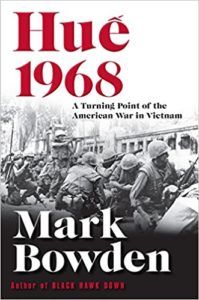 interviews, and, for the departed, from other primary sources at his disposal, such as lengthy wartime correspondences. Bowden has properly set the strategic stage for his action in the context of the war’s two most relevant contemporaneous developments. There was the very fact of Tet, simultaneous attacks with varying degrees of effectiveness on virtually every population center and military base in the South. The Year of the Monkey came in like Armageddon, catching General Westmoreland, for one, completely off guard even though he later claimed he knew those crafty commies were planning something.
To draw attention away from their true intentions, the North Vietnamese had executed a feint, keeping a remote Marine encampment under heavy bombardment at Khe Sanh near the border with Laos, and just below the Demilitarized Zone (DMZ). Taking the bait, and just two weeks before Tet, Westmoreland weakened his coastal enclaves by detaching troops to reinforce the beleaguered camp. The American general believed he was luring the North Vietnamese into a repeat of the battle of Dien Bien Phu, which in 1954 brought French colonial control of Vietnam to an end but inadvertently opened the door to an American invasion. This time, Westmoreland fantasized, “he was determined to prevent history from repeating itself.” That battle never developed, and several months later, Khe Sanh was abandoned by the Americans.
Westmoreland’s obsession with Khe Sanh apparently prevented him from fully grasping that Hue, South Vietnam’s third largest city, and former Imperial capital, had fallen to the Liberation Front in less than twenty-four hours. This pattern of disbelief was moreover pervasive up and down the American chain of command. At Phu Bai, a Marine base less than fifteen miles south of Hue, the commanding general, with improbable symmetry named Forster LaHue, repeatedly ignored reports on the size of the force his counterattack would face, and insisted that, instead of thousands, their number couldn’t possibly exceed more than a few hundred. Could a force as large as the one being reported enter and occupy the entire city that quickly and virtually undetected? Through some of his most original reporting Bowden reconstructs exactly how that occurred.
Shifting the action in his account from one adversary to the other, Bowden begins with the attack, describing how four regiments totaling roughly four thousand uniformed NVA soldiers managed to infiltrate the border between North and South Vietnam, rendezvous with local guerrillas in a force of equal size, and ultimately bivouac on the outskirts of Hue. “It was the kind of troop movement,” comments Bowden, “that could remain secret only if the citizenry supported it, or didn’t care enough to sound the alarm.”
Certainly in Hue there were many Catholics who, in general, were partisans of the Saigon regime, not to mention a contingent of elite ARVN soldiers stationed there, who would have sounded the alarm if they’d been aware of any imminent threat. On another side was a strong current of anti-Americanism among the Buddhists and the student body at Vietnam’s prestigious Hue University, who two years earlier had combined and rioted against the repressive South Vietnamese government, and burned the library of the United States Information Service. But by early 1968, Hue was being little frequented by the war’s violence, and hopes were stoked that the city’s rich stock of architectural treasures, not least the palace of Vietnam’s last royal dynasty, might avoid destruction. Compared with the rest of the country, life in Hue was reasonably good, and reasonably safe. A degree of political complacency had set into what remained a functional commercial entrepot where trade and traffic on Hue’s iconic Perfume River remained brisk.
Even though a majority of Hue’s population of 140,000 could not be considered pillars of the revolution, an underground resistance network was well-entrenched in the city and highly motivated. And Bowden, having tracked down a small cast of survivors, gives us affecting sketches of, among others, the Village Girl who guided the troops through the darkness and pointed them toward their targets; the VC commander who stood up to the hero of Dien Bien Phu, General Vo Nguyen Giap, and revised the battle plan; the college boy who worked with his fisherman landlord to smuggle arms into the city by sampan; the Buddhist poet turned what we would call ‘information officer,’ and Bowden – who holds many conventional opinions– calls “propagandist;” but my favorite was the balsy little guy who was given the task to create a giant new flag for the victors to raise once they’d taken the city.
The flag detail merits a special nod to illustrate the contrast between the high tech m.o. of the Empire’s war machine, and the endless improvisation of those in the Front who used gumption, imagination and stealth to their advantage in the face of overwhelming fire power from air, land and sea. The task to create a flag to be seen, not as “an invasion or occupation, but rather as a liberation,” fell to Sargent Cao Van Sen, an old war horse who’d fought with the Viet Minh against the French, joined the northern Army, and was then ordered back to his native Hue to organize among the Viet Cong. The idea of the flag, Bowden says “was to recognize real political differences between North and South,” with a design that represented, not only the liberation forces, but also “the intelligentsia and the city’s religious factions – Buddhists and Catholics.” Hanoi’s political objective at that stage was transitional, “to establish a neutral, independent South Vietnam,” leaving reunification to future negotiations.” Sgt. Sen’s job was to line up the material, a sewing machine and a seamstress to produce a single flag, which, when completed, required two men to carry it. After being “run up the 123-foot flagpole… that stood just outside the royal palace before the Citadel’s southern wall… it was visible all over Hue” when the city’s denizens awoke January 31st on the first morning of Tet.
Metropolitan Hue spread over both sides of the Perfume River, and the Front’s objective was to occupy the zone on the south bank called the Triangle, and, on the north, the Citadel, an “enormous fortress that enclosed nearly two square miles… its walls twenty-six feet high and impenetrably thick,” and enclosing the neighborhoods of Hue’s most affluent residents. Primary targets, included the air strip inside the Citadel, the province headquarters, the treasury, the post office, the prison, the radio station and “the sole American base, the [Military Assistance Command, Vietnam] MACV compound.”
The Commander of the Front, General Dang Kinh watched from high ground to the west, anxiously awaiting the assault to begin. Finally, “throughout the city arose the sound of gunfire… scattered at first, and then as if touched off by a fuse, it rose rapidly to a din.” By the time the shooting stopped, the attacking force, having “suffered only a few casualties, had dealt Hue’s defenders a crushing surprise blow.” The only major targets not overrun were a fortified redoubt occupied by the 1st ARVN Division inside the Citadel, and the MACV compound on the opposite side of the river, both heavily under siege.
Notwithstanding the loud cheerleading from Hanoi for Tet to unleash a “popular uprising,” it was General Kinh’s opinion, according to Bowden, that no such uprising would occur, not even in subdued and occupied Hue, given the certainty of an overpowering American counter-attack. Kinh knew his forces “could take the city, but… not hold it for long. Achievable goals… were to destroy the ARVN division, and… round up… those who represented the Saigon regime… who were marked for arrest and punishment.”
The subsequent executions of many of these Saigon officials is thematic in Bowden’s text, an overly eager retailing of the ex post facto justification among the war’s apologists for the American decision to rescue their allies by destroying their city. More informed observers might counter that for an American writer of Bowden’s stature to lay charges of mass murder at the Vietnamese resistance– in this instance taking blood retaliation on enemies considered legitimate military targets – demonstrates a highly hometown cast of mind, and a failure to do the math on the infinitely less selective assassination orgy of the U.S. Phoenix Program, not to mention the war’s vastly unbalanced human death toll perpetrated upon the Vietnamese population by the invader.
Kinh’s prediction proved correct. And much of what Bowden encapsulates in Hue 1968 is devoted to a ground level view on just how the city was retaken. Bowden fully examines first January 31st, the day Hue fell, from a variety of vantage points including civilians and combatants on both sides, then moves the battle forward in week long blocks until the Front, faced with annihilation, is forced to withdraw. Had the U.S. command acted more swiftly, the lives of many marines might have been spared, but the city faced devastation in every scenario as long as the occupiers remained. The initial counter-thrust came from the nearby Marine base at Phu Bai when General LaHue, still doubting his adversary’s vast numerical superiority, initially dispatched so few marines that, on one of few occasions during the war, the U.S. was seriously out-gunned. When a marine captain already in Hue called for air and artillery strikes to dislodge the entrenched enemy, General LaHue told him “rather strikingly that he was overreacting.“ LaHue “saw no reason on earth why the more than four hundred men in the [MACV] compound, reinforced with well over three hundred U.S. marines,” assorted tanks and heavy weaponized vehicles, “should not be able to flatten anything between them and the fucking Citadel.” Bowden aptly titles this episode An Idiotic Mission.
Three hundred men represented one understrength marine battalion, but only a single unit, Alpha Company of the 1st Battalion of the 1st Marine Division was dispatched at first to test the enemy strength. This proved a disaster, and the best account of the action on the ground I’ve found was not Bowden’s, but in Vietnam-Perkasie, a memoir by W.D. (Bill) Ehrhart. When Alpha Company left Phu Bai just as the sun was coming up, Bill Ehrhart was given the option of staying behind. He was short, meaning only a few days remained on what had already been a harrowing thirteen month tour. But since the unit was just going to check things out, and were told they’d be back by evening, Bill threw caution to the wind.
Alpha Company, moving to relieve the assault on the MACV compound passed a gas station on the city outskirts, and then, Ehrhart writes, “all hell broke loose… The shock of the ambush caught the whole column completely by surprise… We knew the compound lay straight up the road… seven blocks ahead… We fought our way up the [first] block. And the one after that. All day long we inched up the street. Casualties were appalling. Wounded and dead Marines lay everywhere.” Ehrhart, wounded in action, was in the thick of it the whole time. His memoir is a compelling, heart wrenching read.
From there Bowden covers the fighting chapter and verse. And if battle action is your genre, it’s a read that’s hair raising enough to fix your attention. The killing went on for 26 days, and by the end, 80% of the city lay in rubble. Bowden devotes a last chapter to Hue’s human toll. “Two-hundred and fifty American marines and soldiers were killed, and 1,554 wounded… The Front’s losses are estimated at between 2,400 and 5000…. A conservative guess at those executed would be two thousand… [which] brings us to a combined civilian death toll of about eight thousand… not an exact figure, but to the degree it’s off, it’s off by being too low.”
That the civilian death toll was enormous, cannot be doubted, and is by most accounts I’ve read over the years attributed to the terrible pounding the city took from naval off-shore guns, and from American and ARVN air power and artillery intent on expelling the Front whatever the human cost. As for “those executed,” it appears as if Bowden may have that figure “off” by a factor of ten. Writing in The New York Times in October 1972, Richard Barnet, a former State Department official and co-founder of the Institute for Policy Studies, quotes what the Hué Police Chief told a correspondent of The Times of London in March 1968 just days after the battle. The Chief, “Doan Cong Lap estimated the total number of executions at 200.“ Moreover, “the local Catholic priest reported that none of his clergy or parishioners were harmed by the N.L.F. [National Liberation Front],” who had been given instructions to be on their best behavior. Even if these two eyewitnesses under-counted the reprisal deaths, it’s still unlikely that Bowden’s figure holds water, given his reliance on official U.S. sources.
Richard Barnet took up this topic at a time when voices in the Nixon administration were claiming that mass executions at Hué were proof there would be a bloodbath if the U.S. withdrew and the communists came to power. When questioned on this in Hanoi, Premier Pham Van Dong retorted, “There is nothing in recent Vietnamese history to suggest that a government bent on killing hundreds of thousands of people in South Vietnam can keep peace.” In any case the bloodbath was us. As Barnet dryly quipped, “In the Orwellian age, the daily saturation bombings of Indochina are defended as missions of mercy.”
Mark Bowden seems to bend over backwards throughout this voluminous and valuable book to provide a two-sided perspective on a particularly tragic moment in the Vietnam War. But there’s something distastefully familiar in his throwaway rhetoric of the Cold War bias that got us into Vietnam in the first place. Bowden demonstrates how truth is betrayed by the words he chooses, for example, that “antiwar activists in the States romanticized Ho Chi Minh, and his cause, emphasizing his nationalist character… [but] Hanoi was Communist, authoritarian to the core… ruthless and doctrinaire.” Yet even this phobic reflex to honor the thought police in the mainstream where he prospers doesn’t cause Bowden to ignore that it was the Stalinists who hoped to come to power though the ballot box and the Americans who made war to prevent that.
By consensus in the school of conventional wisdom the Tet Offensive of 1968 was the turning point of the Vietnam War, after which the American war aim was not to win, but how to get out. Mark Bowden makes an excellent case that the fulcrum of that turning point was the Battle of Hue. But what if there was no turning point? In Vietnam the protracted war to expel a powerful foreign invader had its roots in millennia past; the American invasion was just another bump in the road.
Michael Uhl is the author of Vietnam Awakening.
Guardian Plugs War Criminal’s Book

This insane liar just wrote his sixth book, all about how great he is. Wanna buy it for £20? Yeah, me neither.
OffGuardian | September 16, 2107
Nobody should be surprised to learn that Alistair Campbell, the former Blair PR guru, suffers from psychological problems. Obviously, lacking empathy to the extent that you can start an illegal war with a peaceful country, for the lone purpose of enriching corporate interests, would be a red flag to any psychiatrist worth his salt. Even supposing you weren’t entirely psychopathic beforehand, the associated guilt-rotting of the soul, after the fact, would surely be enough to drive one mad.
Just look at Blair. Look at his mummified, rictus grin and tell me that’s not a man whose evil has stained his face.
No, no one is surprised that Alistair Campbell has mental problems. And, sadly, no one is surprised that the Guardian gives him column inches – not just to whine about the stress involved in coordinating (among other things) mass-murder – but also to plug his book. I will not name it or link to it here, it doesn’t deserve the clicks.
In any right-thinking society, this man would be in prison for war crimes, or at least banished from the public eye in disgrace. That he is not shows us that the ruling class of this country have no moral center, and that the press – for all their faux outrage on certain topics – no longer possess a facility for judging right from wrong.
Instead of rotting away in a dank cell, or testifying in chains from the Hague, he as allowed to air his (very predictable and rather dull) views on Brexit, Blair, Brown, Trump and Corbyn (against, for, for, against, against… just in case you were wondering).
We hear all about how his marriage nearly broke apart in 2006, and how his post-politics career is not as exciting as it sounds. They also go into the apparent “homoerotic love triangle” of Blair-Brown-Campbell, and how that is reflected in Campbell’s psychiatrist and GP fighting over his attention. If you can read it without gagging, or at least curling a lip in disgust, you are made of sterner stuff than I.
The article mentions Campbell’s “preference for madness over mediocrity”, without seeming to realise that it’s perfectly possible to be both. Or indeed that “The Mad Mediocrity” would be a smashing title for Campbell’s next book.
The words “Iraq” and “war” do not appear anywhere within the story. Though they do make several spirited and emotional cameos in the comment section. Which was closed after only three hours.
On the 35th Anniversary of Sabra and Shatila: The Forgotten Refugees
By Dr. Swee Chai Ang | Arab America | September 13, 2017
This September will be the thirty-fifth anniversary of the Sabra-Shatila Massacre in West Beirut. Three thousand unarmed refugees were killed from 15-18 September 1982.
I was then a young orthopedic trainee who had resigned from St Thomas Hospital to join the Christian Aid Lebanon medical team to help those wounded by Israel’s invasion of Lebanon. That invasion, named “Peace for Galilee”, and launched on 6 June 1982, mercilessly bombarded Lebanon by air, sea, and land. Water, food, electricity, and medicines were blockaded. This resulted in untold wounded and deaths, with 100,000 made suddenly homeless.
I was summoned to the Palestine Red Crescent Society to take charge of the orthopedic department in Gaza Hospital in Sabra- Shatila Palestinian refugee camp, West Beirut. I met Palestinian refugees in their bombed out homes and learned how they became refugees in one of the 12 Palestinian refugee camps in Lebanon. Before this encounter, I had never heard of Palestinians.
They recounted stories of being driven out of their homes in Palestine in 1948, often fleeing massacres at gunpoint. They fled with whatever possessions they could carry and found themselves in neighboring Lebanon, Jordan and Syria.
The United Nations put them in tents while the world promised they would return home soon. That expectation never materialized. Since then the 750,000 refugees, comprising half of the population of Palestine in 1948, continued to live in refugee camps in the neighboring countries. It was 69 years ago that this refugee crisis started. The initial 750,000 has since grown to 5 million. Palestine was erased from the map of the world and is now called Israel.
Soon after my arrival, the PLO (Palestine Liberation Organisation) evacuated. It was the price demanded by Israel to stop the further relentless bombardment of Lebanon and to lift the ten-week military blockade. Fourteen thousand able-bodied men and women from the PLO evacuated with the guarantee by Western powers that their families left behind would be protected by a multinational peacekeeping force.
Those leaving were soldiers, civil servants, doctors, nurses, lecturers, unionists, journalists, engineers, and technicians. The PLO was the Palestinians’ government in exile and the largest employer. Through evacuation, fourteen thousand Palestinian families lost their breadwinner, often the father or the eldest brother, in addition to those killed by the bombs.
That ceasefire lasted only three weeks. The multinational peacekeeping force, entrusted by the ceasefire agreement to protect the civilians left behind, abruptly withdrew. On September 15, several hundred Israeli tanks drove into West Beirut. Some of them ringed and sealed off Sabra-Shatila to prevent the inhabitants from fleeing. The Israelis sent their allies; a group of Christian militiamen trained and armed by them, into the camp. When the tanks withdrew from the perimeter of the camp on the 18 September, they left behind 3,000 dead civilians. Another seventeen thousand were abducted and disappeared.

Our hospital team, who had worked non-stop for 72 hours, was ordered to leave our patients at machine-gun point and marched out of the camp. As I emerged from the basement operating theatre, I learned the painful truth. While we were struggling to save a few dozen lives, people were being butchered by the thousands. Some of the bodies were already rotting in the hot Beirut sun. The images of the massacre are deeply seared into my memory: dead and mutilated bodies lining the camp alleys.
Only a few days before, they were human beings full of hope and life, rebuilding their homes, talking to me, trusting that they would be left in peace to raise their young ones after the evacuation of the PLO. These were people who welcomed me into their broken homes. They served me Arabic coffee and whatever food they found; simple fare but given with warmth and generosity. They shared their lives with me. They showed me faded photographs of their homes and families in Palestine before 1948 and the large house keys they still kept with them. The women showed me their beautiful embroidery, each with motifs of the villages they left behind. Many of these villages were destroyed after they left.
Some of these people became patients we failed to save. Others died on arrival. They left behind orphans and widows. A wounded mother begged us to take down the hospital’s last unit of blood from her to give to her child. She died shortly afterward. Children witnessed their mothers and sisters being raped and killed.
The terrified faces of families rounded up by gunmen while awaiting death; the desperate young mother who tried to give me her baby to take to safety; the stench of decaying bodies as mass graves continued to be uncovered will never leave me. The piercing cries of women who discovered the remains of their loved ones from bits of clothes, refugee identity cards, as more bodies were found continue to haunt me.
The people of Sabra Shatila returned to live in those very homes where their families and neighbors were massacred. They are a courageous people and there was nowhere else to go. Afterwards, other refugee camps were also blockaded, attacked and more people were killed. Today, Palestinian refugees are denied work permits in 30 professions and 40 artisan trades outside their camps. They have no passports. They are prohibited from owning and inheriting property. Denied the right of return to their homes in Palestine, they are not only born refugees, they will also die refugees and so will their children.
But for me, painful questions need to be answered. Not why they died, but why were they massacred as refugees? After 69 years, has the world already forgotten? How can we allow a situation where a person’s only claim to humanity is a refugee identity card? These questions have haunted me and they have yet to receive answers.
Dr. Swee Chai Ang is a Consultant Orthopaedic Surgeon and founder of Medical Aid for Palestinians. She is the author of: “From Beirut to Jerusalem,” published by The Other Press.
America’s Fragile Future
By Gilbert Doctorow | Consortium News | September 14, 2017
Does the United States have a future as a great power?
Twenty years ago posing this question would have seemed absurd. The United States was fully self- confident about its position as the sole surviving superpower in the world. It faced virtually no obstacles or objections to its performance on behalf of the “public good,” a process that supposedly brought order to the world either through the liberal international institutions that it helped to create after World War Two and dominated, or through unilateral action when necessary via “coalitions of the willing” aimed at bringing down one or another disruptive malefactor on a regional stage.
From many voices abroad it heard “amen” to its claims of exceptionalism and farther-seeing vision that came from its standing taller, as Secretary of State Madeleine Albright put it. The “indispensable nation.”
Fourteen years ago, when America prepared for its ill-conceived invasion of Iraq and encountered loud resistance from France and Germany, backed up by Russia, it became possible to wonder whether U.S. global hegemony could last. The disaster that the Iraqi adventure quickly became within a year of George W. Bush declaring “mission accomplished” rolled on and progressively diminished the enthusiasm of allies and others hitherto on the U.S. bandwagon for each new project to re-engineer troublesome nations, to overthrow autocrats and usher in an age of “liberal democracy” across the globe.
Still, the doubts were discussed sotto voce. Governments tended to conform to what the Russians colorfully call “giving someone the finger in your pocket.” Observers spoke their piece privately against the violations of international law and simple decency that the United States was perpetrating — and against the swathe of chaos that followed American intervention across the Greater Middle East. But such persons were on the fringes of political life and drew little attention.
What has happened over the past couple of years is that doubts about the competence of the United States to lead the world have been compounded by doubts about the ability of the United States to govern itself. The dysfunction of the federal government has come out of the closet as an issue and is talked about fairly regularly even by commentators and publications that are quintessentially representative of the Establishment.
In this connection, it is remarkable to note that the September-October issue of Foreign Affairs magazine carries an essay entitled “Kleptocracy in America” by Sarah Chayes. This takes us entirely away from the personality peculiarities of the 45th President into the broader and more important realm of the systemic flaws of governance, namely the extraordinary political power wielded by the very wealthy and the self-serving policies that they succeed in enacting, all at the expense of the general public that has stagnated economically for decades now, setting the stage for the voter revolt that brought Trump to power.
And in an op-ed essay in The Washington Post on Sept. 1, which was remarkable precisely for its identification of the failing political culture in Washington, Sen. John McCain, R-Arizona, says the following:
“Congress will return from recess next week facing continued gridlock as we lurch from one self-created crisis to another. We are proving inadequate not only to our most difficult problems but also to routine duties. Our national political campaigns never stop. We seem convinced that majorities exist to impose their will with few concessions and that minorities exist to prevent the party in power from doing anything important.”
McCain himself was until now a major contributor to the poisonous political climate in Washington, to partisanship that tramples patriotism under foot. One thinks of his unprecedented attack on fellow Republican Sen. Rand Paul several months ago whom he accused of “working for Putin” because the senator from Kentucky refused to vote for the accession of Montenegro to NATO.
Permanent Gridlock
Gridlock in the federal government is nothing new. In the past decade, work of the federal government came to a standstill when Congress and the President could not agree to the conditions under which the federal debt ceiling would be raised. Such an eventuality was just narrowly averted in the past few days.
Public exposure and ridicule of a sitting president for personal failings, such as the case of Bill Clinton’s sexual transgressions, have been exploited for political gain by his opponents whatever the cost to national prestige. We have lived through that crisis of the political elites and the Republic survived.
What is new and must be called out is the loss of civility in public discourse at all levels, from the President, from the Congress and down to the average citizen. The widely decried unsubstantiated personal attacks that otherwise would be called defamation during the 2016 presidential electoral campaign were symptomatic of this all-encompassing phenomenon. It signifies a dramatic decline in American political culture that the whole world sees and is beginning to act upon in self-defense.
Let us start with President Donald Trump, who is attacked daily by the liberal media that represents the lion’s share of all television programming and print publications, media that vehemently opposes Trump’s domestic and foreign policy positions. In their determination to ensure either his impeachment or effectively to strip him of powers, they speak of Trump the way cheaply printed caricatures for the masses lampooned Louis XVI and Marie Antoinette before the French Revolution.
The President is publicly described by his compatriots as an imbecile, a rabid racist, a misogynist, a volatile and impulsive narcissist whose finger on the nuclear button gives us all goose pimples: this cannot be ignored by the wider world outside U.S. borders and it is not ignored.
To be sure, Donald Trump has brought a good deal of this ignominy on himself by his intemperate comments on daily events, particularly at home but also abroad, where silence or a nod to conventional verities would be the better part of valor. He keeps his own counsel on foreign affairs and erroneously believes that his instincts are superior to the advice of experts.
In his kitchen cabinet, there are no experts. In the official cabinet, he has for his own reasons assembled a group consisting mostly of neoconservatives and liberal interventionists, who made it easy for him to get their confirmations in the Senate but who are all pulling in the direction opposite to the America First concepts of nonintervention in the affairs of other states that he set out in his electoral campaign.
Trump changes direction daily, even on matters as critical as the likely U.S. response to the ongoing crisis on the Korean peninsula. The tactic of unpredictability was an approach he said in the campaign he would use against enemies, in particular against terrorist groups, not to tip them off about U.S. intentions in advance and weaken the effect of eventual U.S. military strikes. But it makes no sense when applied to all other current business, which requires a firm hand on the tiller and sense of continuity and predictability, not constant disruption.
Undoing Bonds
The net result of Donald Trump’s first six months in office has been to undo the bonds of mutual confidence with America’s allies and friends, and to put America’s competitors on notice that America’s role in the world is up for grabs.
Foreign policy has opened up as a topic for discussion here in Europe ever since Donald scattered the chickens by his loose talk about NATO and America’s commitment or non-commitment to the Article 5 provision of “all for one and one for all.” This has given impetus to the long-spluttering plans to create a European Union army as an alternative to NATO, and as a rallying point for federalists in what will be a two-speed Europe.
During the two terms of Obama, meddling in the internal politics of China and Russia, repeated hectoring over their alleged human rights and rule of law violations, but still more importantly the wrong-headed policy of simultaneous containment of these two giants through construction of military alliances and bases at their borders put in motion a strategic partnership between them that was once improbable but is now flourishing. The Russia-China axis is underpinned by vast joint investments and promises to remake the global power balance in the decades to come.
Now, with Trump, the damage to American power in the Pacific region is spreading. His ripping up free trade accords and his incautious rhetoric regarding possible military strikes against North Korea have pushed both Japan and South Korea to explore actively and urgently how Russia can be befriended, at a minimum, for the sake of greater leverage against the big ally in North America. This has been demonstrated with perfect clarity by the meetings of Vladimir Putin with Japanese premier Shinzo Abe and South Korean president Moon Jae-in at the Eastern Economic Forum in Vladivostok over the past couple of days.
Russia’s evolving political entente with both South Korea and Japan is providing support for the launch of ambitious foreign investment projects in its Far East as announced at the Forum. These include one which has the potential to re-shape the imagination of regional populations for a generation to come: revival of plans to build a $50 billion rail-auto bridge linking Hokkaido with the Russian island of Sakhalin, thus uniting Japan with the continent and facilitating freight shipments across Russia to Europe.
For its part, South Korea announced infrastructure investments for the Northern sea route linking South Korea with European markets through sea lanes kept open by Russian icebreakers. Like the Chinese One Belt One Road, these plans all dramatically reduce the importance to world trade of the long-standing U.S.-policed sea lanes off Southeast Asia up to and through the Suez Canal.
Of course, the low point in America’s image in the world today under Trump is not entirely new. By the end of his two terms in office, George W. Bush had driven American prestige to what were then all time lows even among Europeans. There was a brief resurgence of American popularity at the start of Barack Obama’s tenure in office. But that was quickly dissipated by his failure to deliver on the pledges of his campaign and inaugural address, as the Guantanamo Bay prison remained open, as the wars in Iraq and Afghanistan continued, and as drone strikes proliferated.
Opening a Void
But Donald Trump has shaken up the world order by repeatedly questioning the public good that the United States claimed to be delivering these past decades, opening a void without projecting a new vision of global governance. In the meantime, the unique value of America’s commitment to the public good is being eroded as other countries step forward with infrastructure and other plans that provide practical improvements in the public sphere.
It is commonplace today within the United States to put all blame for the shocking decline in political culture at the door of President Trump with his boorish language and behavior. However, as we noted from the outset in citing Senator John McCain’s recent op-ed, Congress has contributed mightily to the erosion of civic values by its vicious and counterproductive partisanship.
And yet a still greater threat to American democracy and to the sustainability of America’s great power status has come from the inverse phenomenon, namely the truly bipartisan management of foreign policy in Congress. The Republican and Democratic leaderships have maintained strict discipline in promotion of what are nearly identical neoconservative (Republican) and liberal interventionist positions on virtually every foreign policy issue before Congress.
Committees on security and foreign affairs invite to testify before them only those experts who can be counted on to support the official Washington narrative. Debate on the floor of the houses is nonexistent. And the votes are so lopsided as to be shocking, none more so that the votes in August on the “Countering America’s Adversaries through Sanctions Act.” This measure moved sanctions on Iran, North Korea and Russia from the category of Executive Order to federal law. In the Senate, the bill passed 98 to 2. In the House, the vote was 419 for, 3 against. Such results remind us of the rubber-stamp legislature of the USSR, the Supreme Soviet, in its heyday.
That particular vote was still more scandalous for its being drafted and passed without any consultation with U.S. allies and friends, though its intent is to control their commercial and credit policies with respect to the target countries under sanction.
For Europeans, in particular, this puts into question their ability to pursue what they see as great economic benefits from trade and investment with Russia and Iran. In this sense, Congress demonstrated that it is pursuing a still more radical program of America First than the President. This in-your-face unilateralism works directly to the detriment of America’s standing in global forums.
The New McCarthyism
It would be comforting if the problems of our political culture began and ended with the elites operating in Washington, D.C. However, that is patently not the case. The problem exists across the country in the form of stultifying conformism, or groupthink that is destroying the open marketplace for ideas essential for any vital democracy.
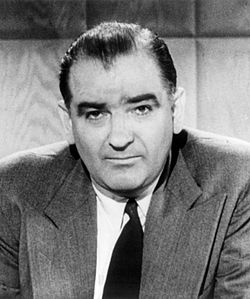
Senator Joseph McCarthy
Some of us have called this the new McCarthyism, because the most salient aspect of groupthink is the ongoing hysteria over alleged Russian “meddling” in U.S. domestic politics. The denunciations of “stooges of Putin” and the blacklisting from both mass and professional media of those known to deliver unconventional, heterodox views on Russia and other issues of international affairs is reminiscent of what went on during the witch hunt for Communists in government and in the media during the early 1950s.
However, no one is being hounded from office today. There are no show trials, as yet, for treasonous collusion with Russia. So, it would be safer to speak of an atmosphere of intimidation that stifles free debate on the key security issues facing the American public. Absence of debate equates to a dumbing-down of our political elites as intellectual skills atrophy and results in poor formulation of policy. The whole necessarily undermines America’s soft power and standing in the world.
Groupthink in America today did not come from nowhere. Debilitating conformism was always part of our DNA, as is the case in a great many countries, though its emergence has been episodic and in varying degrees of severity. The present acute manifestation in the United States goes back to the mass paranoia which followed the 9/11 terrorist attacks when the George W. Bush administration introduced the Patriot Act, gutting our civil rights in exchange for the promise of security.
Though the revelations of Edward Snowden have shown the extent and potency of the instruments of surveillance over the general population that were introduced by the Bush administration after 9/11, there was enough of state control exposed in the Patriot Act text to silence anyone with doubts about U.S. government policies at home and abroad. When the harsh personalities of President Bush’s immediate entourage were replaced by the liberal-talking officials of Barack Obama, people breathed easier, but the instruments of surveillance remained in place, as did the neocon middle and senior officials in the State Department, in the Pentagon, and in the intelligence agencies.
Thus, for a whole generation the Washington narrative remained unchanged, giving encouragement in communities across the land to neocon-minded administrators and professors of American universities, publishers and owners of our mainstream newspapers, and other arbiters of public taste. That is quite sufficient to explain the current atmosphere of intimidation and groupthink.
It is improbable that any Humpty-Dumpty successor to Donald Trump can put the pieces back together again and restore American dominance to where it was at the close of Bill Clinton’s first term as president. Given American hubris, will our political class accept an equal seat at the global board of governors or just walk away from the table?
Gilbert Doctorow is an independent political analyst based in Brussels. His latest book Does Russia Have a Future? was published in August 2015. His forthcoming book Does the United States Have a Future? will be published in September 2017.
Looking for the Thought Police? Try looking in the mirror.
By T.P. Wilkinson | Dissident Voice | August 25, 2017
1984 is probably one of the worst books of the 20th century because of its mis-interpretation!
a) Although Orwell was writing about ENGLAND, in fact, and not as allegory, the exigencies of anti-Soviet propaganda required that the story be defined as a dystopia about the world under Soviet control. Whatever Orwell may have thought about Stalin, 1984 was a story directly attacking the Labour Party and the policies that would become enshrined in Labour governments dominated by graduates from Oxford and to a lesser extent Cambridge. Anyone outside of Britain might be forgiven at the time for missing this but today the oversight is simply rooted in ignorance — willful or unwitting.
b) Orwell, who served in the colonial police in Burma, was well acquainted with the methods of social control used in Britain’s colonies — including torture and surveillance. He had no reason to draw on reports from the Soviet Union, true or false. He also worked in the British government’s propaganda department. The BBC was created in 1922 as a radio monopoly in part to improve the government’s campaign against organised labour. There the fabrication of “news” was daily routine, as it is today.
c) Post-war Britain was — in comparison to the US esp. — a disaster area. After two world wars, Britain was bankrupt. The empire which had subsidised the metropolitan standard of living was collapsing. Indian independence alone would mean an initial massive balance of payments deficit to the Union, not to mention debt to the US. The economy was more or less in ruins. The standard of living had sunk drastically for all but the very rich. It did not take any imagination to invent “Victory Gin” — Britain was nominally on the side of the winners but had lost everything. For someone like Orwell this was very obvious.
d) Too little attention is paid to the actual structures that Orwell describes. The Party and the Thought Police are most frequently mentioned. This focus distorts Orwell’s depiction of a complex mechanism of social control. Ironically many people who have read Noam Chomsky’s essays do not grasp the point which Orwell makes and Chomsky reiterates — albeit avoiding too much attention to this embarrassing point.
Orwell distinguished between the “inner party”, the “outer party” and the “prols”. This classification is very important for comprehending the whole process. Propaganda — that is the constant manipulation of data in forms to create what counts on any one day as “true” — is directed primarily at the “outer party”. The “inner party” is not concerned with what is actually true, this virtually invisible group is interested only in power. The “outer party” is governed by rigorous ideas of truth and virtue which have to be policed — precisely because the very idea of “truth” is a policing tool — not unlike sexual purity. The “truth” is of no material importance to the mass — the “prols” in Orwell’s depiction. But the “outer party” — the intellectuals, the bureaucrats, middle managers, functionaries of all types whether in the state or private sector, in short those who claim citizenship based on supposed intelligence and virtue/merit — need constant policing.
They must be told not only what is fashionable but what counts as true or as the acceptable/polite consensus. These people cannot be left in abject ignorance since they are needed to maintain the system. They are in short the “Gene Sharp factor” — the percentage of the population with which one moves the whole. (Ironically the first edition (1993) of Sharp’s From Dictatorship to Democracy was published in Burma — where Orwell began his police career.) They are too numerous in comparison to the “inner party” to be ignored but not as disorganized as the “prols” so that they cannot be beaten down physically as a mass.
Perhaps Noam Chomsky does not focus too much on his observation that it is the middle class intellectual/managerial class that is the target of most regime propaganda (most heavily propagandised) because he belongs precisely to that class. In fact, on some issues he might be confused with an asset of the Thought Police — coming too as he does from a central US Thought Police institution — MIT.
Orwell was an Old Etonian. Eton College is the pinnacle of the “outer party” cadre institutions in Britain. It is run for the “inner party” and many of the “inner party” are also Old Etonians but the English public school is notorious for enforcing class distinctions even among those of the same college. All Etonians are equal too, some are more equal than others.
e) Who is “Big Brother”? Big Brother is always supposed to be a kind of Stalin allegory. However, unlike the US, Britain has a constant figure who constitutes the focus of all loyalty and affection — the reigning monarch. The British royal family changed their name when war was declared against Germany in 1914. It became inappropriate to have a German king ordering illiterate British peasants and workers into war against another German king who was directly related for reasons that could not be admitted openly and still cannot. So the name “Windsor” was adopted. Edward VIII both before and after his abdication maintained a healthy relationship with blatant fascists of the old style.
This does not mean that the British royal family ever renounced its affinity for fascism (e.g. Franco and Salazar). Moreover it is almost impossible to criticise the monarchy substantively in the United Kingdom. The actions of its members, singularly or collectively, are beyond review or public reproach — except in matters trivial like taste or polite speech. The pretense that the most wealthy private individual in the country (and one of the world’s wealthiest), the reigning monarch, has no personal interest in the policies of the British government and has no practical influence over the government in defense of those interests is about as great a self-deception as one can demand of any person, let alone an entire country.
God save the King/Queen…

f) It is even arguable that Orwell was more concerned about the US because this was the country which switched sides and manipulated the war aims the most — without any cost to itself. During WWII it was clear that the Soviet Union was fighting a vicious war just to survive in the face of the Western onslaught. However, sober people also saw that the US stood to be the only beneficiary of the war. In 1945, this was obvious. No sooner had the war ended but the US proclaimed a war against the Soviet Union. Britain could not have afforded such a position — even if Churchill would have liked. He gave his deceptive “iron curtain” speech for Truman because of dependence on the US not because Britain could have afforded an anti-Soviet policy on its own.1 Orwell could certainly see the absurdity of an impoverished Britain having been on the side of the Soviet Union against Hitler now aligned with the US against the Soviet Union.
In fact, it could be argued that Orwell’s novel is very coherent with Roger Waters’ The Wall (and its sequel The Final Cut) in their specifically BRITISH views of mass culture and pseudo-democracy concealing party dictatorship. It has little, if anything, to do with Russian society, let alone politics. That is only natural. Orwell never lived in Russia and would not have been able to explain Russian society. For that one has to turn to Russians themselves; e.g., Tolstoy or Sholokhov or Pasternak. On the other hand many Americans believe that they understand British society — this is due largely to saturation with BBC programming. However similar Britain may appear to the US, it is actually a very different country and culture (except perhaps for the highest strata of the Anglo-American ruling class). The illusion that Britons are only more quaint Americans has done much to promote the mis-understanding of Orwell.
One of the great intellectual travesty’s of the 20th century is the ascendency of US liberal ideology — in its broadest sense.2
There is probably not a country in the world today with so much influence on intellectual and cultural activity from such a depraved and obscene level of general ignorance and stupidity. The capacity to saturate the world with this structural mendacity and almost genetic stupidity is probably worse than any other weapons system the country’s psychopaths have produced — because it is the basis for acceptance of all those weapons in the first place.
- Churchill, unlike Truman, had attended the meetings with Stalin and Roosevelt at Yalta where it was agreed that the Soviet Union would occupy the Eastern European territories that had been absorbed into the German Empire, in part as a basis for war reparations due to the enormous destruction suffered by the Soviet Union — almost all of the European part of the country was razed to the ground. He knew that the Soviet occupation had been agreed by all the Allies. He also knew that the Allies were attempting to deprive the Soviet Union of the reparations due from Germany. In short he knew that it was the West that was hanging an “iron curtain” in front of the Soviet Union in the hope that it would collapse after WWII. Britain could not have afforded such a policy. Among other things the collapse of the empire would deprive it of its cheap access to all sorts of raw materials making it vulnerable to world market fluctuations.
- A more precise clarification of what might otherwise be called the ideology of the North Atlantic Establishment would exceed the scope of this brief note. Carroll Quigley’s The Anglo-American Establishment provides a fairly useful summary of its principles and the way it has been expressed through the 20th century. It should be noted that one of the key cadre institutions for academics according to Quigley is the All Souls College of Oxford University– where Gene Sharp also completed his doctorate.
Dr T.P. Wilkinson writes, teaches History and English, directs theatre and coaches cricket between the cradles of Heine and Saramago. He is also the author of Church Clothes, Land, Mission and the End of Apartheid in South Africa (Maisonneuve Press, 2003).
Skeptic Beating Al Gore on Amazon
By Roy W. Spencer, Ph. D. | August 24th, 2017
Al Gore’s new movie, An Inconvenient Sequel: Truth to Power, has been in theaters for about a month now, and has received rather tepid reviews.
The Kindle e-book version of Gore’s movie, despite being very colorful, has been doing even worse and is currently running at #20,768 overall on Amazon, and is not ranked #1 in any sub-category.
But the skeptic take-down of Gore’s new movie and book, An Inconvenient Deception: How Al Gore Distorts Climate Science and Energy Policy, is at #956, and is #1 in three sub-categories.
What makes the discrepancy even worse is that An Inconvenient Deception was self published, with no paid advertising.
Maybe people are finally wising up to Mr. Gore.
The Betrayal of India: Revisiting the 26/11 Evidence
By Ludwig Watzal | American Herald Tribune | August 14, 2017
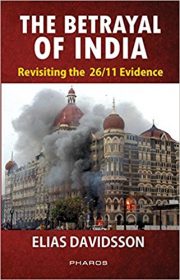 Perhaps the FBI needs guys like Elias Davidsson to solve the circumstances of the 9/11 attacks. Could he have been successful within such an organization? Usually, the FBI investigators can only go so far as their superiors want them to go. That’s why a highly qualified researcher such as Davidsson would have gone nowhere within the FBI.
In the 9/11 community, Davidsson is no blank sheet. He has published books on 9/11 and the follow-up terrorist attacks that set the world on fire. “Hijacking America’s Mind on 9/11“, followed by “Psychological Warfare and Social Denial: The Legend of 9/11 and the Fiction of Terrorism” (Psychologische Kriegsführung und Gesellschaftliche Leugnung: Die Legende des 9/11 und die Fiktion der Terrorbedrohung) presented a different narrative. An English translation of a condensed version would be very informative and highly useful for the English speaking public.
The elucidation of a terrorist offense suffers from the fact that governments clean up only as much as it benefits them politically. Such an approach also holds true for the Mumbai attacks. The impression given by the Indian government that all facts were on the table, is, according to Davidsson, false. As with the “9/11 Commission Report”, which pretends to present the real events and the backgrounds, the same holds true for the processing of this heinous crime of 26/11, 2008. In both cases, statements of witnesses, which didn’t support the official narrative were glossed over or brushed aside.
That’s why Davidsson’s book is so important. In 25 chapters he unravels not only the motivations and the cover-up of the Indian government but also the multifaceted interests of international actors such as Pakistan, the U.S., and possibly Great Britain, Germany, Israel, Iran, Russia, China, and even Australia.
“The book is about the betrayal of the Indian nation by a corrupt, greedy and ruthless elite for whom the lives of ordinary Indians are expendable when power and profit are at stake,” writes the author. From day one, a particular part of the official account was questioned, namely, the circumstances surrounding the deaths of three senior police officials and their assistants. Many Indians voiced their suspicion that the authorities were covering-up facts and called for an independent and impartial investigation of the events.
To understand 26/11, the reader must not work one’s way through the whole book sequentially because the author has attempted to render individual chapters independent of each other. All chapters close with a summary or conclusions. Davidsson’s book is always very well documented by many footnotes. Additionally, all sources used are accessible using the following URL; http://aldeilis.net/mumbai/
The author presents three definite conclusions; firstly, India’s major institutions are suppressing the truth on 26/11; secondly, India’s judiciary has failed its duty to seek truth and render justice; thirdly, Business, political and military circles profited from 26/11. Furthermore, entities in the U. S. and Israel also gained from the attack. The author could not find any benefits for the Pakistani government, military or businesses. The main profiteer seems the Hindu nationalist constituencies by the “elimination” of Hemant Karkare, “who was on the verge of exposing Hindutva terrorist networks.
Davidsson calls on the Indian Civil society to ask for the establishment of a National Truth Commission on 26/11 mandated to establish the facts on the attacks of 26 November 2008. The Civil society itself should demand the creation of an International Commission of Inquiry on the previous terrorist attacks under the authority of Chapter VII of the U.N. Charter, including those committed in the U. S. on 11 September 2001.
With this study, the Indian Civil society has a document at its disposal to challenge the official narrative. The overall objective of the author, however, is the exposure of all the key terror attacks, especially 9/11, which lacks to this day any evidence that 19 Muslims were the perpetrators.
This very compact but exciting book should contribute to the solving of the 26/11 crime. A must read for everybody interested in the truth.
Featured Video

Houthis Don’t Have to Conquer Saudi Arabia to Make It Pay
or go to
Aletho News Archives – Video-Images
From the Archives
Newly Released FBI Docs Shed Light on Apparent Mossad Foreknowledge of 9/11 Attacks
By Whitney Webb | MintPress News | May 17, 2019
NEW YORK — For nearly two decades, one of the most overlooked and little known arrests made in the aftermath of the September 11 attacks was that of the so-called “High Fivers,” or the “Dancing Israelis.” However, new information released by the FBI on May 7 has brought fresh scrutiny to the possibility that the “Dancing Israelis,” at least two of whom were known Mossad operatives, had prior knowledge of the attacks on the World Trade Center. … continue
Blog Roll
 Aletho News
- MEP blasts ‘Euro-Gestapo’ for lecturing Russia on democracy
- Syria May Send Troops to Saudi Arabia Amid War with Ansar Allah
- UK whines about losing billions to ‘Putin tax’
- Baghaei to Rubio: Distorted narratives cannot erase US record of broken commitments
- Houthis Don’t Have to Conquer Saudi Arabia to Make It Pay
- MOE: Nearly 22,000 Students and Education Workers Killed
- Guterres in Islamabad: Genocide, cowardice, and the cage of Imran Khan
- Johnson, Marandi say Yemen holds upper hand over Saudi Arabia
- False flags won’t save aggressors, Iran FM spokesman says
- The Makkah Pact Enters Into Force: The End of American Dominance or Its New Form?
- If Americans Knew
- Report claimed Mark Levin used by Israeli government to influence Trump
- Over 2,000 Gazans have died awaiting medical evacuation amid Israel’s continued siege
- How a U.S. Diplomat Suppressed and Altered Reports Critical of Israel
- 5 Palestinians Die from Israeli Strikes in Gaza as Relentless Attacks Continue
- Report: Ceasefire Slows Killing but Leaves Devastation Intact
- Country Music Singer Zach Bryan Breaks Attendance Record at Robert Kraft’s Gillette Stadium While Wearing ‘Free Palestine’ Shirt for Second Night in a Row
- Three years of death and devastation: Israel’s war on Gaza in pictures
- Why Hamas believed the status quo was more dangerous than its 7 October gamble
- Debunking Israel’s latest list of ‘terrorist’ journalists in Gaza
- In Gaza, focus is on survival, “every step is a struggle” – Daily Update
- No Tricks Zone
- New Study: 50 Years Of The Most Aggressive ‘Net Zero’ Policies Can Only Affect The Global Climate By 0.03°C
- US September “Heat” Was No Record…Many Records Set Decades Ago
- Latest European Green Energy Debacle; Portugal’s Largest Flagship Solar Park Insolvent!
- Green Energy Debacle: German Expert Professor Fritz Vahrenholt Warns Of Severe Economic And Social Consequences
- Two More Paleo Reconstructions Affirm Meters-Higher Sea Levels Across Ireland, Brazil 7000-6000 Years Ago
- New Study: Earth And Venus Surface Warmth Largely Explained By Convection And Lapse Rate, Not CO2 Or Radiation
- 2025 Nature Paper Claiming Worsening Global Drought Gets RETRACTED …Heavily Flawed
- New Study: ‘Global Drought Shows No Detectable Recent Acceleration Under Climate Warming’
- Economic Masterminds: German Socialists Suggest Taxing Productivity Gains Stemming From Using AI
- The South China Sea Has Not Been Cooperating With The Climate Change Narrative

