US officials admit to major violations during 2020 election
RT | December 22, 2025
Election officials in the US state of Georgia have admitted to major violations of vote certification procedures during the 2020 presidential race. US President Donald Trump, who lost to Joe Biden, has repeatedly claimed that the election was “stolen” and marred by widespread fraud and irregularities.
The admission, made earlier this month, emerged from a complaint filed by election integrity activist David Cross, who accused Fulton County, Georgia’s most populous county, of illegally certifying at least 315,000 ballots in 2020.
Biden beat Trump in Georgia – which has 16 electoral votes – by fewer than 12,000 votes, before going on to win the Electoral College 306–232.
The dispute centers on tabulator tapes produced by voting machines during early voting. Under state rules, each tabulator must generate closing tapes signed by poll workers to certify the recorded vote totals.
After filing an open records request with Fulton County, Cross found at least 134 tabulator tapes with no signatures, meaning that the associated ballots could not have been legally certified.
Cross also raised allegations of missing “zero tapes” meant to confirm that machines began counting from zero at the start of polling, along with discrepancies involving scanner serial numbers and unusually late poll closing times.
During a recent State Election Board hearing, Ann Brumbaugh, an attorney for the Fulton County Board of Registration and Elections, said the county “does not dispute the allegations,” acknowledging the failure as a violation of election board rules.
Members of the state board described the findings as “very troubling” and referred the case to the Georgia Attorney General, seeking potential civil penalties of $5,000 per unsigned tape and other enforcement action.
The Georgia result has remained a focal point of Trump’s broader complaints about the 2020 election, which have been rejected by Democrats and formed the basis of multiple legal cases against him.
Since returning to office, Trump has vowed to overhaul the US voting system, pledging stricter voter identification requirements, limits on mail-in voting, and a shift toward paper ballots, arguing that these changes are necessary to restore confidence in elections.
Trump Administration Moves to Overhaul Childhood Vaccine Schedule, Embrace Informed Consent Model
By Sayer Ji | December 20, 2025
In what may prove to be the most significant transformation of U.S. vaccine policy in decades, the Trump administration is preparing to fundamentally restructure how childhood vaccines are recommended—shifting away from blanket federal endorsements toward a model that empowers parents and physicians to make individualized decisions.
According to a December 19th report in The Washington Post, federal health officials are developing guidance that would encourage parents to consult directly with their doctors about vaccination decisions, rather than simply following a standardized federal schedule. This “shared clinical decision-making” approach represents a profound departure from the paternalistic model that has defined American vaccine policy for generations.
The Denmark Model: Less Is More
Central to the administration’s emerging framework is Denmark’s approach to childhood vaccinations. While the current U.S. schedule calls for vaccinations against 18 infectious diseases, Denmark recommends the injections against 10—yet maintains excellent health outcomes.
Tracy Beth Hoeg, a top FDA official, presented the Danish model to the CDC’s federal vaccine advisory committee earlier this month. Her presentation highlighted what she characterized as the “Danish Vaccination Schedule Benefits,” including making “more time for overall health at doctors’ appointments” and decreasing the “medicalization of childhood.”
The policy shift “kicked into high gear” immediately following President Trump’s directive earlier this month to consider recommending fewer shots. In his announcement, Trump noted that the United States is an “outlier” among developed countries and emphasized that “many parents and scientists have been questioning the efficacy of this ‘schedule.’”
Informed Consent Takes Center Stage
Perhaps most significantly, the administration is moving toward what health freedom advocates have long championed: genuine informed consent.
Under the emerging framework, vaccines would shift to “shared clinical decision-making”—meaning parents would consult with medical professionals about the risks and benefits before proceeding. Critically, insurance coverage would remain intact, preserving access while restoring choice.
The CDC has already begun implementing this approach for covid vaccines and the hepatitis B vaccine for children. This marks a fundamental acknowledgment that vaccination decisions are not merely technical matters to be dictated by government committees, but personal medical choices that belong in the hands of families and their trusted physicians.
A Vindication Decades in the Making
For those of us who have spent years (even decades) advocating for medical freedom, parental rights, and genuine informed consent, this moment represents a profound vindication.
Those like Secretary Kennedy, part of the “disinformation dozen,” viciously targeted during the Covid-19 era, have long argued that the U.S. vaccine schedule—which has expanded dramatically over the past four decades—deserves rigorous scrutiny rather than reflexive acceptance. We have insisted that parents are capable of making informed decisions about their children’s health when given accurate information about both risks and benefits. We have maintained that comparing health outcomes across nations reveals that more vaccines do not automatically equal better health.
Health Secretary Robert F. Kennedy Jr., who has called for additional scrutiny of the childhood vaccine schedule throughout his career, now sits at the helm of HHS. Martin Kulldorff, a renowned epidemiologist and biostatistician, has been named a chief science officer at the department. The voices that were systematically marginalized and deplatformed are now shaping policy.
Del Bigtree, founder of the Informed Consent Action Network, told the Post he supports the shift: “Our belief is there are just too many vaccines. It’s very exciting.”
What This Means Going Forward
The policy remains in development, and specific details—including which vaccines would move to the shared decision-making model—have not been finalized. HHS spokesperson Andrew Nixon cautioned that until official announcements are made, reports remain “pure speculation.”
However, the direction is unmistakable. The era of unquestioning deference to an ever-expanding federal vaccine schedule is drawing to a close. In its place is emerging a model that:
- Respects parental rights as the foundation of children’s healthcare decisions
- Restores the physician-patient relationship to its proper central role
- Acknowledges uncertainty rather than projecting false consensus
- Aligns with international norms rather than treating American exceptionalism as an excuse for over-medicalization
- Preserves access while eliminating coercion
The Resistance Has Already Begun
Predictably, the public health establishment is sounding alarms. Former CDC official Demetre Daskalakis called the Denmark comparison “not gold standard science.” The recently defunded American Academy of Pediatrics rejected what it termed the “one-size-fits-all approach” while simultaneously opposing any departure from the current one-size-fits-all schedule.
Even a Danish health official questioned the shift—though notably, his objection was that “public health is not one size fits all” and is “population specific,” which is precisely the point advocates have been making for years. If public health is population-specific, then surely it should also be individual-specific, with families empowered to make decisions appropriate to their unique circumstances.
A New Chapter for Health Freedom
We are witnessing what may be the most consequential health policy transformation of our lifetimes. After years of censorship, deplatforming, and marginalization, the health freedom movement’s core principles are being integrated into federal policy.
This is not about being “anti-vaccine.” It is about being pro-informed consent, pro-parental rights, and pro-science that welcomes questions rather than demanding compliance.
The battle is far from over. State mandates remain in place. Institutional resistance is fierce. The entrenched interests that have profited from the expanding schedule will not yield quietly.
But the tide has turned. And for parents who have long demanded the right to make informed medical decisions for their children, this moment represents nothing less than the restoration of a fundamental freedom.
UK doctor arrested under pressure from Israel lobby over ‘anti-genocide posts’
Press TV – December 21, 2025
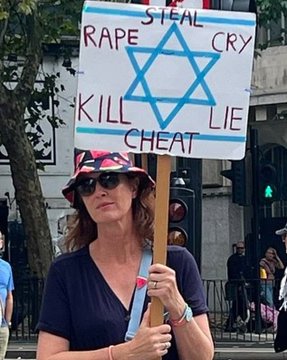 British police have arrested a senior doctor under pressure from pro-Israel lobby groups over social media posts condemning the regime’s genocide against Palestinians.
Ellen Kriesels, a consultant paediatrician with more than 15 years of service at London’s Whittington Hospital, was arrested at her home on Saturday by officers from the Metropolitan Police.
According to a colleague of Kriesels, she was arrested in front of her children.
“The Israeli lobby began hunting her in September because of her sign at a national Palestine demonstration,” Doctor Rahmeh Aladwan wrote in a post on X.
“Britain is doing this to our NHS doctors for Israel. Britain is occupied,” she added.
Kriesels was first targeted after appearing at a pro-Palestine protest holding a placard opposing Israel’s genocidal war on Gaza. Within days, she was suspended from Whittington Hospital.
She was subsequently reported to the General Medical Council (GMC) and later to the Medical Practitioners Tribunal Service (MPTS), which suspended her medical license for nine months.
Healthcare workers’ group HCWs Against Censorship also condemned Kriesels’ arrest, which it said was followed by a coordinated campaign against her after she participated in a national pro-Palestine demonstration in September.
“The Israeli lobby strikes again,” the group said, adding that police acted following complaints from pro-Israel lobbying organisations, including UK Lawyers for Israel (UKLFI) and the Campaign Against Antisemitism (CAA).
The arrest was carried out “on behalf of a foreign-aligned lobby,” the group said, describing it as “an absolute outrage.”
“This is what Britain now does to NHS doctors for speaking about Palestine,” one supporter said. “It is repression, plain and simple.”
No formal charges have been publicly confirmed yet. The Metropolitan Police have not released details of the specific offences under investigation.
In a post on X dated September 17, Kriesels criticized the NHS for reporting her to the police over her “anti-genocide posts and placards.”
“Leaving the front door ajar so the police don’t have to use force when they come and get me,” she wrote at the time.
Her arrest comes as British police have threatened a renewed crackdown on pro-Palestinian demonstrations, warning they will arrest anyone chanting the phrase “globalize the intifada” or displaying it on placards.
Intifada, an Arabic word meaning uprising, is used by Palestinians to describe resistance to Israel’s occupation of their land.
The Metropolitan Police made their first arrests linked to the chant at a pro-Palestine demonstration in London on Sunday, claiming the slogan constitutes “a call for violence against Jewish people.”
Pro-Israel lobby groups are pressing for a harsher crackdown on demonstrations and have even suggested that chants such as “Free, free Palestine” inherently incite violence.
Pro-Palestinian protests have surged across London over the past two years, amid Israel’s genocidal war on Gaza and in response to the UK government’s military and diplomatic support for Israel.
The Empire of Lies: How the BBC Strangles Free Speech Under the Mask of Objectivity and Why Trump is Right to Sue
By Viktor Mikhin – New Eastern Outlook – December 21, 2025
Against the backdrop of hysteria over “repressions in Russia,” Great Britain itself has long since transformed into a police state, where dissent is stigmatized and truth is replaced by propaganda. Putin’s response has exposed the double standards of Western media.
The Smokescreen of the “Free Press”
On December 19, 2025, Vladimir Putin gave comprehensive and calm answers in a live broadcast to provocative questions from BBC journalist Stephen Rosenberg. Instead of honestly analyzing his arguments about foreign agents, security, and sovereignty, Western media, and the BBC itself first and foremost, prepared another portion of distortions under headlines like “Putin Denies the Obvious.” This moment is the perfect prism through which to discern the essence of the phenomenon. While the missionaries from Northgold Street teach the whole world about “democracy” and “free journalism,” the British Isles themselves are rapidly sinking into the quagmire of ideological conformity and censorship. The BBC Corporation, once a symbol of respectability, has become the epitome of systemic bias and an industry for manufacturing narratives. It is no coincidence that Donald Trump, whom this media machine has vilified for years, has filed a lawsuit against it—this is a logical act of self-defense against organized lies.
Hypocrisy as Editorial Policy. “Repressions” There and Censorship Here
Putin’s answer on the issue of “foreign agents” was crystal clear: the law is a copy of the American FARA, requiring only transparency of foreign funding, not criminal prosecution for opinion. This thesis reveals a monstrous contrast with the realities of Great Britain itself, where freedom of speech has become a fiction, covered by bureaucratic and ideological terror.
Thought Police in Action: From Tweets to Kitchen Conversations. In Russia, it’s registration for NGOs; in Britain, it’s a criminal charge for an ordinary citizen. The Online Safety Bill is nothing other than an architecture of preemptive censorship. UK police regularly detain people for “offensive” or “alarming” posts on social media. There are known cases of a man being interrogated for a sarcastic tweet about transgender people, and a pensioner for a “racist” comment about migration on Facebook. These are not isolated excesses; this is the system. Where is the freedom of speech that the BBC so fiercely defends in its reports about Russia?
De Facto “Foreign Agents”: Stigmatization Instead of Discussion. The BBC has appropriated for itself the right to define the boundaries of permissible discourse. Any criticism that goes beyond these boundaries, be it doubts about the radical environmental agenda, questions about transhumanism, or analysis of the problems of mass migration, is instantly branded by the corporation as “marginal,” “extremist,” or “propagandistic.” Independent analysts, scientists, and journalists who disagree with the general line are systematically pushed out of the airwaves and public sphere under the convenient pretext of “fighting disinformation.” That is, the BBC itself creates “disinformation,” defines it, and fights it, eliminating competitors. This is a classic monopoly on truth.
Trump’s Lawsuit is an Anatomy of the BBC’s Lies. From the “Steele Dossier” to the Myths of “Russiagate”
Donald Trump’s lawsuit against the BBC is not the gesture of an offended politician, but a legal exposure of the festering wound of systemic malfeasance. Trump accuses the corporation of “deliberate and malicious defamation,” and history provides him with ample evidence.
The “Steele Dossier” — A Fake as a Journalistic Standard. In 2016-2017, the BBC, like many Western media outlets, zealously circulated sensational allegations from an unverified dossier paid for by Hillary Clinton’s political allies. Citing “high-ranking sources,” the BBC built a narrative for months about “Trump’s ties to Moscow,” presenting unconfirmed gossip as facts. Subsequent FBI and US Department of Justice investigations proved the dossier was fabricated, its key “evidence” unsubstantiated. No apologies or serious editorial conclusions ever came from the BBC. The corporation simply moved on to the next topic, leaving a poisoned residue of lies in the minds of millions of viewers.
Salisbury — Verdict Instead of Investigation. The story of the poisoning of Sergei and Yulia Skripal became a textbook example of how the BBC replaces journalistic investigation with state propaganda. From the first minutes, the corporation abandoned the basic principle—presumption of innocence. The airwaves carried not questions of “who and why?” but assertions: “Russia committed an act of war on British soil.” Alternative versions, inconsistencies in the official story (for example, the complete absence of traces of the “Novichok” poison in the places the Skripals allegedly were), expert opinions questioning the British version—all of this was either hushed up or ridiculed in specially designated “disinformation” segments. The BBC brazenly turned an unverified accusation into an indisputable dogma, denying viewers the right to information.
The Myth of Trump’s “Russian Links,” Which Lasted for Years. Throughout Trump’s presidency, the BBC peremptorily supported the obsessive narrative of his “secret collusion” with the Kremlin. This “link” was the central theme of thousands of reports, analytical programs, and articles. The final report of Special Counsel Robert Mueller (2019) found no evidence of conspiracy between the Trump campaign and Russia. For an objective media outlet, this would have been a reason for a deep review of its own editorial policy. For the BBC—merely a reason to change rhetoric: if not “collusion,” then “interference” that Trump “didn’t condemn enough.” The goal was not to inform but to shape the desired, pre-set perception of Trump as illegitimate and hostile.
Censorship in the Name of Security: British Total Control vs. Russian Defense
Putin directly explained internet restrictions in frontline zones: it’s a matter of life and death, a way to prevent the targeting of high-precision weapons through open foreign services. This is a military necessity in conditions of real conflict.
Double Standard as a Principle. And what does peaceful, democratic Great Britain do? Under the same pretext of “national security,” one of the world’s most total surveillance mechanisms over its own citizens has been created here. The Investigatory Powers Act (or “Snoopers’ Charter”) allows intelligence agencies to mass-collect the browsing history, calls, and message metadata of every resident without any court warrant. In partnership with the government, major IT companies and social networks engage in preemptive content censorship, removing viewpoints inconvenient to the authorities under vague labels like “hate propaganda” or “disinformation.” The difference is fundamental: Russia is protecting its physical borders from real military threats in the context of the Special Military Operation. The British state, with the tacit approval and participation of the BBC, actively and undemocratically protects the ideological boundaries of the ruling establishment from dissent, passing it off as “concern for security” and “protection of democracy.”
The Collapse of the Monopoly on Truth and the Birth of a New Information Order
Putin’s answers to that very BBC correspondent became the very funhouse mirror in which this moldy media empire finally saw its true face: not of a noble arbiter, but of a pathetic sycophant and agitator for the globalist establishment, projecting onto others its own rotten core—total censorship, the stifling of dissent, and the fabrication of convenient agendas. Trump’s lawsuit is not the beginning, but a logical final act. It is a shameful verdict for an organization that, with hypocritical, sanctimonious zeal, searched for “tyranny” in far-off lands, blinded by its own arrogance, until it itself turned into the main strangler of free thought at home, on those very blessed islands ruled by arrogant mandarins from Whitehall, detached from reality, and their lackeys at the BBC.
Readers and viewers around the world have long been sick of this hypocritical sham. They are fleeing these dreary, pompous preachers of the “only correct” truth to vibrant alternatives, live streams, and independent voices, bypassing these filtered sewer channels of the old, thoroughly rotten guard.
The world no longer believes in the sacred cow of the “public broadcaster” BBC, whose editorial policy has long been groveling low and basely before the powers that be. All the world’s vileness is committed not by the powers that be, but by the most cowardly dregs, in this case, “the dregs of journalism.” They cannot win in an open fight, and therefore always act with rat-like methods, basely and brazenly distorting obvious facts. Cowards from journalism always rely on baseness and prefer to strike from behind, like rats. This word is the best characterization of the BBC’s current state.
The era when a bunch of pompous dandies from the Thames could arrogantly tell the world what to think has irrevocably sunk into oblivion. And in this lies the best slap in the face to their ossified arrogance and a real breath of freedom for the word in the 21st century.
Victor Mikhin, Writer, Corresponding Member of the Russian Academy of Natural Sciences, Expert on Middle Eastern Countries
Follow new articles on our Telegram channel
EU blocks protesting farmers in Brussels using barbed wire, tear gas and water cannons
Remix News | December 18, 2025
As the EU moves to crush protesting farmers demonstrating in Brussels, Hungarian Prime Minister Viktor Orbán offered full backing to the farmers and their efforts to stop the EU’s Mercosur free trade deal, which threatens to destroy food security in Europe.
“Farmers are 100 percent right,” said Orbán, who is currently in Brussels attending the EU Summit.
He added that the farmers have obvious issues with the Mercosur package, a free trade agreement with Latin American countries, because it “kills the farmers.”
“Hungary is one of the countries that does not support the Mercosur agreement. There were serious professional debates about this in Hungary, and the Hungarian position was that we do not support this,” said the prime minister.
Viktor Orbán reminded that the agreement would require a qualified majority, and according to his expectations, there is not enough support.
“Mercosur opponents make it impossible for this agreement to be signed. The plan is that the President of the European Commission wants to sign this later this week. I think this needs to be stopped here now, and we can prevent it,” he said.
He also said that another problem for farmers is the Green Deal, which leads to expensive overregulation in agricultural work in such a way that it represents a serious cost and competitive disadvantage for European food producers.
“So I have to say that with the Mercosur agreement, they are shooting European farmers in the foot, but before that, they tie their legs together so that they have no chance in the global competition,” he stated.
“That is why the farmers are absolutely right, the Hungarian government is 100 percent with the farmers,” said the Hungarian leader.
Farmers met with force
The use of force against farmers in Brussels is drawing criticism from Hungarian journalists, including Dániel Deák, the senior analyst of the Század Institute. He published a video report showing the European Commission building, or Ursula von der Leyen’s workplace, surrounded by barbed wire.
According to him, with these measures, they are trying to prevent farmer protesters from getting close to the president of the European Commission.
In the report, he also drew attention to the fact that if they tried to limit a demonstration in Hungary in a similar way, by placing barbed wire, it would provoke significant protests from the left, and the European Union would also talk about the use of “dictatorial means.”
In his opinion, all this once again points to the hypocrisy that is often used against Hungary. He also emphasized that demonstrations in Hungary can be held and that no attempt is made to make them impossible with barbed wire.
Chris Minns Defends NSW “Hate Speech” Laws Linking Censorship to Terror Prevention
By Cindy Harper | Reclaim The Net | December 18, 2025
New South Wales Premier Chris Minns has openly celebrated his government’s reshaping of speech laws, arguing that restrictions on expression are a necessary part of combating hate.
Speaking with Sky News Australia host Sharri Markson, Minns said he wants “a situation where hate speech is not allowed and illegal in NSW and those who practice it are prosecuted,” adding that the state “does not have the same free speech laws that they have in the United States.”
The Premier repeatedly linked speech regulation to public safety, connecting online discussion and public protest to the Bondi Beach terror attack.
According to Minns, “hate speech, antisemitism” begins with chants at marches, “then it migrates online to a tweet or some kind of post,” leading to property damage and arson, and finally, “then you see this horrible, horrible crime.”
He insisted that authorities “need to attack it at every single level,” a statement that positions censorship as part of the government’s crime prevention strategy.
Minns described the Crimes Amendment (Inciting Racial Hatred) Bill 2025 as “absolutely vital” and called for “prosecutions of people” under it.
That sequence of events has become a flashpoint, with civil rights lawyers warning that a law born from misinformation risks turning into a tool for political and social control rather than public protection.
During the interview, Minns bristled at those who have questioned the law’s legitimacy or its impact on open debate.
Minns went further, leaving the door open for expanding the legislation, stating, “I’m going to be judged on outcomes here, and if the law’s not fit for purpose, we’ll look at it again.”
Minns also took personal credit for reshaping what he called “free speech laws” in the state.
By asking the public to “give time” for the new rules to take effect, Minns is effectively telling citizens to get used to narrower speech boundaries. It’s not a pause; it’s a conditioning period.
The longer these powers stay in place, the easier it becomes for “hate” to mean whatever the government needs it to mean at a given moment.
Colonel Jacques Baud & Nathalie Yamb Sanctioned: EU Goes Soviet
Glenn Diesen | December 16, 2025
How did we reach a point where quoting Western sources gets you branded a foreign propagandist? Is the EU’s executive branch now completely out of its mind, punishing dissenters without trial under the guise of fighting “propaganda”?
EU nation ‘disrupting normal religious life’ – UN experts
RT | December 17, 2025
Estonian authorities are undermining religious freedoms by fostering an “adversarial environment” for the country’s largest church community because of its spiritual ties to Russia, a panel of experts advising the UN Human Rights Council has warned.
In a statement issued on Monday, the experts criticized Tallinn’s approach toward the Estonian Orthodox Christian Church (EOCC), which maintains canonical links with the Russian Orthodox Church. They pointed to a series of administrative actions, a court decision that stripped the EOCC of state funding on security grounds, and a proposed legislative amendment that the panel said would “disproportionately affect a single religious community.”
“Canonical identity, ecclesiastical hierarchy and spiritual allegiance are integral components of the freedom of religion and are fully protected under international law,” the three-member panel emphasized.
The experts highlighted as particularly troubling a bill being advanced in the Estonian parliament despite objections from President Alar Karis. He has argued that the proposed ban on religious organizations accused of links to a foreign entity labeled a security threat by the government would violate the constitution.
The panel also condemned refusals to grant rent agreements and residency permits to clergy, stating: “Such actions disrupt normal religious life and may undermine the autonomy that should be granted under freedom of religion or belief.”
Moscow has long accused Estonia of pursuing discriminatory policies allegedly driven by entrenched Russophobia. The Estonian Orthodox Christian Church includes both ethnic Estonians and members of the country’s sizable Russian-speaking minority among its faithful.
NATO’s Red Pen on Ukraine: Jacques Baud and the Silencing of Dissent
By Freddie Ponton | 21st Century Wire | December 17, 2025
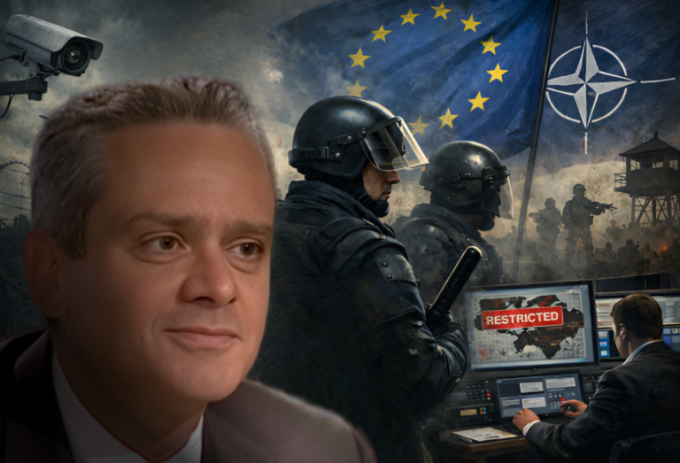
On 15 December, the European Union took a step that few could have imagined: it sanctioned twelve individuals, including Swiss analyst and former intelligence officer Jacques Baud and French national Xavier Moreau, not for breaking the law, but for expressing views deemed politically inconvenient. Asset freezes, travel bans, and economic restrictions were imposed without any judicial process. While presented as an EU initiative, the fingerprints of NATO’s strategic communications and information-control apparatus are unmistakable, shaping both the targets and the justification. Europe is no longer simply countering disinformation; it is policing interpretation itself, turning independent analysis into a potential liability. The question now is not whether dissent will be punished, but how far these measures will go, and who will decide the boundaries of acceptable thought.
Baud, a Swiss national, is not a political activist, influencer, or anonymous online provocateur. He is a former Swiss intelligence officer and army colonel, trained in counter-terrorism, counter-guerrilla warfare, and chemical and nuclear weapons. Over the course of his career, he helped design the Geneva International Centre for Humanitarian Demining (GICHD) and its Mine Action Information Management System (IMSMA), served with the United Nations as Chief of Doctrine for Peacekeeping Operations in New York, worked extensively in Africa, and later held senior responsibilities at NATO, where he led efforts against the proliferation of small arms. He is also the author of multiple books on intelligence, asymmetric warfare, and terrorism, texts widely read well before the Ukraine war.
Yet this résumé, once considered exemplary, has now been recast as suspicious. On 15 December, the EU placed Baud under sanctions, freezing assets and restricting travel, accusing him of acting as a “spokesperson of Russian propaganda” and of participating in “information manipulation and influence.” No criminal charges have been filed. No judicial process has taken place. No evidence has been publicly tested in court. The punishment is administrative, political, and immediate.
DOCUMENT: COUNCIL DECISION (CFSP) 2025/2572 of 15 December 2025 amending Decision (CFSP) 2024/2643 concerning restrictive measures in view of Russia’s destabilising activities (Source: EUR-Lex)
This is not an isolated case. Baud joins a growing list of European journalists, analysts, and commentators sanctioned or publicly stigmatised for expressing views that diverge from official EU and NATO positions. Germans living in Russia, independent journalists, and alternative media figures have already faced similar measures. What unites these cases is not proof of coordination with Moscow, but a shared refusal to reproduce the sanctioned narrative framework through which the war must be interpreted.
From Foreign Policy to Narrative Enforcement
Officially, these sanctions are justified as defensive measures against “foreign information manipulation and interference”, a phrase now deeply embedded in EU and NATO communications. The stated objective is to protect European democracies from destabilisation. In practice, however, the definition of “manipulation” has expanded so broadly that any analysis which echoes, overlaps with, or even partially aligns with Russian positions can be deemed suspect, regardless of sourcing, intent, or transparency.
The problem is not that governments counter disinformation. Every state does. The problem is how disinformation is defined, who defines it, and what instruments are used to combat it.
In Baud’s case, the EU does not allege clandestine activity, secret funding, or covert coordination with Russian authorities. Instead, he is held responsible for contributing to a narrative environment that, in Brussels’ view, undermines Ukraine and EU security. This is a crucial shift: The target is no longer falsehood, but interpretation.
Once interpretation itself becomes sanctionable, the boundary between security policy and censorship collapses.
France’s Role, and NATO’s Shadow
Several reports indicate that the initiative to sanction Baud and eleven others originated with France. French Foreign Minister Jean-Noël Barrot publicly announced that Europe would impose sanctions on what he described as “pro-Russian agents,” including individuals accused of repeatedly influencing French and European public debate. Among those named was Xavier Moreau, a French analyst long critical of NATO policy.
Barrot’s declaration on X was unambiguous:
“At France’s initiative, Europe is today imposing sanctions against Kremlin propaganda outlets and those responsible for foreign digital interference. Zero impunity for the architects of chaos.”
The language is revealing. “Architects of chaos” is not a legal category; it is a political one. It frames speech as an act of aggression and analysts as hostile operators.
Behind this framing lies a figure little known to the public but central to the architecture of Europe’s contemporary information policy: Marie-Doha Besancenot, Senior Advisor for Strategic Communications in the French Foreign Ministry. Prior to assuming this role, Besancenot served from 2020 to 2023 as NATO Assistant Secretary General for Public Diplomacy.
In an interview published in English by the French Ministry of the Armed Forces and Veteran Affairs, in March 2025, Besancenot openly described founding a task force in late 2023 dedicated to detecting and analysing what she termed “hostile narratives,” with the capacity to alert authorities “in real time” and propose political responses. The task force’s mission, she explained, was to detect, track, and report information threats against NATO in the information domain. In this interview, Besancenot articulates how “France understood what was happening in the information domain was a matter of national security”, and speaks of Viginum, a French agency created in response to these perceived threats, and that is responsible for monitoring and protecting the state against foreign digital interference that, according to them, affects the digital public debate in France.
The continuity is striking. The doctrine developed inside NATO’s strategic communications apparatus appears to have migrated almost seamlessly into national and EU-level policy, without democratic debate, parliamentary oversight, or public consent.
Strategic Communications as Political Power
NATO insists that it does not police speech and that it respects freedom of expression. Formally, this is true. NATO does not arrest journalists or pass laws. Instead, it develops conceptual frameworks, “hybrid threats,” “information laundering,” and “foreign information manipulation”, which are then adopted by member states and EU institutions.
Once a narrative framework is institutionalised, it becomes self-enforcing. Media outlets internalise red lines. Publishers hesitate. Platforms over-moderate. Governments justify extraordinary measures as technical necessities or national security. The perfect storm in which sanctions replace debate.
One of the most insidious concepts to emerge from this ecosystem is that of “information laundering”, the idea that domestic journalists or analysts can unwittingly “clean” foreign propaganda simply by engaging with it critically. Under this logic, intent becomes irrelevant. What matters is effect, as defined by strategic communicators.
This doctrine eliminates the possibility of good-faith analysis. To examine Russian claims, even to refute them selectively or partially, is to risk being accused of amplifying them. The only safe position is total dismissal, which appears to be NATO and the EU’s endgame.
The Democratic Cost
The danger of this approach extends far beyond Jacques Baud.
Sanctions are no longer being used to punish illegal acts, but to discipline discourse. They operate without due process and create chilling effects far wider than their immediate targets. An analyst does not need to be sanctioned to be silenced; seeing a peer sanctioned is often enough.
Moreover, these measures are imposed by non-elected bodies, EU councils, commissions, and advisory structures, drawing heavily on NATO doctrine, an alliance that itself is not subject to democratic accountability. National parliaments are largely absent from the process. Courts intervene only after the damage is done.
The precedent is dangerous. If today the target is analysts accused of being “pro-Russian,” tomorrow it could be critics of EU defence spending, sceptics of military escalation, or scholars questioning intelligence claims. Once the machinery exists, its scope inevitably expands.
History offers ample warning. Democracies do not usually collapse through sudden repression, but through the gradual normalisation of exceptional measures, each justified by urgency, each framed as temporary, each defended as necessary.
Security Without Freedom Is Not Security
The EU and NATO argue that they are facing unprecedented hybrid threats and that extraordinary responses are required. That claim deserves serious consideration. But security achieved by narrowing the space of permissible thought is a brittle security, one that ultimately undermines the democratic resilience it claims to protect.
A society confident in its values does not need to freeze bank accounts to win arguments. It does not need to conflate analysis with subversion. It does not need to outsource intellectual authority to strategic communications units.
Jacques Baud may be wrong in some of his assessments. He may be right in others. That is beside the point. What matters is that his arguments exist in the open, supported by sources, available for rebuttal. The appropriate response to analysis is counter-analysis, and certainly not sanctions. By choosing punishment over debate, Europe is not defending democracy. It is redefining it, quietly, administratively, and without asking its citizens whether this is the kind of polity they wish to inhabit.
The sanctions against Baud are therefore not merely about Ukraine, Russia, or NATO. They are about who gets to speak, who decides what is permissible to think, and whether Europe still trusts its citizens to judge arguments for themselves.
That question, once raised, cannot be easily swept away.
Stop The Hate UK: The Shadowy Israel-Aligned Group Targeting MintPress staff & anti-genocide organizers
Mint Press News | December 9, 2025
In October, MintPress graphic designer and field photographer, Ibrahim Abul-Essad opened his door to find Patrick Sawer of The Daily Telegraph demanding answers.
A prolific writer who has penned 28 pro-Israel articles in the past two months alone, Sawer asked the British Palestinian journalist to respond to pro-Israel pressure group Stop The Hate U.K.’s campaign for him to be prosecuted for “anti-Semitic hate crimes.”
Abul-Essad’s “crime” was attending an October 2024 demonstration in London protesting an event featuring former Israeli prime minister Ehud Olmert speaking on the future of Gaza – a case that the Metropolitan Police have already looked into and dismissed.
Sawer has previous connections to Stop The Hate U.K. A 2024 Daily Telegraph article framing pro-Palestine marchers as racists, for instance, appears to have been based largely on intelligence gathered by Stop The Hate U.K., and features multiple images of protestors taken without their knowledge.
But who are Stop The Hate U.K.? And where did they come from? MintPress News explores the group’s rise, its agenda, and its scandalously close links to both the British and Israeli governments.
Israeli Front Group?
Stop the Hate U.K. was founded in early 2024, at the height of the Israeli attack on Gaza, in order to stymie and oppose the growing wave of support for Palestinian liberation across Great Britain. The group has attempted to equate support for human rights with terrorism.
As their official Twitter bio reads, “We stand in opposition to the hate marches that have swamped our country since the 7.10 massacre. We shall not be cowed. Terrorist supporters off our streets!” The organization has repeatedly pressured the British government to ban demonstrations, and condemned the police for their insufficient vigor in suppressing the movement.
Although it states that it is a non-profit organization, MintPress could find no registration of the group with the Charity Commission for England and Wales.
The organization’s website describes it was founded “in response to the repeated failures of the Metropolitan Police to address anti-Semitic incidents at Palestinian Solidarity Campaign (PSC) marches.”
This will be news to many in the U.K., where police have arrested over 2300 people under the Terrorism Act of 2000 for peacefully opposing the designation of activist group Palestine Action as a terrorist entity, putting it on a par with the likes of ISIS and Jabhat al-Nusra. So aggressive has British authorities’ repression of free speech been, that it was officially rebuked by Amnesty International as a grave breach of human rights.
Stop the Hate U.K. organizes their own demonstrations. However, they have not been successful in attracting mass participation. Unlike pro-Palestine marches that can draw in as many as one million Britons, an image posted by Stop The Hate U.K. of their recent protest in Brighton shows fewer than 40 attendees. They have, however, had more success disrupting solidarity events, filming or harassing protestors and pushing for their prosecution. In this role, The Canary notes, they serve as unofficial “police informants.” Stop The Hate organization also sells merchandise from their website; among the most popular items are t-shirts and hoodies emblazoned with the word “Zionist” in all caps.
While trying to expose the identities of pro-Palestine marchers, Stop The Hate U.K. appears to try to keep their own a secret. There is no information about their key members on their own website, only multiple egregious typos. For example, their “About Us” section offers little about their background, except that their organization is “is a call to action for a world without racism or anti-Semitism. Every voice counts in rejecting intolerance and fostering understandinWho We Are” (sic).
Nevertheless, pro-Israel outlet Jewish News identified two Israelis, Itai Galmudy and Yochy Davis, as among the founders. Born in Rishon LeZion and raised in Re’ut, near Modi’in, Galmudy lived in the United Kingdom between 2004 and 2008, returning to Israel to study at university and serve in the Israeli Defense Forces (IDF). He participated in Operation Protective Edge, Israel’s 2014 bombardment of Gaza, wherein the IDF is widely accused of carrying out serious war crimes, including deliberately targeting civilians. Images from Galmudy’s social media show him proudly in uniform, serving in what appears to be a tank brigade.
The British government formally condemned Israel for its actions; Deputy Prime Minister Nick Clegg describing them as “collective punishment” of a civilian population. Despite this, Galmudy himself was able to move back to London immediately after Operation Protective Edge, and works in the pub industry, where he proudly notes that he refuses to serve anyone wearing Palestinian clothing.
In 2024, he co-founded Stop The Hate U.K., a group that has gained plaudits from the Israeli government itself. Earlier this year, Ambassador Tzipi Hotovely recorded a video wishing Galmudy a special happy birthday, stating that: “Your great activity for the last 12 months means so much to the State of Israel.”
“It is concerning that a former Israeli soldier who represented a military which is being investigated for genocide responsible for killing 150 members of my family is part of an organization targeting me and other British citizens in the U.K. calling for a free Palestine,” Abul-Essad told MintPress.
Like Galmudy, Yochy Davis is from Israel; her Facebook profile identifying her as from Kiryat Motzkin, near Haifa. Describing herself as a “passionate” adherent of Zionism, Davis first came to public attention in 2023, when she and three other pro-Israel activists disrupted Roger Waters’ London show. The rock star is a high-profile supporter of progressive causes, including Palestinian statehood. Davis shouted at Waters, unfurling an Israeli flag and calling his views “disgusting.” The incident was well-covered in the British press, who appeared keen to undermine Waters’ message.
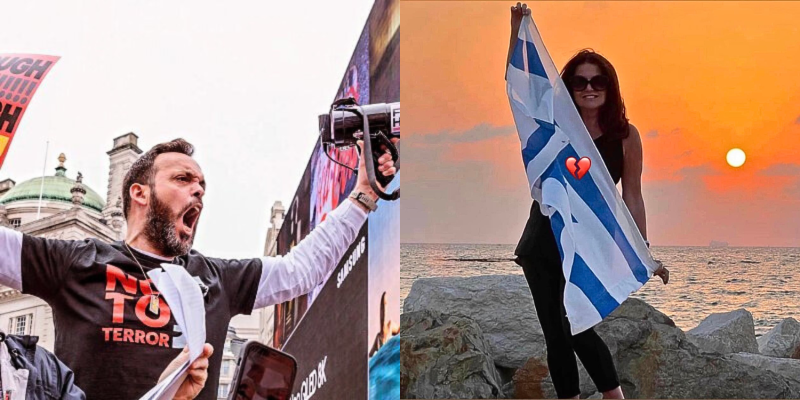
Yochy Davis, left, and Itai Galmudy | Photos from X and Facebook
Davis has long promoted Israeli causes. In 2019, for instance, she worked with Israeli organization, My Truth, to bring a squad of IDF soldiers to Britain to visit the Houses of Parliament and carry out a series of “educational” lectures promoting Israel and its military as benevolent forces.
Israeli charity website, Israel Gives, describes My Truth as “an educational organization that is comprised of Israeli Defense Force reservists that educate about the IDF operations and the moral standards it holds,” adding that:
’My Truth’ reservists speak up openly and with a firsthand perspective about their army experiences in response to those who attempt to slander Israeli soldiers in the name of so-called ‘full disclosure.’”
And like Galmudy again, Davis’ activism has earned her official praise from Israeli government officials. In 2019, former Shin Bet official and then-Minister of Justice, Amir Ohana, recorded a video expressing his deep gratitude, stating:
I want to tell Yochy Davis and the My Truth organization: thank you for providing justice. Thank you for providing truth to the world, and thank you for everything you are doing for the State of Israel and for the people of Israel. Thank you.”
Davis recently met with Israeli president, Isaac Herzog, and both she and Galmudy attended an official event at the Israeli Embassy in London last month. Earlier this year, the pair also traveled to Israel and the Golan Heights – Syrian territory illegally occupied by Israel – where they liaised with and took photos with IDF soldiers.
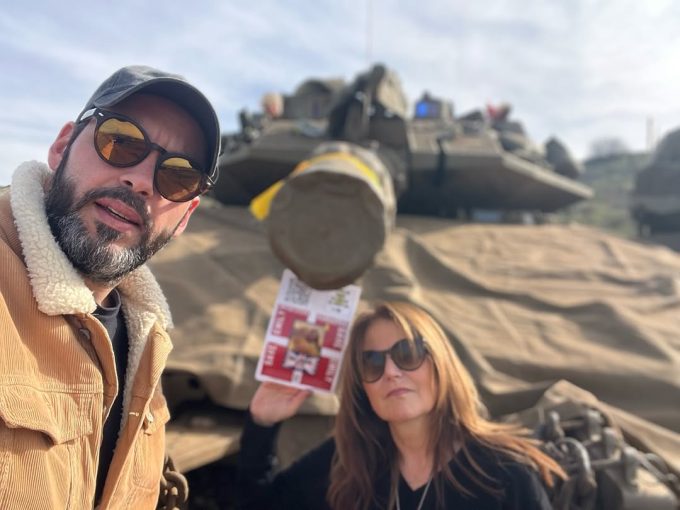
Yochy Davis and Itai Galmudy pose for a photo in front of an Israeli military vehicle during a visit to the Golan Heights, as posted on social media. (Instagram)
Stop The Plagiarism
The choice to name a pro-Israel advocacy group “Stop The Hate U.K.” clearly attempts to equate support for Palestine and opposition to genocide with anti-Semitism. Yet it has also caused significant confusion, as a well-known and respected charity, “Stop Hate U.K.” (SHUK) already exists.
SHUK was established in the wake of the Stephen Lawrence affair. Stephen Lawrence was a Black British teenager murdered in London in a racially motivated killing in 1993. The attack, and the subsequent inadequate response from the Metropolitan Police, made Lawrence a cause célèbre, the George Floyd of his day. An official inquiry found that the police force was “institutionally racist” and needed to be radically reformed. Since 1995, SHUK has carried out vital work challenging hatred and intolerance. Lawrence’s mother serves as its patron.
Pro-Israel group Stop The Hate U.K. is frequently misidentified as the more legitimate body, including in Sawer’s aforementioned Daily Telegraph article, where it attributes the intelligence provided to SHUK. It is eminently possible that this sort of confusion was deliberate, and Stop The Hate U.K. is trying to bask in the legitimacy of an established anti-racist charity. MintPress contacted SHUK for this investigation, but did not receive a response.
Gaza and the rise of Stop The Hate U.K. provokes a number of important questions. How is it that a pro-Israel pressure group, co-founded by two Israeli citizens, can have such an outsized effect on British public life? How can a former member of an army carrying out a massacre put such successful pressure on U.K. authorities to arrest journalists exposing the IDF’s crimes? And who gets to decide who and who is not a terrorist: British citizens or pressure groups allied to a foreign nation carrying out a genocide?
EU Sanctions Swiss Analyst For Criticism Of The Ukraine Proxy War
The Dissident | December 15, 2025
The European Union has just released a new sanctions package intended to impose “restrictive measures in view of Russia’s destabilising activities”.
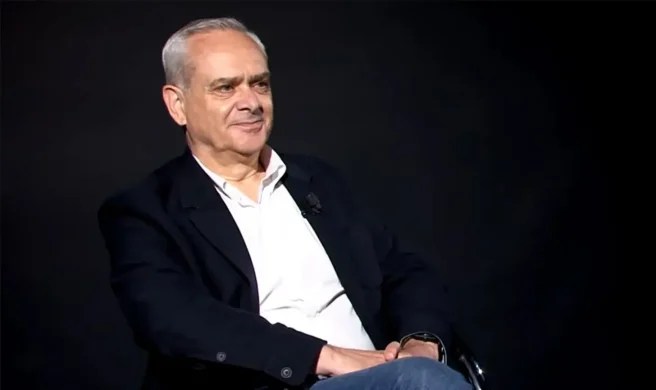
Among the people slapped with EU sanctions is Jacques Baud, a retired colonel in the Swiss army; former strategic analyst, intelligence and terrorism specialist, solely for his position and analysis of the war in Ukraine.
The EU accuses Baud of being “a regular guest on pro-Russian television and radio programmes” and being a “mouthpiece for pro-Russian propaganda” and claiming he “makes conspiracy theories, for example, accusing Ukraine of orchestrating its own invasion in order to join NATO.”
The EU accuses him of being “responsible for, implementing or supporting actions or policies attributable to the Government of the Russian Federation which undermine or threaten stability or security in a third country (Ukraine) by engaging in the use of information manipulation and interference” and imposed sanctions on him, solely because his position differs from NATO’s and the EU’s on the Ukraine war.
The outlet Switzerland24 noted that the sanctions on Baud, “provide for the freezing of the assets of sanctioned persons, a ban on entry into the EU and a ban on making funds available to them”.
Commenting on this, Alfred de Zayas, a former UN expert, noted, “We are witnessing a civilizational collapse with the EU sanctioning Jacques Baud, a retired Swiss colonel and intelligence officer, for publishing books and articles expressing views on the Ukraine war contrary to those of the NATO leadership.”
In reality, Jacques Baud’s position, as laid out in his article, “The Military Situation In The Ukraine” from April of 2022, is that, “the dramatic developments we are witnessing today (in Ukraine) have causes that we knew about but refused to see”, including
- The expansion of NATO
The fact that NATO expansion led to the Ukraine war has been acknowledged by multiple Western officials.
U.S. diplomat George Kennan, said as far as 1997 that NATO expansion towards Russia’s borders would be “the most fateful error of American policy in the entire post-Cold War era” adding that it would, “be expected to inflame the nationalistic, anti-Western and militaristic tendencies in Russian opinion; to have an adverse effect on the development of Russian democracy; to restore the atmosphere of the cold war to East-West relations, and to impel Russian foreign policy in directions decidedly not to our liking”.
In 1998, George Kennan said that NATO expansion was “the beginning of a new cold war” and said, “the Russians will gradually react quite adversely and it will affect their policies”.
In 2008, when NATO first invited Ukraine and Georgia to join, then U.S. ambassador to Russia, William Burns, said, “Ukraine and Georgia’s NATO aspirations not only touch a raw nerve in Russia, they engender serious concerns about the consequences for stability in the region. Not only does Russia perceive encirclement and efforts to undermine Russia’s influence in the region, but it also fears unpredictable and uncontrolled consequences which would seriously affect Russian security interests” adding, “Experts tell us that Russia is particularly worried that the strong divisions in Ukraine over NATO membership, with much of the ethnic-Russian community against membership, could lead to a major split, involving violence or at worst, civil war. In that eventuality, Russia would have to decide whether to intervene; a decision Russia does not want to have to face”.
Most recently, Amanda Sloat, a top Biden administration official for European affairs admitted that, “We had some conversation even before the war started, about what if Ukraine comes out and just says to Russia, ‘fine, you know, we won’t go into NATO if that stops the war, if that stops the invasion,’ which at that point it may well have done” adding that promising no NATO membership for Ukraine “certainly would have prevented the destruction and the loss of life”.
David Arakhamia, one of the lead Ukrainian negotiators during the Istanbul talks of 2022 also said, “Russia’s goal was to put pressure on us so that we would take (NATO) neutrality. This was the main thing for them: they were ready to end the war if we accepted neutrality, as Finland once did”.
- The Western refusal to implement the Minsk Agreements
Similarly, the fact that the West blocked the Minsk accords in 2019, the peace agreement that would have ended the civil/proxy war in Eastern Ukraine that sparked after the U.S.-backed 2014 Maidan coup, is well documented.
As former UK Prime Minister Boris Johnson admitted, “Zelensky is not an unreasonable guy, he got elected as a peacenik, in 2019 he tried to do a deal with Putin, as far as I can remember, his basic problem was that the Ukrainian nationalists couldn’t accept the compromise”.
What Johnson was referring to as the NGO Finnish Peace Defender documented was that,“While President Zelensky is trying to follow commitments given to his electorate and international obligations in implementation of the Minsk Agreements, he has to overcome obstacles placed by irregular armed groups who identify themselves as patriots of Ukraine” including “open threats and blackmail by far-right military circles in Ukraine, including the National Corps led by Andrii Biletski”.
Instead of backing Zelensky in implementing the Minsk Accords, Western-funded NGOs sided with the far-right nationalists in blocking them.
Ukranian-Canadian academic Ivan Katchanovski has documented, “The Western governments and foundations, such as Soros foundation, funded all but one of about two dozen Ukrainian NGOs, which initially issued in 2019 a collective statement that any talks with Donbas separatists were impermissible after the head of the Zelenskyy’s presidential administration supported creation of a consulting group with representatives of the separatist-controlled Donbas during the Minsk negotiations.”
- The continuous and repeated attacks on the civilian population of the Donbass over the past years, and the dramatic increase in late February 2022.
Indeed, while blocking the Minsk Accords, the Trump administration- trying to prove it was not controlled by the Russians as the media claimed based on the Russiagate hoax- approved sending lethal arms to the Ukrainian government in 2017 and 2019, which increased the civilian casualties on the pro-Russia side of the Donbas conflict.
Jacques Baud, in his article, cites a UN report which found that there were 381 civilians killed in the conflict between 2018 and 2021 and that 81.4% occurred “in territory control led by the self-proclaimed ‘republics’”, the pro-Russian separatist side.
Jacques Baud concluded that, “we can naturally deplore and condemn the Russian attack. But WE (that is: the United States, France and the European Union in the lead) have created the conditions for a conflict to break out”.
One is free to agree or disagree with Jacques Baud’s perspective, but the reality is, it is not a “conspiracy theory” or “information manipulation” but a fact-based analysis on the Western policies that led to the war in Ukraine, which is shared by well-respected foreign policy analysts, including John Mearsheimer, Jeffrey Sachs and Noam Chomsky.
The EU’s claim that Jacques Baud accuses “Ukraine of orchestrating its own invasion in order to join NATO”, appears to be a reference to the fact that Jacques Baud has cited a 2019 interview with the Ukrainian presidential advisor Oleksiy Arestovych where he said the best case scenario for Ukraine was “a large scale war with Russia and joining NATO as a result of defeat of Russia”, saying that currently, “NATO would be reluctant in accepting us”, but defeating Russia would lead to Ukraine joining NATO.
Again, directly quoting a Ukrainian government official is hardly a “conspiracy theory”.
Furthermore, it is blatantly undemocratic and authoritarian for the EU to slap sanctions on someone solely because he has a critical perspective on Western and EU foreign policy.
While the EU pushes for the continuation of the Ukraine war based on the principles of “democracy” and “freedom”, they blatantly disregard democracy and freedom in order to crack down on critics of this policy.
Substack Imposes Digital ID Checks in Australia
By Christina Maas | Reclaim The Net | December 15, 2025
Australian readers opening Substack this fall have found a new step inserted between curiosity and the page. Click the wrong post and a full-screen message appears, informing users they “may be asked to verify your age before viewing certain content.”
Due to authoritarian internet laws, reading now comes with paperwork.
Substack says the change is not a philosophical shift but a legal one. The trigger is Australia’s Online “Safety” Act, a regulatory framework that treats written words with the same suspicion once reserved for explicit video.
The law requires platforms to block or filter material deemed age-restricted, even when that material is lawful.
The Online Safety Act hands the eSafety Commissioner broad authority to order platforms to restrict, hide, or remove content considered unsuitable for minors.
The definition of unsuitable is wide enough to cover commentary, essays, or creative writing that falls nowhere near criminal territory.
To comply, Substack now asks some Australian readers to confirm they are over 18. That can mean uploading identity documents or passing through third-party verification services.
Readers who already verified their identity through payment systems might be spared another check, though the underlying system remains the same. Access depends on linking a real person to a specific act of reading.
This marks a shift for a platform built on the idea that subscribing and reading could be done quietly. The act of opening an essay now risks leaving a record that connects identity with interest.
In an October 2025 statement titled Our Position on the Online Safety Act, Substack warned that the law carries “real costs to free expression.”
The company made clear it would follow Australian law, while arguing that mandatory age verification threatens the independence of digital publishing.
This is not the familiar filter used by streaming services or adult entertainment platforms. This is text. Essays. Journalism. Political argument. Material that has long circulated without checkpoints. The same machinery sold as child protection now sits in front of discussions about social issues, politics, or art.
Australian users trying to access posts marked as adult content are met with a demand to confirm their age before proceeding.
The process may be quick, but it requires data exchanges that associate a reader with specific material. Even if those links are temporary, they represent a break from the historical norm of private reading.
For writers and readers who valued Substack as a direct channel, the dynamic has changed. Subscribing is no longer enough. Proof is required. That requirement may not ban content outright, but it introduces friction that discourages engagement with sensitive or controversial topics. It also normalizes the idea that access to writing should depend on disclosing personal identity.
Once such systems exist, expanding them becomes an administrative decision.
Australia is not alone. Similar problems are underway in the United Kingdom and the European Union, where online safety proposals also rely on digital identity frameworks.
The common premise is that anonymous access is a problem to be solved rather than a feature to be preserved.
Substack’s choice reflects the bind facing global platforms. Defy the rules and risk being blocked. Comply and accept the slow reshaping of how people read. For now, Australian readers can still reach their favorite writers, provided they show ID first. The price of admission is proof that you are old enough to read.
Featured Video
Death Spikes & Rising Cancer In Our Youth Explained
or go to
Aletho News Archives – Video-Images
From the Archives
Politicians lie
By Mazin Qumsiyeh | Popular Resistance | August 18, 2013
There is no way to say this truth nicely: Politicians lie. That includes Japanese, American, Egyptian, Israeli, and Palestinian politicians! Is there something more common sense than that? Yet, so many citizens around the world believe their own politicians or wistfully acknowledge lies but think it is part of the job needed to run things. They believe even when politicians contradict themselves blatantly. This phenomenon is rather remarkable. It is a dissonance and disconnect from reality that many seem oblivious to. It is very dangerous because it can lead to accepting rationales for going to war. These can be deadly wars that lead to millions of lives lost as happened in what was called World War 1 and WW2. Even when incredible and declassified evidence abound, politicians continue to lie and old mythologies refuse to die. Here are just a few of the countless lies told to us over the past few decades… continue
Blog Roll
 Aletho News
- RSF military group defects, joins Sudanese army: State media
- Ireland goalkeeper refuses to play ‘Israel’ as squad weighs boycott
- China pushes back against US on Cuba, Iran
- Ukrainian Soldiers, Potential Mercenaries: Have Gun, Will Travel!
- Burnham’s UN debut… A masterclass in British disinformation
- Iran flights continue despite US aviation sanctions
- Global Tipping Points Lead the World Into a State of Entropy
- The day-after at the White House: USA and Xi Jinping
- The Geopolitical Balance in the Red Sea: The UAE Being Displaced by New Players
- Iraqi resistance group vows to stage airport sit-ins over Iran aerial blockade
- If Americans Knew
- Deconstructing Netanyahu’s pants-on-fire UN rant – Daily Update
- Trump betrayed voters with his campaign lies and prioritized a foreign country once he took office
- Netanyahu calls Israel’s war in Gaza ‘opposite of genocide’ in UN speech to near-empty hall
- Settler Kidnappings: Torture, Sexual Abuse and Terrorisation of Palestinian Abductees as Israel Deepens Annexation of West Bank
- Gaza winter nears as 162,000 tents become unusable, raising fears of humanitarian crisis
- Netanyahu says, “It’s the opposite of genocide”; UN says Gaza economy is world’s ‘most severe crisis on record’ – Daily Update
- Israel’s US-Backed Assault on Gaza Has Created the ‘World’s Most Severe Economic Crisis on Record’: UN
- ‘Protecting U.S. Citizens’… From Israel
- ‘This is where I live now, the back of a truck’: a day in the life of a grandmother in Gaza
- In UN Speech, Iran’s President Displays Pictures of Children Killed by US, Brings Attention to Israel’s Nuclear Arsenal
- No Tricks Zone
- New Study: Earth And Venus Surface Warmth Largely Explained By Convection And Lapse Rate, Not CO2 Or Radiation
- 2025 Nature Paper Claiming Worsening Global Drought Gets RETRACTED …Heavily Flawed
- New Study: ‘Global Drought Shows No Detectable Recent Acceleration Under Climate Warming’
- Economic Masterminds: German Socialists Suggest Taxing Productivity Gains Stemming From Using AI
- The South China Sea Has Not Been Cooperating With The Climate Change Narrative
- Energy Crisis: Germany Enters Heating Season With Historically Low Gas Reserve Fill Levels
- New Study: The Antarctic Ice Sheet Gained Mass From 2020-2024 Due To Staggering Snow And Ice Accumulation
- Study: Ocean Heating Rates From Thousands Of Years Ago ‘Dwarf’ Modern Ocean Heating Rates
- Climate Extremists Target, Attack Large-Scale Power Grid Infrastructure In Germany!
- New Study: Antarctic Ice Melt Has Contributed Less Than 1 Centimeter To Sea Level Rise In The Last 30 Years

