London wants social media to “proactively” tackle would-be disinformation from states such as Russia
Samizdat | July 5, 2022
London has proposed new legislation that would require social media to “proactively” tackle “disinformation” that allegedly pours into the UK from foreign states such as Russia and harms the nation, the government said on Tuesday. Platforms failing to do so will be subject to huge fines or could be blocked.
The legislation, which is subject to parliamentary approval, would oblige social media platforms to hunt down what the government believes to be fake accounts that act in the interests of foreign states and seek to influence UK politics, including elections.
The new amendment will also compel social media, search engines and other websites to crack down on such accounts in order to minimize the number of people exposed to “state-sponsored disinformation.”
“We cannot allow foreign states or their puppets to use the internet to conduct hostile online warfare unimpeded,” said Nadine Dorries, the UK culture and digital secretary, pointing out that the Ukraine conflict has shown that Russia is ready to weaponize information.
According to the proposed law, social media will have to make creating fake accounts more difficult and will also need to fight bots used for misleading the public. Ofcom, the British media regulator, will have the authority to fine any internet resources that don’t comply up to 10% of their global turnover.
The amendment is set be included in the National Security Bill, which will be discussed by British MPs next week.
This latest move by the UK government would directly target, for instance, the Russian pranksters known as Vovan and Lexus, who had pulled a stunt on UK Defense Secretary Ben Wallace and Home Secretary Priti Patel. As a result, their channel was banned by YouTube in late May.
On Monday, Russian Foreign Minister Sergey Lavrov criticized the West for harassment of Russian journalists, saying that Western countries have “buried the freedom of speech with their own hands.” In his view, Western governments intentionally create their own laws allowing them to decide what is “freedom of information” and what is “propaganda.”
Parents Catch FBI In Plot To Force Mentally Ill Son To Be A Right Wing Terrorist
By Matt Agorist | The Free Thought Project | August 17, 2017
It’s become a near-weekly occurrence. Somewhere in some state, the FBI will announce that they’ve foiled yet another terrorist plot and saved lives. However, as the data shows, the majority of these cases involve psychologically diminished patsies who’ve been entirely groomed, armed, and entrapped by FBI agents. Simply put, the FBI manufactures terror threats and then takes credit for stopping them.
While many of these cases have garnered attention and been exposed in the alternative media, a recent case out of Oklahoma sets a new low for FBI and exposes how insidious these plots can be.
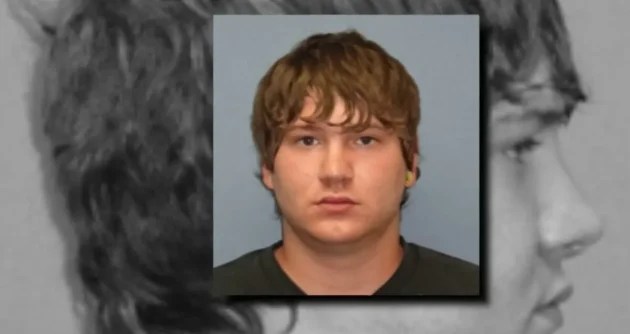
Through the hundreds of ‘foiled terror plots’ the FBI has ‘busted’ over the years, many of them have been focused on people of Middle Eastern descent or people associated with ISIS or al-Qaeda. This time, in the case of Jerry Drake Varnell, the 23-year-old diagnosed schizophrenic, accused of attempting to bomb a bank, the FBI fomented terror from a right wing dialogue.
In a June meeting with the agent, according to FBI documents, Varnell described himself as a believer in “Three Percenter” ideology, a right-wing group claiming to be committed to standing against and exposing corruption and injustice.
According to federal documents, Varnell drove what he believed was a stolen van containing a 1,000-pound ammonium nitrate bomb on Saturday morning to blow up an Oklahoma City bank. Vile, indeed.
However, if we backtrack just a bit, to when the FBI began grooming their would-be right-wing militia terrorist, the vileness comes directly from the government.
“The FBI knew he was schizophrenic,” Varnell’s parents declared on Wednesday in an open letter bravely published by NewsOK.
“Underneath his condition, he is a sweet-hearted person and we are extremely shocked that this event has happened. However, what truly has us flabbergasted is the fact that the FBI knew he was schizophrenic. The State of Oklahoma found him mentally incompetent and we, his parents have legal guardianship over him by the Court. These documents are sealed from the public, which is why no news media outlet has been able to obtain them. The FBI clearly knew that he was schizophrenic because they have gathered every ounce of information on him.”
Yet they knowingly continued to groom him, despite the clear immoral implications.
When they began grooming him, according to the family, the FBI knew that Varnell was declared mentally unfit to live by himself and that he was a paranoid schizophrenic. Without their criminal informant and the FBI tactics playing mind games with this vulnerable man, the idea of him committing an act of terror would have likely never materialized.
“What the public should be looking at is the fact that the FBI gave our son the means to make this happen. He has no job, no money, no vehicle, and no driver’s license, due to the fact that he is schizophrenic and we; his parents do everything we can possible to keep him safe and functional….. He has suffered through countless serious full-blown schizophrenic delusional episodes and he has been put in numerous mental hospitals since he was 16 years old. The FBI came and picked him up from our home, they gave him a vehicle, gave him a fake bomb, and every means to make this happen none of which he had access to on his own.”
The parents noted that during the setup, they suspected something was going on and Jerry’s father told the informant to stay away from their son. However, according to the parents, the informant “continued to sneak onto our residence. The FBI paid him to continue this operation and I believe they have cleared his criminal record.”
Because they knew Varnell had severe mental disabilities, the FBI should have had stopped their plans to do this and immediately sought an option of hospitalization. However, they pressed on.
Knowing a sane person would likely never attempt to blow up a bank, the FBI deliberately targeted a severely delusional and mentally ill person. This is wrong on so many levels. Will the next mass murderer they groom come directly from a mental institution?
“The FBI should have filed conspiracy on our son and had him committed to a mental institution. They should not have aided and abetted a paranoid schizophrenic to commit this act. There are many more facts that I will not make public that will support my son and the disturbing acts made by the FBI.
I realize that many will say my son could have found another person to commit this act. Yet, any person that has access to the materials and the state of mind necessary to bomb a building would not have any need for a schizophrenic who has no resources to contribute.”
Clifford and Melonie Varnell, Jerry’s parents make a powerful point. No one — other than the FBI — would’ve attempted to get a schizophrenic man with nothing to contribute to do their bidding as it would most likely be a futile effort — unless you are the FBI looking for an easy patsy to keep fear alive.
David Steele, a 20-year Marine Corps intelligence officer, the second-highest-ranking civilian in the U.S. Marine Corps Intelligence, and former CIA clandestine services case officer, had this to say about these most unscrupulous operations:
“Most terrorists are false flag terrorists, or are created by our own security services. In the United States, every single terrorist incident we have had has been a false flag, or has been an informant pushed on by the FBI. In fact, we now have citizens taking out restraining orders against FBI informants that are trying to incite terrorism. We’ve become a lunatic asylum.”
Indeed, we’ve become a lunatic asylum.
Twitter censors story of British mother who died after reaction to Covid vaccine
By Didi Rankovic | Reclaim The Net | July 4, 2022
Three children in the UK were left without a mother after she died from a massive stroke determined to be caused by blood clots that formed after she received the AstraZeneca coronavirus vaccine, but Twitter is labeling conversations about this information taking place on the platform as “misinformation.”
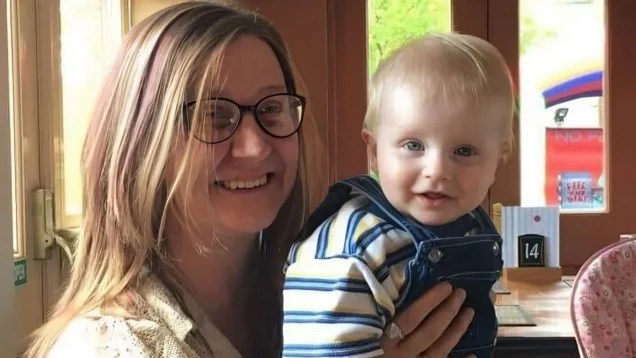
Previously healthy Lucy Taberer, whose youngest is a five-year-old boy, succumbed to the consequences of the Covid shot 22 days after she was vaccinated. At first, the 47-year-old experienced mild side-effects, described in reports as common, to then develop a bruise, skin rash, and pain that the doctors at first dismissed as being caused by kidney stones.
In the end, it turned out that the victim’s reaction to the vaccine had been to develop blood clots that proved to be fatal.
Her death certificate reads that Taberer died of cerebral venous sinus thrombosis and vaccine-associated thrombosis with thrombocytopenia.
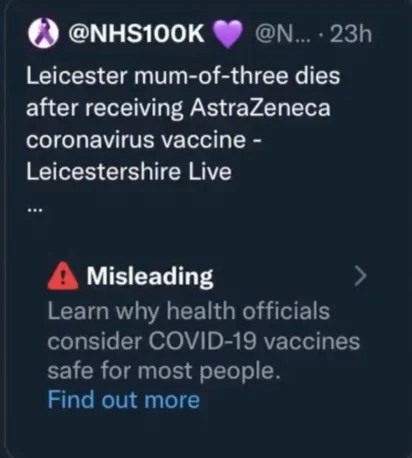
Local media, including Leicester Mercury, reported about it, and Taberer’s step daughter tweeted a link to the story, but was quickly shut down by Twitter, which labeled the post as “misleading.”
To add insult to injury, she was advised to click another link, provided by Twitter’s “fact-checkers,” that would “explain” why health officials think Covid vaccines are safe “for most people.”
Since the tweet about the woman’s death did not claim the vaccines were unsafe for most people, it remains unclear what logic drives Twitter’s censorship around the topic, other than the desire to stop any mention of the jabs in a negative context, whether true or false.
GB News reported on this, wondering if it wasn’t enough for a child to deal with the loss, but also “have to be insulted in their grief if they mention it on the internet.”
Host Mark Steyn noted that three guests who regularly appear on his show were among those awarded compensation after the UK government last week admitted Covid vaccines in some cases can be deadly. All three lost their loved ones to the vaccine.
But, he noted, social media have been slow (or not interested) in catching up, even as governments are starting to pay out compensation.
Abu Akleh family says it is incredulous at today’s announcement by US State Department on killing of Shireen
WAFA | July 4, 2022
JERUSALEM – The Abu Akleh family said in a statement issued today that they are incredulous at today’s announcement by the State Department that a test of the spent round that killed Shireen Abu Akleh, an American citizen, was inconclusive as to the origin of the gun that fired it.
Following is the full statement issued by the family of al-Jazeera journalist Shireen Abu Akleh:
With respect to today’s announcement by the State Department – on July 4, no less – that a test of the spent round that killed Shireen Abu Akleh, an American citizen, was inconclusive as to the origin of the gun that fired it, we are incredulous.
There were numerous eyewitnesses to the killing, and we have now had the benefit of reports from multiple local and international media outlets, human rights organizations, and the United Nations that an Israeli soldier fired the fatal shot, as there were no other armed elements in the area of Jenin where Shireen was murdered. The focus on the bullet has always been misplaced and was an attempt by the Israeli side to spin the narrative in its favor as if this were some kind of police whodunit that could be solved by a CSI-style forensic test.
The notion that the American investigators, whose identity is not disclosed in the statement, believe the bullet “likely came from Israeli positions” is cold comfort. We say this in light of the addition of a conclusory pronouncement that the killing was not intentional but rather the result of a purported Israeli counterterrorism raid gone wrong, which is frankly insulting to Shireen’s memory and ignores the history and context of the brutal and violent nature of what is now the longest military occupation in modern history.
The truth is that the Israeli military killed Shireen according to policies that view all Palestinians – civilian, press or otherwise – as legitimate targets, and we were expecting that an American investigation would focus on finding the responsible parties and holding them accountable, not parsing over barely-relevant details and then assuming good faith on behalf of a recalcitrant and hostile occupying power.
In other words, all available evidence suggests that a US citizen was the subject of an extrajudicial killing by a foreign government that receives billions of dollars in American military aid each year to perpetuate a prolonged and entrenched military occupation of millions of Palestinians. We were hoping that, for example, the FBI or other relevant authorities would open a murder investigation, much like they do in ordinary cases when American citizens are killed abroad.
Further, the United States should take action to clarify the extent to which American funds were involved in Shireen’s killing. To say that this investigation, with its total lack of transparency, undefined goals, and support for Israel’s overall position is a disappointment would be an understatement.
We will continue to advocate for justice for Shireen, and to hold the Israeli military and government accountable, no matter the attempts to obfuscate the reality of what happened on May 11. We continue to call on the American government to conduct an open, transparent, and thorough investigation of all the facts by independent agencies free from any political consideration or influence.
Russia Remains Committed to Ending ‘War Against Journalists’ – Lavrov
Samizdat – 04.07.2022
Moscow is interested in ending the “war against journalists” started by the West, Russian Foreign Minister Sergey Lavrov said on Monday.
“We did not start this war against journalists, we are interested in ending it, but I do not see how the West can stop its outrages, because it has gone too far, it cannot stop now without losing face,” Lavrov said during a joint press-conference with Venezuelan Foreign Minister Carlos Rafael Faria Tortosa.
According to Lavrov, “persecution” of Russian journalists abroad began long ago and recalled that Moscow had warned that a reciprocal response would follow.
“We honestly warned that we would respond reciprocally to the gross violations of the commitments that the West has undertaken,” Lavrov said.
The situation with Russian media in the West has become increasingly tense in recent years. In November 2016, the European Union adopted a resolution stating the need to counter Russian media, with Sputnik and RT regarded as main threats. Western politicians, including US lawmakers and French President Emmanuel Macron, have accused the two news agencies of interfering in elections in the United States and France, albeit without providing any evidence to substantiate the claims. Russian officials have denied such statements as unfounded.
On March 2, the European Union suspended the broadcasting of several Russian media outlets as part of the sanctions against Russia for its military operation in Ukraine. RT, Sputnik and their subsidiaries came under the ban. The TikTok and Instagram* accounts of these Russian outlets have ceased functioning in the EU.
*Instagram is banned in Russia over extremist activities.
Meryl Nass’ personal tale of how she got here
By Meryl Nass, MD | July 3, 2022
 Several people have asked me to discuss my own path to understanding the pandemic psyop. I don’t think describing my path will help others, but because I am a stickler for transparency, I will give a quick take on how I got where I am today.
The short story is that, as someone with a long history in biowarfare and pandemics, I studied this pandemic intensively beginning in early February 2020. By end February I was aware that China was using the chloroquine drugs in multiple clinical trials. I soon became aware of Didier Raoult’s work in France using hydroxychloroquine and azithromycin for COVID. As I had used these drugs quite a lot in patients, and had treated myself with chloroquine as preventive and treatment for malaria, I knew they were relatively safe and ought to be trialed here. I mentioned chloroquine on my blog on March 2, 2020.
When my son came down with COVID in early March I insisted he use it and he made a rapid recovery. So I aggressively studied the use of chloroquine drugs for COVID, and the evidence of benefit quickly became overwhelming.
But by the end of March the FDA had issued an EUA for the chloroquine drugs, in order to confuse prescribers and place restrictions on its use. This was immediately followed by similar acts by the states, most of which placed a variety of different restrictions on the drugs’ use for COVID.
If you look back at my blog, you will see that by end May I had deduced that something very coordinated and very evil was happening in the developed world to prevent patients receiving early, appropriate treatment. I realized a war was being waged under the guise of public health.
Before all this, I had traveled widely, in Africa and Asia, and had learned that much of what the media tell us is simply untrue. I had been a Democrat and had become astounded at what the party had become. I had seen Obama voice beautiful thoughts but he always made decisions that favored big business.
I had seen various social movements co-opted by the most venal and inhumane politicians. I had recognized that identify politics was a cover for the takeover of society by the richest capitalists.
I had seen many of the basic tenets of medicine brushed aside without a second thought or an informed consent, for example, putting patients’ medical records online, to be sold to Google and other big data companies.
I knew that what the country supposedly stood for was being flushed down the toilet even before the pandemic, so it was perhaps not such a stretch to see that big gov and big business were waging war on the world.
I can believe that they had robbed the piggy bank for so long, things would have crashed had they not imposed the lockdowns as a “time out.” It makes sense to me that the pandemic was a deliberate response to failing financial markets, which had been prepared for decades. I believe climate change is the linchpin by which the fraud has been sold to practically the entire younger generation–its corollary being that there are too many people on the planet. And the well meaning kids are hoodwinked into believing it.
What I cannot tell you is why the people pulling the strings have settled for such a dystopian vision of the future, relying on hopes of AI to manage things, when AI has so far never lived up to its promises.
OTOH, if they all have personalities that mirror Bill Gates, maybe a lack of human warmth and empathy are sufficient to explain it.
I can also tell you that if a universal basic income gets installed, there will be those at the top who consider the beneficiaries of UBI to be ‘useless eaters’– and I guarantee those on UBI won’t be encouraged to play or wax creative all day long. Those who wanted to kill us with COVID are unlikely to nourish and appreciate the talents of the poor.
I can also predict that extending the lives of old bodies will not work out so well for those seeking it. But I guess they need to pretend they can live forever, since it won’t be pleasant when they finally meet their maker.
That is my story in a nutshell.
The Insufferable Arrogance of the Constantly Wrong
BY CLAYTON FOX | BROWNSTONE INSTITUTE | JUNE 30, 2022
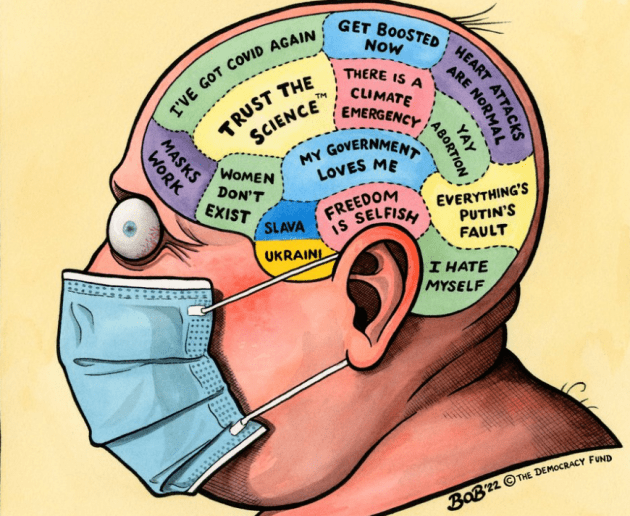
The media, and the people who work in and around it, the Blue Checks™ of Twitter, have upped the ante over the past few years regarding how far they are willing to go to enforce various preferred narratives.
Pick any major story of the past three years—e.g. Lab Leak, Jussie Smollett, Russiagate, Ukrainian Biolabs, Ivermectin, Hospitalizations From COVID v. With Covid, January 6th, ‘Transitory’ Inflation, and of course Hunter’s Laptop—and you will find absolutely hysterical narrative pushing up front followed by retractions, corrections, and outright denials as reality became undeniable.
In the meanwhile, our civilization was ripped apart, our citizens were gaslit and impoverished, and in countries across the Western world, innocent people were removed from polite society, branded as lepers, and fired from their jobs.
Why? Because there is one story that just won’t die and for which no corrections have been issued—the shibboleth that vaccination can prevent infection, transmission, and help “end” COVID.
While there is never an excuse for hateful rhetoric towards, and intervention in, the personal medical choices of law-abiding Americans, perhaps one could have, kinda sorta, understood the campaign if the new vaccines had provided long-lasting immunity and prevented community transmission. They do not.
Early on we were told: “Nine out of ten [vaccinated] people won’t get sick” (Columbia University feat. Run-DMC, February 12th, 2021, no this is not a joke); “Vaccinated people do not carry the virus, don`t get sick” (Dr. Rochelle Walensky, March 29th, 2021); “When people are vaccinated, they can feel safe that they are not going to get infected” (Dr. Anthony Fauci, May 17th, 2021).
And by mid-summer, 2021, we were still being told that unequivocally, these vaccines were a resounding success worthy of uncritical support. On July 27th in Scientific American, Dr. Eric Topol wrote, “Vaccination is the closest thing to a sure thing we have in this pandemic.” Not to be outdone, Dr. Anthony Fauci of the NIAID told CBS on August 1st, that the unvaccinated were responsible for “propagating this outbreak.”
But on July 29th, 2021, the Washington Post reported a scoop that the CDC was privately acknowledging that the vaccinated could spread COVID as easily as the unvaccinated. Occasionally, they are forced to report inconvenient facts. And August 5th, CDC Director Walensky told CNN’s Wolf Blitzer that, “They continue to work well for Delta, with regard to severe illness and death — they prevent it. But what they can’t do anymore is prevent transmission.”
While there is a mountain of medical literature available demonstrating quite clearly the failure of these vaccines to prevent infection and transmission, the August 5th declaration from the CDC Director should have made clear that being vaccinated is contributing in no way to the safety of others, nor to the eradication of this virus.
In fact, Israeli Health Minister Nitzan Horowitz was even caught on tape in September of last year explaining that the use of the Israeli Green Pass wasn’t intended to make a difference epidemiologically, but because it would help convince people to get vaccinated. And even vaccine poobah Bill Gates admitted in a late 2021 interview, that, “We got vaccines to help you with your health, but they only slightly reduce the transmissions.”
So there should be no question that continuing to suggest in any way that these shots are a panacea, and that those who refused to get them were plague spreaders, should have been thoroughly trashed by Fall 2021.
Nonetheless, on September 24th President Joe Biden coined his now famous phrase “a pandemic of the unvaccinated.” To our north, Prime Minister Trudeau called the unvaccinated science deniers, misogynists, and racists, and asked rhetorically whether Canadians should “tolerate” them.
And during the first week of January 2022, while kicking the unvaccinated out of French daily life and public spaces, French President Emmanuel Macron said he wanted the measures to “piss off” his unvaccinated citizens. With world leaders speaking this way, it’s no wonder so many Blue Check™ elites took up the banner!
Prominent media figures like Amy Siskind, Pulitzer Prize winner Gene Weingarten, and more have come out of the woodwork in recent months to share with us their enthusiasm for medical discrimination. Noted neurotic Howard Stern is all in on forced vaccination due to what must be his own debilitating fear of his mortality. Bill Kristol says the unvaccinated have “blood on their hands.”
David Frum, heir to Maimonides, writes, “Let the hospitals quietly triage emergency care to serve the unvaccinated last.” Charles M. Blow was “furious” at the unvaccinated. CNN contributor Dr. Leana Wen suggested that the unvaccinated should not be allowed to leave their homes. The Ragin’ Cajun even wants to punch the unvaccinated in the face!
All of the above links/stories were posted after Dr. Walensky’s unequivocal announcement that the vaccines do not prevent transmission.
And all of the self-satisfied segregationists are supported in their vitriol by the Blue Checks™ of the Medical Establishment, like Dr. Paul Klotman, President and Executive Dean of the Baylor School of Medicine, who said on camera back in January that he isn’t polite to friends and family who aren’t vaccinated. “Keep them away. I don’t do it respectfully, I tell them to stay away, and teach them a lesson.” Less vitriolic but equally problematic, the WHO’s COVID-19 “technical lead” Dr. Maria Van Kerkhove continued to push the lie that vaccination can prevent outbreaks as recently as January 26th, 2022. She is, as well, a Blue Check™. And yes, Dr. Anthony Fauci is still at it, even as of April 14th, 2022, telling MSNBC that harsh Chinese lockdowns could be used to get the population vaccinated so that “When you open up, you won’t have a surge of infections.”
The examples are legion. Blue Checks, Medical Blue Checks, Times Columnists, Radio Jocks, Presidents, and Prime Ministers have all espoused misinformation and/or hate speech regarding vaccination status. But they are all given intellectual cover by the official reporting of the fourth estate. Even in the face of all the evidence that there is no epidemiological basis for discrimination, our intellectual betters in the legacy media press onward the canard.
On August 26th, the Toronto Star ran an article entitled, “When it comes to empathy for the unvaccinated, many of us aren’t feeling it.” Then, on December 22nd, published an explainer which stated that two doses won’t stop you from spreading COVID-19. Comme ci, comme ca.
Back in February, MSNBC political contributor Matthew Dowd shared his insight that the unvaccinated do not believe in the United States Constitution, because if they did, they would get vaccinated for “We The People.” For the common good.
An examination of the New York Times reveals three articles written this year which overtly continue supporting the idea that the vaccines prevent transmission. First, on January 29th in a piece entitled, “As Covid Shots For Kids Stall, Appeals Are Aimed At Wary Parents,” the author cites “public health officials” who say that to aid in “containing” the pandemic, kids must also be vaccinated. (It is worth mentioning that the current vaccines and boosters being distributed were designed in February 2020 to provide an immune response to a version of the SARS-CoV-2 spike protein circulating prior to that, not entirely similar to what is circulating now.)
Then February 23rd, in a hit piece on the Surgeon General of Florida Dr. Joe Ladapo, the Times writes, “When public health officials across the country were urging vaccines as a way to end the pandemic, Dr. Ladapo was raising warning flags about possible side effects and cautioning that even vaccinated people could spread the virus.”
So, Dr. Ladapo was correct?
Finally, in a piece about Novak Djokovic published March 3rd, they write, “Djokovic was the only player ranked in the top 100 in Australia who had not received a Covid-19 vaccination, which experts have long said will not eradicate the virus unless most of the population receives one.”
They do not address the question of how a vaccine which does not prevent transmission can eradicate a virus. And they won’t. As Israeli Health Minister Horowitz candidly admitted, none of this is about epidemiology.
And even when mainstream media tacitly acknowledges the failures of the vaccines to prevent transmission, they skillfully elide the significance of this fact in order to allow them to continue to scapegoat the unvaccinated. In a dazzling display of sophistry, Time Magazine moved the Overton window in this January 12th, 2022 piece, “These Charts Show That COVID-19 Is Still A Pandemic of the Unvaccinated.”
The author states that due to the rapidly narrowing gap between cases in the vaccinated and unvaccinated, some readers might think that the phrase “pandemic of the unvaccinated” is no longer justifiable. But with the grace of a ballerina, Time goes on to tell us that because the vaccines are still showing efficacy against severe illness, the phrase is still kosher. If an unvaccinated person gets sicker than his vaccinated neighbor who contracted COVID at a fully vaccinated wedding, that unvaccinated person is still the problem!
New York Magazine isn’t lacking in similar gymnastics. On February 16th of this year, Matt Stieb published a piece entitled, “Is Kyrie Irving Going to Get Away With It?” Irving is the Brooklyn Nets player who famously chose not to be vaccinated, and has become a fetish object for the Covidian Left. Stieb acknowledges that Irving’s vaccinated teammates were getting COVID at such high rates that it forced Nets management to allow Irving back to play in away games but still calls the New York City ban on unvaccinated athletes “a rare public health mandate with real teeth.”
Just seven days later on February 23rd, Will Leitch, in the same publication, sighs, “Unfortunately, It’s Time to Let Kyrie Irving Play in New York.” He outlines all the reasons why epidemiologically it makes no sense to prevent athletes like Irving and Novak Djokovic from participating, but says, “It would feel like they got away with all their bullshit.” And also, they are “annoying.”
And this barely concealed hatred for the unvaccinated from media and government and Big Tech—even in the rare moments when writers such as Leitch acknowledge the failure of the vaccines to prevent transmission—has real consequences. People have lost their jobs. People have been arrested for trying to go to a movie theater.
Families got kicked out of restaurants, and patrons either cheered or remained indifferent, which is worse. A teenage boy at an uber-progressive and expensive Chicago prep school committed suicide after being bullied over an incorrect rumor he was unvaccinated. The stench of bad journalism rots people’s basic decency.
A January Rasmussen poll found that, “Fifty-nine percent (59%) of Democratic voters would favor a government policy requiring that citizens remain confined to their homes at all times, except for emergencies, if they refuse to get a COVID-19 vaccine…Forty-five percent (45%) of Democrats would favor governments requiring citizens to temporarily live in designated facilities or locations if they refuse to get a COVID-19 vaccine…”
As well as, “Twenty-nine percent (29%) of Democratic voters would support temporarily removing parents’ custody of their children if parents refuse to take the COVID-19 vaccine.” Unfortunately, these disturbing results are politically lopsided, but it’s no surprise when you consider who the readers of most legacy media platforms are.
The saddest thing is that these media outlets and their flag bearers really think their readers are all morons. The New York Times believes that, in the midst of the Omicron wave as boosted person after boosted person was getting COVID, they could tell you these particular vaccines are still the way to eradicate this thing, and expect you to deny reality and nod your head.
It calls to mind the quote attributed to Solzhenitsyn (or Elena Gorokhova), “The rules are simple: they lie to us, we know they’re lying, they know we know they’re lying, but they keep lying to us, and we keep pretending to believe them.”
We have ceded the better angels of our common cerebrum to people who may not have our best interests at heart, and a sycophantic laptop class who gleefully endorses their diktats and “fact-checks.” Collectively: Sophistry Inc.
Their behavior, endorsed by every single entity which holds power in our society, is destroying us, and has already poisoned us such that there may be no antidote. Yes, first they came for the unvaccinated, but that doesn’t mean they won’t come for you next.
Alex Berenson and Twitter to settle censorship lawsuit
By Cindy Harper | Reclaim The Net | July 2, 2022
Alex Berenson, a journalist, and author, has agreed to settle his lawsuit with Twitter. He sued the social media platform last year after it banned him.
Berenson was banned from Twitter for questioning the efficacy of the Covid vaccines.
“It doesn’t stop infection. Or transmission,” Berenson wrote on Twitter at the time. “Don’t think of it as a vaccine. Think of it — at best — as a therapeutic with a limited window of efficacy and terrible side effect profile that must be dosed IN ADVANCE OF ILLNESS.”
“And we want to mandate it? Insanity.”
Twitter flagged the tweet as “misleading,” and suspended his account.
Berenson took to his Substack, Unreported Truths, to break the news of the settlement. He didn’t share many details about the settlement because they are confidential. However, he did insist that he does not believe Elon Musk’s efforts to buy Twitter influenced the company’s decision to settle.
“At least from my point of view, Elon Musk had nothing to do with what’s happening here. I emailed Musk briefly about the suit in April, after Twitter accepted his offer and before Judge William Alsup rejected Twitter’s motion to dismiss and allowed my lawsuit to proceed. (At the hearing on April 28, Alsup himself raised the question of whether Musk’s purchase would make the lawsuit moot.) Musk didn’t email back. The last time I’ve heard from him was last year. Whether the deal played any role in Twitter’s decision to settle is a question you’ll have to ask them, but I mostly doubt it, given the fact that no one really knows if – much less when – it will close,” Berenson wrote in his Substack newsletter.
New York gun control law requires social media checks

Samizdat | July 2, 2022
New York has adopted a sweeping gun control law aiming to ban firearms from a number of “sensitive areas,” including Times Square, also requiring social media checks for gun permit applicants to ensure their “character and conduct.”
The Democrat-sponsored bill advanced through the New York legislature during a special session on Friday, with Governor Kathy Hochul signing it soon after.
“This to me is the embodiment of what it means to be an American,” Hochul said of the law soon after it passed the state Senate, adding she would sign it “in honor of our Fourth of July weekend.”
The law bans guns from a long list of “sensitive areas” around the Empire State, such as popular tourist sites in New York City, as well as schools, libraries, universities, government buildings, playgrounds and parks, public transit and stadiums. Residents will also no longer be allowed to carry firearms into private businesses unless the owners post clear signage stating it is permitted.
A more controversial measure in the bill requires those looking to obtain a gun permit to send the government “a list of former and current social media accounts… from the past three years” in order to confirm the “applicant’s character and conduct.” Additionally, they will be made to submit at least four “character references” who can “attest to the applicant’s good moral character.”
The bill was passed during a special legislative session called after the US Supreme Court shot down a century-old gun control law in New York last week. While the provision forced permit-seekers to demonstrate that they required a gun for self-defense, the court concluded that it violated the 14th Amendment “by preventing law-abiding citizens with ordinary self-defense needs from exercising their right to keep and bear arms in public.”
Though Democratic supporters have said it will help “make New Yorkers safe,” the new legislation has faced intense criticism from Republicans and gun advocates, with the executive director of the New York State Firearms Association, Aaron Dorr, blasting it as “the kind of bill that the Gestapo would be proud of.”
“This will never survive a court challenge,” he added.
GOP Rep. Lee Zeldin – who won the party’s nomination for an upcoming governor’s race earlier this week – was also highly critical, arguing the law would only make residents less safe.
“Only under one party Democrat rule can criminals run amuck armed with illegal guns, while law abiding New Yorkers are stripped of their right to safely and securely carry a firearm solely for self-defense,” Zeldin said.
Debate over gun control has been rekindled by a spate of mass shootings in recent months – including a rampage in Buffalo, New York which left 10 dead in May – prompting new legislation across a number of states and on the national level. Late last week, President Joe Biden signed a major bipartisan gun bill into law, aiming to limit access to firearms from those considered dangerous, the most significant legislation of its kind to clear Congress in nearly 30 years.
Twitter ‘Silenced’ Physicians Who Posted Truthful Information About COVID, Lawsuit Alleges
By Megan Redshaw | The Defender | June 30, 2022
Three physicians are suing Twitter, alleging the company violated its own terms of service and community standards when it suspended their accounts for posting “truthful statements regarding COVID-19 policy, diagnosis and/or treatment.”
Drs. Robert Malone, Peter McCullough and Bryan Tyson on Monday filed the lawsuit in Superior Court in California, San Francisco County.
The complaint alleges Twitter breached the terms of its contract when it permanently suspended the plaintiffs’ accounts, silenced their voices and failed to provide them with “verified” badges.
Plaintiffs allege Twitter’s actions were a substantial factor in causing them harm, and are asking the judge to order Twitter to reactivate their accounts.
All three doctors are represented by attorneys Bryan M. Garrie and Matthew P. Tyson (no relation to the plaintiff, Bryan Tyson).
Matthew Tyson on May 12, sent a letter to the directors and managing agents of Twitter requesting the company reinstate the accounts of five physicians, including the plaintiffs, and provide them with “verified” badges. Twitter failed to respond.
In the letter, Matthew Tyson acknowledged Twitter is a “private company” and its terms state it can “suspend user accounts for any or no reason.”
“However, Twitter also implemented specific community standards to limit COVID-19 misinformation on the platform, and Twitter was bound to follow those terms,” he added.
According to the complaint, Twitter’s content-moderation terms included removal procedures for ineffective treatments and false diagnostic criteria, and measures for “labeling” information as “misleading.”
Twitter has a “five-strike policy” as part of its COVID-19 misinformation guidelines and community standards.
Twitter’s website states:
“The consequences for violating our COVID-19 misleading information policy depend on the severity and type of the violation and the account’s history of previous violations. In instances where accounts repeatedly violate this policy, we will use a strike system to determine if further enforcement actions should be applied.”
Strike 1 is “no account-level action.” Strike 2 results in a 12-hour account lock. Strike 3 results in another 12-hour account lock. Strike 4 results in a seven-day account lock and five or more strikes lead to permanent suspension.
Plaintiffs claim they relied on Twitter to employ and enforce its terms in good faith and it was foreseeable to Twitter that plaintiffs would rely on the terms the company is obligated to follow.
According to the complaint, a “truthful tweet regarding COVID-19 policy, diagnosis and/or treatment” would not violate Twitter’s terms of service, community standards, content moderation policies or misinformation guidelines.
“None of these physicians posted false or misleading information, nor did they receive five strikes before suspension,” Matthew Tyson stated in his letter to Twitter.
“It’s no accident that Twitter violated its own COVID-19 misinformation guidelines and suspended the accounts of Drs. Zelenko, Malone, Fareed, Tyson and McCullough,” he wrote.
The letter stated:
“Twitter received express and implied threats from government officials to censor certain viewpoints and speakers, lest Twitter face the amendment or revocation of Section 230, or antitrust enforcement. This was a financial decision for Twitter.
“For the sake of profits, it chose to abandon its role as a neutral internet service provider and instead openly and intentionally collude with government to silence lawful speech.”
In an email to The Defender, lead attorney Garrie and co-counsel Matthew Tyson said:
“In this political climate, honesty is a rare commodity, and concerns over new and experimental vaccines and drug therapies and the safety and effectiveness of alternative outpatient treatments should be the subject of full and transparent public debate.
“Drs. Malone, Tyson and McCullough are highly qualified and credentialed physicians and scientists who posted truthful information on Twitter that contradicted the mainstream narrative regarding COVID-19 policy, diagnosis, and treatment.
“They shared fact-based information which furthered an important public interest as people around the world try to decide how to treat themselves and their loved ones for COVID-19. Twitter silenced them.
“Our clients seek to hold Twitter liable not as a Section 230 publisher, but as a counterparty to a contract, as a promisor who has breached the very terms it put in place to moderate tweets. We will hold Twitter accountable in court and prove the truth of our clients’ statements for the world to see.”
Twitter refused to verify physicians’ accounts
In addition to being suspended from Twitter, the company refused to verify the plaintiffs’ accounts even though the accounts met Twitter’s criteria for verification.
To be verified, an account must be “notable and active.”
Twitter defines a notable account to include “activists, organizers, and other influential individuals,” including “prominently recognized individuals.”
According to the complaint, Malone is an “internationally recognized scientist and physician” who completed a fellowship at Harvard Medical School as a global clinical research scholar and was scientifically trained at the University of California and Salk Institute Molecular Biology and Virology laboratories.
Malone is the “original inventor of mRNA vaccination technology, DNA vaccination and multiple non-viral DNA and RNA/mRNA platform delivery technologies,” and has “roughly 100 scientific publications, which have been cited more than 12,000 times.”
He holds an “outstanding” impact factor rating on Google Scholar and sits as a non-voting member on the National Institutes of Health [Accelerating COVID-19 Therapeutic Interventions and Vaccines] committee, which is tasked with managing clinical research for a variety of drug and antibody treatments for COVID-19.
The complaint states Malone used his Twitter account to post truthful statements regarding COVID-19 policy, diagnosis and/or treatment. He received no strikes for his content and he did not violate Twitter’s rules, yet his account was permanently suspended.
McCullough, according to the complaint, is a highly accomplished physician who is the founder and current president of the Cardiorenal Society of America.
He has been “published more than 1,000 times, made presentations on the advancement of medicine across the world and has been an invited lecturer at the New York Academy of Sciences, the National Institutes of Health, U.S. Food and Drug Administration and the European Medicines Agency.”
McCullough has also served on the editorial boards of multiple specialty journals and was a member or chair of data safety monitoring boards of 24 randomized clinical trials.
He was a “leader in the medical response to COVID-19, has more than 30 peer-reviewed publications on the infection, and has commented and testified extensively on COVID19 treatment, including before the U.S. Senate Committee on Homeland Security and Governmental Affairs,” the lawsuit states.
McCullough’s account was suspended, but Twitter allowed him to create a new account that is followed by more than 480,000 people. Yet, he is still unable to receive a “verified” badge.
In a June 28 tweet, McCullough said “trouble is on the horizon for the “common carrier” whose only role is to provide a platform for communications operations,” referring to the lawsuit.
Tyson is a licensed physician with15 years of hospital and emergency medicine experience. He practices with Dr. George Fareed, who also was suspended from Twitter for posting what he claimed was truthful COVID-19 information.
Tyson and Fareed have “gained international recognition for providing successful early treatment to more than 10,000 COVID-19 patients, with zero patient deaths when treatment was started within 7 days,” the complaint states.
Tyson testified in various proceedings about early treatment protocols and co-authored a book about COVID-19.
He also ran as a candidate for the U.S. House of Representatives for California’s 25th Congressional District, yet was not deemed a “notable figure of public interest” regarding COVID-19 policy, diagnosis and/or treatment, which prohibited him from obtaining a “verified” badge on Twitter.
Tyson says he posted only truthful statements about COVID-19 policy, diagnosis and/or treatment with his account, and none of his tweets were classified as a “strike” or violated Twitter’s terms of service.
Like Malone’s, Tyson’s and Fareed’s accounts were permanently suspended.
“In a nutshell, these are five [physicians] of the most knowledgeable and helpful voices in the world regarding COVID-19 treatment,” Matthew Tyson wrote in his letter. “Disturbingly, Twitter silenced all of them.”
Megan Redshaw is a staff attorney for Children’s Health Defense and a reporter for The Defender.
© 2022 Children’s Health Defense, Inc. This work is reproduced and distributed with the permission of Children’s Health Defense, Inc. Want to learn more from Children’s Health Defense? Sign up for free news and updates from Robert F. Kennedy, Jr. and the Children’s Health Defense. Your donation will help to support us in our efforts.
South Korea, Poster Child for Containment Strategy, Now Has Same Excess Mortality as Sweden
BY NOAH CARL | THE DAILY SCEPTIC | JUNE 30, 2022
Until recently, South Korea was the poster child for the ‘contain and vaccinate’ strategy, having kept infections to a minimum until completing its vaccine rollout.
In November of last year, former ‘Zero Covid’ proponent Devi Sridhar argued, “It is never too late to learn lessons from countries such as South Korea, which pursued maximum suppression, and succeeded.” And in a super-viral tweet, Vincent Rajkumar (a professor at the Mayo Clinic) proclaimed, “South Korea followed the textbook principles of epidemiology. Kept deaths 40 times lower all the way till 75% of population fully vaccinated. This is success.”
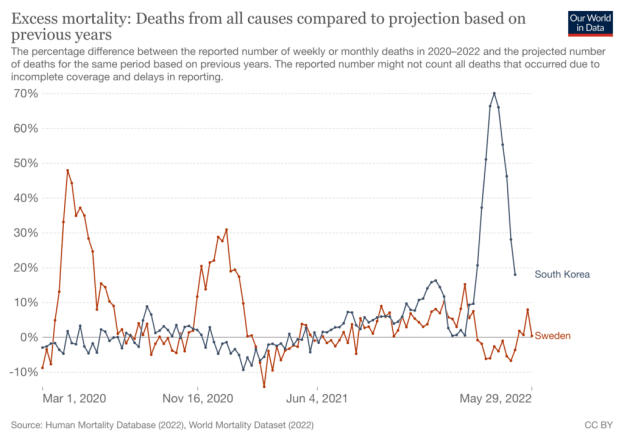
All that was true until February of this year, when the country saw its first major outbreak. This outbreak, as I noted previously, led to a large spike in excess mortality; by March’s end, the number of weekly deaths was almost 70% higher than normal.
Owing to this spike, South Korea now has the same excess mortality as Sweden – which took a famously relaxed approach to dealing with Covid. Note: the chart below is based on weekly deaths, rather than age-standardised mortality rates, so it overstates excess mortality in both countries.
Incidentally, you wouldn’t know this from looking at the official Covid death rates. As the chart below indicates, the number of ‘confirmed’ Covid deaths per million people is much higher in Sweden, presumably due to differences in testing or diagnosis. Which illustrates the importance of tracking excess mortality.
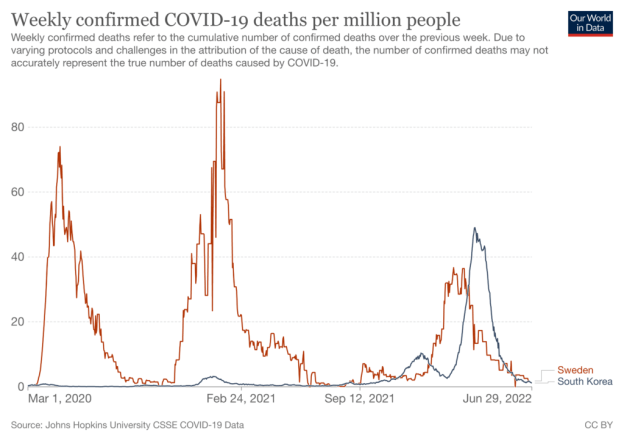
So, the country that did least to contain Covid has ended up with the same death toll as one of the countries that did most. What’s more, the majority of Sweden’s infections occurred before the vaccine rollout, whereas the vast majority of South Korea’s occurred after. Which suggests the benefits of containing the virus until after the vaccine rollout have been overstated.
Of course, South Korea didn’t do terribly. By containing the virus using border controls and contact tracing, they avoided really draconian lockdowns, and saw a comparatively mild downturn. Yet the measures they took still constitute a major infringement on civil liberties. As the Guardian notes, “Koreans’ movements were so finely and publicly tracked that secret love affairs and even hidden sexualities were brought to light.”
Anyone who cares about civil liberties will now have to ask whether South Korea’s strategy was worth it, given that Sweden ended up with the same death toll.
Featured Video
Dan Dicks with James Corbett on Solutions Watch
or go to
Aletho News Archives – Video-Images
From the Archives
MMR (Measles, Mumps and Rubella) – Vaccine Risk Statement
MMR Vaccine (Measles, Mumps, and Rubella) Is It Safer Than Measles, Mumps and Rubella?
Physicians for Informed Consent | December 2024
… It has not been proven that the MMR vaccine is safer than measles, mumps, and rubella. The vaccine package insert raises questions about safety testing for cancer, genetic mutations, and impaired fertility. Although VAERS tracks some adverse events, it is too inaccurate to measure against the risk of measles, mumps, and rubella. Clinical trials do not have the ability to detect less common adverse reactions, and epidemiological studies are limited by the effects of chance and possible confounders. Safety studies of the MMR vaccine are particularly lacking in statistical power. A review of more than 60 MMR vaccine studies conducted for the Cochrane Library states, “The design and reporting of safety outcomes in MMR vaccine studies, both pre- and post-marketing, are largely inadequate.”19 Because permanent sequelae (aftereffects) from measles, mumps, and rubella are so rare (especially in children with normal levels of vitamin A and infected after birth),6,15-17 the level of accuracy of the research studies available is insufficient to rule out the possibility that the MMR vaccine causes greater death or permanent disability than measles, mumps, and rubella. – Read full article
Blog Roll
 Aletho News
- Moscow issues warning to NATO over Russian exclave
- Yes, the Iran war has destroyed Trump’s presidency
- The fallacy of US delusions about Iran’s economic collapse
- Hezbollah denies Syria cell link, warns of Israeli plan to sow discord
- The legacy of US sanctions, war, and occupation in Iraq
- Iraqi resistance group rejects disarmament, vows to maintain support for Lebanon
- Sheikh al-Asadi warns of Iraqi government compliance with US demands
- How to MAKE THE CONSPIRATORS PAY for their crimes! Dan Dicks with James Corbett on Solutions Watch
- There’s a drought in academia: A drought in honest research on the subject of drought and other weather extremes
- Department of War Awards $20.7 Billion Contract to Raytheon for Air-to-Air Missiles
- If Americans Knew
- Israeli Attacks Kill Ten Palestinians in Gaza
- Massacre at Minab: The School That Became a Grave
- Israeli media: The IDF Shows It Doesn’t Turn a Blind Eye; It Actively Emboldens Settler Havoc
- As settlers ravage West Bank, Israeli forces kill 10 in Gaza – Daily Update
- New Report: “Scholasticide and Genocide in Gaza: Assessment, Testimonies and Legal Analysis”
- Ex-Biden officials are desperate for a Gaza scapegoat
- Israeli “settlers” Invade Al-Aqsa; Pour Boiling Water on 75-Year-Old
- Israel Has Kidnapped Another American Teenager
- US arms sales to Israel worth $21.6 billion in 20 months
- Three Palestinians Killed in Israeli Attacks on Gaza
- No Tricks Zone
- Green Energy Debacle: German Expert Professor Fritz Vahrenholt Warns Of Severe Economic And Social Consequences
- Two More Paleo Reconstructions Affirm Meters-Higher Sea Levels Across Ireland, Brazil 7000-6000 Years Ago
- New Study: Earth And Venus Surface Warmth Largely Explained By Convection And Lapse Rate, Not CO2 Or Radiation
- 2025 Nature Paper Claiming Worsening Global Drought Gets RETRACTED …Heavily Flawed
- New Study: ‘Global Drought Shows No Detectable Recent Acceleration Under Climate Warming’
- Economic Masterminds: German Socialists Suggest Taxing Productivity Gains Stemming From Using AI
- The South China Sea Has Not Been Cooperating With The Climate Change Narrative
- Energy Crisis: Germany Enters Heating Season With Historically Low Gas Reserve Fill Levels
- New Study: The Antarctic Ice Sheet Gained Mass From 2020-2024 Due To Staggering Snow And Ice Accumulation
- Study: Ocean Heating Rates From Thousands Of Years Ago ‘Dwarf’ Modern Ocean Heating Rates

