Ukraine eyes law to deprive people of citizenship
Samizdat | May 20, 2022
Ukrainian lawmakers have introduced a bill that seeks to deprive conscripts of citizenship if they left the country during martial law.
In a bill registered in the Verkhovna Rada – Ukraine’s parliament – on Tuesday, lawmakers proposed several amendments to legislation defining the legal regime under martial law intended to “strengthen the economy and defensive capabilities of the country.”
One of the proposals suggests that anyone liable for military service may be deprived of Ukrainian citizenship if they left the country and failed to return within 30 days.
The measure would apply to those who left and did not return without a valid reason, such as a ban on leaving the host country, natural disasters, accidents, business trips, official work abroad, hospitalization or other circumstances preventing the individual from returning back home.
The bill also states that the measures would extend to individuals who have left for the Russian Federation amid the ongoing military conflict between Moscow and Kiev and those who have submitted a written refusal to mobilize.
On Wednesday, Ukrainian President Volodymyr Zelensky signed a decree on the extension of martial law and the terms of general mobilization in the country by 90 days, which is now awaiting approval by the Supreme Council of Ukraine.
Under Ukraine’s martial law, men between the ages of 18 and 60 are prohibited from leaving the country and all citizens liable for military service are required to participate in the general mobilization of all reserve forces.
Ukraine imposed martial law on February 24, after Russia attacked the neighboring state following Kiev’s failure to implement the terms of the Minsk agreements, first signed in 2014, and Moscow’s eventual recognition of the Donbass republics of Donetsk and Lugansk. The German- and French-brokered Minsk Protocol was designed to give the breakaway regions special status within the Ukrainian state.
The Kremlin has since demanded that Ukraine officially declare itself a neutral country that will never join the US-led NATO military bloc. Kiev insists the Russian offensive was completely unprovoked and has denied claims it was planning to retake the two republics by force.
It’s Time That U.S. Taxpayers Defund The Davos Sponsor – World Economic Forum
The WEF soaked up $60 million In taxpayer funding over the last eight years
By Adam Andrzejewski | OpenTheBooks | May 19, 2022
Davos. It’s a “playground” for the world’s billionaire business elite. Every year, like swans, the rich, pretty, and powerful people descend upon a picturesque ski town in Switzerland to mix with world leaders. They discuss shaping our future into a utopian global society.
 For the first time since 2019, the 2022 Davos meeting will be in person beginning Sunday, May 22.
The host organization, World Economic Forum (WEF), founded by German economist Klaus Schwab, says it provides a platform for high-powered leaders to “shape global, regional and industry agendas.” It’s all pretty gauche, with heady thoughts about the world order. Much of this runs contrary to American values.
Attendees cough up $28,000 just for a ticket, with a coveted all-access badge fetching more like $50,000 – and that’s before attendees spend tens or hundreds of thousands on private air travel, ski chalets, and entertainment. Then, the event devolves into brazen networking among tycoons and public officials.
You probably didn’t even realize it, but you – the American taxpayer – helped fund the sponsoring organization with tens of millions of dollars in federal grants.
Since 2013, WEF received nearly $60 million from U.S. taxpayers. Our auditors at OpenTheBooks.com found that under the Trump Administration, the WEF received $33 million, which outpaced the $26 million in second-term Obama-era funding.
Why are American taxpayers funding this organization?
Our national debt exceeds $30 trillion and there are cascading world crises. Obviously, the U.S. should not subsidize an organization whose member companies are already fabulously wealthy – and whose largest annual conference functions as a magnet for the super-rich. (As of January 2017 the WEF membership and partnership fees ranged from $65,000 to $650,000 annually.)
“The real magic [of Davos] happens behind closed doors,” Business Insider writes. “The rich and powerful use the event as a chance to network and hash out their differences out of the public eye.”
Hypocrisy takes center stage: the WEF criticizes CEOs making much more than their employees, while Davos gathers the world’s super rich. Schwab himself has come under scrutiny for using WEF funds and business contracts to enhance his own personal wealth.
It sure doesn’t make it sound like America’s strategic or financial interests are being prioritized. It gets worse when you consider the themes of Davos-hosted discussions.
In January 2021, the Davos conference became a vehicle for promoting the “Great Reset,” a concept Schwab developed in his book about Covid-19 with French economist Thierry Malleret. It’s described as a guide to understand how the virus “disrupted our social and economic systems, and what changes will be needed to create a more inclusive, resilient and sustainable world going further.”
The authors look at what “the root causes of these crises were, and why they lead to a need for a Great Reset” of our global social, economic and political systems.
Schwab advocated seizing the pandemic to “reset and reshape the world,” as climate change, inequality and poverty gained greater urgency during the crisis.
If you guessed that would involve bigger governments, more taxes and spending, and more surveillance of citizens, you’d be correct.
One book reviewer summarized Schwab’s point: “Governments’ poor track record isn’t because of incompetence or corruption, but because it is simply not powerful enough.”
Schwab’s thesis, according to the review: “society is at a crossroads, facing a post-pandemic future that either returns to an uncertain and precarious (but familiar) pre-pandemic state or moves on” to being “‘more inclusive, more equitable, and more respectful of Mother Nature.’”
Losing individual liberty, and giving government more power and tax money isn’t what most Americans consider an appealing way to make the world a better place.
So, how did WEF soak up nearly $60 million in U.S. taxpayer funding since 2013?
It was mostly through the State Department’s USAID; taxpayers paid $16 million to support the WEF Grow Africa program, which facilitated trade partnerships between agricultural businesses and African governments. Another $43 million went to WEF’s Global Alliance for Trade Facilitation program, to “boost competitiveness and business conditions, which are key drivers of inclusive economic growth and poverty reduction” in developing countries.
While we can debate the worthiness of those efforts, funding from the world’s greatest superpower only boosts the WEF’s credibility. In Davos, these Klaus-ocrats socialize with heads of state, diplomats and journalists. For example, the Great Reset discussions included IMF Director Kristalina Georgieva; Charles, Prince of Wales; and UN Secretary-General Antonio Guterres, among others. Presidents Trump and Obama both have attended meetings.
The 2022 meeting will “offer world leaders an opportunity to take stock of the state of the world and shape partnerships and policies for the crucial period ahead.”
One can only hope the discussions are as ineffective as critics suggest. America must stop subsidizing the hosts of this lavish globalist soiree.
After all, this organization wants to press the reset button on our way of life.
Adam Andrzejewski is the CEO and founder of OpenTheBooks.com – the largest private database of U.S. public-sector expenditures.
World Bank to receive $450 million to start pandemic preparedness fund
The Counter Signal | May 17, 2022
Joe Biden announced that the US would give the World Bank $450 million to start a pandemic preparedness fund, which will be run in collaboration with the World Health Organization (WHO).
“We’re increasing our support for [a] new pandemic preparedness and global health security fund that will be established at the World Bank this summer with $450 million in seed funding,” Joe Biden announced at the second Global COVID Summit.
Vice President Kamala Harris also said that the US would work to “shape new international norms” on pandemic-related issues.
WHO Director-General Tedros Adhanom confirmed this and continued, reminding others in attendance that the WHO is still drafting its pandemic treaty.
“At the World Health Assembly this month, WHO will present a plan to strengthen the global architecture for health emergency preparedness response and resilience,” said Tedros Adhanom. “This includes the creation of a financial intermediary fund to support equitable access to life-saving tools in the face of future epidemics and pandemics.”
During the COVID Summit, other world leaders confirmed that they’re in favour of strengthening the WHO after reiterating that “the pandemic is not over” — even though it clearly is.
PM Justin Trudeau also announced that he would waste $732 million in Canadian taxpayers’ money on the Access to COVID-19 Tools-Accelerator (ACT-A).
“We must continue to work together and support the international response to end this pandemic everywhere and for everyone,” Trudeau began.
“Today, I am announcing new and meaningful funding for the Access to COVID-19 Tools Accelerator (ACT-A), bringing Canada’s total contribution to more than $2 billion since the start of the pandemic. Canada is contributing to the international pandemic response and will continue to work with partners to ensure that that we strengthen our collective ability to prevent, prepare and respond to disease outbreaks going forward.”
WHO pandemic treaty: A fresh push for vaccine passports, global surveillance, and more
By Tom Parker | Reclaim The Net | May 20, 2022
Members of the World Health Organization (WHO) are days away from voting on an international pandemic treaty and amendments to the International Health Regulations (2005) which would give the unelected WHO greater control of national emergency healthcare decisions and new powers to push vaccine passports, global surveillance, and “global coordinated actions” that address “misinformation” whenever it declares a “health emergency.”
From May 22 to May 28, representatives of the WHO’s 194 member states (which represent 98% of all the countries in the world) will attend a World Health Assembly meeting in Geneva and vote on this treaty and the proposed amendments to the International Health Regulations (IHR). If passed, both the treaty and amendments to the IHR will be legally binding under international law.
The international pandemic treaty
The World Health Assembly (WHA), the decision-making body of the WHO, established an intergovernmental negotiating body (INB) to draft and negotiate a “global accord on pandemic prevention, preparedness and response” in December 2021. The WHA aims to have this treaty adopted under Article 19 of the WHO Constitution which gives the WHA the power to impose legally binding conventions or agreements on WHO member states if two-thirds of the WHA vote in favor of them.
While the WHO framed this as an international pandemic treaty, the latest draft of the treaty has since evolved to cover all “health emergencies.” Unlike the term “pandemic,” which is limited in scope and refers to the worldwide spread of infectious disease, the WHO’s definition of a “public health emergency of international concern” (PHEIC) is much broader and applies to all types of disease, regardless of whether they’re infectious:
“A PHEIC is defined in the IHR (2005) as, ‘an extraordinary event which is determined to constitute a public health risk to other States through the international spread of disease and to potentially require a coordinated international response.’”
The draft treaty places the “WHO at the centre” and solidifies the WHO as “the directing and coordinating authority on international health” and gives it sweeping, legally binding powers to force member states to adopt many of the censorship and surveillance tools that were imposed during the COVID-19 pandemic.
Some of the key areas of the draft treaty include:
International vaccine passports and contact tracing: Member states will be required to “support the development of standards for producing a digital version of the International Certificate of Vaccination and Prophylaxis” (the WHO’s official vaccine passport). The WHO will also “develop norms and standards” for “digital technology applications relevant to international travel” such as contact tracing apps and digital health forms.
Global surveillance: The WHO will conduct “coordinated global surveillance of public health threats” and member states will be required to build out their surveillance systems and work with “the WHO’s global systems for surveillance.” Non-state actors (which could include Big Tech companies) will also be required to work with governments, the WHO, and other international partners to leverage their “considerable data” to “create the strongest possible early warning and response systems.”
Addressing “misinformation,” “disinformation,” and “too much information:” The draft treaty pushes “national and global coordinated actions to address the misinformation, disinformation, and stigmatization, that undermine public health.” Member states will also be required to strengthen their approaches to “infodemic management” (a term coined by the WHO that refers to “too much information including false or misleading information in digital and physical environments during a disease outbreak.”) Additionally, non-state actors will be required to actors to work with governments to fight disinformation.
Funding: WHO members are set to collectively pay the WHO over $950 million in dues for 2022-2023 and already paid over $270 million in voluntary contributions for 2020-2021. And this draft treaty proposes that G7 countries (Canada, France, Germany, Italy, Japan, the UK, and the US) also pay $11 billion for the “Access to COVID-19 Tools Accelerator (ACT-A).” Additionally, it intends to create an”International Pandemic Financing Facility” that will extract long-term (10-15 year) contributions of $5-10 billion per year.
We obtained a copy of the draft treaty for you here.
If this draft treaty is approved at the May 22 to May 28 WHA meeting, the INB will hold a second meeting on August 1 to discuss progress on the draft. A progress report will then be delivered at the 76th WHA meeting in May 2023. The final treaty will then be presented for adoption at the 77th WHA meeting in May 2024.
Proposed amendments to the International Health Regulations (2005)
On January 18, the Biden administration quietly sent the WHO its extensive proposed amendments to the IHR. The details of these proposed amendments were only made public on April 12, almost three months after they were sent.
Under the current IHR, 196 countries are legally required under international law to build the capability to detect and report potential public health emergencies worldwide and respond promptly to a public health emergency of international concern (PHEIC) whenever it’s declared by the WHO.
These proposed amendments from the Biden administration give the WHO and its Director-General, Dr. Tedros Adhanom Ghebreyesus, sweeping new powers to declare public health emergencies, even over the objection of member states, and implement global surveillance measures that require the mass collection of genetic sequence data.
Some of the key amendments that are being pushed by the Biden administration include:
Increased WHO powers to declare “potential” emergencies: Currently, the WHO can only declare a PHEIC when there’s an actual “public health risk to other States through the international spread of disease.” These proposed amendments allow it to declare a PHEIC when there’s a “potential or actual” PHEIC. This means there doesn’t have to be evidence of the international spread of disease, just the potential for it.
Increased WHO powers to declare health emergencies: Currently, the WHO has to follow the PHEIC criteria when declaring a public health emergency and health emergencies can only be declared by the Director-General. But under these proposed amendments, the WHO Director-General can issue an “intermediate public health alert” to any country in response to events that don’t meet the criteria of a PHEIC and a WHO “regional director” can declare a “public health emergency of regional concern” (PHERC).
Global surveillance and data sharing: The Biden administration’s proposed amendments empower the WHO to develop new “early warning criteria” for monitoring “national, regional, or global risk posed by an event of unknown causes or sources.” Additionally, these proposed amendments expand the scope of data sharing under the IHR and require members to hand over genetic sequence data to the WHO whenever they have an event that “may constitute a public health emergency of international concern.”
We obtained a copy of the proposed amendments to the IHR for you here.
If these amendments are approved at the May 22 to May 28 WHA meeting, nations have six months to reject them. After six months, they’ll enter into force and any rejection or reservation “shall have no effect.”
The WHO’s history of supporting surveillance and acting as an arbiter of truth
Not only could this treaty and the proposed amendments to the IHR empower the unelected WHO to push surveillance, vaccine passports, and global programs that target what it deems to be misinformation but this international health agency already gave the world a taste of how it exercises these powers during the COVID-19 pandemic. As COVID-19 spread, the WHO rigorously supported surveillance tech and was increasingly used as an arbiter of truth on Big Tech platforms, even though it got many things wrong.
YouTube, Facebook, Wikipedia, and others have partnered with the WHO to tackle misinformation or display labels with information from the WHO. YouTube even goes as far as removing videos that go against the WHO and has censored over 800,000 videos under this policy.
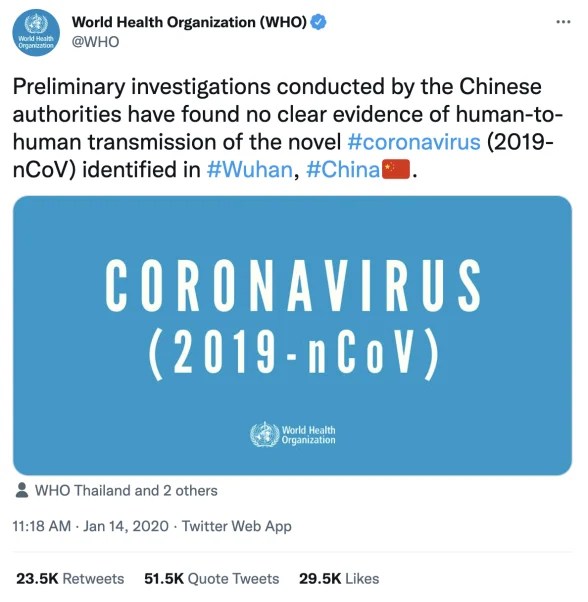
Despite having significant influence over how these platforms determine which posts to brand as misinformation, the WHO has got many things about COVID wrong and amplified misleading statements. For example, in an infamous January 14, 2020 tweet, the WHO stated that “preliminary investigations conducted by the Chinese authorities have found no clear evidence of human-to-human transmission” of the coronavirus.
The WHO has also praised China’s response to COVID which relies heavily on digital censorship and surveillance. Only recently did the WHO break this trend and criticize China’s zero-COVID policy. And when it did, these digital censorship systems were unsurprisingly used to censor the WHO’s statements on Chinese social platforms.
Another thing that the WHO heavily supported throughout the COVID-19 pandemic was vaccine passports. It pushed for them in December 2020 and it’s still pushing for the adoption of global vaccine passports this year.
The WHO’s undemocratic global governance system
The way the WHO gains its powers gives citizens almost no recourse. Instead of the response to national emergencies in democratic nations being the sole purview of elected officials who can vote on proposed measures that apply to their citizens and be held accountable at the ballot box by those citizens, WHO members vote on legally binding international treaties and agreements on their behalf via the WHA. If two-thirds of the WHA vote to adopt a treaty or agreement, it becomes legally binding under international law.
This global governance system has the support of both parties in most democratic countries. For example, during the 2022 Australian federal election campaign, both of the leading candidates expressed full support for the WHO’s expanded powers.
And the WHO Director-General has used the COVID-19 pandemic to push countries to further embrace the WHO’s global governance system by blasting countries that made their own decisions and claiming that their “‘me-first’ approaches… stymie the global solidarity needed to deal with a global threat.”
Countries that support the WHO’s expanded powers
Many countries have expressed support for the international pandemic treaty or the proposed amendments to the IHR.
The US supports both its proposed IHR amendments and the international pandemic treaty.
The treaty also has the support of the UK, Canada, Australia, New Zealand, and the European Council (EC) (which represents 27 European Union (EU) member states). According to the EC, 110 countries supported the decision to launch negotiations on the treaty. If these 110 countries vote in favor of the treaty, it would give the WHA close to the two-thirds of the majority it needs to pass the treaty.
Opposition to the WHO’s expanded powers
While there’s significant member state support for these expanded WHO powers, local politicians, citizens, and rights groups are opposing this power grab.
In the US, Congresswoman Mary Miller (R-IL), Congressman Byron Donalds (R-FL), and Congressman Chris Smith (R-NJ), have opposed the Biden administration’s proposed amendments to the IHR.
Senator Rick Scott (R-Fla.), and Senator Tom Cotton (R-Ark.) have also opposed the Biden administration’s support of the international pandemic treaty.
In Australia, Senator Malcolm Roberts (One Nation), Senator Alex Antic (Liberal Party), and Senator Gerard Rennick have opposed the international pandemic treaty.
Several UK Members of Parliament (MPs), including the Conservative MPs Craig Mackinlay and Steve Baker, have also called for the government to provide clarity on the treaty.
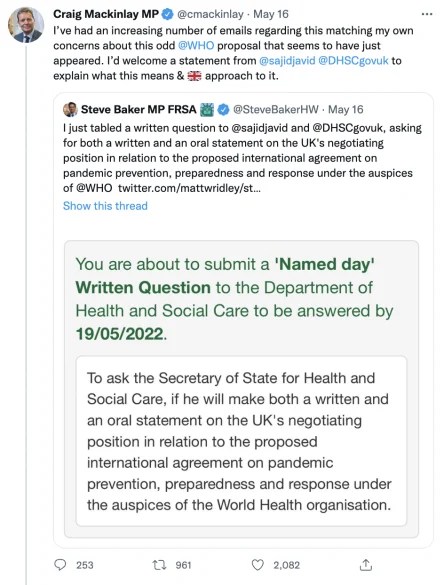
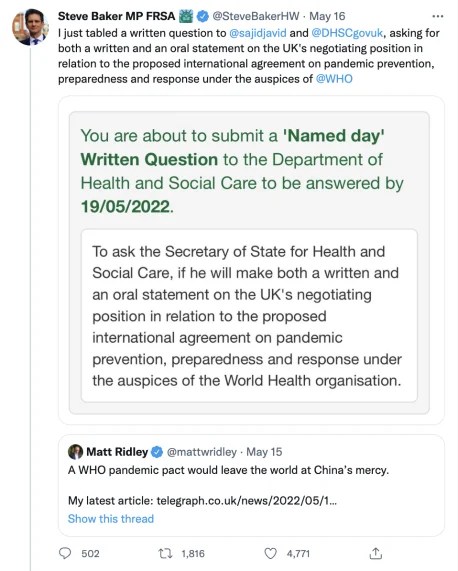
UK Health Secretary Sajid Javid responded to Baker’s calls by stating that the UK government supports the treaty but “would not sign up to any instrument that compromises the UK’s sovereignty,” including “any instrument which compromises the UK’s ability to take domestic decisions on national restrictions or other measures.”
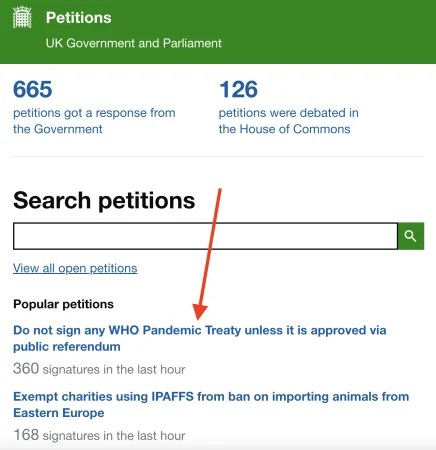
A UK Government and Parliament petition urging the government to not sign any WHO pandemic treaty unless it’s approved via public referendum has received over 130,000 signatures which means Parliament will now consider it for a debate. The petition has also trended on the homepage of the UK Government and Parliament petition’s website.
Member of the European Parliament (MEP) Christine Anderson has opposed the treaty, branding it an “abolition of democracy by the global elites.”
Conservative Party of Canada (CPC) MP Leslyn Lewis has also pushed back against the treaty and launched a “Stop The Treaty” petition which calls for Canada to decline the treaty.
And rights group World Council for Health has launched a #StopTheWho Campaign which opposes both the treaty and proposed IHR amendments.
But for now, the fate of this WHO power grab rests on the outcome of the May 22 to May 28 WHA meeting.
Governments worried about Covid misinformation should start with their own lies and distortions: Indiana AG
The Daily Sceptic | May 20, 2022
Governments concerned about Covid misinformation should start with their own lies and distortions, Indiana’s Attorney General has told the U.S. Government. In a submission to the U.S. Surgeon General, who had requested information on the impact of online health misinformation during the pandemic in the United States, Todd Rokita joined with leading scientists Dr. Jay Bhattacharya and Dr. Martin Kulldorff to set out nine examples of disinformation propagated by the CDC and other health organisations that have “shattered the public’s trust in science and public health and will take decades to repair”. Read their full submission below.
May 2nd 2022
Agency: Department of Health and Human Services, Office of the Surgeon General
Action: Request for Information (RFI)
Subject: Impact of Health Misinformation in the Digital Information Environment in the United States Throughout the COVID-19 Pandemic
Response: COVID-19 Misinformation from Official Sources During the Pandemic
Submitting parties: Todd Rokita, Indiana Attorney General; Dr. Jay Bhattacharya, Professor at Stanford University School of Medicine; and Dr. Kulldorff, Senior Research Fellow at the Brownstone Institute and former Professor at Harvard University School of Medicine.
The Office of the Surgeon General requested information on the prevalence of health misinformation during the COVID-19 pandemic and the impact of such misinformation on the U.S. public health system in order to be better prepared to respond to a future public health crisis.
We agree that misinformation has been a major problem during the pandemic. The spread of inaccurate scientific information has made it difficult for the public to make the right decisions to protect themselves, their families, and their communities from COVID-19 and the collateral public health damage arising from the pandemic countermeasures. As such, the disinformation has led to great harm in the lives and livelihoods of Americans. We submit the following examples of disinformation from the CDC and other health organisations that have shattered the public’s trust in science and public health and will take decades to repair.
#1 Overcounting COVID-19: The official CDC numbers for COVID-19 deaths and hospitalisations are inaccurate. The official tallies include many people who have died with rather than from COVID-19. CDC has not distinguished deaths where COVID-19 was the primary cause of death, where COVID-19 was a contributing cause of death, or where the death was entirely unrelated to COVID-19, but they incidentally tested positive.
There are three reasons for this problem. (i) The counting of COVID-19 cases and deaths is unlike the way that public health counts the incidence and mortality caused by other diseases; physicians have been advised to fill out death certificates to privilege COVID-19 as a proximal cause, even when the medical facts suggest otherwise. (ii) The population-wide testing to identify asymptomatic individuals infected with the SARS-CoV-2 virus is unprecedented in human history. (iii) Although it would have been easy, CDC has not conducted random national surveys of medical charts to determine what proportion of reported COVID-19 deaths were truly due to COVID-19. Ex-post audits of death certificates and medical records in Santa Clara County and Alameda County, California, for instance, found that in around 25% of death certificates in which COVID-19 was labelled as the primary cause of death, other causes of death were more likely. The peer-reviewed literature confirms that COVID-19 is overcounted in other developed countries. Ex post audits of death certificates should be conducted to establish an accurate death count from COVID-19.
#2 Questioning Natural Immunity: There has been consistent questioning and denying of natural immunity after COVID-19 recovery. Using seriously flawed studies, CDC falsely claimed that natural immunity is worse than vaccine acquired immunity. In October 2020, the CDC director published a “memorandum” in the Lancet, questioning natural immunity. Most critically, by mandating vaccination for people who have recovered from COVID-19, the Government, corporations, and universities de facto deny natural immunity.
For scientists, this has been the most surprising disinformation. We have known about natural immunity since the Athenian Plague in 430 BC; other coronaviruses generate natural immunity; and throughout the pandemic, we knew that the COVID-19 recovered have good natural immunity if and when they get exposed the next time. That is, six months after the start of the pandemic, we had epidemiological evidence that natural immunity lasts at least six months; a year into the pandemic, we knew that natural immunity lasted at least one year, and so on.
#3 COVID-19 Vaccines Prevent Transmission: The CDC director and other health officials falsely claimed that the COVID-19 vaccine prevents the transmission of COVID-19 to others. This was also the rationale for vaccine mandates and passports – to prevent the spread of the virus to others. At the time, we did not know, and it turned out to be wrong. When the COVID-19 vaccines were approved for emergency use, the manufacturers presented randomised controlled trials (RCTs) that showed that the vaccines reduced symptomatic disease. The trials were not designed to determine whether they could also limit transmission or prevent death, even though they could have been designed to do so. As it turned out, vaccinated individuals spread the disease to others. While it was unfortunate that the RCTs were not designed to answer the disease transmission question, it is irresponsible for public health officials to claim that they did when the RCTs did not even attempt to answer that question.
#4 School Closures Were Effective and Costless: In the United States, most schools were closed for in-person teaching for some time, and many schools were closed for over a year. This decision was based on false claims that it would protect children, teachers and the community at large. Already in the early summer of 2020, we knew this was false. Sweden was the only major Western country to keep schools open throughout spring 2020 without masks, social distancing, or testing. Among these 1.8 million children ages one to 15, there were zero COVID-19 deaths, only a few hospitalisations, and teachers did not have a higher COVID-19 risk than the average of other professions.
Moreover, while older people living with a working-age adult had a higher COVID-19 risk, there was no evidence that also living with a child increased that risk further. In a July 2020 New England Journal of Medicine article evaluating school closures, they did not mention the Swedish data and evidence, which is like evaluating a new drug without including data from the placebo comparison group. Despite clear evidence on the safety of keeping schools open, misinformation led to many schools being closed for over one year.
#5 Everyone is equally at risk of hospitalisation and death from COVID-19 infection: Though public health messaging has blunted this fact, there is more than a thousand-fold difference in the risk of hospitalisation and death for the old relative to the young. Though the risk of death is high for the old and some other vulnerable populations with severe chronic illness, the risk posed to children from COVID-19 infection is on par with the risk posed by a bad influenza season. Surveys indicate, however, that both old and young overestimate the risk of death from COVID-19 infection. This misperception about risk is harmful because it leads to demand for policies – such as school closures and lockdowns – that were themselves harmful.
#6 There was no reasonable policy alternative to lockdowns: Even from the beginning of the pandemic, the sharp age-gradient in the risk of severe disease on COVID-19 infection has provided an alternative to the lockdown-focused policies that many U.S. states adopted – focused protection of the aged and otherwise vulnerable. In October 2020, along with Prof. Sunetra Gupta of Oxford University, we wrote the Great Barrington Declaration – a public petition that proposed heightened measures to protect the vulnerable and a return to near-normal life for the less vulnerable (including the opening of schools). Tens of thousands of doctors and scientists signed the Declaration in opposition to lockdowns. In the Declaration itself and in supporting documents, we offered many concrete policy suggestions for better protecting the vulnerable, including reduced staff rotations in nursing homes, free home delivery of groceries and other essentials offered to older people living in the community, paid sabbatical leave or alternative work arrangements for older workers, and many other policy options. We also invited the public health community to join in thinking creatively about other ideas to protect the vulnerable. As subsequent research has confirmed, it was clear even at the time that lockdowns could not protect the vulnerable (nearly 80% of COVID-19 deaths have occurred among the elderly in the U.S.). Meanwhile, countries like Sweden, which did not implement lockdowns, have had near-zero overall excess death over the last two years of the pandemic. Lockdowns are an aberration– a sharp deviation from traditional public health management of respiratory epidemics – and a catastrophic failure of public health policy.
#7 Mask mandates are effective in reducing the spread of viral infectious diseases: Contrary to assertions by some public health officials, mask mandates have not been effective in protecting most populations against COVID-19 risk. The SARS-CoV-2 virus spreads by aerosolisation. Unlike larger viral droplets, which are pulled by gravity to the ground shortly after emission, aerosols are tiny particles that can persist in the air for extended periods. Aerosols escape through gaps of poorly fitted masks, greatly reducing their ability to stop disease spread. Cloth masks, in particular, cannot stop aerosols, and even well-fitted N95 masks have diminished capacity to stop viral transmission when they become moist from breathing. It is thus unsurprising that the highest quality evidence available – randomised trials – conducted both before and during the pandemic find that masks are ineffective at stopping the spread of respiratory viruses in most settings when worn by untrained people.
#8 Mass testing of asymptomatic individuals and contact tracing of positive cases is effective in reducing disease spread: Mass testing of asymptomatic individuals with contact tracing and quarantining of people who test positive has failed to substantively slow the progress of the epidemic and has imposed great costs on people who were quarantined even though they posed no risk of infecting others. Three facts are crucial to understanding why this policy has failed. First, even close contacts of someone who tests positive for the SARS-Cov-2 virus are unlikely to pass the disease on. In a large meta-analysis of household contacts of asymptomatic positive cases, only 3% of people living in the same home got sick. Second, the PCR test that has been used to identify asymptomatic infections often returns a positive result for people who have dead viral fragments, are not infectious, and pose no risk of infecting others. And third, the contact tracing system becomes overwhelmed whenever cases start to rise, leading to long delays in contacting new cases. At precisely the moment when contact tracing might be needed, it cannot do its job. At the same time, quarantining people is costly – for workers without adequate sick leave, absenteeism due to contact tracing means pay cuts, lost opportunities and perhaps even an inability to feed families. For children, it means more skipped lessons and missed opportunities for academic and social growth at school, with long-run negative consequences for their future prospects. In the U.K., an official government review determined that its 37 billion pound investment in contact tracing was a waste of resources. The same is undoubtedly true in the United States.
#9 The eradication of COVID-19 is a feasible goal: Throughout the pandemic, from “two weeks to flatten the curve” and onwards, the suppression of the spread of COVID-19 has been an explicit policy goal. Implicitly, public health leaders have made the suppression of COVID-19 spread to near-zero levels the endpoint of the pandemic. However, SARS-CoV-2 has none of the characteristics of a disease that can be eradicated. First, we have no technology to reduce the spread of the disease or meaningfully alter disease dynamics. Lockdowns and social restrictions fail because only people who can afford to work from home without losing their job can comply over long periods. While we have vaccines that can help prevent hospitalisation or death resulting from COVID-19 infection, the vaccines wane in efficacy against COVID-19 infection and cannot stop transmission. Second, there are many animal hosts for SARS-CoV-2 and evidence of transmission between mammals and humans. One USDA study in late 2021 found that nearly 80% of white-tailed deer in the U.S. had evidence of COVID-19 antibodies. Dogs, cats, bats, mink and many other mammals can get COVID-19. So even if the disease were eradicated among humans, zoonotic transmission would guarantee that it would come back. Finally, eradication takes a global commitment from every country – an impossible goal since COVID-19 eradication is far from the most pressing public health problem for many developing countries.
House passes antisemitism resolution calling for surveillance and censorship of online content
By Christina Maas | Reclaim The Net | May 20, 2022
The House of Representatives has voted to pass a resolution that calls for increased surveillance and censorship of online speech, to help reduce antisemitism.
The resolution goes beyond condemning antisemitism; it goes into the realm of calling on social media platforms to do more to stop it.
We obtained a copy of the resolution for you here.
The resolution calls on social media platforms to “institute stronger and more significant efforts to measure and address online antisemitism” and, like most resolutions of this kind, pays lip-service to the idea of “protecting free speech concerns,” without providing details on how this is possible.
The resolution also calls for the house to work “in tandem with the cross-party Inter-parliamentary Task Force to Combat Online Anti-semitism to help craft thoughtful global initiatives designed to address online antisemitism.”
The resolution names platforms specifically, saying there has been an uptick in “antisemitic language, conspiracy theories, and hatred has increased on multiple social media platforms—from Facebook and Instagram to Twitter and TikTok.”
Rep. Thomas Massie, a Republican, was the only member of the House that recognized the implications of government once again trying to insert themselves into moderation on online platforms and voted against the bill on free speech grounds.
Massie made clear that his vote against the bill was not due to hating anyone “based on his or her ethnicity or religion” but on First Amendment grounds, that is designed to prevent the government from regulating speech. While the resolution is not a law that would force this speech regulation on platforms, the sentiment of the government pressure on platforms is evident.
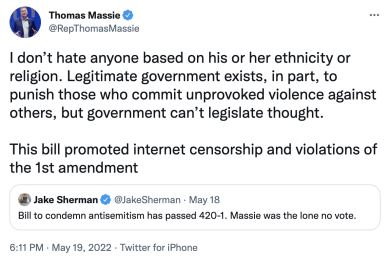
“I don’t hate anyone based on his or her ethnicity or religion. Legitimate government exists, in part, to punish those who commit unprovoked violence against others, but government can’t legislate thought,” Massie wrote on Twitter.
“This bill promoted internet censorship and violations of the 1st amendment.”
The author of the resolution, Democrat Rep. Debbie Wasserman Schultz, blamed the racially-motivated shooting in Buffalo, New York, on social media for amplifying “radicalizing content and conspiracy theories.” She argued that Section 230, which protects platforms from liability from content posted by users, should be removed.
“It’s past time to pass sane gun safety laws, but we also need to revisit Section 230 to remove social media company immunity if they amplify radicalizing content and conspiracy theories that promote violence like we saw in Buffalo,” she wrote on Twitter.
Caught on camera – how Trump was robbed of the 2020 election
By Thomas Lane | TCW Defending Freedom | May 19, 2022
Joe Biden is president of the United States. That is an indisputable fact. But how he got to 1600 Pennsylvania Avenue is questionable.
The statistical anomalies of the 2020 election alone make Biden’s victory seem dubious. Here are a few, of many, examples:
Donald Trump’s campaign rallies filled stadiums with tens of thousands of supporters; Biden’s campaign events – when he left the basement – hardly attracted a dozen. If these candidates were two musicians, and one was selling out arenas while the other was struggling to fill a little pub, which act would a record company executive bet on becoming a gold-record performer?
For the past ten American presidential elections, 19 counties, often referred to as the ‘bellwether counties’, predicted the outcome of the race. In 2020, Donald Trump won 18 of these counties, but Biden won the presidency.
At midnight on election night, vote counting mysteriously stopped in five states – Pennsylvania, Michigan, Wisconsin, Nevada and North Carolina – where Trump had a significant lead over Biden. The next morning, Biden suddenly had more votes than Trump. One is expected to believe that nearly 100 per cent of the votes which arrived during this suspicious pause were for Biden?
Certain that the election was fraught with fraud, Trump and some of his supporters challenged the results of the 2020 election with dozens of lawsuits. But most of the cases were dismissed by judges due to ‘lack of standing’, which is a legal term that states ‘the party has not alleged a sufficient legal interest and injury to participate in the case’.
However, Dinesh D’Souza’s new political documentary, 2,000 Mules, just might give Trump’s lawsuits a leg to stand on.
Using geotracking, a technology which locates the exact position of a person by obtaining data from his or her smartphone or similar devices, Catherine Engelbrecht and Gregg Phillips of True the Vote were able to expose a couple of thousand mules (people who illegally collected and deposited voting ballots) travelling between pro-Biden campaign offices and ballot drop boxes during the final month of the election season.
Engelbrecht and Phillips then obtained security camera footage of the mules stuffing the drop boxes with ballots. The mules’ activity ranged from just a few ballots deposited in several boxes throughout the month, to nearly 300 mules visiting one box and depositing 1,900 ballots (10x the average) in a single day.
In the most compelling scene in the documentary, D’Souza multiplies the number of mules by the number of their drop-box visits, then multiplies that number by the number of ballots deposited by each mule to get a total number of illegal votes. He does this calculation for each swing state where Biden won, then subtracts the number of illegal votes from Biden’s total. Spoiler alert: Mules concludes that Trump won the 2020 election.
D’Souza and his team have done their part: they have exposed the criminals and the crime. Between the geotracking data and the surveillance footage, they have evidence of over 2,000 people committing felonies. However, their hands are tied because they are mere citizens. As D’Souza concludes in the film: ‘It is time for law enforcement to step in.’
Big Pharma-funded paper recommends taxing the unvaccinated
By Kit Knightly | OffGuardian | May 17, 2022
A new paper published by Oxford University’s Center for Business Taxation discusses – and in the end supports – the idea of a special tax levied on those who decline to be “vaccinated” against “Covid19”.
The paper’s authors argue that a vaccine-related tax would be “justified” because “Taxes on behaviour that is considered undesirable are nothing new.”
And that even if the “vaccines” do cause serious harm to some people…
“some states do adopt policies that can lead to serious harm in exceptional cases when they consider that the benefits outweigh the costs“
Yes, you did read that right.
They go on to suggest all sorts of ways of correcting this “undesirable behaviour”, from straight taxation to tax credits for those who have been vaccinated, to vaccine mandates and compulsory Covid insurance for the unvaccinated (which is just another way of saying “taxation”).
Now, here is where we could – and normally would – break down the article paragraph by paragraph. We would dissect the arguments, include data they ignore, highlight logical fallacies… you know, the usual.
We’re not going to do that today.
We could point out the infection-fatality ratio for Covid “cases” is minuscule.
Or that the so-called “vaccines” don’t prevent either infection or transmission of the alleged new disease called “Covid19”.
We could launch into a legal argument on civil rights, the Nuremberg Code, and medical coercion.
But we’re not going to do any of that.
Because it’s been two years of this, and life is just too damn short. We’ve done it enough, the facts are all there for anyone who cares enough to find them.
Instead, we’re just going to quote the ‘About’ page of the Oxford Center for Business Taxation, with a bit of added emphasis…
The Centre for Business Taxation was formed in 2005 and was initially funded by substantial donations from a large number of members from the Hundred Group. A number of these companies and others continue to support the CBT. Donors during the year were AstraZeneca [and] GlaxoSmithKline Plc
To be clear, the Hundred Group is a lobbying group which works on behalf of the all the members of the FTSE100.
GlaxoSmithKline is one of the largest pharmaceutical companies in the world, and partnered with French giant Sanofi to produce a Covid vaccine which netted the companies billions in supply contracts, despite the fact it is yet to be approved for public use.
If you know anything at all about Covid, you don’t need us to tell you who AstraZeneca are.
The CBT – and therefore the paper – are funded by big business and big pharma.
Do we really need to add anything else?
German Supreme Court rules mandatory vaccination is constitutionally justified
The Naked Emperor’s Newsletter | May 19, 2022
Judges in Germany’s top court clearly haven’t looked at the data produced in multiple countries, showing the vaccinated being more likely to catch coronavirus.
In a press release today, the court announced that a case, challenging the obligation to provide evidence of vaccination, had been unsuccessful. The complainants said that the mandates violated their fundamental rights.
Whilst the initial vaccine mandate for all adults was rejected earlier in the year, it was still implemented for healthcare workers in March. This meant that all healthcare workers had to provide proof of full vaccination, recovery from COVID-19 or a small number of medical exemptions. If employees did not provide proof, the health department was to be notified immediately and the individual banned from entering the workplace.
One of the reasons for the case being unsuccessful, given in the judgment, was that interference with the right to physical integrity is constitutionally justified. Basically, the protection of vulnerable people is more important than an individual’s fundamental right.
The judgement admits that COVID-19 is mild for most people but can be fatal for the elderly and vulnerable who also don’t respond well to vaccination. They say that at the time the law was passed, a clear scientific majority assumed that vaccinated and recovered people were less likely to become infected and therefore transmit the virus. It was also assumed that vaccinated people were less infectious and for a shorter amount of time. According to the judgement, expert third parties largely agree that vaccine effectiveness will continue to exist, albeit at a reduced level.
Comically, the judgement states that there is no justification for compulsory vaccination enforced by the state but instead the decision should be down to the individual – they can choose to either give up their previous job or consent to the impairment of their physical integrity. Why thank you, Master, for providing me with two terrible choices. But, every cloud and all that, I suppose it is better than being pinned down and vaccinated. Well, until you can’t pay your rent or buy food for your children and have to steal a cardboard box to sleep on in the street.
Fortunately, the judges concluded that it is ok to breach an individual’s fundamental rights because serious side effects or serious consequences induced by the administration of the vaccine are very rare. And, in any case, they are continuously monitoring and evaluating them. They say that the very low probability of serious consequences of vaccination contrasts with the significantly higher probability of damage to vulnerable people.
They conclude, that the further development of the pandemic, after the law was passed, has not changed anything. Nor have any new developments or better insights.
So there you have it. An individual’s rights can be overhauled if a majority of experts conclude you are a danger to a small group of people. Whilst I can understand and appreciate the need to protect the elderly and vulnerable, this shouldn’t be used as a pretext to remove people’s basic rights.
The majority of health care workers want to protect the elderly and vulnerable, that’s why they do the jobs they do. If they are ill or test positive, they aren’t going to deliberately go and infect someone who is likely to die from Covid – they aren’t pyschos (unlike some of the individual’s making these laws).
Furthermore, the science clearly doesn’t back up what they are saying. You are more likely to catch Covid if you are vaccinated and your viral load is similar, if not the same. There may be evidence showing that you are not as infectious for as long but there also may be evidence showing you can have Covid but aren’t testing positive.
Health Minister Karl Lauterbach welcomed the ruling saying that “the state is obliged to protect vulnerable groups”. He is now off for a meeting with other G7 ministers, despite being in contact with the US health secretary, a day before testing positive for Covid. Rules for thee, not for me.
Clearly, the battle to retain one’s basic rights is still not over in many parts of the world. And if it isn’t completely squashed now, you can be sure it will return everywhere with a vengeance, come the winter.
From the heart of the Covid establishment, the truth about asymptomatic spread
By Hector Drummond | TCW Defending Freedom | May 19, 2022
AN important study into Covid-19 has got very little traction, despite coming from the Covid industry’s favourite university, Imperial College London.
This is likely to be because the study totally destroys the industry’s assumptions about asymptomatic spread.
The other institutions involved in this study are the Vaccine Taskforce and Department of Health and Social Care (DHSC), hVIVO (part of Open Orphan plc), and the Royal Free London NHS Foundation Trust. In other words, this study was conducted by the heart of the Covid establishment.
What did they find? Well, forget all you were told about it taking five to six days to develop Covid symptoms, which was always an unwarranted claim whose main purpose was to imprison whole populations. Even if that had been true, it wouldn’t have provided the justification for the Great Jailing that governments across the world sprang on their people. But it’s not true anyway: ‘Researchers found that symptoms start to develop very fast, on average about two days after contact with the virus.’
In fact, it was less than two days – it was 42 hours.
What’s more (and the Imperial press release makes little of this) the amount of detectable virus in the throat and nose in that 42 hours is small. It’s only after symptoms start that the virus levels really crank up. For the first day there’s pretty much nothing; on the second day levels start to rise, but to nowhere near the levels they reach on subsequent days, after symptoms have appeared.
We can see this by looking at some graphs from the paper (from Fig. 2 – the first graph shows levels in the nose by day, the second shows the levels in the throat).


https://www.nature.com/articles/s41591-022-01780-9
As the study says, ‘viral shedding begins within 2 days of exposure’.
Bear in mind also that coughing and sneezing send out vastly far more virus particles than breathing. (For the in-depth details, see chapter 3 of my book The Face Mask Cult.) But if you do not have symptoms, you will not be sneezing or coughing. So even if in the last few hours of your pre-symptomatic period your viral load starts to build up in your nose and throat, you aren’t going to be sending that out into the world in any great amount, because you are pre-symptomatic, and so by definition you aren’t coughing and sneezing.
Remember how you were told at the start of spring 2020 that Covid-19 was a unique virus, different from every virus in history, in that it spread wildly from asymptomatic people, which apparently no virus had ever done before, at least not in anything like the way Covid did? Even normally sober writers such as Matt Ridley spread this melodramatic idea, despite the fact that at the time it had little more credibility than your average urban myth. Asymptomatic spread was the basis for locking everyone up – everyone, not just those with symptoms – but it has turned out to be a chimera.
And of course the enforced quarantine periods not only had to be long, they had to be repeated, over and over, because you could never tell if someone was infected and their breath was spreading Covid across whole suburbs and workplaces and factories, even if that person had just come out of a long enforced quarantine a few days ago after a close contact tested positive, and even if that person felt completely fine. They might still have caught Covid for real since they left quarantine, and even now are killing grandmothers by the dozen as they eat their lunch with their friends. Better lock them up again. And everyone else.
Such was the damage inflicted upon society by the asymptomatic hysteria. In theory it could have gone on for ever; the only things that stopped it doing so were, firstly, the public gradually starting to realise that their lives were being ruined for an overhyped threat, and, secondly, the embarrassing lack of solid evidence to show that asymptomatic spread played much of a role in Covid dissemination (or that Covid was unique in regard to the extent of asymptomatic spread).
So there isn’t any point at all in worrying about catching Covid from someone with no symptoms. There also isn’t any point in symptomless people testing themselves all the time. Or ever. Getting Covid from someone who isn’t showing any signs of it will not happen very often, so the social damage caused by requiring people who aren’t ill to take a test vastly outweighs the benefits of testing them (especially when we consider that the benefits of testing are basically nil anyway – billions of tests have done nothing to prevent Covid remorselessly spreading across the world).
In other words, these results tell us (although this was already clear) to stop testing, stop quarantining and stop worrying about getting Covid from people who aren’t sick. And that means shutting down the whole Covid-industrial complex. The world was trashed for nothing.
I should note that the study does say ‘our data clearly show that SARS-CoV-2 viral shedding occurs at high levels irrespective of symptom severity, thus explaining the high transmissibility of this infection and emphasising that symptom severity cannot be considered a surrogate for transmission risk in this disease’.
This may seem to go against what I have said so far, but it doesn’t, as it applies to the period after symptoms have started, not the period before. It is true that once you have symptoms, there is little correlation between the severity of those symptoms and the amount of viral shedding, as Figs. 4e and 4f in the paper show. (‘Viral shedding’, I should note, refers to the amount of virus found in the nose and throat – it doesn’t refer to the amount of virus being ‘sent out’ by the infected person into the surrounding world.) So someone who has very severe symptoms may not have any more virions in their nose and throat than someone who has mild symptoms.
In the two-day pre-symptomatic period, however, it remains the case that there are only low levels of viral load in the nose and throat, as we saw from the graphs above.
Another significant finding from the study was that it took very little virus to infect someone: ‘Participants were exposed to the lowest possible dose of virus found to cause infection, roughly equivalent to the amount found in a single droplet of nasal fluid when participants were at their most infectious.’
This also means that facemask use is particularly pointless. At best masks can reduce the amount of virions breathed in and out by about 10-15 per cent but if it takes very little to infect a person this will achieve nothing. If someone is breathing out 15,000 virions every ten minutes, reducing that to between 13,500 and 14,000 won’t help.
Of course, the study and the Imperial press release didn’t tell you this. All it said about facemasks was that the study emphasised the importance of wearing them over the nose as well as the mouth, because the nose contained higher peak levels of the virus than in the mouth.
Also, as expected, none of the healthy young people in the study developed anything other than mild-to-moderate cold-like symptoms. None of them ended up in a bad way. As we already knew two years ago, this is a disease which does not threaten the vast majority of young people.
For two years now sceptics like me have been telling people to throw away their tests, and to stop isolating healthy people, and to stop worrying whether the people around you in the restaurant are going to kill you, as the scientific evidence doesn’t support this. If you didn’t believe us then, perhaps you will now.
A Primer on the WHO, the Treaty, and its Plans for Pandemic Preparedness
By David Bell | Brownstone Institute | May 19, 2022
The World Health Organization (WHO), whose constitution defines health as ‘a state of physical, mental and social well-being, not merely the absence of disease or infirmity,’ has recently orchestrated remarkable reversals in human rights, poverty reduction, education, and physical, mental and social health indices in the name of responding to the Covid-19 pandemic.
WHO proposes to expand the mechanisms that enabled this response, diverting unprecedented resources to addressing what in terms of history and disease are rare and relatively low-impact events. This will greatly benefit those who also did well from the Covid-19 outbreak, but has different implications for the rest of us. To address it calmly and rationally, we need to understand it.
Building a new pandemic industry
The World Health Organization (WHO) and its Member States, in concert with other international institutions, is proposing, and currently negotiating, two instruments to address pandemics and widely manage aspects of global public health. Both will significantly expand the international bureaucracy that has grown over the past decade to prepare for, or respond to, pandemics, with particular emphasis on development and use of vaccines.
This bureaucracy would be answerable to the WHO, an organization that in turn is increasingly answerable, through funding and political influence, from private individuals, corporations and the large authoritarian States.
These proposed rules and structures, if adopted, would fundamentally change international public health, moving the center of gravity from common endemic diseases to relatively rare outbreaks of new pathogens, and building an industry around it that will potentially be self-perpetuating.
In the process, it will increase external involvement in areas of decision-making that in most constitutional democracies are the purview of elected governments answerable to their population.
WHO does not clearly define the terms ‘pandemic’ and ‘public health emergency’ that these new agreements, intended to have power under international law, seek to address. Implementation will depend on the opinion of individuals – the Director General (DG) of the WHO, Regional Directors and an advisory committee that they can choose to follow or ignore.
As a ‘pandemic’ in WHO parlance does not include a requirement of severity but simply broad spread – a property common to respiratory viruses – this leaves a lot of room for the DG to proclaim emergencies and set the wheels in motion to repeat the sort of pandemic responses we have seen trialed in the past 2 years.
Responses that have been unprecedented in their removal of basic peace-time human rights, and that the WHO, Unicef and other United Nations (UN) agencies have acknowledged to cause widespread harm.
This has potential to be a boon for Big Pharma and their investors who have done so well out of the last two years, concentrating private wealth whilst increasing national indebtedness and reversing prior progress on poverty reduction.
However, it is not something that has just appeared, and is not going to make us slaves before the month is out. If we are to address this issue and restore societal sanity and balance in public health, we need to understand what we are dealing with.
Proposed International Health Regulations (IHR) amendments
The IHR amendments, proposed by the United States, build on the existing IHR that were introduced in 2005 and are binding under international law. While many are unaware of their existence, the IHR already enables the WHO DG to declare public health emergencies of international concern, and thereby recommend measures to isolate countries and restrict movement of people. The draft amendments include proposals to:
- Establish an ‘emergency committee’ to assess health threats and outbreaks and recommend responses.
- Establish a ‘Country review mechanism’ to assess compliance of countries with various recommendations / requirements of WHO regarding pandemic preparedness, including surveillance and reporting measures. This appears to be modeled on the UN’s human rights country review mechanism. Countries would then be issued with requirements to be addressed to bring them into compliance where their internal programs are considered inadequate, on the request of another State party (country).
- Expand the power of the WHO DG to declare pandemics and health emergencies, and therefore recommend border closures, interruption and removal of rights to travel and potentially internal ‘lockdown’ requirements and send teams of WHO personnel to countries to investigate outbreaks, irrespective of the findings of the emergency committee and without consent of the country where the instance is recorded.
- Reduce the usual review period for countries to internally discuss and opt out of such mechanisms to just 6 months (rather than 18 months for the original IHR), and then implement them after a 6-month notice period.
- Empower Regional Directors, of which there are 6, to declare regional ‘public health emergencies,’ irrespective of a decision by the DG.
These amendments will be discussed and voted on at the World Health Assembly on May 22-28, 2022. They only require a simple majority of countries present to come into law, consistent with Article 60 of the WHO constitution. For clarity, this means countries such as Niue, with 1,300 people, have an equal weight on the voting floor as India, with 1.3 billion people. Countries must then signal intent to opt out of the new amendments within 6 months.
Once approved by the WHA, these measures will become legally binding. There will be heavy pressure applied to governments to comply with the dictates of the WHO DG and the unelected bureaucrats that comprise the organization, and thereby also the external actors who are influential in WHO decision-making processes.
Proposed WHO pandemic ‘treaty’
The WHO proposes a new ‘instrument’ to allow it to manage pandemics, with force of a convention under international law. This has been formally discussed within WHO since early 2021, and a special session of the WHA in November 2021 recommended it go to a review process, with a draft to be presented to the World Health Assembly meeting in Q2 2023.
This proposed treaty would give WHO powers to:
- Investigate epidemics within countries,
- Recommend or even require border closures,
- Potentially recommend travel restrictions on individuals,
- Impose measures recommended by the WHO which, based on Covid-19 experience, may include ‘lockdowns,’ prevention of employment, disruption of family life and internal travel, and mandated masks and vaccination,
- Involve non-state actors (e.g., private corporations) in data gathering and predictive modeling to influence and guide pandemic responses; and in implementing, including providing commodities for, the response;
- Impose censorship through control of, or restrictions on, information the WHO considers to be ‘mis-information’ or ‘dis-information’, which may include criticism of the measures WHO imposes.
Notably, it envisions the setting up of a large entity within WHO to support permanent staff whose purpose is to undertake and enforce the above measures. This sounds very similar to the ‘GERM’ entity proposed recently by Mr Bill Gates, a wealthy US software developer with major pharmaceutical investments, who is the second largest funder of the WHO and one of a number of ‘billionaires’ who have greatly increased personal wealth during the Covid-19 response.
The proposed treaty would prioritize vertical structures and pharmaceutical approaches to pandemics, reflecting approaches by Gavi and CEPI, two organizations set up in the past decade in parallel to the WHO. It would create another bureaucratic structure on pandemics, not answerable directly to any taxpayer base, but imposing further support, reporting and compliance requirements.
Process, acceptance and implementation
These two mechanisms for increasing direct WHO control of pandemics have strong backing from private sector funders of the WHO, and from many national governments, starting with Western governments who adopted Covid draconian measures. To come into practice they must be adopted by the WHA and then be agreed, or ratified, by national governments.
The proposed IHR amendments modify an existing mechanism. A simple majority of States present at the WHA voting against them at the May 2022 meeting would also reject them, but this appears unlikely. To prevent their application, sufficient individual countries will need to signal non-acceptance or reservations after the coming WHA and WHO DG’s notice of adoption, so probably before the end of November 2022.
With regard to the proposed treaty, a two-thirds majority at the 2023 WHA will be required for its adoption, after which it will be subject to national ratification by processes which vary according to national norms and constitutions.
Funding for the large increase in bureaucracy proposed to support both mechanisms will be necessary – this may be partially diverted from other disease areas but will almost certainly require new, regular funding. Other mechanisms in parallel are already being discussed, with the World Bank also proposed as the home for a similar bureaucracy to manage pandemic preparedness, and the G20 mulling their own mechanism.
It is unclear whether these would be tied into the WHO’s proposed treaty and IHR mechanisms or be presented as a ‘rival’ approach. The G20 task force of the WB and WHO suggest a $10.5 billion additional annual budget for pandemic preparedness is required. With such potential financing on offer, and the promise of building powerful institutions around this pandemic preparedness agenda, there is going to be much enthusiasm and momentum, not least from institutional staff and the global health community in general, who will sense lucrative employment and grant opportunities.
While all this depends on money being available, a refusal of countries to fund may not be sufficient to prevent it, as there is considerable private and corporate interest in the treaty and related proposals. The same entities that benefited heavily financially from the Covid-19 response will also stand to benefit from an increased frequency of similar responses.
Whilst pandemics are historically rare, the existence of a large bureaucracy dependent on their declaration and response, coupled with the clear gains to be made by influential funders of the WHO, raise a strong risk that the bar to declaring emergencies, and imposing human rights restrictions on States, will be far lower than before.
Independent States are not however directly subject to the WHO, and adopting these amendments and treaties will not automatically allow the WHO to send teams across borders. Treaties must be ratified according to national processes and constitutions. If accepted by the WHA, it will however be difficult for individual States to avoid compliance unless they are particularly influential on the WHO itself.
International financial agencies, such as the IMF and World Bank, can also exert considerable pressure on non-complying States, potentially tying loans to implementation and commodity purchase as the World Bank has done for the COVID-19 response.
The IHR amendments also allow measures to be taken such as interrupting international travel that can be economically very harmful to small States, irrespective of the State providing permission. Powerful States that are highly influential on the DG election may also in practice be subject to different levels of implementation than smaller ones.
There seem to be at least two feasible scenarios for preventing the adoption of the two new mechanisms.
Firstly, the populations in democratic donor States, who have most to lose in terms of autonomy, sovereignty and human rights and whose taxes will predominantly fund these institutions, can stimulate open debate leading to decisions of national governments to reject the treaty at the WHA, and/or otherwise refuse to ratify.
Secondly, large blocs of countries could refuse to ratify or subsequently comply, making the treaty and IHR amendments unworkable. The latter is conceivable if, for instance, African nations perceive all this as a form of neo-colonialism that needs to be fought in the name of independence.
Some background on pandemic risk, and the WHO.
What is the risk of pandemics?
WHO records 5 pandemics in the past 120 years:
- The Spanish Flu (1918-19), killed 20-509 million people. Most died due to secondary bacterial infection, as this was before availability of any modern antibiotics.
- The 1957-58 influenza outbreaks that killed about 1.1 million people each
- The 1968-69 influenza outbreak that also killed about 1.1 million
- Swine Flu in 2009-10 killed about 120,000 to 230,000.
- Lastly, COVID-19 (2020-22) is recorded by WHO as contributing to the death of several million, but most in old age with other severe comorbidities, so actual figures are difficult to assess. As this indicates.
Pandemics have therefore been rare – once per generation. For context, cancer kills many more people each year in Western countries than Covid-19 at its height, tuberculosis kills 1.6 million people every year (much younger than Covid-19) and malaria kills over half a million children annually (barely affected by COVID-19).
However, as pandemics are very loosely defined by WHO, it Is not unreasonable to assume that a large bureaucracy dependent on pandemics to justify its own existence, and heavily invested in surveillance for new strains of virus, will find reason to declare far more pandemics in the future.
Pandemic response
COVID-19 is the first pandemic in which mass lockdowns, including border closures, workplace closures and prolonged school closures, have been used on a large scale. It is worth remembering that 1969 is remembered for the Woodstock music festival more than the ‘Hong Kong flu,’ a pandemic that targeted young people more than Covid-19. Human rights and economic health did not suffer such declines in any of these prior events.
These new approaches used in the Covid-19 response have resulted in wide disruption of supply lines and healthcare access, increases in early marriage / enslavement of women, mass loss of education of children, and increases in current financial inequality and educational (so future) inequality. Many low-income countries have increased debt and undergone recession, which will reduce future life expectancy, while child deaths have increased, including from former priority diseases such as malaria.
What is WHO, and who owns or runs it?
The WHO (the World Health Organization) was set up in the late 1940s, to coordinate health standards and data sharing internationally, including support for the response to pandemics. It is the main health agency of the United Nations Organization (UN). It provides some support for low-income country health systems where local technical expertise is lacking.
It has country offices in most countries, 6 regional offices, and a global office in Geneva. It is a hierarchical organization, with the Director General (DG) at its head. It has a few thousand staff (depending on definition) and a budget of roughly $3.5 billion a year.
The WHO is controlled in theory by the member nations (most UN members, and a couple of others), on a one country-one vote basis through the World Health Assembly, that usually meets annually. As example, India, with 1.3 billion people, has the same power on the voting floor as Nuie, with 1,300 people. The WHA elects the DG through a 4-yearly vote that is often heavily accompanied by lobbying by major countries.
WHO funding was originally nearly all derived from member countries, who contributed to the ‘core’ budget. WHO would then decide on priorities for expenditure, guided by the WHA. In the past 2 decades, there has been a significant change in funding:
- A rapid increase in private funding, from individuals and corporations. Some is direct, some indirect through parallel international health organizations (Gavi, Cepi) that are heavily privately funded. The second largest contributor to the WHO budget is now a private couple in the United States heavily invested in the international pharmaceutical sector and in software / digitization services.
- The budget has moved from mainly core funding, to mainly ‘directed’ funding, in which the funder specifies the area in which the funding can be used, and sometimes the actual activities to be undertaken. The WHO therefore becomes a conduit for their funds to undertake their intended activities. Both country private funders heavily use this directed approach.
The WHO therefore retains under overall control of an assembly of countries, but day-to-day priorities are increasingly directed by single countries and private interests. Former strong rules on conflict of interest regarding private sector involvement are less externally obvious now, with WHO working more closely with private and corporate sector entities.
Reference documents:
- WHO constitution: https://apps.who.int/gb/bd/PDF/bd47/EN/constitution-en.pdf?ua=1
- IHR 2005: https://www.who.int/publications/i/item/9789241580410
- WHO IHR proposed amendments: https://apps.who.int/gb/ebwha/pdf_files/WHA75/A75_18-en.pdf
- EU and proposed WHO treaty: https://www.consilium.europa.eu/en/policies/coronavirus/pandemic-treaty/
- WHO WHA Nov 21 Special Session draft report: https://apps.who.int/gb/wgpr/pdf_files/wgpr5/A_WGPR5_2-en.pdf
- WHO (EURO) influenza pandemic definition: https://www.euro.who.int/en/health-topics/communicable-diseases/influenza/pandemic-influenza
- WHO ‘zero draft’ of proposed pandemic treaty: https://apps.who.int/gb/wgpr/pdf_files/wgpr9/A_WGPR9_3-en.pdf
- Review of WHO pandemic definitions: https://www.ncbi.nlm.nih.gov/pmc/articles/PMC3127275/
- Unicef on harms from public health response:
- https://data.unicef.org/covid-19-and-children/
- IFF harms from public health response: https://www.globalfinancingfacility.org/emerging-data-estimates-each-covid-19-death-more-two-women-and-children-have-lost-their-lives-result
- BIS on health impact of economic harms https://www.bis.org/publ/work910.htm
- On G20 and World Bank mechanisms: https://g20.org/wp-content/uploads/2022/02/G20-FHTF-Financing-Gaps-for-PPR-WHOWB-Feb-10_Final.pdf
- WHO pandemic guidelines (includes previous pandemic list): https://apps.who.int/iris/bitstream/handle/10665/329438/9789241516839-eng.pdf
- Background on evolution of the WHO: https://www.pandata.org/who-and-covid-19-re-establishing-colonialism-in-public-health/
David Bell is a public health physician based in the United States. After working in internal medicine and public health in Australia and the UK, he worked in the World Health Organization (WHO), as Programme Head for malaria and febrile diseases at the Foundation for Innovative New Diagnostics (FIND) in Geneva, and as Director of Global Health Technologies at Intellectual Ventures Global Good Fund in Bellevue, USA. He consults in biotech and global health. MBBS, MTH, PhD, FAFPHM, FRCP
WHO Stealth Coup to Dictate Global Health Agenda of Gates, Big Pharma
By F. William Engdahl – New Eastern Outlook – 18.05.2022
Acting on an initiative from the Biden Administration, by November 2022, conveniently at the onset of the next flu season in the northern hemisphere, the World Health Organization, barring a miracle, will impose an unprecedented top-down control over the national health regulations and measures of the entire planet. In what amounts to a stealth coup d’etat, WHO will get draconian new powers to override national sovereignty in 194 UN member countries, and to dictate their health measures with force of international law. It is sometimes referred to as the WHO Pandemic Treaty but it is far more. Worse, most of the WHO budget comes from private vaccine-tied foundations like the Gates Foundation or from Big Pharma, a massive conflict of interest.
Draconian New WHO Powers
Doing something with stealth means doing it in a secretive or concealed manner, to prevent it being widely known and possibly opposed. This applies to the proposal given by the Biden Administration to the Geneva WHO in January 18, 2022 according to official WHO documents. The WHO hid the details of the US “amendments” for almost three months, until 12 April, just a month before the relevant body of the WHO meets to approve the radical measures. Moreover, rather than the previous 18 month waiting time to become treaty in international law, only 6 months are used this time. This is a bum’s rush. The US proposal is backed by every EU country and in total 47 countries ensuring almost certain passage.
The proposals, officially titled, “Strengthening WHO preparedness for and response to health emergencies: Proposal for amendments to the International Health Regulations,” were submitted by Assistant Secretary for Global Affairs (OGA) in the US Department of Health and Human Services, Loyce Pace, as “amendments” to a previously ratified 2005 WHO International Health Regulations treaty. The WHO defines that 2005 treaty thus: “the International Health Regulations (2005) (IHR) provide an overarching legal framework that defines countries’ rights and obligations in handling public health events and emergenciesthat have the potential to cross borders. The IHR are an instrument of international law that is legally-binding on 196 countries, including the 194 WHO Member States.” (emphasis added).
Ms Pace came to the Biden Administration from heading the Global Health Council, whose members include the most corrupt names in Big Pharma including Pfizer, Lilly, Merck, J&J, Abbott, Bill Gates-funded AVAC, to name a few. Her proposals for the radical transformation of WHO “pandemic” and epidemic powers, could easily have been written by Gates and Big Pharma.
Before we look at what the Loyce Pace “amendments” will do to empower the transformation of WHO into a global health dictatorship with unprecedented powers to overrule judgments of any national governments, one stealthy legal issue must be noted. By disguising a complete change in the 2005 WHO treaty powers as mere “amendments” to a ratified treaty, WHO claims, along with the Biden Administration, that the approval of the amendments requires no new ratification debate by member governments. This is stealth. With no national debate by elected representatives, the unelected WHO will become a global superpower over life and death in the future. Washington and WHO have deliberately restricted the process of public participation to ram this through.
A De Facto New Law
As required, the WHO finally published the US “amendments.” It shows the deletions and as well the new additions. What the Biden Administration changes do is to transform a previously advisory role for the WHO to national governments on not only pandemic responses but also everything tied to national “health,” with an entirely new power to override national health agencies if the WHO Director General, now Tedros Adhanom, determines. The US Biden Administration and WHO have colluded to create an entirely new treaty which will shift all health decisions from a national or local level to Geneva, Switzerland and WHO.
Typical of the Washington amendments to the existing WHO Treaty is Article 9. The US change is to insert WHO “shall” and delete “may”: “If the State Party does not accept the offer of collaboration within 48 hours, WHO shall may…,. In the same article now deleted is “offer of collaboration by WHO, taking into account the views of the State Party concerned…” The views or judgment of say, Germany or India, or USA health authorities become irrelevant. WHO will be able to override national experts and dictate as international law its mandates for any and all future pandemics as well as even epidemics or even local health issues.
Moreover in the new proposed Article 12 on “Determination of a public health emergency of international concern, public health emergency of regional concern, or intermediate health alert,” WHO head–now Tedros in his new 5-year term–alone can decide to declare an emergency, even without agreement of the member state. The WHO head will then consult his relevant WHO “Emergency Committee” on Polio, Ebola, Bird Flu, COVID or whatever they declare to be a problem. In short this is a global dictatorship over citizen health by one of the most corrupt health bodies in the world. The members of a given WHO Emergency Committee are chosen under opaque procedures and typically, as in the current one on polio, many members are tied to the various Gates Foundation fronts like GAVI or CEPI. Yet the selection process is entirely opaque and internal to WHO.
Among other powers the new Pandemic Treaty will give Tedros and WHO the power to mandate vaccine passports and COVID jabs worldwide. They are working on the creation of a global vaccine passport/digital identity program. Under the new “Pandemic Treaty”, when people are harmed by the WHO’s health policies, there’s no accountability. The WHO has diplomatic immunity.
Former WHO senior employee and whistleblower, Astrid Stuckelberger, now a scientist at the Institute of Global Health of the Faculty of Medicine of the University of Geneva, noted, “if the new Pandemic Treaty is adopted by member states, “this means that the WHO’s Constitution (as per Article 9) will take precedence over each country’s constitution during natural disasters or pandemics. In other words, the WHO will be dictating to other countries, no longer making recommendations.”
Who is WHO?
The Director General of WHO would have the ultimate power under the new rules, to determine for example if say, Brazil or Germany or USA must impose a Shanghai-style pandemic lockdown or any other measures it decides. This is not good. Especially when the head of WHO, Tedros, from the Tigray region of Ethiopia, is a former member of the Politburo of the designated terrorist (then by Washington) Marxist organization, the Tigray People’s Liberation Front. He holds no medical degree, the first in WHO director-general history without such. He has a PhD in Community Health, definitely a vague field, hardly medical qualification for a global health czar. Among his published scientific papers are titles such as “The effects of dams on malaria transmission in Tigray Region.” He reportedly got his WHO job in 2017 via backing from Bill Gates, the largest private donor to WHO.
As Ethiopia Minister of Health in the Tigray-led dictatorship, Tedros was involved in a scandalous coverup of three major cholera outbreaks in the country in 2006, 2009 and 2011. An investigative report published by the Society for Disaster Medicine and Public Health found that during one major cholera outbreak, “Despite laboratory identification of V cholerae as the cause of the acute watery diarrhea (AWD), the Government of Ethiopia (Tedros) decided not to declare a “cholera outbreak” for fear of economic repercussions resulting from trade embargos and decreased tourism. Further, the government, in disregard of International Health Regulations (WHO), continually refused to declare a cholera epidemic and largely declined international assistance.”
As Ethiopian Health and later Foreign Minister Tedros was accused of systematic ethnic cleansing against rival tribes in the country, especially Amharas, denying opposition supporters World Bank and other food aid, as well as nepotism, diversion of international funds for hospital construction into political support for his minority party. Ironically this is the opposite of the new WHO law Tedros backs today. On 22 September 2021 Merkel’s Germany proposed Tedros for a further term without opposition.
WHO, Gates, GERM
A hint of what’s in store under the new rules was given by WHO’s largest donor (including his GAVI), the self-appointed “Globalist Everything Czar”, Bill Gates. On his April 22 blog entry, Gates proposes something amusingly with the acronym GERM — Global Epidemic Response and Mobilization—team. It would have a “permanent organization of experts who are fully paid and prepared to mount a coordinated response to a dangerous outbreak at any time.” He says his model is the Hollywood movie, Outbreak. “The team’s disease monitoring experts would look for potential outbreaks. Once it spots one, GERM should have the ability to declare an outbreak…” It would be coordinated by, of course, Tedros’ WHO: “The work would be coordinated by the WHO, the only group that can give it global credibility.”
A dystopian notion of what could take place is the ongoing fake “Avian Flu” epidemic, H5N1, that is causing tens of millions of chickens to be terminated worldwide if even one chick tests positive for the disease. The test is the same fraudulent PCR test used to detect COVID-19. Recently, Dr Robert Redfield, Trump’s head of CDC, gave an interview where he “predicted” that Bird Flu will jump to humans and be highly fatal in the coming “Great Pandemic,” for which COVID-19 was a mere warm-up. Redfield declared in a March 2022 interview, “I think we have to recognize – I’ve always said that I think the COVID pandemic was a wakeup call. I don’t believe it’s the great pandemic. I believe the great pandemic is still in the future, and that’s going to be a bird flu pandemic for man. It’s gonna have significant mortality in the 10-50% range. It’s gonna be trouble.” Under the new WHO dictatorial powers, WHO could declare a health emergency on such a fraud regardless of contrary evidence.
Featured Video

New positive ivermectin evidence
or go to
Aletho News Archives – Video-Images
From the Archives
Fanatical Followers of the Covid Regime: A Jim Jones-Style Cult?
By Professor Roger Watson and Dr. Niall McCrae | The Daily Sceptic | November 15, 2021
As scholars at leading British universities over recent decades, we witnessed the replacement of critical thinking and debate by narrative: facts are discrimination and scientific method is imperialism; truth, instead, is derived from ‘progressive’ values. This educational trend may be a major contributory factor to the ease in which society has been inculcated to the Covid ‘new normal’ of masking, testing, and repeated doses of vaccines for a disease of similar risk to severe influenza.
One doesn’t need much critical reasoning to observe the flawed logic of some vaccination enthusiasts, such as people who respond to experiencing any side effects, however debilitating, by saying “at least I know it’s working”, or, after contracting the disease despite their promised inoculation (over 90% effective, according to initial drug company claims), “I’d have been worse off without the jab.” … continue
Blog Roll
 Aletho News
- ‘Grave, alarming’: Iran mission on Trump’s UNGA ‘annihilation’ threats
- Najaf airport to reopen to Iranian flights within 24 hours: Ambassador
- From ‘How Will This End For Iran’ to ‘When America Walks Away’: A tale of two Economist covers
- Tehran blasts ‘baseless’ speculation linking Iran to alleged bomb plot at UK air base
- The Rise And… Rise Of ‘Color Revolutions’
- The Coming GOP Bloodbath?
- Arctic Scare Stories Melt Away
- Wrong, Euronews: Climate Change Has Not Created a Food, Energy, and Economic “Meta-Crisis”
- New positive ivermectin evidence
- Met Office Caught Fabricating Daily Temperature Record Claims
- If Americans Knew
- Netanyahu Asked UAE Leader to Deny Report on Oct. 7 Warning in Secret Visit, Sources Say
- CNN Chief Int’l Correspondent Clarissa Ward on Journalists in Gaza
- Democratic Party Consultants Surround Troy Jackson with Pro-Israel Donors
- Christian Leader Responds To Netanyahu’s Claims Regarding Palestinian Christians
- In Gaza, ‘Whoever Survives the Bombing Won’t Survive the Rubble’
- Israel kills more Palestinians, amid push to resettle Gaza – Daily Update
- Israel forces Gazans to live in constant peril – Daily Update
- Deconstructing Netanyahu’s pants-on-fire UN rant – Daily Update
- Trump betrayed voters with his campaign lies and prioritized a foreign country once he took office
- Netanyahu calls Israel’s war in Gaza ‘opposite of genocide’ in UN speech to near-empty hall
- No Tricks Zone
- New Study: Earth And Venus Surface Warmth Largely Explained By Convection And Lapse Rate, Not CO2 Or Radiation
- 2025 Nature Paper Claiming Worsening Global Drought Gets RETRACTED …Heavily Flawed
- New Study: ‘Global Drought Shows No Detectable Recent Acceleration Under Climate Warming’
- Economic Masterminds: German Socialists Suggest Taxing Productivity Gains Stemming From Using AI
- The South China Sea Has Not Been Cooperating With The Climate Change Narrative
- Energy Crisis: Germany Enters Heating Season With Historically Low Gas Reserve Fill Levels
- New Study: The Antarctic Ice Sheet Gained Mass From 2020-2024 Due To Staggering Snow And Ice Accumulation
- Study: Ocean Heating Rates From Thousands Of Years Ago ‘Dwarf’ Modern Ocean Heating Rates
- Climate Extremists Target, Attack Large-Scale Power Grid Infrastructure In Germany!
- New Study: Antarctic Ice Melt Has Contributed Less Than 1 Centimeter To Sea Level Rise In The Last 30 Years

