Biden state media appointee advocated using propaganda against Americans and ‘rethinking’ First Amendment
By Ben Norton · The Grayzone · November 11, 2020
Richard Stengel, the top state media appointee for US President-elect Joe Biden’s transition team, has enthusiastically defended the use of propaganda against Americans.
“My old job at the State Department was what people used to joke as the chief propagandist,” Stengel said in 2018. “I’m not against propaganda. Every country does it, and they have to do it to their own population. And I don’t necessarily think it’s that awful.”
Richard “Rick” Stengel was the longest serving under-secretary of state for public diplomacy and public affairs in US history.
At the State Department under President Barack Obama, Stengel boasted that he “started the only entity in government, non-classified entity, that combated Russian disinformation.” That institution was known as the Global Engagement Center, and it amounted to a massive vehicle for advancing US government propaganda around the world.
A committed crusader in what he openly describes as a global “information war,” Stengel has proudly proclaimed his dedication to the careful management of the public’s access to information.
Stengel outlined his worldview in a book he published this June, entitled “Information Wars: How We Lost the Global Battle Against Disinformation and What We Can Do About It.”
Stengel has proposed “rethinking” the First Amendment that guarantees the freedom of speech and press. In 2018, he stated, “Having once been almost a First Amendment absolutist, I have really moved my position on it, because I just think for practical reasons in society, we have to kind of rethink some of those things.”
The Biden transition team’s selection of a censorial infowarrior for its top state media position comes as a concerted suppression campaign takes hold on social media. The wave of online censorship has been overseen by US intelligence agencies, the State Department, and Silicon Valley corporations that maintain multibillion-dollar contracts with the US government.
As the state-backed censorship dragnet expands, independent media outlets increasingly find themselves in the crosshairs. In the past year, social media platforms have purged hundreds of accounts of foreign news publications, journalists, activists, and government officials from countries targeted by the United States for regime change.
Stengel’s appointment appears to be the clearest signal of a coming escalation by the Biden administration of the censorship and suppression of online media that is seen to threaten US imperatives abroad.
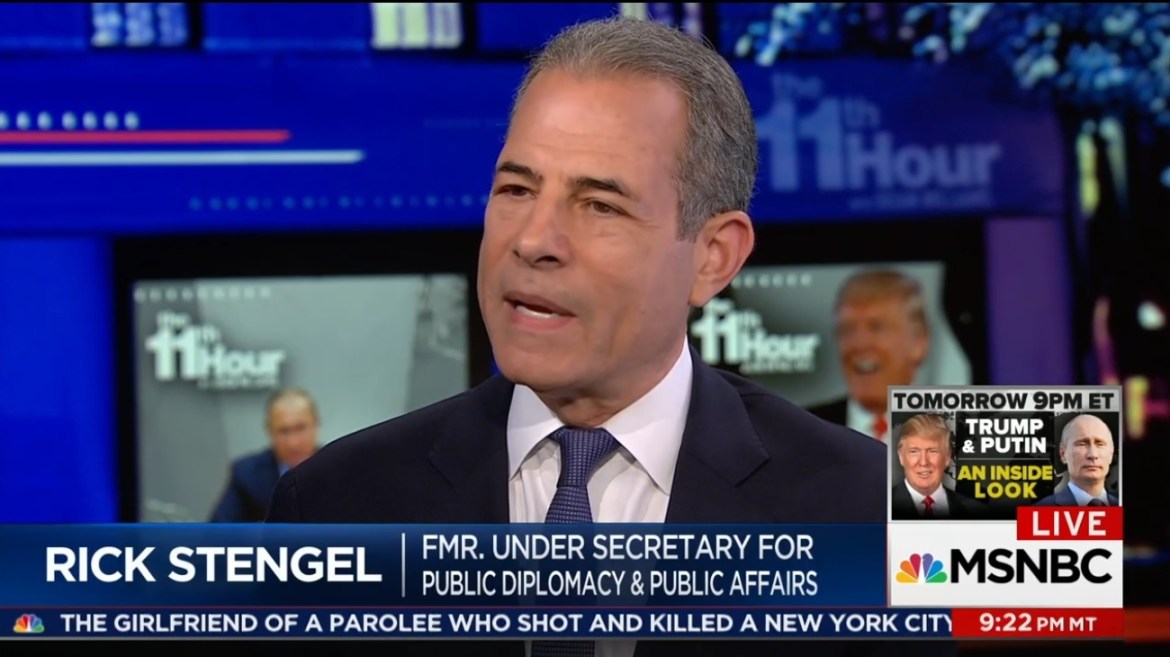
From Obama admin’s “chief propagandist” to Russiagate-peddling MSNBC pundit
Before being appointed as the US State Department’s “chief propagandist” in 2013, Richard Stengel was a managing editor of TIME Magazine.
In the Obama administration, Stengel not only created the Global Engagement Center propaganda vehicle; he also boasted that he “led the creation of English for All, a government-wide effort to promote the teaching of English around the world.”
After leaving the State Department in 2016, Stengel became a strategic advisor to Snap Inc., the company that runs the social media apps Snapchat and Bitmoji.
Stengel also found time for a fellowship at the Atlantic Council, a think tank closely linked to NATO and the Biden camp which has received funding from the US government, Britain, the European Union, and NATO itself, along with a host of Western weapons manufacturers, fossil fuel corporations, Gulf monarchies, and Big Tech juggernauts.
Stengel worked closely with the Atlantic Council’s Digital Forensic Research Lab, a dubious organization that has fueled efforts to censor independent media outlets in the name of fighting “disinformation.”
But Stengel is perhaps most well known as a regular political analyst on MSNBC in the Donald Trump era. On the network, he fueled Russiagate conspiracy theories, portraying the Republican president as a useful idiot of Russia and claiming Trump had a “one-sided bromance” with Vladimir Putin.
Stengel left MSNBC this November to join Biden’s presidential transition. The campaign announced that he was tapped to lead the Biden-Harris agency review team for the United States Agency for Global Media (USAGM).
Agency review teams are an integral part of the transition process, responsible for evaluating the operations of federal agencies.
Our teams are composed of diverse experts with deep policy expertise, ready to ensure we’re prepared to lead on Day One.https://t.co/2gY1E0Ey5k
— Biden-Harris Presidential Transition (@Transition46) November 10, 2020
USAGM is a state media propaganda organization that has its origins in a Cold War vehicle created by the CIA to spread disinformation against the Soviet Union and communist China. (The agency was previously called the Broadcasting Board of Governors, or BBG, until it rebranded in 2018.)
USAGM states on its website that its most important mission is to “Be consistent with the broad foreign policy objectives of the United States.”
An agency shakeup this year produced revelations that USAGM provided clandestine assistance to separatist activists during the protests that consumed Hong Kong in 2019. The program earmarked secure communications assistance for protesters and $2 million in “rapid response” payouts for anti-China activists.
Richard Stengel’s “obsessive” crusade against Russian “disinformation”
When Richard Stengel referred to himself as the State Department’s “chief propagandist,” advocated the use of propaganda against the American people, and proposed to “rethink” the First Amendment, he was participating in a May 3, 2018 panel discussion at the Council on Foreign Relations (CFR).
During the CFR event, titled “Political Disruptions: Combating Disinformation and Fake News,” Stengel hyped up the threat of supposed “Russian disinformation,” a vague term that is increasingly used as an empty signifier for any narrative that offends the sensibilities of Washington’s foreign policy establishment.
Stengel stated that he was “obsessed with” fighting “disinformation,” and made it clear he has a particular obsession with Moscow, accusing “the Russians” of engaging in “full spectrum” disinformation.
Joining him on stage was political scientist Kelly M. Greenhill, who mourned that alternative media platforms publish “things that seem like they could be true… that’s the sphere where it’s particularly difficult to debunk them… it’s this gray region, this gray zone, where it’s not traditional disinformation, but a combination of misinformation and play on rumors, conspiracy theories, sort of gray propaganda, that’s where I think the nub or the crux of the problem lies.”
Stengel approved, adding, “By the way those terms, the gray zone, are all from Russian active measures, that they’ve been doing for a million years.”
The panelists made no effort to hide their disdain for independent and foreign media outlets. Stengel stated clearly that a “news cartel” of mainstream corporate media outlets had long dominated US society, but he bemoaned that those “cartels don’t have hegemony like they used to.”
Stengel made it clear that his mission is to counter the alternative perspectives given a voice by foreign media platforms that challenge the US-dominated media landscape.
“The bad actors use journalistic objectivity against us. And the Russians in particular are smart about this,” Stengel grumbled.
He singled out Russia’s state-funded media network, RT, lamenting that “Vladimir Putin, when they launched Russia Today, said it was an antidote to the American English hegemony over the world media system. That’s how people saw it.”
Ben Decker, a research fellow at the Misinformation Project at the Harvard Kennedy School of Government, lamented that “RT is invading every weekly finance media space.”
But Decker was cheered by the proliferation of US oligarchs committed to retaking control of the narrative. “In America and across the world,” he stated, “the donor community is very eager to address this problem, and very eager to work with communities of researchers, academics, journalists, etc. to target this problem.”
“I think that there is an appetite to solve this from the top down,” he continued, urging the many academics in the audience “to apply for grant money” in order to fight this Russian “disinformation.”
The CFR panel culminated with an African audience member rising from the crowd and confronting Stengel: “Because what is happening in America is what the United States flipped on the Global South and in the Third World, which we lived with, for many, many years, in terms of a master narrative that was and still is propaganda,” the man declared.
Rather than respond, Stengel rudely ignored the question and made his way hurriedly for the exit: “You know what, I hate last questions. Don’t you? I never, I usually just want to end something before the last question.”
The video of the revealing confrontation caused such a furor that CFR’s YouTube account disabled comments and made the video unlisted. It cannot be found in a search on Google or YouTube; it can only be found with the direct link.
The video of the full discussion is embedded below:
Less Than Half Of Americans Likely To Comply With New COVID Lockdown: Gallup
By Tyler Durden – Zero Hedge – 11/12/2020
Earlier we featured the worrisome prospect of a second national coronavirus lockdown under a future Biden administration, considering the latest scientist to join Joe Biden’s “special coronavirus transition advisory team” is calling for just that.
Dr. Michael Osterholm, who serves as director of the Center of Infectious Disease Research and Policy at the University of Minnesota, now one of Biden’s coronavirus task force doctors told Yahoo News the following on Wednesday: “We could pay for a package right now to cover all of the lost wages for individual workers… if we did that, then we could lockdown for 4 to 6 weeks.”
But we know that’s unlikely to go well based on the latest polling data, as it appears the majority of Americans would not conform to such new stay-at-home orders and travel restrictions:
Americans are less likely to comply with another coronavirus lockdown than they were in the spring, with fewer than half saying in a new poll that they’re very likely to stay home this time around, according to a new Gallup Poll released as record numbers of cases skyrocket nationwide.
Here’s the data, according to Gallup, based on the poll taken between Oct.19 and Nov.1:
- 49% say they’re “very likely” to stay home for a month if mandated, down from 67% who said they would in the spring.
- 18% said they were “somewhat likely” to comply.
- One-third said they would be “unlikely” to comply with new lockdown orders.
- This despite 61% saying they believe the situation is getting worse.
- The number of respondents who said they’d be unlikely to comply is double the rate seen from polls in the spring.
However, it appears more Americans are intentional about social distancing measures, including wearing masks, compared to in the spring.
As Newsmax summarizes of the numbers: “Meanwhile, the number of people who are wearing masks has gone up sharply.”
The report states “Only about half of Americans reported in April that they were wearing masks, just after the Centers for Disease Control and Prevention suggested wearing them. Now, 88% reported they wear masks, after the number went up to 92% in July.”
Democrats are giving McCarthyism a major comeback by blacklisting Trump supporters, and we should all be worried
By Zachary Leeman | RT | November 12, 2020
Blacklisting anyone perceived as supportive of President Donald Trump has become a shockingly mainstream idea for liberals, who are proving day after day that they embrace the very authoritarian beliefs they claim to be against.
It may be difficult to believe, but McCarthyism seems to be making a comeback.
The late Wisconsin senator’s public hearings in the ‘50s where he investigated individuals for any and all connections to communism (which ultimately led to many losing their livelihoods) represent a dark time for the US, but Democrats appear to be taking notes on this unfortunate chapter in history for future use.
The warm embrace of a likely Biden presidency has not softened the left’s hatred for Trump supporters in any way, but rather only emboldened them to promote more and more extreme ideas.
Rep. Alexandria Ocasio-Cortez (D-New York) recently promoted “archiving” Trump “sycophants” so they cannot “downplay or deny their complicity in the future.”
One quick question for AOC: in what scenario besides a McCarthy-style hearing would someone need to “deny” their relationship to the Trump administration?
The congresswoman should be happy because Democrats have been promoting the Trump Accountability Project, which promises to hold anyone who worked for or with the Trump administration accountable for “what they did.”
“The world should never forget those who, when faced with a decision, chose to put their money, their time, and their reputations behind separating children from their families, encouraging racism and anti-Semitism, and negligently causing the unnecessary loss of life and economic devastation from our country’s failed response to the COVID-19 pandemic,” the group’s site reads.
Their list of who they want to keep from getting future jobs is pretty extensive as it includes anyone who donated to the president’s campaigns, worked with his campaigns or for any groups “affiliated” with them, as well as anyone who was part of his staff.
The group has even been promoted by Democrat operatives, including former Pete Buttigieg aide Emily Abrams and former Barack Obama campaign staffer Michael Simon.
Public figures like ‘The View’ co-host Sunny Hostin and CNN’s Jake Tapper have also been accused of promoting blackballing pro-Trumpers.
“I don’t think we should look the other way,” Hostin recently said of Trump “associates.”“I think we need to remember because if you don’t remember things then past becomes prologue. I do think people need to be held accountable for their actions and um I don’t think it’s reminiscent of McCarthyism at all.”
Tapper meanwhile warned Trump supporters backing accusations of voter fraud from the president about what future employers would think of their “character.” To be fair, when confronted with the Trump Accountability Project, blacklisting seemed to become too real for the anchor and he did a complete about-face on the issue.
The idea of blacklisting someone through public shaming or (gulp) Senate hearings may sound ludicrous, but there is sadly precedent for it in this country. McCarthy capitalized on the red scare in the ‘50s and played into people’s fears and ignorance by making communists and anyone associated with communists sound like deranged spies looking to infiltrate industries and government agencies to destroy American values.
Compare that extremism to how many on the left speak of anyone they deem a Trump supporter today. They constantly slam the opposition as white supremacists, misogynists, fascists, etc. Even someone like rapper Ice Cube simply admitting to working with the administration on legislation to help black communities was enough to get him called a racist and labeled a Trump supporter.
McCarthy is sadly not the only precedent here. We only need to look to Hollywood to see how organized and powerful liberals can blacklist conservatives.
Ironically an industry many theorize is very left-leaning due to McCarthy keeping Hollywood titans out of work once they were labeled communists, Hollywood has long been accused of blackballing anyone they deem right-leaning.
Many of Hollywood’s most outspoken conservatives like James Woods and Robert Davi have detailed in the past how their politics have kept them out of certain jobs. The president himself accused the industry of blacklisting conservatives after ‘Will & Grace’ stars Debra Messing and Eric McCormack demanded knowing who was attending a Hollywood fundraiser for the president.
While accusations of Hollywood blacklisting does not amount to actual full-blown McCarthyism, the strategy of shaming and punishing conservatives and non-liberals has evolved. Instead of being behind the scenes and only kept in discussion through accusations, it is now an idea being embraced and promoted by actual politicians and media talking heads.
Right or left, every American should resist and fear a world where one side controls the other through wild accusations, public shaming, and blacklisting. Joseph McCarthy is dead. Let McCarthyism die with him.
Zachary Leeman is the author of the novel Nigh and journalist who covers art and culture. He has previously written for outlets such as Breitbart, LifeZette, and BizPac Review among others. Follow him on Twitter @WritingLeeman
Elections and Legitimacy
By James Bovard | American Institute for Economic Research | November 11, 2020
This year’s presidential election is the fourth since 2000 to be marred by either widespread allegations of voter fraud or of foreign interference. Politicians and pundits have long counted on elections to wave a magic wand of legitimacy over the reign of whoever is designated the winner. But Americans are increasingly wondering if the endlessly-trumped “consent of the governed” has become simply another sham to keep them paying and obeying.
Twenty years ago, America was in the throes of a fiercely disputed recount battle in Florida. Democratic presidential nominee Vice President Al Gore won the national popular vote but the Electoral College verdict was unclear. Florida’s 25 electoral votes would give either Gore or Republican candidate George W. Bush the 270 votes needed to win the presidency. Six million votes were cast in Florida, and Bush initially had a winning margin of 537 votes. But the count was a complete mess.
Some Florida counties had antiquated voting equipment while others had harebrained ballot designs that confounded voters, resulting in “dangling chads,” “butterfly” ballots, and other unclear preferences. After the Florida Supreme Court ordered a manual recount of disputed votes in all counties, the Bush campaign legal team quickly filed briefs with the Supreme Court seeking to stop the process.
In a controversial decision, the Supreme Court, in a 5-to-4 ruling, stopped the recount because it could result in “a cloud upon what [George W. Bush] claims to be the legitimacy of his election,” Justice Antonin Scalia wrote. Justice John Paul Stevens dissented: “The Florida court’s ruling reflects the basic principle, inherent in our Constitution and our democracy, that every legal vote should be counted.” No such luck. Two days later, the same Supreme Court majority blocked any subsequent recounting because it was “not well calculated to sustain the confidence that all citizens must have in the outcome of elections.” Sustaining confidence” was more important than counting votes. Justice Stevens again dissented: “We have never before called into question the substantive standard by which a State determines that a vote has been legally cast.”
The 2000 election results seemed almost as shaky as the story of the Lady of the Lake giving the Excalibur sword to Arthur, thereby signifying his right to rule England. At a minimum, the outcome of the 2000 presidential election was decided by lawyers and political appointees (justices), not by voters. Former President Jimmy Carter observed in 2001, “As we have seen in Florida and some other states… the expected error rate in some jurisdictions is as high as 3 percent of the [vote] total.”
Four years later, George W. Bush narrowly won reelection after a campaign that was boosted by numerous false terror attack warnings that helped frighten voters into giving him another four years. Ohio was the key state determining the outcome that time, and its results appeared tainted by numerous decisions by Republican election officials who favored Bush. Democrats also charged that the electronic voting machines used in much of Ohio had been manipulated to produce misleading vote totals.
In January 2005, Democratic members of the House of Representatives launched a brief challenge to the legitimacy of the 2004 presidential election. Rep. Maxine Waters (D-Cal.) complained that many states used more sophisticated technology for lottery tickets than for elections: “Incredibly even in those few jurisdictions that have moved to electronic voting… we do not require a verifiable paper trail to protect against vote tampering.”
Republican Congressmen went ballistic. Rep. Rob Portman (R-Ohio) accused the Democrats of seeking to “obstruct the will of the American people.” Rep. J.D. Hayworth (R-Ariz.) bewailed that the protest “serves to plant the insidious seeds of doubt in the electoral process.” Rep. Roy Blunt (R-Mo.), the House Majority Whip, sought to put the entire government above questioning: “It is the greatest democracy in the history of the world and it is run by people who step forward and make a system work in ways that nobody would believe until they see it produce the result of what people want to have happen on Election Day.” Blunt’s “nobody would believe” phrase was more prescient than he intended.
For tens of millions of Americans and for convention halls full of editorial writers, the 2016 presidential election results were forever tainted by allegations that the Trump campaign colluded with the Russians to score an upset victory. Those allegations spurred a Special Counsel investigation that haunted most of Trump’s presidency and helped Democrats capture control of the House of Representatives in 2018. In 2019, Special Counsel Robert Mueller finally admitted that no case of collusion existed. But we have since learned that there was pervasive collusion between Obama administration officials and federal agencies to target Trump’s 2016 campaign. And, as George Washington University professor Jonathan Turley observed, the media ignored “one of the biggest stories in decades. The Obama administration targeted the campaign of the opposing party based on false evidence.”
Instead, the media cheered secretive federal agencies that had interfered in American politics. Washington Post columnist Eugene Robinson captured the Beltway’s verdict: “God bless the Deep State!” The media’s veneration will make it easier for the FBI, CIA, and National Security Agency to meddle with if not fix future elections.
This year’s presidential election may be the most fraud-ridden event since 1876, when four states had disputed results and Congress gave the presidency to Republican Rutherford Hayes despite ample evidence of conniving. Earlier this year, some states mailed ballots to all the names on the voting lists, providing thousands of dead people the chance to vote from the grave. More than 92 million people voted by mail.
President Trump warned that the shift to mail-in voting could result in “the most corrupt vote in our nation’s history.” A 2012 New York Times analysis concluded that “fraud in voting by mail is… vastly more prevalent than the in-person voting fraud that has attracted far more attention.” But that blunt admission vanished into the Memory Hole as the media endlessly derided any apprehension of electoral foul play.
Shortly before Election Day, Democratic candidate Joe Biden boasted, “We have put together I think the most extensive and inclusive voter fraud organization in the history of American politics.” A Reuters “Fact Check” analysis revealed that Biden’s comment was a “slip of the tongue” and that he likely meant “voter protection.” Since Election Day, the same media outlets that insisted that there was no corruption in the Biden family now assure Americans there was no significant voter fraud.
The 2020 election controversies are being fought out by lawyers and judges. The media is hoping that hailing Joe Biden as the rightful ruler will speedily restore legitimacy to the political system. But 70 million Trump voters are unlikely to be swayed by the same media that endlessly belittled both the president and his supporters.
Perhaps the real problem with the current American political system is that elections are practically the last remaining source of apparent legitimacy. Presidents take an oath to “preserve, protect and defend the Constitution of the United States.” But this has long been a nonbinding throwaway gesture – if not a laugh line for Washington insiders. Elections failed to prevent every recent American commander-in-chief from expanding and exploiting the dictatorial potential of the presidency.
Should we expect anything different from Biden? When he was chairman of the Senate Judiciary Committee, he co-authored numerous oppressive drug laws and forfeiture laws that helped obliterate much of the Bill of Rights. His political philosophy never went beyond his famous utterance: “Lock the S.O.B.s up!” He supported expanding federal power whenever there were votes or campaign contributions to be pocketed.
Biden has said he would dictate a national mask mandate and could impose a national lockdown if Covid infection rates rise. The same media outlets that served as Biden’s Basement Barricade during the campaign – helping him avoid challenges that might have raised questions about his positions and mental capacity – will cheer any restrictive Covid policy Biden imposes. In lieu of constitutionality, we’ll hear that it is the “will of the people” or some such pablum.
Nor will there likely be any way to constrain Biden if he follows the advice of his bellicose foreign policy advisors. Counterpunch editor Jeffrey St. Clair asked: “Which country will Biden bomb first in order to ‘restore America’s place in the world?’” The Biden campaign promised to “increase pressure” on Syrian president Bashar Assad – presumably by providing more arms and money to the terrorist groups that Obama began aiding almost a decade ago. Biden will sanctify his foreign bombing campaigns with the same lame legal tautology that the Obama administration used to justify killing Libyans in 2011. The Justice Department announced that Obama “had the constitutional authority” to attack Libya “because he could reasonably determine that such use of force was in the national interest.”
The more power presidents capture, the more facts they can suppress. The federal government is creating trillions of pages of new secrets every year, effectively making it impossible for average citizens to learn the truth about foreign policy until long after U.S. bombs have dropped. Biden is unlikely to end the pervasive secrecy that makes a mockery of self-government.
In his victory speech last Saturday, Biden pledged to “restore the soul of America.” But Americans were not voting for a faith healer; they were selecting a chief executive for a federal government. Only 20 percent of Americans nowadays trust the government to “do the right thing” most of the time, according to a Pew Research Center survey. The election results will likely further erode federal legitimacy at a time when Uncle Sam has no trust to spare. How many more election debacles and brazen abuses of power does Washington believe the American people will tolerate?
James Bovard is the author of ten books, including Public Policy Hooligan, Attention Deficit Democracy, The Bush Betrayal, and Lost Rights: The Destruction of American Liberty. He has written for the New York Times, Wall Street Journal, Playboy, Washington Post, New Republic, Reader’s Digest, and many other publications. He is a member of the USA Today Board of Contributors, a frequent contributor to The Hill, and a contributing editor for American Conservative.
U.S. Color Revolution: The Not So Phantom Menace
By Tom Luongo | Gold Goats n’ Guns | November 9, 2020
“There is no civility, there is only politics…
The Bureaucrats are in charge now…”
— Senator Palpatine
The Black Revolution in the U.S. is proceeding according to script. We are into the 3rd act of it.
Act I was the Coronapocalypse setting the stage for vastly expanded government powers and the systemic undermining of the sitting President.
Act II was the summer of violence and fake polling data which created the illusion of a society at war with that same President for not addressing the needs of the people.
Underneath the headlines the forces arrayed against Trump were building the infrastructure to ensure that however the people voted on November 3rd, the outcome was pre-determined in their favor against him.
Act III is the election itself and the aftermath. The coup has begun. The pressure campaign to force the incumbent Trump, hated by the establishment, to concede has ratcheted up to eleven.
This is all very normal for color revolutions, just ask Alexander Lukashenko in Belarus or Viktor Yanukovich formerly of the Ukraine. We can’t ask Slobodon Milosovic. He dead.
But one thing happened they didn’t count on, Trump actually winning the election by margins in swing states that couldn’t be overcome without overt and blatant fraud.
That’s created the opportunity for a complete reversal of the current results and a successful countering of the color revolution strategy, which rests on a media-made frenzy supported by foreign government leaders to oust the sitting president from power quickly without proper adherence to the process.
And that feeds the plot points for the next eight weeks until Congress convenes to certify (or not) the Electoral College.
President Trump refuses to concede the election, and rightly so. There are multiple paths to not only victory for him but also exposing the deep corruption of the election process and the people who control it.
Lukashenko survived the color revolution in Belarus because the attempt there was ham-fisted. It lacked the ingredients necessary to pull it off — identitarian division within the people and ‘corporate’ sponsorship.
The conditions weren’t ripe for that kind of result. All he had to do was offer reforms once the energy died down and make peace with Russia and he would survive.
Ousting him from power may not have been the primary goal, but achieving the secondary goal of severing EU and US ties to it and forcing Russia to devote resources to Belarus is almost as important.
So, if Trump wants to lead the nation he has to show it by fighting tooth and claw, just like Lukashenko did. And that means organizing support for him across the country. This is why he is incredibly smart to organize rallies. According to Axios :
President Trump plans to brandish obituaries of people who supposedly voted but are dead — plus hold campaign-style rallies — in an effort to prolong his fight against apparent insurmountable election results, four Trump advisers told me during a conference call this afternoon.
“Insurmountable election results??” Really? A few thousand votes separates Trump from outright sweeping all the battleground states whose vote totals are very sketchy and this is ‘insurmountable?’
This is what I mean by the pressure campaign having gone plaid. There is no responsible journalism left within the major media outlets.
Only those who were forced out on principle or corruption have the ability to speak their mind now.
Never in a million years would I look to Megyn Kelly for the voice of rationality. But it looks like being excommunicated from the inner circle does wonders for one’s ability to tell the truth.
The division today was cynically stoked and nurtured for this current operation to effect this exact result. The bigger point Megyn doesn’t articulate is that this division is exactly the kind of ‘secondary goal’ desired if Trump prevails in the courts or through the Electoral College.
Regardless of the outcome that division cuts deep enough to ensure an America permanently weakened, ripe for a complete remaking into a hellish place. There is a full-court press on right now across the world to attack sovereignty of important states whose populations are dissident to The Davos Crowd’s Great Reset — notably the U.K., the U.S., Poland and Russia.
Trump’s fight is their fight. His supporters and sovereigntists of all stripes are to be ritualistically humiliated by every headline, every utterance, every Tweet and every newscast between now and when the State Legislatures meet to select slates of Electors in December.
The media will never concede they were wrong, will never report on anything fairly. They are in on the grift. Looking for them to admit anything is a waste of energy and time. Simply turn them off and become #Ungovernable.
This is a psychological war now, designed to rob you of your reason and sap your willingness to fight by creating an overwhelming picture of Trump as the bad guy, Quixotically clinging to power we’re being told he’s already lost.
But Megyn Kelly is right in telling people that there will be no reconciliation without acceptance. And since, at its core, leftism is a religion without the ability to forgive, since it is vehemently anti-Christian, there will be no acceptance back into the fold, including for her.
It will be marginalization, retribution and continued vitriol of all Trump supporters and anyone not down with being reset into the grand vision of the New Soviet Green Man.
They haven’t even secured the presidency yet and BLM/Antifa are already turning on white Biden supporters who are urging peace.
Nothing shields you from the mob once the mob gets going. I hope this person’s conscience is clean that he did his part to stop Orange Man Bad because once this is over, that’s all he’ll have left.
Klaus Schwab told you this. You’ll Own Nothing and be Happy.
Or else.
The choice was struggle sessions or Trump rallies. I told you months ago you would be faced with the Hobson’s Choice of accepting their dystopic future or having your house burned down.
Millions chose poorly last week and they will have massive buyer’s remorse as the plans are rolled out and they are sacrificed.
Don’t believe me? Ask Ukrainians if they are better off six years after their color revolution or not? That one was successful.
Act III of a color revolution is the most dangerous. It is the one where chaos can reign for months and the balance tipped by the slimmest of margins. But in the end it always comes down to the willingness of the people to decide their future.
Because taking down the U.S. is such a monumental undertaking they had to create a problem global in scale, COVID-19.
The U.S. has everything against it in this situation. The oligarchy and its quislings are firmly in command of the narrative. There are real, deep divisions to keep people fighting each other while the oligarchs proceed with their plans.
Trump is trying to marshal a counter-revolution on the ground and in the courts. The evidence will be presented. Apparatchiks will ignore their orders. Protests will miraculously spring up in all the right places.
The media will misrepresent everything.
It will be up to us to decide which way the State Legislatures decide whose electors go to Washington D.C. next month by putting real pressure on them to act on their conscience and the evidence. That’s the law.
But the menace of it is real and it won’t go away regardless of the outcome of the election. It no longer lurks in the shadows. It slouches towards Washington waiting to be reborn.
US – UK Intel Agencies Declare Cyber War on Independent Media
By Whitney Webb |
Unlimited Hangout| November 11, 2020
In just the past week, the national-security states of the United States and United Kingdom have discreetly let it be known that the cyber tools and online tactics previously designed for use in the post-9/11 “war on terror” are now being repurposed for use against information sources promoting “vaccine hesitancy” and information related to Covid-19 that runs counter to their state narratives.
A new cyber offensive was launched on Monday by the UK’s signal intelligence agency, Government Communications Headquarters (GCHQ), which seeks to target websites that publish content deemed to be “propaganda” that raises concerns regarding state-sponsored Covid-19 vaccine development and the multi-national pharmaceutical corporations involved.
Similar efforts are underway in the United States, with the US military recently funding a CIA-backed firm—stuffed with former counterterrorism officials who were behind the occupation of Iraq and the rise of the so-called Islamic State—to develop an AI algorithm aimed specifically at new websites promoting “suspected” disinformation related to the Covid-19 crisis and the US military–led Covid-19 vaccination effort known as Operation Warp Speed.
Both countries are preparing to silence independent journalists who raise legitimate concerns over pharmaceutical industry corruption or the extreme secrecy surrounding state-sponsored Covid-19 vaccination efforts, now that Pfizer’s vaccine candidate is slated to be approved by the US Food and Drug Administration (FDA) by month’s end.
Pfizer’s history of being fined billions for illegal marketing and for bribing government officials to help them cover up an illegal drug trial that killed eleven children (among other crimes) has gone unmentioned by most mass media outlets, which instead have celebrated the apparently imminent approval of the company’s Covid-19 vaccine without questioning the company’s history or that the mRNA technology used in the vaccine has sped through normal safety trial protocols and has never been approved for human use. Also unmentioned is that the head of the FDA’s Center for Drug Evaluation and Research, Patrizia Cavazzoni, is the former Pfizer vice president for product safety who covered up the connection of one of its products to birth defects.
Essentially, the power of the state is being wielded like never before to police online speech and to deplatform news websites to protect the interests of powerful corporations like Pfizer and other scandal-ridden pharmaceutical giants as well as the interests of the US and UK national-security states, which themselves are intimately involved in the Covid-19 vaccination endeavor.
UK Intelligence’s New Cyberwar Targeting “Anti-Vaccine Propaganda”
On Monday, the UK newspaper The Times reported that the UK’s GCHQ “has begun an offensive cyber-operation to disrupt anti-vaccine propaganda being spread by hostile states” and “is using a toolkit developed to tackle disinformation and recruitment material peddled by Islamic State” to do so. In addition, the UK government has ordered the British military’s 77th Brigade, which specializes in “information warfare,” to launch an online campaign to counter “deceptive narratives” about Covid-19 vaccine candidates.
The newly announced GCHQ “cyber war” will not only take down “anti-vaccine propaganda” but will also seek to “disrupt the operations of the cyberactors responsible for it, including encrypting their data so they cannot access it and blocking their communications with each other.” The effort will also involve GCHQ reaching out to other countries in the “Five Eyes” alliance (US, Australia, New Zealand and Canada) to alert their partner agencies in those countries to target such “propaganda” sites hosted within their borders.
The Times stated that “the government regards tackling false information about inoculation as a rising priority as the prospect of a reliable vaccine against the coronavirus draws closer,” suggesting that efforts will continue to ramp up as a vaccine candidate gets closer to approval.
It seems that, from the perspective of the UK national-security state, those who question corruption in the pharmaceutical industry and its possible impact on the leading experimental Covid-19 vaccine candidates (all of which use experimental vaccine technologies that have never before been approved for human use) should be targeted with tools originally designed to combat terrorist propaganda.
While The Times asserted that the effort would target content “that originated only from state adversaries” and would not target the sites of “ordinary citizens,” the newspaper suggested that the effort would rely on the US government for determining whether or not a site is part of a “foreign disinformation” operation.
This is highly troubling given that the US recently seized the domains of many sites, including the American Herald Tribune, which it erroneously labeled as “Iranian propaganda,” despite its editor in chief, Anthony Hall, being based in Canada. The US government made this claim about the American Herald Tribune after the cybersecurity firm FireEye, a US government contractor, stated that it had “moderate confidence” that the site had been “founded in Iran.”
In addition, the fact that GCHQ has alleged that most of the sites it plans to target are “linked to Moscow” gives further cause for concern given that the UK government was caught funding the Institute for Statecraft’s Integrity Initiative, which falsely labeled critics of the UK government’s actions as well as its narratives with respect to the Syria conflict as being related to “Russian disinformation” campaigns.
Given this precedent, it is certainly plausible that GCHQ could take the word of either an allied government, a government contractor, or perhaps even an allied media organization such as Bellingcat or the Atlantic Council’s DFRLab that a given site is “foreign propaganda” in order to launch a cyber offensive against it. Such concerns are only amplified when one of the main government sources for The Times article bluntly stated that “GCHQ has been told to take out antivaxers [sic] online and on social media. There are ways they have used to monitor and disrupt terrorist propaganda,” which suggests that the targets of GCHQ’s new cyber war will, in fact, be determined by the content itself rather than their suspected “foreign” origin. The “foreign” aspect instead appears to be a means of evading the prohibition in GCHQ’s operational mandate on targeting the speech or websites of ordinary citizens.
This larger pivot toward treating alleged “anti-vaxxers” as “national security threats” has been ongoing for much of this year, spearheaded in part by Imran Ahmed, the CEO of the UK-based Center for Countering Digital Hate, a member of the UK government’s Steering Committee on Countering Extremism Pilot Task Force, which is part of the UK government’s Commission for Countering Extremism.
Ahmed told the UK newspaper The Independent in July that “I would go beyond calling anti-vaxxers conspiracy theorists to say they are an extremist group that pose a national security risk.” He then stated that “once someone has been exposed to one type of conspiracy it’s easy to lead them down a path where they embrace more radical world views that can lead to violent extremism,” thereby implying that “anti-vaxxers” might engage in acts of violent extremism. Among the websites cited by Ahmed’s organization as promoting such “extremism” that poses a “national security risk” were Children’s Health Defense, the National Vaccine Information Center, Informed Consent Action Network, and Mercola.com, among others.
Similarly, a think tank tied to US intelligence—whose GCHQ equivalent, the National Security Agency, will take part in the newly announced “cyber war”—argued in a research paper published just months before the onset of the Covid-19 crisis that “the US ‘anti-vaxxer’ movement would pose a threat to national security in the event of a ‘pandemic with a novel organism.’”
InfraGard, “a partnership between the Federal Bureau of Investigation (FBI) and members of the private sector,” warned in the paper published last June that “the US anti-vaccine movement would also be connected with ‘social media misinformation and propaganda campaigns’ orchestrated by the Russian government,” as cited by The Guardian. The InfraGard paper further claimed that prominent “anti-vaxxers” are aligned “with other conspiracy movements including the far right . . . and social media misinformation and propaganda campaigns by many foreign and domestic actors. Included among these actors is the Internet Research Agency, the Russian government–aligned organization.”
An article published just last month by the Washington Post argued that “vaccine hesitancy is mixing with coronavirus denial and merging with far-right American conspiracy theories, including Qanon,” which the FBI named a potential domestic terror threat last year. The article quoted Peter Hotez, dean of the School of Tropical Medicine at Baylor College of Medicine in Houston, as saying “The US anti-vaccination movement is globalizing and it’s going toward more-extremist tendencies.”
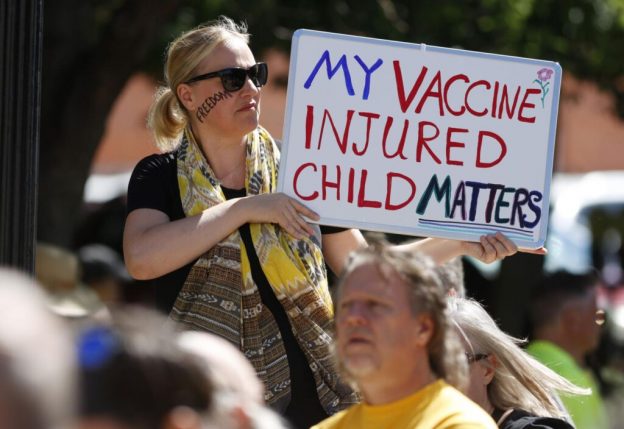
Simone Warstat attends a rally against a legislative bill to make it more difficult for parents to opt out for non-medical reasons to immunize their children, June 7, 2020, in Denver Colorado.
It is worth pointing out that many so-called “anti-vaxxers” are actually critics of the pharmaceutical industry and are not necessarily opposed to vaccines in and of themselves, making the labels “anti-vaxxer” and “anti-vaccine” misleading. Given that many pharmaceutical giants involved in making Covid-19 vaccines donate heavily to politicians in both countries and have been involved in numerous safety scandals, using state intelligence agencies to wage cyber war against sites that investigate such concerns is not only troubling for the future of journalism but it suggests that the UK is taking a dangerous leap toward becoming a country that uses its state powers to treat the enemies of corporations as enemies of the state.
The CIA-Backed Firm “Weaponizing Truth” with AI
In early October, the US Air Force and US Special Operations Command announced that they had awarded a multimillion-dollar contract to the US-based “machine intelligence” company Primer. Per the press release, “Primer will develop the first-ever machine learning platform to automatically identify and assess suspected disinformation [emphasis added]. Primer will also enhance its natural language processing platform to automatically analyze tactical events to provide commanders with unprecedented insight as events unfold in near real-time.”
According to Primer, the company “builds software machines that read and write in English, Russian, and Chinese to automatically unearth trends and patterns across large volumes of data,” and their work “supports the mission of the intelligence community and broader DOD by automating reading and research tasks to enhance the speed and quality of decision-making.” In other words, Primer is developing an algorithm that would allow the national-security state to outsource many military and intelligence analyst positions to AI. In fact, the company openly admits this, stating that their current effort “will automate the work typically done by dozens of analysts in a security operations center to ingest all of the data relevant to an event as it happens and funnel it into a unified user interface.”
Primer’s ultimate goal is to use their AI to entirely automate the shaping of public perceptions and become the arbiter of “truth,” as defined by the state. Primer’s founder, Sean Gourley, who previously created AI programs for the military to track “insurgency” in post-invasion Iraq, asserted in an April blog post that “computational warfare and disinformation campaigns will, in 2020, become a more serious threat than physical war, and we will have to rethink the weapons we deploy to fight them.”
In that same post, Gourley argued for the creation of a “Manhattan Project for truth” that would create a publicly available Wikipedia-style database built off of “knowledge bases [that] already exist inside many countries’ intelligence agencies for national security purposes.” Gourley then wrote that “this effort would be ultimately about building and enhancing our collective intelligence and establishing a baseline for what’s true or not” as established by intelligence agencies. He concludes his blog post by stating that “in 2020, we will begin to weaponize truth.”
Notably, on November 9, the same day that GCHQ announced its plans to target “anti-vaccine propaganda,” the US website NextGov reported that Primer’s Pentagon-funded effort had turned its attention specifically to “Covid-19 related disinformation.” According to Primer’s director of science, John Bohannon, “Primer will be integrating bot detection, synthetic text detection and unstructured textual claims analysis capabilities into our existing artificial intelligence platform currently in use with DOD. . . . This will create the first unified mission-ready platform to effectively counter Covid-19-related disinformation in near-real time.”
Bohannon, who previously worked as a mainstream journalist embedded with NATO forces in Afghanistan, also told NextGov that Primer’s new Covid-19–focused effort “automatically classifies documents into one of 10 categories to enable the detection of the impact of COVID” on areas such as “business, science and technology, employment, the global economy, and elections.” The final product is expected to be delivered to the Pentagon in the second quarter of next year.
Though a so-called private company, Primer is deeply linked to the national-security state it is designed to protect by “weaponizing truth.” Primer proudly promotes itself as having more than 15 percent of its staff hailing from the US intelligence community or military. The director of the company’s National Security Group is Brian Raymond, a former CIA intelligence officer who served as the Director for Iraq on the US National Security Council after leaving the agency.
The company also recently added several prominent national-security officials to its board including:
- Gen. Raymond Thomas (ret.), who led the command of all US and NATO Special Operations Forces in Afghanistan and is the former commander of both US Special Operations Command and Joint Special Operations Command (JSOC).
- Lt. Gen. VeraLinn Jamieson (ret.), the former deputy chief of staff for Air Force Intelligence, Surveillance and Reconnaissance who led the Air Force’s intelligence and cyber forces. She also personally developed “strategic partnerships” between the Air Force and Microsoft, Amazon, Google, and IBM in order “to accelerate the Air Force’s digital transformation.”
- Brett McGurk, one of the “chief architects” of the Iraq War “surge,” alongside the notorious Kagan family, as NSC Director for Iraq, and then as special assistant to the president and senior Director for Iraq and Afghanistan during the Bush administration. Under Obama and during part of the Trump administration, McGurk was the special presidential envoy for the Global Coalition to Defeat ISIS at the State Department, helping to manage the “dirty war” waged by the US, the UK, and other allies against Syria.
In addition to those recent board hires, Primer brought on Sue Gordon, the former principal deputy director of National Intelligence, as a strategic adviser. Gordon previously “drove partnerships within the US Intelligence Community and provided advice to the National Security Council in her role as deputy director of national intelligence” and had a twenty-seven-year career at the CIA. The deep links are unsurprising, given that Primer is financially backed by the CIA’s venture-capital arm In-Q-Tel and the venture-capital arm of billionaire Mike Bloomberg, Bloomberg Beta.
Operation Warp Speed’s Disinformation Blitzkrieg
The rapid increase in interest by the US and UK national-security states toward Covid-19 “disinformation,” particularly as it relates to upcoming Covid-19 vaccination campaigns, is intimately related to the media-engagement strategy of the US government’s Operation Warp Speed.
Officially a “public-private partnership,” Operation Warp Speed, which has the goal of vaccinating 300 million Americans by next January, is dominated by the US military and also involves several US intelligence agencies, including the National Security Agency (NSA) and the Department of Homeland Security (DHS), as well as intelligence-linked tech giants Google, Oracle, and Palantir. Several reports published in The Last American Vagabond by this author and journalist Derrick Broze have revealed the extreme secrecy of the operation, its numerous conflicts of interest, and its deep ties to Silicon Valley and Orwellian technocratic initiatives.
Warp Speed’s official guidance discusses at length its phased plan for engaging the public and addressing issues of “vaccine hesitancy.” According to the Warp Speed document entitled “From the Factory to the Frontlines,” “strategic communications and public messaging are critical to ensure maximum acceptance of vaccines, requiring a saturation of messaging across the national media.” It also states that “working with established partners—especially those that are trusted sources for target audiences—is critical to advancing public understanding of, access to, and acceptance of eventual vaccines” and that “identifying the right messages to promote vaccine confidence, countering misinformation, and targeting outreach to vulnerable and at-risk populations will be necessary to achieve high coverage.”
The document also notes that Warp Speed will employ the CDC’s three-pronged strategic framework for its communications effort. The third pillar of that strategy is entitled “Stop Myths” and has as a main focus “establish[ing] partnerships to contain the spread of misinformation” as well as “work[ing] with local partners and trusted messengers to improve confidence in vaccines.”
Though that particular Warp Speed document is short on specifics, the CDC’s Covid-19 Vaccination Program Interim Playbook contains additional information. It states that Operation Warp Speed will “engage and use a wide range of partners, collaborations, and communication and news media channels to achieve communication goals, understanding that channel preferences and credible sources vary among audiences and people at higher risk for severe illness and critical populations, and channels vary in their capacity to achieve different communication objectives.” It states that it will focus its efforts in this regard on “traditional media channels” (print, radio, and TV) as well as “digital media” (internet, social media, and text messaging).
The CDC document further reveals that the “public messaging” campaign to “promote vaccine uptake” and address “vaccine hesitancy” is divided into four phases and adds that the overall communication strategy of Warp Speed “should be timely and applicable for the current phase of the Covid-19 Vaccination program.”
Those phases are:
- Before a vaccine is available
- The vaccine is available in limited supply for certain populations of early focus
- The vaccine is increasingly available for other critical populations and the general public
- The vaccine is widely available
Given that the Covid-19 vaccine candidate produced by Pfizer is expected to be approved by the end of November, it appears that the US national-security state, which is essentially running Operation Warp Speed, along with “trusted messengers” in mass media, is preparing to enter the second phase of its communications strategy, one in which news organizations and journalists who raise legitimate concerns about Warp Speed will be de-platformed to make way for the “required” saturation of pro-vaccine messaging across the English-speaking media landscape.
Ongoing legal battle over 2005 UK police killing brings to light covert op to smear victim justice campaigns
By Kit Klarenberg | RT | November 10, 2020
On July 22, 2005, Jean Charles de Menezes was executed by armed police on a London Underground train. He was quickly found innocent, but his family’s fight for justice goes on, exposing police efforts to dodge responsibility.
Due to a litany of catastrophic blunders and miscommunications by senior officials and officers on-the-ground, he’d been wrongly identified as one of the fugitives involved in a string of failed suicide bombings the previous day.
Followed by a team of plainclothes police from his home to nearby Stockwell Underground station, despite clear orders from Metropolitan Police ‘Gold Command’ he be apprehended, Jean Charles was shot seven times in the head and once in the shoulder at close range in an underground train carriage. His body was said to be “unrecognizable” afterwards.
Lying squad
In the immediate aftermath, confusion and hysteria abounded, thanks largely to contradictory witness accounts and numerous “off-record” briefings from police being eagerly and uncritically amplified and speculated upon over and again by the mainstream media.
The day after his killing, it was fully established that Jean Charles hadn’t been a bombing suspect, and was in fact entirely innocent. Yet news outlets seemed oddly determined to imply he wasn’t entirely guiltless.
It was widely reported that he’d been an illegal immigrant, wires had been trailing from his rucksack, he’d been acting dubiously, fled from police after being challenged, vaulted the station ticket barriers, and refused to stop running despite shouted demands from officers.
All of these stories were entirely untrue, and widely acknowledged to be false over the course of subsequent months, but these impressions endure to this day in the minds of many. Suspiciously, the stories all seemed purpose-built to cast doubt on Jean Charles’ actions and character, and in the process mitigate the seriousness of the police’s fatal errors.
A subsequent investigation of Jean Charles’ killing by the then-Independent Police Complaints Commission (IPCC) specifically examined the question of how these lies entered the public domain.
It determined that no officer had knowingly fed disinformation to the press, but somewhat contradictorily, concluded that once officials knew Jean Charles was innocent the morning of July 23, 2005, “they should have refrained from publicly discussing the shooting until… the facts had been fully established.”
“Whilst [police] admitted to having made a tragic mistake they continued to try to justify the shooting by referring to de Menezes’ own actions and clothing,” the IPCC added.
The same probe concluded none of the officers involved would face disciplinary charges, while criticising the Metropolitan Police’s command structure. As of November 2020, no one has ever been criminally prosecuted for their actions on that fateful day.
Without knowledge or consent
Jean Charles’ family have never given up their quest for British police to be held accountable for his killing. In August 2005, they launched a campaign, Justice4Jean, calling for a public inquiry into his “unlawful killing.”
Shockingly, in 2014 they were contacted by representatives of Operation Herne, which was investigating the activities of the Special Demonstration Squad (SDS), a now-defunct covert unit of Special Branch, Britain’s elite national security police force. They were told information about them and their campaign had been inappropriately gathered by undercover operatives.
Among them was Patricia Armani Da Silva, Jean Charles’ first cousin and flatmate, who’d played a prominent role in Justice4Jean since its foundation. At a subsequent meeting with Herne investigators, she and other family members were shown five heavily redacted intelligence reports. The documents recorded covertly obtained information about individuals connected with the campaign and its meetings. For reasons unclear, the details gathered included the family’s political views.
In October 2015, Patricia was granted core participant status in the Undercover Policing Inquiry (UCPI), established by then-home secretary Theresa May to investigate numerous controversies surrounding the British state’s use of clandestine operatives.
Despite offering to actively participate with the investigation and two judicial reviews into her surveillance, in 2020 Patricia remains entirely in the dark as to why she, her relatives, and their campaign, were spied on by police. Now the UCPI has finally begun hearing evidence, and an opening statement on her behalf was read to the Inquiry on November 9 by Phillipa Kaufmann QC.
She outlined the immensely distressing impact mendacious media allegations had on Jean Charles’ family at the time, as they knew it highly unlikely their law-abiding, respectable son could have done anything wrong. She also noted they often relive the pain of the dark, harrowing period following his death, as they still encounter those bogus allegations, and are frequently forced to counter erroneous perceptions that Jean Charles in some way contributed to his own killing.
Moreover though, Kaufmann made it clear that the family are adamant police were fundamental to the dissemination of these stories, and continued to perfidiously pump discrediting disinformation about Jean Charles into the public domain long after he was so brutally slain.
For example, at the start of 2006, it was widely reported that a woman had approached police and claimed a man bearing a “striking resemblance” to Jean Charles had sexually assaulted her in a hotel room on New Year’s Eve 2002 in West London. After initially refusing, his family consented to a blood sample being taken from Jean Charles’ autopsy for forensic tests, and in April that year, Scotland Yard announced he’d been fully exonerated.
Strikingly, Kaufmann revealed that in March 2006, Patricia’s solicitor Harriet Wistrich received a telephone call from DI Paul Settle informing her that an article detailing the woman’s allegations would soon be published by the Sunday Mirror. Moreover, Wistrich clearly recalls that Settle “gave the unambiguous impression” the article was a result of a police leak.
The matter was investigated by the Metropolitan Police Service’s Directorate of Professional Standards, under the supervision of the IPCC. Settle denied having suggested the information was leaked by police, and the probe halted after concluding the number of people who knew of the allegations, including those outside the police, meant further investigation was unlikely to identify its source.
Undermining campaigning efforts
To say the least, Jean Charles’ relatives well understand the critical role that information and disinformation play in shaping public narratives about police action.
It’s in this context that undercover surveillance of the family justice campaign gains an even more sinister dimension. Illicitly obtained private information about them could easily be weaponised to discredit them and undermine their battle, in the same way disinformation served to discredit Jean Charles and by implication exonerate police.
In all, undercover officers spied on at least 18 family justice campaigns between 1968 and 2011. Such a profusion suggests a clear pattern of behaviour, a pattern in turn plausibly influenced by established internal policy. However, police consistently seek to characterise surveillance of justice campaigns as mere ‘collateral intrusion’ – inadvertent and unintentional intelligence gathering by covert operatives investigating individuals involved, rather than direct and deliberate targeting of grieving relatives themselves.
Families are deeply sceptical of this explanation, particularly in light of the revelations of former undercover officer Peter Francis, who as ‘Pete Black’ infiltrated 12 separate justice campaigns between 1993 and 1997. In 2010, under the alias ‘Officer A’, he said his presence in these groups was specifically intended to make the truth they sought “harder to obtain,” as part of a wider wrecking tendency on the part of SDS. Once the unit infiltrated an organisation, it was “effectively finished,” he claims.
In later years, Francis identified himself publicly, and shed further light on his undercover activities, particularly in regard to the Stephen Lawrence justice campaign, set up after the South London teenager was murdered in a cold-blooded racist attack. He alleged he was specifically tasked with unearthing incriminating information on Stephen’s parents and friends, which could halt their crusade in its tracks.
“Had I… found anything detrimental, the police using the media would’ve used that information to smear the family. My superiors were after any intelligence of that order. That was made clear to me. The Lawrences weren’t unique in this. I suggest journalists read some of the information leaked to the press at the time about these campaigns and seriously question where they came from and why,” he has claimed.
Kaufmann said that for Patricia, there was a “chilling parallel” between the disinformation about her cousin perpetuated in public, and Francis’ accounts of seeking out dishonouring dirt at his superiors’ behest.
While an individual spied-upon campaign may not be able to prove particular information was disseminated as part of a deliberate police strategy to smear them, if this is provably a common experience across many such groups, then defences of accidental error, or denial of attribution, on the part of the police by definition become very difficult to maintain.
“The inquiry is asked to scrutinise very carefully, with a penetrating sceptical gaze, the purported explanation advanced by the [police] for undercover reporting on justice campaigns… Patricia asks the inquiry to seek out the evidence of those involved in the campaigns and consider whether there are common aspects of their experiences which call into question those denials,” Kauffman concluded.
Isolated examples of disinformation about victims of police misconduct circulated by news outlets may be dismissed as perverse mishaps, the result of misunderstandings, breakdowns in communication, overzealous officials carelessly hypothesising beyond available evidence. Repeated instances of information on these groups and their members being secretly obtained and committed to internal police documents raise obvious questions over ulterior motives and ultimate objectives.
Patricia has waited over 15 years for justice in respect of Jean Charles’ killing, and over six to learn the truth about the police surveillance of her and her family. She’s now forced to wait even longer to see whether the UCPI delivers the answers she so deserves. Inquiry hearings related to police undercover activities between 1993 and 2007 are only expected to commence in the first half of 2023.
Kit Klarenberg is an investigative journalist exploring the role of intelligence services in shaping politics and perceptions. Follow Kit on Twitter @KitKlarenberg
“Shredding The Fabric Of Our Democracy”: Biden Aide Signals Push For Greater Censorship On The Internet
By Jonathan Turley | November 10, 2020
We have been discussing the calls for top Democrats for increased private censorship on social media and the Internet. President-elect Joe Biden has himself called for such censorship, including blocking President Donald Trump’s criticism of mail-in voting. Now, shortly after the election, one of Biden’s top aides is ramping up calls for a crackdown on Facebook for allowing Facebook users to read views that he considers misleading — users who signed up to hear from these individuals. Bill Russo, a deputy communications director on Biden’s campaign press team, tweeted late Monday that Facebook “is shredding the fabric of our democracy” by allowing such views to be shared freely.
Russo tweeted that “If you thought disinformation on Facebook was a problem during our election, just wait until you see how it is shredding the fabric of our democracy in the days after.” Russo objected to the fact that, unlike Twitter, Facebook did not move against statements that he and the campaign viewed as “misleading.” He concluded. “We pleaded with Facebook for over a year to be serious about these problems. They have not. Our democracy is on the line. We need answers.”
For those of us in the free speech community, these threats are chilling. We saw incredible abuses before the election in Twitter barring access to a true story in the New York Post about Hunter Biden and his alleged global influence peddling scheme. Notably, no one in the Biden camp (including Biden himself) thought that it was a threat to our democracy to have Twitter block the story (while later admitting that it was a mistake).
I have previously objected to such regulation of speech. What is most disturbing is how liberals have embraced censorship and even declared that “China was right” on Internet controls. Many Democrats have fallen back on the false narrative that the First Amendment does not regulate private companies so this is not an attack on free speech. Free speech is a human right that is not solely based or exclusively defined by the First Amendment. Censorship by Internet companies is a “Little Brother” threat long discussed by free speech advocates. Some may willingly embrace corporate speech controls but it is still a denial of free speech.
This is why I recently described myself as an Internet Originalist:
The alternative is “internet originalism” — no censorship. If social media companies returned to their original roles, there would be no slippery slope of political bias or opportunism; they would assume the same status as telephone companies. We do not need companies to protect us from harmful or “misleading” thoughts. The solution to bad speech is more speech, not approved speech.
If Pelosi demanded that Verizon or Sprint interrupt calls to stop people saying false or misleading things, the public would be outraged. Twitter serves the same communicative function between consenting parties; it simply allows thousands of people to participate in such digital exchanges. Those people do not sign up to exchange thoughts only to have Dorsey or some other internet overlord monitor their conversations and “protect” them from errant or harmful thoughts.
Russo’s comments mirror the comments of other Democrats who are seeking greater censorship. Indeed, in the recent Senate hearing on Twitter’s suppression of the Biden story, Democratic senators ignored the admissions of Big Tech CEOs that they were wrong to bar the story and, instead, insisted that the CEOs pledge to substantially increase such censorship. Senator Jacky Rosen warned the CEOS that “you are not doing enough” to prevent “disinformation, conspiracy theories and hate speech on your platforms.”
Again, as someone raised in a deeply liberal and Democratic family in Chicago, I do not know when the Democratic party became the party for censorship. However, limiting free speech is now a rallying cry for Democratic members and activists alike. At risk is the single greatest invention for free speech since the printing press. Russo’s comments reaffirm that the Biden Administration will continue this assault against Internet free speech. What is most unnerving is that Russo is denouncing such free speech as “shredding the fabric of our democracy.” There was a time when free speech was the very right that we fought to protect in our democratic system. It was one of the defining principles of our Constitution system. It is now being treated as a threat to that system.
State of Texas Refused to Certify Dominion Voting Systems for Its Elections in 2020
21st Century Wire | November 10, 2020
We’ve now learned that recently embattled voting technology provider, Dominion Voting Systems, could not get certified by the State of Texas after failing to meet the state’s election standards for efficiency, accuracy, and safety from “fraudulent or unauthorized manipulation” – according to a report completed by the Office of the Secretary of State.
In the report, signed by Texas Deputy Secretary of State, Jose A. Esparza, the findings of several data communications experts and voting system examiners found Dominion’s “Democracy Suite 5.5-A” to be not “suitable for its intended purpose”:
The examiner reports identified multiple hardware and software issues that preclude the Office of the Texas Secretary of State from determining that the Democracy Suite 5.5-A system satisfies each of the voting-system requirements set forth in the Texas Election Code. Specifically, the examiner reports raise concerns about whether the Democracy Suite 5.5-A system is suitable for its intended purpose; operates efficiently and accurately; and is safe from fraudulent or unauthorized manipulation. Therefore, the Democracy Suite 5.5-A system and corresponding hardware devices do not meet the standards for certification prescribed by Section 122.001 of the Texas Election Code.
The voting and tabulation machines made by Dominion caused problems and raised doubts about the accuracy of 2020 election results in at least two key swing states, Michigan and Georgia, according to multiple reports.
Antrim County, Michigan, traditionally a Republican stronghold, had the Democrat, Joe Biden, beating Donald Trump by roughly 3,000 votes – inaccurately reported while using Dominion’s technology, and later corrected by election officials, eventually netting Trump a 2,500 vote advantage in the final results.
In Georgia, other ‘glitches’ stopped voting in both Morgan and Spaulding Counties – caused by a software update that was uploaded to voting machines the day before the election. Gwinnett County also experienced delays in reporting voting results due to a ‘software issue‘ with machines counting absentee ballots.
Dominion is also facing political scrutiny for its support of Democratic Party aligned organizations, including the Clinton Foundation, donating to it in 2014 and also partnering with it for The DELIAN Project – a transnational voting technology initiative valued at over $2 million.
A full breakdown of the voting system examinations conducted by the State of Texas on Dominion software and hardware can be found on the Secretary of State’s website.
Suspect AI Software Verified Mail-In Ballots With Little Human Oversight in Key Battleground States
By Whitney Webb |
Unlimited Hangout| November 9, 2020
Though accusations of election fraud in the 2020 US presidential election have been swirling across social media and some news outlets for much of the past week, few have examined the role of a little known Silicon Valley company whose artificial intelligence (AI) algorithm was used to accept or reject ballots in highly contested states such as Nevada.
That company, Parascript, has long-standing cozy ties to defense contractors such as Lockheed Martin and tech giants including Microsoft, in addition to being a contractor to the US Postal Service. In addition, its founder, Stepan Pachikov, better known for cofounding the app Evernote in 2007, is a long-standing and 2020 donor to Democratic presidential candidates.
Parascript’s AI software was used during this election in at least eight states for matching signatures on ballot envelopes with those in government databases in order to “ease the workload of staff enforcing voter signature rules” resulting from the influx of mail-in ballots. Reuters, which reported on the use of the technology, asked the company to provide a list of counties and states using its software for the 2020 election. Parascript, however, declined to supply the list, replying, instead, that their clients “included 20 of the top 100 counties by registered voters.”
Despite not receiving the official list from Parascript, Reuters was able to compile its own partial list, which revealed that several counties in Florida, Colorado, Washington, and Utah, among others, utilized the AI software to determine the validity of ballots. Reuters also reported that Clark County, Nevada, which is one of the hotspots of litigation between the Trump and Biden campaigns and fraud allegations, was one that used the software. Reuters was able to determine how the software was used in some counties, with many counties allowing the software to approve anywhere from 20 to 75 percent of mail-in ballots as acceptable. For several counties included in the Reuters list, staff reviewed 1 percent or less of the AI software’s acceptances. Figures were not available for Clark County, Nevada.
Prior to the election, concerns were raised regarding the efficacy of AI signature-verification software for use on mail-in ballots. For instance, Kyle Wiggers, a journalist who covers AI for Venture Beat, noted that the accuracy of such systems is believed to vary between 74 and 96 percent. However, he also stated that “we don’t have benchmarks from the systems that are in use to verify signatures on these mail-in ballots. We basically have to go by what the manufacturers of the systems are telling us, which is that the systems are accurate.” Given that states and counties have relied on companies themselves for information on the accuracy of their algorithms, it becomes important to take a deeper look into Parascript, their partners, and their software.
An Untested “Xpert”
This May, Parascript announced a new version of its automated signature-verification software, called SignatureXpert, which the company said was able to “evaluate ballot signatures and compare them with voter record signatures pulled from driver’s licenses,” adding that “with advanced machine learning image perfection, even low-resolution driver’s licenses can be used.”
At the time of the announcement, Parascript’s vice president of marketing and product management, Greg Council, stated:
“We did a lot of research with our partners and found oftentimes the most efficient way for municipalities to create voter signature databases was to pull them from signatures on driver’s licenses. . . . But we found that these images are often stored at lower resolutions. With our new advanced machine learning image processing, we can take lower resolution images and improve them to high levels of quality that enable automated signature verification to be used on more ballots.”
What Council did not state is that most driver’s license signatures are acquired via an electronic tablet or signature pad, which often results in a very different signature than one written on a paper ballot.
Regarding the use of their new SignatureXpert software in the 2020 election, the company stated in a blog post that “ASV [automated signature verification] is used today in the vote-by-mail processes of many states to provide solid assurances that each vote is treated fairly and thoroughly reviewed. For this election, some of the larger cities and counties in America are deploying ASV software from Parascript to assist their verification teams to produce accurate results.”
Parascript’s October 30 blog post on its software also noted that that the algorithm had yet to be verified for use on mail-in ballots, but it attempted to obfuscate this fact. In response to the question “Is this proven technology?” the post responded:
“In the case of Parascript, the answer is yes. The AI that powers SignatureXpert has been field-proven in the banking industry for over a decade and is trusted to produce reliable voting results. States such as Oregon, Colorado, Washington and Utah use it to ensure that every election is efficient, legitimate and secure. Voters can also be assured knowing SignatureXpert is always used to assist, not replace, election officials so there is no worry that the ASV bots will secretly throw the election!”
While the AI that powers SignatureXpert was tested for use in the banking industry, it has not been tested for use on mail-in ballots. Furthermore, the statement that several states use the software “to ensure that every election is efficient, legitimate and secure” omits the fact that the version of SignatureXpert to be used on mail-in ballots was not announced until this May and had yet to be tested for mail-in ballots, having only been previously used in Colorado to verify signatures on petitions. In addition, the claim that SignatureXpert only assists and does not replace election officials varies by county, as each county decides if there is human oversight and to what extent. As previously mentioned, Reuters found that several counties only have humans review 1 percent or less of ballots accepted by Parascript’s software.
Also notable is Parascript’s concluding statement regarding its promotion of the use of its AI software for mail-in ballots in the presidential election. The company states that “no matter which candidate wins the 2020 election, the voting process will have changed forever. AI such as that provided by Parascript will become more commonplace in the never-ending battle to keep our elections safe and secure from fraud.”
Parascript Post
Today, Parascript boasts clients in numerous sectors, including finance, health care, logistics, and the public sphere, with one of their most prominent clients being the US Postal Service. Since 2011, Parascript has provided the USPS with automated and bundled mail-sorting equipment that utilizes the company’s optical character recognition (OCR) technology.
In addition to their multimillion-dollar contracts with the USPS, Parascript is partnered with another major USPS contractor, Lockheed Martin. While best known as a weapons manufacturer and a key fixture of the military-industrial complex, Lockheed Martin has also long been the contractor for the USPS’s remote-computer-reader system, which utilizes Parascript’s software. Through its partnership with Lockheed, Parascript’s software has been a component of USPS’ automated mail sorting process since at least 2003.
A Parascript press release stated the following regarding the Lockheed Martin–Parascript relationship as it relates to this USPS system:
“Parascript was recognized [by Lockheed Martin], in particular, for providing highly advanced and reliable Optical Character Recognition (OCR) software for handwritten address recognition and interpretation on letter mail pieces with its AddressScript technology. The primary purpose of the AddressScript OCR system is to work closely with Lockheed Martin’s advanced mail processing technology to meet and exceed requirements of the USPS.”
Since 2017 Lockheed Martin has also provided the USPS with its “next generation” processing systems for packages and mail. These processing machines “are capable of automatically separating mail pieces, reading printed and handwritten addresses, and sorting packages, priority and bundled mail,” according to a Lockheed Martin press release. Parascript’s AI software automatically identifies and sorts the addresses.
Notably, Lockheed Martin is one of the leading investors in the intelligence-linked cybersecurity firm Cybereason, which, for well over a year, has simulated various chaotic scenarios for the 2020 US election. Cybereason’s various simulations ended with Americans’ faith in the electoral process being utterly destroyed and subsequent declarations of martial law. Despite Cybereason’s clear and enduring ties to the intelligence apparatus of a foreign power (Israel) with a history of using backdoors in software to spy on the US government, Lockheed Martin has served as the key conduit that allowed Cybereason’s cybersecurity software to gain access to some of the United States’ most classified systems. This election cycle, Lockheed Martin affiliates donated heavily to both candidates but gave nearly $27,000 more to Biden than to Trump.
In addition, Parascript is also partnered with Pitney Bowes, a private “work-share partner” that sorts and processes an estimated 15 billion pieces of mail annually on behalf of the USPS. Pitney Bowes is also one of the leading companies that has pushed for the privatization of the USPS, even funding a report authored by the National Academy of Public Administration (NAPA) that laid out a roadmap for transforming the USPS into a “public-private hybrid” in which all retail and processing components of the USPS would be privatized. Pitney Bowes “Exemplar Mail Sorting Solution” utilizes Parascript’s software, according to the company’s promotional material. More recently, Pitney Bowes has become heavily focused on e-commerce, developing a very close relationship with eBay, which is owned by Silicon Valley billionaire and Democratic Party donor Pierre Omidyar.
Pitney Bowes has long offered an automated mail-in balloting system for elections, called Relia-Vote, which was used to sort mail-in ballots during the 2020 presidential election. However, Relia-Vote is now owned by Bluecrest, a spin-off of Pitney Bowes that has operated independently of its parent company since 2018. Bluecrest is currently owned by Platinum Equity, an investment firm founded and headed by Tom Gores. Gores donated $100,000 to Hillary Clinton in her unsuccessful bid for the presidency in 2016. It is unclear if the latest version of Relia-Vote, which was used in the 2020 presidential election, employs Parascript’s AI software.
Given the use of Parascript’s unproven AI software for the verification of signatures on mail-in ballots during this year’s highly contested election, the near ubiquitous presence of this company’s software on automated mail-sorting machines and its long-standing ties to the USPS and other prominent USPS contractors is worth noting.
Parascript’s Powerful Partners
In addition to Lockheed Martin, Parascript enjoys partnerships with other prominent companies with long-standing ties to US intelligence. For instance, Parascript is a partner of Hewlett-Packard, a company whose close ties to the CIA and its venture capital arm In-Q-Tel, particularly under the leadership of Carly Fiorina, is an open secret.
Parascript is also partnered with IBM. Just last year, the CIA hired IBM Federal vice president Juliane Gallina to serve as the intelligence agency’s chief information officer. In that position, Gallina oversees “the CIA’s modernization efforts as well as making better use of the massive amount of data it possesses.” In addition, IBM is a major corporation driving the push to create “smart cities” in the United States and globally, but to date they have focused much of their smart city efforts on China and have long-standing ties to China’s political and economic elites. In addition, IBM is one of the four sponsors of the Center for Presidential Transition, which issued a statement on Sunday (November 8) urging President Trump to concede to his rival Joe Biden. IBM had previously sponsored Biden’s cancer initiative for the Department of Veterans Affairs when he was vice president and, this election cycle, donated $640,801 to Biden, compared to $139,373 to Trump.
In addition to its partnerships with HP and IBM, Parascript is also a “gold” application development partner of Microsoft and has a long-standing relationship with the tech giant. Parascript’s previous iteration as a company, Paragraph International, developed the first handwriting-recognition technology employed by Microsoft in the 1990s. When Paragraph International transformed into Parascript the partnership continued through application development, with Microsoft fully integrating Parascript’s image-recognition technology into its SharePoint software in 2014.
Notably, the two former Parascript software leads for developing USPS mail sorting now hold prominent positions at Microsoft. The development lead for Parascript’s automated address-reading software, Mikhail Parakhin, is now Microsoft’s corporate vice president of technology. Max Lepikhin, who worked directly under Parakhin in overseeing the development of Parascript’s mail-sorting–related software, currently works at Microsoft as a principal software engineer.

Stepan Pachikov, Parascript’s founder, with Bill Gates in 1990
Microsoft executives have shown obvious support for Biden during this election cycle, with nearly $2 million donated to him in his bid to oust Trump. In addition, the wife of former Microsoft CEO Steve Ballmer donated the maximum amount for an individual to the Biden campaign, while Microsoft’s current president, Brad Smith, hosted fundraisers for Biden. Microsoft chief technology officer, Kevin Scott, also donated over $50,000 to support Biden’s election efforts, and Reid Hoffman, the LinkedIn founder who sits on Microsoft’s board, was one of Biden’s largest donors in this campaign cycle, funneling over half a million to Biden, the DNC, and related PACs. Microsoft affiliates have donated to the RNC during this election cycle, but those donations are dwarfed by contributions to the DNC and Biden.
Currently, US election infrastructure is overseen by the Department of Homeland Security’s Cybersecurity and Infrastructure Security Agency (CISA), headed by Chris Krebs, who was a top Microsoft executive before taking on his current role. Under Krebs’s leadership, CISA’s 2020 election operations center includes representatives from major Silicon Valley companies, including Google, Facebook, and Twitter, as well as unspecified “election technology” companies. The center also works with the Center for Internet Security, which is funded by eBay billionaire Pierre Omidyar’s Democracy Fund and has several members of the Obama administration’s cybersecurity team and/or National Security Council on its board. Microsoft directly partnered with the Center for Internet Security’s efforts related to the 2020 election this past June and IBM is also partnered with the center.
Krebs, in his capacity as CISA director, has advocated for the implementation of Microsoft’s controversial ElectionGuard software nationwide. ElectionGuard was co-developed by Microsoft and Galois, a cybersecurity contractor for the national security state whose only investors are the Pentagon’s Defense Advanced Research Projects Agency (DARPA) and the Office of Naval Research. Over the past two years, Microsoft has finalized agreements or is in the process of drafting agreements with the main voting-machine manufacturers in the United States. Microsoft has publicly stated on several occasions in just the past week that it expects ElectionGuard to be widely adopted nationwide for the 2024 presidential election and ostensibly all subsequent presidential elections. ElectionGuard recently received a glowing review from the neoconservative American Enterprise Institute.
Stepan Pachikov and the DNC’s “Russian Interference” Double Standard
Given its partners, it should be unsurprising that Parascript’s founder and many employees have close ties to prominent Silicon Valley billionaires and are known for their support of the Democratic Party and their rejection of President Trump.
Paragraph International, it should be noted, was founded by a team of immigrants from the Soviet Union led by Stepan Pachikov and funded by American venture capitalists. As Paragraph International, it made several big deals with Apple and Microsoft in the 1990s before becoming Parascript in 1996. Most of Parascript’s top executives are Russian citizens who have been with the company for decades, starting when it was Paragraph International.
Pachikov, as mentioned, is better known as a co-founder of Evernote. Evernote’s founding CEO and current chairman, Phil Libin, has developed close ties to Amazon’s Jeff Bezos and LinkedIn’s Reid Hoffman. Pachikov, like many in Silicon Valley, is an avid transhumanist who continues to promote the use and development of brain implants to “improve memory” and “dreams of immortality by uploading all memories to artificial intelligence.” In fact, Pachikov’s original vision for Evernote was of a brain-machine interface that would allow a user to “remember everything.” In a piece for Evernote’s blog written by Pamela Rosen, Pachikov denotes his belief that “future technology [will exist] as a literal physical extension of the human brain, perhaps as an embedded chip,” with Pachikov adding that “we have no choice” when it comes to merging the human body with machines. “It’s just another type of integration,” he asserts.
In addition to his embrace of transhumanism, Pachikov is a long-time donor to Democratic Party candidates, having contributed to Obama in his presidential campaigns, Hillary Clinton in her unsuccessful 2016 presidential campaign and previous senatorial campaigns, and to the Democratic Party in this election cycle. Pachikov’s distaste for Donald Trump was the subject of his 2016 Bloomberg op-ed entitled “Russian-Americans Don’t All Back Trump.”
Given this background, one thing that is particularly odd about Parascript’s role in the 2020 election is that there were no complaints from the Democratic National Committee or any prominent “Russiagaters” regarding a company that is founded and staffed largely by Russian citizens. Russians having such intimate involvement in the verification of mail-in ballots in a highly contested presidential election, especially when such technology has been accused of being biased against ethnic minorities and immigrants for whom English is a second language, is something one would think would evoke distress from those espousing concern about foreign interference in our electoral process.
The DNC and many prominent Democrats have put forward claims (discredited) of Russian election interference on behalf of Donald Trump (and against Hillary Clinton) during the 2016 election, with many warning in recent months that “Russians” would seek to meddle in the 2020 contest between Donald Trump and Joe Biden. Indeed, highly contested parts of the country, including Clark County, Nevada, used Parascript’s software and were subsequently accused of election fraud, something that would presumably spark the ire of Russiagaters everywhere. Yet, since proponents of Russiagate are by and large supporters of Biden and critical of Trump, it appears that prime opportunities to breathe new life into the discredited Russiagate narrative are readily cast aside when it benefits their preferred candidate.
Don’t Fall For The Psyop! Biden’s Not Officially The President-Elect, At Least Not Yet…
By Andrew Korybko | One World | November 8, 2020
An Unprecedentedly Intense Psyop
Most of the world fell for the massive psyop that was launched over the weekend after the Mainstream Media “projected” that Biden will become the President-Elect. This dramatic declaration is factually false and deliberately ignores the legal process for deciding the presidency as stipulated by the Constitution, instead relying on the masterful manipulation of carefully cultivated perceptions to craft the impression of a fait accompli despite the coup plotters’ desired outcome not yet being legally certified. It’s of the utmost importance to explain the latest development in the decades-long Hybrid War of Terror on America since the “perception management” method that’s presently being perfected will almost certainly be employed in future regime change operations across the world for the purpose of delegitimizing targeted incumbent governments and demoralizing their supporters after disputed elections.
The Election College Reigns Supreme
First things first, it’s actually the Electoral College — and not the media or even the popular vote like many folks (both Americans and especially foreigners) wrongly believe — which legally decides the presidency as per the Constitution. Each state’s electors are expected — but not always legally obligated — to vote for the candidate who wins the popular vote in their state when this institution meets in mid-December. The existing and forthcoming litigation from the Trump team might change the final tally in key battleground states, however, which could in turn influence the outcome of this process. There’s also the possibility of so-called “dueling slates of electors” being nominated by the governor and legislature of some contested states, especially given the legally unresolved outcomes there, the scenario of which was described in detail by Reuters in their informative article on the topic from last month.
Edward Bernays Is Back
It’s for this reason why the Mainstream Media’s claim about Biden becoming the President-Elect is factually false, yet it’s nevertheless being propagated far and wide for the purpose of manipulating the masses. Psychological operations, or psyops for short, aren’t anything “conspiratorial” like self-deluded or dishonest critics might claim, but are part and parcel of human history, having become all the more ubiquitous in everyday life as a result of the relatively recent revolution in information-communication technology which brought most of the planet online through internet-connected cell phones with social media apps. Never before have Edward Bernays’ teachings about “Propaganda” and “The Engineering Of Consent” been more relevant, which is felt by all folks across the world, even if only subconsciously for most of those who still remain unaware of these techniques’ very existence.
The Gaslighting Game
What the coup plotters want to have happen — and make no mistake about it, this is definitely a coup because of the credible claims that fraud was committed in several key battleground states — is to manipulate Trump’s supporters into becoming defeatist so that they don’t employ “Democratic Security” strategies such as exercising their constitutionally enshrined right to stage peaceful rallies in his support while the litigation process continues. They’re also unsure of what the legal outcome will be, especially if the Supreme Court’s new conservative supermajority is ultimately forced to rule on one or some of the cases, hence why they want everyone to wrongly believe that the issue is already decided so that they can then gaslight their targeted audience into thinking that the election was stolen from them instead of them being the ones who are actually trying to steal it from Trump.
The International Community’s Self-Interested Reaction
There are also several international dimensions at play as well. By prematurely “projecting” the victor with the strategic motivation of misleading the masses, the anti-Trump members of the US’ permanent military, intelligence, and diplomatic bureaucracies (“deep state”) expected that sympathetic foreign officials will fall for their Mainstream Media proxies’ psyop by following suit and congratulating Biden before the results are legally certified, as most of them ended up doing since it conformed with their “wishful thinking” expectations. Others, however, might not necessarily have been supportive of this “deep state” coup, but simply thought to safeguard their national interests in the (likely?) event that it succeeds, hence why they took a calculated risk congratulating Biden in order to get on his team’s good side. Polish President Duda was probably the most measured, however, since he wisely wrote that “we await the nomination by the Electoral College”.
Perfecting The Syrian & Venezuelan Precedents
“The Anti-Trump Regime Change Sequence Is Worthwhile Studying” for other reasons as well. As the author warned in his latest piece about how “Schadenfreude Towards The US Is Acceptable, But Don’t Sacrifice Your Principles!” which he wrote for The Iranian Council For Defending The Truth, a new Iranian think tank, the “perception management” method that’s presently being perfected in the final stage of the four-year-long psyop against Trump is intended to be used in other regime change operations across the world for delegitimizing targeted incumbent governments after disputed elections and demoralizing their supporters. It’s actually not all that novel of a method either since it was earlier employed against Syrian President Assad and Venezuelan President Maduro but to no avail, though its use against Trump is unprecedentedly intense and carries with it globally significant consequences considering the US’ fading superpower status.
The Future Victims Tie Their Own Infowar Noose
Those in general society and the halls of foreign governments who sympathize with this rolling coup for whatever their reasons may be might eventually find themselves on the receiving end of these “political technologies”, except they’ll be applied even more intensely and arguably more convincingly since the “deep state’s” Mainstream Media proxies could present evidence of those targeted leaders tacitly endorsing the anti-Trump regime change psyop which was later used against them. The carefully cultivated impression of hypocrisy that would then be on full display could deal enormous damage to the morale of those leaders’ supporters and could even result in other governments once again ignoring constitutional processes to congratulate their target’s opponent on their so-called “victory” instead. The de-facto establishment of “dueling governments” partially recognized by the international community could worsen any political crisis as seen in Venezuela.
#NotMyPresident?
With the psyop reaching its crescendo towards what might ultimately end up being Trump’s official capitulation (although no such concession on his side is constitutionally required), the question on his supporters’ minds is whether or not they should recognize the contentious results even if the Electoral College certifies them. That’s a personal decision that every person must make for themselves, though it should be said that everyone should abide by the law and not burn, loot, riot, and even murder in rare instances like the “deep state’s” de-facto street militias of Antifa and “Black Lives Matter” have done for nearly the past half-year with practical impunity when expressing their rage against the system. Nevertheless, consent is purely personal and doesn’t have to be given even if one goes through the motions of abiding by the certified outcome in order to avoid the possible consequences of being placed on the “enemies list” that the dictatorial Democrats are currently compiling.
Concluding Thoughts
The “deep state’s” Mainstream Media proxies launched a massive psyop against the world by prematurely declaring Biden the President-Elect despite the outcome still being litigated and the Electoral College not yet having cast their ballots for the Democrat puppet. Many average folks and foreign governments fell for it either out of innocent ignorance or willing hypocritical complicity with the coup due to their political sympathies for Trump’s opponents. In any case, just like “The Connection Between World War C & Psychological Processes Is Seriously Concerning”, so too should the widespread manipulation of global perceptions be equally concerning for all those are aware of what’s happening. Biden’s possible presidency is already off to an ominous start after he’s on the brink of being installed through a superficially “democratic” coup that his handlers felt compelled to defend by launching a worldwide psyop in the (unlikely?) event that the Supreme Court saves Trump.
“It Defies Logic”: Scientist Finds Telltale Signs Of Election Fraud After Analyzing Mail-In Ballot Data
By Tyler Durden – Zero Hedge – 11/09/2020
A most interesting thread popped up on Twitter Sunday from a data scientist who wishes to remain anonymous, regarding mail-in ballot data which strongly suggests fraud occurred in the wee hours of election night, when several swing states inexplicably stopped reporting vote counts while President Trump maintained a healthy lead over Joe Biden.
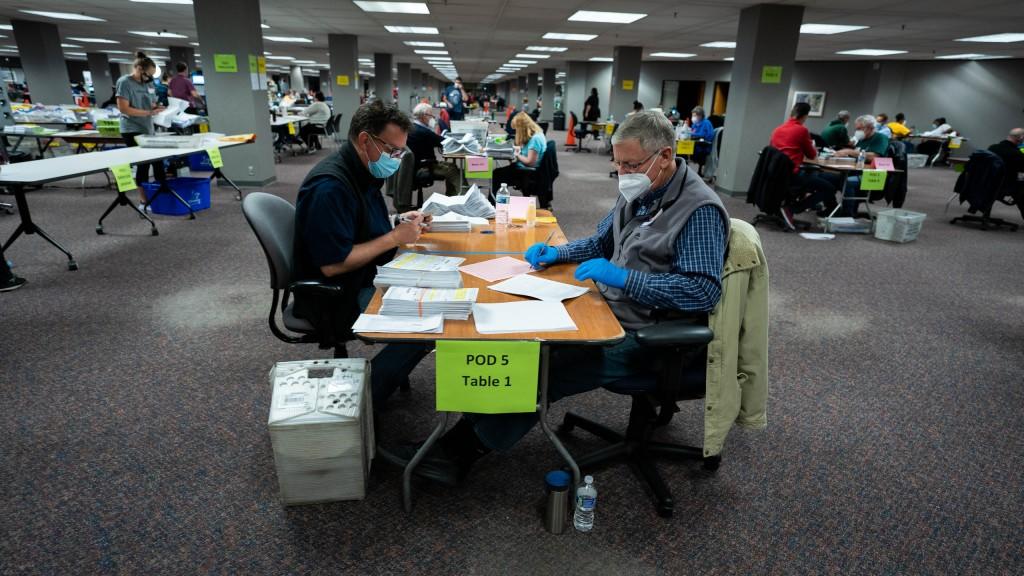
Using time series data ‘scraped’ from the New York Times website, the data – comparing several states (swing and non-swing) – clearly illustrates what fraud does and does not look like, and how several anomalies in swing states left ‘fingerprints of fraud’ as Biden pulled ahead of President Trump.
Presented below via @APhilosophae:
The following information is provided via an anonymous data scientist and another anonymous individual who wrote a script to scrape the national ballot counting time series data of off the @nytimes website.
— CulturalHusbandry (@APhilosophae) November 9, 2020
Continued…
This is based on their proprietary “Edison” data source which would ordinarily be impossible to access for people outside the press. The CSV is available here. And the script to generate it is here. I suggest that everyone back up both of these files, bc this is an extremely important data source, and we cant risk anyone taking it down.
What we are looking at will be time series analysis and you will see that it is extremely difficult to create convincing synthetic times series data. By looking at the times series logs of the ballot counting process for the entire country, we can very easily spot fraud.
One of the first things noticed while exploring the dataset is that there seems to be an obvious pattern in the ratio of new #Biden ballots to new #Trump ballots.
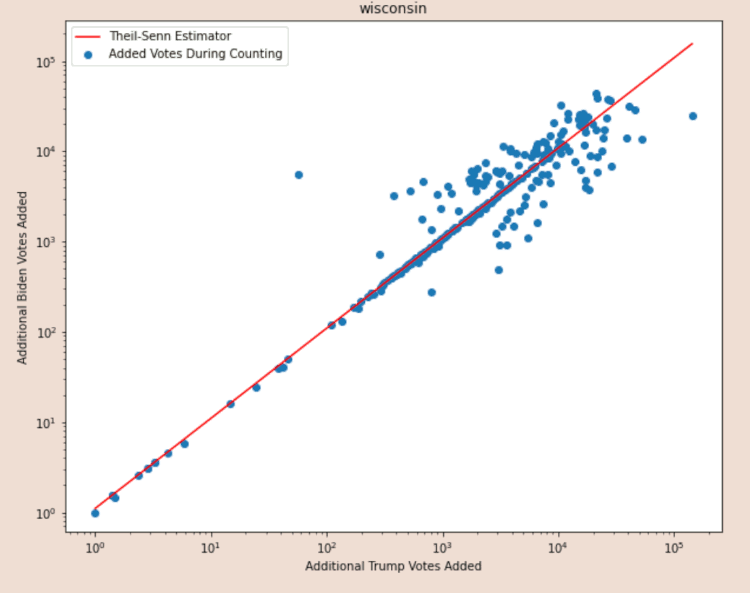
As we can see on this log-log plot, for many of the counting progress updates, we see an almost constant ratio of #Biden to #Trump. It’s such a regular pattern that we can actually fit a linear regression model to it with near-perfect accuracy, barring some outliers. How could this be possible? Is this a telltale sign of fraud? Surprisingly, as it will be shown, the answer is no! This is actually expected behavior. Also, we can use this weird pattern in the ballot counting to spot fraud!
Here is the same pattern for Florida. We see this linear pattern again.
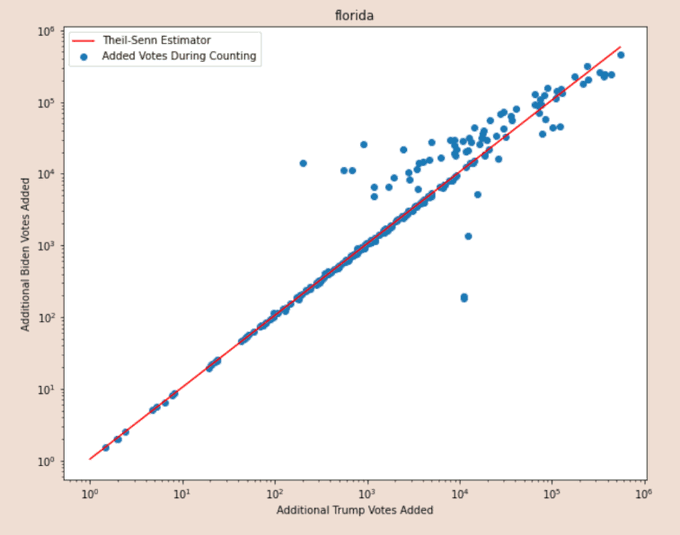
And again (Texas)
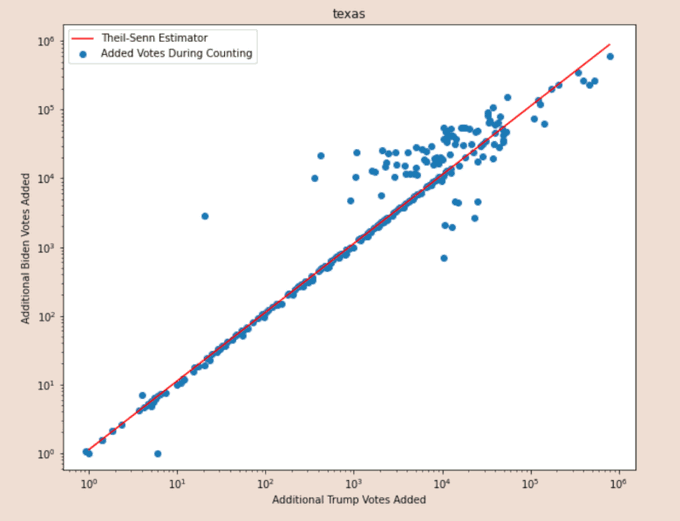
And again (South Dakota)
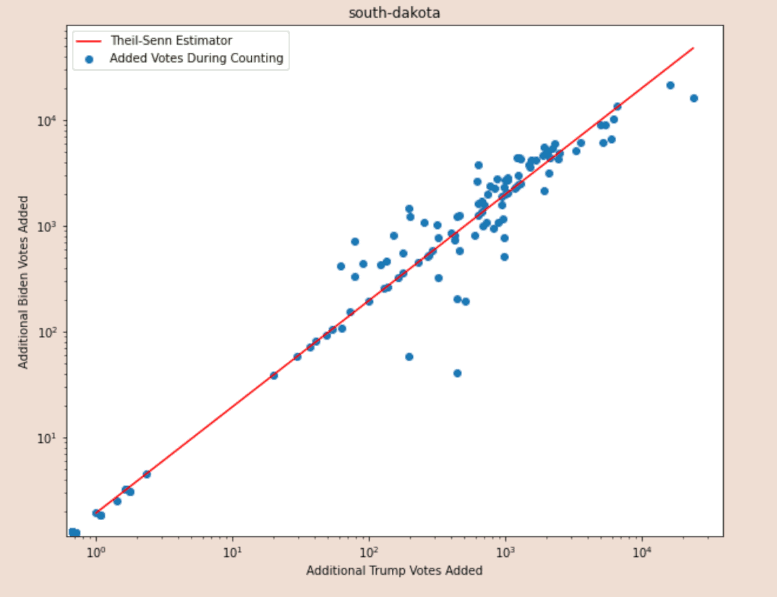
And again all over the country. What appears to be happening is that points on the straight line are actually mail in votes. The reason they’re so homogeneous across with respect to the ratio of #Biden vs #Trump votes is that they get randomly shuffled in the mail like a deck of cards. Since the ballots are randomly mixed together during transport, spanning areas occupied by multiple voting demographics, we can expect the ratio of mail-in #Biden ballots to mail-in #Trump ballots will remain relatively constant over time and across different reporting updates.
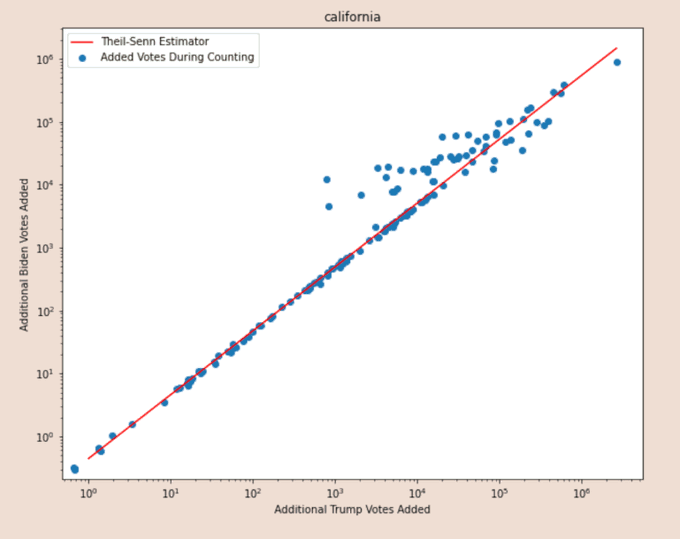
Lets dig a little deeper into this:
Here is a plot of the same Florida voting data, but this time it’s the ratio of #Biden to #Trump ballots, versus time. What we see is that the initial ballot reportings are very noisy and “random”.
The initial reporting represents in-person voting. These vote reports have such large variation bc in-person voting happens across different geographic areas that have different political alignments. We can see this same pattern of noisy in-person voting, followed by homogeneous mail-in reporting in almost all cases. What we see in almost all examples across the country is that the ratio of mail-in Dem to Rep ballots is very consistent across time, but with the notable drift from Dem to slightly more Rep.
This slight drift from D to R mail-ins occurs again and again, and is likely due to outlying rural areas having more R votes. These outlying areas take longer to ship their ballots to the polling centers.
Now we’re getting into the really good stuff. When we see mail-in ballot counting where there isn’t relatively stable ratios of D and R ballots that slightly drift R, we have an anomaly! Anomalies themselves are not necessarily fraud, but they can help us spot fraud more easily.
Now let’s look at some anomalies:
This is the Wisconsin vote counting history log. Again, on the Y axis we have the ratio of D to R ballots in reporting batch, and on the X axis we have reporting time. Around 4am there, there is a marked shift in the ratio of D to R mail-in ballots. Based on other posts in this thread, this should not happen. This is an anomaly, and while anomalies are not always fraud, often they may point to fraud.
Around 3am Wisconsin time, a fresh batch of 169k new absentee ballots arrived. They were supposed to stop accepting new ballots, but eh, whatever I guess.
— CulturalHusbandry (@APhilosophae) November 9, 2020
By 4am the D to R ratio was all thrown out of whack. That is because these ballots were not sampled from the real Wisconsin voter population, and they were not randomized in the mail sorting system with the other ballots. They inherently have a different D to R signature than the rest of the ballots quite possibly bc additional ballots were added to the batch, either through backdating or ballot manufacturing or software tampering. This of this being kind of analogous to carbon-14 dating, but for ballot batch authenticity.
Lets look at another anomaly (Pennsylvania):
Here is Pennsylvania’s vote counting history. For the first part of the vote counting process, we see the same pattern for mail-in ballots that we’ve seen in every other state in the country, which is relatively stable D to R ratio that gradually drifts R as more ballots. But then as counting continues, the D to R ratio in mail-in ballots inexplicably begin “increasing”. Again, this should not happen, and it is observed almost nowhere else in the country, because all of the ballots are randomly shuffled in the mail system and should be homogeneous during counting. The only exceptions to this are other suspect states that also have anomalies.
Again, this is evidence of ballot backdating, manufacturing of software tampering.
Lets look at another anomaly:
In Georgia we see pretty much the same story as Pennsylvania: increasing fractions of mail-in D ballots over time even though it defies logic and we see this pattern no where else in the country.
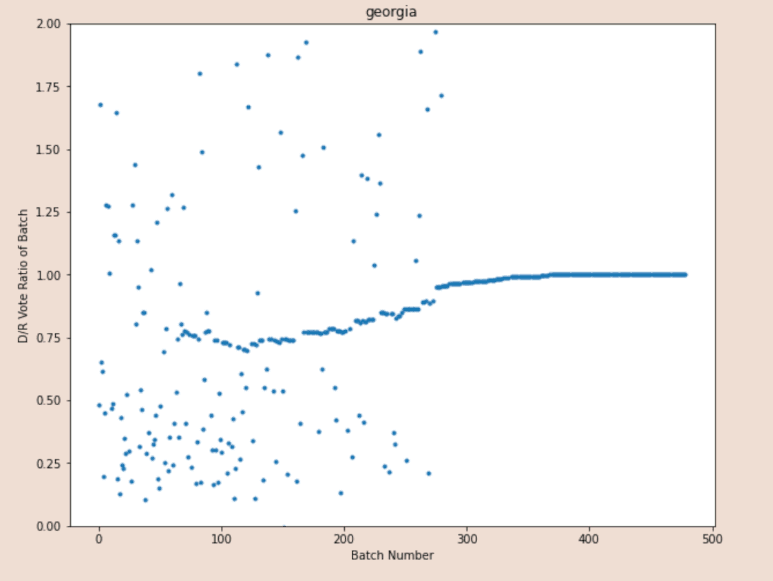
In Michigan, we see a combination of Wisconsin strangeness, together with the GA/PA weirdness. We see both signs of contaminated ballot dumping, and ballot ratios drifting toward dems when they should not be.
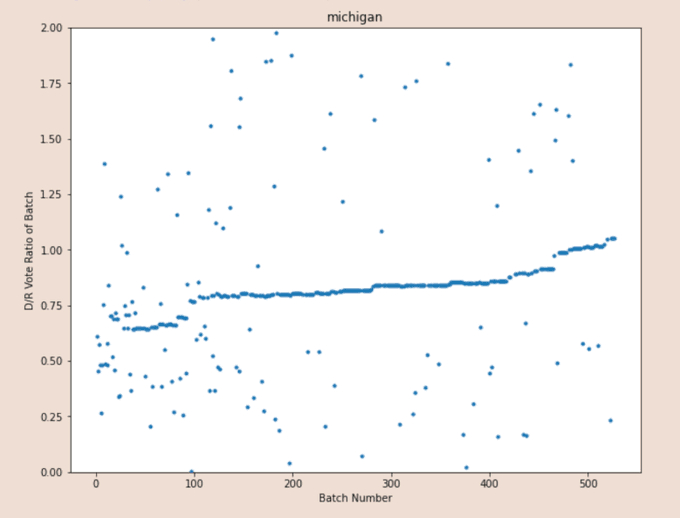
Virginia:
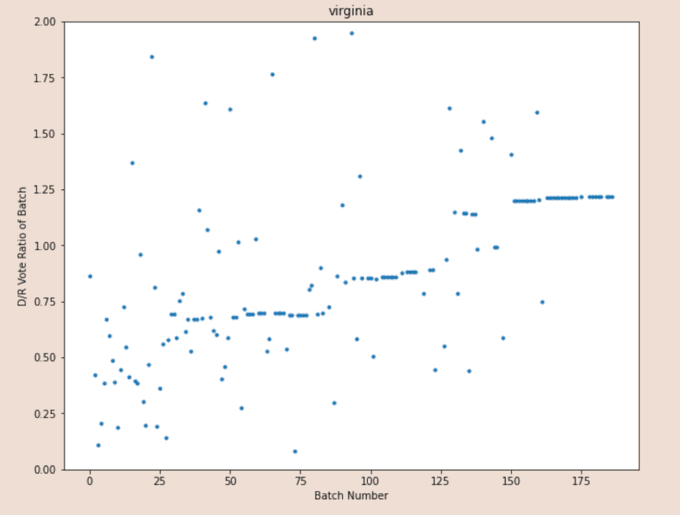
Now in fairness, VA is the only state out of the 50 that has anomalies but has not had accusations of voter fraud, yet. I think this is the exception that proves the rule. Yet to figure out what causes this anomalous shift, but here it is so no one accuses me of holding it back.
Lets wrap this up: It appears Dems shot themselves in the foot bc making everyone do mail-in ballots actually makes it easier to catch mail-in ballot fraud. Bc all of the ballots go through the postal system, they get shuffled like a deck of cards, so we expect reported ballot return to be extremely UNIFORM in terms of D vs R ratio, but to drift slightly towards R over time bc some of those ballots travel farther. This pattern proves fraud and is a verifiable timestamp of when each fraudulent action occurred.
Featured Video

Anthrax War – CBC The Passionate Eye
or go to
Aletho News Archives – Video-Images
Book Review
Shattered Dreams: The HPV Vaccine Exposed (2019)
By Christina England – 30 Q&As – Book Review & Summary
Lies are Unbekoming | September 4, 2026
… Gardasil received FDA fast-track approval in 2006, Cervarix followed in 2009, and Gardasil 9 was approved in December 2014 with more than double the aluminium adjuvant content of the original. The commercial context is specific. Merck was about to lose patent protection on Zocor and faced $18 billion in Vioxx injury claims from a cardiovascular drug the company had marketed while suppressing its own data showing a five-times increase in heart attacks. Analysts projected the global HPV vaccine market at $4 billion by 2011, contingent on government-funded national programs for teenage girls. The 1986 National Childhood Vaccine Injury Act had already granted manufacturers complete liability immunity. By 2013, Japan had withdrawn its HPV vaccine recommendation after cataloguing severe adverse reactions in hundreds of girls. No Western government followed. The establishment position across the UK, US, Australia, and most of Europe held, and still holds, that the vaccines are safe and effective, that reported injuries are coincidental, and that cervical cancer prevention justifies the program. The book was published into this position, not against a vacuum.
Shattered Dreams sits alongside Mary Holland’s The HPV Vaccine On Trial and Viera Scheibner’s foundational vaccination work as part of the documented record on what has been done to a generation of teenage girls under the banner of cancer prevention. The full summary unpacks three specific findings: that Merck used the aluminium adjuvant itself as the “placebo” control in 92.5% of trial subjects, making it structurally impossible to detect excess reactions from the adjuvant; that Dr. Sin Hang Lee found HPV DNA fragments bound to aluminium in every one of sixteen Gardasil samples tested, and in the blood and spleen of a New Zealand girl six months after her third dose; and that in every country with high vaccination coverage, including Australia, the UK, Norway, and Sweden, cervical cancer rates have stopped declining and started rising specifically in the vaccinated cohort. Martínez-Lavín’s 2017 calculation puts the number needed to seriously harm with Gardasil 9 at 140, and the number needed to vaccinate to prevent one case at 1,757. Thirteen young women are seriously harmed for every one who benefits. The vaccine was approved on the basis of trials that could not detect what the trials were supposed to detect, and it is still being given to twelve-year-olds today. … Read full review
Blog Roll
 Aletho News
- The Five-Year Fuel Crisis: Why the World Economy Is Paying for a War It Thinks Is Ending
- Trump’s Big Bluff on Iran
- Swiss scammed out of millions by Ukraine-linked call centers – media
- Germany facing potential ‘violent conflict’ with Russia – spy chief
- Ukraine’s EU neighbors reject new plea from Kiev – Politico
- British Transport Police Facial Recognition Trial Scanned 926,912 People With Zero Arrests
- House Bill Would Ban Federal Use of Flock ALPR Data
- Can a Spice Rival a Drug? 10 Head-to-Head Trials Put It to the Test.
- The oil routes around Hormuz face their own chokepoints
- The Saudi-Israeli war on Yemen’s resistance: Intelligence sharing, civilian targets & sectarian propaganda
- If Americans Knew
- “We See Our Homes Now From A Satellite, Like Strangers”
- Watch “Gaza: Doctors Under Attack”, originally censored by BBC
- NAZA: Israeli embassies in UK and US promote rival documentary to challenge Gaza genocide allegations
- David Ellison appoints Israeli to lead merged Paramount-Warner studios
- Turkish Red Crescent helps elderly Gaza man walk again after Israel confiscates his prosthetic limb
- Four Palestinians Killed in Israeli Attacks in Gaza
- Two Palestinian youths killed and village razed as Israeli attacks on West Bank continue
- Two more Christian women innocent victims of Gaza raids
- Cruelty, Deprivation, Indignity: A Journalist’s 22 Months in Israeli Prison
- New IDF Website Frames Slain Gaza Journalists as Terrorists
- No Tricks Zone
- Latest European Green Energy Debacle; Portugal’s Largest Flagship Solar Park Insolvent!
- Green Energy Debacle: German Expert Professor Fritz Vahrenholt Warns Of Severe Economic And Social Consequences
- Two More Paleo Reconstructions Affirm Meters-Higher Sea Levels Across Ireland, Brazil 7000-6000 Years Ago
- New Study: Earth And Venus Surface Warmth Largely Explained By Convection And Lapse Rate, Not CO2 Or Radiation
- 2025 Nature Paper Claiming Worsening Global Drought Gets RETRACTED …Heavily Flawed
- New Study: ‘Global Drought Shows No Detectable Recent Acceleration Under Climate Warming’
- Economic Masterminds: German Socialists Suggest Taxing Productivity Gains Stemming From Using AI
- The South China Sea Has Not Been Cooperating With The Climate Change Narrative
- Energy Crisis: Germany Enters Heating Season With Historically Low Gas Reserve Fill Levels
- New Study: The Antarctic Ice Sheet Gained Mass From 2020-2024 Due To Staggering Snow And Ice Accumulation

