Germany: Far-left extremist on trial for attempted murder wins state-sponsored €30,000 art prize

By Thomas Brooke | Remix News | April 15, 2025
Hanna Schiller, a German art student charged with attempted murder and membership of the notorious far-left “Hammer Gang,” has been awarded the 27th Federal Prize for Art Students — a prestigious state-sponsored honor carrying €30,000 in prize money and additional production support.
Schiller has been in pre-trial detention since May 2024 and has been formally charged for her role in violent assaults carried out by the Antifa-affiliated gang, including in Budapest, where the gang severely beat nine people they suspected of being right-wing back in 2023.
The indictment states Schiller and others pinned one of the victims down during the attack while others beat him unconscious with a baton, which prosecutors say could have resulted in death.
Despite these charges, Schiller was nominated by the Academy of Fine Arts Nuremberg, where she remains a registered student. The nomination came months after her arrest and appears to have been made in full knowledge of the legal proceedings.
The prize is ultimately awarded by the Federal Ministry of Education and the German Students’ Union after assessing nominations from respective institutions.
As reported by Tichys Einblick, the prize jury praised Schiller’s work for its “precise political images” and its focus on “structural violence and power,” referencing pieces made from women’s hair as examples of her exploration of contemporary sociopolitical issues. The official announcement made no mention of the charges or her imprisonment.
Academy officials have defended the nomination, citing a commitment to the principle of presumption of innocence. “The AdBK Nuremberg treats her like any other student until the verdict is announced,” the school said in a written response to inquiries.
The academy does, however, state in its mission statement that it is “for openness, tolerance and against any kind of extremism and violence.”
Still, critics say the award signals an unacceptable tolerance for violent extremism, pointing to Schiller’s alleged crimes, which include premeditated assaults using hammers and pepper spray. The gang’s targets were reportedly individuals believed to be right-wing, whom they ambushed and beat without warning. Prosecutors say Schiller was directly involved in restraining and attacking several victims during the assaults, one of whom received over 15 blows to the head.
Other members of the gang have already been convicted. Lina Engel was sentenced to five years and three months in prison by a Dresden court back in June 2023, while three of her associates received lesser sentences. Another member was sentenced to three years in a Hungarian prison the following January.
After years on the run, Johann Guntermann, the 31-year-old suspected head of the extremist group, was arrested by German police after being apprehended near Leipzig in November last year.
In addition to the €30,000 prize money, Schiller also received a scholarship of €18,000 to fund an art exhibition scheduled to open in November at the exhibition planned from November 2025 at the Bundeskunsthalle in Bonn.
Commenting on the news, Alternative for Germany (AfD) co-leader Alice Weidel claimed Schiller’s violent activism may have actually been a key reason for her receiving the award.
“Left-wing extremist Hanna S., allegedly part of the ‘Hammer Gang,’ receives a state-sponsored art prize worth 30,000 euros, possibly not despite, but precisely because of, her ‘activism.” No taxpayer money for violent left-wing extremism!” Weidel wrote on X.
With the trial ongoing in Munich, the Ministry of Education and the Nuremberg Academy have yet to revise their position or address the appropriateness of awarding a national prize to an individual currently facing charges for attempted murder and violent extremism.
It is unclear whether the prize and subsequent funds will be revoked pending a conviction.
Zelensky moves to delay election again
RT | April 15, 2025
Ukraine’s Vladimir Zelensky has submitted a bill to extend martial law in the country by another 90 days, which would rule out any chance of a new presidential election being held in the foreseeable future.
Zelensky – whose presidential term expired almost one year ago – has repeatedly cited martial law as a pretext for refusing to hold a new election. Russia has declared Zelensky “illegitimate” as a leader, insisting that the Ukrainian parliament remains the only legal authority in the country.
On Tuesday, Zelensky introduced draft legislation in the Ukrainian parliament proposing a three-month extension of martial law and general mobilization starting from May 9. According to Ukrainian law, elections cannot be held while martial law is in effect, meaning the presidential vote will remain suspended.
If martial law were lifted, parliamentary elections could be held within 60 days after the end of the restrictions, and presidential elections within 90 days.
The submitted bills are expected to be approved by parliament between April 15 and 18, Ukrainian MP Yaroslav Zheleznyak has said.
Zelensky’s potential run for reelection has been the subject of much media speculation, particularly after Steve Witkoff, US President Donald Trump’s special envoy to the Middle East and a key figure in negotiating a settlement of the Ukraine conflict, claimed in late March that “there will be elections” in the country, although without providing a timeline. His comments also came after Trump himself called Zelensky “a dictator without elections.”
A later report by The Economist claimed that Zelensky and his team were gearing up for a blitzkrieg election campaign to “catch [his] rivals off guard” and win the vote before the opposition could muster its strength.
However, Ukrainian officials have dismissed any plans to hold an election anytime soon. David Arakhamia, the head of Zelensky’s faction in the parliament, said that “all parliamentary parties and groups have agreed that elections should be held six months after the lifting of martial law.”
Russian Foreign Minister Sergey Lavrov has said that European NATO members are making every effort to make sure that Zelensky retains power. Even if he fails to do so, Kiev’s backers would seek to maintain “the same Nazi and overtly Russophobic regime” in Ukraine by installing a new “half-Fuhrer” in Zelensky’s stead, Lavrov stated.
Leaked files reveal the Steele Dossier was discredited in 2017 — but sold to the public anyway
By Kit KLARENBERG | MintPress News | April 8, 2025
On March 25, Donald Trump signed an executive order declassifying all documentation related to Crossfire Hurricane, the FBI’s 2016 investigation into alleged collusion between Russia and then-presidential candidate Donald Trump. The order has unexpectedly resurrected buried documents that cast new light on the Steele dossier — and when it was known to be false.
It is unclear what new information will be revealed, given substantial previous declassifications, two special counsel investigations, multiple congressional inquiries, several civil lawsuits, and a scathing Justice Department internal review. It has long been confirmed the FBI relied heavily on Steele’s discredited dossier to secure warrants against Trump aide Carter Page, despite grave internal concerns about its origins and reliability, and Steele’s sole “subsource” for all its lurid allegations openly admitted in interviews with the Bureau he could offer no corroboration for any of the dossier’s claims.
Such inconvenient facts and damning disclosures were nonetheless concealed from the public for several years following the dossier’s January 2017 publication by BuzzFeed News, now defunct. In the intervening time, it became the central component of the Russiagate narrative, a conspiracy theory that was a major rallying point for countless mainstream journalists, pundits, public figures, Western intelligence officials, and elected lawmakers. In the process, Steele attained mythological status. For example, NBC News dubbed the former MI6 operative “a real-life James Bond.”
Primetime news networks dedicated countless hours to the topic, while leading media outlets invested enormous time, energy and money into verifying the dossier’s claims without success. Undeterred, legacy reporters relied on a roster of mainstream “Russia experts,” including prominent British and U.S. military and intelligence veterans, and briefings from anonymous officials to reinforce Steele’s credibility and the likely veracity of his dossier. As award-winning investigative journalist Aaron Maté told MintPress News :
Media outlets served as unquestioning stenographers for Steele. If his dossier’s claims themselves weren’t sufficient to dismiss it with ridicule, another obvious marker should have set off alarms. Reading the dossier chronologically, a clear pattern emerges – many of its most explosive claims are influenced by contemporary media reporting. For instance, it was only after Wikileaks published the DNC emails in July 2016 that the dossier mentioned them. This is just one example demonstrating the dossier’s true sources were overactive imaginations and mainstream news outlets.”
Even more damningly, leaked documents reviewed by MintPress News reveal that while Western journalists were hard at work attempting to validate Steele’s dossier and elevating the MI6 spy to wholly undeserved pillars of probity, the now-defunct private investigations firm GPW Group was, in early 2017, secretly unearthing vast amounts of damaging material that fatally undermined the dossier’s content, and comprehensively dismantling Steele’s previously unimpeachable public persona. It remains speculative what impact the firm’s findings might have had if they had been released publicly at the time.
‘Financial Incentives’
“In order to build a profile of Christopher Steele… as well as the broader operations of both Orbis Business Intelligence and Fusion GPS,” which commissioned the dossier on behalf of Hillary Clinton’s presidential campaign and the Democratic National Committee, GPW consulted “a variety of sources.” This included “U.S. intelligence figures,” various journalists, “private intelligence subcontractors” who had previously worked with Steele and Orbis, and “contacts who knew the man from his time with [MI6]…and, in one instance, directly oversaw his work.”
The picture that emerged of Steele sharply contrasted with his mainstream portrayal as a “superstar.” One operative who “acted as Steele’s manager when he began working with [MI6] and later supervised him at two further points” described him as “average, middle of the road,” stating he had never “shined” in any of his postings. Another suggested Steele’s founding of Orbis “was the source of some incredulity” within MI6 due to his underwhelming professional history and perceived lack of “commercial nous.”
Yet another suggested Steele’s production of the dossier reflected his lack of “big picture judgment.” Sources consulted by GPW were even more critical of Fusion GPS chief Glenn Simpson. One journalist described him as a “hack” without “a license or the contacts to do… actual investigations,” instead outsourcing “all” work ostensibly conducted by his firm to others while skimming commissions. They also “openly admitted” to disliking Simpson, described by GPW as “not an uncommon attitude amongst those to whom we spoke.”
GPW also scrutinized “credibility and perceptions of the dossier in Russia,” specifically whether Steele‘s claims that high-ranking Kremlin-linked sources in Moscow provided him with information had any merit. The firm consulted “Western and Russian journalists, former officials from the FSB and the Russian security services more broadly, a former high-ranking official at the CIA who oversaw the agency’s Russian operations, and several private-sector intelligence practitioners operating in Moscow” for this purpose:
The prevailing sentiment from our contacts was one of extreme skepticism as to the accuracy of… the [dossier]. Most found it unimaginable… senior Russian officials would risk life imprisonment (or worse) by speaking to a former foreign intelligence official about such sensitive issues. At the very least… it would have cost Steele a great deal more… than he could afford… Former intelligence operatives (from both the U.S. and Russian services) seriously doubted Steele would have been able to retain Russian sources from his time in MI6.”
GPW also examined “possible sources for the dossier” that had been hypothesized in the media to date. Among them was former FSB General Oleg Erovinkin, who was found dead in his car in Moscow in December 2016. After the dossier’s release, the Daily Telegraph suggested his death was “mysterious” and could have resulted from providing information to Steele. A former high-ranking official in U.S. intelligence mockingly dismissed the proposition, noting that career security and intelligence officer Erovinkin was “unlikely to have needed the money.”
While conceding that financial incentives could encourage such a breach… [if] Steele had offered Erovinkin £100,000, the mooted budget for the entire project, ‘Erovinkin would have said he needed to see three more zeros before opening his mouth. It’s just a ridiculous proposition to think he would speak to a former intelligence officer from the UK, or anyone else for that matter, for such a paltry sum of money.’”
Overall, GPW concluded: “The quality and level of the sourcing was greatly exaggerated in order to give the dossier and its allegations more credibility.” This impression was reinforced by “informed sources from both government and the private sector” in Russia who were “very dismissive” of the dossier’s content. Many pointed to “woeful inaccuracies” contained therein “and its author’s general lack of understanding around Russian politics and business.” This “deficiency was particularly acute with respect to the dossier’s coverage of Alfa Bank.”
‘Reputational Damage’
GPW’s investigation also proved prescient in other areas. For example, several knowledgeable sources the company consulted — including former senior Russian and U.S. intelligence officials — suggested the dossier’s “most likely sources” were Russian émigrés, “providing… their own views.” They also noted the Steele dossier’s “hyperbole and inaccuracies” were “typical of the hyperactive imaginations of the subcontractors widely used in the business intelligence sector.” This was not confirmed until July 2020.
That month, the Senate Judiciary Committee released notes taken by FBI agents during February 2017 interviews with Igor Danchenko, Steele’s “subsource” and the dossier’s effective author. A Washington think tank journeyman jailed years earlier on multiple public intoxication and disorderly conduct charges and investigated by the FBI for potentially serving as a Kremlin agent, Danchenko admitted he had been fed much of the dossier’s salacious content by his Russian drinking buddies, who lacked any high-level access. Steele then embroidered their dud information further.
Other striking passages in the leaks refer to a conversation between GPW and “a source from within the business intelligence sector in London [who] knows Christopher Steele well, both socially and professionally, and is familiar with his company.” They relayed various details and “commentary” gleaned “directly from speaking to Steele.” For example, they noted that contrary to its self-description as a “leading corporate intelligence consultancy,” Orbis was “not a major operation” and seemed to employ just two junior analysts “who looked like recent graduates.”
The source revealed that “other, larger firms in the sector were approached before Steele and turned the work down before he took it on,” and the dossier was his solo project. “The rest of the company wasn’t involved at all, either to help on the research side of things or to look through the product before it went out,” and “Steele basically collated the information himself.” They further suggested the dossier’s sources let their imaginations run wild, believing their claims would never see the light of day:
I think they got carried away — they didn’t think the material would ever be made public because at that point it was very unlikely that Trump was going to get into power…Steele was rather naive about the whole thing. He didn’t think that it would get exposed in the way it did.”
In other investigative briefs, GPW noted it was unusual that “Steele would have permitted (or indeed facilitated) the distribution of such questionable material under his name,” given the dossier’s apparent falsity. The firm postulated that “in sharing the material with U.S. government figures,” the former MI6 operative “may have thought he was currying favor with them by doing so,” but ultimately, “he never intended for the dossier to be made public in the manner it was.”
One possible answer to this question is found in a defamation case brought against Orbis by Petr Aven, Mikhail Fridman, and German Khan in Britain in May 2018. In July 2020, a British court ruled that the dossier’s allegations against them and Alfa Bank were “inaccurate and misleading,” awarding damages “for the loss of autonomy, distress and reputational damage.” During the trial, Steele made a notable disclosure:
Fusion’s immediate client was law firm Perkins Coie… it engaged Fusion to obtain information necessary for Perkins Coie to provide legal advice on the potential impact of Russian involvement on the legal validity of the outcome of the 2016 U.S. Presidential election. Based on that advice, parties such as the Democratic National Committee and [“Hillary for America”] could consider steps they would be legally entitled to take to challenge the validity of the outcome of that election.”
In essence, the dossier was commissioned by Clinton’s campaign as a contingency in the event she lost the election. However, as GPW’s source close to Steele noted, when the MI6 operative took on the work, the prevailing perception was that “it was very unlikely” Trump would win. As a result, Steele may have had the motivation to fill the dossier with unverified material, believing it would never be used for its intended purpose. He also had a commercial incentive to exaggerate his high-level access. A serving CIA official told GPW:
Steele was known to have been ‘up and down the alley’ pitching for business – a reference to the major defense firms, such as Lockheed Martin, which are located close to one another in Arlington, Virginia. She did not know which firms Steele had worked for in particular, if any, but he has visited several of them in person at their headquarters.”
A core mystery at the heart of the Steele dossier saga has never been satisfactorily resolved — one that Trump’s latest declassification order could help illuminate. In his December 2019 report on Crossfire Hurricane, Justice Department Inspector General Michael Horowitz criticized the FBI’s use of the dossier to obtain warrants against Carter Page but insisted Steele’s assorted claims “played no role” in the bureau opening its investigation of Trump’s campaign, reportedly on July 31, 2016.
As extensively documented by Aaron Maté, this claim is difficult to reconcile with the numerous contacts and meetings between Steele and senior FBI and Justice Department officials in the weeks leading up to that date. The former MI6 officer provided material that would later comprise the dossier to senior U.S. government officials, including Victoria Nuland, prior to the official opening of Crossfire Hurricane. Nuland reportedly encouraged the bureau to investigate the contents.
According to the FBI’s electronic communications that initiated Crossfire Hurricane, the probe’s founding predicate was a vague tip provided to the bureau by Australian diplomat Alexander Downer. He claimed that low-level Trump campaign staffer George Papadopoulos had “suggested” to him over drinks in London that “the Trump team had received some kind of suggestion [emphasis added] from Russia that it could assist… with the anonymous release of information during the campaign that would be damaging” to Clinton. The EC further acknowledged that “It was unclear whether he or the Russians were referring to material acquired publicly or through other means. It was also unclear how Mr. Trump’s team reacted to the offer.”
As Maté told MintPress News, this was an “extraordinarily thin basis upon which to investigate an entire presidential campaign.” He added that “upon officially opening Crossfire Hurricane, FBI officials immediately took investigative steps that mirrored the claims in the Steele dossier, even though they were supposedly unaware of it.” The FBI’s first probes into individual Trump campaign figures — Carter Page, Michael Flynn, and Paul Manafort — began in August 2016. All are mentioned in the dossier. Maté concludes:
To accept the official timeline, one has to stipulate that the FBI investigated a Presidential campaign, and then a President, based on a low-level volunteer having ‘suggested’ Trump’s campaign had received ‘some kind of suggestion’ of assistance from Russia. One would also have to accept that the Bureau was not influenced by the far more detailed claims of direct Trump-Russia connections – an alleged conspiracy that would form the heart of the investigation – advanced in the widely-circulating Steele dossier.”
Here’s why the AfD is destined for the German government
By Tarik Cyril Amar | RT | April 12, 2025
Germany has an undeserved reputation for dour rationality and lacking an appreciation of the absurd. In reality, however, Germany is a – for want of nicer terms – very counterintuitive country.
If you are running a regime in Kiev (at least according to the official story) and blow up Germany’s vital energy infrastructure, Germans will say thank you and throw money and arms at you, while also helping you blame someone else (the Russians, of course: Germany has never been an imaginative country).
If you are in Washington and certainly had a hand in blowing up that infrastructure, and then go on to fleece the Germans by selling LNG at a high cost and promoting their deindustrialization by filching their companies, good Germans get very, very angry – at China.
If you happen to be the single most popular and perfectly legal political party in Germany, get ready to never be allowed to actually participate in governing. Because Germany is also a country in which that single most popular party – the Alternative for Germany (Alternative für Deutschland, commonly known simply as AfD) – is locked out of building governing coalitions. By definition.
That system is called a “firewall” – against that nasty most popular party that makes life so difficult for all those other, no longer popular parties. It has absolutely no basis in the constitution or in law.
Come to think of it, as the “firewall” systematically and deliberately treats the votes of AfD voters as somehow less effective than those of others, it may well be the “firewall” itself that is unconstitutional, at least in spirit if not even by the letter of the law. So much for Germany, the country that allegedly loves order and rules.
In reality, the “firewall” amounts to a dirty political cartel and a form of disenfranchisement: The traditional parties, feeling threatened by the insurgent AfD have simply decided that they do not care what the voters say and won’t have anything to do with it. Since German governments are virtually always based on coalitions, which means that the AfD and its voters are treated as inferior. That this means that, as of now, in particular voters in the former East Germany are subject to this kind of discrimination, adding a West-East aspect to it that sits very badly with talk about German unity.
To get one thing out of the way: For now, it is only one poll that shows the AfD in the lead; other polls still have it in (barely) second place after the mainstream conservatives of the CDU/CSU bloc (which, in reality, functions as one party) of soon-to-be chancellor Friedrich Merz. But these differences are irrelevant. What matters is that the AfD’s rising trend is unbroken. That is definitely a blow to Merz, even before he has officially assumed office, as international observers are noting. Especially in view of the fact that Merz’s own poll numbers are cratering at the same time.
Yet there is a broader point, too: The whole “firewall” strategy is malfunctioning extremely badly. Sensible observers have long predicted it, and now it is becoming ever more obvious: Freezing the AfD out only serves to make it stronger.
One thing that does not make Berlin’s ruling parties, the CDU and SPD, any more popular is that they have concluded their negotiations on how to divvy up the spoils of ministries and other goodies. Indeed, it is extremely embarrassing for the new governing coalition of conservatives and Social-Democrats (SPD) that the most recent AfD milestone breakthrough is happening now. It is a coincidence from hell: there they are, the traditional parties, seemingly safe behind their “firewall” and all ready to go, and the voters – uncouth as they can be – show them just how unpopular they are.
Germans expect little from them, even now: A fresh poll shows that two thirds do not believe that things will change under the new coalition of tired old parties.
Note that most Germans have been deeply unhappy with the status quo, as we also know from recent polls: In February, Ipsos found that the general mood was “as bad as never before.” Only 17 percent of citizens – less than a fifth – believed their country was “on a good trajectory.” The other 83 percent were not indifferent or neutral but felt Germany was on the “wrong” trajectory. Even for a nation with something of a culture of angst and doom, those are atrocious figures.
Hence, expecting no change now amounts to deep pessimism: Germans have felt for a while already that they are in dire trouble; and a preponderant majority thinks that that is where they will be stuck under new old management as well.
A senior AfD leader, Alexander Gauland, is already more than confident: “It’s a natural law that we’ll be ahead of the CDU at the next elections,” he recently declared. That may be jinxing it. The AfD is, after all, much less unlike other parties than the latter like to pretend: The AfD as well may end up squandering its current good luck with infighting, for instance, over how to react to US President Donald Trump’s tariff attacks, which will severely harm Germany.
Yet there is no doubt that the traditional parties are doing their utmost to repel not only voters but even their own members. In particular Merz’s CDU is in barely contained rebellion: its members and voters are fuming at having voted conservative and yet being saddled with a massive deficit spending program. The pretext that all of this is needed because of – drum roll – Big Bad Russia is not dampening down the anger.
One local CDU organization has already rebelled openly. In the state of Sachsen-Anhalt, formerly part of East Germany, CDU members from the Harz district have gone public with an official resolution making two points and one demand: There is “massive” unrest among the CDU’s base of ordinary party members, and in Germany’s “East,” that is, what used to be the former German Democratic Republic, the CDU has decisively lost the last federal elections. The demand is to tear down the so-called “firewall” against the AfD and start collaborating with it systematically. It is symptomatic that this very local rebellion is making news all over the country.
“What a scandal! Opening the gates to the far right!” many will scream. Yet they have it all upside down: Disregarding the fact that, in reality, the CDU/CSU conservatives and the AfD mostly see eye-to-eye ideologically, one day, in the not so far away future, the AfD may well enter and perhaps even dominate a German government. The irony is that when that happens, those who have upheld the, frankly, moronic “firewall” will have only themselves to blame. Because the real question is not if the AfD will enter government in Berlin but how and, in particular, how strong. The longer the “firewall” is kept up, the more likely the AfD will not just participate but dominate.
Tarik Cyril Amar, a historian from Germany working at Koç University, Istanbul, on Russia, Ukraine, and Eastern Europe, the history of World War II, the cultural Cold War, and the politics of memory
The end of La Grande illusion democratique
By Stephen Karganovic | Strategic Culture Foundation | April 11, 2025
Only the incurably naïve were shocked by the brazen and deliberate rigging of the French Presidential elections. Granted, the outrageous infringement of collective West’s verbally proclaimed democratic electoral canons in Romania, which took place shortly before, could have been taken by alert observers as a reliable signal of what might imminently occur in other precincts of the “European garden.” Blinded by cultural racism however some of them might have mistaken electoral rigging in Romania, a recently acquired patch of that garden, as a sui generis case, entirely attributable to Balkan primitivism. But they would have overlooked conveniently the now well established fact that instructions to corrupt Romanian bureaucrats to eliminate inconvenient candidate Georgescu did not emanate from Bucharest alone. We now know that they were issued imperatively from the idyllic Garden’s ideological centre, which is in Brussels.
Without diminishing, in the electoral disqualification and penal punishment of Marine Le Pen, the influence of the local French branch of the globalist cabal (it would be unpardonably incorrect to call that scum “elite”) there also the nefarious role of the nerve centre in Brussels must be stressed.
The arbitrary mechanism which allows the cabal to target virtually anybody it perceives as unsuitable or as a threat was laid bare by Croatian European Parliament deputy Mislav Kolakušić. The core charge pressed against Le Pen, let us recall, was of a basely pecuniary nature, namely that as an EU deputy she partially used her office employees in Strassbourg to do political work on behalf of her French political party, the Front National, improperly remunerating them with European Union funds. The outspoken EU parliamentarian Kolakušić knows of what he speaks because he was himself charged with this ghastly infraction, an accusation from which he managed to successfully defend himself only thanks to having kept meticulous records. It appears that acting with Gallic abandon Marine Le Pen or her office manager were not nearly as fastidious record keepers and they are now paying the political and penal price for the oversight.
What Kolakušić reveals about the inner workings of the system, based on his own experience and observation, is most unsettling and strongly suggests a deliberately built-in trap ready to be sprung on anyone who gets out of line. His remarks are in Croatian, but their gist is as follows. The way the European Parliament interprets its own rules, its officials are authorised to determine as they deem fit whether parliamentary deputies or their staff on any given day had worked a full eight hours as required on tasks exlusively related to matters pertaining to European Parliament affairs, or not. If not, there are unpleasant consequences that can be made to follow. That portion of salaries alleged to have been paid out from European funds for performing tasks deemed unrelated to European Parliament work is refundable on demand, as subjectively assessed by investigators who are empowered to act with arbitrary discretion. But that is the least of it. More ominously, the arbitrariness extends to the determination of how the matter shall be treated. It could be considered a harmless lapse curable with a reprimand and a refund. But if the powers that be take a particularly dim view of the alleged malefactor, it could also be treated as an act of moral turpitude, having been committed with the element of mens rea, which creates grounds for the imputation of criminal liability. It is by opting for the latter interpretation, of course, that with the helpful assistance of the French judiciary (that some naive folks had thought to be so incorruptible) that they got Marine Le Pen.
“Such a procedure,“ Kolakušić explains further, “is unprecedented anywhere else in the world or in any other parliament, but it is a perfect weapon for settling accounts with dissidents, be they of the so-called extreme right or extreme left, or independent parliamentarians, which is to say the only members of the European Parliament who think using their own brains and who formulate their own original positions on major issues.“
Before over-sentimentalising the plight of Madame Le Pen and showering her with excessive sympathy, some of which she undoubtedly deserves but not uncritically and always in prudent measure, her own responsibility for the situation she faces should be honestly confronted. At some point she made a conscious decision to play ball with the cabal that is now persecuting her. In order to try to accomodate them she went as far as reneging on her filial duties and renouncing her father, Jean-Marie Le Pen, the founder of the political party she now heads, which she virtuously relabelled from Front National to Rassemblement national in an attempt to make it more palatable and sound less “extremist“ to her enemies. She then went on to ease her father’s associates out of the picture and replace them with a more “modern“ and “progressive“ crew, with the same goal in mind of ingratiating and reinventing herself as a “mainstream“ political actor (or actress, if you wish). Needless to say, she presided also over an ideological shift in her party’s political orientation which, whilst remaining verbally committed to sovereignism and the promotion of French national interests, conspicuously lost the sharp edge that previously had made it distinctive in the French political landscape.
And now, with the Presidency of France within her grasp, the French people having become utterly disgusted with the alien cabal that is running their country into the ground and ready to vote for her, what has Marine Le Pen got to show for her accomodations? She can boast a multimillion euro fine, a four year prison sentence, half of it suspended but the other half very much in effect, and a five-year ban on political activity, crashing her dream of becoming President of France for a long time, and more likely forever.
Madame Le Pen has now learned the hard way a painful lesson that Russians also have had to grasp gradually and at considerable cost to themselves. It is that the cabal are недоговороспособныe, or in plain English “not agreement capable.” All attempts to curry favour with them are futile. They have their trusted agents, “Mr. and Mr. Macron” being prime examples, whom they cultivate to do their bidding. No substitutes are solicited or accepted from the ranks of the profane, no matter how hard and long the newcomers have laboured to ingratiate themselves.
The massive outpouring of anger by the disenfranchised French people, who are rightfully furious at being deprived of the opportunity to vote for the candidate of their choice, may be of some consolation to Marine Le Pen, just as similar expressions of popular anger that have been going on in Romania for weeks may assuage the wounded feelings of Calin Georgescu, but will otherwise have no palpable effect.
Madame Le Pen may waste her time appealing the French court’s scandalous decision if she so wishes. She may publicly fume and denounce her persecutors to her heart’s content. (Humiliatingly, the video recording of one of her scathing denunciations, where she delusionally likens her electoral disqualification to a “nuclear bomb,” was removed from YouTube shortly after being posted, as can be verified by clicking on the hyperlink above.) But it is unlikely that any sort of commotion in the streets will produce significant changes in the dispensation that has from on high been decreed, either in France or in Romania.
Instead of wasting her time in the courts, which are as rigged as the electoral system, Marine Le Pen could perhaps have some fun and play a little game with her tormentors. Our advice to her is to pull a Perón stunt and delegate her super smart and photogenic niece Marion Maréchal Le Pen, an EU Parliament deputy and political figure in her own right, to take up the Le Pen mantle and with the blessing of aunt Marine run for President of France in 2027. It may be recalled that in the 1970s Juan Perón was in exile and similarly disqualified in Argentina to run for political office. He outwitted his opponents by designating Hector Cámpora to run on the Peronist party ticket in his stead. Cámpora won, annulled the impediments blocking Perón’s return to power and resigned in Perón’s favour. Surely Marion could do the same for aunt Marine.
Will Marine Le Pen have the creativity to step out of the box and twist the lion’s tail just a bit? We will soon find out.
US-Funded “Anti-Misinformation” Groups Are Still Quietly Active
By Didi Rankovic | Reclaim The Net | April 9, 2025
Despite the big and open push that came in with the new US administration to end the practice of the government funding third-party groups to effectively act as its censorship proxies – some of these arrangements continue to be operational.
Most appear to be working to strengthen previously established “preferred” narratives around health issues – as ever, with “combating misinformation” given as the declarative, overarching purpose behind the effort.
But critics say, that was/remains a smokescreen meant to manipulate public opinion.
The Federalist reports that the National Science Foundation (NSF) – one of the US government’s “independent agencies” designed to channel federal funds – had a number of programs under its “anti-misinformation” umbrella, the Convergence Accelerator.
Among the ones who continue to this day are Chime In, Analysis and Response Toolkit for Trust (ARTT), and Expert Voices Together (EVT).
Chime In’s original name was Course Correct. It was set up at the University of Wisconsin-Madison – with $5 million coming from NSF in 2022 – to provide “anti-misinformation” resources for journalists.
True to the era, its original “mission” was to persuade (Covid) vaccine skeptics to take the jab; and then it went into advocating (“misinformation detecting”) in favor of persuading people there was no reason to be skeptical about genetically modified (GMO) foods, Covid narratives, and vaccines in general, as well as issues like sunscreen product and raw milk safety.
ARTT, meanwhile, came up with its own “AI” chatbot, that focused on political discourse, but according to the Federalist, once again, heavily tied to vaccine hesitancy.
From 2021, ARTT received close to $750,000 from the NSF, and a further $5 million, “to develop practical interventions to build trust and address vaccine hesitancy.”
Another controversial tie-in concerning ARTT was the organization’s plans to partner with, among others, the Children’s Hospital of Philadelphia, which the article describes as being “infamous for performing transgender surgeries on, and administering opposite-sex hormones to minors.”
ARTT – now operating as Discourse Labs, a non-profit – was, while one of the groups incubated by NSF’s Convergence Accelerator, backed up by the World Economic Forum (WEF), Wikimedia Foundation, Google, Mozilla, and Meta.
EVT’s “new home” as of 2025 is “the leftist group Right To Be,” the report says.
Some of the issues covered by this group are named, “Bystander Intervention To Support The LGBTQIA+ Community,” “Conflict De-Escalation In Protest Spaces,” and “Bystander Intervention To Stop Police Sponsored Violence and Anti-Black Racism.”
But the Federalist reported earlier that, “a representative from Right To Be” previously told the site EVT “remains under the direction of George Washington University (and) direct inquiries there.”
Bitchute shuts down in UK because of Online Safety Act
To our valued users in the United Kingdom
After careful review and ongoing evaluation of the regulatory landscape in the United Kingdom, we regret to inform you that BitChute will be discontinuing its video sharing service for UK residents.
The introduction of the UK Online Safety Act of 2023 has brought about significant changes in the regulatory framework governing online content and community interactions. Notably, the Act contains sweeping provisions and onerous corrective measures with respect to content moderation and enforcement. In particular, the broad enforcement powers granted to the regulator of communication services, Ofcom, have raised concerns regarding the open-ended and unpredictable nature of regulatory compliance for our platform.
The BitChute platform has always operated on principles of freedom of speech, expression and association, and strived to foster an open and inclusive environment for content creators and audiences alike. However, the evolving regulatory pressures—including strict enforcement mechanisms and potential liabilities—have created an operational landscape in which continuing to serve the UK market exposes our company to unacceptable legal and compliance risks. Despite our best efforts to navigate these challenges, the uncertainty surrounding the OSA’s enforcement by Ofcom and its far-reaching implications leaves us no viable alternative but to cease normal operations in the UK.
Therefore, effective immediately, BitChute platform users in the UK will no longer be able to view content produced by any other BitChute user. Because the OSA’s primary concern is that members of the public will view content deemed unsafe, however, we will permit UK BitChute users to continue to post content. The significant change will be that this UK user-posted content will not be viewable by any other UK user, but will be visible to other users outside of the UK. Users outside the UK may comment on that content, which the creator will continue to be able to read, delete, block, reply and flag. Users outside the UK may share UK-user produced content to other users outside of the UK as normal. In other words, for users in the UK, including content creators, the BitChute platform is no longer a user-to-UK user video sharing service.
We deeply regret the inconvenience and disappointment this decision may cause to our UK users and partners. This decision was not taken lightly. It reflects our commitment to maintaining the highest standards of compliance, protecting our community, and ensuring that our platform remains a safe and sustainable space for creative expression globally. We recognize the value of our UK community and extend our sincerest apologies for the disruption caused by this necessary step. Our support team remains available to answer any queries or concerns regarding this transition.
We appreciate the support and engagement of our community around the world and remain dedicated to providing a platform that champions free expression and innovative content sharing in an environment of regulatory certainty.
Thank you for your understanding.
Marine Le Pen on trial while corrupt Ursula von der Leyen protected
By Ahmed Adel | April 10, 2025
Although European Commission President Ursula von der Leyen should be in prison for the Pfizergate scandal, not to mention inciting war crimes in Ukraine and the Gaza Strip, nothing will come of it as Brussels is evidently corrupt. However, following the verdict handed down to right-wing French National Rally party leader Marine Le Pen, the question arises as to why Ursula von der Leyen has not been indicted for the Pfizergate scandal, which is worth several billion euros.
Le Pen has been sentenced to four years in prison, fined 100,000 euros, and banned from running in the 2027 presidential election. She was convicted of corruption, having allegedly embezzled 2.9 million euros from European Parliament funds. Nonetheless, no one cares whether Marine Le Pen will actually be in prison or not. What matters is that she is banned from political activity and that a coup is carried out against the National Assembly at a time when the ruling paradigm is in crisis.
The case against the former French presidential candidate is not the first instance of a political process canceling unsuitable politicians in the EU, nor is it a precedent, as seen in the ban on Călin Georgescu’s candidacy, where it is clear that the European Commission undermined democracy in Romania.
It is also recalled that in 1999 and 2000, when the right-wing Austrian Freedom Party won 27 percent of the vote in the elections, its then-leader, Jörg Haider, was supposed to be the prime minister. However, Brussels completely isolated Austria, and it ended with Haider giving up, even resigning from the party leadership, and eight years later, he died in a suspicious car accident.
Therefore, the ban on political activity by politicians unsuitable for Brussels is not a surprise, as the EU has never been distinguished by its democratic character, which is why it has often been advertised as “the greatest peace project.” The EU has long had a European Commission composed of unelected bureaucrats, which is why Ursula von der Leyen, as an unelected politician from Germany, has often been perceived as acting like the de facto leader of Europe, or one of two, alongside French President Emmanuel Macron.
EU elites support all authoritarians on the continent that suit their interests, such as Ukrainian President Volodymyr Zelensky and Moldovan President Maia Sandu, and even on Europe’s periphery, such as Syria’s self-designated president, Ahmed al-Sharaa, regardless of the fact that he committed genocide against Alawites and Christians last month.
Corruption is also an integral part of EU structures. It would not be so significant if it were not accompanied by political action. This is exemplified by the fact that liberal Ursula von der Leyen escapes prosecution for Pfizergate, while right-wing Marine Le Pen is imprisoned.
During the COVID-19 pandemic, von der Leyen made a deal with Albert Bourla, the CEO of US pharmaceutical giant Pfizer, to purchase 1.8 billion doses of untested COVID-19 vaccines, valued at approximately $37.6 billion. Von der Leyen negotiated this deal through a series of text messages that she eventually deleted — supposedly by mistake — along with those she exchanged with her husband, Heiko, a medical director at a biotech company with ties to Pfizer. As a result, von der Leyen was accused of corruption and “abuse of power.”
Even before becoming European Commission president, at the end of her term as Germany’s Defense Minister (2013-2019), von der Leyen became the target of an investigation by the Federal Audit Office for continually awarding lucrative contracts to external consulting firms. In its 2018 report, the Federal Audit Office questioned the awarding procedures of some of these contracts, worth millions of euros, which appeared to have been made without proper cost assessment or a proper tendering process.
Although this may seem like incompetence at first, the American consulting firm McKinsey, for example, attracted attention when its Berlin office hired the daughter of von der Leyen. The firm eventually won contracts worth millions of euros.
While von der Leyen is protected from prosecution by German and European Union authorities, Le Pen is being prosecuted because she does not conform to the liberal values of Brussels and is described as far-right.
US President Donald Trump even demanded on April 4 for Le Pen to be freed and allowed to run for office, calling her ban a “witch hunt.”
On Truth Social, he described the court case as “another example of European Leftists using Lawfare to silence Free Speech and censor their Political Opponent, this time going so far as to put that Opponent in prison.”
Trump added that it is “all so bad for France and the Great French People”, before ending his post with “FREE MARINE LE PEN!”
In this way, while von der Leyen is protected, Le Pen is being prosecuted on allegations stemming from her time in the European Parliament that are not yet fully substantiated, all because she threatens the rule of Macron, a loyal servant of Europe’s elites.
Ahmed Adel is a Cairo-based geopolitics and political economy researcher.
Max Blumenthal: Banning Protests Against Israel
Glenn Diesen | April 9, 2025
The editor-in-chief of The Grayzone, Max Blumenthal is an award-winning journalist and the author of several books, including best-selling Republican Gomorrah, Goliath, The Fifty One Day War, and The Management of Savagery. He has produced print articles for an array of publications, many video reports, and several documentaries, including Killing Gaza.
Follow Prof. Glenn Diesen: Substack: https://glenndiesen.substack.com/
12,000 Brits arrested per year over social media posts – Times
RT | April 7, 2025
Thousands of people in the UK have been detained and questioned by police over online posts deemed threatening or offensive, The Times has reported, citing custody data.
According to figures published on Friday, officers make around 12,000 arrests annually under Section 127 of the Communications Act 2003 and Section 1 of the Malicious Communications Act 1988. These laws criminalize causing distress by sending messages that are “grossly offensive,” or by sharing content of an “indecent, obscene or menacing character” via electronic communications networks.
In 2023 alone, officers from 37 police forces made 12,183 arrests – around 33 per day. The Times said this marks a 58% increase from 2019, when 7,734 arrests were recorded.
At the same time, government data shows that convictions and sentencings have dropped by nearly a half. While some cases were resolved through out-of-court settlements, the most commonly cited reason was “evidential difficulties,” particularly when victims declined to proceed.
The statistics have sparked public outcry, with civil liberties groups accusing the authorities of overpolicing the internet and undermining free speech through the use of “vague” communications laws.
The Times highlighted the case of Maxie Allen and Rosalind Levine, who were arrested on January 29 after raising concerns in a private parents’ WhatsApp group about the hiring process of their daughter’s school. Six uniformed officers arrived at their home, detained them in front of their youngest child, and took them to a police station.
The couple was questioned on suspicion of harassment, malicious communications, and causing a nuisance on school property after the school alleged they had “cast aspersions” about the chair of governors. They were fingerprinted, searched, and locked in a cell for eight hours.
“It was hard to shake off the sense that I was living in a police state,” Allen told the Daily Mail, adding that the messages contained “no offensive language or threat” but were simply a “bit sarcastic.”
Le Pen’s verdict exposes Western Europe’s dangerous trend
The EU’s repression is backfiring spectacularly
By Vitaly Ryumshin | Gazeta.ru | April 4, 2025
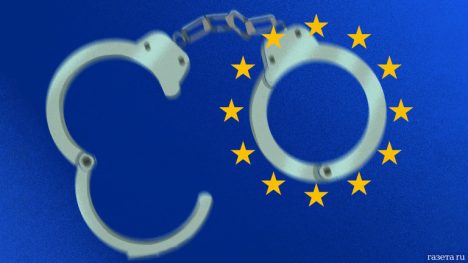
What’s happening in Western Europe is increasingly raising uncomfortable questions. On March 31, a French court found Marine Le Pen guilty in the so-called “fictitious aides” case, sentencing her to four years in prison and banning her from running for office for five years. Remarkably, the ban took effect immediately, without even waiting for an appeal.
The court’s decision has proved highly controversial, and not only among Russians, who typically see Le Pen as part of Europe’s Moscow-friendly political forces. Even French political figures have expressed bewilderment. Given Le Pen’s position as the frontrunner in the 2027 presidential elections, her conviction has undeniably taken on political dimensions. Some French politicians have already called upon President Emmanuel Macron to pardon Le Pen in order to preserve the face of the country’s “democracy.” Prime Minister François Bayrou reportedly expressed alarm, admitting privately to aides, “France is the only country that does this.”
But Bayrou is mistaken in believing France stands alone. Suppressing opposition figures through tactics reminiscent of hybrid autocracies is becoming the latest trend in EU states. Recently, Romania spectacularly canceled the first round of its presidential election, later jailing Calin Georgescu, the leading candidate.
Germany seems likely to follow suit. The emerging coalition government between the CDU/CSU and SPD is drafting legislation that could bar anyone convicted of “incitement to hatred” from political activity. Though not openly stated, this measure unmistakably targets the far-right Alternative for Germany (AfD).
The reason behind this crackdown lies deeper than any immediate legal disputes. Far-right parties across the bloc have increasingly challenged the European integration project itself. These political forces have openly called for slowing down or completely dismantling the EU in favor of returning to traditional nation-state structures. While some of these right-wing parties, including Le Pen’s National Rally and Germany’s AfD, have moved toward the political center in order to broaden their appeal, their reputation as “destroyers of Europe’s garden” remains entrenched.
Western European bureaucrats and established national elites are deeply unsettled by the growing popularity of these parties. Having benefited tremendously from the EU’s expansion and centralization for over three decades, they are unwilling to surrender their privileged positions without a fight. It’s as if they feel the ground shifting beneath their feet and will do anything necessary to preserve their status quo.
Yet here lies the paradox: the more the EU establishment struggles to remain in power through repressive measures, the quicker its authority and legitimacy erode. The bloc’s foundational identity rests on liberal democratic ideals, institutional sanctity, and the rule of law. When Brussels arbitrarily removes opposition candidates, it saws off the very branch upon which its entire elite sits.
The surge of Europe’s far right has not emerged in a vacuum. Its popularity directly stems from the existing EU leadership’s chronic inefficiency and inability to respond adequately to today’s challenges. Attempting to remove right-wing politicians from the playing field is not a solution. Discontented voters will inevitably find alternative ways to express their frustrations – likely even more fiercely once their grievances are compounded by deep mistrust of the political establishment.
Romania’s recent experience provides a vivid example. After the scandal involving the canceled election, Calin Georgescu’s popularity surged dramatically – from 23% to 40%. Once Georgescu was banned from running, voters swiftly pivoted to another far-right candidate, George-Nicolae Simion, who is now leading the race. This scenario seems almost comical, but could soon be replicated across France, Germany, and other EU states where authorities are excessively targeting opposition figures.
Western European leaders appear somewhat aware they’re playing a dangerous game. However, their conclusions and reactions to this crisis remain fundamentally flawed. EU bureaucrats try to unify the continent by exploiting citizens’ fears – fear of global instability, fear of military threats, fear of economic chaos. Their agendas emphasize support for Ukraine, joint military initiatives, and endless symbolic summits. Billions of euros are readily allocated to armament and defense.
Yet none of these actions address the real issues underlying the bloc’s deepening political divisions – economic stagnation, deteriorating living standards, mass immigration challenges, and declining trust in traditional governance structures. The EU’s refusal or inability to tackle these fundamental problems continues to fuel voter disillusionment.
Ultimately, the more the EU establishment clings desperately to power through authoritarian methods, the faster its cherished structures crumble. Until Western Europe’s leaders face reality and address genuine citizen concerns, this spiral of distrust and repression will only accelerate, making the EU’s future increasingly uncertain.
This article was first published by the online newspaper Gazeta.ru and was translated and edited by the RT team
Featured Video

Trita Parsi: Middle East Unraveling — Are We on the Path to World War?
or go to
Aletho News Archives – Video-Images
New Book
Trans agenda is ‘normalization of sadism’ – US author

RT | September 23, 2026
The US Democratic Party has embraced a transgender agenda that amounts to “the normalization of sadism,” author A.J. Rice has said, warning that radical trans policies would return if the party is allowed to regain power.
Speaking to RT’s America First host Scotty Nell Hughes about his new book, ‘The Curse of the Bearded Lady: How the Trans Mafia Whacked American Sanity’, Rice argued that activists have gained significant influence in schools, medicine, and corporate America while people who questioned the agenda have faced pressure to stay silent.
The author described the “trans mafia” as the sprawling network of people and institutions that have helped the movement gain influence. He singled out parts of academia, wealthy backers, and corporations, and stated that providers of transition-related treatment also have a financial incentive to keep young people in their care indefinitely.
Rice argued that the consequences of these policies ultimately fall on children who are being drawn toward gender-affirming medical treatments and on girls who are expected to share locker rooms or compete in sports with biological males.
He noted that while voters rejected the Democrats’ approach to gender in 2024, the party, which has been “captured by madness,” has since only doubled down and is seeking what is effectively “the normalization of sadism.” … Full report
Blog Roll
 Aletho News
- ‘We don’t seek permission to defend our country’: Snippets from President Pezeshkian’s UNGA address
- NATO chief wants Europeans to fight American wars [for Israel]
- German chemicals giant reveals details of downsizing
- Refaat Al-Areer Was The Canary In The Coal Mine In Israel’s War On The Truth
- Israeli election committee bars candidate from Knesset race over Gaza war opposition
- French-Lebanese man files war crimes complaint over Israeli attacks
- Mahan Air Flight Lands in China Despite US Threat against Iranian Airlines
- US eyes $10bn fund to rebuild war-battered Gulf infrastructure
- Trump meets Rodríguez near Maduro’s prison as Venezuela’s oil flows to US
- Trita Parsi: Middle East Unraveling — Are We on the Path to World War?
- If Americans Knew
- An error has occurred; the feed is probably down. Try again later.
- No Tricks Zone
- New Study: Earth And Venus Surface Warmth Largely Explained By Convection And Lapse Rate, Not CO2 Or Radiation
- 2025 Nature Paper Claiming Worsening Global Drought Gets RETRACTED …Heavily Flawed
- New Study: ‘Global Drought Shows No Detectable Recent Acceleration Under Climate Warming’
- Economic Masterminds: German Socialists Suggest Taxing Productivity Gains Stemming From Using AI
- The South China Sea Has Not Been Cooperating With The Climate Change Narrative
- Energy Crisis: Germany Enters Heating Season With Historically Low Gas Reserve Fill Levels
- New Study: The Antarctic Ice Sheet Gained Mass From 2020-2024 Due To Staggering Snow And Ice Accumulation
- Study: Ocean Heating Rates From Thousands Of Years Ago ‘Dwarf’ Modern Ocean Heating Rates
- Climate Extremists Target, Attack Large-Scale Power Grid Infrastructure In Germany!
- New Study: Antarctic Ice Melt Has Contributed Less Than 1 Centimeter To Sea Level Rise In The Last 30 Years

