Will Hillary Clinton Get Favored Treatment?
By Ray McGovern | Consortium News | June 6, 2016
Former Secretary of State Hillary Clinton is in a legal pickle over her careless email practices – in that she appears to have endangered national security secrets including the identity of covert CIA officers and done so for selfish reasons (personal convenience or keeping her documents out of reach of transparency laws).
The facts of the case would seem to merit criminal charges against her, since Clinton’s situation is analogous to problems faced by other senior officials, including former CIA directors John Deutch and David Petraeus who were accused of mishandling classified information, Deutch by having secret material on his home computer and Petraeus for giving notebooks with highly sensitive information to his lover/biographer.
Deutch agreed to plead guilty to a misdemeanor but was preemptively pardoned by President Bill Clinton; Petraeus pled guilty to a misdemeanor in a plea deal that spared him from jail time and was widely criticized as excessively lenient, especially since the Obama administration had jailed lower-level officials, such as former CIA officer John Kiriakou, for similar violations.
In 2012, faced with a multiple count indictment, Kiriakou agreed to plead guilty to one count of violating the 1982 Intelligence Identities Protection Act for giving a reporter the phone number of a former CIA officer whose work for the spy agency was still classified. Though the reporter did not publish the ex-officer’s name, Kiriakou was sentenced to 30 months in prison.
The Intelligence Identities Protection Act was also a factor in the “Plame-gate affair” in 2003 when officials of George W. Bush’s administration disclosed the CIA identity of Valerie Plame as part of a campaign to discredit her husband, former U.S. Ambassador Joseph Wilson, who had challenged Bush’s claims about Iraq seeking yellowcake uranium for a nuclear program, one of the falsehoods that was used to justify invading Iraq.
Right-wing columnist Robert Novak blew Plame’s undercover identity but a special prosecutor chose not to indict anyone, including Bush’s aides, under the 1982 law. He did, however, convict Vice President Dick Cheney’s chief of staff, I. Lewis Libby, of obstructing justice. However, Bush commuted Libby’s sentence so he avoided jail time.
The recent State Department Inspector General report makes clear that Clinton blithely disregarded safeguards designed to protect the most highly classified national security information and that she included on her unprotected email server the names of U.S. intelligence agents under cover.
In other words, there is legal precedent for Hillary Clinton to be charged in connection with her decision to handle her State Department emails through a personal server in her home in Chappaqua, New York, rather than through official government servers. But there’s political precedent as well for the well-connected to be either slapped on the wrist or let off the hook.
A Biblical Warning
Beyond Clinton’s legal predicament over secrets, there is also the question of how she manipulates information on small matters as well as big. There’s a pertinent Bible quotation: “If you are faithful in little things, you will be faithful in large ones. But if you are dishonest in little things, you won’t be honest with greater responsibilities.” (Luke 16:10)
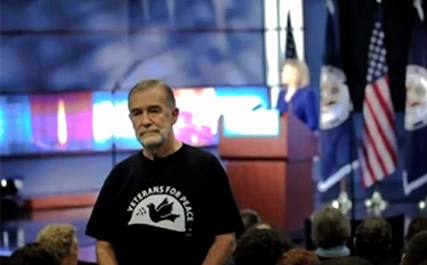
Ray McGovern standing in protest.
And I happen to have personal experience with how Clinton has been dishonest in the little matter of my brutal arrest on Feb. 15, 2011, after I stood with my back turned toward her while she delivered a speech at George Washington University about the importance of respecting dissent (in other countries, that is).
I have looked closely at her relevant email exchanges from late February 2011 after Secretary Clinton didn’t miss a syllable as I was roughly dragged away by security personnel right in front of her. From my review of those emails, I had two take-aways: (1) Secretary Clinton is not truthful about the smallest of things; and (2) she had a much more important issue to worry about at the time; namely, rallying support for a “no-fly zone” as a gateway to a “regime change” war on Libya.
Could that be why she never took up her confidant Sidney Blumenthal’s suggestion that an apology to me might be in order? Since the emails speak so eloquently to both issues, I will cite them below:
On my standing silently at George Washington U. on Feb. 15, 2011:
From: sbwhoeop [Sidney Blumenthal]
To: H (Hillary Clinton)
Sent: Fri Feb 18, 09:27:25, 2011
Subject: H: FYI, an unfortunate incident. Sid
“Don’t know if you are aware of this unfortunate incident described below on Larry Johnson’s website. Ray McGovern, a former CIA officer who gave the daily brief for President George H.W. Bush, is pretty well known in the intelligence community. He’s become a Christian antiwar leftist who goes around bearing witness. Whatever his views, he’s harmless. Something bad happened at your speech at GW. And it’s become a minor cause celebre on the Internet among lefties. You might have someone check this out and also have someone apologize to Ray McGovern. Sid”
From Sidney Blumenthal (continued)
“Larry C. Johnson is a former analyst at the U.S. Central Intelligence Agency, who moved subsequently in 1989 to the U.S. Department of State, where he served four years as the deputy director for transportation security, antiterrorism assistance training, and special operations in the State Department’s Office of Counterterrorism. He left government … in October 1993 … and is an expert in the fields of terrorism, aviation security, and crisis and risk management, and money laundering investigations. Johnson is the founder and main author of No Quarter, a weblog that addresses issues of terrorism and intelligence and politics.)”
Blumenthal then quoted from a blog piece that Johnson wrote after hearing what happened during Secretary Clinton’s speech at GWU on Feb. 15:
“During a speech by Hillary earlier this week at George Washington University retired CIA analyst, Ray McGovern, was physically accosted and arrested for disorderly conduct for the simple act of standing up and turning his back to Hillary. Ray ended his career at the CIA as one of the senior officers who provided George H.W. Bush his daily intelligence brief. Since then Ray has emerged as an anti-war activist. Ray is a fearless but he also is a kind, gentle soul. …
“Unfortunately Hillary is getting blamed for what happened to Ray, but it is not her fault. Hillary is not in charge of her security detail. … He had every right to stand and silently protest. He posed no threat to Hillary and made no threatening move. The security folks grossly over-reacted. … Since the folks inside the auditorium had gone thru a metal detector there was no reason to assume that Ray represented a threat to do harm. It is the ultimate irony that the Obama Administration is calling on foreign leaders to tolerate protest and dissent but when it comes to an old man standing silently there was no tolerance at all.”
[end of shortened text of email from Larry Johnson, quoted by Sidney Blumenthal]
Clever Wording
Secretary Clinton then replied:
To: Sidney Blumenthal Subject: “H: FYI, AN UNFORTUNATE INCIDENT. SID”
From: H hrod17@clintonemail.com [one of two email accounts that Clinton used]
To: sbwhoeop
Sent: Friday, February 18, 2011 10:14 AM [replying to Blumenthal less than an hour later]
Subject: Re: “H: FYI, an unfortunate incident.”
“Sid I appreciate your sending thgis (sic) to me. Neither State nor my staff had anything to do w this. The man stood up just as I was starting and GW–which claims their quick actions were part of their standard operating procedures to remove anyone who stands up and starts speaking while an invited guest is talking–moved to remove him. GW claims he was not in any way injured. We have no other info but I will see what else can be done.”
In this brief email, Secretary Clinton takes two misleading tacks. Though she had first-hand knowledge that I had not been “speaking” — since she was there — she suggests otherwise while not actually saying so. She just strongly implies that I was “speaking.”
Not only was she an eyewitness, numerous videos on the Internet in the days prior showed that I did not say a word until the security people had me in a headlock and almost out the door and into the street. Lawyers like Hillary Clinton apparently parse words – even on minor matters, and even in emails that they hope will never see the light of day. (And what, by the way, is the meaning of “is?”)

Ray McGovern on Feb. 15, 2011.
Similarly, Secretary Clinton attributes to GWU the claim that I “was not in any way injured.” Case closed. … except for the photos sent around on the Web a few days earlier.
So, as you might guess, there was no apology from the Secretary of State or a statement that perhaps the “unfortunate incident” with McGovern had unfortunately stepped on her passionate and surely heartfelt denunciation of Iran for not respecting the right of dissidents to protest their government’s policies.
Targeting Gaddafi
But the incident with me was minor compared to what Secretary Clinton was then cooking up for Libya, where she was outraged that Col. Muammar Gaddafi was citing the need to root out Islamic terrorists operating around Benghazi. Dismissing Gaddafi’s claims, Clinton and her State Department preferred to denounce Gaddafi’s domestic “war on terror” as a “genocidal” attack on innocent dissenters in eastern Libya.
Again, Clinton was communicating with her outside adviser Blumenthal about how to rile the world up enough against Gaddafi to push a “no-fly zone” through the United Nations Security Council.
Secretary Clinton’s private emails also contradict her testimony before the House Benghazi Committee that Blumenthal “was not at all my adviser on Libya,” although I guess it depends on what your definition of “adviser” is. The emails show that she actually took immediate proactive steps to follow up on his advice, as can be seen in the following:
From: sbwhoeop [Sidney Blumenthal]
Sent: Monday, February 21, 2011 10:32 PM
To: H Subject: H: Option: no-fly zone over Libya. David Owen proposes. S
“UK former Foreign Secretary David Owen has called for a no-fly zone over Libya, imposed by the United Nations and/or Nato … US might consider advancing tomorrow. Libyan helicopters and planes are raining terror on cities.”
[Article from Aljazeera as quoted by Blumenthal]: “In the wake of reported aiattacks (sic) on civilian crowds by the Libyan airforce, former Foreign Secretary Lord David Owen has called on the UN Security Council to immediately meet in emergency session and authorise a `No Fly Zone’ over Libya. Speaking on al Jazeera, Lord Owen called for a UN Charter Chapter 7 intervention (meaning the authorisation of both military and non-military means to ‘restore international peace and security’) to be enforced by NATO air forces with Egyptian military support to demonstrate regional backing.”
From: H <HDR22@clintonemail.com> [the other Clinton email, using her maiden name initials, Hillary Diane Rodham]
To: Sullivan, Jacob 3 [deputy chief of staff]
Sent: Mon Feb 21 22:42:21 2011
Subject: Fw: “H: Option: no-fly zone over Libya. David Owen proposes. Sid”
“What do you think of this idea?”
From: Sullivan, Jacob J [mailto:Sullivan33@state.gov]
Sent: Tuesday, February 22, 2011 04:59 AM [early the next morning]
To: H
Subject: Re: “H: Option: no-fly zone over Libya. David Owen proposes. Sid”
“Several have proposed it but honestly, we actually don’t know what is happening from the air right now. As we gain more facts, we can consider.”
From: H hrod17@clintonemail.com [back to the other email address]
Sent: Tuesday, February 22, 2011 6:09 AM
To: sbwhoeop
Subject: Re: “H: Option: no-fly zone over Libya. David Owen proposes.”
“Sid, We are looking at that for Security Council, which remains reluctant to ‘interfere’ in the internal affairs of a country. Stay tuned!”
From: H <HDR22@clintonemall.com>
To: Sullivan, Jacob J
Sent: Tue Feb 22 06:34:15 2011
Subject: Re: “H: Option: no-fly zone over Libya. David Owen proposes. Sid”
“I’ve heard contradictory reports as to whether or not there are planes flying and firing on crowds. What is the evidence that they are?”
From: Sullivan, Jacob J <SullivanJJ@state.gov>
Sent: Tuesday, February 22, 2011 7:21 AM
To: H
Subject: Re: “H: Option: no-fly zone over Libya. David Owen proposes. Sid”
“Not much – unconfirmed reports. Though helos firing seems more plausible.”
On to War
It took three more weeks, but on March 17, 2011, Secretary Clinton got her wish for a “no-fly zone” approved by the UN Security Council, acting under the military authority of Chapter Seven of the UN Charter. The vote was ten in favor, zero against, and five abstentions.
The five abstentions were: Brazil, Russia, India, China and Germany; Russian and China, which as permanent members could have vetoed the motion, complained later that they were deceived as to the real purpose of the “no-fly zone,” not realizing that it was a pretext for another “regime change,” which involved slaughtering much of the Libyan army before driving Gaddafi from power.
When Gaddafi was captured in his home town of Sirte on Oct. 20, 2011, he was tortured with a knife, which was used to sodomize him. Then he was murdered. When Clinton was notified of Gaddafi’s demise, she declared, “we came, we saw, he died” — and clapped her hands in undisguised glee.
It turned out, however, that Gaddafi was right that many of his adversaries in the east were radical jihadists and terrorists, a truth that Clinton learned when U.S. Ambassador Christopher Stevens and three other U.S. personnel were slain by attackers in Benghazi on Sept. 11, 2012.
Clinton’s deception around the Libyan “no-fly zone” – as a gateway to yet another brutal U.S.-backed “regime change” – also helped poison U.S. relations with Russia and China, which balked at similar U.S. demands for a “safe zone” inside Syria, an idea that Clinton has advocated both as Secretary of State and as a presidential candidate.
In other words, Clinton is no more honest about big things than small, just as the Bible passage foretold, except now the fate of the world may hang in the balance.
Ray McGovern works with Tell the Word, a publishing arm of the ecumenical Church of the Saviour in inner-city Washington. He served as a CIA analyst for 27 years, and used to brief every other morning one of Secretary Clinton’s predecessors, George P. Shultz, with the President’s Daily Brief.
European Commission’s Hate Speech Deal With Companies Will Chill Speech
By Jillian York | EFF | June 3, 2016
A new agreement between the European Commission and four major U.S. companies—Facebook, Google, Twitter, and Microsoft—went into effect yesterday. The agreement will require companies to “review the majority of valid notifications for removal of hate speech in less than 24 hours and remove or disable access to such content,” as well as “educate and raise awareness” with their users about the companies’ guidelines.
The deal was made under the Commission’s “EU Internet Forum,” launched last year as a means to counter what EDRi calls “vaguely-defined ‘terrorist activity and hate speech online.’” While some members of civil society were able to participate in discussions, they were excluded from the negotiations that led to the agreement, says EDRi.
The agreement has been met with opposition by a number of groups, including EDRi (of which we’re a member), Access Now, and Index on Censorship, all of which have expressed concerns that the deal with stifle freedom of expression. The decision has also sparked debate on social media, with a wide variety of individuals and groups opposing the decision under the hashtag #IStandWithHateSpeech.
But you don’t have to stand with hate speech to stand against this decision. There are several reasons to oppose this Orwellian agreement. First, while Article 19 of the International Covenant on Civil and Political Rights allows states to limit freedom of expression under select circumstances, such limitations are intended to be the exception, and are permitted only to protect the following:
-
The rights or reputations of others,
-
national security,
-
public order,
-
public health, or
-
morals.
These limits must also meet a three-part test as defined by the ICCPR: be defined by law; have legitimate aim; and be truly necessary. While some of the speech that concerns the Commission may very well qualify as illegal under some countries’ laws, the method by which they’ve sought to limit it will surely have a chilling effect on free speech.
In addition, as EDRi points out, despite a lengthy negotiation between companies and the Commission, “hate speech” remains vaguely-defined. Companies have been tasked with taking the lead on determining what constitutes hate speech, with potentially disastrous results.
In fact, social media companies have an abysmal track record when it comes to regulating any kind of speech. As Onlinecensorship.org’s research shows, speech that is permitted by companies’ terms of service is often removed, with users given few paths to recourse. Users report experiencing bans from Facebook for 24 hours to up to 30 days if the company determines they’ve violated the Community Standards—which, in many cases, the user has not. Requiring companies to review complaints within 24 hours will almost surely result in the removal of speech that would be legal in Europe.
By taking decision-making outside of the democratic system and into backrooms, and granting corporations even greater control, the European Commission is ensuring a chill on online speech.
Dismantling Civil Society in Bahrain
By Rannie Amiri | CounterPunch | June 3, 2016
Like a vise which first grips its object and then slowly, deliberately and inexorably crushes it, the al-Khalifa regime has done similarly to civil society in Bahrain. It did not stop when peaceful, pro-democracy, reform protests erupted in 2011 and were violently put down by government forces aided by an invasion of Saudi troops in March of that year. Indeed, the vise continues to close and relentlessly so.
Nationalities have been revoked, mosques razed, citizens deported, human rights activists imprisoned on flimsy charges of insulting the monarchy at the least or plotting its overthrow at worst, and the most perfunctory of dialogues with the opposition abandoned. By smothering the figures and institutions who dare challenge the authority of the ruling dynasty in the most benign of fashions – a tweet, waving the country’s flag, tearing up a photo or merely questioning the tenure of the world’s longest serving prime minister – the Bahraini regime and its Gulf allies would like to believe monarchal rule has been preserved. Such desperate measures however, only speak to its precarity.
The stalwart activist Zainab al-Khawaja was given a sentence of three years and one month in Dec. 2014 for (again) tearing up a picture of King Hamad. She refused to be separated from her infant son whom she took with her to prison. Al-Khawaja has just been released on “humanitarian” grounds after serving 15 months in jail.
Her father though, Abdulhadi al-Khawaja, remains imprisoned serving a life sentence on trumped-up charges of attempting to topple the government. While authorities may have set Zainab al-Khawaja free, they simultaneously doubled the sentence of Sheikh Ali Salman, head of al-Wefaq, an opposition political party. Initially given a term of four years incarceration for alleged incitement against the regime, it was increased to nine years on appeal. The unflinching President of the Bahrain Center for Human Rights (BCHR) and founding Director of the Gulf Centre for Human Rights Nabeel Rajab, remains banned from leaving the country despite the need to secure medical treatment for his wife.
Busy highlighting the nation’s cordial relations with the United Kingdom and United States, the latter of which headquarters its Navy’s Fifth Fleet in the capital Manama, the Western media has largely ignored the plight of Bahrain’s ordinary citizens. The arrest and torture of disabled youth has now been documented by the BCHR. Indeed, for more than a decade, the Center has meticulously chronicled the dismantling of Bahrain’s civil society in all its forms by the al-Khalifa regime.
Most recently, with the passage of a law preventing any religious figure from joining political societies or engaging in political activities, the BCHR issued a statement condemning, “… the Bahraini parliament and Shura Council’s passage of amendments to the Political Societies Law, which places a ban on participation in political decision-making based on discriminatory religious grounds. In defense of this draft amendment, lawmakers supporting this motion argued it would prevent religious acts from being politicized. This decision restricts people’s ability to freely engage in religious practices, as those members willing to join political activities pertinent to the legislative process in Bahrain would now need to refrain from any activities carrying religious connotations.”
In the face of widespread and open abuses in civil society, lack of proportional parliamentary representation, curfews, detentions, and imprisonment and torture of those who dissent, these practices have nonetheless failed to adversely impact the ties enjoyed between Bahrain and the United States. But when a regime becomes alienated from those whom it rules and for example, gives lengthy jail sentences for tweets it finds offensive, it speaks to a tenuous reign.
The pillars of civil advocacy in Bahrain – Nabeel Rajab, Abdulhadi al-Khawaja, Maryam and Zainab al-Khawaja, Abduljalil al-Singace (sentenced to life in prison for participating in pro-democracy protests), Naji Fateel, Hussain Jawad and countless others both named and unnamed – have consistently engaged in purely secular, non-sectarian activism. Unlike the practice of the regime, the designations Sunni and Shia need not be applied when discussing the ongoing struggle for legal, political and socioeconomic rights in Bahrain. The people have waited too long for the West to recognize their demands are not based on sect, but on equity.
Despite an oppressive regime and the long shadow cast by the U.S. Fifth Fleet, resilient Bahrainis remain unintimidated.
Rannie Amiri is an independent commentator on Middle East affairs.
Dreams of Control: Israel, Global Censorship and the Internet
By Binoy Kampmark | CounterPunch | June 3, 2016
“Under the cover of darkness, there is no limit to the expansion of Big Brother.”
Ilan Gilon, Meretz Party (Israel), Times of Israel, Feb 4, 2016
While Israel’s central justification for its often reactionary policies is couched in hyper-exceptionalist rhetoric, nourished by the ashes of Holocaust remembrance, current interest in censoring the Internet is far from exceptional.
Like a machine of justification against its critics and its enemies, Israel enlists various projects under the banner of the remarkable and precious, when it is simply accomplishing what other states have done before or since: the banal and ordinary. All states want to limit expression, control criticism and marginalise the sceptics. Some do it more savagely, and roughly, than others.
Israel’s military censor, Col. Ariella Ben Avraham, who is part of the IDF’s Directorate of Military Intelligence, gave a good example of this in February by insisting that social media activists and bloggers submit material relevant to security matters for approval prior to posting. The move also revealed an increasing interest to police the digital realm, previously considered an anarchic jungle incapable of effective policing.
Up to 32 Israeli bloggers and social media activists were informed about the directive, one of the first being Yossi Gurvitz, a left-wing activist running the “Friends of George” Facebook page. In rather unceremonious fashion, he was informed via Ben Avraham’s private Facebook account that he was obligated to run future submissions by her office. To his credit, he promises to defy the order.
Internal censorship is but one aspect of this policy. Israel Public Security Minister Gilad Erdan has dipped into the discourse of censorship to convince others that limiting various social media platforms on a global scale is the way to go. In January, he revealed the inner ambition of Israel’s security establishment to internationalise the censorship effort.
To achieve that goal, Erdan speaks of an “international coalition” that would make limiting criticism of Israel its primary objective. The central aim is hardly imaginative: making such providers as YouTube, Twitter and Facebook face up to responsibility as to what they host on their sites.
The Erdan plan suggests that various countries would form a “loose coalition that would keep an eye on content and where it is being posted, and members of the coalition would work to demand that the platforms remove the content that was posted in any of their countries at the request of members.” The simple idea behind this collusion is extra-territorial cooperation, effectively circumventing the global nature of such platforms.
As for the scurrilous subject matter itself, the issues are universal fare for states keen to control matters that supposedly stimulate the darker side of human nature. (Read: contrary to state interests.) Erdan’s office gives the example of material from a Palestinian (of course) disclosing the best locations on the body to inflict fatal stab wounds.
This begs that grand question about how far such an effort goes: control the more sordidly violent sides of the Old Testament because it encourages various unsavoury practices? Limit suggestive literature being discussed in the whirl of social media, buzzing away with malicious promise? The mind is an untidy place filled with remarkable things, and not all of them necessarily make it to actual perpetration. This is a point that continues to elude the mighty warriors of the security state.
Another justification is being thrown in: they, the social media giants, rake in the proceeds, and should therefore man the barricades. “We are planning to put a stop to this irresponsibility,” claimed Erdan’s office, “and we are going to do it as part of an international coalition that has had enough of this behaviour as well.”
Other governments have also done their bit to limit the internet and content available to their citizens. Most famously, Beijing runs its own “Great Firewall of China”, overseen by the Ministry of Information Industry (MII), while the State Council Information Office and the Chinese Communist Party’s Propaganda Department examine content.
In recent times, countries of a supposedly democratic character have taken to the blinds and endeavoured to do what Erdan dreams about. Dangerous thoughts are seen as the reason for dangerous actions. To that end, the country that gave Europe the Enlightenment has been busy forging its own vision of global internet censorship, using a mixture of security and privacy concerns.
The latter has proven to have potentially pernicious consequences, framed largely as an effort to protect the privacy of the French citizen. From that vantage point, a vision of global control has been built on a premise forged in European law: the right to be forgotten. The Court of Justice of the European ruling of May 13, 2014 (Google Spain v Agencia Española de Protección de Datos, Mario Costeja González) has supplied the subject matter for the latest enlargement of censorship powers.
The French response has been intrusively enthusiastic, with the privacy regulator, CNIL, fining Google 100,000 Euros in March for not applying the right to be forgotten across the global network. In the chilling words of the regulator, “For people residing in France to effectively exercise their right to be delisted, it must be applied to the entire processing operation.” Erdan may well be irritated he did not come up with that one.
Binoy Kampmark was a Commonwealth Scholar at Selwyn College, Cambridge. He lectures at RMIT University, Melbourne. Email: bkampmark@gmail.com
The US and the EU Support a Savage Dictator
By Brian CLOUGHLEY | Strategic Culture Foundation | 31.05.2016
On May 6 a court in Istanbul, acting on the orders of Turkey’s President Recep Erdogan, sentenced the editor of the Cumhuriyet newspaper to five years and ten months in prison for publishing a report about illegal provision of weapons to Islamist terrorists in Syria by Turkey’s secret service. His bureau chief got five years.
Two weeks later Istanbul was host to the World Humanitarian Summit, which was held «to stand up for our common humanity and take action to prevent and reduce human suffering». Attendance included 65 heads of state. It was the usual total waste of time (Oxfam called it «an expensive talking shop» and those who refused to be there included President Putin and the global medical charity Médecins Sans Frontières), but the point is that a humanitarian conference should never have been held in Turkey, which is being transformed into a dictatorship by a president who is well-described by Professor Alan Sked of the London School of Economics as «a volatile, unstable, highly authoritarian personality».
The professor went on to observe that Erdogan «has pursued a civil war in his own country and has clamped down on the opposition and social media at will. Thousands have been imprisoned for merely criticising him. He has ordered the shooting down of a Russian warplane, and his country has been accused by Russia of trafficking secretly in oil with Isis. He cannot be trusted…»
Erdogan is a bigoted thug, yet the international community rushed to his country to hold a humanitarian conference and foreign heads of state flock to press his hand in friendship. He is treated with deference around the world and there can be no public criticism of him in the many countries that have laws prohibiting disparagement of heads of state and holding defamation and insult of their leaders to be a criminal offence punishable by imprisonment.
In January over 1,100 Turkish academics signed a letter asking Erdogan to cease his merciless blitz on Kurdish centres in the south east of the country. Thousands of Kurds had been (and continue to be) killed and crippled by ground and air assaults of merciless savagery. Erdogan’s response to the petition was to declare that these compassionate scholars «spit out hatred of our nation’s values and history on every occasion. The petition has made this clearer… In a state of law like Turkey, so-called academics who target the unity of our nation have no right to commit crimes. They don’t have immunity for this».
Some thirty of the humanitarian signatories were arrested and fifteen were dismissed from their university posts. They live under constant threat, as do all who attempt to disagree with the imperial president.
Yet Erdogan’s Turkey is strongly supported by the United States and by the European Union, albeit for very different reasons.
The US backs him because he supports Washington’s efforts to destroy President Assad of Syria and is a strident and aggressive opponent of Russia, while the EU is behind him because if he chose he could control the influx of Syrian refugees to Europe. So Erdogan can persecute and jail as many journalists and academics as he likes, while continuing to slaughter Kurds in Turkey, Syria and Iraq, and although there may be a few murmurs of disapproval in Brussels and Washington there will be no action whatever taken by either the US or the EU to stop the President of Turkey wielding absolute power over his people.
In March, while Erdogan was attending the 2016 Nuclear Security Summit in Washington (yet another total waste of time and money, except for the travel industry) he met separately with the US president and vice-president, neither of whom had the moral courage to take him to task for his blatant oppression of those of his citizens who dare to have ideas and opinions contrary to his own.
As the Voice of America reported on March 31, «President Barack Obama assured his Turkish counterpart of American commitment to the security of Turkey, a critical ally in the fight against the Islamic State group», while the White House “readout” of the Erdogan-Biden meeting recorded that «the Vice President reiterated the United States’ unwavering commitment to Turkey’s national security as a NATO Ally». They discussed «ways to further deepen our military cooperation» which was no doubt heartening to a bellicose thug whose aim is to persecute and preferably kill Kurds wherever they may be.
In spite of all the evidence, the United States refuses to acknowledge that Erdogan’s Turkey has sent massive quantities of weaponry to Islamic terrorist groups who are prepared to kill Kurds. It does not appear to matter to Washington that «Not only has Erdoğan done almost everything he can to cripple the forces actually fighting ISIS; there is considerable evidence that his government has been at least tacitly aiding ISIS itself».
The countries of the European Union, in similar blinkered mode, ignore Erdogan’s transformation of Turkey from democracy to dictatorship because they are prepared to make almost any sacrifice to reduce the flood of refugees now threatening their countries. Their leaders are terrified that behaving in a humanitarian manner will damage their domestic electoral chances and have set up an extraordinary deal with Erdogan who has agreed to «do more to prevent refugees from traveling to Europe via its territory and take back all migrants and refugees who manage to cross into Europe from Turkey … In return, the European Union has doubled the financial aid it promised Turkey from 3 billion to 6 billion euros, has agreed to take in more Syrian refugees from Turkey, and will move to provide visa-free travel to Turks and reopen EU accession talks».
Little wonder that Erdogan is on the crest of a wave and can persecute dissenters and slaughter Kurds with hardly a word of international criticism. In March, when he took over Turkey’s largest newspaper, the independent Zaman, and replaced the entire staff with his supporters, US State Department spokesman John Kirby called the seizure «troubling». And it was reported on 25 May that, «the EU wants Ankara to narrow its definition of terror to stop prosecuting academics and journalists for publishing ‘terror propaganda’, but Turkey has refused to do so».
Unless the US and the EU bring pressure to bear on Erdogan to restore democracy in his country, he will continue to suppress and persecute his critics and continue his killing spree. But he is too valuable to them for that to happen. All they will do is hold more humanitarian conferences.
New Survey: Over Two-Thirds of California Voters Oppose Asset Forfeiture
By TJ Martinell | The Tenth Amendment Center | May 27, 2016
One thing Californians agree on is their opposition to laws that allow law enforcement to seize and keep people’s cash and property merely for being suspects of a crime, also known as asset forfeiture (learn more here).
That’s according to a two new surveys by the Public Policy Polling. The surveys found “overwhelming statewide and local opposition” to asset forfeiture laws. Over two-thirds of voters surveyed (82 percent) opposed these laws compared to 14 percent in favor of them.
Opposition to asset forfeiture also transcended party lines. Rough the same amount of Democrats, Republicans and independents expressed aversion to the idea that our property rights don’t apply when someone is suspected of crime – even if they’re never convicted.
Their support is not due to voter ignorance, as PPP also found that “opposition to civil asset forfeiture laws strengthens as voters learn more about them” and very few changed their minds after hearing law enforcement arguments justifying these laws. Maybe that’s because 17 percent of those surveyed knew someone who had lost property to police without a conviction.
Although California has asset forfeiture restrictions a loophole allows local police to pass off cases to the federal government, while still getting up to 80 percent of the proceeds obtained through civil forfeiture.
A bill introduced last year in the California state Senate would rein in these practices by law enforcement agencies. After passing the Senate by a wide margin, SB 443 was hit by massive opposition and delays in the Assembly. It was pulled from the “inactive file” this week and a final Assembly vote is expected in coming days.
California residents should contact their Assemblymember and insist the loophole be closed once and for all.
There’s also a Facebook group to support SB443 – HERE.
Nobel Laureate: “Plan Condor Should Never Have Happened”
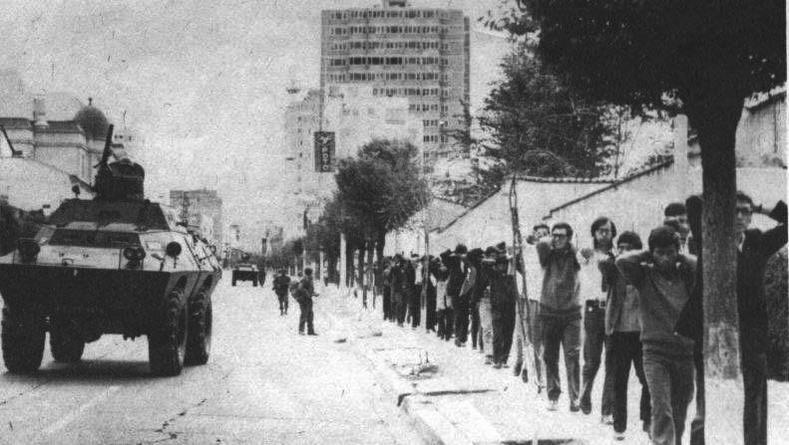
In Bolivia, a CIA-backed military coup led to the overthrow of leftist President Juan Torres. Following the coup, dictator Hugo Banzer had over 2,000 political opponents arrested without trial, tortured, raped and executed.
teleSUR | May 28, 2016
Adolfo Perez Esquivel voiced his opposition to celebrations over the conviction of 15 military officials in Argentina. In his view, there is nothing to celebrate.
Perez Esquivel, recipient of the 1980 Nobel Peace Prize, said Friday that Plan Condor was a conspiracy to kill leftist movements in Latin America and the Caribbean.
In his view, there is no reason to celebrate the conviction of those who participated in Plan Condor in Argentina. An Argentine court found 15 military officials guilty Friday.
“Plan Condor should never have happened,” the Argentine Nobel laureate and human rights defender wrote on the social network Twitter.
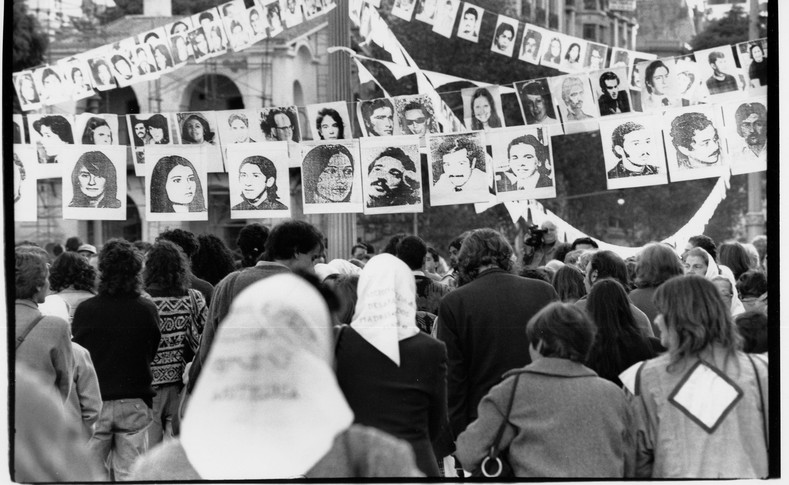
Photographs of the disappeared in Argentina. Photo:Colección AGRA, Archivo Memoria Activa
After the sentencing of several of the military officials, Chilean journalist and diplomat Odette Magnet said “justice was achieved, but we need the truth,” referring to her sister Maria Cecilia Magnet who was disappeared during the dictatorship in the country.
The journalist explained that for 40 years she has played an active role in seeking the truth about repression during the military dictatorships in Latin America.
“I want to know where they are, where (the death squads) threw them, where all the victims of this macabre plan are,” Magnet said. Officials from the dictatorships across Latin America would often throw victims out of helicopters and airplanes into the ocean.
“Nobody knows what really happened to our people, we have no information because the murderers do not speak, they will not talk and that is very frustrating because we have the facts,” Magnet concluded.
RELATED:
Freddie Gray Case Judge Rules it is Unreasonable to Expect Cops to Obey the Law
A Black Agenda Radio commentary by executive editor Glen Ford | May 25, 2016
The cops charged in the death of Freddie Gray had another good day in a Baltimore courtroom, on Monday, when one of the six officers was found not guilty of second degree assault, misconduct and reckless endangerment. Officer Edward Nero had opted not to undergo a trial by jury, so the case was decided by a Black circuit court judge, Barry Williams. The trial of another cop, William Porter, ended in a mistrial back in December when the jury deadlocked on all four counts. If Officer Porter is tried again, it will be after the trials of all the other cops are completed.
But Officer Nero is home free, because Judge Williams ruled that there was “no evidence that the cop intended for a crime to occur.” Judge Williams was affirming the triple legal standard that exists in American law: one standard for cops, another for civilians in general, and no reliable expectation of justice at all for Black people.
Officer Nero was one of the cops that arrested Freddie Gray, dragged his limping body to a police transport wagon, and then failed to secure him with a seatbelt. Gray was given a wild ride through the streets of Baltimore, his handcuffed body crashing into the sides and front of the vehicle, fatally severing his spine.
Lawlessness Begins with the Lawmen
Freddie Gray’s only offense was to run away after making eye contact with a police supervisor – which is not a crime in anybody’s law book. But, as my colleague Bruce Dixon often says, cops are like hounds, and Black people are treated like rabbits, and when a rabbit runs away from the hounds they will chase it down and tear it apart.
So, the hounds are on trial in Baltimore. The prosecution maintains that the cops had no right to arrest and move Freddie Gray – that this amounted to second degree assault on his person. In her closing arguments, deputy state’s attorney Janice Bledsoe said “people get jacked up in the city all the time” by cops, and such behavior must be punished. But, the judge seemed to think it would be ridiculous to treat every arrest as criminal just because there were no grounds for arrest. Officer Nero’s lawyer agreed, saying it didn’t make any difference if the cops acted illegally in arresting Freddie Gray. “Wrong or right isn’t the standard,” said the cop’s attorney. “The standard is, were they so wrong that it was unreasonable?”
So, cops have to be more than just guilty of breaking the law; they must be “unreasonably” guilty – whatever that is.
Warren Brown, a defense lawyer who observed the proceedings, said: “If you’re going to go back and charge every police officer whose arrest was determined to be illegal with assault, or every search that’s deemed to be absent probable cause, [then] you’re going to indict the entire police force.”
Sounds good to me. Indict them all, and empower the people to form a security force that respects, and is answerable to, the community it serves. But, of course, it would be “unreasonable” for Black people to expect anything that smacks of justice in America.
Glen Ford can be contacted at Glen.Ford@BlackAgendaReport.com.
Brother of ‘Guantanamo Diary’ author denied entry to US
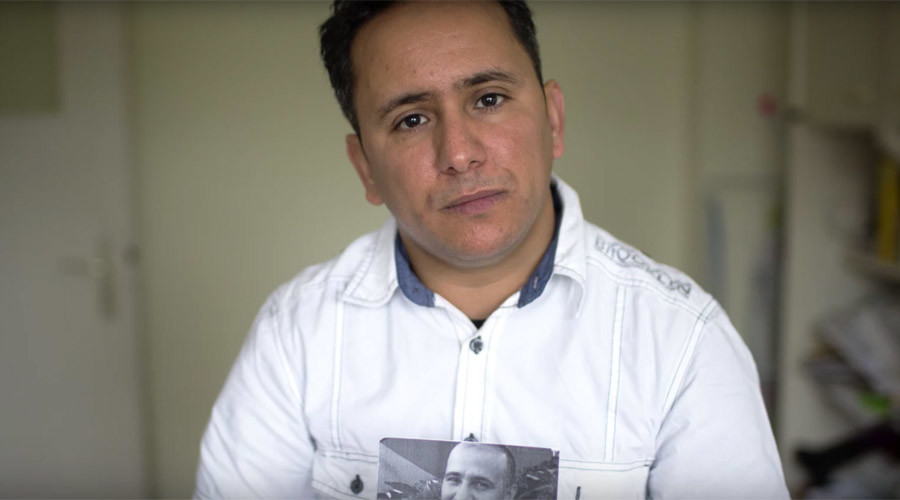
Yahdih Ould Slahi holds up a photo of his brother Mohamedou in a May 2016 video by American Civil Liberties Union © acluvideos / YouTube
RT | May 24, 2016
US authorities detained, interrogated and sent back a German citizen flying in to campaign for the release of his brother – author of the best-selling “Guantanamo Diary,” who has been imprisoned and tortured at the US camp since 2002.
Mohamedou Ould Slahi’s memoir, heavily redacted by government censors, was published in 2015 and quickly became a best-seller. The Mauritanian native was arrested in 2001 and rendered to Jordan for interrogation by the CIA. He was transferred to Guantanamo Bay the following year.
His younger brother Yahdih, a German citizen, has campaigned for Mohamedou’s release for years. Yahdih was supposed to attend a number of events in the US this week, seeking to persuade Guantanamo’s Periodic Review Board to set Mohamedou free at the June 2 hearing.
When Yahdih Slahi arrived at the John F. Kennedy airport in New York on Saturday, however, he was detained by US Customs and Border Patrol (CBP) agents, questioned for hours, and sent back to Germany the following day, The Intercept reported.
“He was asked questions about his family, his brother, and what he knew about why his brother was in Guantánamo,” said Hina Shamsi of the American Civil Liberties Union. “It was a harrowing, stressful, and exhausting experience.”
Yahdih Slahi is a German citizen who lives in Düsseldorf, and would have been able to enter the US under the visa waiver program that Germany participates in. The CBP gave no explanation for denying Slahi entry.
In his memoir, Mohamedou Slahi described being held in isolation and subjected to beatings, extreme cold, sleep deprivation, sexual abuse, a simulated kidnapping, and a simulated execution. At one point, his captors tried to trick him by showing him a forged letter from his mother, Yahdih recounted in 2015. The ploy failed because the forgery misspelled Slahi’s name – and because, unbeknownst to his jailers, Slahi’s mother was illiterate.
Mohamedou Slahi admits that he fought in Afghanistan in the early 1990s with what became Al-Qaeda– when the organization was backed by the US in its struggle against the socialist government in Kabul. While he had nothing to do with Al-Qaeda since 1992, Slahi did stay in touch with his cousin and former brother-in-law, Mahfouz Ould al-Walid, who served as a lieutenant to Osama Bin Laden.
Slahi was never charged with any crime, but the 2010 decision to release him has been held up by government appeals.
“The judge said there was no evidence in 2010 to hold him. There’s certainly not evidence now. The Chief Prosecutor said when he resigned in 2007, that there was no evidence then,” Slahi’s attorney Nancy Hollander told RT in January 2015.
Slahi’s family and friends hope the Periodic Review Board will recommend his release at the June 2 hearing. The inter-agency panel ruled on Monday to set free an Afghan man, known only as Obaidullah, who was held at Guantanamo for 14 years.
It took a decade of fighting with the government for the Guantanamo Diary, written in 2005, to see the light of day. Slahi is the first Guantanamo prisoner to publish a memoir while still at the camp. He has not been allowed to receive a copy of his book.
Counter-extremism scheme could turn cops into ‘Thought Police’
RT | May 24, 2016
Draconian plans to target alleged extremists through a controversial anti-radicalization program are at risk of creating a ‘Thought Police’ in the UK, the officer leading the operation has warned.
In a damning critique, Leicestershire Police Chief Constable Simon Cole said the ‘Prevent’ legislation risks making cops judges of “what people can and cannot say.”
The government formally announced a controversial new bill to tackle extremism in the Queen’s Speech to Parliament last week. It is considered to be Prime Minister David Cameron’s flagship policy of the year.
The legislation widens the police fight to include those who are defined as ‘extremists’, but who do not take part in or even advocate terrorism themselves.
“Unless you can define what extremism is very clearly then it’s going to be really challenging to enforce,” Cole told the Guardian.
“We don’t want to be the Thought Police. We absolutely don’t want to be the Thought Police.”
When asked if the Prevent strategy could make this happen, Cole said: “Potentially there is a risk.”
Cole’s intervention will prove damaging for the government, coming from a senior counterterrorism officer.
Cameron already faced several embarrassing defeats last parliamentary year, despite having a slim majority of seats in the House of Commons, and will be keen to avoid another capitulation.
But Cole believes the legislation has triggered serious reservations among British Muslims.
“The police need to be able to safeguard people without being drawn into a hugely contentious potential role about a kind of thought police control of what people can and cannot say.
“And that needs really clearly defining and it needs parliament to lay out what is and isn’t acceptable,” he added.
Despite spending eight months drafting a “legally robust” definition of extremism, government officials are still struggling to complete the task.
Cole said he has concerns about how “enforceable” the legislation would be, adding it is important for police officers to speak out.
While he accepted that society must impose “some limits” on what can and cannot be said, “They [the limits] need to be as broad as they possibly can be.”
U.S. Government Secretly Destroyed Evidence in Trial of Accused “9/11 Masterminds”
By Derrick Broze | Activist Post | May 21, 2016
In another setback for the death penalty trial of the five men accused of aiding the terrorist attacks of September 11, 2001, two defense lawyers for Khalid Shaikh Mohammed say the U.S. government secretly destroyed relevant evidence.
On May 11, defense lawyers for the accused mastermind of the 9/11 terror attacks asked for judge Col. James Pohl and the prosecution team to be recused from the trial, and for the case to be shut down. Defense lawyers David Nevin and Maj. Derek Poteet say that the U.S. government destroyed evidence related to the case, according to the New York Times. The two men are unable to provide further details because the issue is classified, but Mr. Nevin said the evidence was “favorable” to the defendants.
Major Poteet also told the Times that the defense was first informed in February that Colonel Pohl would provide them with a “summary of a substitute” for the original, classified evidence. The defense requested Colonel Pohl to preserve the evidence for the record and Pohl complied. Or so they thought.
“But they learned in February, they said, that about 20 months earlier, and without their knowledge, prosecutors had obtained from Colonel Pohl a secret order that reversed his previous decision,” the Times writes. “By the time they found out, the government had already destroyed the evidence, giving them no opportunity to challenge the move.”
Major Poteet said the situation created the appearance that Colonel Pohl was “colluding with the government.” The Times reports that the original, now destroyed evidence, may have been related to one of several foreign black site prisons operated by the Central Intelligence Agency in Thailand, Poland, Romania, Lithuania and Afghanistan, and at a secret site at the Guantánamo base. KSM was tortured for several years at one of these sites before being transferred to the military prison at Guantánamo Bay, Cuba in 2006.
The accusations are likely to delay upcoming scheduled hearings from May 30 to June 3. If there is a delay it will be latest in a long line of interruptions to this alleged pursuit of justice. Most recently, Col. Pohl canceled two weeks of hearings that were scheduled to begin on Friday, April 1st.
“The whole thing is really odd to me. I thought it was an April Fools’ joke,” said Chicago defense attorney Cheryl Bormann, who was already in Washington to travel to Guantánamo this weekend to represent alleged 9/11 plot deputy Walid bin Attash.
The destruction of evidence is, unfortunately, not the first controversy this trial has faced. Another conflict of interest became an issue in 2014 when the defense attorneys for Mohammed and the four alleged co-conspirators said they believed they were being spied on by the Federal Bureau of Investigation.
Foreign Policy reported,
the FBI had secretly conducted an investigation into possible wrongdoing on the part of one or more members of the five separate defense teams (one for each defendant). Such an investigation could put defense team members in the untenable position of having to provide information to defend themselves or others against possible criminal action — information that could be used against the interests of their own clients.
There was also the issue of interference from outside sources during the hearings. FP continues:
In January 2013, the court’s audio-visual feed, visible to a small set of commission observers, was abruptly cut off by someone other than Judge Pohl; previously, Pohl was believed to be the only person with the authority to use the unique-to-Guantanamo “kill-switch.”
Later, a clearly annoyed Pohl learned that something called the Original Classification Authority (OCA) — which is likely the CIA given that most of the information subject to censorship in the case is related to the agency’s rendition, detention, and interrogation program — had hit the kill switch. Judge Pohl promptly cut off their privileges.
In February 2013 it was revealed that listening devices were hidden within smoke detectors, possibly infringing upon attorney-client privileges. The defense also claimed their emails and work files were disappearing. Former defendant Ramzi Bin al-Shibh was also removed from the trial by the judge in an attempt to speed the process along after so many delays. However, critics argue that al-Shibh was removed because he refused to be quiet, complaining loudly of sleep deprivation.
Is this trial really about truth, justice, and upholding law and order? If the military court hopes to find something close to the truth they should open the hearings to the public, end the spying on the defense team, and be transparent about the treatment of the alleged hijackers. Only by allowing the truth to be released will the wounds of 9/11 begin to heal.
Derrick Broze is an investigative journalist and liberty activist. He is the Lead Investigative Reporter for ActivistPost.com and the founder of the TheConsciousResistance.com. Follow him on Twitter.
Featured Video
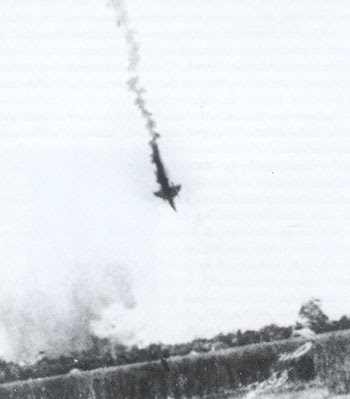
The Failed Air War Over Vietnam
or go to
Aletho News Archives – Video-Images
From the Archives
USS Liberty Massacre: A Pivotal Moment in the Hostile Takeover of America
By Kevin Barrett | Crescent | Dhu al-Qa’dah 24, 1445
In corporate America, hostile takeovers are commonplace. They occur when an aggressor—a larger corporation or rich individuals—seizes control of a smaller corporation without asking permission.
What few recognize is that the United States itself has been subjected to a hostile takeover. Since the aggressor, the illegitimate settler colony known as “Israel,” is much smaller than the US, the takeover has necessarily been surreptitious.
As of June, 2024, Israel’s gradual takeover of the US has become obvious and undeniable—a proverbial “elephant in the living room.” … continue
Blog Roll
 Aletho News
- Leaders Condemn Ansarallah Attack on Saudi Arabia While Ignoring Illegal War Against Yemen
- Leaked: Britain’s Covert Iraqi Psyops Network
- Yemeni Armed Forces Warn Airlines Against Using Saudi Airports, Exempt Mecca and Medina
- Iran security chief says powers greater than US tried to conquer Iran but ended in ‘dustbin of history’
- Europe’s mounting social chaos… chickens coming home to roost for proxy war against Russia
- US-Russia Diesel Deal Becomes Massive Defeat for Ukraine
- Hormuz and the Looming Economic Catastrophe
- Dhubab offensive, media blitz and the rapid unraveling of Saudi-backed coalition’s new gambit
- Putin Conveys to Trump Iran’s Vision on Possible Conflict Resolution – Kremlin
- The Search for Truth: Charlie Kirk’s Assassination One Year Later
- If Americans Knew
- For three years, Israel has killed a child in Gaza every 71 minutes – Daily Update
- Israeli forces kill another child in Gaza – Daily Update
- Gaza ceasefire exists in name only, say more than 100 organizations
- Nearly 2 Million in Gaza Need Urgent Shelter Assistance as Winter Looms: IOM Chief Warns
- Suppressing Palestinian resistance: US charity under fire for AI monitoring of Gaza classrooms
- Thousands Are Held in Israeli Torture Camps. This Is What Happens Inside
- Israel puts Gaza’s sick, injured, newborn in peril – Daily Update
- Report claimed Mark Levin used by Israeli government to influence Trump
- Over 2,000 Gazans have died awaiting medical evacuation amid Israel’s continued siege
- How a U.S. Diplomat Suppressed and Altered Reports Critical of Israel
- No Tricks Zone
- Germany’s Green Energy Debacle: High Energy Costs Force Kahla Porzellan to Close After 182 Years!
- New Study: 50 Years Of The Most Aggressive ‘Net Zero’ Policies Can Only Affect The Global Climate By 0.03°C
- US September “Heat” Was No Record…Many Records Set Decades Ago
- Latest European Green Energy Debacle; Portugal’s Largest Flagship Solar Park Insolvent!
- Green Energy Debacle: German Expert Professor Fritz Vahrenholt Warns Of Severe Economic And Social Consequences
- Two More Paleo Reconstructions Affirm Meters-Higher Sea Levels Across Ireland, Brazil 7000-6000 Years Ago
- New Study: Earth And Venus Surface Warmth Largely Explained By Convection And Lapse Rate, Not CO2 Or Radiation
- 2025 Nature Paper Claiming Worsening Global Drought Gets RETRACTED …Heavily Flawed
- New Study: ‘Global Drought Shows No Detectable Recent Acceleration Under Climate Warming’
- Economic Masterminds: German Socialists Suggest Taxing Productivity Gains Stemming From Using AI

