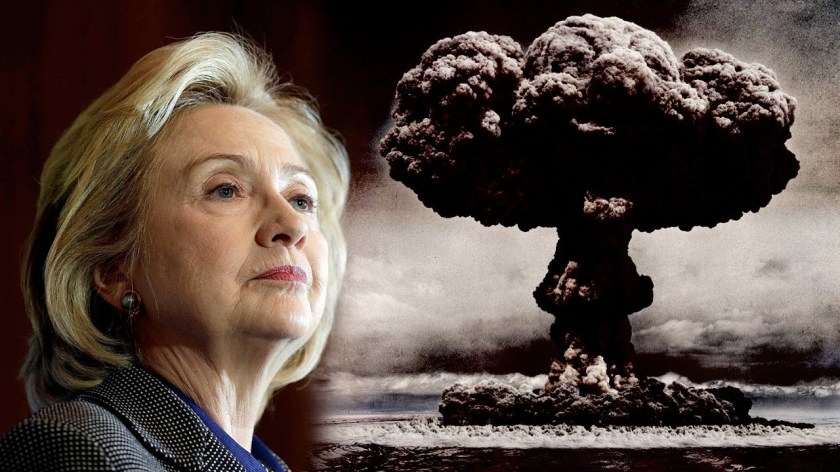
The U.S. Congress has passed the National Defense Authorization Act (NDAA) 2017 with provisions that will force women to sign up for potential military draft and continues the practice of indefinite detention.
On Tuesday, the U.S. Senate approved a $602 billion annual defense budget that President Obama has promised to veto because the bill does not allow for the closing of the military prison at Guantanamo Bay, Cuba. Senate Bill 2943, the National Defense Authorization Act for Fiscal Year 2017, passed with a vote of 85 Senators in favor and 13 against.
Before the vote, Senator John McCain tweeted that “It’s never been more urgent to give our troops the resources they need to succeed.” The majority of Congress have no issue taking money from the American people and redistributing it to fund their empire. The conflict arises when lawmakers begin debating whose pet projects are going to get a boost. The major conflicts in passing the bill stemmed from various amendments dealing with how the military budget will be spent.
One issue the entire Congress seemed to agree on was voting against closing military bases around the world. While the Pentagon called for budget cuts stating that the military has more space than they need, Congress refused to go along with the cuts. “Besides, several lawmakers have argued that the Pentagon has cooked the books to justify its conclusions or at least didn’t do the math completely,” the Associated Press reports. The Senate also voted against an amendment to close the infamous military detention center at Guantanamo Bay, Cuba.
Another contentious area of debate was the mandate to force women who turn 18 on or after Jan. 1, 2018 to register for Selective Service. Males are already required register within 30 days of their 18th birthday. The United States has maintained a volunteer military force since 1973, but through Selective Service the military could reinstate a draft and call upon registered males and females. Those who do not register could face up to five years in prison and a fine of up to $250,000, although the penalty has rarely been enforced.
The most horrendous part of the NDAA 2017 is that that the annual military budget continues to include a provision which allows for indefinite detention of American citizens without a right to trial. Many of you may remember that President Obama had no problem signing the NDAA 2012 in 2011, which legalized the indefinite detention of American citizens suspected of ties to terrorism. The indefinite detention provision is still contained in the NDAA, and has been approved by Congress and signed by President Obama every year since it first passed.
On Thursday June 9, Senators Mike Lee of Utah, Rand Paul of Kentucky, and Dianne Feinstein of California spoke on the floor of the Senate in support of an amendment bill which would have removed the indefinite detention clause from NDAA 2017 and offered protections to American citizens weary of a federal government with too much power. The “Due Process Guarantee Amendment to the NDAA for Fiscal Year 2017” would have clarified “that an authorization to use military force, a declaration of war, or any similar authority shall not authorize the detention without charge or trial of a citizen or lawful permanent resident of the United States.”
“This amendment addresses a little known problem that I believe most Americans would be shocked to discover even exists,” Senator Mike Lee said from the floor of the U.S. Senate. “Under current law, the federal government has proclaimed the power, has arrogated to itself the power to obtain indefinitely without charge or trial U.S. Citizens and lawful permanent residents who are apprehended on American soil. Let that sink in for just a minute.” Senator Lee also reminded the Congress that the last time the U.S. federal government detained Americans was the internment of Japanese Americans during the Second World War.
Senator Rand Paul noted that President Obama recognized the danger of granting the federal government the power to indefinitely detain Americans. Upon signing the bill in 2011 President Obama added a signing statement promising not to use the power. “He said, this is a terrible power and I promise never to use it. Any president who says a power is so terrible he’s not going to use it should not be on the books,” Paul stated. “Someday there will be someone in charge of the government that makes a grievous mistake, like rounding up the Japanese. So we have to be very, very careful about giving power to our government.”
Unfortunately, the federal government will continue to have the ability to indefinitely detain American citizens. This is especially worrisome going into 2017 when a new president, one who hasn’t promised not to detain you, will be claiming the Oval Office. What will he or she do with the power to indefinitely detain Americans? Only time will tell.
Slavery has been abolished in the United States since 1865, when the 13th Amendment was passed in the ashes of the Civil War.
Well, almost abolished. Actually, the amendment included a caveat: “except as punishment for a crime.” Since then, prison and forced labor have always gone together.
In fact, with over 2 million people behind bars in this country, the American prison system is a massive — albeit largely invisible — part of our economy and social fabric.
Recent years have seen a rise in both private prisons and the use of prison labor by private, for-profit corporations. This has created perverse incentives to imprison people and exploit them for cheap labor — often at 50 cents an hour or less.
Corporations such as Microsoft, Target, Revlon, and Boeing have all made products with prison labor. With over a third of home appliances and 30 percent of speakers and headphones made using prison labor, it’s likely most American households own inmate-made products.
(Photo: popularresistance.org)
Even Whole Foods, a famed destination for ethical consumers, was forced to stop selling certain artisanal cheeses last year when those “artisans” were revealed to be prisoners who made a base wage of 60 cents a day
We won’t even get into what Whole Foods — sometimes called “Whole Paycheck” — was charging consumers for prisoner-made products, which also included organic milk and tilapia.
The problem is making its way into popular culture as well. A season three episode of the Netflix prison dramedy Orange Is the New Black, for example, illustrated a similar scam.
In the episode, a thrilling new job opportunity is marketed to the inmates. Most are beside themselves at the idea of working for $1 an hour — well above the compensation offered for any other job in the prison. A scheme is hatched to trick the women into clamoring for the job in a fake competition.
The episode closes with a scene showing the chosen women as their new job is revealed to them. They walk into a warehouse. The lights click on, and the viewer first sees the shock and disappointment on their faces. Then the camera turns to show rows and rows of sewing machines and a corporate logo overhead.
They’d competed to work in a sweatshop.
Real-life prisoners are starting to organize against this kind of abuse. This April, prisoners in Texas held a coordinated work stoppage with the help of the Incarcerated Workers Organizing Committee — an arm of the global IWW union.
The striking inmates refused to do work assigned to them by Texas Correctional Industries, an arm of the state Department of Justice that uses inmate labor to make everything from personal care items to toilets. Incarcerated workers there are paid as little as 17 cents an hour, even as phone calls can cost $1 a minute and medical care requires a $100 copay.
Another union-coordinated strike is underway at several Alabama prisons, where inmates labor in deplorable conditions even as they generate profits for private industries. Unions and rights groups are gearing up for a national strike this September to derail this exploitative system.
Those most directly and negatively affected, the prisoners and their families, need and deserve our support. But the rest of us need to finish the work of the Civil War and end forced labor in our country for good.
Lauren Karaffa is a New Economy Maryland fellow at the Institute for Policy Studies.
An industry-dominated “multistakeholder process” convened by the Commerce Department recently produced a set of voluntary privacy “best practices” for commercial drones that are so riddled with exceptions and vague language that companies could engage in all sorts of practices that would violate the public’s privacy expectations, while still claiming to comply with these guidelines.
The idea of the process was to produce a set of voluntary best practices to ensure that commercial drone use protects privacy rights. It was convened at the direction of President Obama in an executive order on drone privacy that he issued in February 2015.
Last month, before the document was finalized, we, along with the Electronic Frontier Foundation and Access Now, urged the corporate participants to make a clear commitment to actual best practices, rather than a weak document designed primarily to ensure maximum flexibility in what companies can do with drones. We proposed a set of changes to the document’s language that would have strengthened it enough to allow us to endorse it. Unfortunately, these changes were rejected.
Why won’t Amazon and other industry players in the drone space make a clean commitment to good privacy practices when it comes to drones? To take just one example, I think one thing most Americans would definitely not want to see companies doing with their drones is engaging in persistent and continuous surveillance of people without their consent. Yet this industry-led draft says the best practice is to avoid doing that “in the absence of a compelling need to do otherwise.” A compelling need? What is that? Is Amazon planning to engage in such surveillance with its delivery drones? If not, why wouldn’t it agree to a more straightforward statement? There were a lot of industry players, so I don’t mean to pick on Amazon. Except actually I do, because apparently that company led the meeting negotiations for industry on what turned into the final product.
Perhaps one could dream up scenarios where a company engages in persistent, continuous surveillance of people without their consent, in a way that nobody would find objectionable. I’m not sure what that scenario would look like, but that certainly wouldn’t be a best practice, and the inclusion of such language is far more likely to be abused than to cover such a remote eventuality.
Other areas where we thought the documents language was too weak were around issues such as consent, the collection of data where people have a reasonable expectation of privacy, the sharing of data with third parties, and data retention. We spell out these and other problems in our letter. As it now stands, the document shows more promise as a corporate consciousness-raising document than an assurance that any complying company isn’t doing anything objectionable.
Any company that is operating drones should certainly comply with the practices laid out in this document. But doing so represents the very bare minimum of what companies should do on privacy, not best practices. The NTIA should reject this document, and discussions in the multi-stakeholder process should continue until adequate privacy protections can be included.
Hillary Clinton is the most qualified person to “rule the world”, if she can get around the “insane” US Constitution
OffGuardian | June 11, 2016
With the democratic nomination now officially all but certain (Sanders, quite obviously, never had a chance), the Guardian has thrown their full editorial weight – such as it is – into a pre-emptive defence of Hillary’s record and an hysterical celebration of the “progress” that the election of this particular bank-backed, corporate-bought, war-hawk would (apparently) demonstrate.
Those out to demonise Hillary Clinton should be careful what they wish for”
“Demonise”, in this instance, seems to mean “accurately describe her political career and possible criminal activities”. If you can demonise someone by holding a mirror up to their face, chances are that person is a demon.
“The choice of the next US president is now so stark that it’s time the left put aside its sneers and pray that this strong woman will get to rule the world”
“Rule the world?” Does the US president rule the world? I think I missed that particular UN resolution. As I recall, the POTUS doesn’t even wield supreme executive power within their own nation, the US constitution prevents that… but we’ll get to that later.
As for the starkness of the electoral field – I have to say I agree with Toynbee there. The choice between a bombastic orange billionaire, who sometimes seems to be running for president as an elaborate prank, and a proven corrupt and dangerous war-hawk, backed by lunatics like Victoria Nuland is indeed a stark one. Nuclear winter type stark. Perhaps literally.
This is a time to celebrate. At last, a woman leads a major US party to fight for the presidency.
Yes. At last, a woman. It doesn’t matter who the woman is, what she has done, how much she cheats to get there. Irrelevancies used to “demonise” her. Hillary is a woman, and thus her being president is A Good Thing… because progress. This is going to be key to Clinton’s campaign, and you will hear it a lot. It’s one of only 2 real tactics the Clinton camp have at their disposal. “What’s the other”, you ask? Simple: Lying. A lot of lying.
… as the first woman to enter the White House, she will also step through the door as by far the most qualified and experienced arrival there for generations…”
Now, this isn’t technically a lie… but only because we don’t know what Toynbee means by “qualified”. If being a shambolic Secretary of State and highly unpopular first lady makes you qualified then sure. If being proven to lie for your own benefit, time and time again, makes you “qualified”, or being firmly behind every American military intervention for the past 25 years… then I guess Hillary has qualifications to spare.
… a searing firestorm of abuse… Why so fierce, so unreasonable, so vitriolic?”
This is called a strawman. Having made a statement, one which is not backed up by any citations or quotes, she will attempt to “explain” this fictional phenomenon with some cloying cod psychology:
If you are naturally left of centre, especially if you are a woman, yet you find you instinctively dislike her, ask yourself why. There may be some good reasons…
So, liberal traitors – especially the female liberal traitors – why do you “instinctively” dislike Hillary Clinton? I mean there may be some good reasons, for example:
… she’s not as radical as Sanders; she is not a natural rabble-rouser at rallies; she is the wife of a past president; she’s called “robotic” in her careful choice of words; and as a flesh-presser she warms the cockles of few hearts.
To rephrase: You may not like her because she has no principles, is a bad public speaker, her election reeks of nepotism or she comes off as cold and sociopathic. Toynbee volunteers these facts – and we should note that these are the qualities the media list when they are trying to make her look good.
There are others: You MAY not like her because she planned and executed an illegal coup in Honduras, the destruction of Libya and execution of its head of state, she backed the Afghan and Iraq wars, she lied to cover up for a pedophile by blaming his 12 year old victim, the many alleged crimes, or any of the other callous and dreadful instances of dishonesty and self-aggrandisation she has taken part in.
These are the reasons you MAY think justify your “instinctive” hatred of this woman. But Toynbee knows better. She knows why you REALLY don’t like her – It’s because you’re a misogynist who doesn’t understand how tough it is for a woman:
If women of the left do break into the bastions of power, the sisters often view them as sell-outs to the establishment, as if permanent outsiderdom and victimhood is the only true mark of feminism.
You see? You “instinctively” dislike her, because you assume she must be a member of the establishment. That is the burden of the female “liberal”. You start a few wars, attend a few Bilderberg conferences, get a few million dollars donated to you from the most powerful banks in America, speak at the Council of Foreign Relations a few times and suddenly – BOOM – you’re viewed, unfairly, as part of the establishment.
But, putting aside the forced gendercentric argument and massive intellectual dishonesty, there’s some far more worrying agenda being whispered subliminally into the minds of Guardian readers here – Hillary’s greatest opponent is not the Republicans, it’s not the patriarchy, it’s not the other women who so resent her rise to power.
No, it is the law itself:
Unlike most, she knows how to wield the power levers, insofar as the insane US constitution allows any president to carry out their manifesto.
The United States Constitution is insane folks. I’m not sure which specific part of the most important egalitarian legal document of all time Toynbee has taken issue with – and she declined to answer when I asked her on twitter. But there’s a lot of good places to start.
For one thing: Limiting the power of the chief executive, making them answerable to the legislative body in order to prevent tyranny? That is obviously stupid when your head of state is a WOMAN who only wants to be nice. No, that has to go. The three separate branches of government should obviously be reshaped into a supreme executive with control over both legislative and judicial bodies. After all, how can you expect to implement a “manifesto” when you don’t have absolute power?
Free speech? Well, this is an antiquated notion, from a time before “progress” when people didn’t understand what was definitively correct. Now that we have reached consensus on what is “right” and what is “wrong” there is no need for freedom of speech – and in fact it is a hindrance, as people will only abuse their “right to free speech” by spreading propaganda, or broadcasting opinions which we have all agreed are wrong. As the Guardian has made clearmany times, free speech is meaningless if people use it to bully and disenfranchise minorities. If free speech is being used to inflict hatred and tyranny on women, ethnic minorities or the trans community, then what use is it? Free speech doesn’t mean hate speech… but unfortunately banning hate speech DOES mean banning free speech sooo…. yeah.
Right to bear arms? Absolutely crazy. The very idea that civilians having access to firearms is important as a general principle in guarding against tyranny is foolish. There isn’t going to BE any tyranny anymore, because we’ve handed absolute power over to a woman who has banned the “tyranny” of “free speech”.
This frightening statement gives us a flash of the future – of the agenda already set in place. The US constitution has been largely ignored and misinterpreted for years to excuse totalitarian laws, such as the Patriot Act. But when Clinton is president, it will come under full-blown attack. Make no mistake: Clinton will be president, there’s no doubt about that. The election will be fixed, either literally like in 2000 and 2004, or more subtly by simply making the alternative bizarre and unelectable – as in 2008 and 2012. The latter possibility even explains the rise of Trump.
I don’t know if the man is genuine or not, I don’t know if he really believes he can win, but I understand his role. He is there to guarantee a Clinton victory. That’s why the press talks up his “violent” supporters, and balloons any and every tiny comment he makes into “racism” and “sexism”. He exists so that people like Toynbee can say this:
Outside, the world looks on aghast at any possibility America could choose a racist, sexist brute over a feminist with a long track record of standing up for the right causes.”
… and has there be a tiny kernel of truth to it. A very tiny kernel.
Consider professional wrestling. It’s fake, everybody knows that, it only just barely pretends to be otherwise. An elaborate action-based soap opera, with wild stunts and expensive tickets. That is all that American democracy has become. In wrestling it is predetermined who will win, they have labels for their wrestlers. First there is the Face, the hero, the good guy. He fights fair, he has a noble cause. He wears the American flag like a cape. When his music pipes up, we cheer because we’re supposed to. And the other guy? He’s the Heel. He’s obnoxious, he cheats, he’s mean for mean’s sake and smiles when we boo. And when your Face is Hillary Clinton, you need a HELL of a big Heel. Enter Donald Trump. A cartoon character. The caricature of the everything we’re supposed to hate about the GoP.
The fact that Clinton has still somehow contrived to be behind him in the polls tells you all you need to know about the desperate struggle the media face in turning Clinton into a believable hero.
Regardless, Clinton WILL be President. But it won’t be a sign of progress, it will be a neon display highlighting everything that has gone wrong with the American political system. It won’t be because she’s a woman, or a liberal, or an idealist. It will be because she sold her soul to finance her ambition for fleeting prestige and the appearance of power.
Rarely has any candidate so deserved their place.
In this case I tend to agree with Toynbee – never before has a candidate SO obviously worked SO hard to become president. Never before has a candidate so brazenly sold out the values they were (at best) pretending to hold dear. Never before has a candidate so artlessly and obviously lied about so many things. Never before has a candidate been so open and obvious about the Faustian pact they needed to make to get where they want to go, so obviously played the political game of the oligarchs who really run the country, in order to get her pay-off.
Editorials such as Toynbee’s will appear on the regular all through the campaign, all variations on a theme, all attempting to re-write Clinton’s history and hinging on the worst kind of puddle-deep identity politics. The truly tragic part is that they KNOW they are lying, they KNOW they will be called on it, they KNOW what they ARE, and they resent us for telling them. That’s why they say stuff like this:
And if you want a reminder of what women like her are up against, just read the comments that will no doubt follow this.
The comments, as you’d expect, were full of people commenting on her obvious bias, pointing out her half-truths and correcting her glaring factual errors. In the world the Guardian wants Clinton to build, this will be called “demonisation”.
Thanks to FBI meddling, a straightforward electronic communications privacy reform with bipartisan support and barely any opposition is now stalled, and is dangerously close to dying this session.
The Electronic Communications Privacy Act (ECPA) became law in 1986, and hasn’t been updated since. The statute, which governs law enforcement access to electronic communications, contains an obsolete clause enabling government agencies to obtain stored communications without warrants as long as the records are over 180 days old. This provision made more sense when the law was passed, at a time when computer data storage was expensive and most people couldn’t afford to store anything in digital form for as long as 6 months. Today, when storage is cheap and many people have emails dating back a decade in their Gmail inboxes, the law makes no sense. For years now, advocates including the ACLU and major tech companies have been furiously lobbying to update the law. This year, the House finally passed an ECPA modernization bill, which if enacted would do away with the 6 month rule and instituting a warrant requirement for content across the board—no matter how long the information has been sitting in your Dropbox folder or Gmail account. After the unanimous House vote, I and others expected the reform to quickly move through the Senate and get a signature from President Obama. Finally!
Alas, that’s not what is happening.
Unfortunately, the FBI intervened, and now the bill has a poison pill in it. Republican Senator John Cornyn attached an amendment to the bill that would vastly expand the FBI’s power to use much-abused ‘National Security Letters,’ or NSLs, secret subpoenas. Email privacy supporters Senators Pat Leahy and Mike Lee have said they will pull the bill from consideration instead of allowing their efforts to be coopted by the FBI—which intends to broaden its surveillance authorities, instead of contract them, as the email privacy bill intends.
“Unfortunately, some Senators on the committee have decided late in the day that this bill should be a vehicle to move an unrelated and controversial expansion of the use of national security letters by the FBI,” Lee said. “Such an expansion would swallow up the protections this bill offers to the American people. While there are other concerns we had hoped to negotiate, the national security letter amendment is something I cannot in good conscience have attached to this bill.”
FBI Director James Comey has said getting the NSL power extended to internet information is his organization’s top legislative priority.
THE EU is not defending workers’ rights as the Remainiacs never cease to claim.
In fact the EU is directly behind the huge assault on wages, pensions, collective bargaining and other workers’ rights across the EU, including the current battle going on in France.
Moreover it is being done in contravention of its own treaties in a typically bureaucratic and Byzantine way.
Officially, the Treaty on the Functioning of the European Union (TFEU, Article 153.5), explicitly states that the EU has no competences in the area of wage policy.
Yet this has not prevented EU institutions such as the European Commission, the European Central Bank (ECB) or even the European Council from demanding wage “moderation” across the EU.
The Broad Economic Policy Guidelines (BEPG), regularly produced by the Commission since 1993, always included demands for wage “moderation.”
However a new system of European economic governance began to emerge in 2010 with the adoption of the controversial, neoliberal Europe 2020 strategy, which included a yearly cycle of EU economic policy co-ordination.
This explicitly includes wage policy which is considered the most important adjustment variable for promoting “competitiveness.”
The legal basis for this new form of “authoritarian neoliberalism” as it has been called comprises above all the Euro Plus Pact adopted on the initiative of Angela Merkel and Nicolas Sarkozy in March 2011.
As a result, while EU competence over wage policy is still expressly forbidden, with the Euro Plus Pact wage policy intervention at EU level is now mystically allowed.
Now the EU issues annual policy recommendations for all member states which must then be transformed into national “reform programmes” whose effectiveness will again be assessed by the EU.
The annual economic co-ordination cycle was further developed in 2011 with the adoption of a package of five Regulations and one Directive.
The so-called “six-pack” contains two new major instruments in order to intensify economic policy co-ordination: one is the establishment of a new system of surveillance and the second is the introduction of fines on those countries that fail to comply.
The 2013 Treaty for Stability, Co-ordination and Governance (TSCG) further reinforced mechanisms to enable the EU to “co-ordinate and monitor the economic and budgetary policies of the member states.”
Each February the Commission publishes detailed reports on each country and their “progress.” This year’s report pointed out an “excessive” imbalance — too much public expenditure and a lack of competitiveness.
However, it recorded “substantial progress in the matter of reducing the cost of labour and retirement pension reform.”
On April 13, the French government adopted its EU National Programme of Reform (NPR) and acquiesced to EU demands for “giving more latitude to companies, to adapt wages and working hours to their economic situation” — ie huge changes to French employment law.
It is this that French workers are fighting against.
The scope for EU attacks on wages and collective bargaining expanded most rapidly in those crisis-hit countries which rely on “bailouts” from the EU and/or the International Monetary Fund (IMF).
In exchange for bailouts, these countries had to introduce “reforms” laid down either in so-called memorandums of understanding with the Troika of EU, European Central Bank (ECB) and IMF in the case of Greece, Ireland and Portugal, or in “stand-by arrangements” with the IMF, in the case of Hungary, Latvia and Romania.
These policy measures comprised attacks on wages, social services and public ownership and far-reaching labour market “reforms” including the abolition of systems of collective bargaining.
There is a simple reason for this — where there is no collective bargaining there is a decline in wages.
For the hard-line German member of the ECB Executive Board Joerg Asmussen, labour market “reforms” such as removing collective rights are even “the key if a country wishes to remain within the euro.”
As a result attacks on workers at national level are being driven by a new EU interventionism in an unprecedented way.
For example prior to the 2008 crisis, Romania had a legal system that supported dialogue between trade unions, employers and the government, resulting in widespread collective bargaining at all levels.
By 2011, at the behest of the EU, the government had scrapped all collective agreements and changed, without parliamentary debate, the main labour laws, making it impossible to have cross-sectoral collective agreements.
The recession was thus exploited by the EU and a compliant government in Bucharest as a pretext to rip the guts out of the existing industrial relations system and lower labour costs.
Even the EU-funded European Trade Union Confederation general secretary Bernadette Segol identified two fronts where collective bargaining is coming under attack: the decentralisation of bargaining and allowing employers to ignore trade union bodies in favour of non-union bodies.
Addressing the theme of Social Europe, she points out that “policies that are being implemented are attacking industrial relations systems, putting pressure on wages, weakening public services and weakening social protection.
“These are the core aspects of the social model,” confirming the view of many observers that the model is now dead — if indeed it was ever alive at all.
Brian Denny is a spokesman for Trade Unionists Against the EU.
One of the essential functions of the corporate media is to marginalise or silence acknowledgement of the history – and continuation – of Western imperial aggression. The coverage of the recent sentencing in Senegal of Hissène Habré, the former dictator of Chad, for crimes against humanity, provides a useful case study.
The verdict could well have presented the opportunity for the media to examine in detail the complicity of the US, UK, France and their major allies in the Middle East and North Africa in the appalling genocide Habré inflicted on Chad during his rule – from 1982 to 1990. After all, Habré had seized power via a CIA-backed coup. As William Blum commented in Rogue State (2002: 152):
With US support, Habré went on to rule for eight years during which his secret police reportedly killed tens of thousands, tortured as many of 200,000 and disappeared an undetermined number.
Indeed, while coverage of Chad has been largely missing from the British corporate media, so too was the massive, secret war waged over these eight years by the United States, France and Britain from bases in Chad against Libyan leader Colonel Mu’ammar Gaddafi. (See Targeting Gaddafi: Secret Warfare and the Media, by Richard Lance Keeble, in Mirage in the Desert? Reporting the ‘Arab Spring’, edited by John Mair and Richard Lance Keeble, Abramis, Bury St Edmunds, 2011, pp 281-296.)
By 1990, with the crisis in the Persian Gulf developing, the French government had tired of Habré’s genocidal policies while George Bush senior’s administration decided not to frustrate France in exchange for co-operation in its attack on Iraq. And so Habré was secretly toppled and in his place Idriss Déby was installed as the new President of Chad.
Yet the secret Chad coups can only be understood as part of the United States’ global imperial strategy. For since 1945, the US has intervened in more than 70 countries – in Africa, Eastern Europe, the Middle East, South America and Asia. Britain, too, has engaged militarily across the globe in virtually every year since 1914. Most of these conflicts are conducted far away from the gaze of the corporate media.
Reporting of the Habré sentencing has been predictably consistent across all the leading newspapers in the UK and US. Thus the focus has been on the jubilant reactions of a few of the victims of Habré’s torture and rape, on the comments from some of the human rights organisations involved for many years in the campaign to bring the Chad dictator to justice – and on the fact that it was the first time an African country had prosecuted the former head of another African country for massive human rights abuses. Only a tiny part of the reporting has mentioned the West’s role in the genocide. None of the reporting has placed the Chad events in the broader context of US/Western imperial aggression.
The story in the Guardian, by Ruth Maclean, was typical. Some 21 paragraphs were devoted to the report. But only in the last one (appearing almost as an after-thought) was there any mention of US complicity:
The US State department and the CIA propped up Habré, sending him weapons and money in return for fighting their enemy, Muammar Gaddafi.
In a follow-up editorial on 1 June 2016, the Guardian again left mentioning the West’s role until the last paragraph:
Many questions still remain unanswered, including several concerning the responsibility or complicity of Western countries, such as France and the US, which actively supported Habré during the cold war years, turning a blind eye to his methods.
The Telegraphadopted a similar approach. Aislinn Laing, based in Johannesburg, reported briefly:
Mr Habré, 73, is a former rebel leader who took power by force in Chad in 1982 and was then supported by the US and France to remain at the helm as a bulwark to Muammar Gaddafi in Libya.
Adam Lusher, in the Independent, devoted just eight words to contextualising the trial:
Hissène Habré was once backed by America’s Cold War-era CIA.
In the New York Times, buried in paragraph 24 of a 27-paragraph report by Dionne Searcey are these words:
Mr. Habré took power during a coup that was covertly aided by the United States, and he received weapons and assistance from France, Israel and the United States to keep Libya, to the north of Chad, and Col. Muammar el-Qaddafi, then the Libyan leader, at bay.
Similarly, in Paul Schemm’s 23-paragraph report in the Washington Post, his paragraph 15 reads:
Supported by the United States and France in his wars against Libyan leader Moammar Gaddafi, Habré was accused of killing up to 40,000 people and torturing hundreds of thousands.
Intriguingly, the final paragraph in the Guardian‘s report also included a statement by John Kerry, the US secretary of state, which ‘acknowledged his country’s complicity’:
As a country committed to the respect for human rights and the pursuit of justice, this is also an opportunity for the United States to reflect on, and learn from, our own connections with past events in Chad.
But how hypocritical is this rhetoric given the fact that the US today is still supporting human rights offenders across the globe – including the current dictator of Chad, Idriss Déby. Moreover, the Western powers, the US and France in particular, are using Chad as a major base for their covert military operations in Africa.
A number of newspapers have commented on how the case set an important precedent for holding high-profile human rights abusers to account in Africa. Yet there has been little mention of the extraordinary background. For in June 2003, the US actually warned Belgium that it could lose its status as host to Nato’s headquarters if the Habré case went ahead on the basis of a 1993 law, which allowed victims to file complaints in Belgium for atrocities committed abroad. Campaigners determined to bring Habré to justice only then shifted their attention to Africa.
William Blum comments in the introduction to Killing Hope (p. 13) on the US’s secret wars:
With a few exceptions, the interventions never made the headlines or the evening TV news. With some, bits and pieces of the stories have popped up here and there, but rarely brought together to form a cohesive and enlightening whole; the fragments usually appear long after the fact, quietly buried within other stories, just as quietly forgotten…
How perfectly this both predicts and explains the corporate media’s coverage of the Chad dictator, Hissène Habré!
• Richard Lance Keeble, Professor of Journalism at the University of Lincoln since 2003, has written and edited 36 books. In 2014, he was given a Lifetime Achievement Award by the Association for Journalism Education.
Facebook and Twitter have recently deleted thousands of posts, pages and accounts in response to demands from the Israeli ministry of justice, Quds Press reported on Wednesday.
“We succeeded to achieve our goals as around 70 per cent of our demands [to delete Facebook and Twitter content] were fulfilled,” Israeli Minister of Justice Ayelet Shaked said, according to Israeli newspaper Yedioth Ahronoth.
She also added: “We succeeded to delete incitement contents calling for death and violence across the internet.”
During a meeting she held to discuss “fighting incitement and shameful content on social media” three-days ago, Shaked reiterated Israel’s “cooperation with Facebook, Twitter and google regarding the violent electronic Palestinian incitement”.
Shaked claimed that when internet incitement decreased, the attacks on Israelis decreased.
“This proves that there is a direct relationship between internet incitement and violence in Israel,” she said.
Media is doling out in bite-sized bits what we already knew: we are being tracked and traced, recorded and stored.
The Guardian recently told us that – shock – Google is storing lots of information about us; meanwhile, the wildly different Independent gently awakens us to the fact that Facebook is doing something almost identical. Both articles contain instructions on how to appear to thwart these intrusions.
Oh well, click, click, yawn. Safe again.
An Orwellian present
Most people who read my column will have read Orwell’s 1984. And most who haven’t will have seen the film (the one with John Hurt, I hope). If you haven’t done either, go and do one of them right now.
Orwell’s famous dystopian vision describes a world in which the State knows everything about you. He had entitled his book The Last Man – meaning by that: The last true man left on earth. It was changed – perhaps fortuitously – by the publisher.
The book fed a slew of references into the culture, seemingly understood even by those who had never read it: Big Brother, Doublespeak, Sex Crime, Winston Smith.
The world Winston inhabits is physically viler and more obviously brutal that ours – at least if you live outside the perimeters of the wars the US is waging directly or indirectly. Its architecture and ambiance are, likewise, orders of magnitude darker and more depressing than ours – parts of inner cities excepted.
Orwell’s Doublespeak is more directly relevant to our experience today. With things now routinely called by something other than their proper names – men ‘identifying’ as women, women ‘identifying’ as men, men ‘identifying’ as dogs, and forty-six-year-old fathers ‘identifying’ as six-year-old girls – our world is littered with an increasing number of obvious truths which must be resolutely ignored on the grounds of political necessity.
Doublespeak has hamstrung academia – rendering whole swathes of it inoperative, and much of the rest of it either irrelevant, farcical or pernicious.
In our day-to-day exchanges it has resulted in smile-fronted loneliness and lurking suspicion as necessary features of a life wherein those of us who comment openly upon the Spandex-coated bars of our prison are treated as pariahs and lepers.
As in Orwell’s world, our language is undergoing a thinning process and morphing into a ghettoized Newspeak and Twitteresque literary shorthand. Our grandparents knew what it was to speak and write well because they acknowledged an objective standard. Those who attained it were regarded as exemplars, and those who had not could see what remained to be done. Now, as in so much else, mediocrity and approximation are defended as acceptable standards; simply noticing one’s own shortcomings is elitist – and, therefore, contemptible – while commenting on another’s is an outright sin.
The result is a common language attenuated to the point where being correctly understood is increasingly difficult, and the scope for being wrongfully construed almost unlimited.
But here the overlap in terms of content between our world and Orwell’s thins out in favor of a stark – and for some disarming – stylistic dissonance.
Orwell’s world is bleak. It is dark. The walls are covered – at best – by poorly applied institutional paint and creeping mold. The lights hang by a rat-eaten wire and flicker erratically, serving only – to plunder Milton – to discover sights of woe, regions of sorrow, doleful shades. Orwell’s “boot stamping on a human face – forever” is congruent in Hollywood terms with the scenery.
But our world is not like that. At least, not yet. Much of it is shiny and manicured – and not only for the technocrats and Inner Party members, but also for the drones of the Outer Party like Winston Smith.
Today, Smith does not wear dungarees and inhabit cold, dark corners creeping with vermin. He wears clothes which look something like what he sees on TV. He makes his car repayments. True, what he buys has the obsolescence of Orwell’s world, but that is due to a design philosophy geared to keep the drones shopping, rather than a simple inability to produce at all.
These seeming contradictions are difficult to process. A system which tortures you and stamps on your face might still be identified by the proles in their current state of conditioning as an enemy. But boot-stamping is not our experience – again, at least not yet.
The Big Brother of our experience has a public relations department and a team of designers with bed-head haircuts working on more palatable and fabulous ways to sell you servitude. Our prison does not simply consist of bars. It consists of hi-tech, ergonomically designed, ambient-adjustable bars. And it is policed by people who want you to call them by their first name; who are trained to seem to agree with you; who sit patiently when you talk, and then tell you to have a nice day.
If this seems unconnected with your current worldview, consider that some of the highest-profile puppets we vote for recently attended the opening of the Gotthard Tunnel, Switzerland – without batting an eyelid.
Sure, if you are deep in the bowels of Badnet – downloading a program you just discovered you really need but don’t want to pay for from a site featuring languages you don’t understand and from which windows with images of scantily dressed females jump out erratically at you – then you expect nasties. It feels dodgy and dangerous – and it is.
But Facebook and Google don’t feel like that. They are shiny, convenient heavens generated by serried ranks of earnest, enthusiastic angels in love with what they do. They love you, too. They don’t love you individually, but they love you mathematically; they love you when enough of you say the same thing to them for it to be incrementally advantageous to do something about your prayers. The world they produce feels professional and safe, something like a cross between a business park, a shopping mall where everything is free, and a children’s nursery.
This does not feel like a place where boots stamp on faces forever.
Collecting data
A common misconception about this ergonomic, customer-service Big Brother decked out in primary colors is that he couldn’t possibly watch everyone at the time.
But it doesn’t work like that. Mostly, he doesn’t care what you are doing on a day-to-day basis.
When databases were created in the 1970s, storing stuff was very expensive. That’s why they used the relational data model: it could cram more stuff into less space.
Now storing stuff costs nothing. I bought a 16 GB USB memory stick for the price of two cups of coffee last week. So they are not watching you. They are storing what you do.
Firstly, in case they need it. As morals, mores and norms are re-engineered and hemorrhage and coalesce in new configurations and are downloaded as normative updates by a population unable to concentrate or remember, everyone eventually will be a criminal – at least retrospectively. There is no future-proofing compliance with this new system of control. No matter how quickly you take the upgrades in Newthink, proof of your Oldthink will be accessible and visible to those who care to use it against you.
Secondly, they are building profiles. They want to know who the troublemakers are.
Those at the helm couldn’t care less what you think currently. If you are intelligent and happen to have spent your time online researching rather than looking at compilations of top goal-scoring moments, pornography, or highly pixelated editions of the Simpsons’ back catalog, that is likely to have rendered you a social outcast sheltering under the bridge of your own Cassandra complex yelling at random passing cars. So they don’t care about you – at least, not yet.
What they are on the lookout for in the current phase is a rogue idea. They are afraid that some bright individual will find the solar plexus of the psychological control grid and start jumping up and down on it. And they are also making sure existing powerful entities don’t go off the reservation of what is agreed by the guiding think tanks and conclaves of the mighty.
What to do?
We incline toward fight or flight. Many feel their security lies in keeping their heads down, by conforming. While I understand the feeling, my opinion is that no amount of conformity will be enough to placate what is coming. This system does not simply want conformity – although it does require it – it will not rest until it has your homage. For myself, my mind is made up: I will not bow to the new idol.
Armchair heroism is easy, it is true. But I know one thing: Room 101 will hold much less terror for me if I ever have to enter it, if I know then that I stood up now and spoke out while I could, leveraging what intelligence God saw fit to give me.
And that is something no boot can stamp out of existence.
Sam Gerrans is an English writer, translator, support counselor and activist. He also has professional backgrounds in media, strategic communications and technology. He is driven by commitment to ultimate meaning, and focused on authentic approaches to revelation and realpolitik.
On June 5 New York Governor Andrew Cuomo signed into law an executive order aimed at the Boycott, Divestment, and Sanctions (BDS) Movement. BDS is a non-violent economic and political protest against the Israeli occupation of the Palestinian territories.
In Cuomo’s order, which Salon reporter Ben Norton called “McCarthyite,” there is a provision that requires the state to create a list of companies that participate in the BDS movement. The list aims to publicly shame and financially harm those who exercise their First Amendment right of political protest.
And though Cuomo’s order will not stand up to a challenge in court, the list itself will cause extreme harm and damage- and that’s the plan.
Within the next 180 days, the Commissioner of General Services of the state of New York will deliver the initial list of BDS- participating companies to the governor. The list will be placed online for the public’s viewing. Companies are allowed to appeal their placement for 90 days in advance of their placement.
As Glenn Greenwald and Andrew Fishman described it in The Intercept :
Cuomo’s Executive Order requires that one of his Commissioners compile “a list of institutions and companies” which – “either directly or through a parent or subsidiary” – support a boycott. That government list is then posted publicly, and the burden falls on them to prove to the state that they do not, in fact, support such a boycott.
Note- the language Greenwald and Fishman cite in the accompanying image to this paragraph appears to indicate companies have time to appeal their placement prior to public posting, not after
Once a company is on the list, they can appeal for removal from the list. The list will be updated every 180 days.
Draconian stuff.
Even if the legislation doesn’t survive the inevitable legal challenges on its merits, the creation of such a list will have irreversible consequences.
One of the lingering after-effects of the Hollywood blacklist in the McCarthy era of the 1950s was the difficulty of the wrongly accused to find work, decades after the list had been closed. Despite the efforts of the Hollywood Ten, the breaking of the list did not result in the immediate reinstatement to work of those on the list.
Some would go without work for years due to their association with the blacklist and, by proxy, Communism. Even after the country by and large had rejected the blacklist and McCarthyite scaremongering, the ostracization of those associated with the list remained in place.
It’s for this reason that Cuomo’s legislation is so dangerous.
First Amendment rights of association and political protest are designed specifically to combat government interference. Cuomo’s anti- BDS law is an obvious and blatant violation of those rights. It will be struck down in court.
But if it is not struck down in time, if the courts do not manage to issue a stay on its implementation, or if the NY state bureaucracy can tie up the legal system while putting the order into effect, the list will exist. And once it exists, the damage will have been done.
Even when the law is struck down, the stigma of being associated with this draconian law will linger. Just as those who were on the Hollywood blacklist in the 1950s found it hard to find work for years after the list was broken, so too will businesses that are tied to BDS in NY state find it difficult to survive in the American economy.
Which is exactly the point. Cuomo wants the fear of that stigma to do the work of the law, no matter the outcome in the courts.
Britain’s College of Policing is teaching the Saudi Arabian interior ministry high-tech forensic skills that risk being “used to identify individuals who later go on to be tortured”, an internal police report obtained by human rights charity Reprieve reveals.
According to the document, released under Freedom of Information, the controversial training program began in 2009 and continued even after juvenile protesters were rounded up, tortured and sentenced to death following the Arab Spring uprisings.
British police now want to step up their training package to include advanced cyber-crime courses, which could be misused to target pro-democracy activists in Saudi Arabia.
Although the UK Foreign Office opposes the death penalty, the College of Policing wants to teach Saudi officers how to analyse mobile phone records, which could lead to activists being arrested and executed.
Ali al-Nimr was just 17 years old when he was sentenced to death for attending non-violent protests in 2012 and allegedly using his blackberry phone to invite friends to join demonstrations. At trial the prosecution requested execution by “crucifixion”.
That same month, the College of Policing proposed further courses for Saudi personnel despite noting that there was a risk “the skills being trained are used to identify individuals who later go on to be tortured or subjected to other human rights abuses”.
Other techniques on sale to Saudi detectives include decrypting hard drives, retrieving deleted files, voice recognition and trawling CCTV systems. The project is described as an “income generating business opportunity” for the College of Policing.
Some of the training has taken place at the College of Policing’s forensics centre outside Durham, and “over 120 fingerprint personnel are in the process of being trained”.
The document says that the Saudi officers are drawn from the gulf kingdom’s 300,000 strong interior ministry, which includes policemen, prison guards and national security staff.
The college claims to have developed a “trusted and professional partnership” with the ministry, which carries out beheadings, stoning and lashings. David Cameron faced outcry in Parliament last year over a Ministry of Justice project with Saudi prison guards.
Commenting, Maya Foa, Director of the death penalty team at Reprieve said: “It is scandalous that British police are training Saudi Arabian officers in techniques which they privately admit could lead to people being arrested, tortured and sentenced to death.”
“The training Britain delivered included hi-tech skills that could easily have been used to target pro-democracy activists in Saudi Arabia. Let’s not forget that while this was going on, teenage protestors like Ali al-Ribh, Abdullah al-Zaher, Ali al-Nimr, and Dawood al-Marhoon were rounded up and sentenced to death.”
“The FCO has to explain how on earth helping execute juvenile protesters makes anyone safer in Saudi Arabia or the UK.”
The FBI hopes to amend surveillance laws as early as this year, giving the agency explicit authority to access a personal Internet browser history by simply issuing an administrative “national security letter,” the Washington Post reports.
The new legislation being readied would empower the FBI to obtain “electronic communication transactional records” bypassing judges’ approval with the help of a “national security letter” (NSL) which could be issued by the special agent in charge of a bureau field office, the paper says.
The FBI chief made a specific point that gaining this access through changing legislation is topping agency’s priorities for the year 2016, since the inability to get the necessary data “affects our work in a very, very big and practical way,” James Comey told the Senate Intelligence Committee in February.
The Obama administration already tried to adopt a similar amendment some six years ago, but had to retreat after fierce opposition from the IT industry and privacy advocates.
Incidentally, Comey believes the current state of things is thanks to a “scrivener’s error” in the Electronic Communications Privacy Act, enabling internet providers and other technical companies to refuse providing certain personal information to the agency, citing infringement of American citizens’ privacy.
The ECPA is “needlessly hamstringing our counterintelligence and counterterrorism efforts,” Comey stressed.
The FBI also insists that a broader update of the ECPA should set electronic communication transactional records equal to telephone billing records.
The personal web ‘transactional records’ in question will allegedly include protocol addresses and the exact time a person spends on a web resource, but not content like search queries and email texts.
A coalition of privacy and civil society groups united with internet industry organizations to oppose the legal initiative, warning that the amendment would “dramatically expand the ability of the FBI to get sensitive information about users’ online activities without oversight.”
Security letters requesting data usually come with a gag order forbidding the internet providers from making the fact of the FBI request public.
The FBI has issued over 300,000 such requests within the past 10 years and in most cases they were accompanied by gag orders, estimated American Civil Liberties Union (ACLU) legislative counsel Neema Singh Guliani.
“That’s the perfect storm of more information gathered, less transparency and no accountability,” Guliani said.
By Kevin Barrett | Crescent | Dhu al-Qa’dah 24, 1445
In corporate America, hostile takeovers are commonplace. They occur when an aggressor—a larger corporation or rich individuals—seizes control of a smaller corporation without asking permission.
What few recognize is that the United States itself has been subjected to a hostile takeover. Since the aggressor, the illegitimate settler colony known as “Israel,” is much smaller than the US, the takeover has necessarily been surreptitious.
As of June, 2024, Israel’s gradual takeover of the US has become obvious and undeniable—a proverbial “elephant in the living room.” … continue
This site is provided as a research and reference tool. Although we make every reasonable effort to ensure that the information and data provided at this site are useful, accurate, and current, we cannot guarantee that the information and data provided here will be error-free. By using this site, you assume all responsibility for and risk arising from your use of and reliance upon the contents of this site.
This site and the information available through it do not, and are not intended to constitute legal advice. Should you require legal advice, you should consult your own attorney.
Nothing within this site or linked to by this site constitutes investment advice or medical advice.
Materials accessible from or added to this site by third parties, such as comments posted, are strictly the responsibility of the third party who added such materials or made them accessible and we neither endorse nor undertake to control, monitor, edit or assume responsibility for any such third-party material.
The posting of stories, commentaries, reports, documents and links (embedded or otherwise) on this site does not in any way, shape or form, implied or otherwise, necessarily express or suggest endorsement or support of any of such posted material or parts therein.
The word “alleged” is deemed to occur before the word “fraud.” Since the rule of law still applies. To peasants, at least.
Fair Use
This site contains copyrighted material the use of which has not always been specifically authorized by the copyright owner. We are making such material available in our efforts to advance understanding of environmental, political, human rights, economic, democracy, scientific, and social justice issues, etc. We believe this constitutes a ‘fair use’ of any such copyrighted material as provided for in section 107 of the US Copyright Law. In accordance with Title 17 U.S.C. Section 107, the material on this site is distributed without profit to those who have expressed a prior interest in receiving the included information for research and educational purposes. For more info go to: http://www.law.cornell.edu/uscode/17/107.shtml. If you wish to use copyrighted material from this site for purposes of your own that go beyond ‘fair use’, you must obtain permission from the copyright owner.
DMCA Contact
This is information for anyone that wishes to challenge our “fair use” of copyrighted material.
If you are a legal copyright holder or a designated agent for such and you believe that content residing on or accessible through our website infringes a copyright and falls outside the boundaries of “Fair Use”, please send a notice of infringement by contacting atheonews@gmail.com.
We will respond and take necessary action immediately.
If notice is given of an alleged copyright violation we will act expeditiously to remove or disable access to the material(s) in question.
All 3rd party material posted on this website is copyright the respective owners / authors. Aletho News makes no claim of copyright on such material.