Nigerian army bulldozes Shia religious center in Zaria

Hussainiyyah Baqeeyatullah in Nigeria’s northern city of Zaria before its reported destruction
Press TV – December 21, 2015
The Nigerian army has completely demolished a religious center belonging to the Islamic Movement in Nigeria (IMN) following the recent massacre of Shia Muslims in the West African country.
The IMN’s website cited a local source as saying that the army bulldozed Hussainiyyah Baqeeyatullah in the northern city of Zaria in Kaduna State on Sunday.
This comes nearly a week after Nigerian soldiers opened fire on the people attending a religious ceremony at the site. Local media said more than a dozen people were killed during the December 12 raid.
The military accused the Shias of stopping the convoy of Nigeria’s Chief of Army Staff Lieutenant General Tukur Yusuf Buratai and attempting to assassinate him. The IMN and its leader Ibrahim al-Zakzaky strongly rejected the assassination accusation.
IMN spokesman Ibrahim Usman also rejected an accusation by local officials that the movement had “blocked roads for four days” during the religious ceremony, which marked Arba’een, the fortieth day to follow the martyrdom anniversary of Imam Hussein (PBUH), the grandson of Prophet Muhammad (PBUH) and the third Shia Imam.
One day later, Zakzaky was arrested during a raid by the army on his residence and the buildings connected to the Shia community in Zaria. Local sources say hundreds of people trying to protect the cleric, including three of his sons, were killed in the raid.
Two face politically-motivated execution in Bahrain based on torture ‘confessions’
Reprieve – December 21, 2015
Two Bahrainis who were tortured into ‘confessing’ to an attack on police officers in the wake of anti-Government protests last year could be executed at any moment, unless the country’s King pardons them.
Husain Moosa and Mohammed Ramadan were arrested in February and March 2014 respectively, shortly after demonstrations took place in Bahrain to mark the third anniversary of the ‘Arab Spring’ protests in the country.
February also saw a bomb attack in the village of al Dair, which injured two police officers, one of whom subsequently died. Mr Moosa and Mr Ramadan were arrested one week and one month after the event, respectively, and say they were subjected to extensive torture until they produced ‘confessions’ to being involved in the attack.
No evidence aside from these forced confessions and the testimony of police officers was produced in court to link either man to the attack. But despite this they were both convicted and sentenced to death in December 2014. Last month, Bahrain’s court of cassation rejected their final appeal, meaning they could now face execution at any moment, at the discretion of King Hamad.
Mr Ramadan has described how he was held incommunicado for four days and beaten until he produced the ‘confession’ that the authorities wanted, relating to the bombing. When he subsequently told a judge that the confession had been given under torture, he was taken to another prison and subjected to further beatings, and was forced to listen to other prisoners being tortured, for ten days.
Mr Moosa has described how he was hung from the ceiling and beaten with police batons. He says that officers threatened to fabricate charges against his relatives and rape his sisters unless he confessed. Mr Moosa subsequently recanted his confession in front of the public prosecutor, but like Mr Ramadan was then subjected to further torture as a result.
The case has been the focus of concern from both the European Parliament and UN officials. In July this year, MEPs warned that in Bahrain “… the use of the death penalty in politically motivated cases has expanded since 2011, with “at least seven individuals have been handed death sentences in political cases since 2011… four of these seven being sentenced to death in 2015 alone.”
Earlier this year, five UN human rights experts, including the Special Repporteur on Torture, raised concerns that both Mr Ramadan and Mr Moosa had confessed under duress.
International human rights charity Reprieve is calling on the King of Bahrain to commute the sentences, and on the UK to intervene given its status as a close ally of the country.
Conscientious Objectors In Their Own Words
By Margaret Brooks | Imperial War Museum
Before the First World War there had never been compulsory military service in Britain. The first Military Service Bill was passed into law in January 1916 following the failure of recruitment schemes to gain sufficient volunteers in 1914 and 1915. From March 1916, military service was compulsory for all single men in England, Scotland and Wales aged 18 to 41, except those who were in jobs essential to the war effort, the sole support of dependents, medically unfit, or ‘those who could show a conscientious objection’. This later clause was a significant British response that defused opposition to conscription. Further military service laws included married men, tightened occupational exemptions and raised the age limit to 50.
There were approximately 16,000 British men on record as conscientious objectors (COs) to armed service during the First World War. This figure does not include men who may have had anti-war sentiments but were either unfit, in reserved occupations, or had joined the forces anyway. The number of COs may appear small compared with the six million men who served, but the impact of these men on public opinion and on future governments was to be profound.
Download the transcript of the interviews.
-
Who were Conscientious Objectors?
Broadly speaking there were four reasons why men objected to armed service during the First World War. The most common ground was a religious one. Pacifism was a time-honoured tenet of the Society of Friends (Quakers), although some Quaker men did enlist. Other individuals, including Christian fundamentalists, took the Bible at its word: ‘Thou shalt not kill’. The next largest group of COs were political activists of the left who saw the First World War as an imperialist war and as an example of the ruling classes making a war that the workers had to fight. The left was split over support for the war and those who opposed it on the radical left were not necessarily pacifists – they reserved the right to fight for a cause in which they believed. Thirdly, there were those who might be termed ‘humanists’, who felt it wrong to kill but not on religious grounds. A former naval rating, for example, had worked as a butcher and became a conscientious objector because, as he said, ‘l know what it is to kill a pig – I won’t kill a man’ (IWM SR 784). The fourth group were those who generally objected to government intervention in their lives; some thought the war had nothing to do with them personally but might have fought if they felt the United Kingdom was directly threatened.
Image – Printed leaflet issued by the No-Conscription Fellowship entitled ‘Why We Object’, from the Private Papers of W Harrison (Documents.163)
Audio – Walter Griffin interview © IWM (IWM SR 9790)
-
The Tribunals
The usual procedure for a CO was to apply to his local tribunal for exemption from military service. Here, Walter Griffin describes a particular line of questioning used at the tribunals. Made up of local prominent figures, the tribunals had been set up earlier to decide on exemptions under the unsuccessful Derby Scheme. They were therefore available after conscription was introduced to assess a CO’s conviction and sincerity. The tribunals’ members were poorly briefed and in many cases merely used the hearings to state their own views. One of IWM’s interviewees was asked his age and, on hearing that he was eighteen, the tribunal chairman said: ‘Oh in that case you’re not old enough to have a conscience. Case dismissed’. The CO was sent to prison. At the tribunal’s discretion exemption could be absolute, from combatant service only, or conditional on undertaking work of national importance; but COs were frequently rejected by the local tribunal or offered an unacceptable position. They could then go before an appeals tribunal and if they were refused again they could appeal to the Central Tribunal in London. Once a CO was refused exemption, he was considered to have enlisted into military service.
Image – Military Service Act 1916, poster (Art.IWM PST 5161)
Audio – Walter Griffin interview © IWM (IWM SR 9790)
-
Alternativist and Absolutist Conscientious Objectors
A problem for the CO was determining where to draw the line in his stance and whether there was a difference in principle between combatant and non-combatant service. Some COs would take on alternative civilian work or enter the military in non-combatant roles in the Royal Army Medical Corps or Non-Combatant Corps, for example. COs in prison were offered so-called ‘work of national importance’ in a scheme put forward by the Home Office. This was generally agriculture, forestry or unskilled manual labour. Other conscientious objectors – known as ‘absolutists’ – refused to do any war-related work or obey military orders.
Image – Munitions workers painting shells at the National Shell Filling Factory No.6 in Chilwell, Nottinghamshire, 1917 (Q 30016)
Audio – Philip Radley interview © IWM (IWM SR 642)
-
Military and Civil Punishments
In practice, having been rejected on appeal a CO was a soldier absent without leave and as such was subject to arrest. COs who entered military service were also arrested for refusing to obey military orders. Over one-third of the 16,000 COs went to prison at least once, including the majority of absolutists who were imprisoned virtually for the duration. At first, COs were sent to military prisons because they were considered to be soldiers. It was a minor triumph for the anti-conscription movement when a mid-1916 Army order ruled that COs who had been court martialled were to be sent to civil prisons. The initial standard sentence was 112 days third division hard labour – the most severe level of prison sentence under English law at that time. This began with one month in solitary confinement on bread and water, performing arduous and boring manual jobs like breaking stone, hand-sewing mailbags and picking oakum. With good conduct remission, most COs served about three months. However, after being released a CO could be immediately arrested again as a deserter, court-martialled and returned to prison. This ‘Cat and Mouse’ treatment had been previously used on the Suffragettes, and as the war went on sentences handed down to COs increased. Over the course of the war, some conscientious objectors were actually taken with their regiments to France, where one could be shot for refusing to obey a military order. Thirty-four were sentenced to death after being court martialled but had their sentences commuted to penal servitude. Here, Howard Marten talks about military field punishments and the outcome of his court martial in France.
Image – Copy negative made from a photomontage and cartoon postcard “A Souvenir of C.O. Settlements 1918” (Q 103096)
Audio – Howard Marten interview © IWM (IWM SR 383)
-
Prison conditions
-
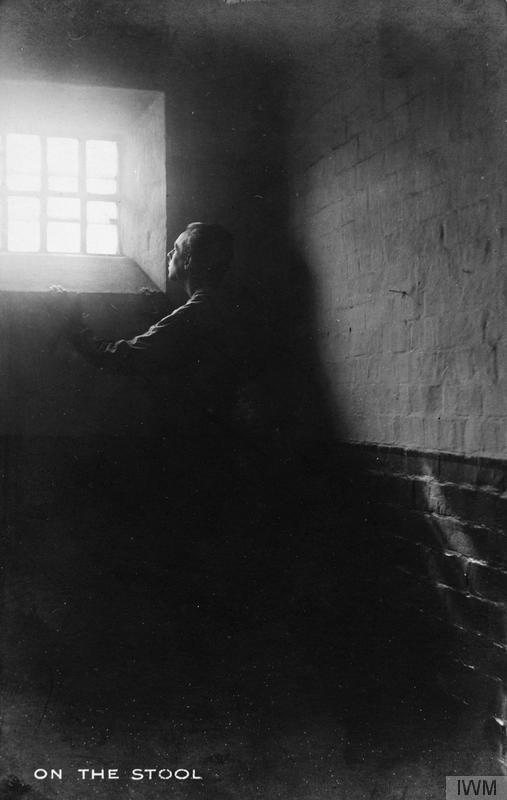
When Harold Bing was in Winchester Prison, there was one wing for male criminal prisoners, one for women and two for conscientious objectors. The conditions for COs were exactly the same as those for criminal prisoners, but COs did succeed in getting prisons to offer a vegetarian diet. Vegetarianism was common among COs, as it had an obvious affinity, particularly with humanitarian pacifism. CO prisoners were allowed a very limited number of censored letters, though one of the COs interviewed by IWM said ‘filling the notepaper was quite an art’ because there was nothing to say after months or years in prison. They had no calendars, no newspapers, and few visits – those visits they did receive were through a grille. They were limited to a few books from the prison library at infrequent intervals, but after a while COs were allowed to have books sent in under the condition that they donate them to the prison library once finished with them. Later CO prisoners were impressed to find prison libraries stocked with titles by William Morris, Sidney and Beatrice Webb and other writers of the left. Here, Bing recalls the constrained and degrading conditions of prison life.
Image – Copy negative made from a postcard of a conscientious objector prison, original caption reads ‘On the stool’ (Q 103094)
Audio – Harold Bing interview © IWM (IWM SR 358)
-
How did conscientious objectors cope in prison?
-
Severe physical brutality towards all COs seems to be a First World War myth. Certainly several of IWM’s interviewees experienced or witnessed very harsh treatment and 73 COs died as a result of physical abuse. The primary punishment – in many cases the most severe – was psychological rather than physical. The most fortunate COs were those who could devise ways to cope with loneliness, doubt, depression and loss of ability to concentrate. Some COs took an active role in challenging the situation in which they found themselves. Some participated in covert activity, described here by Harold Bing. Others coped through mental exercise. One of the COs interviewed by IWM, a musician, played an imaginary piano on his knees and even did some composition. Some COs learned Esperanto, many recited poetry from memory, and several went on long, imaginary, remembered walks. One man held races on the floor between bits of cobbler’s wax and another gained comfort from talking to the spiders on the cell wall and the bolts on its door.
Image – Copy negative made from a conscientious objector postcard depicting the interior of a cell (Q 103669)
Audio – Harold Bing interview © IWM (IWM SR 358)
-
Resistance
-
Some COs openly resisted the system, as described here by Fenner Brockway. Work and hunger strikes were held by COs including Clifford Allen (later Lord Allen of Hurtwood), chairman of the No-Conscription Fellowship, and Sir Francis Meynell. For many COs, the pressures and hardships strengthened their resolve.
Image – Copy negative made from a conscientious objector postcard, original caption reads ‘Ger – inside an’ close yer door!’ (Q 103666)
Audio – Fenner Brockway interview © IWM (IWM SR 476)
-
How were conscientious objectors treated?
-
Whether in prison or not, COs and their families did have a common experience in many respects, especially from the pressures they felt from society. Britain’s public support for the war was almost unanimous and society tended to view men who would not fight – and the men and women who supported them – with suspicion and loathing. To become a conscientious objector in 1916 was a difficult decision, which apparently involved rejecting the whole of conventional British society and everything it stood for. Wartime domestic propaganda made it all too plain that a person was either with the national effort or against it; and if against it, he was by implication either not concerned with the sacrifices of others or was undermining their willingness to serve. The conscientious objector was trapped psychologically: he felt guilty if he shared the soldiers’ ordeal and guilty if he did not. COs were not released until about six months after the end of the war, in order to give most soldiers a head-start when looking for jobs. They were also stripped of the right to vote until 1926. With time most did find a way to fit back into society – some very successfully. None of the COs interviewed by IWM appeared to feel any bitterness about their treatment, but they seem to remain, through their First World War experiences, permanently set apart.
Image – First World War-era cartoon by Frank Holland titled ‘An “Object” Lesson: This Little Pig Stayed at Home’ (Q 103334)
Audio – Clips from interviews with Percy Leonard © IWM (IWM SR 382), Lewis Maclachlan © IWM (IWM SR 565), Dorothy Bing © IWM (IWM SR 555)
This is an abridged version of a longer article, written by Margaret Brooks (former Keeper of the IWM Sound Archive), which appeared in the Imperial War Museum Review, No. 3 (1988).
Nigeria Shia leader to face prosecution: Nigerian official

Nigerian Shia leader Ibrahim al-Zakzaky
Press TV – December 20, 2015
Nigerian authorities say Shia leader Ibrahim al-Zakzaky, who has been arrested and whose family and supporters have faced a bloody crackdown, will face prosecution.
On Saturday, Nasir al-Rufai, the governor of Kaduna State in north-central Nigeria, where Zakzaky was arrested in his home city of Zaria last week, said the cleric “will be prosecuted for any crimes that he may have committed,” Nigerian newspaper THISDAY reported on Sunday.
“That is the decision for the federal authorities. There are state and federal crimes,” the official added, making it clear that the case would be brought against the cleric by Abuja rather than local officials. “There is a government and a constitution and we are resolved to follow the constitution and due process.”
Nigerian forces raided the house of Zakzaky, the head of the Islamic Movement of Nigeria (IMN), last Sunday and arrested him after reportedly killing individuals attempting to protect him, including one of the movement’s senior leaders and its spokesman.
Nigerian soldiers had opened fire on Shia Muslims attending a ceremony at a religious center in the city the previous day, accusing the Shias of stopping the convoy of Nigeria’s Chief of Army Staff Lieutenant General Tukur Yusuf Buratai and attempting to assassinate him. Zakzaky was planning a speech at the center, and the IMN has strongly rejected the assassination accusation.
The attack on Zakzaky’s residence and the violence during the road incident led to the deaths of hundreds of the members of the religious community, including three of Zakzaky’s sons.
The IMN spokesman, Ibrahim Usman, meanwhile, rejected the accusation by the governor that the movement had “blocked roads for four days” during the religious ceremony, which marked Arba’een, the fortieth day to follow the martyrdom anniversary of Imam Hussein (PBUH), the grandson of Prophet Muhammad (PBUH) and the third Shia Imam.
“Clearly, this is a deliberate attempt to twist the facts. During the Arba’een symbolic treks, we block only limited part of the road, and this is to protect persons from traffic accidents, control mass movement and avoid chaos on the roads,” Usman said.
“The governor here was trying to give the impression of a complete occupation of a lane for four days. That was not the case. Blocks were only from junction to junction on the roads. The public was informed about these little inconveniences with apologies on public radio and television stations throughout the trek. Road users during the period would be surprised by the governor’s statement,” he said.

Shia Muslims in Nigeria march during a procession marking Arba’een. (File photo)
Rufai has also announced that a judicial commission of inquiry has been set up to look into the attack on the cleric’s residence.
The IMN has said it does not trust any likely findings by the state investigators, adding that authorities have refused to listen to the Shia community about what happened in Zaria and are only focusing on the army’s account.
How About Perjury Prosecutions for Cops Who Lie About Other Cops’ Killings?
By Adam Dick | Ron Paul Institute | December 12, 2015
It is disheartening to see police unjustifiably abuse, injure, or kill people and then just return to their jobs after perfunctory investigations. In the instances when a cop is charged with a crime, so often the grand jury does not indict or the trial jury does not convict. Not every cop accused of criminal activity is guilty. But, it does seem like in many cases police do the crime but not the time.
At Mimesis Law, Ken Womble suggests employing an underutilized means to ensure some accountability for cops behaving badly: Prosecute police for perjury when they lie in their reports and to investigators. Womble looks to Chicago for an example of where such prosecutions could be undertaken. How about, he asks, prosecuting any police who were present when their fellow cop Jason Van Dyke killed Laquan McDonald and who then described the occurrence in a manner that is inconsistent with the video of the shooting but supportive of Van Dyke’s contention that Van Dyke’s lethal actions were in response to a threat from McDonald?
Womble is not suggesting that prosecutions of cops for murder, assault, theft, and other crimes be abandoned. He is just saying that perjury prosecutions of cops, including cops who took no part in a criminal action yet then lie to cover it up, should be undertaken as well. These perjury prosecutions, Womble explains, should often be easier to carry through to conviction and should have the added bonus of removing the convicted cops from the police profession.
Womble writes:
Unlike murder, assault or other crimes of violence, perjury is much more mathematical. There is no self-defense when it comes to perjury. The only viable defense is that the person believed that their statement was true. When a group of cops put forward the same story, and that story turns out to be demonstrably false when compared to the clear video evidence, it is not a mistake. It is a lie. Even the great Gerry Spence might have to stare at his shoe tops when trying to argue otherwise.
Beyond the sheer improbability of a group of officers all incorrectly remembering an event in the same exact way, there is clear motive. The cherry on top in a prosecution of Van Dyke’s fellow officers would be that they each had the motive to lie, to turn the illegal killing of Laquan McDonald into a justifiable instance of self-defense or defense of others. They did it to protect their fellow officer, in spite of the truth. Is there any reasonable doubt that those officers lied?
No, there is not. Guilty of perjury. Turn in those guns and badges. Those officers would never be able to credibly testify ever again with a perjury conviction under their belts, so they are useless as law enforcement officers. The punishment they should receive for their crime is honestly of lesser concern. Just stop being cops. Go sell shoes or vacuums. You can lie all you want in those professions.
Read Womble’s complete article here.
Home of the brave? Law professor says freedom to read is too dangerous!
PrivacySOS | December 16, 2015
Live from slate.com : ISIS is so scary that we should think really hard about gutting the First Amendment.
In true Slate pitch form, the website has posted an anti-First Amendment screed by law professor Eric Posner, in which he argues that we should “[c]onsider a law that makes it a crime to access websites that glorify, express support for, or provide encouragement for ISIS or support recruitment by ISIS; to distribute links to those websites or videos, images, or text taken from those websites; or to encourage people to access such websites by supplying them with links or instructions.”
Such a law could exempt “journalists, academics, private security agencies, and the like,” Posner reassures us. The punishments for unlawfully accessing public information the government does not like would range from “a warning letter from the government” to fines and “prison sentences,” to escalate in severity with each commission of an ISIS-related thought crime.
Woefully, Posner writes, the pesky First Amendment interferes with such a plan. Courts have repeatedly held that the First protects our right to access “[s]peech that blasts the American constitutional system and praises America’s enemies.”
Ughhhhhhhhh.
So what to do about this obnoxious history of judicial rigidity when it comes to free speech and the freedom to read? Posner suggests we turn back the clock, to a time before the 1960s, when “people could be punished for engaging in dangerous speech.” Ah, the good old days.
Reminiscing, he cites the prosecution of World War One draft resisters, Nazi sympathizers during World War Two, and even Confederate sympathizers during the Civil War. But he forgot to mention that before the Supreme Court’s revolution on expanding speech rights, anti-speech laws were mostly used to crack down on domestic dissent that had nothing to do with support for any foreign “enemy.”
The ACLU was founded in response to such attacks, primarily on union and worker speech:
In 1912, feminist Margaret Sanger was arrested for giving a lecture on birth control. Trade union meetings were banned and courts routinely granted injunctions prohibiting strikes and other labor protests. Violators were sentenced to prison. Peaceful protesters opposing US entry into World War I were jailed for expressing their opinions. In the early 1920s, many states outlawed the display of red or black flags, symbols of communism and anarchism. In 1923, author Upton Sinclair was arrested for trying to read the text of the First Amendment at a union rally. Many people were arrested merely for membership in groups regarded as “radical” by the government. It was in response to the excesses of this period that the ACLU was founded in 1920.
Imagine that. Laws passed to deal with a wartime enemy were used to crush domestic dissent and corral American popular opinion.
How could we make sure a law banning certain kinds of reading wouldn’t bleed out into criminalizing dissent, as similar anti-speech and censorship laws always have in US history? Posner suggests it’s easy: “A simple balancing test would permit laws to target dangerous speech that does not advance public debate.”
Right. Because determining what “does not advance public debate” is simple as pie, and not at all subject to wild fluctuation depending on who makes the determination. That’s totally not the kind of insane “balancing test” the First Amendment was designed to foreclose. … Full article
Privacy advocates blast ‘surveillance bill in disguise’ after CISA tucked into spending deal
RT | December 17, 2015
Under the cover of a late-night session of Congress, House Speaker Paul Ryan announced a new version of the “omnibus” federal government funding bill that includes a version of the Cybersecurity Information Sharing Act, outraging privacy advocates.
The new version combines three bills, two passed by the House, and one – the Cybersecurity Information Sharing Act (CISA) – that had already passed the Senate by a vote of 74 to 21.
A long-standing critic of government overreach in surveillance, Senator Ron Wyden (D-Oregon), who voted against the Senate bill, issued a statement on Wednesday stating that it was a “bad bill when it passed” and “worse bill today.”
“Americans deserve policies that protect both their security and their liberty. This bill fails on both counts,” said Wyden, adding that “cybersecurity experts say CISA will do little to prevent major hacks and privacy advocates know that this bill lacks real, meaningful privacy protections.”
Under the latest version, the bill creates the ability for the president to set up “portals” for agencies like the FBI and the Office of the Director of National Intelligence so that companies can hand information about potential threats directly to law enforcement and intelligence agencies instead of the Department of Homeland Security. It allows for more data sharing between the public and private sector while shielding companies from liability.
It also changes the criteria for when information shared for cybersecurity reasons can be used in law enforcement investigations. Previously, the backchannel use of data could only occur in cases of “imminent threats,” while the new bill requires just a “specific threat.”
The Electronic Frontier Foundation has strongly opposed cybersecurity bills over the past five years. In a statement, it said they did nothing to address the real problems the government faces, “like computer data breaches that are caused by unencrypted files, poor computer architecture, un-updated servers, and employees (or contractors) clicking malware links.”
Other advocacy groups, such as Fight for the Future, have previously referred to the bill as “a surveillance bill in disguise.”
The group’s campaign director, Evan Greer, called it “a disingenuous attempt to quietly expand the U.S. government’s surveillance programs.”
“Congress has failed the Internet once again,” she added, “now it’s up to President Obama to prove that his administration actually cares about the Internet. If he does he has no choice but to veto this blatant attack on Internet security, corporate accountability, and free speech.”
The bills were opposed not just by privacy advocates, but also civil society organizations, computer security experts, and many Silicon Valley companies. In April, a coalition of 55 civil groups and security experts signed an open letter opposing an earlier version of CISA.
The Department of Homeland Security itself warned in July that the bill could overwhelm the agency with data of “dubious value,” while at the same time “sweep[ing] away privacy protections.”
The EFF also said the CISA bill has no place in the federal budget package, a point shared by the Open Technology Institute (OTI).
“They’re kind of pulling a Patriot Act,” Robyn Greene, police counsel of OTI, told Wired. “They’ve got this bill that’s kicked around for years and had been too controversial to pass, so they’ve seen an opportunity to push it through without debate. And they’re taking that opportunity.”
Lieberman launches campaign to oust Hanin Zoabi and the Joint Arab List from the Knesset
MEMO – December 17, 2015
Israeli Member of Knesset Avigdor Lieberman, who also heads the Yisrael Beiteinu Party, has launched a campaign to oust Arab MK Hanin Zoabi and the Joint Arab List from the Israeli parliament.
The campaign, which Lieberman began on his Facebook page yesterday, calls for “permanently” ousting Hanin Zoabi from the Knesset. “Together we can expel vandal supporters from the Knesset,” he said in a Facebook post.
In a video posted on his page, Lieberman called on the Israeli public to put pressure on MKs from the Likud, Jewish Home, Kulanu, Shas and United Torah Judaism parties to support the proposed campaign, which aims to expel Zoabi and the Joint List from the Knesset.
Lieberman mentions in the video that the Central Election Commission (CEC) previously banned Zoabi and her party Balad (a member of the Arab Joint List) from running but that the Supreme Court overturned the commission’s decision. As a result, Lieberman presented a bill seeking to remove the Supreme Court’s power of intervening in CEC’s decision of whether to approve or ban the participation of a candidate or a list in the Knesset’s elections.
Lieberman claims that the banning of Balad was in line with the law, which states that those who support terrorism and armed struggle against the state of Israel, or deny Israel’s existence as a Jewish state, cannot be in the parliament. “The party of traitor Azmi Bishara and his successor Hanin Zoabi is doing that openly, and it is time they were made to pay the price,” he added.
Turkish troops ‘raiding civilian houses’ in Kurdish city of Silopi
© farukencu / Instagram
RT | December 17, 2015
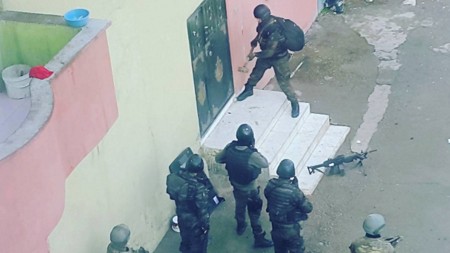
The Turkish Army has reportedly sent military vehicles, including tanks, into civilian areas in its predominantly-Kurdish southeast. While mainstream Western media remains silent, local activists posted frightening photos on social media.
The People’s Democracy Party (HDP) published a series of photos of the Thursday raid by the Turkish Army. According to HDP, soldiers in the Yenisehir district of Silopi “broke into a building and pointed guns at people.”
Ferhat Encu, an MP for the People’s Democratic Party, was taken into custody in Silopi.
“The world and those justifying this cruelty know well, this isn’t an ‘anti-terror’ act. This is an ethnic cleansing and genocide operation,” the party tweeted.
Ankara has been busy conducting military operations in the southeast since summer. Tensions have been mounting for months as security forces have been battling Kurdistan Workers’ Party (PKK) militants after a ceasefire collapsed in July. The PKK has been fighting for an autonomous Kurdish region inside Turkey for over three decades.
Earlier this week, Turkish Prime Minister Ahmet Davutoglu promised that anti-PKK operations would continue in Silopi and Cizre in order to, as he put it, prevent the militants from “spreading the fire” from Syria and Iraq into Turkey.
“The terrorists will be wiped out from these districts. Neighborhood by neighborhood, house by house, street by street,” he pledged.
Nurcan Baysal, founder of the Diyarbakir Political and Social Research Institute, has described Davutoglu’s language as “very dangerous.”
“If the Turkish state wants peace with its Kurdish citizens, it should change its dangerous language into the language of peace,” Baysal told the Middle East Eye news outlet. “Unfortunately, the Turkish state has decided to wage war against the Kurdish people again.”
“People are without water, electricity, food, medical care, and many civilians have died – and state officials say that they will continue this.”
Figen Yuksekdag, the co-chair of the pro-Kurdish Peoples’ Democratic Party (HDP), has publicly accused Davutoglu of “ordering a massacre” in Cizre and Silopi.
“Who are these operations against, Mr. Prime Minister?” Yuksekdag wondered at a press conference in Diyarbakir. “There are people living in these houses, Davutoglu,” she said.
Thousands took to the streets of Diyarbakir in late November after Tahir Elci, a lawyer and campaigner for Kurdish rights, was shot dead in while giving a speech on November 28. This became the last straw.
Seven Kurds were killed following clashes with Turkish security forces earlier this week. Two died in the city of Diyarbakir as protesters fought with police, while five lost their lives in the Mardin province.
Around 5,000 people gathered for a march in Diyarbakir on Monday, according to AP, which was called by the Peoples’ Democratic Party (HDP). Local residents gathered to voice their concerns about round-the-clock curfews being implemented in the region.
According to the Human Rights Foundation of Turkey, there have been a total of 52 curfews imposed since mid-August across seven provinces in the region, affecting areas where some 1.3 million people live.
Residents from the pro-Kurdish town of Silvan (some 80km north east of Diyarbakir) said they had been shelled by Turkish forces in mid-November, while the never-ending curfew had driven them to the brink of starvation.
Featured Video

Seyed M. Marandi: US-Iran War Inevitable: Kuwait and Bahrain May Fall
or go to
Aletho News Archives – Video-Images
From the Archives
USS Liberty Massacre: A Pivotal Moment in the Hostile Takeover of America
By Kevin Barrett | Crescent | Dhu al-Qa’dah 24, 1445
In corporate America, hostile takeovers are commonplace. They occur when an aggressor—a larger corporation or rich individuals—seizes control of a smaller corporation without asking permission.
What few recognize is that the United States itself has been subjected to a hostile takeover. Since the aggressor, the illegitimate settler colony known as “Israel,” is much smaller than the US, the takeover has necessarily been surreptitious.
As of June, 2024, Israel’s gradual takeover of the US has become obvious and undeniable—a proverbial “elephant in the living room.” … continue
Blog Roll
 Aletho News
- Seyed M. Marandi: US-Iran War Inevitable: Kuwait and Bahrain May Fall
- Leaders Condemn Ansarallah Attack on Saudi Arabia While Ignoring Illegal War Against Yemen
- Leaked: Britain’s Covert Iraqi Psyops Network
- Yemeni Armed Forces Warn Airlines Against Using Saudi Airports, Exempt Mecca and Medina
- Iran security chief says powers greater than US tried to conquer Iran but ended in ‘dustbin of history’
- Europe’s mounting social chaos… chickens coming home to roost for proxy war against Russia
- US-Russia Diesel Deal Becomes Massive Defeat for Ukraine
- Hormuz and the Looming Economic Catastrophe
- Dhubab offensive, media blitz and the rapid unraveling of Saudi-backed coalition’s new gambit
- Putin Conveys to Trump Iran’s Vision on Possible Conflict Resolution – Kremlin
- If Americans Knew
- Gaza: Ceasefire Anniversary Marks Year of Failed Promises
- The American Conservative: Mike Huckabee Should Resign
- A C-Section in Shackles: A Palestinian Woman’s Harrowing Birth in Israeli Detention
- ‘He’s Desperate’: AIPAC Begins Spending Against Abdul El-Sayed to Boost Mike Rogers:
- Trump, Hormuz, and the Looming Economic Catastrophe
- For three years, Israel has killed a child in Gaza every 71 minutes – Daily Update
- Israeli forces kill another child in Gaza – Daily Update
- Gaza ceasefire exists in name only, say more than 100 organizations
- Nearly 2 Million in Gaza Need Urgent Shelter Assistance as Winter Looms: IOM Chief Warns
- Suppressing Palestinian resistance: US charity under fire for AI monitoring of Gaza classrooms
- No Tricks Zone
- Germany’s Green Energy Debacle: High Energy Costs Force Kahla Porzellan to Close After 182 Years!
- New Study: 50 Years Of The Most Aggressive ‘Net Zero’ Policies Can Only Affect The Global Climate By 0.03°C
- US September “Heat” Was No Record…Many Records Set Decades Ago
- Latest European Green Energy Debacle; Portugal’s Largest Flagship Solar Park Insolvent!
- Green Energy Debacle: German Expert Professor Fritz Vahrenholt Warns Of Severe Economic And Social Consequences
- Two More Paleo Reconstructions Affirm Meters-Higher Sea Levels Across Ireland, Brazil 7000-6000 Years Ago
- New Study: Earth And Venus Surface Warmth Largely Explained By Convection And Lapse Rate, Not CO2 Or Radiation
- 2025 Nature Paper Claiming Worsening Global Drought Gets RETRACTED …Heavily Flawed
- New Study: ‘Global Drought Shows No Detectable Recent Acceleration Under Climate Warming’
- Economic Masterminds: German Socialists Suggest Taxing Productivity Gains Stemming From Using AI

