Washington DC Student Forced to Remove Palestinian Flag
Sputnik – 10.12.2015
A student at George Washington University has been forced by police to remove a Palestinian flag they had hanging from their dorm room — despite countless flags hanging from other windows in the dormitories.
Ramie Abounaja, a 20-year-old pre-med student has also been threatened with future disciplinary action despite complying with the police, the Intercept reported.
On October 26, a police officer arrived at Abounaja’s Washington, DC, dorm room to order the removal of flag. The officer cited receiving multiple complaints and explained that he would not be leaving until it was removed, which the student complied with.
The following week, the student received a letter from the school’s Office of Student Rights and Responsibilities, which oversees disciplinary issues. “This letter serves as a warning that this behavior is a violation of the ‘Code of Student Conduct’ and/or the Resident Community Conduct Guidelines,” it began.
“As a member of the larger residential community we hope that you will be respectful of your peers and be aware of your behavior. The act of an individual has a profound impact on the community. … Subsequent reports naming you as a subject may result in disciplinary action taken by the university.”
The student noted that other students have been allowed to continue hanging their national flags from their windows, and that he is being selectively targeted.
“I felt like I was being singled out, because of my heritage and the viewpoint of my speech, for something I’ve seen dozens of students, fraternities and other student groups do in my three years at GW,” Abounaja wrote in a letter to the school.
Nationwide, there appears to be a crackdown taking place on pro-Palestinian speech and particularly against the BDS movement which aims to boycott Israel over their treatment of the Palestinian people.
Palestine Legal, a US civil rights advocacy organization, has reported 140 instances of suppression of Palestine advocacy in the first six months of 2015, 80 percent of which were on college campuses, the Intercept reported.
After Palestine Legal published an open letter to the George Washington University regarding their treatment of Abounaja and demanding an apology, explanation, and for them to retract their future disciplinary notice, the university’s media relations released a statement claiming that it wasn’t discrimination and that no students may have flags hanging from the school’s housing.
“The George Washington University is committed to fostering a welcoming and safe environment for every member of the GW community, and we encourage students to share their rich diversity of backgrounds, experiences and views with their peers. GW has not banned any flags from its campus; however, the university’s Residential Community Conduct Guidelines prohibit the hanging of any object outside of a residence hall window (Section III. 7). These guidelines apply to all on-campus housing residents.”
Following the school’s statement, Students for Justice in Palestine at GW released a statement of their own, calling the university on their hypocrisy.
The student group alleged that the selective enforcement points to an anti-Palestine sentiment and that “flags of other countries hang out of dorm windows with no disciplinary consequence.”
They continued on to state that “selective reinforcement of these rules is discrimination. In this moment of rising Islamophobia in the United States, it is contradictory that a university that advertises inclusivity and diversity would act like this.”
Universal Vaccinations for Children will be Overseen by Committee which Accepts Vaccine Manufacturer Monies
By Janet Phelan – New Eastern Outlook – 10.12.2015
A House of Representatives Bill, short titled “Vaccinate All Children Act of 2015,” has been referred to the Subcommittee on Health and is awaiting committee action.
HR 2232 was introduced by Frederica Wilson, Democrat from Florida and is largely modeled on the California student vaccination act, which was signed into law by Governor Jerry Brown in June of this year.
Like the California Act, HR 2232 removes all previous exemptions from vaccination, other than a medical exemption, supported by a medical doctor’s statement that a particular vaccination would be hazardous to a specific child’s well- being. Gone are the religious exemptions and philosophical exemptions.
Previously, forty-eight states had laws on the books honoring religious exemptions and nineteen states allowed philosophical exemptions.
This Act would override any state law governing vaccine exemptions, making it mandatory for all students at public elementary and secondary schools to be vaccinated. The bill would amend the Public Health Services Act to require students “to be vaccinated in accordance with the recommendations of the Advisory Committee on Immunization Practices.” (ACIP)
The bill does not, however, reveal which vaccinations would be mandatory nor does it place a cap on vaccinations.
The above cited Advisory Committee, which will be making the decisions concerning which shots are mandatory, is stacked with pro-vaccination heavyweights. Notable committee members include a Dr. Kelly Moore, Director, Tennessee Immunization Program, Dr. Edward Belongia, Director, Center for Clinical Epidemiology & Population Health at the Marshfield Clinic Research Foundation and Dr. Kathleen Harriman, Chief, Vaccine Preventable Disease Epidemiology Section with the California Department of Public Health, to name a few. Also sitting on the Committee as Ex Officio members are Department of Defense (DoD) officials as well as FDA officials and members of the Department of Veterans Affairs, among representatives from other federal agencies.
Dollars for Docs
A close scrutiny of this Advisory Committee reveals that quite a number of its members are enriching themselves through vaccine industry “donations” or grants.
For example, some of these individuals have a history which includes industry sponsorship or employment. An example is Dr. Belongia, who has been listed as Co-Principal Investigator for an industry sponsored study of effectiveness of quadrivalent influenza vaccine in children.
According to Propublica, a number of these vaccine experts on the Advisory Committee are accepting large sums of vaccine company money. Dr. Gregory Poland, who is with the American College of Physicians and also the Mayo Clinic, has received a total of $17,351.00 from vaccine manufacturers Novartis Vaccines and Sanofi Pasteur. The money changed hands, according to Propublica, for activities by Dr. Poland listed as promotional speaking, consulting and travel and food expenses from November 2013 through December 2014.
Dr. Stanley Grogg, a “Liaison Member” of the Committee and with American Osteopathic Association (AOA), was rewarded for his “promotional speaking” activities, as well as “consulting,” “travel and lodging” and of course the ubiquitous “food and beverage” — to the tune of $60,391.00. These payments were made during the period of August 2013 through December 2014 and came from a buffet of pharmaceutical companies, including Pfizer, Sanofi, Novartis Vaccines and GlaxoSmithKline, among others.
Dr. Kenneth Schmader is listed as a “Liaison Member” of the ACIP, due to his position with the American Geriatrics Society (AGS). He is a Professor of Medicine-Geriatrics and Geriatrics Division Chief at Duke University and Durham VA Medical Centers in Durham, NC. Dr. Schmader received $75,913.79 for research, paid by Merck, Sharp and Dohme Corporation during the program year 2014.
Dr. Carol Baker, a “Liaison member” and with Infectious Diseases Society of America (IDSA) , also works as a Professor of Pediatrics with the Baylor College of Medicine in Houston, Texas. Dr. Baker was also found to have received $37,514.00 from August 2013-December 2014 for speaking, consulting, lodging and eating. The usual suspects pop up as the vaccine manufacturers who contributed to Dr. Baker—Novartis and Pfizer making the majority of the contributions.
Not to be left in the dust, Dr. William Schaffner, a “Liaison Member” from the National Foundation for Infectious Diseases (NFID) and the Chairman, Department of Preventive Medicine, Vanderbilt University School of Medicine, received a total payment of $26,208 in the two year period from Pfizer and Sanofi Pasteur. The total paid Dr. Schaffner for travel and lodging came to $13,653.00.
Committee member Dr. Ruth Karron, who is listed as Professor and Director at the Center for Immunization Research, Department of International Health at Johns Hopkins Bloomberg School of Public Health in Baltimore, received $ $7,173 from GlaxoSmithKline for consulting from April-December, 2009, while Dr. Lee Harrison of Pittsburgh was paid a total of $27,663.00 by Glaxo and Pfizer, from 2009-2012.
Besides direct payments to pro- vaccine committee members from the pharmaceutical companies, there are other revenue streams gracing ACIP committee members. While this reporter did not find evidence that Advisory Committee member Dr. Arthur Reingold had received the above types of monies from Big Pharma, his name surfaced in connection with an effort to shut down a Professor whose work challenged the conventional wisdom that AIDS was mortally impacting large numbers of Africans. Reingold was assigned to “investigate” professor Peter Duesberg for “misconduct,” surrounding Duesberg’s findings that figures on AIDS deaths in Africa had been deliberately inflated.
As it turned out, Dr. Arthur Reingold had received over $37 million for AIDS research since 1988. Professor Duesberg was subsequently exonerated of the charges.
Dr. David Stephens, a voting member of the Committee, also did not show up on the Propublica list of doctors who took money from pharmaceutical companies. Stephens, whose bio states he has “led research initiatives in the School of Medicine” (at Emory University), is responsible for Emory researchers receiving “$521.8 million from eternal funding agencies in fiscal year 2014.”
Stephens also hobnobs with the Vaccine Dinner Club, which exists to “advance the practice of vaccine science by stimulating the intellectual potential and research productivity of the vaccine research community in the Southeast…”
Dinners and membership in the club are free, sponsored by Emory University and other organizations. I guess with a half billion dollars knocking around in your pocket, a free lunch for your fellow scientists wouldn’t be much of an issue.
Stephens also sits on the Board of Directors for Georgia Bio, a non-profit organization dedicated to advancing the growth of Georgia’s life sciences industry. Also represented on the Georgia Bio Board are vaccine manufacturers and pharmaceutical companies: Johnson and Johnson, Geovax, Arbor Pharmaceuticals, Immucor, Osmotica Pharmaceutical Company and Femasys.
Georgia Bio was contacted by this reporter, who wished to query what, if any, compensation Stephens received for his service on the Board. Jennifer Kauffman, Development Director, promptly hung up rather than answer.
Should HR 2232 be approved by the US Congress, it is this Advisory Committee which will decide which vaccinations American children must receive. The clear conflict of interest inherent in Committee members padding their wallets with money from the pharmaceutical industry realistically should disqualify the members from making these critical decisions.
Opaque Government
These conflicts of interest are not new for the ACIP. As reported over fifteen years ago by the National Vaccine Information Center, previous conflicts of interest ranged from the ACIP chairman owning stock in vaccine giant Merck, to other financial ties between committee members and vaccine companies. In addition, the National Vaccine Information Center reported that the mandated financial disclosures filed by committee members were incomplete, rendering a full accounting of their financial relationships with pharmaceutical companies difficult, if not impossible.
Regarding the compensation paid by the CDC to ACIP members, CDC reports that;“Appointments are not remunerated. However, members are compensated for expenses incurred by attendance at meetings. Such compensation, which includes the issuance of airline tickets, per diem to cover lodging, meals and incidental expenses will be in accordance with DHHS/CDC travel rules. An optional honorarium of $250/day for each day that a member attends an ACIP meeting is offered to voting members, who are designated as Special Government Employees during their tenure on the Committee.”
Radio show host (Wise Women Media) Anita Stewart contributed research to this report. This reporter requested that Stewart contact the CDC to query what sort of compensation the ACIP members received, as the CDC will no longer respond to public records or media requests from this reporter. This blacklisting took place following the publication of an article in Activist Post, indicating that the CDC was deflating the numbers of biological weapons labs.
Stewart, who located the above information on ACIP compensation online, was questioned by CDC media officer Sonny Dill, who kept insisting that Stewart was I. Dill also wanted to know who Stewart worked for, stating this information was necessary before answering any questions. Stewart, who was forthcoming in response, reports that Dill declined to supply the information requested.
California Cops Shoot Two Innocent Black Men, Then Accuse Them of Murder
Sputnik – 10.12.2015
Two innocent black men who were shot by Los Angeles area cops have been falsely accused of murder even though the victim was actually struck and killed by a police vehicle.
Robert Pickett, 35, and Darryl Lewis, 39, testified in federal court that they were simply going about their business in May 2011, when Officer Mike Bollinger of the Inglewood Police Department approached them with his gun drawn.
Pickett claims that Bolliger “parked his car at the corner, got out armed with his shotgun cocked, loaded and ready to fire” and shot at the two men.
“No questions asked, no weapons seen, no words offered or exchanged,” Pickett wrote in a federal complaint. “Defendant Bollinger blasted three shotgun rounds at the hapless and unarmed plaintiffs, striking them and wounding them as they sought to take cover from assault, leaving them in critical condition, bleeding face-down on the ground.”
The two men were outside the apartment complex where Lewis lived as the officer arrived alone to respond to a call of a home invasion involving two black men armed with handguns. No other information was provided about the alleged robbers.
“Without warning, without investigation, without knowledge of who was in the area, of who the suspects were or what they looked like, and in violation of all training and standard police protocol, [Bollinger] approached the apartment gate and immediately shot Mr. Lewis and Mr. Pickett,” the complaint alleges.
Pickett, who has a young son, was shot seven times, including in his head.
Lewis, a father of four, was shot in the back and three times in his legs.
As more officers arrived on the scene, the two men say it had become apparent to the police that they had the wrong guys, and that the officers set to covering it up.
An officer also struck and killed a pedestrian while rushing to the scene.
Mysteriously, stolen items from the robbery that had initially prompted the police response appeared at the scene, as well as two weapons.
“The problem for defendant Bollinger and the rest of defendant police officers was that neither plaintiff was armed; neither possessed a weapon of any kind. Likewise, neither plaintiff was in possession of any of the stolen items supposedly taken by the suspect in the robbery,” the complaint states. The robbery victims also did not name Pickett and Lewis as the people who had entered their home.
The complaint also states that the first photos from the scene “do not show any weapon nor any of the stolen items. Some of the responding officers to the scene failed to see any weapons purportedly belonging to either plaintiff. Somehow, however, two handguns appeared and stolen items appeared as well. It was determined by subsequent forensic analysis before plaintiffs’ criminal trial, that neither plaintiff was in any way connected physically with the weapons or the items.”
The men reportedly did not receive medical treatment for an hour, and the officer allegedly told them that he “he did not give a f*** that he had shot him in the head.”
Pickett and Lewis were charged with murder of the pedestrian killed by the police car, attempted murder of Bollinger, and carrying loaded firearms.
The innocent men then spent a year in jail awaiting their trial, which eventually exonerated them.
They now seek punitive damages for civil rights violations, unreasonable and excessive force, false arrest, malicious prosecution, and failure to intervene, train, supervise and discipline, Courthouse News reported.
‘Sick of being targeted’: French authorities conducting warrantless raids on Muslims
RT | December 9, 2015
Emergency legislation enacted after last month’s Paris attacks has led to a fierce crackdown on France’s Islamic population. Warrantless searches and raids have become commonplace, a move which many say violates the civil liberties of Muslims.
Speaking to RT’s Daniel Bushell, the manager of the Pepper Grill restaurant on the outskirts of Paris recalled a police raid at his restaurant on Saturday night.
“They blocked the roads with trucks, and up to 40 armed men stormed our restaurant… Saturday night’s the busiest time. Children were eating. The cops had shotguns, black masks, and shields, making the women tremble with fear. Several officers rushed downstairs, then suddenly… they began breaking the doors with battering rams. The door wasn’t even locked,” the restaurant manager said.
After police failed to find any weapons during the search, they raided so-called “undeclared prayer rooms” above the restaurant. However, legal experts told RT that it is unlikely that such rooms are illegal, even under the country’s new emergency legislation.
The emergency laws, implemented after last month’s terror attacks which killed 130 people and left 352 others injured, have led to thousands of warrantless searches and raids.
But it’s not just private property that is being targeted – Muslims are also being singled out on the street.
“Police tried to pull the hood off the head of an Arab friend eating with my little brother. Then they detained him, saying it’s a state of emergency so they have the right,” a local told RT on condition of anonymity, fearing police reprisals. He added that the community is “sick of being targeted.”
Such targeting is reportedly worse for young people, many of whom said they pull hoods over their faces as soon as they see a police car, so officers can’t see the color of their skin.
That fear is a direct result of the war being waged against the Muslim community, according to Yasser Louati of the Collective Against Islamophobia in France. He recalled a situation where a mother was “touched in her private parts by police,” and another mother who “lost her baby after a raid.”
However, one French mayor is not backing down, believing that extra security is necessary because France is “living amid an Islamic threat.”
“I’ve already doubled the number of city policemen, but I went even further. I asked all the former policemen, firefighters and servicemen to come and help to protect our citizens. If my initiative goes against the law, we should change the law. We are living amid an Islamic threat and we should be aware of the consequences. Our country, as well as other European countries, is at war – both outside our borders, in Syria for instance, and inside our borders, because our enemies live in our own country,” Robert Menard, mayor of the French town of Beziers, told RT.
In addition to warrantless searches and raids, France’s state of emergency laws allow the government to put people under house arrest, seal the country’s borders and ban demonstrations. The laws were created during the Algerian war in 1955.
France is currently aiming to change its constitution to allow a state of emergency to last for six months, according to government sources. The proposal, which has been slammed by many who say the government is abusing its powers, will be put to ministers on December 23, according to AFP.
Anti-Assimilation group protests Christmas tree event in Jerusalem
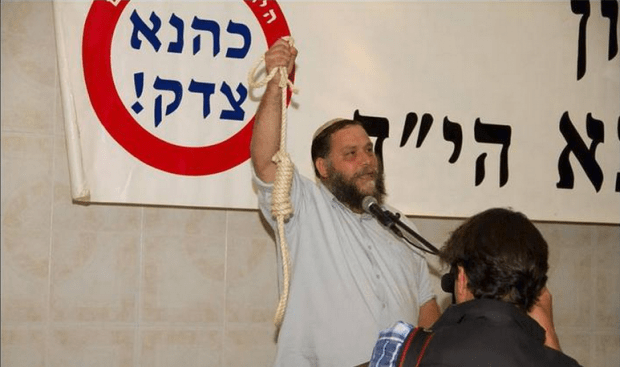
Benzi Gopstein holds a noose at a Lehava meeting shared on social media (Twitter/@ronnie_barkan)
IMEMC News | December 6, 2015
The right-wing Jewish group ‘Lehava’ held a protest outside of the YMCA in Jerusalem, shouting at Palestinian Christian children and families as they were entering and leaving the annual Christmas-tree decoration party.
Lehava is a group that calls for the expulsion of the indigenous Palestinian population from their homes in what is now Israel, in Jerusalem and in the West Bank. At a protest last year outside of a business that had some Palestinian employees, the group chanted “Stop hiring Arabs,” “stop dating our women” and “employing Arabs equals Assimilation.”
The group, whose name in Hebrew stands for the “Organization for the Prevention of Assimilation in the Holy Land”, has also disrupted weddings between Palestinians and Israeli Jews, and handed out fliers saying they are trying to “save the daughters of Israel” by preventing them from dating or marrying Arab men.
A 2011 investigation by the Israeli newspaper Ha’aretz found that around half of the annual budget of the controversial Lehava organization was funded directly by the Israeli government.
The leader of the group, Benzi Gopstein, was reportedly present at the YMCA protest on Friday. Gopstein is on the record voicing support for Pinhas Aburamed, an Israeli man who murdered a Palestinian who he thought was trying to flirt with a Jewish girl. Gopstein said that Aburamed is a hero and should receive a medal.
The event that the right-wing Jewish Lehava group chose to protest was a family event described on the YMCA’s website as “A festive evening in the YMCA lobby decorating the Christmas tree, singing carols and enjoying holiday treats.”
The protesters shouted anti-Palestinian and anti-Christian slogans at the children who came to decorate the Christmas tree, including, “The Arabs won’t defeat us with knifes, and the Christians won’t buy us with presents,” and “Jews want a hanukkiah [menorah], not a fir tree”, according to Israel National News.
Around 1% of the population of Israel, the West Bank and Gaza is Christian. The percentage had been higher before the Israeli military occupation and theft of Palestinian land began. The emigration of Palestinian Christians to other countries increased significantly after the Oslo Accords were signed in 1993 and Israeli settlement expansion increased exponentially.
Many Palestinian Christians in Bethlehem, Jerusalem and Nazareth can trace their ancestry back to early Christians who have remained continuously on the land where Christians believe that Jesus was born, died and resurrected.
Why ‘Active Investigations’ Don’t Justify Keeping Police Video Secret
By Jay Stanley | ACLU | December 4, 2015
The Chicago police last week released video of 17-year-old Laquan McDonald being shot to death by a police officer. Release of the video showing the 16-shot barrage came only after a judge order its release, and after more than a year during which the police had refused to make it public. In Minneapolis, protesters have been clashing with police as the police similarly refuse to release video in the recent shooting death of another young Black man, 24-year-old Jamar Clark. In both cases the police have cited the need to keep video under wraps because there is an “ongoing investigation.”
The question of what police body camera video gets released to the public, and when, is an important one, and has become one of the central areas of dispute surrounding the technology. At issue are two sometimes conflicting values: privacy, and government transparency. Our position (as outlined in our body camera white paper and model policy) is that while most video footage should be kept private—held for a short period in case a complaint is filed, not analyzed or used for any other purpose, and then deleted within six months—some video footage is important for the public to see. We call for video of incidents to be releasable under state open records laws where there has been a use of force, a felony arrest, or a complaint against a police officer. Certainly in the case of a police shooting or other use of deadly force, the public’s interest in understanding how and why an officer took such an extreme measure is overwhelming.
Police departments, however, regularly refuse to release video citing their need not to release details of ongoing criminal investigations. Aside from the question of whether police should have exclusive control over videos in the first place, the question needs to be asked: does this general exception to public transparency make sense in the case of body camera or other video footage of police uses of force?
There are a limited and narrow range of purposes for which exemptions should legitimately be granted. Those purposes include:
- Protecting personal privacy
- Protecting confidential sources
- Not interfering with the investigation
- Protecting the right to a fair trial
Many state laws have active-investigation exceptions to their open-records laws, and these laws vary but generally include the above factors, as does the federal FOIA law (Exemption 7). The federal law also includes a broad catch-all exemption for circumstances where disclosure could “reasonably be expected to interfere with enforcement proceedings,” as well as an exemption for when it could “reasonably be expected to endanger the life or physical safety of any individual.” And, it contains an exemption for law enforcement guidelines, techniques, and procedures where “such disclosure could reasonably be expected to risk circumvention of the law.”
But none of these exemptions justify the withholding of video footage of a shooting or other use of force by a police officer. Exemptions to open-records laws for “ongoing investigations” were simply not created with police video of police shootings in mind, and do not make sense applied to such recordings. Yet police departments around the country are using these rules to block or delay release of video not because it would harm investigations, but because it makes them look bad. This is not how things are supposed to work in a democracy.
Let’s look at each justification for “active investigation” exemptions and how they apply—or not—to body camera footage.
Privacy: One purpose of these exemptions is to protect people from the stigma of being under investigation before the police have even finished assessing whether there is evidence of their involvement in a crime. A police officer who has used deadly force against a citizen has typically already been identified, and has no right to privacy in such circumstances as they are an employee of the public whose actions, ostensibly to protect the interests of that public, merit the highest levels of community scrutiny.
A concrete example of this was given to me recently by Laura Schauer Ives, a civil rights attorney in New Mexico (and former legal director for the ACLU there) who litigates on police use-of-force issues, including the infamous James Boyd shooting. As she pointed out,
The public needs to know if there are problematic officers. That’s why in Albuquerque, we know which officers have shot people three, four times. We have officers who have repeatedly used excessive force against citizens, and that’s the only way to know it, by knowing their names. And that is their job. You’re a police officer doing your public job.
In Chicago, where police and city officials fought to keep civilian complaints secret, the resulting lack of sunshine has allowed problematic officers to stay on the job unpunished (as we now know only because of a decade-long legal battle to bring that information to light).
When it comes to the privacy interests of the subject or victim of a use of force (or his or her survivors), typically they do not object to release of the video on privacy grounds; in the vast majority of cases under contention they are the ones clamoring for release. I recently wrote about an exception, where a shooting victim’s family sought to block release—but even there the public’s interest in monitoring the police force overcomes the privacy rights of the subject of police use of force. Should a video show bystanders with a legitimate privacy interest, their identity can be obscured through redaction of the video.
Protecting confidential sources: If an officer shown in the video is an undercover officer, his or her identity can ordinarily be obscured through redaction. While a case involving an undercover officer is theoretically possible, I have not heard of one. Redaction should also be sufficient should bystanders or others in a video happen to be informants. (And of course unredacted bystander video posted online can render any of these protections moot.) But this exemption to transparency has been abused: Ives told me that in New Mexico “we see the Albuquerque Police Department making the argument that officers who are not undercover, are undercover. If you’re out in public in a police vest that says APD, sorry but you’re not undercover.”
Interfering with the investigation: Another purpose of secrecy can be to avoid alerting suspects that they are under investigation (potentially spurring them to destroy evidence) or revealing what the authorities know about them and their possible crimes. But if there has been a police shooting, then the situation is different from those in which the above concerns apply. In a shooting, or if there has been a complaint, the involved officers know full well that they will be the subject of an investigation. (It is important to temporarily withhold the video from viewing by those under investigation—witnesses, arrestees, and the involved officers—until after they have given initial statements on the incident, as we have explained, but that does not justify any significant delay in release of the video to the public.)
Furthermore, the reason that police don’t want to release the details of an investigation to the public is that they don’t want one member of the public in particular—the perpetrator—to see that evidence. But in a police shooting, once the involved officer has seen that video, withholding it from the public no longer serves the purpose of keeping it from the person under investigation—now it serves only to prevent the public from seeing it. That’s not a legitimate goal on its own.
The right to a fair trial: It is important insofar as possible to protect defendants in criminal trials—whether they are arrestees or police officers—against pre-judgment by the community. Exposure to video evidence can harm not just the defense, but also the prosecution; one former Justice Department official whose job had included prosecuting police officers made the point to me that letting potential jurors in the community view a video before trial will shape and prejudice their impressions of what took place.
This is a legitimate concern, but generally does not hold up against the public’s critical need to engage in oversight of how its police are using force. There are also several factors that diminish the force of this consideration. Bystander video has so far been much more common in police shootings than bodycam video, and nothing can stop bystanders from exercising their First Amendment right to post their videos of an incident for the whole community to see. The courts have dealt with public bystander videos and they can deal with public bodycam videos—through the jury selection process for example, or change-of-venue motions that can be filed if the concern is particularly significant. In addition, it’s not clear how differently a video will prejudice a juror who views it on YouTube before joining a jury, compared to how they’ll interpret it when viewed at trial. It is far more important to get untainted initial testimony from witnesses and participants in a use of force case, than shielding the community at large.
The right to a day in court: There’s another reason it’s not okay to delay release of video until investigations and other legal processes around an incident have run their course: it prevents individuals from seeking justice for police wrongdoing in court. “It’s actually imperative that these things be public because of federal pleading requirements,” Laura Ives told me, explaining:
It used to be when you go to federal court with a claim of abuse, you just needed to make enough of a claim to get past a motion to dismiss. Now the federal standard under a case called Iqbal is that your claim needs to be “plausible.” To demonstrate that, you have to have enough information—you have to have evidence, you have to have a fairly strong claim going into the litigation, and even then you’re going to go up and back within a circuit on the qualified immunity issue before you ever get discovery, before you ever get to see a video or get a deposition. So getting video as a public record, seeing what happened in a shooting for example, is very, very important if you don’t want your lawsuit dismissed before you ever get to see discovery.
Overall, in some circumstances there can be sufficient reason to delay the release of certain evidentiary materials due to an active investigation, but when it comes to police body camera videos, the public’s interest in immediate oversight of how police officers use force is overwhelming, and it is hard to imagine circumstances in which the reasons for withholding such videos are not inapplicable or fatally weak—and even in the scenarios I can come up with, redaction would be sufficient.
Indeed last week’s release of the Laquan McDonald video followed a ruling by a judge who found that the Chicago police had failed to prove that releasing the video would hurt any ongoing investigation. But where existing state open records laws and jurisprudence do not clearly provide for the immediate release of police body camera video, state legislatures should take action to make clear that ongoing-investigations exceptions to open records laws do not apply to police body camera footage. If unusual situations should arise that we have not unanticipated, in which the harms such laws are intended to prevent would be brought about with sufficient severity to overcome the compelling public interest in disclosure, then withholding should be allowed if the police can establish the likelihood of those harms to a judge under a very high standard—and establish that redaction cannot solve the problem. And the videos should be released at the earliest possible moment that those extraordinary conditions no longer apply.
Finally, it’s important to note the significant harm that withholding video of police shootings does to trust and confidence in police and their relations with the community. Such withholding increases the sense of disrespect, and often appears to communities to be another example of police abusing their authority—not without reason, as our analysis here suggests. Police having exclusive control over, and then refusing to release, video of killings, which are disproportionately of Black men, frays even further any semblance of dignity and trust, and brings into sharp relief the use of authority to attempt to avoid accountability.
‘New Turkey’: Toward an Authoritarian and Sectarian Police State
By Sinem Adar | Jadaliyya | December 2, 2015
Tahir Elçi, the president of the bar association in southeastern Diyarbakır province and a determined Kurdish human rights lawyer, was shot dead on Saturday, 28 November, during a press statement he had delivered in Diyarbakır. Photos of Elçi’s dead body lying on the ground quickly overwhelmed social media accounts, symbolizing the deadly difficulty of talking about and fighting for peace at this critical juncture that Turkey, and the region at large, are going through. Despite the fact that Turkey is known for its long history of unsolved political crimes and political violence, Elçi’s assassination is an alarming turning point in the final phase, after the electoral victory of the AKP (Justice and Development Party) in the 1 November elections, of consolidating an authoritarian and sectarian police state.
In this essay, I argue that the “new Turkey” the AKP government is forcefully imposing on its citizens goes beyond a mere ideological transformation. It includes a full reorganization of the state’s security apparatus to consolidate an authoritarian and sectarian police state, thoroughly controlled by the AKP government under the leadership of President Recep Tayyip Erdoğan. The institutionalization of this police state is made possible through a physical war against Kurds that is legitimized by a war of discourse, the complete suppression of dissidence, and the manipulation of regional dynamics. In the rest of the essay, I will elaborate this argument by focusing on three disparate events that happened last week: the assassination of Tahir Elçi; the arrest of Can Dündar and Erdem Gül, two journalists at Cumhuriyet daily; and Turkey’s shooting down of a Russian military jet with the claim that it violated Turkish airspace. Although these events are independent of one another and thus there is seemingly no causal relationship among them, they come together as pieces of a rather discomforting, and even alarming, puzzle, indicating the deeper transformation toward building the “new Turkey.”
The Physical War against Kurds and the War of Discourse
The country is at war. It is a war of discourse through the constant and willful reproduction by state elites of the infamous friend-enemy binary. But also, it is an actual physical war brutally carried out through a state of emergency in the Kurdish southeastern and eastern Anatolia. The AKP government legitimizes this physical war against its Kurdish citizens through expansively launching a war of discourse against any form of dissidence. In other words, the AKP government has been strategically manipulating, since the 7 June elections, ethnic cleavages and societal fears, leading up to its electoral victory in the re-elections on 1 November.[1]
Following the suicide bombing in Suruç on 20 July that killed thirty-three and injured 104 people, and the killing of two policemen in Șanlıurfa (which was at first claimed by the PKK, although the group then denied responsibility for it), the ceasefire between the Turkish army and the PKK came to an abrupt end. Extensive and intensive securitization policies in what are defined as “special security zones” were quickly put to work in most of the cities and towns of the Kurdish southeast and east, directly targeting life itself. It is important to emphasize here that the state of emergency and curfews continue today.
The death toll increased rapidly during the period between 7 June and 1 November. A total of 229 civilians died and about 595 were injured in incidents not related to the armed struggle. Among these, 101 died and about four hundred were injured in the Ankara suicide bombing. A total of 150 soldiers, policemen, and village guards died and forty-two were injured during the armed struggle, while at the same time, 181 armed guerrilla members died and nineteen were injured. In addition, nine civilians died and 101 were injured as a result of the armed struggle.[2]
Despite the fact that state violence has been a common practice in Turkey since the establishment of the republic in 1923 (and even preceding the founding of the republic), this particular moment is distinctively different, mainly because of the changes made to the security apparatus of the state. Among these are the reorganization of the National Intelligence Organization (MIT) under the Council of Ministers and the expansion of the MIT’s access to personal and private information; the expansion of power given to government-appointed mayors over the deployment of security measures, particularly at the local level; and the reorganization of the police force. In other words, the governance of violence has been reorganized in ways toward institutionalizing a police state.
The war of discourse around the constant re-evocation of the friend-enemy binary that has brutally accompanied this physical war against Kurds since 7 June is only possible in this context of hyper-securitization. Such a war of discourse significantly confines the contours of any conversation about, and any political action for, peace, by effectively de-sanctifying any attempt to reason and mobilize. As such, the war of discourse has the ideological capacity to turn anything and everything that is considered a threat to the status quo of the party into an enemy of national unity and security, into a spy against the state. As loyalty to the party—and thus the state—has now become the overt doctrine of the AKP government in the name of assembling the nation together, the search for truth and justice is under severe attack.
Suppression of Dissidence
It is exactly in this context that Elçi became a prominent target, as someone who violated this desired and imagined state of loyalty of the citizen/subject to the party/state. In the aftermath of his remarks as part of a television discussion about the PKK not being a terrorist organization but rather an organization of Kurdish resistance, he became the target of a public verbal lynching and death threats. There was also a court order banning Elçi from international travel. As a symbol of “out-of-the-box” thinking who had the political ability to mediate between different positions through reason and a powerful language of peace, Elçi was systematically turned into a public enemy. His assassination therefore came as no surprise to many, as was painstakingly expressed by Selahattin Demirtaş, the co-leader of the HDP, at Elçi’s funeral.
A total of 5,713 people, the majority of whom are supporters of the Kurdish resistance movement, were taken into custody during the period between 7 June and 9 November. Of these, 1,004 were arrested. There were also attacks on party buildings of the HDP (People’s Democratic Party), as well as lynchings of HDP supporters and Kurdish citizens.[3] In other words, as the most vocal oppositional fraction and the most adamant supporter of freedoms in the Turkish public sphere today, the Kurdish movement and its supporters, Kurdish and Turkish alike, were at the center of this full-fledged attack on dissidence since the 7 June elections.
The arrest of Can Dündar, the editor-in-chief of Cumhuriyet daily, and Erdem Gül, the paper’s Ankara bureau chief, on 27 November came within this larger context of suppressing dissidence. The two journalists were charged with “spying” and “helping a terrorist organization without being active members of it” after alleging, through photos and video footage published at the newspaper, that Turkey’s intelligence agency sent arms to Islamist rebels in Syria. President Erdoğan personally filed charges against the newspaper, also threatening Dündar in an interview aired on the national television channel right before the November elections.
Regional Dynamics: Rojava and Re-Mapping the Borders
The charges filed against Dündar and Gül—that is, “spying” and “helping a terrorist organization”—demonstrate the highly expansive reach that the war of discourse has over dissidence in Turkey today. These terms have now become the legitimizing grounds for any (arbitrary) attack on freedom of expression. Turkey is ranked number 149 in press freedom out of 180 countries, according to Reporters Without Borders’ 2015 Press Freedom Index. The state of exception that was confined to the Kurdish southeastern and eastern Anatolia during the 1990s has now extended into the entire country.
Besides the actual physical war that the government has launched against its Kurdish citizens, the civil war taking place in Syria, which involves myriad international and regional actors with competing and conflicting interests, contributes to the government’s excessive suppression of dissidence. In fact, the government’s response to the allegations made by the daily Cumhuriyet was that the ammunition had been sent to Turkmens, instead of Islamist groups, fighting in Northern Syria.
There are two important factors that raise the AKP government’s stakes in the war in Syria. One is driven by the sectarian concern to establish a strong Sunni hand in the changing power order in Syria. The second is the government’s discomfort with the rising Kurdish power in Northern Syria, especially following the Rojava revolution. The Kurdish People’s Protection Units (YPG) is one of the most prominent factions powerfully fighting on the ground against the Islamist rebels, and particularly ISIS. The shooting down of a Russian jet by the Turkish army on 24 November should be interpreted in this context. Although the dynamics and factors behind Turkey’s decision to shoot down the plane are likely to be much more complicated than what appears in public, there are two implications of the decision.
First, it is a declaration—a rather too ambitious one—meant to re-position Turkey in the politico-military field beside the West as an imperial/powerful actor along the Cold War nexus. Bashar Al-Assad still remains in power despite Turkey’s staunch criticism of him since the beginning of the uprising in Syria, and the support Turkey has been giving to the quite heterogeneous and ambiguous mix of Syrian opposition groups that includes Islamist rebels of all factions. Moreover, Russia’s actual military involvement in Syria since September 2015 came as a significant challenge to Turkey’s attempt to limit the rising Kurdish power in Northern Syria, on one hand, and its support to Islamist rebels, on the other. Therefore, Turkey’s decision to shoot down the Russian military jet was part of an attempt to regain power in Syria.[4]
Second, it is also a subtle declaration aimed to position Turkey in the politico-religious field as the legitimate hegemonic actor vis-à-vis the Islamist rebels fighting in Syria. Putin immediately said that the shooting down of the plane “represents a stab in the back by the terrorists,” implying Turkey’s relationship with ISIS. Since then, allegations of Turkey’s relations with ISIS have been at the center of the cat-fight between Turkey and Russia. It would be naïve to think that Turkey acted without knowing that this action would heat up such a discussion. The dangerous pragmatism of the West (the most recent example of which is the agreement between Turkey and the EU to control the migrant and refugee flow) and the rise of Salafi jihadism across the world provide the AKP government the opportunity to attempt to position itself as the legitimate Sunni actor in the politico-religious field.
What Is Our Political Imaginary for the Future?
We are living through dark times, not only in Turkey, but also across the world. In the particular case of Turkey, what makes this juncture critical is that it underlines a deeper transformation of the state, but also of the nation. The state is being consolidated as an authoritarian police state, while at the same time the nation is re-engineered based on a sectarian imagination.
At this critical juncture, we should all earnestly ask ourselves the following questions: What is our political imaginary for the future? What kind of a country do we want to live in? What do we need to do to build such a future? Debating and answering these questions is much more pressing than ever. It is a time that urgently calls for an honest self-reflection about our societal fears. This requires a confrontation with historical injustices.
If the state is significantly failing to protect its citizens’ right to have rights—and thus the right to have a life—as equals, we are left with the political and moral responsibility of demanding it begin to do so, in full solidarity with one another despite our differences. Politics is not a kind of magic that happens to us tomorrow by some visible hand or power. Politics happens today through our deliberate choices to act or not to. Through silence and dismissal, we contribute to every death, to every bit of suffering, and to every other catastrophe.
NOTES
I would like to thank the Turkey Page editors for their useful comments in revising this essay.
[1] For a discussion of political parties’ strategic deployment of ethnic, racial, and religious cleavages toward political articulation, see Cihan Tugal, Cedric de Leon, and Manali Desai, “Political Articulation: Parties and the Constitution of Cleavages in the United States, India, and Turkey,” Sociological Theory 27:3 (2009): 193-219.
[2] See this report by the Human Rights Association (IHD).
[3] See this report by the Human Rights Association (IHD).
[4] See this essay by Metin Gurcan for an analysis of the incident.
Chicago Mayor Rahm Emanuel Fires Police Chief Even Though Mayor Was Part of Police Shooting Coverup

By Carlos Miller | PNAC | December 1, 2015
In an obvious effort to detach himself from the growing scandal in the Windy City, Chicago Mayor Rahm Emanuel fired the police department’s top cop today, saying it was the first step in restoring confidence in the Chicago Police Department.
But the coverup of the Laquan McDonald police shooting death extends way above Police Superintendent Garry McCarthy, up through the state attorney’s office and to the mayor’s office.
To truly restore confidence, both Emanuel and Cook County State Attorney Anita Alvarez need to lose their jobs.
And it needs to be done now.
After all, it is pretty obvious they tried their best to coverup the shooting to protect their political positions as was pointed out by university professor Bernard E. Harcourt in a New York Times opinion piece:
The Cook County prosecutor, Anita Alvarez, must have had probable cause to indict Officer Van Dyke for the Oct. 20, 2014, shooting death of Mr. McDonald the moment she viewed the police dash-cam video, after her office received it two weeks later. That video, in her own words, was “everything that it has been described to be by the news accounts. It is graphic. It is violent. It is chilling.”
Ms. Alvarez, and other city leaders, surely knew they would have to indict Mr. Van Dyke for murder as soon as the public saw that footage. “I have absolutely no doubt,” Ms. Alvarez finally said last week, “that this video will tear at the hearts of all Chicagoans.”
But the timing, in late 2014, was not good.
Then up for re-election, the mayor of Chicago, Rahm Emanuel, was looking ahead to a contested election on Feb. 24, 2015, which would ultimately result in a runoff election on April 7. In Ferguson, Mo., a grand jury was hearing testimony on the police shooting of Michael Brown. The video of Eric Garner being choked to death during an arrest in New York had gone viral. The Black Lives Matter movement was gaining momentum across the country.
The video of a police shooting like this in Chicago could have buried Mr. Emanuel’s chances for re-election. And it would likely have ended the career of the police superintendent, Garry F. McCarthy.
And so the wheels of justice virtually ground to a halt. Mayor Emanuel refused to make the dash-cam video public, going to court to prevent its release. The city argued that releasing the video would taint the investigation of the case, but even the attorney general of Illinois urged the city to make it available.
In other words it was Emanuel who had the final say in whether or not the video was released.
With the help of Alvarez, of course, who recently announced her reelection campaign, and who has spent the past two terms protecting dirty cops.
Firing McCarthy is the first step, who admitted today that the initial information about the shooting of McDonald was inaccurate.
Chicago Police Superintendent Garry McCarthy admitted Tuesday on NBC Chicago that the initial press release sent out after 17-year-old Laquan McDonald was fatally shot 16 times by an officer last year was wrong.
“The initial press release was mistaken, no two ways about it,” he said. “I guess that’s my fault.”
Police initially said an officer shot McDonald in the chest when the teen refused to drop a knife and continued to walk toward officers. Authorities also said the boy lunged at officers with the knife.
But dash-cam video of the shooting shows an officer shooting the teen several times as he appeared to walk away from police.
McCarthy added that he didn’t see dash-cam video of the shooting until the day after the press release went out.
So not only do we have a mayor who ordered the video not be released and a prosecutor who waited a year to file charges – and also found no wrongdoing in how police deleted surveillance video from a local Burger King – we have a police chief who claims he did not even see the video before describing what took place on the video.
And for that, he was making more than $400,000-a-year.
McCarthy is a liar, of course, as is Emanuel and Alvarez. They all saw the video and chose not to release it. Had it shown exactly what they described, they would have wasted no time in releasing the video.
Also part of the coverup is the president of the police union, who told the media that McDonald “lunged” at Chicago police officer Jason Van Dyke. The Fraternal Order of Police also paid the $1.5 million to bond Van Dyke out of jail and is also handling his attorney fees as he defends himself from the first-degree murder charge.
But we expect that from police unions which have proven to defend police officers at all costs. We even expect that from police chiefs.
But we should expect more from our prosecutors and mayors.
Saudi Arabia to execute 52 prisoners, including juveniles, en masse
Reprieve | December 2, 2015
The government of Saudi Arabia is preparing to execute some 52 prisoners at once, including several juveniles arrested at protests, according to reports.
Several Arabic media outlets have this week reported official sources as saying that 52 prisoners are set to be executed in the near future. The reports appear to suggest that among those executed will be six youths arrested at protests in the country’s Eastern Province – including juveniles Ali al Nimr, Dawoud al-Marhoon and Abdullah al-Zaher. All three were tortured into bogus ‘confessions’ that would be used to convict them.
The reports say the 52 prisoners – all of whom were convicted in the secretive Specialized Criminal Court – will be executed across nine different cities in the Kingdom in a single day. They suggest that preparations for the executions will be made in the next two weeks. It appears that Sheikh Nimr – Ali’s uncle and an outspoken critic of the Saudi government – is among those set to be executed.
Sheikh Nimr and the juveniles are currently understood to be held in isolation, awaiting execution. All have reportedly recently been given an unexplained medical examination, and there are concerns that this could be a prelude to their being executed at any time. Abdullah – who was 15 when arrested – has recently been moved to a prison some 1,000km from his family, who are now unable to visit him.
The news comes amid outrage at separate plans by the Saudi authorities to execute Ashraf Fayadh, a Palestinian poet who was convicted of ‘apostasy.’ There have been widespread calls for the execution to be halted, including from the Palestinian Authority. Recent research by international human rights organization Reprieve has found that a large majority of those facing execution in Saudi Arabia were convicted of non-violent offences such as apostasy and political protest.
Glenn Greenwald Stands by the Official Narrative
By William A. Blunden | Dissident Voice | November 30, 2015
Glenn Greenwald has written an op-ed piece for the Los Angeles Times. In this editorial he asserts that American spies are motivated primarily by the desire to thwart terrorist plots. Such that their inability to do so (i.e., the attacks in Paris) coupled with the associated embarrassment motivates a public relations campaign against Ed Snowden. Greenwald further concludes that recent events are being opportunistically leveraged by spy masters to pressure tech companies into installing back doors in their products. Over the course of this article what emerges is a worldview which demonstrates a remarkable tendency to accept events at face value, a stance that’s largely at odds with Snowden’s own documents and statements.
For example, Greenwald states that American spies have a single overriding goal, to “find and stop people who are plotting terrorist attacks.” To a degree this concurs with the official posture of the intelligence community. Specifically, the Office of the Director of National Intelligence specifies four topical missions in its National Intelligence Strategy: Cyber Intelligence, Counterterrorism, Counterproliferation, and Counterintelligence.
Yet Snowden himself dispels this notion. In an open letter to Brazil he explained that “these [mass surveillance] programs were never about terrorism: they’re about economic spying, social control, and diplomatic manipulation. They’re about power.”
And the public record tends to support Snowden’s observation. If the NSA is truly focused on combatting terrorism it has an odd habit of spying on oil companies in Brazil and Venezuela. In addition anyone who does their homework understands that the CIA has a long history of overthrowing governments. This has absolutely nothing to do with stopping terrorism and much more to do with catering to powerful business interests in places like Iran (British Petroleum), Guatemala (United Fruit), and Chile (ITT Corporation). The late Michael Ruppert characterized the historical links between spies and the moneyed elite as follows: “The CIA is Wall Street, and Wall Street is the CIA.”
The fact that Greenwald appears to accept the whole “stopping terrorism” rationale is extraordinary all by itself. But things get even more interesting…
Near the end of his article Greenwald notes that the underlying motivation behind the recent uproar of spy masters “is to depict Silicon Valley as terrorist-helpers for the crime of offering privacy protections to Internet users, in order to force those companies to give the U.S. government ‘backdoor’ access into everyone’s communications.”
But if history shows anything, it’s that the perception of an adversarial relationship between government spies and corporate executives has often concealed secret cooperation. Has Greenwald never heard of Crypto AG, or RSA, or even Google? These are companies who at the time of their complicity marketed themselves as protecting user privacy. In light of these clandestine arrangements Cryptome’s John Young comments that it’s “hard to believe anything crypto advocates have to say due to the far greater number of crypto sleazeball hominids reaping rewards of aiding governments than crypto hominid honorables aiding one another.”
It’s as if Greenwald presumes that the denizens of Silicon Valley, many of whose origins are deeply entrenched in government programs, have magically turned over a new leaf. As though the litany of past betrayals can conveniently be overlooked because things are different. Now tech vendors are here to defend our privacy. Or at least that’s what they’d like us to believe. In the aftermath of the PRISM scandal, which was disclosed by none other than Greenwald and Snowden, the big tech of Silicon Valley is desperate to portray itself as a victim of big government.
You see, the envoys of the Bay Area’s new economy have formulated a convincing argument. That’s what they get paid to do. The representatives of Silicon Valley explain in measured tones that tech companies have stopped working with spies because it’s bad for their bottom line. Thus aligning the interests of private capital with user privacy. But the record shows that spies often serve private capital. To help open up markets and provide access to resources in foreign countries. And make no mistake there’s big money to be made helping spies. Both groups do each other a lot of favors.
And so a question for Glenn Greenwald: what pray tell is there to prevent certain CEOs in Silicon Valley from betraying us yet again, secretly via covert backdoors, while engaged in a reassuring Kabuki Theater with government officials about overt backdoors? Giving voice to public outrage while making deals behind closed doors. It’s not like that hasn’t happened before during an earlier debate about allegedly strong cryptography. Subtle zero-day flaws are, after all, plausibly deniable.
How can the self-professed advocate of adversarial journalism be so credulous? How could a company like Apple, despite its bold public rhetoric, resist overtures from spy masters any more than Mohammad Mosaddegh, Jacobo Árbenz, or Salvador Allende? Doesn’t adversarial journalism mean scrutinizing corporate power as well as government power?
Glenn? Hello?
Methinks Mr. Greenwald has some explaining to do. Whether he actually responds with anything other than casual dismissal has yet to be seen.
RT reporter teargassed while filming unrest in Diyarbakir, Turkey
RT| November 30, 2015
An RT news crew has been caught in a tear gas attack by Turkish police in Diyarbakir. Police responded as Kurds were protesting the killing of a prominent lawyer, Tahir Elci, shot dead by unidentified gunmen while giving a public speech on Saturday.
“We came into the city center of Diyarbakir just now,” said RT correspondent William Whiteman. “The whole city had been on lockdown over night after there were sounds of heavy automatic gunfire and there were a lot of explosions during the night.”
He said the barricades in the city center were removed early on Monday morning and the RT crew tried to enter the center of Diyarbakir. They were looking to get to the spot where the lawyer Tahir Elci was shot.
“As soon as we arrived here there was a very tense situation and there were security forces out in full force in the streets with guns and we heard gunshots,” Whiteman reported.
“We have just managed to escape the gas now and it is very intense here,” Whiteman added.
A campaigner for Kurdish rights, Tahir Elci had been criticized for challenging Turkey’s official stance of calling the Kurdistan Workers Party (PKK) a terrorist organization.
He was subsequently shot dead on Saturday, while giving a public speech in the city.
“The government came out about an hour after he was killed and said it was the PKK that had killed him, even despite the fact that Tahir Elci was actively defending the PKK and calling for them to be no longer recognized as a terrorist organization, given all of their involvement in fighting ISIL in Syria,” Whiteman mentioned, describing why local Kurds have been even more incensed by the shooting of the rights campaigner.
“This assassination is a deliberate act of political intimidation against all those who take part in political struggles against injustice in Turkey,” Firat Anli, a human rights lawyer and friend of Tahir Elci told RT.
“Social media and the mass media say this has been carried out by the PKK, but the Kurdish region does not buy any of this,” he added.
Whiteman mentioned that there is a lot of skepticism amongst the local Kurdish population as to the claims made by the government, while adding that the Turkish authorities are using this as an excuse to clamp down further against the Kurdish minorities in south eastern Turkey.
Featured Video
Seyed M. Marandi: US-Iran War Inevitable: Kuwait and Bahrain May Fall
or go to
Aletho News Archives – Video-Images
From the Archives
Oil and the Israel Lobby
Reknowned economist M. Shahid Alam offers this excellent critique of Noam Chomsky’s defective analysis of the relative influence of Oil versus the Israel lobby over US foreign policy: … continue
Blog Roll
 Aletho News
- Seyed M. Marandi: US-Iran War Inevitable: Kuwait and Bahrain May Fall
- Leaders Condemn Ansarallah Attack on Saudi Arabia While Ignoring Illegal War Against Yemen
- Leaked: Britain’s Covert Iraqi Psyops Network
- Yemeni Armed Forces Warn Airlines Against Using Saudi Airports, Exempt Mecca and Medina
- Iran security chief says powers greater than US tried to conquer Iran but ended in ‘dustbin of history’
- Europe’s mounting social chaos… chickens coming home to roost for proxy war against Russia
- US-Russia Diesel Deal Becomes Massive Defeat for Ukraine
- Hormuz and the Looming Economic Catastrophe
- Dhubab offensive, media blitz and the rapid unraveling of Saudi-backed coalition’s new gambit
- Putin Conveys to Trump Iran’s Vision on Possible Conflict Resolution – Kremlin
- If Americans Knew
- Gaza: Ceasefire Anniversary Marks Year of Failed Promises
- The American Conservative: Mike Huckabee Should Resign
- A C-Section in Shackles: A Palestinian Woman’s Harrowing Birth in Israeli Detention
- ‘He’s Desperate’: AIPAC Begins Spending Against Abdul El-Sayed to Boost Mike Rogers:
- Trump, Hormuz, and the Looming Economic Catastrophe
- For three years, Israel has killed a child in Gaza every 71 minutes – Daily Update
- Israeli forces kill another child in Gaza – Daily Update
- Gaza ceasefire exists in name only, say more than 100 organizations
- Nearly 2 Million in Gaza Need Urgent Shelter Assistance as Winter Looms: IOM Chief Warns
- Suppressing Palestinian resistance: US charity under fire for AI monitoring of Gaza classrooms
- No Tricks Zone
- Germany’s Green Energy Debacle: High Energy Costs Force Kahla Porzellan to Close After 182 Years!
- New Study: 50 Years Of The Most Aggressive ‘Net Zero’ Policies Can Only Affect The Global Climate By 0.03°C
- US September “Heat” Was No Record…Many Records Set Decades Ago
- Latest European Green Energy Debacle; Portugal’s Largest Flagship Solar Park Insolvent!
- Green Energy Debacle: German Expert Professor Fritz Vahrenholt Warns Of Severe Economic And Social Consequences
- Two More Paleo Reconstructions Affirm Meters-Higher Sea Levels Across Ireland, Brazil 7000-6000 Years Ago
- New Study: Earth And Venus Surface Warmth Largely Explained By Convection And Lapse Rate, Not CO2 Or Radiation
- 2025 Nature Paper Claiming Worsening Global Drought Gets RETRACTED …Heavily Flawed
- New Study: ‘Global Drought Shows No Detectable Recent Acceleration Under Climate Warming’
- Economic Masterminds: German Socialists Suggest Taxing Productivity Gains Stemming From Using AI

