Florida Man Accused of ‘Terrorism’ Based On Book Collection
Counter Current News | July 2, 2015
Imagine being falsely accused of terrorism for nothing more than the books you have read. Well that’s exactly what has happened to a Florida man named Marcus Dwayne Robertson.
The U.S. government composed “snippets of information from various sources, out of context, to weave together a narrative of terrorist ideation,” according to a Florida judge.
That judge just ordered the release of Robertson, also known as “Abu Taubah,” an Orlando, Florida resident and Islamic scholar. Abu Taubah was accused of “supporting terrorism,” but the “evidence” against him amounted to nothing more than the books on his bookshelf.
Robertson, also known as “Abu Taubah,” was incarcerated from 2011. The charges he faced, however, were tax fraud and illegal gun possession. Not exactly “terrorism.”
But following his arrest and conviction stemming from these charges, prosecutors added what they termed “terrorism enhancement” to the sentence.
There seems to be no rationale for this other than ABu Taubah’s religious orientation… that and his book collection.
This sentencing guideline modification would have locked Robertson up for 20 years.
But the judge’s recent rejection of this bizarre, Orwellian sentencing “enhancement”, led to the Islamic scholar being released immediately.
Robertson’s sentence was argued as justifiable by prosecutors who said the contents of his Islamic book collection were sufficient “evidence” that he was connected to terrorism.
Approximately two dozen eBooks that Robertson downloaded were presented as “evidence” of his “terrorist connections.”
Prosecutors highlighted passage after controversial passage, as though this could serve as legitimate evidence that someone is a terrorist. They didn’t seem to understand that the contents of a book someone owns cannot be used as evidence against them.
A memorandum obtained by First Look was issued along with Judge Gregory A. Presnell decision. That memorandum strongly rejected the government’s argument that eBook passages could be used as “evidence” of “terrorism.”
“[T]here was no evidence produced that Robertson ever accessed these particular documents, much less that he took their extremism to heart,” Presnell argued.
He made it clear that even if the Islamic scholar admitted to having read the eBooks in question, this would not and could not be used as evidence of terrorism.
“The government has never disputed Robertson’s claim of being an Islamic scholar,” he added. “It is not at all remarkable for an Islamic scholar to study, among many, many others, the writings of Islamic extremists.”
He said that beyond this, the prosecutors did “not even come close to proving… Robertson’s relatively minor income tax fraud was intended to promote a federal crime of terrorism.”
The judge noted that he received “hundreds of emails” over the last few weeks that urged him to lock up the man for no reason other than because he was a Muslim. These emails amount to little more than racism and bigotry in most cases, and fear-mongering and ignorance in the rest.
“In America, everyone has a right to say and believe what they want, within the bounds of the law,” Presnell said before declaring that Robertson would have to be released immediately.
Robertson’s lawyer Daniel Broderson agreed that “at no point did the government ever have any actual evidence [Robertson] advocated terrorism, so they attempted to use his library of books as a backhanded way of branding him as a terrorist. He spent four years in prison, two years of it in isolation, over a prosecution that was both unfounded and that completely ran afoul of the first amendment.”
Speaking to The Intercept after he was released, Robertson said, “they’re trying to find an indirect way to sentence people with non-terrorism charges as though they’d committed terrorism offenses, without having to provide the preponderance of evidence that is normally required in such cases. You own a few books and some guy tells an informant you said something, and suddenly that is legal basis enough to sentence you to prison for decades.”
He added that he “lost all those years, in jail, in terrible conditions, away from my family. After all that, they couldn’t produce one single statement from me that supported terrorism.”
FBI Claims it Doesn’t Have to Share Records with Justice Dept. Inspector General
By Noel Brinkerhoff and Steve Straehley | AllGov | June 29, 2015
The Federal Bureau of Investigation (FBI) has continued to stonewall requests by the Department of Justice’s inspector general for records pertaining to multiple investigations by the internal watchdog.
The FBI has contended since 2010 that the IG’s office lacks the legal authority to see documents related to certain matters, including grand juries, Title III electronic surveillances and Fair Credit Reporting Act information.
FBI officials also claim they don’t have to share documents related to two investigations of alleged whistleblower retaliation, or those pertaining to an IG review of the FBI’s use of telephonic metadata collected under Section 215 of the Patriot Act, according to the Project on Government Oversight.
The IG said in a report “delaying or denying access to agency documents imperils an IG’s independence and impedes our ability to provide the effective and independent oversight that saves taxpayers money and improves the operations of the federal government.”
“Actions that limit, condition, or delay access have profoundly negative consequences for our work: they make us less effective, encourage other agencies to take similar actions in the future, and erode the morale of the dedicated professionals that make up our staffs,” the report stated.
And it might become even more difficult for the inspector general to get information from the FBI. The 2016 Justice Department budget proposal does not include the section that now forces the Bureau to cooperate with requests from the IG.
Inspector General Michael Horowitz said such a move “could lead the FBI to believe that its conduct has been sanctioned and could cause other department components to conclude that it is acceptable to ignore the Appropriations Act and clear requirements of the IG Act and raise legal objections to the OIG’s access to certain records necessary to perform our important oversight function.”
To Learn More:
Watchdog Barks for Access to FBI Records (by Michael Smallberg, Project on Government Oversight)
Justice Watchdog Continues to Clash with FBI Over Access to Documents (by Charles Clark, Government Executive )
180 Day Report to Congress on the Impact of Section 218 of the Department of Justice Appropriations Act for Fiscal Year 2015 (Department of Justice Inspector General) (pdf)
Justice Dept. Report Details Clashes between FBI and Organized Crime Drug Task Force (by Noel Brinkerhoff, AllGov )
Media Uncritical of Justifications for Shooting Escaped Convict
By Matt Pepe | Just The Facts | June 29, 2015
After nearly a month on the run after breaking out of a maximum-security prison in Upstate New York, convicted murderer David Sweat was shot on Sunday by a New York State trooper and apprehended. Two days earlier fellow convicted murderer and escapee Richard Matt was shot dead by a federal agent nearby. While Governor Andrew Cuomo was quick to label Sergeant Jay Cook, who shot and captured Sweat, a “hero” – a claim that was repeated by CNN, the Daily News, Time and many other outlets – there was no serious analysis about whether Cook’s use of lethal force was legally justified.
The Associated Press published “Trooper had law on his side when he shot unarmed escapee” (6/29/15), which was widely reprinted nationally and internationally. The article makes the case appear definitively open and shut.
“A state trooper had the law on his side when he shot unarmed prison escapee David Sweat, apparently in the back, as the convicted killer ran toward a forest near the Canadian border,” the AP wrote.
Their source: one legal expert. Maria Haberfeld, head of the law and police science department at John Jay College of Criminal Justice, told the AP : “You cannot shoot a fleeing felon, but certainly you can shoot the one who poses a real threat. There was no reason to believe this person who had killed a police officer before was not posing a real threat.”
The AP cites the 1986 Supreme Court decision Tennessee v. Garner defining the condition that deadly force may only be used if “the officer has probable cause to believe that the suspect poses a significant threat of death or serious physical injury to the officer or others.” The AP also notes a New York State law permits the use of deadly force against a dangerous convict escaping from a detention facility.
While the AP says that “experts” differentiated the shooting from the case of Walter Scott, who was gunned down in South Carolina after a traffic stop, only the head of the National Association of Police Organizations is quoted to make this point. He said “these prisoners … they’re not presumed to be an innocent citizen walking down the street.”
The only opinions the AP mentions countering arguments for the legality of shooting Sweat are “some people online” who “questioned the decision to fire.”
It wouldn’t have been hard to at least find sources questioning the legal basis for shooting an unarmed man clearly not posing a immediate threat to the officer or anyone else.
Ten days earlier, Amnesty International released a report titled “Deadly Force: Police Use of Lethal Force in the United States,” which found that neither U.S. Constitutional law nor a single state law meets international standards concerning the use of force by police officers.
“Amnesty International reviewed US state laws – where they exist – governing the use of lethal force by law enforcement officials and found that they all fail to comply with international law and standards. Many of them do not even meet the less stringent standard set by US constitutional law,” the report says.
So even if it were true that the shooting of David Sweat was legal according to state and/or Constitutional law, it could still be the case that it does not meet the legal justifications of international treaties to which the United States is a party.
According to Principle 9 of the United Nations Basic Principles on the use of Force and Firearms by Law Enforcement Officials: “Law enforcement officials shall not use firearms against persons except in self-defence or defence of others against the imminent threat of death or serious injury, to prevent the perpetration of a particularly serious crime involving grave threat to life, to arrest a person presenting such a danger and resisting their authority, or to prevent his or her escape, and only when less extreme means are insufficient to achieve these objectives. In any event, intentional lethal use of firearms may only be made when strictly unavoidable in order to protect life.”
This is clearly a much more stringent standard than that established in the Garner case. Not only is an officer required to act in self-defense (or defense of a third person), but there must be an “imminent threat of death or serious injury” and the shooting must be “strictly unavoidable in order to protect life.”
The sequence of events leading to the shooting of Sweat, according to the New York Times, was that after being asked by Sergeant Cook to approach him, “instead Mr. Sweat turned and fled across a field toward the tree line.” Cook “patrolling by himself, gave chase and finally opened fire, striking Mr. Sweat twice in the torso, because he realized the fugitive was going to make it to the woods and possibly disappear.”
While Sweat had been convicted of the murder of a police officer, which would have established the justification to use lethal force against him under New York law, it would be much harder to argue he presented an “imminent threat” as he was unarmed and there was no one else nearby. He had been on the lam for more than three weeks without harming anyone. If he were to have escaped to the woods without being detained, would that have constituted an imminent threat?
There was no mention in the Associated Press article of any investigation into the shooting. As Amnesty noted: “All cases of police use of lethal force must be subject to an independent, impartial and transparent investigation and if the evidence indicates that the killing was unlawful, the police officer responsible should be criminally prosecuted.”
There are enough questions surrounding the shooting of an unarmed man to warrant an investigation, regardless of whether Sweat was a convicted murderer. Instead the officer is quickly called a hero and the media follow suit in their hero worship.
Sweat is reportedly in serious condition at Albany Medical Center. The media seems willing to ignore his rights because of the horrific crimes he was convicted of. But despite his crimes, he is legally still entitled to the right to life that every person – even the most hardened criminal – enjoys.
With the shooting of Sweat coming so soon after the Amnesty report, media organizations could have drawn attention to the higher standard for the use of lethal force by law enforcement officers under international law that the report documents, which quite likely were not met. They could have at least mentioned that relevant international law exists and is something American law enforcement are obligated to follow.
Utah police introduce programs to ‘reeducate’ civilians
By Justin King • The Fifth Column • June 16, 2015
Salt Lake City – The Utah Fraternal Order of Police hosted an event for more than 70 law enforcement agencies. The local media dutifully touted it as a way to reduce violence and some form of community outreach, apparently they didn’t examine the message very closely. The propaganda effort is, unsurprisingly, being conducted in a state where cops kill more people than drug dealers or gang bangers. It’s being conducted in a city that had a DA elected after promises of holding police to account for their actions. There has not been a single conviction.
The premise behind the program is as Stalinesque as they come. The advertising for the program paints it as something that helps officers and the community step into each other’s shoes. However, rather than address the fact that officers consistently use excessive force, it’s designed as a mobile reeducation center to convince people to “play the yes sir, no sir game” when dealing with officers. In other words, comply or die. For officers, the training revolves around attempting to alter the community’s perception of excessive force, rather than actually stopping it. During the class in Utah, officers were advised to go to neighbors after they bust down a door to execute a search warrant to explain why it was done. Nothing says “safe community” like terrorizing one family with a no-knock raid and then going and knocking on all the doors in the neighborhood to confront those families and scare them as well. More importantly, what are the officers going to say? It’s doubtful they will act with a presumption of innocence and therefore open the department up to a lawsuit.
The speaker at the event said, “Who is going to re-educate people who have been educated in a negative way? You!” Yes, it really is designed as a reeducation program.
The name of the organization is “Why’d You Stop Me.” There’s a 17-minute commercial available on YouTube that showcases some of the advice they are giving to kids who endure the reeducation program. Even in the video designed to make the organization look as if it is something other than a propaganda effort, the one-sided message provided by the organization that incorporates “the thin blue line” into its logo is apparent.
The video starts by displaying a badge wrapped with the “thin blue line,” which has become synonymous with police cover-ups, brutality, and misconduct. It then shows a series of clips of officers being beaten or shot. Then after endorsements from a bunch of members of the thin blue line, it displays: “121 Police Officers died in 2014 while protecting the communities they serve.”
With all of the images of violence, the message is clear: 121 cops were killed by criminals last year alone. Of course, that isn’t anywhere near the truth. According to the ODMP (the cited source in the video), the actual number of line of duty deaths was 134. However, they weren’t all beat to death or gunned down by merciless criminals. 2 were killed by other cops, 19 had heart attacks, 7 died from a “9/11 related illness,” 41 were killed in car accidents of some sort, and so on. Less than half of that number were actually killed by the actions of criminals. There’s no telling how many were killed during excessive force scenarios they provoked or by conducting no-knock raids against people that would have otherwise been nonviolent. It makes no mention of the number of unarmed civilians killed by cops during the same year. It makes no mention of the number of people killed by cops at all. That number is 1104. Seems like it would be worth mentioning that cops are killing civilians at a ratio of 20:1.
At 8:21 in the video the speaker states: “If you guys act respectfully, you get through that contact alive.” Seems to me that simply being unarmed should be enough to get through the contact alive. Just like World War II propaganda films, it shows successful conversions of people that didn’t respect police officers, who now say they do. They must be very proud to be able to trick a child from an underfunded inner-city school by feeding them lies and half-truths, but what is going to happen when that child sees a cop beat someone to death because they weren’t acting respectfully?
The primary speaker is obviously some form of social worker, anthropologist, or psychologist, right? Nope. He’s a cop. He works for Long Beach Police Department. He’s a member of the thin blue line. Why should we have expected anything else?
Why does Utah need some form of propaganda effort to reeducate the population? It probably has something to do with the fact that becoming a homicide victim at the hands of police is the most likely way of becoming a homicide victim in the state except for domestic violence, but we don’t have the numbers to determine how many domestic violence victims were killed by partners who are law enforcement. A cursory search found at least 4.
One Utah incident that has made headlines recently because the cop taunted the family of the unarmed man he killed is the case of Joey Tucker. Tucker was in some form of medical or emotional distress when an officer shot him three times. Even though the video clearly shows the officer’s statements to be false, and the new DA, Sim Gill, campaigned on holding police accountable and once wrote a paper lamenting the law enforcement community’s practice of not properly investigating crimes, no charges have been filed. Two videos of Tucker’s execution and screenshots of the Facebook conversation in which the cop says the son’s life was only worth $100,000 are available here.
Welcome to a society that will allow the population to be reeducated to accept brutality and violence, rather than ending it. We are headed to a hellish future where the security services of the United States are permitted to behave as judge, jury, and executioner while the public is expected to cheer at their own executions.
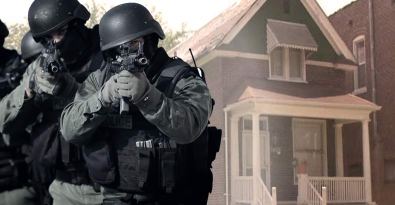
SWAT Raids Wrong Home, Breaks Windows, then Issues Family Citation for Broken Windows
This case gives a new and an even more despicable meaning to the term, “Broken Windows Policing”
By Matt Agorist | The Free Thought Project | June 30, 2015
St. Louis, MO — Leon Walker and his family were settling down for dinner last week when they were violently interrupted as flashbang grenades came flying into their house and began exploding.
The front door was kicked down, and armed assailants rushed in with AR-15 rifles drawn and pointed Walker and his family. These armed and incredibly incompetent and dangerous assailants were members of the St. Louis Police Department’s SWAT team.
The SWAT team was looking for an evil man who allegedly committed the ‘crime’ of selling a substance to willing customers. This man’s name was Darron Ford, and he lived two doors down from the Walker family.
The fact that the man they were looking for lived two doors down was of no consequence to these thugs in uniform as they went along with the raid, in full. For two hours, police, who knew they were at the wrong address, tore the home of Leon Walker apart in search of a non-existent reason to justify their idiocy.
Never let a botched SWAT raid go to waste.
Had Walker tried to defend his home against the armed invaders, he would have been killed, and the world would have never known about it. The blurb on the nightly news would have been that police kill an armed man who fired on them.
“Obviously they think they’re being invaded,” family attorney Bevis Schock said. “The hope is that they won’t fight back but that they’ll cower in fear – the flight response rather than the fight response.”
Schock says that police should have stopped their madness once they realized they were at the wrong home. However, they were on an apparent mission to destroy and intimidate.
After the life-threatening home invasion and subsequent destruction of their home, the St. Louis Police Department sent out a building inspector. In turn, the inspector issued the Walker family a citation for a window the SWAT team broke during the raid!
“In this case the insult was to have the building inspector cite them for the window that had been broken by the police an hour earlier as part of the entry, and that’s outrageous,” Schock said.
The Walker family could have been killed by these barbarians as they followed their controller’s orders to seek out illicit substances. Instead of an apology for threatening all their lives and ransacking their home, the Walkers were extorted!
The Walker family has since filed a lawsuit against the city of St. Louis. The taxpayers will now foot the bill for the belligerent idiocy of the St. Louis SWAT team.
The Walker’s situation is hardly an isolated one either. Also this month, and in the same town, another family was wrongfully raided by St. Louis SWAT. Angela Zorich and family were subject to a massive military-style raid during which their house was destroyed, their beloved dog killed, and their mother kidnapped. The reason for this war-like assault on a family — Zorich was on hard times and was temporarily unable to pay her gas bill.
Sadly, many Americans are still unable to see the horrors of the massive and brutally negligent police state that has exploded in this country. The apologists sit back and tell people that if they don’t do anything wrong, they don’t have anything to worry about.
UK trade unionists, blacklisted activists demand police spying inquiry
RT | June 30, 2015
Trade unionists are demanding a full inquiry into ‘very troubling allegations’ of police spying on activists and blacklisted workers.
Home Secretary Theresa May has already set up an inquiry headed by Lord Justice Pitchford into allegations of police surveillance operations against activists, but its full remit is not yet known.
The inquiry has come about in response to allegations by police whistleblower Peter Francis, formerly of the Special Demonstration Squad, that during his four years working as an infiltrator of political groups he spied on member of five unions, including the Fire Brigades Union (FBU).
“Trade unions are the largest democratic, mass-membership organizations in the UK,” FBU General Secretary Matt Wrack told the Guardian.
“Trade unionists have legitimate concerns about police operations that may have undermined our decisions, interfered with industrial relations and led to the victimization of our elected officials.”
Wrack said an inquiry into allegations of police spying on causes such as environmentalism, the Stephen Lawrence murder case and trade unionism was “long overdue.”
Another group affected are those blacklisted by employers. Blacklist Support Group (BSG) secretary Dave Smith made an official submission to Pitchford last week regarding allegations of “collusion” between police and businesses.
“Trade unions are a perfectly legal part of civil society,” he told the Guardian.
“Why are we being infiltrated by undercover police units and why is the state sharing intelligence with big business?
“It is only because we were prepared to kick up a stink that the evidence about police collusion has slowly come to light.”
In March it was reported police spying had also been extended to Labour MPs. Francis revealed 10 Labour MPs were tailed and spied upon by British police. Those affected demanded the release of secret files kept on them.
The surveillance was carried out as recently as the 1990s when the politicians had been democratically elected to parliament.
Among the MPs targeted were prominent left-wingers and serving ministers Jeremy Corbyn, Diane Abbott and Dennis Skinner. The late Tony Benn, a lifelong socialist and anti-war campaigner, was also tailed by British police.
The highest-ranking MP to have been surveilled was Labour’s deputy leader Harriet Harman. Speaking to Penning, she said: “I would like you to assure me that you, the government, will let me see a full copy of my file.
“I was campaigning for the rights of women, for the rights of workers and the right to demonstrate — none of that was against the law, none of that was undermining our democracy.”
Read more: Labour witch-hunt: Spied-on MPs demand release of undercover police files
Egypt president to change law to permit speedy executions
Reprieve | June 30, 2015
Egypt’s President, General Abdel-Fattah al Sisi, has said he wants to change the law to allow for quicker executions in the country.
In remarks at the funeral of Egypt’s Attorney-General Hisham Barakat, who died after a car bomb attack on Monday, Sisi is reported to have said: “The arm of justice is chained by the law. We’re not going to wait for this. We’re going to amend the law to allow us to implement justice as soon as possible”. He added: “If there is a death sentence, a death sentence shall be enforced.”
The decision to expedite executions for those sentenced to death raises fears for scores of people arrested in the military’s 2013 breakup of protests. Many face possible death sentences in mass trials that fail to meet international standards; including juveniles such as Irish teenager Ibrahim Halawa, who is being tried as an adult alongside 493 other people. Ibrahim, a student from Dublin, was 17 and visiting family in Cairo when he was arrested in August 2013. Now 19, he has reported torture and mistreatment throughout his two years of pre-trial detention.
Commenting, Maya Foa, the head of Reprieve’s death penalty team, said: “In Egypt we’ve already seen scores of innocent people – including juveniles such as Ibrahim Halawa – arrested for the mere ‘crime’ of being at or near a protest. Thousands still face torture, ‘mass trials’, and the threat of hanging. It is sickening that President Sisi now wants to dismantle what little checks remain to prevent wrongful executions. This wave of repression has done nothing to restore law and order in Egypt – Sisi must urgently change course, before any more lives are lost.”
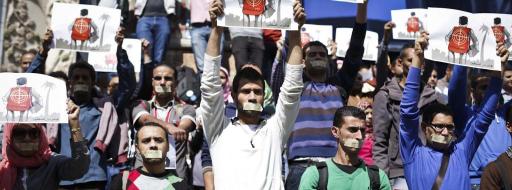
Families of detained journalists commence sit-in at syndicate
By Mostafa Mohie* | Mada Masr | June 28, 2015
The families of detained journalist Mohamed Saber al-Battawy and photojournalist Mahmoud Abou Zeid, known as Shawkan, started a sit-in on Sunday at the Journalists Syndicate until the release of their relatives.
Battawy’s wife, Rofaida al-Safty, told Mada Masr, “We don’t know why my husband has been detained, we and his lawyers haven’t seen him yet, despite the fact that he has been prosecuted and received a 15-day detention order pending investigation.”
Safty explained that on June 17 at dawn, “a masked force broke into the house and confiscated personal documents, books and Battawy’s hard drive.” Safty wasn’t home when this happened, but Battawy’s father was with him and recounted the details to her.
When Battawy’s father asked about where his son would be taken, he was told “Toukh Police Station,” but Safty didn’t find him there or at any other station within Qalyubiya Governorate, and his arrest was denied by those she asked.
“We called around, notified the syndicate, as well as state-owned Akhbar al-Youm media oulet, and filed a complaint with the general prosecutor and interior minister. We even called the human rights division within the ministry, who asked us to call again, but when we did, their phone was off, Safty recounted.
The Journalists Syndicate filed a complaint with the prosecutor on Monday last week, demanding the disclosure of Battawy’s place of detention and the charges brought against him. The syndicate added in a statement released on the same day that it had communicated with the interior ministry, but received no adequate answer.
On Tuesday, the state-owned Middle East News Agency published an article quoting security sources saying Battawy is in Tora prison and has been accused of “being a member of an illegal group.” Battawy’s defense team headed to the prosecution to verify this information, but no accusations were listed.
Safty reportedly awaits her husband’s transfer to the prosecution again next Wednesday.
As for Shawkan’s family, his mother said he was arrested in August 2013 while covering the Rabea sit-in, along with two foreign photographers who were later released. Shawkan was taken to Cairo Stadium and then transferred to the prosecution, who charged him with murder, attempted murder, being part of an armed group, assaulting security forces, and the possession of a firearm, she added.
Shawkan hasn’t been released or transferred to court and has been detained for 22 months.
Ahmed Abdel Naby, Shawkan’s lawyers, previously told Mada Masr, “There is no evidence against Shawkan and upon arrest he was only carrying a camera. We have submitted all the necessary documents, stating that the photojournalist was working when he was arrested, in addition to the testimony of both his foreign colleagues before their release, but obviously all this is insufficient for his acquittal.”
Abdel Naby said Shawkan was beaten at Cairo Stadium and was then taken to Abu Zaabal Prison, then finally to Tora Prison. Shawkan’s health condition has deteriorated in detention as he has Hepatitis C.
A letter from Shawkan to Yehia al-Qalash, head of the Journalists Syndicate, was published a couple of days ago saying, “All that matters now is the release of all journalists, so that they don’t die a slow death like me. I am afraid that my colleagues will end up like me … thin, pale, with dark circles under the eyes, a heart with an irregular pace and a featureless face that has lost all hope that one day I will be free and will be able to hug my mother again.”
Shawkan added, “I have explained how I die each day, so that you know the suffering of my colleagues in detention. Therefore, I do not ask for my release, but theirs, and I hope that one day they will be free, whether I am alive inside prison or dead.”
Qalash met with Shawkan’s family upon their arrival at the syndicate on Sunday and told reporters he is communicating with the presidency concerning Shawkan’s case.
The Association for Freedom of Thought and Expression (AFTE) issued a report on Saturday on the violations of freedom of the press during the first half of 2015. According to the report, 18 journalists were arrested, 14 others were illegally detained, 34 were physically assaulted, eight were verbally abused, and 85 were prohibited from future coverage. AFTE reported one case in which a media institution was raided. AFTE added that five journalists were detained for more than 500 days and five others for more than 100 days.
The Committee to Protect Journalists (CPJ) issued a statement on June 25 saying that Egyptian authorities jailed 18 journalists in 2015 — the highest number of detentions since 1990.
CPJ sent a “delegation to Egypt in February, where it met with the general prosecutor and the minister of transitional justice, who said that no journalists have been detained because of their work. However, the committee stated that Sisi’s government used national security as a way to control human rights and freedom of the press.”
The report added, “The Egyptian government is randomly accusing journalists and activists of being members of a banned group. The majority of detained journalists have been accused of being Muslim Brotherhood affiliated.
* Translated by Mada Masr
NYPD Officer Waited 20 Minutes to Call for Help After “Accidentally” Shooting Akai Gurley

By Cassandra Fairbanks | PINAC News | June 25, 2015
The rookie NYPD cop who shot and killed Akai Gurley in a stairwell last year waited almost 20 minutes to report the shooting, refusing to call for or provide medical assistance, as he bickered back and forth with his partner about who should be the one to call their sergeant.
Meanwhile, Gurley lay bleeding on a stairwell with a bullet wound to his chest, still breathing, while his girlfriend ran to a neighbor for help, according to a new document presented this week in the manslaughter trial of New York City police officer Peter Liang.
The statement of facts, presented by the district attorney in rebuttal to a motion from Liang’s defense attorney that the case be dismissed– offers the most detailed account of the shooting to date, describing the rookie officer being more concerned about keeping his job than keeping Gurley alive.
In the minutes after the shooting, Melissa Butler, never having been trained in CPR before, kneeled over her boyfriend, applying pressure to the wound and administrating CPR as her neighbor remained on the phone with the 911 operator relaying instructions.
The cops, despite being trained in CPR and required as police officers to administer it when needed, stepped around them as they made their way down the stairs, still arguing about who should call the sergeant.
“Hurry up and call,” NYPD police officer Shawn Landau told Liang.
“What’s the address?” Liang asked his partner.
Liang finally reported the shooting at 11:19 p.m., almost 20 minutes after the shooting, estimated to have taken place a little after 11 p.m.
And five minutes after the neighbor had already called 911.
During that time, Liang also texted his union representative in a desperate attempt to save his job.
It all started on November 20, 2014 when Gurley, who was unarmed and not breaking any law, was visiting his girlfriend at the Brooklyn housing project she lived in.
NYPD officers Liang and Landau were on-duty patrolling the housing projects when they entered a darkened stairwell from the eighth floor to make their way downstairs.
Liang pulled out his gun before entering, even though he was not being threatened.
Meanwhile, Gurley and his girlfriend entered from the seventh floor after having waited for an elevator that never arrived.
Seconds later, Liang fired his gun, striking Gurley in the chest. Investigators said the bullet ricocheted off a wall before striking Gurley.
Fearing for their safety, Gurley and Butler ran down two flights of stairs but Gurley collapsed on the fifth-floor stairwell. Butler then ran down to the fourth floor where she knocked on the neighbor’s door for help.
“What the fuck happened,” Landau asked his partner.
“It went off by accident,” Liang responded, who then began repeatedly saying he would be fired.
The document states that Liang reported the shooting at exactly 11:19 and 46 seconds, followed by a series of follow-up reports to dispatch of an “accidental discharge.”
But New York City Police Lieutenant Vitaly Zelekov had already received a report at 11:15 p.m. that a man had been shot in the building, thanks to the neighbor’s call.
Minutes later, Zelekov arrived at the building as numerous other cops were arriving. He reached the fourth-floor landing and spotted Liang, asking him what had happened.
“I shot him accidentally,” Liang told him.
Zelekov took Liang’s gun, secured it in his waistband and made his way up to the fifth floor where he saw Butler attempting mouth-to-mouth resuscitation on Gurley.
Zelekov ordered another officer to relieve Butler, then radioed to dispatch to “rush the bus,” meaning to send an ambulance as soon as possible – the first time that night anybody had requested an ambulance.
That request was logged at 11:21 p.m. and seven seconds. Gurley was pronounced dead at a local hospital at 11:55 p.m.
Liang’s lawyer Stephen Worth told the New York Times that Liang was hyperventilating in the moments following the shooting, and was “too distraught” to help Butler attempt to save Gurley’s life, so therefore, charges should be dismissed.
But Justice Danny K. Chun rejected the motion to drop the charges against Liang, who is facing manslaughter in the second degree, criminally negligent homicide, assault in the second degree, reckless endangerment in the second degree, as well as two counts of official misconduct.
Officer Landau has not been charged for his role in Gurley’s death.
269 die in Egypt jails after Morsi ouster: Rights body
Press TV – June 27, 2015
A Cairo-based rights group has revealed that as many as 269 people have lost their lives in Egyptian custody since the 2013 ouster of Mohamed Morsi, the country’s first democratically-elected president.
The Egyptian Commission for Rights and Freedoms (ECRF) disclosed the data in a report issued on Friday to mark the United Nations International Day in Support of Victims of Torture.
The group said 130 of the fatalities, which comprised 68 political detainees and 62 criminal defendants, had occurred under Egypt’s military-appointed interim President Adly Mansour, who was trusted with the country’s leadership after Morsi’s overthrow from July 3, 2013, to early June 2014.
The report also noted that among the deaths, 143 had occurred due to systematic medical negligence and 32 others as a result of torture practices.
The ECRF also documented 139 deaths in Egyptian prisons and detention facilities since President Abdel-Fattah el-Sisi ascended to power last year.
Morsi, affiliated with Egypt’s Muslim Brotherhood movement, was elected as the country’s president in 2012 but was ousted only a year later in a military coup led by the then army chief, Sisi.
Sisi, who had also served as military chief under former dictator Hosni Mubarak, later campaigned for and won the country’s presidency in controversial elections in June 2014.
The Sisi administration has been cracking down on any opposition since Morsi was ousted, banning the Muslim Brotherhood movement.
Thousands of the supporters of Morsi and the Muslim Brotherhood movement have also been jailed, with many of them, including Morsi, receiving death penalties in mass trials.
Featured Video

Seyed M. Marandi: US-Iran War Inevitable: Kuwait and Bahrain May Fall
or go to
Aletho News Archives – Video-Images
From the Archives
Oil and the Israel Lobby
Reknowned economist M. Shahid Alam offers this excellent critique of Noam Chomsky’s defective analysis of the relative influence of Oil versus the Israel lobby over US foreign policy: … continue
Blog Roll
 Aletho News
- ICC ignored ‘very well-documented’ NATO crimes – ex-Libyan minister
- SNSC secretary dismisses US response to Iran’s conditions as ‘inadequate’
- Sanaa says Taiz roads open, secure for residents, warns Saudi forces
- Iraqi resistance group urges Saudi leadership to admit defeat, lift Yemen siege
- Trump’s Retreat: How Al-Aqsa Flood Took Down the US Empire
- Israel’s Military Actions in Lebanon Grossly Violate International Law — Lavrov
- Seyed M. Marandi: US-Iran War Inevitable: Kuwait and Bahrain May Fall
- Leaders Condemn Ansarallah Attack on Saudi Arabia While Ignoring Illegal War Against Yemen
- Leaked: Britain’s Covert Iraqi Psyops Network
- Yemeni Armed Forces Warn Airlines Against Using Saudi Airports, Exempt Mecca and Medina
- If Americans Knew
- An error has occurred; the feed is probably down. Try again later.
- No Tricks Zone
- Germany’s Green Energy Debacle: High Energy Costs Force Kahla Porzellan to Close After 182 Years!
- New Study: 50 Years Of The Most Aggressive ‘Net Zero’ Policies Can Only Affect The Global Climate By 0.03°C
- US September “Heat” Was No Record…Many Records Set Decades Ago
- Latest European Green Energy Debacle; Portugal’s Largest Flagship Solar Park Insolvent!
- Green Energy Debacle: German Expert Professor Fritz Vahrenholt Warns Of Severe Economic And Social Consequences
- Two More Paleo Reconstructions Affirm Meters-Higher Sea Levels Across Ireland, Brazil 7000-6000 Years Ago
- New Study: Earth And Venus Surface Warmth Largely Explained By Convection And Lapse Rate, Not CO2 Or Radiation
- 2025 Nature Paper Claiming Worsening Global Drought Gets RETRACTED …Heavily Flawed
- New Study: ‘Global Drought Shows No Detectable Recent Acceleration Under Climate Warming’
- Economic Masterminds: German Socialists Suggest Taxing Productivity Gains Stemming From Using AI

