NSA to open new $60mln facility in N. Carolina university amid surveillance scrutiny
RT | August 16, 2013
While new disclosures this week have exposed inept oversight and gross privacy violations within the National Security Agency, news out of North Carolina has revealed that the NSA is spending $60.75 million on another brand new facility.
In the midst of an international debate focused on how the United States’ premier spy agency has conducted dragnet surveillance over much of the world, including at home, the NSA is expanding even further. The News & Observer reported on Thursday that North Carolina State University in Raleigh, NC is receiving a $60.75 million grant from the NSA to develop a top-secret data analysis lab.
The grant, the paper reported, is three times larger than any award ever received by the university in the school’s history.
Randy Woodson, the school’s chancellor, said Thursday that the deal had been in the works for three years. He said he hoped the data center would make North Carolina a more attractive destination for technology companies. Woodson predicted that the project would create 100 jobs over five years.
“We appreciate the confidence of the National Security Agency to select NC State for this groundbreaking endeavor,” Woodson said in a statement. “Not only will it enhance the academic experience for our students and faculty, it will also add to the economic prosperity of our community through new jobs, new industry and new partnerships.”
Many details on the project have been kept secret because of national security, according to officials. But North Carolina State already has contracts with the Department of Defense, helping the agency research technology which will help soldiers identify improvised explosive devices and expand their foreign language capabilities, among other functions.
The NSA has come under harsh scrutiny in recent months due to the disclosure of classified surveillance programs which the government has used to justify monitoring the communications of Americans, as well as the international community. Internal emails published by the News & Observer reveal that North Carolina State originally intended to announce their deal with the NSA just before the leaks were published but decided to delay in fear of potential blowback.
“A very important announcement about our new NSA-funded Laboratory for Analytic Sciences was supposed to be made public this morning, but with that bit out of The Guardian newspaper on NSA collecting phone records of Verizon customers – everyone thought it best to not make the announcement just yet,” Randy Avent, the associate vice chancellor for research at NCSU, wrote in a message to other administrators. “By the way – our Lab is just that – a research program studying the fundamental science behind analytics. It is not a storage facility for classified data and does not work with any data like that mentioned in the article.”
The delayed announcement comes after another disclosure which further harmed the NSA’s reputation. The Washington Post published top-secret documents Thursday night which provide a glimpse into just how often the NSA breaks the law and invades the privacy of Americans. Thousands of violations were recorded in each of the years since the NSA’s power was expanded in 2008.
Tide Begins to Turn against FIFA in Rio de Janeiro
By Brian Mier | CEPR Americas Blog | August 15, 2013
After two months of protests that started over price gouging in public transportation and spread to a variety of issues spanning the political spectrum, positive results are beginning to be seen in Rio de Janeiro, where governor Sérgio Cabral, once touted in the New York Times as a possible 2014 presidential candidate is now so unpopular that socialist former mayoral candidate Marcelo Freixo said that he doesn’t think he could even get elected as a condominium residents association secretary.
During the last week a series of measures was announced that seem to show a turning of the tide against the hegemony wielded by the Fédération Internationale de Football Association (FIFA) and the Rio de Janeiro state and municipal governments over local residents.
First, after spending over $500 million rehabbing the structurally sound Maracana stadium – its third multi-million rehab in a dozen years – the plan to privatize and sell it off to a group of cronies for a fraction of that value has been stalled. The landmark status for the neighboring high school and Indigenous museum buildings has been upheld by the court system, so they can no longer be destroyed to create a parking garage. Furthermore, the federal government has blocked destruction of the public swimming pool and athletic track that made up part of the stadium compound. According to the privatization agreement, these are deal killers. The original plan was to surround the stadium with parking garages and luxury shops for the white, middle-class patrons who would now be the only ones able to easily afford ticket prices. The consortium that was poised to take over management of the stadium announced that it was going to back out, then changed its mind but still hasn’t closed a deal. It appears that the new, expensive ticket prices are keeping fans away and this might prove to be a deciding factor in blocking privatization.
Meanwhile, last Friday, the mayor’s office announced that after years of protests and construction of an alternative participatory development plan by local residents together with social movements and the Universidade Federal de Rio de Janeiro planning department, it will no longer raze the neighborhood of Vila Autódromo, which was originally marked for destruction in order to “beautify” the neighborhood for the upcoming “mega-events.” Since 2008, the mayor’s office has evicted tens of thousands of people, but it is hoped that this too will mark a turning point against a government that, until its popularity plummeted last month, felt like it could do whatever it wanted.
The much hailed program for setting up police stations in favelas that were previously controlled by drug trafficking organizations and paramilitary militias, called UPP, is also coming under fire. Drug trafficking gangs continue to operate within the pacified favelas, albeit without carrying machine guns around on the street, and a recent study shows that disappearances of residents has increased by over 50 percent in favelas after the UPP Units have been put in place. The disappearance of a construction worker and father of four, last seen being forced into a UPP Police car in front of his house in Rocinha, has turned into a national issue, as people are holding up signs all over the country during protests asking, “Where is Amarildo?”
Across the nation, people are rising up against the planned “state of exception” that FIFA demands take place for two months before and after the World Cup in 2014, coded into Brazilian law as part of the “General Law of the World Cup” of June 5, 2012. This “state of exception” will enable the government to bypass public bidding laws, provide tax abatement on all official FIFA-sponsored products and hire private foreign security forces to replace the local police protecting players and FIFA officials. In accordance with the Brazilian constitution of 1989, a “state of exception” can only be called in cases of war or natural disasters, making the FIFA law technically illegal. But popular and legal challenges to the Brazilian general “Law of the Cup” are mounting. During the World Cup in South Africa FIFA was able to leave the country with $2.4 billion in profits, while South Africans were left footing the maintenance bill for “white elephant” stadiums in towns with no major sports teams. It will be interesting to see how much FIFA is able to get away with this time around, especially since 2014 is an election year in Brazil.
Brian Mier is a geographer and freelance journalist who lives in Brazil and works as a policy analyst at the Centro de Direitos Econômicos e Sociais. He has a podcast, focused on news reported in the Brazilian alternative media, at http://progressivebrazil.tumblr.com/
Related article
Cory Booker, the Next Black Corporate Presidential Contender
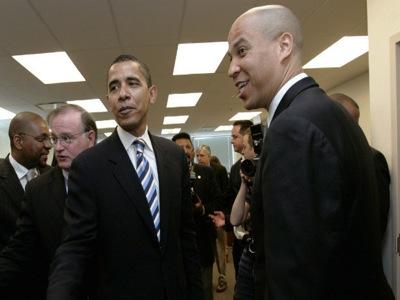
A Black Agenda Radio commentary by Glen Ford | August 14, 2013
Cory Booker, the obnoxious and joyously cynical Newark, New Jersey mayor and soon-to-be U.S. senator, perfected the role of stealth Black corporatist Democratic politician years before Barack Obama was elected to national office – although he’s eight years younger than Obama. If anything, Booker has more friends in high rightwing places at this stage in his career than did Barack Obama when he was running for the U.S. Senate from Illinois, ten years ago. Obama came out gradually as a servant of the corporate class; Booker has always been a sycophant of the rich and devotee of their most reactionary causes.
While Barack Obama waited until he was president to fully display his school privatization colors, Cory Booker began his public career as an operative in the corporate-funded private school vouchers game. At the age of 33, and with only one term as a city councilman under his belt, Booker used his rich contacts in rightwing, mainly Republican circles to vastly outspend, and almost defeat, the most powerful Black politician in New Jersey, Newark mayor Sharpe James. Four years later, in 2006, after a very large Republican U.S. Attorney and now governor, Chris Christie, had put James on the path to prison, Cory Booker walked into City Hall with an army of Wall Street and Silicon Valley billionaires behind him.
Once he steps into the U.S. Senate, to serve out the remainder of the late Frank Lautenberg’s term, Booker will immediately start running for president, staking out a position to the right of the current occupant and of Obama’s likely successor, Hillary Clinton. In the last presidential race, Booker infuriated the Obama camp by coming to the defense of Bain Capital, the Wall Street investment firm where Mitt Romney made his fortune. Booker said it was “nauseating” to see all those good people in high finance held up to scorn in an election campaign.
Nobody can say that Cory Booker doesn’t take care of his friends in the 1%. They certainly take care of him. They have bankrolled all of his electoral efforts, most recently allowing Booker to spend almost three times as much as his top Democratic senatorial opponents, combined. Facebook billionaire Mark Zuckerman’s $100 million gift to the Newark Public Schools made Booker look like an urban miracle worker – although the transaction was actually more like Booker presenting the schools as a gift to Zuckerman and his privatizing friends. Other Silicon Valley fat cats set Booker up as head of a start-up Internet company that made Booker a millionaire, at least on paper. Now that Booker is going to Washington, the start-up is going down the tubes. But, there are plenty more self-serving deals to be made on Capitol Hill.
In the recent campaign, Booker sounded positively like an old-style Republican, badmouthing “Washington” in every other sentence.
The filthy rich have cultivated a true-blue believer in Cory Booker, the still-young man from the suburbs of New Jersey. As I wrote in the inaugural issue of the Black Commentator, in April of 2002, “At his age, Cory will be a blight on the political scene even longer than the rest of the Four Cs (colored conservatives counting cash).” I was referring to Condoleezza (Rice), Clarence (Thomas), and Colin (Powell).
He’ll likely be around even longer than his fellow Black stealth corporatist, Barack Obama.
Watched from a waste bin: UK pulls plug on ‘spy’ trash cans
RT | August 12, 2013
The City of London has demanded that an advertising firm cease its ‘spy bin’ program which uses high-tech trash cans to track people walking through the city’s financial district. The bins follow Wi-Fi signals and capture smartphone serial numbers.
Renew installed 200 bomb-proof bins with built-in Wi-Fi and digital screens inside London’s Square Mile during and after the 2012 Olympic Games. The firm initially offered to place advertisements and financial information on its “pods.” But in June, the agency started testing the bins’ wireless potential, subsequently launching a smartphone-tracking campaign.
The company’s ‘ORB’ technology scanned the streets for smartphones, indentifying the manufacturer of every device through unique media access control (MAC) addresses. It also detected the owner’s “proximity, speed and duration” of stay. Renew had hoped the program would attract advertisers and help companies in their marketing campaigns.
“The technology enables clients to accumulate data readings that will aid in compounding statistical analysis on trending demographics in high profile locations (and particularly a client’s own market share within the City relative to peers in the handheld manufacturing example),” the website’s press release said at the start of the ‘Renew ORB’ beta-testing.
The captured data – which encompassed 4,009,676 devices in just one week of testing – was to be sold to advertisers in “raw form.” Shop owners, for example, could find it very useful for analyzing their customers’ visit time and loyalty.
Instead, the program triggered a media storm, building on ‘spy bins’ hype. This was followed by public outrage and an official ban. Questions were raised regarding whether the scheme was completely legal.
Responding to the turbulent reaction, Renew’s ORB technology CEO attempted to downplay the trash bins’ data collection capabilities.
“I’m afraid that in the interest of a good headline and story there has been an emphasis on style over substance that makes our technology trial slightly more interesting than it is,” Kaveh Memari said in a Monday statement published on Renew’s website. He added that “none” of the proposed capabilities “are workable right now.”
Memari also assured that the MAC addresses collected during the pods’ beta-testing were totally “anonymized and aggregated.” He stressed that no personal details could be devised from analyzing such data, comparing the process to the work of a website counter.
Earlier, Renew promised the technology would enable it to “cookie the street.” The comment was in reference to internet cookies – tiny files created by websites to track an individual’s activity.
A City of London spokesman took a different position on the matter, saying, “Irrespective of what’s technically possible, anything that happens like this on the streets needs to be done carefully, with the backing of an informed public.”
According to the spokesman, the issue has been taken to the Information Commissioner’s Office – a UK public body dealing with data protection and freedom of information.
Renew appeared to be ready both for public discussion and for a legal battle, saying that “the law has not yet fully developed and it is our firm intention to discuss any such progressions publicly first and especially collaborate with privacy groups…to make sure we lead the charge on this as we are with the implementation of the technology.”
However, the firm admitted that such technology required “the future levels of protection” and “people being comfortable with interactive technology.”
Meanwhile, Nick Pickles of Big Brother Watch – a civil liberties and privacy pressure group – said that questions need to be asked “about how such a blatant attack on people’s privacy was able to occur.”
Brazil may reject US fighter jet deal over NSA spying scandal
RT | August 13, 2013
Brazilian officials have expressed reluctance to purchasing dozens of military planes from the US after it was revealed that the NSA not only closely monitored Brazilian energy and military affairs, but also mined for commercial secrets.
The US had planned to sell Brazil – a country in the process of revitalizing its Air Force – 36 fighter jets in a deal worth more than US$4 billion. But when US Secretary of State John Kerry meets with Brazilian President Dilma Rousseff on Tuesday, the leaders will not discuss the deal, a source near to the situation told Reuters.
Kerry traveled to Colombia before making his way to Brazil in an attempt to repair relations with Latin American nations after NSA leaker Edward Snowden disclosed documents showing that the US spied on communications related to the military, political and terror issues, and energy policies.
“We cannot talk about the fighters now…You cannot give such a contract to a country that you do not trust,” the source said.
Chicago-based Boeing Co. is competing for the $4 billion contract against France’s Rafale and Sweden’s Gripen, although the longer Brazil goes without choosing, the more likely it is that other competitors will enter the fray.
Rousseff delayed a decision on the fighter jets because of budget woes and widespread demonstrations protesting austerity and government corruption.
“I don’t expect the president to decide on the fighter contract this year, and next year is an election year so it might have to wait until 2015,” a Brazilian government source said.
Brazil’s Foreign Minister, Antonio Patriota, informed United Nations Secretary General Ban Ki-Moon of the nation’s situation as recently as last week.
Tuesday’s visit will be Kerry’s first trip to Brazil as Secretary of State.
But it’s not just Brazil that was reportedly upset over the NSA revelations. Even Colombia – one of Washington’s closest allies in the region – was unhappy about the information revealed. In Bogota, Kerry aimed to play down the rift during a press conference.
“Frankly, we work on a huge number of issues and this was in fact a very small part of the overall conversation and one in which I’m confident I was able to explain precisely that this has received the support of all three branches of our government,” Kerry told reporters. “It has been completely conducted under our Constitution and the law…The president has taken great steps in the last few days…to reassure people of the US intentions here.”
US Vice President Joe Biden has visited Brazil and Colombia, and President Barack Obama recently made a three-day trip to Mexico and Puerto Rico. Both trips have been portrayed as evidence of US politicking below the equator.
During his visit to Brazil, Biden said that stronger trade ties should usher in a new era of relations between Washington and Brasília.
How long that goodwill will last remains to be seen, according Carl Meacham, former Latin America adviser on the Senate Foreign Relations Committee and director of the Americas Program at the Center for Strategic and International Studies.
“I think the tone of the visit will be a bit tense because of these issues raised by the surveillance [program] and I think Secretary Kerry will have to speak to that,” he told AP.
Related article
Greenwald Testifies to Brazilian Senate about NSA Espionage Targeting Brazil and Latin America
By Mabel Duran-Sanchez | CEPR Americas Blog | August 10, 2013
This past Tuesday, investigative journalist Glenn Greenwald testified before the Brazilian Senate’s Committee on Foreign Relations and National Defense (CRE) at a public hearing on the clandestine surveillance activities of the U.S. National Security Agency (NSA) in Brazil.
Greenwald, who has published many top-secret NSA documents leaked to him by whistleblower Edward Snowden, explained how the agency’s surveillance programs go far beyond gathering intelligence related to terrorism and other national security threats, as the U.S. government has suggested. According to Greenwald, NSA spying has focused on foreign business interests as a means for the U.S. government to gain a competitive advantage in negotiations. Greenwald mentioned that he has information regarding instances of NSA surveillance of the Organization of American States (OAS) and secret intelligence documents on economic agreements with Latin American nations. He explained that this type of surveillance has helped the U.S. to make the agreements appear more appealing to Latin American countries. Brazil’s concern about this economic espionage is particularly understandable given that it is the U.S.’s largest trading partner in South America.
During the hearing, Greenwald made reference to a 2009 letter wherein Thomas Shannon, the former Assistant Secretary of State for Western Hemisphere Affairs (from November 2005 – November 2009) and current U.S. Ambassador to Brazil, celebrated the NSA’s surveillance program in Latin America and how it has helped advance U.S. foreign policy goals in the region. Greenwald wrote a detailed account of his findings in an article entitled “Did Obama know what they were thinking?” in the Brazilian print magazine, Época. In this piece, Greenwald explains that Shannon’s letter, addressed to NSA Director Keith Alexander, discusses how the spy agency obtained hundreds of documents belonging to Latin American delegations detailing their “plans and intentions” during the summit. Shannon asserted that these documents were instrumental in helping the Obama administration engage with the delegations and deal with “controversial subjects like Cuba” and “difficult counterparts” like former President of Venezuela, Hugo Chávez, and Bolivian President, Evo Morales. In the same letter Shannon encouraged Alexander to continue providing similar intelligence as “the information from the NSA will continue to give us the advantage that our diplomacy needs,” especially ahead of an upcoming OAS General Assembly meeting in which he knew discussions on Cuba’s suspension from the OAS would ensue.
Greenwald went on to explain the functioning of the NSA’s XKeyscore program to the Brazilian senators, which he referred to as the most frightening of all the programs revealed thus far. He also discussed the first U.S. secret surveillance program revealed to the world, PRISM. In the next 10 days, Greenwald said, he will have further reports on U.S. surveillance and “[t]here will certainly be many more revelations on spying by the U.S. government and how they are invading the communications of Bra[z]il and Latin America.”
When asked by the current CRE President, Senator Ricardo Ferraço, what the international community should do if the U.S. continues its mass surveillance programs, Greenwald said that although many governments around the world have expressed indignation, it has been a “superficial indignation.” He called on foreign governments to put pressure on the U.S. by granting Snowden asylum, which would be most effective if many countries were to do so.
According to Reuters, Greenwald also told reporters that “[t]he Brazilian government is showing much more anger in public than it is showing in private discussions with the U.S. government,” but that “[a]ll governments are doing this, even in Europe.” Although some Brazilian senators have questioned President Rousseff’s upcoming trip to Washington, yesterday, Foreign Minister Antonio Patriota told reporters that “the trip is still on.” Nevertheless, Patriota added that the NSA revelations are “an issue that cannot be left out of the bilateral US-Brazil agenda,” and that he would raise the issue when John Kerry travels to Brasilia early next week.
Related articles
TSA expands role beyond airports amid growing cases of misconduct
RT | August 7, 2013
Cases of misconduct among airport screeners employed by the Transportation Security Administration (TSA) increased by 26 per cent between 2010 and 2012, according to a new report. It comes as the agency expands its services beyond airport security gates.
The report, which was released last week by the US Government Accountability Office (GAO), found 9,622 cases of misconduct among TSA workers from 2010 through the 2012 fiscal year. It concluded that the agency had insufficient procedures for reviewing and recording the outcomes of misconduct cases.
At the same time, fresh attention has been cast on TSA’s expanding its roles into train terminals and even sporting events in the form of Visible Intermodal Prevention and Response squads, or VIPR teams, which have been assigned to counterterrorism security checks at transportation hubs in the US since 2005.
According to a profile published this week by The New York Times, TSA’s VIPR program now boasts a $100 million annual budget and is growing quickly. The scheme has grown since 2008, consisting of 37 teams in 2012.
Meanwhile, the agency’s records show that it has provided security for over 8,800 “unannounced checkpoints” and other search operations in conjunction with local law enforcement outside of airports. Such events have included the Indianapolis 500 race and both the Democratic and Republican national conventions.
VIPR teams usually comprise of federal air marshals, explosives experts, and baggage inspectors. The squads move through crowds at events and transportation hubs with bomb-sniffing dogs and perform random stops on individuals. Plainclothes members of VIPR teams monitor crowds for suspicious behavior.
“Our mandate is to provide security and counterterrorism operations for all high-risk transportation targets, not just airports and aviation,” TSA administrator John S. Pistole said. “The VIPR teams are a big part of that.”
However, members of Congress and officials at the Department of Homeland Security question whether the teams are properly trained while civil liberties groups wonder what the VIPR teams have to do with TSA’s original mandate to provide security at the nation’s airports.
“The problem with TSA stopping and searching people in public places outside the airport is that there are no real legal standards, or probable cause,” said Khaliah Barnes, administrative law counsel at the Electronic Privacy Information Center.
“It’s something that is easily abused because the reason that they are conducting the stops is shrouded in secrecy.”
Representative Bennie Thompson, a ranking member on the House Homeland Security Committee with oversight of TSA, supports the VIPR teams but remains concerned about warrantless searches and the process of detecting suspicious behavior.
“This is a gray area,” he said. “I haven’t seen any good science that says that is what a terrorist looks like. Profiling can easily be abused,” Thompson told The New York Times.
As for the rising number of offenses among TSA workers, the majority of those listed in the report include attendance and leave violations and excessive absences or tardiness. Only a small fraction represented instances of theft.
Specific violations of screening and security rules were outlined in 20 per cent of the cases profiled in the report. One of those offenses included sleeping while on duty.
Although the GAO report does not indicate high occurrences of issues such as theft, there have still been some high profile cases among the 56,000-strong staff which is spread out among 450 airports across the US.
For example, a TSA officer at Orlando International Airport pleaded guilty to embezzlement and theft after stealing 80 laptop computers and electronics from passenger luggage in 2011. The items were worth $80,000.
Another TSA employee was arrested after allegedly stealing some $50,000 worth of electronics at Fort Lauderdale-Hollywood International Airport the same year, although the GAO does not cite that incident.
It remains to be seen whether the occurrences of misconduct listed in the report will carry over into TSA’s growing role. For the most part, the presence of VIPR teams seems to mostly confuse and irritate the public.
A joint operation in 2012 involving VIPR, Houston police, and local transit officers led to complaints of stops and searches of bags. The deployment yielded a few arrests, mostly for passengers with existing warrants for prostitution and minor drug possession, according to The Times.
“It was an incredible waste of taxpayers’ money,” said Robert Fickman, a local defense lawyer who attended a subsequent meeting in the city packed with angry residents. “Did we need to have TSA in here for a couple of minor busts?”
Greenwald claims up to 20,000 Snowden documents are in his possession
RT | August 7, 2013
The journalist involved in the publication of leaks provided by whistleblower Edward Snowden said in a testimony to the Brazilian government that he possesses up to 20,000 secret US government files.
Glenn Greenwald testified before a Brazilian Senate foreign relations committee on Tuesday. The Brazil-based American reporter – who was approached by Snowden while the whistleblower still worked as a contractor for the NSA – has published details of US electronic surveillance programs taking place domestically and abroad.
“I did not do an exact count, but he gave me 15,000, 20,000 documents. Very, very complete and very long,” Greenwald told Brazilian lawmakers.
“The stories we have published are a small portion. There will certainly be more revelations on the espionage activities of the US government and allied governments… on how they have penetrated the communications systems of Brazil and Latin America,” he said.
In addition to his reporting for Britain’s Guardian newspaper, Greenwald has also been a fixture on O Globo, where the journalist shared the alleged details of US electronic surveillance of Brazil and virtually all of Latin America.
During his testimony, Greenwald alleged that Brazilian companies have agreements in place with American telecoms to collect data for the National Security Agency (NSA), and stressed that their complicity should be investigated by that country’s government.
O Globo recently published claims that Washington had at least at one time maintained a spy center in the capital of Brasilia, as part of a network of 16 similar facilities worldwide designed to intercept foreign satellite transmissions.
Allegations of widespread US surveillance of Brazil prompted US Vice President Joe Biden last month to call Brazilian President Dilma Rousseff to provide an explanation. US Ambassador to Brazil Thomas Shannon had earlier denied the NSA was tapping into telecoms in the country.
The additional files in Greenwald’s possession are believed to have been handed over when Snowden took refuge at a hotel in Hong Kong before fleeing to Moscow.
“The pretext [given by Washington] for the spying is only one thing: terrorism and the need to protect the [American] people. But the reality is that there are many documents which have nothing to do with terrorism or national security, but have to do with competition with other countries, in the business, industrial and economic fields,” Greenwald said on Tuesday.
On Monday, foreign ministers of the South American trade bloc Mercosur raised the issue of alleged NSA surveillance throughout Latin America with UN Secretary-General Ban Ki-moon.
The ministers discussed with Ban a statement adopted by the bloc on July 12 following a summit in Montevideo, Uruguay. The statement called for UN members to propose ways to halt spying and potentially pursue sanctions against the United States.
But doing so would be impossible under the current framework, as only the Security Council can impose legally binding sanctions and the US holds veto privilege over any such resolution as a permanent member of the council.
One of the most recent leaks provided by Snowden – published last month – refers to a secret surveillance system named XKeyscore which is allegedly used by the NSA to monitor internet traffic.
In his Tuesday testimony, Greenwald described the system as not only able to collect metadata “but also the content of emails and what is being discussed in telephone conversations. It is a powerful program which frightens.”
Chilean judge closes case into the origin of Pinochet millions
MercoPress | August 6, 2013
Chilean court decided on Monday not to charge any of late Dictator Augusto Pinochet’s family members in a long-running investigation into the origin of the general’s fortune and his suspected embezzlement of public funds.
The judge did charge six former members of the military who had collaborated with Pinochet in the so-called Riggs case.
Pinochet was charged in 2005 with tax evasion in connection with millions of dollars he held in foreign bank accounts, which came to light after a US Senate investigation into banking irregularities at the now-defunct Washington-based Riggs Bank.
Chilean judge Manuel Antonio Valderrama decided not to charge Pinochet’s widow, Lucia Hiriart, and her children. He said the decision can be appealed within 15 days.
Pinochet, who took power in a 1973 military coup, died in 2006 at the age of 91. He did not face a full trial for crimes committed during his 1973-1990 dictatorship, when around 3,000 people were kidnapped and killed and 28,000 were tortured.
An audit by the Universidad de Chile’s Business and Economics faculty in 2010 estimated that Pinochet had accumulated 21 million dollars before his death, of which more than 17 million was of unknown origin.
The six former military members charged in the case could face five to 10 years in prison if found guilty.
Related article
- Bachelet takes on Pinochet ally (morningstaronline.co.uk)
LAWS TO PENALIZE DRUG LORDS BEING TURNED ON THE INNOCENT
By Sherwood Ross | August 6, 2013
State “civil-forfeiture”(CF) laws aimed at drug kingpins are being twisted to confiscate the property of people “never charged with a crime,” The New Yorker magazine (August 12) asserts.
Example: a Philadelphia couple fighting a home eviction after their son sold a small amount of marijuana to an informant.
What’s more, a high proportion of the victims appear to be African-Americans and Latinos, the magazine says.
Example: Tenaha, Texas, where victims of CF actions were motorists who had been pulled over for routine traffic stops, “and the targets were disproportionately black and Latino,” The New Yorker quotes one defense attorney as stating.
Under laws once enacted to penalize drug dealers and their ilk, the authorities using CF “are routinely targeting the workaday homes, cars, cash savings, and other belongings” of the innocent, writes magazine reporter Sarah Stillman.
“In general, you needn’t be found guilty to have your assets claimed by law enforcement; in some states, suspicion on par with ‘probable cause’ is sufficient. Nor must you be charged with a crime or even be accused of one,” Stillman adds.
“Unlike criminal forfeiture, which requires that a person be convicted of an offense before his or her property is confiscated, civil forfeiture is a lawsuit filed directly against a possession, regardless of its owner’s guilt or innocence.”
Owners who wish to contest CF often find that the cost of hiring a lawyer far exceeds the value of their seized goods, the magazine reports. “There’s this myth that they’re cracking down on drug cartels and kingpins,” says Lee McGrath, of the Institute for Justice, of Arlington, Va. In fact, the victims “aren’t entitled to a public defender and can’t afford a lawyer and the only rational response is to walk away from your property, because of the infeasibility of getting your money back.”
Since in many states law enforcement authorities can use CF revenue as they like, the temptation of easy money collides with ethical values. Reporter Stillman writes, in some Texas counties, more than 40 percent of law-enforcement budgets come from forfeiture” so that a system “that proved successful at wringing profits from drug cartels and white-collar fraudsters has given rise to corruption and violations of civil liberties.”
“What stands out to me is the nature of how pervasive and dependent police really are on civil-asset forfeiture—its their bread and butter—and, therefore, how difficult it is to engage in systemic reform,” says Vanita Gupta, a deputy legal director of the ACLU.
Jennifer Boatwright, one of the 140 CF plaintiffs in a suit against Tenaha, Tex., said the county district attorney threatened to put her in jail and her son into child protective services, if she did not sign over $6,000 in her car. “Where are we?” Stillman quotes her as saying. “Is this some kind of foreign country where they’re selling people’s kids off?”
(No, Ms. Boatwright: it’s worse than that. This is some kind of country where the president is ordering illegal drone strikes in foreign countries that are killing children by the score.)
Sherwood Ross can be reached at sherwood.ross@gmail.com
Featured Video

New positive ivermectin evidence
or go to
Aletho News Archives – Video-Images
From the Archives
Fanatical Followers of the Covid Regime: A Jim Jones-Style Cult?
By Professor Roger Watson and Dr. Niall McCrae | The Daily Sceptic | November 15, 2021
As scholars at leading British universities over recent decades, we witnessed the replacement of critical thinking and debate by narrative: facts are discrimination and scientific method is imperialism; truth, instead, is derived from ‘progressive’ values. This educational trend may be a major contributory factor to the ease in which society has been inculcated to the Covid ‘new normal’ of masking, testing, and repeated doses of vaccines for a disease of similar risk to severe influenza.
One doesn’t need much critical reasoning to observe the flawed logic of some vaccination enthusiasts, such as people who respond to experiencing any side effects, however debilitating, by saying “at least I know it’s working”, or, after contracting the disease despite their promised inoculation (over 90% effective, according to initial drug company claims), “I’d have been worse off without the jab.” … continue
Blog Roll
 Aletho News
- ‘Grave, alarming’: Iran mission on Trump’s UNGA ‘annihilation’ threats
- Najaf airport to reopen to Iranian flights within 24 hours: Ambassador
- From ‘How Will This End For Iran’ to ‘When America Walks Away’: A tale of two Economist covers
- Tehran blasts ‘baseless’ speculation linking Iran to alleged bomb plot at UK air base
- The Rise And… Rise Of ‘Color Revolutions’
- The Coming GOP Bloodbath?
- Arctic Scare Stories Melt Away
- Wrong, Euronews: Climate Change Has Not Created a Food, Energy, and Economic “Meta-Crisis”
- New positive ivermectin evidence
- Met Office Caught Fabricating Daily Temperature Record Claims
- If Americans Knew
- Netanyahu Asked UAE Leader to Deny Report on Oct. 7 Warning in Secret Visit, Sources Say
- CNN Chief Int’l Correspondent Clarissa Ward on Journalists in Gaza
- Democratic Party Consultants Surround Troy Jackson with Pro-Israel Donors
- Christian Leader Responds To Netanyahu’s Claims Regarding Palestinian Christians
- In Gaza, ‘Whoever Survives the Bombing Won’t Survive the Rubble’
- Israel kills more Palestinians, amid push to resettle Gaza – Daily Update
- Israel forces Gazans to live in constant peril – Daily Update
- Deconstructing Netanyahu’s pants-on-fire UN rant – Daily Update
- Trump betrayed voters with his campaign lies and prioritized a foreign country once he took office
- Netanyahu calls Israel’s war in Gaza ‘opposite of genocide’ in UN speech to near-empty hall
- No Tricks Zone
- New Study: Earth And Venus Surface Warmth Largely Explained By Convection And Lapse Rate, Not CO2 Or Radiation
- 2025 Nature Paper Claiming Worsening Global Drought Gets RETRACTED …Heavily Flawed
- New Study: ‘Global Drought Shows No Detectable Recent Acceleration Under Climate Warming’
- Economic Masterminds: German Socialists Suggest Taxing Productivity Gains Stemming From Using AI
- The South China Sea Has Not Been Cooperating With The Climate Change Narrative
- Energy Crisis: Germany Enters Heating Season With Historically Low Gas Reserve Fill Levels
- New Study: The Antarctic Ice Sheet Gained Mass From 2020-2024 Due To Staggering Snow And Ice Accumulation
- Study: Ocean Heating Rates From Thousands Of Years Ago ‘Dwarf’ Modern Ocean Heating Rates
- Climate Extremists Target, Attack Large-Scale Power Grid Infrastructure In Germany!
- New Study: Antarctic Ice Melt Has Contributed Less Than 1 Centimeter To Sea Level Rise In The Last 30 Years

