‘Low-level NSA analysts can spy on Americans’
RT :: July 28, 2013
NSA spying programs give access to US citizens’ private data to low-level analysts with little court approval or supervision, says Guardian journalist Glenn Greenwald, who broke the story on Washington’s PRISM surveillance system.
“[PRISM] is an incredibly powerful and invasive tool,” Greenwald told ABC’s ‘This Week.’ The NSA programs are “exactly the type that Mr. Snowden described. NSA officials are going to be testifying before the Senate on Wednesday, and I defy them to deny that these programs work exactly as I’ve said.”
The NSA keeps trillions of telephone calls and emails in their databases which they can access anytime with simple screen programs, he said.
“And what these programs are, are very simple screens, like the ones that supermarket clerks or shipping and receiving clerks use, where all an analyst has to do is enter an email address or an IP address, and it does two things.”
“It searches that database and lets them listen to the calls or read the emails of everything that the NSA has stored, or look at the browsing histories or Google search terms that you’ve entered, and it also alerts them to any further activity that people connected to that email address or that IP address do in the future.”
While the program conducts wiretapping with little court approval or supervision, there are “legal constraints” on surveillance that require approval by the Foreign Intelligence Surveillance Act (FISA) of 1978, in which court judges can secretly review the government’s plans to track suspected terrorists in advance.
“You can’t target [Americans] without going to the FISA court,” Greenwald stressed. “But these systems allow analysts to listen to whatever emails they want, whatever telephone calls, browsing histories, Microsoft Word documents.”
“And it’s all done with no need to go to a court, with no need to even get supervisor approval on the part of the analyst,” he added.
Greenwald will testify before a Congressional committee on Wednesday, along with NSA officials who have previously downplayed Snowden’s claims about the agency’s easy-access data.
PRISM is a mass electronic surveillance data mining program operated by the NSA since 2007. The program was exposed by former NSA contractor Edward Snowden earlier this summer. Snowden leaked information about the program to the media, warning of a far greater extent of mass data collection than the public knew existed. The disclosures were published by The Guardian and The Washington Post on June 6.
Snowden later leaked further information to Greenwald which pertained to mass security operations carried out across the world. He spoke of British spy agency GCHQ, which uses the Tempora surveillance program. The whistleblower also shared information regarding Germany’s cooperation with US intelligence, which reportedly combs through half a billion German phone calls, emails, and text messages on a daily basis.
A call for transparency on surveillance programs
The call for increased oversight and transparency for surveillance programs has been growing, even among supporters of the NSA.
“I do think that we’re going to have to make some change to make things more transparent,” Senator Saxby Chambliss, vice chairman of the Senate Intelligence Committee, told ABC.
Former federal judge James Robertson, who used to grant surveillance orders, said he was shocked to hear of changes to allow broader authorization of NSA programs – such as the monitoring of US phone records. He urged for a reform which would to allow counter-arguments to be heard.
“What FISA does is not adjudication, but approval,” Robertson said, speaking as a witness during the first public hearings into the Snowden revelations. “This works just fine when it deals with individual applications for warrants, but the 2008 amendment has turned the FISA court into an administrative agency making rules for others to follow.”
However, government officials have defended the surveillance initiatives as authorized under law, claiming they are necessary in order to guard the country against terrorist threats.
Following Snowden’s revelations on NSA surveillance, President Barack Obama assured US citizens in June that “nobody is listening to [their] telephone calls.”
He said the surveillance programs monitor phone numbers and the durations of calls, adding that if there are any suspicions and “if the intelligence community then actually wants to listen to a phone call, they’ve got to go back to a federal judge, just like they would in a criminal investigation.”
President Obama added that America is “going to have to make some choices” between privacy and security, warning that the highly publicized programs will make it harder to target terrorists.
Meanwhile, deputy FBI Director Sean Joyce said that the “program is not intentionally used to target any US citizens” and is “key in our counter-terrorism efforts.”
Testifying on Capitol Hill before the House Permanent Select Committee on Intelligence in June, NSA director Gen. Keith Alexander claimed that the NSA’s storage of millions of phone records has thwarted more than 50 terror attacks in more than 20 countries since September 11, 2001. However, evidence of the prevented attacks has not been revealed.
Thousands of Syrian police who joined the rebels are on U.S. payroll
WorldTribune | July 25, 2013
WASHINGTON — The United States has been paying thousands of Syrian police officers who deserted the regime of President Bashar Assad.
Officials said the administration of President Barack Obama has approved tens of millions of dollars to pay the salaries of police officers who joined the rebels. They said the officers were working to maintain order in rebel-controlled territory, mostly in northern Syria.
“There are literally thousands of defected police inside of Syria,” Assistant Secretary of State Rick Barton said. “They are credible in their communities because they’ve defected.”
In an address to the Aspen Security Forum on July 19, Barton, responsible for State Department stabilization operations, did not say how many Syrian police deserters were on the U.S. payroll. He said the officers were receiving about $150 per month, a significant salary in Syria.
The address marked a rare disclosure of direct U.S. aid to Sunni rebels in Syria. Congress has approved more than $50 million for the Syrian opposition, much of which has not been spent.
Barton said the police officers remained in their communities despite their defection from the Assad regime. He said the U.S. stipend was meant to ensure that they stay on the job.
“We’d rather have a trained policeman who is trusted by the community than have to bring in a new crowd or bring in an international group that doesn’t know the place,” Barton said.
Barton said the rebel movement was awaiting a range of non-lethal U.S. equipment. He cited night vision systems and medical supplies.
Netanyahu proposes new “Marshall Plan” for Egyptian economy to support coup
MEMO | July 26, 2013
Netanyahu hopes that his “Marshall Plan” would see the emergence of a new Arab middle class.
Israeli Prime Minister Benjamin Netanyahu is pushing for the West to adopt a new “Marshall Plan” for the Egyptian economy in order for the coup to succeed. He is being backed by US Republican Senator Rand Paul in his efforts. If successful, Netanyahu will regard the burying of the democratic process in the neighbouring country as the achievement of one of his most important strategic objectives.
The original Marshall Plan was America’s way of helping to rebuild Europe after the Second World War to stem the tide of revolutionary liberation. According to Maariv newspaper, Netanyahu’s plan proposes significant economic growth in the Arab world in order to prevent “radical” Islamic groups from rising to power.
The deputy head of Israel’s National Security Council, Eran Lerman, has been pushing the plan in recent meetings in Washington with Congress members. Netanyahu himself suggested such a plan during his own recent visit to the US; finance for the scheme would come from private sources, he claimed. The prime minister believes that Arab countries should be encouraged to have stable democracies free of Iranian influence and that the international community should work towards that objective. Maariv’s report claims that the Israeli officials are looking at possible funding for the project to come from Arab states such as Saudi Arabia and the UAE.
Netanyahu hopes that his plan would see the emergence of a new Arab middle class, presumably more ready to do business with Israel. His thinking follows the logic behind US Secretary of State John Kerry’s proposal for massive financial investment in the occupied West Bank to boost the Palestinian Authority’s standing. “The capitalist West thinks that throwing ever more money at a problem will solve it,” said MEMO’s Senior Editor Ibrahim Hewitt. “The natural aspiration of a people to be free of economic, political and military occupation doesn’t register with Western governments for whom economic growth is the Holy Grail.”
The newspaper pointed out that the Israeli government is also preparing to ask the US Department of Defence for an increase in military aid on the pretext of potential threats from the popular uprisings in the Arab region.
Related article
- Israel reacts positively to Egypt coup (rinf.com)
NSA docs prove Germany complicit in spying program: Report
Press TV – July 22, 2013
A report has revealed that German intelligence services themselves used one of US National Security Agency’s most valuable spying programs.
The new information was published by German weekly Spiegel on Sunday and was based on secret documents from the US intelligence service.
This report comes as another blow to German Chancellor Angela Merkel and her ministers, who all claim that they first learned about the NSA spying programs from press reports.
The documents show that Germany’s foreign intelligence service, the BND, and its domestic intelligence agency, the Federal Office for the Protection of the Constitution (BfV), both used an NSA surveillance program called XKeyScore.
The obtained documents also revealed that the XKeyScore program collected the major part of the up to 500 million phone calls and data activities monitored monthly by the NSA.
The XKeyScore program is able to reveal retroactively any terms the target person has typed into a search engine through collected metadata, i.e. information about which data connections were made and when, according to an internal NSA presentation from 2008.
The system is also capable of receiving a “full take” of all unfiltered data over a period of several days, including contents of communications.
Furthermore, the secret documents show that the BND head, Gerhard Schindler, had an “eagerness and desire” for Germany’s intelligence agencies to intensify cooperation with the NSA.
“The BND has been working to influence the German government to relax interpretation of the privacy laws to provide greater opportunities of intelligence sharing,” the NSA stated in January.
Elsewhere in the document, the NSA said that in Afghanistan the BND had proved to be the agency’s “most prolific partner” when it came to information gathering.
Moreover, the documents show that a 12-member high-level BND delegation was invited to the NSA at the end of April to meet with various experts on “data acquisition”, just a few weeks before first revelations by the NSA surveillance programs by Edward Snowden were published.
In June, Snowden, an American former technical contractor for the NSA and a former employee of the CIA, leaked documents showing the US spied on the European Union and monitored up to a half-billion German telephone calls and internet activities each month.
Related article
Avaaz: Imperialist Pimps of Militarism, Protectors of the Oligarchy, Trusted Facilitators of War
Part one, section one of an investigative report by Cory Morningstar | Wrong Kind of Green | September 10, 2012
“I wish you a refreshing bath of conscience, I wish that you may be able to try out looking at others eye to eye, I wish that the spring of truth makes life more humane for you.” – Excerpt from the profound message to Avaaz by poet Gabriel Impaglione of Argentina
The Art of Social Engineering | The Art of Social Genocide
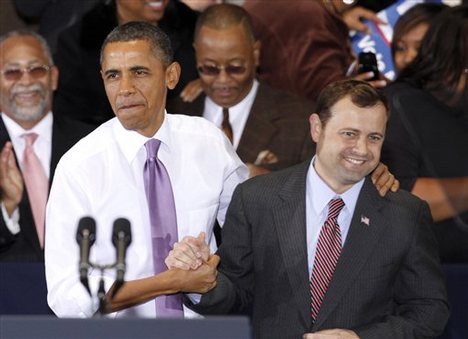
Image: U.S. President Barack Obama with Avaaz co-founder and former U.S. Representative Tom Perriello.
The Ivy League bourgeoisie who sit at the helm of the non-profit industrial complex will one day be known simply as charismatic architects of death. Funded by the ruling class oligarchy, the role they serve for their funders is not unlike that of corporate media. Yet, it appears that global society is paralyzed in a collective hypnosis – rejecting universal social interests, thus rejecting reason, to instead fall in line with the position of the powerful minority that has seized control, a minority that systematically favours corporate interests.
This investigative report examines the key founders of Avaaz, as well as other key sister organizations affiliated with Avaaz who, hand in hand with the Rockefellers, George Soros, Bill Gates and other powerful elites, are meticulously shaping global society by utilizing and building upon strategic psychological marketing, soft power, technology and social media – shaping public consensus, thus acceptance, for the illusory “green economy” and a novel sonata of 21st century colonialism. As we are now living in a world that is beyond dangerous, society must be aware of, be able to critically analyze, and ultimately reject the new onslaught of carefully orchestrated depoliticization, domestication of populace, propaganda and misinformation that is being perpetrated and perpetuated by the corporate elite and the current power structures that support their agenda. The non-profit industrial complex must be understood as a mainspring and the instrument of power, the very support and foundation of imperial domination.
Within part I of this investigative report:
- The Simulacrum
- Modus Operandi: The 21st Century NGO
- 2004: The Soft Power Imperative | 2011: Mission Accomplished
- Introduction: The Non-profit Industrial Complex: Imperialist Pimps of Militarism, Protectors of the Oligarchy, Trusted Facilitators of War
- Historical Amnesia
- Corporate “Green” Pedophilia
- The Commerce of Trust
- The Cat is Out of the Bag
- New York City Occupy Wall Street Embraces Otpor and Bombing for Peace
- The WikiLeaks Connection
- Unidentified “Freedom of Speech”
- 15M – Europe’s Occupy Movement
- The Commerce of Exploitation: Change.org
- Indoctrinated Subservience & Whitism
- Avaaz’s Founder and MoveOn.org Announce the U.S. “Spring”
Part II:
- Bread and Circuses
- Avaaz: The Emperor of the NGO Network
- Did Libya’s Citizens Demand Foreign Intervention?
- The Avaaz Gate-Keepers
- Avaaz Co-Founder and Executive Director: Ricken Patel
- Avaaz Co-founder: Tom Perriello
- Indoctrination of the Youth is Essential
- The Humanitarian Industrial Complex: The Ivory Towers Within the Dark Triad
- The Empire
- Avaaz Co-founder: Tom Pravda
- Avaaz Co-founder: David Madden
- Avaaz Co-founder: Eli Pariser
- Avaaz Co-founder: Jeremy Heimans
Part III:
- Behavioural Change
- May 2010: Avaaz’s Co-Founders Seek a Purpose-Driven Consumer Life | Behavioral Economics
- The Behavioral Economics of Hatred
- Purpose
- Res Publica
- Avaaz Founding Board Member: Ben Brandzel
- Purpose: James Slezak
- MoveOn.org
- GetUp
- The 21st Century Social Movements
- The Non-Profit Industrial Complex Finally Finds “Success”
- Avaaz Co-founder: Andrea Woodhouse
- Avaaz Co-founder: Paul Hilder
- The Avaaz “Core Campaign Team Members”
The Simulacrum
“As regards the ‘foundations’ created for unlimited general purposes and endowed with enormous resources, their unlimited possibilities are so grave a menace, not only as regards to their own activities and influence but also the numbing effect which they have on private citizens and public bodies, that if they could be clearly differentiated from other forms of voluntary altruistic effort, it would be desirable to recommend their abolition.” – Senator Frank Walsh, 1915
In his Sophist, Plato speaks of two kinds of image-making. The first is a faithful reproduction, a precise copy of the original. The second is distorted intentionally in order to make the copy appear correct to viewers. Plato gives the example of Greek statuary, which was crafted larger on top than on bottom so that viewers from the ground would see it correctly, whereas if they could view it in scale, they would realize it was malformed.
This latter representation serves as a visual art metaphor for the non-profit industrial complex. A semblance of entities, united in an ideology encompassing truth, justice and ethics – which is false. This is the simulacrum, distorted in such a way that it appears accurate unless viewed from the proper angle. This report aims to allow you, the reader, to view the matrix from such an angle. By denying the reliable input of our senses while accepting the non-profit industrial complex’s manipulative constructs of language and “reason,” global society has arrived at a grossly distorted copy of ethics and intrinsic worth – a warped simulacrum of thespian complexity, a vast work of superficial depth.
Modus Operandi: The 21st Century NGO

“What a cluster-fuck of disinformation this world has become. The sinister forces of greed and avarice are, through consolidation of wealth and power, more powerful than ever. Humankind has a huge uphill battle to wage.” — Comment at How Avaaz is Sponsoring Fake War Propaganda from Syria
The 21st century NGO is becoming, more and more, a key tool serving the imperialist quest of absolute global dominance and exploitation. Global society has been, and continues to be, manipulated to believe that NGOs are representative of “civil society” (a concept promoted by corporations in the first place). This misplaced trust has allowed the “humanitarian industrial complex” to ascend to the highest position: the missionaries of deity – the deity of the empire.
Modus operandi (plural modi operandi) is a Latin phrase, approximately translated and backronymed as “mode of operation.” The term is used to describe someone’s habits or manner of working, their method of operating or functioning. In English, it is frequently shortened to M.O.
The expression is often used in police work when discussing a crime and addressing the methods employed by the perpetrators. It is also used in criminal profiling, where it can help in finding clues to the offender’s psychology. It largely consists of examining the actions used by the individual(s) to execute the crime, prevent its detection and/or facilitate escape. [Source: Wikipedia]
2004: The Soft Power Imperative | 2011: Mission Accomplished
“Existing soft power initiatives and agencies, particularly those engaged in development and strategic communications, must be reinvigorated through increased funding, human resources and prioritization. Concurrently, the U.S. government must establish goals, objectives and metrics for soft power initiatives. Furthermore, the U.S. government can better maximize the effectiveness of soft power instruments and efforts through increased partnerships with NGOs. By providing humanitarian and development assistance in areas typically inaccessible to government agencies, NGOs are often able to access potential extremist areas before the government can establish or strengthen diplomatic, developmental or military presence, including intelligence.” — Joseph S. Nye, former US assistant secretary of defense, June 2004
The non-profit industrial complex represents a rich portfolio of soft power tools readily available to the ruling elite. Today we witness the near complete metamorphosis of the complex having successfully morphed into the absolute idyllic clearinghouse for the collective and coordinated imperialist agenda shared by a broad spectrum of government institutions, dominated by the financial industrial complex, corporate power and hegemonic rule – all under the guise of a global conscience reflective of “civil society” via self-appointed NGOs.
Joseph S. Nye (quoted above) is a former US assistant secretary of defense, former chairman of the US National Intelligence Council and professor at Harvard University. A world renowned scholar of international relations, Nye co-founded the liberal institutionalist approach to international relations, theorizing that states and other international powers possess more or less “soft power” (a term first coined in the 1980s). In a 2004 article titled The Rising Power of NGO’s, Nye peddled his soft-power theory as the quintessential element that must be employed in order to protect the American public from “terrorists.” Of course, Nye neglected to include the fact that the true “terrorists” are those who hold power within our very own EuroAmerican governments/establishments, waging violence upon sovereign, resource-rich states. It’s an easy sell as it enables one to conveniently deny their assent to (our own) state-sponsored terrorism and continued collective and voluntary servitude as well-behaved, rapturous consumers under the influence of American (non) culture.
If a state can present its power as legitimate in the eyes of others, it will encounter far less resistance to its foreign policies and agendas. Further, if the Western states’ (non) culture and (illusory) ideology are desirable, other states will more willingly acquiesce. This is an area where the NGOs excel. They do so by never referring to their own “leaders” as dictators or fascists, yet more than willing to apply these derogatory terms to leaders targeted for regime change. Simultaneously, while reporting on human rights abuses or environmental violations in states exploited by industrialized capitalism, the NGOs neglect to comment on their own states’ escalating assault on “democracy.” Most important, the non-profit industrial complex certainly does not address the fact that industrialized and globalized capitalism (imposed by hegemonic rule) is the crux of most all suffering and ongoing crisis in the very states they criticize and deem culpable. A continuous subtle undertone of support/belief in their own states’ democracy is achieved simply by never opening a dialogue on the legitimacy of power structures within their own (imperialist) states.
In essence, soft power is “the universalism of a country’s culture and its ability to establish a set of favourable rules and institutions that govern areas of international activity [that] are critical sources of power” or, more simply, the ability to attract and co-opt rather than coerce and rather than using force or money as a means of persuasion. This is where states such as Bolivia (and Libya until its recent annihilation) are very real threats to the American superpower. States such as Bolivia and Libya (past-tense) serve the people to advance themselves to a more enlightened, more democratic existence in a very real sense, while democracy and freedoms in the Americas mean little more than “freedom to shop” and buy as much sweatshop junk as one can(not) afford. If corporate-owned/controlled media and corporate-funded/controlled educational institutes actually educated the American public on intellectual enlightenment and progressive advances in other countries – Americans would truly wonder what the fuck was going on. Rather, we are kept in the dark; doped up by big pharma and stupefied by Big Brother, all while such states and leaders are continually vilified and demonized in the media (both corporate and foundation-funded “progressive”), all while NGOs remain silent on their own accelerating fascist governments. American “exceptionalism” is, undoubtedly, the biggest lie ever told sold.
Introducing the Non-Profit Industrial Complex: Imperialist Pimps of Militarism, Protectors of the Oligarchy, Trusted Facilitators of War

Packaging – Uncle Sam is the best in packaging and selling illusions.
“I am convinced that some NGOs, especially those funded by the U.S.AID, are the fifth column of espionage in Bolivia, not only in Bolivia, but also in all of Latin America.” — Evo Morales, February 2012
In 2001, it was George W. Bush who propelled an illegal invasion of Iraq by way of relentless pounding of repetitive messaging of discovered weapons of mass destruction in Iraq coupled with incessant images of the Twin Towers being destroyed. This psyop (or psychological operation, a new form or warfare) reverberated throughout a mainstream media that obediently fed the lies to the masses. The role of the media was absolutely essential. Yet, in spite of Bush calling for the invasion of Iraq, citizens of the globe, in united cohesion, held the largest mass protests and peace vigils the world had ever witnessed.
Today, however, the push to invade under the guise of humanitarianism is no longer a message from predominantly imperialist governments alone. Rather, there is a new game in town. Flash forward one decade to 2011 and the push for war no longer comes from the lone vacuity of despised war criminals such as George Bush or his charismatic alter-ego, Barack Obama. Rather, the message is now being spoon-fed to global society via the “trusted” NGOs, with Avaaz, Amnesty International and Human Rights Watch at the forefront, as documented prior to and during the attack on and subsequent occupation of Libya, and more recently, the destabilization of Syria. [One of many reports of such malfeasance include “HUMAN RIGHTS” WARRIORS FOR EMPIRE | Amnesty International and Human Rights Watch“, by Glen Ford, Black Agenda Report.]
“While much was made of the United Nations decision to establish a Human Rights Council in 2006, those who’ve witnessed the evolution of this institution are well aware that the UN was designed by (and functions to serve) the interests of modern states and their supplicants, not the Indigenous nations they rule. For those attached to charitable organizations like Human Rights Watch and other pashas of the piety industry, this is a bitter pill to swallow.” — Jay Taber, Obstacles to Peace, 13 July 2012
“The UN Human Rights Council stands as one of the significant obstacles to dynamic political development in the Fourth World. Many individuals and the peoples they represent in the Fourth World have come to believe that the UN Human Rights Council will relieve their pain from the violence of colonialism. It cannot, and it will not.” — Dr. Rudolph Ryser, Chair of the Center for World Indigenous Studies
A decade later, thanks to the non-profit industrial complex awash in an influx of money that flows like the river Nile, partnered with the corporate media complex, it is now “the people” – having been swayed by fabrications, omissions and lies – who lead the demand for invasion of these sovereign states. And, most ironic, it is not the so-called “right” at the vanguard; rather, it is the “progressive left.”
Historical Amnesia
“False reality” requires historical amnesia, lying by omission and the transfer of significance to the insignificant. In this way, political systems promising security and social justice have been replaced by piracy, “austerity” and “perpetual war”: an extremism dedicated to the overthrow of democracy. Applied to an individual, this would identify a psychopath. Why do we accept it? — John Pilger, award–winning journalist, in History is the Enemy as “Brilliant” Psy-ops Become the News, 21 June 2012
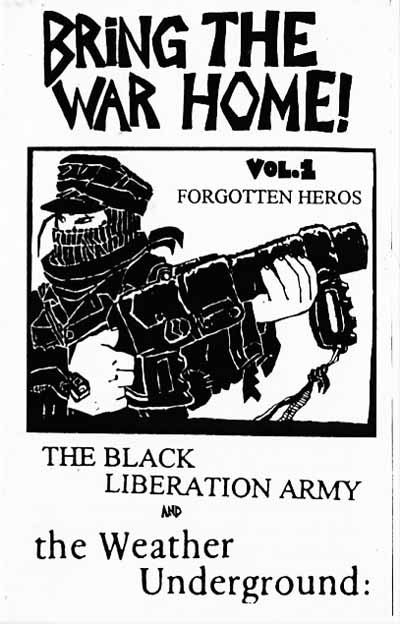

Huey P. Newton, Bobby Seale, Eldridge Cleaver, David Hilliard, Fred Hampton, and Erica Huggins – forgotten heroes indeed. The Black Panthers, who emerged on the scene in 1966, drew much inspiration from the ideologies of Malcolm X. Rejecting pacifism and reformism, under the leadership of Fred Hampton, the Panthers recognized the necessity of militant action and self-defense (“by any means necessary”) against racists and the state. The Panthers were effective in organizing the struggle towards a true revolutionary faction, with the state full-well recognizing the very real potential the Panthers held to gain mass support for their revolutionary movement. The state was terrified at this very real threat. It must be noted that during this same time period, white youth were demonstrating against the Vietnam war while 45% of Blacks fighting in Vietnam proclaimed they would be prepared to take up arms within their own state to secure justice for the American people. Considering that in 1960 almost half of America’s population was under 18 years of age, the ample surplus of youth made the threat of a widespread revolt against the status quo a very real possibility. By 1967, the rise in militancy and “Black Power” drew a very tactical response from very anxious foundations. Rockefeller and Ford created the National Urban Coalition (NUC) with the intent of transforming “Black Power” into “Black capitalism.” This was the vehicle designed/created to crush the building momentum that was confronting/challenging the prevailing system of economic control and oppression. By 1970, as Black capitalism took hold, foundations were funneling over $15 million into “moderate” Black organizations in order to effectively deflect the Black Power movement into non-threatening channels. With Black Power successfully transitioning itself into Black capitalism, American corporations utilized the opportunity to cast themselves in a liberal, progressive light by financing Black Power conferences.
The evidence that the Panthers’ revolutionary movement was a very real threat to the American state is indisputable: the FBI (under J. Edgar Hoover) declared the Panthers the number one threat to the internal security of the US. The state tried to eradicate the Panthers “by any means necessary,” gunning down scores of Panthers in the street.
Martin Luther King, Jr. was also closely affiliated with the Rockefellers via the 1957 founded Southern Christian Leadership Council (SCLC), which received money from the church and the Rockefellers. Although quite radical, elites considered SCLC moderate and “workable” because of its stance on nonviolence (which protects the state), alongside goals of integration rather than revolution. However, by the late 1960′s, Martin Luther King, Jr. had embraced militancy and radical positions espoused by both the Panthers and Malcolm X. As Martin Luther King, Jr.’s refusal to compromise increased, the foundation funding decreased. A respected man of such stature, speaking out, thus educating a vast public of the oppression caused by the capitalist system/racism, was indeed (and remains so today) a great threat to the powers that dominate. Thus, King was assassinated. Today, in united cohesion, the states work ardently with “progressive” (foundation-funded) media and the non-profit industrial complex, in ensuring that the King legacy is continually and relentlessly sanitized, watered down and co-opted to serve the elitist agenda. The pacifist doctrine, fondly funded by hegemonic rule, is continuously pumped through and circulated throughout the gentrified “movement” like fluoride in the city water – a neutral benevolence of slow poison we drink in voluntary servitude. [June 27, 2012: Black On The Old Plantation | Civil Rights Organizations Enslave Themselves to Corporate Funding]
“We do not fight racism with racism. We fight racism with solidarity. We do not fight exploitative capitalism with black capitalism. We fight capitalism with basic socialism. We fight imperialism with proletarian internationalism.” — Bobby Seale, a founder of the Black Panthers
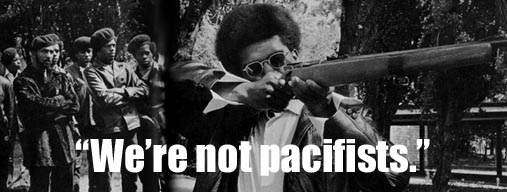
While Huey P. Newton advocated armed struggle, his ideology did not mean that the end product would be a world in which violence reigns. Rather, Newton believed that the oppressed must use guns as the means to a peaceful end of the oppression. He quoted Mao Tse-tung: “We are advocates of the abolition of war, we don’t not want war; but war can only be abolished through war, and in order to get rid of the gun it is necessary to take up the gun.” Within the Panther Party, the gun was not upheld as a means of violence, rather, it was a symbol for empowerment and self-determination. [Huey P. Newton :: Philosophy :: Armed Self-Defense]
In October of 1969, hundreds of youth clad in football helmets marched through an elite shopping district of Chicago. Utilizing lead pipes, they shattered shop windows and demolished parked cars. This was the first demonstration known as the “Days of Rage” – organized by a group who called themselves the Weather Underground. Outraged by the war on Vietnam and the rampant racism in America, the Weather Underground waged a strategic low-level war against the state that continued throughout much of the seventies. The Underground had the state on the run. Members of the Underground bombed state property including the Capitol building (never incurring a single casualty) and even broke Timothy Leary out of prison all while successfully evading one of the largest FBI manhunts ever conducted in US history.
Weather Underground Bombs the Capitol, Pentagon, and State Department (Running time 10:00)
Today, most all the past revolutionary leaders of the Weather Underground, now conformed, apologize for their “tactics,” having been isolated and framed as “violent” by the co-opted left and status quo. [http://youtu.be/S6kPGh0w_-c]
It was during this time of true revolutionary uprising that money and “opportunities” began to siphon into the movements. The art of co-optation had begun with the only weapon (palatable to the public) the oligarchy possessed – money. This money would serve to indulge, thus co-opt, inflated egos scouted from within the left. Co-opting was an absolute necessity for the state to protect the dominant power structures from true systemic change that would effectively transfer power to the people. Examples of revolutionary movements in history, as evidenced in The Weather Underground, the Panthers and others, demonstrate unequivocally that the left became more jingoistic for war only after an influx of money began pouring in from the state and plutocrats via their foundations, which were in many cases set up for this very purpose.
A case in point: Roy Innis of the Congress of Racial Equality/CORE (who advocated “Black control of Black communities” in order to allow for the manifestation of “Black capitalism”) was named a Ford Foundation fellow and became a board member of the Rockefeller/Ford-created NUC/National Urban Coalition. Ford granted CORE Cleveland $175,000 in 1967 to help elect Carl Stokes, who was very much pro Black-capitalism.
Lesser known are the events led by CIA operant Gloria Steinem. The “Black Feminist” movement was created, funded and manipulated by the CIA from the very beginning with Steinem leading the charge. Steinem planted faux “Black feminists” in revolutionary Black Power movements/grassroots organizations in order to instill division and hatred and, ultimately, to dismantle the growing movement. Steinem’s “success” would assist the state’s crushing of the Black Power movement itself. [Read: BLACK FEMINISM, THE CIA AND GLORIA STEINEM]
Throughout the world, there are organizations identifying themselves as the Black Panthers and other true revolutionary movements in existence. However, blinded by the shiny veneer of the big NGOs, few people are aware that such revolutionary movements even exist today. It is the job of the non-profit industrial complex, while waving the pacifist bible in one hand, to deliberately ensure that these groups are not only marginalized, but ignored altogether. Such movements, which have to potential to disrupt (or even dismantle) the power structures that enslave us, must remain invisible or framed in a negative light – if co-opting them is not possible, that is.
And that is something that the Western culture has perfected: co-optation. Forrest Palmer writes: “I am writing a blog post called ‘Malcolm X on a postage stamp.’ It is exactly what you see here [http://www.movements.org/pages/team]. If you know that something is happening at the grassroots and you can’t stop it, the West accepts it, places their handpicked leaders in the forefront who appease the masses into thinking what they are doing is still ‘revolutionary,’ negotiate with the ‘leaders’ ensuring they acquiesce to the state, compromise and either end up with things status quo or so watered down that the compromise doesn’t help the masses at all, but instead helps the state. The best example of a singular event of this: The March on Washington. It went from a black mass rebellion to a benign walk in the park masquerading as a movement. They had all their speeches proofread by the state, including King’s ‘great’ I Have a Dream speech. If the speeches weren’t what the state wanted, they either changed them (John Lewis) or weren’t allowed to speak (James Baldwin).”
“Malcolm predicted that if the civil rights bill wasn’t passed, there would be a march on Washington in 1964. Unlike the 1963 March on Washington, which was peaceful and integrated, the 1964 march Malcolm described would be an all-Black ‘non-violent army’ with one-way tickets.” [Wikipedia, speaking of Malcolm X and his speech The Ballot or the Bullet.]
And so it goes. Malcolm X was assassinated on 21 February 1965. And while our brothers and sisters in Africa, the Middle East and the Global South continue to be grossly exploited or altogether annihilated by the imperialist forces, the movement is ever-so acquiescent. Five hundred dollars a day for lodging at the Rio+20 Summit has never been so easy for those within the champagne circuit. And with a Democratic administration and a Black American president in the White House, the modern civil rights movement and dominant left organizations have never found it so easy to remain silent, with little to no criticism from civil society who, self-appointed, they falsely claim to represent.
“While in the US those puppets have traditionally taken on the form of talking heads on corporate and public television, they are increasingly represented in the form of NGO PR puppets employed in the moral theatrics industry…. As the credibility of politicians and pundits plummets, it is these PR puppets that are increasingly responsible for bolstering public support for militarism in general and militarized humanitarian intervention in particular.” — Jay Taber, Intercontinental Cry; Pious Poseurs, 24 June 2012
Although now seemingly normalized, one must consider it slightly ironic that it is in fact no longer the dominant “progressive left” beating the drums against war. [Exceptions include legitimate grassroots groups such as Peacelink in Italy.] Rather, as in the case of climate change, it is primarily the countries seeking to free themselves from the chains of imperialist enslavement that vocally oppose the escalating destabilization campaigns, inclusive of the most recent, in Syria. On 16 February 2012, the 12 sovereign states who voted against the resolution to condemn Syria at the United Nations included North Korea, China, Russia, Iran and Syria, along with states who primarily compose ALBA; Bolivia, Belarus, Cuba, Ecuador, Venezuela and Nicaragua. And it is not coincidence that most all the leaders of all these same states, who continue the struggle for autonomy, are all similarly vilified and demonized by the corporate-media complex, joined recently by the non-profit industrial complex. It is critical to note that the imperialist powers (inclusive of the UN) do not criticize or demonize or withdraw their support from such leaders on any ethical or moral ground. Denunciation of state leaders and emotive language is merely theatre. Rather, the imperialist states strategically set out to destroy any state leader that is unwilling to be controlled by US interests and foreign policy. A case in point is unwavering support of the Saudi royal family responsible for atrocious human rights violations to which the imperialist countries turn a blind eye.
Demonization is a key psyop, directly sponsored by the US Pentagon and intelligence apparatus to influence and sway public opinion and build consensus in favour of invasion. [Prof. Michel Chossudovsky] A recent example can be extracted from the failed 2011 destabilization campaign against the Morales government in Bolivia led by US-funded NGOs including the “Democracy Centre,” which declared: “But the abuses dealt out by the government against the people of the TIPNIS have knocked ‘Evo the icon’ off his pedestal in a way from which he will never fully recover, in Bolivia and globally.” [Further reading: U.S. Funded Democracy Centre Reveals Its Real Reason for Supporting the TIPNIS Protest in Bolivia: REDD $$$. ¿Por qué se defiende el tipnis?, http://youtu.be/RPiw3cDotHA]
A similar situation (developing nations, rather than the “environmental movement,” taking the lead) has taken place on the issue of climate change. ALBA nations, with Bolivia at the forefront, led while the non-profit industrial complex purposely and grossly undermined the strong positions necessary to mitigate the climate emergency. The climate justice movement was acquiescent and thus kowtowed to the “big greens”; “big greens” such as Avaaz, 350.org and Greenpeace who had partnered with HSBC, Lloyds Bank, nuclear giant EDF, Virgin Group, Shell (via TckTckTck partner, the Corporate Leaders Group on Climate Change) and other corporate giants constituting the “TckTckTck campaign” whereby “the objective was to make it become a movement that consumers, advertisers and the media would use and exploit” (Havas Press Release). There was no justice to be found, only a cohesive hypocrisy amongst the professional left that flourished like a cancer.
Next: Part one, section II.
Avaaz Investigative Report Series [Links]|Further Reading: Part I | Section I | Part I | Section II | Part I | Section III | Part II | Section I | Part II | Section II
Panama refuses to extradite CIA’s Lady to Italy
Press TV – July 20, 2013
Panama has refused to extradite the former CIA chief of Milan station to Italy where he has been sentenced to nine years in prison for the 2003 abduction of an Egyptian Muslim cleric on suspicion of terrorist activities.
Italian justice ministry’s press office on Thursday announced that Robert Seldon Lady, also known as “Mister Bob,” has been arrested in Panama. However, it is not clear when and where he has been arrested.
On Friday, the US State Department confirmed Lady was on his way back to the United States. Italy had asked Panama to hold Lady while an extradition request was being made.
Panama foreign ministry sources have said the documents submitted by Italy for the extradition were “insufficient,” according to Italian media.
Italy’s Justice Minister Anna Maria Cancellieri said Friday that she was “deeply disappointed” by Panama’s decision not to return Lady to Italy.
The former Milan CIA station chief was sentenced to nine years in jail for the abduction of Osama Moustafa Hassan Nasr, also known as Abu Omar. Twenty-two other Americans involved in the kidnapping were each sentenced to five years in prison.
The court ordered each of the 23 convicts, none of whom appeared for the trial, to pay one million euros (about $1.3 million) to Abu Omar, plus 500,000 euros to his wife.
The Muslim cleric was transferred to US military bases in Italy and later in Germany before being flown to Egypt. He was later set free in Egypt.
Related article
Featured Video

New positive ivermectin evidence
or go to
Aletho News Archives – Video-Images
From the Archives
Fanatical Followers of the Covid Regime: A Jim Jones-Style Cult?
By Professor Roger Watson and Dr. Niall McCrae | The Daily Sceptic | November 15, 2021
As scholars at leading British universities over recent decades, we witnessed the replacement of critical thinking and debate by narrative: facts are discrimination and scientific method is imperialism; truth, instead, is derived from ‘progressive’ values. This educational trend may be a major contributory factor to the ease in which society has been inculcated to the Covid ‘new normal’ of masking, testing, and repeated doses of vaccines for a disease of similar risk to severe influenza.
One doesn’t need much critical reasoning to observe the flawed logic of some vaccination enthusiasts, such as people who respond to experiencing any side effects, however debilitating, by saying “at least I know it’s working”, or, after contracting the disease despite their promised inoculation (over 90% effective, according to initial drug company claims), “I’d have been worse off without the jab.” … continue
Blog Roll
 Aletho News
- ‘Grave, alarming’: Iran mission on Trump’s UNGA ‘annihilation’ threats
- Najaf airport to reopen to Iranian flights within 24 hours: Ambassador
- From ‘How Will This End For Iran’ to ‘When America Walks Away’: A tale of two Economist covers
- Tehran blasts ‘baseless’ speculation linking Iran to alleged bomb plot at UK air base
- The Rise And… Rise Of ‘Color Revolutions’
- The Coming GOP Bloodbath?
- Arctic Scare Stories Melt Away
- Wrong, Euronews: Climate Change Has Not Created a Food, Energy, and Economic “Meta-Crisis”
- New positive ivermectin evidence
- Met Office Caught Fabricating Daily Temperature Record Claims
- If Americans Knew
- Netanyahu Asked UAE Leader to Deny Report on Oct. 7 Warning in Secret Visit, Sources Say
- CNN Chief Int’l Correspondent Clarissa Ward on Journalists in Gaza
- Democratic Party Consultants Surround Troy Jackson with Pro-Israel Donors
- Christian Leader Responds To Netanyahu’s Claims Regarding Palestinian Christians
- In Gaza, ‘Whoever Survives the Bombing Won’t Survive the Rubble’
- Israel kills more Palestinians, amid push to resettle Gaza – Daily Update
- Israel forces Gazans to live in constant peril – Daily Update
- Deconstructing Netanyahu’s pants-on-fire UN rant – Daily Update
- Trump betrayed voters with his campaign lies and prioritized a foreign country once he took office
- Netanyahu calls Israel’s war in Gaza ‘opposite of genocide’ in UN speech to near-empty hall
- No Tricks Zone
- New Study: Earth And Venus Surface Warmth Largely Explained By Convection And Lapse Rate, Not CO2 Or Radiation
- 2025 Nature Paper Claiming Worsening Global Drought Gets RETRACTED …Heavily Flawed
- New Study: ‘Global Drought Shows No Detectable Recent Acceleration Under Climate Warming’
- Economic Masterminds: German Socialists Suggest Taxing Productivity Gains Stemming From Using AI
- The South China Sea Has Not Been Cooperating With The Climate Change Narrative
- Energy Crisis: Germany Enters Heating Season With Historically Low Gas Reserve Fill Levels
- New Study: The Antarctic Ice Sheet Gained Mass From 2020-2024 Due To Staggering Snow And Ice Accumulation
- Study: Ocean Heating Rates From Thousands Of Years Ago ‘Dwarf’ Modern Ocean Heating Rates
- Climate Extremists Target, Attack Large-Scale Power Grid Infrastructure In Germany!
- New Study: Antarctic Ice Melt Has Contributed Less Than 1 Centimeter To Sea Level Rise In The Last 30 Years

