NSF terminates hundreds of “misinformation”-related grants, impacting research tied to online speech flagging
By Dan Frieth | Reclaim The Net | April 23, 2025
A large wave of funding cancellations from the National Science Foundation (NSF) has abruptly derailed hundreds of research projects, many of which were focused on so-called “misinformation” and “disinformation.”
Late Friday, researchers across the country received emails notifying them that their grants, fellowships, or awards had been rescinded; an action that stunned many in the academic community and ignited conversations about the role of the government in regulating research into online speech.
Among those impacted was Kate Starbird, a prominent figure in the “disinformation” research sphere and former Director of the University of Washington’s Center for an Informed Public.
The Center, which collaborated with initiatives like the Election Integrity Partnership and the Virality Project, both known for coordinating content reporting to social media platforms, had ties to federal agencies and private moderation efforts.
Starbird expressed dismay over the NSF’s move, calling it “disruptive and disheartening,” and pointed to a wider rollback in efforts to police digital content, citing reduced platform transparency and the shrinking of “fact-checking” operations.
Grants that were cut included studies like one probing how to correct “false beliefs” and another testing intervention strategies for online misinformation. These projects, once backed by taxpayer dollars, were part of a growing field that often overlaps with content moderation and speech policing; a fact acknowledged by even Nieman Lab, which admitted such research helps journalists “flag false information.”
The timing of the cancellations raised eyebrows. The NSF’s action followed a report highlighting how the Trump administration was reevaluating $1.4 billion in federal funding tied to misinformation research. That investigation noted NSF’s involvement in these programs but did not indicate the impending revocations.
The NSF stated on its website that the grants were being terminated because they “are not aligned with NSF’s priorities,” naming projects centered on diversity, equity, inclusion, and misinformation among those affected.
A published FAQ further clarified the agency’s new direction, referencing an executive order signed by President Donald Trump. It emphasized that NSF would no longer support efforts aimed at combating “misinformation” or similar topics if such work could be weaponized to suppress constitutionally protected speech or promote preferred narratives.
Some researchers, like Boston University’s Gianluca Stringhini, found multiple projects abruptly defunded. Stringhini, who had been exploring AI tools to offer users additional context about social media content; a method akin to the soft content warnings platforms deployed during the pandemic—was left unsure about the full scope of consequences for his lab.
Foundational to many early studies in this space, the NSF had long played a key role in launching initiatives that shaped how digital discourse was studied and potentially influenced. According to Starbird, about 90% of her early research was NSF-funded. She cited the agency’s vital support in forging cross-institutional collaborations and developing infrastructure for examining information integrity and technological design.
The mass termination of these grants signals a pivotal shift in the federal government’s stance on funding initiatives that blur the lines between research and regulation of public speech. What some see as necessary oversight to prevent narrative enforcement, others view as a dismantling of essential tools used to navigate complex digital environments. Either way, the message from Washington is clear: using federal dollars to police speech, even under the guise of scientific inquiry, is no longer a priority.
Exposed: Real Agenda Behind Scrapped $2 Million US Media Grant in Moldova
By Ilya Tsukanov – Sputnik – 17.04.2025
US taxpayers will no longer have to foot a $2 million bill for ‘Newsroom Sustainability’ in a post-Soviet republic 5,000 miles away after DOGE sniffed out another $215 million in State Department foreign aid waste.
Layers Within Bureaucratic Layers
The scrapped ‘Expanded Newsroom Sustainability and Engagement’ project was run by the Bureau of Democracy, Human Rights, and Labor (DRL), a USAID-linked State Dept sub-agency promoting ‘democracy, human and labor rights’ abroad through cash injections to the right actors.
Officially, the $2 million grant was meant to ‘support independent newsrooms and increase civic engagement through professional journalism’.
In reality, it was part of a vast web of US and EU-financed media in Moldova and other post-Soviet countries pushing the pro-Western, pro-EU and anti-Russian narrative.
Green Light for Attack Dog Journalism
The DRL, USAID, the European External Action Service and the Council of Europe have spent tens of millions of dollars annually funding Moldovan media like Recorder, ZDG and NewsMaker.
These outlets drag opposition parties (like Sor, now banned) and figures (like former president Igor Dodon) through the mud in corruption investigations and exposés, but ignore the alleged corruption and wrongdoing of ruling PAS Party elites.
While pro-EU media has flourished, independent and opposition outlets have faced shutdowns, sanctions and harassment, from fake tax inspections to legal threats.
This was made possible by draconian “anti-fake news” and “disinformation” laws, overseen by the country’s powerful Audiovisual Council and supported by the EU.
Could State Department’s Move Level the Playing Field?
$2 million in lost funding may not seem like much, but every little bit helps. USAID alone has already nixed $32 million in media support to Moldova and $22 million in elections-related aid this year ahead of September’s crucial parliamentary vote.
Cuts won’t bring back banned outlets, but they could deamplify the pro-West media narrative, and accordingly the political and media power of the Sandu government.
Funding the PA is for the benefit of Israel and the EU, not the Palestinians
By Ramona Wadi | MEMO | April 15, 2025
Palestinian Authority leader Mahmoud Abbas met with the EU’s High Representative for Foreign Affairs and Security Policy, Kaja Kallas, in March. The meeting was replete with the usual hyperbole that still clings to the defunct two-state paradigm, the PA’s reform and funding for this purpose.
Yesterday, Reuters reported that the EU will be funding the PA with a three-year package worth $1.8 billion to support reform. According to European Commissioner for the Mediterranean Dubravka Suica, “We want them to reform themselves because without reforming, they won’t be strong enough and credible in order to be an interlocutor, not for only for us, but an interlocutor also for Israel.”
The reasoning is warped.
It only spells one thing clearly: the EU wants the PA to be strong enough to act against the Palestinian people and prevent them from being their own interlocutors in a political process that concerns them much more than the PA.
Speaking about the EU funding for the PA, Kallas said, “This will reinforce the PA’s ability to meet the needs of the Palestinian people in the West Bank and prepare it to return to govern Gaza once conditions allow.” No time frames, of course, because the conditions will always depend on Israel. Funding buys time for Israel’s genocide in Gaza. Meanwhile, the PA, which has not only neglected the needs of Palestinians in the occupied West Bank, but also exacerbated their humanitarian and political neglect as evidenced in Jenin, for example, can rest assured of some more years of EU support. That is, as long as the humanitarian paradigm remains relevant to the illusory state-building funded by Brussels.
From the allocated budget, the UN Relief and Works Agency for Palestine Refugees (UNRWA) will receive €82 million per year.
The most telling clause in the European Commission’s statement detailing its assistance is found right at the end. “This designation shall not be construed as recognition of a State of Palestine and is without prejudice to the individual positions of the Member States on this issue.”
France’s announcement that it might recognise the State of Palestine by June this year, symbolic as the gesture is, only shows the EC’s urge to detach itself from all possibilities, no matter how remote, of Palestinian independence. Which brings one back to the big question:
Why is the EU really funding the PA’s state-building to prevent the eventual formation of a Palestinian state?
Funding a Palestinian entity for Israeli and EU purposes does not bode well for Palestinians, who are still only spoken of in terms of humanitarian matters. The political purpose is reserved only for Israel’s allies, the PA being one of them, as seen in many instances of its collaboration with the occupation state.
But Western diplomats would do well to recall that one major democratic implementation postponed repeatedly by Abbas – democratic legislative and presidential elections – has not featured once in the EU’s vision of a post-war Gaza, determined as it is to have the PA take over political authority in the enclave and bring Palestinians under different forms of misery. How scared is the EU of having Palestinians being allowed to vote freely and possibly electing alternatives that have nothing to do with the current Fatah-Hamas bipolarisation? Funding the PA indeed serves a purpose; that of destroying Palestinian democracy.
The silencing of scientific curiosity
Medical journals have became enforcers of orthodoxy—retracting genuine hypotheses while protecting proven fraud
By Maryanne Demasi, PhD | April 14, 2025
As a scientific writer and researcher, I’ve witnessed the decline of medical journals firsthand. Once forums for open debate and intellectual rigour, they’ve morphed into gatekeepers, more concerned with preserving a narrow orthodoxy than pursuing truth.
My previous work has exposed how journals suppress uncomfortable questions, avoid studies that challenge dominant narratives, and operate under a peer-review system distorted by bias and external influence.
But never have I seen a more absurd example of this decay than the retraction of a hypothesis paper—yes, a hypothesis—authored by Dr. Sabine Hazan in Frontiers in Microbiology.
Her 2022 article hypothesised that ivermectin might mitigate Covid-19 severity by promoting the growth of Bifidobacterium, reducing inflammation via the gut-lung axis.
She cited preliminary observations in 24 hypoxic patients who recovered without hospitalisation after combination therapy including ivermectin.
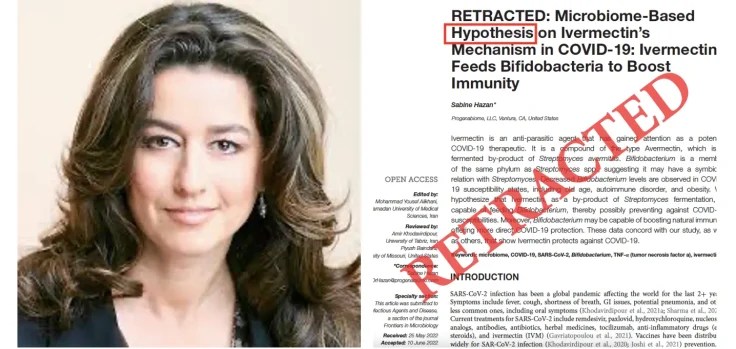
Dr Sabine Hazan, ProgenaBiome, Ventura, CA
She made no claims of definitive proof. Instead, she proposed a mechanism worth investigating. That’s the point of a scientific hypothesis.
But in May 2023—more than a year after the article was peer-reviewed and published—the journal retracted the paper following a series of complaints on PubPeer, offering only a vague explanation about “scientific soundness.”
Seeking clarity, I contacted both the journal’s editorial office and the editor who handled the paper, Professor Mohammad Alikhani at Hamadan University.
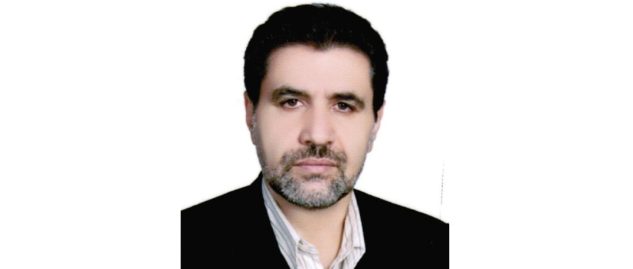
Prof Mohammad Alikhani, Department of Microbiology, Hamadan University
Specifically, I sought an explanation for retracting a ‘hypothesis’, but I did not receive a response.
This silence is damning.
Retraction is a serious step, historically reserved for cases of fraud or clear ethical misconduct. But here, no such claim was made—nor could one be substantiated.
The journal simply erased the paper, offering no transparent justification, no engagement with the scientific process, and no accountability.
In fact, it violated the very guidelines that journals are supposed to follow.
The Committee on Publication Ethics (COPE) advises that publications should only be retracted if they contain seriously flawed or fabricated data, or plagiarism that cannot be addressed through a correction.
Hazan’s paper was transparent about its speculative nature. In a January 2023 tweet, Hazan challenged her critics.
“It’s a hypothesis. PROVE ME WRONG,” she wrote.
After all, that’s the essence of science. But the journal’s decision to retract sends a message that even theoretical propositions are now intolerable.
Having tasted blood, Hazan’s critics kept digging. In January 2025, Future Microbiology retracted another of her studies—this one examining ivermectin-based multidrug therapy.
Hazan, her co-author Australian immunologist Dr. Robert L. Clancy, and others strongly disputed the decision after the journal failed to conduct a meaningful investigation into the alleged data integrity issues.
The irony is palpable.
While pundits argued over ivermectin’s efficacy during the pandemic, Hazan was one of the few actually doing the hard work to test its effects—collecting data, proposing mechanisms, engaging with the science. And yet she’s the one being silenced!
Which begs the question – why?
Is there professional jealousy in the microbiome space? Are pharmaceutical companies, threatened by low-cost alternatives like ivermectin, pressuring journals to kill competing narratives?
If so, the Securities and Exchange Commission (SEC) should investigate. Suppressing research that could affect investor decisions—by inflating the perceived value of antivirals or vaccines—could amount to securities fraud.
While there’s no definitive evidence, the pattern is hard to ignore: two retractions, no clear misconduct, and a growing campaign to discredit a scientist whose work challenges a profitable status quo.
Whether coordinated or not, the outcome is the same – the erasure of inconvenient data.
The spinelessness of journals in these episodes is unmistakable. Why do they capitulate so readily?
Just follow the money.
Many journals are financially entangled with the pharmaceutical industry—relying on drug ads, sponsorships, and profitable reprint sales. That financial tether distorts editorial independence.
Editors, often underpaid and overstretched, are understandably risk-averse. They fear litigation. They fear social media outrage. They fear becoming the next target.
Pharmaceutical companies, meanwhile, don’t hesitate to use legal threats to silence dissent because their pockets are deep—as in the case of Covaxin.
In July 2024, Bharat Biotech International Limited sued 11 authors—six of them students—and the editor of Drug Safety, Nitin Joshi, over a peer-reviewed article questioning the safety of their Covaxin vaccine.
The journal, under legal duress, retracted the paper. The authors were left to fend for themselves.
Journals are supposed to stand on principle. But, increasingly, they serve as enforcers of orthodoxy—vulnerable to financial pressure and online activists.
Let’s be honest, the trolls are part of the strategy. Anonymous complaints, often from individuals with no expertise, are weaponised to trigger retractions and smear reputations.
That’s not peer review. That’s mob rule.
The SEC must take a closer look at this ecosystem. If research is being suppressed to protect corporate revenue or manipulate investor confidence, that’s not just unethical—it’s illegal.
During his presidential campaign, Robert F. Kennedy Jr. addressed this very issue, declaring that journals colluding with pharmaceutical companies might be subject to charges under the Racketeer Influenced and Corrupt Organizations (RICO) Act.
“We’re gonna… file some racketeering lawsuits if you don’t start telling the truth in your journals,” he warned in 2023. It was provocative, yes—but it struck a chord with those of us watching the machinery of science betray its mission.
Retractions have become so casually executed, they’ve lost all meaning. What was once a mark of serious fraud is now a tool of reputational management.
Today, many papers are retracted not because they’re wrong, but because they’re inconvenient.
How else can one explain the demonstrably fraudulent studies funded by industry that remain published?
Whistleblower Dr. Peter Wilmshurst has spent years trying to get the MIST trial retracted—published in Circulation. It’s riddled with false claims, undeclared conflicts, and unreported adverse events, yet the journal continues to protect it.
This exposes the rot. These decisions have nothing to do with science.
They are political, financial, and reputational tools—used selectively to punish dissent.
There’s a growing list of researchers penalised—not for bad science, but for exploring uncomfortable truths.
Journals must reclaim their role as platforms for robust scientific debate. COPE must enforce its standards, not just cite them. Editors must be held accountable for vague or retaliatory retractions. And if corporate suppression of research is distorting public markets, then the SEC must act.
Because what I’m witnessing isn’t scientific curiosity—it’s narrative control. And the death of curiosity is the death of science itself.
Diana Panchenko: How Zelensky Dismantled Ukraine’s Democracy
Glenn Diesen | April 13, 2025
Diana Panchenko was Ukraine’s “journalist of the year” in 2020 and ranked as the 7th most influential woman in the country. Panchenko has been a critic of both Russia’s invasion of Ukraine and Zelensky’s destruction of democracy in Ukraine.
Follow Prof. Glenn Diesen:
Substack: https://glenndiesen.substack.com/
The fix is in for new Air Force F-47 — and so is the failure
By Andrew Cockburn | Responsible Statecraft | April 7, 2025
If and when it finally comes to be written decades from now, an honest history of the F-47 “fighter” recently unveiled by President Trump will doubtless have much to say about the heroic lobbying campaign that garnered the $20 billion development contract for Boeing, the corporation that has become a byword for program disasters (see the KC-46 tanker, the Starliner spacecraft, the 737 MAX airliner, not to mention the T-7 trainer.)
Boeing, which is due to face trial in June on well-merited federal charges of criminal fraud, was clearly in line for a bailout. But such succor was by no means inevitable given recent doubts from Air Force officials about proceeding with another manned fighter program at all.
“You’ve never seen anything like this,” said Trump in the March Oval Office ceremony announcing the contract award.
Well, of course we have, most obviously in recent times with the ill-starred F-35. Recall that in 2001 the Pentagon announced that the F-35 program would cost $200 billion and would enter service in 2008. Almost a quarter century later, acquisition costs have doubled, the total program price is nudging $2 trillion, and engineers are still struggling to make the thing work properly.
Thus, succeeding chapters of the F-47’s history will likely have to cover the galloping cost overruns, unfulfilled technological promises, ever-lengthening schedule shortfalls, and ultimate production cancellation when only a portion of the force had been built.
There seems little risk in predicting the F-47 — “a beautiful number,” said the 47th president — will follow the same dollar-strewn path. As Trump truthfully remarked, “we can’t tell you the price.” And don’t imagine that, if the development phase reveals that the program can’t fulfill any or most of its projected requirements, the Air Force will call it a day and kill the program. The official Air Force press release accompanying the announcement states: “This phase will produce a small number of test aircraft for evaluation. The contract also includes competitively priced options for low-rate initial production.”
In other words, the fix is in. “Low rate initial production” means that subcontracts will be spread across the political landscape, ensuring the creation of an unstoppable lobby preventing any future effort to strangle this boondoggle in its cradle.
For confirmation, look only at the F-35, 1,000 or so copies of which were cranked out before Lockheed got the go-ahead for full-scale production. In confident anticipation that nothing will interrupt the production cycle, Boeing has invested a reported $2 billion in expanding production facilities at its St. Louis, Missouri, plant, where production of the F-15EX (a costly version of the venerable F-15, originally gold-plated to sell to the Qataris) is due to end this year.
Extolling the plane’s advertised virtues, Trump singled out its presumed invisibility to radar. “America’s enemies will never see it coming,” he said.
Stealth has indeed been the holy grail of aerospace development ever since the days when Jimmy Carter sought to kill the B-1 bomber program in favor of the F-117 stealth bomber. (We did of course end up buying both.) Claims for this technology appeared to be justified when Lockheed’s F-117 diminutive bomber was advertised as having effortlessly penetrated Iraqi air defenses undetected on the first night of the 1991 Gulf War.
Only later did a GAO report reveal that in fact the planes had required the protection of a fleet of electronic warfare planes, and they missed most of their assigned targets, and furthermore failed to destroy Saddam’s air-defense network as claimed.
In the 1999 Kosovo war, the Serbs managed to knock down one F-117 and severely damage another using clever tactics and a modified ancient Soviet SAM missile system. Nowadays both the Chinese and Russians claim to have developed technologies to detect stealth intruders — there are even claims that the Chinese system could passively employ signals from Elon Musk’s SpaceX Starlink satellite array!
Nevertheless, the F-47 designers have clearly prioritized stealth, despite the fact that obligatory features, such as carrying all bombs and missiles internally, enlarge the fuselage. Hence the large nose-on profile, apparent even in the uninformative images so far released. This militates against aerodynamic performance and maneuverability, unfortunate deficiencies for a fighter.
Such carping aside, the most notable feature of the F-47 program is that it will purportedly not fly alone, but be accompanied by unmanned Collaborative Combat Aircraft, or drones, “as many as you want,” according to Trump. The Air Force plans to buy 1,000 of them, at around $30 million a pop.
Under the overall direction of the F-47 pilot, they will in theory at least be able to engage enemy planes, attack targets on the ground, or perform reconnaissance. Two contractors, General Atomics and Anduril, are already competing for the initial CCA contract and have been displaying mockups of their candidates at trade shows since last year while hurling insults at each other via social media and the trade press.
“Anduril is the Theranos of defense,” jibed General Atomics spokesman Mark Brinkley during the Air Force Association jamboree in Washington D.C. last September, referencing the infamous Palo Alto startup that fraudulently claimed to perform comprehensive medical diagnostics from a single drop of blood. Both contestants are supposed to put prototypes in the air this summer.
Pentagon insiders are not impressed either with the concept or at least progress to date. One veteran observer of technologically ambitious programs suggested to me that the Air Force staff officers supervising the CCA program may be easy prey for the contractors.
“They’re not nearly skeptical enough about General Atomics or Anduril. I don’t see any of the skepticism they should be exhibiting for pouring out this kind of money,” the observer said.
Hopefully, these glib enthusiasts will be mulling the problems associated with the software required to enable an F-47 “quarterback” pilot to oversee the operations of the wingmen drones. After all, their peers in the F-35 program are still struggling with “Technology Refresh-3,” the latest (failing) effort to make the plane’s software work adequately. Mulling other inevitable problems facing an F-47 in combat, such as surviving enemy efforts “to find you, track you, and kill you” before getting into position to deploy the unmanned aircraft with their missile loads
“I don’t know why we’re doing it, I don’t get it,” the observer concluded.
Last December, then-Air Force Secretary Frank Kendall suggested that the Air Force might not be able to afford a next-generation fighter as well as the collaborative drone, in addition to a next-generation refueling tanker, and that “we have to get somewhat creative…to meet the threat.” As it turned out, no creativity at all was required, as the history books will most assuredly record.
How Big Pharma Weaves Its Web
By Kim Witczak | Brownstone Institute | April 5, 2025
Inever set out to be an advocate. I wasn’t a doctor, scientist, or policy expert. I was just a regular person who, like so many, blindly trusted that our healthcare system was designed to protect us.
But life has a way of pulling us into the arena when we least expect it.
After the tragic and unexpected loss of my husband Woody to the antidepressant Zoloft he was prescribed for insomnia, I was thrust into a world I never imagined—one where medicine wasn’t solely about healing, but deeply entangled in a system that prioritizes profit over safety, buries harms, and keeps the public in the dark.
For over two decades, I’ve had a front-row seat to how this system truly operates—not the illusion of rigorous oversight we see in medical journals or glossy pharmaceutical ads, but the reality of how industry influence is woven into every stage.
I’ve met with regulators, testified before the FDA and Congress, filed a wrongful death and failure-to-warn lawsuit against Pfizer, and earned a seat on the FDA’s Psychopharmacologic Drugs Advisory Committee as a consumer representative.
I’ve also spoken at and participated in global conferences like Selling Sickness, Too Much Medicine, and the Harms in Medicine meeting in Erice, Italy—where some of the world’s leading experts acknowledge what few in mainstream medicine dare to say:
Our healthcare system isn’t about health—it’s about business.
And in this business, harm isn’t an accident. It’s built into the system.
The more I uncovered, the more I realized:
We aren’t just patients. We are customers.
And we are all trapped in Big Pharma’s spiderweb of influence.
The Spiderweb of Influence
The more I learned, the more I saw just how deeply embedded the pharmaceutical industry is—not just in drug development and marketing but in every corner of our healthcare system.
That’s why I created the Big Pharma Spider Web of Influence—to visually map out how the system is designed not to prioritize health but to sell sickness while minimizing, downplaying, or outright hiding harms.
From clinical trial design to regulatory approval, from direct-to-consumer advertising to medical education, from controlling medical journals to silencing dissenting voices, the industry has built an intricate and self-reinforcing web—one that traps doctors, patients, and even regulators in a cycle of pharmaceutical dependence.
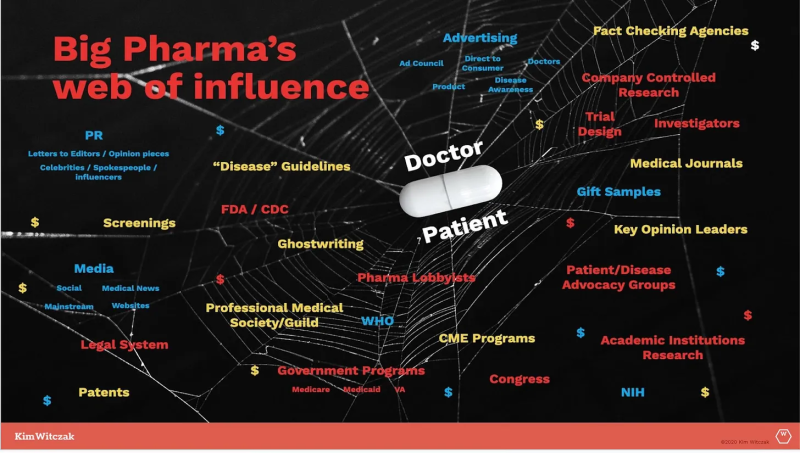
How the Web Works
- Clinical trials are often designed, funded, and controlled by the very companies that stand to profit. They manipulate data to exaggerate benefits and obscure risks, ensuring that negative results are buried, spun, or never published at all.
- Regulatory agencies like the FDA are deeply entangled with the industry they’re supposed to oversee. More than 50% of the FDA’s budget comes from industry-paid user fees, and a revolving door ensures that many key decision-makers come from—and later return to—pharmaceutical companies.
- Medical journals depend on pharmaceutical funding through advertising, reprint sales, and industry-sponsored studies—severely limiting independent scrutiny of drug safety. Many studies are ghostwritten or crafted by paid “key opinion leaders” (KOLs) who serve as pharma’s trusted messengers.
- Doctors receive education through industry-funded programs, learning “best practices” based on treatment guidelines crafted by the very system that profits from overprescription.
- Patient advocacy groups, once independent grassroots organizations, have been co-opted by industry money, ensuring that the loudest voices often serve pharma’s interests rather than patients’ needs. I call them “astroturf” patient groups—they look like real grassroots organizations, but they’re anything but.
- Screenings and guidelines continuously expand the definitions of disease, turning more people into lifelong customers.
This isn’t about one bad actor or isolated corruption—it’s a systemic issue. The entire structure is designed to push more drugs onto the market, medicalize normal human experiences, and only acknowledge harm when it becomes too big to ignore.
It’s a brilliant business model—but a catastrophic public health strategy.
“To Sell to Everyone:” The Business Model of Medicine
If this sounds like a conspiracy, consider the bold admission made by Henry Gadsden, former CEO of Merck, in a 1976 interview with Fortune Magazine:
“The problem we have had is limiting the potential of drugs to sick people. We could be more like Wrigley’s Gum…it has long been my dream to make drugs for healthy people. To sell to everyone.”
– Former Merck CEO Henry Gadsden
Let that sink in.
This wasn’t about curing disease—it was about expanding markets. Gadsden’s vision wasn’t just to treat illness, but to medicalize everyday life—creating a cradle-to-grave model where every person, healthy or sick, became a customer for life. Just like selling a variety of gum—something for everyone. Juicy Fruit, Big Red, Doublemint, Spearmint, and so on.
And that’s exactly what happened.
Today, we live in a system where:
- Everyday emotions—sadness, worry, shyness—are rebranded as medical conditions requiring treatment.
- Preventive medicine often means lifelong prescriptions, not lifestyle changes.
- Drugs are marketed to the “worried well”, turning normal human experiences into diagnoses.
This isn’t just theory—it’s well documented. In Selling Sickness: How the World’s Biggest Pharmaceutical Companies Are Turning Us All into Patients, Ray Moynihan and Alan Cassels expose how pharmaceutical companies create diseases, expand diagnostic criteria, and convince the public that normal life experiences require medical intervention.
The goal?
Make medication the default—not the last resort.
Harms Are Always an Afterthought
Harms from medication are not rare, nor are they unexpected.
But in this system, they are treated as acceptable collateral damage—something to be dealt with only after the damage is done, after lives are lost or forever changed.
I’ve sat in FDA Advisory Committee meetings, reviewing new drug applications, and have seen firsthand how safety concerns are often dismissed in favor of “innovation” or “unmet medical need.”
I’ve heard industry representatives and advisory committee members argue that safety signals can be addressed post-market, meaning after a drug is already in circulation and causing harm or a required REMS (Risk Evaluation and Mitigation Strategies) program upon approval.
But by the time post-market safety issues are acknowledged, it’s often too late.
We’ve seen this play out over and over:
- Opioids—marketed as “non-addictive” and pushed aggressively onto patients, leading to an epidemic of addiction and death.
- SSRIs and antidepressants—long linked to increased risks of suicide and violence, particularly in young people, yet downplayed or dismissed for decades. Other hidden harms include withdrawal syndromes and Post-SSRI Sexual Dysfunction (PSSD), conditions that many patients were never warned about.
- Antipsychotics—widely prescribed for off-label use, leading to severe metabolic and neurological side effects.
- Covid-19 vaccines—an experimental mRNA platform rushed to market, mandated, and imposed on society despite limited long-term safety data and growing concerns over harms.
Every time, the pattern is the same:
The industry sells the benefits while downplaying the risks—until those risks become too big to ignore.
By then, the drug is a blockbuster, billions have been made, and the system moves on to the next new “breakthrough.”
More Than Degrees: The Truth of Lived Experience
One of the biggest lessons I’ve learned in this fight is that real-world experience matters just as much as credentials.
Over the years, I’ve been invited to speak at medical schools, PhD programs, and universities, thanks to brave academics willing to challenge the narrative. I share my journey as an accidental advocate—someone who didn’t have a medical degree but discovered America’s broken drug system the hard way.
But let’s be honest—the medical world is driven by credentials. Or, as I like to say, the alphabet soup.
At conferences, attendees wear name tags listing their titles—MD, PhD, JD, MPH. It’s a quick way to size someone up, to assess credibility before even speaking. And I’ve seen it happen: people glance at my name tag, see no impressive letters after my name, and walk right by.
Years ago, I was speaking at the Preventing Overdiagnosis Conference and noticed my badge read: Kim Witczak, BA.
I was horrified. Was that really necessary? Did my name tag need to remind everyone that I only had a BA?
Later, I was telling the story to a doctor friend, and he laughed.
“Next time, tell them BA stands for Bad Ass.”
And he was right.
Because real expertise doesn’t always come from an advanced degree—it comes from lived experience, from asking the right questions, from refusing to accept the status quo.
The Counterargument: But Don’t We Need Experts?
Of course, some will argue that only experts with MDs and PhDs should be trusted to shape healthcare policy.
But that assumes that the system they operate in is free from bias, conflicts of interest, or financial incentives.
The reality is that many of those with the most letters after their names are also the ones benefiting from pharma funding—whether through consulting fees, research grants, or advisory roles.
Meanwhile, patients and their families—the ones living with the consequences—are too often ignored.
That needs to change.
Asking Better Questions: Reclaiming Our Power
If there’s one thing I’ve learned on this journey, it’s this: no one is coming to save us. The institutions meant to protect us are too entangled in the web to act with true independence.
My late husband, Woody, used to say: “Follow the money.” And when you do, the truth becomes impossible to ignore. Pharmaceutical profits—not patient well-being—drive the system. That’s why the only way to create real change is through awareness, transparency, and fundamentally shifting how we think about medicine and health.
That starts with asking better questions:
- Who funded this research?
- Does this person or institution have financial ties, intellectual bias, or self-interest that could impact their recommendations?
- Who benefits from this treatment?
- What aren’t we being told?
- What are the long-term consequences of this drug or intervention?
- Are there safer, non-drug alternatives being ignored because they aren’t profitable?
But asking the right questions isn’t enough.
We have to stop outsourcing our health to a system built on financial incentives and guided by corporate interests.
We must demand full transparency, challenge the status quo, and recognize that sometimes the best medicine isn’t a pill but a deeper understanding of what our bodies truly need.
Because once you see the web, you can’t unsee it.
And once you recognize how deeply medicine has been shaped by profit, you’ll realize the most important question isn’t just “What can I take?”—it’s “Who benefits if I do?”
Final Thoughts: Tearing Down the Web
I never wanted to be in this fight, but once you see the web, you can’t unsee it. That’s why I continue to speak out, to challenge the system, and to push for real accountability.
Because the stakes aren’t theoretical. They’re deeply personal.
For me, this fight began over two decades ago with Woody. But for countless others, it begins the moment they or someone they love is caught in the web—trusting a system that was never truly designed to protect them.
It’s time to tear down the web.
And it starts with seeing it for what it really is.
HHS Ousts Peter Marks, Sending Vaccine Stocks Tumbling and Biopharma Lamenting Loss of ‘Ally’ at FDA
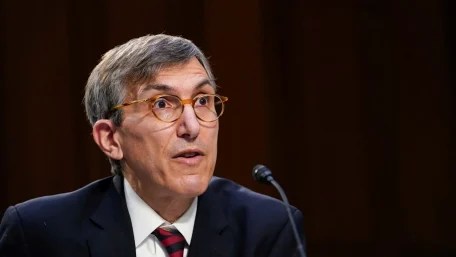
By Michael Nevradakis, Ph.D. | The Defender | March 31, 2025
Pharma stocks tumbled today after Peter Marks, M.D., Ph.D., director of the agency within the U.S. Food and Drug Administration (FDA) responsible for authorizing vaccines, resigned under pressure from his new boss, Health and Human Services (HHS) Secretary Robert F. Kennedy Jr.
“If Peter Marks does not want to get behind restoring science to its golden standard and promoting radical transparency, then he has no place at FDA under the strong leadership of Secretary Kennedy,” an HHS official said in a statement.
Shares of Moderna, BioNTech, Novavax and Pfizer declined 11%, 7%, 6% and 2%, respectively, on the news, Fast Company reported. STAT News reported that Marks’ departure “is a worst-case scenario realized” for investors and “a biopharma industry that saw him as an ally.”
“Given Dr. Marks’ influence on the development of biologics and uncertainty as to who will replace him and how his legacy might continue, his departure will create a significant near-term overhang,” William Blair analyst Matt Phipps told Reuters.
The Biotechnology Innovation Organization, an industry lobbying group, said it was “deeply concerned” Marks’ resignation would “broadly impact the development of new, transformative therapies to fight diseases for the American people.”
Brian Hooker, Ph.D., chief scientific officer for Children’s Health Defense (CHD), said the reaction to Marks’ departure on the part of the markets and the pharmaceutical industry is indicative of the influence Big Pharma had over the FDA. He said:
“Marks gave an over $100 billion gift to Pfizer and Moderna via the woefully undertested and outright dangerous COVID-19 mRNA vaccine. So, yes, for the short term, I would imagine that some investors would not like his departure from the FDA.
“Marks’ departure also signals a shift from ‘sick care’ and ‘customers for life’ where, unfortunately, Pharma invests now, to ‘Make America Healthy Again’ where everyone benefits from ending chronic disease in the U.S.”
John Gilmore, executive director of the Autism Action Network, welcomed Marks’ departure. “The American people are well-served by Marks’ resignation.” Gilmore cited the “institutional failure” of the Center for Biologics Evaluation and Research (CBER) “to use the highest standards for evaluating the safety and efficacy of products that are injected in almost all American children.”
Marks has led the FDA’s CBER since 2012 and “played a key role,” The Wall Street Journal reported, in Operation Warp Speed in 2020, leading to the development of the COVID-19 vaccines.
In his resignation letter, Marks wrote: “It has become clear that truth and transparency are not desired by the Secretary, but rather he wishes subservient confirmation of his misinformation and lies.”
Marks’ ‘support of immunizations conflicted with Kennedy’s skepticism’
According to the Journal, an HHS official gave Marks a choice between resigning or being fired. His resignation is effective April 5. Marks wanted to remain in his position, but “his support of immunizations conflicted with Kennedy’s skepticism.”
“Undermining confidence in well-established vaccines that have met the high standards for quality, safety, and effectiveness that have been in place for decades at FDA is irresponsible, detrimental to public health, and a clear danger to our nation’s health, safety. and security,” Marks wrote in his resignation letter.
Marks said he was “willing to work to address” Kennedy’s concerns on vaccine safety, including through a series of public meetings, but that these proposals were rejected. He also accused Kennedy of spreading “misinformation and lies” during the “ongoing multistate measles outbreak.”
But in a post on X, Steve Kirsch, founder of the Vaccine Safety Research Foundation, said that while Marks “claimed he wanted to stop misinformation,” he “refused all offers to meet with the ‘misinformation spreaders’ to settle the question on just who is spreading the misinformation.”
While Marks claimed he was willing to address questions on vaccine safety, he also wrote, “Efforts currently being advanced by some on the adverse health effects of vaccination are concerning.”
One day before Marks’ resignation, Kennedy announced the creation of a new sub-agency under the Centers for Disease Control and Prevention (CDC) to focus on vaccine injuries — part of a broader restructuring of public health agencies, including the FDA.
In February, Kennedy promised that under his watch, HHS and CDC would develop a better system for tracking vaccine injuries.
Earlier this month, Reuters reported that unnamed sources within the CDC said the agency was planning to study the possible link between vaccines and autism. The story triggered negative mainstream news reports claiming the study isn’t needed.
Last week, The Washington Post, citing anonymous sources, reported that HHS had tapped researcher David Geier — a researcher and expert on the connections between toxic exposures and autism — to lead a study of possible links between vaccines and autism. The Post and other media outlets used the opportunity to attack Geier and the need for such a study.
Marks’ resignation also came as the FDA is considering a petition a group of scientists submitted earlier this year, calling upon the FDA to suspend or withdraw the mRNA COVID-19 vaccines.
Marks ‘became a cheerleader for the jab’
Writing on Substack, investigative journalist Maryanne Demasi, Ph.D., said it’s “evident there was a significant clash over vaccine safety” that led to Marks’ resignation. She said Marks’ departure “may be an opportunity for the FDA to refocus on its mission of protecting public health rather than rubber-stamping new vaccine approvals.”
Epidemiologist Nicolas Hulscher agreed. “Those who believe vaccine safety must not be questioned do not belong in our regulatory agencies. When it comes to injectable products, safety is more important than blind faith in vaccine ideology.”
According to The New York Times, while Marks “was viewed as a steady hand by many during the Covid pandemic,” he was criticized “for being overly generous to companies that sought approvals for therapies with mixed evidence of a benefit.”
The Times cited Marks’ role in pressuring two FDA scientists to approve full licensure of Pfizer’s mRNA COVID-19 vaccine in 2021, leading to the researchers’ resignation. Pfizer’s vaccine was fully licensed in August 2021 — one day later, the Biden administration mandated COVID-19 vaccination for military service members.
The rushed licensure of the Pfizer vaccine was the topic of a congressional hearing last year in which Marks testified. In a post on X Saturday, Rep. Thomas Massie (R-Ky.) wrote, “Instead of verifying safety and efficacy of the shots, Marks swept things under the rug and became a cheerleader for the jab.”
“In order to get the vaccines to people in need when thousands of people were dying, we actually allowed the safety to be authorized with just two months of median follow-up, rather than the normal six to 12. But we were confident that that would capture adverse events,” Marks testified at last year’s hearing.
‘It was clear that he did not want to know about our injuries’
While Marks was actively engaged in the licensure of the Pfizer COVID-19 vaccine, he “remained steadfast” in dismissing concerns about injuries related to the COVID-19 vaccines as “misinformation,” Demasi wrote.
In 2023, The BMJ wrote that “more than once” during FDA meetings, Marks “expressed confusion about why it would matter to doctors whether or not regulators acknowledged that a condition might be related to the vaccine.”
Documents CHD obtained last year through a Freedom of Information Act request showed that Marks was aware of COVID-19 vaccine injuries in early 2021 when several vaccine injury victims emailed him for help. Marks blew off scheduled meetings with them.
According to TrialSite News, even though Marks was aware of the growing number of COVID-19 vaccine injuries, “vaccine injury became a political hot potato under the Biden administration,” leading Marks to abandon the vaccine-injured.
Brianne Dressen, co-founder of React19, an advocacy group for the vaccine-injured, sustained serious injuries after participating in a clinical trial for the AstraZeneca COVID-19 vaccine in 2020 and later sought meetings with Marks but was rebuffed.
“Constant emails and calls with Marks … sent while I was in constant pain, literally begging for help, begging for them to help others, begging for a lifeline. A lifeline that never ever came,” Dressen said.
Dr. Danice Hertz, a retired gastroenterologist from California injured by the Pfizer COVID-19 vaccine, also communicated with Marks but said he “brushed off anyone who contacted him regarding vaccine side effects.”
“He systematically refused to hear our pleas for acknowledgment and help,” Hertz said. “This is why the medical community is unaware of these injuries and cannot help us. One would think that the FDA would want to know about serious adverse reactions to the novel COVID vaccines. I can say from first-hand experience that they don’t … It was clear that he did not want to know about our injuries.”
Dressen said it “didn’t matter what we said or how we said it, COVID vaccine injuries were not a priority at the FDA. Didn’t matter if it was safety signals for MIS-V, dysautonomia, neuropathy, tinnitus or reports of suicides. It was never enough. We begged, we pleaded, we pushed as hard as we could, and came up with nothing.”
According to Demasi, Marks instead “blurred the line between regulation and promotion” by participating in FDA videos promoting the COVID-19 vaccines and by authorizing COVID-19 mRNA vaccines for children without sufficient testing.
“Without randomized data regarding clinical outcomes, he repeatedly approved COVID boosters for kids as young as 6 months,” Dr. Vinay Prasad, professor of epidemiology and biostatistics at the University of California, San Francisco, wrote on Substack, calling these “some of the biggest regulatory errors in the 21st century.”
Demasi said Marks “repeatedly pointed to the Vaccine Adverse Event Reporting System (VAERS) as proof of rigorous safety monitoring, yet failed to improve its efficiency.”
During last year’s congressional hearing, Marks claimed that numerous false reports of vaccine injuries are submitted to VAERS, a government-run database. However, he acknowledged, “We probably have not done a good enough job of communicating sometimes the actual numbers of deaths versus what’s in VAERS.”
This article was originally published by The Defender — Children’s Health Defense’s News & Views Website under Creative Commons license CC BY-NC-ND 4.0. Please consider subscribing to The Defender or donating to Children’s Health Defense.
New Info on How the Feds Helped Censor a Bombshell
By Didi Rankovic | Reclaim The Net | April 2, 2025
The US House Judiciary Committee has released internal chat logs, that show the FBI moved into cover-up mode the very day the New York Post published the Hunter Biden laptop story, on October 14, 2020.
The logs, first reported about by journalists Michael Shellenberger and Catherine Herridge, reveal that the FBI employees were immediately instructed “not to discuss the Biden matter,” while an intelligence analyst who, during a call with Twitter, accidentally confirmed that the story, i.e., the laptop, was real, was placed under a “gag order.”
The reason the analyst, who was with the FBI’s Criminal Investigative Division, was able to so quickly confirm the reporting was based on credible information was the fact the FBI had seized and authenticated Hunter Biden’s laptop several months earlier.

Big Tech platforms – notably Twitter and Facebook – then started censoring the article, branding it falsely “Russian disinformation.” By maintaining the “no comment” policy instead of confirming that the laptop was real and under investigation, the FBI was in effect tacitly promoting the false narrative about foreign interference.
These moves originated from the Foreign Influence Task Force, which was shut down earlier this year for its activities related to censorship through pressure on social platforms.
The laptop scandal was unfolding during a crucial time in the 2020 campaign and represents one of the most egregious publicly known examples of political censorship of free speech and media orchestrated by government agencies.
The chat logs that have now been published reveal that one of the FBI staff involved in the Hunter Biden laptop story suppression was Bradley Benavides.
Only weeks prior, Benavides featured in another controversy: that time in what appeared to be a smear campaign against Senators Ron Johnson and Chuck Grassley, who were allegedly “advancing Russian disinformation.”
At the time, the senators just so happened to be investigating Hunter Biden’s financial connections to foreign governments.
A letter the Judiciary Committee sent Benavides in June 2023, shows that he had by that time gone through the Big Tech-Big Government “revolving door” – and was senior risk manager at Amazon.
Trump’s Foreign Aid Suspension Unnerves Washington, not Recipients. Part 1
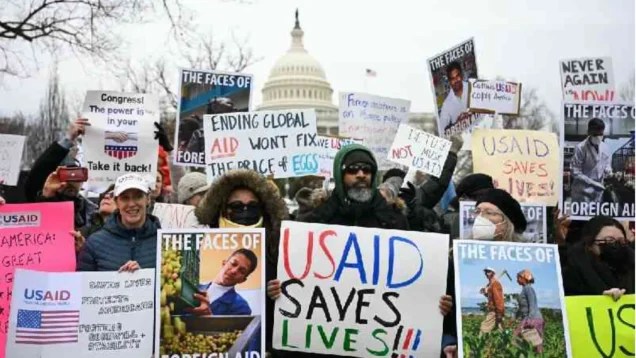
By Simon Chege Ndiritu – New Eastern Outlook – April 2, 2025
On January 20th, 2025, Donald Trump paused US foreign assistance for 90 days. This move was followed by the suspension of the United States Agency for International Development (USAID), through which most US foreign assistance was channeled.
The ‘Donor’ Protesting
Surprisingly, the recipients ignored this suspension, leaving Washington to protest it, which shows that parties in Washington have been the chief beneficiaries of this aid. Meanwhile, some in the recipient countries do not perceive the suspended assistance as worth bemoaning but replacing and moving on. While Trump has repeatedly accused other countries of ripping off the US through aid, using the term ‘development assistance’ to refer to this money that is never used to build roads, bridges, power plants, or buildings is quite ironic. It shows that ‘development’ means something else to Washington. According to USAID’s localization report released in 2023, over 90% of its money went to its international partners in and around Washington.
Therefore, only 10% reaches targeted communities, and some end up funding opium production and pedophile-run children’s orphanages, among others. The US and Western Europe frame Africa as surviving on aid, which is only a colonial ploy. In response to Trump’s suspension, some Kenyans recognized that America’s foreign aid helps Washington and that the US is an unreliable partner. Surprisingly, Kenyan media coverage recognizes the need to move on from Washington’s posturing and find sustainable funding sources.
Trump’s Cutting Funds for Contractors in Washington
Some Kenyans have been baffled by Trump’s suspension of aid, noting how it gave Washington unsolicited influence. For instance, an opinion sent to Kenya’s Daily Nation after Trump’s suspension revealed that the sender was baffled by the White House, since the aid gave the US soft power and influence. The opinion email proceeded to suggest that Trump’s America is cash-strapped due to its senseless tariff war with China. Noteworthy, the US received funds from Europeans before passing the bulk of it to Washington-based contractors, emphasizing the importance of this aid to America. It has been an open secret that Western aid helps the donors and not the recipients. Trump’s move will adversely affect American businesses, even as noted by an FP article from May 2022, which revealed that foreign aid was funding a bubble in Washington.
Therefore, his suspension runs against his America First Policy; this drastic move must be informed by a more significant concern for the US empire, such as China. An article authored by Nicholas Okumu, a Kenyan orthopedic surgeon for the Star Newspaper, steered clear of Trump’s actions, and their motivations and focused on how Kenya should respond. Okumu observed that American aid has always been a tool for political leverage and economic self-interest, insisting that Kenya should seek sustainable ways of funding its projects instead of relying on Washington’s unpredictable and ineffective assistance. US aid only yields minimal tangible benefits for Africans, as it is fashioned to prioritize American commercial interests, for instance, by awarding contracts to US firms and undermining industries in recipient countries.
US Aid’s Vicious Cycle
Issuing the US development assistance, including the part disbursed through USAID, starts by leading the audience into a tunnel vision of how the country is planning an extensive (supposedly) altruistic program to alleviate pressing challenges in poor countries. At this stage, audiences are not informed that Washington created the challenge or wants to enrich its contractors without addressing the problem. For instance, details that Washington’s Pentagon had bombed Al-Shifa pharmaceutical manufacturing company in Sudan in 1998, hence preventing millions from accessing health supplies, are hidden. The aid ends with money being spent in Washington and nothing being achieved for recipient communities, even while a justification for an enormous investment is created. Washington does not care if people access medical supplies, but whether its contractors can benefit from purporting to supply them.
A good example may include the repeated cycle of USAID’s Global Health Supply Chain Cycle. The first cycle, conceived in 2015 and worth $9.5 billion, ended without substantial results and was used in 2024 to justify a new one worth $17 billion. In the beginning, Washington’s media machine told audiences how USAID planned the Global Health Supply Program, which was designed to solve the problem of lifesaving health supplies being inaccessible to poor countries. The empty hype in this endeavor may have been detected in the statement that the project was supposed to “shake up global health contracting,” meaning the primary interest was not to alleviate supply problems but to award a massive contract to the main contractor, Chemonics International.
The project’s value of $9.5 billion had been dispensed three years later and was spent on fraud and inefficiencies. After 2017, the main contractor received a deadline extension and an additional $2 billion without delivering substantial results. An investigative report found that Chemonics International’s procurement reviewers had made up figures to report that 80% of the contracts had been delivered. Thirty-nine people had been indicted with fraud, but the main contractor escaped with a slap on the wrist by paying only $3.1 million to the justice department. Therefore, Washington’s aid benefited a contractor who used a façade of delivering aid to other countries. To attest to the failure of the first project cycle, which started in 2015, USAID launched a similar $17 billion project, dubbed NextGen, by signing contracts for delivering ‘lifesaving supplies around the globe.’ It is Ironic for anyone to think that Washington, which bombed a pharmaceutical factory in Sudan in 1998 and a trauma hospital in Afghanistan in 2015, really cares whether people can access medical suppliers. Noteworthy, most countries are unable to produce medical supplies because America’s big Pharma monopolizes them through patents.
Going Forward
USAID has always been tied to procuring from the US, making recipient countries fail to develop industries that can organically respond to local challenges. For instance, American laws mandate that food aid be purchased from American farmers and delivered using American-flagged vessels, which means farmers in the recipient countries lose business. Similarly, other industries that receive aid from the US can also collapse, which limits Africans’ development. The deleterious effects of the US aid programs can explain the donors’ insistence on issuing them out, meaning that Africans should not view Trump’s suspension of aid as a tragedy. Instead, it is an opportunity for reflection on how American aid should be replaced, since it is ineffective and unreliable. The US will permanently halt its aid when it does not stand to gain. Therefore, African governments must seek ways to finance their projects without relying on Western aid.
How Bernie Sanders and the Democrats Made Elon Musk the Richest Man in the World
By Thomas Eddlem | The Libertarian Institute | April 1, 2025
Just before Senator Bernie Sanders (I-VT) and Rep. Alexandria Ocasio-Cortez (D-NY) started their ongoing series of rallies against Elon Musk and President Donald Trump, Sanders stopped by Face the Nation on CBS and hilariously exclaimed in feigned outrage:
“We’re looking at a rapid growth of oligarchy. We’re looking at a rapid growth of authoritarianism. And I fear that we’re looking at a rapid growth of kleptocracy as well. And I’m going to do everything I can to work with my supporters all over this country to stand up and fight back to make sure we have an economy that works for everybody, not just Elon Musk.”
All I could do is laugh, as Bernie Sanders specifically and the other Democrats generally are the ones who made the economy work so well for Elon Musk.
The $465 million Energy Department loan under President Barack Obama that saved Tesla from bankruptcy in 2010 emerged from the Energy Independence and Security Act of 2007, which was adopted because Bernie Sanders and all the Democrats in the Senate voted for it (except Debbie Stabenow and a half-dozen conservative Republicans). Further, Obama’s American Recovery and Reinvestment Act of 2009 (which all the Senate Democrats voted for, including Bernie Sanders) included the $7500/EV subsidy that put $1.5 billion in Elon’s wallet. Nearly all Republicans voted against it.
And Musk’s Tesla gains more than $1 billion dollars annually from carbon tax credits passed by Democrats in California in the first decade of the century and which was expanded by President Joe Biden’s Inflation Reduction Act of 2022 (which Sanders and all Democrats passed on a party-line vote in the Senate, and AOC and her Democratic colleagues voted for in the House).
The Washington Post reported on February 26 that Musk received some $38 billion in government contracts, loans, subsidies, and tax credits in the past two decades, most from the federal government funded by Democrats (and some from Democrat-run California), often with strong Republican opposition. And most of these subsidies were realized during President Biden’s term.
Sanders complains constantly about Musk being a billionaire, but you don’t have to be a math major to understand that it’s a just smidge easier to become a billionaire when the government hands you $38 billion. Of course, Sanders and his touring sidekick Ocasio-Cortez work for a government that takes in $5,485 billion from people for almost nothing and somehow still runs a deficit of $1,781 billions every year. So maybe they don’t have the competency to pull that kind of math off.
Sanders and AOC seem to think it was the Republicans who fought for all those green energy subsidies and carbon swap programs. They seem to think the Republicans wanted to keep money flowing to NASA because of the GOP’s fond memories of JFK sending astronauts to the moon, and did not work to end the wasteful agency. But in reality it was Democrats who kept funding flowing to NASA, resulting in Space X scoring huge multi-billion federal space contracts.
If truth in advertising laws were being enforced, Bernie Sanders and Alexandria Ocasio-Cortez’s nationwide “Rally Against Oligarchy” would instead be labeled “Rally Against the Oligarchy We’re Building.”
I don’t think Elon Musk is a Nazi; I think he’s a highly talented tax dollar harvester. But if he is a Nazi, he is the Democrats’ Nazi. Democrats made him the richest man in the world and saved his businesses from bankruptcy with massive government subsidies championed by the Democrats. They need to own this, because they can’t deny it.
Instead, many of the same Democrats who voted for the politicians who made Musk the richest man in the world now think that a massive pogrom against Musk is a successful strategy to resist Trump’s policies and oppose “fascism.” Uh huh.
Nothing says “I’m opposing fascism” like spray-painting a swastika on a Tesla owned by a Jewish dude. Three quarters of all the swastikas being publicly painted across the world today are being painted by Democrats in America on Teslas, and the other quarter are being painted by the remnants of the neo-Nazi Azov Brigade that has been absorbed into the Ukrainian National Army, a group the Democrats back to the hilt with your tax dollars.
The world’s swastikas being painted these days are being scrawled or funded by the Democratic Party within a rounding error of 100% of the global total. For the first time in many years I went over to the Stormfront.org webpage (a page run by open neo-Nazis) and found them positively bitchy with suppressed jealousy about how Democrats have managed to spread their message so much further than the Mädelschaft of goobers who run that website.
Meanwhile, the captive media fact-checkers acknowledge, “At least 10 Tesla dealerships, charging stations and facilities have been hit by vandals,” along with the vandalization of hundreds of cars of [private] Tesla owners, but simultaneously claim there’s “no evidence of coordinated vandalism.” It’s got to sting when Democrats can pull off a slow-motion, global Krystallnacht against Tesla when the Schutzstaffel-wannabes have been so unsuccessful for so many decades. Meanwhile, Democrats get wild cheers from The Daily Show audience for their ongoing swastika pogrom.
I predict Stormfront’s next published story will be a worried report about the global shortage of swastikas, accompanied by a request for the Democrats to refund a quota of some of the swastikas back so American neo-Nazis can stop swastika rationing.
There’s a reason Elon Musk’s companies faced twenty different investigations by multiple government agencies under the Biden administration and most of those investigations just went away once Trump took office, and it wasn’t because of Elon’s criminal conduct. It was the criminal conduct of Washington and its lawfare. That’s part of the plan, too.
Elon backed the “wrong” party, according to the Democrats. They villainize Musk and the Koch brothers but not Bill Gates, John Kerry, and George Soros. Their vilification of billionaires is notably and risibly selective.
The latter are their bread-and-butter while the former fund their opposition. Washington politics long ago ceased to be an ideological battle, succumbing fully to a team sport.
We’re on a Highlander course for political parties in America: There can be only one.
In at least one sense, we’re already there; Trump and his cabinet are all 2004 Democrats, with a Kennedy in charge of the world’s largest welfare agency and no mandate to cut even a dime of welfare spending. That’s what the “conservative” Republican Party has become. America has a uniparty, and the media wants to make us choose either the Party of Caesar or the Party of Pompey, but both are on the same path to centralization of power in Washington.
How To Claim Your Specialty Suffers From “Climate Change”
And get government money for your pain
By William M Briggs | March 26, 2025
I’ve told you innumerable times that scientists are good at finding evidence which supports their fancies, and just as lousy, or lousier because of their egos, than others when finding evidence which kills their darlings. As you know, the rage in grant-funded academia is “climate change”. Because of the evidence-finding powers of scientists and the great flow of your money, as I’ve shown many, many (many) times, scientists have “discovered” every evil thing is caused by “climate change”. Today the evil thing is lung disease.
The peer-reviewed NIH-grant-funded paper is “Global warming risks dehydrating and inflaming human airways” by Edwards and others in Nature Communications Earth & Environment. Abstract opens with these two contradictory sentences:
Global warming increases water evaporation rates from planetary ecosystems. Here, we show that evaporation rates encountered during human breathing in dehydrating atmospheres promote airway inflammation and potentially exacerbate lung diseases.
Global warming—a refreshing use of the old term, instead of the ill-defined “climate change”—is supposed to increase, not decrease, water vapor content of the atmosphere. Which would make the air wetter, not drier. Here is the old, pre-Trump nervous EPA on this:
Water vapor is another greenhouse gas and plays a key role in climate feedbacks because of its heat-trapping ability. Warmer air holds more moisture than cooler air. Therefore, as greenhouse gas concentrations increase and global temperatures rise, the total amount of water vapor in the atmosphere also increases, further amplifying the warming effect.7
Indeed, water vapor, i.e. humidity, at the surface was expected to increase, even in dry and semi-arid areas. Take, for example, the peer-reviewed paper “Increase in Tropospheric Water Vapor Amplifies Global Warming and Climate Change” by Patel and somebody with a name too long to retype. They say “Most regions show positive trends in the annual mean tropospheric water vapor,” etc. The troposphere is where you and I breathe, dear reader.
Yet, others say there hasn’t been any change in moisture. Here’s an article by NCAR (I spent a summer there in the late 1990s, working on climate model skill) with the laconic title “Climate change isn’t producing expected increase in atmospheric moisture over dry regions“.
The laws of thermodynamics dictate that a warmer atmosphere can hold more water vapor, but new research has found that atmospheric moisture has not increased as expected over arid and semi-arid regions of the world as the climate has warmed.
The findings are particularly puzzling because climate models have been predicting that the atmosphere will become more moist, even over dry regions. If the atmosphere is drier than anticipated, arid and semi-arid regions may be even more vulnerable to future wildfires and extreme heat than projected.
So one science authority says the air you breathe is growing wetter, and one says it isn’t. Nobody says it’s decreasing. Best I could find was one source saying there was a “weakened” increase. Which is still an increase. There seems to be more agreement that the moisture in the stratosphere, where nobody breathes (unaided), has decreased a bit.
How, then, did our authors get the dry air they needed? By simulating it. I kid you not. “The numerical simulations for urban/rural VPD are carried out using the Community Earth System Model (CESM) version 2.1.” And so on.
After blowing some words explaining how people breathe, and then harassing some poor mice by forcing them to breath extra-dry air to prove their point, Edwards and his pals write “Together with climate model simulations, these findings suggest that most of the United States will be at elevated risk of airway inflammation by the latter half of this century.”
Suggest. Suggest. Suggest.
You paid for this.
Now I am sure they are right, or right enough, about how dry air can cause airway irritation. The vivid red color of the inflamed trachea they use as an illustration is impressive. They even give us some math, and who doesn’t love a few good old-fashioned equations? Airway irritation is their specialty, and I would not want to take the glory from them over how throats crave moisture.

But they don’t know squat about the climate. Though they must have known their careers would be enhanced if they could tie their specialty to “climate change”, which they have been told to believe is bad, and therefore do believe.
A mere tying together of “climate change” and throats is not sufficient, though. If they wrote a paper that said “Climate change will improve breathing”, because moisture will increase, they’d be hounded from their offices. Maybe have some lunatic nitwit activists smearing paint on their cars or FOIAing their emails, which they’d probably have to turn over, given their work was government (i.e. you) funded: “A portion of this research was funded at UNC by NIH grants R01HL125280, P01HL164320, and P30DK065988.”
What makes it worse, is that if it’s true that dry areas are worse for man, then we should see a nice signal in actual data. Here, I don’t know what I don’t know, so I can’t say for sure chronic lower respiratory disease is related. I can say, given CDC’s tracking of mortality rates of it by state, that the death rates-humidity signal is far from clear. Hawaii, which is humid, has the smallest rate. Oklahoma, also humid, has the highest. Nevada and Arizona, both dry, are in the middle.
Pneumonitis, which is lung inflammation, doesn’t seem to be big enough to track, so I couldn’t find much on the geographic distribution of it. One paper in Japan said moister areas, not drier, are more common. Maybe there are better diseases to look for than pneumonitis.
Well, that’s not my job. It was the authors’. They owed us actual observations that show how people out in the world, and not mice hooked to tubes, are affected by drier and wetter air. Instead, they stuffed what they knew (which I don’t question) about lungs and what they hoped was true about the climate into models, ran the models, forgot that all models only say what they’re told to say, then declared the models showed them their worst fears were realized.
This is how it works. This is how your money is blown. This is why government funding of science has to end.
Featured Video

BRITAIN’S WARNING: PREPARE FOR WAR
or go to
Aletho News Archives – Video-Images
From the Archives
British weapons and personnel doing much of the killing in Yemen
Press TV – June 18, 2019
A detailed report published by the Guardian newspaper has shown how Britain is massively contributing to Saudi Arabia’s devastating war on Yemen as it suggests that London is not only supplying the bombs that fall on Yemenis, but it provides the personnel and expertise that keep the war going.
The comprehensive report by Arron Merat published on Tuesday showed that Britain was doing much of the killing in Yemen as the country continues to provide Saudi Arabia with everything it needs to turn its southern impoverished neighbor into a graveyard.
“Every day Yemen is hit by British bombs – dropped by British planes that are flown by British-trained pilots and maintained and prepared inside Saudi Arabia by thousands of British contractors,” said Merat in the report. … continue
Blog Roll
 Aletho News
- Elijah Magnier: Yemen’s Strikes Are Shattering Saudi Arabia’s Long-Term Strategy
- Pentagon designates Chinese cultural centers national security threat
- Israel Demolishes Home Of Lebanese Journalist Whose Viral Film Exposed Pager Attack
- Record Oil, Empty Tanks: The UAE’s Miracle Recovery
- Burnham tackles Britain’s poverty with aggression in Yemen
- Peace in Ukraine: the easy way – or the hard way
- Trump & the Rrrrussians
- US taxpayer money laundered back through Ukraine – Musk
- Before COVID, an NIH lab chief proposed making a SARS-like bat virus more infectious
- Gates, Bourla on Trial in Netherlands Accused of ‘Great Reset’ Scheme at Vaccine Injury Hearing
- If Americans Knew
- An error has occurred; the feed is probably down. Try again later.
- No Tricks Zone
- Sudden Stratospheric Warming, Powerful El Niño Combination May Lead To Extreme Europe Cold, Energy Crisis!
- Two New Studies Find Thwaites Glacier Melt Cannot Be Driven By Human Activity Or A Warming Ocean
- E-Cars Reduce CO2 Emissions By Only 41% Compared To Internal Combustion Engine Vehicles
- Predictions Made By Renowned Climate Professor Over Past Decades Have Been Proven To Be Poor
- New Study Suggests Large Regions Of The Pacific Ocean Have Been Cooling For The Last 80 Years
- Germany’s Green Energy Debacle: High Energy Costs Force Kahla Porzellan to Close After 182 Years!
- New Study: 50 Years Of The Most Aggressive ‘Net Zero’ Policies Can Only Affect The Global Climate By 0.03°C
- US September “Heat” Was No Record…Many Records Set Decades Ago
- Latest European Green Energy Debacle; Portugal’s Largest Flagship Solar Park Insolvent!
- Green Energy Debacle: German Expert Professor Fritz Vahrenholt Warns Of Severe Economic And Social Consequences

