Rarely reported in the West has been the concerted repression of democracy activists on the Arabian Peninsula. Saudi Arabia, the first among equals in the peninsula, has been ruthless against any suggestion of democratic reform. Most recently, the Saudi authorities arrested the Qatif-based cleric Nimr al-Nimr, shooting him in the leg and killing several people during the operation in the village of al-Awwamiyya. Interior Minister Prince Ahmed bin Abdulaziz said that al-Nimr is “the spreader of sedition” and “a man of dubious scholarship and dubious mental condition, and the issues he raises and speaks about show a deficiency or imbalance of the mind.” In the Kingdom, to champion democracy is a mental illness. Al-Nimr is not alone. The authorities have arrested Ra’if Badawi, editor of Free Saudi Liberals, and activists such as Mohammed al-Shakouri of Qatif, the hotbed of unrest. The Saudis cleverly use blasphemy laws to hit the democracy activists hard. The activists are “those who have gone astray” (al-fi’at al-dhallah), and it is the truncheon that is tasked with bringing them back to their senses.
For a year, the Bahraini authorities have been unrelenting in their crackdown against democracy campaigners. Most recently Nabeel Rajab, the head of the Bahrain Centre for Human Rights, a veteran of the al-Khalifa prisons, was arrested for an insulting tweet. On June 22, about thirty activists of the al-Wefaq party, led by their leader Sheikh Ali Salman, marched east of Manama with flowers in hand. The police fired tear gas and sound bombs, injuring most of the demonstrators. Things are so bad in Bahrain that the UN Human Rights Council passed a declaration calling on King Hamad bin Isa Al Khalifa to implement the recommendations of his own appointed Bahrain Independent Commission of Inquiry. Unsurprisingly, the United States, the United Kingdom and seven European Union states (including Sweden) sat silently and did not endorse the declaration.
Matters have taken a turn for the worse in the United Arab Emirates (of the seven emirates in this union the most famous are Dubai and Abu Dhabi). There the authorities have shown no mercy to al-Islah, the Association of Reform and Social Guidance. Since March of this year, the UAE has arrested at least fifty activists, including the human rights lawyers Mohammed al-Roken and Mohammed Mansoori as well as Khaifa al-Nu`aimi, a young blogger and twitter user. The attack on al-Islah began in December 2011, when the full enthusiasm of the Arab Spring reached the gilded cities. The government promptly arrested its main leaders, and stripped seven of them of their UAE citizenship. The UAE Seven, as they fashioned themselves, released a statement calling for reforms “in the legislative authority so as to prepare the climate for a wholesome parliamentary election.” Nothing of the sort has happened, and indeed the crushing blow to the activists has been swifter and more powerful.
On July 24, University of Sharjah law professor and a former judge, Ahmed Yusuf al-Zaabi, was sentenced to twelve months in prison for fraud. The government alleged that he had impersonated someone else (his passport said he was a judge even as he had been dismissed from the bench for his support of the 2003 call for political reforms). The recent arrests are a piece of this general policy of intolerance for political diversity, and for any call to reform. On August 1, Human Rights Watch’s Joe Stork called upon the US and Britain to “speak out clearly, in public as well as in meetings with UAE officials, about this draconian response to the mildest calls for modest democratic reforms.” There is silence from US Secretary of State Hillary Clinton, who said, in February 2011, that the US would “support citizens working to make their governments more open, transparent and accountable.” The asterix to that statement said the following: “citizens of the Gulf need not apply.”
Arab Desert Democracy.
John Harris, the architect of Dubai, wrote in a 1971 master plan that the UAE’s political system was a “traditional Arab desert democracy [which] grants the leader ultimate authority” (this is quoted in Ahmed Kanna’s fabulous 2011 book Dubai: The City as Corporation). The term “desert democracy” had become clichéd by the 1970s. In 1967, Time ran a story on Kuwait as the “desert democracy,” a title the magazine reused in 1978 for its story on Saudi Arabia. The idea of “desert democracy” refers to the Gulf monarchies allowance of a majlis, a council, to offer advice to the monarch, at the same time as the oil-rich monarchs pledge to provide transfer payments to the citizens for their good behavior (in 1985 the leader of the illegal Saudi Communist Party said that these payments made the Saudi workers “the favorites of fortune”). If this basic compact is violated by the call for greater democracy, for instance, the monarch is enshrined to crack down. It is almost as if the Gulf Arab monarchs had read their Bernard Lewis, the venerable Princeton professor, whose What Went Wrong? The Clash Between Modernity and Islam in the Middle East (2001) notes that the “Middle Easterners created a democracy without freedom.” All the usual Orientalist props come tumbling in: tribal society, Arab factionalism and so on.
The fog of culture is convenient, but it does blind one to much simpler explanations. The emirs of the Gulf have no interest in sharing power with their people who might ask embarrassing questions about the extravagant living of the royal families off the petro-dollars. No elite willingly submits to democracy, the “most shameless thing in the world,” as Edmund Burke put it. It has been piously hoped since the 1950s that the “next generation” of the Gulf Arabs will be more moderate then their forbearers, that distance from their Bedouin tents will turn them into Liberals. The Saudi King Abdulla is 87, his crown prince Salman is 77 and sick. Their younger descendants have not shown any eagerness to move a reform agenda. The costs would be catastrophic to their family’s control of the wealth. The US government is well aware of this situation. A 1996 State Department cable points out that the “Royals still seem more adept at squandering than accumulating wealth… As long as the royal family views (Saudi Arabia) and its oil wealth as Al Saud Inc., the thousand of princes and princesses will see it as their birthright to receive dividend payments and raid the till.” Reform is a distraction to their plunder.
US Ambassador James Smith wrote to Secretary Clinton in February 2010 that the US-Saudi relationship has “proven durable.” Much the same has been said of the US and European relationship with the rest of the Gulf. Oil is of course key, but it is not the only thing. Political control through the military bases is equally important. Of the many bases, the most significant are the Naval Support Activity Station in Bahrain, the air base at al-Dhafra in the UAE, and the air base at al-Udeid in Qatar. Democracy and other such illusions can be squandered by the West to forge a realistic alliance with the Gulf Arabs who share, as Ambassador Smith put it, “a common view of threats posed by terrorism and extremism [and] the dangers posed by Iran.” One of Iran’s great threats is its attempt to export its style of Islamic democracy, anathema to the Gulf Arab monarchies. The US has lined up behind aristocracy against democracy.
The power of the Gulf sovereigns is increasing, although the sovereigns are less stable. The people have already been through the stages of al-mithaq (the pact) and al-hiwar (the dialogue). Far more is wanted. Night descends. The mukhabarat (political police) and the mutaween (religious police) are on the move. There is gunfire. There are shreaks. There is silence.
Vijay Prashad’s new book, Arab Spring, Libyan Winter , is published by AK Press.
August 5, 2012
Posted by aletho |
Civil Liberties, Corruption, Subjugation - Torture, Timeless or most popular | Arabian Peninsula, Bahrain Independent Commission of Inquiry, Saudi Arabia, United Arab Emirates |
Leave a comment
The world’s super rich, according to a new report, are squirreling away phenomenal quantities of their cash in secret tax havens.
Are America’s rich getting richer? Certainly. Every official yardstick shows that America’s most affluent are upping their incomes much faster than everyone else.
How fast? Between 1980 and 2010, note economists Emmanuel Saez and Thomas Piketty, incomes for America’s top 1 percent more than doubled after inflation. They now average a little more than $1 million.
The top 0.1 percent saw their incomes more than triple, to $4.9 million, over that same span. And income more than quadrupled for the top 0.01 percent — the richest 16,000 Americans — to nearly $24 million.
And what about the rest of us? After inflation, average incomes for America’s bottom 90 percent actually fell — by 4.8 percent — between 1980 and 2010, from $31,337 to $29,840.
These numbers tell us how much people make. Measuring wealth gauges how much people have. The two, common sense tells us, ought to be related. If incomes are getting much more unequal, then the distribution of our national wealth ought to become much more unequal too.
But that doesn’t seem to be the case. A Congressional Research Service of new Federal Reserve data indicates that the gap between the wealth of America’s most awesomely affluent and everyone else is holding steady.
In 2010, the Fed data show, the top 1 percent held 34.5 percent of the nation’s wealth, almost the same exact share as in 1995, and not that much more than the 30.1 percent share they held in 1989.
These numbers just don’t add up — income is increasingly skewed toward the top, but wealth distribution is holding steady. What can explain this paradox?
Maybe the Federal Reserve isn’t doing a good job of assessing just how much wealth the wealthiest Americans own. Indeed, Fed researchers do acknowledge that they don’t take into account — for privacy reasons — the wealth of anyone listed in the Forbes magazine annual list of America’s 400 richest.
But including these 400 only moves the top 1 percent’s share of America’s wealth up by a bit over a percentage point. It isn’t enough to explain the disconnect between the extraordinary income gains of America’s rich and the modest rise in their share of national wealth.
Maybe the rich are simply living large, wasting their astronomical incomes on caviar, private jets, and other luxuries. But wasteful consumption can’t explain the inequality paradox either. Deep pockets in America’s top 0.01 percent could shell out $5,000 every single day of the year and still have 93 percent of their annual incomes left to spend.
So what in the end can explain the inequality paradox? The London-based Tax Justice Network has an answer. The world’s super rich, the group has just reported, are squirreling away — and concealing — phenomenal quantities of their cash in secret global tax havens.
The Network’s new tax-dodging study “conservatively” computes the total wealth stashed in these havens at $21 trillion. That total could plausibly run as high as $32 trillion.
Americans make up, we know from previous research, almost a third of the global super rich. That would put the American share of unrecorded offshore assets as high as $10 trillion.
Add this $10 trillion to the wealth of America’s top 1 percent and the inequality disconnect between wealth and income largely disappears. Paradox solved.
Now we have to tackle a much bigger challenge: ending the march to ever greater inequality. Shutting down tax havens would make a great place to start.
~
Sam Pizzigati’s latest book is titled Greed and Good: Understanding and Overcoming the Inequality that Limits Our Lives
July 30, 2012
Posted by aletho |
Corruption, Economics, Supremacism, Social Darwinism, Timeless or most popular | Tax haven, Tax Justice Network, United States |
Leave a comment
The Department of Interior today released the final version of a policy that will smooth the way for industrial-scale solar energy development on public lands throughout America’s southwestern deserts. Even though Interior weakened environmental protections seen in earlier drafts, and crafted the policy to meet industry demands–essentially putting on paper what is already Interior’s de facto policy of allowing solar companies to bulldoze wherever they please–several national environmental groups still applauded the announcement, including the Sierra Club, NRDC, the Wilderness Society, and the national Audubon Society. Their statements of support for the policy probably represent efforts to put positive spin on what is ultimately an environmental catastrophe for the renewable energy industry and our public lands.
Corporate Giveaway of Public Lands
The final policy–which is expected to be signed by Secretary Salazar later this year–designates nearly 32,000 square miles of desert habitat as suitable for industrial-scale solar energy development. About 445 square miles will be designated as “solar energy zones,” where companies will be encouraged (but not required) to build their facilities. Some national environmental groups initially supported a policy that would only allow energy companies to build in the proposed solar zones, minimizing potential with conservation efforts outside of the zones. It became apparent last year that Interior was more interested in giving public lands away to industry under an alternative known as the Solar Energy Development Program, so environmental groups began to pretend that this was also their preferred alternative.
To highlight the backtracking in these environmental groups’ own position, several national environmental groups urged Interior to adopt a “zone-based” approach to solar development in a May 2011 press release, and had this to say about the Solar Energy Development Program:
“the agency’s Preferred Alternative, goes much farther by opening up an additional 21 million acres outside those zones that have yet to be studied for potential resource conflicts. Conservation groups disagreed with the choice of the Preferred Alternative, and argued neither alternative offered the certainty that the groups, solar developers, and the agency itself needs to move forward on a smart path.”
Fast forward to today, and now the national environmental groups are singing praises for the same misguided policy in a press release. Jim Lyons of Defenders of Wildlife appeared to be preparing a new job at the Chamber of Commerce in this statement from today’s press release:
“Balancing our nation’s energy production by increasing solar, wind and geothermal sources will strengthen our economy, improve energy security and reduce greenhouse gases. This solar energy plan is an important step in that direction.”
F@*k the Zones: Industry Can Bulldoze Wherever They Want
The only places where the energy industry cannot build their projects will be lands that are already protected, such as National Parks and Areas of Critical Environmental Concern. Other than the creation of weak incentives for zone-based development, this policy is essentially no different than the last few years of solar energy siting in our deserts, where companies have ignored environmental concerns and built their projects on some of the most ecologically valuable desert habitat. Nevertheless, the Wilderness Society’s Chase Huntley in typical Washington Beltway double-speak claimed “this is the quickest route to meeting the renewables targets set by Congress consistent with protecting our dwindling undeveloped wildlands.”
Protect Endangered Species (Optional)
The one aspect of the solar policy that some groups might claim to be a victory for wildlife is actually a glossy sheen added at the last minute that will only be as good as the political will of environmental stewards in the BLM and US Fish and Wildlife Service. A proposal to exclude solar energy development from critical desert tortoise connectivity areas was added late last year, but the proposal appears to have been significantly weakened by industry lobbying, and now only amounts to words of discouragement from the US Fish and Wildlife Service that developers can ignore.
Interior initially designated desert tortoise connectivity areas that are assessed to be essential to the recovery and survivability of this Federally listed species, where solar energy development would be strictly controlled or excluded. The draft exclusion policy would have kept projects off of desert habitat where the desert tortoise population exceeded 2 per square mile in the connectivity area. Another land designation known as “variance” areas would have required companies to maintain a wildlife corridor at least 3 miles in width and prohibited projects that would require the translocation of more than 35 adult tortoises. These requirements have been eliminated from the final policy, and replaced with vague references to protecting wildlife corridors that will ultimately give companies the discretion to override scientific concerns, unless wildlife officials are willing to say no to the companies. Because of political pressure from Washington, however, local land management and wildlife officials have been under pressure to fast-track and approve most projects.
The tortoise connectivity corridors are still referenced in the policy, but only to show companies where they are discouraged from building. Perhaps not surprisingly, a vast swath of tortoise connectivity designation was abandoned in a region of the Mojave Desert along the California-Nevada border where BrightSource Energy is proposing to build two massive solar projects — Hidden Hills and Sandy Valley solar projects. The only real requirement that remains in the wildlife protection aspect of the policy is that developers have to meet with Department of Interior, and possibly listen to words of discouragement before they continue with their application.
The Sierra Club’s Barbara Boyle had this to say about the plan’s protection of wildlife:
“This Administration’s design for solar development on public lands is based on sound principles, particularly by focusing projects in locations with the lowest impacts on wildlife habitat, lands and water.”
It’s unfortunate when the words of our supposed environmental guardians become hollow and pointless. These groups have already shown a willingness to abandon the principles of sustainability and environmental protections for yet another darling industry that will save us from climate change. … Full article
July 29, 2012
Posted by aletho |
Corruption, Environmentalism | BrightSource Energy, Mojave Desert, Public land, Sierra Club, Solar energy, United States, Wilderness Society |
Leave a comment
Imagine for a moment what would happen if former President George W. Bush were to give an interview on television and declare that his invasion of Iraq, and the ensuing nine years of death and mayhem that resulted from that war, had been the wrong thing to do. Imagine if he were to say “mistakes were made.”
Well, something equally momentous happened yesterday when Sanford I. Weill, the former CEO of Citigroup back when it was the nation’s largest bank, announced in an interview on the cable network CNBC, that banks should never have been permitted to merge with insurance companies and investment banks. Discussing the financial crisis that continues to wreak havoc in the US and the global economy, he said, “What we should probably do is go and split up investment from banking. Have banks done something that’s not going to risk the taxpayer dollars, that’s not going to be too big to fail.”
Incredibly, this shocking comment, surely as big as Bush announcing that he was wrong to invade Iraq, was buried on the business page in the New York Times. Many other major newpapers, including the Philadelphia Inquirer, didn’t even run the story!
Sanford Weill, it must be recalled, was the Wall Street financier who pushed the government to the wall to get banks deregulated, and to end the Depression-era law, called Glass-Steagall, that since 1933 had barred them from engaging in investment banking and dealing in insurance.
As principle shareholder and head of Travelers Group, an insurance company and brokerage he had acquired for less than $5 billion, Weill thumbed his nose at the law and arranged a merger with Citicorp, in which the big bank bought the Travelers Group for $72 billion. The merger was a blatant violation of the law, but Weill and Citicorp CEO John S. Reed didn’t care.
They pushed the deal through and essentially dared the Securities and Exchange Commission and the Justice Department to stop them. The SEC and Justice Department, as well as Congress and the president at the time, who was Bill Clinton, were “rolled” by Weill and Reed, who together hired former Republican President Gerald Ford and Former Clinton Treasury Secretary Robert Rubin to lobby for the repeal of Glass-Steagal, which happened in 1999. There followed a wave over the next decade of ever bigger mergers between banks and investment banks, and a decade of increasingly wild gambling by bankers who played with dodgy derivatives and with other people’s money.
People like Weill became rich beyond human imagining, and enormous bubbles were created, first in the start-up technology industry where gambling on initial public offerings of stock in companies that had no appreciable sales or profits to show (remember the dot.com boom and bust, featuring the epic collapses of Enron and Worldcom?), and then in residential and commercial property. It was all designed to enrich the executives at these unregulated banking giants, who then would leave their posts, if possible, before the inevitable crash and collapse.
Weill did that handily. In 2005, after he had left Citicorp, he was ranked 72nd among Forbes Magazine’s list of the world’s richest people.
Some journalists are writing now that it is “ironic” that Weill would now be calling the elimination of the barrier between banks and investment banks and other financial industries a “mistake.”
It may be something else though–something more calculated than ironic: a case of the architect of the biggest theft in the history of mankind trying to get away before an increasingly desperate and angry public starts to call the criminals to account.
The American public, in particular, is slow to explode. Years of meaningless elections and deliberately dumbed-down news and dumbed-down campaign debates have left most people feeling helpless and powerless politically. Where Greeks and Spaniards and even the French are quick to take to the streets in huge numbers to protest against government outrages, Americans are more apt to sign an internet petition and then turn on the TV to escape from the harsh reality of shrinking paychecks and shrinking home values.
But the continuing recession, which has left nearly one-in-five Americans still jobless or underemployed after six years of an unrelenting economic collapse, and which has erased some $7 trillion in home equity from family balance sheets, is finally starting to light a fire, especially amid growing concern that the country could be heading for another economic slide, and a new rise in unemployment numbers.
Calls for bankers to be arrested and punished are starting to be heard, and even though the news media don’t say much about the arrest of bankers in Iceland and Ireland, word of those country’s moves to prosecute criminal bankers is spreading.
The latest scandal, involving the conspiracy among the big US and European banks to artificially manipulate the setting of LIBOR, the interest rate that is a benchmark for many if not most mortgages and other loans with floating interest rates, has made people even angrier and has widened the list of targets of that anger to include the politicians and bank regulators — Democrat and Republican — who knew of the bankster fraud and either encouraged it or did nothing to stop it.
At a time when people are talking about putting bankers in jail, Weill’s mea culpa on CNBC may have been not ironic, but rather a deliberate attempt to try and remove the target from his own back.
He shouldn’t get away with it. It should stay there.
July 27, 2012
Posted by aletho |
Corruption, Timeless or most popular | Citigroup, Glass–Steagall Act, John Reed, Sanford I. Weill, Weill |
Leave a comment
The Justice Department’s inspector general found at least seven instances of federal employees engaging in illegal attempts to hire family members at the agency, according to a report issued Thursday.
The report is the third investigation in less than a decade that has found numerous examples of illegal hiring practices, amounting to nepotism, within the DOJ.
The latest series of nepotistic attempts came after Rep. Frank Wolf (R-Va.) alerted the IG to complaints he received in 2010 from a former DOJ employee-turned-whistleblower.
Wolf said the report was “alarming” and called on the DOJ employees, whose attempts at hiring relatives are exposed in the IG’s report, to be punished by the department.
“The report issued by the Department of Justice Inspector General today is alarming, especially given that the department has twice been warned about these illegal practices before,” said Wolf, the chairman of the House Appropriations subcommittee that oversees the DOJ’s budget, in a statement.
“I expect for the employees involved in this nepotism ring to be punished under full extent of the law. I also expect the department to move quickly to enact the necessary reforms to prevent this from happening again.”
Sen. Chuck Grassley (R-Iowa), the ranking member on the Senate Judiciary Committee, criticized the DOJ in the wake of the IG’s report, saying that the agency is running “wild.”
At an executive committee meeting on Thursday, Grassley called on Attorney General Eric Holder to take legal action against the employees cited in the report. Grassley has butted heads with Holder for most of the attorney general’s time in office, saying that the DOJ constantly “stonewalls” his requests for information and action.
“This is another example of the Justice Department run wild,” said Grassley. “It is troubling to me how employees within the Department colluded and schemed to hire one another’s relatives in order to avoid rules against nepotism.
“At the very least, the Attorney General needs to hold these employees accountable — with more than just disciplinary action,” he said. “Laws were broken and false statements were made. The Department can’t simply sweep this under the rug. Employees need to be punished.”
The IG’s report found seven examples of employees within the DOJ’s Justice Management Division (JMD) attempting to hire the family members of their fellow employees.
According to the IG’s report, in two separate instances a pair of employees, who worked in different sections of the DOJ, engaged in schemes to hire the other’s child. In another example, a DOJ employee tried to secure employment for his cousin and nephew.
The IG released two prior reports on nepotistic hiring practices in 2004 and again in 2008, in which they found that employees manipulated the DOJ’s hiring process to favor certain candidates.
In 2008, the IG recommended that the department conduct ethics training and establish a “zero-tolerance” policy for future attempts at illegal hiring.
In a memorandum issued earlier this week, Assistant Attorney General for Administration Lee Lofthus wrote the IG to say that he would strengthen and clarify training for employees, with particular attention on the agency’s nepotism rules.
Lofthus also said that by Friday his office would be implementing a three-prong set of disclosure forms that would require DOJ employees to disclose any family member who they are aware of applying for a job within the agency. It would also require any DOJ applicant to reveal a family member who works for the department.
Lofthus said, according to the IG report, the actions of illegal hiring were a result of intentionally “bad behavior” and not ignorance of the rules or a lack of training on the DOJ’s part.
“The OIG report concludes by saying most of the misconduct identified in the report did not stem from ignorance of the rules, but rather was the result of bad behavior by individuals insufficiently impressed with the principles of fair and open competition.”
July 27, 2012
Posted by aletho |
Corruption | Eric Holder, Inspector General, Nepotism, United States Department of Justice |
Leave a comment
The United States wants to drag Africa into its drug wars – on top of Washington’s War on Terror. Since drugs always follow American “anti-narcotics” activity in the world, the inevitable result will be an explosion of drug networks in targeted African countries. “Liberia and Ghana will soon emerge as hubs of the African drug trade – just as happened in Colombia and elsewhere in Latin America.”
When a high U.S. government official says Africa is “the new frontier,” it’s time for everyone that cares about the continent to watch out, because something really dangerous is afoot. A top guy in the D.E.A. recently described Africa as the “new frontier” where Washington hopes to embed commando-style teams of specially vetted police for an American-run war on drugs, similar to U.S. operations in El Salvador, Guatemala, Panama, and the Dominican Republic. And we all know how those U.S. so-called anti-drug operations turned out. We should add to the list Colombia and Afghanistan, the world capitals of cocaine and heroin, respectively.
According to mythology, everything King Midas touched turned to gold. It appears the United States has the Narcotics Touch; everything the Americans touch turns to dope. American allies in the developing world quickly become narco-states.
The pattern has not changed in 60 years, since the Italian and French mafias were rewarded with international drug franchises in return for their assistance against socialists and communists. Southeast Asia’s Golden Triangle became the center of the global heroin trade during the Vietnam War – a project of the CIA. When the U.S. shifted its focus to suppressing leftist movements in Latin America, cocaine became the region’s biggest export. The United States has never waged war against drugs – quite the opposite. Washington rewards its political friends with drug franchises and monopolies, in return for service to American corporate interests. That’s why most of America’s friends in the developing world are criminal regimes.
The U.S. Drug Enforcement Administration is most proud of its work in Honduras, where a U.S.-backed coup overthrew a mildly leftist government during President Obama’s first year in office. The Americans now roam the country like they own it, in joint operations with the same soldiers and national police that continue to kill and brutalize peasant, student and worker organizations. The joint drug operations, which have succeeded in killing at least four innocent Mosquito Indians, including two pregnant women, will undoubtedly result in a march larger drug trade under the tight control of the military, police and wealthy landowners allied with the Americans. That’s how the American Narco Touch works. The endless phony War on Drugs is a tool of U.S. policy, designed to subvert foreign governments and societies. The drug trade never gets smaller.
Now it’s Africa’s turn. Washington has its eyes on Liberia and Ghana, where it plans to train elite police units after first “vetting” their personnel – a euphemism for making sure that the commandos are willing to act as de facto U.S. operatives. You can be sure that Liberia and Ghana will soon emerge as hubs of the African drug trade – just as happened in Colombia and elsewhere in Latin America. With Washington’s “vetted” operatives in charge of the African drug networks, the U.S. will vastly increase its ability to buy influence among the greedy classes all across the continent, both in and out of uniform. Just as in Colombia and Honduras and Panama and Guatemala, the Drug Wars become indistinguishable from the War on Terror, which used to be called the War on Communism. It’s really a war against the poor.
Glen Ford can be contacted at Glen.Ford@BlackAgendaReport.com.
- Our Perverse War on Drugs (alethonews.wordpress.com)
July 25, 2012
Posted by aletho |
Corruption, Militarism, Timeless or most popular | Africa, Colombia, Drug Enforcement Administration, Honduras, Latin America, United States, War on Drugs |
Leave a comment
Americans want a Peace Dividend, but their leaders won’t give it to them. Despite multiple polls showing broad support for cuts in U.S. defense spending, a sort of anti-democratic bipartisanship has emerged in Washington, where both Republicans and Democrats oppose such cuts, often vocally.
The most recent polling data on the issue, released last week by the Program for Public Consultation (PPC), in conjunction with the Center for Public Integrity and the Stimson Center, shows that Americans believe defense spending should shrink next year by a fifth to a sixth of its present size. Other polls released during 2012, including surveys by Gallup, Roper, and others, have been similar, although variations have occurred.
The issue has arisen this summer because, under a budget compromise reached last year between Democrats and Republicans, 10% across the board cuts are set to kick in at the beginning of 2013, which would give the Department of Defense a budget next year of $470 billion—an amount it got by on during the George W. Bush administration while the U.S. was fully engaged in both the Iraq and Afghanistan wars. Nevertheless, both Republicans and some Democrats in Congress oppose these spending reductions, and former Vice President Dick Cheney recently emerged to lobby Congress against them, joined by representatives of Lockheed Martin Corp., who warned of thousands of layoffs if the cuts occur.
Lockheed Martin, the largest arms merchant in the world, is eager to keep filling up from the taxpayers’ money spigot. With annual revenues of about $45 billion, it invests its profits in influence, especially in Washington, where since 1989 Lockheed has donated $23 million to political campaigns, spent $125 million on lobbying; received $20 million in earmarks; received 31 grants and 15,358 contracts from the federal government; and placed 257 of their people on 135 government advisory committees.
The economic impact of defense cuts, especially on jobs, is one of the main reasons otherwise moderate or liberal Democrats oppose defense cuts, reasoning that the recession-ravaged economy cannot sustain a significant spending cut. Yet according to the PPC poll the public, even when provided information about the possible economic consequences of defense spending reductions, still opts for them over cuts to domestic programs like Social Security, health care, or education. Further, people in congressional districts with high defense spending supported defense cuts as readily as those in other districts, although Democrats generally supported larger cuts than Republicans.
“The idea that Americans would want to keep total defense spending up so as to preserve local jobs is not supported by the data,” said PPC director Steven Kull. On average, Democrats supported a Pentagon cut of 22%, while Republicans wanted a cut of 12%.
July 24, 2012
Posted by aletho |
Corruption, Economics, Militarism | Center for Public Integrity, Lockheed Martin, Military budget, United States |
Leave a comment
US President Barack Obama shook hands with some of his wealthiest supporters Tuesday night at a fundraising shindig in San Francisco. Also on hand, though, was a matter the commander-in-chief just can’t seem to shake: his failed deal with Solyndra.
Around sixty patrons paid $35,800 a piece to attend a party in honor of President Obama this week, including a pair of gentlemen who have become central figures in an energy debacle that has haunted the Oval Office since last year. Among those in attendance were two key players in the Solyndra scandal.
President Obama touted Solyndra, a California solar-panel start-up, as an example of perfect American entrepreneurship early on in his presidency. Last year, however, the infant green energy company filed for bankruptcy, despite the president earlier approving a gigantic loan guarantee worth $535 million for the Silicon Valley start-up. The company had borrowed all but $8 million of the massive loan before calling it quits late last year, a move that prompted Obama’s opponents to ridicule the president over what some said was “a dubious investment” and even initiated an investigated by the FBI.
Nearly a year after Solyndra first filed for bankruptcy, the scandal took center stage again this week after Monday’s fundraiser funneled in donations from Matt Rogers, a former adviser at the Department of Energy that helped approve the loan as part of the stimulus plan, and Steve Westly, a venture capitalist that warned the White House against offering a deal to Solyndra before the president offered his own endorsement. Darren Samuelsohn of Politico was on-hand at Monday’s fundraiser and writes that it appears that the president isn’t exactly distancing himself from one of the most costly scandals of his administration.
Officials within the campaign to elect Massachusetts Governor Mitt Romney for president have already attacked the administration for still maintaining ties with people privy to the Solyndra deal. In a statement addressing the latest news, Romney spokesman Ryan Williams writes, “The Obama Administration betrayed American taxpayers when it dumped hundreds of millions of public dollars into Solyndra while ignoring clear warnings about the company’s dire financial situation.”
“President Obama’s first term worked out well for his donors who got special access and taxpayer money for their failed ventures. It hasn’t worked as well for the 23 million Americans struggling for work in the worst economic recovery our country has ever had,” Williams adds.
July 24, 2012
Posted by aletho |
Corruption, Progressive Hypocrite | Obama, Silicon Valley, Solyndra, Steve Westly |
Leave a comment
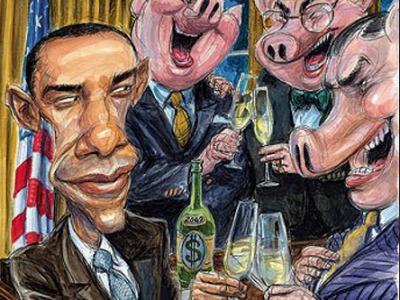
The Obama Justice Department is in theater mode, again, pretending to threaten the bankster class with criminal penalties – prison time! – for their manipulation of the global economy’s benchmark interest rates. The Justice Department claims to be building criminal and civil cases in the LIBOR scandal, which in sheer scope is the biggest fraud by international capital in history. But that’s all a front, a farce. Barack Obama has spent his entire presidency protecting Wall Street, starting with his rescue of George Bush’s bank bailout bill after it’s initial defeat in Congress, in the last days of Obama’s candidacy. He packed his administration with banksters, passed his own bailout and, in collaboration with the Federal Reserve, channeled at least $16 trillion dollars into the accounts of U.S. and even European banks – by far the greatest transfer of capital in the history of the world. Obama has reminded the banksters that it was he who saved them from the “pitchforks” of an outraged public. He pushed through Congress so-called financial reform legislation that left derivatives – the deadly instruments of mass financial destruction that were at the heart of the meltdown – untouched.
Wall Street may or may not remain loyal to Obama, but Obama has been loyal to Wall Street, the guys who gave him the campaign cash to become a viable candidate. His Attorney General, Eric Holder, a corporate lawyer to the core, is busily staging a pre-emptive LIBOR prosecution of bankers in order to shield them from legal action by a host of other government agencies and, ultimately, from the global universe of parties that have been harmed by the bankster’s schemes– a list that stretches to infinity. Holder’s job is to monopolize the LIBOR case, to the extent legally and humanly possible, grabbing jurisdiction and consolidating the cases against the banks with the aim of reaching a settlement that does not further destabilize the financial system.
Holder and his boss already pulled that trick earlier this year with settlement of the bank “robo-signing” scandal – a scheme that would have ranked as the “crime of the century” until LIBOR came along. A small group of state attorney generals were holding up an administration-brokered settlement that effectively gave the banksters immunity from prosecution, in return for a measly $25 billion payout. Obama used every power of his office to pressure the state law officers into line. The last one capitulated with a promise from Obama that a “special unit of prosecutors” would expand the investigation into abusive mortgages practices. You haven’t heard a peep about it, since.
Now Obama and Holder are playing the same diversionary game, making tough noises about criminal investigations of the LIBOR conspirators. But the Justice Department has already given immunity to Barclay’s Bank, of Britain, and to the Swiss banking giant UBS. More immunities will follow. The reason Eric Holder is staging criminal investigations is because that’s the only way he can protect the bankers, through immunities and by gradually narrowing the scope of the case. In the end, there will be settlements all around, and the banksters will move on to even more fantastic heights of criminality – thanks to the loyal, protective hands of President Obama.
BAR executive editor Glen Ford can be contacted at Glen.Ford@BlackAgendaReport.com.
July 18, 2012
Posted by aletho |
Corruption, Deception, Progressive Hypocrite, Timeless or most popular | Eric Holder, London Interbank Offered Rate, Obama, UBS, United States Department of Justice, Wall Street |
Leave a comment
Perhaps the most humiliating legacy of our nation-building venture in Afghanistan is the stubborn narco-state flourishing under our noses. The opium crop in Afghanistan has doubled since US forces deposed the Taliban, and the drug trade threatens to dominate the country as never before when our forces leave in 2014. How did this happen?
By and large, it seems US forces followed a policy of turning a blind eye to the opium crop, on the premise that poor farmers are not our main enemies in Afghanistan, and attacking their livelihood would turn them to the Taliban. To combat opium production, our principal initiatives included helping farmers cultivate alternate crops, and setting up an independent court system to try traffickers. While these have shown some promise, progress has been slow, and funding for these programs is drying up. Crop eradication was on our minds, too, but we charged the Afghan forces with that task. Their efforts, however, have been undermined by political corruption on the ground.
Underscoring the futility of our drug war in Afghanistan is the impact of the current blight on opium poppies in the country. At first glance, this might sound like a God-send: crop eradication at its best. However, something happened that we American capitalists should have anticipated. With opium supply suddenly scarce, the price of the crop soared. This has in turn enriched –and entrenched—the big dealers, inspired farmers to double down on next year’s crop to make up for current losses, and likely attracted more people to the drug trade in a very poor country. The result of this blight illuminates the main problem of crop eradication: it drives up prices, providing more incentives surrounding the drug trade.
In Latin America, our anti-narcotic efforts have largely featured interdiction, eradication, and assaulting the drug gangs. Our tactics on this front were recently highlighted by reports of a bloody incident in Honduras where local forces, with US financing and support, have been intercepting drug traffickers from South America in the remote Honduran jungle. The Honduran forces mistakenly killed unarmed civilians while intercepting a drug shipment. Notable in our efforts in Honduras is the extensive involvement of the US military. The Honduran forces who conducted this raid flew out of one of the three bases the US military operates in that country. The forces were tipped off by our military’s Southern Command in Miami, carried to the location by State Department helicopters, and accompanied by DEA agents. For all intents and purposes, the US seems to be waging war in Latin America.
So far it seems the most obvious result of our aggressive approach in Latin America is increasingly grotesque violence. Since Mexico started its crack down on the drug cartels, thanks to US prodding and support, the country has suffered 50,000 deaths. Mexican cartels have exploded, resorting to mass killings, beheadings, mutilation—body parts found in bags in public squares—assassinations of government officials. Savage violence surrounding the drug trade is spreading through the countries of Central America as we ramp up interdiction efforts there. The brazen and pervasive violence is testimony to what’s at stake, namely, the incredibly lucrative US drug market. The sum total of our efforts in Latin America compounds the problem.
As the New York Times Magazine explained in a recent expose on the Mexican drug cartels (“The Snow Kings of Mexico”, 6/17/12), the cost of drugs on the street is largely determined by the amount of risk assumed in getting the product to market. So: make the risk greater and the prices rise; more dealers get involved, and jockey (or kill) for a piece of the action.
This is why, our former ambassador to Colombia has argued, we must pair our negative policies with economic development in Latin America. If we build schools and hospitals, and help develop businesses in the region, we can reduce incentives to enter the drug trade. And yet, as long as the drug trade remains so lucrative, it’s reasonable to suppose, incentives to enter it will always be powerful.
What strikes me in the many prongs of our current war on drugs is how we seem to focus on everything but ourselves—and go to great efforts in so doing. We monitor the nations our drugs come from, and toil to frustrate traffickers thousands of miles from our borders. We work to change the economic conditions on the ground in very poor nations—no small task—while poor neighborhoods at home beg for attention. We enlist our military, the largest in the world, to stem the flow of drugs northward. And none of it works. These efforts have the opposite effect of what we intend, for they drive up prices and stoke the drug trade. The traffickers will do anything to get the product to market as a result: Colombian gangs have built submarines for this purpose; the Mexican cartels use catapults to launch drugs over our multi-million dollar border fences.
We’d rather do anything but zero in on demand here, but it’s so clear this would be the cheapest, most direct, most effective, most humane solution. It makes you wonder if we want to win the war on drugs at all.
Firmin DeBrabander is an Associate Professor of Philosophy at the Maryland Institute College of Art.
July 17, 2012
Posted by aletho |
Corruption, Economics, Militarism, Timeless or most popular | Afghanistan, Honduras, Latin America, Mexico, United States |
Leave a comment

Earlier this week, Glenn Greenwald reported that, on Tuesday,
The Huffington Post published a post by Hossein Abedini, who was identified in the byline as a “Member of Parliament in exile of Iranian Resistance.” His extended HuffPost bio says that he “belongs to the Foreign Affairs Committee of the National Council of Resistance of Iran” (NCRI). The NCRI is the political arm of the Mujahideen-e Khalq, (MeK), the Iranian dissident group (and longtime Saddam ally) that has been formally designated by the U.S. State Department since 1997 as a Terrorist organization, yet has been paying large sums of money to a bipartisan cast of former U.S. officials to advocate on its behalf (the in-hiding President of the NCRI, Massoud Rajavi, is, along with his wife Maryam Rajavi, MeK’s leader). Abedini, the HuffPost poster, has been identified as a MeK spokesman in news reports, and has identified himself the same way when, for instance, writing letters to NBC News objecting to negative reports about the group.
After noted journalists Hooman Majd, Robert Mackey, Greenwald himself, and others “noted the oddity that HuffPost was publishing pieces from a designated Terrorist group, HuffPost deleted the piece.” A HuffPo spokesperson also told Greenwald that Abedini’s post “was published by mistake,” adding, “By policy, we don’t publish blog posts by people affiliated with designated terrorist organizations. The blog editor who published it was unaware that NCRI is MEK’s political arm. When the mistake was discovered the post was removed.”
Nevertheless, all of Abedini’s previous articles remain archived on HuffPo. Furthermore, Greenwald points out that “The Huffington Post has also repeatedly published Ali Safavi, who is also identified as ‘a member of Iran’s Parliament in Exile, National Council of Resistance of Iran'” and “use[s] his HuffPost platform to propagate standard MeK propaganda.” All of Safavi’s posts remain accessible.
But that’s not all.

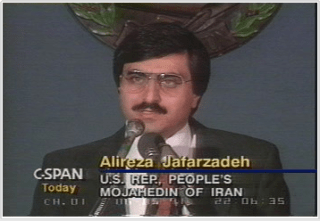
There’s yet another MeK/NCRI spokesman and propagandist who also regularly posts articles on HuffPo: Alireza Jafarzadeh. All of his posts remain live on HuffPo, where he is touted (in a bio written by himself) as a foreign affairs analyst who has appeared all over Western media, speaking on behalf of the terrorist group. Fox News has long featured him as a contributing commentator and he currently runs his own “consulting” firm in Washington D.C. called “Strategic Policy Consulting” which is pretty much just a phony company that manages his own media appearances and lobbying to Congress. One look at his Twitter feed removes all doubt as to Jafarzadeh’s affiliation (at the highest level) with the MeK. … Full article
July 16, 2012
Posted by aletho |
Corruption, War Crimes | Glenn Greenwald, Huffington Post, HuffPost, Iran, Maryam Rajavi, Massoud Rajavi, National Council of Resistance of Iran, People's Mujahedin of Iran |
Leave a comment
While nothing in its policy guidelines say it’s supposed to be this way, the Department of Homeland Security (DHS) has distributed the vast majority of its nonprofit security grants to Jewish organizations.
During one three-year period (2007-2010), Jewish groups received 73% of DHS’ Nonprofit Security Grant Program (NSGP) awards. This share grew larger in 2011 (80%) and still larger in 2012 (97%).
In total dollars, Jewish institutions will take in $9.7 million in NSGP grants this year out of $10 million available.
Homeland Security Secretary Janet Napolitano explained the results of the program’s grant awards this way: “Unfortunately there are risks attendant on the Jewish community that are not attendant on all other communities.”
The point of the NSGP funding is to help nonprofits at risk of terrorist attacks to better protect themselves. Orthodox Jewish groups in particular have done better than non-Orthodox Jewish groups in receiving assistance, presumably because they are more likely to be targeted by anti-Semitic movements. Of the 109 NSGP grants in 2012, 35 went to groups linked to Chabad, an orthodox Hasidic organization. A majority of the funding went to groups in the areas of New York City, Chicago and Los Angeles.
Only a few the NSGP recipients this year were not Jewish. These included a San Diego church, a Planned Parenthood center in Washington and a New York City Catholic church.
DHS policy defines preferred recipients as those having “the highest risk of terrorism-related activity due to their ideology, beliefs and mission.”
July 14, 2012
Posted by aletho |
Corruption, Progressive Hypocrite, Supremacism, Social Darwinism, Timeless or most popular | Barack Obama, Chabad, Janet Napolitano, Levi Shemtov, NSGP, Orthodox Judaism, United States Department of Homeland Security |
Leave a comment


 Aletho News
