Charles H. Ferguson, the director of the Oscar-winning documentary Inside Job, now explains how a predator elite took over the country.
He exposes the networks of academic, financial, and political influence, in all recent administrations, that prepared the predators’ path to conquest.
Over the last several decades, the United States has undergone one of the most radical social and economic transformations in its history.
·Finance has become America’s dominant industry, while manufacturing, even for high technology industries, has nearly disappeared.
· The financial sector has become increasingly criminalized, with the widespread fraud that caused the housing bubble going completely unpunished.
· Federal tax collections as a share of GDP are at their lowest level in sixty years, with the wealthy and highly profitable corporations enjoying the greatest tax reductions.
· Most shockingly, the United States, so long the beacon of opportunity for the ambitious poor, has become one of the world’s most unequal and unfair societies.
Ferguson shows how from the Reagan administration forward, both major political parties have become captives of the moneyed elite.
It was the Clinton administration that dismantled the regulatory controls that protected the average citizen from avaricious financiers. It was the Bush team that destroyed the federal revenue base with its grotesquely skewed tax cuts for the rich. And it is the Obama White House that has allowed financial criminals to continue to operate unchecked, even after supposed “reforms” installed after the collapse of 2008.
It is no exaggeration to say that since the 1980s, much of the American (and global) financial sector has become criminalized, creating an industry culture that tolerates or even encourages systematic fraud. The behavior that caused the mortgage bubble and financial crisis was a natural outcome and continuation of this pattern, rather than some kind of economic accident.
It is important to understand that this behavior really is seriously criminal. We are not talking about neglecting some bureaucratic formality. We are talking about deliberate concealment of financial transactions that aided terrorism, nuclear weapons proliferation, and large-scale tax evasion; assisting in concealment of criminal assets and activities by others; and directly committing frauds that substantially worsened the worst financial bubbles and crises since the Depression.
None of this conduct was punished in any significant way. On November 7, 2011, the New York Times published an article (Wall Street’s Repeat Violations, Despite Repeated Promises) based on its own review of major banks’ settlements of SEC lawsuits since 1996. The Times’ analysis found fifty-one cases in which major banks had settled cases involving securities fraud, after having previously been caught violating the same law, and then promising the SEC not to do so again. The Times’ list, furthermore, covered only SEC securities fraud cases; it did not include any criminal cases, private lawsuits by victims, cases filed by state attorneys general, or any cases of bribery, money laundering, tax evasion, or illegal asset concealment — all areas in which the banks have numerous and major violations. In Predator Nation, I provide detailed, well-documented accounts of behavior ranging from assisting Enron’s frauds (Citigroup, Merrill Lynch), to fraudulently exploiting the Internet bubble (most of the major investment banks), to using for-profit colleges to exploit government student loan programs (Goldman Sachs), to assisting in money laundering and tax evasion on a large scale (at least eleven banks including UBS, Barclay’s, and Lloyds), to using bribery and artificially complex derivatives to destroy the finances of a county government (JP Morgan Chase), to profiting from Bernard Madoff even while strongly suspecting him to be a fraud (JP Morgan Chase, UBS).
Total fines for all these cases combined appear to be far less than 1 percent of financial sector profits and bonuses during the same period. There have been very few prosecutions and no criminal convictions of large U.S. financial institutions or their senior executives. Where individuals not linked to major banks have committed similar offenses, they have been treated far more harshly.
Given this background, it is difficult to avoid the conclusion that the mortgage bubble and financial crisis were facilitated not only by deregulation but also by the prior twenty years’ tolerance of large scale financial crime. First, the absence of prosecution gradually led to a deeply embedded cultural acceptance of unethical and criminal behavior in finance. And second, it generated a sense of personal impunity; bankers contemplating criminal actions were no longer deterred by threat of prosecution.
And just as the last twenty years of unpunished financial crime constituted a green light for the bubble, so, too, America’s non-response to the bubble and crisis is setting the tone for financial conduct in the future.
The Obama administration has rationalized its failure to prosecute any senior financial executives (literally, not a single one) for bubble-related crimes by saying that while much of Wall Street’s behavior was unwise or unethical, it wasn’t illegal. Here is President Obama at a White House press conference on October 6, 2011:
Well, first on the issue of prosecutions on Wall Street, one of the biggest problems about the collapse of Lehmans [sic] and the subsequent financial crisis and the whole subprime lending fiasco is that a lot of that stuff wasn’t necessarily illegal, it was just immoral or inappropriate or reckless….I think part of people’s frustrations, part of my frustration, was a lot of practices that should not have been allowed weren’t necessarily against the law.
The president and senior administration officials (such as Lanny Breuer, head of the Justice Department’s Criminal Division) have portrayed themselves as frustrated and hamstrung — desirous of punishing those responsible for the crisis, but unable to do so because their conduct wasn’t illegal, and/or the federal government lacks sufficient power to sanction them. With apologies for my vulgarity, this is complete horseshit.
When the federal government is really serious about something — preventing another 9/11, or pursuing major organized crime figures — it has many tools at its disposal and often uses them. There are wiretaps and electronic eavesdropping. There are special prosecutors, task forces, and grand juries. When Patty Hearst was kidnapped by the radical Symbionese Liberation Army in 1974, the FBI assigned hundreds of agents to the case.
In organized crime investigations, the FBI and federal prosecutors often start at the bottom in order to get to the top. They use the well established technique of nailing lower-level people and then offering them a deal if they inform on and/or testify about their superiors — whereupon the FBI nails their superiors, and does the same thing to them, until climbing to the top of the tree. There is also the technique of nailing people for what can be proven against them, even if it’s not the main offense. Al Capone was never convicted of bootlegging, large scale corruption, or murder; he was convicted of tax evasion.
In this spirit, here are a few observations about the ethics, legalities, and practicalities of prosecution related to the bubble:
First, much of the bubble was directly, massively criminal.
Second, if you really wanted to get these people, you could. Maybe not all of them, but certainly many. Some bubble-related violations are very clear, with strong written evidence, as my book Predator Nation demonstrates. And if you flipped enough people, some of them would undoubtedly have interesting things to say about what their senior management knew. In fact, there are many techniques, venues, organizations, regulations, and statutes, both civil and criminal, available to investigate these people, punish them, and recover the money they took — if you really wanted to. The federal government has used almost none of them.
Third, the moral argument for punishment is very strong, providing ample justification for erring on the side of aggressive legal pursuit. Whatever portion of banking conduct during the bubble was criminal, it was certainly substantial, and there is no doubt whatsoever that it was utterly, pervasively unethical, designed to defraud in reality if not in law. Since the crisis, the people who caused it have been anything but honest or contrite. They have been evasive, dishonest, and self-justifying, returning as quickly as possible to their unerringly selfish behavior. Their behavior caused enormous damage, both human and economic; the consequences of their wrongdoing are so large as to justify almost any action that could help to prevent another such crisis by creating real deterrence. There would also be intangible but large benefits to raising the general ethical standard of a vital industry, and one whose executives often become high-level government officials.
Given this background, let’s now consider the question of criminal liability, as well as the feasibility of prosecution.
J’Accuse
The list of prosecutable crimes committed during the bubble, the crisis, and aftermath period by financial services firms and senior executives includes: securities fraud (many forms); accounting fraud (many forms); honest services violations (mail fraud statute); bribery; perjury and making false statements to federal investigators; Sarbanes-Oxley violations (certifying accounting statements and financial controls); RICO offenses and criminal antitrust violations; Federal aid disclosure regulations (related to Federal Reserve loans); Personal conduct offenses (many forms: drugs, tax evasion, etc.).
In Predator Nation I consider each of these categories in detail, naming many names and providing many specific examples. But in considering only one category, securities fraud, we already face an embarrassment of riches.
Almost all the prospectuses and sales material on mortgage-backed securities sold from 2005 through 2007 were a compound of falsehoods. But it starts even earlier in the food chain. We also know that mortgage originators committed securities fraud when they misrepresented the characteristics of loan pools, and the nature and extent of their due diligence with regard to them, when they sold pools to securitizers (and accepted financing from them). Most or all of the securitizers (meaning nearly all the investment banks and major banking conglomerates) then committed securities fraud when they misrepresented the characteristics of the loans backing their CDOs, the characteristics of the resulting mortgage-backed securities, and the nature and results of their due diligence in the process of creating those securities. The securitizers also committed securities fraud when they made similar misrepresentations to the insurers of, and sellers of credit default swap (CDS) protection on, those securities.
The executives of both originators and securitizers then committed a separate form of securities fraud in their statements to investors and the public about their companies’ financial condition. They knew that they were engaging in a Ponzi-like fraud that would eventually need to end, and as the bubble peaked and started to collapse, they repeatedly lied about their companies’ financial condition. In some cases they also concealed other material information, such as the extent to which they, themselves, and/or other executives of their firms, were selling or hedging their own stock holdings because they knew that their firms were about to collapse.
Next, several investment banks committed securities fraud when they failed to disclose that they were selling securities that were designed to fail so that the investment banks, and/or their hedge fund clients, could profit by betting on their failure. The Hudson and Timberwolf synthetic CDOs sold by Goldman Sachs, and which were the focus of the Levin Senate subcommittee hearings, provide a very strong basis for prosecution. Goldman’s trading arm had been dragooned into finding and dumping their most dangerous assets to naive institutional investors. Important representations in the Hudson sales material–that assets were not sourced from Goldman’s own inventory — were lies, and they were material lies, since investors had learned to be wary of banks clearing out their own bad inventory. E-mail trails show that top executives closely tracked the garbage disposals and were gleeful at the unloading of the Timberwolf assets — as they should have been, for the assets were nearly worthless within months. There have been no prosecutions.
In some cases, we already have clear evidence of senior executive knowledge of and involvement in these frauds. For example, quarterly presentations to investors are nearly always made by the CEO or CFO of the firm; if lies were told in those presentations, or if material facts were omitted, the responsibility lies with senior management. In some other cases, such as Bear Stearns, we already have evidence from civil lawsuits that very senior executives were directly involved in constructing and selling securities whose prospectuses contained lies and omissions.
The list is long. In chapters three through six of Predator Nation, I survey the financial sector’s behavior during the bubble, and provide dozens of examples of major criminal behavior. Again, there have been no prosecutions.
Statins are medications which lower cholesterol by inhibiting an enzyme involved in its production by the liver and other organs. First approved by the FDA in 1987, statins are arguably the most widely prescribed medicine in the industrialized world today–and the most profitable, representing $26 billion a year in profits to the drug industry. In fact, Lipitor was the world’s best selling drug until its patent expired recently. Yet, most trials that prove statins’ effectiveness in preventing cardiac events and death have been funded by companies and principle investigators who stand to benefit from their wide use. In February, the FDA warned that statins can increase users’ risk of type 2 diabetes and memory loss, confusion and other cognition problems.
Martha Rosenberg: Statins have become so popular with adults middle-aged and older in industrialized countries, they are almost a pharmaceutical rite of passage. Yet you write in your new book there is little evidence they are effective in many groups and no evidence they are effective in one group, women without heart disease. Worse, you provide evidence, including stories from your own patients, that they are doing serious harm.
Barbara Roberts: Yes. Every week in my practice I see patients with serious side effects to statins and many did not need to be treated with statins in the first place. These side effects range from debilitating muscle and joint pain to transient global amnesia, neuropathy, cognitive dysfunction, fatigue and muscle weakness. Most of these symptoms subside or improve when they are taken off statins. There is even growing evidence of a statin link to Lou Gehrig’s disease.
MR: One patient you write about caused a fire in her home by forgetting that the stove was on. Another was a professor who experienced such memory loss on a statin he could no longer teach; others ended up in wheelchairs. The only thing more shocking than the side effects you write about is the apparent blindness of the medical establishment to them. Until half a year ago, there were practically no warnings at all.
BR: There is no question that many doctors have swallowed the Kool-Aid. Big Pharma has consistently exaggerated the benefits of statins and some physicians used scare tactics so that patients are afraid that if they go off the statins, they will have a heart attack immediately. Yet high cholesterol, which the statins address, is a relatively weak risk factor for developing atherosclerosis. For example, diabetes and smoking are far more potent when it comes to increasing risk.
MR: One group you say should not be given statins at all because there is no benefit and significant risk is women who have no heart disease.
BR: In three major studies of women without diagnosed heart disease, but who were at high risk (in one of these studies, each participant had to have high blood pressure and three other risk factors), 40 women out of 4,904 on statins had either a heart attack or cardiac death, compared to 44 women out of 4,836 on placebo. That is not a statistically significant difference. Since the likelihood of experiencing a statin side effect is about 20 to 25 percent, the risk of putting a healthy woman on a statin far outweighs the benefit. Still, statins are routinely given to this group because the guidelines are shaped by Big Pharma. The guidelines are not supported by the evidence and in the case of healthy women I don’t follow them.
MR: You give a story in your book about your 92-year-old patient who had a total cholesterol of 266, triglycerides of 169, HDL cholesterol of 66, and LDL cholesterol of 165. Her primary care doctor wanted her to take a statin, but you did not feel she needed to because she had no evidence of heart disease, had never smoked, did not have high blood pressure and was not diabetic.
BR: Yes, and today she is 103 and a half and doing fine, never having taken a statin.
MR: In The Truth About Statins you explain pretty clearly how studies have made statins look more effective and safer than they are. How has this been done?
BR: First of all, the studies are of short duration and some of them even have a “run in” phase during which people are given the drug to see if they tolerate it. If not, they are not enrolled in the study. Secondly, study subjects are cherry-picked to exclude the very elderly, people with liver or kidney disease or those with any chronic illness that might “muddy” the results–
MR: In other words, the very people who will be taking them?
BR: Yes, and, of course, patients will also be staying on the drugs for life unlike trial subjects. Then, the data from the studies are usually given in terms of relative rather than absolute risk. The absolute risk of a cardiac event is only reduced by a few percentage points by statins and in some patients, like the women without heart disease we just talked about, the reduction is not even statistically significant. In some studies surrogate endpoints like inflammation or artery thickness are used but a favorable change in surrogate markers does not always translate into clinical benefit. In addition, many studies use composite end points which include not only “hard” end points like heart attack or death (which are pretty hard to misdiagnose) but also “softer” end points like the “need” for revascularization or the occurrence of acute coronary syndromes. For example, studies may be performed in many countries with very different rates of revascularization procedures, making use of this as an end point very problematic.
MR: This brings to mind the JUPITER trial which enrolled people without heart disease, with normal levels (less than 130) of LDL or bad cholesterol, but evidence of increased inflammation as measured by the hsCRP test and treated them with placebo or rosuvastatin. JUPITER stood for “Justification for the Use of Statins in Prevention” and both the study and its principle investigator were funded by AstraZeneca, who makes the statin Crestor. The principal investigator also holds the patent for the hsCRP blood test. Why was JUPITER regarded as medical science and not marketing?
BR: Actually the JUPITER study was criticized to some extent. But you have to remember that medical journals depend upon Big Pharma for their ads and reprint orders just as medical centers and medical professionals rely on Big Pharma for funding. It is a Round Robin situation that probably won’t change until the patients, doctors and the public demand change. As for CRP, it can also rise if a patient has a cold, bronchitis or is taking post menopausal hormones.
MR: You are very outspoken about the problem of industry shaping and influencing medical practice yet you also admit that you accepted Big Pharma money yourself.
BR: In 2004, Pfizer asked me to become a speaker, specifically on Lipitor. I told the drug rep who invited me to be a speaker that I would be interested in giving talks on gender-specific aspects of cardiac disease, but not in just talking about their statin and I gave lectures in restaurants and hospitals. Despite the fact that Pfizer was sponsoring my talks, I never failed to point out that there was no evidence that Lipitor–or any statin–prevented cardiac events in women who did not have established cardiovascular disease. They tolerated this until one day a regional manager came to one of my talks and then I was disinvited. I was on the speaker’s bureau for another company, Abbott, but when they began to insist that I use their slides rather than my own, I gave up being on any Big Pharma speaker’s bureaus. I write in my book that even though my interactions with drug and device companies complied with ethical guidelines it does not mean I was not influenced.
MR: In journalism, when a reporter takes money from someone she is writing about, she is regarded as no longer a reporter but a publicist. Yet doctors who consult to Pharma are not judged as harshly and most contend they are not influenced by industry money….
BR: They are wrong. An article in the American Journal of Bioethics in 2003 found that gifts bestow a sense of indebtedness and influence behavior whether or not the recipient is directly conscious of it. More recently, research presented at a symposium at Houston’s Baylor College of Medicine called the Scientific Basis of Influence and Reciprocity mapped actual changes in the brain when gifts are received.
MR: I was surprised to find recipes in your book and even more surprised by some of your dietary recommendations such as avoiding a low-fat diet and eating a lot of olive oil. A lot of experts have recommended a low-fat diet.
BR: The first thing I prescribe to my patients who have low levels of the “good” or HDL cholesterol is two to three tablespoons of olive oil a day and in every case the HDL increases. Olive oil is rich in polyphenols which have anti-inflammatory and antioxidant effects. Several studies have shown that the Mediterranean diet reduces total mortality and especially death from cardiovascular disease yet it gets little media attention. The Mediterranean diet is a plant-based diet that includes colorful vegetables, fruits, whole grains, beans, cheese, nuts, olive oil, seafood, red wine with meals, and very little meat.
MR: You indict professional medical associations like the American Heart Association (AHA) for profiteering at the public’s expense by calling harmful foods healthful in exchange for corporate money.
BR: For years, the AHA preached the gospel of the low-fat diet, calling it the “corner- stone” of its dietary recommendations though there was, and is, no evidence of its benefit. The AHA rakes in millions from food corporations for the use of its “heart-check mark.” Some of the so called heart healthy foods it has endorsed include Boar’s Head All Natural Ham which contains 340 milligrams of sodium in a 2-ounce serving and Boar’s Head EverRoast Oven Roasted Chicken Breast which contains 440 milligrams of sodium in a 2-ounce serving. High sodium intake raises blood pressure which increases the risk of cardiovascular disease. In addition, studies have shown that eating processed meat increases the risk of diabetes and atherosclerosis.
MR: You are not afraid to express strong opinions. You say that the AHA has “sold its soul,” that medical centers conducting drug trials for Big Pharma have become “hired hands” and that one university medical center is Big Pharma’s “lapdog.” Are you afraid of retaliation from Big Pharma, medical centers or the colleagues you work with?
BR: I haven’t received any communiqués from Big Pharma. A few colleagues have expressed dismay, but I am thick-skinned and hard-headed and don’t care what they say. My main concern is the health and safety of my patients.
We are told that cholesterol is a major cause of heart disease. At least 40 million people are currently taking cholesterol-lowering medications, known as statins, and millions more people are avoiding foods that contain saturated fat and cholesterol.
The basic idea is that dietary saturated fat raises cholesterol levels, and these two substances somehow clog-up our arteries, causing a heart attack. This idea is often referred to as the diet-heart hypothesis.
However, a numbers of doctors and researchers have been challenging this hypothesis for decades, and the latest heart disease statistics reveal some alarming facts. Such as:
● People with high cholesterol tend to live longer
● People with heart disease tend to have low levels of cholesterol
● Cholesterol-lowering of a population does not reduce the rate of heart disease
In addition, despite their widespread use, and description as “wonder drugs” statin medications do not extend life for the majority of people who take them.
Cholesterol-lowering has become a huge global industry, generating at least $29 billion each year. Have the facts about heart disease, cholesterol and cholesterol medications been distorted by pharmaceutical companies and food manufacturers keen to increase their profits?
If the focus on cholesterol has been a mistake, then the greatest cost is associated with the lost opportunity to tackle heart disease.
WASHINGTON — A South Sudan presidential adviser had been forced to leave Juba after the disclosure of a letter urging 75 officials to return some four billion dollars they are accused of stealing, a news report unveiled.
According to a report published on Monday by the AmericanMcClatchy Newspapers, an Ethiopian-American adviser to President Salva Kiir was forced to flee Juba fearing for his safety following the release of a letter sent to influential officials and individuals close to the government.
Ted Dagne, (L) late Congressman Payne and John Prendergast of ENOUGH at a meeting on Darfur crisis in 2008 (file photo Enough Project)
Ted Dagne, hired by the U.N. to advise Kiir on anti-corruption policy and international relations, played a key role in the preparation of the letter which was put public to embarrass the officials who are accused of stealing the four billion dollars.
On 3 May Kiir asked the 75 officials to return money they allegedly stole and offered amnesty if they deposit it at a foreign bank account.
However the letter, released one month later on 4 June, was contested by many officials who denied the accusation as some others openly disputed the 4 billion figure. The U.N. told the McClatchy it “is not familiar” with how the $4 billion figure was calculated.
Following his departure to Nairobi after the release of the letter, Dagne received a message from the South Sudanese president telling him that “he should remain outside South Sudan. Dagne later tried to return, but was refused entry,” the report said.
However the United Nations said he is still on contract with its mission in South Sudan.
Dagne who has been settled in Juba since January 2012 was named to the coveted position by the head of U.N. Mission in the Republic of South Sudan (UNMISS) the Norwegian Hilde Johnson who was closely involved in the peace talks between Khartoum and the former SPLM rebels.
The influential U.S. Ambassador to the United Nations, Susan Rice, supported the appointment of the former Norwegian minister at the head of UNMISS.
Dagne, and Rice, were together in a close circle of people who worked during the past years to mobilise American officials and Congress members to support South Sudanese cause. The group narrated in a long story published byReuters last July how they worked to achieve South Sudan independence.
The Ethiopian American researcher and activist told the U.S. newspaper group before leaving Juba that he was very frustrated by the extent of corruption, tribal wars and lack of development in the new nation.
World champions in arbitrary detention, the United States and the European Union, are now behind a campaign to free a person convicted for drug trafficking in Nicaragua. The US is notorious for its prisons at Guantanamo and Abu Ghraib and for its global network of secret detention centers. Its overseas accomplice, the EU, is also notorious, for having collaborated in setting up that network as well as for its own detention centers wherein tens of thousands of undocumented immigrants languish. Their support for the Puracal campaign is just one more political ploy, another clear example of the US-EU tandem at work to co-opt and corrupt the entire international human rights system.
“Midnight Express” in Central America
On August 2011, U.S. citizen Jason Puracal Zachary was convicted in a Nicaraguan Court of Justice to 22 years in prison for narcotics trafficking and money laundering along with 10 Nicaraguans, also sentenced to long prison terms.
Nine months earlier, Puracal’s home and office had been raided by Nicaraguan authorities without a warrant, an extraordinary procedure permitted in the country’s criminal code for serious cases in which there is suspicion that the investigation risks having evidence destroyed or concealed. Using the latest technology (provided, incidentally, by the United States) traces of narcotics were found in Puracal’s vehicle along with extensive documentation supporting the investigation, which the Nicaraguan judicial authorities argue justifies the charges against him and the other members of the network in which he participated.
As a U.S. national, Puracal has appealed the sentence and hearings begin this week in the district appeals court in Granada.
Jason Puracal is a former Peace Corps volunteer for the United States in Nicaragua. After having met and married a Nicaraguan, he decided to stay in the country, buying a real estate franchise after his volunteer service tour ended. His arrest has led to an unprecedented international campaign in the form of a petition organized in favour of his release which has gathered more than 90 thousand signatures on the internet.
The sentiment is understandable given the ease with which the situation can be turned into a parallel of the famous film Midnight Express (1978), by Alan Parker, from the screenplay by Oliver Stone. In the film, an American drugs trafficker is sentenced to 30 years in a Turkish prison. Over the decades the film, based on a true story, has become a classic of Islamophobia with all the clichés that portray countries of the non-Western “periphery” as lawless places where whites are exposed to all kinds of torture, including sexual abuse, at the hands of corrupt, ruthless and unpredictable locals. After years of enduring inhumane conditions and abandoning all hope of support from the U.S. government, Billy Hayes, the film’s protagonist, decides to escape from prison on his own.
Puracal’s case has been supported by groups in U.S. such as the Innocence Project and has received support from such influential persons as the former director of the U.S. Drug Enforcement Agency (DEA) Tom Cash (who helped prosecute Colombian narcotics kingpin Pablo Escobar) and Irwin Cotler, former Canadian justice minister and Attorney General. Cotler wrote an inflammatory letter to Nicaraguan President Daniel Ortega referring to the Puracal case as one of “arbitrary detention” and “a serious abuse of justice”, according to Nicaragua Dispatch. Even the supposedly prestigious UN Working Group on Arbitrary Detentions recommends the “immediate release” of Jason Puracal.
According to the version of events put forward by the defenders of Puracal, Puracal’s rights were violated by Nicaraguan authorities in their failure to produce a search warrant when entering his home and business office. They also argue that he was denied the right to a proper defense and that his prison sentence is longer than Nicaraguan law allows. Finally they allege that he has been forced to live with seven other prisoners in the same cell, and that at one point he suffered burns from a water kettle used in the prison.
All of these allegations have been rejected outright by the President of the Court of Appeal, Dr. Norman Miranda Castillo, who in turn accused the U.S. Embassy in Managua of interfering in the course of Nicaraguan justice.
“Responsibility to Protect” the Narcos
This past May 24, the Secretary for the UN’s Working Group on Arbitrary Detentions, Miguel De la Lama, sent a letter in response to a request by Jared Genser, on behalf of the “non-profit organization” Perseus Strategies LLC. In the letter, Lama informs Genser that the Working Group on Arbitrary Detention in its sixty-third session issued a “text of opinion”, number 10/2012 on Puracal.
The Working Group on Arbitrary Detention was established by Resolution 1991/42 of the now superseded UN Commission on Human Rights, among other things to investigate cases of arbitrary detention inconsistent with the Universal Declaration of Human Rights, a task that according to the United Nations should be carried out “with discretion, objectivity and independence.”
The “text of opinion“, sent by the UN Group to the Government of Nicaragua, clarifies that the human rights body cannot comment on the charges against Puracal, nor about the evidence presented against him by the State of Nicaragua. However, given that the Nicaraguan government did not respond to the allegations made by the group within the stipulated period of two months, the Council recommended Puracal’s immediate release, and for a new trial to be conducted if deemed necessary, along with with an indemnity to Puracal for alleged damage to his person. Clearly, this letter from the UN body immediately became a powerful media weapon.
The Working Group’s members are Malick El Hadji Sow from Senegal, Shaheen Sardar Ali from Pakistan, Roberto Garreton of Chile, Mads Andenas from Norway and Vladimir Tochilovsky, from the Ukraine. It is not difficult to discern the influence of the European Union and NATO prevalent in this UN Working Group.
The Working Group chairman Malick Sow, is a Supreme Court judge in Senegal, a strong regional ally of France and a country lauded as a “strong and stable democracy” by the European Union. Senegal ranks 155th of the 169 countries that make up the Human Development Index, and is heavily reliant on EU aid, which exceeds 10% of the national budget. Meanwhile, the Working Group’s Pakistani vice-president is actually a law professor at the University of Warwick in England and at the University of Oslo, in Norway. It is hardly possible to expect actions deviating from the official line by a Chilean representative who, although a recognized human rights defender during the Pinochet era, today represents a state that practices arbitrary detention of indigenous Mapuche of all ages, as if it were a sport. Nor can one expect independent action from a Ukrainian trial lawyer involved in the first stages of organizing the International Criminal Court, widely criticized for its bias against any head of State identified by Washington as an enemy, and for its reluctance to investigate the crimes by allies of the White House.
Lastly, the Norwegian, Andenas is, like the Pakistani Shaheen Ali, a professor at the University of Oslo’s Law Faculty, but he has also been a member of the board of a very exclusive organization, the Association of Human Rights Institutes (AHRI) of the European Union. This group, funded by the European Cooperation in Science and Technology (COST) organization, brings together some 41 universities in Europe to conduct research in the area of human rights. In December 2010, with funding from COST, AHRI conducted the seminar “International Criminal Court and the Responsibility to Protect – Synergies and Tensions.” One of the seminar themes was the suggestive name of “The Way Ahead”, a “discussion of the ways in which the “international community could coordinate their future actions” to implement the doctrine known as R2P.
The Responsibility to Protect, or R2P, is an idea that NATO countries have been promoting for several years within the United Nations. The basic concept of R2P is that when a state fails to protect its population, either deliberately or through being unable to, it is the responsibility of the “entire international community” to intervene, even when this is in contradiction with one of fundamental principles of the United Nations: non-interference in the internal affairs of other States. At the UN World Summit in September 2005, a majority of member states, under pressure from NATO countries accepted the idea of R2P in principle, but recommended a more extensive discussion of the topic. Little more than five years later, that doctrine would be put into practice by NATO forces through a war of aggression against the Libyan people.
Within the stretch of a few days in March 2011, Soliman Bouchuiguir of the Libyan League for Human Rights (LLHR) released a statement to an assembly of more than 70 NGOs for the 15th Special Session of the UN’s Human Rights Council beginning February 25, 2011. The session for the first time in its history decided to expel a member state, Libya, for alleged bombings against its civilian population. A few weeks later would mark the beginning of a NATO slaughter against the North African country.
“To be honest, it’s was not a very difficult undertaking because all these NGOs are known to each other (…) and finally, the session of the UN Human Rights Council made it all come together in Geneva, and so the statement was launched, signed by all members,” said Bouchuiguir interviewed for the documentary film “The Humanitarian War”, directed by Julien Teil.
The figures that Bouchuiguir convinced the other members of the Council of were shocking: March 17, 2011, reported 6,000 dead, 12,000 wounded, 500 missing, 700 rapes and 75,000 refugees. Just two weeks later, Bouchuiguir spoke of 18,000 dead, 46,000 wounded, 28,000 missing, 1600 sexual assaults. It was these figures that were used to justify the “no fly zone” and NATO bombing that resulted in a veritable slaughter. All these figures were invented.
Remember that on March 2, the Joint Chiefs of Staff of the U.S., Mike Mullen, testified before Congress: “we could not confirm that Libyan planes had opened fire on their own population.” Around the same time, the Russian Joint Chief of Staff reported that satellite monitoring over Libyan territory since the crisis’ beginning in mid-February, failed to detect any kind of bombing.
“There is no way to do it”, replied Bouchuiguir to Teil’s question about how to check whether the figures he had given the UN were true. “The Libyan government never, ever, gives information on human rights (…) so you have to do an estimate,” he said. “… his information (on the number of civilian casualties in Libya) I did not receive from just anyone. I received it from The Libyan Prime Minister – on the other side,” added Bouchuiguir referring to the National Transitional Council (NTC) sponsored by the so-called “rebels” in turn supported by NATO.
“It was Mr. Mahmoud… of the tribe Warfallah. It was he who gave me these figures. I used them, though with some caution,” he adds. Bouchuiguir was referring to Mahmoud Jibril, the “Prime Minister” of the “Libyan rebels” designated by NATO and the CIA.
Ali Zeidan, introduced in early March as the LLHR spokesman, would also become spokesman for the NTC. Later, when pressed by Teil, Bouchuiguir recognized that several members of the NTC were also members of the above mentioned “human rights” organization. “You know, these people in the government (the NTC), we are all part of the same group! They are members of the Libyan League for Human Rights! The Minister of Information, for example, the Education Minister, the Minister for Oil, the Finance Minister, all are members of our league! … None occupy positions of responsibility, but are members of our league,” he explains.
The true scale of the slaughter committed against the Libyan people may some day be known. For now, though, through some heavily embellished figures from NATO itself, detailing the use of 7,700 missiles and bombs on some more than 10,000 flights, one can get an idea, one that would very probably pale against the horror of the true facts. As long as those in charge of the task of counting the bodies on the ground continue to show the same unethical behaviour as individuals such as Bouchuiguir Soliman and the officials of the 70 “human rights” NGOs – who without even thinking voted so that others would execute their “responsibility to bomb” the Libyan people – the truth may never be known, simply because there are interests to ensure it never does.
All this begs the question: If these kinds of humanitarian bureaucrats have no qualms about inventing a genocide so as to sanction their own genocide in accordance with the interests of Western powers, why would they refrain from demanding the release of a convicted drug dealer like Jason Puracal?
What are the chances that the UN Working Group will deal seriously with these issues? None whatsoever, because its members are totally supportive of countries that are known human rights violators. Israel, arguably the closest ally of the United States, and it’s largest recipient of military aid, is also a de facto member of the European Union under generous trade and other agreements of cooperation and association.
Rising stars
Nothing happens spontaneously in the corrupt world of institutional “human rights”, controlled by NATO. As an example, one should ask, who is the person charged with requesting the UN Working Group to investigate the case of Jason Puracal?
Jared Genser, named by the National Law Journal as one of the “40 rising stars under 40 in Washington”, is the manager of Perseus Strategies, LLC and founder of Freedom Now, an “independent”, “non-profit ” organization devoted to defending alleged prisoners of conscience worldwide. Genser worked for the law firm DLA Piper LLP and the famous consulting firm McKinsey & Company, among whose clients are several multinational companies and governments along with their militaries. One detail in this bright star’s career: In 2006-2007 he was a visiting professor at the National Endowment for Democracy (NED), one of whose founders, Allen Weinstein, said back in 1991, “much of what we do today is what the CIA was doing covertly 25 years ago.” Another detail: amongst his official clients are former Czech president Vaclav Havel, Myanmar’s Aung San Suu Kyi, the Chinese Nobel prize winner Liu Xiaobo, South African Bishop Desmond Tutu, and the Hungarian-Jewish Nobel Prize winner Elie Wiesel. Genser is a graduate from prestigious universities such as Cornell, Harvard and Michigan. Nor should one omit from his curriculum a year spent as Raoul Wallenberg Scholar at the Hebrew University of Jerusalem.
Genser is also the author of “Review and Practical Guide” for the UN Working Group on Arbitrary Detention (to be published in 2013) and co-editor of another work on the R2P doctrine: “The Responsibility to Protect: The Promise of Stopping Mass Atrocities in Our Times “(Oxford University Press, 2012). Who was the editor of that book? None other than the former Canadian justice minister who sent the inflammatory letter to President Daniel Ortega demanding the immediate release of drug trafficker Jason Puracal in the first place: Irwin Cotler. With such a backdrop, it’s not surprising that the Nicaraguan Government has not paid much attention to the Puracal campaign, nor replied to the letter from the UN Working Group on Arbitrary Detention. When a group of influential allies with close contacts within the most powerful circles of the empire begin a campaign of letters and statements to the media, this is not a social movement, but a conspiracy.
One of Genser’s partners in Perseus Strategies, LLC, is Chris Fletcher, more a CIA agent than an idealistic lawyer. Fletcher is an expert on human rights and corporate social responsibility with office experience within the UN, he participated in the trials of the Khmer Rouge in Cambodia and worked for the NGO Oxfam in the United States among other organizations. Furthermore, Fletcher has been involved in “Tibet Forum, Governance and Practice”, at the University of Virginia. This university is a well-knownCIA recruiting ground with professors active in national security and intelligence circles for decades, such as Frederick P . Hitz, at the university’s law school. Other temporary appointments of Chris Fletcher have been at the State Department and the World Bank.
Perseus Strategies, LLC, is a company dedicated to providing legal consulting services to large NGOs, multinational corporations and governments in the field of human rights, corporate social responsibility and the implementation of R2P. Their activities often include the promotion of U.S. interests in various countries, and the preparation of various documents to justify the application of imperialist aggression under the guise of R2P against target, as in the case of North Korea.
In parallel, or indeed as a special division within the organization, Genser and Fletcher operate a sui generis “social movement”, Freedom Now. This organization works to free “prisoners of conscience” from around the world by giving them “pro bono” legal assistance. It is no surprise that the list of Freedom Now defendants fails to include cases such as the Cuban-American citizens René González and his four Cuban comrades unjustly incarcerated in maximum security prisons for working to obtain information in order to prevent terrorist acts against Cuba from Miami. Incidentally, this August 13, within three days of Puracal initiating his appeal in Nicaragua, René González turned 56 years old somewhere in the U.S., unable to be with most of his family still living in Cuba.
These cases are of little or no interest or concern for the UN Working Group, for Genser, or for Fletcher and other individuals like them. They are only interested in cases that promote US government interests: for now, these include Chinese dissidents, Iranian “activists”, perhaps some journalists in some dark nether region of the Third World, or convicted U.S. drug traffickers in countries like Nicaragua, or some other nation being targeted by White House smear campaigns.
Genser is just one member of the Freedom Now board. Another, the president of Freedom Now, is the lawyer Jeremy Zucker, a former law clerk at the International Criminal Court and a member of the influential Council on Foreign Relations, where the elite of American power, both Democrats and Republicans, decide United States and allied foreign policy. In Norway, the Cuban-American Teresita Alvarez-Bjelland, works as a specialist “non-profit” consultant with the directors of the Norwegian-American Association, positioned to exert pressure on the UN Working Group through their strong Norwegian influence there. Peter Magyar, the attorney in charge of expanding the activity of Freedom Now in Europe, is an influential lawyer in the fields of privatization and international capital markets.
Freedom Now does not defend just anybody. Their work is designed “strategically” so as to promote political changes in the countries where they have selected defendants. Nor is their work limited to the courts, but is also devoted to developing public relations and propaganda campaigns with a broad range of agents and actors.
Freedom Now say they only defend prisoners of conscience. But in the case of Jason Puracal, convicted for drug trafficking, it is difficult if not impossible, to use that argument. In short, their activity is merely one more way, under the guise of human rights campaigns, to intervene with political motives in countries targeted by the United States.
Innocence? What innocence?
One of the most influential organizations sponsoring the campaign for Puracal is the group called the Innocence Project, whose mission is to protect the rights of American citizens unjustly imprisoned inside and outside the United States. In addition to media support, the organization has given Puracal legal support through its network of lawyers in the United States. This organization in 2011 received a grant of $ 400,000 for two years for overhead as part of US financial magnate George Soros’ “Open Society Foundations”, belonging to his Open Society Institute.
According to U.S. investigator Eva Golinger, the Open Society Institute has been involved in the destabilization of governments that have withstood the post-Soviet colour revolution offensive. The Open Society Institute was active in Yugoslavia, Ukraine and Georgia, working closely with both Freedom House and the Albert Einstein Institution (AEI) to overthrow governments by financing media and opposition groups. While the area of most interest for the Open Society Institute is Eastern Europe and the Caucasus, it is also very active in Africa and Latin America.
According to Barry C. Scheck in the New York Times late last year, the new director of Soros’ “philanthropic empire”, Christopher Stone, “has a passion to change things and a great vision and understanding of how to build institutions and re-engineer them to endure”. Scheck, co-director of the Innocence Project, is notorious as O. J. Simpson’s lawyer in the highly publicized 1995 case.
Scheck’s organization is just another in the dozens of NGOs and other groups that Soros has co-opted throughout the world to follow the empire’s agenda with his millions, last year alone, some 860 of them. An expert in breaking central banks around the world via speculative attacks on vulnerable national currencies, Soros criticizes the excesses of the financial system and advocates regulation, yet, he says, “not excessive regulation. Regulators are human beings who are fallible and are also bureaucrats who make decisions slowly and are subject to political influence.”
Soros’s speech about open societies, free markets and his criticisms of Bush have made him popular among Democrats, but he is by no means progressive. With respect to the strategy of empire, Soros is a leading player among the global power elite. He is a member of the Council on Foreign Relations, Bilderberg, the International Crisis Group and Human Rights Watch, all organizations working to achieve U.S. geopolitical goals, often using “human rights” as a pretext for US and NATO interventions.
The white rags of the DEA
The “recommendation” by the UN Working Group on Arbitrary Detention turned out to be political engineering at the highest levels of the U.S. government’s self-interested, politicized, corrupt “human rights” network. The former Canadian Justice Minister who so severely criticized Commandante Daniel Ortega, turns out to be an old friend of Jared Genser, the network’s orchestrator. Soros provides far-from-innocent funding to the international human rights “Innocence” organization
Likewise, there is more than meets the eye to former DEA chief Tom Cash as regards his support for Puracal. Thomas V. Cash is one of the men who helped prosecute Pablo Escobar. When he left the DEA, Cash went to work at the information and intelligence consulting company Kroll Inc., becoming head of it’s Miami office. Among its services Kroll offers advice to governments of various tax haven countries on how to improve their image and get themselves removed from the anti-money laundering lists of the Organization fro Economic Cooperation and Development.
Kroll hires former intelligence officers when they leave public office to go into the private sector. Kroll assigned Cash to whitewash the tax haven of Antigua by giving it a financial facelift and creating the loopholes through which contemporary Pablo Escobars can continue flushing drug revenues. What made Tom Cash fall from grace, however, was a different matter.
Last June, the fraudster R. Allen Stanford was sentenced to 110 years in prison. An investigation into his Ponzi scheme found that over a period of 20 years he stole $7 billion from 30,000 depositors, promising fabulous interest rates on their deposits at the Stanford International Bank in Antigua. The case first burst open three years ago, in 2009, when federal authorities raided the offices of the Stanford Group to investigate fraud.
In late July of that year, Cash left his position at Kroll. The reason? As a consultant working for Kroll, Cash gave investors the green light to invest in Stanford, but never bothered to report that his company had once been “hired and paid” as a consultant for Stanford. An electricians’ organization which lost more than $6 million in the Ponzi scheme then denounced Cash. Cash never told the electricians that Stanford had been penalized by the Financial Industry Regulatory Authority. Nor did he inform them that a former Stanford employee had sued the company charging that the scheme was all a scam.
Among Cash’s credentials, according to the New York Post, he has served as chairman of the Fraud Prevention International Bankers Association of Florida. The newspaper adds that the connections amongst the circles between Cash and state police were so large that a judge assigned to the electricians’ demand against Kroll, had to give up the case because he had been a personal friend of Cash for many years.
Blatant interference
On August 16th the appeal hearing begins in Nicaragua in the case of Jason Puracal. The Granada district appeal court will decide whether or not there are enough elements to declare a mistrial in the original trial that ended with his prison sentence of 22 years based on the procedures in Nicaragua’s Constitution and Penal Code. Even so, via their networks of political interference, false US human rights groups are using Puracal’s case for blatant anti-Nicaraguan propaganda. That in its turn does very little to help Puracal’s defense.
The campaign to free Jason Puracal, a convicted narcotics dealer, perfectly illustrates, yet again, the extent of the corrupt manipulation of human rights by the United States and its allies around the world.
Never mind the drought, shrinking corn crops, rising food prices, or the possibility of global grain shortages, let’s talk about the evils of foreign oil.
That was the message put out last week by the ethanol lobbyists just a day or so before Jose Graziano da Silva the director of the United Nations Food and Agriculture Organization called for “an immediate, temporary suspension” of America’s corn-ethanol mandates to “give some respite to the market and allow more of the crop to be channelled towards food and feed uses.”
Da Silva was responding to soaring corn prices, which are up by more than 60 percent over the past two months. They recently hit $8.49 per bushel, an all-time high. And if drought conditions in the United States and Europe continue, prices will continue climbing.
Da Silva is not alone in his concern about grain prices. On Tuesday, Shenggen Fan, the director of the International Food Policy Research Institute, told Bloomberg that a global food crisis may “hit us very soon” due to the drought. Fan continued saying “Biofuel production has to be stopped. That actually pushed global food prices higher and many poor people, particularly women and children, have suffered.”
But never mind the women and children, says Brooke Coleman, the executive director of the Advanced Ethanol Council, one of a myriad of biofuel lobby groups. On August 8, Coleman defended the corn-ethanol mandates saying that “the problem is our dependence on foreign oil, which in turn costs consumers billions of dollars and comes at great cost to the economy and the environment. The Renewable Fuel Standard, which drives American-made fuel into the marketplace, is part of the solution.”
Growth Energy, yet another ethanol lobby group, had a nearly identical message. On August 8, the group’s CEO, Tom Buis, issued a statement defending domestic corn ethanol production, and dismissed criticisms that “tie biofuel production to alleged increased food prices.” He went on, saying that efforts to curtail the corn ethanol mandates will only continue “to keep our nation addicted to foreign oil. Ethanol reduces our dependence on foreign oil, creates jobs right here in America, improves our environment, revitalizes rural communities and saves consumers at the pump.”
For the ethanol lobby, the bogeyman of foreign oil trumps everything, including common sense. But you don’t have to be an economist to understand why the ethanol sector is driving food prices higher.
This year, about 4.3 billion bushels of corn will be converted into motor fuel, according to Bill Lapp, president of Advanced Economic Solutions, an Omaha-based commodity consulting firm. That means that nearly 37 percent of this year’s corn crop, which Lapp estimates to amount to about 11.6 billion bushels, will be diverted into ethanol production.
Compare those numbers to those of 2005, when corn was selling for just $2 per bushel. That year, 1.6 billion bushels of corn —or about 13 percent of domestic corn production—was distilled into ethanol.
By dramatically increasing the volume of ethanol that must be blended into our gasoline supplies, Congress has, in just seven years, nearly tripled the amount of corn being diverted from food production to fuel production. And with the worst drought in recent memory desiccating corn fields, those mandates are hurting consumers who are already being pummeled by stubbornly high unemployment and a weak economy.
A recent study published by a coalition of food producers, including the National Turkey Federation, National Pork Producers Council, and the National Cattlemen’s Beef Association, found that since 2007, when the ethanol mandates took effect, prices for grain-intensive foods like cereals, bakery products, meats, poultry, eggs, fats, and oils, have increased at almost twice the rate of overall inflation. That study is one of at least 16 reports—published by entities ranging from Purdue University to the World Bank—which have linked the ethanol mandates to higher food costs.
Last month, Ken Powell, the CEO of General Mills, the world’s sixth-largest food producer, said that the corn ethanol mandates were leading to higher food prices because corn and wheat prices are “all linked.”
To understand why the corn ethanol scam is affecting grain prices, consider this: America ’s corn ethanol sector now consumes about as much grain as all of this country’s livestock. About 4.6 billion bushels of corn will be used for livestock feed this year. Thus, American motorists are now burning about as much corn in their cars as is fed to all of the country’s chickens, turkeys, cattle, pigs, and fish combined.
Need another comparison? This year, the American automobile fleet will consume about twice as much corn as is grown in the entire European Union. Put another way, the U.S. ethanol sector will burn almost as much corn as is produced by Brazil, Mexico, Argentina, and India combined.
Need another comparison? This year, the U.S. is now using about 13 percent of global corn production—that’s about 4.6 percent of all global grain production—so that it can produce a quantity of ethanol that contains the energy equivalent of about seven-tenths of one percent of global oil needs.
Despite these facts, the Obama administration has become a willing accomplice to the corn ethanol industry. Agriculture Secretary Tom Vilsack (the former governor of Iowa) routinely praises the corn ethanol sector. In February, during a speech at the 2012 National Ethanol Conference, he said that “we owe ethanol producers in this country a debt of gratitude.” Meanwhile, the EPA is doing all it can to force more ethanol into the gasoline supply despite objections from a broad coalition of groups ranging from grocery makers to the oil industry.
Gasoline containing ten percent ethanol, or E10, has been sold for many years. But with too much ethanol on its hands, the ethanol industry launched an intensive lobby campaign at the EPA to convince the agency to increase the permissible blend to 15 percent, or E15. And a few weeks ago, the agency gave final approval to the move to E15 even though only about four percent of all the motor vehicles in the U.S. are designed to burn fuel containing that much ethanol.
The EPA approved the move to E15 despite strident objections from groups like the Outdoor Power Equipment Institute, which says the higher-ethanol blend fuel is “dangerous” and could damage or ruin motors used in generators, lawn mowers, and other devices. Numerous other trade groups, including the Alliance of Automobile Manufacturers and American Petroleum Institute, have also been fighting the move to E15. Toyota Motor Corporation has taken the unusual step of adding a label to the fuel caps on the new cars it sells in America. The label warns “Up to E10 gasoline only.”
Last year, Peter Brabeck-Letmathe, the chairman of the Swiss food giant Nestle declared that using food crops to make biofuels was “absolute madness.”
He’s right, of course. But what is so maddening about the madness is that all of this was so easily predictable. The leaders in Congress who foisted the ethanol scam on the American people should have known that droughts happen, that corn crops cannot, will not, grow to infinity.
David Swenson, an associate scientist in the economics department at Iowa State University told me recently that Iowa hasn’t had a hard drought since 1988 and the current drought is “now rivaling that. We forget about childbirth, and pain, and lessons learned.” Over the last two decades, says Swenson, the U.S. has had good corn crops, and “That luck enabled the renewable fuel policies to slide through and not be addressed seriously. Everyone forgot about Mother Nature.”
Today, Mother Nature is taking her revenge. And consumers here in the U.S. and abroad are paying the price. The only question is whether the feckless bureaucrats in the Obama administration and their willing enablers in Congress will finally put an end to the ethanol madness.
While the polls have demonstrated that America is just not taken with Romney’s choice of a youngish gentleman with both Reagan and Rand fetish, that doesn’t mean it is worthless. For one thing, it will make the coffers fill up again from a cadre of deep-pocketed yet shallow donors.
As of Tuesday morning, reporters would not be permitted to cover Ryan’s fundraiser with billionaire mega-donor Sheldon Adelson at The Venetian in Las Vegas tonight. The campaign’s agreement with the press is that events not at private residences are to be open to reporters.
Some of Romney’s Jewish donors are flying here from the United States to attend the Jerusalem fundraiser on Monday morning, including Las Vegas casino mogul Sheldon Adelson, who has pledged to personally give tens of millions of dollars to a pro-Romney super PAC…
But Romney’s campaign announced Saturday that it would block the news media from covering the event, which will be held at the King David Hotel. The campaign’s decision to close the fundraiser to the press violates the ground rules it negotiated with news organizations in April
That Sheldon Adelson must be shy, because breaking his word is so rare for Mitt Romney — and here is Mitt’s rather hilarious explanation for this latest ban of the media.
A Romney aide told reporters that the event in Las Vegas is not a fundraiser but a “finance event,” and therefore closed to reporters. The aide would not say what the distinction is between the two, declining to say whether the campaign is collecting checks at the event.
We have seen many cover-ups and scandals throughout the history of our nation. Barely twelve years into this, the 21st century, there are three major cover-ups that add to our national shame: 9/11, Iraq invasion and the Jerry Sandusky child abuse scandal. Each time, those at the very top of power failed, or chose to fail, to follow the narrow path of truth. Truth is this funny thing because the more you either stretch it or silence it, eventually, like that puppy that runs away… it always returns. It may take months or years, or even a generation or two, but it will come back!
There are many facts and half truths, disinformation of all types about what really went down on 9/11. This writer will not focus on what it took volumes of 9/11 Truth to uncover, that being to question how many rogue elements inside of our own intelligence agencies were somewhat involved. Sometimes it is the little things that reveal so much. When the president of the United States is told on August 6, 2001 that “…FBI information indicates suspicious activity in this country consistent with preparations for hijackings and other types of attack”… the threat was so real that the Attorney General of the United States, John Ashcroft, stopped flying on commercial aircraft that summer!
We had true patriots like Sibel Edmonds, a government translator, who warned in April of 2001 that “Bin Laden was planning a major attack in the US within a few months, using airplanes and targeting four or five American cities.” She went on to warn that the operatives were “already inside the United States”. There were diligent FBI agents like Coleen Rowley who actually pinpointed some of these possible Bin Laden operatives… and nothing was done to follow up. So, way before the heinous act was completed, the truth was swept under the rug by those who had the power to save lives.
The invasion of Iraq was consummated after a campaign of fear, disinformation and outright lying. We knew then that Iraq did not have weapons of mass destruction. In his 2003 resignation speech before Parliament, Labor MP Robin Cook, former cabinet member and one time confidante of Tony Blair, made things perfectly clear. Cook explained how not only did Saddam Hussein not possess WMDs in 2001, but any WMDs that he once had were supplied for him by the US, the Brits and the French. Here at home in America, the Bush cabal was working overtime to rally the public into a ‘fear plus revenge’ and ‘fight them there before they come here’ mode. An overly compliant mainstream media and bipartisan Congressional cowardice helped take the phony war on Iraq over the top.
Senator Robert Byrd was left with an almost empty Senate chamber to hear his warnings about rushing to war. Scott Ritter, former UN weapons inspector, was made into a raving fool by the media. Phil Donahue had his cable television talk show cancelled right before we invaded Iraq, because he covered the subject too well (and too balanced – Donahue always had more pro invasion talking heads on his panels than dissidents). So, we invaded and Shock and Awed that modern and culturally advanced sovereign nation back into the Stone Age.
Then the cover-up went into high gear. In October of 2006 a group of (so called) progressive Democrats held an impromptu panel discussion on the invasion of Iraq. Rep. John Conyers of Michigan made a most eloquent statement promising that when the Democrats took back control of the Congress and he became chair of the Judiciary Committee, his first order of business would be to conduct hearings on the run-up to the invasion of Iraq. History reveals that the Democrats did succeed and he did become chair… yet no hearings! The Military Industrial Empire once again ruled supreme.
As anyone who reads or watches television knows, former assistant football coach of Penn State University, Jerry Sandusky, was arrested, tried and convicted of repeated sexual child abuse, spanning decades. Football coach Joe Paterno and three school officials were either indicted or put under the public microscope for helping to cover up these heinous acts by Sandusky.
There were many other individuals, from government agencies to charity executives, to even janitors, who knew that this man was a sexual predator. Read the new book Game Over by Bill Moushey and Bob Dvorchak for the intricate details of this terrible crime and cover-up.
When a grown man is seen showering with a young boy, not even 12 years of age, that should be enough to begin investigations. Yet, there were much worse instances than that. When a mother goes to the high school where her son is a freshman, and sees him in a fetal position on a chair sobbing in the school office about how Sandusky had sexually violated him for years… that was in 2008, three years before any arrest! We can focus all our attention on Jerry Sandusky, who was and is a very sick man.
Yet, it was the multitude of individuals who refused to pursue the facts as they were given them. Why? Why was the young boy who was in the shower with Sandusky in 2002, the event that got Paterno and the Penn State officials into this fray, never questioned by any of them? If he was questioned, perhaps many other young boys could have been spared the most heinous violations of their beings by this perverse and mentally ill man.
Truth does always triumph in the end, but at whose expense?
Philip A Farruggio, a spokesperson for the 25% Solution Movement to Save Our Cities by cutting military spending 25%, can be reached at: paf1222@bellsouth.net.
Foreign subsidiaries of Pfizer spent years bribing foreign doctors and healthcare officials to expand sales of the company’s pharmaceuticals, according to a $60 million settlement reached with the U.S. government.
The deal, brokered by the Securities and Exchange Commission (SEC) and the U.S. Department of Justice, resolves charges of illegal activities that took place in about a dozen countries, including China, Bulgaria, Croatia, Kazakhstan, and Russia.
“Pfizer subsidiaries in several countries had bribery so entwined in their sales culture that they offered points and bonus programs to improperly reward foreign officials who proved to be their best customers,” Kara Brockmeyer, an SEC official, said in a news release. “These charges illustrate the pitfalls that exist for companies that fail to appropriately monitor potential risks in their global operations.”
In China, a subsidiary awarded doctors with points for every Pfizer prescription they wrote, allowing them to redeem the points for medical books, cell phones, and other gifts. In some cases, Pfizer’s China operation bribed physicians with free trips abroad.
Pfizer officials in the U.S. reportedly learned of the bribes in 2004 and began in internal investigation that kept federal regulators in the loop on what they discovered. The company insisted its executives knew nothing about the schemes before then.
Morgan Stanley got off easy, according to consumer advocates, when a federal judge reluctantly approved a $4.8 million settlement involving price fixing in the electricity market.
The agreement resolved accusations that Morgan Stanley had gotten into a complex swap arrangement with KeySpan Corp. through which it gained a stake in the profits of its competitor Astoria Generating Company Acquisitions. The scheme allowed KeySpan to bump up the cost of electricity in New York, taking approximately $300 million out of consumers’ pockets.
Other than paying just under $5 million, which represented less than a quarter of its earnings from the scheme, Morgan Stanley did not have to admit any wrongdoing.
Judge William H. Pauley III said he had “misgivings” about the size of the penalty, saying, “$4.8 million is a relatively mild sanction.”
“There is a risk that a large financial services firm like Morgan Stanley could view such a modest penalty as merely the cost of doing business,” Pauley added.
Peter Vallone, a councilman who represents the Queens district that hosts KeySpan’s facilities, was irate over news of the settlement. “Here, they’re allowed to keep what they stole,” Vallone told Courthouse News. “That is ridiculous…. This is pocket change for them.”
The AARP and New York’s Public Service Commission objected to the settlement. They said Morgan Stanley should have been forced to admit what they did was wrong and pay $21.6 million, the amount it made off the deal with KeySpan Corp.
The Obama re-election campaign and the Democratic Party and their backers, like the organization MoveOn, are bitterly decrying the flood of corporate money going to his opponent, presumptive Republican presidential nominee Mitt Romney, who is out-fund-raising the president by an ever-increasing amount.
But there is a hollow sound to the president’s whining. Back in 2008, Obama, who had earlier said he opposed corporate funding and had promised to run his campaign using public funds only, in an agreement with his then opponent, Republican Sen. John McCain, broke that agreement and went on to accept what still remains at this point a record sum of corporate money.
By the time the 2008 election was held, Obama’s campaign had collected and spent a staggering $745 million. McCain, who had been a leader in the effort to limit corporate campaign spending, stuck with government funding and thus spent “only” $126 million on his losing general election campaign — the amount that Obama would have also been limited to had he not “opted out” of his earlier promise to use only government funds to run for the nation’s top office.
About 80% of Obama’s campaign cash came from large donors — either individuals or, in most cases, corporations. His second biggest donor, giving a total of $1,013,091, was Goldman Sachs, a company that later provided many of the leading economic and financial advisors to the Obama administration, and that, by late 2008, was already known to have been a key player in causing the 2008 financial crisis, and that also received enormous bailout funding from the government, both during the campaign, when Obama was running for office and President George W. Bush was still president, and then later, when Obama was president. The second biggest corporate contributor was software giant Microsoft, $852,167, a company which had serious anti-trust issues being pursued by the federal government. Third was Google, which gave $814,540, which had its own anti-trust and other issues, and fourth was JP Morgan & Chase, another mega-bank that both played a key role in causing the financial crisis, and which benefited mightily from the federal bailout. Both Goldman Sachs and Morgan Stanley have subsequently played key roles in lobbying to water down any kind of serious corrective regulation of the financial industry, to block efforts to break up the too-big-to-fail banks, and to have senior banking executives criminally or even civilly prosecuted for their roles in precipitating and profiting from the global economic crisis.
As Oklahoma Republican Congressman Tom Cole correctly wrote in an opinion article in US News and World Report back in April 2011, “Barack Obama’s candidacy wasn’t just the beginning of the end of public financing. His meteoric fundraising spree rendered the system instantly extinct.”
For the president and his backers to now cry foul because Romney, a corporate executive and member of the $100-plus millionaire club himself, is raking in even more money this election season than the Obama did when he chose to forgo public funding in his first campaign and roll over his opponent who took a principled stand and limited himself to federal financing is beyond hypocritical.$16 million
Granted, Romney benefits even further by the new US Supreme Court decision allowing corporations and private individuals to secretly contribute unlimited amounts to run negative campaigns against candidates, as long as they aren’t “coordinated” with any candidate’s campaign organization, because the overwhelming among of that corrupt money is flowing to Republicans, including Romney. That is simply another example of how corrupt the US political system has become.
It is little wonder that American citizens have essentially thrown up their hands in disgust, with many just walking away from the whole thing. Both candidates are at this point owned by corporate America. There may be shades of difference based upon which industries are supporting which candidates, but that is small consolation to the average person, whose interests are for the most part diametrically opposed by those of the rich and of the companies that are buying the candidates.
In 2008, even though it was well-known that Obama was soliciting and accepting huge contributions from Wall Street ($19 million), from the health care industry ($16 million), from real estate companies ($11 million), from the media industry ($16 million) and from the high-tech industry ($9 million), a huge number of voters believed his campaign theme of “hope and change.”
Not surprisingly, though, given all that corporate cash, which amounts to legal bribes, what they got was an industry-vetted, non-reform of the financial industry, a health care “reform” that leaves health care in the hands of the insurance industry, where it was already, continued concentration of the media industry into the hands of a few large media conglomerates, and growing control over and limits on the diversity and freedom of the internet.
Arguably, things will even get worse if, as looks increasingly likely, Romney wins election, even more beholden to corporate America.
The loser is the American public, which is being effectively shut out of government and politics by big money.
Unless something dramatic is done, this election could well be the swan song of American democracy.
“I feel like the voice of business journalism is sort of, it’s an authoritative voice of God.”
—Adam Davidson
Adam Davidson is the co-creator and host of the popular economic news radio program Planet Money. On air, Davidson plays the role of an earnest, brainy reporter who’s doing his best to make sense of the complicated, jargon-filled world of finance to report business news in a way that NPR listeners can understand. However, behind the dweeby, faux-naive facade Adam Davidson presents to his listeners, is a shrewd propagandist with a long, consistent history of shilling for powerful and destructive interests—and failing to disclose his financial ties to the companies and industries he reports on.
Over the years, Davidson has boosted for the Iraq War and whitewashed the occupation of Iraq, praised sweatshop labor and “experimenting on the poor,” attacked the idea of regulating Wall Street, parroted libertarian propaganda about the government’s inability to directly create jobs, argued for “squeezing the middle class,” and shamelessly fawned over Wall Street for allegedly blessing Americans with “just about anything that makes you happy.” (Read Adam Davidson’s full S.H.A.M.E. profile.)
While Adam Davidson has recently come under increasing scrutiny for using his NPR platform to promote the narrow interests of the super-wealthy in this country, little attention has thus far been given to Davidson’s corruption—his numerous financial conflicts of interest that seriously undermine his claims to being a journalist, and instead reveal Davidson as a glorified product spokesman for his Wall Street sponsors.
Adam Davidson gained national media recognition as an on-air personality in 2008, after co-producing an episode for This American Life called “The Giant Pool of Money” about the implosion of subprime lending. Although Davidson’s segment was praised for making the murky world of finance easier to understand, his framing of the subprime housing debacle served another purpose: It let Wall Street off the hook for its role in rampant criminal mortgage fraud and predatory lending.
“This was a crisis that was caused by willing participation of every single person. Nobody was coerced,” said Davidson’s co-producer and partner in Planet Money, Alex Blumberg. “And there was fraud. But that was not what caused the crisis. What caused the crisis was something bigger and more systemic that required the involvement of everybody at every step.”
This evasion-by-exaggerating-the-complexity strategy is one that Davidson and Planet Money have deployed often to whitewash and deflect the role of criminality in the housing crisis. Among the show’s fans was Treasury Secretary and former New York Federal Reserve Bank chief Timothy Geithner: “Yeah, they did a good job.”
As a piece of journalism, Davidson’s report on the subprime fraud was a failure bordering on journalistic malpractice. By absolving the role of rampant predatory criminality and spreading blame in a grand false equivalency, Davidson provided a narrative frame that comforted the American Establishment at a time when it badly needed comforting, and was duly rewarded for his services. The mainstream media joined Timothy Geithner in lavishing praise on Davidson’s subprime fraud whitewash, and awarded him and his partner with the prestigious “Peabody Award” while New York University’s Journalism Institute named the segment one of the “Top Ten Works of Journalism of the Decade.”
Thanks to this broad acceptance and praise of Davidson’s whitewash, he was given his own show, which launched just as the entire financial system began to meltdown.
The new show, called Planet Money, was a partnership between NPR and Chicago Public Media’s This American Life, and was molded on Davidson’s successful subprime episode. Not surprisingly, Planet Money was compromised almost from the very start.
In early 2009, just a few months after Planet Money was launched, NPR announced it had secured Ally Bank (formerly GMAC) as the show’s exclusive sponsor. It was an unusual setup for NPR, and unusual (and highly dubious) for anything that called itself journalism, because it meant that a major, troubled financial institution was the only source of money for a news program about finance. At the time that the unusual agreement was signed, Planet Money was the only NPR program underwritten by a single exclusive sponsor. The arrangement raised eyebrows and would have been unthinkable before the crisis—but even by post-crisis funding arrangements, Planet Money’s deal with Ally Bank stood out as such an obvious violation of basic journalism standards that even Ad Age, the advertising industry’s trade publication, was taken aback by the “close alignment of message and news program.”
To understand why Davidson’s arrangement with Ally Bank is so odious, a little background is needed. Ally Bank is a subsidiary of Ally Financial, a giant financial services company formerly known as GMAC. There’s a good reason why GMAC would have wanted to change its name to “Ally Financial” after the financial collapse: The bank is one of the biggest mortgage servicers in the country, and has been one of the very worst offenders in foreclosure fraud and in the very same subprime fraud that Davidson whitewashed as a “blameless” phenomenon. GMAC deserves far more blame—and jail time—than any of the subprime borrowers it fleeced and ruined. Since GMAC collapsed in late 2008, it has received more than $17 billion of taxpayer bailout funds in a series of bailouts. As of August 1, 2012, 74% of Ally Financial was still owned by the U.S. Government. [ 1 ]
At the time Ally signed its sponsorship agreement with Planet Money, the bank was being investigated across the country for foreclosure fraud, robo-signing fraud, and student loan fraud. Even as bad bailed-out banks go, GMAC/Ally is considered one of the worst, most tainted of them all.
GMAC goes from thief to Ally…
Planet Money‘s relationship with Ally is a textbook example of “conflict of interest” of the sort every journalist is taught to shun. The bank had a clear and demonstrable interest in Planet Money‘s coverage of the financial industry, especially issues that affected the bank’s bottom line. As Planet Money‘s sole sponsor at a time when NPR funds were falling, Ally obviously wielded considerable power.
After Davidson sprang a vicious and bizarre smear-attack on Elizabeth Warren in 2009, some NPR listeners started to get wise to Planet Money‘s corruption problem, and made their concerns known. Following months of complaints from readers pointing to the conflict-of-interest and the way Planet Money‘s segments dovetailed with the banking lobby’s own propaganda—and with Ally’s interests—NPR’s Ombudsman was forced to issue a public statement on the Ally-Planet Money relationship. Perhaps not surprisingly, the NPR Ombudsman decided that listeners’ concerns over the conflict-of-interest were “cynical”—as if the problem lay in listeners’ psychology, rather than in Planet Money’s violation of basic journalism ethics. The NPR Ombudsman went further, arguing essentially that if listeners who complained about corruption weren’t cynical, then they were ignorant.
Despite Davidson’s long experience in sales and underwriting for public radio, he claimed he was out of the loop when it came to the deal his own show, Planet Money, cut with its sole sponsor, Ally Bank: “I have nothing to do with the underwriting stuff. We don’t pay any attention to the fact that they are a sponsor. We wouldn’t for a second give them any special treatment — positive or negative.”
And yet, the actual record proves that NPR readers were right to suspect and criticize the arrangement, and that Davidson was wrong in claiming that Planet Money has not consistently pushed a narrative so in synch with Ally Bank and the financial industry that it boggles the mind how he has gotten away with it. Planet Money coverage hasn’t just been friendly to banks and the finance industry in general—some of it has been suspiciously lined up and in synch with specific policy priorities of its exclusive sponsor, Ally Bank.
One example: In 2009, just as Planet Money inked its exclusive sponsorship deal with Ally Bank, Davidson began broadcasting a number of segments critical of the proposed Financial Consumer Protection Agency Act of 2009, questioning the need to regulate consumer financial products like mortgages and credit cards in order to protect people against bank fraud. “Will it work at all?” Davidson asked in one of his fake “gee-whiz” questions. “Is this just one more layer of regulation in a regulatory system that fundamentally broke down?”
In May 2009, in the heat of the banking industry’s massive pushback, Davidson essentially mugged Elizabeth Warren, the chief architect of the financial consumer protection bill, in an interview that took a sharp and bizarre hostile turn early on. Davidson surprised Warren and his own listeners with uncharacteristic personal smears, trying to portray her as a clueless, power-hungry ideologue. Davidson’s attack on Warren was so out-of-line and uncharacteristically hostile that it sparked a torrent of criticism from NPR listeners who couldn’t understand why Davidson or NPR would do such a thing. Keep in mind, this was in the spring of 2009, when unemployment was still shooting through the roof, the future of the economy was in doubt, and talk of a 1930s style Great Depression-2 was still front-and-center.
It’s worth going back and listening to the interview to get a sense of just how malevolent Davidson really was, and is. Here’s an excerpt, courtesy of Corrente:
ADAM DAVIDSON: What it feels to me is what you are missing is that — I think we put aside your pet issues. We put them aside. We put them aside until this crisis is over.
ELIZABETH WARREN: The cr– What you’re saying makes no sense. Now come on. [interpolate Davidson sputtering and attempting to interrupt throughout.] It makes no sense. On an emergency basis, on one day, one week, one month, there’s no doubt in my mind we’ve got to step in, we’ve got to make sure we have a functioning banking system. I think I’ve said that like nine times now. Of course we’ve got to have a functioning banking system.
DAVIDSON: Wait a minute. I want to make you go farther. I want to make you madder before I —
ELIZABETH WARREN: No no no. [Davidson snickers] We’re now at what — we’re now seven, eight months into this. And it’s the second part of what you said. We can’t do anything about the American family until this crisis is over? This crisis will not be over until the American family begins to recover. [More Davidson sputtering.] This crisis does not exist independently —
DAVIDSON: That’s your crisis.
ELIZABETH WARREN: No it is not my crisis! That is America’s crisis! If people cannnot pay their credit card bills [Davidson tries to interrupt] if they cannot pay their mortgages —
DAVIDSON: But you are not in the mainstream of views on this issue. You are not —
ELIZABETH WARREN: What, if they can’t pay their credit card bills the banks are gonna do fine? Who are you looking at?
DAVIDSON: The [sputters]–
ELIZABETH WARREN: Who says a bank a bank is going to survive — Who is not worried about the fact that the Bank of America’s default rate has now bumped over 10%? That’s at least the latest data I saw. So the idea that we’re going to somehow fix the banks and then next year or next decade we’re going to start worrying about the American family just doesn’t [Davidson talking over] make any sense.
DAVIDSON: The American families are not — These issues of crucial, the essential need for credit intermediation are as close to accepted principles among every serious thinker on this topic. The view that the American family, that you hold very powerfully, is fully under assault and that there is — and we can get into that — that is not accepted broad wisdom. I talk to a lot a lot a lot of left, right, center, neutral economists [and] you are the only person I’ve talked to in a year of covering this crisis who has a view that we have two equally acute crises: a financial crisis and a household debt crisis that is equally acute in the same kind of way. I literally don’t know who else I can talk to support that view. I literally don’t know anyone other than you who has that view, and you are the person [snicker] who went to Congress to oversee it and you are presenting a very, very narrow view to the American people.
The Columbia Journalism Reviewdescribed the Planet Money interview as a “disaster” and “really cringeworthy stuff from Davidson,” who was so rude and unprofessional that NPR’s Ombudsman was forced to issue a public apology for his behavior. Davidson’s excuse: he had been traveling for a NPR fundraiser and was “very, very tired.”
What Adam Davidson did not disclose to the public was that at the same time he was smearing Elizabeth Warren and attacking legislation that would protect consumers against the sort of bank fraud that has devastated millions of Americans, Ally Bank, the sole sponsor underwriting Davidson’s Planet Money show and his salary, was simultaneously spending hundreds of thousands lobbying against the Financial the Consumer Protection Agency Act of 2009.
Evidence: Here’s just one of GMAC’s lobbying disclosure forms mentioning the Consumer Financial Protection Agency Act of 2009
Ally Bank is not the only financial company funding Adam Davidson’s career, and filling up his bank accounts.
On top of Ally Bank’s exclusive sponsorship of Planet Money, Davidson earns lucrative speaking fees from banks and financial companies, including J.P. Morgan, Well Fargo, Bank of America and Goldman Sachs—the same companies he covers as a journalist. Davidson is frequently the only journalist/reporter booked to speak at these events; other speakers usually work in finance.
Davidson has yet to disclose his corporate clients and how much they pay him, but here is a partial list of Davidson’s speaking gigs from the last two years compiled from various publicly available sources:
In April 2011, Davidson was the headlining speaker at the 9th Annual “Women’s World Banking” Microfinance and the Capital Markets Conference. The conference was hosted by J.P. Morgan, but the organization itself is funded by the world’s biggest banks and corporations, including BP, Morgan Stanley, Pfizer, Barclays Capital, VISA, ExxonMobil—just to name a few.
In 2011, Davidson spoke at another microfinance conference, this once was also funded by Morgan Stanley, Citi, Bank of America, Deutsche Bank and CapitalOne.
In 2012, Davidson spoke at the 27th Annual Conference for the Treasury & Finance Professional. Sponsors of the event included Bank of America, BlackRock, BNY Mellon, Bloomberg, Citibank, Findelity Investments, Goldman Sachs, J.P. Morgan, Morgan Stanley, Well Fargo and about a dozen of the most powerful financial the largest financial companies in the world.
These speaking fees are a huge unaddressed problem in news media and academia. As explained by Charles Ferguson, director of Inside Job and author of Predator Nation, the problem with speaking fees is that they are “sometimes used to launder or disguise payments . . . for lobbying and policy advocacy.” That is why, for example, Obama’s former economy czar Larry Summers was roundly criticized for taking hundreds of thousands of dollars in speaking fees in 2008 from the same banks he was bailing out in 2009.
Chicago Public Media, which co-owns “Planet Money” through its ownership of “This American Life”, explicitly bars conflicts-of-interest: “WBEZ journalists must uphold the trust of the public by not overlapping individual interests with professional responsibilities. WBEZ journalists may not accept any form of compensation from the individuals, institutions or organizations they cover.”
Neither NPR nor This American Life would comment on S.H.A.M.E.’s investigation into Adam Davidson’s conflicts of interest. We will be seeking to get comment from Davidson’s other employer, The New York Times, about their policy on journalists having conflicts-of-interest.
Notes
See Naked Capitalism’s coverage of GMAC/Ally’s mortgage fraud.
Never in the history of the United States have we witnessed crimes committed on the scale and scope of the present day by both private and state elites.
An economist of impeccable credentials, James Henry, former chief economist at the prestigious consulting firm McKinsey & Company, has researched and documented tax evasion. He found that the super-wealthy and their families have as much as $32 trillion (USD) of hidden assets in offshore tax havens, representing up to $280 billion in lost income tax revenue! This study excluded such non-financial assets as real estate, precious metals, jewels, yachts, race horses, luxury vehicles and so on. Of the $32 trillion in hidden assets, $23 trillion is held by the super-rich of North America and Europe.
A recent report by a United Nations Special Committee on Money Laundering found that US and European banks laundered over $300 billion a year, including $30 billion just from the Mexican drug cartels.
New reports on the multi-billion dollar financial swindles involving the major banks in the US and Europe are published each week. England’s leading banks, including Barclay’s and a host of others, have been identified as having rigged the LIBOR, or inter-bank lending rate, for years in order to maximize profits. The Bank of New York, JP Morgan, HSBC, Wachovia and Citibank are among scores of banks, which have been charged with laundering drug money and other illicit funds according to investigations from the US Senate Banking Committees. Multi-national corporations receive federal bailout funds and tax exemptions and then, in violation of publicized agreements with the government, relocate plants and jobs in Asia and Mexico.
Major investment houses, like Goldman Sachs, have conned investors for years to invest in ‘garbage’ equities while the brokers pumped and dumped the worthless stocks. Jon Corzine, CEO of MF Global (as well as a former CEO of Goldman Sachs, former US Senator and Governor of New Jersey) claimed that he “cannot account” for $1.6 billion in lost client investors funds from the collapse of MF Global in 2011.
Despite the growth of an enormous police state apparatus, the proliferation of investigatory agencies, Congressional hearings and over 400,000 employees at the Department of Homeland Security, not a single banker has gone to jail. In the most egregious cases, a bank like Barclay’s will pay a minor fine for having facilitated tax evasion and engaging in speculative swindles. At the same time, the principle ‘miscreant’ in the LIBOR swindle, Chief Operating Officer (COO) of Barclay’s Bank, Jerry Del Missier, will receive a severance payout of $13 million dollars.
In contrast to the ‘lax’ law enforcement practiced by the burgeoning police state with regard to the swindles of the banking, corporate and billionaire elites, it has intensified political repression of citizens and immigrants who have not committed any crime against public safety and order.
Immigrants have been seized from their homes and work-places, jailed, beaten and deported. Hundreds of Hispanic and Afro-American neighborhoods have been the target of police raids, shootouts and killings. In such neighborhoods, the local and federal police operate with impunity – as was illustrated by shocking videos of the police shootings and brutality against unarmed civilians in Anaheim, California. Muslims, South Asians, Arabs, Iranians and others are racially profiled, arbitrarily arrested and prosecuted for participating in charities and humanitarian foundations or simply for attending religious institutions. Over 40 million Americans engaged in lawful political activity are currently under surveillance, spied upon and frequently harassed.
The Two Faces of the US Government: Impunity and Repression
Overwhelming documentation supports the notion that the US police and judicial system has totally broken down when it comes to enforcing the law of the land regarding crimes among the financial, banking, corporate elite.
Trillion-dollar tax-evaders, billionaire financial swindlers and multi-billionaire money launderers are almost never sent to jail. While some may pay a fine, none have their illicit earnings seized even though many are repeat criminals. Recidivism among financial criminals is rife because the penalties are so light, the profit are so high and the investigations are infrequent, superficial and inconsequential. The United Nations Office on Drugs and Crime (UNODC) reported that $1.6 trillion was laundered, mostly in Western banks, in 2009, one fifth coming directly from the drug trade. The bulk of income from the cocaine trade was generated in North America ($35 billion), two-thirds of which were laundered in North American banks. The failure to prosecute bankers engaged in a critical link of the drug trade is not due to ‘lack of information’, nor is it due to the ‘laxness’ on the part of regulators and law enforcement. The reason is that the banks are too big to prosecute and the bankers are too rich to jail. Effective law-enforcement would lead to the prosecution of all the leading banks and bankers, which would sharply reduce profits. Jailing the top bankers would close the ‘revolving door’, the golden portal through which government regulators secure their own wealth and fortune by joining private investment houses after leaving ‘public’ service. The assets of the ten biggest banks in the US form a sizable share of the US economy. The boards of directors of the biggest banks inter-lock with all major corporate sectors. The top and middle financial officials and their counterparts in the corporate sector, as well as their principle stockholders and bondholders, are among the country’s biggest tax evaders.
While the Security and Exchange Commission, the Treasury Department and the Senate Banking Committee all make a public pretense of investigating high financial crimes, their real function is to protect these institutions from any efforts to transform their structure, operations and role in the US economy. The fines, which were recently levied, are high by previous standards but still only amount to, at most, a couple of weeks’ profits.
The lack of ‘judicial will’, the breakdown of the entire regulatory system and the flaunting of financial power is manifested in the ‘golden parachutes’ routinely awarded to criminal CEOs following their exposure and ‘resignation’. This is due to the enormous political power the financial elite exercise over the state, judiciary and the economy.
Political Power and the Demise of ‘Law and Order’
With regard to financial crimes, the doctrine guiding state policy is ‘too rich for jail, too big to fail’ , which translates into multi-trillion dollar treasury bailouts of bankrupt kleptocratic financial institutions and a high level of state tolerance for billionaire tax-evaders, swindlers and money launderers. Because of the total breakdown of law enforcement toward financial crimes, there are high levels of repeat offenders in what one British financial official describes as ‘cynical (and cyclical) greed’.
The current ‘banner’ under which the financial elite have seized total control over the state, the budget and the economy has been ‘change’. This refers to the deregulation of the financial system, the massive expansion of tax loopholes, the free flight of profits to overseas tax havens and the dramatic shift of ‘law enforcement’ from prosecuting the banks laundering the illicit earnings of drug and criminal cartels to pursuing so-called ‘terrorist states’. The ‘state of law’ has become a lawless state. Financial ‘changes’ have permitted and even promoted repeated swindles, which have defrauded millions and impoverished hundreds of millions. There are 20 million mortgage holders who have lost their homes or have been unable to maintain payments; tens of millions of middle class and working class taxpayers who were forced to pay higher taxes and lose vital social services because of upper class and corporate tax evasion. The laundering of billions of dollars in drug cartel and criminal wealth by the biggest banks has led to the deterioration of neighborhoods and rising crime, which has destabilized middle and working class family life.
Conclusion
The ascendancy of a criminal financial elite and its complicit, accommodating state has led to the breakdown of law and order, the degradation and discrediting of the entire regulatory network and judicial system. This has led to a national system of ‘unequal injustice’ where critical citizens are prosecuted for exercising their constitutional rights while criminal elites operate with impunity. The harshest enforcement of police state fiats are applied against hundreds of thousands of immigrants, Muslims and human rights activists, while financial swindlers are courted at Presidential campaign fund raisers.
It is not surprising today that many workers and middle class citizens consider themselves to be ‘conservative’ and ‘against change’. Indeed, the majority wants to ‘conserve’ Social Security, pubic education, pensions, job stability, and federal medical plans, such as MEDICARE and MEDICAID against ‘radical’ elite advocates of ‘change’ who want to privatize Social Security and education, end MEDICARE, and slash MEDICAID. Workers and the middle class demand stability of jobs and neighborhoods and stable prices against run-away inflation of medical care and education. Wage and salaried citizens support law and order, especially when it means the prosecution of billionaire tax evaders, criminal money-laundering bankers and swindlers, who, at most, pay a minor fine, issue an excuse or ‘apology’ and then proceed to repeat their swindles.
The radical ‘changes’ promoted by the elite, have devastated life for millions of Americans in every region, occupation and age group. They have destabilized family life by undermining job security while undermining neighborhoods by laundering drug profits. Above all they have totally perverted the entire system of justice where the ‘criminals are made respectable and the respectable treated as criminals’.
The first defense of the majority is to resist ‘elite change’ and to conserve the remnants of the welfare state. The goal of ‘conservative’ resistance will be to transform the entire corrupt legal system of ‘functional criminality’ into a system of ‘equality before the law’. That will require a fundamental shift in political power, at the local and regional level, from the bankers’ boardrooms to neighborhood and workplace councils, from compliant elite-appointed judges and regulators to real representatives elected by the majority groaning under our current system of injustice.
Beirut – During his visit with US Secretary of State, Mike Pompeo, Lebanese President Michael Aoun reportedly received a US-Israeli document detailing plans for creating a civil war in Lebanon with covert false flag operations and possible Israeli invasion.
Although the source of the document is Israeli and created in partnership with Washington, no one knows who presented it to Aoun. The Lebanese TV station, Al-Jadeed, initially reported the document on Lebanese TV and a video on its website. Geopolitics Alert translated the report for this article. … continue
This site is provided as a research and reference tool. Although we make every reasonable effort to ensure that the information and data provided at this site are useful, accurate, and current, we cannot guarantee that the information and data provided here will be error-free. By using this site, you assume all responsibility for and risk arising from your use of and reliance upon the contents of this site.
This site and the information available through it do not, and are not intended to constitute legal advice. Should you require legal advice, you should consult your own attorney.
Nothing within this site or linked to by this site constitutes investment advice or medical advice.
Materials accessible from or added to this site by third parties, such as comments posted, are strictly the responsibility of the third party who added such materials or made them accessible and we neither endorse nor undertake to control, monitor, edit or assume responsibility for any such third-party material.
The posting of stories, commentaries, reports, documents and links (embedded or otherwise) on this site does not in any way, shape or form, implied or otherwise, necessarily express or suggest endorsement or support of any of such posted material or parts therein.
The word “alleged” is deemed to occur before the word “fraud.” Since the rule of law still applies. To peasants, at least.
Fair Use
This site contains copyrighted material the use of which has not always been specifically authorized by the copyright owner. We are making such material available in our efforts to advance understanding of environmental, political, human rights, economic, democracy, scientific, and social justice issues, etc. We believe this constitutes a ‘fair use’ of any such copyrighted material as provided for in section 107 of the US Copyright Law. In accordance with Title 17 U.S.C. Section 107, the material on this site is distributed without profit to those who have expressed a prior interest in receiving the included information for research and educational purposes. For more info go to: http://www.law.cornell.edu/uscode/17/107.shtml. If you wish to use copyrighted material from this site for purposes of your own that go beyond ‘fair use’, you must obtain permission from the copyright owner.
DMCA Contact
This is information for anyone that wishes to challenge our “fair use” of copyrighted material.
If you are a legal copyright holder or a designated agent for such and you believe that content residing on or accessible through our website infringes a copyright and falls outside the boundaries of “Fair Use”, please send a notice of infringement by contacting atheonews@gmail.com.
We will respond and take necessary action immediately.
If notice is given of an alleged copyright violation we will act expeditiously to remove or disable access to the material(s) in question.
All 3rd party material posted on this website is copyright the respective owners / authors. Aletho News makes no claim of copyright on such material.
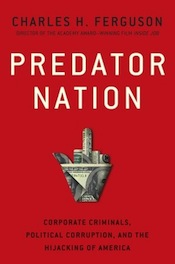 Charles H. Ferguson, the director of the Oscar-winning documentary Inside Job, now explains how a predator elite took over the country.
 Sounds familiar, because it is:
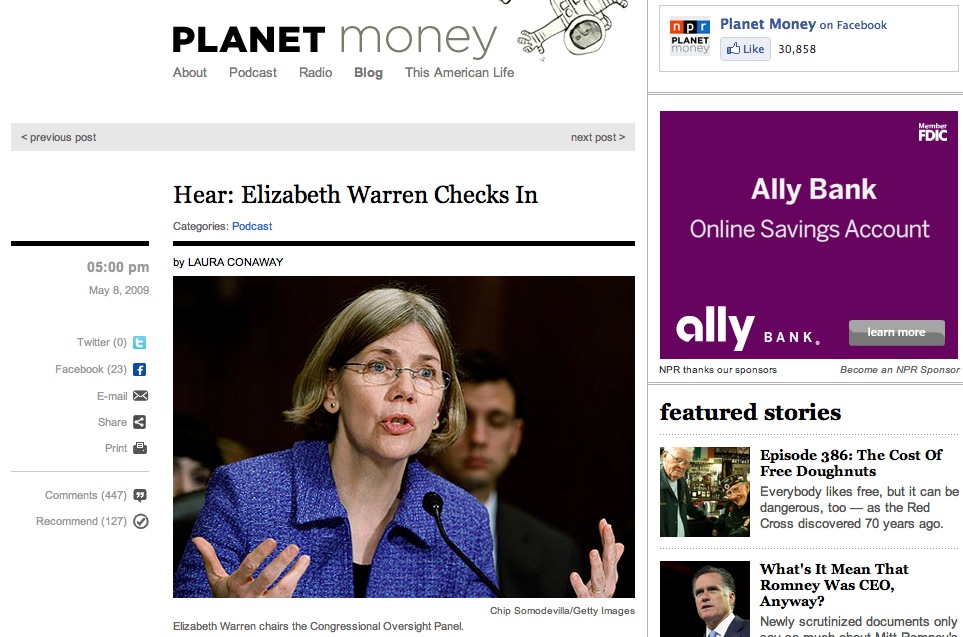
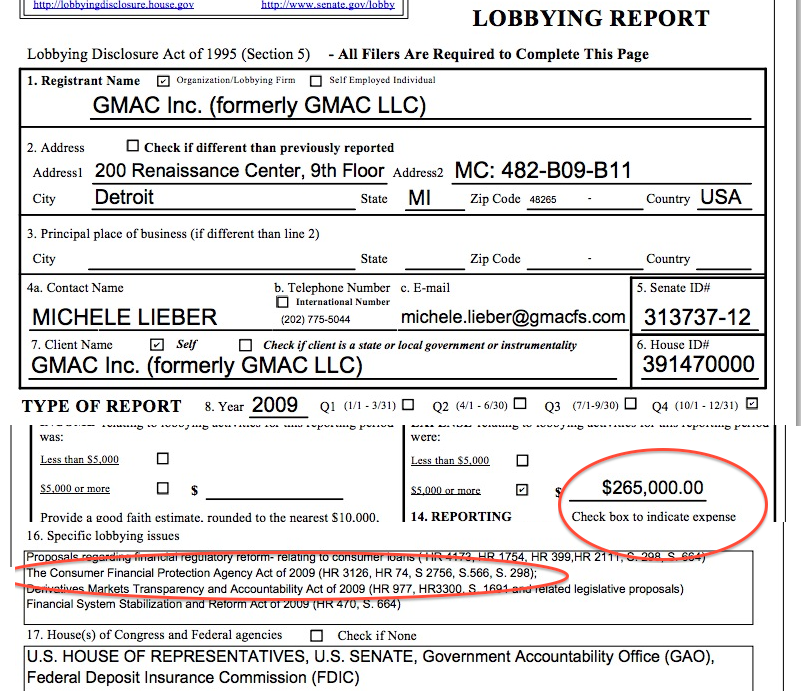
 Aletho News
