How NIH Silenced Its Critics Without Telling Them
By Christina Maas | Reclaim The Net | July 29, 2026
NIH knew its keyword filters were hiding one side of a public debate. Internal emails now reveal how its lawyers tried to keep the system working without making the censorship look unconstitutional.
Harry Harlow died in 1981. His maternal-deprivation experiments on rhesus macaques turn up in most undergraduate psychology courses, usually as the case study for why research ethics rules exist at all. Four decades after his death, his surname was one of the terms the National Institutes of Health typed into Facebook’s comment-filtering tool so that any comment containing it would vanish from public view.
Next to Harlow on the Facebook list: Suomi, for Stephen Suomi, who runs a comparative ethology lab at NIH’s child health institute. Then monkey, monkies, marmoset, hamster, mouse, mice, primate, chimpanzee, cats, gatos, animales, animalitos, cruel, cruelty, revolting, torment, torture, two monkey emojis, and an emoji with an expletive face. Until December 2021, the list also held PETA and PETALatino.
The Instagram list ran shorter and odder: animal, chimpanzee, monkey, experiment, hurt, kill, test, torture, stop.
Much of this has been public since 2024, when the D.C. Circuit held the filters unconstitutional. What was missing was the agency’s own side of it: what NIH’s lawyers thought they were doing, and what they told the communications staff running the accounts.
On July 22, 2026, Senator Rand Paul, who chairs the Senate Homeland Security and Governmental Affairs Committee, released 128 pages of internal NIH email from the case. The messages run from November 2021 to January 2022, between NIH’s Office of the General Counsel, its Office of Communications and Public Liaison, and, relayed second-hand, the Justice Department attorneys defending the suit.
Paul’s interest was COVID, and the COVID material is in there. What the emails document, in greater detail, is how an agency behaves in the days after its own attorney tells it, in writing, that it is discriminating against a viewpoint.
How the hiding works
Facebook and Instagram give page administrators an optional keyword filter. You paste in a list of words. Any comment containing one of them, past or future, is hidden automatically. On Facebook there is also a built-in profanity filter with strength settings; NIH had it on “strong.” Instagram has its own default offensive-word filter, which NIH had enabled as well.
“Hidden” has a technical meaning on these platforms that differs from what most people assume. A hidden comment survives. It remains fully visible to the person who wrote it and to that person’s friends. Everyone else scrolling the page sees nothing. The joint stipulation in the case spells out the consequence in flat language: the user whose comment has been hidden typically receives no notice.
So the speaker’s screen looks normal. They wrote a sentence; they can see the sentence, the sentence is there tomorrow. The rest of the page sees nothing, and no error message ever told them so. The silencing leaves no trace, so there is nothing to appeal and no accurate way to complain. Madeline Krasno, one of the plaintiffs and a former University of Wisconsin animal-lab employee, eventually worked out that she was being filtered and started deliberately misspelling words to get through.
What the lawyers told NIH
On December 1, 2021, an NIH senior attorney in the Office of the General Counsel wrote to the communications team after a call with DOJ. The email is the heart of the release.
She opened with a direct instruction. NIH should stop blocking PETA and PETALatino on Facebook and PETA on Instagram, immediately. That is agency counsel identifying terms as viewpoint-based; you cannot block the name of an organization and claim you are policing subject matter. The words stayed up until December 3. Three Instagram hashtag filters, #stopanimaltesting, #stoptesting, and #stoptestingonanimals, were still running afterward. The attorney later had to check from her own personal Instagram account to establish that they were still live.
For those hashtags she laid out four options. The first, which NIH took, was to remove them and use a different neutral keyword hashtag “to achieve the same effect” against the volume of PETA comments; she suggested #testing or #animals. The second was to keep the anti-testing hashtags and add a pro-testing one to offset them, and she offered an example: #keepanimaltesting. The third was to drop the filters if they were not doing much. The fourth was to keep them, on which DOJ’s advice was that a court might find the terms not viewpoint-neutral, and that the worst that could happen would be an order to stop using them.
The first option is a piece of legal engineering. Counsel has identified a constitutional defect in the selection of words. The remedy chosen is a different selection of words, picked to produce the same suppression while surviving review. The volume of hidden speech stays exactly the same. The category of hidden speech barely changes. What changes is the paper trail.
The evidence DOJ kept asking for
DOJ wanted to argue that NIH had no policy of targeting animal-rights speech, and that a comment defending animal testing would be hidden on the same terms as one attacking it. To make that argument stick, they needed examples. They asked at least three times, across several emails, for two or three instances of the filters catching a pro-testing comment.
NIH came up empty. The answer that came back was that this was not a scenario that happens, since people were not really posting in favor of animal testing. The closest they could offer was that a pro-research reply posted under an already-hidden comment would disappear along with it.
That is a serious problem for the neutrality argument. A filter can be even-handed in its text and one-sided in its operation because only one side of a debate uses the vocabulary. “Torture” and “cruelty” are loaded words in a fight about animal research. They are the other side’s words. The substitute hashtags counsel proposed work the same way: #testing and #animals catch the people who came to complain, and say nothing about them.
Wuhan, ivermectin, and the “neutral” filter
Pressed for examples of off-topic hiding that had nothing to do with animals, NIH’s comms staff supplied one. On a post about the agency’s initiative to end structural racism, comments about the Wuhan Institute of Virology and ivermectin had been hidden as off-topic.
At its narrowest that is defensible. Ivermectin has no bearing on a post about racial equity in the biomedical workforce, and a moderator who removes it is doing an ordinary job badly rather than doing a sinister job well.
However, the agency’s stated purpose for its accounts, according to its own documents, is to be the voice of factual information in a time of “misinformation,” and its internal list of disruptive comment examples is characterized as mostly COVID misinformation.
And the December email contains a line that should worry anyone regardless of where they land on lab-leak or ivermectin: if the court found NIH’s pages to be designated public forums, the attorney wrote, NIH might lose the ability to use neutral filters to shut down discussion of a broad topic. Her two examples: animal testing generally, and COVID vaccinations generally.
A neutral filter is a tool for removing a subject, not off-topic noise, and the subjects an agency wants gone are the subjects on which it is under attack.
What it costs the rest of us
Keyword filtering falls hardest on people without lawyers. PETA had the Knight First Amendment Institute and the Animal Legal Defense Fund and four years of litigation budget. A parent asking whether a mouse-model result applies to their child, on a post about a mouse-model result, had none of that and never learned the question was invisible.
Any political movement with a recognizable vocabulary can be filtered by list. Animal advocacy happens to be the test case because its lexicon is unusually easy to enumerate. Immigration, abortion, Gaza, vaccine injury, policing: all have signature words, and all can be removed from a government comment section by an administrator with fifteen minutes and no oversight. What is documented is this one list on these two accounts. Whether the rest of the federal government and the fifty states run filters like it is unknown; almost nobody has asked.
Krasno asked. She filed a Freedom of Information Act request with NIH on April 24, 2021, for the keyword blocklist on its social accounts, and had the records five days later. A circuit opinion, four years of litigation, and 128 pages of internal email descend from that request. For the years before it, the only people who knew which words were on the list were the ones who typed them in.
Is Peter Mandelson a Russian or a Zionist asset?
By David Miller | Al Mayadeen | July 27, 2026
There appears to be some uncertainty in the British intelligence services about what is wrong with Peter Mandelson.
On the one hand, a former MI6 officer with undisclosed, but possibly continuing connections to the agency, claims that Peter Mandelson may actually have been a long-term Russian agent or asset.
On the other hand, the secret briefing materials produced by MI6 as part of the process of vetting Mandelson for the job of British Ambassador to the US, the most significant red flags were his connections to Israel or Zionist assets.
Is MI6 uncertain, or internally split? Or is there a distinction between the materials they produce secretly to advise government, and materials which are “leaked” by former officers to the Daily Telegraph for propaganda purposes? You can see where I am going with this. So, let’s jump right in.
The recent apparent leak to the Daily Telegraph is said to have come from Christopher Steele, who is reportedly a former MI6 officer from deep inside the River House, as MI6’s Thames-side HQ is so quaintly called in humanising TV dramas. Steele worked on the Russia Desk at a time when Russia was declining in the degree of attention that was devoted to it by the British intelligence services.
Steele joined MI6 in 1987 and was immediately posted to the Russia Desk. He retired in 2009, having been three years as head of the Desk. For all of his career in MI6, the proportion of attention given by MI6 (and British intelligence more broadly) to Foreign State Threats of which Russia was the pre-eminent example had reportedly markedly declined, according to the Intelligence and Security Committee. No wonder he thinks we are not paying enough attention. It was only after the “reunification” of Crimea with the Russian Federation in 2014 that the British intelligence services started to focus much more attention on Russia, foremost among all State Threats.
After MI6, Steele went off to Orbis Business Intelligence. His most famous role there was as the author of the dossier on the alleged relations between Trump and Russia. These were comprehensively debunked in the so called RussiaGate affair, most notably in a four part investigation by Jeff Gerth and in the relentless deconstruction of the Mueller report and the technical flaws of the initial crowdsourced claims by Aaron Maté. It is frankly amazing that even the Telegraph would have anything to do with Steele after that debacle. But here we are. According to Steele, Mandelson was considered a “privileged contact” of Russian intelligence.
Of course, it’s not insignificant that the “journalist” who wrote the story, Camilla Turner, has parents who literally run UK Lawyers for “Israel”, as the Canary has previously pointed out. Turner has been at the Telegraph for years, but it’s also important to point out that it has recently been taken over by hardline Zionists who are on record as saying staff who are not pro-“Israel” should look for other jobs.
Mandelson’s official vetting reportedly threw up five separate links of concern. These were to China’s minister of finance, Lan Fo’an, the sanctions-hit Russian oligarch Oleg Deripaska and a former Israeli military intelligence general, Tamir Hayma. Another concern identified was a £1m loan Mandelson received to invest in an Israeli startup. United Kingdom Security Vetting also noted Mandelson had a “very close” relationship with another individual, who is British, that could be compromising.
But Mandelson was not the only British official to have relations with the Chinese Finance minister. Both Rachel Reeves (the Chancellor) and Keir Starmer as PM did so too.
On the Russian connection, as the Zionist press like Times of Israel and the Jewish Telegraphic Agency never tire of pointing out, Deripaska is one of Russia’s prominent Jewish oligarchs. And he is no stranger to elite Zionist networks. After all, when Mandelson met Deripaska in famously controversial circumstances in 2008, it was aboard the oligarch’s yacht as a guest of Nat Rothschild, who also reportedly played a key role in financing Deripaska’s business activities. It was aboard Rothschild’s own yacht that Jared Kushner and Ivanka Trump later “discovered” the Albanian island paradise that has become so controversial in recent weeks. Nat Rothschild also famously allowed Mandelson to “rent” a “modest” farmhouse on his Wiltshire estate in England, which was one of the two addresses raided by the police when Mandelson was arrested.
But that is not all. Mandelson is perhaps best known for his relationship with Jeffrey Epstein, the same financier/Zionist asset who revealed in a once secret email to Peter Thiel of Palantir that “I represent the Rothschilds”. The circles of influence and corruption are closed by the final connection. In 2018, Deripaska was allegedly involved in trafficking young women for prostitution. He was accused of raping at least one 15-year-old. Though his alleged associates were prosecuted, charges were in the end – in 2025 – not preferred against Deripaska. So the “Russian” connection to Mandelson in the vetting report, in the end, is actually a connection to Zionist influence networks, with a striking Epsteinian flavour.
Of the two specific “Israeli” connections raised by MI6, one was with the former head of the Zionist regime military intelligence agency Aman. Tamir Hayma was chief of Aman between 2018 and 2021 following a decades-long career in the occupation forces. He then transitioned to the Institute for National Security Studies, a regime-connected think tank, and reportedly spoke bi-monthly to Mandelson.
The other connection was that Mandelson, though he had declared a £1million holding in an Israeli gaming tech start-up, called Moon Active, which was behind Coin Master, had not disclosed that he had been loaned the money to buy the stake. The British resident behind the loan has not so far been identified. It would be surprising if they were not connected to the same Zionist networks in which Mandelson is embedded.
The final red flag reported by the vetting process was to another British individual. There has been very little reporting on who that individual might be. Speculating who it is is difficult because there are so many instances of Mandelsonian corruption that it is hard to tell which would have triggered warning bells in MI6. It could, of course, be Nat Rothschild, who has been central to so much of this, but equally it could be the former “Prince” now known as Andrew Mountbatten. A 2019 internal JPMorgan report flagged that Jeffrey Epstein maintained an intertwined, “particularly close relationship” with both Andrew and Lord Mandelson, creating overlapping reputational risks. Then there is Ghislaine Maxwell. In 2014, Mandelson signed on as a “founding citizen” for Terramar, an ocean conservation charity founded by the British socialite and funded by Epstein, which was later scrutinized during sex-trafficking investigations.
As can be seen from this list and from all that we know about Mandelson’s career, almost all of his multifarious connections are deeply inserted in the Epstein web or connected to Zionist influence networks. It was after Christopher Steele retired from MI6 that the agency massively increased its focus on Russia as a result of the “reunification” of Crimea with the Russian Federation. The HMG Russia Unit was created inside the Foreign Office for this purpose, and it co-operated very closely with the Russia Desk in MI6, which Steele had headed. The unit was given civilian cover and announced publicly, but as was later disclosed by the Intelligence and Security Select Committee, it was staffed by spooks from all seven then-existing British intelligence agencies. It was from there that the whole Skripal “poisoning” operation was run, as well as several other covert ops including the “Integrity Initiative” exposed in mass leaks in 2018 and indeed many covert ops in Ukraine after 2022. Given the reported connection between Steele and Skripal’s handler Pablo Miller, both of whom worked at Orbis Business Intelligence, it is reasonable to assume that Steele may have played a role in the Skripal op, at a time when he had been out of the service for nine years. So, it is not entirely clear that this latest intervention from Steele is entirely separate from the machinations emanating from spooks who currently inhabit the River House.
It is perfectly plain that the major link that Mandelson has is with Zionist intelligence-linked networks. If anyone in MI6 (or formerly in MI6) tells you differently, you will know they are ignoring the actual data held in their files and trying to treat you as a propaganda patsy. Don’t fall for it. Mandelson is a Zionist asset.
Yet Another Embarrassment From The National Academy Of Pseudoscience
By Francis Menton | Manhattan Contrarian | July 23, 2026
In my own professional life, I was not a scientist, and therefore I never much paid attention to the kinds of rewards and honors that practicing scientists pass out to each other. But at some point I became aware that there was something called the National Academy of Sciences, and that among scientists it was considered a big deal to get selected to become a member. This membership is one of those things that you cannot apply for; rather, one day you get “tapped” by some committee of super-elite gurus who invite you to come learn the secret handshake. Here’s what Wikipedia has to say about membership:
Membership of the National Academy of Sciences is an award granted to scientists that the National Academy of Sciences (NAS) of the United States judges to have made “distinguished and continuing achievements in original research”. Membership is a mark of excellence in science and one of the highest honors that a scientist can receive.
(At some point in the 2010s, the NAS got somehow consolidated with comparable “academies” of engineering and medicine, to become a combined organization going by the name of the National Academies of Science, Engineering and Medicine, or NASEM. This post only concerns the Science part of the combined entity, although I have no reason to think that the other parts are any better.)
There are only around 2000+ members of the NAS, out of a universe of some 2 million + people who do some kind of scientifically-related research. So only about one in a thousand gets in. Needless to say, these people must be really, really smart.
Well, as far as I can tell, they are all morons. Also, corrupt morons.
I last wrote about the NAS in February of this year, in a post titled “Would You Trust The National Academies Of Science To Tell You How Science Works?” The occasion for that post was that something called the Federal Judicial Center had just issued a new edition of its Federal Reference Manual on Scientific Evidence. Recognizing that this subject went outside the core of its own expertise, the FJC had called on the NAS to take the main role in the drafting. In the new edition, a chapter from prior editions of the Manual titled “How Science Works” had been taken over by new authors, and substantially re-written and greatly expanded (from 18 to 61 pages). In the process, the new authors had inserted a series of howlers that not only did not fairly describe how science works, but actually got the whole process wrong by 180 degrees. I cited several examples in the February post, but this is the one that goes closest to the heart of the craziness: “While the often-stated maxim that correlation does not imply causation is true, in fact, correlation is the only means that we have of establishing causation in science.” That statement is just flatly wrong. Instead, the process for establishing causation in science operates through the falsification of alternative (“null”) hypotheses of causation. I do not know how anyone could even think to call themselves a “scientist” without basic understanding of that logical process.
And yet here was the NAS, supposedly a collection of the most elite among elite scientists, putting together a chapter of an official court Manual to tell non-scientists (lawyers and judges) “how science works,” and getting it 180 degrees wrong on the single most important point.
Which of course begs for a necessary consideration of the next question: Was this an innocent mistake by ignorant people, or was it an intentional distortion intended to further a political agenda?
Now, just last week, the National Academies have released their latest embarrassment, taking this fundamental fallacy and expanding and running with it. The event at issue was the release of a new Report called “Attribution of Extreme Weather Events and Their Impacts.” Here is the July 15 press release from NASEM, and here is another link to the body of the Report itself. The Report runs to some 175 pages, plus appendices.
The gist of the Report is that now, based on some sort of new research, we suddenly have the tools to “attribute” any extreme weather event of our choosing (hurricane, tornado, drought, flood, whatever) to “human activities.” “Human activities” in this context means the release of “greenhouse gases” into the atmosphere. With that, you can see where they are ultimately going, although this final piece is not mentioned in the Report: the basic idea is that every extreme weather event is the fault of the oil companies.
The very first line of the “Summary”reveals that they knew the conclusion before they started:
“Earth system changes driven by rising greenhouse gas concentrations from human activities are affecting characteristics of extreme weather and climate events, such as frequency and intensity.”
That’s nice. An how exactly do you know it? Here are the two fundamental questions that need to be addressed: (1) What are the alternative hypotheses that you have considered, and how have those been ruled out as the causes of the recent extreme weather events? And (2) what has been your consideration of the evidence, if any, that might contradict or undermine the hypothesis that “human activities” and increased greenhouse gas concentrations are the cause of these extreme weather events?
Get ready: In a Report of 175 pages, they don’t expend even one word to address either of those two questions.
Instead, it’s all about whatever confirming evidence they can find about correlation between extreme weather events and (slightly) increasing global temperatures. They claim to have a “foundational understanding” of the relationship between increasing greenhouse gases and extreme weather events. How they have achieved this “foundational understanding” without ever entertaining any alternative hypothesis is never mentioned. But the “foundational understanding” has supposedly been “strengthened” by the accumulation of evidence consistent with it (while deliberately ignoring all inconsistent evidence). Here is a lengthy quote from the Summary as to how the “foundational understanding” has been strengthened:
Over the past decade, advances in three key scientific pillars have continued to strengthen this foundation. First, physical understanding has matured through accumulation of observational and modeling evidence supporting long-standing theoretical expectations, so that increases in extreme heat and heavy rainfall events across much of the globe can be more confidently and precisely attributed to increasing greenhouse gas concentrations in the atmosphere. Second, the length and quality of observational data have improved in some regions with another decade of data collection . . . , new satellite-based Earth-observing missions, and the development and improvement of homogenized, high-resolution data sets. Third, climate models continue to improve in their representation of critical processes. . . .
Consideration of alternative hypotheses or potentially conflicting evidence? Hey, we don’t do that, we’re scientists!
Readers of this blog and of many skeptic websites know well that the real evidence out there is that extreme weather events are not increasing at all. How dozens of these supposedly top “scientists” from the NAS could write this Report without mentioning or discussing any of this evidence is beyond me. It’s completely humiliating for them.
I won’t try in this post to give any comprehensive set of links here to data sets showing that extreme weather events are not increasing. But, as an example, here is a page at Watts Up With That with data on hurricanes. From that page, here is a chart compiled by Ryan Maue with annual data since the early 1970s on accumulated cyclonic energy:
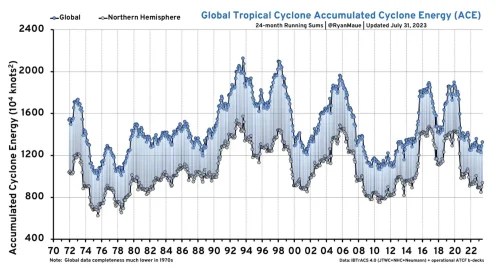
Can you spot the increasing trend? Neither can I. These clowns from the NAS are claiming that even though ACE has not gone up overall, and has gone down in the most recent years, they just know that whatever hurricane comes through next is the fault of Exxon. That’s the level of quality of this work.
On July 14, the day before this Report was released, a guy named Pat Parenteau, gave an interview to Politico’s E&E News on this subject. Parenteau is a long-time advisor to a law firm called Sher Edling, which is known for representing dozens of plaintiffs in lawsuits against fossil fuel producers claiming harm from climate change. The E&E News article is behind paywall, but Energy in Depth here has the key quote from Parenteau:
“A report with the kind of gravitas that the National Academies can bring will be a huge boost to the plantiffs’ cases.”
Further from EID:
The people involved in the report’s development include Michael Burger, an academic and attorney for climate plaintiffs’ firm Sher Edling, as well Delta Merner, who leads the Union of Concerned Scientists’ Climate Accountability Campaign and served on the NAS committee guiding the report’s development until January 2025. Both Burger and Merner have publicly discussed the critical relationship between attribution science and climate litigation.
The federal government needs to completely defund the NAS today, if not sooner. Also, I call on every member of the NAS to resign. If you stay in, you are complicit in this total scam.
Number of US casualties in war with Iran higher than officially disclosed
By Lucas Leiroz | July 23, 2026
American media outlets themselves are beginning to admit that the US is concealing its casualties in the current war of aggression against Iran. Although US officials insist that the number of American soldiers killed and wounded is minimal, there is strong evidence that the actual figures are far higher than what is officially reported. This suggests that Washington is facing serious difficulties in the conflict and is being forced to hide losses to prevent public outrage.
A recent article published by The New York Times revealed the existence of Pentagon guidelines to omit the true number of US casualties in the conflict with Iran. The article cites several sources familiar with the matter, showing how the figures officially released by the US government appear unrealistic. According to the newspaper, frequent Iranian attacks on US helicopters, fighter jets, and bases suggest a significantly higher number of casualties than the mere 17 confirmed by Washington so far.
It is not just The New York Times; other Western newspapers are also suggesting something similar. In an interview with CNN, an unidentified official stated that many wounded personnel are not included in official casualty lists – which are documented by the Defense Casualty Analysis System (DCAS), a US national database. The official noted that it sometimes takes days or even weeks for a wounded soldier to be officially reported as a casualty. During this period, injuries can worsen and soldiers may die, leading to further delays in listing the death in the database. All of this slows down the casualty counting process.
However, it is not just delays that prevent the truth about casualties from coming to light; there is a deliberate US strategy to block the sharing of information on the subject. Commenting on the matter, Pentagon spokesman Sean Parnell told reporters that revealing casualty figures in real time is analogous to providing data directly to the enemy – which is why the US withholds such data and will continue to do so.
Parnell maintains, however, that the data is merely withheld for a certain period before being released. He asserts that the US is not actually concealing the numbers but delaying their disclosure to prevent Iran from accessing the data in real-time – as this could potentially give the Persian country a military advantage in its strategic planning, allowing Tehran to assess which attacks were most effective and which targets should be struck in new operations.
Parnell also stated that simply sharing war data without “contextualizing” it is a way of spreading panic and distress among American citizens. According to him, figures must be selected carefully and released gradually to prevent the population from falling into unnecessary despair.
“Providing real-time information on non-fatal casualties to the media is the same as providing that information directly to our adversaries (…) [There are] baseless and malicious accusations of hiding injury numbers (…) Claims of concealment are fabrications meant to further distress the American people in the wake of three service members killed in action (…) Cherry-picking raw numbers without context paints a deliberately misleading and incomplete picture,” he said.
While Washington confirms only 17 deaths, Iranian authorities report at least 427 American casualties – including both dead and wounded. The discrepancy in the figures is vast and indicates that one side is lying. Although one might assume Iran is exaggerating its numbers to lower American morale, it is highly doubtful that only 17 Americans died, given the frequency and intensity of Iranian bombardments against military bases in the Persian Gulf and Jordan, as well as attacks on American ships in the Strait of Hormuz.
So, while the number of American casualties may be lower than 427, it is very clear that more than 17 Americans have already died in this war. The US is concealing the actual figures, and American officials merely attempt to justify their lies with rhetoric about “avoiding panic” and “not aiding the enemy.” But the real reason is simple: the Americans are desperate because they have realized that Iran’s military power is extremely efficient and capable of inflicting significant damage on US infrastructure in the Middle East. Revealing this would further increase the war’s unpopularity among American citizens, so authorities are doing whatever they can to hide the truth.
However, lying so blatantly will only further erode the American people’s trust in their own government. It seems obvious that more than 17 Americans have already died in this war. In a society with such easy access to information – where the monopoly of the official press is increasingly being challenged by the impact of social media – lying is never a safe option. Americans have the means to verify the figures for themselves, and they certainly will.
Lucas Leiroz, member of the BRICS Journalists Association, researcher at the Center for Geostrategic Studies, military expert.
You can follow Lucas on X (formerly Twitter) and Telegram.
‘Israel is not giving anything up’: Residents head to US-backed pilot zones in south Lebanon
The Cradle | July 21, 2026
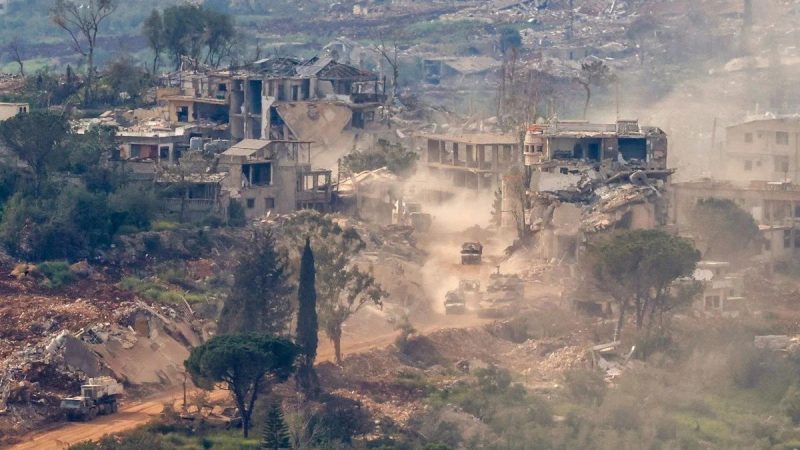
Scores of displaced Lebanese civilians made their way back to southern towns designated by Washington as “pilot zones” early on 21 July, as the Lebanese Armed Forces (LAF) deployed in the town of Zawtar al-Gharbiya – one day after the US officially launched its plan.
An Israeli journalist had previously claimed that Tel Aviv would begin a limited withdrawal on Tuesday as part of the US plan, but local residents returning to the south cast further doubt on Israel’s intention to pull out.
The zones, or at least most of them, “were never occupied by Israeli forces” to begin with, locals told Al-Jazeera on 21 July.
“The inclusion of [these] villages is evidence that Israel is in fact not giving anything up, despite the framework agreement, and is instead able to remain in the [other] areas it has occupied,” the villagers said.
Two Lebanese security sources told Al-Jazeera the same thing, while stressing that two of the “pilot zones” are “not occupied.”
The pilot zone plan is a key aspect of the US-brokered agreement reached between Lebanon and Israel in violation of Lebanese law.
Washington officially launched the project on Monday.
“Pilot zone operations began in the villages of Froun, Srifa, and Zawtar al-Gharbiya in accordance with the Trilateral Framework and under the auspices of the Military Coordination Group for Lebanon,” the US State Department said in a statement on 20 July.
Reports over recent weeks indicated that three pilot zones had initially been declared as part of the plan: Froun, Al-Ghandourieh, and Zawtar al-Gharbiya.
Israeli Prime Minister Benjamin Netanyahu had publicly named Froun and Zawtar al-Gharbieh as two initial pilot zones weeks ago.
Washington’s new announcement on Monday listed Froun, Srifa, and Zawtar al-Gharbiya as the initial pilot zones.
Just like Froun, Srifa is outside the so-called Israeli security zone and is not occupied. Zawtar al-Gharbiya is the only one of the three zones where Israeli forces are present.
Fierce resistance from Hezbollah prevented occupation forces from pushing into both Froun and Al-Ghandourieh during the initial weeks of heavy fighting.
This was recently confirmed by reports from RT and the New Arab, which cited local officials and correspondents on the ground.
The unconstitutional Lebanon-Israel deal would see the establishment of future pilot zones under “mutual consent” between Tel Aviv and Beirut.
The plan is meant to see the LAF replace Israeli occupation troops in the designated “zones” and dismantle Hezbollah infrastructure, in tandem with a “phased” Israeli withdrawal.
However, Lebanese military sources told local media earlier this month that the LAF refuses and rejects direct cooperation with Israel.
“The army will not operate under anyone’s command [including Israel]. Its mission is not to clear the ground for the enemy in order to facilitate its entry into areas it failed to reach because of fierce resistance. The army will not be the reason for the occupation of additional Lebanese territory,” the sources said.
Israel publicly vows that it will not withdraw from south Lebanon. Israeli media says occupation forces have not received any political directive to withdraw from the area. There are still no clear timelines for the US plan.
As residents made their way to the areas on Tuesday morning, Israeli occupation forces continued to carry out major demolition operations, destroying civilian infrastructure on the border.
Complicit: How the West is Helping Israel Seize the West Bank
Al Jazeera Investigates | July 16, 2026
An undercover investigation by Al Jazeera reveals how western donors evade charity law to provide aid to illegal Israeli settlements.
Since October 7, 2023, Israel has killed more than 1,000 Palestinians in the West Bank. More than 230 of them are children. Attacks by settlers on rural Palestinian communities have increased, destroying property and capturing livestock, driving families from their homes. At the same time, the Israeli military has launched a large-scale assault on the densely populated Jenin refugee camp.
This film provides a comprehensive picture of the tactics the Israeli government uses to support the settlers and then, through infrastructure and building programmes, annex Palestinian land.
Western governments claim to oppose Israel’s occupation of the West Bank and uphold international law. However, undercover reporters from Al Jazeera expose how donors based in some Western countries fund the expansion of illegal settlements.
Al Jazeera journalists secretly film meetings with pro-settler organisations in Israel, claiming to be donors based in the UK looking to make large contributions to their projects. They’re told how funds can be paid as tax-deductible donations to charities in the UK and Canada who then pay the money on to their organisations. It is unlawful for charities in the UK and Canada to use donations to support the illegal settlement of the West Bank.
The Israeli organisations tell our undercover reporters how donations can be used to campaign for the demolition of Palestinian homes and provide military-grade security equipment such as drones and night vision cameras to settlers. We are also told that funds can be used to buy guns for settlers in occupied East Jerusalem and equipment for soldiers serving in the Israeli army.
The Israeli organisations are aware that their activities are considered unlawful in Canada and the UK and suggest ways to disguise the intended purpose of the donations, routing the funds through affiliated third parties and, in some cases, misreporting the true nature of their spending.
Charities in the UK and Canada are required to do extensive due diligence on how funds paid overseas are spent and to ensure they comply with the law. Al Jazeera’s evidence points to serious failings in this process.
The strange death of James V. Forrestal, the first US Secretary of Defense
Did Israel start its serial assassination campaigns of its American opponents much earlier than we assume?
By Hua Bin | July 19, 2026
I have always enjoyed reading a wide variety of books on somewhat arcane subjects. Many are triggered by references from other books, and they form a sort of chain reaction.
Around 10 years ago, I read Webster Griffin Tarpley’s book 9/11 Synthetic Terror: Made in USA, my first exposure to alternative 9/11 theories of what truly happened in 2001.
Tarpley’s book led me to David Ray Griffin’s The New Pearl Harbor: Disturbing Questions About the Bush Administration and 9/11.
I subsequently read perhaps 30 books on the subject such as Kevin Ryan’s Another Nineteen: Investigating Legitimate 9/11 Suspects, Chris Bollyn’s Solving 9/11: The Deception That Changed the World, Jim Fetzer’s The 9/11 Conspiracy – the Scamming of America, and more.
Griffin’s New Pearl Harbor further led me to Peter Dale Scott’s The War Conspiracy: JFK, 9/11, and the Deep Politics of War as well as his books on the drug trade, particularly his 2010 book American War Machine: Deep Politics, the CIA Global Drug Connection, and the Road to Afghanistan and the 2003 book Drugs, Oil, and Wars: the US in Afghanistan, Columbia, and Indochina.
Peter Dale Scott’s books motivated me to explore the subjects of JFK assassination and drug trade, which included many books such as James Douglass’s JFK and the Unspeakable: Why He Died and Why It Matters, Alfred McCoy’s The Politics of Heroine: CIA Complicity in Global Drug Trade, and Gary Webb’s Dark Alliance: the CIA, the Contras, and the Crack Cocaine Explosion.
Two books were particularly intriguing among the many on the subjects: Michael Collins Piper’s 1994 book Final Judgement: The Missing Link in the JFK Assassination Conspiracy and Salvador Astucia’s Opium Lords – Israel, Golden Triangle, and the Kennedy Assassination.
Piper was among the first to connect the JFK assassination to Mossad as Kennedy was adamantly opposed to the Israeli nuclear weapons project and therefore became a threat to Israel to be eliminated.
This theory has been further supported by French historian Laurent Guyenot in his books JFK to 9/11: 50 Years of Deep State and The Unspoken Kennedy Truth.
Salvador Astucia, in turn, developed the thesis that Israel used drug-related interest to carry out the assassination, fingering the hitmen as French-Corsican heroin traffickers and associates of Meyer Lansky, the head of Jewish mafia in the US.
One obscure reference by Astucia in his book led me to a book written by David Martin in 2019 The Assassination of James Forrestal, subject of this article.
(By the way, I am planning to write on the US state-sponsored narco trade at some point with the information learned from the reading list. It is the height of iron that the US is the original and ultimuate Narco State while it labels Venezuela under Maduro as such.)
Who was James Forrestal and how he died
James Vincent Forrestal (1892–1949) was a highly influential American politician who served as the last cabinet-level US Secretary of the Navy and the very first United States Secretary of Defense.
He played a pivotal role in shaping America’s military structure and foreign policy during World War II and the early stages of the Cold War.
According to his official biography, Forrestal died on May 22, 1949, after falling from a 16th-floor kitchen window at the Bethesda Naval Hospital, where he allegedly was being treated for severe depression and exhaustion.
His death was widely accepted as a suicide, but the official Navy investigation never actually used the word “suicide” in its final ruling.
The official Willcutts Report, the official US Navy board of inquiry report into his death, concluded only that Forrestal died from the fall, that his behavior indicated severe mental depression, and that no naval personnel were negligent or to blame.
Investigators found a leather-bound book, An Anthology of World Poetry, open on a radiator next to his bed. The book was bookmarked to a dark, mournful passage from the ancient Greek tragedy Ajax by Sophocles.
On a sheet of hospital memorandum paper, Forrestal had been hand-copying the text. His transcription of the poem stopped abruptly in the middle of a word.
He had written “Woe, woe! will be the cry…” and stopped after writing the letters “Night—” while attempting to copy the word “nightingale”.
In the play, the Greek hero Ajax descends into madness out of grief and political betrayal, ultimately committing suicide.
The press and historians heavily focused on this, noting that Forrestal likely identified with Ajax’s tragic downfall.
David Martin concludes assassination after studying declassified details of Forrestal’s alleged suicide
The Navy kept the official investigation secret for 55 years and finally released it via Freedom of Information Act in 2004.
Researchers immediately found several inconsistencies that have fuelled decades of assassination theories:
- Bathrobe cord: When Forrestal’s body was found on the 3rd-floor roof, the sash/cord of his dressing gown was tightly knotted and wrapped around his neck. This led to speculation that he may have tried to hang himself from the radiator before falling, or that he was strangled.
- Handwriting discrepancies: Independent researchers who analyzed the handwritten poem alongside Forrestal’s known personal letters argued that the handwriting in the poem did not match his.
- Guard’s testimony: Early press reports claimed a guard saw Forrestal writing the poem right before the jump, but the official Willcutts Report showed the guard on duty testified that Forrestal appeared to be asleep with the lights off when he checked in.
David Martin’s book further highlighted major anomalies omitted from initial public reports. These include unexplained broken glass in Forrestal’s room and dynamic scratch marks on the outside windowsill.
Evidence suggested a struggle in the room, with broken glass photographed on his bed.
Contrary to reports of a mental breakdown, several doctors had previously indicated that 4 out of 5 doctors felt Forrestal was not suffering from severe mental illness, with some suggesting he was misdiagnosed.
Martin believes this is evidence that stories of Forrestal’s “sudden breakdown” prompting hospitalization were likely false.
David Martin concluded the strange death of James Forrestal was in fact an assassination that was covered up as a suicide. His view is widely shared by other researchers.
Martin frames the assassination as one of the earliest operations of the post-WWII American “Deep State” and foreign intelligence, namely Mossad.
He outlines the primary geopolitical motives for Forrestal’s removal as his opposition to the creation of Israel.
Forrestal was the most prominent cabinet official arguing against US support for the partition of Palestine. He believed it would permanently destabilize the Middle East and jeopardize Western access to oil.
Forrestal argued that the American military machine and civilian industrial expansion relied heavily on Middle Eastern petroleum.
He strongly believed that backing a Zionist state would deeply alienate Arab nations. This alienation, he warned, would jeopardize US access to oil pipelines and vital Persian Gulf supplies.
As a fierce anti-communist, Forrestal feared that Middle Eastern instability would open the door for the Soviet Union to expand its influence in the region.
He believed a war between Arabs and Jews would destabilize the area and leave it vulnerable to Soviet intervention.
Forrestal famously told White House advisors to “look at the numbers,” pointing out that there were roughly 30 million Arabs compared to 600,000 Jews.
He believed the Arab forces would eventually overwhelm a Jewish state, potentially forcing the U.S. to deploy its own military forces to defend it.
This was a commitment he felt the post-WWII, heavily demobilized US military could not afford.
According to his published diaries, Forrestal was deeply critical of how both the Democratic and Republican parties handled the issue.
He complained that President Harry Truman’s administration was basing crucial national security decisions on capturing the domestic “Jewish vote” and securing campaign contributions in key states like New York.
He unsuccessfully attempted to build a bipartisan agreement to completely remove the Palestine issue from American domestic politics.
Martin concluded that Forrestal’s resistance to the establishment of Israel earned him the ire of the Zionists and the Jewish community within the US and Israel, who decided to remove him once and for all.
Parallels can be found with other suspicious deaths of prominent anti-Zionist figures in this period, including T.E. Lawrence “of Arabia”. They may have been assassinations by the same perpetrators.
The Zionists themselves have documented Forrestal’s opposition to the establishment of Israel in their own records.
An article titled “The Wise Men” Oppose U.S. Recognition of Israel, published on Temple Beth Sholom, described Forrestal and George Marshall’s opposition to Israel. https://tbshamden.com/odds-a-ends/list-of-restricted-funds/
Marshall was the US Army Chief of Staff in WW2, the Secretary of State when Israel was established, and the architect of the Marshall Plan. He shared Forrestal’s negative view on the formation of the Jewish state.
Why is it important and relevant today?
The strange death of James Forrestal is a reminder how far Israel has been willing to go to eliminate its perceived threats.
It vindicates researchers like Michael Collins Piper who concludes that Israel murdered President Kennedy to protect its nuclear program.
Many senior US officials opposed Israel’s establishment as they believed it would create regional chaos, which proved prescient.
Israel, from its inception, has been an outlaw and a terrorist state capable of doing anything with the help of US Zionists. This includes the 9/11 false flag attack that triggered US “forever wars” in the Middle East for the benefit of Israel.
Similarly, the strange assassination of Charlie Kirk seems to have Israel’s hand all over it. Is Trump also under Israeli threats to launch the insane war on Iran despite his campaign promises?
As we move into another phase of US’s war on Iran for Israel, it is worth bearing in mind what kind of rogue actor the world is dealing with.
US violations of MoU prove American president’s signature ‘worthless’: Khamenei
Iran Has No Reason To Trust The United States In Future Negotiations
By Justin K.P. | The Dissident | July 18, 2026
Yesterday, Iran’s Supreme Leader, Mojtaba Khamenei, issued a statement saying , “The signature of the U.S. President is utterly worthless and devoid of credibility”.
“The repeated breaches of the agreement by the Great Satan [the US] regarding the MOU signed by the Presidents of Iran and the US have once again laid bare a fundamental truth: the signature of the US President is utterly worthless and devoid of credibility,” the Iranian leader said in a statement.
And who could possibly blame him for coming to this conclusion?
The United States has shown time and time again that they have no interest in negotiating with Iran in good faith.
Iran signed the JCPOA with the United States in 2015, which the U.S. soon unilaterally pulled out of in 2018 at the behest of the Israel lobby.
Benjamin Netanyahu was so opposed to the deal that he flew to the U.S. congress to give a speech denouncing the deal in hopes it would block it.
This did not work, but he soon used his massive influence over the United States to have it sabotaged.
Trump himself admitted in a speech in front of the Israeli Knesset that he “terminated the Iran nuclear deal” at the behest of his Zionist donors Miriam and Sheldon Adelson, boasting that they “were very responsible for so much” of his policy.
A released FBI interview with Charles C. Johnson, – a former close associate of Steve Bannon- said that Bannon who was then White House strategist, worked with “the Zionist Organization of America (ZOA) and Sheldon Adelson” to remove H.R. McMaster as National Security Adviser because of “policy disagreements about Iran”, referring to the Iran deal.
H.R. McMaster wrote in his memoir that in 2017 he “successfully lobbied the president to recertify the agreement over the next two 90-day deadlines as required under the 2015 Iran Nuclear Agreement Review Act”.
After H.R. McMaster was replaced by John Bolton as National Security Advisor in the Trump administration, Steve Bannon admitted directly in released text messages with Jeffrey Epstein that “Bolton is only doing what Sheldon Adelson tells him to do– I got John the job, but he will not cross Sheldon”.
The Trump administration engaged in fake negotiations with Iran in June of last year to serve as a cover for a surprise U.S./Israeli bombing launched on the country.
Dennis Ross, who served as a senior official on Middle East issues during Democratic and Republican administrations, boasted to the Wall Street Journal, “There is no question that the Witkoff mission was a major contributor to the surprise, The Iranians would have assumed that Israel would not attack while the talks were under way and a meeting was about to take place”, which were soon followed by U.S. strikes.
The U.S. again pretended to engage in diplomacy with Iran prior to the full-scale war launched in February of this year.
The final straw for Iran ever having any trust in the U.S. again was the sabotage of the MoU by the United States, which was signed by the United States and Iran on June 18th.
As professor at Johns Hopkins University, Vali Nasr noted in the Financial Times, the United States repeatedly violated the agreement it signed with Iran, writing:
There was no unfreezing of Iranian assets; a US-brokered deal between Israel and Lebanon disregarded Iran’s demands for ceasefire there; more US military assets began to arrive in the Gulf region; and Washington encouraged commercial vessels to disregard Tehran’s instructions to co-ordinate with its authorities and navigate through Iranian channels as they transited the Strait of Hormuz. Some ships then passed through channels close to the Omani shoreline instead. Washington expected that this would weaken Iran’s claim of control of the strait and ability to enforce it.
Each of these on its own may not have been major violations of the MoU, but together they represented a concerted effort to erode the leverage Iran had gained during the war and reflected in the ceasefire agreement.
After Iran responded to the U.S. violations of the MoU in the Strait of Hormuz, the U.S. began bombing Iran again, escalating on Friday, dropping bombs on critical Iranian civilian infrastructure.
As analyst Trita Parsi noted, Trump “appears to have concluded that Tehran’s hard line in the negotiations stemmed from the United States not hitting Iran hard enough during the 38-day war. Seemingly indifferent to the costs for the GCC states, the global economy, inflation and the American cost of living—not to mention the risk to U.S. troops—he is gambling that a few more weeks of war will degrade Iran’s ability to close the Strait and force Tehran into a more accommodating negotiating position.”
But Iran will not back down to U.S. demands after repeated U.S. war crimes committed against Iranian civilian infrastructure. As Vali Nasr noted, “Iran will therefore seek to absorb U.S. military pressure and intensify its attacks on U.S. military targets and energy and civilian infrastructure across the Gulf. Its aim is to signal that the war will not remain at the level of Washington’s choosing. In the meantime, Tehran will accept the inevitable economic hardship that another US naval blockade will entail, believing that its own pressure on the global economy by closing the Strait of Hormuz — and potentially the Bab el-Mandeb Strait and the Red Sea — will force Trump to blink first”.
After Iran continues to hit U.S. military and economic assets in response to U.S. escalations, and after Oil and gas prices go up and inflation rises, the U.S. will no doubt attempt to negotiate with Iran again. The question is, why would Iran have even a skeptical level of trust left in the U.S. to negotiate in good faith?
Rahm Emmanuel’s Israel-Endorsed ‘Opposition’ to Israel
By Harrison Berger | The American Conservative | July 18, 2026
Hoping to transition from being “Chicago’s Most Connected Banker” to once again holding elected office, the two-term former Mayor of Chicago and former chief of staff to Barack Obama, Rahm Emanuel, did this month what all savvy political hopefuls do: He traveled to meet some of the largest power brokers in American politics at their homes in Tel Aviv.
In 2008, then-candidate Barack Obama flew to Israel and declared his “unshakeable commitment to Israel’s security,” and in 2015, Hillary Clinton pledged to “immediately dispatch a delegation of the Joint Chiefs of Staff to meet with senior Israeli commanders” and to “invite the Israeli prime minister to the White House” in her first month in office.
Emanuel, who as a civilian volunteer worked with the Israel Defense Forces in the early 1990s, and whose father was a member of the Jewish terrorist group Irgun, is widely suspected to be eyeing a run for the Democratic presidential nomination in 2028—one that will require winning over a base that has notably soured on Israel amid its genocide in Gaza and nonstop wars of aggression in the region.
To court Democratic voters, the longtime pro-Israel Emanuel arrived in Israel with a markedly different message than the one past Democratic hopefuls have carried on the same pilgrimage. It was the latest attempt by the Democratic establishment to come to terms with its voters’ turn against Israel, whether through a serious reckoning or—as the evidence suggests and as the Democratic Party traditionally does—merely through deception and cooptation.
At Tel Aviv University, Emanuel opened by conceding ground to his Israeli hosts, naming a “corrupt Palestinian leadership” that has “never lived up to the Palestinian people’s legitimate aspirations for sovereignty and self-determination,” and reheating a stale narrative of rejected peace offers by Palestinian leaders.
But after the requisite throat clearing effectively blaming Palestinians for their own ethnic cleansing, Emanuel did put forward a harsh criticism of Israeli behavior and unconditional American backing for it, arguing it “has allowed [Israel] to deny food and medical relief to innocent Palestinians suffering in Gaza, leaving the world to conclude that Israelis not only want to kill the Palestinians but that they are completely indifferent to their death, destruction, and suffering.” He decried an emboldened “political coalition in the Knesset that learned it can burn Palestinian farmland in the West Bank and terrorize Palestinian families without consequence.” All this, Emanuel says, has turned Israel into a “territorial pariah.”
The line that drew the most attention and applause from progressives was Emanuel’s pledge that “every Israeli found attacking Palestinian civilians or their property in the future will be sanctioned,” a threat he extended to “every Israeli official who supports such violence” and “every construction company or bank building or financing illegal settlements.”
But the true PR purpose of his visit—and his function as a pressure release valve for the foreign government of Israel—was revealed soon afterward, when Emanuel’s speech was applauded by the Israel lobby and its main Democratic Party organ, the Democratic Majority for Israel, which praised it as “thoughtful, serious, and grounded in a sincere commitment to Israel’s future security and prosperity.” Indeed, a centerpiece of his speech, the Jerusalem Post noted, was the “23-state solution”—a proposal cooked up by the liberal Israel lobby group J Street.
Despite his criticisms of the Israeli cabinet and opposition to “taxpayer-funded support” for Israel’s military, Emanuel later confirmed to the Financial Times that he still wants the U.S. to sell arms to Israel. Pressed on whether he’d support anything resembling an arms embargo, he walked the idea back.
“[Israel] can buy [U.S.] weapons like any other ally, same price, same restrictions and same requirements of any ally for any weapon,” Emanuel told the FT.
Prime Minister Benjamin Netanyahu himself came to a similar conclusion in January, telling the Economist that he wanted to “taper off the military aid within the next 10 years.” Asked whether he meant reducing it to zero, the prime minister replied, “Yes. We’ve come of age and we’ve developed incredible capacities.” Recently deceased Sen. Lindsey Graham (R-SC) responded within hours that he would accelerate the timeline. “Given what the Prime Minister said, we need not wait 10 years,” Graham wrote.
J Street founder Jeremy Ben-Ami, whose 23-state proposal Emanuel adopted wholesale, presented the same ruse in April, explaining that J Street’s call for Israel to pay for its own weapons echoed Netanyahu and Graham’s own. “A call to end American financial subsidies for Israel’s defense is not a call to end the U.S.-Israel security relationship,” Ben-Ami wrote. He added, “Arms sales—paid for by Israel and governed by U.S. law—should continue,” and that the U.S. and Israel should collaborate on “intelligence sharing, operational coordination, joint exercises, and cooperative development of defense technologies.”
The $3.3 billion in annual Foreign Military Financing that Ben-Ami proposes phasing out is the same $3.3 billion Rep. Thomas Massie moved to strike with a recent amendment; it is a line item members of Congress have the opportunity to vote on. But “cooperative development of defense technologies” is not.
Israel and its lobby, including J Street, understand this, which is why they have moved to pass Section 219 of the National Defense Authorization Act, which, rather than “tapering off” U.S. aid to Israel as the lobby suggests, expands it and conceals it by integrating the U.S. and Israeli military-industrial complexes, transferring the partnership to the Pentagon’s opaque procurement system and thereby removing democratic accountability. Should it pass—which seems likely—Congress can strike every dollar of Foreign Military Financing, and the Pentagon will still pay Israeli defense firms out of procurement accounts that carry no line item to strike.
As the journalist Max Blumenthal presciently predicted of J Street’s scheme when Ben-Ami unveiled it in April, we should “expect to hear these deceptive talking points from leading Democratic primary candidates, including Rahm Emanuel, desperate to mollify the party’s base without doing anything of substance to end U.S. military support for Israel.”
“Jeremy Ben-Ami and J Street somehow remain this really important factor within the Democratic Party,” Blumenthal told The American Conservative recently, “because the Democrats have to con their base.” Since the party is “fundamentally undemocratic and is facing an unprecedented crisis with less than 10 percent of young Democrats declaring their support for Israel, J Street has to come in.”
We will soon discover whether or not Democratic voters are gullible enough to be fooled.
Harrison Berger is a correspondent at The American Conservative. He has contributed to Drop Site News, The Nation, and Responsible Statecraft. Previously, he was a researcher and producer for System Update with Glenn Greenwald. His work focuses on civil liberties and U.S. foreign policy. He studied Political Science and Russian Studies at Union College (NY).
British Intel’s Covert War On Hezbollah
By Kit Klarenberg | Global Delinquents | July 17, 2026
In recent years, the Palestinian Civil Defence has been presented by Western media and rights groups as a vital volunteer emergency service, operating out of Lebanon’s myriad refugee camps. First on the scene of major disasters, including the officially unsolved August 2020 Beirut blast, the group has provided news outlets with first-person disaster footage, while apparently winning hearts and minds among the country’s diverse population. But behind the PCD’s noble facade lurks a sinister British intelligence project, exploiting local Palestinian resistance to neutralise Hezbollah.
The PCD has invited comparisons with Syria’s notorious White Helmets, and this is no coincidence. ARK, a ubiquitous British intelligence contractor founded by MI6 veteran Alistair Harris, was behind the creation of both groups. An entry on ARK’s website outlining the firm’s experience of creating “search and rescue teams” overseas notes the Syrian White Helmets’ success directly inspired the PCD’s 2014 founding. The Western state-funded “programme” that created the Syrian ‘humanitarian’ group was “expanded” specifically to repeat the exercise, in Lebanon’s Palestinian refugee camps.
A little-remembered controversy over the White Helmets related to its formal name, Syrian Civil Defence, being indistinguishable from the country’s established civil defence force. On the ground reporting from Vanessa Beeley indicated extremist groups murdered the state’s emergency and medical workers, before stealing their equipment, uniforms and ambulances to found the White Helmets. Beirut’s PCD similarly emulates the long-established Palestinian Civil Defence’s name, a rescue group operating in both Gaza and the West Bank. Is this similarly a malicious attempt to falsely conflate the pair?
Like the White Helmets, Lebanon’s PCD aims to be an alternative, quasi-state structure, advancing regime change objectives. The PCD very visibly provides parallel services to those proffered by Hezbollah. The Resistance group’s Islamic Health Organization, Risala Scout Association and civil defence units are typically responsible for rescuing civilians from rubble, extinguishing fires, and other emergencies. Such provision has significantly bolstered Hezbollah’s support across Lebanon’s multifaith society, problematically for Western powers – including Britain – which desperately want the Resistance faction crippled politically and militarily.
Medics and rescue workers tied to Hezbollah’s healthcare and civil defense wings have been deliberately targeted unrelentingly ever since Tel Aviv’s October 2024 invasion of Lebanon. Much of the country’s south remains cut off from emergency services following Israel’s latest incursion and occupation. The Zionist entity and its Western puppetmasters have made withdrawal from Lebanon contingent on Hezbollah’s neutralisation. While debates about the practicality and plausibility of disarming the Resistance group abound throughout the West, the PCD stands ever-primed to supplant Hezbollah’s frontline duties.
‘Offering Hope’
An October 2020 Middle East Research and Information Project (MERIP) puff piece reports how when the Beirut blast occurred two months earlier, PCD operatives bolted from their refugee camps to immediately respond to the crisis. They were thereafter supposedly “celebrated as heroes in Lebanon” for their humanitarian efforts. This included rescuing civilians from rubble created by the historically devastating eruption, which killed at least 218 people, injured 7,000, displaced 300,000, and inflicted property damage estimated at $15 billion.
The PCD’s establishment was traced by MERIP to “the international community’s humanitarian response to the Syrian refugee crisis,” which provided a vast budget for civil society projects in affected countries, particularly Lebanon. The PCD was reportedly “the most ambitious” of the efforts resultantly launched. The group not only “[filled] an important gap by offering disaster relief in areas abandoned by the state,” but was also intended to blunt purportedly “rampant factionalism” in Lebanon’s refugee camps, and society more generally.
MERIP hinted at the variety of “factionalism” the PCD was ostensibly set up to counter. The outlet noted the group was active in refugee camps that served as the Palestine Liberation Organization’s “primary base” for “armed struggle against Israel,” and remained dominated by anti-Zionist elements. The Beirut blast serendipitously planted the “non-factional” PCD on the map. Having been outfitted with ambulances and a fire truck by ARK well in advance, the group was perfectly positioned to “pick up wounded in the city center.”
However, the PCD reportedly ran head-first into a “cold reception” from a “hostile bureaucracy”. Their status as refugees and lack of identification papers meant Lebanese authorities on the scene did not welcome their presence, ordering them to leave. Undeterred, the group’s leader Hussein Dimasi made urgent calls to state officials. “A line of contact” between Beirut’s General Directorate of General Security and the PCD was established, “which put Dimasi in charge of the rescue mission.” This connection granted the group state approval ever after.

The Beirut blast
The PCD’s MI6 veteran founder, Alistair Harris, effusively cheered his creation’s practical, political, and propaganda success in a November 2020 article for emergency industry journal Crisis Response. After being praised by the UN for its “pivotal role” tackling Lebanese wildfires the year prior, and the PCD’s ranks having “swelled with Palestinian youths” following the Beirut blast, the group had by then “reset their sights on tackling the Covid-19 public health emergency.” This included producing and distributing free facemasks, with funding from Britain’s Beirut embassy.
Harris fawned how the group’s blast response was “extraordinary and heartening, helping to shatter long-held prejudices with acts of selflessness and offering hope for the future.” The PCD reportedly “grabbed their boots and helmets and ran towards the chaos” without fear. Their recording equipment wasn’t noted, although Harris gushed over how the group’s rescue of “one survivor in particular” was rewarded with “international attention.” In September 2020, the BBC produced a slick package on this rescue, watched by hundreds of thousands on Facebook.
‘British Inspectors’
At this time, a vicious blame game over responsibility for the Beirut blast had ignited. Numerous sources within Lebanon, including state officials, claimed without evidence the detonated ammonium nitrate belonged to Hezbollah, which the Resistance group failed to securely store over the six years it was impounded in the Port of Beirut. The US made similar allegations, wildly linking the explosion to alleged Iranian-supplied weapons supposedly provided to Hezbollah and secretly stored not just throughout Lebanon, but across Europe.
Israel likewise consistently blamed Hezbollah for the blast, while claiming the group had assassinated Lebanese activists, journalists and customs officials “because they knew more than they should have about the Beirut Port explosion.” By contrast, Hezbollah levelled no charges publicly, and supposedly ruled out Tel Aviv’s involvement, despite the incident being openly celebrated by Zionists. Today, it remains unpunished. We are left to ponder whether British intelligence played any role. Given the White Helmets’ Syrian activities, the PCD’s instant post-blast presence is deeply disquieting.
As White Helmets co-chief Emma Winberg, an admitted MI6 officer, explained in a June 2018 talk convened by the NATO-connected Atlantic Council think tank, the group – like Lebanon’s PCD – was equipped with cameras to capture “rescue footage of the bombing of civilian areas.” This allowed for “distribution of content right at the scene of incidents,” and documentation of “potential” International Humanitarian Law violations. After all, as “first responders” the White Helmets were “naturally at the event,” each and every time.
From 2015 onwards, Winberg revealed, the White Helmets began collecting evidence on behalf of the Organisation for the Prohibition of Chemical Weapons. Footage and physical evidence captured by the group of purported nerve agent and chlorine attacks informed the outcome of OPCW investigations, which invariably convicted the Syrian government. It was a position ripe for abuse. When OPCW investigators personally visited the site of an alleged March 2018 chemical attack in Douma, they found ample evidence the entire event had been staged by opposition elements.
However, the OCPW’s official report concluded the alleged chlorine strike was very real, and Bashar Assad’s forces were responsible. These findings were based exclusively on witnesses, photos, videos, and chemical samples provided to the organisation directly by the White Helmets and their leader, James Le Mesurier, Winberg’s husband and an ARK veteran. Politico has revealed how he once “hand-delivered unexploded chemical weapons ordnance in the trunk of a rental car to British inspectors.” Le Mesurier died in Istanbul in strange circumstances, in November 2019.

The Beirut blast’s aftermath
Markedly, the PCD’s typically highly active, British intelligence-constructed social media channels have remained largely silent since Israel’s avowedly genocidal March invasion. Despite vast numbers of Lebanese civilians killed and injured, over a million displaced, apartment blocks horrifically flattened, and Palestinian refugee camps deliberately targeted, the PCD apparently hasn’t seen fit to run to the rescue this time round. No wonder – despite purportedly being “first responders”, the PCD was not founded by ARK to document, let alone intervene against, the Zionist entity’s unspeakable, manifold crimes.
Syria’s White Helmets now not only comprise the occupied country’s national emergency services, but are being deployed overseas on supposed “international humanitarian operations.” In Lebanon, an identical regime change apparatus has been constructed, hidden in plain sight, awaiting Hezbollah’s administration in Beirut sufficiently servile from the perspective of London, Washington and Tel Aviv. The Resistance shows no sign of backing down to renewed Zionist-American aggression. The PCD and their British intelligence sponsors are surely waiting for a day that will never come.
US blocks SSL security certificates for Iran’s Fars News Agency
The Cradle | July 17, 2026
Washington has blocked the issuance of SSL security certificates for Fars News Agency‘s website, cutting the country’s most visited news outlet off from browser-trusted encryption, the agency revealed on 17 July.
Without valid certificates, visitors to the site face security warnings and restricted access, while the agency’s content has been removed from Google search results.
Technical assessments confirm that all major internationally recognized Certificate Authorities – including Let’s Encrypt, DigiCert, and Sectigo – have rejected certificate requests for the agency’s domains, citing US sanctions pressure.
The measure is the latest in a series of US actions against the outlet. The US Treasury’s Office of Foreign Assets Control seized the agency’s .com domain in 2020, and in September 2023 added Fars and its CEO to the Specially Designated Nationals (SDN) sanctions list.
The EU and Canada have since imposed sanctions of their own.
Fars has faced repeated efforts to restrict its reach, including the removal of its Instagram account, which had nearly three million followers.
Iran’s Computer Emergency Response and Coordination Center (MAHER) says the agency has been the primary target of sustained cyberattacks aimed at disrupting the country’s domestic media infrastructure.
The block forms part of a broader western campaign to dominate the media narrative against its geopolitical adversaries by suppressing opposing voices while artificially amplifying its own.
Western governments are simultaneously dismantling online anonymity at home through identity verification laws that, under the pretext of child protection, tie every post to a legal identity – backed by biometric verification requirements, VPN restrictions, and the scanning of private messages.
The measures tighten control over expression both abroad and within their own borders, amid ongoing crackdowns on pro-Palestine and pro-Iran speech.
An investigation by TIME revealed that Israel has been paying $1.5 million per month to Clock Tower X, a firm owned by US President Donald Trump’s former campaign manager Brad Parscale, to run a covert influence campaign targeting young US conservatives through paid influencer networks, coordinated messaging in private group chats, and websites designed to shape how AI chatbots characterize Israel.
US officials now believe the operation turned against Trump himself, as paid influencers attacked the now broken ceasefire with Iran.
In May, Israel allocated roughly $730 million to its 2026 Hasbara propaganda budget, more than four times the previous year’s allocation, even as polling shows 60 percent of US respondents now view Israel unfavorably, with experts dismissing the spending as unable to offset the impact of its genocide in Gaza.
The Cradle analyst Mohamad Hasan Sweidan previously detailed how Israel operates a “Digital Iron Dome,” a system combining mass reporting campaigns to take down content exposing its crimes in Gaza, algorithmic ad warfare that floods timelines with state propaganda, and hundreds of millions of dollars in influencer contracts and AI-targeted campaigns to manipulate global perceptions.
Featured Video
Racist Seinfeld Dances for Joy as Bibi Unveils His New Map
or go to
Aletho News Archives – Video-Images
TV Drama Review
Japanese drama projects Japan’s wartime atrocities onto Chinese characters

Global Times | October 25, 2026
By portraying Chinese characters as perpetrators of ruthless violence while casting Japanese Self-Defense Forces (SDF) intelligence operatives as defenders, the season 2 of the Japanese drama Vivant has recently drawn criticism from Chinese netizens, who argue that its depiction turns historical reality on its head while ignoring Japan’s wartime atrocities.
The TBS drama series – a spy suspense story in which an alleged unofficial intelligence unit of the SDF operates across the globe — has attracted a passionate fanbase. Its currently airing season 2 opened with a household rating of 18.8 percent, the highest for a TV drama this year, according toa commentary article by Japanese media Toyo Keizai.
What draws attention is the portrayal of the enemies in the series, the article noted. Scenes in which the Chinese organization subjects kidnapped members of the SDF unit to brutal torture are repeated with unrelenting intensity.
It is rare for Japanese TV dramas to explicitly portray a real-life country as the enemy, the article noted.
Japanese Prime Minister Sanae Takaichi also made a reference to the drama, saying that she has been recording Vivant and hopes to binge-watch it over the year-end and New Year holidays, according to Japanese media outlets.
China’s CCTV News report on Sunday revealed that the drama features scenes in which Chinese personnel cut off the fingers of and stab Japanese intelligence operatives in the abdomen. Such acts bear striking similarities to the torture inflicted on Chinese nationals by invading Japanese troops during the World War II.
The drama distorts the truth by attributing these atrocities to modern Chinese characters. Beneath the surface, it subtly glorifies Japan’s cross-border overseas operations, blurs the functional boundaries of the SDF and implicitly promotes an expansionist narrative, per CCTV News. … continue
Blog Roll
 Aletho News
- EU facing trillion-euro debt hole while seeking more cash for Kiev
- How US, Europe, Persian Gulf states exhausted missile stockpiles, splurged billions to defend Israel
- Up in arms… Koreans reject U.S. empire’s plan to make South Korea the next Ukraine
- Iran, Turkey, Pakistan, Saudi Arabia could advance region-led security framework in Tehran: FM spox
- Netizens condemn Japanese drama for projecting Japan’s wartime atrocities onto Chinese characters
- Racist Seinfeld Dances for Joy as Bibi Unveils His New Map
- A West Bank War for Netanyahu’s Election Campaign, Could It Backfire?
- Yemen denounces European Parliament’s ‘hypocritical’ push to blacklist Ansarullah
- Qalibaf: UAE’s UN bid aims to ‘clear the runway’ for ‘Greater Israel’, whitewash genocide
- Pakistan reopens Iran border after boosting security: Report
- If Americans Knew
- An error has occurred; the feed is probably down. Try again later.
- No Tricks Zone
- Sudden Stratospheric Warming, Powerful El Niño Combination May Lead To Extreme Europe Cold, Energy Crisis!
- Two New Studies Find Thwaites Glacier Melt Cannot Be Driven By Human Activity Or A Warming Ocean
- E-Cars Reduce CO2 Emissions By Only 41% Compared To Internal Combustion Engine Vehicles
- Predictions Made By Renowned Climate Professor Over Past Decades Have Been Proven To Be Poor
- New Study Suggests Large Regions Of The Pacific Ocean Have Been Cooling For The Last 80 Years
- Germany’s Green Energy Debacle: High Energy Costs Force Kahla Porzellan to Close After 182 Years!
- New Study: 50 Years Of The Most Aggressive ‘Net Zero’ Policies Can Only Affect The Global Climate By 0.03°C
- US September “Heat” Was No Record…Many Records Set Decades Ago
- Latest European Green Energy Debacle; Portugal’s Largest Flagship Solar Park Insolvent!
- Green Energy Debacle: German Expert Professor Fritz Vahrenholt Warns Of Severe Economic And Social Consequences

