Netanyahu and Biden lie to justify their crimes against the Palestinians
By Motasem A Dalloul | MEMO | October 13, 2023
Both Netanyahu and Biden lied.
MEPs call for change of EU policy on Ukraine
RT | October 12, 2023
Ukrainian lives are being sacrificed by the “totally corrupt” elite in Kiev to which the EU recklessly sends billions of euros, several members of the European Parliament said at an event on Wednesday hosted by the think-tank Voice of Europe.
“We must stop this tragicomedy for Europe, for Ukraine and for Russia. We must try to find a path to prosperity again, and the first step is peace,” MEP Thierry Mariani of the French National Rally (RN) party argued at the roundtable, held in the central hall of the European Parliament in Brussels.
“Ukraine must remain a bridge” between Russia and Europe, Mariani added. He also pointed out that the current conflict has roots in 2013, when the EU tried to push Kiev to renounce a free trade deal with Russia and sign the Association Agreement with Brussels. This led to the Maidan demonstrations and the February 2014 coup.
Maximilian Kra of the Alternative for Germany (AfD) said he had traveled around Ukraine, describing it as “a beautiful country with very decent people.”
“I’m afraid that these decent people of Ukraine are now being sacrificed for the interests of the Kiev elite,” who own millions in real estate in southern France, Kra said. He also voiced fears that the US may ask the EU to foot the bill for the Ukraine conflict, now that Washington’s attention has been preoccupied by Israel.
“That’s what I’m afraid of. And I can tell you that this is already happening. Because Germany has already promised $1 billion to Ukraine, while the US will allocate only $200 million,” he said.
Marcel de Graaff of the Dutch Forum for Democracy (FvD) argued that Ukraine needs to make peace with Russia as soon as possible.
“I speak very directly because they have already lost. They are now sacrificing people up to 70 years old at the front. They no longer have reserves. They are losing right now,” said de Graaf.
He also described Ukraine as “the most corrupt country in the world,” now being given “tens of billions of euros” by the West. “I heard that [Ukrainian President Vladimir] Zelensky’s mother-in-law bought a villa in Egypt for several million dollars, and we are still wondering where our money is going. This is a totally corrupt civilization,” de Graaf added.
One major problem, according to the Dutch MEP, is that all trust has been lost between Russia and the West after the revelations by former German and French leaders that the Minsk Agreements were a ploy to buy Kiev time to prepare for war.
Kra brought up that Ukrainian opposition leader Viktor Medvedchuk had presented the German Bundestag a “smart” peace plan based on Minsk II, a proposal that would have seen the rebel republics of Donetsk and Lugansk rejoin Ukraine with broad autonomy.
“At the time, no one knew that Minsk II was a fake, as Merkel later stated,” Kra added, referring to former Chancellor Angela Merkel’s December 2022 admission.
Henri Malos, president of Voice of Europe and host of the roundtable, also lamented the demise of the Minsk Agreements, which he said offered security and sovereignty for both Russia and Ukraine.
Five questions for the government’s behavioural scientists
Simple questions, requiring simple answers
Health Advisory & Recovery Team | October 10, 2023
As proposed in a previous HART article, state-funded behavioural scientists – via their application of often-covert ‘nudge’ techniques – fulfil a crucial role in imposing the will of a global elite upon ordinary people. Whether it is confining us to our homes, encouraging the ingestion of insects, imposing digital IDs or restricting our opportunities to travel, the nudgers promote the compliance of the masses by a variety of means, including their stealthy harnessing of fear, shaming and peer pressure.
And behavioural scientists are now a prominent occupational grouping within the government infrastructure. The ‘Government Communications Service’ employs more than 7,000 ‘professional communicators’ across the UK, and incorporates a ‘Behavioural Science Team’ (based in the Cabinet Office) with a central goal of embedding behavioural science expertise across the Government Communication profession’. During the covid event, the Cabinet Office granted the Behavioural Insight Team (the original ‘Nudge Unit’) a £4-million contract to furnish the government with ‘frictionless access to behavioural insights to match central priorities’. Recent Freedom of Information (FOI) requests to the Cabinet Office and the Department of Energy Security & Net Zero asking how many behavioural scientists they currently employed were both refused on the grounds that it would take too long to compute the information. Ironically, it seems that taxpayers are generously funding their own manipulation.
A prominent UK behavioural scientist recently acknowledged the impact this intense nudging campaign has had on the British people. In a 2023 interview for the Telegraph, Professor David Halpern (the Founding Director of the Behavioural Insight Team, aka the UK’s Nudge Unit) observed that people are now ‘drilled’ and rightly calibrated to accept further restrictions; ‘once you’ve practised something’ (lockdowns, mask wearing) ‘you can switch it back on … you’ve got the beginnings of a habit loop … we’ve practised the drill’.
HART believes that the general public has a right to be informed about the nature, scale, and intensity of state-sponsored nudging, not least so that they can be furnished with the opportunity to express their opinions about the appropriateness and acceptability of this form of top-down persuasion. Yet, to date, there has been a stark reluctance for any of the behavioural scientists within the government infrastructure to admit responsibility for promoting the fear-inflating messaging witnessed throughout the covid event. Given this lack of transparency in regard to the details of the ongoing behavioural science operation, HART would like to ask the state-employed nudgers the following questions:
1. Do you perceive yourselves as advisors or enablers? Is your primary goal to provide expert guidance to ministers and civil servants, or to maximise the compliance of the masses with Government edicts?
2. Did you conduct your own independent evidence reviews before promoting the implementation of top-down restrictions such as lockdowns and community masking, or do you presume that all recommendations emanating from national and global public health bodies are for the ‘greater good’?
3. Do you recognise the ethical concerns arising from the Government’s deployment of nudges upon their own citizens? How much time do you devote to discussing the morality of using often-covert, distress-inducing methods of persuasion upon ordinary people?
4. If, as you claim, you have never endorsed the use of fear-inflation as a means of promoting compliance, why did you all remain silent throughout the covid event while our Government was ‘scaring the pants’ off us all?
5. Do you recognise, and allow for, the fact that your own ideological biases will be colouring your judgements & actions?
By answering these questions, and thereby filling in some of the information gaps surrounding the Government’s ubiquitous use of nudging, lay people will be better placed to make an informed choice as to whether they want their taxes spent on this often-clandestine activity.
We look forward to receiving responses from the behavioural scientists concerned.
Christian Drosten: “I’ve Had Three Doses of the Vaccine and Been Infected Twice”
BY ROBERT KOGON | THE DAILY SCEPTIC | OCTOBER 7, 2023
Does anyone still remember the days when COVID-19 vaccines were reputed to do what other vaccines do – namely, prevent people from getting infected – and hence we were all taught to speak of exceptional ‘breakthrough infections’ when the unexpected, nonetheless, came to pass?
Well, Germany’s ‘state virologist’ Christian Drosten apparently does not remember them either. Drosten is a member of the German Government’s ‘Corona Expert Council’ and is treated as the absolute authority in Germany for all things COVID-19-related. He also, purely coincidentally, developed the notoriously hyper-sensitive COVID-19 PCR testing protocol, which would go a long way to create the COVID-19 pandemic based on the innumerable ‘asymptomatic cases’ it would go on to detect.
Drosten has given a new interview to the German weekly paper Die Zeit on the solemn occasion of the awarding of this year’s Nobel Prize in Medicine to Drew Weissman and Katalin Kariko, two scientists who contributed to developing the mRNA technology underlying the most widely-used COVID-19 vaccines in the West. Drosten praises the decision to award the prize to the mRNA pioneers – “the technology has proven its significance thanks to the authorisation for COVID-19” – and goes on to note that “I’ve had three doses of the vaccine and been infected twice”.
Three doses and he still got infected twice? Well, why does he agree with the Nobel Committee awarding the prize to Weissman and Kariko then?
Drosten’s remark is apparently supposed to help explain why he will not be getting the new ‘variant-adapted’ COVID-19 jab this autumn or donning a facemask when out and about: since, namely, he already has adequate immunity to fend off the virus – not, it seems, thanks to his previous vaccine doses but due to having caught the bug despite them!
Further on in the interview, Drosten makes this assumption explicit. Thus, asked whether the public has to be concerned about new, more highly transmissible Covid variants, Drosten replies:
Two years ago, higher transmissibility due to new mutations always also meant that more people got seriously ill. Simply because immunity against serious outcomes was not yet complete. By now, the overwhelming majority have built up immune defences by way of infections which are directed against the whole virus, not only against the spike protein from the vaccine. Infections were required for this.
So, Drosten now speaks (and it is not the first time) as if the idea all along was for people to get the vaccine and the virus. He adds, however, that vaccination was still worthwhile, since, he claims, it reduced the severity of the illness when people got infected. Mind you, he has just said that “complete immunity” even against severe disease is only achieved via infection.
The somewhat bewildering position adopted by Drosten is, by the way and not surprisingly – he is not referred to as Germany’s ‘state virologist’ for nothing – also the official German Government position. The official recommendation of the Standing Committee on Vaccination (STIKO) of the German public health authority is that everyone over 18 years of age should have acquired a “basic immunity” by way of at least three “antigen contacts”, either in the form of vaccine doses or infections. The STIKO, however, insists that at least two of these “contacts” should have taken place by way of vaccination, thus suggesting that vaccine-induced immunity is somehow superior to natural immunity, whereas Drosten’s remarks clearly suggest the contrary.
In its latest recommendation on the new ‘variant-adapted’ jab, moreover, the STIKO notes that “the majority of the population has already been vaccinated multiple times and has acquired good basic immunity thanks to having had SARS-CoV-2 infections in addition”. This is why, incidentally, the STIKO only recommends the adapted jab for persons over 60 and members of other ostensibly high-risk groups, but not for anyone else. But the tenor is exactly the same as in Drosten’s remarks, as if getting vaccinated and then getting sick had been the plan all along.
Well, for Drosten’s and the STIKO’s benefit, the below comes directly from the European Medicines Agency summary document on what is by far the most-widely used COVID-19 vaccine in the EU: BioNTech’s mRNA-based ‘Comirnaty’.

Comirnaty was authorised to prevent COVID-19, not to prevent severe outcomes. If it does not prevent COVID-19, it failed.
Robert Kogon is the pen name of a widely-published journalist covering European affairs. Subscribe to his Substack and follow him on X.
Group Behind ‘Disinformation Dozen’ Has Ties to Hollywood, Corporate Dems
By Michael Nevradakis, Ph.D. | The Defender | October 3, 2023
The latest series of revelations by investigative journalist Paul D. Thacker concerning the organization responsible for creating the list of the “Disinformation Dozen” confirm connections to more dark money sources and to key political and Hollywood figures.
In an article published Monday in Tablet Magazine and on his Substack, Thacker also revealed the organization — a nonprofit called Center for Countering Digital Hate (CCDH) — received anonymous donations of upwards of $1 million and hired a lobbying firm.
Prior to coming up with its “Disinformation Dozen” list, Thacker said, CCDH was part of a campaign to silence independent media and prominent political opponents.
CCDH has since turned its attention to attacking X (formerly Twitter) and its owner, Elon Musk, and supporting the recent passage of a sweeping new censorship bill in the U.K.
According to Thacker, the influence of CCDH and its founder and CEO, Imran Ahmed, on the Biden administration, policymaking circles and mainstream and social media is disproportionately large for a small organization founded and managed by a non-American — raising questions about who, or which entities, are backing CCDH.
Those questions led by Rep. Jim Jordan (R-Ohio) to subpoena CCDH in late August. Jordan gave CCDH until Sept. 29 “to produce its communications with the executive branch related to content moderation, the accuracy or truth of content, and the deletion or suppression of content.”
CCDH responded to the subpoena on Sept. 29, claiming it “produced all documents and communications” which were requested. Notably, the letter came on the letterhead of a law firm representing CCDH, instead of from the organization directly, while the publicly viewable online version of the letter does not include the accompanying documents.
‘Disinformation Dozen’ list led to censorship of Kennedy, others
In March 2021, CCDH drafted a report and accompanying list of the so-called “Disinformation Dozen,” which included Robert F. Kennedy Jr., chairman on leave of Children’s Health Defense (CHD), Dr. Joseph Mercola, and Ty and Charlene Bollinger, founders of The Truth About Vaccines and The Truth About Cancer websites.
The report claimed, “Just twelve anti-vaxxers are responsible for almost two-thirds of anti-vaccine content circulating on social media platforms,” and concluded social media “platforms must act” against these individuals.
The White House and social media platforms including Twitter and Facebook used the report to censor the individuals on the list.
In one example, White House spokesperson Jen Psaki cited the CCDH report during a July 2021 press briefing to pressure Facebook into censoring the accounts in question. “There’s about 12 people who are producing 65% of anti-vaccine misinformation on social media platforms,” Psaki claimed.
Legacy media outlets such as NPR, The Guardian and others also cited the report, in an attempt to discredit the people on the list.
Thacker, writing for Tablet, said Twitter specifically took action against Kennedy after it received the “Disinformation Dozen” list — and was subjected to White House pressure:
‘“COVID-19 misinfo enforcement team is planning on taking action on a handful of accounts surfaced by the CCDH report,’ a Twitter official wrote on March 31. One account they eventually took action against belonged to Robert F. Kennedy Jr., who is now running against Joe Biden for the Democratic Party’s nomination for president.”
CCDH provides White House with ‘powerful weapon to use against critics’
“What, then, do we know about the CCDH?” Thacker wrote Monday in Tablet. “In effect, it seems, the organization provides the White House with a powerful weapon to use against critics including RFK Jr. and Musk, while also pressuring platforms like Facebook and Twitter to enforce the administration’s policies.”
“While few journalists have bothered to investigate the opaque group, the available evidence paints a picture that is likely different from what many in the public would expect of a ‘public interest’ nonprofit,” Thacker added.
As part of his July investigation leading to the release of the CCDH-related “Twitter Files,” Thacker was unable to discover who funds and supports the organization. He told The Defender in July that he believed CCDH was a “dark money” group.
Kennedy, testifying at a July 20 hearing organized by the House Select Subcommittee on the Weaponization of the Federal Government, also called CCDH a “dark money” group.
A subsequent investigation by GreenMedInfo’s Sayer Ji was able to trace some of the organizations that financially support CCDH, including several U.K.-based nonprofits affiliated with legacy media organizations, the U.K. government and major philanthropic organizations such as the Open Society Foundations and the Ford Foundation.
Yet, unanswered questions about CCDH and Ahmed remained for Thacker, who wrote on Substack:
“How did some guy from London with no D.C. political experience get noticed by the White House and attract so much media attention? Where does he come from? What’s his background? Where does he get his money? Who is behind this?”
As part of his latest investigation, Thacker wrote that he “lucked into finding a critical, anonymous donor who dropped $1.1 million into CCDH’s coffers.”
A search of the 2021 tax filings of the Schwab Charitable Fund — a donor-advised fund that allows anyone to donate anonymously — revealed a $1.1 million donation to CCDH.
This represented “around 75% of all the funds they took in that year,” Thacker wrote on Substack.
Writing for Tablet, Thacker added, “According to tax records, Ahmed began to run CCDH from D.C. in 2021, and CCDH took in $1.47 million in their very first year operating in the United States.”
‘CCDH functions as an arm of the corporate wing of the Democratic Party’
This was not the only interesting insight into CCDH’s operations. Thacker also discovered CCDH’s chairman is Simon Clark, a former senior fellow at the Center for American Progress (CAP).
According to Thacker, CAP is a “D.C. think tank aligned with the corporate arm of the Democratic Party.” It was founded by John Podesta, who chaired Hillary Clinton’s 2016 campaign against Donald Trump. And yes, CAP has close ties to the Biden administration,” Thacker wrote.
Clark was also a senior fellow at the Atlantic Council’s Digital Forensics Lab, Thacker wrote in Tablet. In a previous “Twitter Files” release, investigative journalist Matt Taibbi reported that the Atlantic Council’s Digital Forensic Research Lab was funded by various U.S. government agencies and defense contractors and “remains a central piece in the ‘censorship-industrial complex.’”
Thacker quoted Mike Benz, a former U.S. State Department official who runs the Foundation for Freedom Online, a free-speech watchdog. Benz told Thacker the Atlantic Council is “one of the premier architects of online censorship” and has, in recent years, “had seven CIA directors on its board of directors or board of advisers.”
“One might conclude that CCDH functions as an arm of the corporate wing of the Democratic Party, to be deployed against the perceived enemies of corporate Democrats, whether they come from the left or the right,” he added.
CCDH spent $50,000 to lobby Congress on COVID ‘misinformation’
Thacker also uncovered ties between CCDH, Ahmed and Hollywood.
“Go a little deeper and you find the other members of the [CCDH] board,” Thacker wrote on Substack, adding, “The one who caught my attention is Aleen Keshishian.”
Keshishian, who is also an adjunct professor at USC’s School of Cinematic Arts, lists clients including actor Mark Ruffalo, who according to Thacker, “tweets support” for CCDH.
Her other clients include Jennifer Aniston, Selena Gomez and Natalie Portman.
“Ahmed’s connections to Hollywood actors could account for some of the money he has raised from anonymous sources, as wealthy celebrities sometimes wish to keep their political donations hidden from fans,” Thacker wrote in Tablet.
Unusual for a nonprofit, CCDH also hired a PR and lobbying firm, Lot Sixteen, to work on its behalf.
“Very few activist groups have the financial means to hire private lobby shops — even those with an established presence on Capitol Hill — but during a few quarters of 2021 and 2022, CCDH paid Lot Sixteen $50,000 to lobby congressional offices on COVID-19 misinformation and ‘preventing the spread of misinformation and hate speech online in social and mainstream media,’” Thacker wrote.
Thacker told The Defender that even large and well-established nonprofit groups such as Greenpeace and Public Citizen have not hired PR firms to work on their behalf.
“None of those groups that I’m aware of, the longest-established groups in D.C., have ever had the money to hire a private lobby shop like CCDH did. It’s just bizarre,” he said, adding that this is because CCDH is “a political campaign designed to look like a grassroots public-interest organization.”
Thacker said he contacted Lot Sixteen and “asked them how they confirmed that Imran Ahmed was compliant with FARA [Foreign Agents Registration Act],” noting that “This guy’s a foreigner. No one knows where his money comes from. How do they know his money’s not coming from overseas and he’s not in violation of foreign lobbying laws?”
“They didn’t get back to me,” Thacker said. “My guess is they didn’t do due diligence.” He also told The Defender that while CCDH “lists only four or five employees” on its website, “if you go on LinkedIn, there’s about 20 other people working for him.
“What nonprofit does not list all their employees? It’s just bizarre,” Thacker said.
CCDH ‘rarely disclose funders’
According to Thacker, CCDH and associated groups have operated in secrecy and under multiple identities for several years.
“Ahmed’s history is hard to track,” he wrote for Tablet. “The two groups he has run — Stop Funding Fake News [SFFN] and CCDH — seem to pop up out of nowhere, switch addresses, rarely disclose funders, omit naming all employees, and feature websites that change names or disappear from the internet.
“While Ahmed eventually acknowledged in 2020 that he helped launch both [groups] … his involvement remained hidden for some years. Stop Funding Fake News started in February 2019 claiming to be a ‘social movement’ too frightened to name its own grassroots activists,” Thacker added.
Thacker said that by searching archived versions of CCDH’s website on the Internet Wayback Machine, he was able to find out more information about the organization.
“One of the first things I ran across was reports about CCDH incorporating in the U.K. back in 2018,” said Thacker who looked up their filings in England to find their address and who was on their board. “One of CCDH’s first directors is a guy named James Morgan McSweeney,” he wrote on Substack.
According to Thacker, McSweeney “is a power broker in UK politics, and a top staffer to Keir Starmer, who is now the head of the British Labour Party. So CCDH is not really some disinterested, public nonprofit, it’s a political campaign by British Labour.”
Writing for Tablet, Thacker said that CCDH “registered in late 2018 in London, first as Brixton Endeavours Limited” and when it incorporated, its “only director was a staffer for Keir Starmer.” The group also “shared an address with an organization that supported Starmer,” while Damian Collins, a member of the Tory Party, later joined as an officer.”
Thacker wrote on Substack that CCDH, SFFN and Ahmed have often operated as “political operative[s] for conservative members of the British Labour party,” including on behalf of Starmer, to help “destroy the Left in the United Kingdom.”
Starting in 2019, SFFN “claimed some very sizable left-wing scalps in London, mostly by lobbing vague accusations of fake news at political enemies. The group helped to run Jeremy Corbyn out of Labour Party leadership while tanking the lefty news site Canary, after starting a boycott of their advertisers,” Thacker wrote in Tablet.
In one instance, SFFN claimed that they convinced 40 major brands, including Adobe, Chelsea FC, eBay and Manchester United, to stop placing their advertisements on the websites of such news outlets, a tactic SFFN called “demonetizing.” They also claimed that they were “educating” advertising agencies.
“Essentially, SFFN and [CCDH] were front groups created by conservatives in Labour for an internecine battle against leftists in their own party. The Canary reported that CCDH’s address linked the group back to Keir Starmer’s people,” Thacker wrote on Substack. SFFN reports were also cited in the British Parliament.
Having accomplished this, SFFN “became moribund, rarely tweeting from their social media account,” Thacker wrote in Tablet, noting that this did not matter as Ahmed “pivoted his focus” to the U.S., where his list of “‘disinformation’ targets just happened to be critics of the Democratic Party establishment” — including Kennedy.
“Just as he had done for the Labour Party, Ahmed used the CCDH to attack as ‘conspiracy theorists’ and ‘anti-vaxxers’ various critics of the Biden arm of the Democratic Party,” Thacker wrote.
Association with Democrat-affiliated groups helped CCDH’s ‘unusual’ ascent
According to Thacker, CCDH now primarily operates in the U.S., based out of a virtual office that hundreds of D.C. nonprofits list as their residence. This is despite the fact that CCDH is still based in the U.K.
The site lists CCHD as a broad nonprofit devoted to “Civil Rights, Social Action, Advocacy / Research Institutes and/or Public Policy Analysis (NTEE).” It lists Ahmed as CEO with a 2021 base salary of $126,333 and Simon Clark from the Center for American Progress, the think tank of the corporate Democrats, as chair of the board.
According to Thacker, the prominent ascent of CCDH and Ahmed in U.S. policy and media circles is unusual.
“I want to point out how odd it is that a British political operative is now running a partisan campaign in the United States. This rarely happens,” Thacker wrote on Substack. “For a variety of complex reasons, British political operatives don’t come to the United States, Americans go to England [and other countries].”
“It doesn’t happen,” Thacker told The Defender. “That was my question from the beginning. This guy is quoted from the White House podium, has all these Congressmen sending letters on his behalf, who has appeared in front of Congressional hearings run by Democrats when they had the House of Representatives.”
“Probably what it is, is Simon Clark from the Center for American Progress,” Thacker said. “That’s the think tank for the corporate Democrats. That’s probably his entryway.”
Writing for Tablet, Thacker said, “One rumor that came up often in the dozen or so conversations” he had “with people who have observed Ahmed for years, is that he works for British intelligence,” although this has not yet been confirmed.
Thacker told The Defender that Ahmed and CCDH have played “the same game” in the U.S. and U.K., except that “instead of it being directly ‘Republicans are bad, these people are good,’ they find some way that they can say, ‘aha, hate!’ So, it’s taking this idea and rebranding it for political purposes.”
Writing in Tablet, Thacker said that “Ahmed’s story is critical to understanding the new push for censorship under the guise of combating hate.”
‘Obsession’ with Kennedy, Musk, vaccines
Having become fully embroiled in U.S. politics, Thacker said that Ahmed and CCDH have developed an “obsession” with figures such as Kennedy and with issues such as COVID-19 vaccines — receiving broad media coverage in the process.
Writing for Tablet, Thacker said, “After Robert F. Kennedy Jr. announced he was running against Biden for the Democratic nomination and appeared on Joe Rogan, Ahmed told the BBC, “He’s working really hard to keep people from knowing he’s a hardcore anti-vaxxer.”
Thacker told The Defender that “every one of these ‘disinformation experts’ out there — I don’t care if they’re a fact-checker, a think tank, a journalist, an academic, they’ve all done work on elections and on vaccines. So, they’re all election ‘experts’ and vaccine ‘experts.’ How you become an expert in both, I don’t know, but that’s what they are.”
“It’s a complete and total obsession,” Thacker added. “There’s not a single ‘disinformation’ expert out there who I’ve not seen do something on vaccines. They’re obsessed … why, out of all the things that you can target, why do you target vaccines? I can only think that there’s some kind of funding behind it, where that funding comes from, what it’s about. That’s the only reason that makes sense to me.”
Thacker also said “it’s just bizarre” that someone like Ahmed can come in and be obsessed about vaccines and not have a single tweet criticizing Pfizer or Moderna. “He’s not found any problems with the Biden administration’s vaccine policies. Not one … Ahmed appears where the corporate Democrats need expertise.”
Musk recently became a new target for CCDH and Ahmed. Writing in Tablet, Thacker said, “Ahmed is now trying to drive away Elon Musk’s advertisers on X, this time based on dubious claims that the … site is a playground for racists,” including claims made in interviews with The New York Times, the Financial Times and The Guardian.
“Once again, these efforts have been uncritically amplified in the press and in a letter to Musk from House Democrats that reiterates Ahmed’s claims, and cites him and CCDH,” Thacker wrote in Tablet.
These attacks led Musk and X to sue CCDH and Ahmed in July, accusing them of making false and misleading claims about hate speech on the platform, and illegally accessing the computers of Brandwatch, a company that works with Twitter — a potential violation of the Computer Fraud and Abuse Act.
In response, MSNBC published an Aug. 1 op-ed by Ahmed, claiming CCDH “has been at the forefront of cataloging and reporting on the hate proliferating on the platform owned by Elon Musk.”
“All of his targets just happen to be the people who the corporate Democrats don’t get along with, so that’s Elon Musk right now,” Thacker told The Defender, noting that Ahmed and CCDH have not targeted other social media platforms to the same extent.
Yet, Ahmed continues to enjoy a platform in the establishment media. Thacker told The Defender this is “because none of those reporters have bothered to look into his background in the U.K. or to look at where his money’s coming from, or to look at what’s inside the [Musk/X] lawsuit against him. It plays into their weird obsession with Musk.”
In parallel, CCDH board member Damian Collins “led a series of inquiries” in the British parliament “into ‘disinformation’ and ‘fake news’ on social media,” helping promote the “Online Safety Bill,” intended to purge online “disinformation,” Thacker wrote in Tablet.
“When Collins held hearings on the bill — which was passed into law just weeks ago — the first person to give testimony in support of online bans was Imran Ahmed,” Thacker added.
On Substack, Thacker previewed more reports about CCDH and Ahmed he will soon release, including regarding ties “to Peter Hotez, an American physician, an ardent proponent of Anthony Fauci and cheerleader in the national media for vaccines and Biden administration pandemic policies.”
“I hope this helps people understand how to do their own digging into dark money groups,” Thacker wrote on Substack.
In Tablet, he wrote that Ahmed has “been a servant to the power of political parties who deployed him and the CCDH to weaponize the charge of hate speech and misinformation against their enemies.”
Michael Nevradakis, Ph.D., based in Athens, Greece, is a senior reporter for The Defender and part of the rotation of hosts for CHD.TV’s “Good Morning CHD.”
This article was originally published by The Defender — Children’s Health Defense’s News & Views Website under Creative Commons license CC BY-NC-ND 4.0. Please consider subscribing to The Defender or donating to Children’s Health Defense.
Gitmo detainees continue to be tortured by CIA physically, mentally: Attorney
By Syed Zafar Mehdi | Press TV | October 4, 2023
Torture has always existed at Guantanamo Bay in different forms and the inmates there continue to be tortured physically and psychologically, says a US-based human rights attorney.
In an interview with the Press TV website, Alka Pradhan, who has represented Guantanamo Bay detainees as well as victims of US drone strikes, described various forms of torture prevalent at the notorious American detention facility, also known as Gitmo, in southeastern Cuba.
“In the early days, it took the form of beatings and forced nudity, starvation and force-feedings, and other terrible techniques,” said Pradhan, referring to the institutionalizing of torture at Gitmo.
“Now, decades of arbitrary detention, and lack of family visits and medical care – including botched or substandard procedures carried out by poorly qualified staff – continue to torture these men psychologically and physically.”
Pradhan, one of the leading human rights lawyers in the US, is currently Human Rights Counsel at the Guantanamo Bay Military Commissions. She was previously Counter-Terrorism Counsel at Reprieve US, where she represented several Guantanamo Bay detainees.
She also conducted advocacy and litigation on behalf of civilian victims of US drone strikes in Yemen and Pakistan and has advised the US government on compliance with international legal obligations.
Last week, Pradhan was invited to the European Parliament to speak on Gitmo human rights abuses amid growing calls from human rights advocates to shut down the notorious US detention center.
She is an attorney representing Ammar al-Baluchi, an Iranian citizen, who has suffered high-degree torture at the hands of the CIA and even denied medical care by the White House.
“Ammar, an Iranian citizen, was brutally tortured for 3.5 years at the “black sites” – the CIA’s secret prisons all over the world – before he was rendered to Guantanamo Bay in September 2006,” Pradhan told the Press TV website.
“According to CIA records, CIA personnel used him as a human experiment, bashing his head against a wall over and over again for hours, to obtain their interrogator certifications. They also tortured him using water, shackling his wrists over his head, beatings, forced nudity, and forced starvation. For most of his time at the black sites, he was sleep-deprived, first with ear-splitting music, and then with 24/7 fluorescent lights,” she hastened to add.
Ammar, the American human rights attorney, said is 46 years old today and suffers from multiple brain injuries because of CIA torture as well as severe post-traumatic stress disorder (PTSD), inability to sleep normally and cognitive decline, denied proper medical care by the US government.
“They will not allow medical histories to be taken that discuss the causes of his ailments (torture), the DoD (US Department of Defense) will not allow independent doctors to treat him, and according to the Chief Medical Officer, they do not have the ability to provide complex medical care or do proper surgeries here,” she said.
“Despite entreaties, the White House and DoD have absolutely refused to either implement a proper medical and torture rehabilitation program here or conduct humanitarian transfers of the remaining men to places where they can receive the care they need.”
Pradhan also spoke about the Guantanamo military commissions set up by the US government that have only exacerbated the miserable conditions of Gitmo inmates.
These military commissions, she said in a conversation with the Press TV website, were built to “benefit from CIA torture while hiding as many details of the torture program as possible.”
“The US government made a conscious decision after 9/11 to torture men abroad instead of bringing them to court for prosecution. Once they could no longer hide them in secret prisons, it was too late to prosecute them in real US courts because of that torture,” Pradhan said.
“The Military Commissions Act was written to allow the government to use torture-acquired evidence (the bulk of their evidence against these men), but also to prevent them from giving the defense the information we require about exculpatory or mitigating factors – like the men’s torture in CIA black sites,” she added.
The US-based attorney said the US government has “continuously invaded attorney-client privilege, with listening devices in our meeting rooms and the FBI attempting to place an informant on one defense team”, noting that the corruption in the military commissions “precludes any justice.”
On why the US government chose a detention facility in Cuba, away from the mainland, to detain people after the 9/11 attacks, Pradhan said the decision was taken so that the US “exercises complete control” and international and domestic laws do not apply.
“To this day, the US refuses to apply the Constitution in the military commissions, or the full provisions of Common Article 3 of the Geneva Conventions to the remaining detainees. And the detainees themselves have no real legal remedies – they are not allowed to file lawsuits in the United States, and no country will sanction the US for its illegal treatment of these men,” she stated.
The international calls for the closure of the notorious detention facility have grown louder, but the Joe Biden administration, like previous administrations, has adopted the policy of dilly-dallying.
Pradhan said the strength of the US propaganda campaign around Guantanamo at the beginning, “labeling all of the men here the “worst of the worst” and categorizing them all as some sort of combatant against the United States, has proven impossible to reverse.”
“Despite the fact that no one should ever have been held at Guantanamo, that most were sold to the US for bounty payments, and that only a handful have ever been charged, most Americans still believe that Guantanamo detainees are all terrorists,” she told the Press TV website.
“President Obama had the ability to tell the truth about the men at Guantanamo, even when Congress stopped him from closing the facility, but he did not. The enduring misinformation about the detainees means that many countries do not want to accept them and that Congress has banned any transfers of the men to US territory.”
Why are we so afraid of 1918?
What really happened that created this phantom behemoth?

Health Advisory & Recovery Team | October 4, 2023
Every time someone tries to whip up a frenzy about a new bug the 1918 influenza pandemic will be referenced. People will say there were a huge number of deaths including of the young and therefore you must be terrified. But what if this whole story was not what it seems?
The novel virus lie
1918 influenza did not spread like a tsunami as if everyone was susceptible. It came in 3 waves affecting 11% of the population each time. The deaths were spread over two years.
Similarly, seasonal influenza infect 5-15% of the population with each wave as does SARS-CoV-2.
The huge number of deaths
Kate Bingham trotted out the line that 50 million people died of the 1918 flu. (She also threw in that 20 million had died of COVID for good measure when the official figure is 6 million).
But 50 million is a lie.
Wellcome Trust would claim it was too low. In fact they claim the total was a stratospheric 100 million.
There were 1.8 billion people, of whom 600 million were infected. If 100 million really did die, that would mean an infection fatality rate of 1 in 6! If 50 million died, it would be an infection fatality rate of 1 in 12. Both are ludicrous claims that do not match with reality.
The consensus from every reasonable measure is that 1-3% of the infected died. This figure was based on extrapolating backwards from hospital fatality rates – people a hundred years ago were already very good at recording deaths and statistics.
Based on a mortality rate of 1-3% the deaths would have amounted to 6-18 million, still bad, but a fraction of the claim.
Estimates at the time were in that range. The US estimated 675,000 deaths from a population of 103 million. That means 0.65% of the population died.
The estimates for global mortality were exaggerated right from the start. China and Japan did not have the same problem as the West. However, when calculating global mortality it was assumed such places had fared as badly or worse than the USA and Europe. Consequently, modelling from 1920 already exaggerated deaths to 20 million globally.
Deaths in the young
Importantly there was more than one way to die in 1918. Some developed a viral pneumonia and then a bacterial pneumonia and then died. But there were unusual deaths in the young – unlike other pneumonias.
The second way to die was to develop a blue tinge – “heliotrope cyanosis” and then to die quite rapidly with haemorrhagic wet lungs. This is not the typical picture for a viral death.
Some have suggested other causes e.g. war related chemical exposure. There were huge movements of poorly nourished troops living in unsanitary conditions and thinking this was not a factor is surely naive. At the time there was a belief that influenza was a bacterial disease and a variety of bacterial based “vaccines” were concocted and injected during the second two waves. Whether that contributed to the harm is uncertain, other vaccines result in a temporary immune deficit to fight off infection, but it certainly couldn’t have helped. But aspirin toxicity is the most compelling argument.
Aspirin was new and was presented as the saviour drug. It was widely given in toxic doses of 8 to 31 grams per day, far beyond today’s maximum recommended dose of around 4 grams. It is now known that high doses can lead to lung damage, fever, seizures and death. The more fever the more aspirin would be given.
This story epitomises the problem:
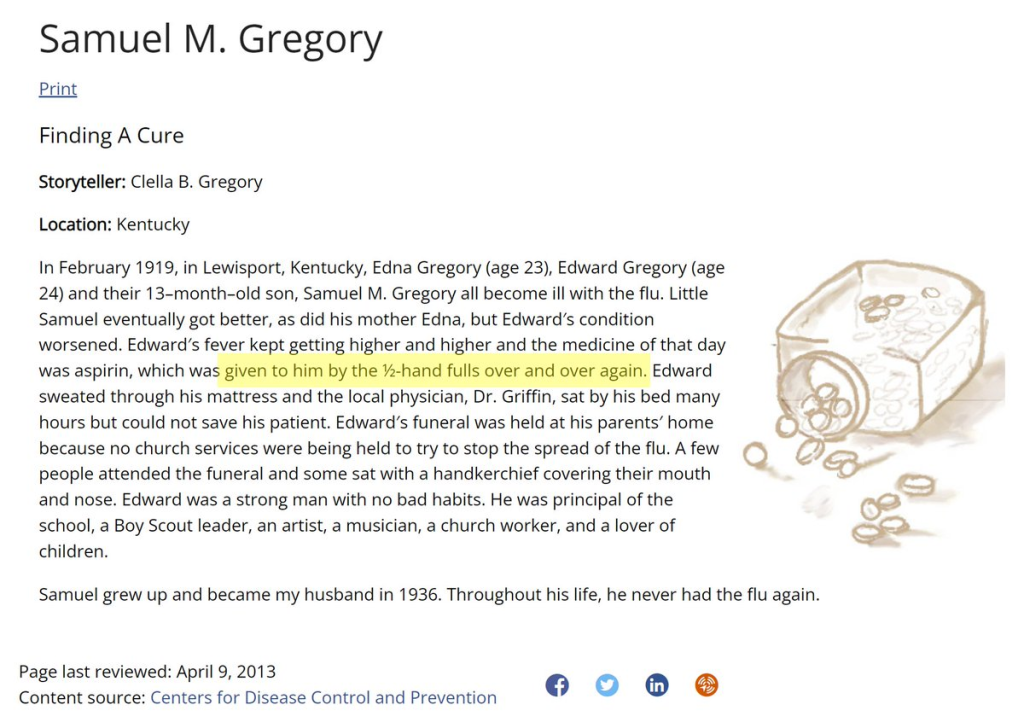
1918 was a story of iatrogenic harm (harm caused by medics). And yet it is being used to promote yet more iatrogenic harm. Do not be scared of 1918. It did not happen the way it was presented.
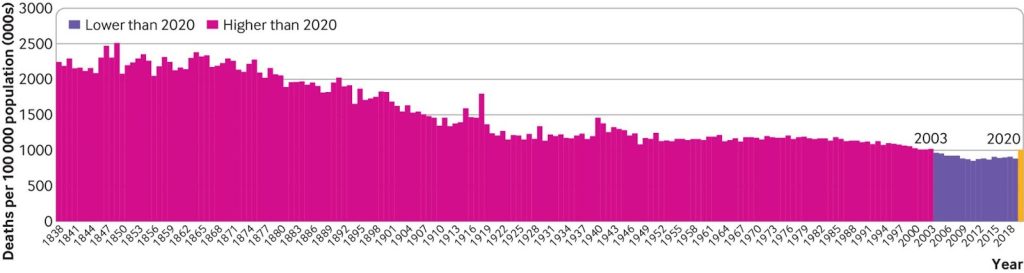
When looking at the bigger picture, 1918 does stand out as a bad year for deaths – as bad as 20 years before but better than almost every year preceding that.
The people exaggerating the claims about it all have something to gain from doing so. That’s how the deaths rose from 20 million (which assumed higher mortality in China and Japan than USA!) to 50-100 million. Stop believing them!
Featured Video

HE SAVED LIVES. NOW HE FACES PRISON.
or go to
Aletho News Archives – Video-Images
From the Archives
NATO Sanctions and the Coming Global Diesel Fuel Disaster
By F. William Engdahl – New Eastern Outlook – 11.04.2022
Amid the ongoing global inflation crisis, NATO heads of state and mainstream media repeat a mantra that high energy prices are a direct result of Putin’s actions in Ukraine since end of February. The reality is that it is the western sanctions that are responsible. Those sanctions including cutting SWIFT interbank access for key Russian banks and some of the most severe sanctions ever imposed, are hardly having an impact on the military actions in Ukraine. What many overlook is the fact that they are increasingly impacting the economies of the West, especially the EU and USA. A closer look at the state of the global supply of diesel fuel is alarming. But Western sanctions planners at the US Treasury and the EU know fully well what they are doing. And it bodes ill for the world economy.
While most of us rarely think about diesel fuel as anything other than a pollutant, in fact it is essential to the entire world economy in a way few energy sources are. The director general of Fuels Europe, part of the European Petroleum Refiners Association, stated recently, “… there is a clear link between diesel and GDP, because almost everything that goes into and out of a factory goes using diesel.” … continue
Blog Roll
 Aletho News
- Trita Parsi: Middle East Unraveling — Are We on the Path to World War?
- Iran FM meets with US envoy on UN meeting’s sidelines at American side’s insistence: Report
- Qatar PM calls for Gulf security framework with Iran, says war must be ‘wake-up call’
- China condemns US extortion of Iranian airlines, rejects Washington’s ‘illegal’ sanctions threats
- Italy to move military personnel from Taif base after missile strike
- Finland’s Stubb tells European leaders to calm down
- Defeating Russia on battlefield impossible – Fico
- Finland’s Gender Clinic Reversal
- Massachusetts Wants Mental Health Visits, Why Does Government Use ‘Health’ to Enter Our Homes & Families?
- US lawmaker admits American people footing bill for Trump’s failed aggression against Iran
- If Americans Knew
- Sanctions are collective punishment: immoral and self-defeating
- Phosphorus Munitions Fired by Israel Burn Groves, Orchards in Southern Lebanon
- Israel Carries Out New Ceasefire Violations Across Gaza
- AI – Emphasis on the ‘I’: Israel Is Funding AI Chatbot Propaganda
- Israel Blocking Hundreds of Wheelchairs for Injured Children From Entering Gaza
- Israel Is Expanding and Upgrading Compounds for Palestinian Militias in Gaza
- The Palestinian-American Residents of This West Bank Town Are Wondering: Where Is Trump?
- Gaza desperately needs tents, wheelchairs, fuel… and everything else (Israel blocks it all) – Daily Update
- Israeli Attacks in Gaza Kill at Least Seven Palestinians Over Three Days, including Woman and Child
- Trump’s militarization of Washington DC as he pursues Israel’s war against Iran
- No Tricks Zone
- New Study: Earth And Venus Surface Warmth Largely Explained By Convection And Lapse Rate, Not CO2 Or Radiation
- 2025 Nature Paper Claiming Worsening Global Drought Gets RETRACTED …Heavily Flawed
- New Study: ‘Global Drought Shows No Detectable Recent Acceleration Under Climate Warming’
- Economic Masterminds: German Socialists Suggest Taxing Productivity Gains Stemming From Using AI
- The South China Sea Has Not Been Cooperating With The Climate Change Narrative
- Energy Crisis: Germany Enters Heating Season With Historically Low Gas Reserve Fill Levels
- New Study: The Antarctic Ice Sheet Gained Mass From 2020-2024 Due To Staggering Snow And Ice Accumulation
- Study: Ocean Heating Rates From Thousands Of Years Ago ‘Dwarf’ Modern Ocean Heating Rates
- Climate Extremists Target, Attack Large-Scale Power Grid Infrastructure In Germany!
- New Study: Antarctic Ice Melt Has Contributed Less Than 1 Centimeter To Sea Level Rise In The Last 30 Years

