Data shenanigans as Sweden misleads its public over vaccination-related mortality data
Health Advisory & Recovery Team | May 29, 2022
In December 2021 Norman Fenton, Martin Neil, Clare Craig, Josh Geutzkow, Joel Smalley, Scott McLachlan and Jonathan Engler published an article casting doubt on the vaccine efficacy implied by the UK’s official mortality statistics as they related to vaccination status, raising miscategorisation of vaccinated deaths soon after injection as unvaccinated as a possible significant factor.
The authors — as expected — were unable to publish this article in any mainstream journal, as anything which counters the government’s official position on anything related to the pandemic, especially vaccinations, has effectively been suppressed or censored throughout the last 2 years.
Despite repeated FOI requests by several parties, no UK government agency has ever released sufficiently granular data broken down into the necessary categories to permit any meaningful analysis of the extent (if any) of this miscategorisation issue.
Now, however, it appears that an FOI request to the Swedish Public Health Agency by 29 doctors and scientists has been successful in obtaining such data (for Sweden). They have written an article about it (in English) here.
The data is revelatory. It essentially shows that individuals dying within 2 weeks of vaccination have been classed and counted as unvaccinated. Incredibly, this applies to the 14 day period after the second as well as the first dose. The numbers involved are certainly non-trivial. In a substack blog, Jessica Rose has re-run the implied vaccine efficacy statistics in light of the new data categorizations.
In conclusion, the correct categorization turns the vaccine efficacy calculation totally on its head, suggesting a significantly increased risk of death in the vaccinated compared to the unvaccinated, rather than the vice-versa conclusion the authorities had originally touted. Whilst there is no age-breakdown, the magnitude of the reversal in the conclusions is nonetheless stark enough to conclude that there has been very serious and likely deliberate misrepresentation of what the mortality statistics truly imply about the efficacy of the vaccines against mortality.
One wonders how many other countries have played similar tricks with their data?
Post-script:
A further – anonymous – author has published an article claiming to build on Jessica Rose’s piece by calculating the mortality rates in the vaccinated and unvaccinated and comparing them to flu.
The author acknowledges the possible effect of age-confounding in the text, but in referring to it as having only a “slight” effect this understates its potential to interfere with his analysis; to draw the conclusions he /she does would in fact require a proper age breakdown of deaths month-by-month. However, if the analysis might lead to a misinterpretation of vaccine effectiveness because of the age bias then it is up to those with access to the data by age to refute the analysis.
The main take-away from the episode around this FOI is not that the vaccines are or are not efficacious (vs death), but rather that there has been a systematic miscategorization error which (1) seems likely to have been deliberate and (2) resulted in an extremely misleading picture of what the data suggests.
Such incidents – which now appear all too common in many countries – are likely to shatter the public’s trust in the institutions upon which we are supposed to rely.
MIT Weighs In On Energy Storage
By Francis Menton | Manhattan Contrarian | May 26, 2022
As I’ve been pointing out now for a couple of years, the obvious gap in the plans of our betters for a carbon-free “net zero” energy future is the problem of massive-scale energy storage. How exactly is New York City (for example) going to provide its citizens with power for a long and dark full-week period in the winter, with calm winds, long nights, and overcast days, after everyone has been required to change over to electric heat and electric cars — and all the electricity is supposed to come from the wind and sun, which are neither blowing nor shining for these extended periods? Can someone please calculate how much energy storage will be needed to cover a worst-case solar/wind drought, what it will consist of, how long it has to last, how much it will cost, and whether it is economically feasible? Nearly all descriptions by advocates of the supposed path to “net zero” — including the ambitious plans of the states of New York and California — completely gloss over this issue and/or deal with it in a way demonstrating total incompetence and failure to comprehend the problem.
And then suddenly appeared in my inbox a couple of weeks ago a large Report with the title “The Future of Energy Storage: An Interdisciplinary MIT Study.” MIT — that’s America’s premier university for matters of science and technology. The Report is 378 pages long, full of lots of detail, charts and graphs, mathematical equations, and technical jargon. It lists as authors some 18 members of the MIT faculty. Surely, if anyone can address this “net zero” energy storage problem competently, these will be the people.
Sorry. This is a product of modern American academia. MIT is as extreme left as any of them.
Having now spent about a week trying to wade through this morass, I am not impressed. The Report is an exercise by genius would-be central planners concocting enormously complex models that just happen to come to the results that the authors are hoping for, while at the same time they avoid ever directly addressing the critical question, namely what is the plan to get through that worst case sun/wind drought. Implicit in every page of the Report is that it is an advocacy document for the proposition that the U.S. should embark full speed ahead on crash “net zero” plans for our multi-tens-of-trillions-of-dollars economy without ever doing any kind of demonstration project to show it can work on any scale no matter how small.
You start to get an idea where this is going at the very beginning, when you come on page romanette v to a list of members of an “Advisory Committee” that appears to have given direction to the project. Members include John Podesta of the Center for American Progress, someone from the Environmental Defense Fund, an “Alternative Energy Research” guy from the Bank of America, an ex-World Bank guy (the World Bank being an organization dedicated to keeping poor countries from having access to energy that works), an environmental bureaucrat from the Massachusetts state government, several people from other alternative energy investors and environmental advocacy groups, and so forth. Clearly, this Report had to come to a pre-determined conclusion that energy storage issues do not pose any major impediment to net zero ambitions.
This being a product of left-wing academia, you can expect the usual touching faith in the ability of the federal government to solve all problems, no matter how intractable, by the magic of spending money out of the infinite federal pile. Thus, early in the Executive Summary, we find a recognition that the only battery storage technology currently being deployed in large amounts in commercial applications — namely Lithium Ion — cannot provide backup for periods longer than about 12 hours:
Li-ion batteries will continue to be a leading technology for EVs and for short-duration storage, but their storage capacity costs are unlikely to fall low enough to enable widespread adoption for long-duration (> 12 hours) electricity system applications.
OK then, what is the technology that will step up for the periods of a week or two that may need to be covered in a world without fossil fuels. From page xv:
To enable economical long-duration energy storage (> 12 hours), the DOE should support research, development, and demonstration to advance alternative electrochemical storage technologies that rely on earth-abundant materials. Cost, lifetime, and manufacturing scale requirements for long-duration energy storage favor the exploration of novel electro-chemical technologies, such as redox-flow and metal-air batteries that use inexpensive charge-storage materials and battery designs that are better suited for long-duration applications. (Emphasis in original).
The feds will “support research” into “novel technologies,” of course using the infinite money pile, and the technology will magically appear. And what exactly is the technology that will then emerge to rescue us? They have no idea:
While several novel electrochemical technologies have shown promise, remaining knowledge gaps with respect to key scientific, engineering, and manufacturing challenges suggest high value for concerted government support. Innovation in these technologies is being actively pursued in other countries, notably China.
You’ve got to hate those “knowledge gaps,” but clearly all that is needed to fill them is enough federal funding. And you can’t let those Chinese beat us!
Well, how about just using that ubiquitous element hydrogen, easily available through the electrolysis of water? They discuss that too:
[H]ydrogen produced via electrolysis can serve as a low-carbon fuel for industry as well as for electricity generation during periods when VRE [variable renewable energy] generation is low. . . . We support the effort that the DOE is leading to create a national strategy that addresses hydrogen production, transportation, and storage. In particular, the ability of existing natural gas transmission pipelines to carry hydrogen without suffering embrittlement, either at reduced pressures or if hydrogen is blended with natural gas or other compounds, remains an open question that deserves government-supported study by the DOE and the U.S. Department of Transportation.
Funny that private investors aren’t putting any real money into this “hydrogen economy” thing. That’s because to get hydrogen out of water is extremely costly, and once you have it, it is inferior to natural gas in every way as a source of energy for the people. It’s less dense, more dangerous, and more difficult to transport and store. But again, throw in some of the infinite pile of federal money and it will all magically work.
Many of the charts and graphs are very complicated and technical, but if you spend some time with them, you start to realize that they are an insult to your intelligence. I’ll give you just one of my favorites, this one from page 191. Here we are considering what the electricity generation system will look like for two regions, the Northeast (New York and New England) and Texas, in various low and no-carbon scenarios. The cutoffs of 0g, 5g, 10g and No Limit at the left refer to how much carbon emissions are allowed per kWh of electricity generated.
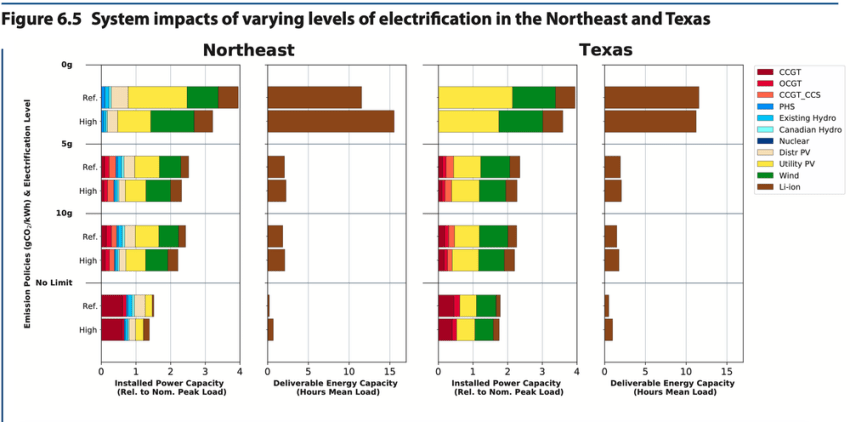
Thus at the top right we see what a zero-carbon scenario will look like for Texas. Supposedly, with about a 3 to 4 times overbuild of a system having only wind and solar generation, then we will only need battery storage for about 50% of capacity and about 11 hours duration. Really? Does anybody remember February 2021? Texas’s wind and solar generators produced at less than 10% capacity for days on end. Can a three times overbuild of wind capacity and 12 hours of battery storage solve that? The answer is no. Not even close. And you could get a wind/solar drought of a full week. If you have no fossil fuel backup, you had better have enough storage to cover that.
And if you take some time to study this chart (not saying that I would recommend that) you can find multiple other equally implausible assertions.
Bottom line: I’m not trusting anybody’s so-called “model” to prove that this gigantic energy transformation is going to work. Show me the demonstration project that actually works.
They won’t. Indeed, there is not even an attempt to put such a thing together, even as we hurtle down the road to “net zero” without any idea how it is going to work.
CDC study purporting to find substantial protective effects for school mask mandates fails to replicate
eugyppius – May 29, 2022
Last year, the CDC published a paper comparing Pediatric COVID-19 Cases in Counties With and Without School Mask Requirements. The authors looked at data from 520 United States counties, concluding that “Counties without school mask requirements experienced larger increases in … case rates … compared with counties that had school mask requirements.” Corona astrologers and face diaper fetishists everywhere have used the findings to argue for forcing healthy children who are at no risk to wear fasks masks for multiple hours each school day.
More county-level data on American infection rates and mask mandates has since become available, and two Toronto scientists have taken the opportunity to replicate the study, looking now at 1,832 counties. In a turn of events that will surprise nobody, they find that the larger dataset shows that mask mandates actually do zero, and that prior findings were almost surely an illusion.
Here are masked vs. unmasked case rates, using a smaller data pool similar to that from the CDC study:
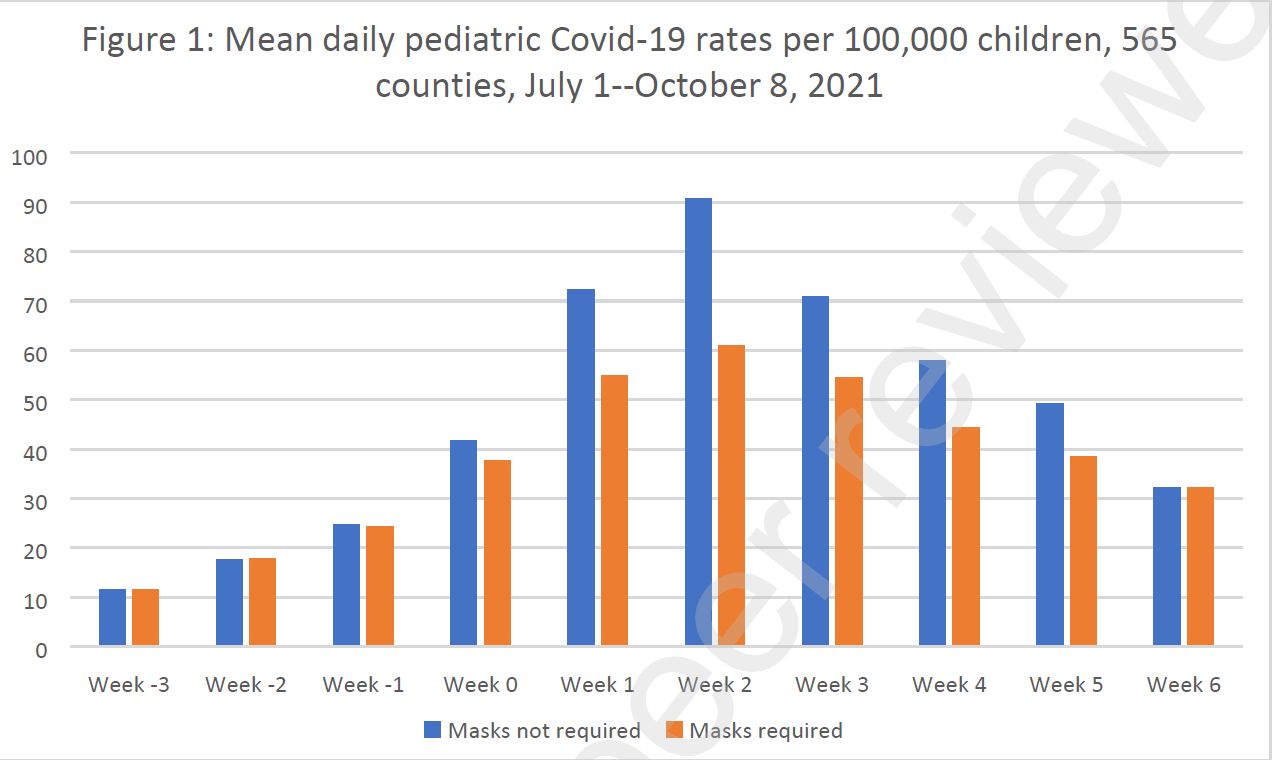
Week 0 is the week of school reopening after the summer holidays.
Yes, the maskless counties seem to do worse! Yet the Toronto authors point out that the original CDC study only considered infection rates through the second week after schools reopened, which turned out to be “exactly the peak of school case numbers for [their] sample of counties.” This obscured the fact “that cases quickly declined in later weeks and did so faster in counties without mask mandates.” Even the smaller sample used by the CDC study, in other words, showed no difference in masked vs. unmasked counties by the six-week mark.
The replication, with a much bigger dataset, meanwhile, showed that maskless counties never led infections at all:
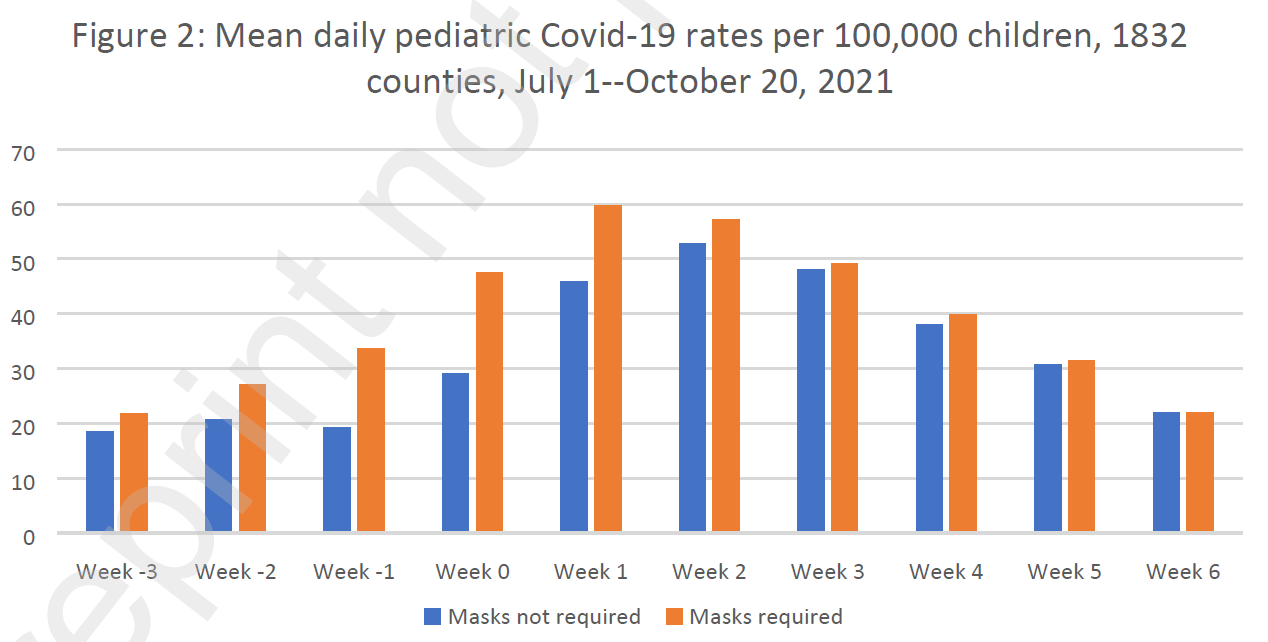
Note that, in the larger sample, the maskless start out with lower rates of infections and catch up; in the smaller sample, they started out with higher rates which collapsed more quickly.
The authors note that the CDC study, by ending their analysis on 4 September 2021, effectively excluded counties with a school-start date after 14 August, which entailed an oversampling of southern states. I’ll fill in the blanks here: Counties in the American south tend to have fewer school mask requirements, and also to experience late summer infection spikes related to high temperatures and extensive reliance on climatisation.
Although masks have become the most clearly discredited measure deployed against SARS-2 (which is saying something), they just won’t go away. Even in places that have lifted all Corona restrictions, a great many people continue to mask in public, and it seems likely that many countries – Germany among them – will retain vestigial mask requirements indefinitely, probably for years. Masking is a totally unsupported superstitious practice that does nothing against viral infection, and yet for precisely this reason, no amount of evidence will ever convince the maskers to stop.
Ex-Louvre director charged in Egyptian artifacts trafficking case
Press TV – May 28, 2022
The former president of the Louvre museum in Paris has been charged with fraud in acquisition of archaeological treasures that may have been taken out of Egypt during the Arab Spring uprisings.
Jean-Luc Martinez who ran the Paris Louvre, the most visited museum in the world, from 2013-21 was charged this week after he was taken in by police for questioning, a French judicial source told Agence France-Presse.
Martinez, who now serves as an ambassador for international cooperation in the field of heritage, stepped down as the Louvre’s president last year.
He was charged with fraud and “concealing the origin of criminally obtained works by false endorsement,” according to a French judicial source.
Martinez, who has denied any wrongdoing, is also accused of neglecting fake certificates of origin for the pieces.
The case, which threatens to embarrass the French culture ministry and ministry for foreign affairs, was opened in July 2018, two years after the Louvre Abu Dhabi bought a rare pink granite stele depicting the pharaoh Tutankhamun and four other ancient works for €8m (£6.8m).
French investigators suspect that hundreds of artifacts were pillaged during the public uprising in Middle-East that engulfed several Middle Eastern countries in the early 2010s.
These were then believed to have been sold to galleries and museums that did not ask too many questions about previous ownership, nor look closely enough at potential incoherence in the works’ certificates of origin.
Several countries are thought to have been affected by artifacts being pillaged, including Egypt, Libya, Yemen and Syria.
Another prized Egyptian work, the gilded coffin of the priest Nedjemankh, which was bought by the Metropolitan Museum of Art in New York in 2017, was at the center of a separate inquiry by New York prosecutors.
The Met, however, said it had been the victim of false statements and fake documentation, and that the coffin would be returned to Egypt.
“Deaths Have Increased Cumulatively”: BBC Producer Defends False Extreme Weather Claim
By Chris Morrison | The Daily Sceptic | May 25, 2022
Fresh insights into the techniques used by the BBC to catastrophise climate change are revealed in an exchange of letters with the producer of Justin Rowlatt’s “Wild Weather” Panorama and a former producer of Top Gear. Justifying the Rowlatt suggestion that global weather is getting warmer and more unpredictable and the death toll is rising, the programme’s producer Leo Telling said the latter figure was “cumulative”. In reply, Ken Pollock called the explanation “asinine”, and suggested Telling recognised that: “The death toll in the U.K. is cumulative. It is difficult to imagine it not increasing, if you quote cumulative figures,” he explained.
The “Wild Weather” programme, broadcast in December 2020, was an emotion-charged rant that tried to show that human-caused climate change was behind a series of recent bad weather events. It led to two internal complaints being upheld against Rowlatt. On the death toll claim, the BBC accepted that deaths from natural disasters have actually been falling for many years.
Telling then went on to argue that heatwaves will lead to excess deaths in vulnerable groups with a lower tolerance to extreme temperatures. In addition, he stated that the heatwaves will lead to avoidable deaths through wildfires.
“How can you write with a straight face that heatwaves will kill more and more people,” replied Pollock, “without also accepting that cold kills 10 times as many people every year and extra heat may save far more people?”
How do you reconcile the fact that Singapore and Helsinki have average temperatures differing by 22°C, and yet you accept that a further 1°C could spell disaster, he went on to ask.
Pollock then wondered what the Panorama producer really meant by the suggestion that avoidable wildfire deaths would increase. “You surely know that most of the Australian wildfires and those in the West of the USA were started by arson. Surely you know that the recent wildfires were nowhere near as bad as those in the West of the USA in the 30s and 40s and in Australia in the 80s, when I filmed them for the BBC, and in earlier decades,” he wrote.
In Pollock’s view, much of what Telling produced was drawn from the World Health Organisation and “highly questionable” IPCC predictions. One might expect you to challenge some of them, or at least refer to the source and the speculative nature of the predictions, he contended. Pollock concluded by noting that in his 22 years as a BBC producer, he became alarmed at the inadequate use of statistics by the Corporation in current affairs and elsewhere: “Many BBC people repeated statistics without understanding them”.
On the BBC climate desk, repeating, seemingly without question, the catastrophe claims from third party sources is a normal method of operation. In February 2019, the BBC environment analyst Roger Harrabin reported the view of Left wing think tank IPPR that “human impacts had reached a critical stage and threaten to destabilise society and the global economy”. No attempt was made to examine these extravagant opinions. It later transpired that the report, which contained numerous false extreme weather claims, was part written by a young woman whose previous employment had been working as a volunteer for an Edinburgh ‘equality’ charity. Meanwhile, Matt McGrath, the first winner of the BBVA Foundation €100,000 award for climate journalism, wrote an article in July 2019 titled “Climate change: 12 years to save the planet? Make that 18 months”. Accepting his award from BBVA, a Spanish bank with large green investments, McGrath defended the primacy of specialist journalism “that draws on sound scientific sources” in an era of fake news.
Barely a week goes by without the Net Zero-inspired fantasies of climate Armageddon being publicised from the work of academics, think tanks, meteorological operations like the Met Office and the IPCC. This latter body, heavily dependent on climate models and their to-date wildly inaccurate forecasts, is held in particularly high esteem. Writing in July last year, Harrabin looked forward to a new edition by stating, “computing will underpin the new climate science ‘Bible’ from the Intergovernmental Panel On Climate Change (IPCC) next month”.
It might be suggested that an editorial emergency is awaiting the BBC in the near future. Most of its climate reporting seems to be little more than repeating bad (“extreme”) weather events, and claiming the climate is, somehow, breaking down. In reality, global warming has run out of steam with pauses and dips common in the record over the last two decades. The accurate temperature news from satellites is largely ignored, and there is little appetite for investigating how the major global surface datasets have quietly adjusted their records to add an extra 30% of heating over the last 20 years. Most of the bad weather claims are easily debunked, and are unlikely to be so well tolerated by the wider public if Net Zero leads to substantial reductions in personal freedoms, income and diet.
Writing an excoriating report on the “Wild Weather” programme, Ross Clark noted recently in the Daily Mail that there was a time when the BBC was committed to presenting both sides of the argument. He noted a 2018 instruction sent by the former BBC director of news and current affairs Fran Unsworth, demanding that “interviewees who were sceptical about man-made climate change were no longer to be invited regularly”. He concluded: “Unsworth’s instructions had clearly become the status quo.”
Last September, Insulate Britain activist Zoe Cohen told the BBC that climate change would lead to “the loss of all we cherish, our society, our way of life, law and order”. Ross noted that it was a hysterical claim that had no foundation in science, yet she remained unchallenged. Some at the BBC, he went on to suggest, were losing patience with their climate editor. “The Justin Rowlatt stuff is grim,” an unnamed BBC source is reported to have told another newspaper. “These are not mistakes; he’s a campaigner.”
Matt McGrath is another who might care to look into some of the sources that feed his doomsday copy. Around the time of receiving his BBVA present, he published a story claiming that over 11,000 scientists were predicting “untold suffering” from the forthcoming climate emergency. Among those signatories promoting a “clear and unequivocal emergency” were Professor Mickey Mouse and Hogwarts headmaster Albus Dumbledore.
The perfect BBC climate breakdown story. Making it up, in a world of make believe.
Is the pandemic treaty a step towards World Government?
By Dr Deborah Ancell | TCW Defending Freedom | May 25, 2022
Dear Prime Minister,
It’s the Davos World Economic Forum (WEF) season and conspiracies about World Government abound. I have a new one for you.
You might recall my letter concerning the opaqueness of the first international tax, the United Nations Carbon Offsetting Reduction Scheme for International Aviation (CORSIA)
CORSIA offsets aircraft carbon dioxide emissions and it’s hidden in the environmental provisions of the UN’s International Civil Aviation Organisation. CORSIA empowered the UN to raise taxes – something which appears to have escaped notice in signatory sovereign nations.
My concerns were that firstly, CO2 is not a pollutant and secondly, CORSIA is a Trojan horse for similar UN taxes on other industries such as shipping and information technology.
Taxation is the tool of national governments. When nations surrender tax powers to an international body, they undermine their sovereignty. CORSIA enables independent, non-political, commercial funding of UN development projects in developing nations and reduces their reliance on UN member-government funding.
CORSIA also provides developing world reparations, since it offsets (unevidenced) claims that underdevelopment results from historical emissions incurred during developed world industrialisation. As the first international tax, it’s an example of UN overreach which undermines national sovereignty.
Now another UN arm – the World Health Organisation – might also be attempting overreach. WHO is proposing a new ‘pandemic treaty’ to encourage more information-sharing in the event of another global health crisis.
The treaty would apparently give WHO ‘unprecedented, undemocratic jurisdiction over its 194 member nations, including the UK’. There would be almost unlimited authority to ‘order mandatory vaccines, digital health IDs, lockdowns, isolation, testing regimes, no-jab-no-job rules, or anything else it decided as policy, irrespective of dissenting voices’.
The treaty will not be voted on until the World Health Assembly in 2023. If the UK agreed to this, health sovereignty could also be undermined.
Combine these two sovereignty concessions and you have the beginnings of an independently-funded and legislating World Government. This prospect was promoted by now-deceased luminaries as diverse as discredited socialist millionaire Maurice Strong and capitalist banker David Rockefeller.
Strong, a promoter of CO2 as a cause of environmental harm, profoundly believed that the UN had the potential to be the World Government. Any such World Government would undermine democracies.
Similarly, Rockefeller founded and led the Trilateral Commission with its aim of a ‘New World Order’ to control population and resources. He is reported as stating that ‘the supranational sovereignty of an intellectual elite and world bankers is surely preferable to the national auto-determination (democracy) practised in past centuries.’ Scary!
Conspiracy theorists believe that today’s WEF, with its agenda to counter natural and anthropogenic climate change and its call for a Great (economic) Reset has a similar, shadowy agenda to these precursor pursuits.
As conspiracy theories go, this one is far-fetched – but can you assure me I’m wrong? Do you think that World Government is on the agenda at Davos today?
Yours sincerely,
Deborah Ancell
What it means that Hillary Clinton did it
By David Zukerman | American Thinker | May 22, 2022
The Wall Street Journal ran a scathing editorial on May 20, called “Hillary Clinton Did It“.
This editorial began: “The Russia-Trump collusion narrative of 2016 was a dirty trick for the ages — and now we know it came from the top — candidate Hillary Rodham Clinton.” The editorial quickly explained: “That was the testimony Friday by 2016 Clinton campaign manager Robby Mook in federal court [in Washington, D.C.], and while this news is hardly a surprise, it’s still bracing to find her fingertips on the political weapon.” (Also not surprisingly, The May 20 print edition of The New York Times did not include a story on Mook’s testimony.)
Mook’s testimony was heard at the trial of attorney Michael Sussman, charged with lying to the FBI in calling to their attention a story that Donald J. Trump, by means of connections with Russia’s Alfa Bank, was colluding with Russian President Vladimir Putin.
The lie at issue was not the false claim about a Trump-Alfa connection, but the charge that Sussman brought this matter to the FBI as a good citizen, and not as a representative of the Clinton campaign.
As the Journal editorial noted: “Prosecutors say [Sussman] was working for the Clinton campaign.” The editorial pointed out, “Mr. Mook said Mrs. Clinton was asked about the plan [to call attention to the Trump-Alfa ties] and approved it. A story on the Trump-Alfa Bank allegations thus appeared in Slate, a left-leaning online publication.”
After that, the Journal explained how the Clinton campaign used the self-generated news of the investigation and the initial Slate article that came of it, both of which they had planted, as the basis for making tweet after tweet to the press about the Slate report to churn up mass coverage about it in the press and convince the public that the investigation was about something serious.
The concluding paragraphs of the editorial are worth quoting in full:
In short, the Clinton campaign created the Trump-Alfa allegation, fed it to a credulous press that failed to confirm the allegations but ran with them anyway, then promoted the story as if it was legitimate news. The campaign also delivered the claims to the FBI, giving journalists another excuse to portray the accusations as serious and perhaps true.
Most of the press will ignore this news, but the Russia-Trump narrative that Mrs. Clinton sanctioned did enormous harm to the country. It disgraced the FBI, humiliated the press, and sent the country on a three-year investigation to nowhere. Vladimir Putin never came close to doing as much disinformation damage.
The harm done to the United States by the perfidy of the Clintonistas cannot be overemphasized. That “three-year investigation to nowhere” represented the Clinton-Obama attempted takeover of the government. (Call it the COAT campaign.) With congressional Republicans unwilling to prevent the COAT campaign, the Trump administration was blocked from putting U.S.-Russia relations on a rational, mutually beneficial footing, to the point that, under the present Senate leadership, the specter of war with Russia is no longer an unthinkable thought. The COAT campaign succeeded in keeping the Ukraine pot boiling, with the water first heated by Obama’s stirring up of anti-Russian feelings in Ukraine, leading to the Maidan revolution that ousted the legitimately elected president of Ukraine, Viktor Yanukovych.
Biden Says Record-High Gas Prices Part of ‘Incredible Transition’ US Going Through
Samizdat | May 24, 2022
Following the beginning of Russia’s special military operation in Ukraine on 24 February, the US and several of its allies cut off all imports of Russian oil and gas, which added greatly to soaring gas prices for Americans.
President Joe Biden has argued that the current record-high gas prices in his country are part of America’s major transition from fossil fuels.
“Here’s the situation. And when it comes to gas prices, we’re going through an incredible transition that is taking place that, God willing, when it’s over, we’ll be stronger and the world will be stronger and less reliant on fossil fuels when this is over,” he said during a joint press conference with Japan’s Prime Minister Fumio Kishida on Monday.
POTUS then insisted that his administration’s actions helped “keep it [the gas prices] from getting worse — and it’s bad”.
“The price of gas at the pump is something that I told you — you heard me say before — it would be a matter of great discussion at my kitchen table when I was a kid growing up,” Biden said before admitting, “It’s affecting a lot of families.”
House Republican Steve Scalise was quick to respond by telling reporters that Biden is “saying the quiet part out loud now.” In an apparent nod to the Biden administration, Scalise added that “they’re causing you pain at the pump because it’s all part of their radical agenda.”
He spoke as the national average for a gallon of regular gas in the US stood at $4.56 as of Monday, which is more than $0.40 higher than it was just a month ago.
In some US states such as California, the average price for a gallon of regular gas has meanwhile already reached $6.06.
While Biden previously tried to cast the price increases as the fault of Russian President Vladimir Putin, labelling high gas prices “Putin’s price hike”, the recent polls show that Americans aren’t buying it.
A survey conducted by conservative pollster Rasmussen found that beliefs about the importance of rising gas prices were essentially unchanged since November 2021, but that a majority (51%) of American voters surveyed held POTUS responsible for higher fuel prices. Another 26% blamed oil companies for the price hike, while just 15% blamed Putin.
The NHS just edited their Monkeypox page… to make it scarier
OffGuardian | May 24, 2022
Afew days ago the UK’s National Health Service (NHS) edited their Monkeypox page to alter the narrative in a few key ways.
Firstly, they removed a paragraph from the “How do you get Monkeypox?” section.
Up until a few days ago, according to archived links, the Monkeypox page said this, regarding person-to-person tranmission [emphasis added]:
It’s very uncommon to get monkeypox from a person with the infection because it does not spread easily between people.
… this has now been totally removed.
Secondly, they’ve removed this paragraph, which was present up until at least November of 2021 (and maybe much more recently, there are no archives between November and May) [emphasis added]:
[Monkeypox] is usually a mild illness that will get better on its own without treatment. Some people can develop more serious symptoms, so patients with monkeypox in the UK are cared for in specialist hospitals.
The new “treatment” paragraph reads [again, emphasis added]…
Treatment for monkeypox aims to relieve symptoms. The illness is usually mild and most people recover in 2 to 4 weeks […] You may need to stay in a specialist hospital, so your symptoms can be treated and to prevent the infection spreading to other people.
So, they remove that it will “get better on its own”, and again reinforce the idea of spreading the disease despite this being described as “very uncommon” as recently as last week.
They even add a line about self-isolating, which was never mentioned before:
as monkeypox can spread if there is close contact, you will need to be isolated if you’re diagnosed with it.
Finally, they now include a warning you can get Monkeypox by eating undercooked meat, which will doubtless feed into the anti-meat narrative too (oh, wait, it already is).
To sum up, history is being re-written a little here.
Before, monkeypox “did not spread easily between people”. Now it does.
Before, monkeypox would “get better on its own without treatment”. Now it won’t.
It’s early days to say that Monkeypox is going to be the “new Covid”, and maybe this rollout will stall and be forgotten in a couple of weeks, but there’s no doubt they are taking some tips from the Covid playbook so far.
Concerns of Fraud in Pfizer Vaccine Trial as Participant’s Hospitalisation with Heart Inflammation is Swept Under Carpet
By Will Jones | The Daily Sceptic | May 23, 2022
You may have heard the disturbing story of Maddie de Garay, who in July 2020, aged 12, participated in Pfizer’s Covid vaccine trial of adolescents aged 12-15. Within 24 hours of receiving the second dose in early January 2021, Maddie experienced “zapping pain up and down her spine with severe abdominal pain… her toes and fingers turned white and were ice cold”. She now can barely see, suffers from tinnitus, mobility issues, vomiting, blood in her urine, numbness in her body and has at least 10-20 seizures a day. Yet her injury was recorded in the vaccine trial data as “abdominal pain” and it was asserted without investigation to be not related to the vaccine.
Another case, similarly disturbing, has now emerged of an adverse reaction during a Pfizer trial that was not recorded in the trial data, raising concerns about the integrity of the trial data and the possibility of fraud.
Augusto Roux is a 35-year old lawyer from Buenos Aires, Argentina who volunteered for Pfizer’s Covid vaccine phase 3 trial. He did so to protect his mother, who has emphysema.
On the way home after his second dose on September 9th 2020, he began feeling unwell, developed a high fever and felt very ill. He fainted on September 11th and went to the hospital on September 12th. The hospital ran tests, including a CAT scan of his chest, which showed an abnormal collection of fluid around the outside of the heart, indicating pericarditis (a form of heart inflammation).
On September 14th he was discharged, with the doctor writing in his discharge note that he had suffered an adverse reaction to the vaccine. Augusto was also told by hospital staff that there had been a considerable number of people from the clinical trial coming to the hospital – one nurse estimated staff had seen around 300 people – so his experience was not new to them. Around 3,000 trial participants had been enrolled before Augusto, so, if the nurse’s estimate is accurate, this would be a hospitalisation rate of 10%.
Following his adverse reaction, Augusto asked to see his trial clinical records, but those running the trial refused. Being a lawyer, Augusto went to law to get access to his records, which took over a year. Once he saw them, he could well imagine why someone might not want them to be released.
In hospital, Augusto had tested negative for Covid, and the doctor at the hospital had written that his condition was due to the vaccine. However, when Augusto contacted the trial site on September 14th to notify the investigators he had been in hospital, they wrote down in his clinical trial record that he had been admitted for a “bilateral pneumonia” that had nothing to do with the “investigational product” – the vaccine – even though that was not what he told them or what the doctor who examined him had stated.
For obvious reasons, Augusto was keen to know whether he’d had the vaccine or not. However, the principal investigator for the trial, Fernando Polack (pictured below), had inaccurately claimed that he could only be unblinded if his life were in danger. Augusto appealed to ANMAT, the Argentinian equivalent of the FDA, and following a formal hearing on October 9th 2020 it forced the trial investigators to tell Augusto that he had, indeed, received the vaccine.
The clinical trial notes reveal that two days prior to this hearing, on October 7th, “at the request of the sponsor” (Pfizer), the adverse event code was updated from pneumonia to “COVID-19 disease”. This is despite Augusto testing negative at the time of his admission. (Conveniently for Pfizer, the COVID-19 ‘diagnosis’ would not be included in the trial vaccine efficacy calculations due to the negative test.)

Even more disturbing, on October 8th, Polack wrote in Augusto’s clinical trial records that he had had an attack of “severe anxiety” starting on September 23rd (not caused by the vaccine, naturally). Polack added that Augusto suspected a conspiracy between the two hospitals, described his anxiety as “constitutional”, and noted that it was ongoing, evidenced by his pursuing his appeal to ANMAT. On October 11th, Polack had this mental health diagnosis added to his actual medical records.
Dr. David Healy, who has interviewed Augusto and seen the medical records in question, comments that “there is nothing in any record that indicates that Dr. Polack or any other doctor attempted on September 23rd to establish whether Augusto had a mental disorder”. He adds:
Augusto points to the notes of October 8th and 11th as evidence that this idea was invented just around the time the ANMAT hearing was about to happen. He states that it is in breach of Argentinian law for Dr. Polack to have diagnosed someone with a medical condition that the person does not have – and to have entered it into his medical record.
Note that Polack is a paediatrician so lacks the qualification to make mental health diagnoses, especially without any formal assessment.
Polack is a key player in the Pfizer Covid vaccine trials. He was the lead author on the December 2020 NEJM paper on the safety and efficacy of the vaccine. Israeli academic Josh Guetzkow notes that he is also one of the directors of i-trials, the site management organisation “paid handsomely by Pfizer to run the trial in Argentina (the largest site of the trial by far)”. Guetzkow adds:
If he raised an alarm about the vaccine safety, his company would have lost a ton of money and would be an unlikely choice by any company to run any trials in the future. So to say that he had an interest in achieving a positive trial outcome would be quite an understatement. There may be other conflicts we’re not aware of.
The evidence of malpractice and possible fraud in the Pfizer Covid vaccine trials is certainly stacking up now. But very few people are aware of it as it is mostly only being reported in alternative media. When will mainstream outlets start following up properly on this potentially massive story?
Featured Video

Death Spikes & Rising Cancer In Our Youth Explained
or go to
Aletho News Archives – Video-Images
From the Archives
Politicians lie
By Mazin Qumsiyeh | Popular Resistance | August 18, 2013
There is no way to say this truth nicely: Politicians lie. That includes Japanese, American, Egyptian, Israeli, and Palestinian politicians! Is there something more common sense than that? Yet, so many citizens around the world believe their own politicians or wistfully acknowledge lies but think it is part of the job needed to run things. They believe even when politicians contradict themselves blatantly. This phenomenon is rather remarkable. It is a dissonance and disconnect from reality that many seem oblivious to. It is very dangerous because it can lead to accepting rationales for going to war. These can be deadly wars that lead to millions of lives lost as happened in what was called World War 1 and WW2. Even when incredible and declassified evidence abound, politicians continue to lie and old mythologies refuse to die. Here are just a few of the countless lies told to us over the past few decades… continue
Blog Roll
 Aletho News
- Iran flights continue despite US aviation sanctions
- Global Tipping Points Lead the World Into a State of Entropy
- The day-after at the White House: USA and Xi Jinping
- The Geopolitical Balance in the Red Sea: The UAE Being Displaced by New Players
- Iraqi resistance group vows to stage airport sit-ins over Iran aerial blockade
- Turkish parliament to review Saudi-Pakistan defense pact next month
- DEATH SPIKES & RISING CANCER IN OUR YOUTH EXPLAINED
- Iran offers Trump deal before US election
- Merz regime wants ‘secret police’ – opposition
- Israeli settlers terrorize West Bank Palestinians with state-provided drones: Report
- If Americans Knew
- Deconstructing Netanyahu’s pants-on-fire UN rant – Daily Update
- Trump betrayed voters with his campaign lies and prioritized a foreign country once he took office
- Netanyahu calls Israel’s war in Gaza ‘opposite of genocide’ in UN speech to near-empty hall
- Settler Kidnappings: Torture, Sexual Abuse and Terrorisation of Palestinian Abductees as Israel Deepens Annexation of West Bank
- Gaza winter nears as 162,000 tents become unusable, raising fears of humanitarian crisis
- Netanyahu says, “It’s the opposite of genocide”; UN says Gaza economy is world’s ‘most severe crisis on record’ – Daily Update
- Israel’s US-Backed Assault on Gaza Has Created the ‘World’s Most Severe Economic Crisis on Record’: UN
- ‘Protecting U.S. Citizens’… From Israel
- ‘This is where I live now, the back of a truck’: a day in the life of a grandmother in Gaza
- In UN Speech, Iran’s President Displays Pictures of Children Killed by US, Brings Attention to Israel’s Nuclear Arsenal
- No Tricks Zone
- New Study: Earth And Venus Surface Warmth Largely Explained By Convection And Lapse Rate, Not CO2 Or Radiation
- 2025 Nature Paper Claiming Worsening Global Drought Gets RETRACTED …Heavily Flawed
- New Study: ‘Global Drought Shows No Detectable Recent Acceleration Under Climate Warming’
- Economic Masterminds: German Socialists Suggest Taxing Productivity Gains Stemming From Using AI
- The South China Sea Has Not Been Cooperating With The Climate Change Narrative
- Energy Crisis: Germany Enters Heating Season With Historically Low Gas Reserve Fill Levels
- New Study: The Antarctic Ice Sheet Gained Mass From 2020-2024 Due To Staggering Snow And Ice Accumulation
- Study: Ocean Heating Rates From Thousands Of Years Ago ‘Dwarf’ Modern Ocean Heating Rates
- Climate Extremists Target, Attack Large-Scale Power Grid Infrastructure In Germany!
- New Study: Antarctic Ice Melt Has Contributed Less Than 1 Centimeter To Sea Level Rise In The Last 30 Years

