Increased energy prices could “cause heart attacks and strokes”
In the middle of the cost of living crisis, the press has found yet another reason people might keel over… and it’s still not the vaccine.
By Kit Knightly | OffGuardian | February 5, 2022
Our UK readers will be familiar with the press coverage of the cost of living crisis in this country, as wages continue to fall further and further behind inflation, and the economy reels from the deliberately devastating lockdown, the cost of everything from food to fuel is ever increasing.
People are understandably troubled and anxious, whether or not the energy cost crisis is genuine or manufactured for the sake of profits, the reality is that many people will face the choice of heating their homes or eating enough food over the last two months of winter and into the spring.
This could easily result in people – especially the elderly or disabled – suffering health problems or even death due to the cold or malnutrition. Many of these people will likely become “covid cases” or “covid deaths” once they’re subjected to the totally unreliable tests.
It’s all a perfect little circuit. And it serves the Covid agenda in more ways than one, because it’s just handed the press yet another explanation for heart attacks that haven’t happened yet.
It seems like only a few days ago we ran an article pointing out all the numerous different reasons the press are predicting people will have heart attacks this year… and that’s because it was.
Stress, anxiety, the weather, “long covid” and a plague of undiagnosed aortic stenosis are all predicted to cause thousands upon thousands of heart attacks and strokes in the near future.
And now so is the increased cost of living.
Appearing on Lorraine on ITV yesterday morning, Dr Amir Khan claimed:
… if you can’t afford to heat your home, it actually causes an increased risk of developing heart attacks and strokes because your blood vessels contract to conserve heat, which pushes your blood pressure up, and over time that has an impact on your heart attack risk.”
In future, maybe they should simply run press releases saying “Covid vaccine only thing in world which doesn’t cause a heart attack”
As Neil Oliver pointed out on Twitter…
MSNBC Misinfo: Zeke Emanuel Peddles Fear, Says Unvaxxed Children ‘Likely To Get Serious Case Of Covid’

By Tyler Durden | Zero Hedge | February 5, 2022
Dr Ezekiel Emanuel – former Biden Covid-19 adviser and brother of former Chicago Mayor Rahm Emanuel (and the real ‘Ari Gold’ from Entourage) appeared on MSNBC Wednesday, where he proceeded to peddle the lie that unvaccinated children are ‘likely’ to get a ‘serious’ case of Covid.
“This repeats what we’ve seen in older kids, five and above, where we know the vaccine does protect very well. And there we still have under 50%, I believe, of the children vaccinated, and that’s a serious problem for the country,” Emanuel told host Kristen Welker after she asked about parents’ willingness to vaccinate their children. “Parents have to be more willing – I think they hear some of these rare side effects and think they’re very common.”
“With the omicron variant, kids are either going to get the vaccine or they’re likely to get a serious condition of omicron. Having omicron with the vaccine is almost invariably going to be better and safer for children,” Emanuel added. “I am confused about parents’ attitudes. Five and above seems like a no-brainer. Two to five, I understand some hesitancy. Two and under with the small dose, I think probably a very good idea.”
It’s been widely established that Omicron is a relatively mild strain of Covid – from which children face an extremely low risk.
Another recent study cited by economist Emily Oster also reiterated the extremely low risk young children face of severe COVID-19 outcomes. “What we can say is that based on everything we know, the risks to small children from COVID-19 are extremely small,” she wrote. –Fox News
MSNBC faced harsh criticism over Emanuel’s statement.
The network even tweeted (and then deleted) the easily debunked misinformation, receiving a serious ratio of comments to ‘likes.’
Intentional? Or…
Following the backlash, Emanuel issued a Saturday tweet in which he says he “misspoke.”
US State Department alleges Moscow prepared ‘crisis actor’ video to invade Ukraine, refuses to offer evidence
RT | February 3, 2022
The US has accused Russia of creating a propaganda video featuring crisis actors, staged fake explosions, and NATO military equipment such as Turkish drones, as a pretext for invading Ukraine in the coming days.
The claim was first published on Thursday morning by the Washington Post, which cited an unnamed US official quoting US intelligence assessments. It was then picked up by CNN and other outlets. On Thursday afternoon, State Department spokesman Ned Price said the government “made public” that intelligence, and echoed the description of the alleged video featured in the Post and CNN stories.
The video is “entirely fabricated by Russian intelligence” and is “one of a number of options the Russian government is developing as a fake pretext to initiate and potentially justify military aggression against Ukraine,” Price claimed. He added that the US is making the claim public as a way to deter Russia from its “destructive and destabilizing disinformation campaign” against Ukraine.
Pressed to show any evidence for the claim, Price said his own statement constituted evidence, and that it was “derived from information known to the US government, intelligence information that we have declassified.”
“If you doubt the credibility of the US government, of the British government, of other governments, and want to find solace in the information the Russians are putting out, that is for you to do,” Price told AP’s diplomatic correspondent Matt Lee, dismissing his line of questioning.
“Russia never does such things,” Moscow’s ambassador to the EU, Vladimir Chizhov, told RIA Novosti on Thursday, when asked about the new US allegations.
As proof of alleged Russian ‘actions’ in Ukraine, the State Department spokesman quoted the allegation anonymous US officials made to CNN in mid-January, claiming that Russia had sent a “group of operatives” trained in urban warfare to attack “Russia’s own proxy forces” in the two disputed regions of eastern Ukraine, in order to create a pretext for an “invasion.”
Moscow dismissed these claims as “unsubstantiated” hearsay. Several days later, leaders of the Donetsk militia told reporters it was British-trained Ukrainian saboteurs that were planning attacks they would then attribute to Russia as ‘false flags’.
Former Pfizer VP Michael Yeadon demands apology from media over ‘lies’ asserting vaccine safety

Dr Michael Yeadon, former Pfizer vice president and co-founder of Doctors for COVID-19 Ethics
By Patrick Delaney | LifeSiteNews | February 2, 2022
After being excoriated by mainstream media outlets regarding his concern that COVID-19 gene-based vaccines could cause fertility issues in young women, Dr. Michael Yeadon is now requesting contrition on the part of media outlets as leaked data from the U.S. military indicates heavy spikes in these tragic outcomes.
“I’m not vindictive, but I want some humility and contrition from the BBC and all other media outlets that lied to their audiences,” said the former Pfizer vice president and Chief Scientist for allergy and respiratory.
Yeadon, who spent 32 years in the industry leading new medicines research and retired from the pharmaceutical giant with the most senior research position in his field, was an author of a submitted petition to the European Medicines Agency (EMA) in December 2020 that raised substantial concerns regarding a lack of sufficient testing of the experimental COVID-19 gene-based vaccines, prior to their emergency use authorizations.
With regard to the possibility of the shots endangering the fertility of women, Yeadon and his colleague, Dr. Wolfgang Wodarg, wrote, “There is no indication whether antibodies against spike proteins of SARS viruses would also act like anti-Syncytin-1 antibodies. However, if this were to be the case this would then also prevent the formation of a placenta which would result in vaccinated women essentially becoming infertile.”
Such a possibility would need to be ruled out through standard experimentation prior to imposing such substances onto the entire population, according to the doctors.
“It’s important to note that none of these gene-based agents had completed what’s called ‘reproductive toxicology,’” Yeadon wrote in his recent statement. “Over a year later, this battery of tests in animals still has not been done. So there was and still is no data package supporting safety in pregnancy or prior to conception.”
Media response to valid concerns: attacks, smears, vilifications
“As a society, we’ve practiced the precautionary principle most assiduously in relation to conception and pregnancy ever since the tragedy of thalidomide, over 60 years ago. So we had hoped that some at least in the media would take this [concern] with the seriousness it deserved,” he wrote.
“Did that happen? No. Instead, we were attacked, smeared and vilified in every medium, from Twitter to the BBC,” the British national wrote. “[M]ajor broadcasters actively lied to the public, explicitly stating that these agents were completely safe in pregnancy.”
Indeed, Reuters excoriated the doctors for making their inquiry “without providing evidence, that the vaccines could cause infertility in women,” shifting the burden of proof onto the petitioners from the regulators whose job it is to ensure proper safety trials are completed before the release of such drugs.
The article quoted an anonymous spokesman for Britain’s Department of Health & Social Care, saying, “These claims are false, dangerous and deeply irresponsible.”
Reuters later attempted to “fact-check” Yeadon as well over several concerns including the danger to fertility, to which he simply reiterated common ethical principles with regard to human experimentation: “No one in their right mind thinks giving experimental treatments to pregnant women is other than reckless. Especially when reproductive toxicity testing is incomplete.”
Of special note for Yeadon was BBC Radio talk show hostess Emma Barnett, who “directly attacked me by name on air in the most unpleasant terms,” which also led to his charging the program with slander. In response, after a bit of investigation, the program editor conceded, apologized to Yeadon, and cut their false representation of the former Pfizer scientist from their recorded podcast.
“[Barnett] also had her guest, who was from the Royal College of Obstetrics and Gynecology, repeat the lies that it was perfectly safe for young women to be injected,” Yeadon called out in his statement.
Preprint paper reveals placental-damaging antibodies increased 2.5 fold after shots
Also of note for the former executive was a preprint study published last May that appeared to attempt a rebuttal of his concern that anti-Syncytin-1 antibodies could be developed due to the shots, but instead reinforced them showing a 2.5 fold increase of the placental-damaging antibodies in days 1 to 4 after COVID-19 gene-therapy injections.
The paper, which claimed a conflict of interest in being funded by Johnson & Johnson, went on to explain that though they had observed this major increase, they did not examine its “clinical significance,” thus admitting they didn’t know if these higher levels of the antibody flagged an actual safety problem with regards to fertility and miscarriage.
At the same time, the study’s authors acknowledged data showing “spontaneous miscarriage as the most common obstetric outcome after COVID-19 mRNA vaccination.”
Based on the outcome of this study alone, Yeadon said “all of these experimental products as a class should have been completely contraindicated in women younger than menopause.”
Pfizer & Moderna ‘definitely knew’ these mRNA products would ‘accumulate in the ovaries’
An additional source of concern regarding fertility was that “the mRNA products (Pfizer and Moderna) would accumulate in ovaries,” the British national explained.
“An FOI request to the Japanese Medicines Agency revealed that product accumulation in ovaries occurred in experiments in rodents. I searched the literature based on these specific concerns and found a 2012 review [here], explicitly drawing attention to the evidence that the lipid nanoparticle formulations as a class do, in fact, accumulate in ovaries and may represent an unappreciated reproductive risk to humans. This was ‘a well-known problem’ to experts in that field,” Yeadon explained.
“I’ll say that again. The pharmaceutical industry definitely knew, in 2012, that formulating these agents in lipid nanoparticles would lead them to accumulate in the ovaries of women to whom these were given.
“No one in the industry or in leading media could claim ‘they didn’t know about these risks to successful pregnancy,’” he emphasized.
Results from the U.S. military leak confirm damage done to unborn children and fertility
“So it’s with tremendous anger and sorrow that I heard of military physicians blowing the whistle about the evidence of harms in pregnancy that their proprietary safety monitoring database had thrown out,” Yeadon said, referring to last week’s revelations during a U.S. Senate panel discussion.
“In the intervening months since journalists (including but definitely not limited to Emma Barnett) chose to downplay or downright lie about our concerns, we learned that women in the U.S. military were experiencing 3X normal rates of miscarriage,” he explained.
In fact, these data leaks, given by three “decorated high-ranking soldiers who are doctors and public health officials,” in sworn declarations under penalty of perjury, show several increases in negative impacts upon fertility, including spontaneous abortion, among this military population where enforcement of an experimental COVID gene-vaccine mandate is strictly observed.
As presented by these soldiers, the following 2021 increases only include the first 10 months of the year (January through October) and are compared with the full five-year average of figures taken from 2016 through 2020.
- Miscarriages — increase of 279%
- Female infertility – increase of 471%
- Male infertility — increase of 344%
- Congenital malformations (birth defects) – increase of 156%
And considering most children conceived after these injections had not been born before November 2021, the final figure of birth defects is likely to significantly increase as well.
Journalists, regulators and manufacturers: ‘You are way out over thin ice and deep water’
After Yeadon’s request for contrition from the BBC and other media outlets, he went on to implore readers, “please do not get injected with these inherently dangerous and ineffective experimental products. Warn anyone you know about the risks to pregnancy, now confirmed by whistleblowers from physicians in the U.S. military.
“Please also tell them there are likely to be other reproductive health consequences, even in young girls, because of accumulation [of lipid nanoparticles] in their ovaries.“
Having originally alerted the EMA of several other possible toxic outcomes due to the injections, Yeadon highlighted that he and Dr. Wodarg were sadly also right about their warning of “allergic, potentially fatal reactions to the vaccination,” citing examples from the UK of emergency interventions and tragic deaths.
“Having had two of two serious harms we warned about, prior to regulatory authorisations, come to pass,” he said. “I humbly recommend that governments and journalists everywhere recognise what you’ve done and lobby for or directly decide to immediately and completely withdraw all these experimental products from the market, before some of the other specified concerns (or issues we didn’t think of) show up in the safety monitoring systems.”
“Journalists, regulators, healthcare professionals and politicians, as well [as], of course, the manufacturers, you are way out over thin ice and deep water. I don’t know how you’re planning to get out from under this before the wider public more fully appreciates what you’ve done,” Yeadon wrote.
“One possibility is that you won’t be able to hide your complicity in the massed harms you’ve done to millions of people. In this case, I look forward to giving evidence against you in a court of law,” he concluded.
Dr. Yeadon’s full statement can be accessed here.
These 5 Studies Reveal a Disturbing Trend — Researchers Presenting Conclusions That Don’t Match the Data
By Josh Mitteldorf, Ph.D. and Madhava Setty, M.D. | The Defender | February 2, 2022
It was January 2020, the very beginning of COVID, when news articles began appearing that connected the genetics of the virus with gain-of-function research on bat coronaviruses at the Wuhan Institute of Virology.
These speculations were put to rest by an authoritative statement in the prestigious journal Nature Medicine, echoed by a summary in Science and an unusual affidavit in the Lancet signed by an impressive list of prominent scientists.
The message in the Nature Medicine article was dispositive: “Our analyses clearly show that SARS-CoV-2 is not a laboratory construct or a purposefully manipulated virus.”
But where was the support for this confident conclusion in the article itself?
The 2,200-word article in Nature Medicine (Anderson, et al) contained a lot of natural history and sociological speculation, but only one tepid argument against laboratory origin: that the virus’s spike protein was not a perfect fit to the human ACE-2 receptor.
The authors expressed confidence that any genetic engineers would certainly have computer-optimized the virus in this regard, and since the virus was not so optimized, it could not have come from a laboratory. That was the full content of their argument.
Most readers, even most scientists, take in the executive summary of an article and do not wade through the technical details. But for careful readers of the article, there was a stark disconnect between the Cliff Notes and the novel, between the article’s succinct (and specious) conclusion and its detailed scientific content.
This was the beginning of a new practice in the write-up of medical research. Recent revelations in the Fauci/Collins emails shed light on the origins of this tactic and the motives behind it.
In the past, if a company wanted, for example, to make a drug look more effective than it really was, it would choose a statistical technique that masked its downside, or it would tamper with the data.
What companies would not do, in the past, was describe the results of a statistical analysis that proves X is false, then publish it with an Abstract that claims X is true.
But this strange practice has become more common in the last two years. Academic papers are being published in which the abstract, the discussion section and even the title flatly contradict the content within.
Why is this happening? There are at least three possibilities:
- The authors cannot understand their own data.
- The authors are being impelled by the editorial staff to arrive at conclusions that match the ascendant narrative.
- The authors and editors realize the only way to get their results into publication is to avoid a censorship net that gets activated by any statement critical of vaccination efficacy or safety.
Before reaching any conclusions, let’s take a closer look at some examples of this troubling phenomenon arising in what should be the foundation of what is known: published scientific data.
In this article, we present five different published studies. Each to varying degrees exemplifies a disconnect between the data and the conclusions.
Example 1: ‘Phase I Study of High-Dose L-Methylfolate in updates Combination with Temozolomide and Bevacizumab in Recurrent IDH Wild-Type High-Grade Glioma’
This example is unrelated to the pandemic, but it typifies a common practice in the pharma-dominated world of medical research. If a remedy is cheap and out of patent, there is no one motivated to study its efficacy.
But research practice has gone well beyond neglect. In fact, investigators are skewing statistics to make cheap, effective treatments look ineffective if they are in competition with expensive pharma products.
This is ridiculously easy to do — all it requires is incompetence. Using the wrong statistical test, using a weak test when a stronger one applies — or just about any mistake in parsing the data — is far more likely to make compelling data appear random than the opposite.
Is it always incompetence? Or is it more often a well-thought-out deception that uses seemingly erudite analysis to lead the undiscerning reader into believing the wrong conclusion?
In the case of this article, a simple B vitamin (L-Methylfolate) was shown to double the life expectancy of 6 out of 14 brain cancer patients who received it, while showing no benefit (and no harm) to the other half of the patients.
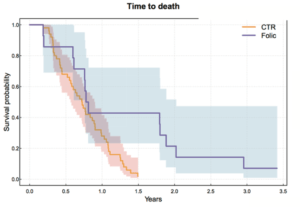
The purple jagged line extending out to the right represents 40% of patients who lived dramatically longer when treated with L-Methylfolate (LMF).
The abstract reports that “LMF-treated patients had median overall survival of 9.5 months [95% confidence interval (CI), 9.1–35.4] comparable with bevacizumab historical control 8.6 months (95% CI, 6.8–10.8).”
The increase in median survival time is just a few months and not statistically significant. But the average survival time of the folate-treated group was more than double, and the difference was statistically significant (by my calculation, not in the article).
But the average is what is more commonly reported, and most readers don’t understand the difference between average and median.
The longest surviving patient on the B vitamin was still alive at the end of the study (3.5 years) when every one of the patients treated only with traditional chemo was dead before 1.5 years.
There were three different dosages in the study, (30, 60, 90 mg) and it was not reported whether the longest-living patients were receiving the highest dosages.
This is, in fact, a hugely promising pilot study about treating a common, fatal cancer with a simple vitamin. If it were an expensive chemotherapy drug instead of a cheap vitamin, you can be sure it would have been hailed as a breakthrough.
But this study will not create much excitement, and few oncologists will even know to prescribe methylfolate for their glioma patients.
Example 2: ‘Preliminary Findings of mRNA Covid-19 Vaccine Safety in Pregnant Persons’
Earlier this year, MacLeod et al used data from a prominent Centers for Disease Control and Prevention (CDC) study to calculate that for women in their first trimester, the rate of miscarriage following administration of an mRNA COVID vaccine was an alarming 82%.
On Jan. 7, the CDC released a report designed to dispel our misgivings about vaccinating pregnant women. Its conclusions were unequivocal:
“These data support the safety of COVID-19 vaccination during pregnancy. CDC recommends COVID-19 vaccination for women who are pregnant, recently pregnant, who are trying to become pregnant now, or who might become pregnant in the future.”
The Defender reported on the numerous flaws in this study. The most egregious deficiency was the dearth of pregnant women in the study who were vaccinated early in their pregnancy (less than 2%).
The authors admit their study could not quantify the risk of vaccine exposure in the first trimester: “First trimester vaccinations are not included in analyses stratified by trimester because few exposures occurred…”
How then can they recommend COVID vaccination for women who are “recently pregnant” if their analyses excluded women in their first trimester?
This report serves a purpose. People who read it superficially will find the reported results reassuring — including front-line doctors who don’t have time to evaluate the research critically.
The CDC chose to paint over troubling safety concerns with reassuring words that are unsupported by clear science.
Example 3: ‘Public Health Scotland COVID-19 & Winter Statistical Report’
There is a section of this report comparing vaccinated and unvaccinated rates of disease, preceded by a warning to the reader not to take the data at face value.
“PLEASE READ BEFORE REVIEWING THE FOLLOWING TABLES AND FIGURES There is a large risk of misinterpretation of the data presented in this section due to the complexities of vaccination data …”
The data the authors don’t want us to misinterpret say that people who have been vaccinated with one shot or three shots are 50% more likely to contract COVID-19 compared to people who are unvaccinated.
People who receive two shots are more than twice as likely to contract COVID-19. This is according to the authors’ own method of calculating age-standardized disease rates.
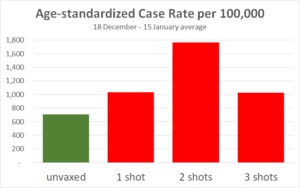
The authors emphasize it’s not about case numbers — it’s about severe outcomes, hospitalizations and deaths:
“Evidence suggests the COVID-19 vaccines are 90% effective at preventing a severe outcome of COVID-19. COVID-19 hospitalizations and deaths are strongly driven by older age, with most deaths occurring in those over 70 years old and having multiple other illnesses. But overall, you are less likely to be hospitalized if you are vaccinated with a booster.”
What data are they talking about? Here are results from their own data table:
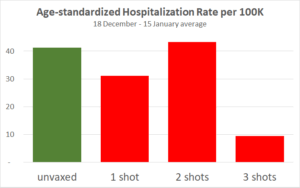
The only substantial reduction is from people who received the third shot, which has only recently been available in Scotland. But for the three-shot cohort only, vaccination effectiveness is declining over the four weeks.
This adds to previous evidence that protection from the vaccine is short-lived, and each injection provides a shorter window of protection than the previous one. Also, note the hospitalization statistics may have been gamed.
Since the publication of this article, England but not Scotland has backed off requirements for vaccination IDs.
Example 4: ‘Clinically Suspected Myocarditis Temporally Related to COVID-19 Vaccination in Adolescents and Young Adults’
Myocarditis, or inflammation of the heart, is a severe and life-shortening disease. It is virtually unknown in young people, but it is a recognized side effect of the COVID vaccines, especially in boys and young men.
This article summarizes the experience of 139 young patients (ages 12 to 20) who were hospitalized for myocarditis following vaccination.
19% of them were taken into intensive care.
Two required infusions of pressors and inotropes (potent intravenous drugs used to raise critically low blood pressure).
Every patient had an elevated Troponin I level. Troponin is an enzyme specific to cardiac myocytes. Levels above 0.4 ng/ml are strongly suggestive of heart damage. These young patients had a median Troponin I level of 8.12 ng/ml — over 20 times greater than the levels found in people suffering heart attacks.
“Conclusions: Most cases of suspected COVID-19 vaccine myocarditis occurring in persons <21 years have a mild clinical course with rapid resolution of symptoms.”
“Mild clinical course” — We suppose this refers to the 81% who did not go to the ICU or the fact that none died or required ECMO (Extracorporeal Membrane Oxygenation, a desperate means to keep the body oxygenated when a patient’s heart or lungs have completely failed).
In any case, every single person in this study was hospitalized. When does a “mild clinical course” require hospitalization for a two-day median length of stay?
“Rapid resolution of symptoms” — How would anyone know this? Myocarditis in older patients doubles the probability of death for the long term.
We don’t know what it will do to young boys in the long term, especially since every patient had some damage to their heart as evidenced by significantly abnormal troponin levels. And we don’t fully understand the mechanism by which the vaccines cause myocarditis.
Example 5: ‘Increases in COVID-19 are unrelated to levels of vaccination across 68 countries and 2947 counties in the United States’
This is the title of a paper by two statisticians from the Harvard School of Public Health, published on Sept. 30, 2021, in the European Journal of Epidemiology.
The title makes the important claim that there is no public health benefit from vaccination. COVID-19 is spreading at the same rate in different populations, unrelated to whether the population is mostly vaccinated or mostly unvaccinated.
It’s a powerful counterpoint to the ubiquitous demand that more people should undergo vaccination for the sake of their community.
The paper completely undermines the requirement of vaccination to attend meetings, concerts, theater and other public gatherings. It says there is no legitimacy to the creeping government vaccine mandates for travel.
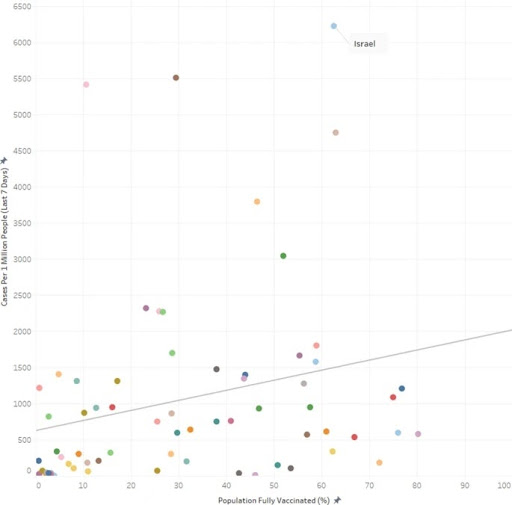
But the data in the paper don’t show that vaccination and spread of COVID-19 are “unrelated.” In fact, there is a paradoxical relationship, an insidious relationship: The more vaccinated countries had more new COVID-19 cases (during the week when the survey was conducted). The correlation is significant (p=0.04).
Still, the authors conclude by explicitly recommending propagandizing of the unvaccinated: “In summary, even as efforts should be made to encourage populations to get vaccinated it should be done so with humility and respect.”
It may sometimes be wrong to promote flawed health policy, but apparently, it’s a good thing, so long as it is done with humility and respect.
Why would these researchers take the trouble to publish data that is so damning to the vaccine narrative, and then pull punches in the title and in the conclusions?
Are we to assume that these authors who have assiduously extracted data from 68 different countries and nearly 3,000 U.S. counties were unable to notice their meticulous scatter plot unequivocally demonstrates high vaccination uptake is associated with higher (NOT lower) prevalence of COVID-19?
This seems to be a different case from the first example, where shills for the pharmaceutical industry set out to create a deceptive narrative. We think it’s probable that in this case, soft-pedaling the implications of these glaring data may not have been the authors’ choice, but rather a decision by the journal’s editors.
We know from personal experience how difficult it is to get an article through peer review at most “reputable” medical journals when the results are out of sync with the COVID narrative.
It may well be that these authors fought hard to get their subversive message into print, and in order to get past peer review, they softened the language, especially, the title.
Conclusions
The church was once the most trusted institution in Europe. Then the bishops started selling indulgences — a kind of get-out-of-hell-free pass for rich sinners.
Today the most trusted institution is science.

Sources: Gallup, Gallup, Gallup, Pew
This is true despite the fact that scientists are human, subject to error and to corruption.
Medical journals have become financially dependent on their advertisers, which are almost exclusively the pharmaceutical giants.
For several decades now, the “Church of Science” has been selling indulgences. With enough money, you could buy a scientific study that says what you want it to say.
Darell Huff’s book, “How to Lie with Statistics,” first published in 1954, remains the all-time best-seller in its field.
Recently, Gerald Posner documented the way in which the pharmaceutical industry has used its profits to affect science at every level, from medical researchers to journal editors to government regulatory agencies to the journalists who interpret science for the public.
Pressure is being placed on independent researchers by the journal editors and peer reviewers, many of whom have ties to Big Pharma. Valid studies, honestly reported, can be rejected for publication if they send a message that threatens corporate profits.
In the age of COVID, we see three reasons that an article’s conclusions might become detached from its statistical findings:
- Scientists have suddenly abandoned basic logic and reason. This is an implausible explanation because, as has been demonstrated above, these examples demonstrate diligence in gathering data. There is no reason why they would abandon diligence in arriving at reasonable conclusions.
- Shortcuts by pharmaceutical companies and their shills in academia. Rigging clinical trials the old-fashioned way is expensive and time-consuming. It’s also uncertain. Sometimes the truth rears its head even if a study is designed to conceal it. Even a study that is designed to fail might succeed when the inconvenient truths are sufficiently stubborn. How much easier it is to report the results and then tack on an abstract and a discussion section that say what you want to say, regardless of the data tables in the body of the article!
- Scientist authors are well aware of the pernicious censorship in scientific publication that has emerged in recent days. This is perhaps the most intriguing possibility. If researchers behind the study have some prestige and some influence, they still may find they have to soften their rhetoric in order to pass peer review. However, what we are witnessing today is more than a tendency to be “diplomatic” in their choice of words. What does it mean when their conclusions do not match the findings? Are they trying to tell us that they are gagged? Are they silently screaming at us to look at the data and not their interpretation of them?
The Nature Medicine article on the origins of the SARS-CoV-2 virus (reviewed first) seems to be an example of researcher corruption.
The article in the European Journal of Epidemiology (Example 5), which relates vaccination rates to COVID prevalence, is more likely an example of corruption by journal editors and peer reviewers.
In this instance, the data and conclusions are so disparate that it begs us to reconsider the cynical position that all scientists have been corrupted. Is there a better way for conscientious scientists to signal their community that they are being censored than by compiling solid data that tell a compelling story and then arriving at a nonsensical conclusion? Are they imploring us to read between the lines?
For the other four articles reviewed above, we leave it to your judgment — how do you think the conclusions came to be so disconnected from the statistical findings in these same articles?
Obviously, this blatant distortion of scientific write-ups is not a long-range strategy, but the world is moving fast, and people who count on their ability to shape scientific conclusions to their financial interests will be successful for long enough to do a great deal of mischief.
What will be the damage to the credibility of science when the dust clears?
Josh Mitteldorf, Ph.D., has a background in theoretical physics. Since the 1990s, he is best known for his contributions to the biology of aging, including many articles and two books.
Madhava Setty, M.D. is senior science editor for The Defender.
© 2022 Children’s Health Defense, Inc. This work is reproduced and distributed with the permission of Children’s Health Defense, Inc. Want to learn more from Children’s Health Defense? Sign up for free news and updates from Robert F. Kennedy, Jr. and the Children’s Health Defense. Your donation will help to support us in our efforts.
How Many Pregnant Women Have Actually Died of COVID-19?
The Daily Sceptic | February 3, 2022
There follows a guest post by a Daily Sceptic reader, who wishes to remain anonymous, who, being pregnant, was following closely the advice and studies concerning pregnant women. However, her own analysis of the reports on the deaths of pregnant women with COVID-19 suggested that the alarming statistics about Covid in pregnancy she was being provided with did not stack up.
As a pregnant woman, I have been following advice and studies that concern this group closely. Unfortunately, it is becoming increasingly difficult to find any balanced information amongst the blatant propaganda. I am so sick of being told at every turn that ICU is full of unvaccinated pregnant women. Below is an example of the stuff that gets shared online by my local maternity team.
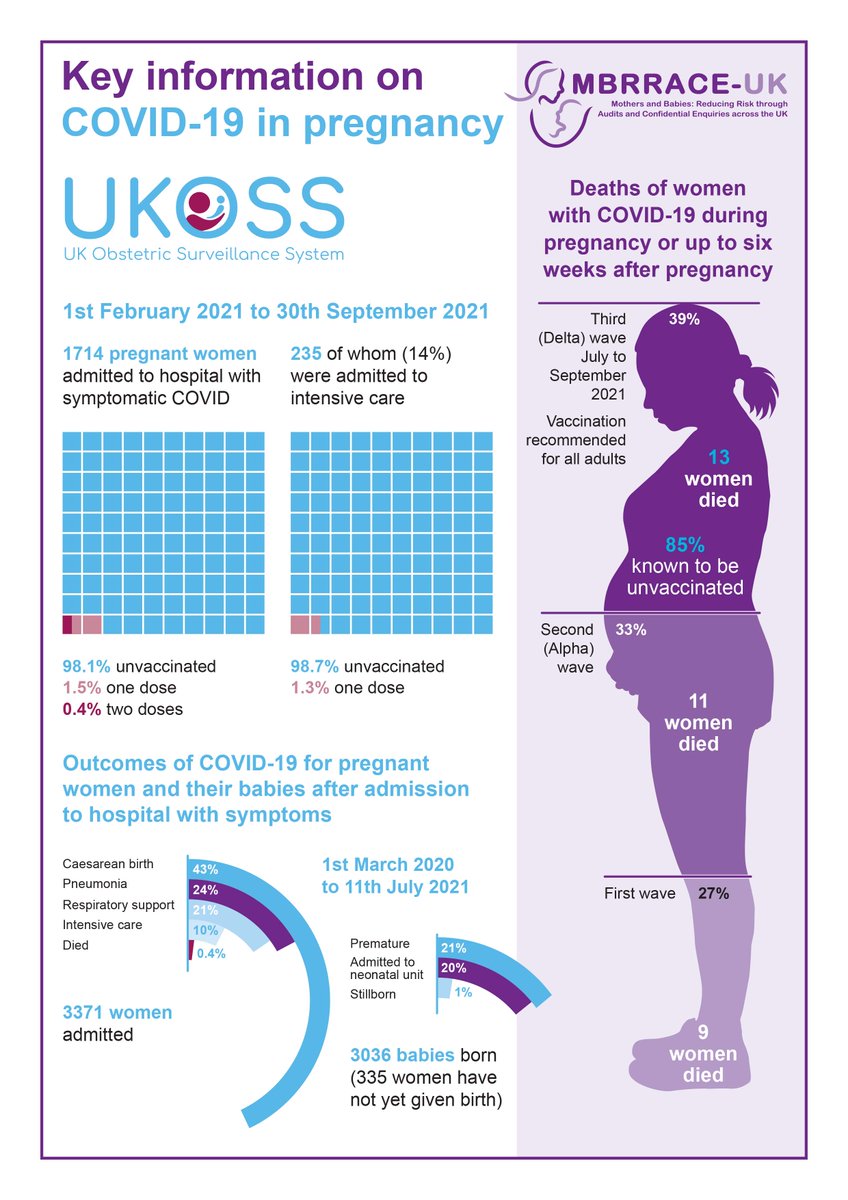
So I thought I would look at what stats MBRRACE had released lately. They have two reports that caught my eye in particular: one on maternal Covid deaths March-May 2020 (10 women) and another covering the period June 2020-March 2021 (17 women).
Despite being such a small group of people, I feel that each case is a fascinating story that paints a dramatically different picture to that portrayed by the media and the NHS. Here are some points that stood out to me from each report
March-May 2020 (10 deaths)
- None of the women who died received any actual treatment, just support.
- Three of the ten women died because they were too scared to go to hospital.
- Four women died of suicide and not being able to access help was a factor (I don’t think they were included in the ten deaths, but the insinuation is that Covid restrictions contributed to their deaths).
- Two women were murdered by their partners, with health services already knowing they were at risk (again, I don’t think they were included in the ten, but the insinuation about restrictions is there again).
- The quote “pregnancy [sic] and postpartum women do not appear to be at higher risk of severe COVID-19 than non-pregnant women” seems telling.
- Only two women were classified as having received “good care”.
June 2020-March 2021 (17 deaths)
- Three women did not even have Covid but died as a result of the side effects of restrictions.
- Four women tested positive but died of unrelated causes – two of these women received poor care because of their Covid status.
- 60% of the women who actually died from Covid were obese and a further 20% were overweight.
- 50% had pre-existing mental health conditions (personally I believe that this both prevents women from being able to speak up for themselves and creates a stigma that they are ‘difficult patients’).
- One woman died at home of a urinary tract infection because no translator was available for her telephone appointment.
- Four women died because they were too scared to go to hospital – one of these women sought no antenatal care at all and died after giving birth at home.
- One woman died after being given painkillers for backache – she was only seen remotely by a GP so he or she couldn’t see she was both heavily pregnant and had sepsis.
- Another woman died of sepsis from a miscarriage because doctors assumed she just had (asymptomatic) Covid.
- A woman died of obvious kidney/liver problems shortly after birth because again, doctors bizarrely assumed she was actually suffering from Covid following a positive routine test.
- 90% of the women who died had “care” that was not managed by the RCOG guidelines.
- One woman was not given treatment despite poor clinical indications, as she did not “look sick”.
- Three women who were very poorly and were considered for ECMO were denied this despite not having any contraindications.
- One woman died from a pulmonary embolism at home after her GP’s online triage system did not recognise either her Covid status or recent pregnancy as risk factors and didn’t give her an urgent appointment.
- Only 10% of the women received “good care”, and in 70% improvements in care may have meant they survived.
The reports are heartbreaking and I do not wish to diminish the pain that these women’s families must be suffering, but it is abundantly clear that very few of these women died from actual Covid – many appear to be victims of the restrictions and fear – and the handful that did had significant confounding factors.
We need an inquiry into nudge
Letter to PACAC about ethical concerns arising from the Government’s use of covert psychological ‘nudges’
By Laura Dodsworth | February 1, 2022
Mr William Wragg, MP, Chair of the Public Administration and Constitutional Affairs Committee
1st February 2022
Dear Mr Wragg,
Re: Ethical concerns arising from the Government’s use of covert psychological ‘nudges’.
Thank you for meeting me to allow me to explain my concerns about the government’s use of behavioural science during the Covid-19 pandemic and beyond. I noted your positive comments about the need to better understand how nudge sits within parliamentary democracy and ministerial accountability, in a Telegraph article dated 28th January 2022, entitled ‘Government nudge unit “used grossly unethical tactics to scare public into Covid compliance”’, which was written in response to a letter by psychologist Gary Sidley et al requesting an investigation.1 I concur with Gary’s letter wholeheartedly.
During the course of researching my book A State of Fear: how the UK government weaponised fear during the Covid-19 pandemic I gained a fascinating but sometimes disturbing insight into how reliant the government is on behavioural science and how little transparency there is about the people, methods, impacts and ethics.2
Behavioural scientists and politicians have called for public consultation in the past, but it has not happened. The Science and Technology Select Committee’s 2011 report Behaviour Change noted that there are ‘ethical issues because they involve altering behaviour through mechanisms of which people are not obviously aware’ and ‘ethical acceptability depends to a large extent on an intervention’s proportionality’.3 David Halpern, the head of the Behavioural Insights Team (BIT), has said that ‘if national or local governments are to use these approaches [behavioural psychology tools], they need to ensure that they have public permission to do so – ie, that the nudge is transparent, and that there has been appropriate debate about it’.4
The MINDSPACE: Influencing behaviour through public policy discussion document which David Halpern co-authored recommended a public consultation about the use of behavioural insights.5 This has never been more pertinent. Fear messaging was used to encourage compliance with the rules. This has changed our lives and our relationships with each other. It has also changed our relationship with the government. This was predicted in the same report, which warned:
‘People have a strong instinct for reciprocity that informs their relationship with government – they pay taxes and the government provides services in return. This transactional model remains intact if government legislates and provides advice to inform behaviour. But if government is seen as using powerful, pre-conscious effects to subtly change behaviour, people may feel the relationship has changed: now the state is affecting “them” – their very personality.’
Our personalities were changed 2020-2021. And the use of fear – a particularly destabilising tactic – has made recovery harder. The collateral damage is becoming clearer, not least with the identification of Covid Anxiety Syndrome, whereby people have heightened fears which are disproportionate to the remaining threat.6 While it is difficult to extricate the different causes – lockdown, the epidemic itself, government messaging, the media – the overall result merits close scrutiny.
One of the BIT founders, Simon Ruda, admitted in an article published in Unherd, that ‘the most egregious and far-reaching mistake made in responding to the pandemic has been the level of fear willingly conveyed on the public’.7 It’s a pity that this revelation was made so late in the pandemic management. (After the sale of BIT to NESTA for a ‘healthy capital gain’, as Ruda observes, for the BIT shareholders.) If the previous calls for public consultation on the use of nudge had happened years ago, then maybe this egregious mistake could have been avoided. But it is never too late.
I believe the UK needs a full analysis of the tactics used and their impacts from experts, including psychologists, behavioural scientists, mental health specialists, politicians, political scientists, sociologists, philosophers, civil liberties organisations, lawyers, as well as representatives of the public.
Furthermore, the harmful impacts of behavioural science go beyond the handling of the Covid epidemic. The impact of behavioural insights on mental health was reported in Loan Charge All-Party Parliamentary Group Report on the Morse Review into the Loan Charge March 2020.8 It concluded that independent assessment and a suspension of HMRC’s use of behavioural insights was needed, ‘in light of the ongoing suicide risk to those impacted by the Loan Charge’. Clear misconduct and bullying, including using 30 behavioural insights in communications, were cited in one of the seven known suicides of people facing the Loan Charge.
The collaboration between a major UK broadcaster and BIT to promote one of the most controversial policies today is deeply alarming. The report, The Power of TV: Nudging Viewers to Decarbonise their Lifestyles, jointly published by BIT and Sky, shows little regard for the obligation imposed on broadcasters by Ofcom’s Broadcasting Code to maintain ‘due impartiality’ across all their output, particularly when it comes to news and current affairs.9 It also neglects the requirement that broadcasters expose viewers to a wide range of different views when it comes to ‘matters of major political and industrial controversy and major matters relating to current public policy’. I wrote a letter of complaint to Ofcom with Toby Young, Founder of the Free Speech Union, on 21st December 2021.
Recently, the Home Office has hired an advertising agency to mobilise public opinion against encrypted communications, with plans that include some shockingly manipulative tactics to sway concerned parents.10
In the past two years I have noted new behavioural science appointments within the government, Public Health England (now UKHSA) and NHS, and nudge seems likely to play a bigger part in future government attempts to transform us into ‘model citizens’ and foreground acceptance of controversial policies. Indeed, this is openly acknowledged. One recent report from a team at the University of Bath already shows how behavioural psychologists hope to segue from Covid to climate behaviour change while ‘habits are weakest and most malleable to change’.11 A BIT paper on how to nudge the public towards Net Zero referred to our ‘powerful tendency to conform’.12
I agree with Gary Sidley that the government must be held to account over its use of behavioural science. The Covid epidemic has shone a spotlight onto how embedded behavioural science is within government, but the inquiry would benefit from widening the scope to a historical review and also agree new frameworks for the future. This should include a historical analysis of all campaigns (especially the many unpublished ones), a review of the ethical framework government behavioural scientists adhere to, and scrutiny of accountability. Most importantly, a review must include the general public, who are as yet unaware of the prolific campaigns to influence them below the level of consciousness, but nevertheless fund the campaigns through taxation.
Nudge assumes we are not rational beings. Ruda does not shy away from this in his article, clearly stating that ‘behavioural science was conceived as a means of recognising and correcting the biases that lead humans to make non-rational decisions’. Stripping away our rational choices and influencing us at a subliminal level is anti-democratic and we are now at a crucial point to take stock of the government’s use of these tactics. I hope that PACAC can conduct a comprehensive and independent investigation. I would be delighted to assist by sharing notes and evidence.
I look forward to speaking with you.
Yours sincerely,
Laura Dodsworth
Biden’s ridiculous free N95 mask offer
Nobody in the medical community is speaking out about how ludicrous this is. So I will.

Traditional ritual mask wearing
By Steve Kirsch | January 31, 2022
The Biden administration is giving out 400 million free N95 masks.
Here’s what they aren’t telling you:
- An N95 respirator will “work” for around 2 hours in a hospital or similar setting with filtered air
- An N95 respirator will “work” for around 30 min outdoors
So if 200M Americans receive two respirators each, they get around 4 hours of protection. And that only works if the respirators are fitted perfectly with no gaps and people are trained on their use. And as we noted before, even if everything was perfect, you aren’t likely to get anywhere close to 95% reduction in virions (because of the size of the particles and the rate of airflow into the respirator), and even with such a reduction, that’s unlikely to make the difference between getting infected and not getting infected.
In general, N95’s are ineffective with respect to protection against viral spread. Randomized studies show cloth and surgical masks do nothing. Zero.
Not surprising at all. If you read the WHO 2004 “Laboratory Biosafety Manual” (Third Edition) it says, “Surgical type masks are designed solely for patient protection and do not provide respiratory protection to workers.”
So it’s not like we haven’t figured that one out 15 years before COVID. It says surgical masks do not work. Period.
Yet, here we are 18 years later and the CDC and medical community are still pretty clueless.
Consider this quote from highly respected UCSF infectious disease Professor Monica Gandhi in a story about the Bangladesh mask study (which, despite the headlines, proved that masks don’t work at all as I’ve pointed out before):
The study results prompted Monica Gandhi, an infectious-disease physician at the University of California, San Francisco, to switch from cloth masks. “I bought surgical masks for myself — pink ones,” she says.
See? You cannot make this stuff up. It is unbelievable how uninformed the doctors are. Professor Gandhi uses protection that even the WHO says does nothing (and so did that Bangladesh mask study).
And you are taking advice from her?!?!
Check out how much better N95’s are compared to surgical masks:

That’s right. Anyone with a working brain can see N95 masks are not effective at all. There is no measurable difference!
Featured Video

Broke Princes: Saudi Arabia’s Powder Keg
or go to
Aletho News Archives – Video-Images
From the Archives
Registered Israeli foreign agent driving contrived campus antisemitism crisis
By Wyatt Reed | The Grayzone | December 17, 2023
Lawsuits accusing top US universities of harboring antisemitism all originate from one source: a corporate law firm that fielded the pro-settler ex-US ambassador to Israel, and which was registered as a foreign agent of an Israeli principal as recently as 2021.
The firm now represents professional Israel lobby activists posing as victimized “Jewish students” and seeking to crush the free speech rights of Palestine solidarity activists. … continue
Blog Roll
 Aletho News
- How Iran defeated Trump’s Israel First GOP
- De-escalating the conflict: What the OSCE, the UN, and Europe are (not) doing to prevent war
- Desperate For A Renewed Iran War, Israel Dusts Off The WMD Deception.
- US Elections Offer Choice Between ‘Bad and Worse’ as Both Parties Serve War Lobby – ex-UN Expert
- Ghalibaf warns US government not to betray voters who rejected war
- Broke Princes: Saudi Arabia’s Powder Keg
- Albania’s Crisis: Rama, Israeli Investments and the Demand for Accountability
- Hezbollah Categorically Denies Syrian Accusations: We Aim at Confronting Israeli Enemy, Not Undermining Syria’s Stability
- Trump claims funding to Israel ending in 2026 as merger of Israeli–US armies looms
- Iran Weathering The Storm, But Saudi Arabia Is Sinking
- If Americans Knew
- An error has occurred; the feed is probably down. Try again later.
- No Tricks Zone
- New Study: The Net Fossil Fuel Contribution To Rising Atmospheric CO2 Has Been Zero For 500 Years
- Germany’s Green Energy Transition Becoming Increasingly Expensive…Another 6 Trillion Euros!
- Sudden Stratospheric Warming, Powerful El Niño Combination May Lead To Extreme Europe Cold, Energy Crisis!
- Two New Studies Find Thwaites Glacier Melt Cannot Be Driven By Human Activity Or A Warming Ocean
- E-Cars Reduce CO2 Emissions By Only 41% Compared To Internal Combustion Engine Vehicles
- Predictions Made By Renowned Climate Professor Over Past Decades Have Been Proven To Be Poor
- New Study Suggests Large Regions Of The Pacific Ocean Have Been Cooling For The Last 80 Years
- Germany’s Green Energy Debacle: High Energy Costs Force Kahla Porzellan to Close After 182 Years!
- New Study: 50 Years Of The Most Aggressive ‘Net Zero’ Policies Can Only Affect The Global Climate By 0.03°C
- US September “Heat” Was No Record…Many Records Set Decades Ago

